
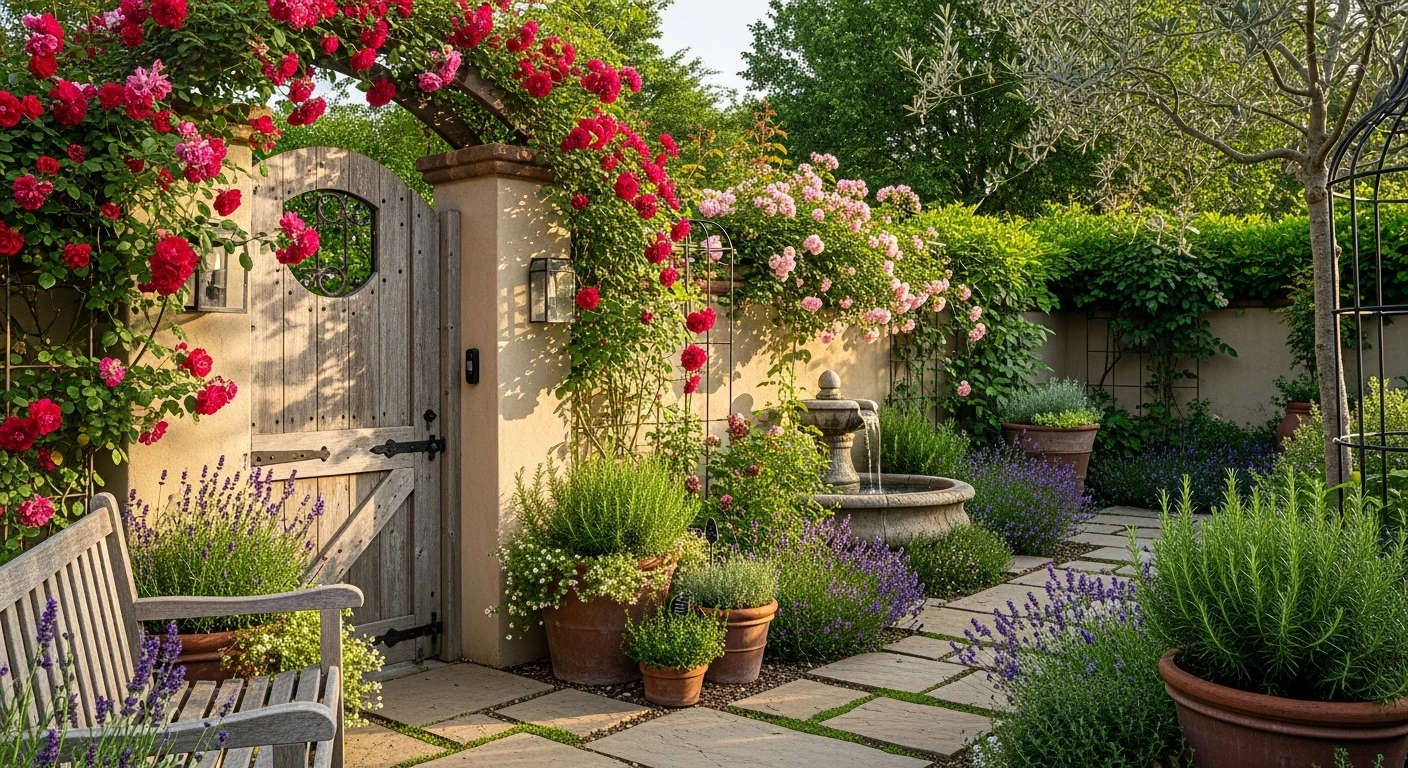
Your front door is currently doing nothing for you. It sits there, painted whatever color the previous owners chose in 2009, flanked by two patches of struggling lawn and maybe a pot of something that blooms for three weeks a year and spends the remaining forty-nine looking defeated. Guests walk up to it. They ring the bell. Nobody stops to appreciate anything because there is nothing to appreciate.
The cruel irony is that your front entry is the one part of your home that everyone sees—every neighbor, every delivery driver, every person you’ve ever invited over—and it gets the least design attention of anything you own. The interior gets obsessed over. The backyard gets a whole renovation. The front entry gets a doormat from a discount bin and the slow death of whatever shrub came with the house.
An entryway garden isn’t about showing off to the neighbors, though that’s a perfectly valid side effect. It’s about creating a transition—a moment between the street and your front door that tells people something is happening here, that someone made decisions, that arriving at this house is an experience rather than just a logistical endpoint. The best ones make the journey from gate to door feel intentional, layered, and genuinely worth taking slowly.
These six ideas run the full range from maximalist chaos to quiet architectural drama, and every single one of them will make your front door worth the walk.
Your Front Entry Has a Perception Problem
Before diving into what makes these gardens work, it’s worth understanding why most front entries fail so consistently—because the problems are always the same and they’re almost always fixable.
Symmetry is the enemy of interest — Two matching shrubs flanking a door is a landscaping decision made on autopilot. It’s the visual equivalent of a firm handshake from someone you’ll forget immediately. Interesting entry gardens break symmetry deliberately, using it selectively rather than reflexively.
Plants chosen for survival rather than impact — Most front yard planting decisions come down to “what won’t die here” rather than “what will make this space extraordinary.” Hardiness and drama are not mutually exclusive, and choosing only for the former produces gardens that technically succeed and aesthetically fail.
The journey to the door is an afterthought — A straight concrete path from sidewalk to entrance is function without experience. The approach to your front door is a design opportunity that most people spend zero time thinking about, which is why most front entries feel like you’re walking to a utility entrance rather than arriving somewhere.
What the Good Ones Have in Common
The entryway gardens worth stealing from aren’t successful by accident. There are consistent principles at work, even across wildly different styles.
They commit to a mood — Whether it’s lush and romantic or architectural and minimal, the gardens that work have picked a direction and followed it all the way through. The ones that don’t work are trying to be a bit of everything and ending up as nothing in particular.
Layers create depth — Height variation, texture variation, and seasonal variation together create gardens that look interesting from multiple angles and at multiple times of year. Flat planting at a single height, however dense, reads as a hedge rather than a garden.
The door earns its role as the focal point — Everything in a well-designed entry garden is working to frame, lead toward, or create contrast with the front door. The door is the destination; the garden is the journey that makes arriving there feel like an event.
Entryway Garden Ideas Worth Stealing
The Potted Jungle That Said Rules Are Suggestions
Entryway
by u/kiddoben in gardening
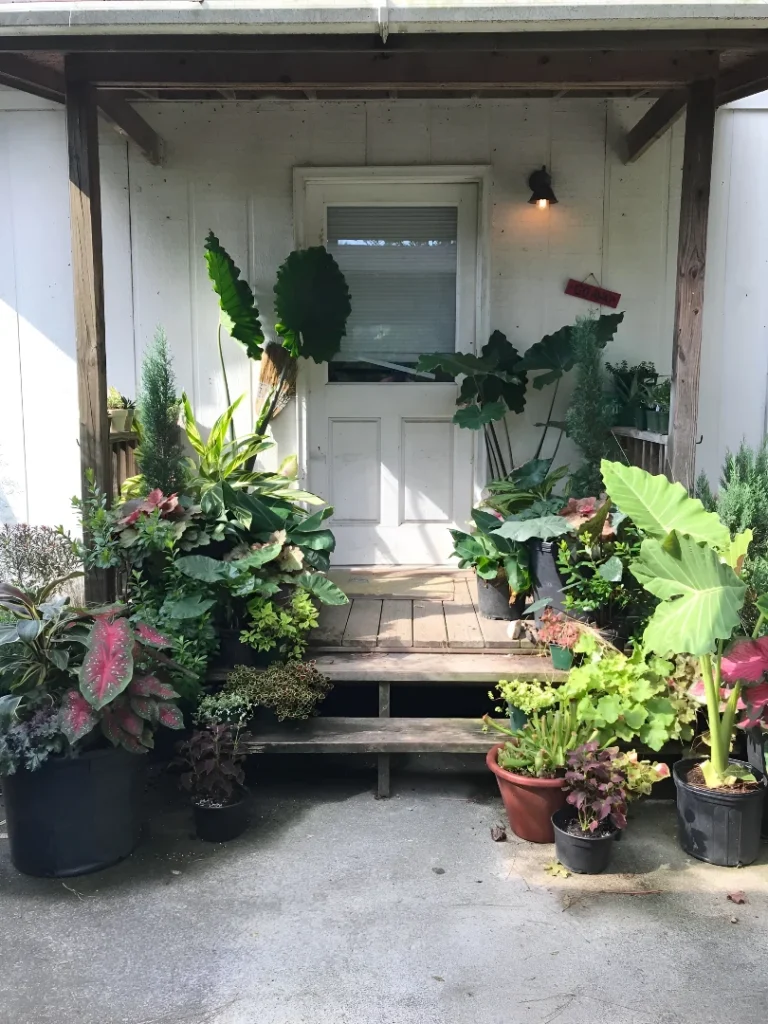
Most people put one pot by the front door. Maybe two, if they’re feeling extravagant. This setup looked at that approach and raised it by approximately twenty plants, and the result is an entry that feels less like a house and more like stumbling onto a very well-curated nursery. Elephant ears with their enormous paddle leaves create the canopy layer, caladiums in pink and green bring color at mid-height, a conifer adds vertical structure, and trailing groundcovers fill every gap between pots at ground level. The weathered wood porch and white clapboard behind it provide exactly the neutral backdrop this much plant life needs—any competing architectural detail would make it chaotic rather than lush. The key to why this works rather than just looking crowded is the container variety: black nursery pots, terracotta, woven baskets, each adding its own texture to the composition. If you’re going to do this, the only rule is that you cannot stop at “enough.” Enough is not the goal here.
The Cottage Porch That Wisteria Built
This is the entryway garden that people photograph from the street without asking permission, and honestly it’s earned. Wisteria cascading from a timber pergola overhead, climbing roses weaving up every post, tulips and daffodils crowding the steps in color combinations that have no business looking this coordinated, and a birdbath tucked into the corner like it grew there—the whole thing operates on the principle that more is more and then more again after that. A porch swing behind the railing with a plaid cushion suggests this is a place where people actually sit, which makes the garden feel inhabited rather than performative. The aged grey timber of the porch structure is doing crucial work: it provides a tonal anchor so all that flower color stays legible rather than becoming a blur. This look requires patience—wisteria and climbing roses both take years to establish this kind of presence—which means anyone who has it earned it the slow way and probably isn’t impressed by anything that happened overnight.
The Rose Arch That Creates a Room Before You Even Get Inside
The inspired decision here isn’t the roses or the arch individually—it’s using the arch as a threshold that divides the approach into two distinct zones, turning what would have been a flat patio into something with genuine spatial depth. A cedar arch draped in climbing roses and clematis in peach, pink, and purple frames the view of a seating area beyond it, creating the experience of entering a room before you’ve entered the house. Trellis panels flanking the arch are covered in their own climbers, raised timber planters hold hydrangeas and lavender at the base, and string lights run between the structure to make the whole thing glow after dark. The striped awning visible beyond the arch adds the one graphic element that stops this from becoming purely romantic and grounds it in something with a slightly more structured sensibility. The watering can left casually on the path is either a styling detail or someone genuinely forgot it there—either way, it belongs.
Tropical Front Yard Landscaping That Refuses to Be Ignored
The house behind this garden is handsome in the way that well-maintained traditional homes are handsome—brick, arched entry, solid and established. The garden in front of it is doing something considerably more interesting than the architecture, which is either bold or backwards depending on your perspective and is absolutely correct. Queen palms rise to significant height in the center, fan palms spread wide at mid-level, black elephant ear plants provide dramatic dark foliage contrast against all the green, and low colocasia fills the ground layer with broad tropical leaves. The mature live oak growing through the middle of it all is the detail that no landscape designer could have planned—it just happened over decades, and the planting around it has learned to work with the structure rather than against it. The front door gets a wreath and seasonal potted mums as its small acknowledgment of conventional decorating instincts, which is almost charmingly restrained given everything else happening in the yard.
The Living Tunnel That Makes Arriving Feel Like an Event
Arriving at a front door through a tunnel of trained trees is the kind of thing you do when you’ve decided that a clear path and a visible door is for people with no imagination. Pleached trees—trained on metal frames over years until their canopies arch and merge overhead—create a green vault above a simple brick path, filtering light into something dappled and constantly moving. Feather grass lines the path on both sides, soft enough to brush against if you walk close to the edges. The weathered timber double door at the end of it is massive, aged, and exactly right: it has the presence needed to justify being the destination of this much horticultural theatrics. This is not a low-maintenance front garden. It is the opposite of a low-maintenance front garden. But the experience it creates—that specific sensation of moving through something alive toward something solid—is worth every hour of work it demands.
Stone Walls, a Painted Lavender Door, and Flowers on Every Available Surface
This entry operates on a different definition of restraint than most of these gardens—namely, there is none, and the results are magnificent. Limestone block walls with hand-painted floral motifs climbing across them set the tone immediately: this is a space where someone had strong opinions and acted on all of them. A lavender double door with leaded glass panels and carved detailing is the centerpiece, pulling in the painted flowers from the walls and concentrating the whole color story at the entry point. Geraniums in hand-painted ceramic pots line both sides of the approach, a climbing rose makes its way up one side of the door frame, and a mosaic tile mat finishes the floor. A glass roof panel above floods the whole corridor with light that makes every painted surface glow warm yellow in the afternoon. The interior glimpsed through the open door—amber walls, another mirror, more flowers—suggests the commitment to this level of detail continues well past the threshold, which is exactly the promise a front entry like this should make.
Master the Linear Luxe: Moss and Limestone For People Who Hate Boring
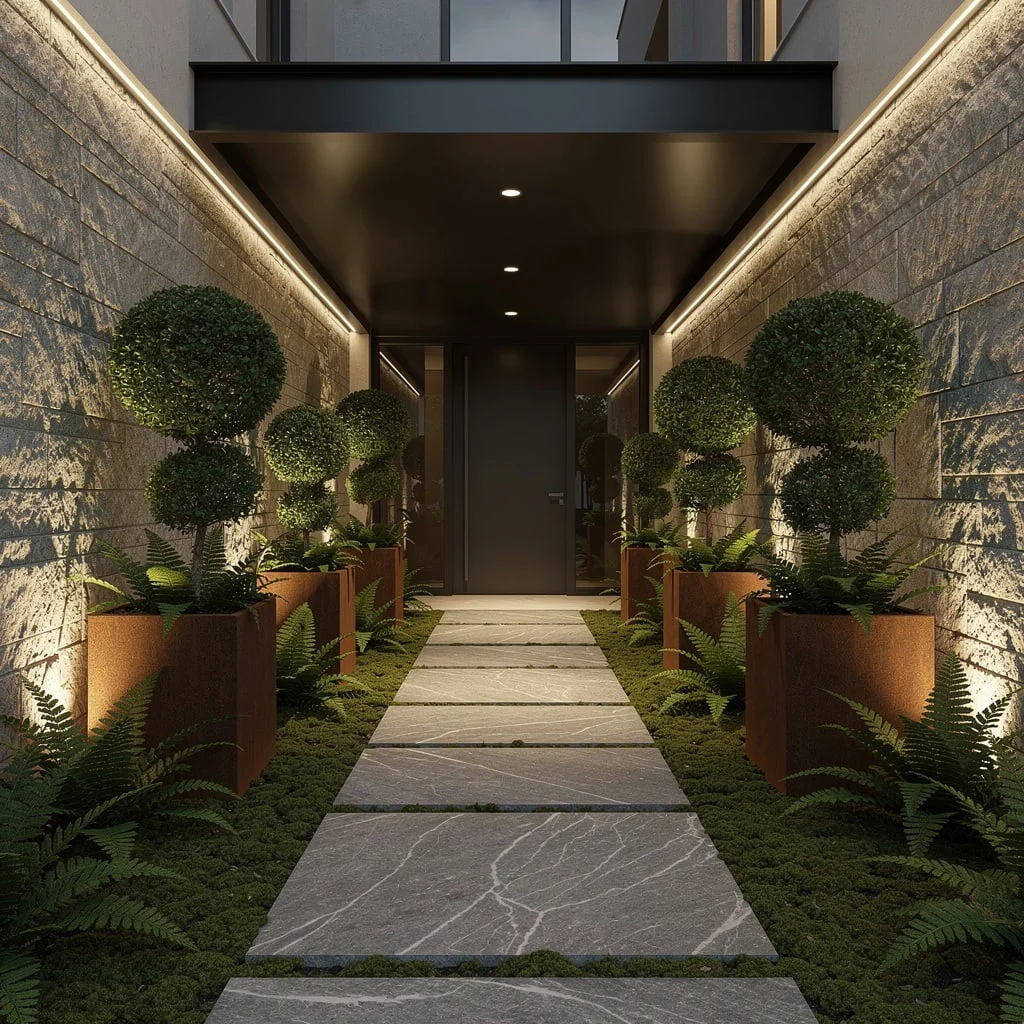
If you crave sophistication with a side of drama, build your entryway from wide, flamed limestone pavers set in lush moss—because plain concrete sidewalks are for quitters. Set up staggered corten steel planters stuffed with sculptural boxwood topiaries and ferns, then slap on a custom cantilevered matte black steel canopy with recessed uplighting for those ‘I paid for an architectural lighting plan’ shadows. Throw in textured stone walls and indirect LEDs grazing them. Don’t forget: every garden needs structure, so keep your planter spacing irregular for max impact. Never—ever—match those topiaries in a row unless you enjoy visual snooze-fests.
Glass and Basalt: Welcome to Your Curated Courtyard
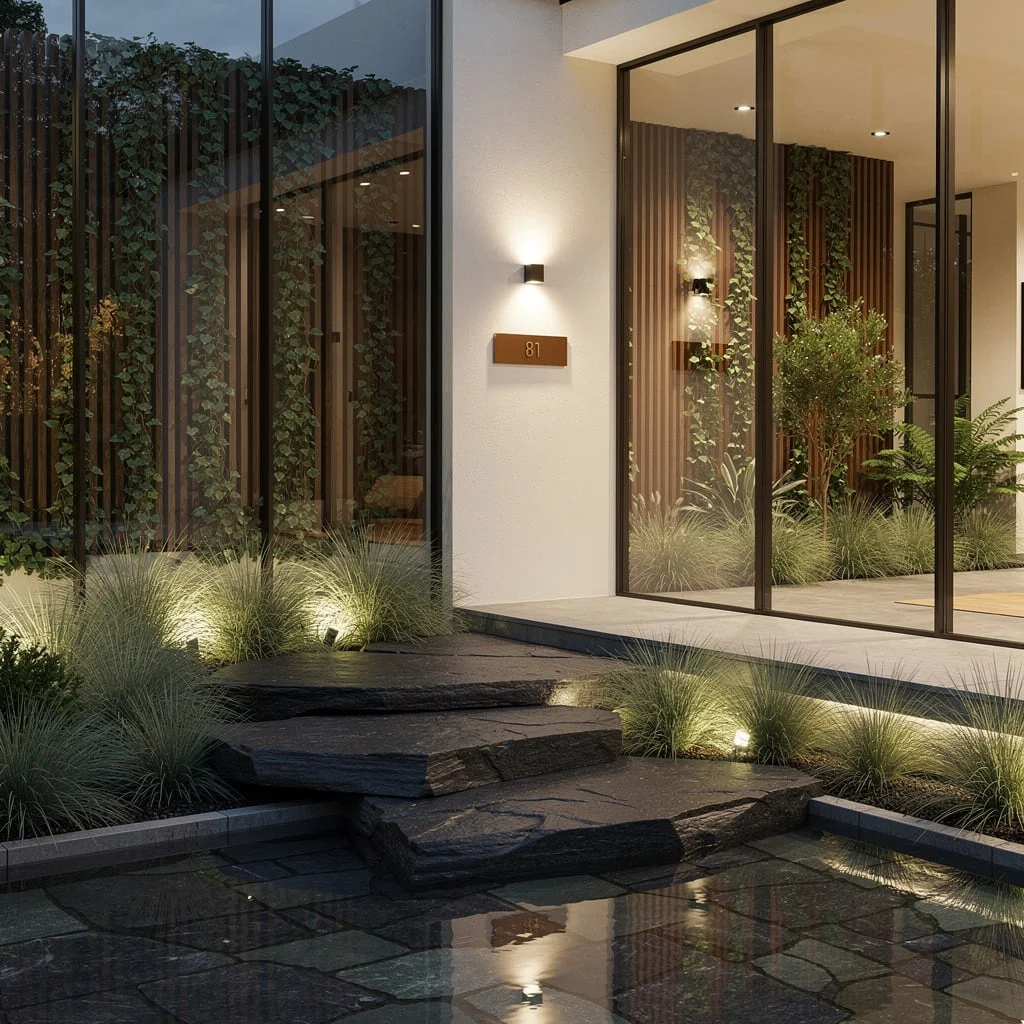
Want an entryway that screams ‘I’m rich but don’t want to brag’? Frame your garden with floor-to-ceiling glass panels for ultimate voyeur vibes, install asymmetrical basalt steps over a shallow water pool, then wrap the perimeter in vertical mahogany slat fencing, tangled with ivy and a mess of soft grasses you can’t kill. For nighttime flexing, hit your planting with wash lighting, and dress the entry wall in creamy white stucco with a single illuminated bronze address plaque—because nobody needs five numbers. Pro tip: Always play with contrast—keep your glass wide and your planting compact for next-level ‘see but don’t touch’ energy.
Belgian Bluestone Entry: Stop Using Cheap Tiles, Seriously
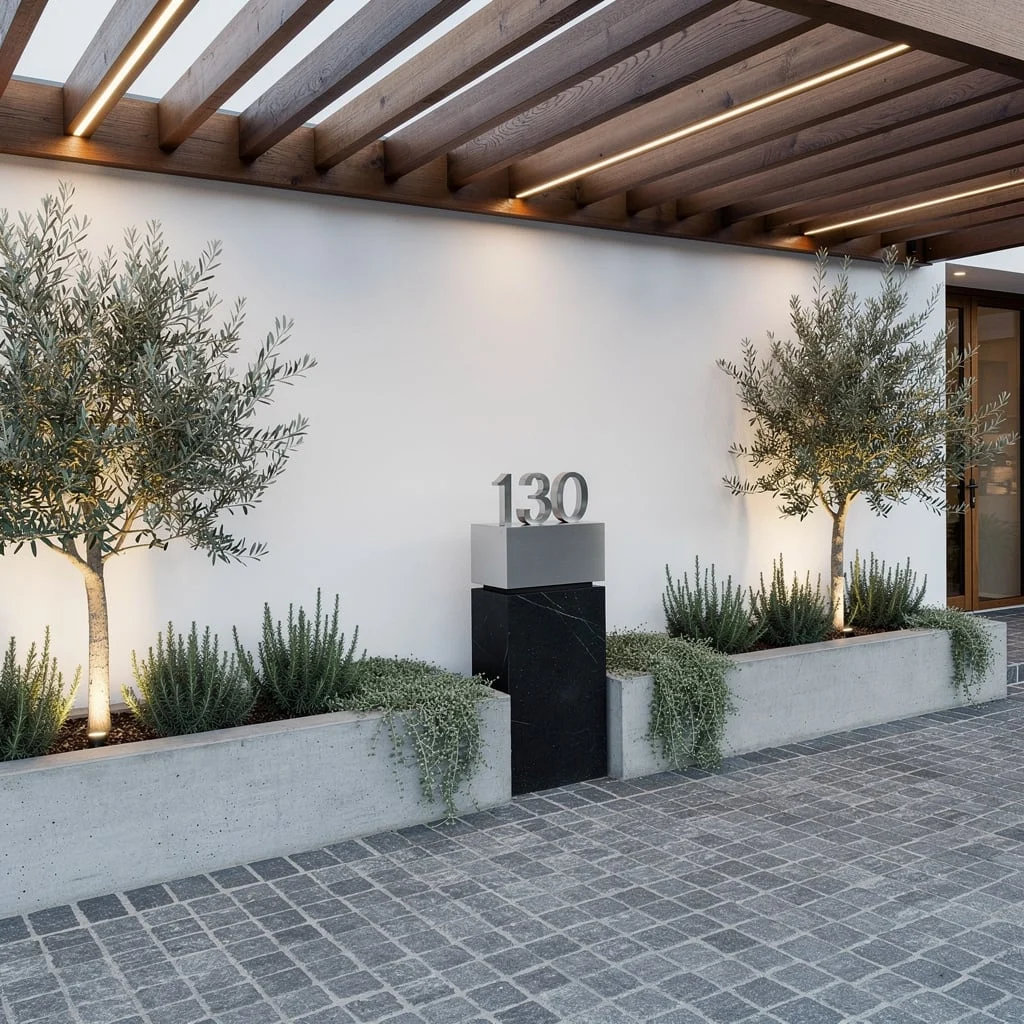
If you’re done with ‘builder-basic’ pavement, pave your entry with hand-cut Belgian bluestone. Border it with raised concrete planters and fill them with silver-leafed olive trees and rosemary—because rosemary does triple duty (looks, smell, survives neglect). Install a hardwood trellis overhead with integrated lighting to create shadow play that’ll make your house look expensive without actually being expensive. Mount brushed stainless steel numbers on a minimalist black stone base, and uplight everything for dramatic effect. Pro tip: Don’t be the person who plantifies only the corners—run your greenery right to the edges and let it spill over.
The Sunken Zen Entry: Float Your Stairs, Level Up Your Luxury
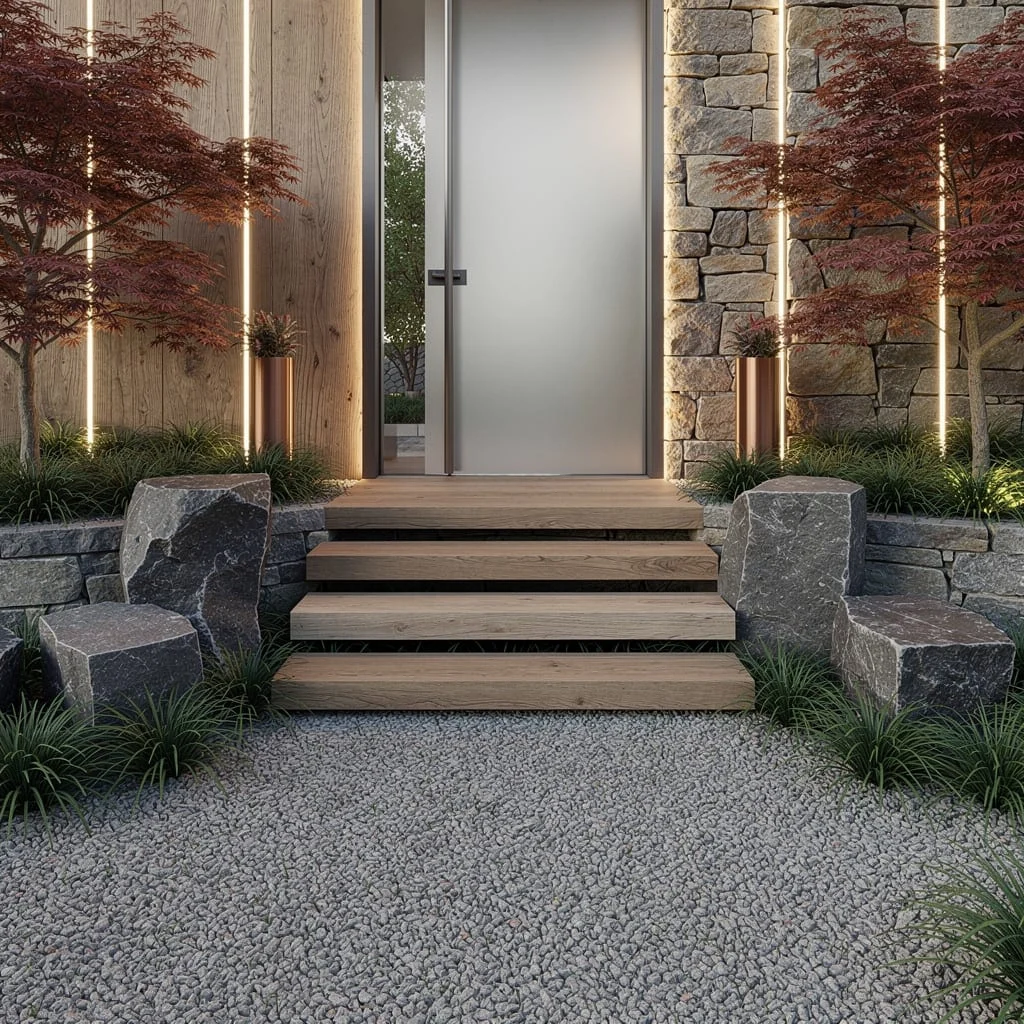
Feeling extra? Dig a sunken vestibule, access it via floating cedar steps (yes, floating—go big or stay cramped), and surround with gravel and Japanese maples. Add chunky basalt boulders because nothing says ‘this is art, not furniture’ like rocks you can sit on. Highlight your stone retaining wall with vertical strip lighting, drop slender copper planters for extra attitude, and finish off with a frosted pivot door for privacy without blocking your precious garden glimpse. Pro tip: Always conceal some lighting—nothing ruins the mood like visible LED strips unless your design strategy is ‘cheap restaurant patio.’
Living Wall Power: Ferns, Travertine, and Why You Need Pendants
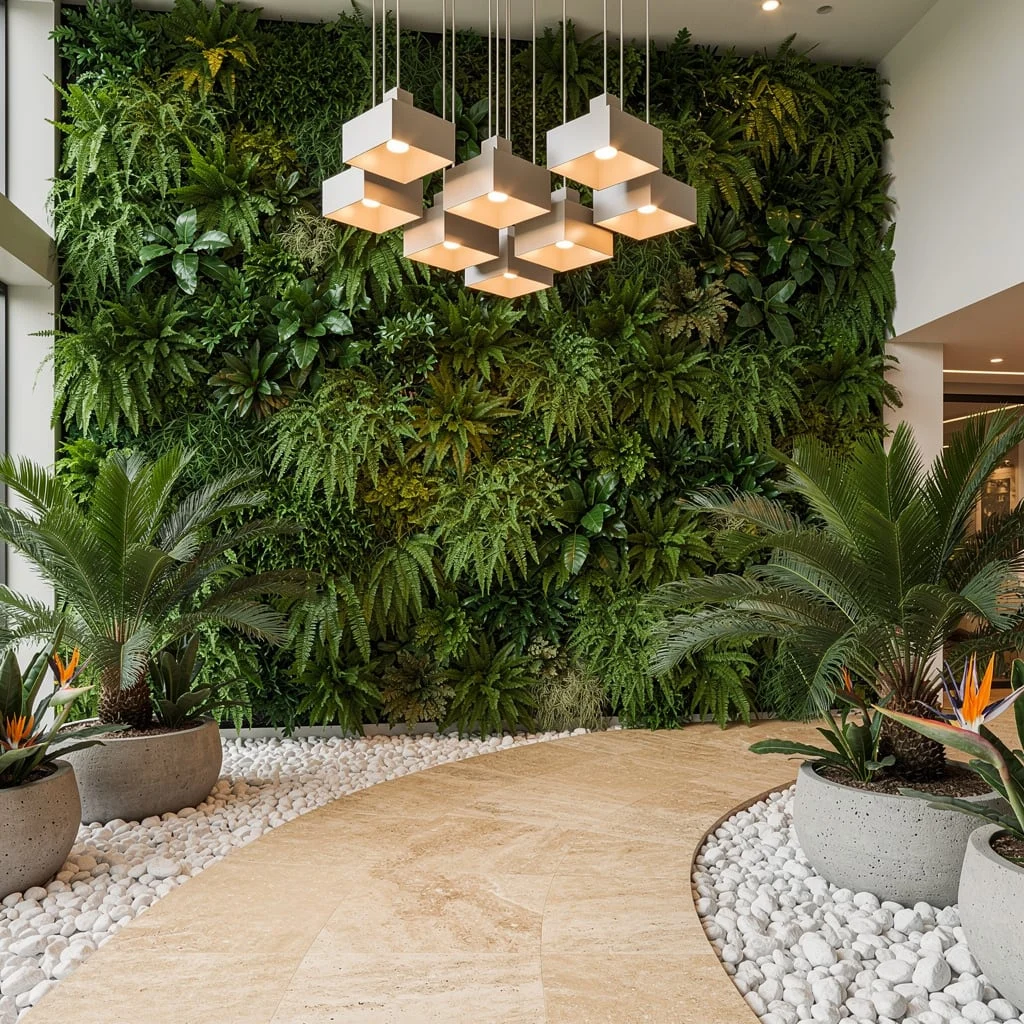
If you want guests to gasp before they even ring the bell, build a living wall stacked with ferns—do not cheap out on variety. Run a curving travertine path under a cluster of geometric powder-coated metal pendants for a lighting statement. Border your pathway in white river stones and concrete planters loaded with cycads and bird of paradise for maximum tropical punch. If you don’t want your entry to look like a greenhouse accident, group plants by height and texture. Pro tip: Pendants go high, river stones stay low—never let the lighting fight with your planting.
Terrazzo and Dogwoods: Minimalist but Not Boring, Promise
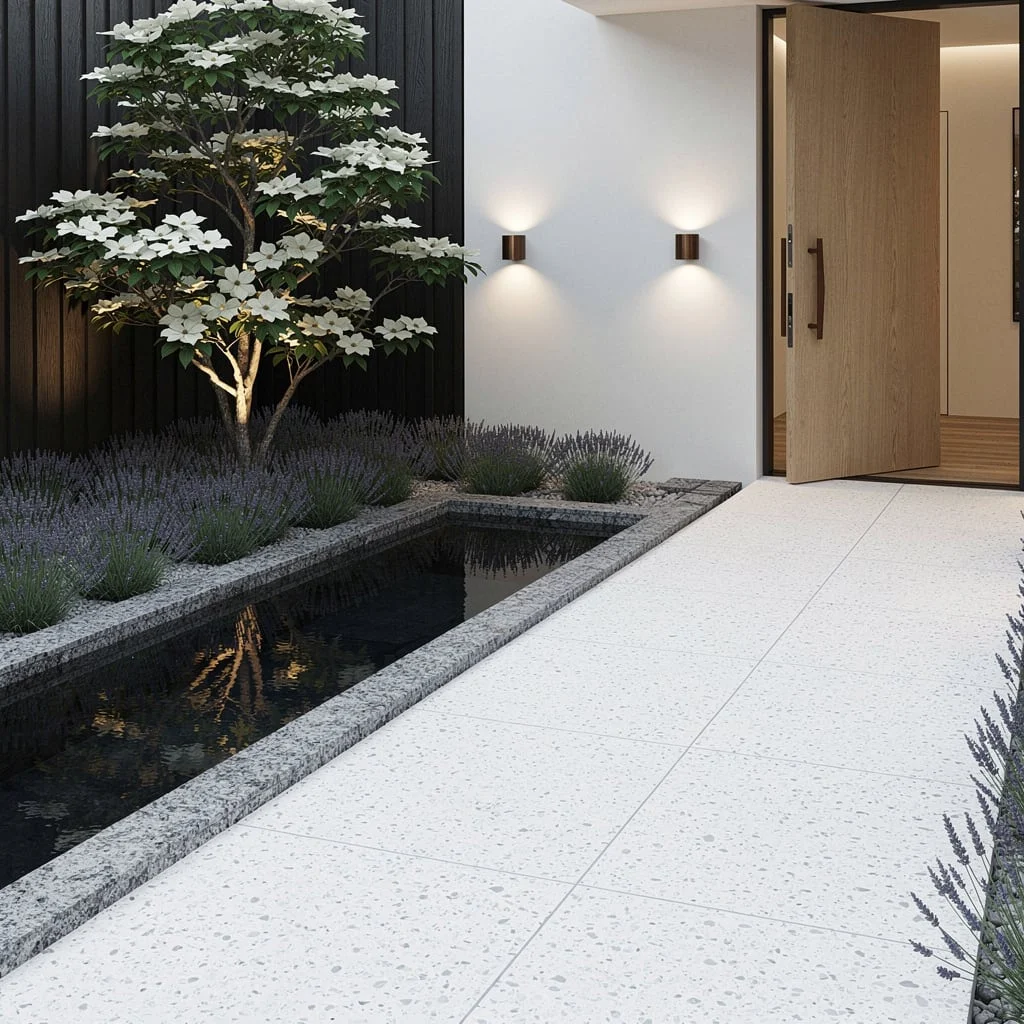
Ready to ditch the builder-grade entry for something grown-up? Drop large-format white terrazzo tiles, then slap in a pivot oak door that doesn’t look like something from a rental. Mirror flowering dogwood trees beside textured ebony-stained wood privacy panels and run a linear reflecting pool to make the space feel about 200% bigger. Add ribbon lavender under custom bronzed sconces so the fragrance and glow hit together. Pro tip: Stick to a tight color palette, but always break it up with a wild card (e.g., lavender blooms)—otherwise ‘minimalist’ just turns into ‘lifeless.’
Charred Timber Drama: Aloe and Granite for the Win
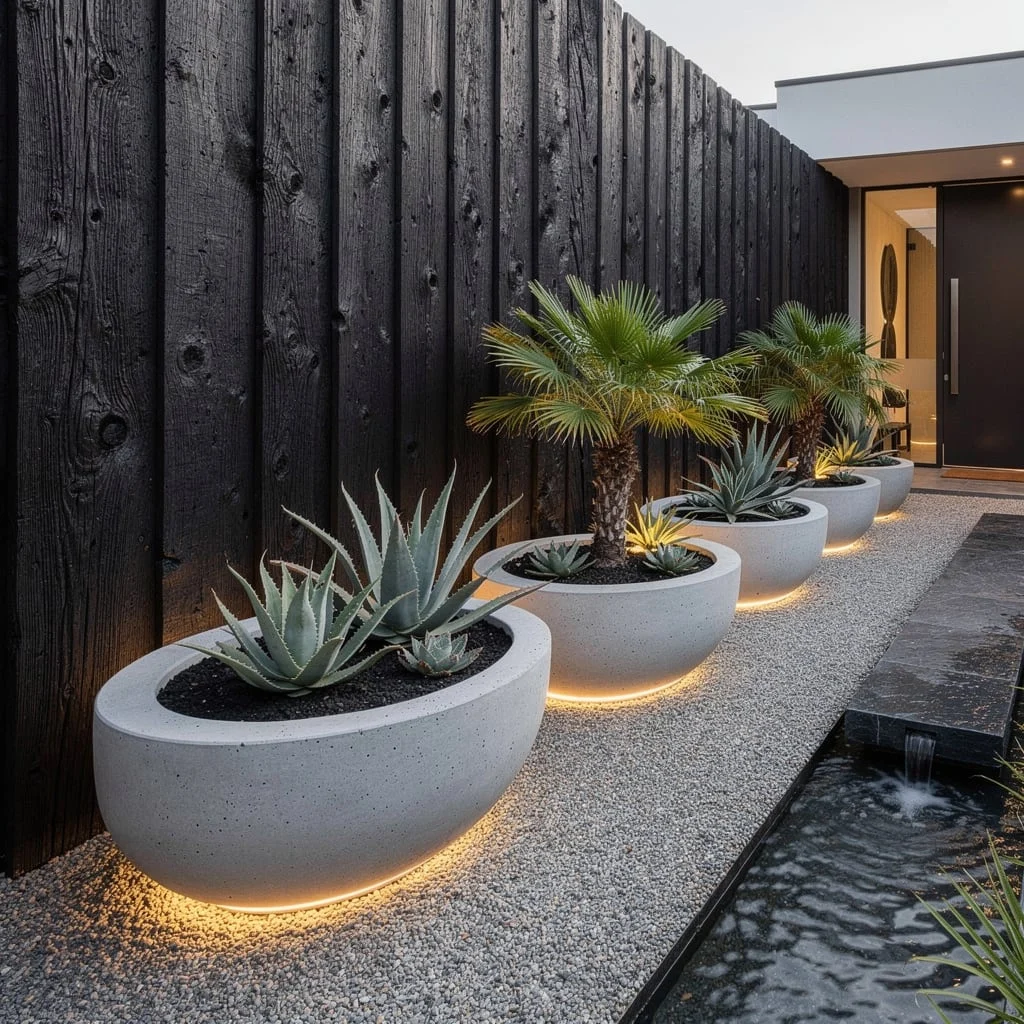
Sick of bland fences? Stand up charred timber planks vertically and make your entry feel instantly architectural. Set elliptical concrete planters packed with sculptural aloe and dwarf palm, then underlight them with LED strips you set into the pavement—not outside it, unless you want to trip. Throw down crushed granite for your pathway—because gravel is a vibe, not just utility—and add a minimalist slate water rill for movement. Pro tip: Mix leaf shapes. Never line up palms alone; layer weird angular aloes for that ‘mad botanist’ feel.
Stepped Limestone Layers: Pittosporum and Jasmine—Scent Meets Structure
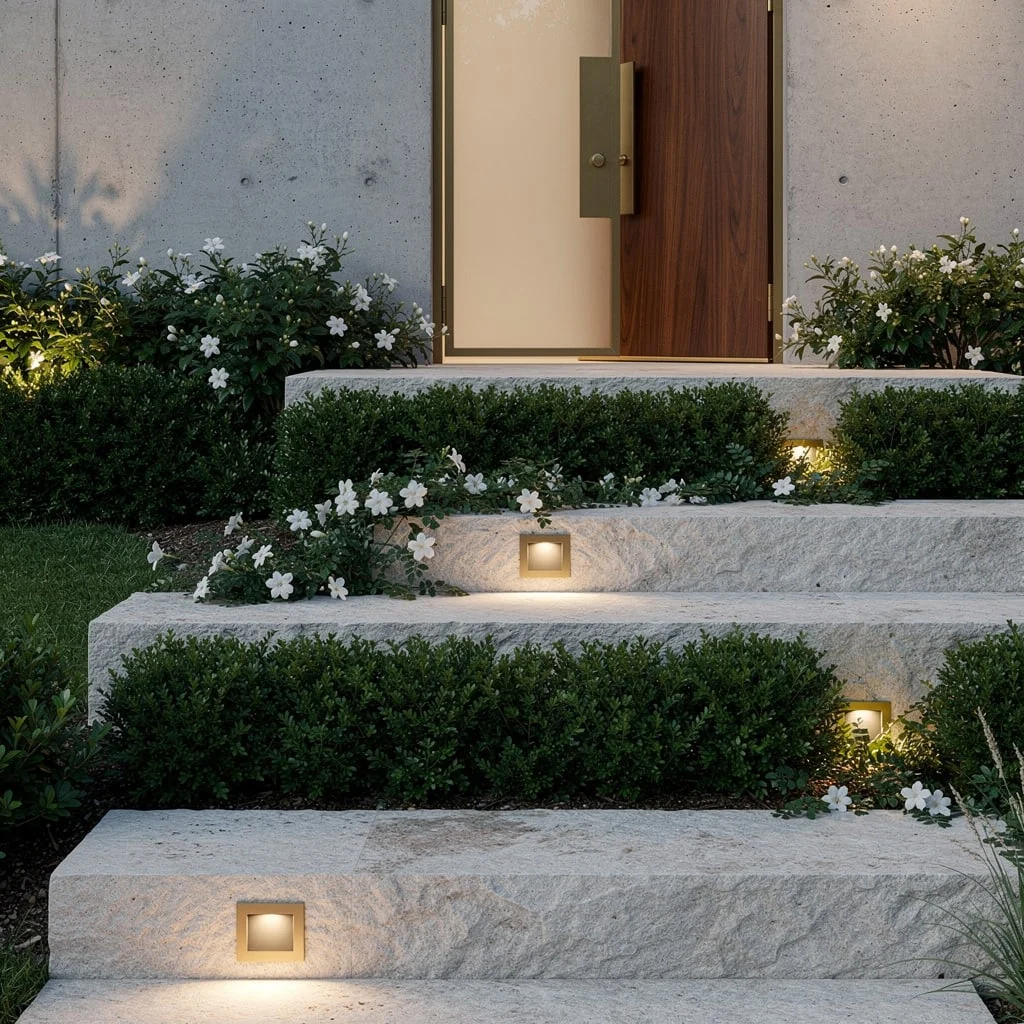
Want sophistication that actually works? Build softly stepped limestone terraces, thick with pittosporum hedges and trailing white jasmine for both scent and lushness. Set little brass up-lights at the base of each step to dramatically highlight plants and stone—no floodlights allowed. Finish with an artisan-forged steel gate (frosted glass insert, of course) and pivot walnut door backed by polished concrete. Pro tip: Keep those hedges deep and the jasmine trailing. Layer lighting so nothing feels flat; always up-light, never side-light, unless your goal is ‘cheap stage show.’
Compact But Bold: Travertine, Allium, and Myrtle Spheres for Days
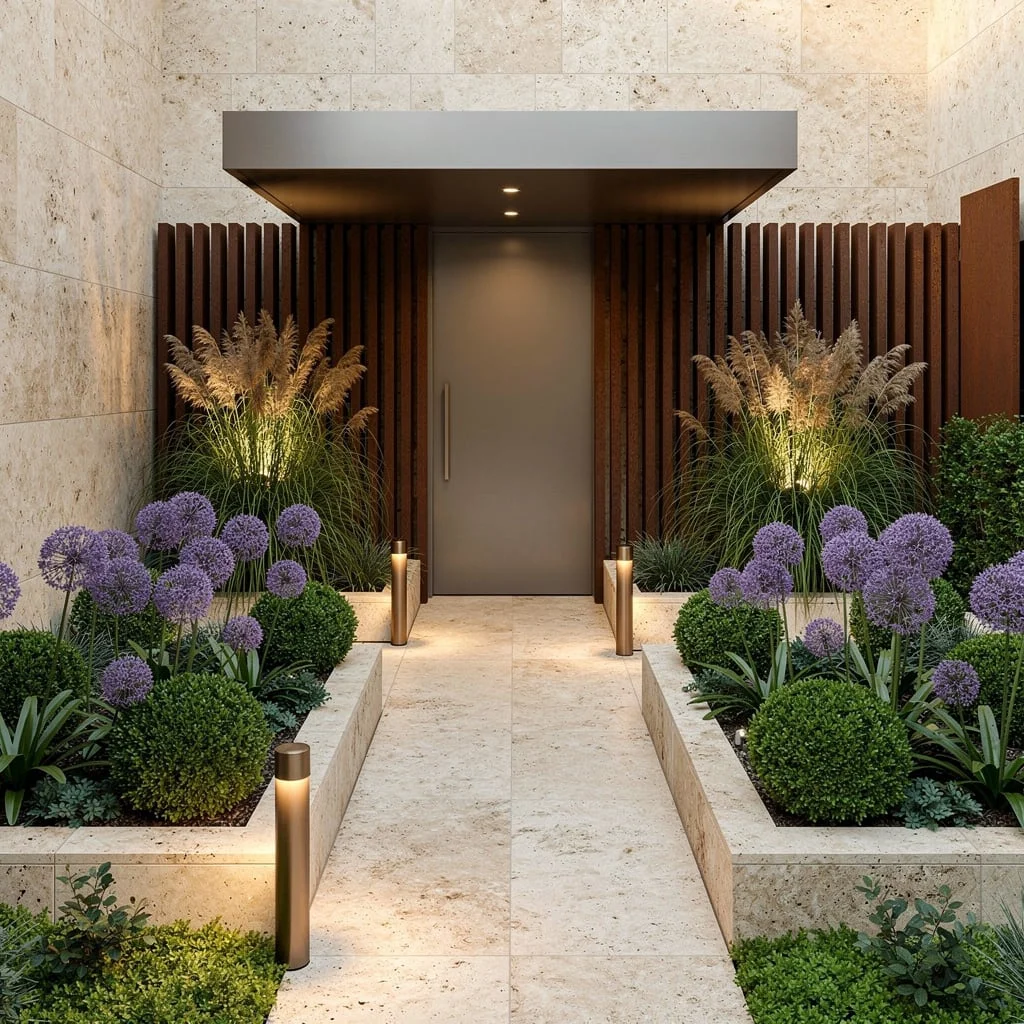
Short on space? Go big anyway. Use tumbled travertine everywhere (floors, walls—don’t be shy), then drop in raised beds stuffed with clusters of purple allium and manicured myrtle spheres. Throw up vertical corten screens for privacy and to frame ornamental grass, uplighting it all for drama. Add antique bronze bollard lights along your central pathway, shade the entry with a matte aluminum canopy, and let lush groundcover ooze between the cracks. Pro tip: Mix round and vertical shapes—never all spheres, never all blades. If you can see all the soil, you’re not done planting.
Minimalist Magic: Marble Pond and Cubic Planters Say ‘I Get It’
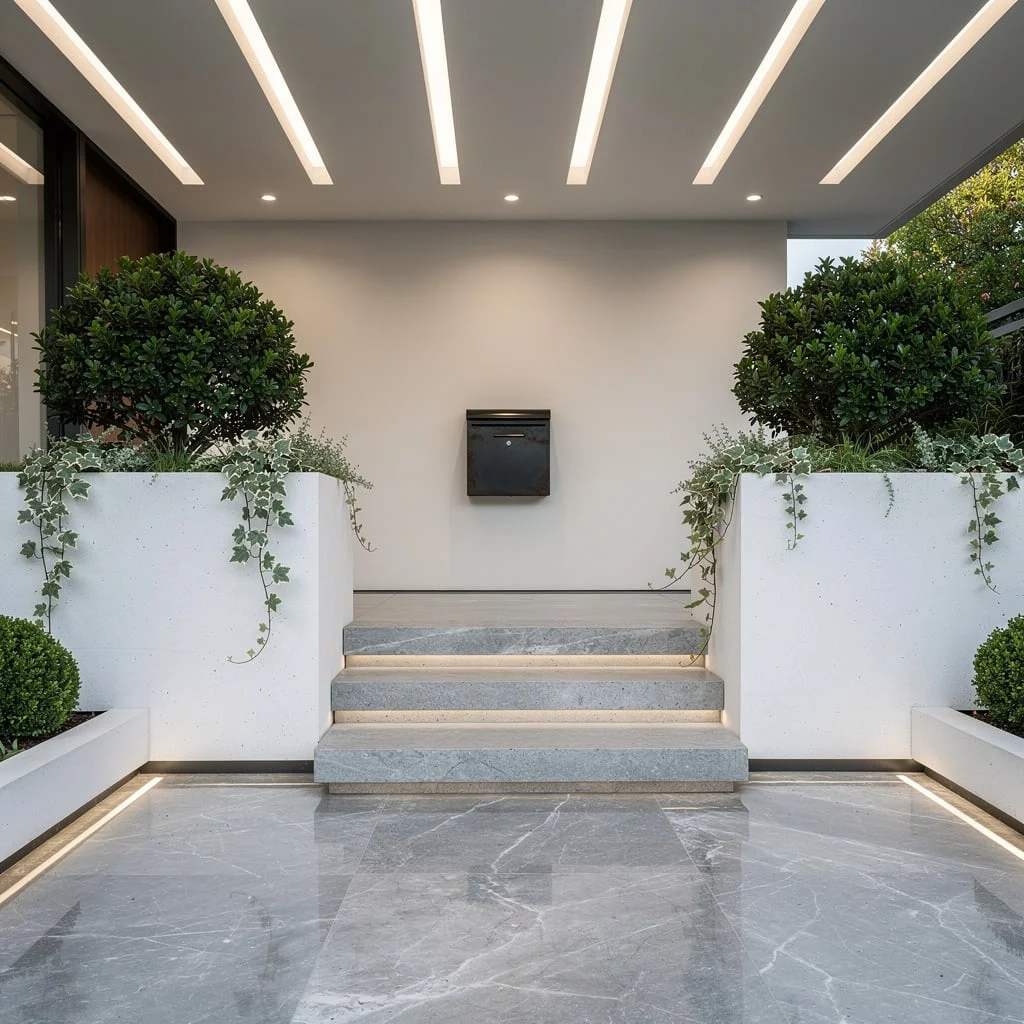
If you seriously mean ‘minimalist,’ start with floating ashlar stone steps over a low marble pond—yes, marble. Throw in tiered cubic planters in matte white concrete packed with clipped osmanthus and trailing ivy. Add a custom blackened steel mailbox, because ugly mailboxes are a crime. Set diffused LED uplights to highlight edges and plant forms, and use slot skylights in the entry canopy for actual daylight (not that flickering fake stuff). Pro tip: Keep lines crisp and plants clipped. If you see even one messy stem, grab the shears and get ruthless.
Espalier and Sandstone: Herringbone Paths That Don’t Try Too Hard
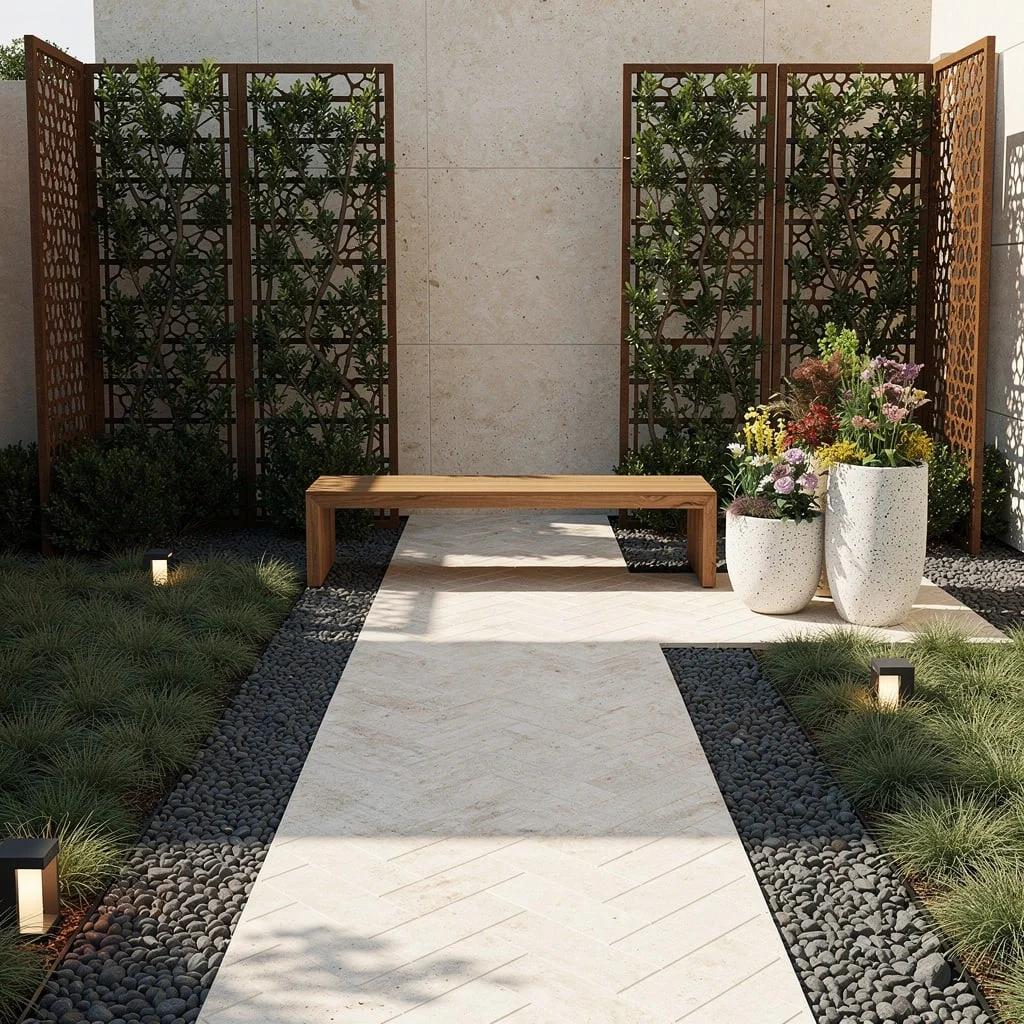
If you want your entry to feel planned, not ‘plopped,’ lay a pale sandstone herringbone path, then run openwork corten steel screens for structured evergreen espalier—training those plants to behave, basically. Alternate bed textures with dark river stones and microflax for layered interest, and set subtle step lights to cast iconic shadows. Finish with a bespoke hardwood bench that actually fits the approach, then drop minimalist terrazzo planters for blooms. Pro tip: Mix spreading and upright plants. Espalier goes vertical; groundcovers go wide. Never let benches float alone—always anchor with a planter.
Geometric Xeriscape: Agaves, Concrete, and a Portal You’ll Actually Use
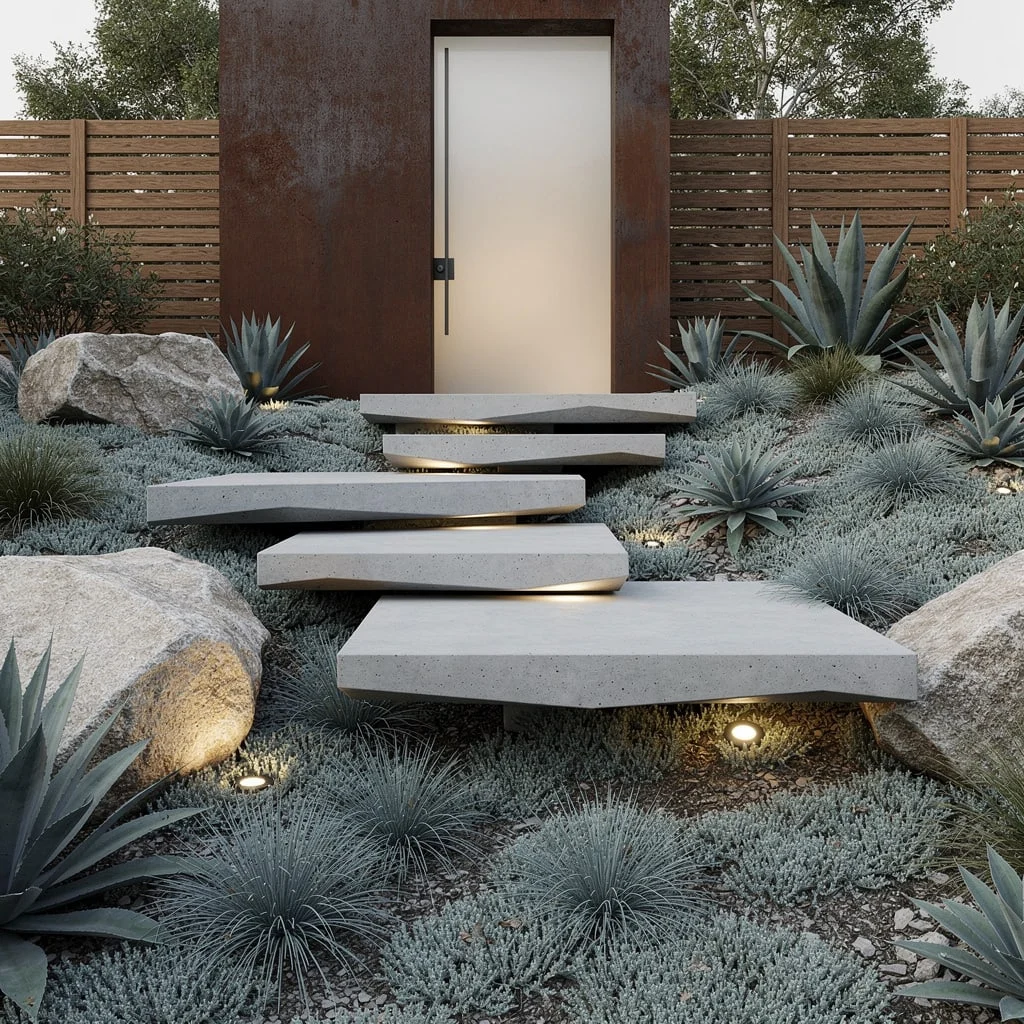
For the bold at heart, float geometric concrete steps over a sunken xeriscape jammed with layered agaves, blue fescue, and silver thyme. Frame everything with a monolithic rusted steel entry portal, then light your rough-cut stone boulders with in-ground LEDs—not those goofy solar things. Run timber slat fencing behind the native planting for warmth, and choose a sandblasted glass door for privacy with filtered light. Pro tip: Always mix plant heights and textures—agaves go big, fescue stays fluffy, thyme trails. Portal must be tall and chunky; thin frames cheapen the drama, period.
Final Thoughts
An entryway garden that actually works is one that treats the approach to your front door as seriously as you treat the interior of your home—which, for most people, means starting to take it seriously at all would already be an improvement.
The gardens on this list succeed because they each decided what kind of arrival experience they were creating and then built toward it without losing nerve. The plant-crowded porch trusted abundance. The living tunnel committed to the theatrical. The painted stone corridor went fully decorative and refused to apologize. None of them hedged. None of them settled for the two-shrubs-flanking-a-door default that most front entries exist in perpetually.
Your front door is the first sentence of whatever story your home tells. Right now a lot of those sentences start with “well, anyway”—and that’s fixable. Pick a direction, plant with intention, and let the approach to your door become the part of your home that makes people stop walking and just look for a moment. That moment, however brief, is entirely worth creating.