
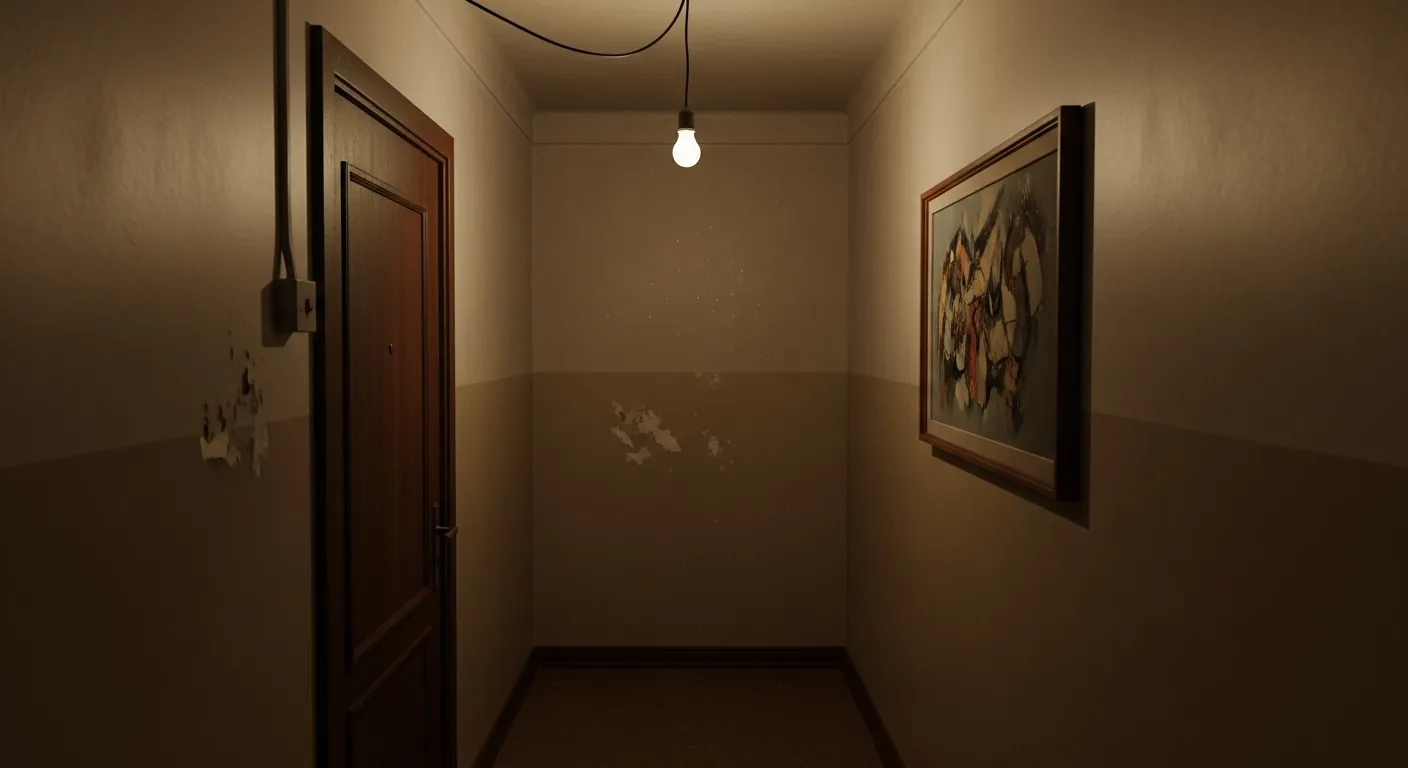
Let’s have an honest conversation about hallway lighting. Not the kind of conversation where someone gently suggests you “layer your light sources” and leaves you staring at a lamp in confusion — the kind where someone tells you directly that the single overhead flush mount you’ve had since you moved in is doing genuine damage to an otherwise decent space, and it needs to go.
Hallway lighting is the most neglected category in home design, which is impressive given how neglected hallway design already is. People will spend weeks choosing the right sofa fabric and then install one recessed light in a six-metre corridor and call it illuminated. The result is a flat, shadowless, slightly sinister passage that makes everyone look vaguely unwell and makes the space feel smaller than it actually is.
Here’s what lighting actually does in a hallway that no amount of paint or furniture can replicate: it creates layers. A hallway lit from a single source has no depth — everything is the same brightness, which means there’s no visual hierarchy, no atmosphere, and no reason for the eye to travel down the space with any interest. Add a second source at a different height and the whole thing changes. Add a third and suddenly you have something that feels genuinely designed rather than just functional.
The other thing lighting does that most people dramatically underestimate is make the architecture visible. Crown molding, paneling, arched doorways, herringbone floors — none of these things read properly under a flat overhead wash. The right lighting makes the bones of a hallway legible, which is the difference between a corridor that looks expensive and one that looks ordinary despite containing the exact same materials.
Why Your Hallway Lighting Is Probably Failing You Right Now
The tell-tale signs of bad hallway lighting are easy to spot once you know what you’re looking for. Everything looks the same brightness from floor to ceiling, which means there are no shadows and no depth. The light source itself is visible and uninteresting — a basic flush mount or a recessed downlight that points straight down and illuminates the floor more than the walls. Art and objects on the walls are either underlit or harshly spotlit without any gradation. And the overall effect is closer to a well-lit corridor in an office building than anything resembling a home.
The fix isn’t necessarily expensive. It’s structural — a decision about where light comes from and what it’s pointing at, made intentionally rather than by default.
The Lighting Layers That Actually Matter
Before buying a single fixture, understand what each layer of light is doing and why all three need to be present for a hallway to feel properly lit.
Ambient light is the base layer — the overall illumination that lets you see where you’re going. In a hallway, this should be warm and even, never harsh. Recessed ceiling lights, cove lighting, or pendants all serve this function, but the color temperature matters enormously — anything above 3000K starts to read as clinical rather than welcoming.
Accent light is what gives a hallway personality — directed light that hits specific surfaces, artworks, or architectural features and creates visual interest. Without accent lighting, a hallway is a evenly lit box. With it, the eye has places to travel and things to discover as you move through the space.
Practical light covers the functional moments — a lit mirror, a lit console, a light source near the entry point where people are dealing with keys and coats. This layer is the most often forgotten and the most immediately missed when it’s absent.
The Fixture Relationship Nobody Talks About
The most common hallway lighting mistake isn’t choosing bad fixtures — it’s choosing fixtures that have no relationship to each other. A pendant that’s too small for the space, flanked by recessed lights on a different circuit with a different color temperature, next to a sconce that’s a completely different metal finish — none of these are talking to each other, and the result is a space that looks assembled rather than designed.
Pick a metal finish and stay in it. Choose a color temperature and apply it consistently across every source. Vary the type and height of your fixtures — pendants, sconces, and floor-level strips can all coexist — but keep the visual language consistent. When fixtures feel like they belong to the same family, a hallway reads as considered rather than accumulated.
Hallway Lighting Ideas Worth Stealing
Dalí on the Wall and Bubbles Painted On: Committing to Weird and Winning
My hallway
by u/SquidOfReptar in HomeDecorating
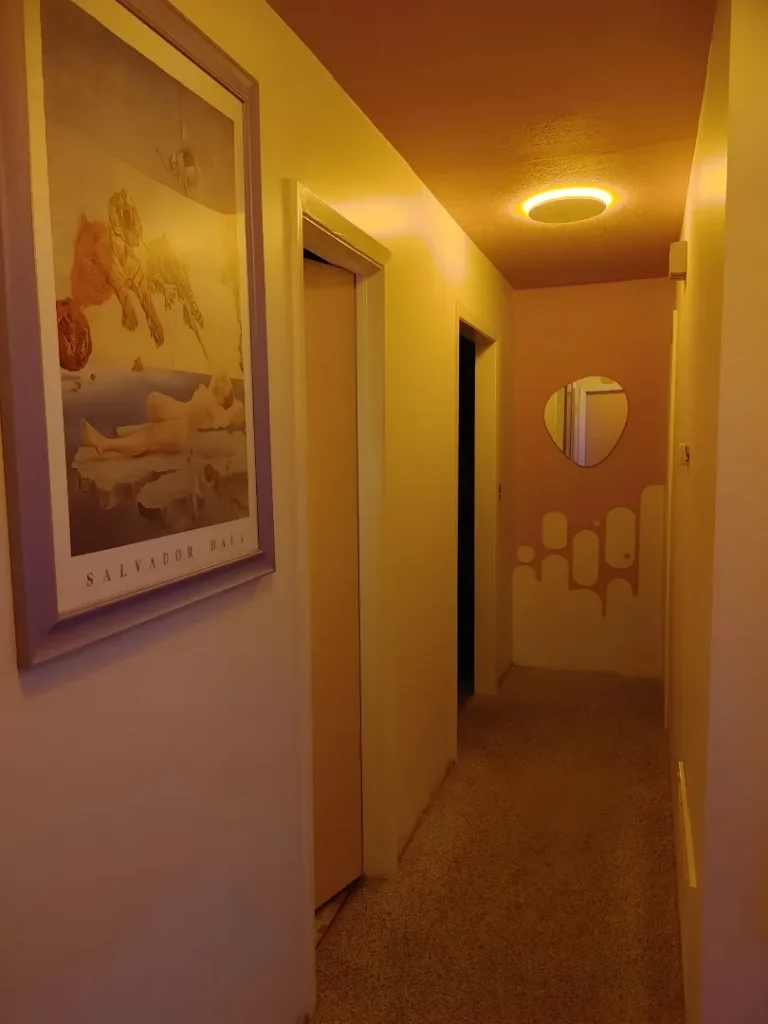
This hallway decided neutrality was for other people and never looked back. A framed Dalí print in a lavender border anchors the left wall with the kind of art confidence most people reserve for living rooms, while the right wall gets a hand-painted bubble mural in cream and terracotta that bleeds down toward the carpet like it’s mid-drip. A warm amber ring flush mount keeps the whole thing glowing in that golden, late-evening tone that makes the earthy wall colors feel intentional rather than accidental. The carpet in a warm oat tone ties the floor into the palette without competing. What makes this work is total thematic commitment — surrealist art, organic painted shapes, warm amber light — everything is speaking the same language. The lesson here is that a hallway with a strong, specific personality beats a tasteful, careful one every single time.
LED Strip Lighting: The Cheat Code That Actually Works
Cream walls, warm oak floors, walnut doors — everything here is doing its job quietly and letting the lighting make the statement it deserves to make. Continuous LED strip lights run along the ceiling perimeter in a recessed channel, throwing a warm wash down the walls without a single visible fixture. Matching LED strips run along the skirting board at floor level, lifting the base of the walls with the same warm tone and creating a soft glow that makes the floor appear to float. Two framed abstract prints in earth tones sit on the right wall, lit naturally by the ambient ceiling strips rather than spotlit. The whole effect is of a space that’s been lit from within rather than from above, which is the hallway lighting holy grail — warm, even, atmospheric, and completely free of the institutional overhead-light problem that plagues most corridors.
All-White Paneling and a Statement Globe: Lighting as Architecture
Every surface in this hallway — walls, door, molding, barrel-vaulted ceiling, arched alcove — is the same creamy white, which means the entire scheme lives or dies by its lighting. And it doesn’t just survive, it thrives, because whoever designed this understood that a single extraordinary fixture in a monochromatic space becomes the entire focal point without competition. A caged glass globe pendant with an antique red canopy hangs from the vaulted ceiling and casts a complex, multi-directional light through its glass panels, throwing dramatic shadows across the ornate plaster frieze above and the layered molding on every wall. The green marble diamond floor tiles provide the only color contrast in the space. This is a masterclass in what happens when you strip a room back to one color and let one exceptional light source do everything — the result is more dramatic than any combination of competing elements could achieve.
Oversized Lanterns and Exposed Beams:
White paneled walls, grey herringbone stone floors, exposed dark wood ceiling beams, a full wall of floor-to-ceiling black-framed windows on one side flooding the space with natural light — and then, suspended between each beam, a substantial hexagonal glass lantern in an aged bronze frame. The genius of this lighting scheme is the explicit conversation between the natural light flooding in from the windows and the artificial light from the lanterns, which have been chosen in a warm enough tone to hold their own against daylight rather than disappearing into it. The wall sconces on the opposite side are simple backlit panels that bounce light off the white walls without adding visual complexity. Everything here is large-scale and confident in proportion to the length and height of the corridor, which is the fundamental rule most hallway lighting gets wrong — undersized fixtures in a long space make the space feel longer and emptier, not more elegant.
Woven Pendants and a Hairpin Console:
White walls, grey herringbone vinyl flooring, white paneled doors, a slim black hairpin console styled with a round black mirror, a ceramic vase, and a small plant — this hallway is not trying to impress anyone, which is exactly why it does. Two woven wire pendant lights hang at slightly different heights, their Edison bulbs throwing a warm, slightly diffused glow that’s characteristic of open-weave shades and impossible to replicate with any other fixture type. The warmth of the bulb tones works perfectly against the cool grey floor and the white walls, adding the one element of visual warmth the rest of the palette lacks. A Christmas garland at the entrance is the only seasonal touch and it earns its place without overwhelming the space. This is the hallway that proves considered lighting choices don’t require a design budget or an extraordinary space — they just require choosing the right fixture for what the space actually needs.
Warm Amber and Retro Pendants: When the Vibe Is More Important Than the Lumens
Cream parquet flooring, white walls, arched alcoves glowing with warm amber light, a checkerboard shag runner in dusty rose and cream, and two oversized sculptural pendant lights in translucent orange casting everything in that golden late-afternoon warmth — this hallway made a deliberate decision to prioritize atmosphere over illumination and it paid off completely. The pendants are the statement here, functioning as both light source and sculptural object in a space that’s otherwise restrained. The arched alcove lighting keeps the walls interesting without requiring art or objects to fill them. It’s not a bright hallway. It’s a warm one, which is a completely different and arguably more valuable thing in a transitional space where the goal is to make people feel immediately at home.
Glow Like a Lux Minimalist: Layered LEDs That Don’t Miss
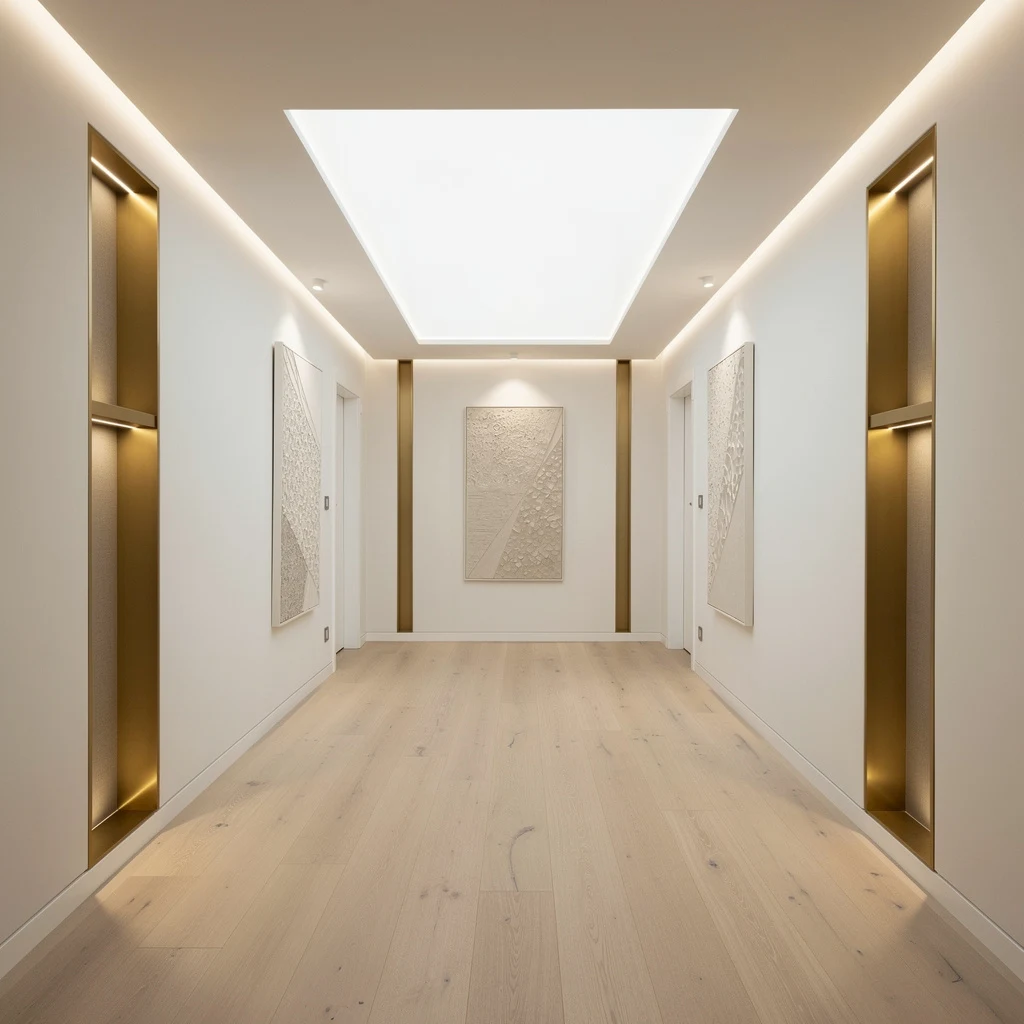
If you crave that fresh, airy, Marie Kondo vibe minus all the clutter, run with wide light oak floors and matte white walls to keep it crisp. Ditch those ugly flushmounts and install custom recessed linear LED strips along your ceiling margins—they’re the cheat code for a soft, continuous glow. Go extra with a flush luminous panel you can actually control the brightness on (hello, mood swings). Frame your wall art with spotlights and hit up vertical brass accents with concealed uplighting. Never let sloppy lighting wash out your art; spotlight to curate, not to interrogate.
Marble Mood: Velvet Walls, Pendants, and Backlit Drama
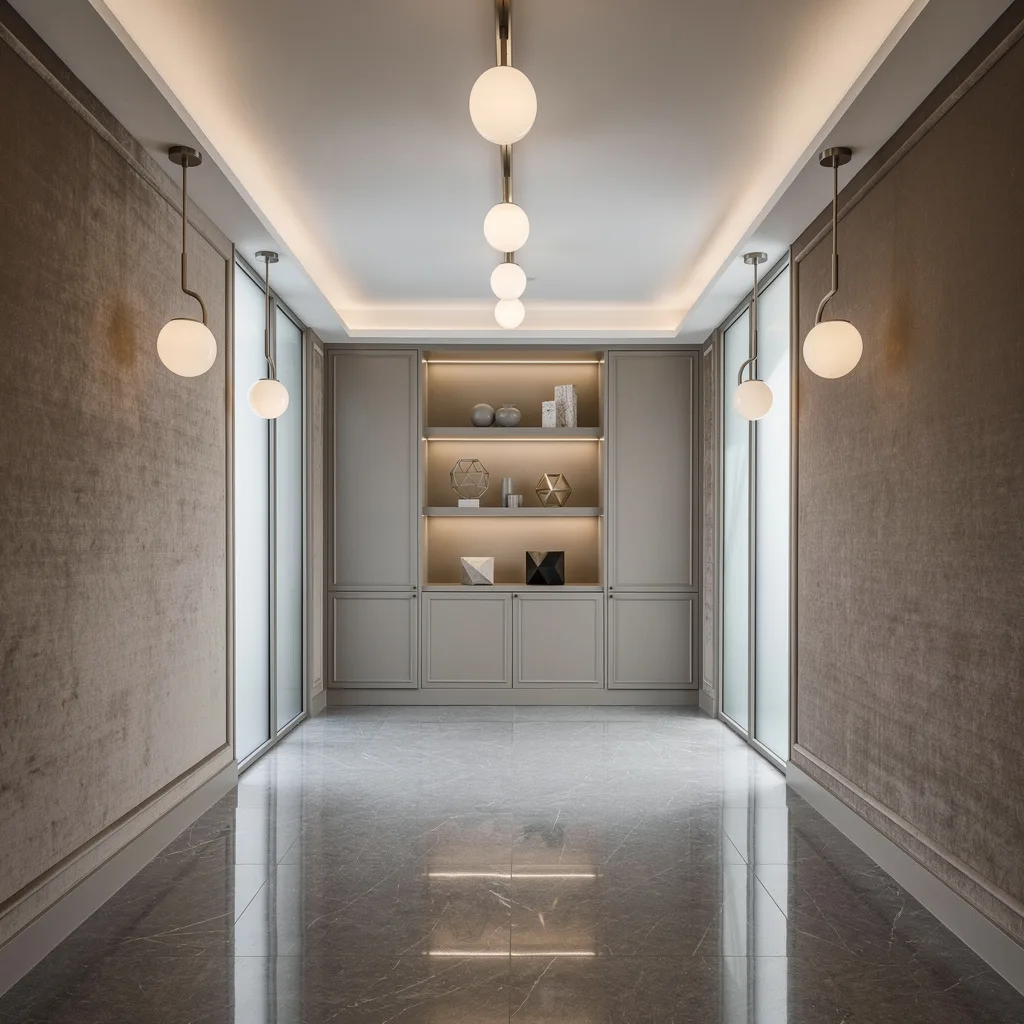
For everyone sick of basic hallways, start with polished grey marble floors and slap velvet-textured taupe wallpaper on the walls for a touch-me vibe. Hang spherical milky glass pendants along a linear track for that visual rhythm you see in fancy hotels. Backlit shelving units and cove lighting over built-in cabinetry makes your decor objects look like they belong in a museum, not your grandma’s house. Always install frosted glass side panels if you can swing it—natural light plus diffuse illumination is chef’s kiss. Always tie ambient with direct; don’t trust just overhead.
Go Drama Queen: Walnut Herringbone & Moody Matte Black Walls
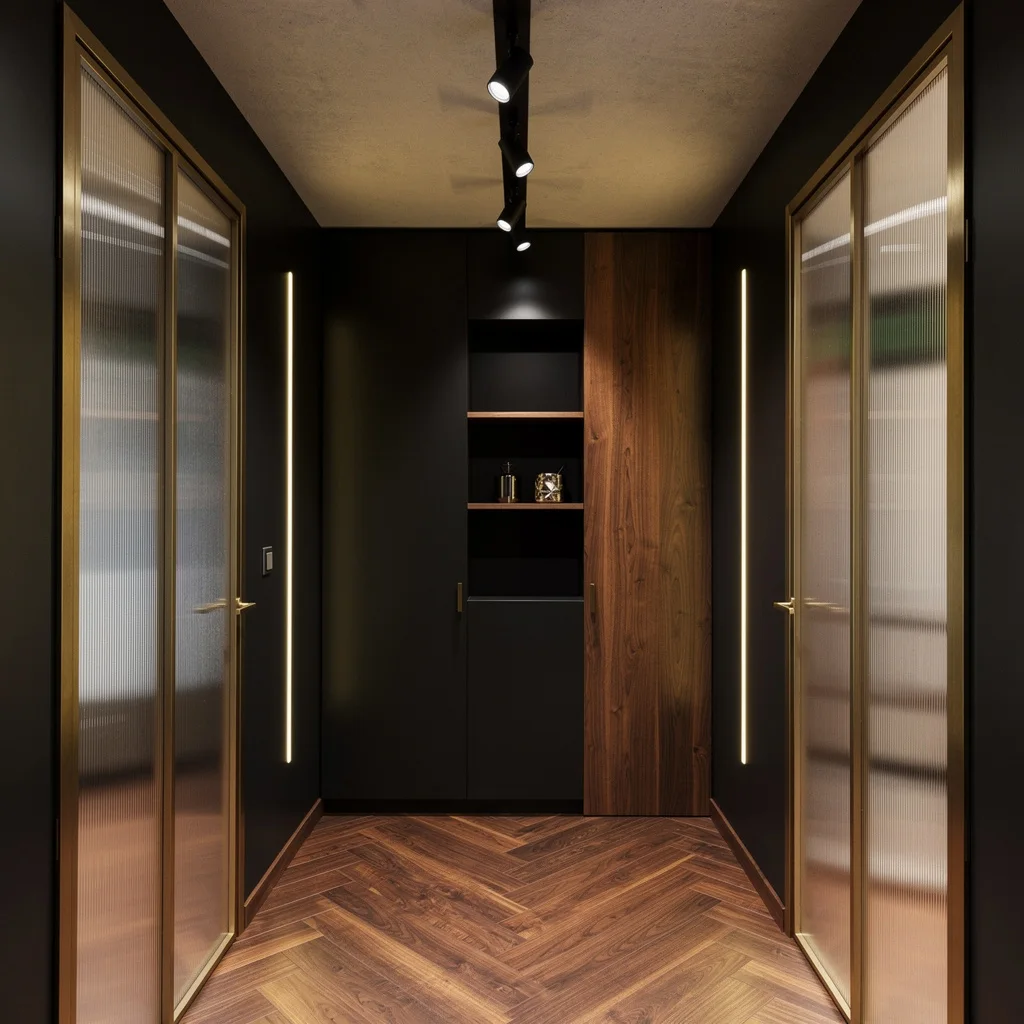
Ready to command attention? Run rich walnut herringbone flooring and slap up matte black walls to create instant depth. Mount adjustable spotlights on a floating plasterboard track to spotlight niche shelving and custom wood paneling—no lame shadows allowed. Integrate vertical LED bars into your walls for a linear ambient glow that’s easy on the eyes. Finish with brass-framed translucent glass doors, so light gets filtered instead of blocked. Always highlight key architectural moments—spotlight your niches, don’t leave them in the dark.
Terrazzo Cool: Gold Flecks and Alcove LED Wizardry
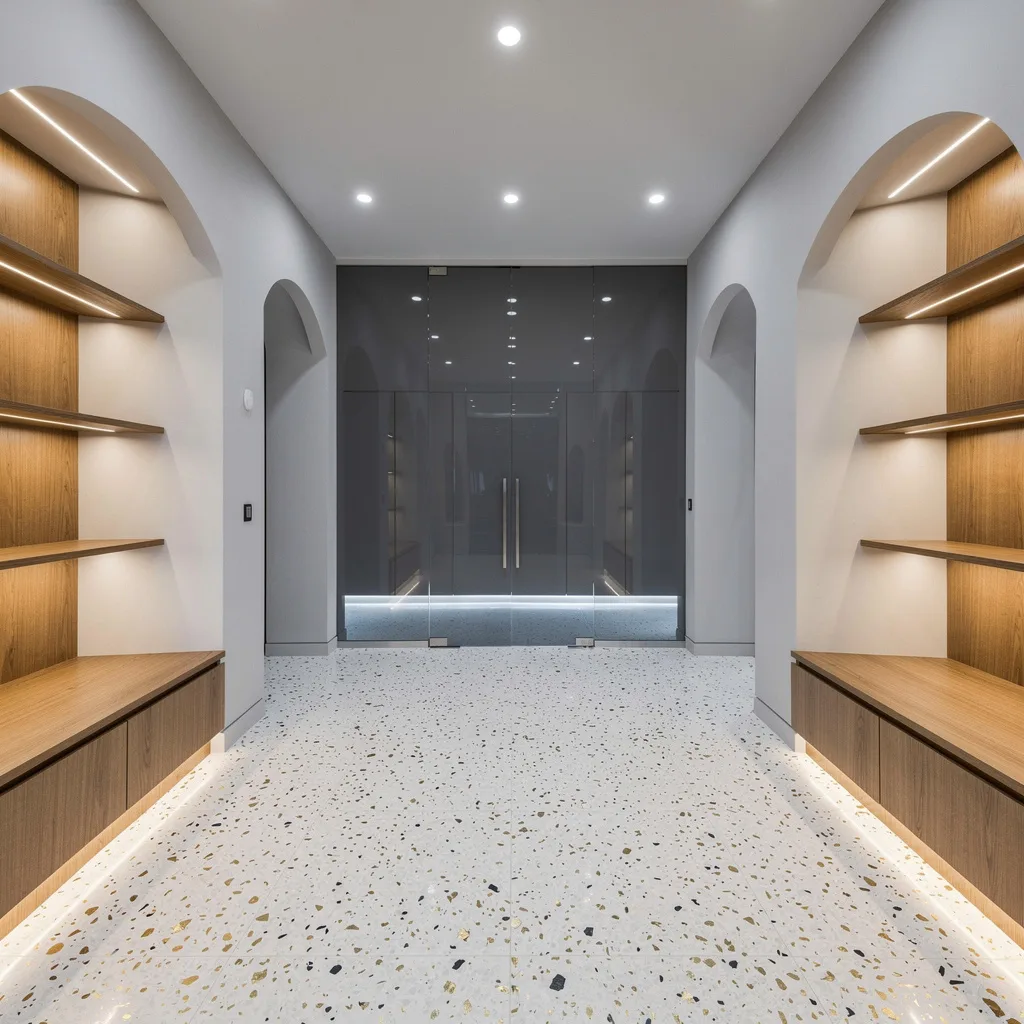
If you’re tired of playing safe, jump into white terrazzo floors with gold and charcoal flecks and pale grey walls for major designer cred. Flush ceiling lights are a must—none of that clunky junk hanging down. Curve alcoves into your side walls and flood those display shelves with warm LED from hidden sources. Light up your glass partitions from below with strips of cool LED for a futuristic glow. Install built-in oak benches to counterbalance all that shine. Always direct your LEDs toward display areas—show off, don’t shy off.
Scandi Glow-Up: Pine Floors, Orb Clusters, and Mirror Magic
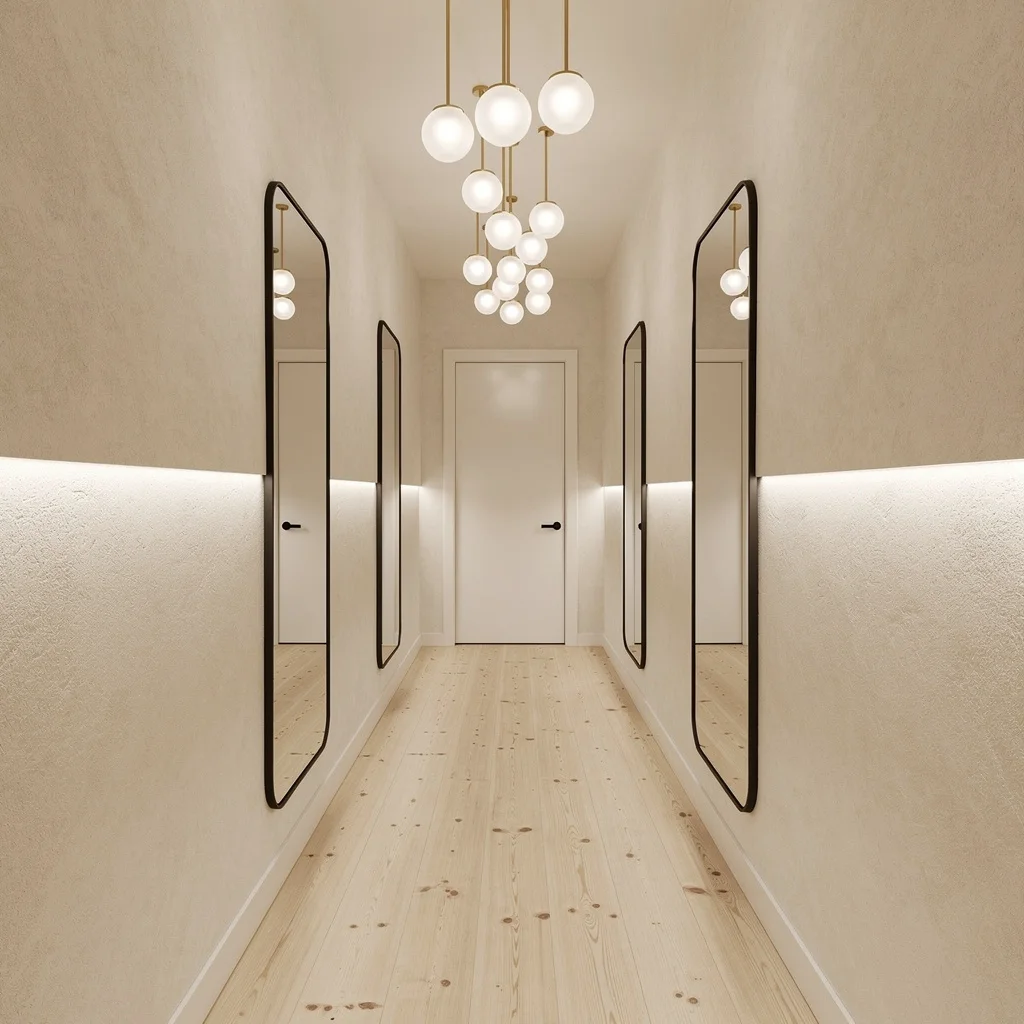
You want modern but cozy? Lay down bleached pine floors, slap on creamy textured plaster walls, and drop a cluster of frosted glass orb lights at random heights from a gold rod. Run embedded wall panels halfway up for the gentlest, most flattering indirect lighting ever. Add matte black framed mirrors to bounce that light and create depth—literally fake a bigger space. Install a stark white lacquered door as your anchor. Always skip matchy-matchy fixtures; mix lamp heights so your lighting looks curated, not catalogued.
Granite Luxe: Vertical Wood Panels and Illuminated Gold Walls
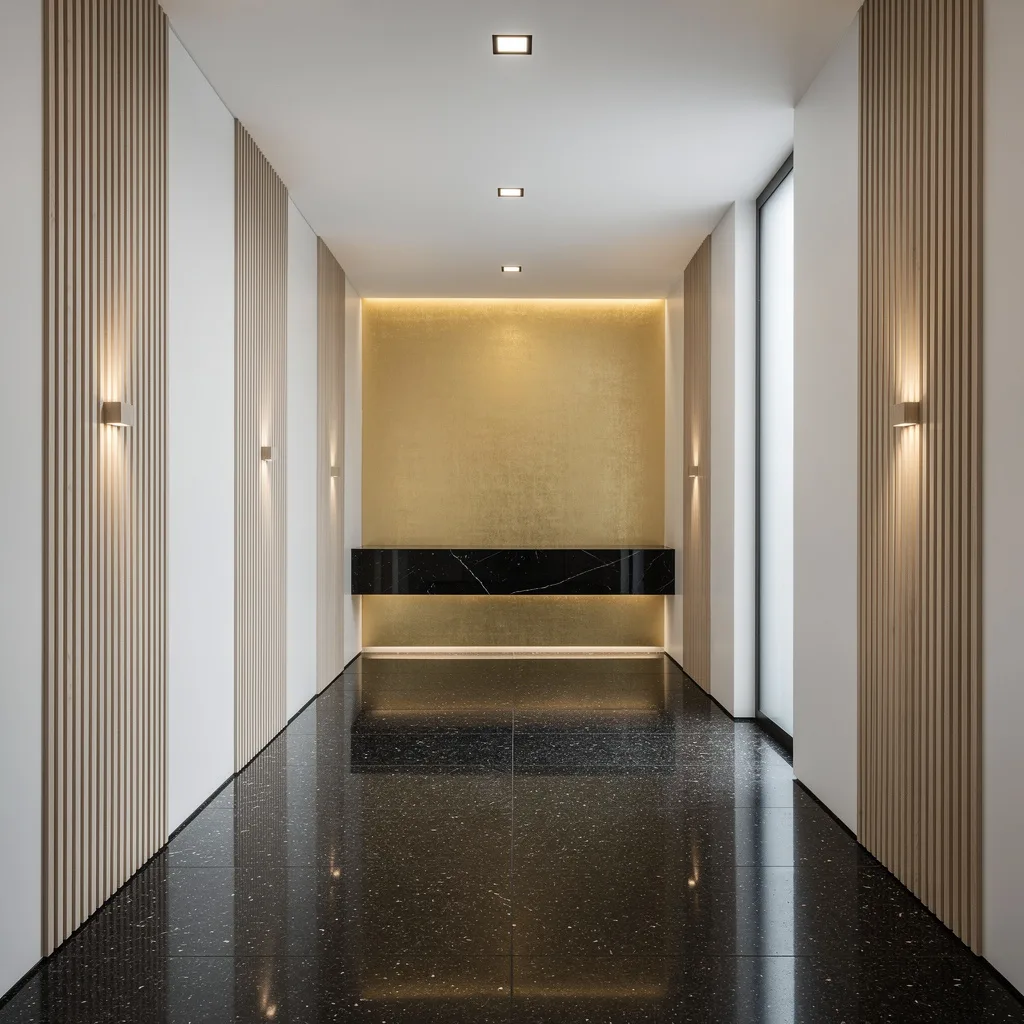
Feeling extra? Start with polished dark granite floors and matte white walls, but spice up with vertical ribbed ash wood panels for tactile intensity. Put recessed wall washers at intervals to make sure those textures actually matter. Ceiling-mount minimalist square LEDs for high-CRI, so your houseplants and your skin don’t look sickly. End it with a gold leaf feature wall—light it softly from the base for instant drama. Slide in a floating black marble console for extra flex. Always use wall washers to spotlight panel texture; don’t let your pricey wood blend in.
Blush Epoxy and Tubular Rod Chandeliers: The New Soft Glam
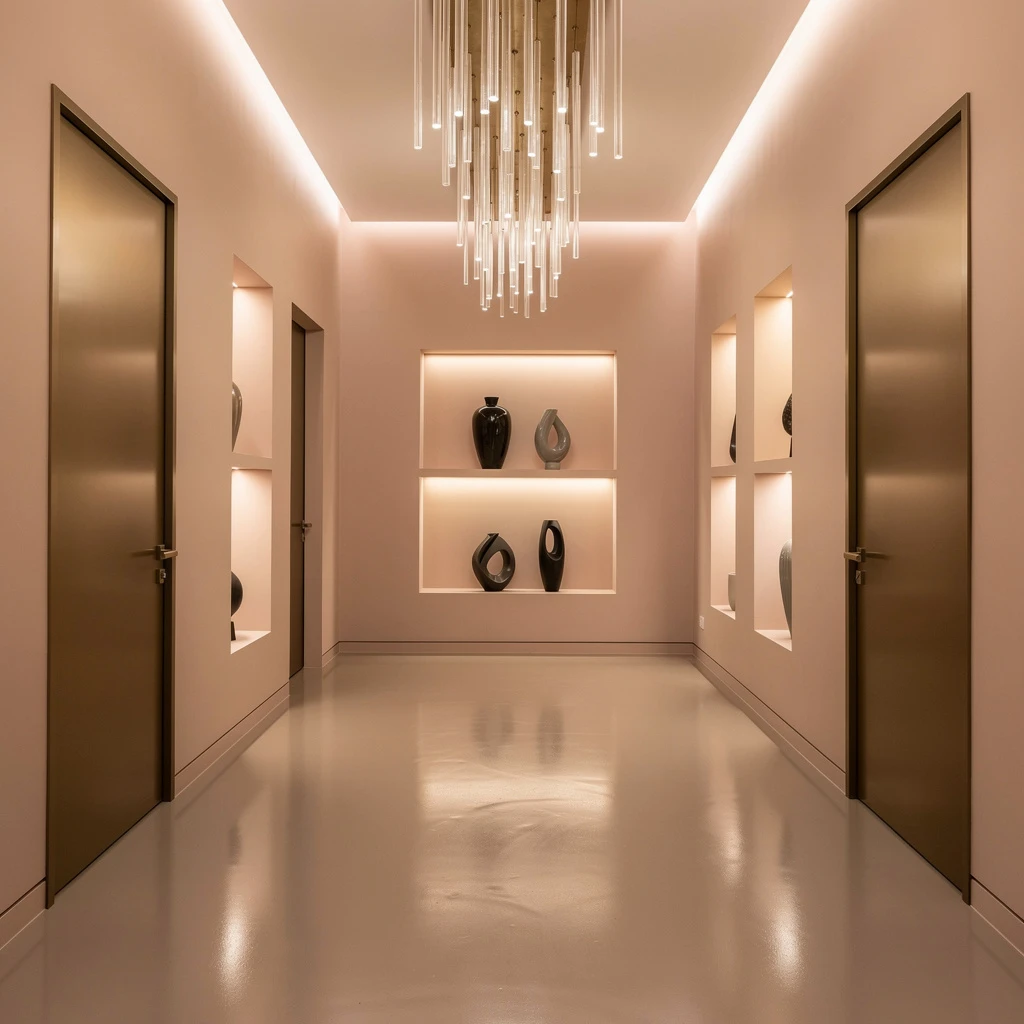
Obsessed with soft luxe? Lay seamless taupe epoxy floors and pale blush walls so your hallway stays fresh. Go hard and install a custom chandelier with cascading tubular glass rods—don’t even look at basic drum shades. Slide invisible cove lights along the wall-ceiling junction for an indirect glow that never strains the eyes. Backlight your recessed shelves and show off some sculptural vases. Use satin bronze for your flush doors to avoid glare. Always choose indirect lighting for wall display; direct spotlights just create attention-seeking hot spots.
Sage Green & Smoked Oak: Metallic Sconces and Halo Ceilings
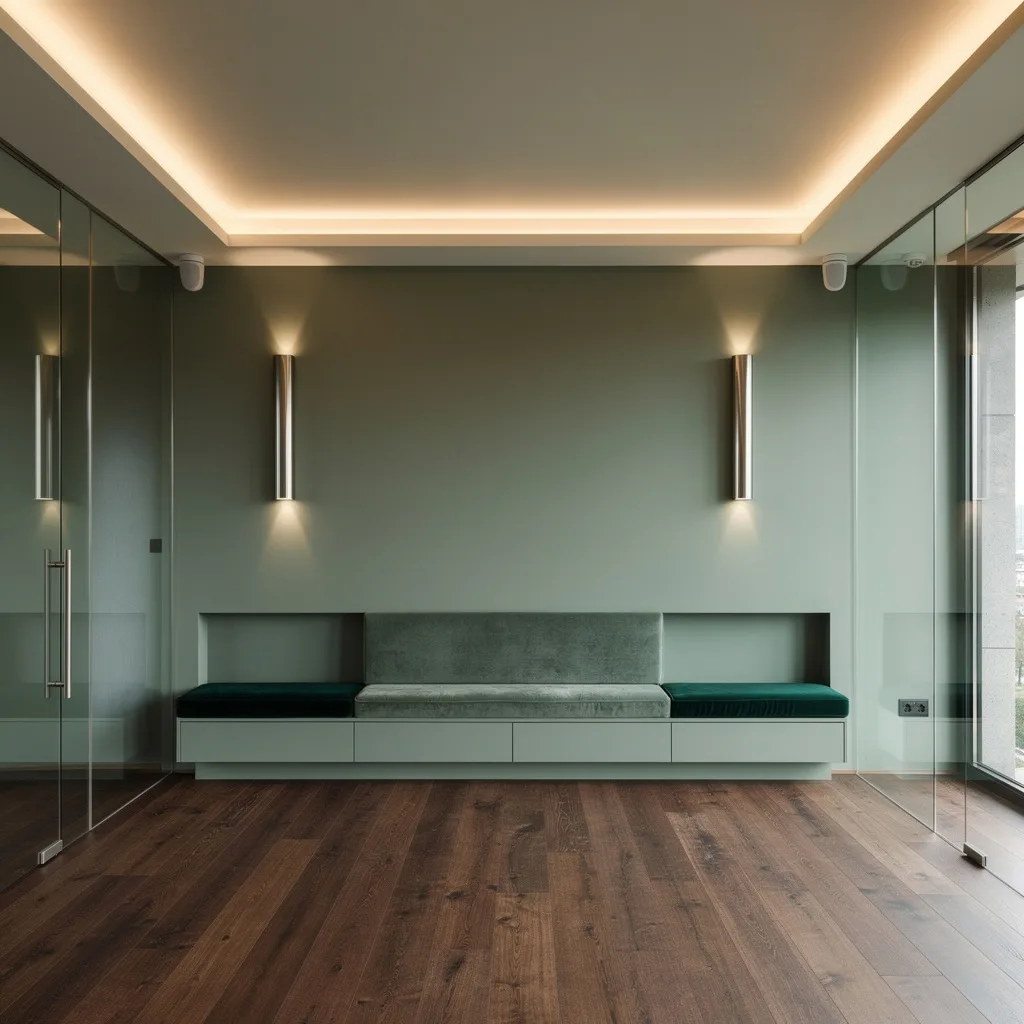
Want contemporary but with actual personality? Throw down wide-plank smoked oak floors and paint your walls matte sage green for serious modern color. Float a ceiling tray lined with hidden, dimmable LED strip lights—think ambient halo, not spaceship landing pad. Pop tall brushed stainless sconces at even intervals to bounce light up and down. Frameless glass partitions let daylight spill through, cocky but practical. Stitch in built-in niche seating upholstered in muted velvet for comfort. Always run dimmable LEDs; nobody wants interrogation lighting at midnight.
Navy Nights: Travertine, Fluted Panels, and Mirror Multipliers
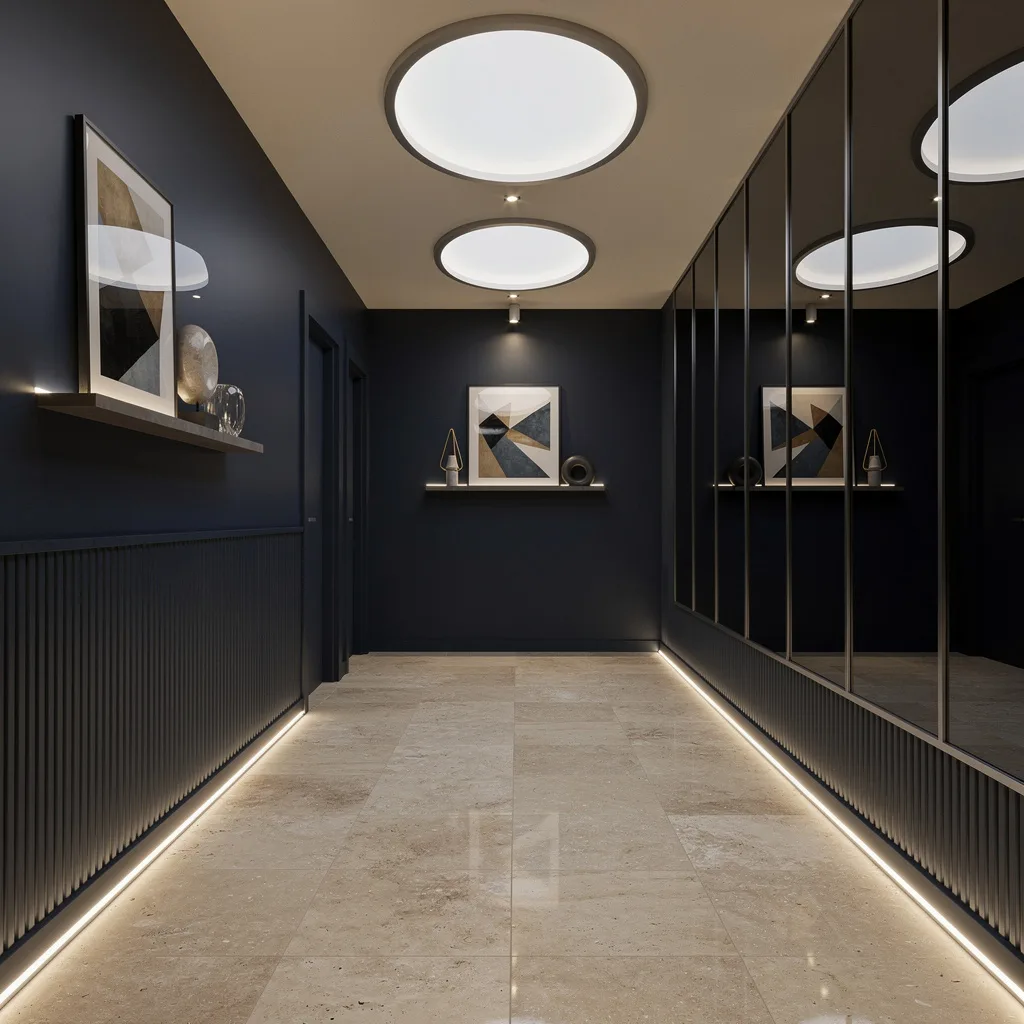
Aim for elegance, not boredom. Lay polished travertine tiles and paint your hallway a deep navy. Recess oval ceiling lights for uniform coverage—no patchy shadows. Line fluted wall panels with floor-level LED strips, so the glow sneaks up, not down. Display geometry-inspired decor ledges and let pinpoint LEDs do the highlighting. Multiply space and light with mirrored wall sections—everyone wants bigger, not shrunken. Always install floor-level LEDs behind fluted panels for indirect drama; don’t go direct unless you’re hosting a game show.
Microcement Chic: Concrete Floors, Matte Black Pendants, and Soft Sculpts
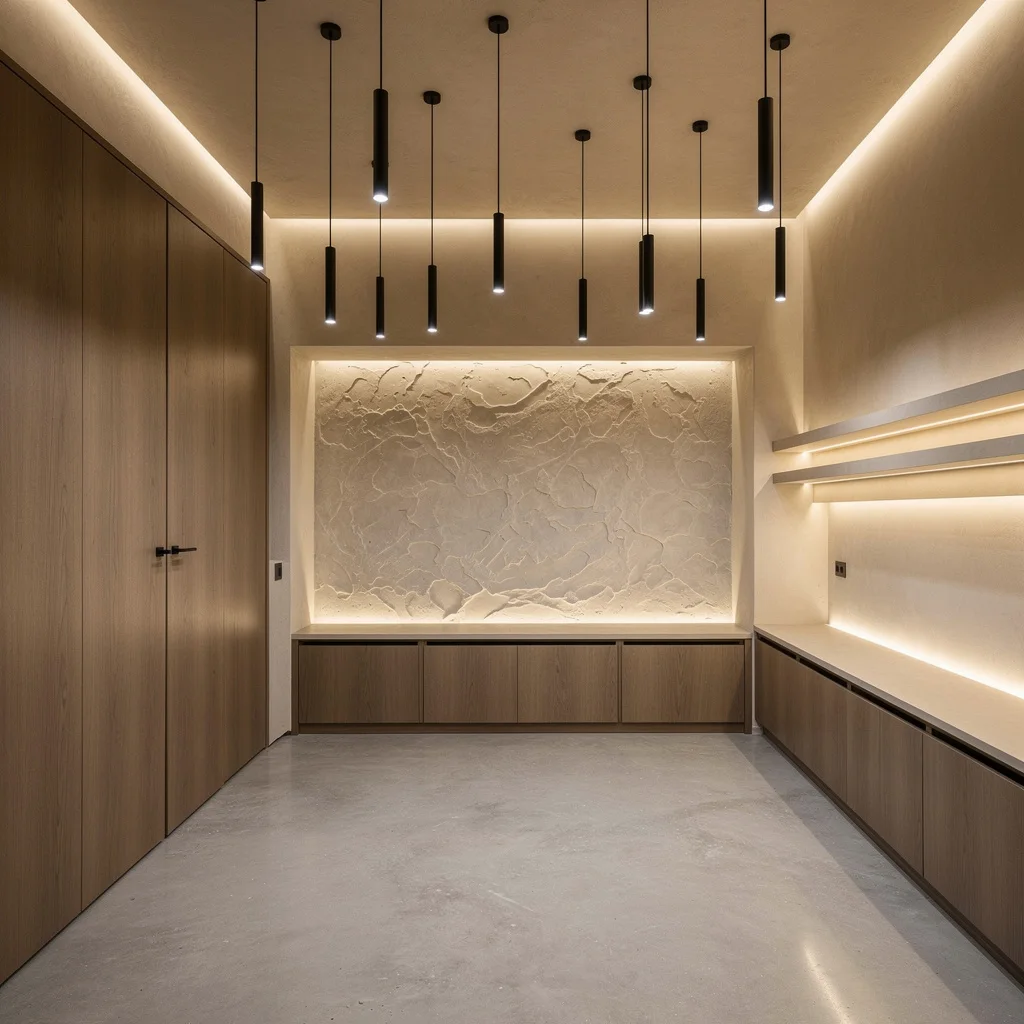
For a hallway that’s grown-up without being boring, run honed concrete floors and creamy microcement walls. Dangle ultra-thin matte black pendant lights in a staggered ceiling arrangement—uneven is interesting, even lighting is snoozy. Integrate horizontal dimmable LED lines in your walls for that layered, soothing vibe. Hide storage cabinets in lacquered walnut with push-to-open fronts because hardware is so last decade. Use a textured gypsum panel for a sculptural focal wall, softly backlit for real depth. Always stagger pendants for visual interest; symmetry is for dentist waiting rooms.
Midnight Glam: Chevron Floors, Crystal Sconces, and Metallic Display
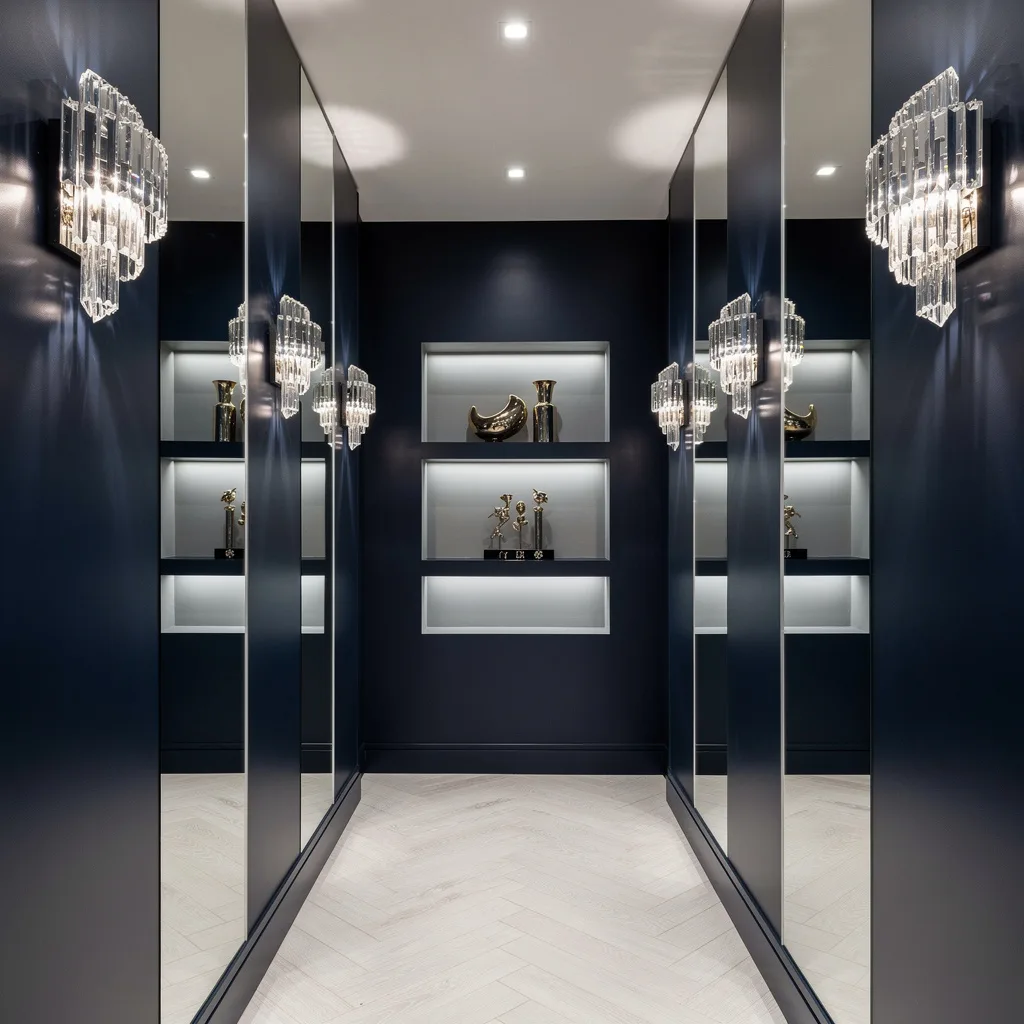
If you want pure drama, crank up the style with chevron-patterned whitewashed oak floors and rich midnight blue walls. Install sequences of crystal prism sconces at varying heights to refract—don’t just reflect—light. Pair minimal recessed ceiling lights with hidden LEDs in floating shelves so your metallic decor shines like it should. Drop slim floor-to-ceiling mirrors to stretch your space visually. Always break up monotony with luminous wall niches—if your hallway is boring, you’re boring. Don’t skip the layering; there’s no going back from full glam.
Final Thoughts
Hallway lighting is not a finishing touch. It’s a structural decision that determines whether everything else in the space — the color, the furniture, the art, the architectural detail — actually registers or disappears into a flat, undifferentiated wash of overhead light.
The hallways that feel special, the ones that make you pause for a moment before walking through them, are almost always the ones where someone thought carefully about where the light was coming from and what it was landing on. Not just which fixture to buy, but what mood it creates, what surfaces it reveals, and how it relates to every other light source in the space.
Get the lighting right and a hallway with modest finishes will look expensive. Get it wrong and a hallway with extraordinary materials will look ordinary. It is the single highest-leverage decision in any corridor, and it costs less to change than almost anything else. There is no good excuse for settling for the flush mount your landlord installed in 2009. Change the light. Change the room.