
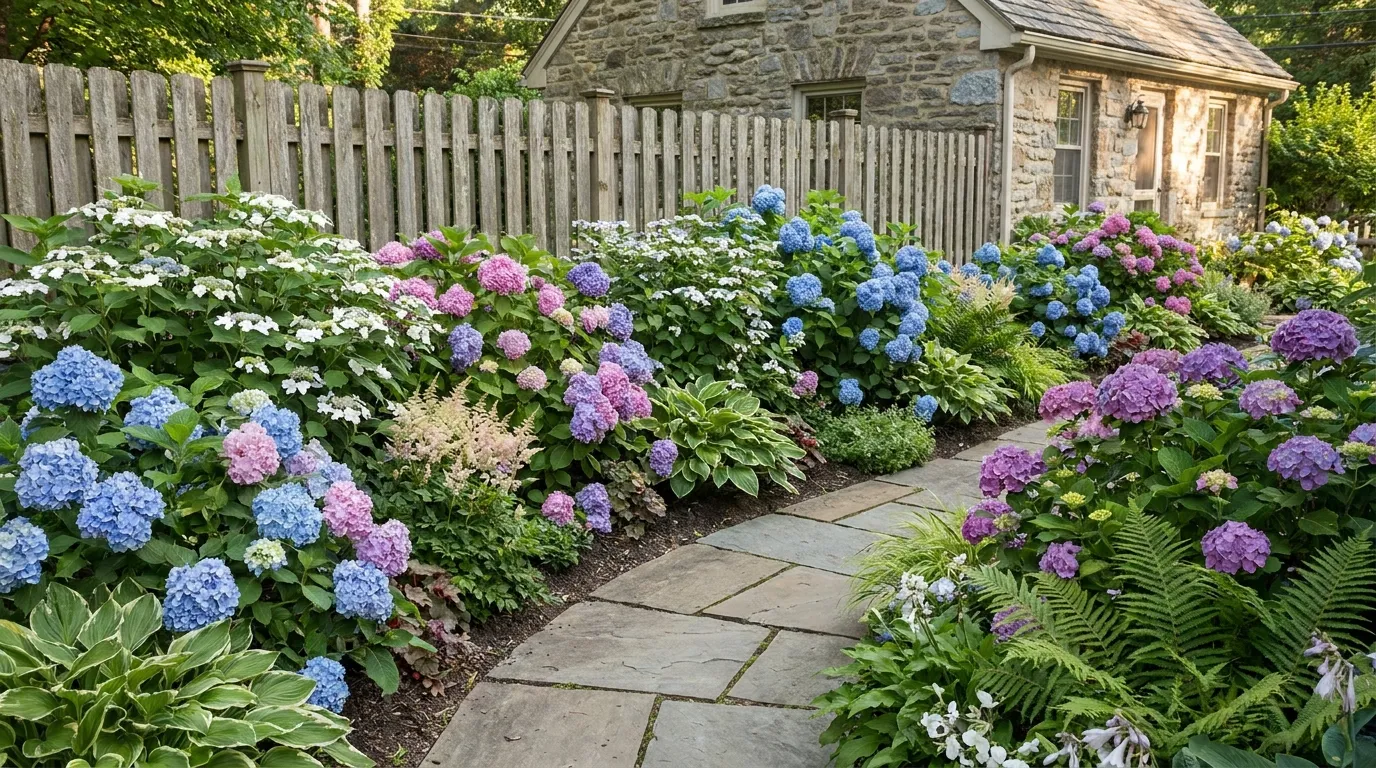
There is a particular kind of front yard that looks like nobody made any decisions. A few shrubs, some mulch, maybe a sad row of annuals that will need replacing by August. It’s not ugly. It’s just completely forgettable, which is almost worse.
Hydrangeas are the correction. They are large, unapologetic, and they bloom with the kind of confidence most plants can only aspire to. A mature hydrangea doesn’t ask permission to take up space. It simply does, and the yard is better for it.
The catch is that hydrangeas are not a decision you make once. They are a commitment. They want the right soil, the right amount of sun, the right pruning at the right time. Get those things wrong and you get a sulking shrub with three flowers and yellowing leaves. Get them right and you get a front yard people slow down to look at.
These yards got it right. Here’s exactly how.
The Ground Rules Nobody Mentions at the Nursery
Most people buy a hydrangea based on the colour of the flowers on the label. They plant it where there’s a gap. They wonder why it’s not performing. The nursery tag had nothing to do with success. The decisions made before the plant went in the ground had everything to do with it.
Sun Is Not a Simple Calculation
Every hydrangea tag says “part shade.” What that means in practice varies wildly depending on which direction your garden faces, what time of day the shade falls, and what kind of hydrangea you’re actually buying.
Bigleaf hydrangeas — the classic mophead and lacecap types — want morning sun and afternoon shade. That’s the combination that produces deep, saturated bloom colour and prevents the flower heads from scorching and going crispy by mid-July. Panicle hydrangeas are the opposite. They tolerate and even prefer more sun, which is why they’re the better choice for south-facing beds against brick walls.
Get this backwards and the plant will live but refuse to be spectacular. Spectacular is the point.
Soil pH Is Controlling Your Colour
If you’re growing bigleaf hydrangeas and want blue flowers, the soil needs to be acidic — a pH below 6.0. In alkaline soil, the same variety will produce pink flowers. This is not a mystery or a miracle. It’s aluminium uptake. Acidic soil makes aluminium available to the plant, and aluminium is what drives the blue pigmentation.
Test your soil before you plant, not after you’re confused by the colour. If you need to acidify, work sulphur or aluminium sulphate into the bed before planting. It takes time — months, not weeks — for the pH to shift enough to change bloom colour. Do not expect instant results.
Spacing Is Where People Go Wrong
A hydrangea at the nursery looks manageable. It is in a two-gallon pot and it is forty centimetres tall. In three years, that same plant can be one and a half metres wide. In five years, wider still.
Plant them at the spacing they need at maturity, not the spacing that looks right the day you install them. That means 90 centimetres to 120 centimetres between plants for most bigleaf and smooth varieties, and up to 150 centimetres for panicle types. The bed will look sparse for the first season. It will not look sparse by the third. Crowded hydrangeas compete for resources, grow poorly, and lose their shape. Give them the room.
What Keeps Hydrangeas Struggling Year After Year
A hydrangea that never blooms is almost always a pruning problem. Prune a bigleaf hydrangea in autumn or early spring and you’re removing the flower buds it set the previous summer. No buds, no blooms. The plant leafs out, looks healthy, and then sits there flowerless while you blame the weather.
Pruning at the Wrong Time
The rule is simple but constantly violated: bigleaf and oakleaf hydrangeas bloom on old wood. Do not touch them after August. If they need tidying, do it immediately after flowering — in late summer — and then leave them alone until the following year. Deadheading spent flowers in autumn is fine. Cutting back hard is not.
Panicle and smooth hydrangeas bloom on new wood. These can be pruned in late winter or early spring without consequences. In fact, cutting them back by about one-third each spring encourages stronger stems and larger flower heads. Knowing which type you have is not optional.
Water That Doesn’t Reach the Roots
Hydrangeas need consistent moisture, particularly in the first two years while they establish. The mistake is watering little and often — a sprinkle every day that wets the top few centimetres of soil and does nothing for the roots. This trains the roots to stay shallow.
Water deeply and less frequently. One to two deep waterings per week during the growing season, soaking the soil to a depth of 20–30 centimetres. A layer of mulch 7–10 centimetres thick over the root zone holds that moisture in and reduces watering frequency without harming the plant. Dark mulch against the deep green foliage of a hydrangea also happens to look exactly right.
Fertiliser That Pushes Leaves Over Flowers
A high-nitrogen fertiliser will give you lush foliage and very few flowers. Hydrangeas don’t need a lot of nitrogen. They need phosphorus for root development and bloom production.
Use a balanced slow-release fertiliser — something in the range of 10-10-10 — applied once in spring as new growth emerges and once more in early summer. Do not fertilise after August. Late fertilising pushes soft new growth that gets caught by the first frost. Stop feeding the plant and let it harden off for winter.
Hydrangea Landscaping Ideas
Window Box Meets Foundation Bed
The design principle at work here is vertical layering — connecting the window box to the foundation bed so the eye reads the whole composition as one continuous statement rather than two unrelated things.
Install a window box across the full width of the window, long enough to extend slightly past the window frame on each side. Use a box at least 25 centimetres deep to give roots enough room and to hold sufficient soil moisture through summer heat. Plant the box with a combination of dark-foliaged sweet potato vine as the trailing element, purple wave petunias for colour volume, and a compact purple-leafed Alternanthera for height at the back. The trailing sweet potato vine should spill generously over the front of the box — allow 30 centimetres of trail at minimum, more if the box is elevated.
Plant the foundation bed below with Limelight or Bobo panicle hydrangeas spaced 90 centimetres apart, allowing them to form a continuous mass of cream and lime-green flower heads. At the front edge of the bed, alternate three to five compact boxwood spheres at regular intervals as a low edging element. The spheres are clipped tight and round, which gives the bed its formality and stops the hydrangeas from reading as a loose, uncontrolled planting. Mulch the bed in dark black bark mulch. The contrast between the dark mulch, the green spheres, and the cream hydrangeas — with the purple-toned window box above — is a four-layer composition built on a single colour logic: cool purple and warm green running vertically from ground to window.
Hydrangeas Under a Shade Tree
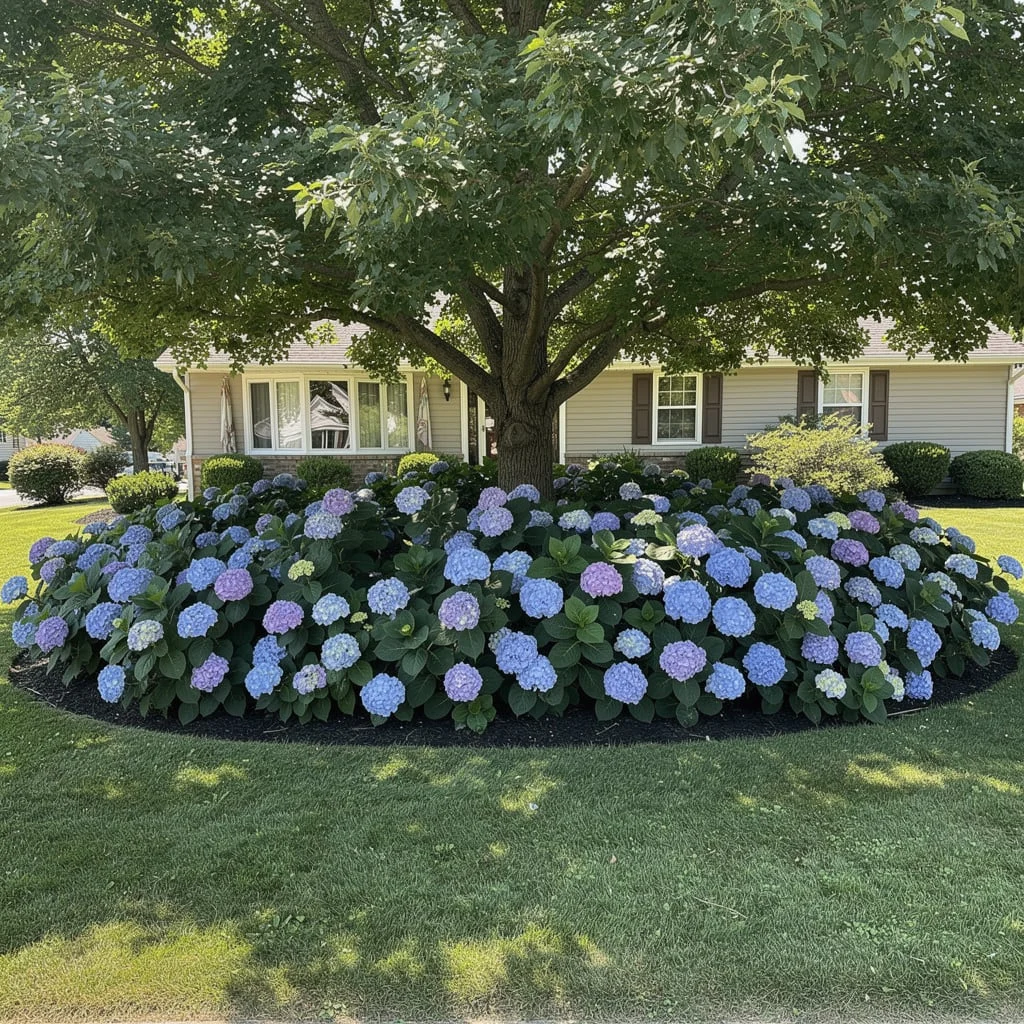
The space under an established deciduous tree is one of the most underused opportunities in a suburban front yard. The shade is dappled, the root competition is real but manageable, and the visual potential is significant.
Excavate a circular planting bed under the tree canopy, with a radius approximately two-thirds the canopy spread. Do not cut large roots — work around them. Improve the soil with compost, adding it generously to the top layer. Plant smooth hydrangeas — Annabelle or Incrediball — around the perimeter of the bed, keeping them away from the immediate root flare of the tree trunk. Leave a 60-centimetre unpainted zone around the trunk where no plants compete directly.
Space the hydrangeas at 90-centimetre centres and mulch the entire bed in dark bark mulch to a depth of 7 centimetres. The circular edge of the bed should be cut with a sharp half-moon edger to a perfectly clean line. No ragged edge. The visual logic of this planting depends on the contrast between the organic canopy of the tree above, the circular geometry of the bed, and the lush dome-shaped flowers of the hydrangeas within it.
The Single-Species Drifting Border
The decision here is to plant a single hydrangea variety in a long drifting border and allow the natural variation in bloom colour — different plants expressing slightly different pH readings in different parts of the bed — to create the interest.
Prepare a border bed at least 120 centimetres wide and as long as the available space allows, ideally following the line of a path, lawn edge, or driveway. Amend the soil with generous quantities of compost and acidify with sulphur if you want blue tones. Plant Endless Summer or Nikko Blue hydrangeas at 90-centimetre centres in a single staggered row. Staggered means two offset lines, not a single straight row — the stagger creates a fuller, more natural profile when viewed from the side.
Mulch the entire bed in a dark-toned hardwood mulch, edging the lawn side with a clean steel garden edge cut to a smooth curve. Do not edge the back of the bed — let the hydrangeas grow naturally against the fence or wall. Over two to three seasons the plants will fill in until the bed reads as a continuous mass of colour. The strength of this planting is its commitment to one thing. No mixed varieties, no competing species. Just hydrangeas allowed to do what hydrangeas do.
Panicle Hydrangeas Framing a Path
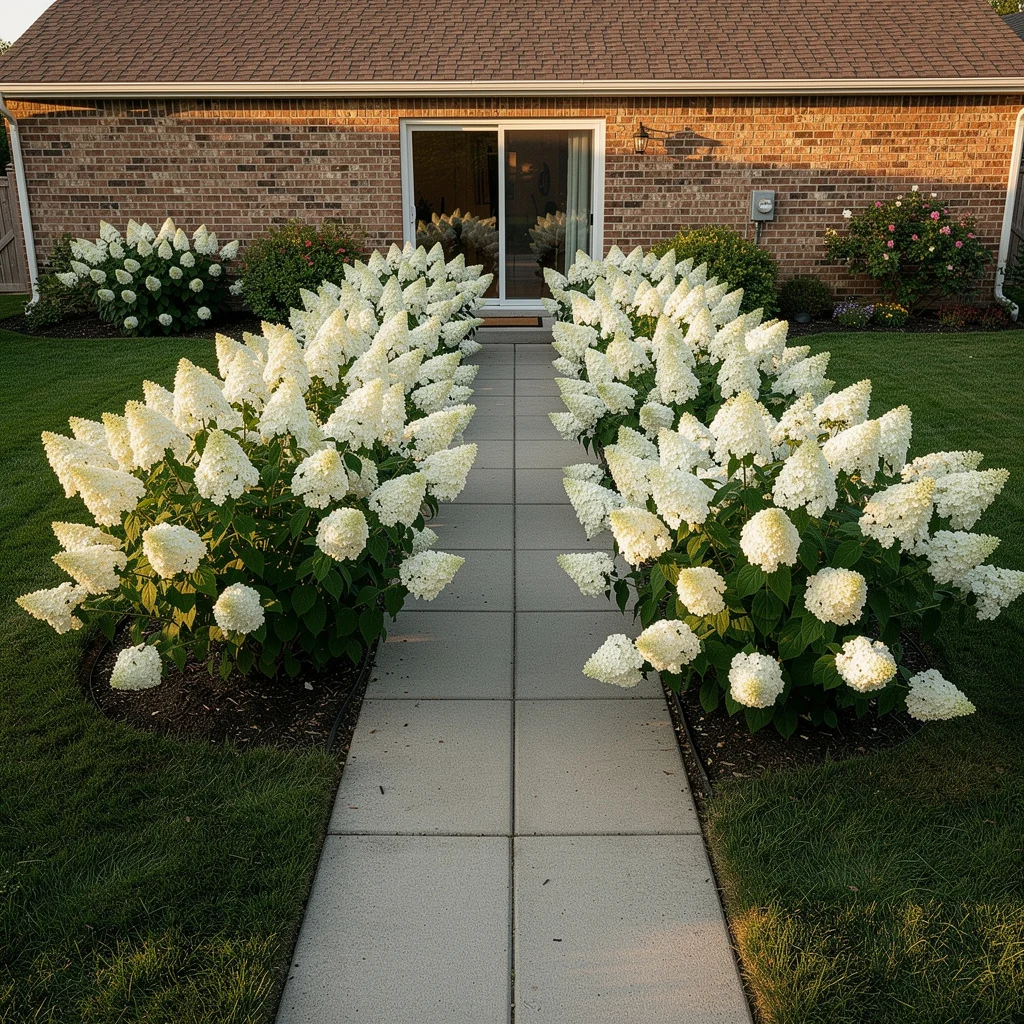
Panicle hydrangeas have the upright form and sturdy stems to create a true avenue effect when planted in mirrored rows flanking a straight path. This is one of the most formal hydrangea arrangements possible, and it works because the plant is built for it.
Choose Limelight, Vanilla Strawberry, or Quick Fire panicle varieties — all reliably upright and tall enough to create an overhead sense of enclosure when mature. Plant one row on each side of the path at 80-centimetre centres, beginning the planting at the path entrance and running it to the door. Keep both rows perfectly symmetrical: the same number of plants, the same spacing, the same alignment. Install the plants using a string line to ensure both rows are parallel.
Allow no other planting in these beds. The power of this arrangement comes entirely from the repetition of a single species in a strict bilateral symmetry. Mulch the beds in a neutral bark and edge the lawn sides with steel garden edging. As the panicle hydrangeas mature and the arching flower-laden stems begin to lean toward the path from both sides, the entry will start to feel like an event rather than just a way of getting to the door.
Blue Hydrangeas Flanking Front Steps
The entry of a house should tell you something about what’s inside. A front door flanked by nothing tells you the owners have not thought about it. A front door flanked by blue hydrangeas tells you someone made a decision.
Excavate a planting bed on each side of the front steps, extending at least 120 centimetres out from the house foundation and running the full width of the stair landing. Add one part compost to the existing soil and incorporate acidifying amendments if your soil is alkaline. Plant a minimum of three Nikko Blue or Endless Summer bigleaf hydrangeas on each side, spacing them 80 centimetres apart so they will merge into a single mass within two seasons.
Allow the plants to grow to their natural height — typically 100 to 150 centimetres — without shaping or cutting back. The size is what creates the enveloping effect that makes the entry feel enclosed and welcoming. Keep the rest of the front garden simple: a clean lawn edge, no competing plantings. The hydrangeas should be the thing. Do not dilute them by adding more plants around them.
Blue Hydrangeas With Lavender
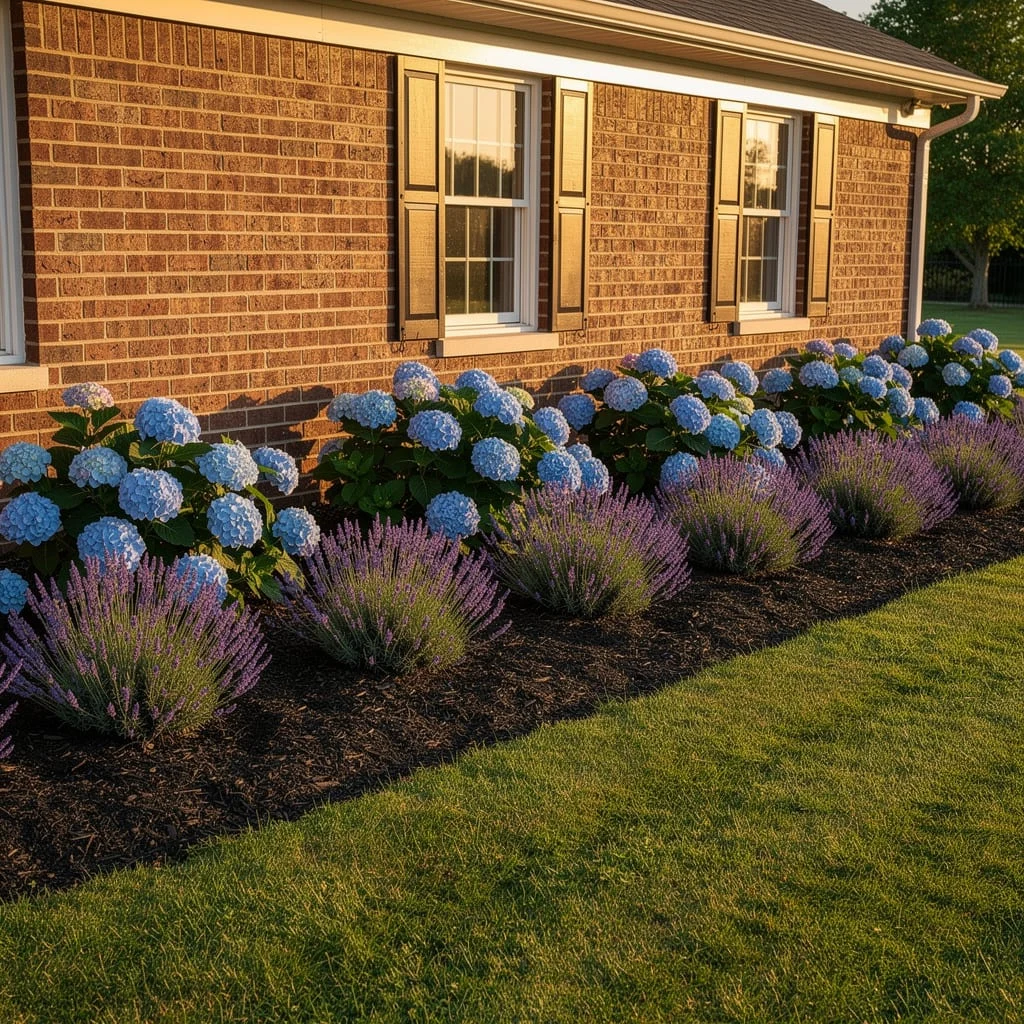
This combination works because blue hydrangeas and lavender share a colour family — they are both cool-toned purples — but they differ completely in scale, texture, and form. The large round heads of the hydrangea sit against the fine vertical spikes of the lavender and the contrast between them is the whole design.
Plant a row of blue bigleaf hydrangeas against the house foundation — one plant per 90 centimetres, running the full length of the bed. In front of the hydrangeas, plant lavender at 40-centimetre centres in a continuous row that runs the full length of the bed. Choose Hidcote or Munstead lavender for compactness and reliable flower production. Mulch the bed in a very dark-toned hardwood bark.
The critical thing is the scale difference between the two plants. The hydrangeas should be significantly taller than the lavender — at least twice the height — so the lavender reads as a foreground layer and the hydrangeas as the background. If the lavender overgrows and competes in height, clip it back hard in late summer after flowering. The layered effect depends on maintaining that size hierarchy.
All-White Cottage Front Garden
Choose Bobo or Little Lime panicle hydrangeas for the primary mass planting — they read as cream to white and hold their colour well through summer. Plant them in a wide front border running the full width of the garden, three plants deep, spaced 80 centimetres apart. Keep the front row lower by selecting a dwarf variety and the back row taller, which gives the planting a gentle graduated profile when viewed from the street.
Leave a central axis of lawn from the garden gate to the front step, flanked symmetrically by the hydrangea planting. The symmetry is what reads as formal and intentional. Paint the front door a soft duck egg blue or sage green — the contrast between a soft coloured door and an all-white hydrangea planting in front of white or pale grey siding is quiet but legible. Plant a single large ceramic urn on one side of the path, near the door, as the composition’s punctuation mark.
Maintain the lawn central axis at a consistent width — use string lines to keep both edges even when mowing. The tidiness of the lawn panel between the planting masses is what makes the whole composition read as controlled rather than overgrown.
Full-Width Foundation Planting
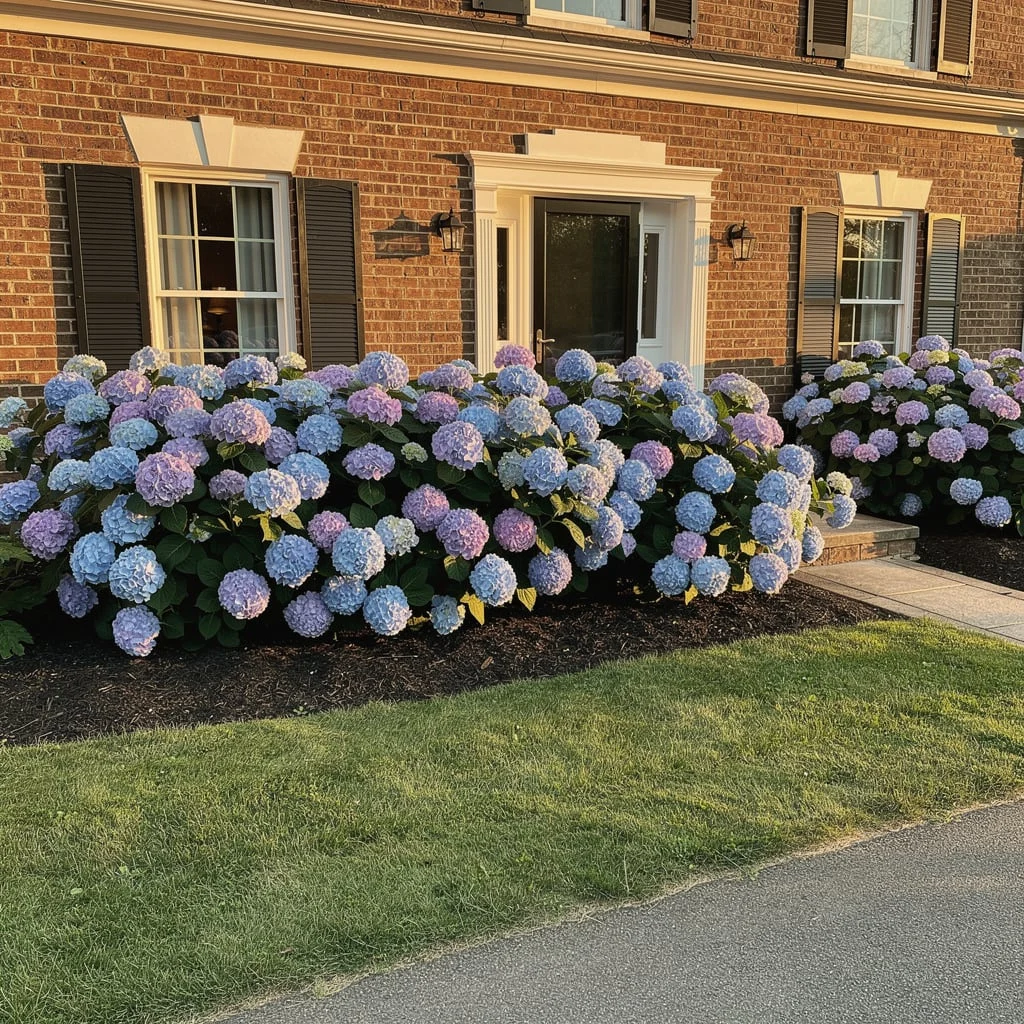
The challenge of a wide brick facade with multiple windows is proportion. Individual plants disappear against the mass of the wall. The solution is not more plants. It is bigger plants, planted densely enough to read as a continuous horizontal band.
Plant Endless Summer or Nikko Blue bigleaf hydrangeas at 80-centimetre centres along the full foundation length — do not leave gaps between plants or between plants and the house corners. The planting should feel like it wraps the house rather than sitting in front of it. Amend the soil before planting with compost and maintain consistent moisture through the first two summers while the plants establish.
Mulch the bed in dark bark mulch and cut a clean curved edge at the lawn boundary — not a straight line, but a gentle curve that follows the natural flow of the lawn. The black shutters on the windows above will read as a vertical counterpoint to the horizontal band of blue flowers below. Do not add any other plants to this bed. The simplicity is the strength.
Terracotta Pot Porch Display
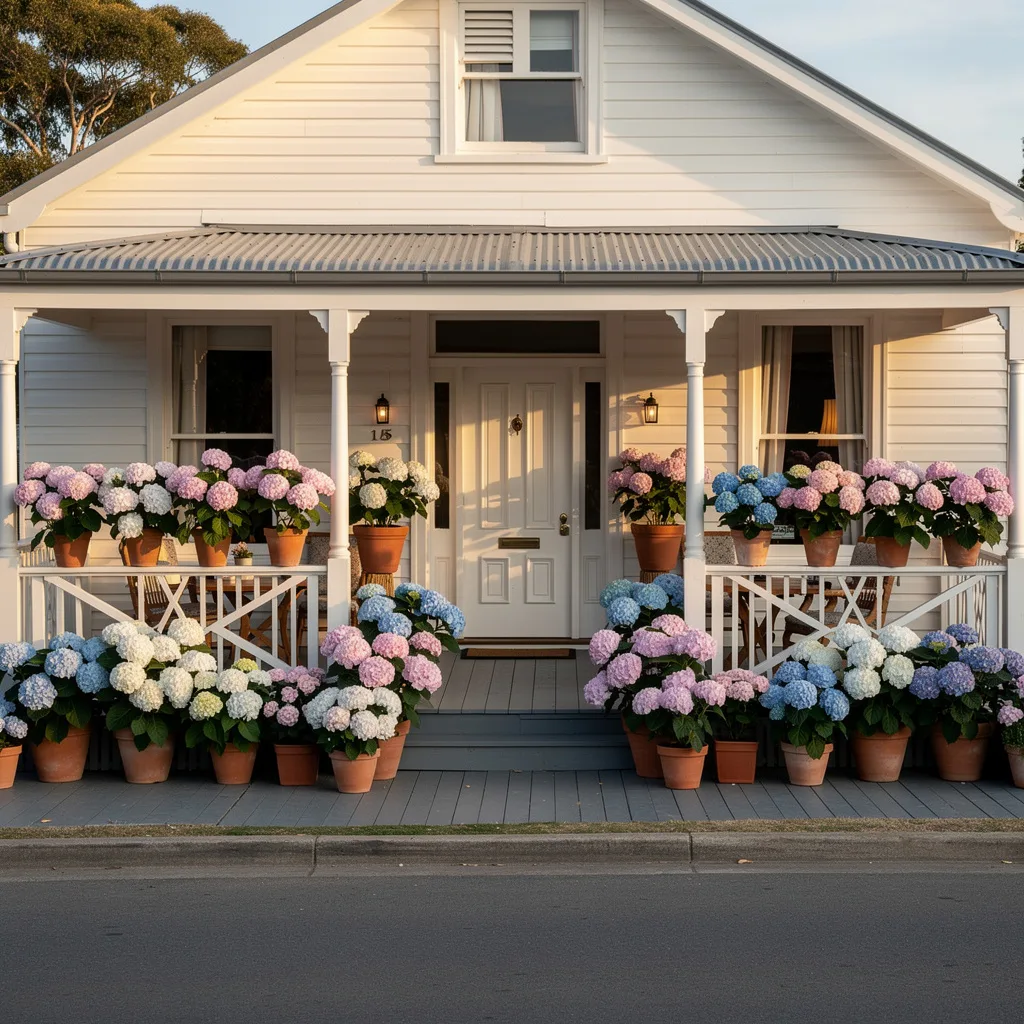
Hydrangeas do not need to be in the ground to make a statement. Massed in terracotta pots on a covered porch, they create an effect that is seasonal, moveable, and extraordinary at peak bloom.
Buy terracotta pots in a consistent size — 35 to 40 centimetres in diameter — and a consistent colour. Consistency in the containers is what makes the massed effect read as designed rather than collected. Plant one hydrangea per pot in a mix that includes good moisture-retaining potting soil and perlite for drainage. Choose a mix of bloom colours across the pots — white, soft pink, lavender, and sky blue — but keep the tones in the same cool family.
Arrange the pots on the porch floor in a staggered double row on each side of the door, with the tallest and fullest pots at the back of each group. Place a second row of pots along the porch railing, smaller specimens in matching terracotta, creating a continuous line of flower colour at railing height. Water the pots daily during summer, as terracotta dries quickly. Feed with a liquid potassium-high fertiliser every two weeks through the blooming season. At the end of summer, plant the hydrangeas out into the garden, replace the pots for the following year, and begin again.
Cottage Garden With Climbing Roses
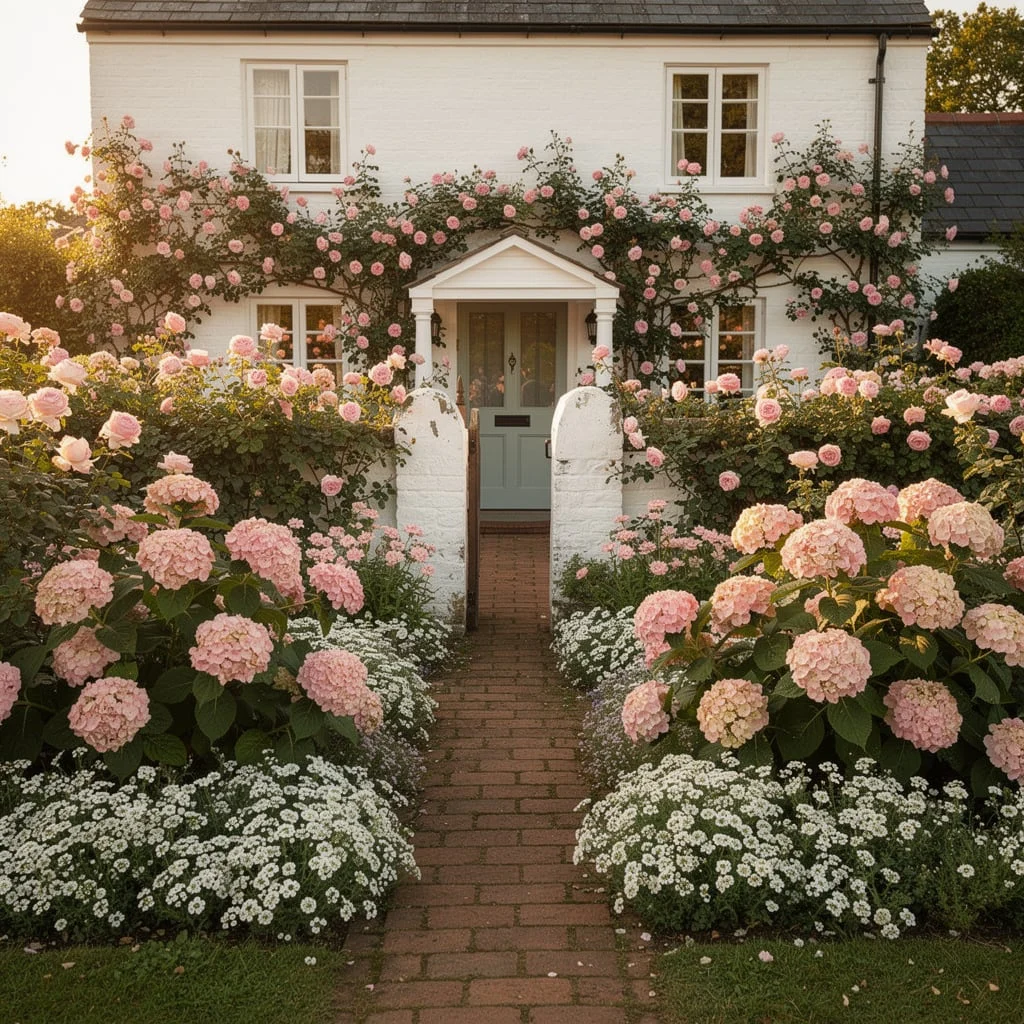
This is the most ambitious combination here and also the most rewarding. The principle is layering: ground-level white flowers, mid-height pink hydrangeas, and overhead climbing roses forming an arch or canopy above the entry path.
Lay a brick or terracotta tile path from the garden gate to the front door, running straight with a consistent width of 90 centimetres. On each side of the path, plant compact bigleaf hydrangeas — choose a blush pink or dusty rose variety like Incrediball Blush or Let’s Dance Diva — at 80-centimetre spacing. In front of the hydrangeas, plant a continuous drift of white hardy annuals or low perennials: white sweet alyssum, white baby’s breath, or white cosmos. These low plants soften the path edge and provide textural contrast to the large hydrangea heads above.
Secure climbing roses to the house facade on each side of the door, training the main canes outward and upward in a fan shape using masonry anchors and soft garden ties. Choose a repeat-blooming climber in soft pink — Climbing Eden or New Dawn are reliable choices. Over three to five seasons, the roses will reach the roofline and arch over the door, completing the vertical layer above the hydrangeas and the low white planting below. The gate, if there is one, should be painted white. The front door, sage green or pale blue.
The Hydrangea Hedge
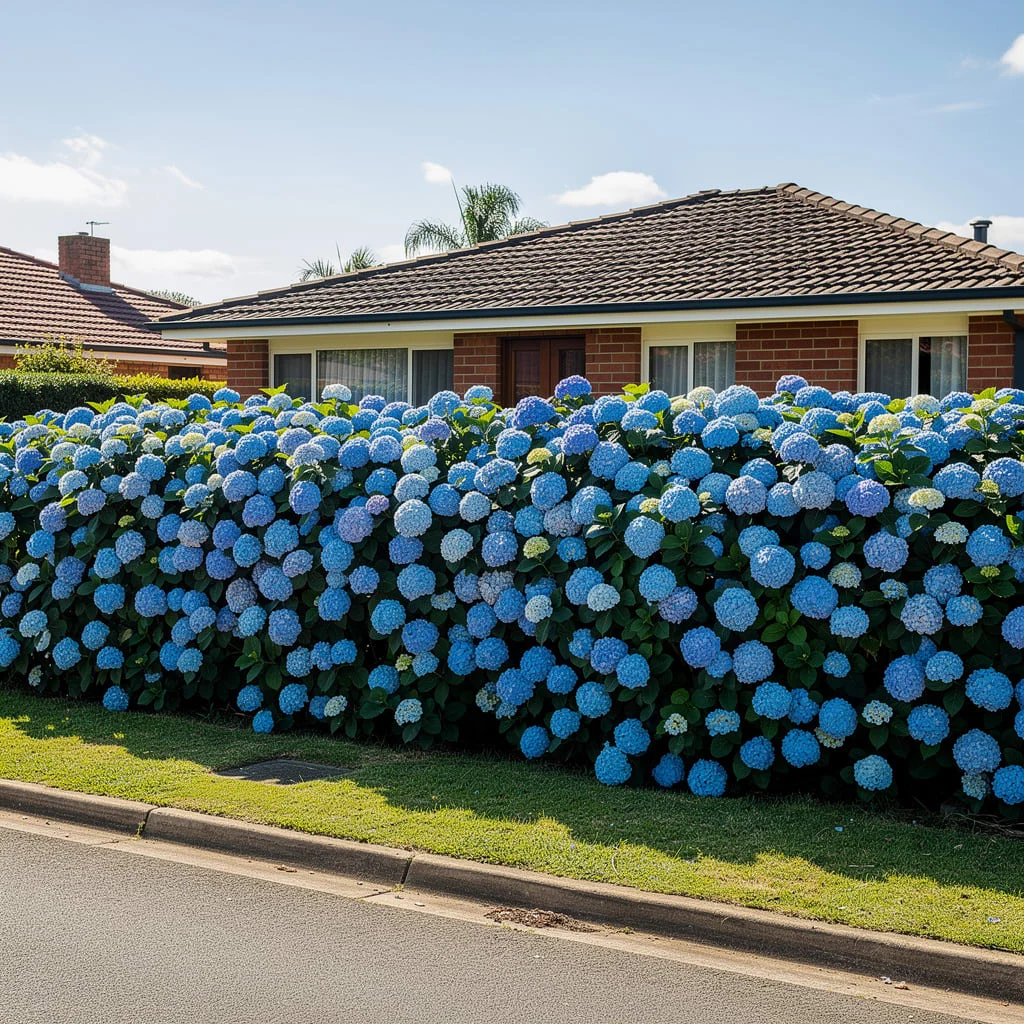
A hedge of flowering shrubs is a different kind of boundary to a fence or wall. It is alive, seasonal, and beautiful in a way that no manufactured material can be. The hydrangea hedge is also the most dramatic option on this list.
Choose a single mophead variety in a clear sky blue — Nikko Blue is the most reliable for this effect — and plant at 60-centimetre centres in a single straight row. This close spacing will produce a continuous solid mass within two seasons. The first season will look sparse. Plant anyway and trust the timeline.
Allow the hedge to grow to its natural height without top-clipping — typically 120 to 150 centimetres. Do not shape the top into a flat line as you would with a formal hedge. Let it follow the natural undulation of the individual plants. The organic top line is what makes it read as a flowering hedge rather than a clipped barrier. Mulch the base generously. Keep the lawn edge at the front razor sharp by edging with a half-moon edger monthly through the growing season. The contrast between the close-clipped lawn edge and the extravagant flower mass above it is the composition.
Statement Specimen in the Lawn
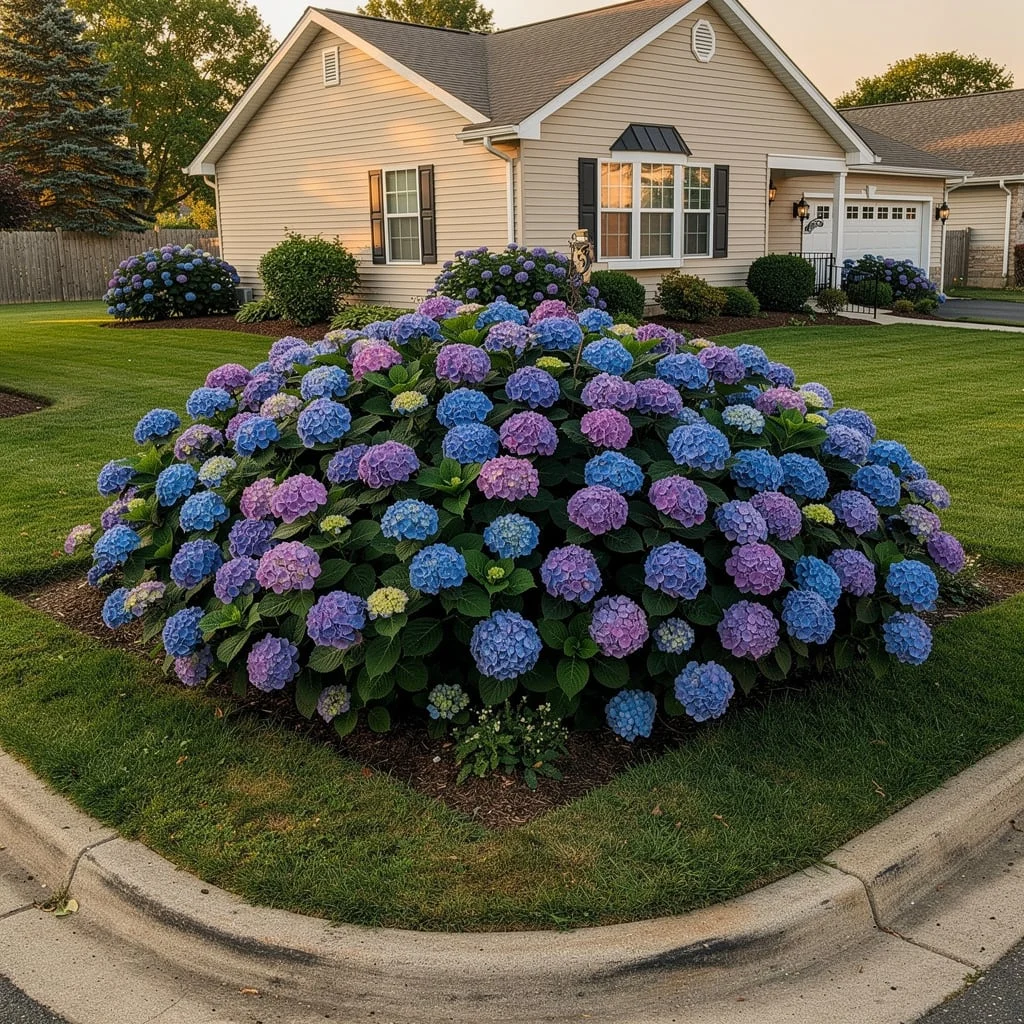
A single large hydrangea specimen grown as a focal point in an open lawn requires a different approach to a border planting. The plant is on its own, visible from all sides, and carries the entire composition by itself. It has to be magnificent.
Choose an established specimen — buy the largest plant the nursery offers, not the smallest — and plant it in the centre of a prepared circular bed in an open lawn position. The bed should be at least 180 centimetres in diameter. Plant Endless Summer or a large-growing blue bigleaf variety, incorporating generous compost and acidifying amendments into the planting hole and surrounding bed area.
Mulch the circular bed in a very dark hardwood bark, edging the perimeter with a sharp, clean circular cut. Keep the lawn surrounding the bed in excellent condition — reel mow it if possible to create a fine, even surface. The lawn is the backdrop for the specimen, and a coarse or patchy lawn undermines the effect. Feed the hydrangea generously and water deeply through summer. This plant is the centrepiece and it should look like it.
Mixed Colour Fence-Line Border
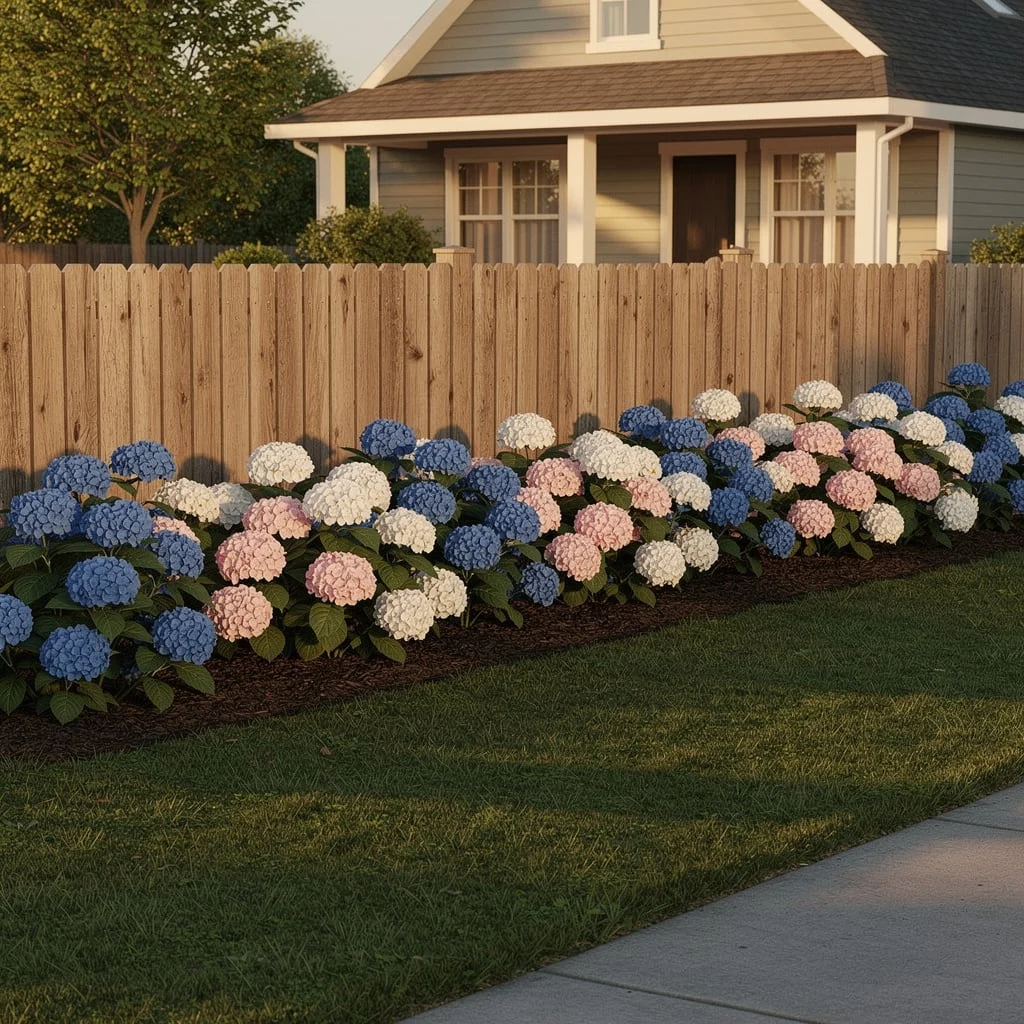
A fence is not a backdrop for nothing. A fence-line bed of mixed hydrangeas — planted in a way that allows the colours to mingle naturally rather than sitting in rigid colour blocks — is one of the most generous and beautiful effects in a residential garden.
Prepare a bed along the full length of the fence, 120 centimetres wide, with good amended soil and dark mulch. Plant a mix of bigleaf hydrangea varieties in white, soft pink, and blue, choosing cultivars of similar mature size so no one variety dominates the others. Do not plant in colour order — blue, then white, then pink, in a repeating pattern. Plant them apparently at random, allowing the colours to sit next to each other without a logical sequence. The mixed-in-the-field effect is what looks natural.
Space the plants at 80 centimetres and mulch densely in dark hardwood bark. The dark mulch behind and beneath the plants makes the pale flower heads read as vivid. Cut a clean lawn edge at the front of the bed and maintain it through the season. The fence behind the planting — wood, vinyl, or brick — acts as a neutral vertical backdrop that shows off the flowering mass in front of it.
Limelight Hydrangeas Against a Brick Wall
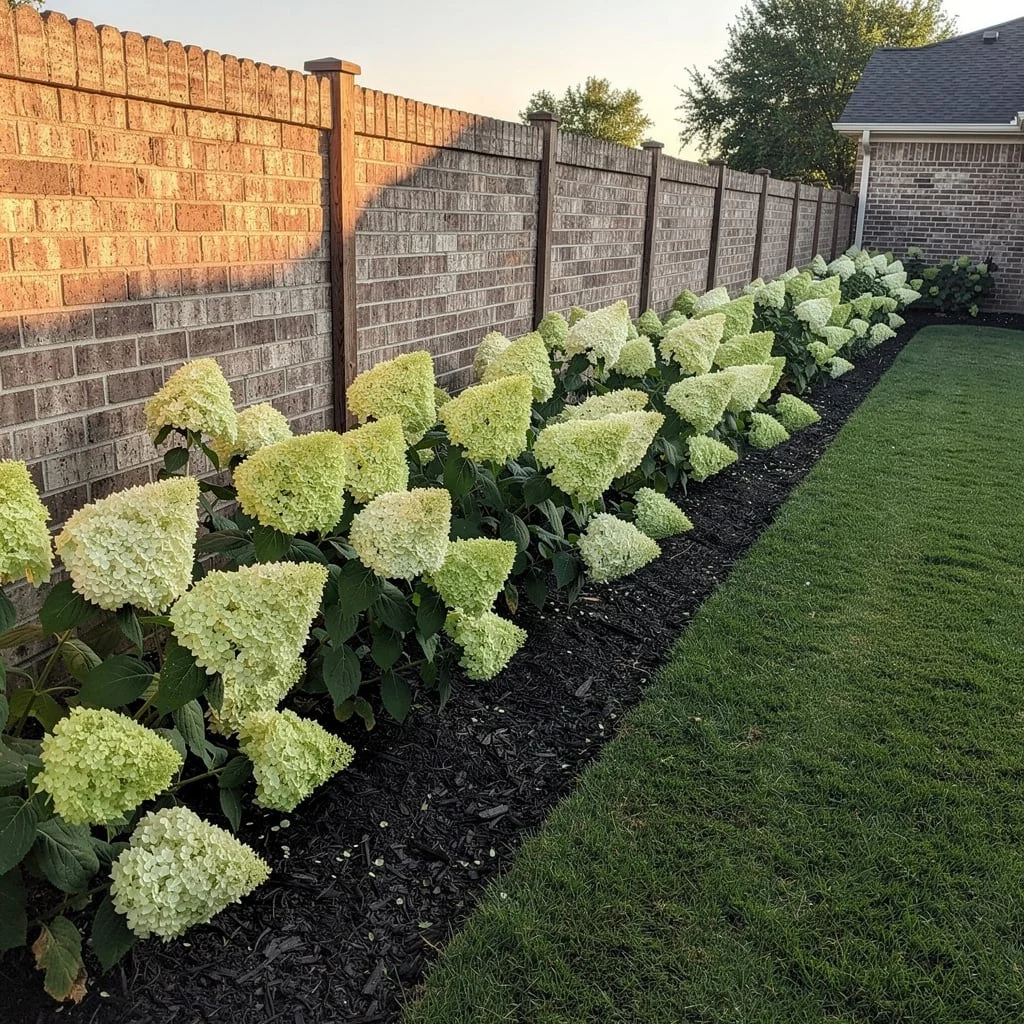
Limelight panicle hydrangeas planted in a continuous bed against a warm brick wall create a particular effect that no other combination quite replicates: the lime-green and cream flowers against warm red or tan brick, with a strip of near-black mulch at the base.
Plant Limelight hydrangeas at 80-centimetre centres along the fence or wall line, choosing specimens of consistent size so the planting presents an even top line. The mature height of Limelight is around 180 centimetres, which positions the flower heads at a height that is visible above the fence while the bulk of the plant fills the foreground.
Mulch the bed in the darkest possible bark mulch — nearly black. The contrast between the dark mulch and the lime-green flower heads is a significant part of the visual impact. Edge the lawn side of the bed in steel garden edging bent to follow a smooth parallel line to the fence. This bed works best when it runs the full length of the fence without interruption. Stopping partway, or leaving gaps at corners, breaks the continuous horizontal band effect that gives this planting its scale and authority.
Annabelle Hydrangeas Along a Driveway
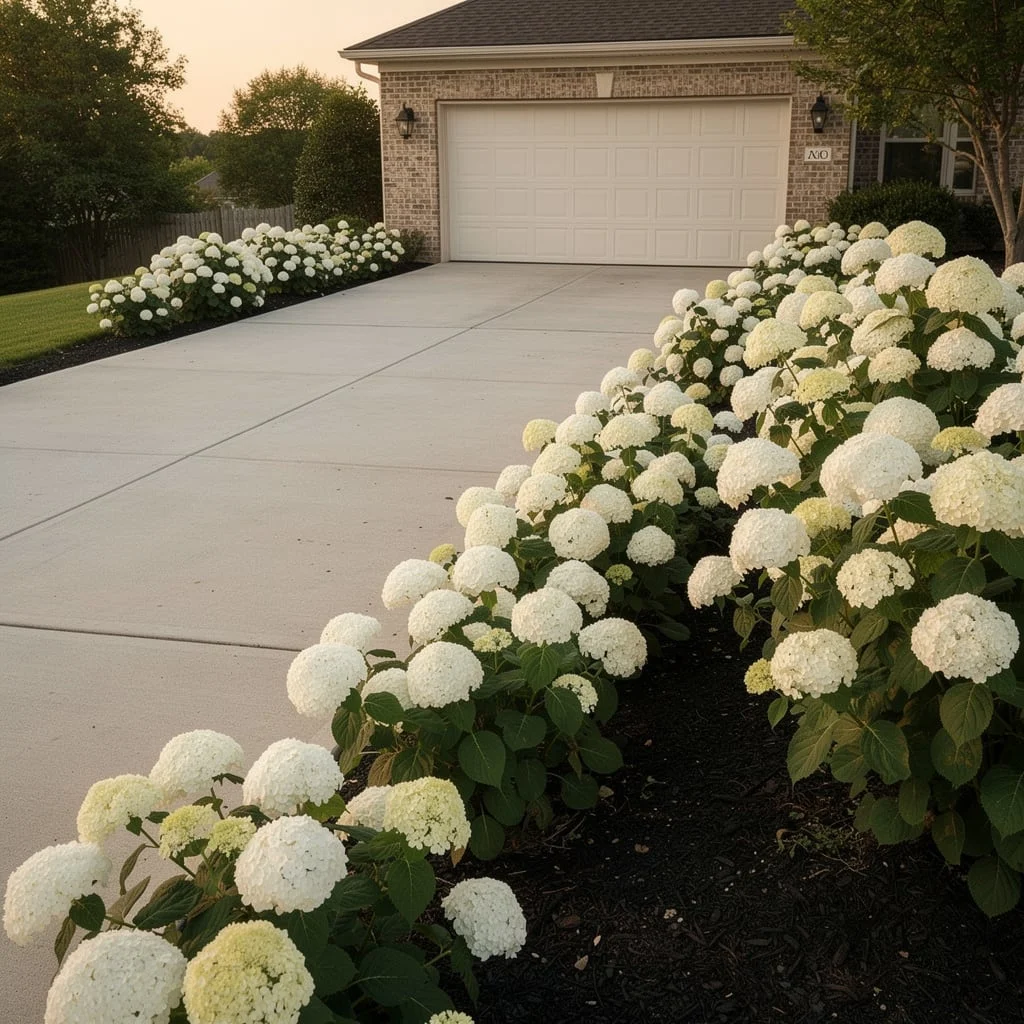
Smooth hydrangeas — Annabelle and its improved relatives Incrediball and Invincibelle — are the easiest hydrangeas to grow and the most reliable producers of large, round, white flower heads. Along a driveway, planted in a continuous mass, they create an arrival sequence that is completely out of proportion to the effort required to achieve it.
Plant Incrediball or Annabelle smooth hydrangeas at 80-centimetre centres along both sides of the driveway, beginning at the street edge and running to the house. Keep the planting on both sides symmetrical in number and spacing. Do not mix varieties between the two sides — choose one and repeat it. Mulch both beds in dark bark mulch and cut clean edges at the driveway side and the lawn side of each bed.
Smooth hydrangeas bloom on new wood, which means they can be pruned hard in late winter and will still flower that summer. Cut them back by one-third each spring to encourage strong upright stems that hold the flower heads clear of the driveway. Left unpruned, the stems weaken over years and the heavy flower heads flop, which is both untidy and a hazard for passing cars. The pruning is not optional — it is part of the annual maintenance that keeps this planting looking the way it should.
Final Thoughts
Hydrangeas reward commitment. That’s the thread running through every yard on this list. The ones that look extraordinary did not get there by accident — they got there because someone decided to plant a lot of one thing and do it properly.
The yards that settle for one hydrangea in a mixed border, squeezed between a spirea and whatever was on sale at the garden centre, never look like this. They look like an afterthought dressed up as a garden.
Decide what you want the plant to do. Give it the soil and sun it needs to do it. Plant enough of them. And then step back and let the summer do the rest.