
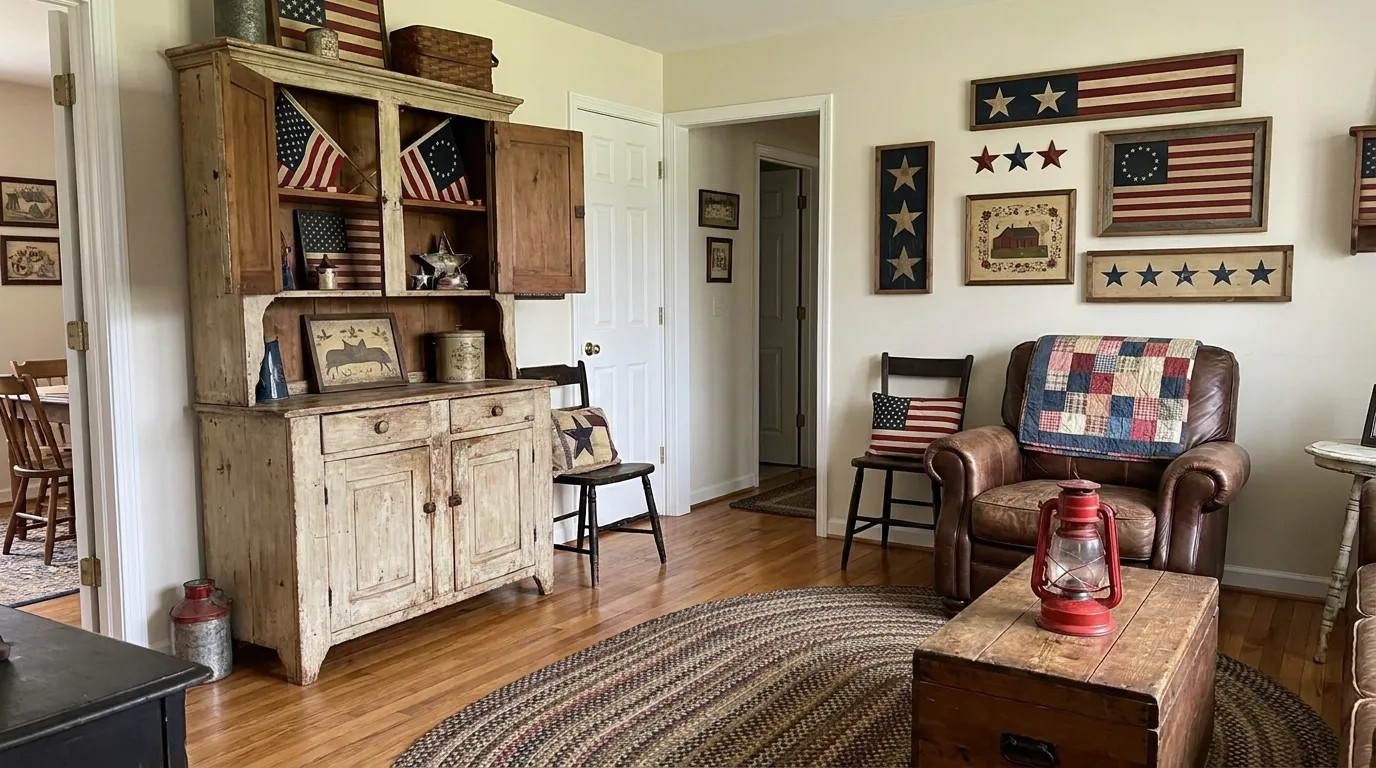
Somewhere between the sad plastic flag from the dollar store and the house that genuinely stops traffic, there is a gap most people never close. They put out one flag, maybe a wreath, call it patriotic, and move on. The houses that actually look the part understand something different: Americana decor is not about quantity of flags. It is about commitment to a visual idea, executed with enough confidence that the whole composition reads as intentional.
Red, white, and blue is a demanding palette. It is loud. It does not forgive half measures. Used without restraint or structure, it looks like a clearance bin. Used well — with the right backdrop, the right scale, the right layering of materials — it looks like the Fourth of July should always look, which is to say: proud, warm, and slightly over the top in the best possible way.
These homes got it right. Here is exactly how to recreate each one.
The House Is Not a Neutral Backdrop
Most people treat their house as the background against which they hang things. The houses that photograph well for Americana decor treat the architecture as part of the decoration itself. The door colour, the trim colour, the texture of the siding — all of it either supports the red, white, and blue palette or fights it.
Choosing the Right Door Colour
A black door is the single best choice for Americana decor. It absorbs the red and white and blue visually, making the decorations read as more saturated and vivid against it. Navy blue is the second best option. It sits inside the palette without competing.
Avoid red or warm wood tones as door colours during the holiday season. A red door next to red bunting is noise. A black door next to red bunting is contrast. Contrast is what makes the decoration legible from the street.
Why White Siding Wins
White painted brick or white clapboard siding is the most forgiving background for patriotic decoration. The white reads as neutral while simultaneously belonging to the red, white, and blue palette. Every piece of fabric, every flower pot, every flag you hang against it sits in front of a surface that is doing design work on your behalf.
Grey shingle siding — the kind you see on Cape Cod and New England farmhouses — is the second best backdrop. It is warm and architectural, and it makes flags and bunting look like they belong to the building rather than having been applied to it. Red brick is workable but requires more care with colour selection, as the warm tone of the brick competes slightly with the red in the palette.
Scale Before Anything Else
The mistake most people make when decorating for the Fourth of July is choosing elements that are too small for the scale of the facade. A single 12-inch wreath on a wide double-door entry disappears. A 24-inch wreath on the same door makes a statement. A basket of flags on a door that is flanked by two large pieces of draped bunting becomes a composition.
Before you buy anything, measure your door height and width. The decoration needs to fill the visual field of the entry. If it does not reach from column to column, from roofline to floor, from wall to wall — add more until it does.
The Colour Logic That Makes Americana Work
Patriotic decor fails when the three colours are used in equal measure with no hierarchy. Equal quantities of red, white, and blue fight each other. Successful Americana decoration chooses a dominant colour, a supporting colour, and an accent.
Setting the Dominant Tone
White should almost always be the dominant colour in Americana decor. Not because it is timid, but because it is the neutral in the palette — it creates breathing room for the red and blue to register. White hydrangeas, white porch columns, white painted railings, white ceramic pots, white siding — these are the field against which the red and blue read as colour rather than noise.
When you flip this and make red the dominant colour, everything starts to feel urgent and loud. That can work for a single accent moment — a row of red geraniums, a red lantern — but as the primary colour it is overwhelming. Red works best as the warmth in the composition. Blue works best as the depth.
The Role of Greenery
Natural greenery is the most underused element in Americana decor and one of the most important. Boxwood spheres in iron urns, fern fronds tucked into a wreath, fresh herbs in a basket hung on a door — green interrupts the three-colour palette in a way that makes everything else read as more saturated and alive.
Without greenery, patriotic decor looks like a flag store. With it, it looks like a garden that happens to be celebrating something.
Texture Is Doing Half the Work
The difference between Americana decor that looks expensive and Americana decor that looks like it came from a party supply chain is almost entirely about texture. Natural linen, aged cotton bunting, wicker baskets, terracotta pots, wrought iron, weathered wood — these materials carry a warmth and authenticity that mylar balloons and plastic never will.
When you are choosing materials for your decorations, ask whether each element looks like it could have been around for a hundred years. If the answer is yes, it belongs in a composed Americana display. If it looks like it was manufactured last Tuesday, it will undermine everything next to it.
Americana Decor Ideas
Draped Bunting Door Entry
The primary element here is patriotic star-and-stripe fabric — either purpose-made bunting or actual cotton flags — draped in generous swoops across the top of the door frame and allowed to cascade down both sides. The key word is generous. The fabric should droop at least 15 to 20 centimetres below the top of the door frame at its lowest point in the center, and the sides should fall to within 30 to 40 centimetres of the floor, tied loosely at two or three points to create soft folded volumes rather than flat panels.
Source a decorative wicker or rattan wall basket — the kind typically used for dried floral arrangements — and fill it with a dense cluster of small handheld American flags, their handles pointing downward into the basket and the flags fanning outward. Mount the basket centered on the door at roughly eye level. The basket anchor brings the composition into the center of the door rather than leaving the entry reading as two separate curtains with nothing between them.
Flank the door at floor level with two matching iron urns or cast-metal planters planted with clipped boxwood spheres. The green spheres ground the whole composition and provide the natural element that stops it from reading as pure pageantry.
Pergola Patio With Bunting
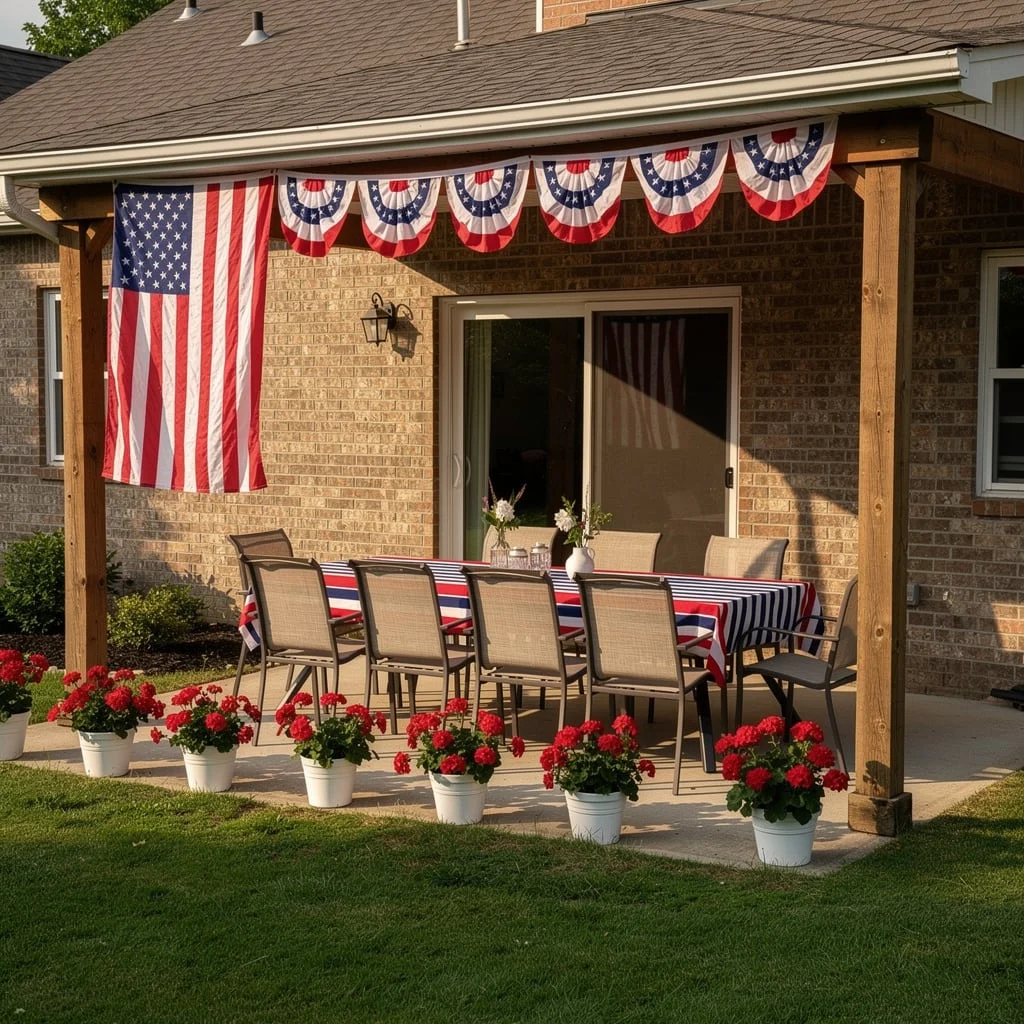
The pergola frame is the structural element that makes this decoration possible. Without the horizontal beam from which to hang the bunting, the patio lacks the overhead plane that transforms it from an outdoor dining area into a decorated room. If your patio has a pergola or covered frame, use every linear foot of it.
Hang fan bunting panels continuously along the full front beam of the pergola — panel to panel with no gaps. Use pre-made cotton or polyester semi-circular bunting in the standard red, white, and navy with star border. Mount each panel using small plastic S-hooks through the bunting grommets, hung from a wire stretched taut between the corner posts. The wire allows the bunting to hang at a consistent height and makes installation and removal easy.
On the left side wall of the pergola, hang a full-size flag flat against the brick, using two small adhesive flag mounts or picture-hanging strips. The flag hangs portrait orientation — stars at top left — as the vertical counterpoint to the horizontal bunting above. Dress the dining table beneath with a horizontal stripe tablecloth in red, white, and navy. Run a continuous line of matching white buckets planted with red geraniums along the base of the pergola, spaced evenly. The white buckets and red flowers at floor level mirror the colours in the bunting above and anchor the composition to the ground.
Window Seat With Bunting and Wreath
A large window or bay window is the ideal canvas for this treatment because the exterior view provides natural depth and greenery behind the decoration, making everything in the foreground read as more vivid. The decorative bunting used here is the semicircular fan-style — half-moon shaped fabric panels in red, white, and navy with gold stars — hung in a continuous row across the top of the window frame on a tension rod or command hooks.
Above the fan bunting, add a second layer of pointed pennant-style banner — alternating white and navy triangles printed with stars and stripes — strung across the same span. The two garland types at different scales create a layered cornice effect across the window without blocking light or view.
For the wreath, choose a natural base — grapevine or wire form — and build it with white hydrangea clusters, fresh or faux, as the primary floral element. Add red berry stems and dark navy or black berry clusters for colour depth. Finish with a large multiloop bow in an American flag-stripe ribbon, with generous trailing tails. Hang the wreath centered in the window on a suction cup hook. On the window seat below, layer four to six pillows in a mix of block-print blue and white florals with blue ruffle edges, red gingham with fringe, and one central flag-print pillow. The pillow arrangement should feel full enough to sit among, not formal enough to avoid.
Patriotic Window Box Facade
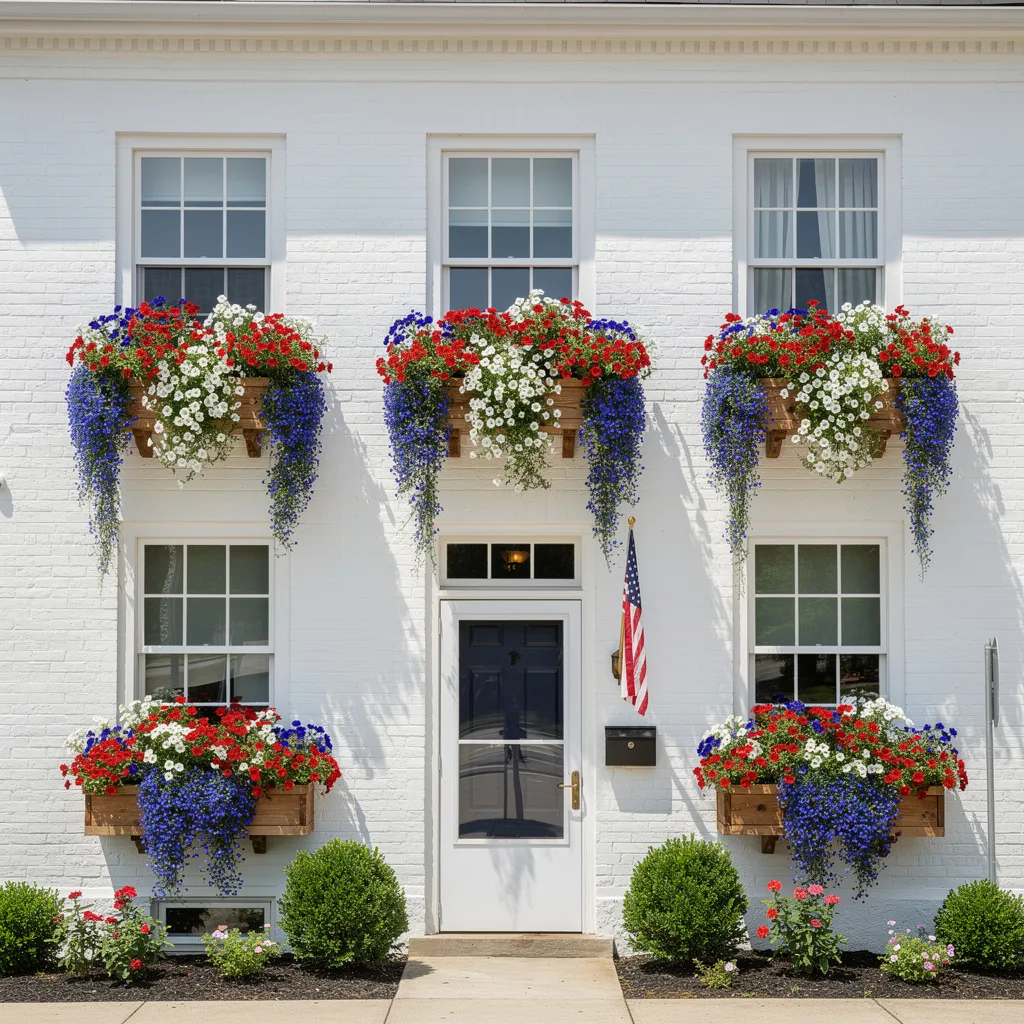
The entire facade effect here depends on three things: identical window boxes at every window, identical planting in every box, and no other decorative elements competing for attention. The repetition is the design.
Build or source cedar window boxes — rough-sawn or smooth finished, either works — at a consistent depth of at least 25 centimetres. Mount them on exterior brackets beneath every visible window using coach bolts and matching black metal brackets. Plant each box identically: red geraniums or red salvias at the back for height, white wave petunias or white bacopa as the mid-layer, and blue Lobelia as the trailing front element. Allow the lobelia to trail at least 20 to 25 centimetres below the box front. The trailing plant is what creates the generous, overflowing effect that makes window boxes look expensive rather than sparse.
A single American flag mounted vertically beside the door — not on a bracket angled outward, but flat against the wall on a proper vertical mount — provides the one non-botanical patriotic element in the composition. Everything else is plants. The white-painted brick facade behind it is the unifying backdrop, and the matching boxes across all five windows create a horizontal rhythm across the facade that reads as architectural rather than decorative.
Patriotic Pinwheels on the Lawn
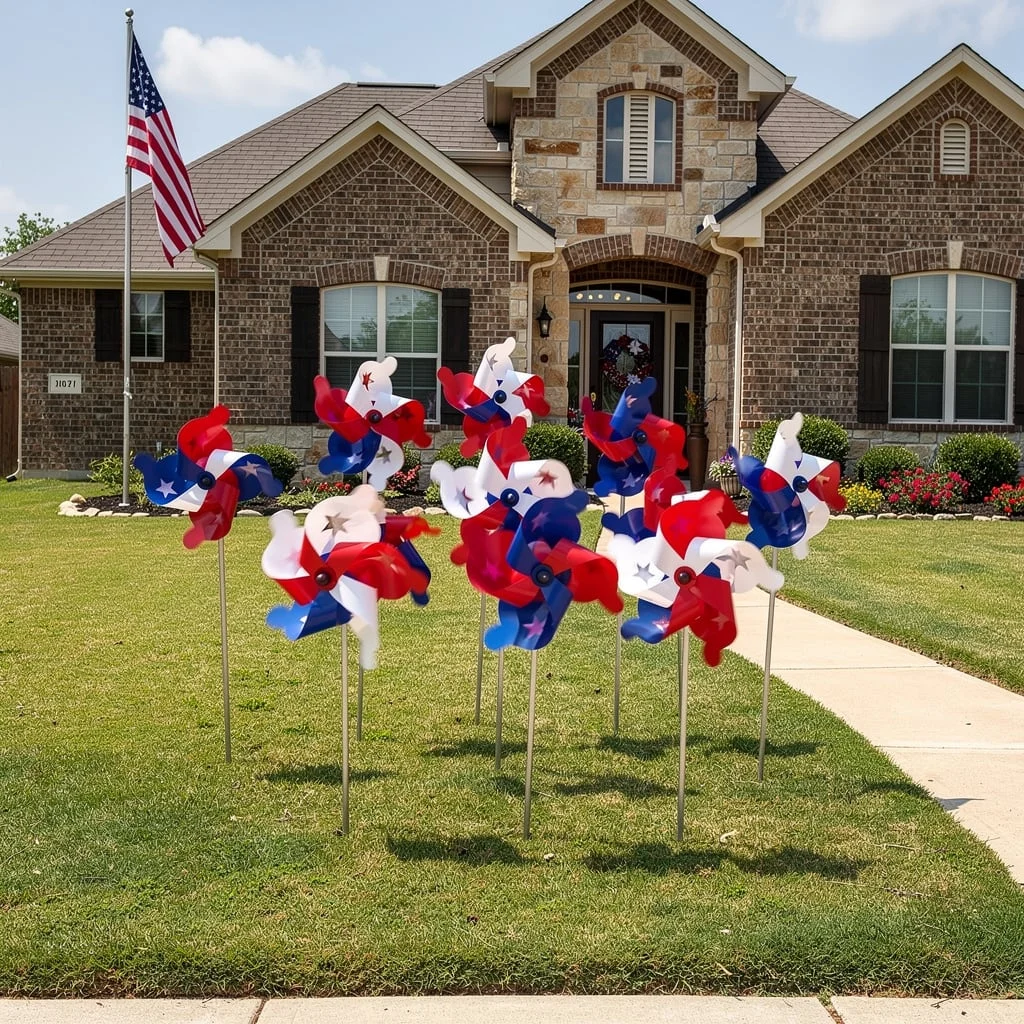
This one only works if you commit completely. Three pinwheels on a lawn look like a child’s birthday party. Twelve pinwheels in a tight cluster look like a decision.
Purchase large-format plastic pinwheels — 30 to 35 centimetres in diameter — in patriotic red, white, and blue, with metallic star cutouts if available. Group them in a tight, overlapping cluster of ten to fifteen pinwheels in a section of the front lawn closest to the street, inserting the stakes close together so the spinning discs overlap and create a kinetic mass of colour. The motion of multiple pinwheels spinning simultaneously at different speeds is what makes this work — the eye is drawn to the movement.
Position the cluster slightly off-center on the lawn rather than in the middle of it, so it sits as an accent to the full composition rather than bisecting the view of the house. A full-size flag on a proper steel pole at the opposite side of the lawn provides the stationary counterpart to the spinning cluster. The scale difference between the large flag and the spinning cluster of smaller pinwheels creates a composition with two focal points that work together rather than competing.
Farmhouse Patriotic Bedroom
The iron or metal bed frame is the structural anchor — nothing else will give the room the vintage weight it needs. If you are starting from scratch, look for wrought iron or powder-coated steel frames in antique or black finishes at estate sales or furniture resale shops. The aged character of the metal is part of what makes the patriotic textile layering feel earned rather than costume-like.
Start with a white quilt as the base layer. Over it, lay a flag-print or stars-and-stripes quilt — properly sized, so it reaches the footboard and drapes over both sides. Stack the pillows in order: two large white sleeping pillows at the back, two standard pillow shams in red-and-white ticking or narrow stripe in front of them, and one accent pillow in a stars-print navy in the center. That three-layer arrangement is what creates the full, styled look rather than the flat, unstaged one.
Mount a wicker or seagrass wall basket to one side of the headboard and fill it with a mix of faux or fresh greenery, red berry stems, white florals, and a small American flag tucked in at an angle. Add a wooden or galvanized star as a wall accent above the basket. Hang a framed American flag print — either a vintage reproduction or a hand-painted panel on reclaimed wood — on the opposite wall at picture-hanging height. Place a red metal lantern with a pillar candle on the floor beside the bed as the finishing detail. Its colour is the warmest note in the room and it pulls the eye downward, completing the vertical range of the composition.
Flag and Hydrangea Wreath Door
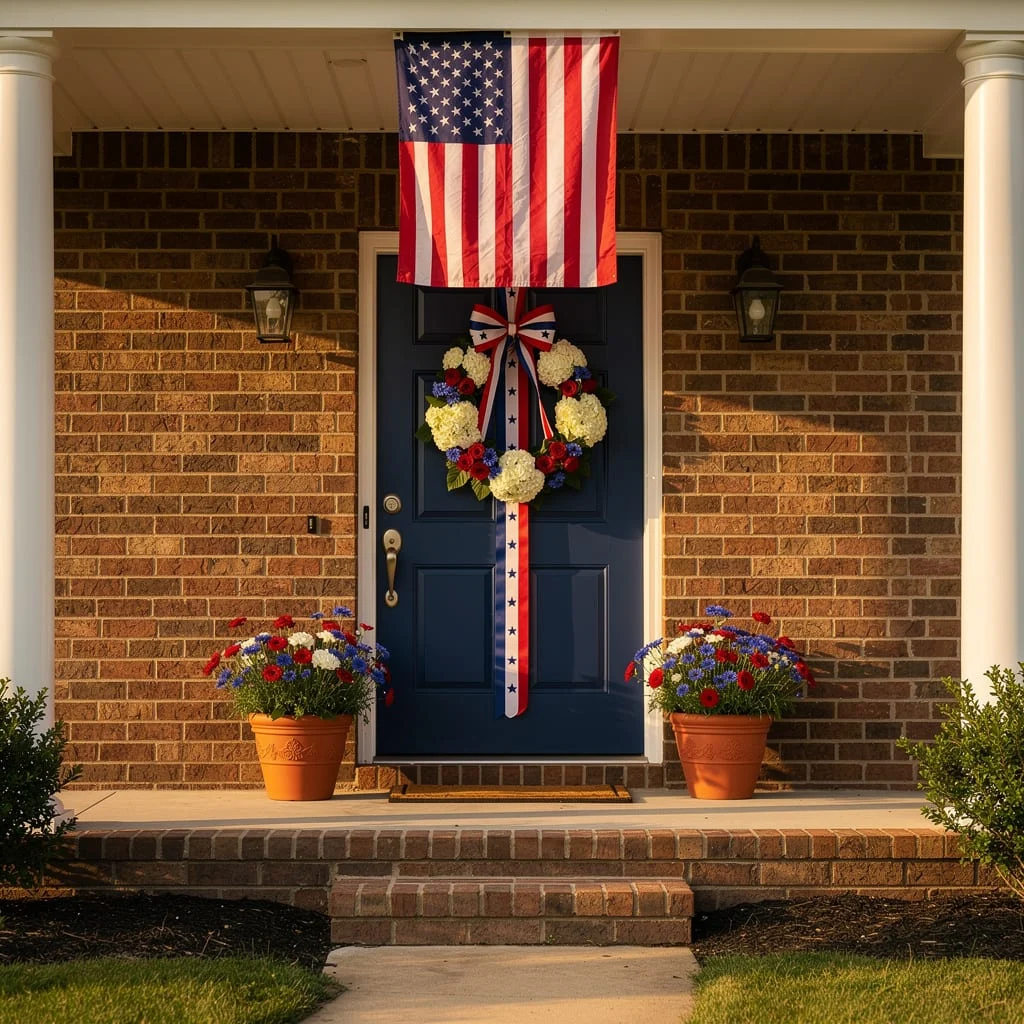
The flag hanging here is mounted vertically from the porch ceiling directly above the door — stars canton at the top, stripes falling straight down — so that it frames the door from above like a canopy. Use a 3 by 5 foot flag rather than a larger one; at this mounting height it fills the door frame without overwhelming it. Attach it to the porch ceiling using two small cup hooks screwed into the bead board, looped through the flag’s grommets.
Build or purchase a large-format door wreath — minimum 22 to 24 inches in diameter — using a wire or grapevine base. Arrange cream or white hydrangea clusters as the primary floral mass, placing them at even intervals around the wreath base. Insert clusters of red roses or red gerbera daisies between the hydrangea heads, and add small sprigs of blue ageratum or blue salvia as the colour accent. The three flower types correspond directly to the flag palette and create a wreath that reads as floral first, patriotic second. Finish with a wide multiloop bow in red, white, and blue striped wired ribbon with long trailing tails, attached at the top of the wreath.
Place two terracotta pots flanking the door at ground level, planted with a loose mixed arrangement of red, white, and blue cut flowers — cornflowers, red zinnias, white cosmos — rather than a structured planting. The loose arrangement echoes the softness of the wreath and avoids the rigid formality of a neatly planted pot.
Decorated Mailbox Post
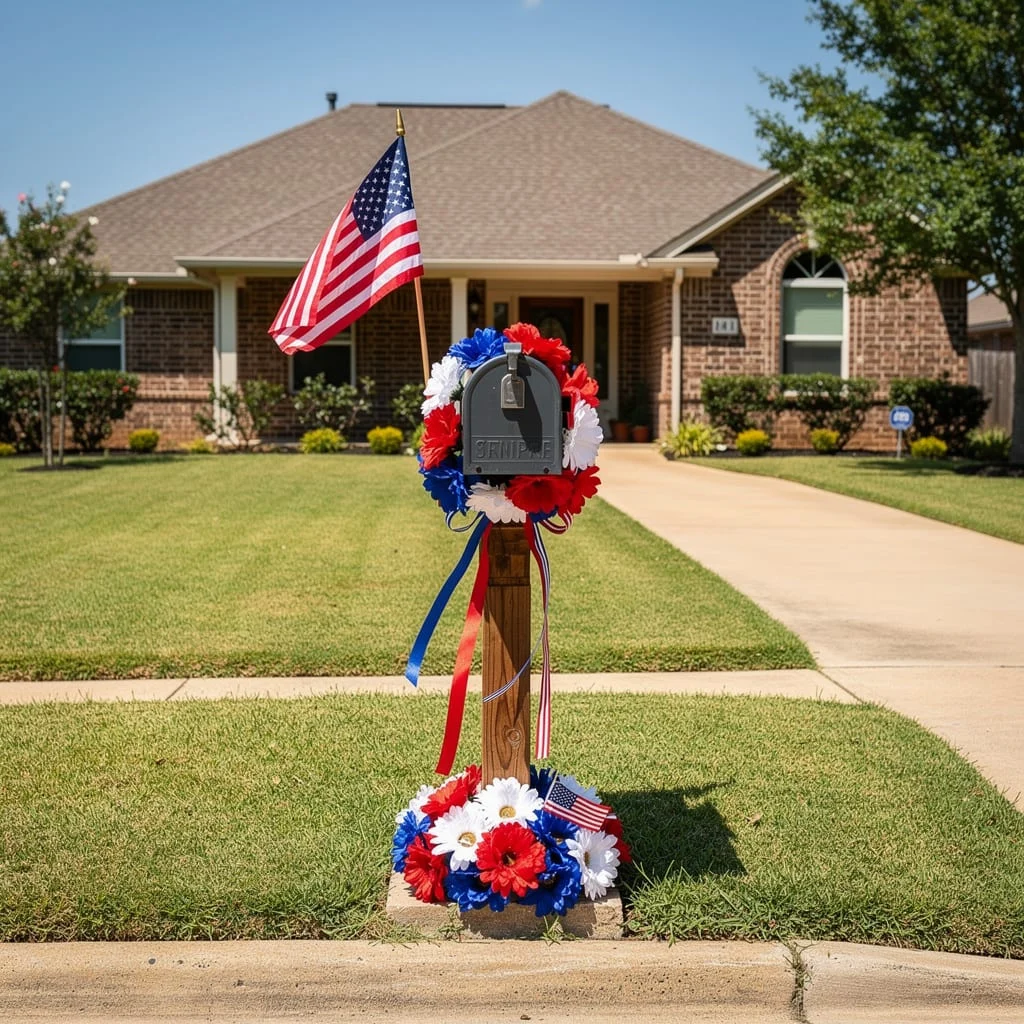
The mailbox post is the first thing a visitor encounters before reaching the house. It is also the element most people completely ignore when decorating for the holiday. That is a missed opportunity.
Wrap a patriotic floral wreath around the mailbox body itself — not the post, but the box — using a wreath that incorporates red gerbera daisies, blue silk daisies, and white paper or silk blooms in equal proportion. Secure it with a thin wire twist tie through the wreath backing and around the mailbox body. At the base of the post, place a second smaller wreath flat on the ground as a ring around the post base, using the same or a matching floral combination.
Insert a handheld American flag into the flag slot of the mailbox itself, angling it outward so it flies away from the box rather than drooping against it. Tie three trailing ribbons — one red, one white, one blue — around the top of the post just below the mailbox, long enough to move in the breeze. The ribbons are the detail that makes the composition feel finished. Without them, the wreath-on-mailbox reads as static. With the moving ribbons, it reads as festive.
Patriotic Dining Table Setup
Lay the flag-print table runner down the center of a dark or black table first — the contrast between the deep table surface and the red, white, and navy runner is what anchors the composition and makes the subsequent elements read clearly. The runner should extend 20 to 30 centimetres past the table end on each side.
Place a large wooden dough bowl or rectangular serving tray at the center of the table. Inside it, arrange a combination of moss balls in two sizes, rattan balls, and two or three red gingham-covered fabric spheres in irregular groupings. Insert a single large dark vessel — a black painted pot or cast iron container — into the center of the tray and fill it with blue hydrangeas and fresh eucalyptus or boxwood stems. The vessel should sit high enough to read above the surrounding spheres without blocking eye contact across the table.
Position two white ceramic candlestick holders of different heights at each end of the tray, with tapered white candles. For the place settings, stack a wooden charger under a white ceramic dinner plate and a smaller salad plate. Tuck a small bunch of fresh boxwood or clipped greenery under each plate as a living decoration. Add a small patriotic accent to each setting — a miniature flag, a painted wooden star, or a small red star ornament — that functions as both decoration and a subtle marker for each guest’s seat. The mantle behind the table should echo the palette: run greenery garland across the full length, add a mirror to double the depth, and place small flags in mason jars at intervals within the garland.
Flag-Lined Driveway
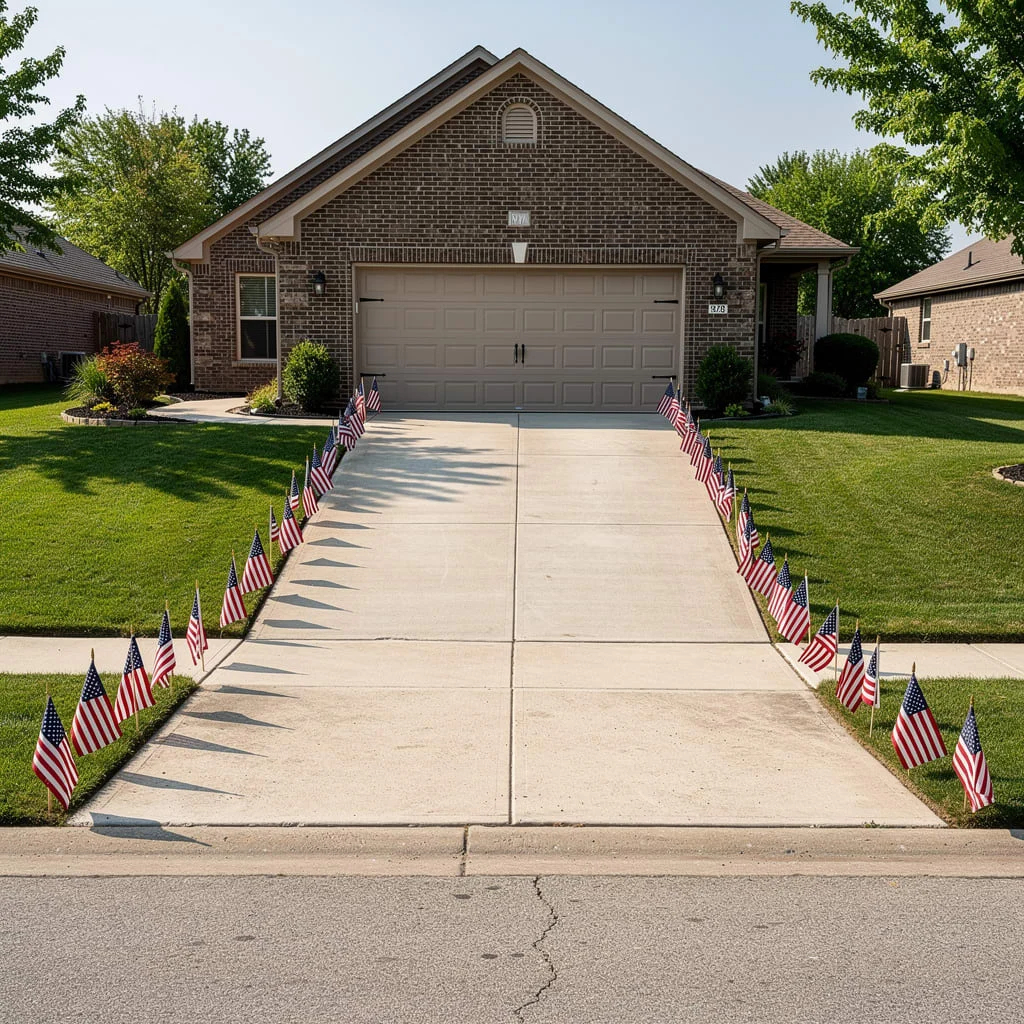
This approach does not try to be subtle and you should not either. The effect is created entirely by repetition: small American flags on wooden stakes, inserted into the lawn on both sides of the driveway at perfectly consistent spacing from the street to the garage.
Purchase a pack of twelve-by-eighteen-inch American flags on eighteen-inch wooden stakes — buy at least two dozen, more for a longer driveway. Using a measuring tape or a rope as a spacing guide, insert the flags at intervals of approximately 45 centimetres on each side of the driveway, starting at the curb and ending at the garage face. Both rows should be absolutely parallel to the driveway edge and to each other. The flags should be inserted at a consistent angle — straight up, perpendicular to the ground — not leaning in different directions.
The power of this display is entirely in the military regularity of the spacing and alignment. A single flag slightly out of line or a gap in the sequence undermines the whole effect. Take the extra five minutes to measure and adjust before stepping back to evaluate from the street. At a distance, the two rows of flags create a visual avenue that transforms an ordinary concrete driveway into a ceremonial approach.
Shingle House With Flag and Gate Bunting
The cedar shingle exterior is the best possible backdrop for this approach because the warm grey-brown of the weathered shingles makes the red and white and blue of the flags read at maximum saturation. There is no paint or finish to choose here — the architecture is doing the work.
Hang a large American flag on the exterior wall to one side of the porch entry, using a proper flag mounting bracket angled outward from the siding at 45 degrees. The flag should hang freely and fly rather than being pressed flat against the wall — the movement is part of the composition. Choose a cotton or nylon flag rather than a printed polyester one; the material quality is visible from the street.
At the garden gate — whether picket fence, post, or railing — hang a single large fan bunting centered on the gate span. The semicircular fan style works best here because it mirrors the arch of a gate opening and reads as an invitation. One well-placed bunting at the gate says more than six identical ones along the fence. Keep the fence itself white and clean. The simplicity of the white fence against the grey shingles and the single burst of red, white, and blue at the gate is a composition that understands restraint.
Full-Width Porch Bunting With Flags
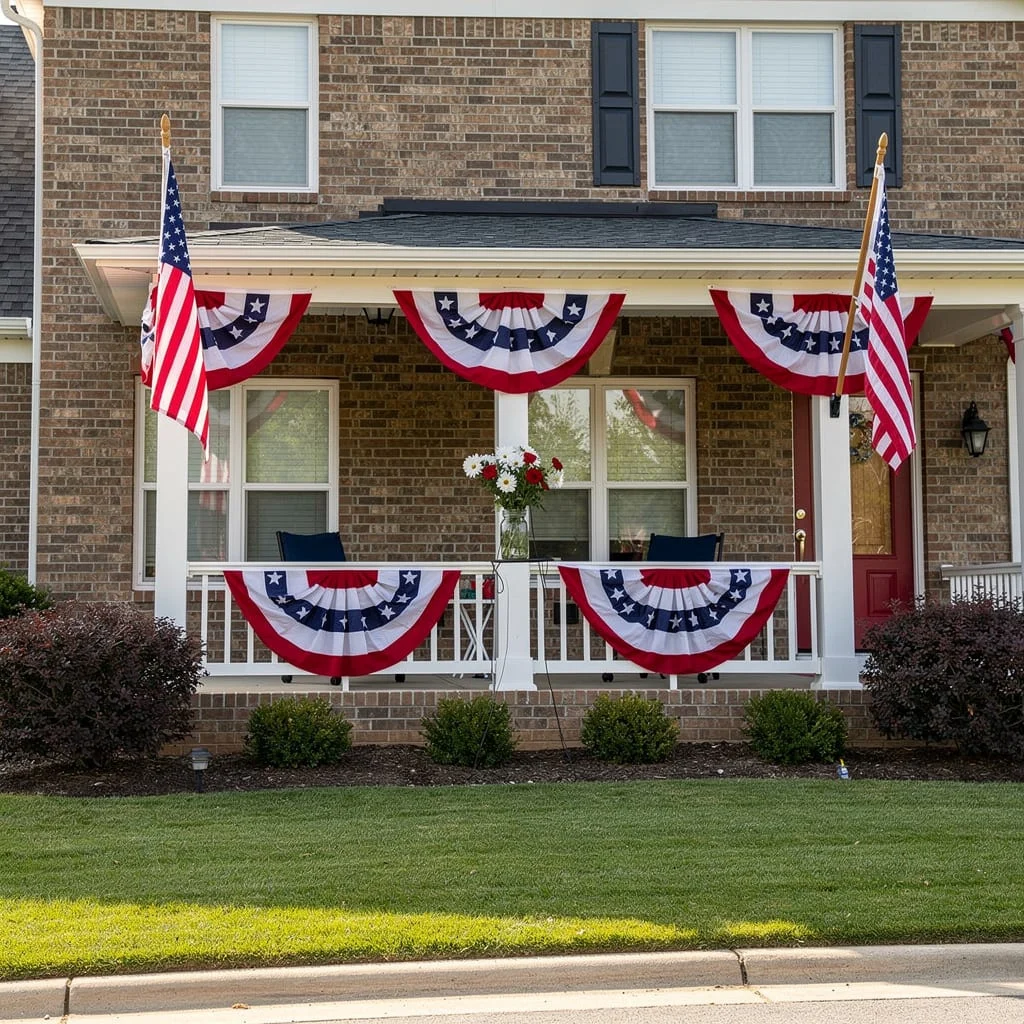
The goal here is complete coverage of the porch face — no bare railing visible between decoration elements. This requires both bunting hanging from the porch roof overhang and bunting attached to the porch railing itself.
Hang three fan bunting panels from the porch ceiling, spaced to cover the railing span from end to end. Each panel should extend low enough to drape slightly over the top of the railing when viewed from the street — a drop of approximately 60 to 70 centimetres from the mounting point. Attach two full-size flags on wooden or metal poles in angled flag holders mounted on the porch columns at each end, so the flags fly outward and frame the entire porch from above.
On the railing itself, attach three smaller fan bunting panels centered under the porch window opening, covering the lower half of the railing face. The combination of large bunting from above and smaller bunting on the railing creates a double-layer patriotic valance across the full facade. Place a mason jar or clear glass vase on the porch railing ledge or a small table, filled with a loose arrangement of red and white flowers as the single botanical note in an otherwise fabric-dominant composition.
Paper Lantern Porch Ceiling
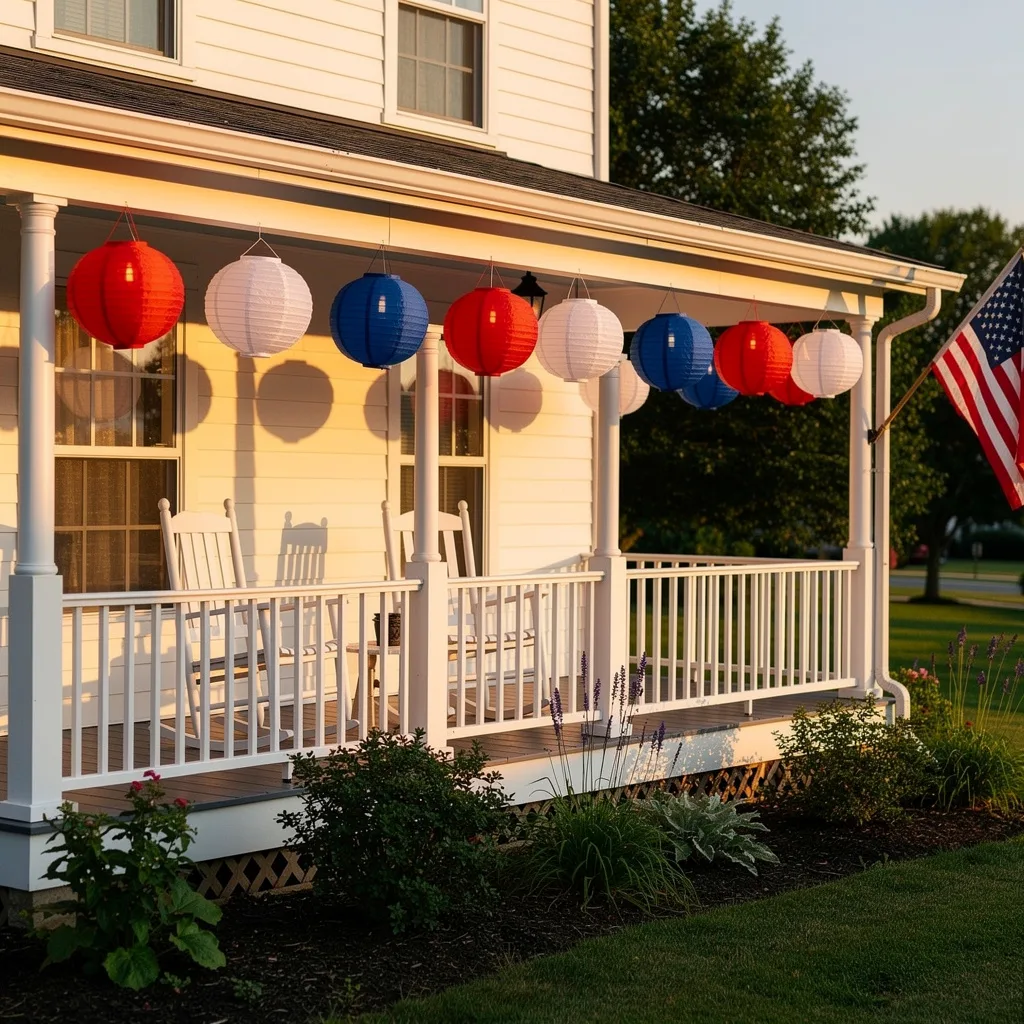
Paper lanterns are underused in Americana decor and they should not be. At dusk, when they are illuminated from the inside with LED tea light inserts or fairy light filler, the effect of red, white, and blue globes glowing across a porch ceiling is genuinely beautiful.
Purchase round paper lanterns in 10-inch and 12-inch diameters in red, white, and blue. String them alternating colours — red, white, blue, red, white, blue — on a length of clear nylon cord or thin string lights stretched from one porch column to the other, slightly below the ceiling so the lanterns hang at approximately six feet from the floor. Use metal S-hooks through the lantern crown loops to hang them from the string, which allows the lanterns to hang level.
Insert a battery-operated LED tea light or a small LED puck light inside each lantern before hanging. The white lanterns will glow warm cream; the red and blue will glow in their respective saturated tones. Hang a full-size flag on a proper bracket at one corner of the porch as the only non-lantern decoration. The restraint of a single flag plus the lanterns is the composition. Do not add bunting, do not add wreaths, do not add potted plants. Let the lanterns do their work alone.
Tiered Stair Pot Display
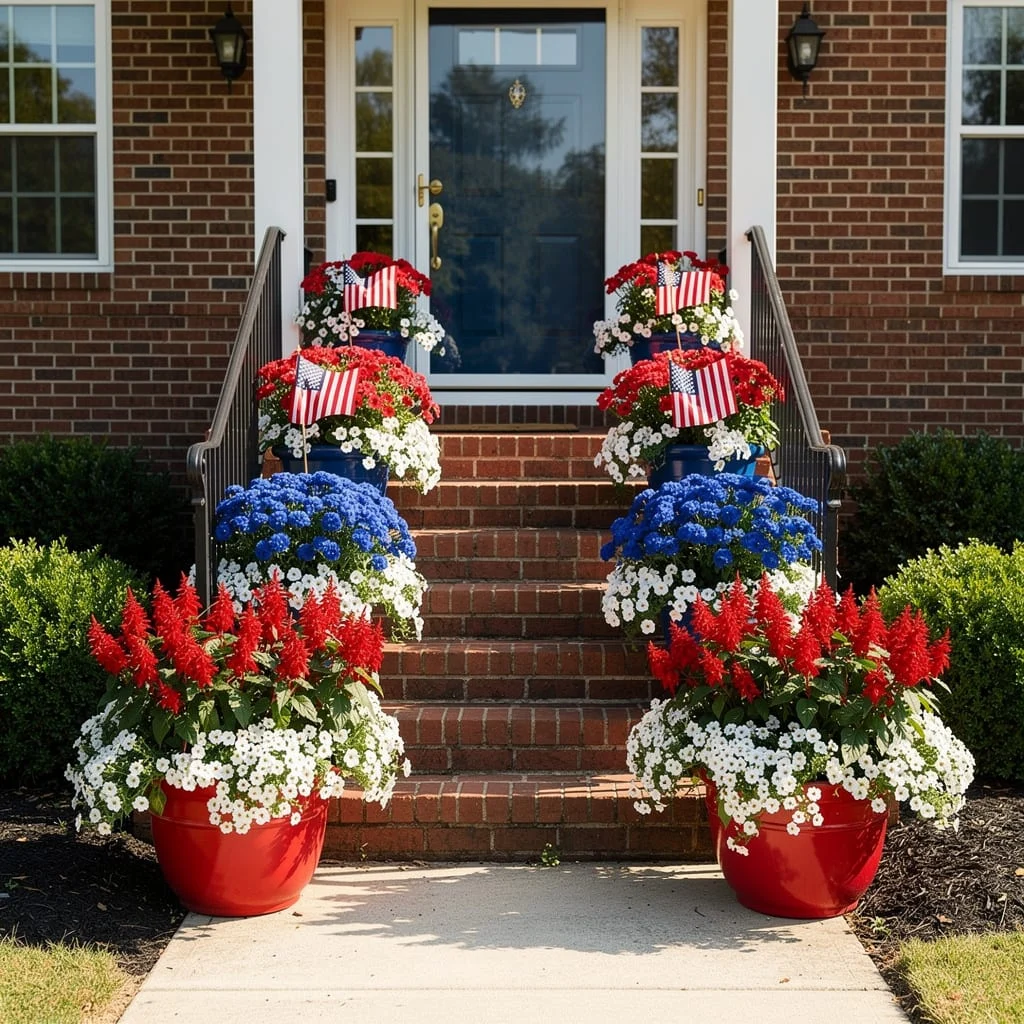
This effect requires an equal number of identically sized pots on each side of the stair and an identical planting in each pot. Asymmetry in pot size or plant selection will undermine the mirror-image quality that makes the display read as a composed entry rather than a cluster of pots.
Start at the base of the stair — the widest and most prominent position — with the largest pots: red glazed or galvanised metal planters approximately 40 centimetres in diameter. Plant these with a mixed combination of red salvia for height, white wave petunias as the middle layer, and white sweet alyssum or white bacopa as the trailing edge. At the first step up, place medium-sized navy blue glazed ceramic pots with blue ageratum or blue lobularia. At the second step, position smaller white or terracotta pots with red impatiens and white lobularia. At the top step beside the door, use matching tall containers with the same mixed planting as the base pots.
Insert a small American handheld flag into each of the mid-level pots at an angle, flags fanned outward. These flags are the connecting detail — they appear at every level and read as continuous decoration running up the stair rather than isolated pots sitting on individual steps. The graduated pot sizes reinforcing the vertical perspective of the stair is what makes the whole composition work as architecture rather than display.
Foundation Bed Flag Row
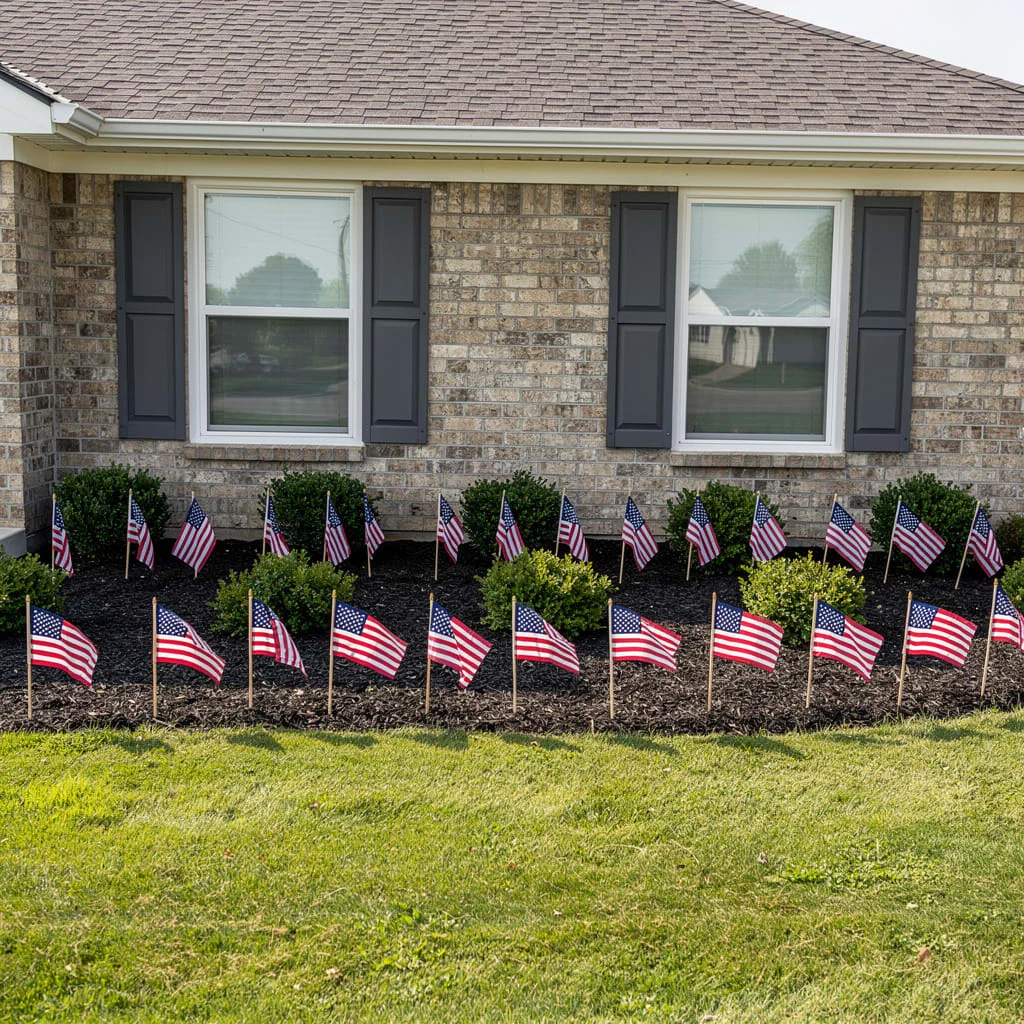
The foundation shrub bed running under windows is not usually thought of as a seasonal decoration canvas. It should be.
Push small American flags on wooden stakes into the mulch bed in two staggered rows: a back row inserted close to the base of the existing shrubs, and a front row inserted near the lawn edge of the bed. The back row should be slightly taller than the front row if your stakes allow for it — standard 18-inch stakes at the back, 12-inch stakes at the front — so that both rows are visible from the street and the flags do not obscure each other.
Space the flags in each row at 20-centimetre intervals, consistently. The density of flags in a double-staggered row creates a very different effect from a single sparse row — it reads as a field of flags rather than a scattering of them. Ensure all flags are inserted at the same angle and to the same depth. This is a display that depends entirely on uniformity. One flag at a different angle, one flag inserted twice as deep as the others — either breaks the visual rhythm that makes the whole bed read as a deliberate installation.
Wreath and Flag Column Entry
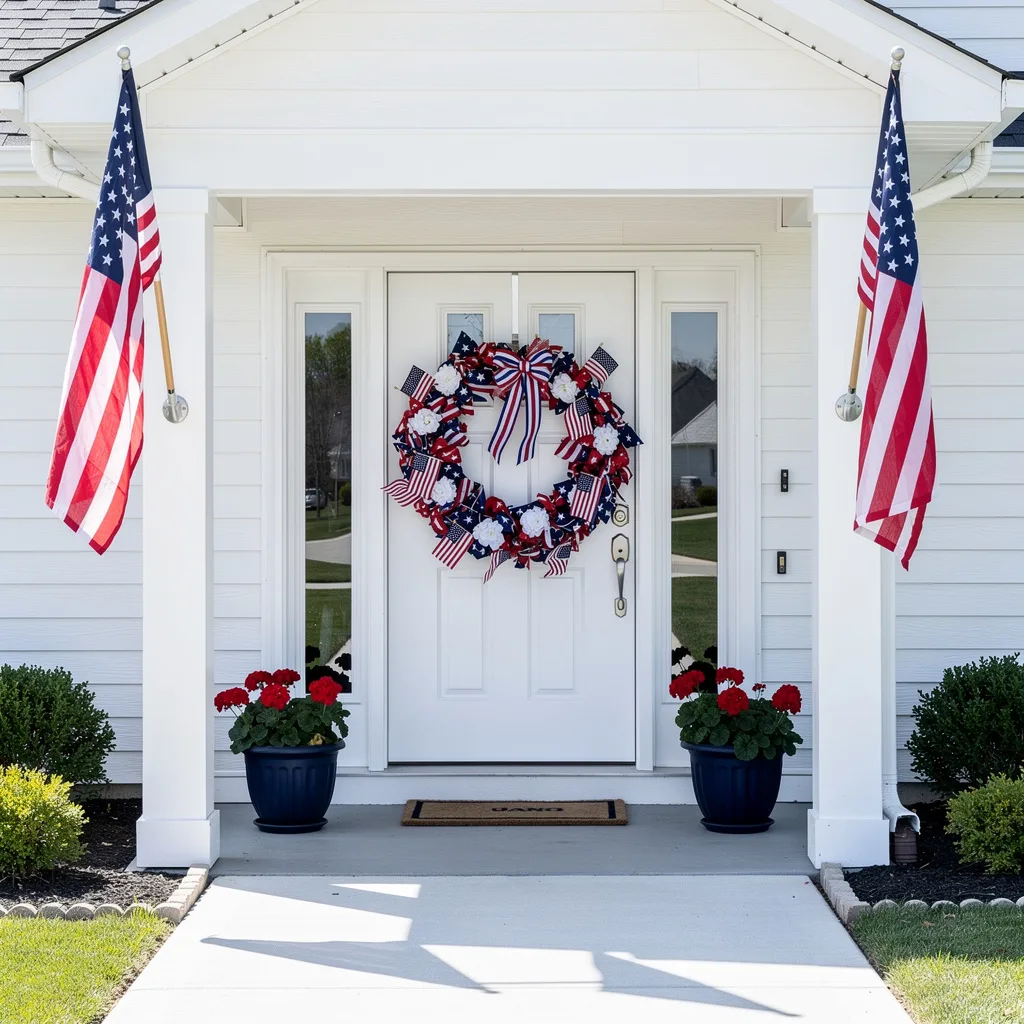
Two angled flag brackets mounted on the porch columns — one per column, positioned at a consistent height on each — are the structural foundation of this entry display. Use proper cast-iron or steel flag brackets angled at 45 degrees and insert full-size American flags in aluminium or hardwood poles. The flags should fly outward from the columns symmetrically, framing the door opening from both sides.
Build the door wreath on a 24-inch or larger wire frame base. Wind narrow red satin ribbon and narrow red-and-blue stripe wired ribbon throughout the frame first, creating a layered ribbon base. Add small American flags — the handheld flag size — at regular intervals around the wreath, pushing the sticks into the ribbon wrapping to secure them. Fill the gaps between flags with white peony or dahlia faux blooms. Finish with a large layered bow in red, white, and navy stripe ribbon centered at the top, with tails long enough to reach the lower third of the wreath.
At ground level, place matching navy blue glazed ceramic pots on each side of the door, planted with red geraniums. The navy pot colour pulls the blue from the wreath ribbon and the flag canton down to floor level, completing a vertical colour connection from the flag poles at column height, through the wreath on the door, to the pots at ground level.
Potted Steps Flower Wall
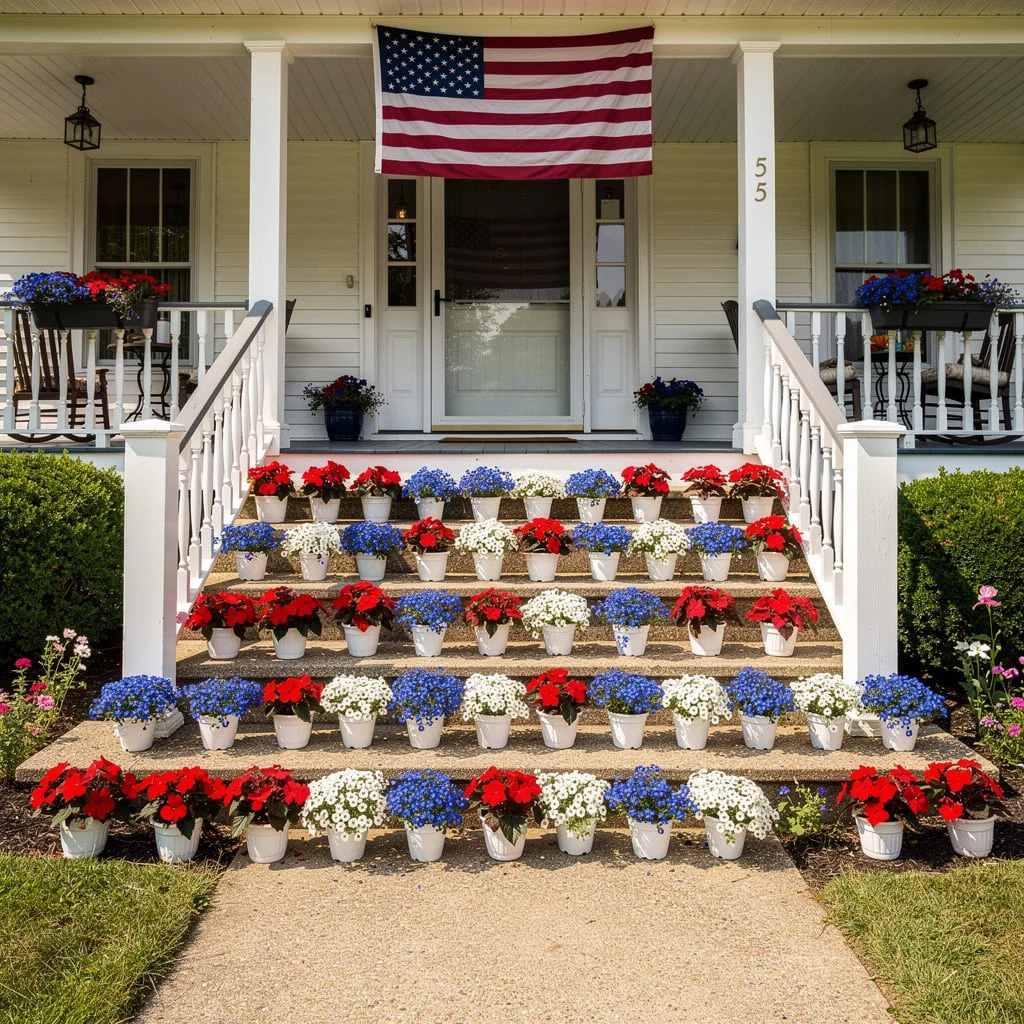
The scale of this display is what most people would never attempt and exactly what makes it unforgettable. Every tread of a wide porch stair becomes a shelf for a continuous row of uniformly sized white-potted flowering plants in a repeating red, white, and blue colour sequence.
Purchase matching white plastic or glazed ceramic nursery pots in a consistent size — 15-centimetre diameter works well for standard-sized stair treads. Plant them with a single species per colour: red impatiens or red begonias for the red pots, white chrysanthemums or white daisies for the white, and blue lobelia or blue ageratum for the blue. Line each stair tread with a continuous row of pots from rail to rail, alternating red, white, blue in a repeating sequence. Use the same sequence on every step and on the landing area at the base of the stairs.
Hang a large American flag from the porch ceiling above the door — horizontal orientation, stars at the top left — using two hooks through the grommets. The flag provides the single large-scale patriotic element above the botanical display below. Window boxes on the porch railing, planted with the same red, white, and blue palette, extend the colour across the full porch width at railing height. At maximum bloom in early July, the stair face reads as a solid tapestry of red, white, and blue flowers. That is the entire point.
Final Thoughts
The homes on this list made one thing clear: Americana decor is not about having the most patriotic house on the street. It is about having the most considered one.
Anyone can hang a flag. The houses that people remember are the ones where every element — the door colour, the pot size, the ribbon width, the flower selection — was chosen in relation to everything else. That is not decorating. That is composing.
Red, white, and blue will do the rest. They have been doing it for a very long time.