
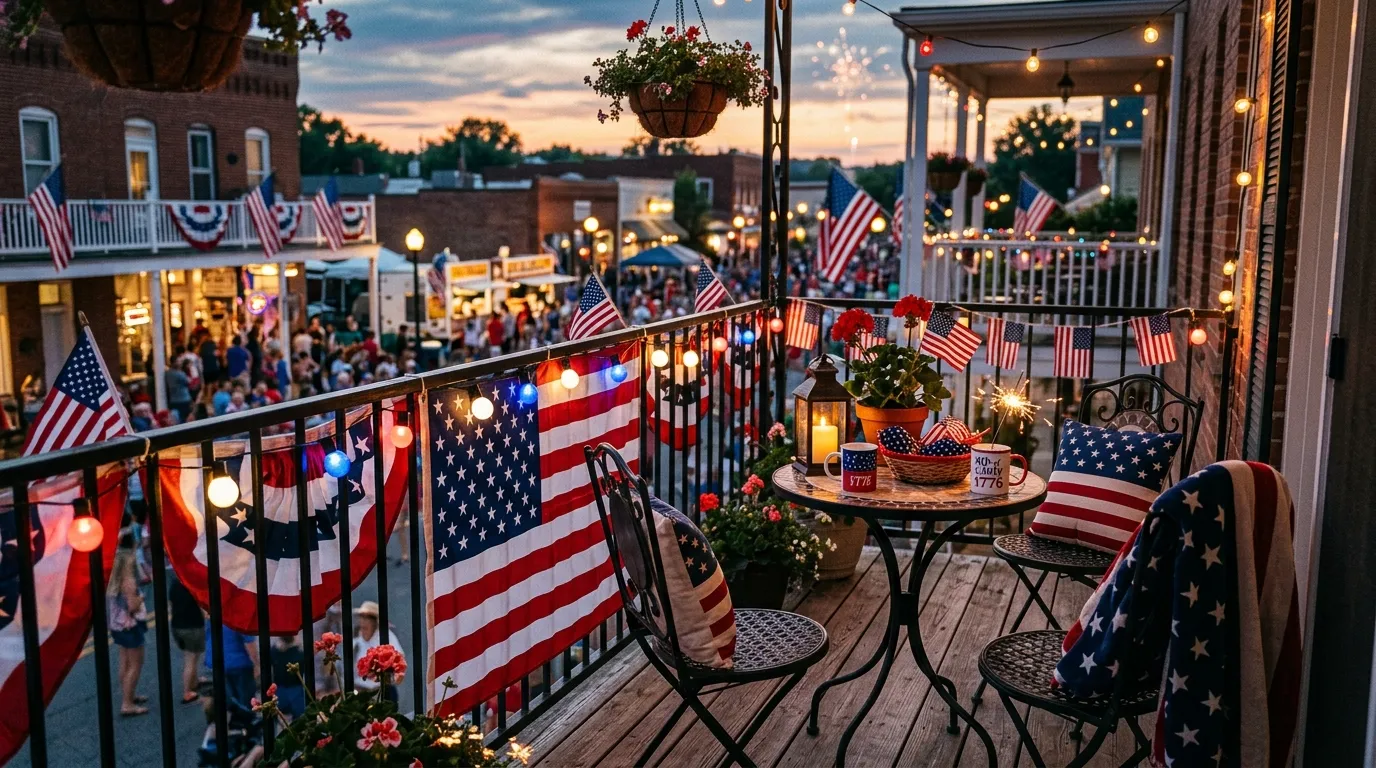
Nobody ever looked at a balcony and thought: this is plenty of space.
You’ve got a railing, a wall, maybe sixty square feet of floor if you’re lucky, and a view you share with twelve other units in the building. Decorating it feels either pointless — who’s going to see this? — or impossible — how do you make something with no door, no columns, and no architectural character feel like anything at all?
Both objections are wrong. The balcony is one of the best spaces to decorate for July 4th precisely because its constraints are so clear. You know exactly what surfaces you have. You know exactly where things can go. The railing is your gallery wall. The wall behind you is your backdrop. The overhead slab or overhang is your ceiling. Work with those three surfaces and you have everything you need.
The problem isn’t the space. It’s that most people treat the railing as a place to drape a single piece of bunting and call it patriotic. Here’s what to do instead.
Why Balcony Decorating Goes Wrong Before Anything Gets Hung
The mistakes are small. Their effect on the finished result is not.
The Scale Error That Ruins Everything from the Start
A balcony is a compressed space. Everything in it reads at close range and from the street simultaneously.
Most people decorate for one of those views and neglect the other. They put a single small wreath on the wall that looks fine from two feet away and disappears entirely when seen from across the street. Or they install something enormous that dominates the view from outside but overwhelms the person actually standing on the balcony trying to enjoy it.
The rule for balcony decoration is that the primary installation — the thing that makes the biggest visual statement — should be on the railing or the wall directly behind the railing. It sits at the threshold between the close view and the far view. Done at the right scale, it works for both.
For reference: a single 24-inch wreath on a 10-foot railing span reads as decoration. Three 18-inch wreaths hung in a row on that same span read as a decision. The scale of the installation relative to the surface it occupies is what distinguishes one from the other.
The Color Dump
Red, white, and blue applied at equal intensity across every surface of a balcony produces the visual equivalent of shouting three things at once.
Balconies have limited surface area, which means color relationships are compressed. A palette that might read as balanced in a yard becomes overwhelming at balcony scale. The solution is to establish a dominant surface color — usually the wall or the railing treatment — and let the other elements respond at lower saturation or intensity.
A deco-mesh garland on the railing and a flower wreath on the wall and balloon columns at either end and a stripe rug on the floor and star lights on the ceiling is too much. Not because any individual element is wrong, but because all of them are competing for the same visual priority at the same time. Every element wants to be noticed. None of them succeed.
Choose one primary installation. Let everything else support it.
The Daytime-Only Setup
July 4th fireworks start after dark. The balcony that looks beautiful at 3 p.m. and does nothing by 9 p.m. missed the point of the holiday.
Planning for evening lighting is not optional on a balcony. The space is small enough that two or three candles, a set of star string lights, or a pair of tiki torches makes a transformative difference after sundown. The evening setup should be considered before anything else gets placed, because lighting affects where everything else can go.
Candles belong on surfaces, not floors. String lights need a clear run from anchor point to anchor point before the decorations that surround them are installed. Torches need floor clearance and positioning that doesn’t block movement. Plan the light first. Then decorate around it.
4th of July Balcony Decoration Ideas
The Georgian Colonial That Understood the Flag Was the Entire Decoration
Some houses don’t need a July 4th decoration strategy. They need the courage to leave things alone.
A Federal or Georgian colonial exterior — white or cream masonry, dark shutters, columns, formal symmetry — already carries everything the flag needs. The architecture is the complement. The flag is the only addition required.
Mount a full-size flag on a wall-bracket pole extending from the second-floor balcony rail or the facade above the entry. The flag should extend far enough from the building face to fly freely rather than hanging limp against the wall. A 4×6-foot flag on a 6-foot angled bracket pole reads correctly at this scale; a smaller flag looks like a token gesture.
At the entry, two cast iron urns with clipped topiary balls and a single sweep of simple greenery are the only allowable porch addition. Nothing seasonal, nothing purchased specifically for the holiday. The formality of the architecture requires that any addition match its restraint.
The colonial house that has a great American flag flying from a proper pole bracket, on a properly maintained exterior, needs nothing else. The person who understands this is decorating more intelligently than anyone who spent two hours arranging star lanterns and balloon clusters.
The City-View Balcony That Used Balloon Columns as Architecture
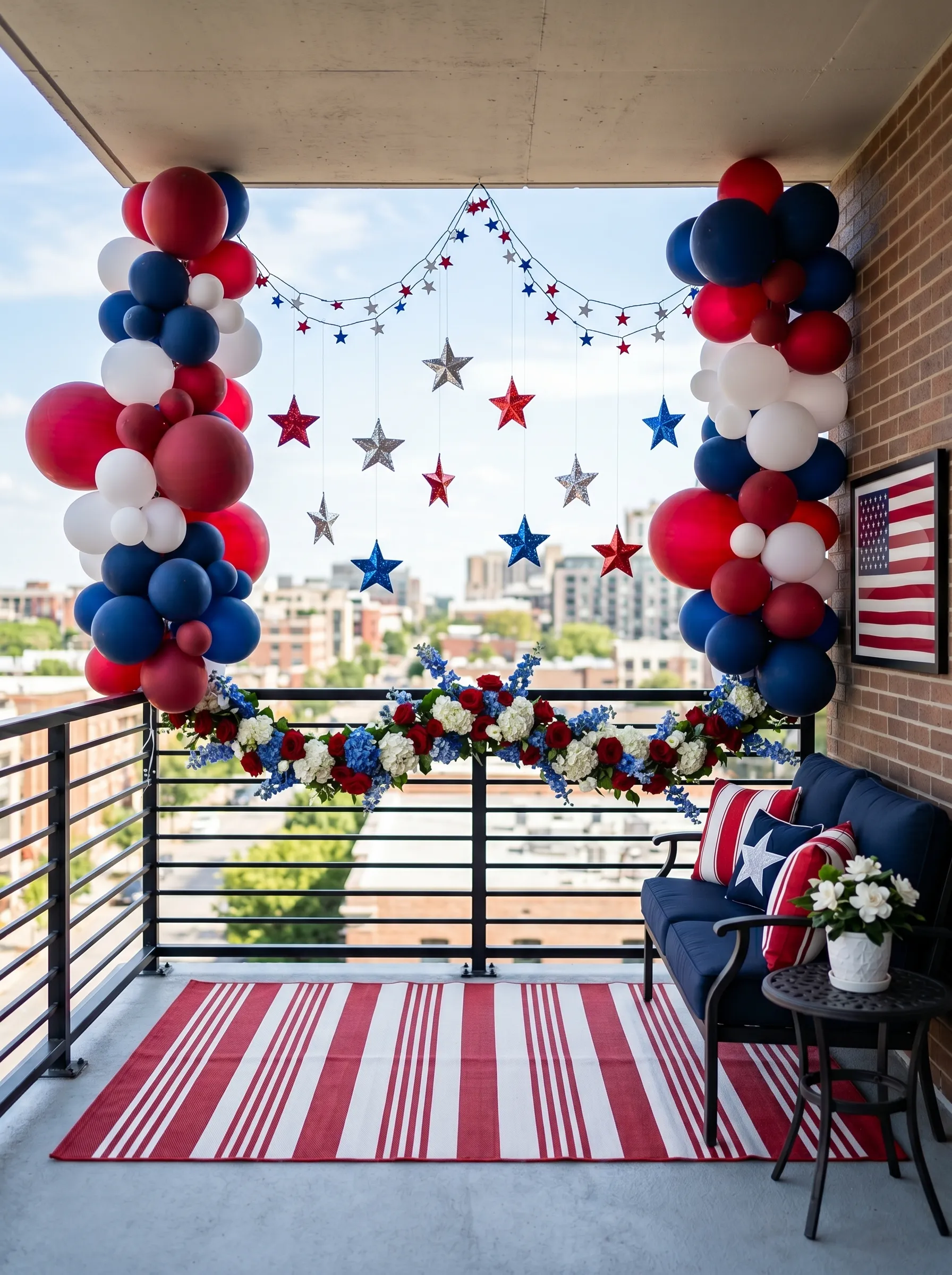
An apartment balcony with a city view is already providing the backdrop. The decoration just needs to frame it.
Build two balloon columns, one at each outer corner of the balcony, using freestanding balloon column stands or by securing balloon strip tape vertically from the railing cap to the ceiling overhang edge. Work crimson, navy, and white 11-inch balloons in an organic cluster pattern rather than alternating rings. The organic distribution looks like a professional installation; the uniform alternating ring pattern looks like a craft project. Mix sizes — a few 5-inch balloons tucked between the larger ones fills gaps and adds texture.
Across the top opening of the balcony — spanning the full width between the two columns — run a string of glitter star ornaments on fishing line, with individual stars hanging at varying drops below the main line. These catch the sky and the city light simultaneously.
Along the railing top rail, attach a dense floral garland: red roses, white hydrangeas, and blue delphinium, built on a foam base or pre-made garland armature. Secure with floral wire looped around the rail.
On the wall behind the seating, mount a framed flag art piece — not a flag pole installation, but a flag presented as a framed print or shadowbox. A single seating chair with navy cushions and a star-and-stripe pillow pair, a small side table with a white gardenia, and a red-stripe outdoor rug finish the space.
The balloon columns are visible from the street. The framed flag is visible from the balcony. Both work in their respective viewing zones.
The Grand Antebellum House That Pulled the Whole Street Into It
This is not a balcony installation. It is a house-scale statement that happens to use balcony and porch bunting as its primary element. It belongs here because the principle — coverage creates presence — applies at every scale.
Source fabric fan buntings in matching style for the full house width. For a house this size, you need buntings for both the upper and lower balcony rail levels, plus the entry gate. The buntings must be identical in style and construction so they read as a unified installation across all three levels.
Mount them at equal intervals along each rail level, allowing the natural drape of each fan to create touching or slightly overlapping swags. The upper level buntings should align vertically with the lower level buntings so the whole facade reads as one coherent composition.
In the lawn beds flanking the entry path, set star-shaped lawn stakes in alternating red and blue plaid or check fabric — the fabric-covered wooden star variety on a stake, spaced evenly and angled uniformly. These transform the garden approach into a flag-lined procession.
Line the entry stair risers with white pots of pale blue hydrangeas, one per step, at the outer edge of each riser. The blue hydrangeas against white stairs against the cream facade read quietly and elegantly against the bold bunting above.
Nothing about this installation is fast or cheap. Everything about it is correct.
The Stone Balcony Light Curtain That Peaked After Dark
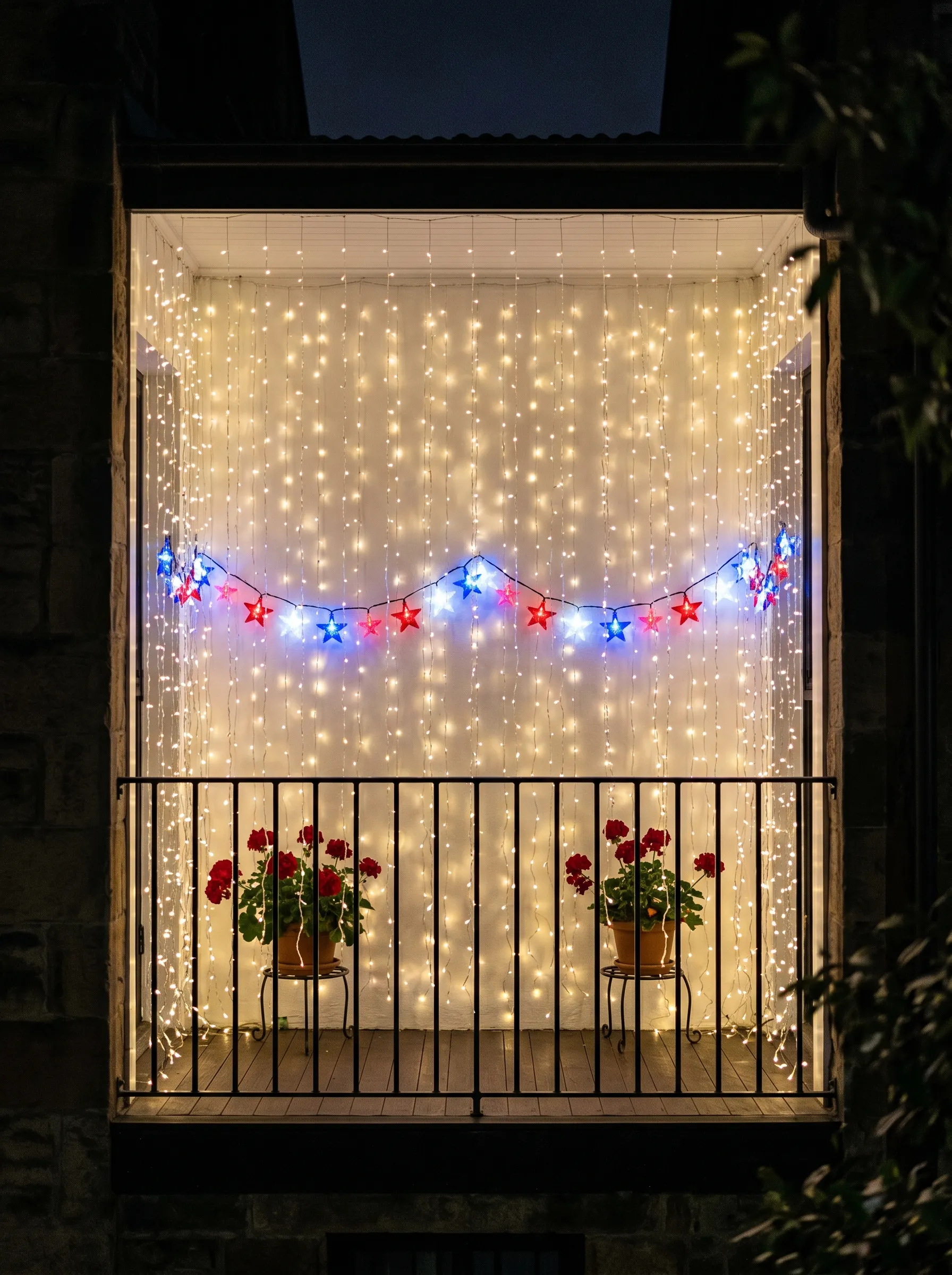
From the street, this balcony looks like a glowing window. That is the design goal.
Source two or three panels of warm white LED curtain lights — the icicle-drop style with hundreds of individual LED points on hanging wire strands, not the braided string light variety — and mount them across the full width of the balcony wall using removable command hooks at regular intervals along the top edge. The strands should hang freely from wall to floor, creating a curtain of warm white light that fills the entire wall surface.
Across the center of this curtain, string a single line of color LED star lights — red, blue, and silver alternating — from railing post to wall mount, sagging gently across the middle distance. The colored stars floating against the white curtain become the focal point of the installation from both inside the balcony and from the street.
At floor level, two small iron plant stands hold simple terracotta pots of red geraniums — no mixed color, just red against the warm white glow. The geraniums silhouette beautifully against the light curtain.
No rug, no cushions, no other elements. The light curtain is the whole installation. Adding more in this setup dilutes the one thing that makes it extraordinary. Restraint is the design decision.
The Architectural Balloon Flag That Covered the Whole Wall
When a balloon installation covers an entire wall face of a house exterior — a full flag pattern in grid mosaic form — it stops being decoration and becomes something more like architecture.
Build the balloon grid on a PVC or metal pipe scaffolding frame secured to the wall face using ground stakes and ties, positioned to stand a few inches away from the wall surface. This gap allows the balloons to be applied from behind the frame and also creates a slight shadow depth that gives the installation visual relief rather than a flat, pasted quality.
The canton uses slate blue or medium blue balloons — not navy, which would read as too dark against the natural light — with silver metallic star foil balloons set into the canton grid at irregular positions. The stripe field uses alternating rows of red and white 11-inch latex, varied in size within each row.
The scale of the frame and the number of balloons required — 400 to 600 for a wall-covering installation — means this is a two-to-three-person project. Allow eight hours. The result is an exterior that is legible and photographable from 200 feet away and does not require any other decoration on the house at all.
The lawn needs to be mowed. The hedges trimmed. The existing wood surfaces in good condition. A balloon wall of this scale sits against the house’s base condition. If the base is compromised, the installation emphasizes it. Get the fundamentals right first.
The Twilight Deck That Built Everything Around Fire
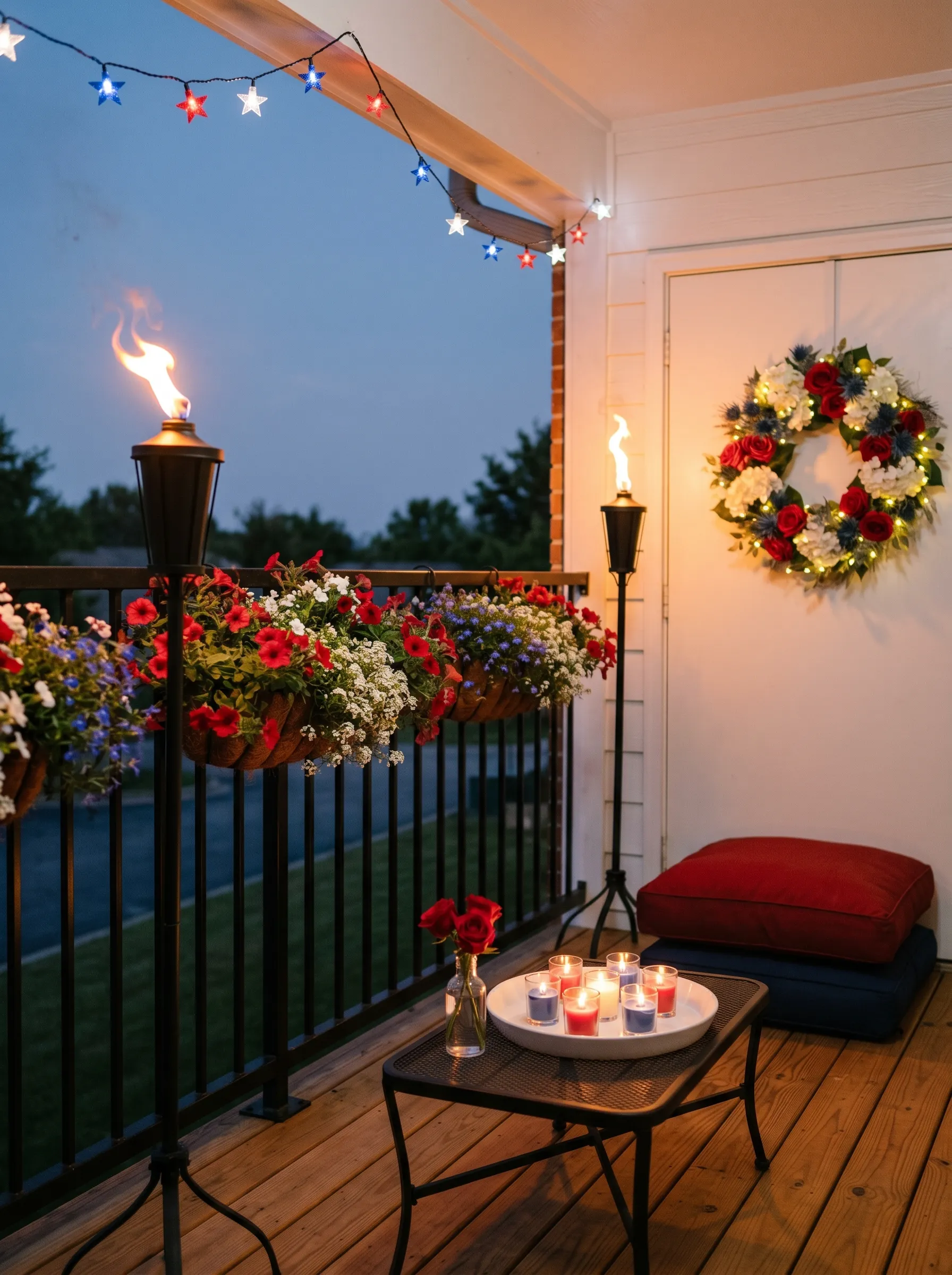
This deck is designed for the exact moment the sky goes from blue to black. Daytime is secondary.
Star string lights in red, white, and blue run along the overhead beam or ceiling edge — a single diagonal swag from the house wall to the outer railing corner. These provide the cool-colored accent overhead.
Two floor tiki torches stand at the outer railing corners, angled slightly outward. They serve as the primary ambient light source and as vertical markers that define the balcony’s outer boundary. Their warm amber flame is the tonal anchor that makes everything else read as warm rather than harsh.
Along the railing, hang coco-fiber bracket baskets filled with red petunias, white alyssum, and blue lobelia. In daylight these are the color story. After dark they become soft silhouettes framed by torch and star light.
On the wall, a mixed silk wreath — red roses, white hydrangeas, blue thistles — with a string of warm LED lights woven through the base greenery. This gives the wreath a secondary glow quality in the evening.
On the floor beside the seating, a round metal tray holds seven to nine votive candles in varying sizes: red, white, and blue glass votives mixed with clear glass holding white candles. A single red rose stem in a small bud vase sits among the candles.
Stack two large floor cushions against the wall — crimson on top, navy beneath — as informal seating that reads as low-effort luxury. The whole setup costs less than one piece of outdoor furniture and works infinitely better for an evening holiday.
The Wrought Iron Balcony Table Centerpiece That Did Everything with Flowers
On a small balcony with a glass-top table and a wrought iron rail, the decoration is the arrangement on the table and nothing more.
Source a foam floral base — a low oval or rectangle, roughly 12 to 14 inches long — and cover it entirely in florals before placing it. Start with the greenery: salal leaves or seeded eucalyptus as the base layer. Then add the primary flowers: red gerbera daisies and dahlias at the center-high point, white statice or wax flower as the white filler tucked throughout, and blue silk anemones or cornflowers pushed in at the sides and forward face.
Keep the arrangement low — no higher than 8 inches — so it reads as table decoration rather than a vase arrangement. It should sit in the middle of the glass table without obstructing sight lines across the table.
Place the arrangement on a mirror tray or a plain white ceramic serving tray. The reflective or white surface catches light and makes the arrangement read as set rather than placed.
The wrought iron rail with its natural scrollwork detail, the cobblestone or tile floor visible below, and the garden visible beyond the railing provide the entire backdrop. The arrangement is the only object on the table. That’s all this balcony needs.
The Illuminated Star Ceiling Porch That Made Going Outside Feel Like Going Under the Stars
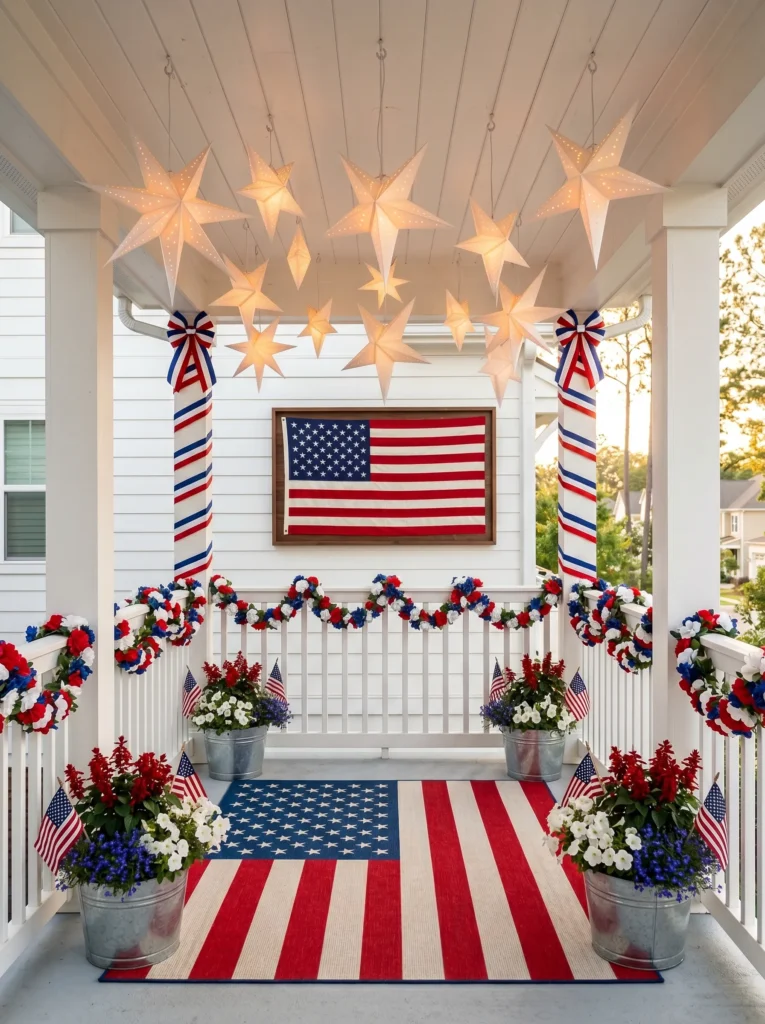
The defining decision here is the ceiling, which most balcony decorators never touch.
Source illuminated paper or fabric star lanterns in the 8-to-12-inch size range — the kind with a bulb socket insert or battery-operated LED inside — and hang them from the porch ceiling joists or overhead structure using clear fishing line at dramatically varying drop lengths. Use a minimum of twelve stars, mixing large and small. The variety in size creates a sense of depth overhead that a uniform set of identical lanterns cannot produce.
Hang them densely enough that you’re looking up into a constellation, not spotting isolated ornaments. The center mass should be directly above where a person stands on the balcony, with stars trailing toward the outer edges.
At the wall, mount a full American flag in a simple wood shadowbox frame — not a pole flag, a flat-framed display. This treats the flag as art and gives the wall a centered focal point below the star canopy.
Wrap each porch column with diagonal ribbon in red, white, and navy, secured at top and base with a wide bow. Run the ribbon in a barber-pole spiral rather than flat vertical stripes, which reads as architectural rather than decorative.
Along the railing, attach a continuous mixed flower garland using zip ties at regular intervals: red, white, and blue silk or live flowers interleaved with greenery, kept loose enough to drape naturally. Galvanized buckets on the floor at each column base, filled with the three-flower combination and small flags, complete the ground level.
Lay a flag-print outdoor rug on the floor. The ceiling is the design decision. Everything else supports it.
The Terracotta Balcony That Let the Flowers Be the Whole Story
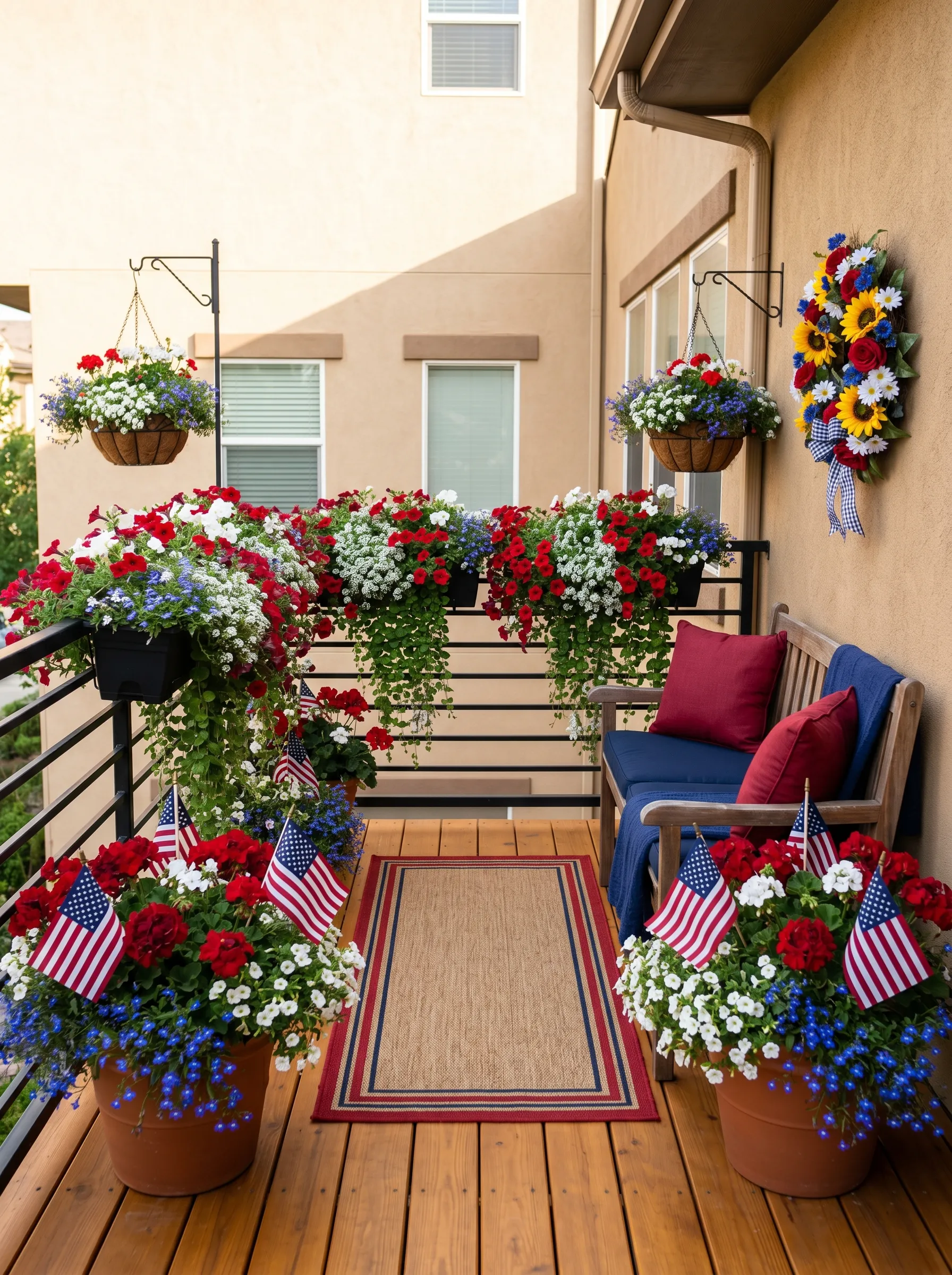
The defining principle of this balcony is density. Everything flower-related is packed to capacity.
Install railing-mount planters — the kind that hook over the top rail — along the full railing run, spacing them as closely as the rail allows. Fill each planter with the same three-layer combination: red petunias or geraniums as the upright layer, white alyssum or bacopa as the trailing middle element, and deep blue lobelia cascading over the front edge. Plant at double the usual density so the planters look full on installation day rather than requiring weeks to fill in.
On the floor at each end of the railing, place large terracotta pots — 14 inches minimum, 18 is better — with the same flower combination plus flags tucked in at angles. The terracotta material echoes the natural warmth of wood decking and prevents the patriotic palette from reading as synthetic.
Mount hanging basket brackets on the wall at head height on either side of the door or window. Fill coco-fiber hanging baskets with the same planting combination and hang them from the brackets. The baskets bring the flower line to three levels: floor pots at ground, railing planters at eye level, hanging baskets at overhead.
On the wall between the hanging baskets, mount a single mixed-style wreath: a sunflower base with red roses, white daisies, and blue cornflowers, finished with a gingham check bow. The wreath provides a focal point at the wall’s center.
Lay a bordered jute rug — natural ground with red and navy stripe frame — on the floor. Add a wooden bench or chair with a navy throw and red pillow. The flowers do everything. The seating just gives you a place to sit inside the garden you’ve made.
The White Wall Balcony That Went All In on Texture
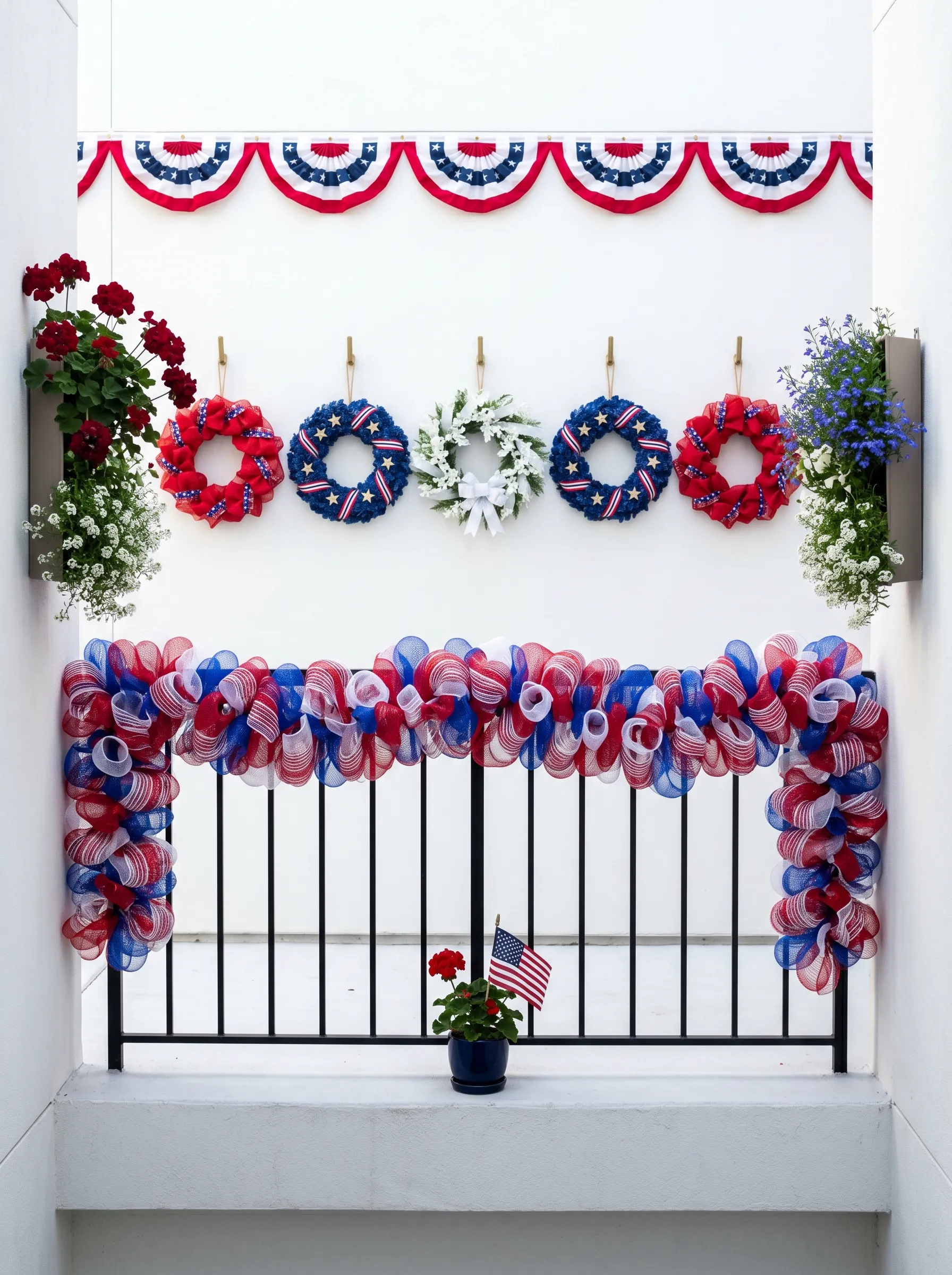
A white wall is the most versatile backdrop in decorating. This balcony used every inch of it.
Along the top of the white wall — above the railing line — attach fabric fan buntings in a continuous row across the full width. Use the proper pleated fan style with actual structure, not flat printed panels. Let them overlap slightly at the edges so the swags read as one continuous draped installation rather than individual pieces with gaps.
Below the bunting, on the wall itself, hang five wreaths in a horizontal row using brass picture hooks. Vary the wreath styles: a red ribbon-and-bow wreath, a navy mesh wreath with gold star accents, a simple white floral wreath, a blue silk flower wreath, and a small ribbon-and-berry wreath. The variety signals a collection; identical wreaths would signal a purchase. Space them evenly with two to three inches between, keeping them all at the same hanging height so the row reads as a deliberate arrangement.
On the railing, build a full deco-mesh garland in red, white, and blue that wraps the railing top rail and drapes down both sides. Pull mesh loops — 6-inch pulls — in alternating colors across the full railing width, securing each loop with floral wire. The garland should be dense enough that the railing structure is entirely invisible.
On the wall-mounted planters flanking the balcony, plant red geraniums and blue lobelia. A single potted red geranium with a small flag at floor level, centered below the railing, provides a grounding element below the deco garland.
The layering — bunting at top, wreaths at middle, deco garland at railing — gives a white wall three tiers of visual interest without anything competing for the same zone.
The White Terrace That Made Flowers Look Like Architecture
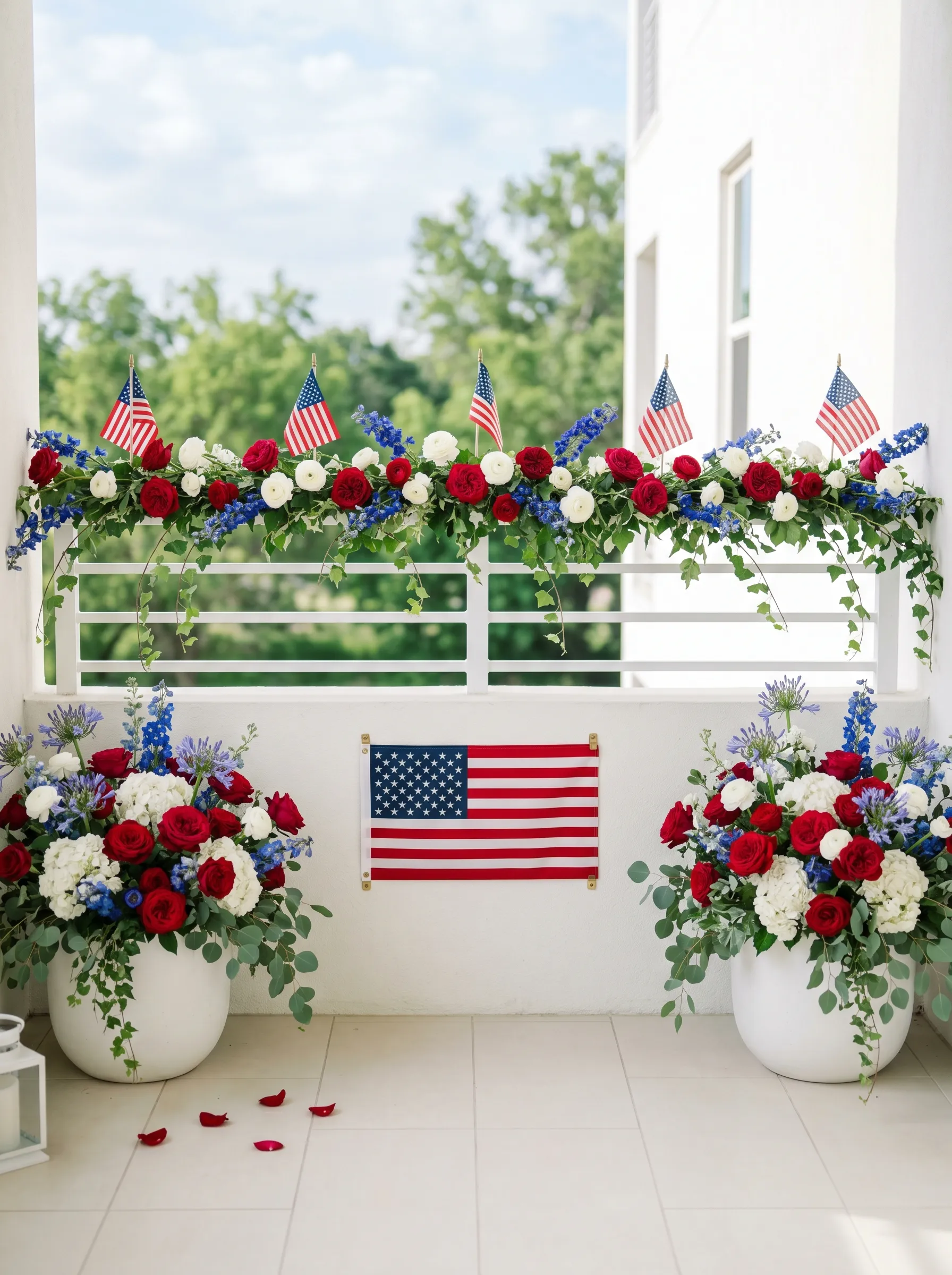
This terrace demonstrates what happens when you treat flower arrangements with the same seriousness as structural installations.
Source four large round white ceramic or fiberglass planters — the smooth globe style, at least 16 inches across. Plant each with an abundant arrangement that extends well above the planter rim: red garden roses and dahlias as the statement flowers, white hydrangea clusters as the mass flower, and blue agapanthus or delphinium for the tall vertical elements. Let eucalyptus and ivy trail over the planter edges and reach toward the floor.
Place the planters in two symmetrical pairs: one pair flanking the balcony opening at either side of the door or railing entry, one pair at the railing corners. The symmetrical positioning reads as formal and considered rather than decorative.
On the solid railing face — the concrete balustrade-style railing rather than a metal bar rail — build a narrow flower runner along the railing cap: a continuous line of roses, ranunculus, and delphinium interspersed with trailing ivy, all secured with floral foam blocks attached to the concrete using removable putty. Push small American flags into the foam at regular intervals, angled to face outward toward the street.
Center a small American flag — properly mounted on two brass corner brackets — on the railing face between the two flanking planter pairs. The flag at center, flanked by the floral symmetry above and the globe planters below, reads as complete and architectural even on a plain concrete balcony.
Scatter fallen petals on the floor of the terrace as a finishing detail. It costs nothing and photographs beautifully.
The High-Rise Evening Balcony with LED Strip Architecture
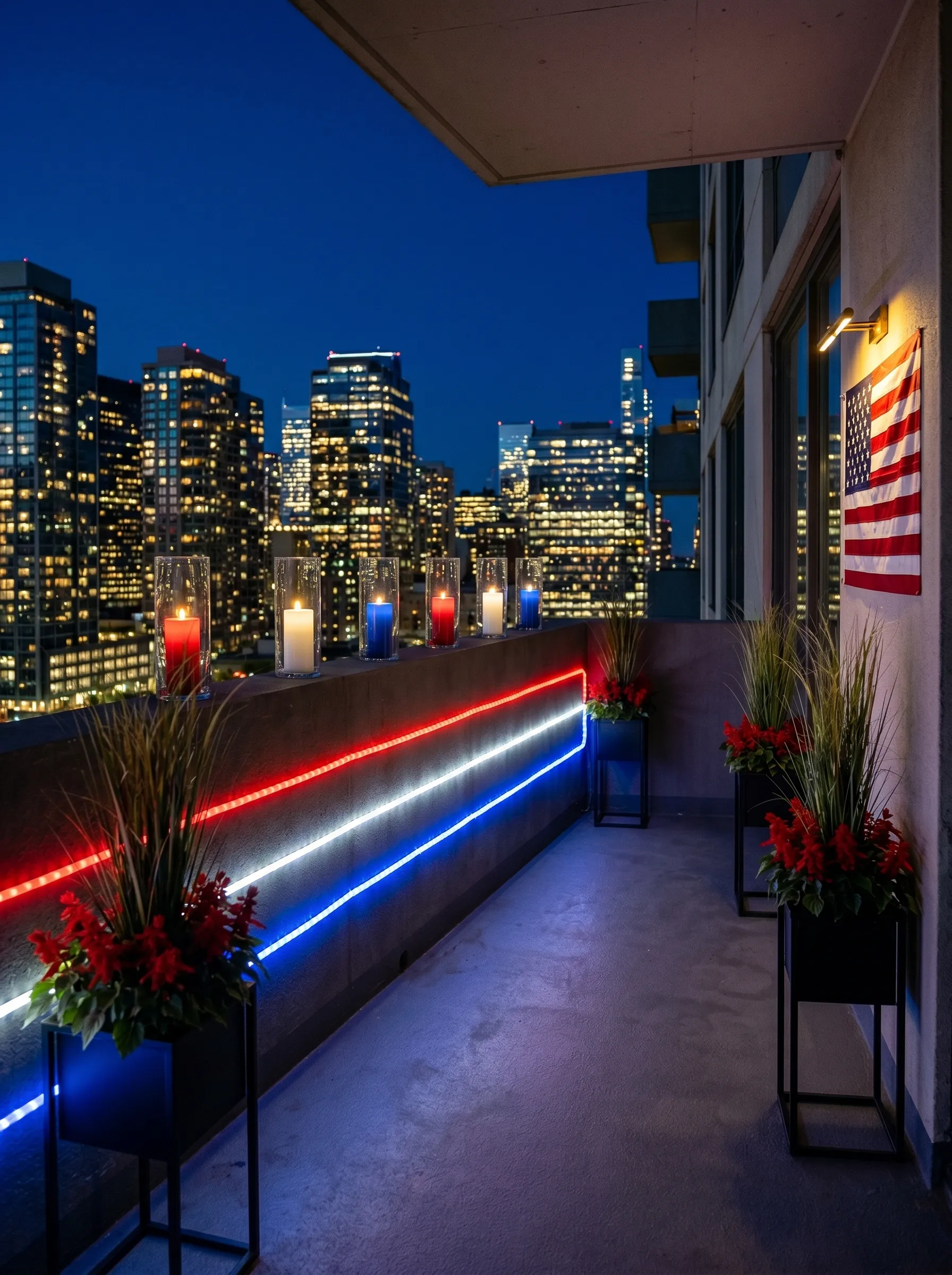
This is a balcony design for people who understand that a concrete ledge is not a limitation — it is a surface.
Adhere LED strip lights along the top face of the concrete railing ledge in three parallel runs: one red strip at the top, one white strip in the middle, one blue strip at the base. Use outdoor-rated weatherproof LED tape with a strong adhesive backing. Press firmly and allow twenty-four hours to cure before running the lights.
The three stripes of color running the full railing length create a linear installation visible from the street at night with a clarity that no flower box or bunting can match. They also illuminate the floor of the balcony from below the railing, giving the concrete deck a warm-glow quality without any overhead lighting.
Along the railing top ledge — above the LED strips — place six glass hurricane vases of varying heights holding pillar candles in red, white, and blue. The candles glow against the city backdrop and are visible from street level.
Mount a small American flag on the wall using brass bracket hardware with a picture light or small spotlight mounted above it. The spot-lit flag becomes the vertical element that commands the wall while the LED railing handles the horizontal.
On the floor at either end, pair matte black metal plant stands with compact red salvia — the single color keeps the floor zone from competing with the railing light installation. The entire setup is fundamentally about the LED strips. Everything else is support.
The Country Balcony with Wicker Baskets and a Tiered Plant Stand
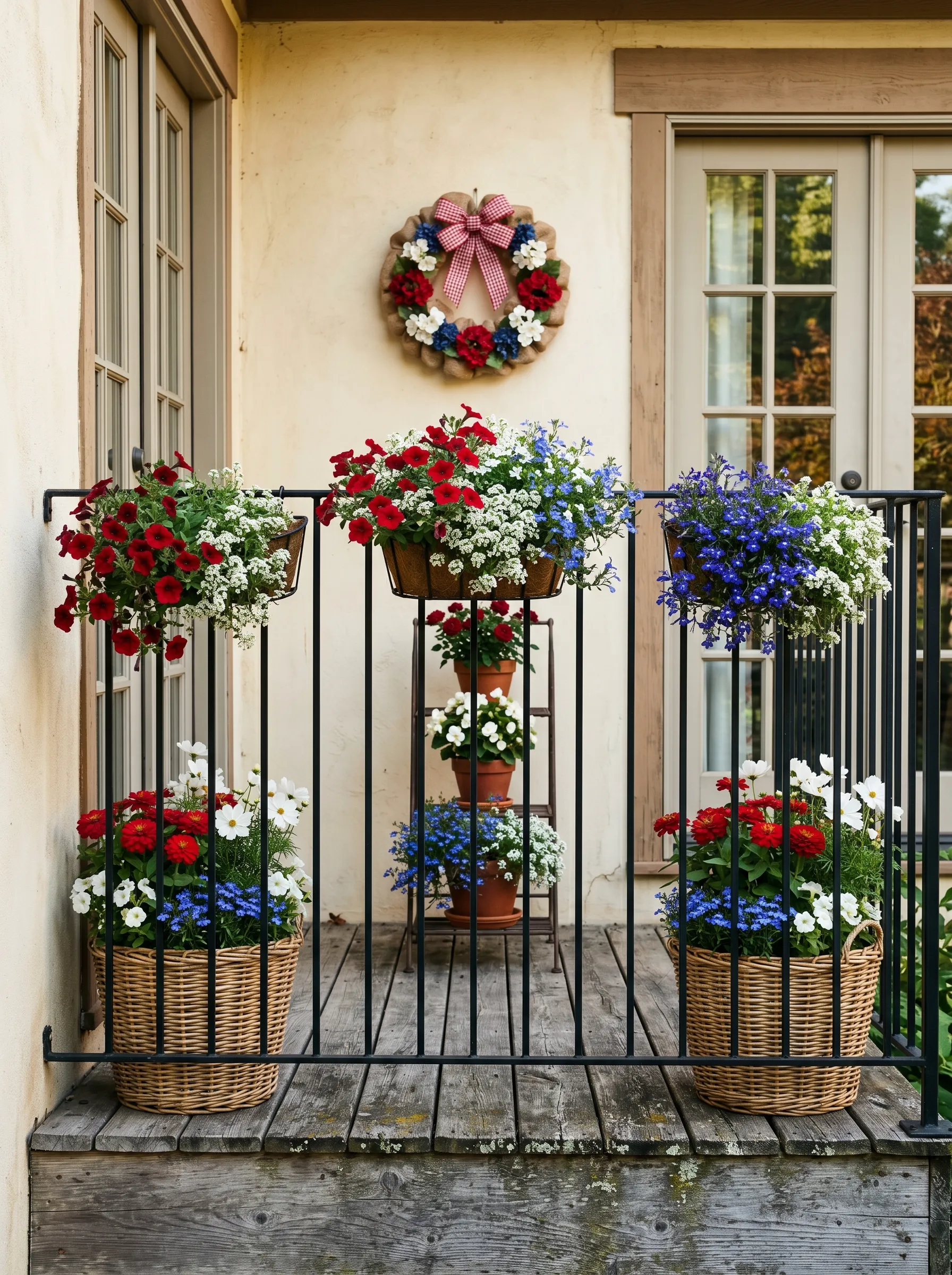
The natural material palette is the thing that makes this balcony different from every other patriotic setup.
Source two large wicker round baskets — the kind used as plant pot covers, at least 14 inches across — and set them at each end of the railing at floor level. Plant each with a mixed combination: red zinnias, white cosmos, and blue lobelia, with trailing sweet potato vine spilling over the wicker edges. The wicker material has a warmth and texture that terracotta and ceramic don’t produce at the same scale.
At the center of the railing, position a black iron tiered plant stand — a folding three-shelf variety works well. Fill the top shelf with a full mixed arrangement in a rust-toned oval planter: red petunias, white alyssum, blue lobelia. Fill the middle shelf with a solid white calibrachoa pot. Fill the lower shelf with a blue lobelia pot that trails toward the floor. The stand creates vertical variation at the center of the composition.
On the railing-mount hangers flanking the tiered stand, place matching coco-fiber basket planters filled with red geraniums and white trailing alyssum.
On the wall above the full arrangement, mount a burlap and gingham wreath — a natural jute base with patriotic flowers and a red check bow. The bow’s domestic quality anchors the whole installation in a familiar, homespun character that feels appropriate for a country-style balcony rather than forced.
The Urban Apartment Balcony with a Balloon Garland Railing Installation
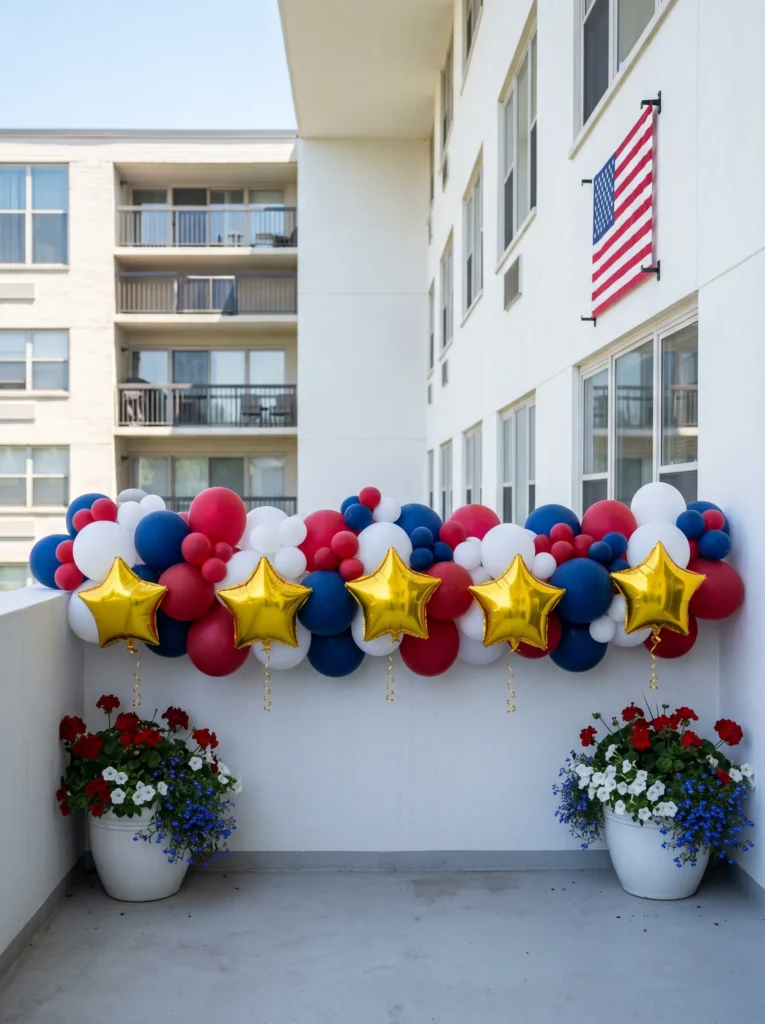
A balloon garland mounted along the railing cap is one of the most impactful installations possible on a small balcony. It is also one of the few patriotic decoration approaches visible from the street at meaningful scale.
Build the garland on balloon strip tape, starting at one railing post and working toward the other. Attach the tape to the railing cap using strong adhesive clips or zip ties at each post. Inflate balloons in three sizes — 5-inch, 11-inch, and 16-inch — in crimson, navy, and white. Work the largest balloons first at intervals along the tape, then fill between them with medium balloons, then pack the remaining gaps with the 5-inch balloons. The size variation creates organic texture.
Weave five to seven gold foil star balloons through the garland at irregular intervals, their ribbon tails hanging 4 to 6 inches below the garland line. The gold introduces a warmth that breaks the strict red-white-blue formula and reads as festive rather than rigid.
Mount a small American flag on the wall using brass brackets. Keep the flag alone on the wall — the garland on the railing is the primary installation; the flag is the anchor. White round planters flanking the base of the railing, filled with the three-flower combination, ground the garland at floor level.
The garland sits at railing height, which is exactly the right elevation to be seen from below, from across the street, and from the balcony simultaneously. A balloon column hits one of those views. A railing garland hits all three.
The Sunset Bistro Balcony That Treated the Railing Like a Trellis
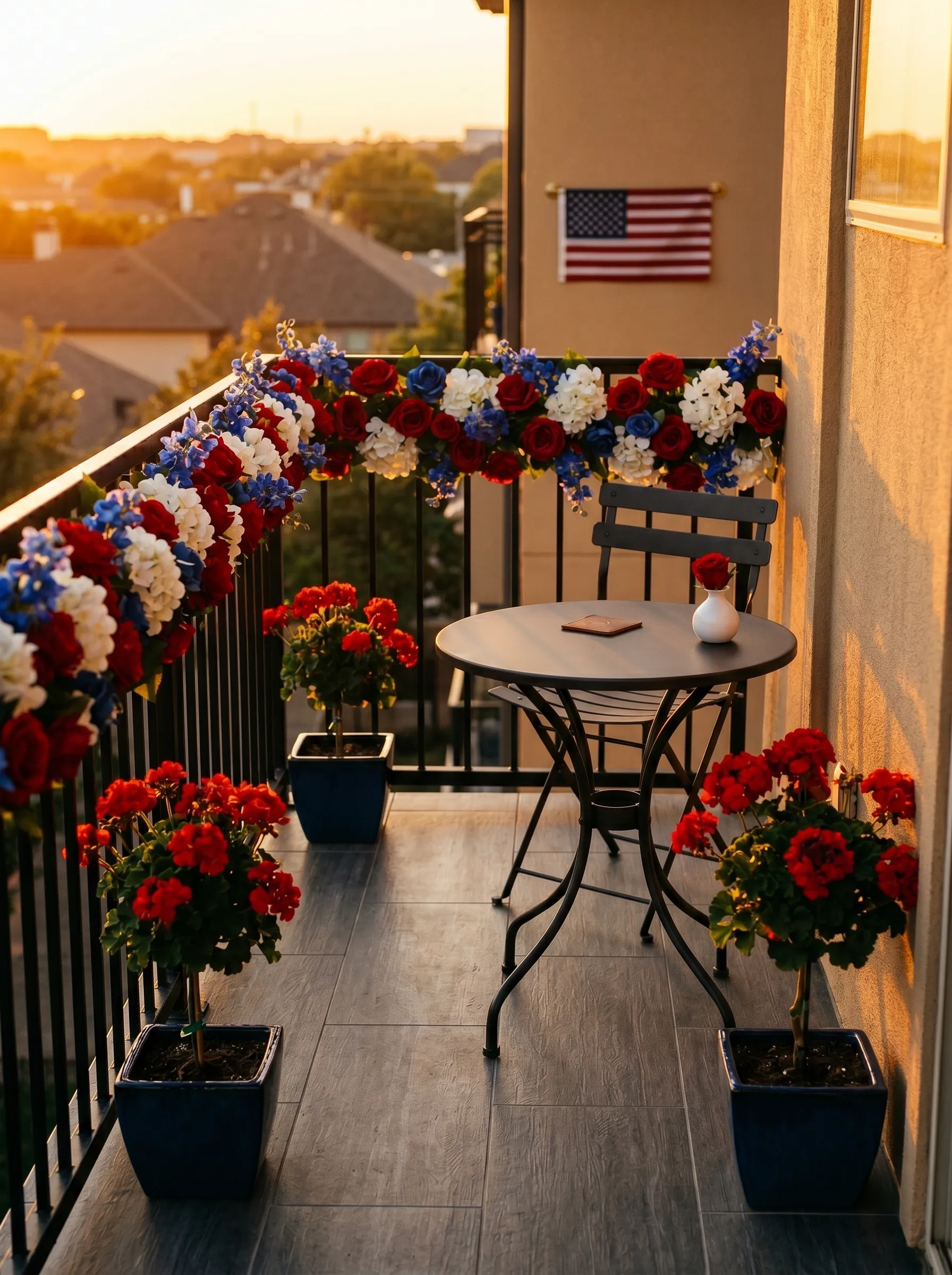
A bistro balcony with two chairs and a table is not a limitation. It is a restraint that makes everything feel more precious.
Build a flower garland and attach it to the railing in a U-shape: across the railing top, down both sides, and back toward the floor at each corner. Use a combination of silk red roses, white hydrangea puffs, and blue delphinium as the primary flowers, with greenery and eucalyptus as the filler. Secure to the railing with floral wire at 6-inch intervals. The garland should feel loose and abundant — not tight and linear.
On the wall at center, mount a small American flag with brass corner brackets. Keep it simple: flag, brackets, wall. No frame, no bunting around it.
On the floor at each corner of the railing, position navy square planters with red geranium topiaries — standard ball-head topiary form on a clear stem. The geometric quality of the topiary contrasts with the loose abundance of the garland.
Keep the bistro table surface spare: a single white bud vase with one red rose stem. A small book. Nothing else. The table is for sitting and the garland and topiaries are for looking at. Don’t confuse the two.
This balcony is designed for one or two people at golden hour. It knows exactly what it is.
The Minimal Balcony with Double-Run Pennant Bunting
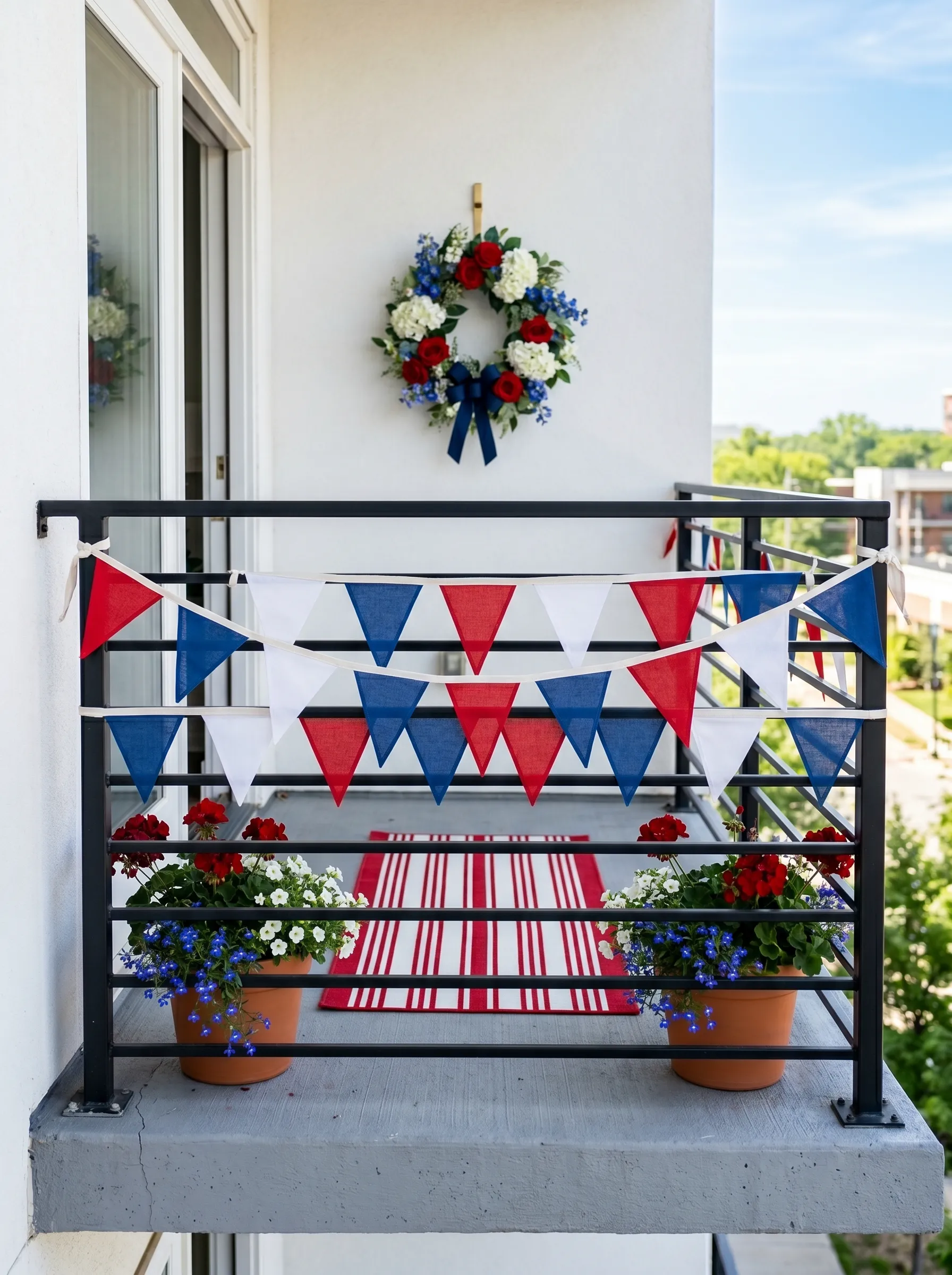
Sometimes the right answer is the simplest one, executed without apology.
Two runs of triangle pennant bunting. One patriotic flower wreath. Two terracotta pots. One stripe mat. That is the complete installation.
Attach both bunting runs across the full railing width at equal vertical spacing, each one tied at the outer posts and allowed to drape naturally. The two parallel runs create a sense of intentional coverage rather than a single decorative gesture.
Hang the wreath — red roses, white hydrangeas, blue delphinium, navy bow — on the wall above the railing center. Size matters: 22 inches minimum. A smaller wreath disappears at balcony scale.
Place the terracotta pots symmetrically at each railing base, filled with red geraniums, white petunias, and blue lobelia. Lay a red-and-white stripe mat on the floor.
Done. The entire setup costs under sixty dollars and takes under ninety minutes. What it lacks in complexity it makes up for in clarity. Every element earns its place. Nothing is competing. The balcony reads as finished.
The Apartment Evening Balcony Built Entirely Around Candlelight
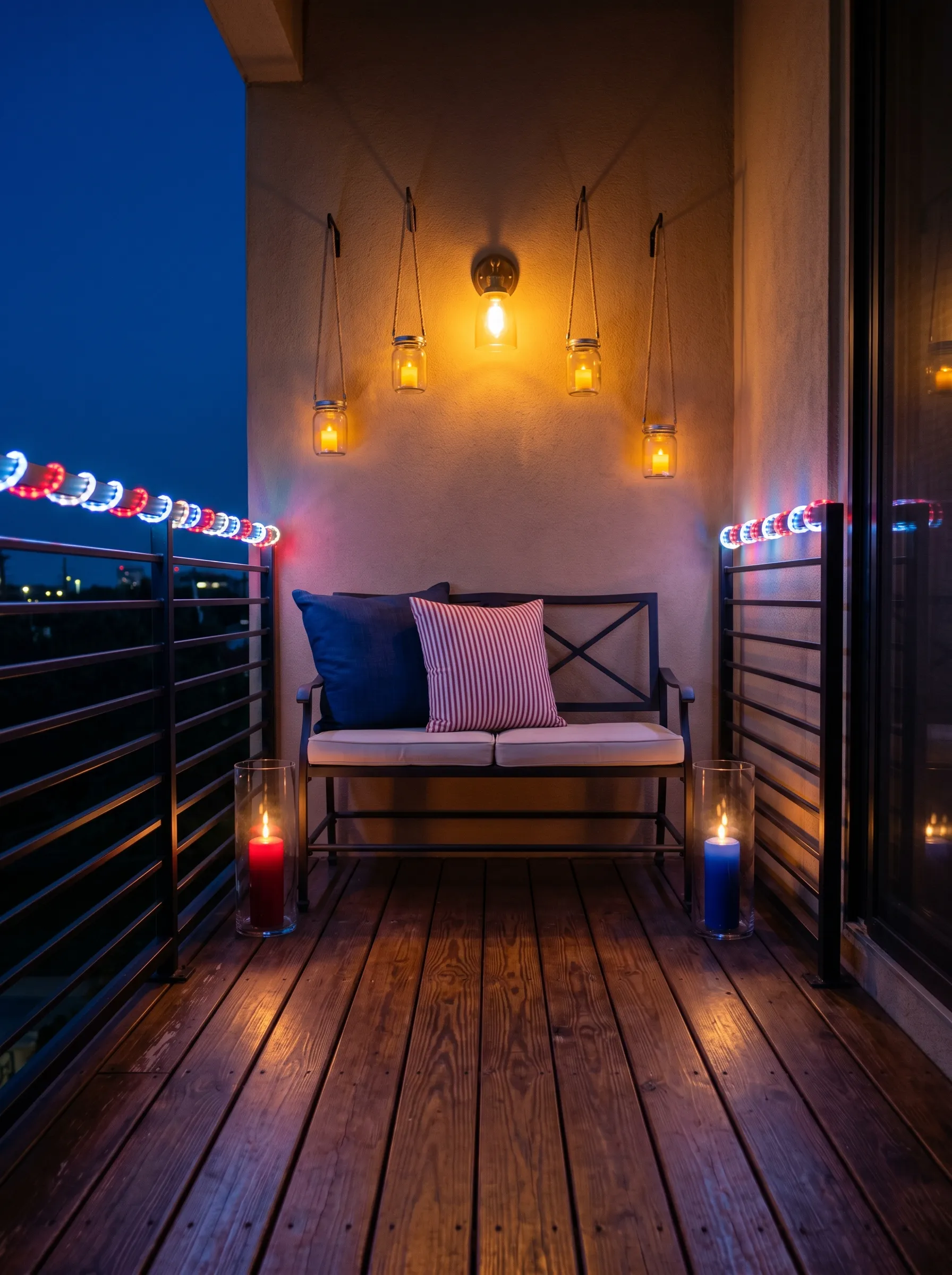
The question this balcony answers is: what if the candles were the architecture?
Suspend four mason jar lanterns from the wall using jute twine looped over removable command hooks, at varying heights above the seating. The jars hold LED pillar candles — not real flames on a wall-mounted element, but LED versions that mimic the flicker convincingly. The hanging jars at three different heights create a layered ambient ceiling that performs better than any overhead string light at close range.
Along the railing tops on both sides, run a string of color-cycle or patriotic LED tube lights — the kind that display red, white, and blue in sequence. These read as modern and energetic against the warm amber of the mason jar candles.
On the floor at each side of the bench seating, stand tall glass hurricane cylinders holding large red and blue pillar candles. These floor-level candles illuminate the bench from below and cast upward light that warms the seated person’s face — the detail that makes candlelit outdoor spaces feel intimate rather than simply dark.
Add a single wall sconce for functional overhead light. Keep it on a dimmer if possible.
Furnish with a metal bench, cream cushion, navy throw pillow, and a red-and-white stripe accent pillow. The seating is simple because the light is doing all the work.
The Clean White Balcony with Balloon Garland and Flag
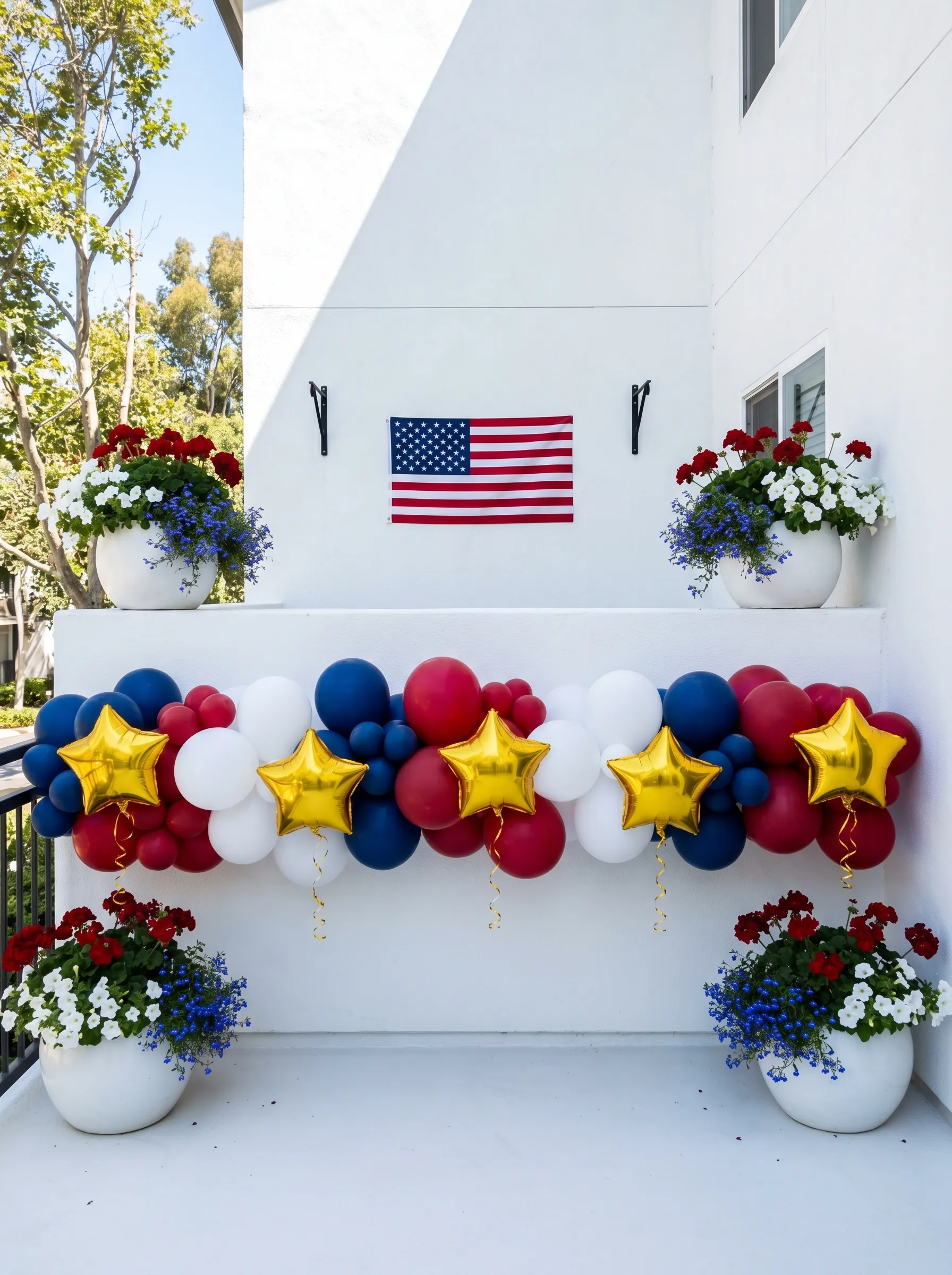
The white stucco balcony is the cleanest backdrop in this collection. Which means the decoration has nowhere to hide.
Mount the American flag first — horizontal, properly sized for the wall width, on brass brackets. Center it between the two railing posts. Leave two to three feet of clear wall above and below it.
Build a balloon garland along the solid railing face — not the top, the face — using double-sided tape and balloon glue dots to adhere directly to the concrete or stucco surface. Work in organic clusters of crimson, navy, and white, mixing 5-inch and 11-inch balloons at a roughly 3:1 ratio. Thread gold foil star balloons through the garland at five evenly spaced positions, their ribbon tails curling downward.
Place white round bowl planters at floor level flanking the railing base, filled with red geraniums, white petunias, and blue lobelia. On the railing ledge above the garland, if the ledge is wide enough, place a matching pair of white bowl planters.
The white surfaces, the white planters, the crisp flag, and the contained balloon garland produce a composition that reads as both casual and deliberate. The white wall is not a neutral background here — it is an active design element that makes the color of the balloons and the flag read at maximum intensity.
The Balcony That Holds Its Own
A balcony is not a yard. It is not a porch. It doesn’t have the square footage of a backyard or the architectural anchors of a front entrance.
What it has is intimacy, elevation, and a clarity of constraint that larger spaces don’t offer. You know exactly what you’re working with. You know exactly what surfaces exist. That limitation, if you treat it as information rather than a complaint, produces a focused approach that sprawling spaces rarely require.
The balconies in these pages don’t succeed because they overcame their smallness. They succeed because they accepted it. They chose one surface to make the statement, let the other surfaces support it, and added enough evening light to make the whole thing worth staying in after dark.
July 4th is an evening holiday. Whatever you put on your balcony should earn its place at 9 p.m. as much as it does at 3 p.m. Build toward that moment and everything before it takes care of itself.