
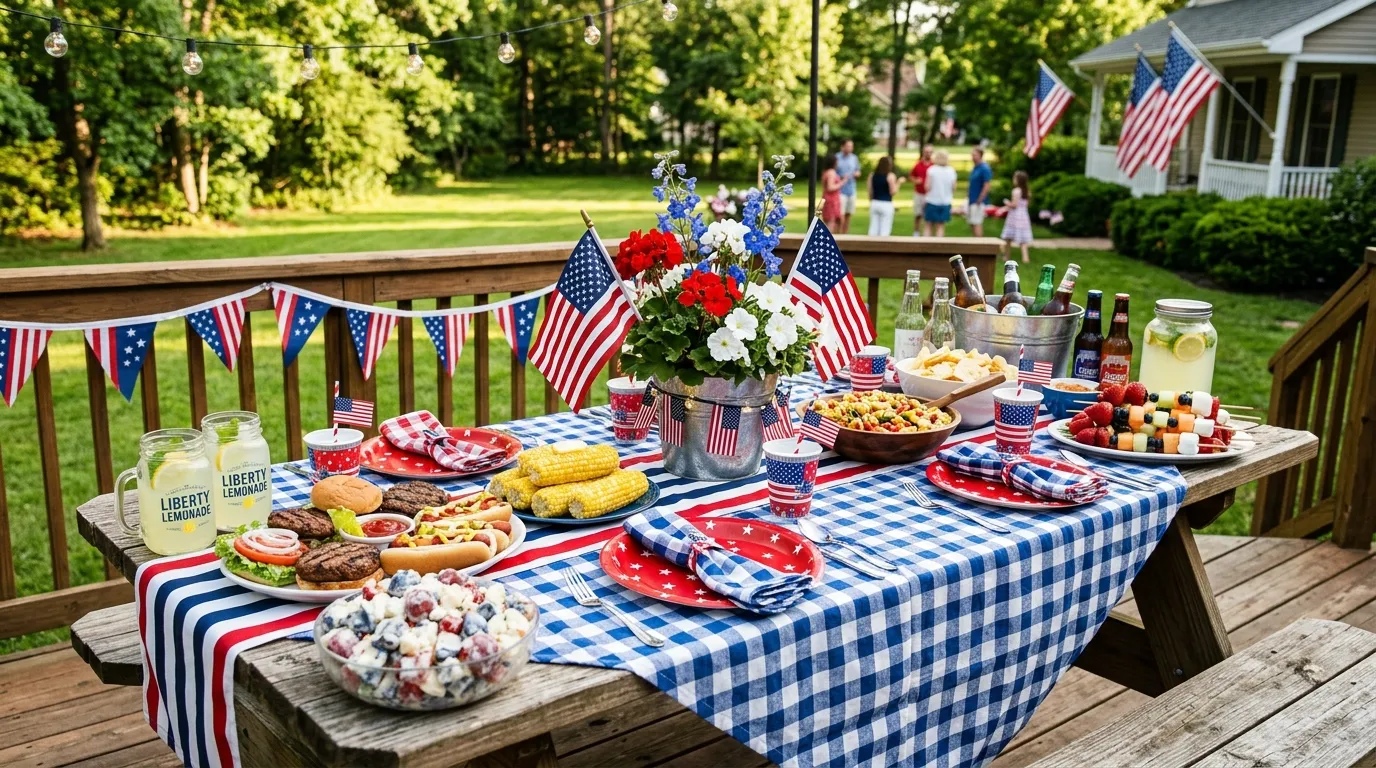
Most 4th of July tables are set the same way.
Red plastic tablecloth, white paper plates, blue napkins from a party store bag. Everyone knows what they’re supposed to do and does exactly that. Nobody remembers it afterward because there was nothing to remember.
A table is the most intimate decorating surface at any party. People sit at it for an hour. They look at it up close, across from each other, for the duration of the meal. Everything on it reads at three feet rather than thirty. The gap between a thoughtful table and a thoughtless one is more visible at that distance than anywhere else in the house.
That gap is not expensive to close. The most beautiful tables in these pages use mason jars and gingham napkins and galvanized buckets. They use things that cost ten dollars and look like they cost ten times that because someone thought about placement, proportion, and how candles interact with flowers before putting anything down.
That’s the whole craft. Here’s how it works.
Why Most Holiday Tables Look Exactly Like What They Are
The problem is not that people try too hard. It is that they follow a template without understanding why the template exists.
The Color Distribution Problem
Red, white, and blue applied at equal intensity across every surface of a table produces something that looks like a flag supply store rather than a dining table.
A tablecloth, plates, napkins, glasses, and centerpiece flowers all in strict equal thirds of each color creates visual noise. Every element is trying to be the patriotic note. None of them succeed individually because they’re all saying the same thing simultaneously.
Good table design uses a dominant ground color that the other elements rest against. A white linen tablecloth lets red flowers read at their most intense. A navy tablecloth makes white plates and red napkins pop against the dark field. A red-and-white gingham ground becomes the pattern anchor that keeps bolder centerpiece elements from looking random.
The table is not a flag. It is a surface designed for eating. The patriotic palette should be present without being the only thing the table communicates.
The Centerpiece Height Problem
Most people put a centerpiece at a height that makes the people across the table invisible.
A tall centerpiece on a dining table creates two separate worlds — one at each end — rather than one shared conversation. Guests spend the meal talking around a floral arrangement they can’t see over, and the host congratulates themselves on having set a beautiful table that nobody could actually sit at comfortably.
The rule is simple: either keep the centerpiece low enough to see clearly over — roughly twelve inches from table surface at maximum — or take it high enough that people can see through under the arrangement — typically eighteen inches and above at the base of the blooms. Everything in the middle zone blocks sight lines without providing the visual drama that justifies the blockage.
Long tables present a different opportunity. A runner of low florals, candles, and scattered petals that runs the full table length keeps sight lines open while providing more combined visual mass than any single centerpiece.
The Place Setting That Doesn’t Know What It Is
A place setting is not just a functional arrangement of plates and cutlery. It’s the first thing a guest sees when they sit down and the thing they look at for the duration of the meal.
Most holiday place settings are either completely functional with a token seasonal element thrown on top — a flag pick stuck in a napkin fold, a patriotic paper napkin underneath a real plate — or completely costumed in themed disposables that communicate “we didn’t think this was worth real plates.”
The place settings that work treat each element as a deliberate choice. The plate material — real or disposable — is consistent with the table’s overall register. The napkin fold communicates something: a bow tied in ribbon signals ceremony; a simple fold with a flag suggests casual warmth. The napkin ring or tie is part of the setting, not an afterthought.
What to Decide Before Buying a Single Stem
A table set well requires three decisions made before anything is purchased.
Indoor or Outdoor
An outdoor table operates under different constraints than an indoor one.
Tablecloths on outdoor tables need weight — clips, tablecloth weights, or a second layer underneath to prevent movement in a breeze. Flowers on outdoor tables need to be in water-secure vessels because July heat depletes stems faster than air conditioning. Candles outdoors need to be in enclosed lanterns or hurricane glass; open-flame taper candles outdoors go out or drip sideways in any wind.
An indoor table has more flexibility: tall tapers in open candlesticks work, loose flowers last, tablecloths drape without concern. The indoor table can be more delicate. The outdoor table needs to be built for real conditions.
Decide which environment you’re working in before choosing any centerpiece element.
Scale for the Table Shape and Size
Round tables, long rectangular tables, and square tables each have different centerpiece geometries.
A round table wants a single centered arrangement or a small cluster of vessels at center. The arrangement should be viewable from all sides equally since every seat faces the center. Elongated arrangements look awkward on round tables.
A long rectangular table wants either a single long runner of material down the center, or a repeating series of identical or near-identical units spaced evenly down the length. A single arrangement at one end of a long table looks forgotten rather than designed.
A square table wants a tight center cluster — four or five vessels grouped close together — or a square arrangement that relates to the table’s geometry.
Set the Table First, Then Style
This is the step most people skip and the one most responsible for tables that look rushed.
Set all the plates, glasses, and cutlery before placing a single decorative element. Look at the table when it’s fully set but undecorated. This tells you how much surface remains for flowers and candles, where the natural sight lines run, and whether your planned centerpiece will actually fit.
Most centerpiece disasters — the arrangement that’s too big, the candles that end up in front of someone’s face, the flowers that keep getting moved to make room for the food — happen because someone styled before setting.
Set first. Then style the negative space.
4th of July Table Styling Ideas
The Blue-and-White Toile Table That Made Chinoiserie Feel Patriotic
The ground is a blue-and-white floral tablecloth — printed toile or floral block print, the kind with garden scenes rendered in navy line on white ground. This is the table’s defining decision and the reason everything else works.
Against this ground, red becomes the accent rather than a third equal: red scallop-edged placemats with embroidered red detail, red bow-tied napkins, red poppy flowers in the centerpiece. The blue and white are already established by the tablecloth; the red is the one additional note that reads as patriotic without overwhelming the refinement of the base.
Source cylindrical silver mint julep cups or low silver vases for the centerpiece vessels — the metal reflects the light and complements the blue toile ground. Fill them with white ranunculus, white peonies, and red poppies or anemones in a loose, garden-style arrangement. Push two small American flags between the arrangements at slight angles — just enough to acknowledge the holiday without transforming the table into a themed event.
For glassware, use navy hobnail goblets or navy-tinted glass. The navy picks up the tablecloth’s dominant color and elevates the whole table’s color saturation simultaneously.
Small patriotic favor cups or berry cups at each place setting — the striped red-and-white kind — filled with mixed berries function as both a table decoration and a pre-meal snack. They’re charming and they cost almost nothing.
The key to this table is that it looks like someone who already owns beautiful things styled for the Fourth. The patriotic elements are additions to an existing sensibility, not replacements for it.
The Porch Table with a Flower Runner That Understood the Verb “Lay”
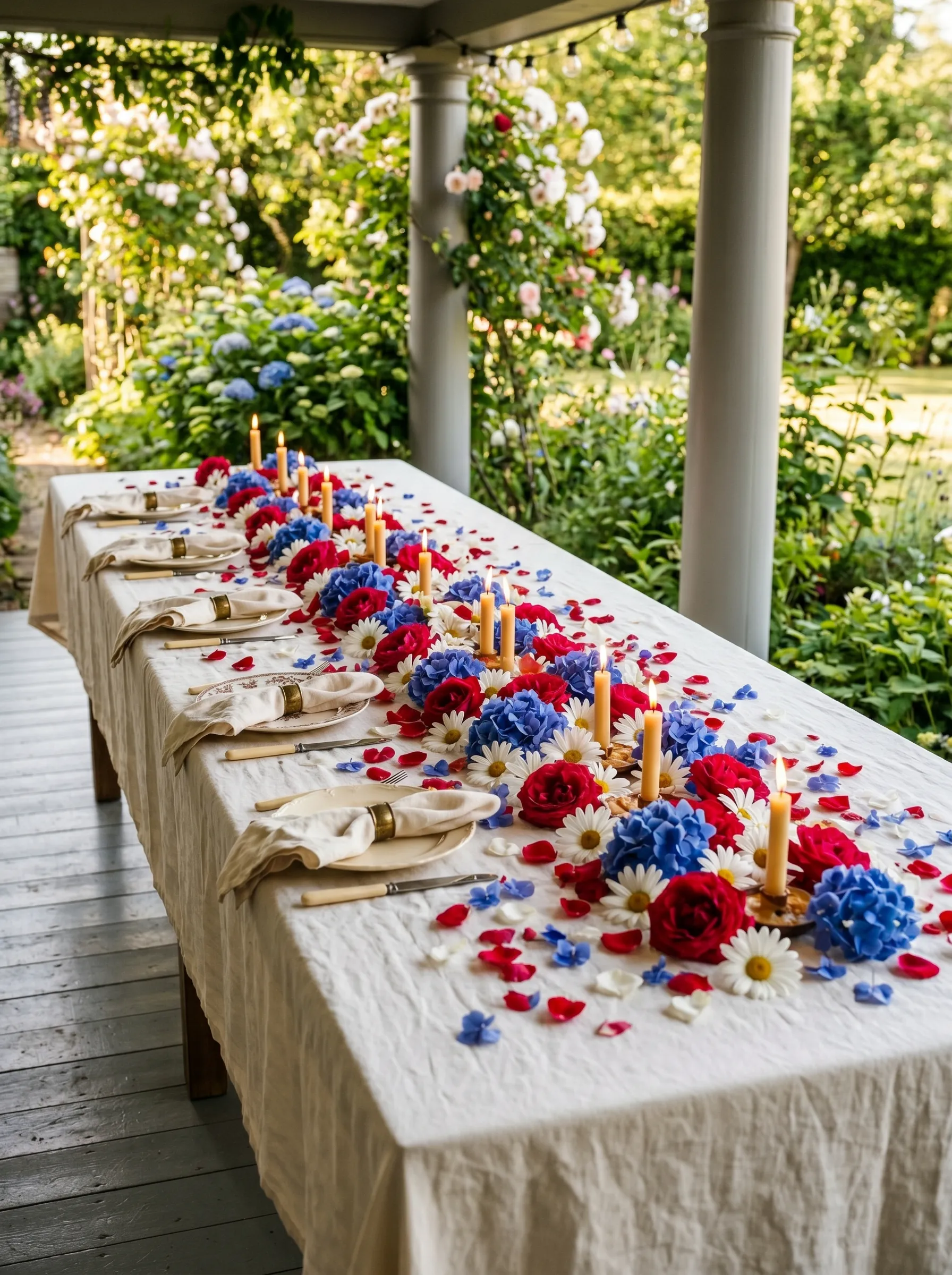
The mistake most people make with a flower runner is installing it. It should look like it was laid.
Lay a white linen or heavy muslin tablecloth first, slightly wrinkled from washing but not pressed flat. The slight texture tells guests this is a handmade, considered table.
Build the flower runner directly on the tablecloth without a base: place full floral heads — large blue hydrangea clusters, red garden roses at full open bloom, white shasta daisies — directly on the cloth in an alternating pattern down the table’s full length. Work quickly and loosely; the roses should vary in openness, the hydrangeas in size. Overlap stems rather than spacing flowers evenly.
Between the flower placements, insert small brass candlestick holders with short natural beeswax tapers — 4 to 5 inches tall — at irregular intervals. Light them when guests sit down.
Scatter individual petals — red, white, blue where available, but mostly red rose petals — extending from the runner edges outward to within four inches of the plate placement zones. The scattered petals extend the runner visually without adding height.
Set antique or vintage plates — mismatched transferware in any blue-and-white pattern — with linen napkins twisted loosely through brass napkin rings. Leave flatware in a simple outside-in arrangement.
The table reads as English garden party with a patriotic color palette. No element is purchased specifically for the holiday. The flowers are in season. The plates are from a collection. This is the table that looks most like something a person with taste lives inside of, rather than a holiday setup they installed and will remove on July 5th.
The Long Table with the Flag Backdrop That Got the Scale Right
This is a table designed to be photographed from the end — and to seat twenty people comfortably, which means the decoration cannot get in the way of either function.
The backdrop is a full-size American flag — the large commercial kind, at least 5×8 feet — pinned flat against the exterior wall behind the head of the table. String globe lights in two parallel horizontal runs across the flag face, secured at the wall edges. The flag lit from the front by globe lights creates a backdrop that reads from anywhere along the table’s length.
The table itself is covered in a red-and-white gingham tablecloth, which establishes the casual-festive register. The gingham immediately signals that this is an outdoor summer party rather than a formal dinner, which tells guests how to behave — with ease.
The centerpiece runs as a repeating unit along the table’s length: low arrangements of white hydrangeas in blue glass mason jars or cobalt blue vases, alternating with clusters of three small American flags in a single vase. The repetition creates the visual rhythm that holds together a table this long. Each unit is simple; the series of them is striking.
White plates on woven chargers give the place settings warmth without formality. Clear glassware keeps the table from looking saturated with color.
The table works because the scale decisions are right: the flag is large enough to command the backdrop zone; the centerpiece units are low enough to see across; the tablecloth pattern is bold enough to register from ten feet away but doesn’t compete with the white hydrangeas above it.
The Farm Table with Mason Jars That Made Humble Vessels Shine
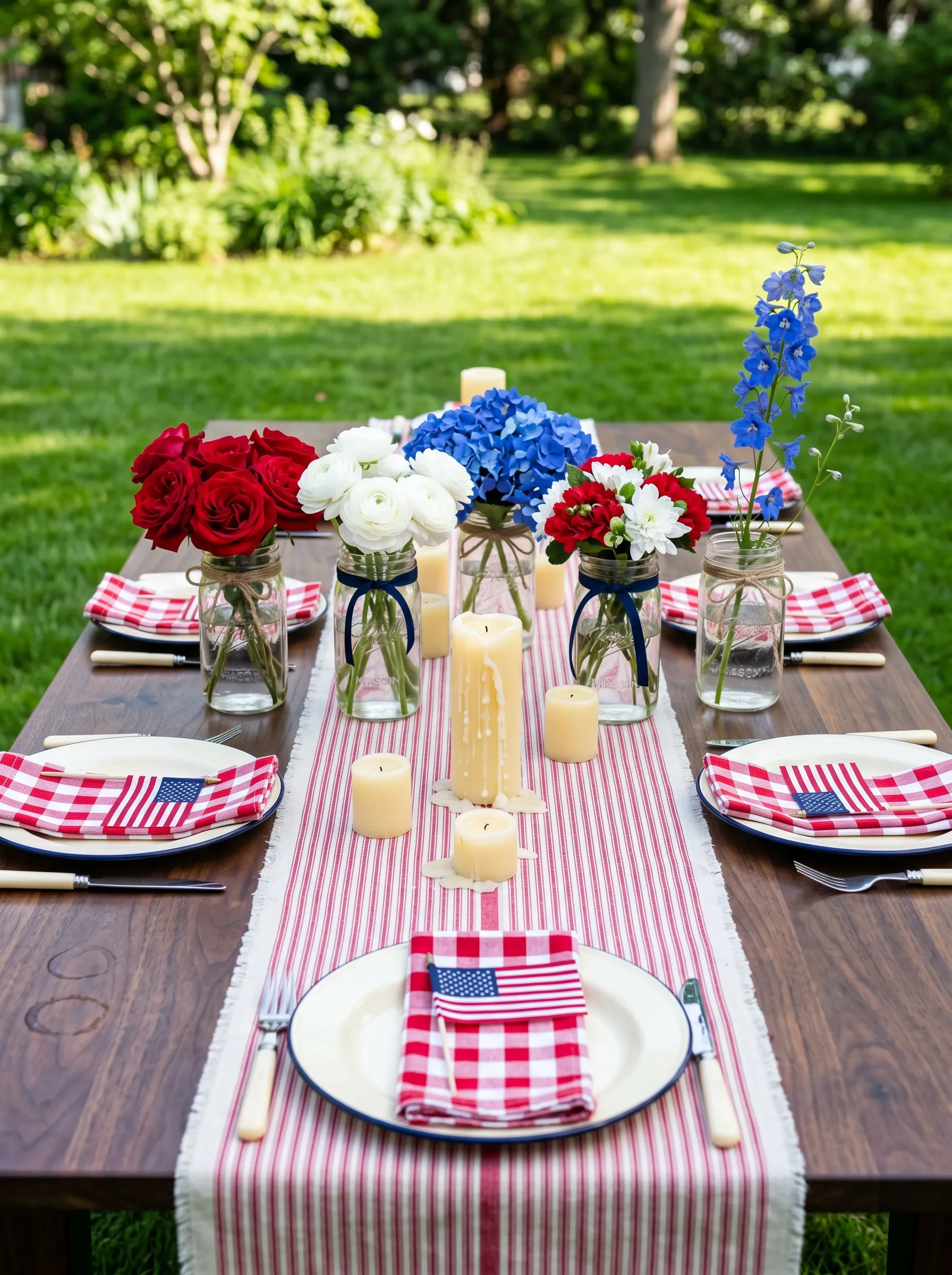
Mason jars are among the most versatile vessels in table styling. They are also among the most easily done wrong.
A mason jar placed simply on a table and filled with flowers reads as a mason jar with flowers in it. A mason jar with a specific treatment — a strip of navy blue ribbon tied in a loose bow around the neck, or a length of natural jute twine wrapped and knotted — reads as a considered design choice. The difference is the same object treated with attention versus without it.
For this table, use quart-size wide-mouth mason jars in three ribbon treatments: navy ribbon, jute twine, and no treatment at all (bare glass). Vary them. One navy ribbon jar holds red roses. One jute jar holds white ranunculus. One bare jar holds blue hydrangea. Alternate these with pillar candles on small wooden disks between each jar.
The table surface is a raw farm table in dark walnut. The runner is a red-and-white ticking stripe with fringe at each end. Enamelware plates — white with a navy rim — at each setting, with red-and-white gingham napkins, a small American flag pick laid across the plate, and bone-handled flatware.
This table is simultaneously casual and careful. The mason jars are humble vessels. The roses inside them are not humble flowers. The jute on one and the ribbon on another and the bare glass on the third says: someone thought about this, even though it doesn’t look like they spent money.
The Garden Table with Gladiolas That Understood Architecture
Red gladiolas are one of the most underused flowers in patriotic table styling. They are tall — 24 to 36 inches — architectural in structure, and deeply red without the formality of roses.
Build the centerpiece around a large cylindrical glass vase, at least 10 inches in diameter, filled with water. Stand eight to ten red gladiola stems in the center, cutting them to varying heights — the tallest at 30 inches, the shortest at 20. Work in blue hydrangea heads around the gladiola bases, tucked in tightly against the vase rim so they read as a blue collar at the base of the tall stems. The effect is gladiolas emerging from a pool of blue.
This centerpiece is tall. Use it only on tables where guests are seated at opposite ends rather than opposite sides, or on a table long enough that the head arrangement doesn’t block cross-table conversation.
At each place setting, pair a small blue hydrangea stem in a low clear bud vase with a single red gladiola bud laid horizontally across the plate. This connects the place setting to the centerpiece without duplicating it.
Use a gray linen tablecloth as the ground — not white, which would be too expected, and not red, which would fight the flowers. The gray reads as sophisticated and lets the red and blue bloom read at full intensity.
For glassware, alternate red glass goblets and clear hobnail tumblers down the table. The red glass picks up the gladiola color; the clear glass provides the neutral counterpoint. Tie white napkins with a narrow red velvet ribbon bow — a single loop, not an elaborate knot.
The Round Table Night Centerpiece That Made Seven Vases One Idea
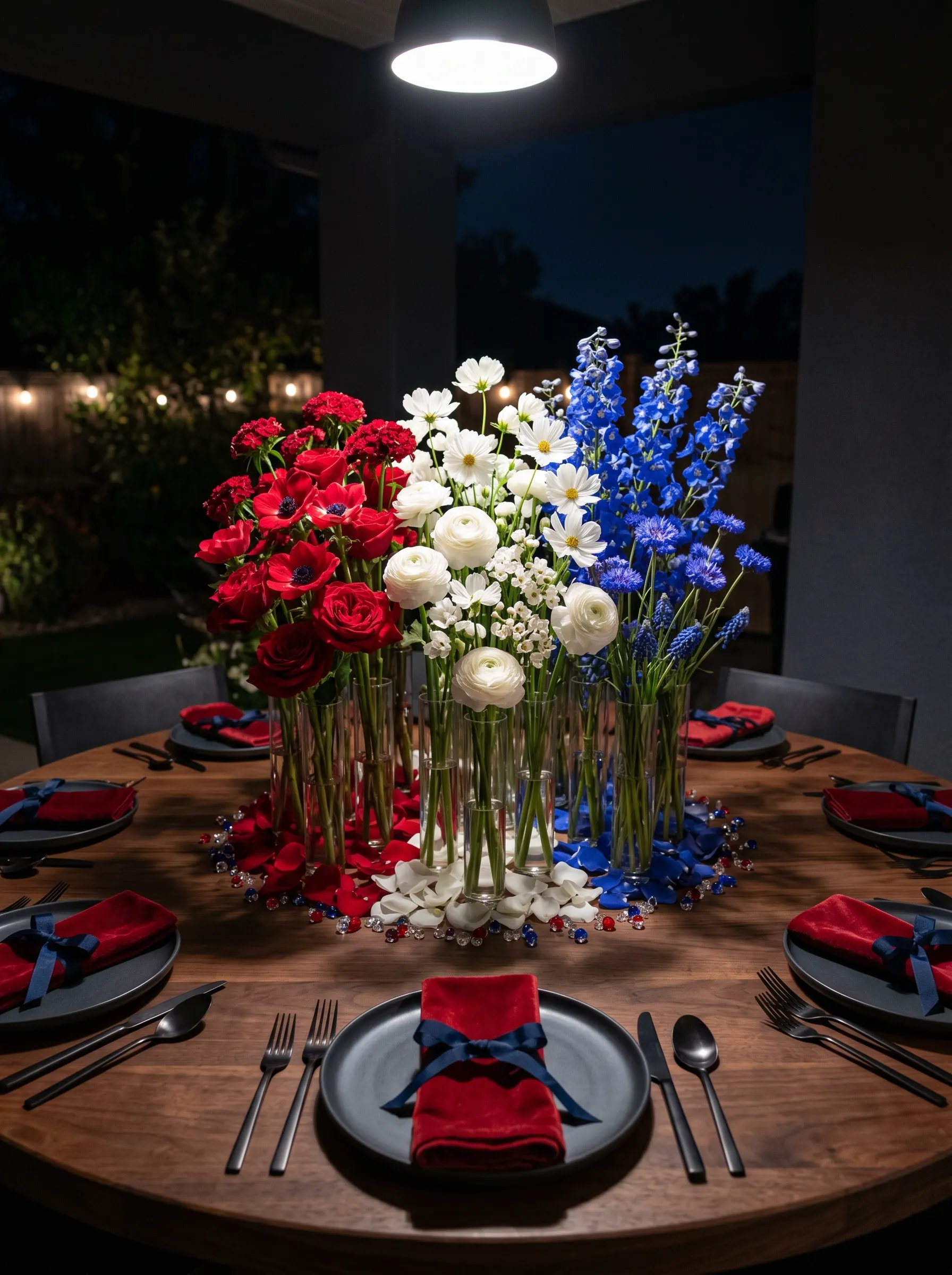
A round table with a central overhead pendant creates a natural spotlight. Use it.
Source seven to nine thin-necked bud vases or test-tube vases — identical, clear glass — and arrange them in a tight cluster on the table at center, facing outward in all directions. Fill each vase with a single flower type in a single color: red roses and anemones in the left third, white ranunculus and cosmos in the center third, blue delphinium, cornflowers, and muscari in the right third. From above, the cluster reads as a single mass of flowers in three distinct zones. From table height, it reads as an abundant garden moment.
Scatter red, white, and blue gem beads or faceted crystal scatter around the base of the vase cluster, extending outward 4 to 5 inches. The scattered gems catch the overhead pendant light and create the appearance of scattered light at table level.
Set dark charcoal or graphite matte plates — not black, not gray, but the specific charcoal matte — with red velvet napkins folded into a flat rectangle and tied with a narrow navy ribbon. The dark plates and velvet napkins push the table into a dramatically saturated register that white plates can never achieve.
This table is designed to be seen at night with overhead light focused on the centerpiece. During daylight it is lovely. At 9 p.m., with dinner plates cleared and everyone still at the table talking, it is extraordinary.
The Grazing Table That Made the Food the Centerpiece
A grazing board at this scale — covering a full six-foot table from edge to edge — is not a side dish. It is the visual centerpiece of the entire event, and it should be composed with the same attention to color, texture, and hierarchy that any floral installation receives.
Build the base layer first. Line the table with wax paper or butcher paper and cover it entirely with crackers arranged in overlapping fans, forming a consistent background texture that the taller elements will sit above.
Work in a color framework. Position white elements — brie wheels, mozzarella logs, white cheddar wedges, cream cheese — as anchors at regular intervals. Position red elements — salami roses made by rolling thin slices over a finger and standing them upright, strawberries, prosciutto folds, red grapes, watermelon cubes — as the primary color mass. Position blue elements — blueberries, purple corn chips, dried fruit — as the secondary accent that reinforces the palette without dominating.
Scatter white chocolate stars — made from a simple mold — across the surface at irregular intervals, so they appear to float above the other elements. These read as decorative even though they are fully edible. Push two or three small American flags on picks into the arrangement at the center, at different heights, so they rise above the food.
Place small ramekins of dips and condiments where natural gaps exist, positioned before the food elements rather than after so the ramekins become part of the composition rather than corrective additions.
The grazing table is the most democratic of decorating formats: everyone takes from it, moves elements, creates gaps that fill again. Design it to look good at the start of the party. Accept that after twenty minutes it will look different. The beginning is what gets photographed.
The Dark Wood Formal Table That Used Candles as Candlesticks
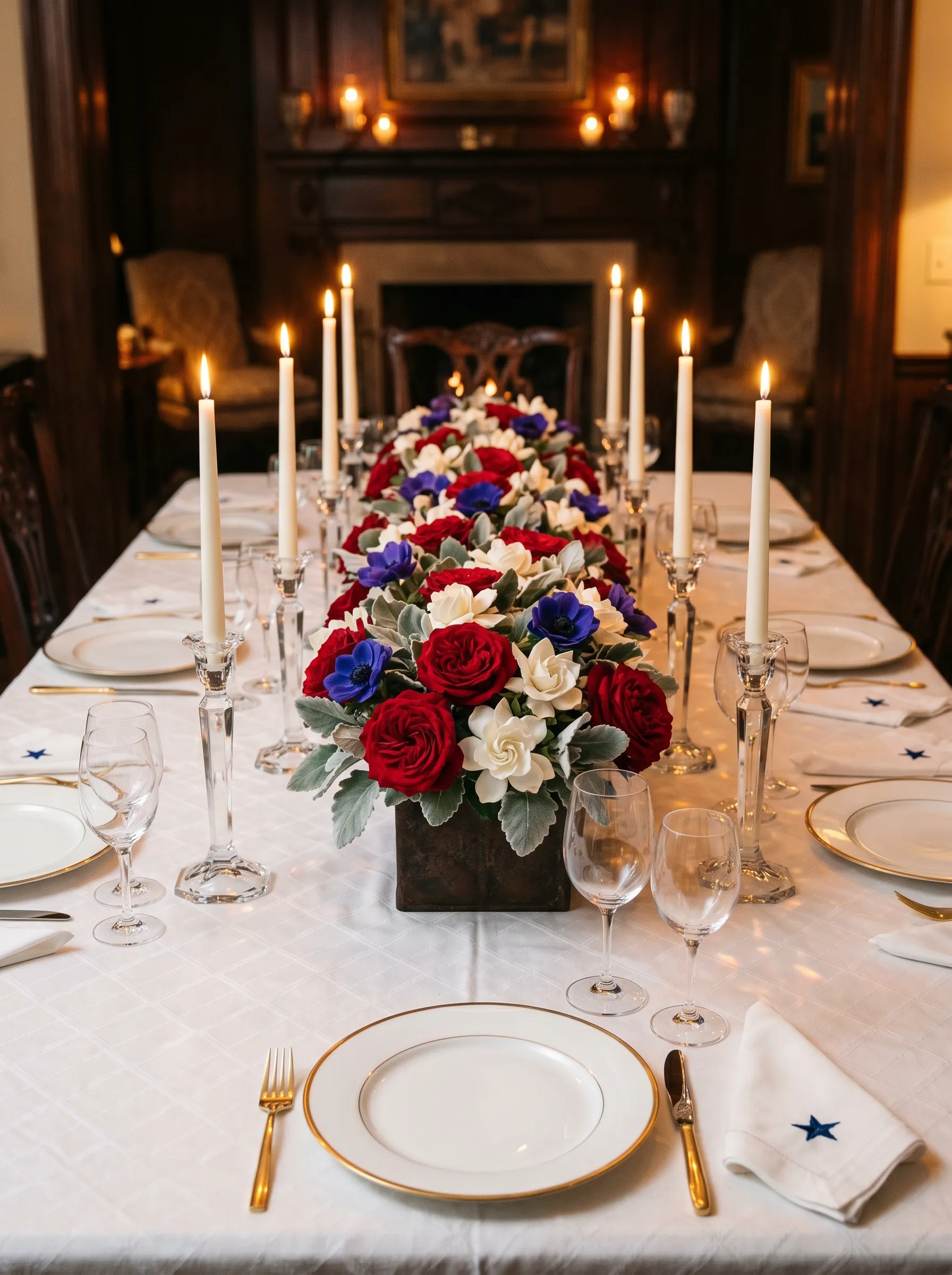
The formal dining table for an intimate July 4th dinner operates under completely different rules than any outdoor or casual setup.
Everything at this table is expensive to replace and worth treating accordingly.
The tablecloth is white damask or white embroidered linen — full length, pressed. The surface is clean and formal before any seasonal element appears.
The floral runner at center is built in a footed urn: a low brass or pewter footed compote used as a flower container, filled with a lush mixed arrangement at a low profile — no more than 10 inches of total height. Fill with deep red garden roses, cream or ivory gardenias, purple anemones with black centers, and silver dusty miller as a texture note. The purple anemone is the choice that distinguishes this table from every other red-white-blue arrangement. Against the red roses and cream gardenias, the anemone’s deep purple reads as navy blue without being exactly blue. It is more interesting than hydrangea or delphinium in this formal context.
Crystal candlesticks hold ivory tapers in eight-inch and ten-inch heights, stepped outward from the central urn in a symmetric arrangement. Crystal because the formal table calls for material purity. Ivory tapers because white tapers read as cheap at this level.
Set fine porcelain plates with a thin gold rim on gold chargers. Gold flatware. Crystal wine glasses. White linen napkins pressed flat and folded in thirds, lying to the left of the plate without a ring. A single embroidered navy star on the napkin corner serves as the only explicit seasonal note on the place setting.
This table says: July 4th is worth treating as an occasion.
The Blue Gingham Table That Knew What Red Glass Does
Blue-and-white gingham as a tablecloth ground has a quality that few other patterns can match: it neutralizes other strong colors. Red on a white ground reads as intense. Red on blue gingham reads as rich.
Lay a blue-and-white large-check gingham tablecloth — not small check, the larger the better — as the table’s primary ground. Over it, place circular white woven placemats with bobbin-lace or eyelet detail at each setting. The circular placemats break up the grid pattern and give each place setting its own visual territory.
Set red charger plates under white dinner plates. The red rim around each white plate creates a small frame at each setting that unifies the table. Source red art glass goblets — the deep ruby kind, not cranberry glass — for the wine glasses. Against the blue gingham, the red glasses read as jewel-like rather than simply patriotic.
Gold flatware is the critical material choice here. Silver flatware on a blue gingham table reads as country. Gold flatware on blue gingham reads as garden party. The metal’s warmth bridges the gap between the informal tablecloth and the more formal glassware and charger plates.
At the centerpiece, arrange American flags in brass candlestick holders at the center of a cluster of white flowers in rattan-wrapped vases. The brass and rattan materials reinforce the warmth introduced by the gold flatware.
Lay blue-and-white striped napkins folded in a loose bishop’s hat fold at each setting, secured with a small embroidered star napkin ring or left without a ring for even greater informality. The napkin pattern echoes the tablecloth without being identical to it.
The Pergola Table with the All-Candle Centerpiece
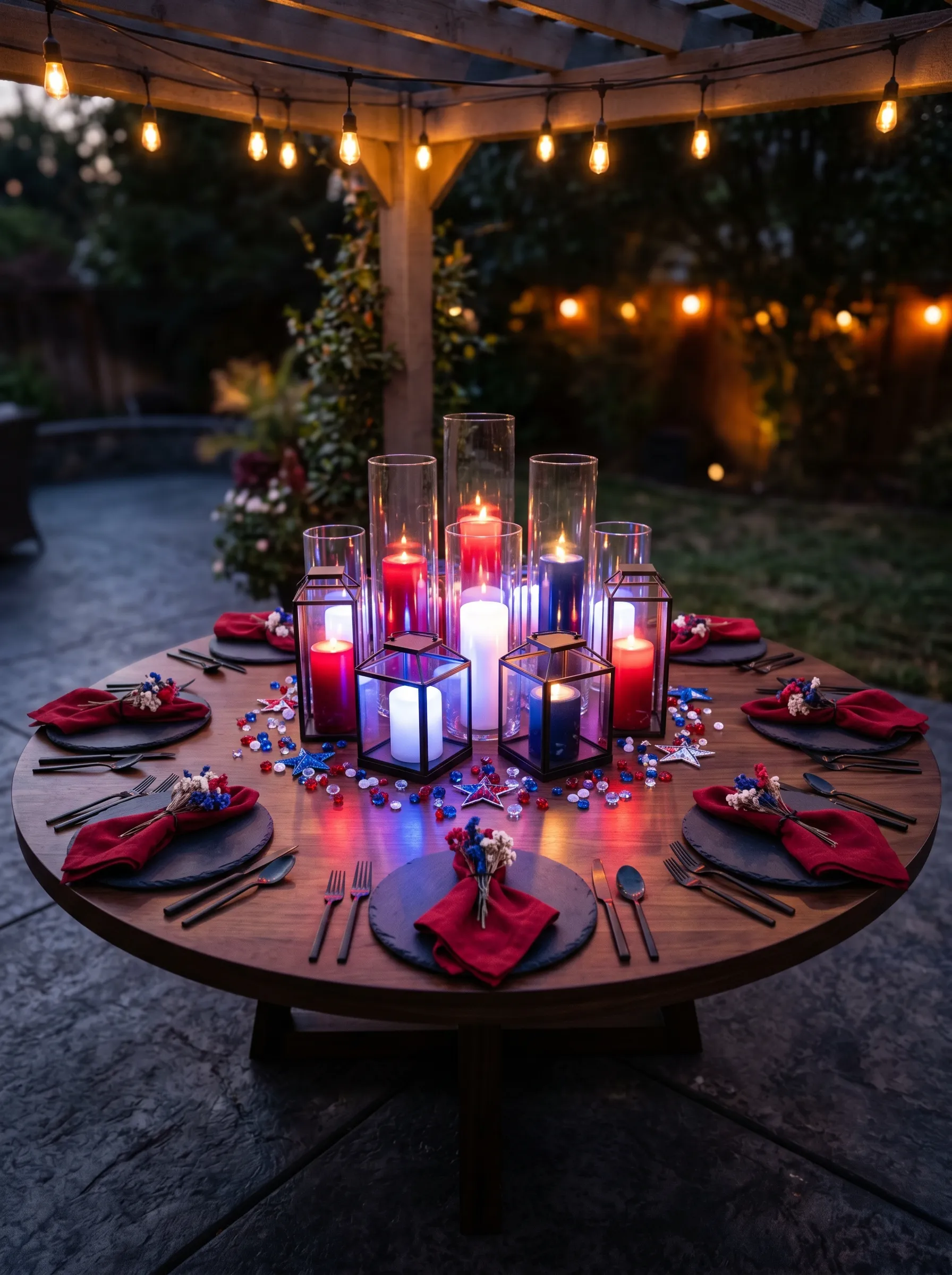
Flowers and candles are the standard combination for a centerpiece. This table removes the flowers entirely and discovers what candles alone can do.
A round walnut or dark-wood table under a pergola is the setting. Lay nothing on the table surface — no cloth, no runner, bare wood. The wood grain is the ground.
At the center, build a candle cluster: tall clear glass hurricane cylinders holding red and blue pillar candles alternating with small square lanterns holding white pillar candles, surrounded by a ring of small glass votives in all three colors. The cluster should be asymmetrical in height — three talls, two mediums, four lows — so it reads as organic rather than arranged.
Scatter small acrylic star and flower gems between the glass vessels, covering the table surface within the cluster zone. When the candles are lit, the gems catch and multiply the light.
Set dark slate or black matte chargers under each plate. Fold red velvet napkins in a flat bow-tie and anchor each with a small sprig of red, white, and blue dried flowers tucked under the ribbon. The dried flower sprig is tiny — barely visible — but tactile and surprising when guests pick up their napkins.
This table’s centerpiece is not visible in daylight the way a floral arrangement is. It is designed to be seen at 8:30 p.m. with the pergola string lights warm overhead and the candle cluster glowing below. At that moment, the combination of Edison bulb warmth overhead and candlelight below produces a quality of light at the table that no amount of flowers can replicate.
The Casual Stripe Table Outside That Did Everything with Layers
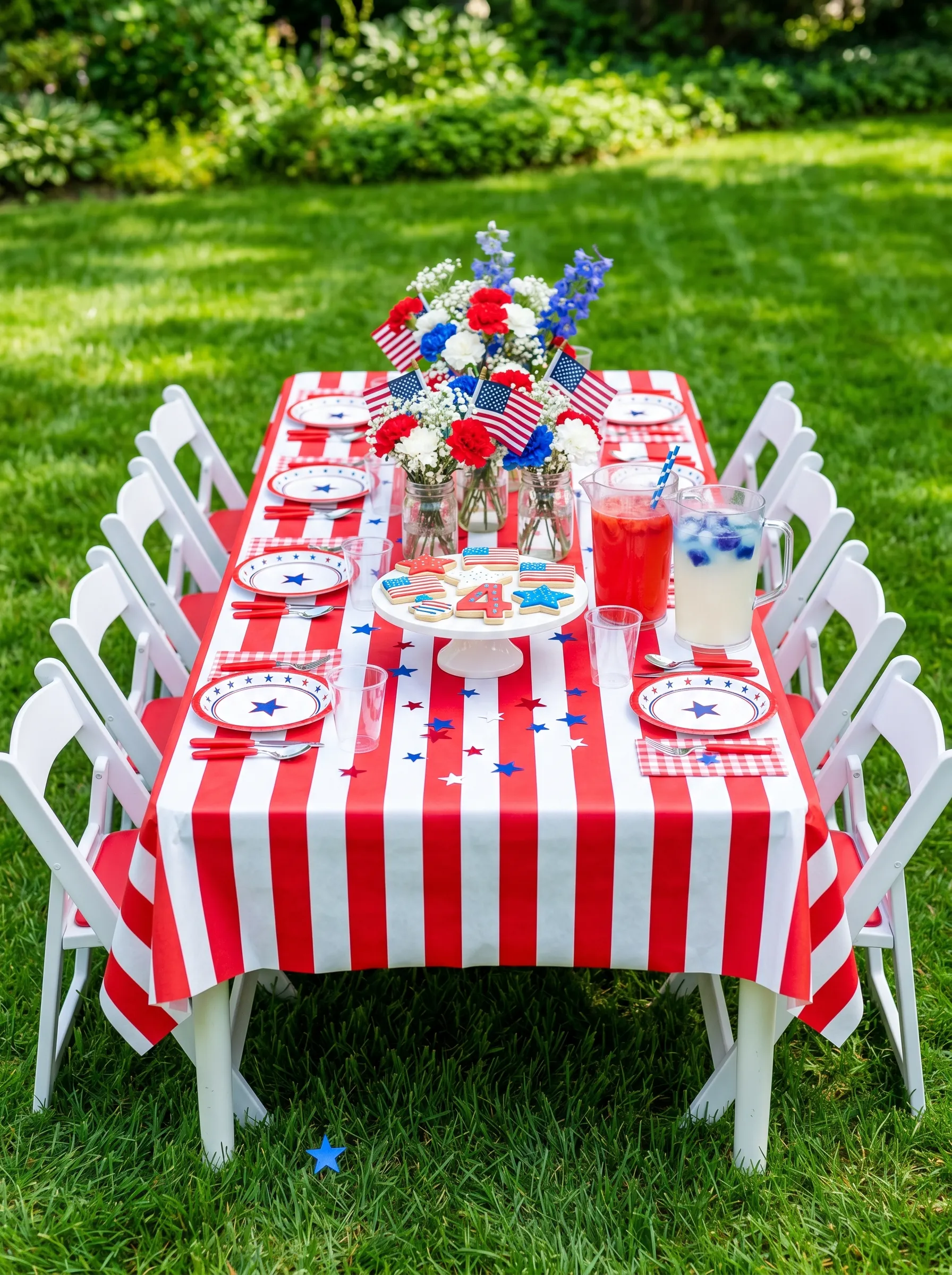
A red-and-white stripe tablecloth is a commitment. It says: this is a party. It says it from across the yard. It does not apologize for being cheerful.
Use it. But layer carefully, because the stripe is already doing a lot of work and everything above it needs to earn its presence.
Scatter star confetti in red, white, and blue across the tablecloth surface before setting any other element. Not in piles, not in rows — scattered loosely as if fallen from the sky. This takes thirty seconds and immediately connects the tablecloth to the holiday without adding any objects at height.
Set star-and-stripe disposable plates on red-and-white check square napkins. The napkins folded corner-to-corner and placed under the plate extend just beyond the plate edge on two sides, creating a layered base that looks deliberate rather than disposable.
Run a cluster of centerpiece vessels down the table’s center: three mason jars with tight flower arrangements in red carnations, white baby’s breath, and blue delphinium, flags tucked in at angles, interspersed with two clear pitchers — one of bright red strawberry lemonade, one of white lemonade with ice and blueberries frozen into ice cubes. The pitchers serve as the drink station and the centerpiece simultaneously.
At one end, place a cake stand with iced cookies on it: flag shapes, star shapes, numeral four. This is both a dessert and a visual focal point at the far end of the table that balances the flower cluster at the near end.
Clear plastic cups with red-and-white striped paper straws at each setting complete the table. Nothing about this table is expensive. Everything about it is considered.
The Marble Table with Cylinder Vases That Said Less Is More
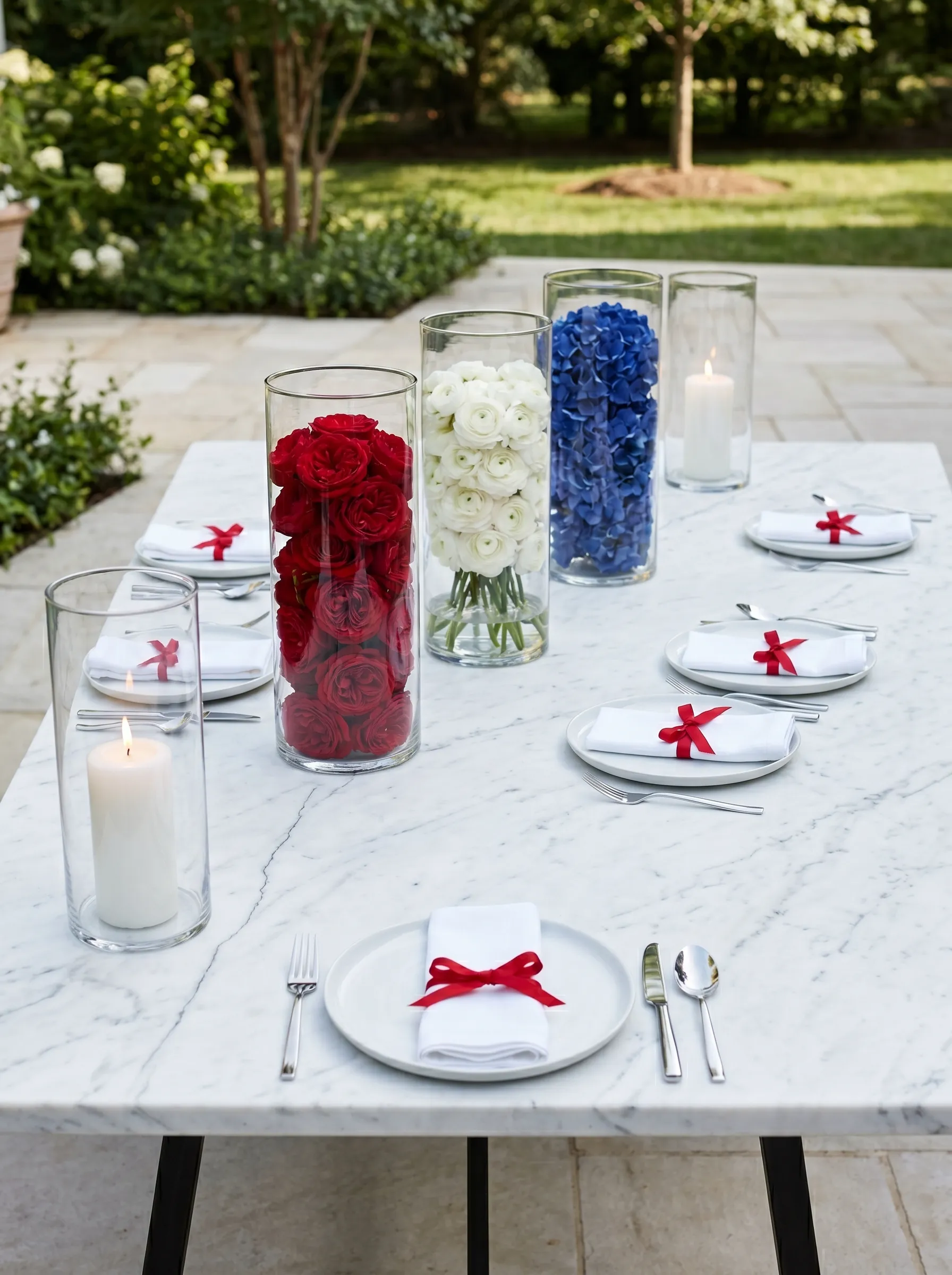
This is the table that has the confidence of its own restraint.
A marble-top outdoor table — white Carrara or similar — needs no tablecloth. The stone is the ground. It is already beautiful and it does not need to be covered.
Source three identical tall glass cylinder vases: one 14 inches, one 12 inches, one 10 inches. Cut the stems of a single flower variety to fill each vase completely — red garden roses in the tallest, white ranunculus in the medium, blue hydrangea heads packed tightly in the shortest. The flowers should fill the vase so densely that no water is visible and the blooms create a solid column of color from base to tip.
Place the three cylinders in a tight triangle cluster at the table’s center — not in a line, a cluster — with the tallest at the back. Add two additional glass hurricane cylinders holding white pillar candles flanking the cluster. The flames are the only light source at the table if this is an evening setting.
At each place setting: a white plate, a white linen napkin folded flat and tied with a single red silk ribbon bow — one loop, two tails, no more. Silver flatware, no charger. The simplicity of the setting makes the marble surface and the cylinder vase centerpiece read as intentional choices rather than minimalism by default.
This table succeeds entirely because of the cylinder vase technique. Densely packed flowers in a clear cylinder read as a jewel-like column of color. A loose arrangement in the same space would read as entirely different — beautiful, but not this beautiful.
The Cabin Round Table with a Lantern Centerpiece
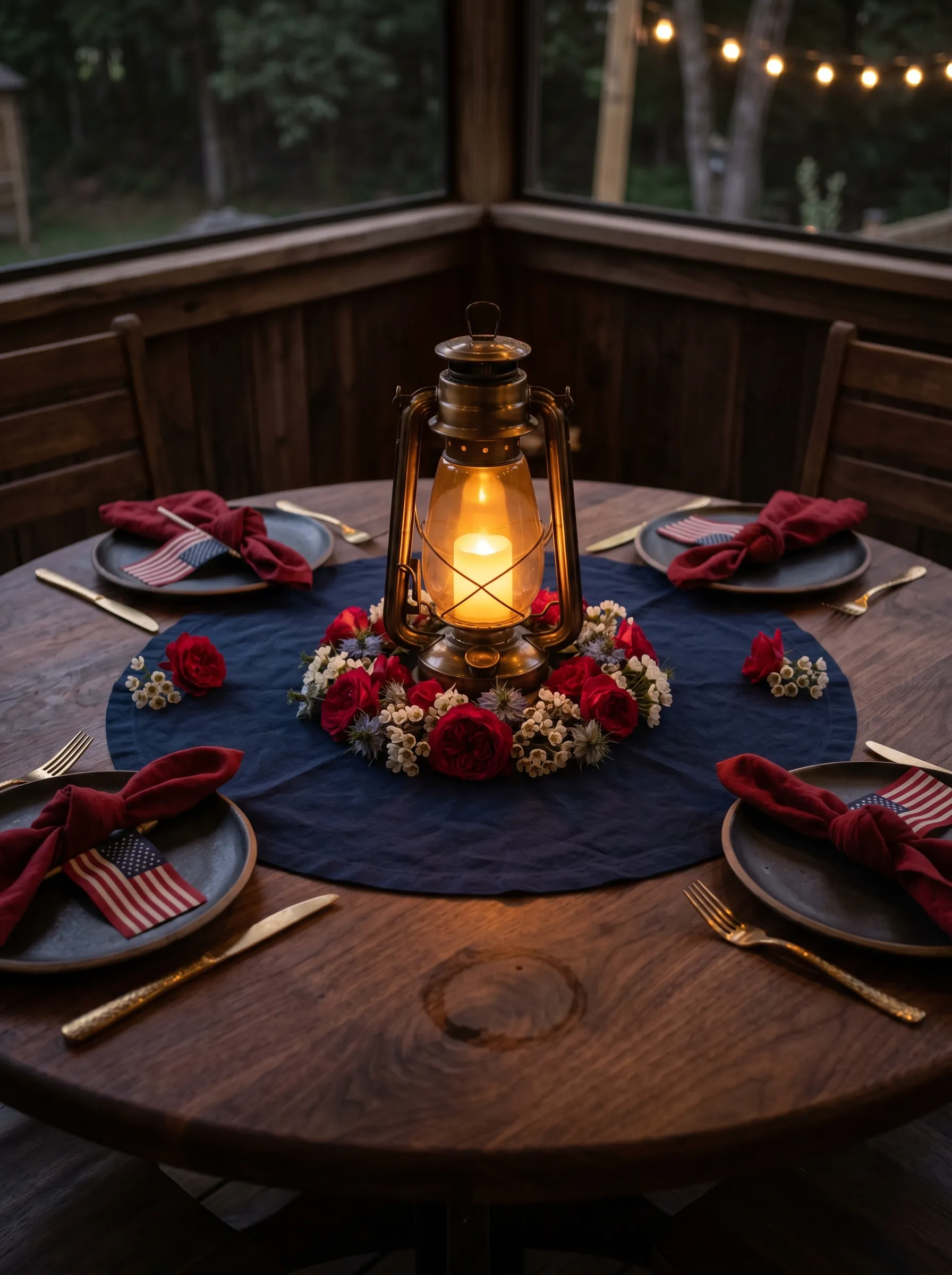
The lantern as centerpiece works because of what it communicates: warmth, fire, time.
A vintage or vintage-style brass kerosene lantern — the tall kind, with a globe chimney and a weighted base — centered on a round table becomes immediately evocative. It suggests something older than the holiday. It suggests sitting around a light and talking for a long time.
Set the lantern on a navy felt or linen round table runner — the kind that just covers the center portion of the table rather than the full surface. Build a low floral ring around the lantern base using a donut-shaped floral foam soaked in water: tuck in red mini roses, white wax flowers, and blue nigella or love-in-a-mist at tight intervals so the foam is completely invisible. The ring of flowers surrounding the lantern base creates a wreath effect that anchors the lantern to the table.
Set dark pewter or matte black plates as the charger at each place. Fold crimson napkins into a flat rectangle and lay a small American flag pick diagonally across each. Gold flatware against the dark plates reads as warm rather than formal in this context.
The outdoor string lights visible through the window beyond provide the secondary light source that completes the scene. This table exists for a small group — four to six people — at a cabin or screened porch. It is not a table for a party. It is a table for a conversation that starts at dinner and continues into the evening.
The Navy Tablecloth Table That Let the Galvanized Buckets Win
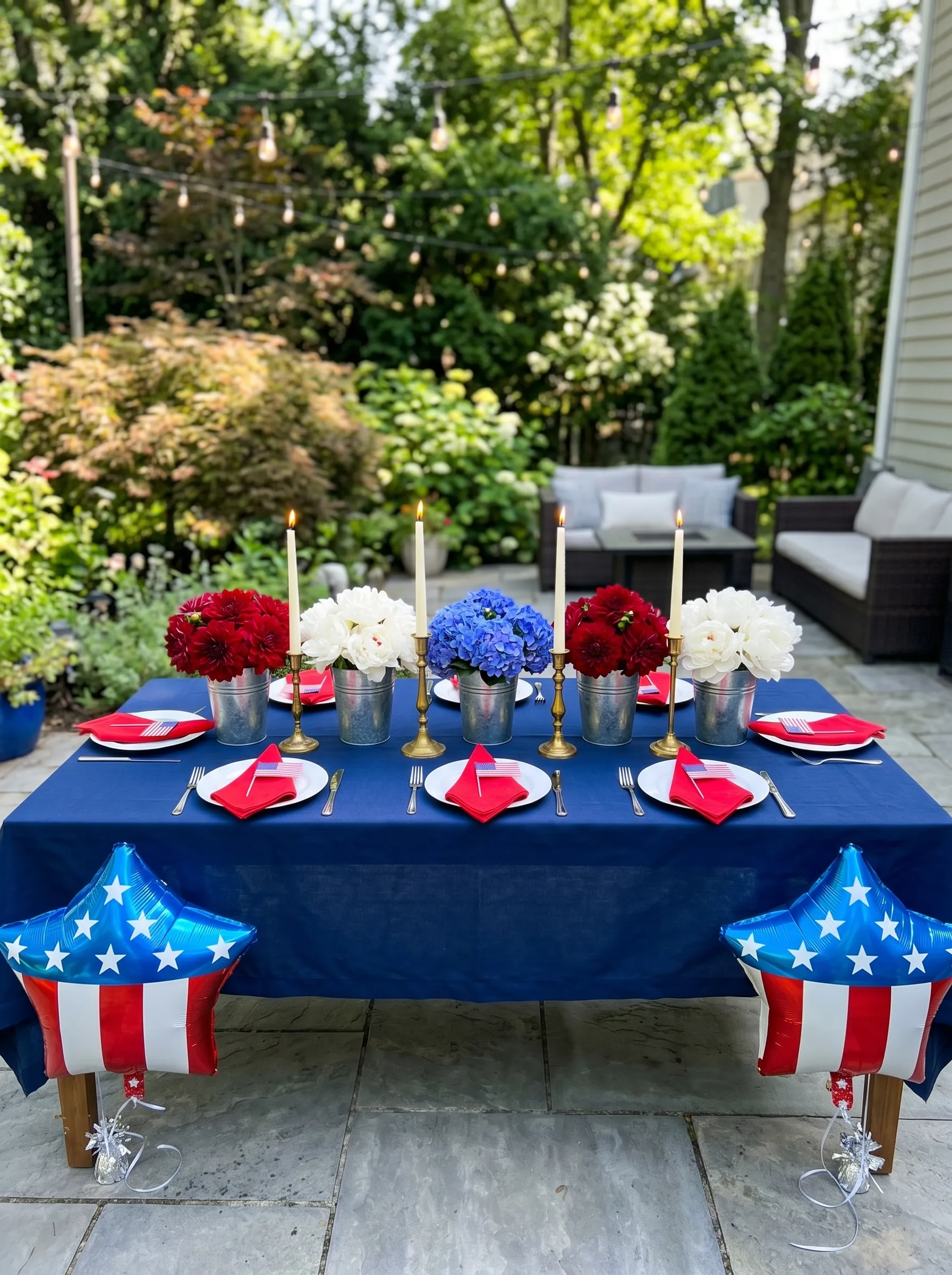
The navy tablecloth is the most underused ground color in July 4th table styling. Most people reach for red or white. Navy reads as rich.
Cover a rectangular outdoor table in a solid navy tablecloth — floor-length, pressed. Set white plates directly on the navy ground without placemats; the contrast is strong enough on its own and placemats would soften a contrast that should stay sharp.
Fold red linen napkins into a triangular bishop fold and lay them at each place with the point facing the diner. Tuck a small American flag pick under the folded napkin point at each setting. The flags at place settings signal the holiday without requiring anything additional at the centerpiece level to do the same work.
The centerpiece is three galvanized buckets of graduated height — 10, 12, and 14 inches — arranged in a tight triangle cluster at the table’s center. Fill each with a single variety of flower: deep red dahlias in the tallest, white peonies or ranunculus in the medium, blue hydrangeas in the shortest. The galvanized metal, matte and industrial, reads as beautiful against the pressed navy tablecloth because of how strongly the materials contrast.
Between the bucket cluster and the end place settings, position pairs of brass candlesticks with white taper candles. The brass introduces a warmth that prevents the navy-and-galvanized palette from reading as cold.
Four star-print foil balloons tied to the table legs and extending below the table hem add a playful ground-level element that doesn’t interfere with anything above the tablecloth edge.
The White Shiplap Table with a Brass Urn Centerpiece
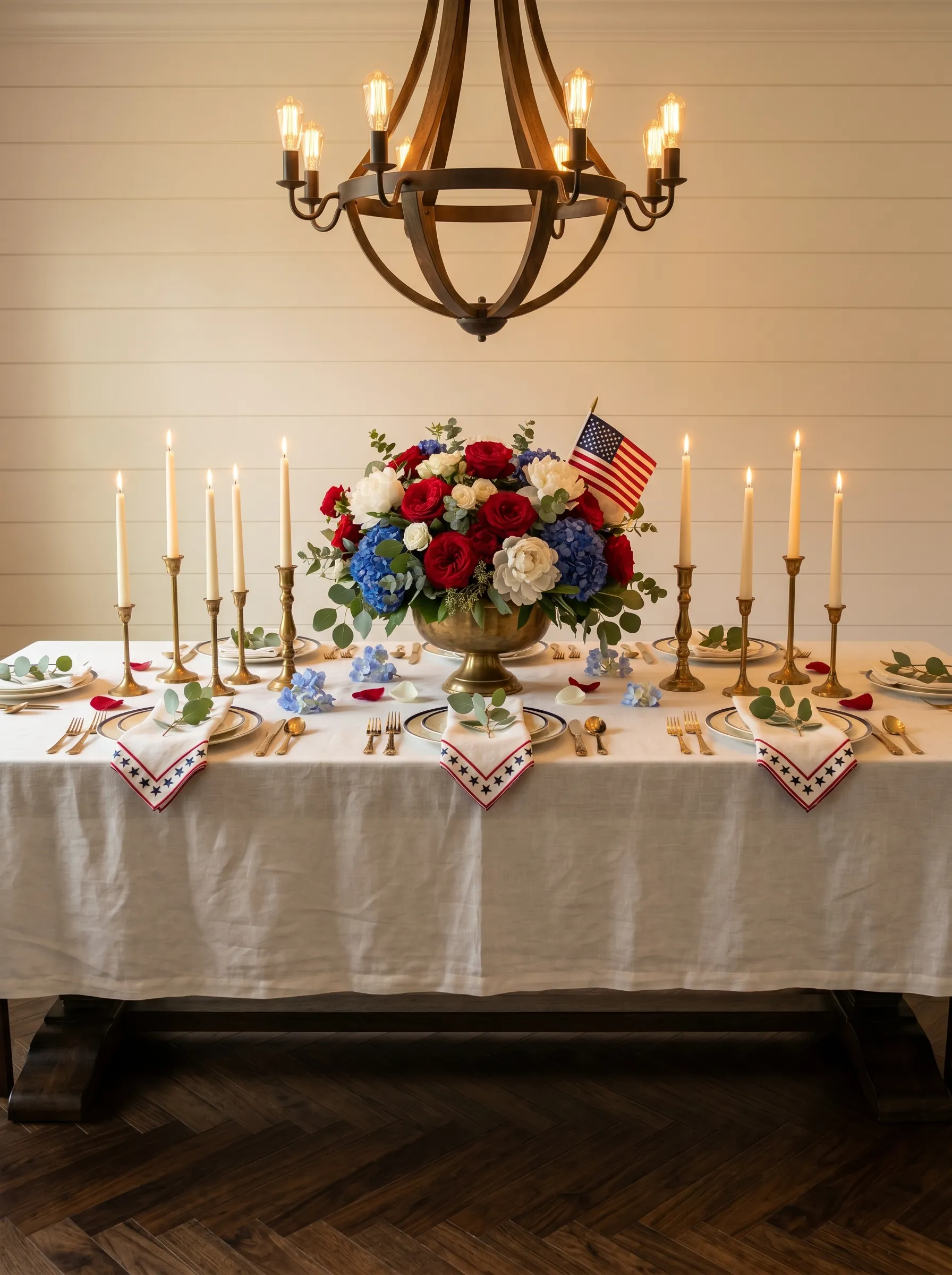
This is the indoor farmhouse table, and it succeeds because of the absolute clarity of its hierarchy.
One object commands the table. Everything else exists in relation to it.
That object is a large brass footed urn — 10 to 12 inches in diameter, 8 inches of height before the arrangement — filled with an abundant mixed flower arrangement: red roses and red ranunculus as the primary flowers, white garden roses and peonies as secondary, blue hydrangea tucked in at the arrangement’s base as a low third element. Eucalyptus extends out from the urn rim on all sides, trailing loosely toward the table surface.
Flank this central urn with pairs of brass candlesticks in varying heights — 12, 10, 8, and 6 inches — stepping outward from the urn in each direction. Eight to ten candlesticks total, all holding the same ivory taper. Light them before guests sit. The candlestick arrangement frames the urn the way columns frame a doorway.
Set white plates on silver charger plates with a thin silver rim. Lay the napkins flat — white linen with an embroidered star-and-stripe border in red and navy, folded in thirds to show the embroidery. Gold flatware, clear crystal wine glasses.
Scatter a few eucalyptus leaves and individual hydrangea petals from the urn outward toward each place setting. One or two petals near each plate. Not arranged, not placed, apparently fallen from the arrangement.
The shiplap wall behind the table, lit by the chandelier above, provides the perfect neutral backdrop. This table reads as a formal farmhouse dinner that happens to occur on July 4th.
The Grass Table with Star Cookies and Striped Everything
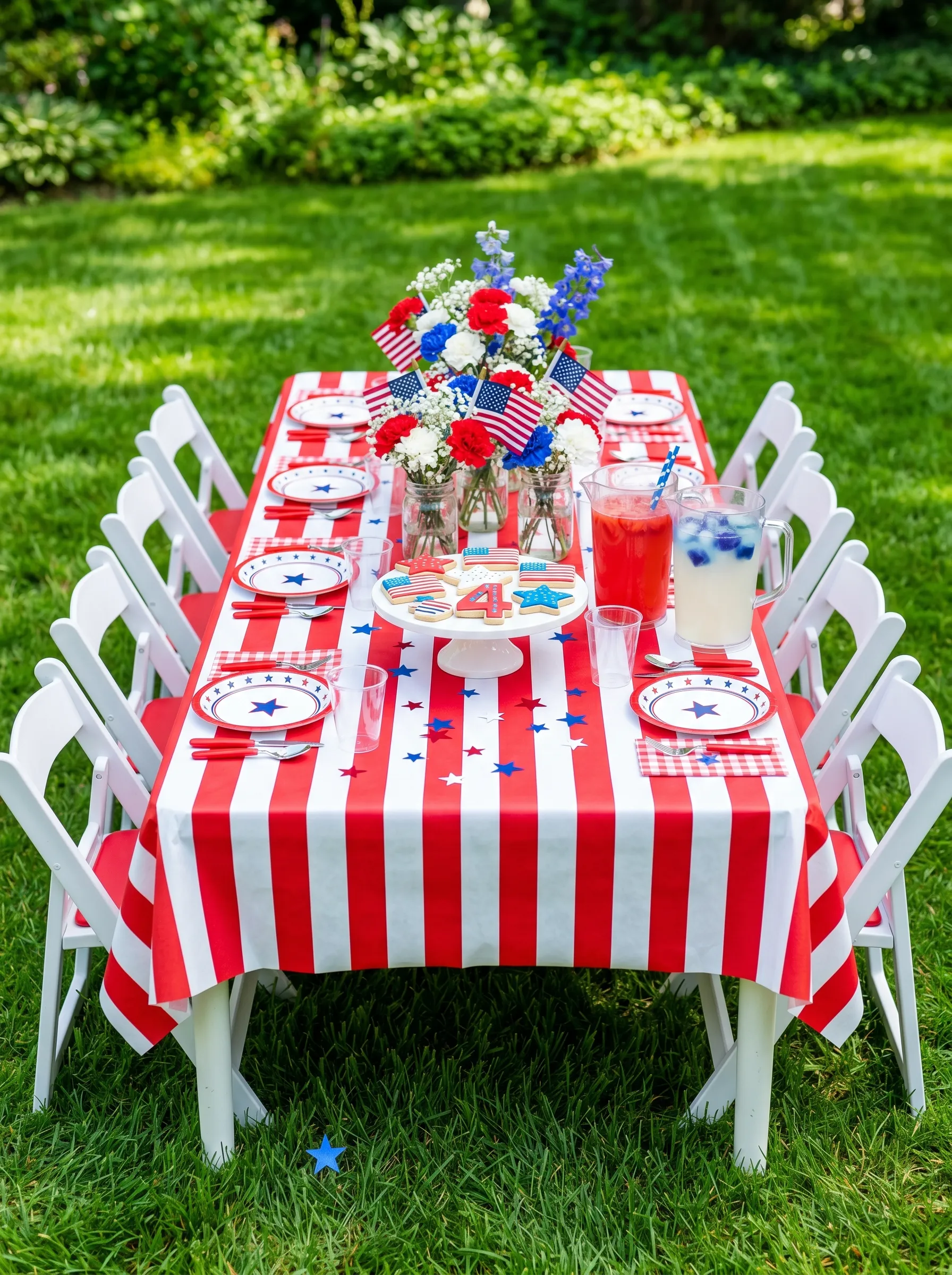
This table has decided to be festive without apology, and it executes that decision completely.
The stripe tablecloth — bold red and white, two-inch stripes — is the commitment. It tells everyone at the party exactly what register they’re in before they sit down. Work with it rather than trying to calm it.
Lay red-and-white check square napkins under each plate for a layered pattern effect. The check under the stripe reads as playful rather than chaotic because both patterns are in the same two colors. Set patriotic-rim paper plates — the kind with a blue rim and red stars — because the tablecloth has declared this a festive rather than formal occasion and the plate should agree.
Scatter red, blue, and white metallic star confetti across the tablecloth surface before anything else is placed. This takes one minute and connects every element visually.
The centerpiece cluster runs down the center of the table: alternating mason jars with loose mixed flower arrangements — red carnations, white baby’s breath, blue delphinium — and clear pitchers of red and white beverages. A white cake stand at the center of this arrangement holds patriotic iced cookies in flag, star, and numeral shapes.
Lay clear plastic cups with color-striped straws at each setting. Place a small gingham napkin folded corner-to-corner under each cup so the cup has a base that reads as finished rather than placed.
The whole table is the antithesis of the formal tables elsewhere in this collection. That is its point and its value.
The Sunlit Charcuterie Table That Was Also a Still Life
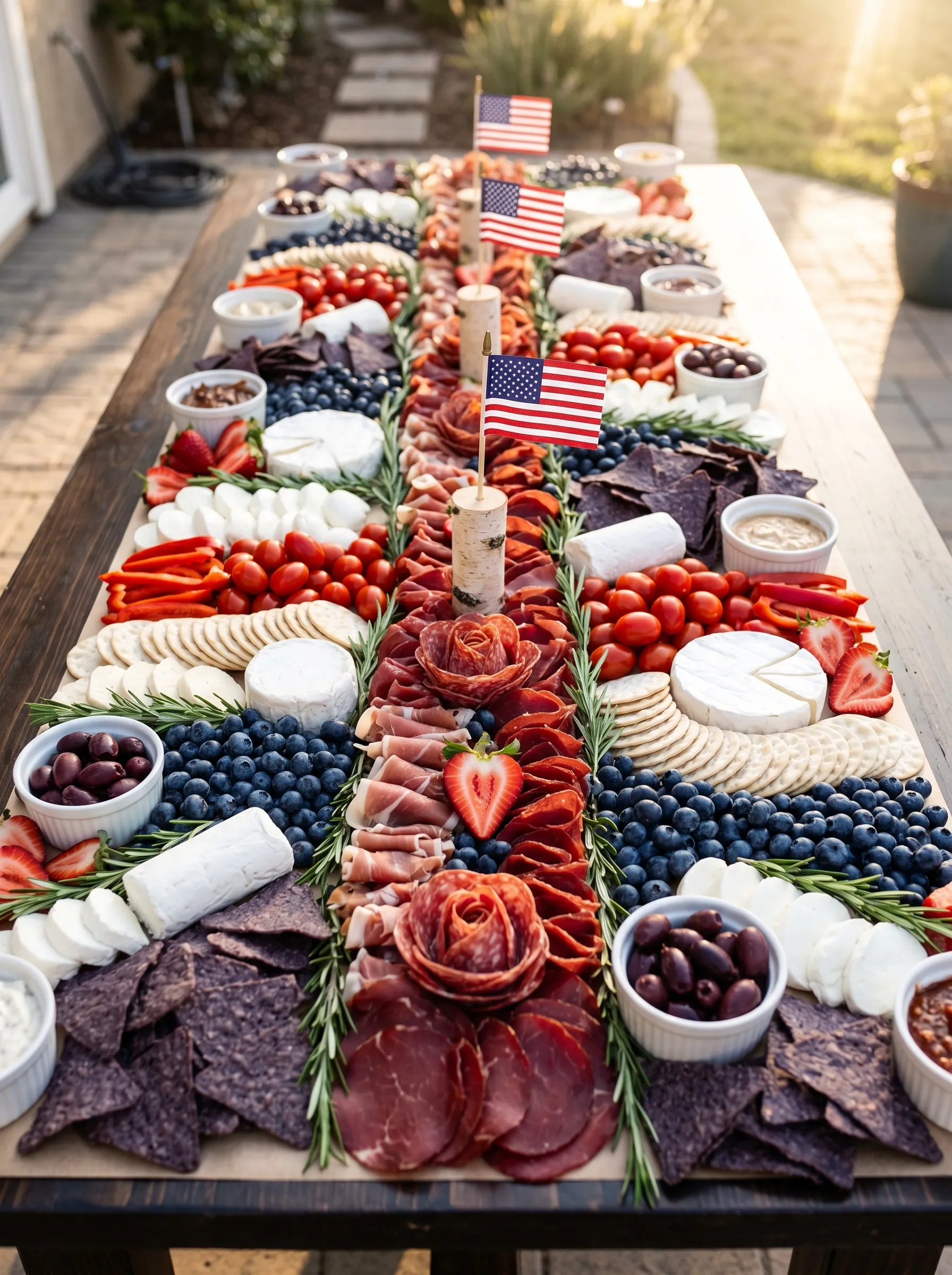
The full-length grazing board at table scale is one of the most demanding things to set up and one of the most impressive when done correctly.
Cover a raw wood farm table with a single board of clean plywood cut to table dimensions, or simply lay the food directly on the clean wood surface. The food is the tablecloth.
Establish the color zones: a red zone of cherry tomatoes, red bell pepper strips, strawberries, salami roses, prosciutto folds, and pepperoni arranged in the center-left third of the table; a white zone of fresh mozzarella slices, white cheddar wedges, crackers fanned in arcs, cauliflower florets, and brie wheels in the center; a blue-to-purple zone of blueberries in dense clusters, kalamata olives in small bowls, and purple corn chips at the right third.
Rosemary sprigs used as dividers between zones serve as the green element that prevents the board from looking like three separate food trays. Push them in at angles where color zones meet.
The flag picks — standard 4×6 American flags on wooden sticks — stand upright in birch log holders or simply pushed directly into the blueberry clusters. Three flags, placed at the back one-third of the board, provide height and signal.
Small white ramekins of dips — hummus, tzatziki, fig jam — are placed at regular intervals where natural gaps exist. Their white ceramic stands out cleanly against the dark wood and the dense food arrangements.
This table does not need a separate floral centerpiece or a tablecloth. The food is the decoration.
The Backyard Table with Galvanized Buckets and Stars
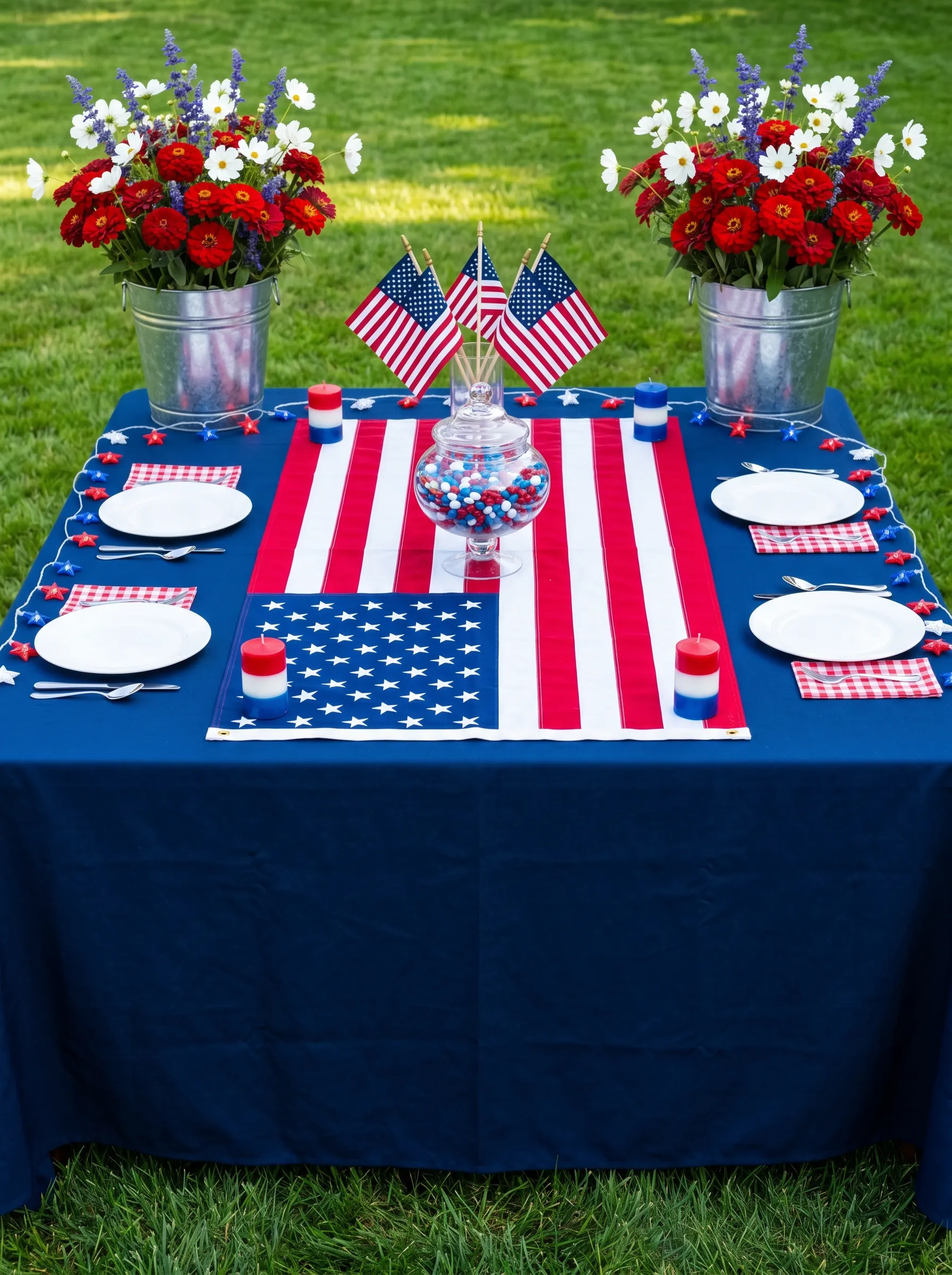
This is the table that most people actually have time and budget to build, and it delivers above its investment.
The ground is a solid navy tablecloth, which covers the inexpensive folding table underneath it completely. A flag-print table runner — the horizontal stripes-and-stars variety — lays centered on the navy ground, dividing the table into a center zone and two side zones.
In the center zone of the flag runner, position a glass apothecary jar filled with red, white, and blue candy-coated chocolates or jelly beans. Flank the jar with three small American flags pushed upright into a low glass vase or jar. Between the flags and the outer settings, place pairs of short striped candles — the kind wrapped in alternating red, white, and blue wax bands — in simple holders.
The two flanking zones hold the star string lights — the battery-operated variety with individual star-shaped bulb covers — running along the table’s outer edge. These are the table’s lighting detail, turned on when the sun goes down.
At each corner of the table, place a galvanized bucket filled with zinnias or dahlias and daisies in red, white, and a purple-ish blue. The buckets are the table’s visual anchors, not the centerpiece — they’re at the corners, not the middle.
Set simple white paper plates on red-and-white check napkins. The table says: outdoor party, July 4th, come as you are.
The Evening Brass Urn Table with Ivy and Agapanthus
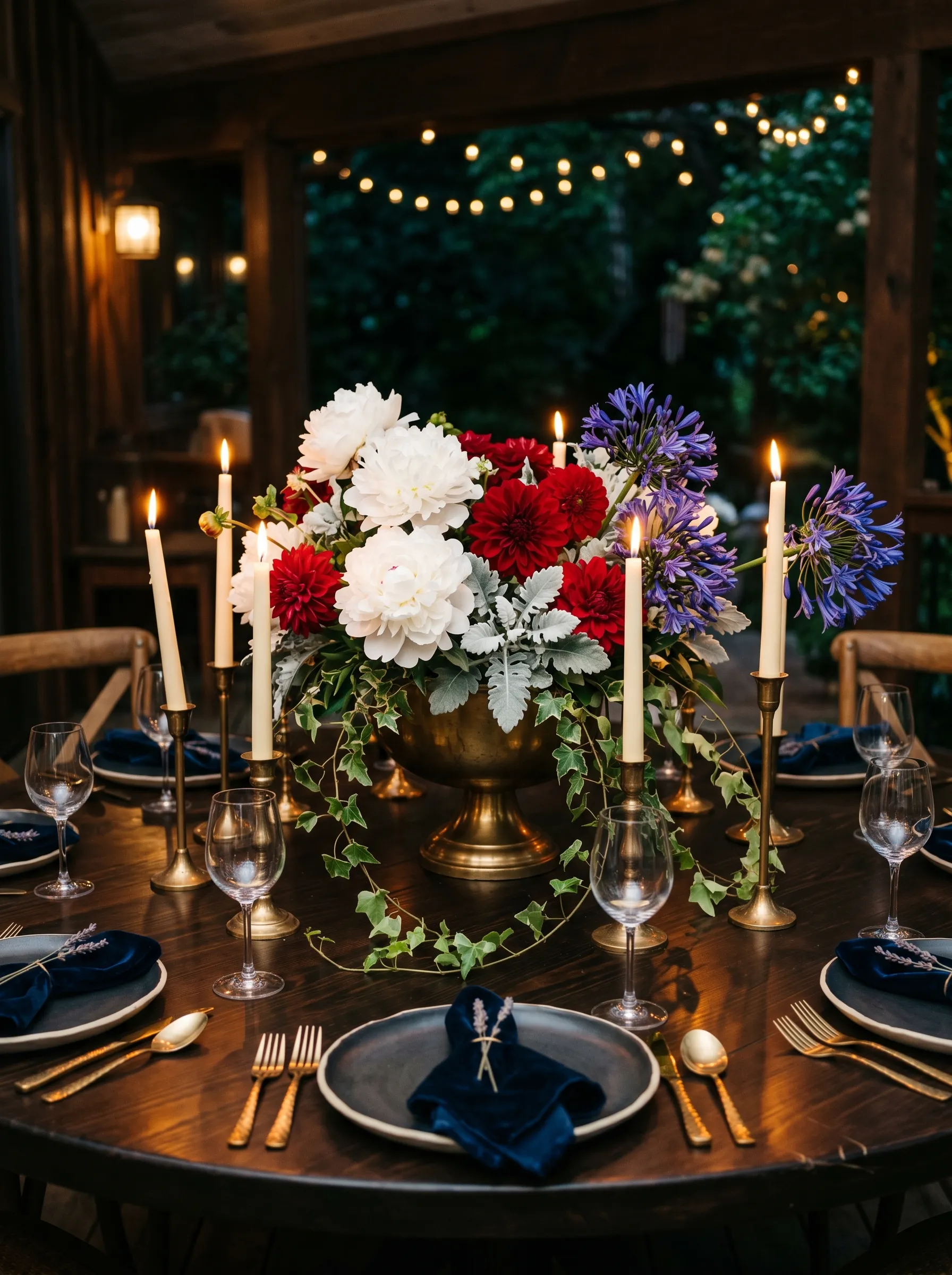
The brass urn at the center of a dark round table is a beautiful thing regardless of what goes in it. The decision about what goes in it is where this table becomes exceptional.
Most July 4th centerpieces default to red roses plus blue hydrangea plus white something. This table substitutes agapanthus — the tall, globe-headed flower also called lily of the Nile — for everything blue. Agapanthus blooms in a cooler, more lavender-facing blue than hydrangea, and the globular flower head on a long stem reads as architectural in a way the fuller hydrangea does not.
Fill a medium-to-large brass footed urn with a center mass of white peonies and deep red dahlias, then extend agapanthus stems outward and upward at the arrangement’s outer edges, letting them extend well beyond the urn rim. Add dusty miller and trailing ivy, draping it over the urn rim and across a few inches of the table surface. The ivy trail is the element that makes the arrangement feel living rather than arranged.
Brass candlesticks — four to six, in varying heights — are placed within the ivy trail, so the candles appear to grow from the same organic source as the arrangement.
Set dark slate plates with navy velvet napkins, each tied with a single sprig of dried lavender as a napkin accent. The lavender costs almost nothing, smells extraordinary, and introduces a texture that connects to the natural-organic quality of the ivy and dusty miller in the centerpiece.
Gold flatware and clear crystal complete the place settings. The outdoor string lights visible beyond the pergola frame provide the secondary light source that says this is a warm evening worth lingering in.
The Dessert Table with Tissue Pom-Pom Backdrop
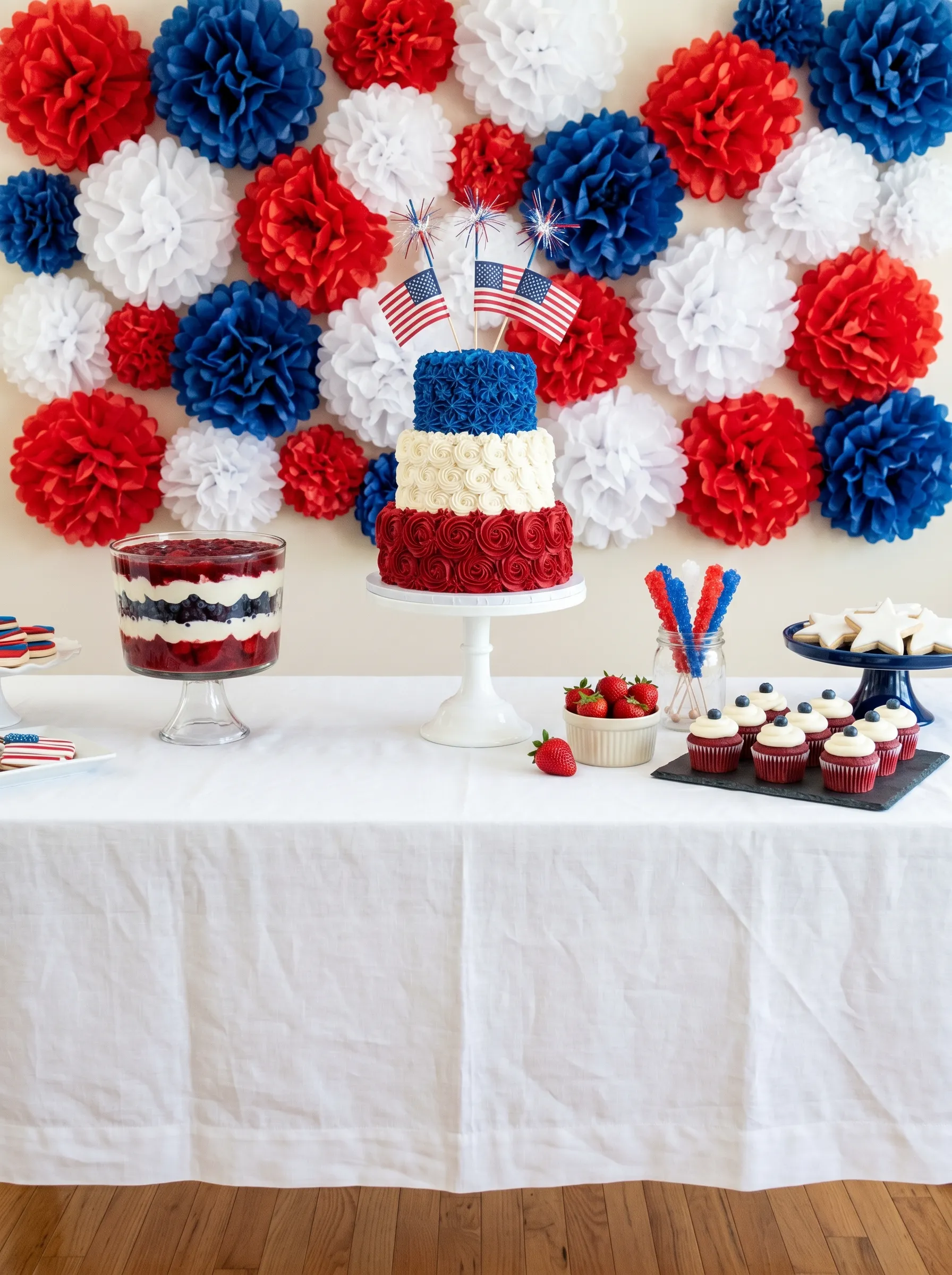
The dessert table is not a table for eating at. It is a table for looking at and then eating from. The distinction matters for how it’s styled.
First: the backdrop. Mount tissue paper pom-poms — the kind made from folded and fluffed tissue paper on a wire — directly to the wall above the table using command strips or tape. Use red, white, and navy pom-poms in three sizes: 8-inch, 12-inch, and 16-inch. Mount them in an irregular mosaic pattern covering roughly 4 feet wide by 3 feet tall, mixing sizes and colors with no fixed alternating pattern. The pom-pom wall is texture-and-color first, pattern second.
Against this backdrop, the dessert arrangement on a white linen tablecloth is composed in descending height order. The tallest element — a three-tier layer cake with rosette buttercream in red, white, and blue on a white pedestal cake stand — centers the arrangement. To its left, a large trifle bowl layered in red strawberry cream, white vanilla cream, and navy blueberry compote. To its right, mini cupcakes in red velvet with white frosting and blueberry dots on a slate serving board.
Flanking the outer edges: a glass jar with red and blue rock candy sticks, a white pedestal stand with star-shaped iced cookies, a plate of pretzel rods drizzled in white chocolate.
A small bowl of fresh strawberries between the cake and the trifle provides the one element that is neither cake nor cookie — a fresh, natural note in an otherwise confected arrangement.
No flags on this table. No banners. The pom-pom backdrop is doing all the patriotic work from above, and the food is doing everything else.
What Every Table in This Collection Has in Common
It’s not the budget. It’s not the formality level. It’s not even the specific flowers or vessels used.
Every table here has a point of view.
Some are formal. Some are unabashedly festive. Some are designed for noon and some for midnight. Some use disposables and some use heirloom plates. None of them apologizes for what it is, and none of them tries to be something it isn’t.
The table you set on July 4th should match the dinner you’re giving, the people you’re feeding, and the home you live in. A farmhouse in Vermont and a high-rise in Chicago require different tables. A family gathering of twenty and an intimate dinner of six require different tables. What they all require equally is that someone decided to think about it.
The difference between a table that gets photographed and one that gets cleared is fifteen minutes of deliberate decision-making before anything is placed. The flowers go in before the plates. The candles get positioned before the napkins are folded. The whole thing is looked at — actually looked at — from a seated guest’s perspective before anyone sits down.
That’s the investment. The result is a meal that feels like it was worth dressing for, even on the Fourth of July.