
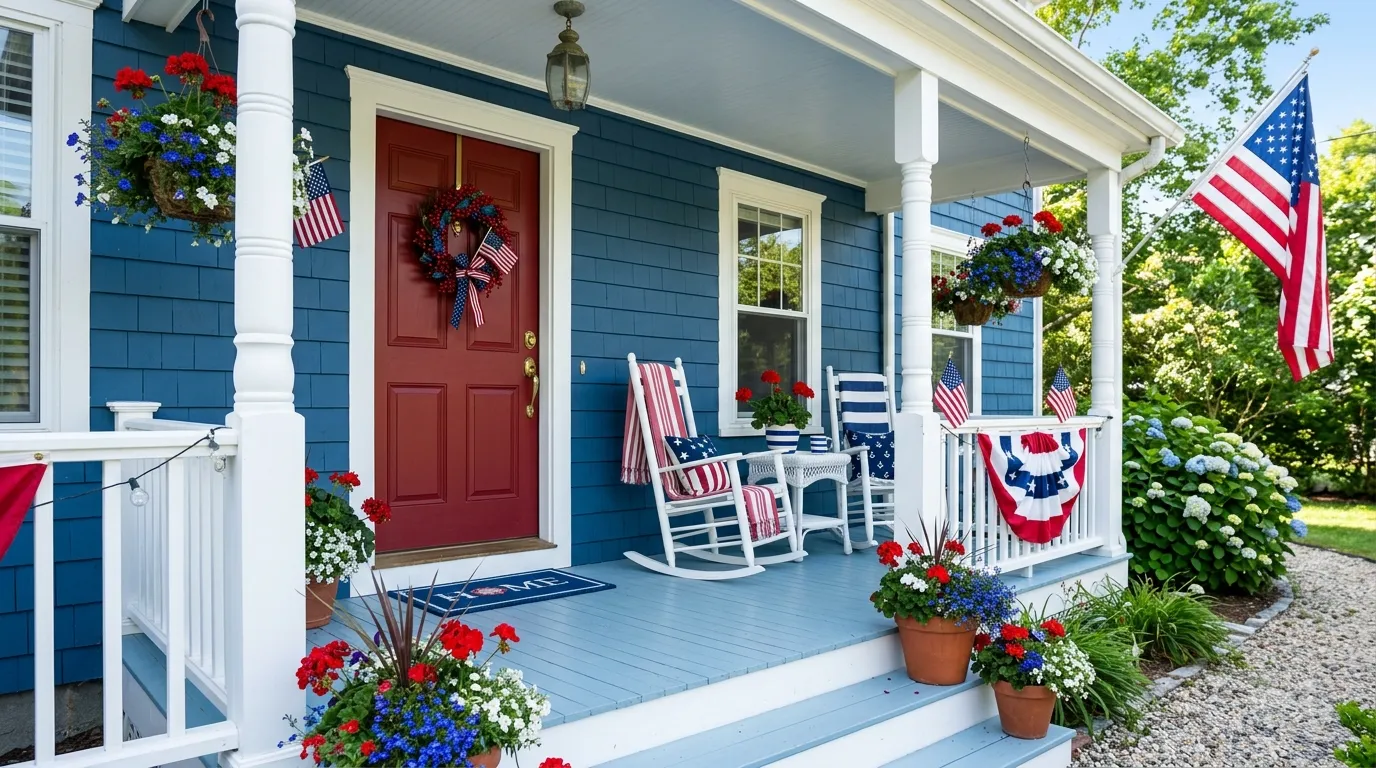
Your porch is doing the bare minimum. One plastic flag from the dollar bin, maybe a wreath that’s been out since Memorial Day, and you’re calling it patriotic. Nobody’s slowing down to look. Nobody’s impressed.
The Fourth of July is one of the few moments in the calendar year when going big is not only acceptable — it’s practically expected. The color palette is handed to you. The theme is non-negotiable. And still, somehow, most front porches manage to miss.
The difference between a porch that gets photographed and one that gets ignored is almost never about budget. It’s about commitment. It’s about deciding what your porch is actually going to say when someone walks up, and then saying it without flinching.
These ideas will show you how to do that. Every single one of them.
Why Your Patriotic Porch Looks Like an Afterthought
The problem isn’t that you tried. The problem is that you tried the wrong things in the wrong order, without a plan for how they’d work together.
You Bought Decorations Instead of Building a Look
There’s a difference between buying patriotic things and creating a patriotic space. When you buy a flag, a wreath, and a doormat separately from three different stores, they arrive home as strangers. They share a color palette, technically. But they have no relationship to each other, to your door color, to your planters, or to the architecture of your porch.
A look is built from one decision outward. You decide on the dominant element — the wreath, the bunting, the balloon arch, the lighting — and then every other choice serves that decision. Everything either echoes it or provides contrast. Nothing simply exists beside it.
You Treated Red, White, and Blue Like a Formula
Three equal parts red, white, and blue, evenly distributed. That’s not design. That’s a spreadsheet.
Every great version of this palette in these images has a clear dominant color. Navy takes the lead. Or white does, with red as the accent. Or the wall is red and the door is navy, so the flowers and the bunting punch white and carry the whole thing. Decide which color is doing the work, and let the others support it.
You Forgot the Vertical Dimension
Most people decorate at eye level and call it done. They put a wreath on the door and planters on either side and feel satisfied. But the most dramatic porches use the full height of the space — bunting that drapes from roof to railing, lantern strings strung across the ceiling, garland that swags between columns from top to top. When you use vertical space, you stop decorating a door and start decorating a room.
What Actually Makes a Patriotic Porch Work
Good porch styling isn’t about the number of decorations. It’s about understanding why certain combinations feel intentional and others feel chaotic.
Scale Is a Decision, Not an Accident
Every porch that reads as impressive has at least one element that’s larger than it needs to be. An oversized wreath. A balloon arch that fills the entire ceiling of the covered porch. A paper lantern installation where you hang twenty lanterns instead of four. Bunting that drapes in full, theatrical swags rather than a modest strip near the railing.
You don’t need everything to be big. You need one thing to be genuinely generous in scale. That single decision changes how every other element reads. The planters look intentional. The flags look purposeful. The smaller touches suddenly have context.
Texture Makes the Palette Interesting
Red, white, and blue in flat plastic is one thing. Red roses, white hydrangeas, and blue lobelia in a cobalt ceramic pot is another. The palette is the same. The effect is completely different.
Introduce as many textures into the palette as you can. Rough galvanized steel versus soft flower petals. Crisp cotton bunting versus trailing greenery. Painted wood railing versus glazed ceramic. The more varied the surfaces carrying your palette, the richer and more considered the whole thing looks. Stick to one texture and it looks like a theme party. Layer them and it looks like a home.
Night Is a Separate Design Problem
A porch that looks great at noon looks completely different at 9 pm on the Fourth. If you’re not accounting for that, you’re losing half the holiday.
The most memorable porches have a lighting plan. Not just a porch light — an actual strategy for how the space will look after dark. Paper lanterns that glow. Fairy lights wrapped around columns that read as magical at dusk. Mason jar candles that throw warm light against dark-stained cedar. Candle lanterns flanking the door that make the whole entry feel like it belongs somewhere older and more deliberate.
Design the night version and the daytime version will take care of itself.
Red Blue and White Porch Decor Ideas
The Flag-Painted Planter That Does All the Heavy Lifting
Take a large, round, glossy ceramic or enamel planter — at least eighteen inches tall — and paint it in flag sections. Keep the bottom two-thirds in alternating red and white vertical stripes, equal width, crisp edges. Use painter’s tape and two thin coats of outdoor enamel in each color to prevent bleeding. The top third goes navy with white five-pointed stars stenciled around the band — space them evenly, roughly the size of a half-dollar coin. Seal with an outdoor clear coat rated for UV exposure.
Plant it with white vinca or white impatiens, something that blooms in a tight, mounding cluster that spills just slightly over the rim. The white flowers against the navy band close the visual circle and turn the whole pot into a piece of folk art rather than a container.
Pair it with a black rocking chair and a red-and-white buffalo check pillow. The planter carries all the patriotic weight. The seating stays simple and lets the pot be the thing.
The Nighttime Porch That Turns the Fourth Into Theater
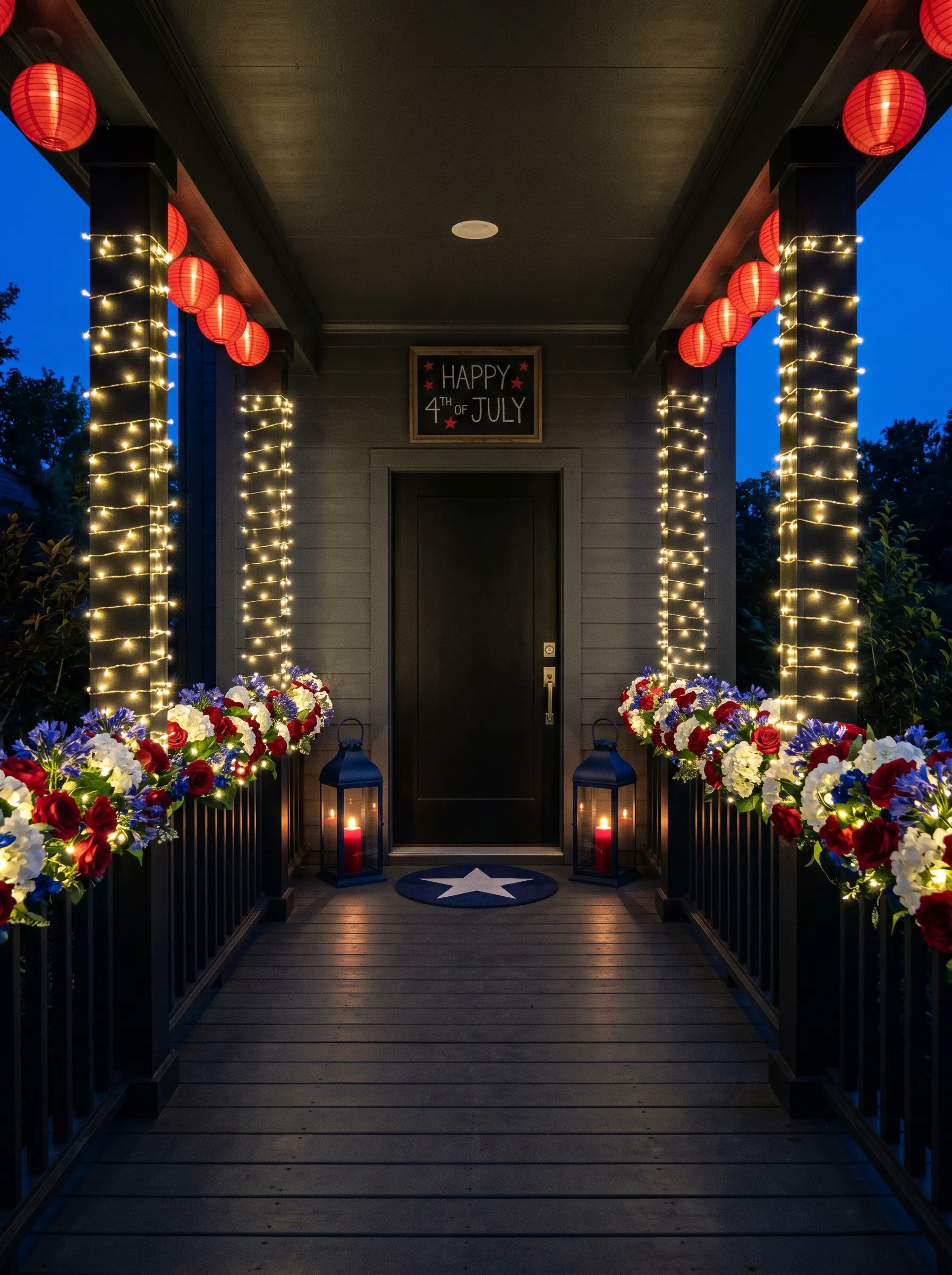
This is an after-dark build. Everything here is designed for how it looks at dusk and in full darkness, and it is genuinely extraordinary when executed properly.
Wrap each porch column from base to cap in a dense winding of warm white fairy lights — not LED cool white, specifically warm white with a slight amber cast. Wrap them in a slow upward spiral with no gaps. This turns the columns themselves into light sources.
String red paper lanterns on a separate line that runs from column to column just below roof height. Space them twelve to fifteen inches apart. The lanterns should be round, substantial, and glowing — plug-in or battery LED inserts in each one.
At the base of each column on the floor, arrange a large mixed flower wreath or mound — red roses, white hydrangeas, blue ageratum — in a low circular form. Nestle a small battery-operated flickering candle among the flowers so the blooms catch the light from below.
Place two matching navy lanterns on either side of the door at floor height, each with a real or battery red candle inside. Hang a chalkboard sign above the door with a simple holiday message. Lay a circular navy rug with a white star centered in front of the door.
The Patriotic Bench That Actually Invites People to Sit
Anchor a dark wood or metal garden bench on your porch and cover the floor in front of it with a wide red-and-white striped outdoor rug — the stripes should run horizontally, parallel to the bench, not perpendicular. The rug unifies the space and gives the arrangement a foundation.
Load the bench with five pillows in three patterns: red-and-white buffalo check on both outer edges, red-and-white star-print pillows in the next slot in, and a single oversized navy pillow with an appliquéd star dead center. Add a navy throw draped over the back of the bench off-center. Tuck a red tassel throw across the seat in front.
Lean a painted wooden “PORCH” sign against the bench’s base, navy letters on white. On each end of the bench, position a white square planter box with simple greenery or small white annuals. Keep the flanking plants plain — the bench scene is already doing a lot of work, and it doesn’t need competition from elaborate floral arrangements.
The Cottage Porch With Galvanized Buckets and Triangle Bunting
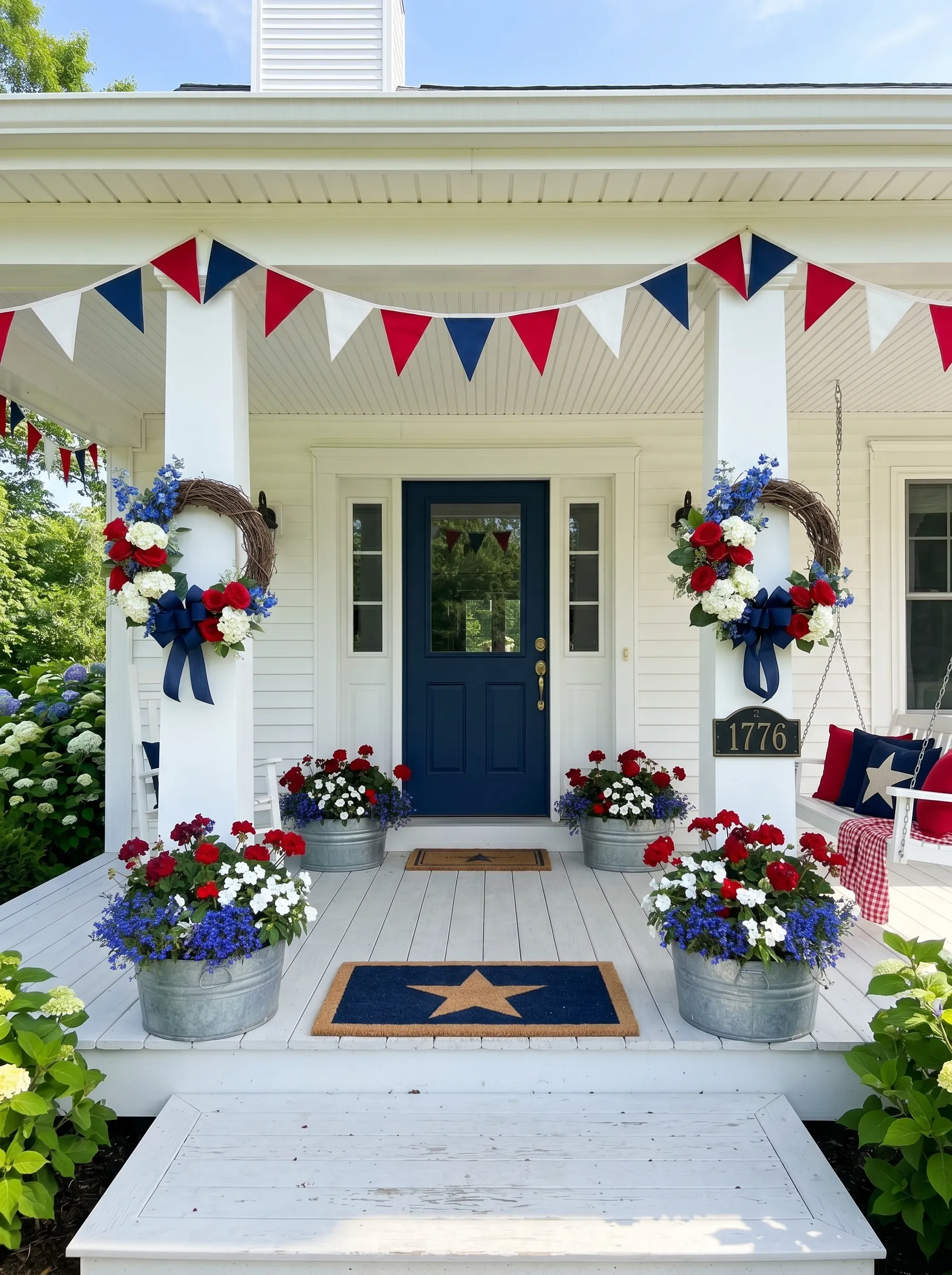
Paint your porch floor white if it isn’t already, or power wash it to as close to white as the wood will take. A white floor expands a small porch dramatically. Hang a string of red, white, and navy triangle pennant bunting from one porch column to the other, draped in a long lazy swag. The triangles should be fabric — canvas or cotton — not plastic. Fabric hangs properly and looks like an actual design decision rather than a party store purchase.
Place four galvanized metal utility buckets on the porch — two flanking the door, two at the front edge of the porch steps. In each bucket, plant a tight mix of red geraniums, white impatiens, and blue lobelia, with each color occupying its own zone rather than being blended: red at the back, white in the middle, blue spilling over the front edge.
On the porch columns, hang crescent-shaped grapevine wreaths — one on each column — filled with red roses, white hydrangea clusters, blue delphinium, and finished with a wide navy grosgrain bow at the bottom. Mount a navy door with a brass knob, or paint your existing door navy. Mount house numbers in antique brass beside it.
The Blue Hydrangea Wreath Door That Earns the Close-Up
Start with a grapevine or wire wreath form, fourteen to sixteen inches in diameter, and fill it completely with fresh or high-quality silk hydrangea clusters in two shades of blue — cornflower and deep navy mixed together so the color shifts rather than sitting flat. Pack them tightly so no base shows. The fullness is the point.
Finish with a layered ribbon bow at the lower center: the base ribbon in red-and-white stripe, wrapped over with a navy satin ribbon slightly narrower, with a third thin red ribbon running through the center. Make the tails long — at least twelve inches per tail — so they hang dramatically against the door’s surface.
On either side of the door at ground level, place large white ceramic pots packed with white hydrangeas. Tuck small American flags directly into the soil at the back of each pot so they stand upright behind the blooms. In front of the hydrangeas, add a second ring of red geraniums and one more layer of blue ageratum or forget-me-nots at the very front. The door wreath mirrors the pot colors. The whole entry reads as one composed arrangement rather than three separate pieces.
The All-In Red Porch That Commits Without Apology
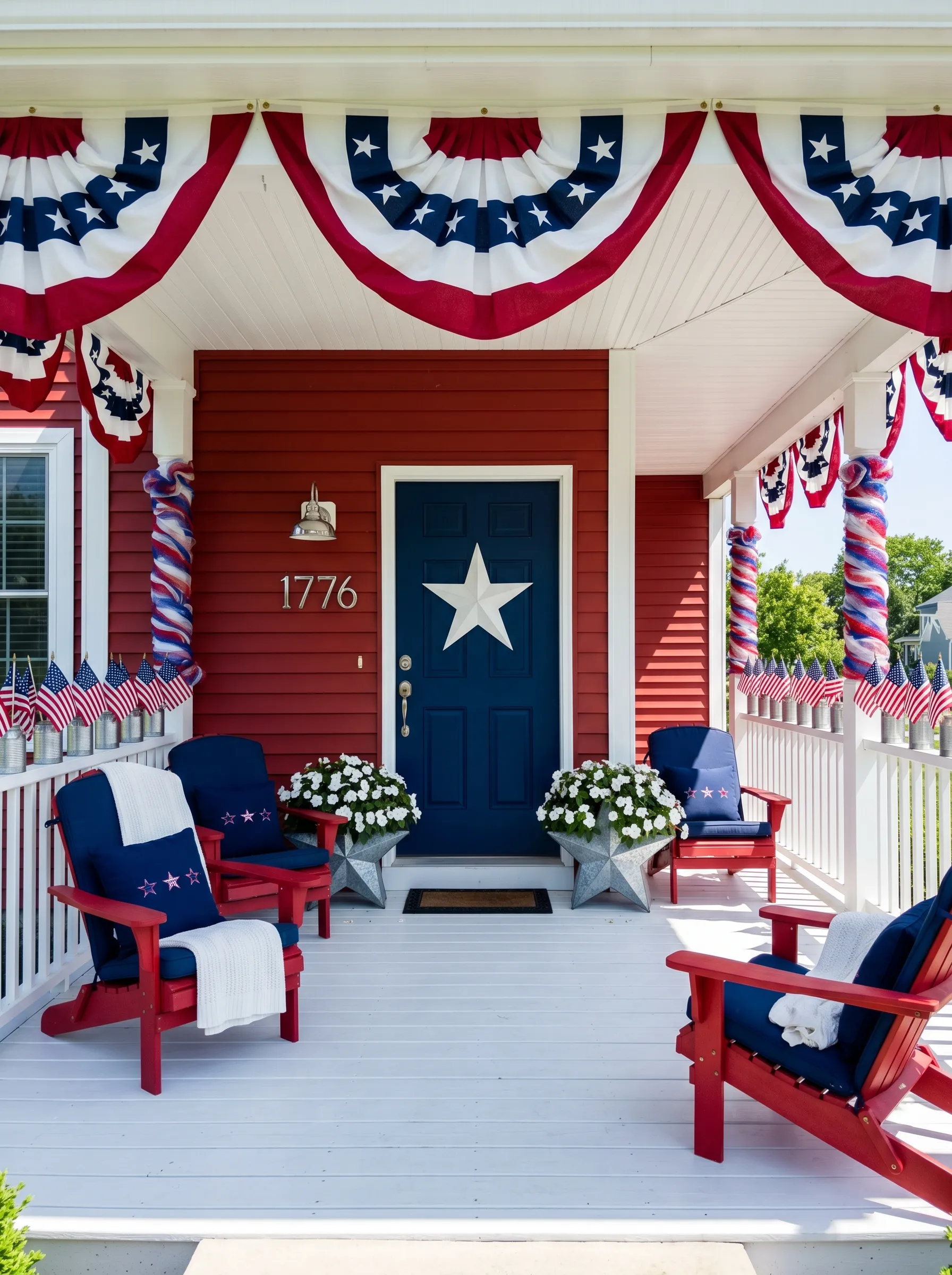
Paint the house exterior a deep barn red — or work with a house that already is. This is the starting condition for the look and there’s no faking it. Against the red, everything else either pops or disappears. You need navy to anchor, white to breathe.
Paint the front door navy. Stencil or mount a large five-pointed star centered on the door in white — not a decal, but painted or dimensional wood. Mount your house numbers above the door in brushed metal.
Hang full-panel patriotic fan bunting across the full width of the porch ceiling — the kind with pleated fabric that unfolds into semicircular fans. Use three panels for a standard porch: one in the center and one on each side. These are the correct bunting for this scale; the small, modest kind will be swallowed.
Place four red Adirondack chairs with navy cushions — two on each side of the entry — and drape a white cotton blanket over each chair arm. Plant compact white impatiens or white vinca in low planters flanking the door. Add galvanized metal star ornaments beside the planters. Line the porch railing with small American flags in galvanized tin cans, equally spaced.
The Warm Wood Door Dressed Up in Blue Hydrangeas and Brass
If your front door is natural stained wood — honey oak, walnut, anything with visible grain — lean into it. The warmth of the wood becomes the fourth color in your palette, and it makes everything else look more refined than it would against a painted surface.
Hang a square or geometric boxwood wreath rather than a round one. The clean angles suit a craftsman-style wood door. Attach an oversized bow made from multiple layered ribbons — red with white polka dots, blue gingham, solid red — and let the tails be deliberately messy, overlapping at different lengths.
Flank the door with large white ceramic cylindrical planters packed with white hydrangeas as the base layer. Add small American flags pushed directly into the soil behind the flowers. For the second pot on one side, plant a mixed arrangement of white hydrangeas, red geraniums, and blue lobelia so the two planters are similar but not identical. Lay a red-and-white stripe doormat on the threshold.
Finish with two matching black iron lantern wall sconces, one on each side of the door, fitted with exposed-filament bulbs. They do double duty: handsome in daylight, warm and welcoming at night.
The Layered Flower Porch That Uses Architecture as a Frame
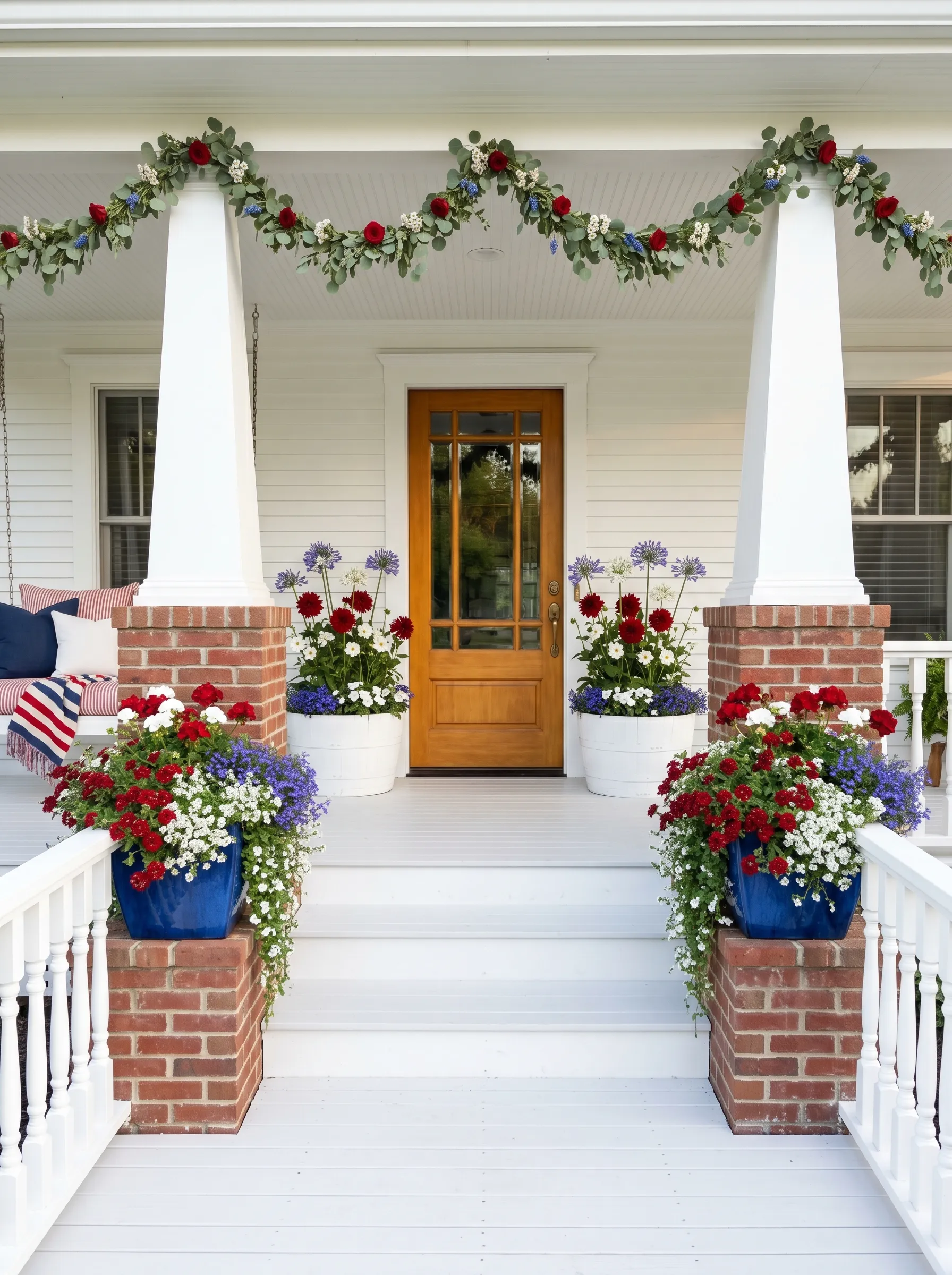
This look works best when your porch has substantial columns — brick-based, square, with real visual weight. Start with the columns as the anchor points and build out from them.
Place a large white low bowl planter at the base of each column and fill it with the tallest flowers: red dahlias and purple-headed agapanthus in the back, white Shasta daisies in the middle. These will reach knee to waist height and give the column a planted base.
In front of each column on the porch step or ground level, position a deep cobalt blue ceramic pot — the brighter and glossier the blue the better — packed with a cascading mix of red verbena, white alyssum, and trailing blue lobelia. Let the lobelia spill freely down the outside of the pot.
Connect the columns overhead with a lush eucalyptus and greenery garland swagged from one column to the other. Thread in red roses, white spray roses, and blue muscari at intervals — not evenly distributed, but clustered in groups so it reads as intentional rather than polka-dotted.
The Balloon Arch Porch That Commits to the Party
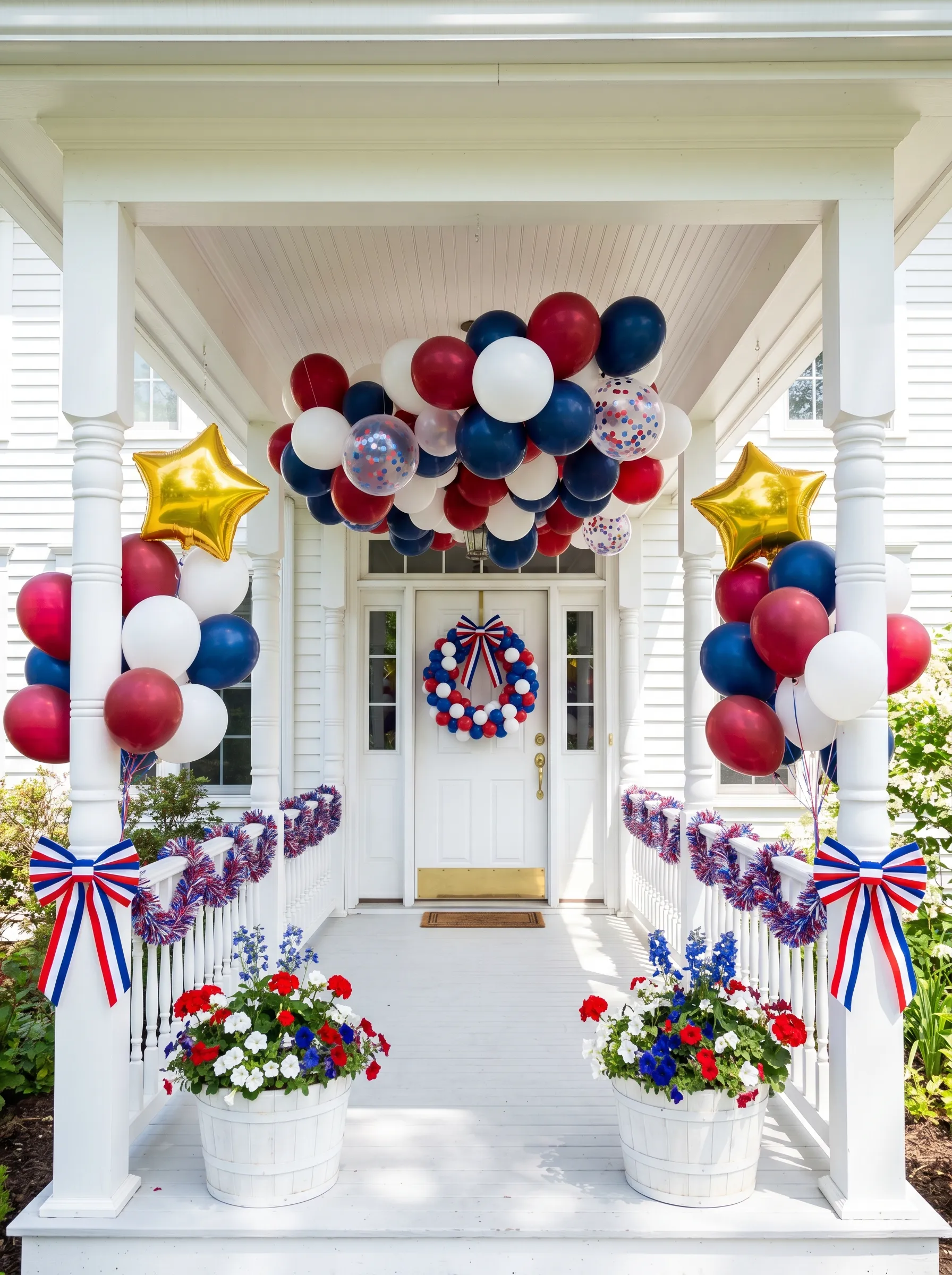
An organic balloon arch is the most festive thing you can put on a porch, and the most underused. People use it for birthdays and then forget it exists for every other holiday. This is a mistake.
For a covered porch, attach a clear fishing line from one side of the ceiling to the other and build the arch downward from it. Use balloons in three sizes — five, eleven, and sixteen inches — in navy, deep cranberry red, white, and clear confetti (with red and blue confetti inside). Cluster them in groups of three to four, varying sizes within each cluster, and work outward from the center of the line toward each side. The arch should feel like a cloud that got temporarily caught on your porch ceiling.
At each column, build a secondary cluster — a bouquet of six to eight balloons on a weight, including one gold or silver star-shaped foil balloon above the cluster for height. Tie ribbon in red, white, and navy hanging from the cluster and let them trail.
On each side of the porch step at ground level, place a white bushel basket filled with a mix of red geraniums, white petunias, and blue delphinium. Attach red-and-blue tinsel garland to the porch railings and finish each post with a large wired grosgrain bow in tri-color stripe.
Hang a balloon-made wreath on the door: a circular form covered in small red, white, and navy balloons tied off close to the knot, finished with a multi-ribbon bow at the base.
The Sage Green Cottage That Earns Its Patriotism Quietly
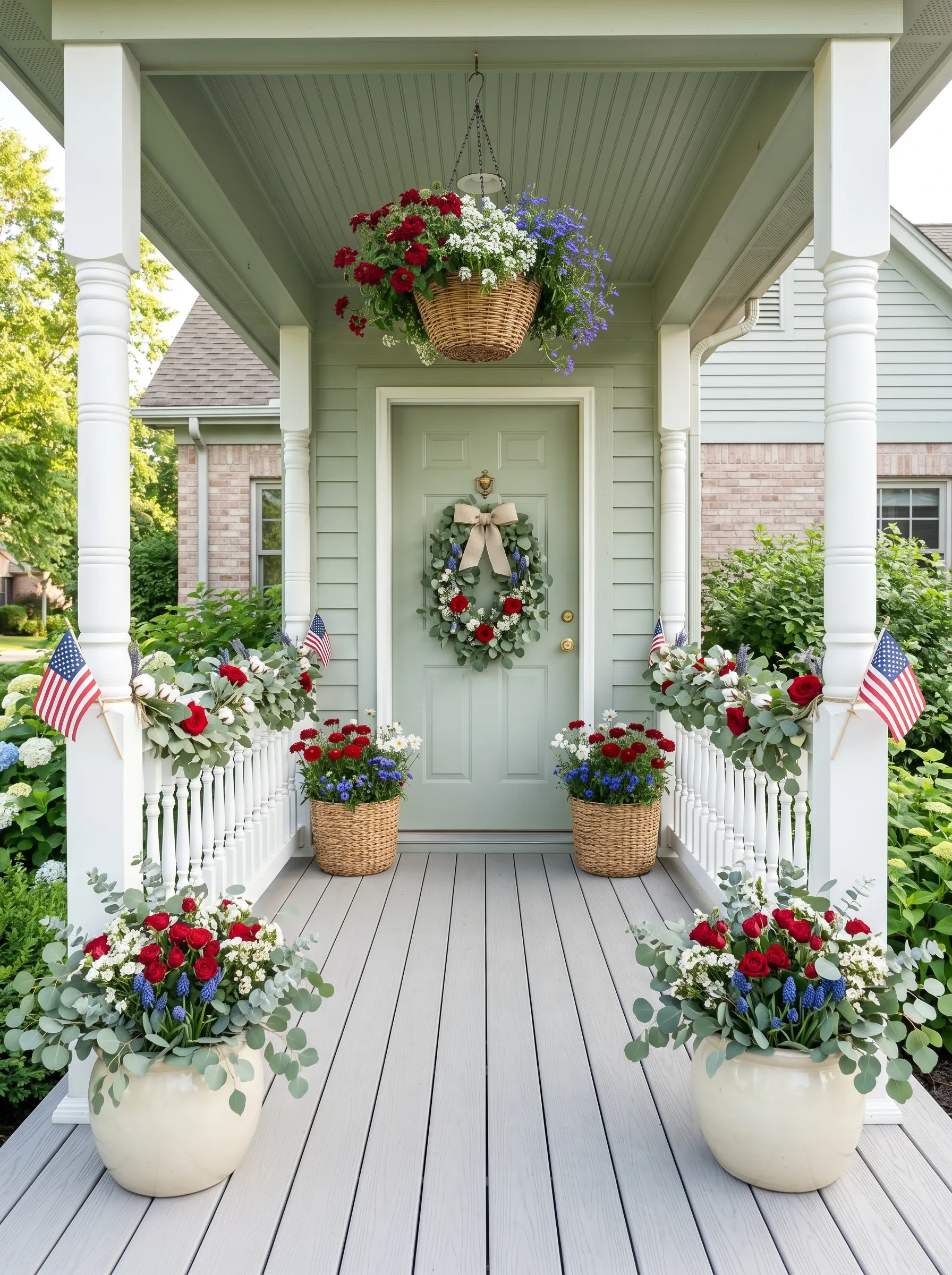
The green here is the secret weapon. Sage green siding and a matching sage door set a tone that’s soft and botanical, and the red-white-blue palette against it reads as garden-style rather than festive-banner. This is the approach for people who love the holiday but don’t want their porch to look like a parade float.
Hang a eucalyptus-based wreath on the door — a loose, airy oval shape, not a tight ball. Tuck in red roses, white waxflower, and blue muscari at intervals, then finish with a wide raw linen or natural burlap bow. The natural bow is important. It prevents the wreath from tipping into full patriotic territory and keeps it in garden territory.
On each side of the door at floor level, set a large creamy white ceramic pot with low rounded sides and fill it with a layered arrangement: red roses and blue muscari at the back, eucalyptus branches falling forward and to the sides, white babysbreath tucked throughout. Add two to three eucalyptus stems with trailing silver-dollar leaves that spill completely over the pot edge and rest on the floor.
Twine additional eucalyptus garland around the porch railing on each side, threading in more roses and muscari and cotton stems at irregular intervals — heavy at the base of the columns, thinning toward the middle. Hang a large wicker basket overhead from the porch ceiling hook and fill it with a mixed planting of red geraniums, white calibrachoa, and blue lobelia.
The Navy Tunnel Porch Built Around One Strong Idea
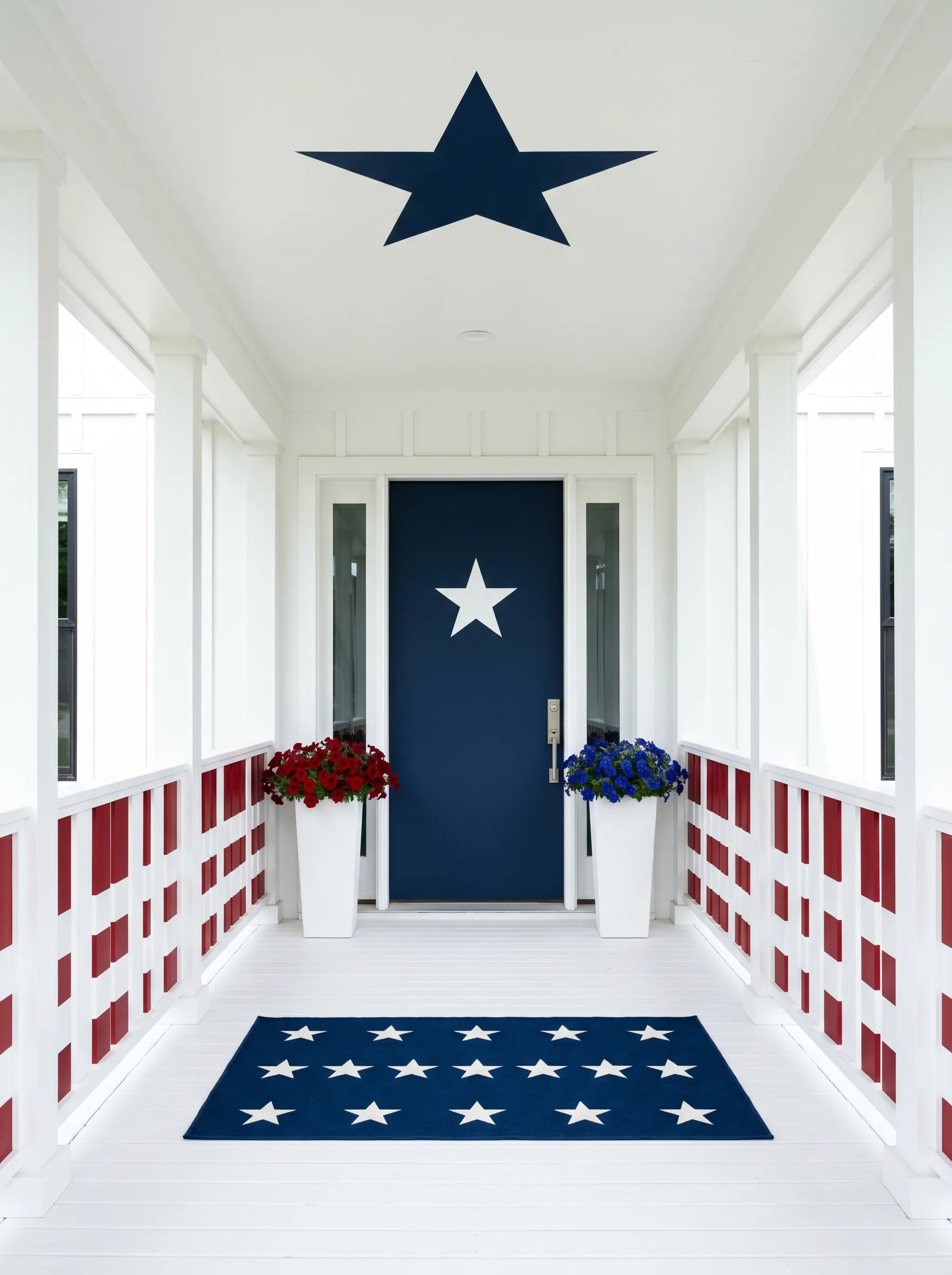
Some porches are shaped like tunnels — long, narrow, enclosed on both sides. This shape is typically treated as a limitation. It isn’t. It’s a frame.
Paint everything white: ceiling, floor, walls. Paint the interior face of the railings on both sides in alternating red rectangular panels so the balustrade reads as a graphic stripe pattern running down both walls of the tunnel. This becomes the defining architectural detail of the whole look.
Paint the door navy. Stencil a large five-pointed white star centered on the door — twelve to fourteen inches across — using chalk paint or exterior latex with a foam roller for clean edges. Paint a matching navy star on the ceiling directly above the center of the tunnel, slightly larger. These two stars, top and bottom, create a vertical axis through the space that makes the whole tunnel feel intentional rather than accidental.
Place two identical white tall tapered planters flanking the door, each with a single large-headed flower: deep red gerbera daisies on one side, cobalt blue ageratum mounded on the other. They don’t match in color but they match in height and form, which is enough symmetry.
Lay a navy rectangular rug in front of the door covered in white five-pointed stars in a grid pattern. No other decoration. The tunnel itself, once painted, is the decoration.
The Dark Wood Porch That Goes Warm and Candlelit
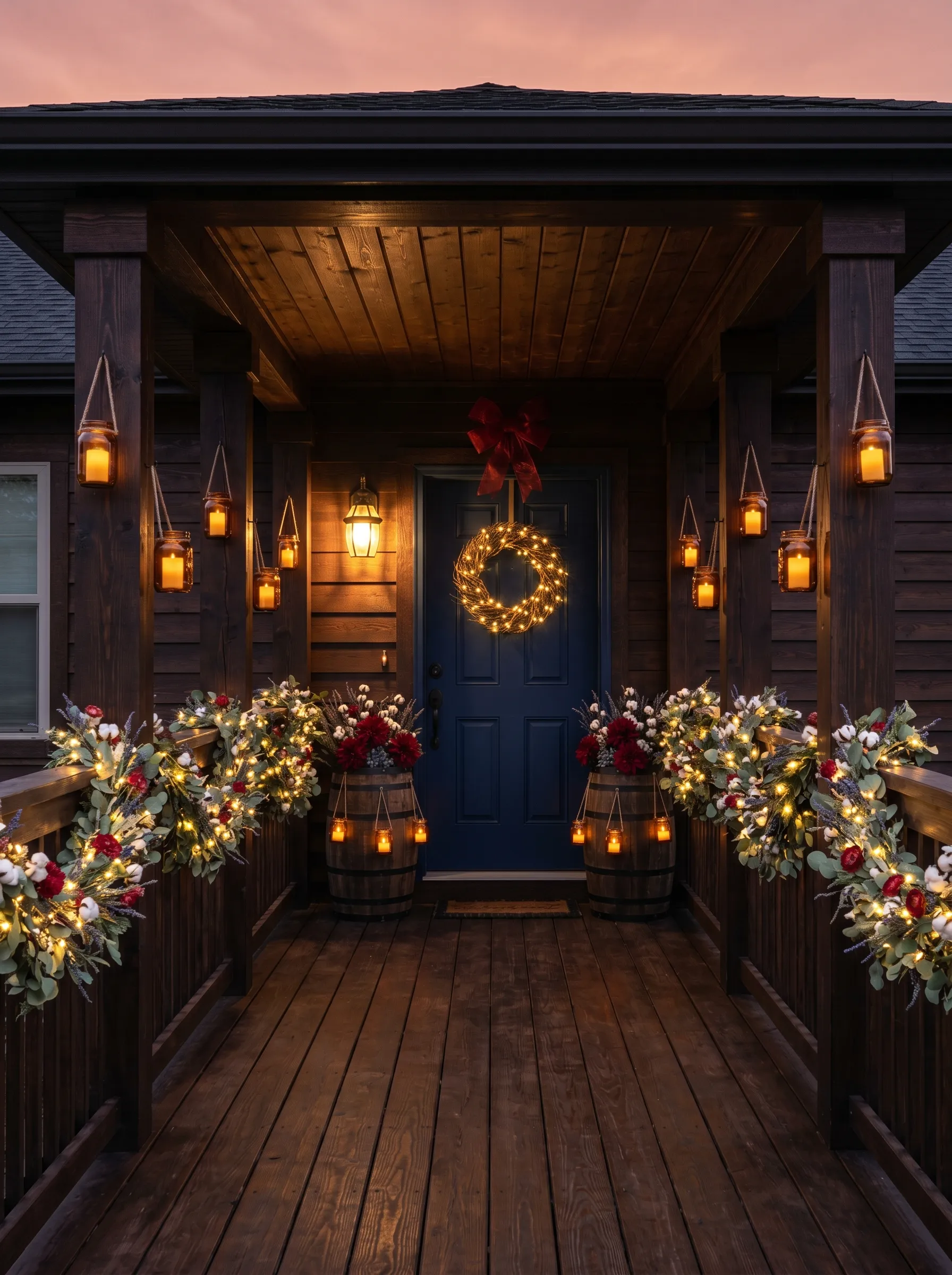
Not every Fourth of July porch needs to announce itself at noon. This one saves everything for dusk.
The porch is deep-stained cedar or aged dark wood — the kind that turns amber in warm light. Don’t fight it. Build everything to work with the warmth of the material.
Fill two large wine or whiskey barrels with mixed plantings: red ranunculus, white cotton bolls, lavender sprigs, and eucalyptus. The mix leans botanical and dried rather than fresh and perky. The cotton bolls are important — they read as American and rustic without being banner-and-flag patriotic.
Attach bunches of the same mixed botanicals with twine to the top rail of the porch railing on each side, clustering them at intervals with LED fairy lights woven through. The lights should come on at dusk automatically if possible, which means running battery-pack strings with timers.
Hang multiple mason jar candle holders at staggered heights from hooks installed along the side walls — three to a side, at slightly different heights — with LED tea light inserts. Add one standard wall-mounted coach lantern centered above the door with a warm-burning bulb.
On the door itself, hang a grapevine wreath base embedded with LED micro-lights threaded through the vines, finished with a simple oversize red velvet or satin bow at the top. In the dark, the wreath glows. In the light, it reads as natural and textural.
The Hanging Lantern Ceiling That Makes the Porch Feel Like a Party
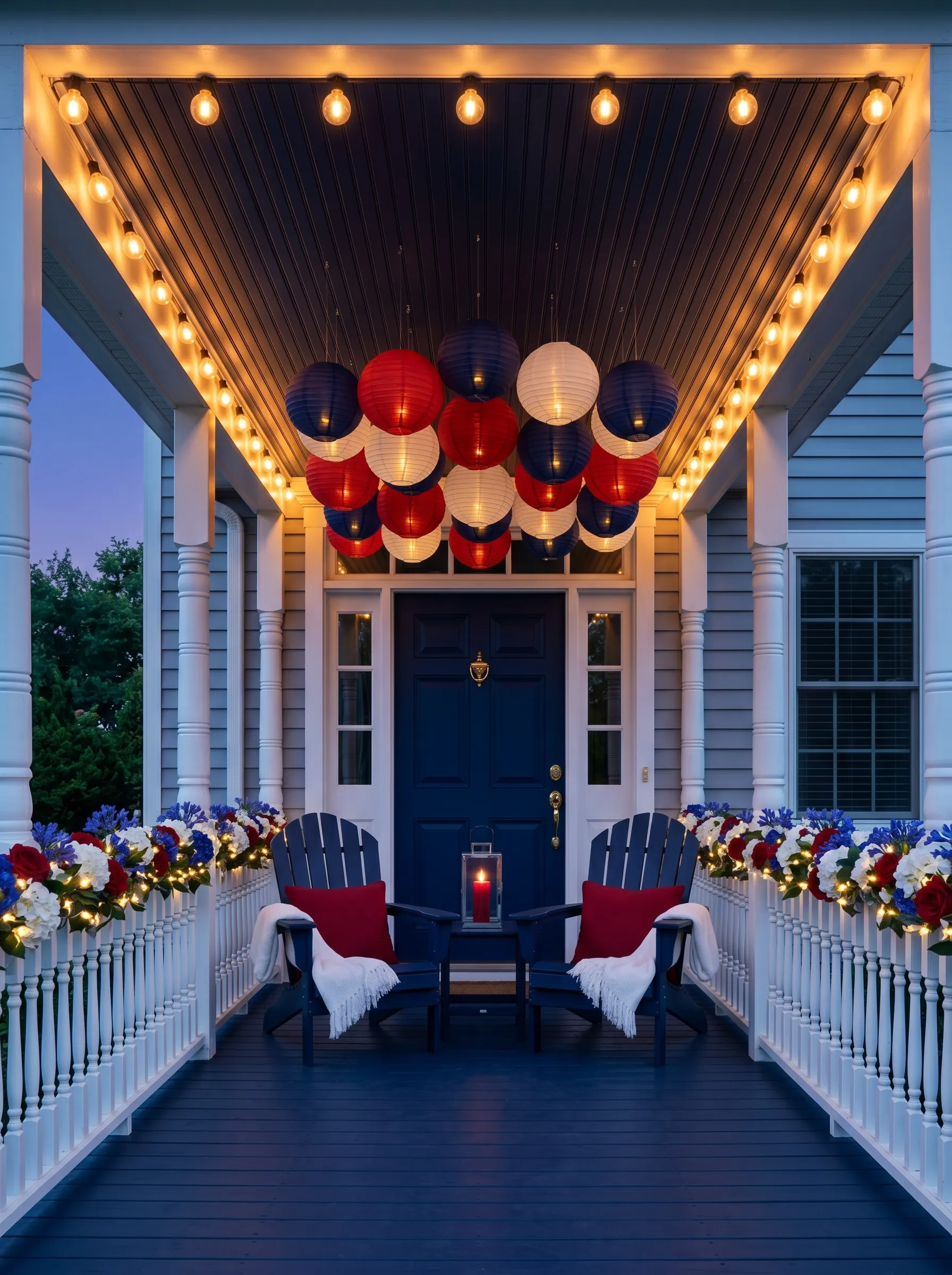
This is an overhead installation, and the overhead is where most porches are completely empty. Stop wasting the ceiling.
String globe Edison lights in a grid or perimeter pattern across the full ceiling of the covered porch first — this is the infrastructure. Use outdoor-rated string lights with S14 bulbs on black wire. Run them in parallel rows spaced twelve inches apart if you want a grid, or simply frame the perimeter.
Suspend paper lanterns in red, white, and navy from the ceiling string at varying heights — some at six inches below the string, some at twelve, some at eighteen. Use twenty to twenty-five lanterns for a standard porch, clustering more toward the center. Insert LED puck lights or battery candles into each lantern so they glow rather than just hanging dark.
Below the lanterns, place two navy Adirondack chairs facing each other with a small bistro table between them. Add red throw pillows and white cotton blankets. Place a single large candle lantern on the table between them with a red pillar candle inside. Line the railing on both sides with flower garland at rail height — red, white, and blue blooms mixed with warm LED lights threaded through.
The lanterns overhead, the floor flowers below, and the two chairs between them create three horizontal layers. The porch becomes a room.
The All-Flower Porch That Makes Petals the Architecture
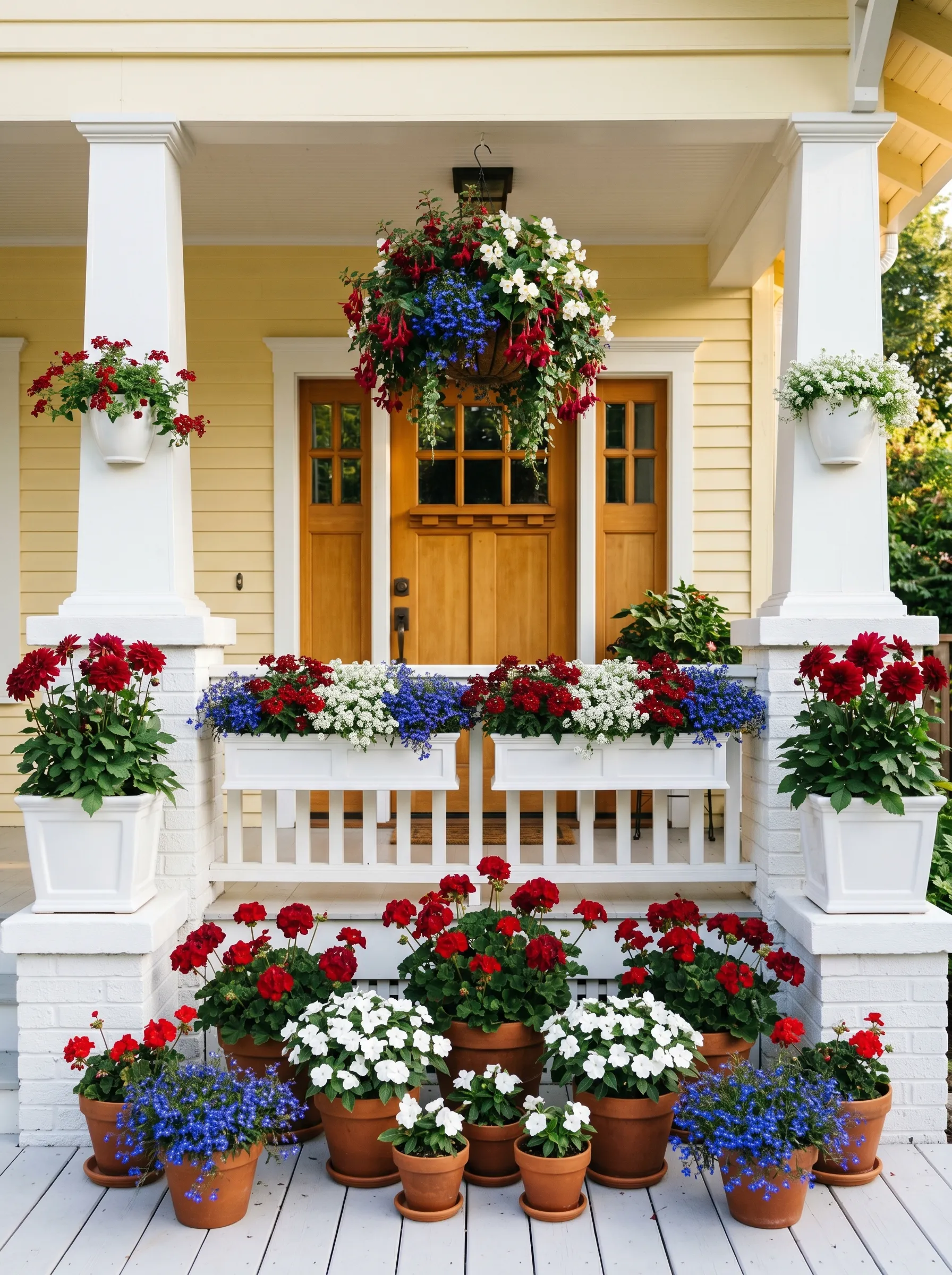
This porch skips bunting and balloons entirely. The decoration is entirely botanical, and it works because the volume of flowers is genuinely extravagant.
Start at the ground in front of the steps: a tiered arrangement of terracotta pots in various sizes, twelve to fifteen pots total, planted in groups of single colors — all-red geraniums in the back row, all-white impatiens in the center row, all-blue lobelia in the front small pots. Pack them tightly enough that no terracotta is visible between them. The pots should look like a continuous carpet of color.
Build up the railing with a full window box mounted along the top rail and filled with the same three-color stripe: lobelia, white alyssum, and red verbena running in horizontal bands across the box. The stripes in the box mirror the rows on the ground.
On each column, mount a small wall planter bracket at mid-height and place a white ceramic wall pot with a single geranium in red or white.
Hang the centerpiece overhead: a large wicker or wire hanging basket filled with a cascading mixed planting of red fuchsia, white bacopa, and blue lobelia. It should be large enough — at least sixteen inches across — to read clearly from the street as the focal point above the door.
The All-White Modern Porch That Lets Two Flowers Do Everything
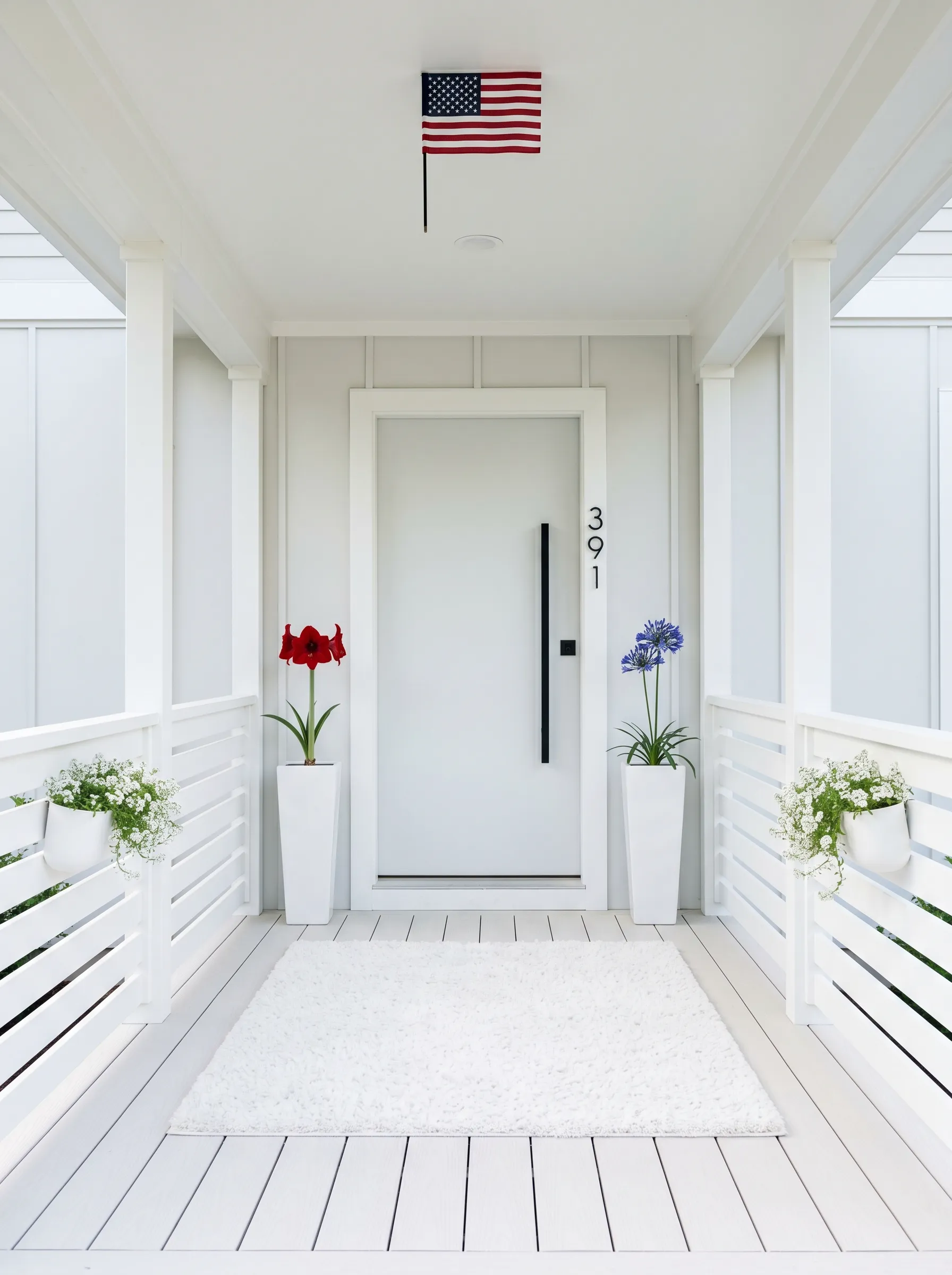
This is for the porch that doesn’t want to perform. It wants to be quiet and precise.
The porch, door, columns, railing, and floor are all white. Keep them that way. Don’t add paint, don’t add bunting, don’t add a rug.
Place two identical white tall tapered planters flanking the door — narrow at the base, wider at the top. In one planter, a single stem of deep red amaryllis, standing alone. In the other, a single stem of blue agapanthus. Nothing else in either pot. One stem, one color, one clean line.
On each side of the railing, mount a small white wall planter with white babysbreath or white alyssum — something soft and trailing that doesn’t introduce a new color.
Mount a single small American flag from the porch ceiling, perpendicular so it hangs flat and visible from below. Choose the correct hardware — a simple horizontal flag bracket — so it reads as deliberate and not improvised.
Everything about this porch is restraint. The two flowers, being the only saturated color on an entirely white field, read as intentional and almost sculptural. The flag overhead is the only banner you need.
The Mod Star Porch Built on a Round Rug
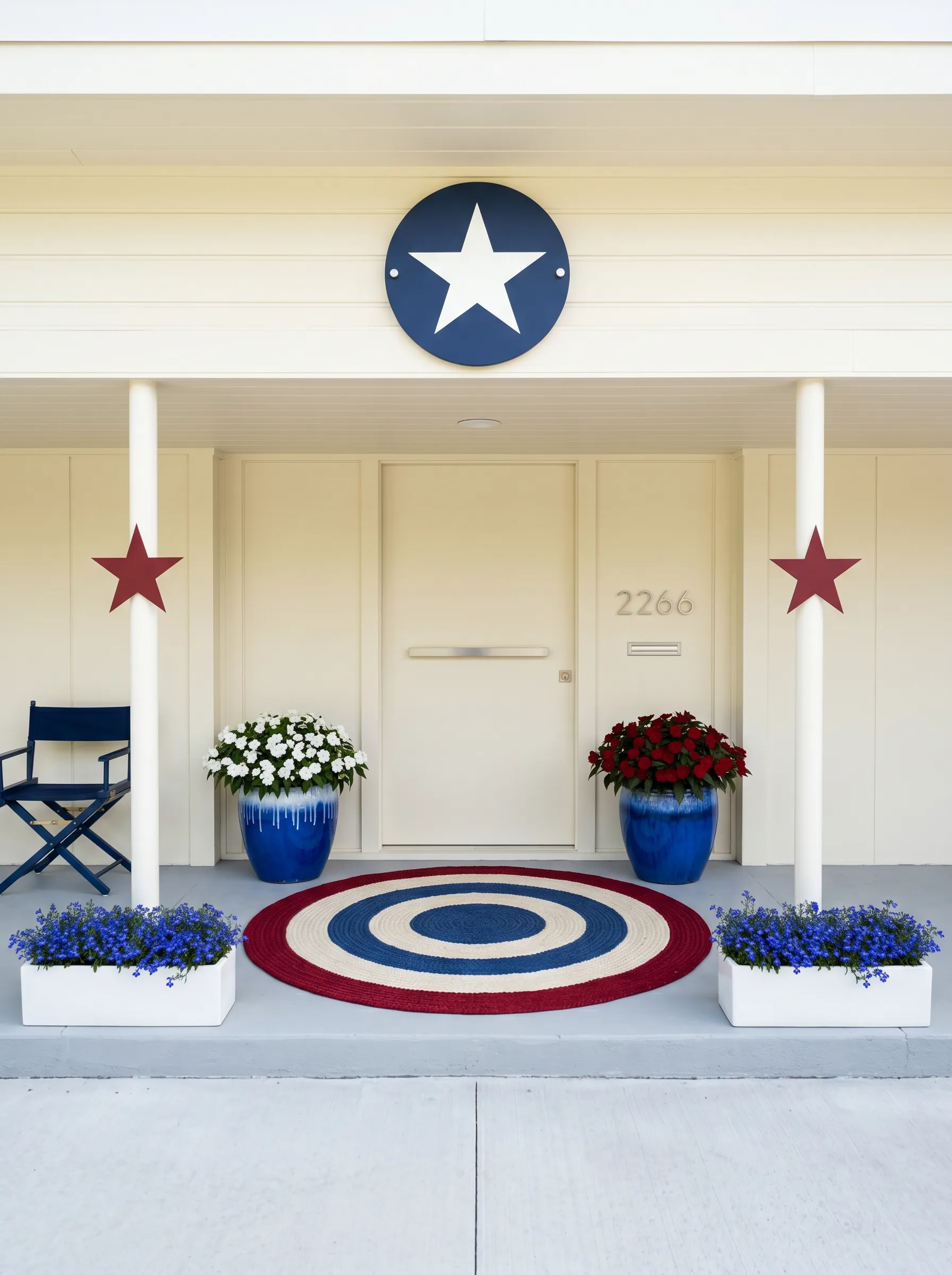
The round braided rug in concentric circles of red, white, and navy is the decision everything else serves.
Find or order a thirty-six to forty-eight inch round outdoor braided rug in the concentric ring pattern — red outermost, cream middle, navy center. Place it centered in front of the door. It reads as graphic and confident in a way that rectangular doormats never do.
Flank the door with two large cobalt blue drip-glaze ceramic urns — the kind with a reactive glaze that shows lighter blue and white streaks — filled with white impatiens on one side and deep red begonias on the other. The blue of the pots picks up the navy of the rug.
At the far edge of the porch on each side, place a low white rectangular planter box filled with blue lobelia only — single-color, mounding, no mixing.
On each column above eye level, mount a flat five-pointed metal star in dark red or burgundy. Above the porch ceiling line on the exterior fascia, mount or hang a large circular disc in navy with a centered white star — not a decorative star, a clean graphic disc like a roundel. This is the one element people will photograph from the street. Make it large enough to register from twenty feet away.
The Victorian Porch With the Theatrical Ribbon Curtain
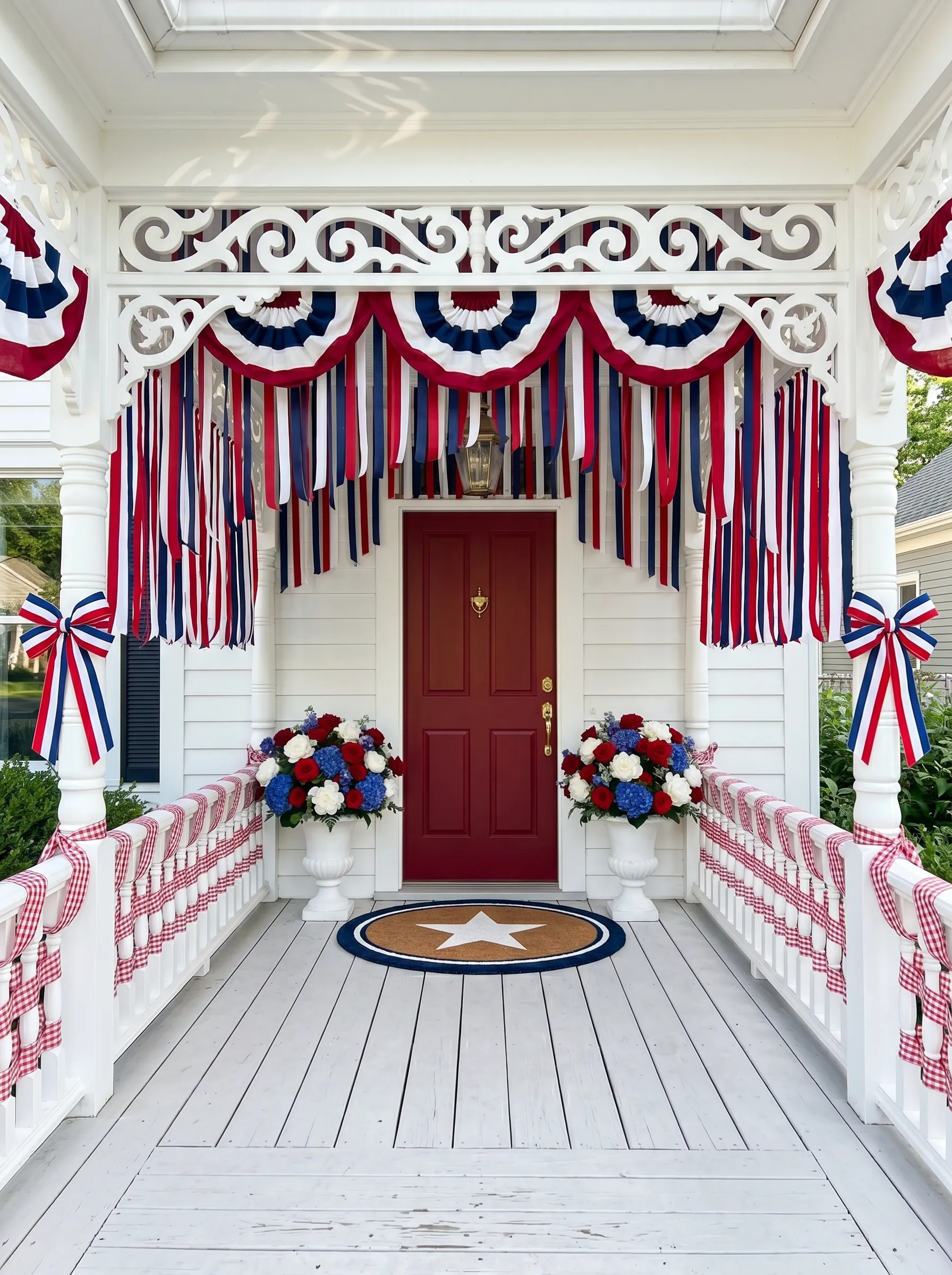
A Victorian porch with ornate fretwork overhead is one of the few settings where theatrical decoration is not just appropriate — it’s architecturally demanded. The fretwork wants something to compete with.
Gather lengths of ribbon in red, white, and navy — satin and grosgrain in two-inch widths — and cut them in lengths of three to four feet each. Group them in bundles of six to eight and tie each bundle to the fretwork header with the tails hanging down. Work across the full width of the fretwork until the bands of ribbon create a dense vertical curtain effect below the decorative woodwork. The ribbons should just clear the top of the door.
Drape full patriotic fan bunting across the top of the fretwork, working with the ribbon curtain rather than behind it.
Paint the front door a deep cranberry red — not the flag red, which is cooler and brighter, but a warmer, more historic red closer to oxblood. Flank the door with white urn planters filled with a formal arrangement: blue hydrangeas as the base mass, white peonies in the middle, red roses at the top. These are structured, symmetrical, upright arrangements — not the casual tumbling style. The Victorian architecture calls for formality.
Tie large tri-color wired ribbon bows to the tops of both porch columns. Line the railing with red-and-white gingham ribbon threaded through the balusters or draped along the top rail. On the floor, a round star-motif coir mat.
The Rustic Barn Porch That Earns Its Yeehaw
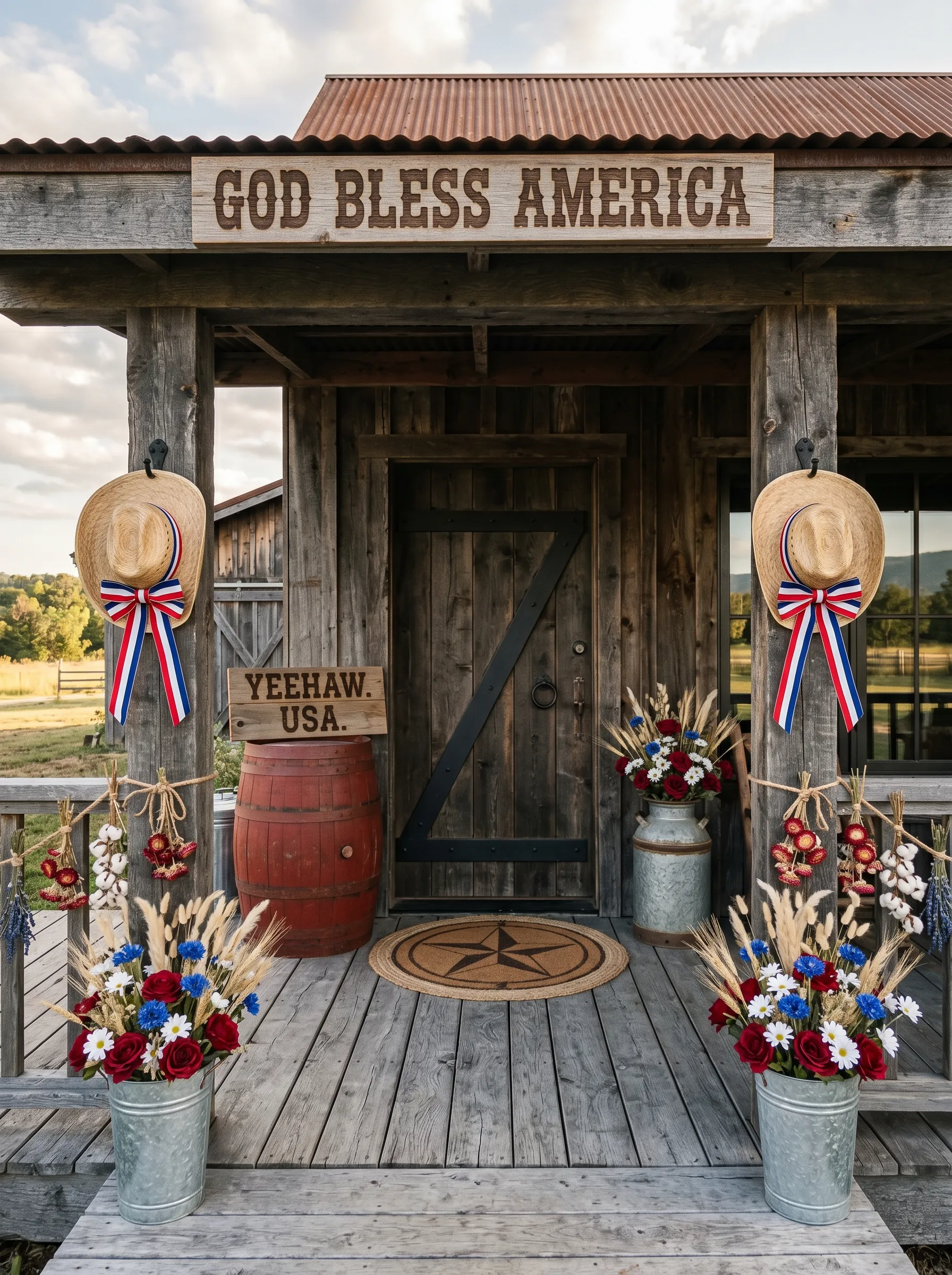
Weathered gray wood siding, rough-hewn timber columns, corrugated metal roofing. This porch doesn’t need bunting. It needs to lean into what it already is.
Source two old straw hats and hang one from a nail on each column, at roughly shoulder height. Thread a wired ribbon through each hat’s crown and tie it in a tri-color bow — red, white, and blue — with long trailing tails. This is the most important detail: the hats signal that this is the rustic version of patriotic, not the suburban version.
Place two large galvanized metal utility buckets on each side of the door. In each bucket, arrange a mixed bunch: red roses, white daisies, blue cornflowers, dried wheat stalks, pampas grass tips, cotton bolls, and a few sprigs of dried lavender. Keep the arrangements loose and wild rather than structured and spherical. They should look like someone cut them from a field, not ordered them from a florist.
Between one door arrangement and the door itself, tuck a red oak barrel standing upright. Lean a small rustic wooden sign against it — something with direct, unpretentious lettering.
Hang a compass-star or Texas-star themed jute door mat at the threshold. Use a galvanized milk can on the other side of the door as a counterpart to the barrel, filled with dried wheat and more cornflowers.
The whole thing should look like someone who lives there put it together in an afternoon from things they already had. That is the goal and it is harder to achieve than it looks.
The Log Cabin Porch That Makes Macramé Patriotic
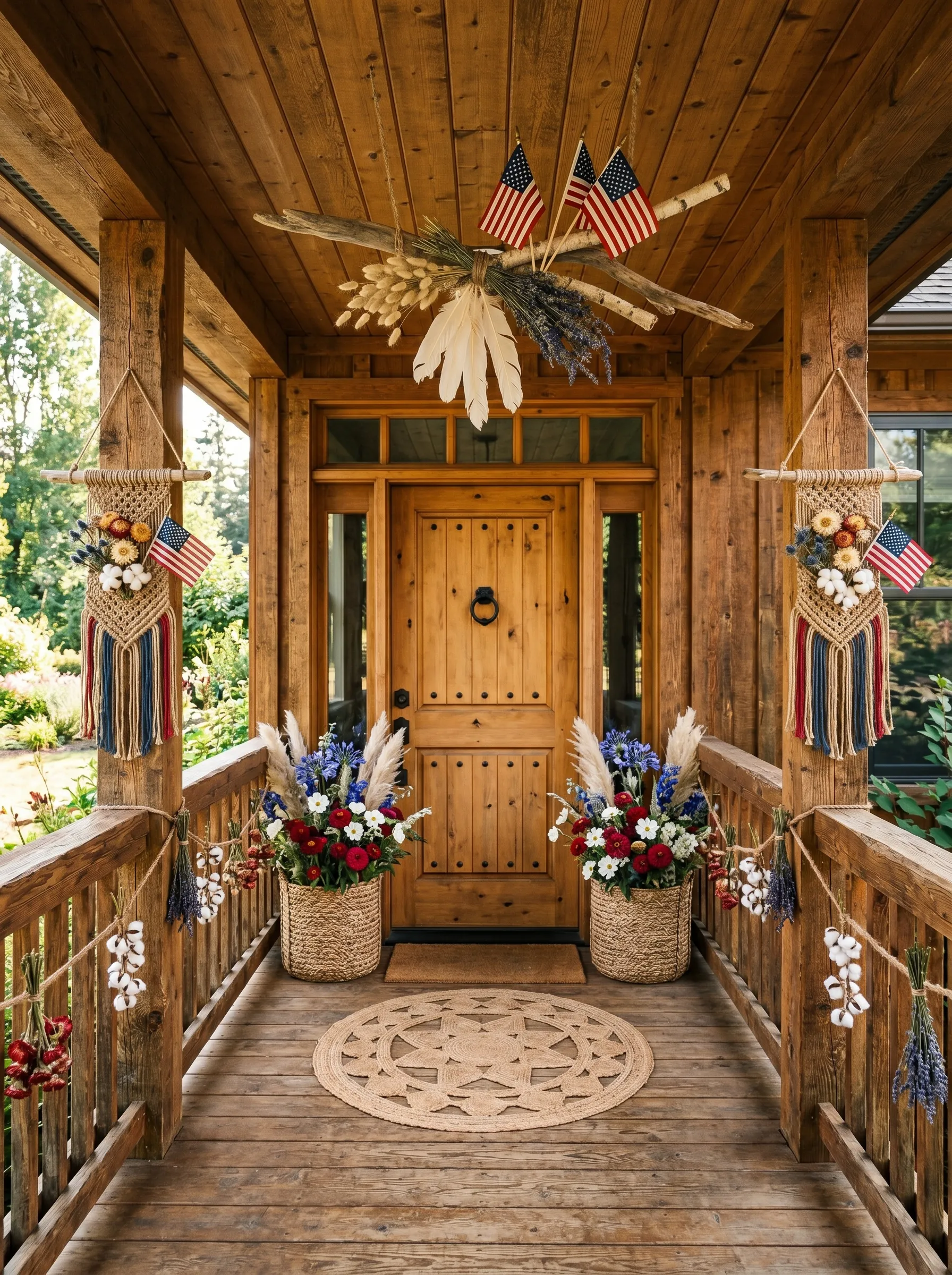
Natural wood everywhere — ceiling, columns, floor, door surround. This is a setting that refuses to be painted.
The anchor elements here are a pair of macramé wall hangings, one on each side of the door. Make or source them in natural jute cord, with the lower fringe dyed in two colors: navy blue on one half and red on the other, blending in the center. The natural jute top section ties it to the cabin’s materials. The colored fringe brings in the palette without a flag or a banner in sight.
Tuck a small American flag and a dried flower into the macramé — gerbera daisy, cotton boll, dried gaillardia — so the hanging reads as a seasonal installation rather than a permanent fixture.
From crossed birch branches suspended from the ceiling above the door, hang a bundle of dried botanical elements: dried wheat, dried lavender, pampas grass, and white feathers. This is the overhead focal point.
At the base of the door, position two woven seagrass or rattan market baskets, each filled with a mix of red ranunculus, blue agapanthus, white daisies, and trailing pampas grass. The baskets match the natural material of the porch.
On the railing, hang small bundles of dried botanicals and a few cotton stem clusters on twine, knotted at intervals, the way a very organized and aesthetically inclined person might hang herbs to dry.
The jute circle rug at the door should have a geometric compass or star pattern woven into it.
A Final Word on Getting It Right
Every porch in these images made one decision first and built everything else around it. Not ten decisions. One.
The things that matter most — the macramé on the log cabin, the navy star on the all-white door, the balloon arch on the cottage porch, the round rug in front of the mod entry — none of them are complicated. They’re clear.
The color palette is the easiest part of Fourth of July decorating. Red, white, and blue. You already know what you’re working with. The hard part is choosing what role each color plays and then having the conviction to stick to it when you’re standing in the store surrounded of options.
The porches that get remembered are the ones where someone made a real decision. Not a safe one. Not a hedge. A decision. Make yours.