
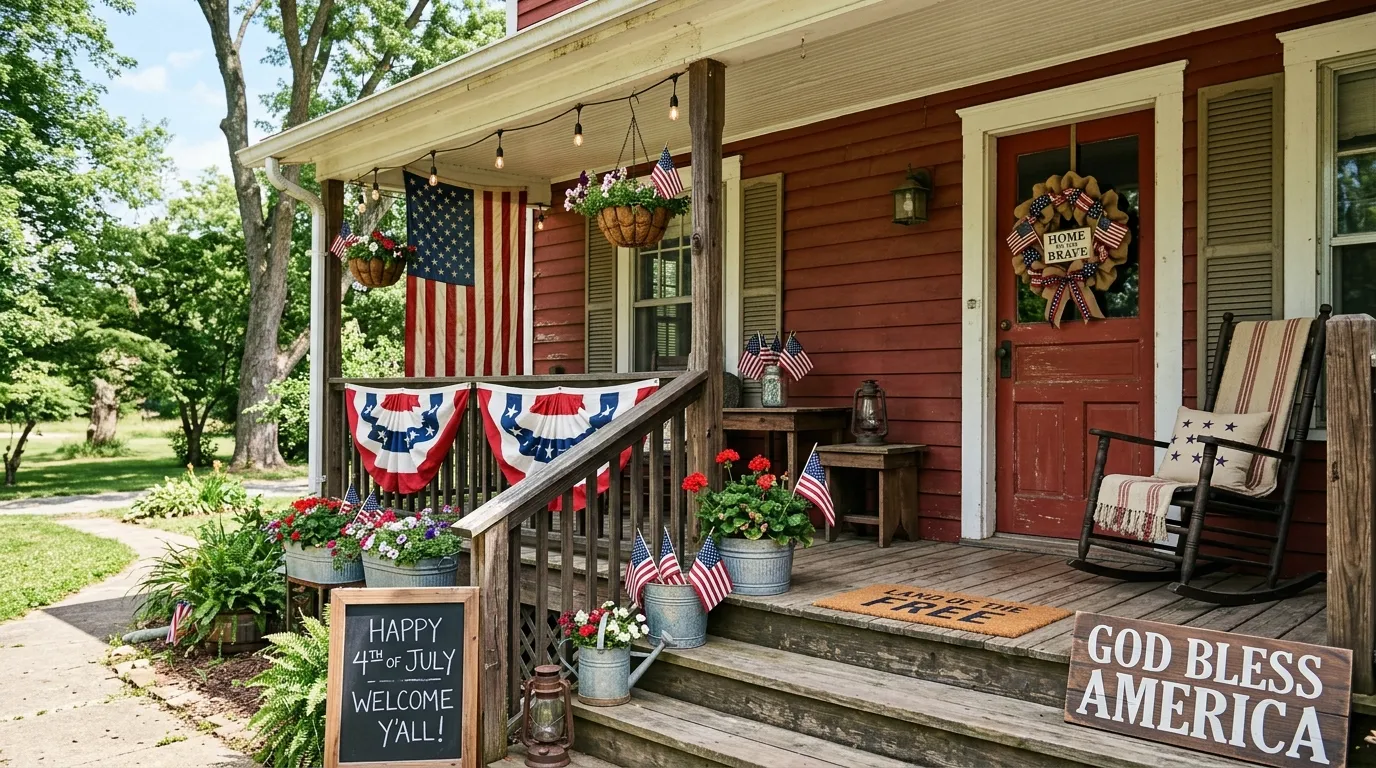
The flags in these porches have been washed so many times they’ve gone soft. The wood has been sitting in the sun for twenty years. The galvanized buckets have rust along the seam. None of it is precious, and all of it is better for it.
Farmhouse patriotic decorating operates on a different logic than the suburban version. It isn’t trying to impress anyone. It isn’t buying things. It’s putting out what’s already there — the old ladder, the quilt, the canning jar — and letting the calendar explain why.
Most people doing the Fourth of July wrong are doing it too new. Everything matches too perfectly. The colors are too saturated. The stars are too crisp. Farmhouse style earns its look through exactly the kind of imperfection that takes time to accumulate, and you either have it or you learn how to manufacture the impression of it.
These porches have all figured that out. Here is what each of them is actually doing.
Why Farmhouse Patriotic Porches Fail Before Anyone Sits Down
The aesthetic has rules most people don’t know they’re breaking.
You Bought New Things and Called Them Vintage
The problem with most farmhouse patriotic porches isn’t ambition. It’s that the materials are lying. A galvanized bucket from a craft store has that fresh aluminum smell and perfectly smooth handles. A real galvanized bucket has a rust ring at the base and a slightly bent handle and paint spatter on one side from a project two summers ago. These things look different. People who grew up around the real thing can tell immediately.
This doesn’t mean you can’t start fresh. It means you have to know which new things pass and which ones don’t. Natural materials age fast: terracotta, galvanized metal, raw wood, cotton and linen textiles. Painted things age fast if you buy them already distressed or distress them yourself with sandpaper and diluted paint. Plastic and polyester never age and never belong.
When in doubt: can you find it at an estate sale? If yes, it probably belongs. If it only exists in a Target seasonal aisle, think carefully.
You Matched When You Should Have Mixed
Farmhouse porch decorating doesn’t match. It accumulates. The quilts on the rockers don’t match each other. The pillow patterns fight, productively. The basket on the hook is wicker and the bucket on the floor is galvanized and the planter by the step is terracotta. None of these were bought together and none of them look like it.
The mix is the point. A farmhouse porch that matches — same font on every sign, same weave on every basket, same terra cotta shade on every pot — doesn’t look like it belongs to anyone. It looks like a set. Real farmhouse porches look like they belong to a specific person who has lived in one place long enough to have acquired a particular and idiosyncratic collection of things.
You Forgot That Farmhouse Patios Grow Toward the House
The typical decorator approach starts at the door and works outward. Farmhouse porches work differently. The porch itself — its age, its color, its material — is part of the decoration. The chipped paint is the decoration. The worn floorboards are the decoration. The rusted hinge on the shutter is the decoration.
This means working with what you have instead of covering it up. If your porch floor is weathered gray wood, you don’t disguise it with a rug. You put one braided oval mat and let the boards show. If your rocking chairs are chalky white with missing paint, you don’t repaint them. You drape a quilt over the arm. The existing imperfection is doing work.
Farmhouse Patriotic Porch Ideas
The Maxed-Out Mountain Cabin Porch Built From Decades of Collecting
The first rule of this look: nothing matches and nothing is new. The porch is layered the way a real working farmhouse accumulates things — slowly, over seasons, with no plan.
Start with white-painted Adirondack chairs, chipped down to bare wood in several spots, fitted with solid red seat cushions. Across the back and arms of the chairs, drape quilts — the star-pattern kind, faded and soft — rather than coordinated throws. Each chair gets its own quilt, and they don’t match.
Pile the chairs with a variety of pillows in different patterns: red-and-white buffalo check, a grain sack pillow with a denim star appliqué and red stripe detail, a printed canvas “America My Home Sweet Home” pillow in red, white, and navy. Stack them so you couldn’t sit down without rearranging them. That’s correct.
On the porch railing or hanging from hooks above the seating area, string a mix of fabric pennant bunting — not matching, not uniform — alternating gingham triangles, floral print triangles, and solid navy. In the center of the porch, place galvanized buckets planted with mixed summer annuals in full bloom: red petunias, yellow pansies, purple verbena, the kind of cottage-garden mix that has no editorial control whatsoever.
On the floor beside the chairs, tuck a red crate or box painted with flag stripes, and hang a mini patriotic fabric banner from its handle. On the oval braided star-pattern rug centered in front of the seating, let everything else stack and overflow. Wicker baskets, potted plants, small flags, a painted bench. The accumulated chaos is exactly right.
The Log Cabin Porch That Makes Macramé Feel Patriotic
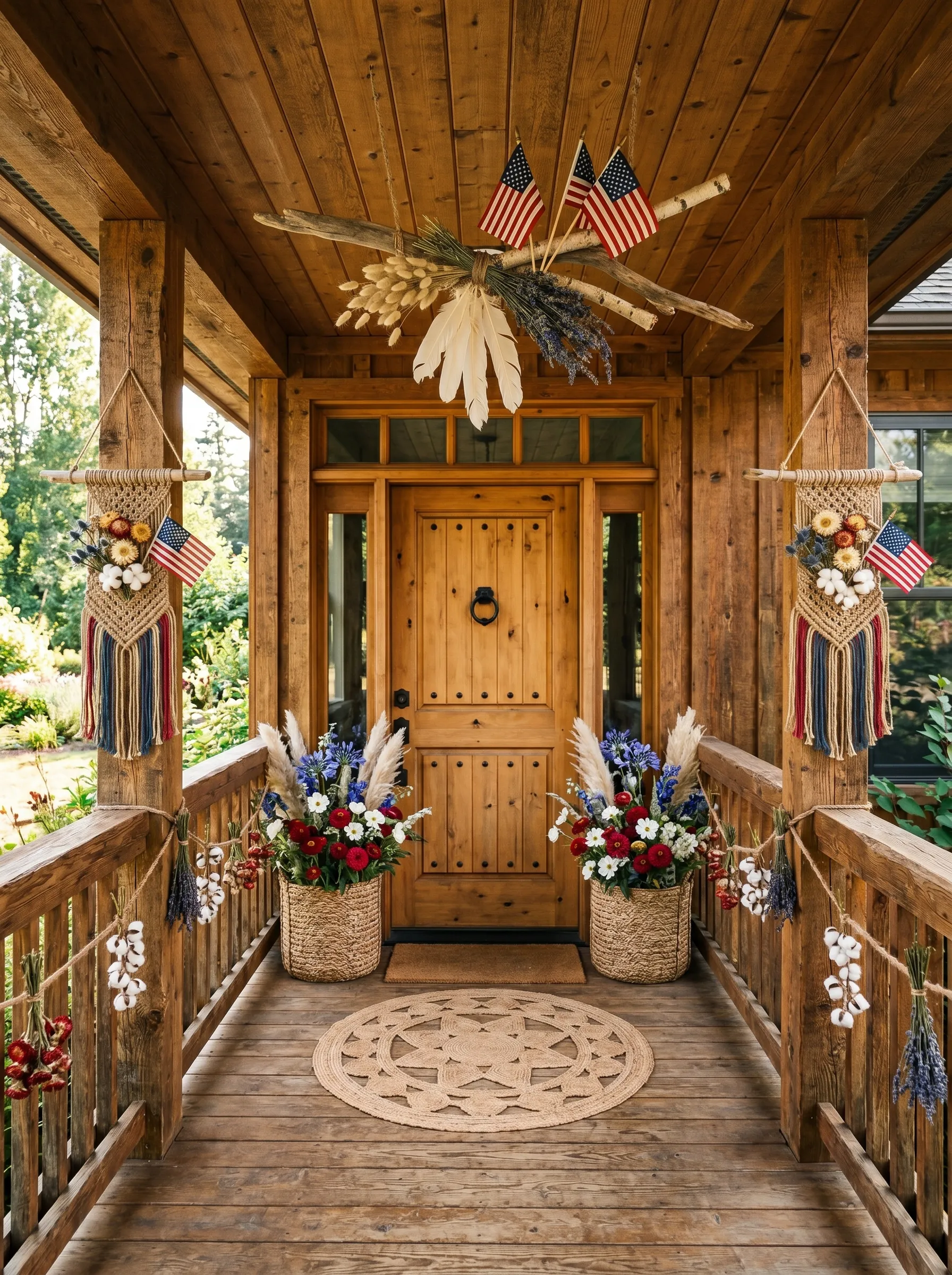
Natural wood everywhere — ceiling, columns, floor, railing, door surround. This is a setting that refuses paint or pattern. Everything on it has to speak through material and texture rather than graphic boldness.
The defining element is a pair of macramé wall hangings, one suspended from each side column. Use natural jute cord with a half-hitch knot body, worked over a dowel rod or a carved birch branch. Leave the lower third as long fringe tails, then dye the fringe in sections: one-third navy, one-third natural, one-third red. The color comes from the dye, not from ribbon or paint. Tuck a small American flag and a dried gerbera and cotton boll into the top of each hanging.
From crossed birch branches tied together and mounted from the ceiling beam above the door, hang a loose bundle of botanicals: dried wheat, lavender bunches, pampas grass plumes, white feathers. The installation should look organic, like something gathered and brought home, not arranged. Add two or three small flags fanned out among the stems.
At the floor of the door, position two large woven seagrass market baskets — round, substantial, handled — packed with mixed flowers that lean loose and wild: blue agapanthus, red ranunculus, white cosmos, pampas grass. The baskets match each other in form but not in exact content.
On the railing, at intervals, tie loose cotton stem bundles and lavender bunches with natural twine, letting them hang at slight angles. The jute circle rug at the threshold should have a compass or mandala-style geometric woven pattern in natural tones.
The Antique Farmhouse Entry That Uses a Red Tricycle as Its Best Piece
The vintage red Radio Flyer tricycle is the centerpiece. Everything else is arranged to give it context.
Source a tricycle that shows genuine age — chrome that’s lost its shine, rubber that’s hardened slightly, a basket attachment on the front that’s rusted at the rivets. Place it on a woven natural jute rug with a harlequin or checkerboard pattern in two tones of neutral. The rug anchors the tricycle and establishes the material vocabulary for everything above it.
For the urns on either side of the door, find genuine aged cast stone or cast iron pedestal urns — the kind with decades of weathering across their surface. Plant them densely with mixed greens and flowers: boxwood and trailing vines as the base, red geraniums and salvia in the middle, white alyssum at the edges. Add small American flags pushed upright into the soil behind the blooms.
Beside the tricycle, set a galvanized watering can with blue hydrangeas and a small flag tucked into the spout. On the door, hang a full hydrangea wreath — this one in pale blue, stuffed completely with bloom clusters so no base shows — finished with a layered ribbon bow using red-and-white gingham, white polka-dot ribbon, and a thin solid strip. Make the tails long. The blue of the wreath against the warm brown door is the visual key to the whole entry.
The Golden-Hour Farmhouse Porch That Gets Everything Right With Quilts and Three Wildflowers
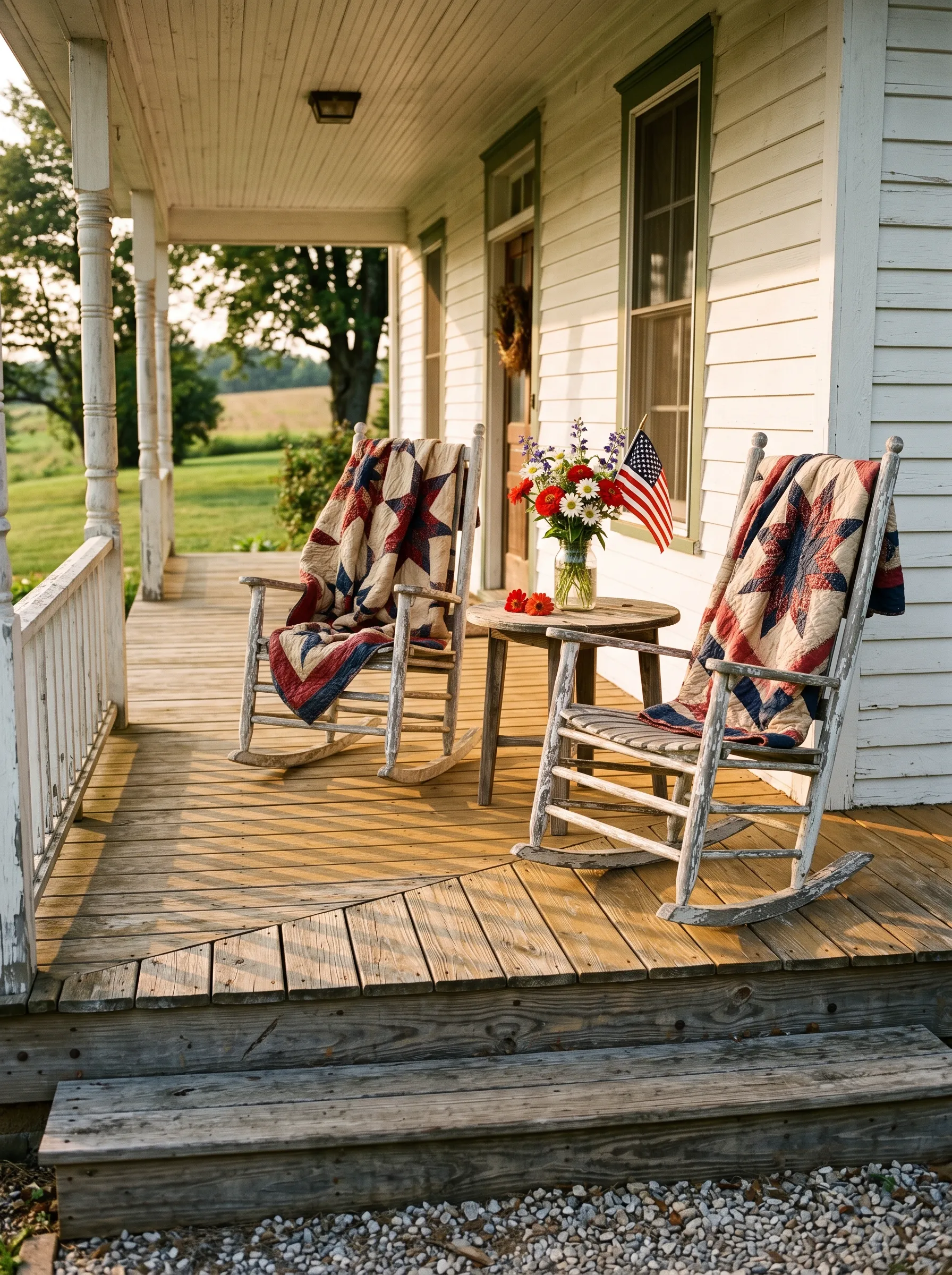
The whole scene is golden afternoon light, two weathered rocking chairs, and two star-pattern quilts draped over the backs. That’s it. That’s the entire concept.
Find or inherit two rocking chairs that have been sitting outside long enough to lose most of their paint. Chalky white is ideal, but gray or barn red is equally correct. They don’t have to match. They just have to be old.
Quilt-sourcing is the most important part. Look for vintage star-block quilts — eight-pointed stars, Ohio stars, lone stars — in faded red and navy fabrics with cream or muslin backgrounds. The older and softer the better. These are not decorative quilts. They are real quilts that have been used and washed and lived with. Drape one casually over the back of each chair, letting it fall to one side and pool slightly on the seat or floor. Don’t fold it. Don’t arrange it. Drape it.
Between the chairs, place a small round wooden spool table or a worn side table at the same worn wood tone as the porch floor. On the table, set a mason jar or simple glass vase with a loose wildflower bunch — red gerbera daisies, white daisies, blue salvia, whatever is available from the garden or a local farm stand. Push a single small American flag into the bouquet from behind. That’s the only explicit patriotic element you need.
The house behind this scene is white clapboard with green trim. Let the house be part of the image. Don’t block it.
The Terracotta Stair Porch That Lets Caladiums Do the Heavy Lifting
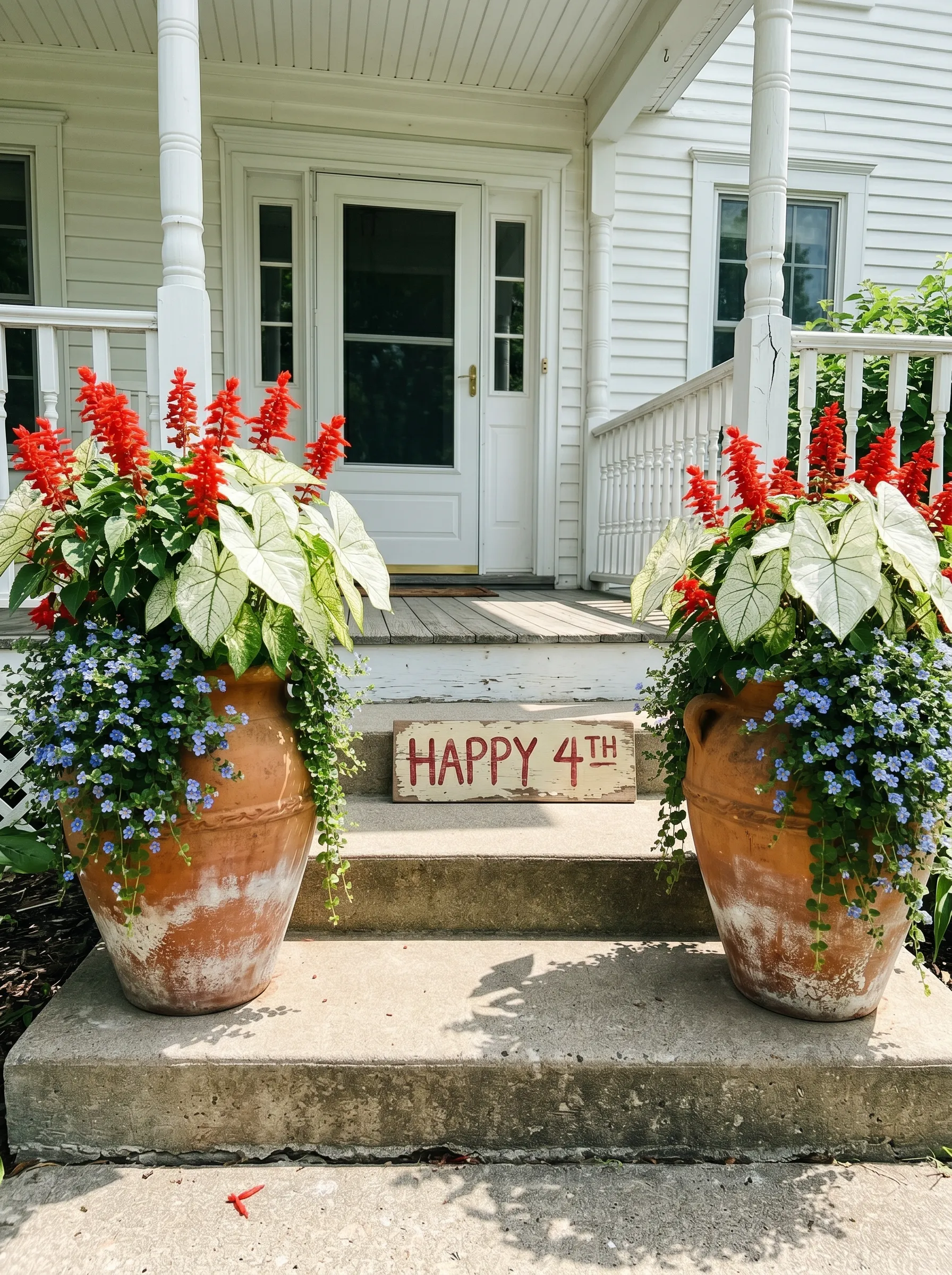
This is a container planting story, not a decoration story. The flowers are the decoration.
Source two very large terracotta urns — the Italian-style ones with the wide middle and the textured rim, at least twenty inches in diameter. These should look like they’ve been outside for ten years: white mineral deposits on the exterior, a slight crack sealed at some point, the natural orange deepened by seasons of wet and dry. New terracotta urns can be aged quickly: soak them in water until they saturate, then rub the outside with plain yogurt and leave them in a shaded spot for two weeks to encourage moss and mineral staining.
In each urn, plant a layered patriotic container combination: caladium in white-and-green as the central thriller with large bold leaves, red salvia spiking upward behind the caladium for height, and blue-flowered scaevola or trailing lobelia spilling over the front and sides. This combination gives you the red-white-blue palette without flags, without bunting, entirely through plants.
Between the urns on the step, lean a small wooden sign with hand-painted or weathered lettering — simple and direct, no fancy font, just the words applied with a brush the way someone would actually paint a sign in a farmhouse kitchen.
The concrete steps beneath are left plain. The plain steps against the abundant planters is the contrast that makes the whole arrangement work.
The Farm Ladder Porch Where Sunflowers Do the Patriotic Work
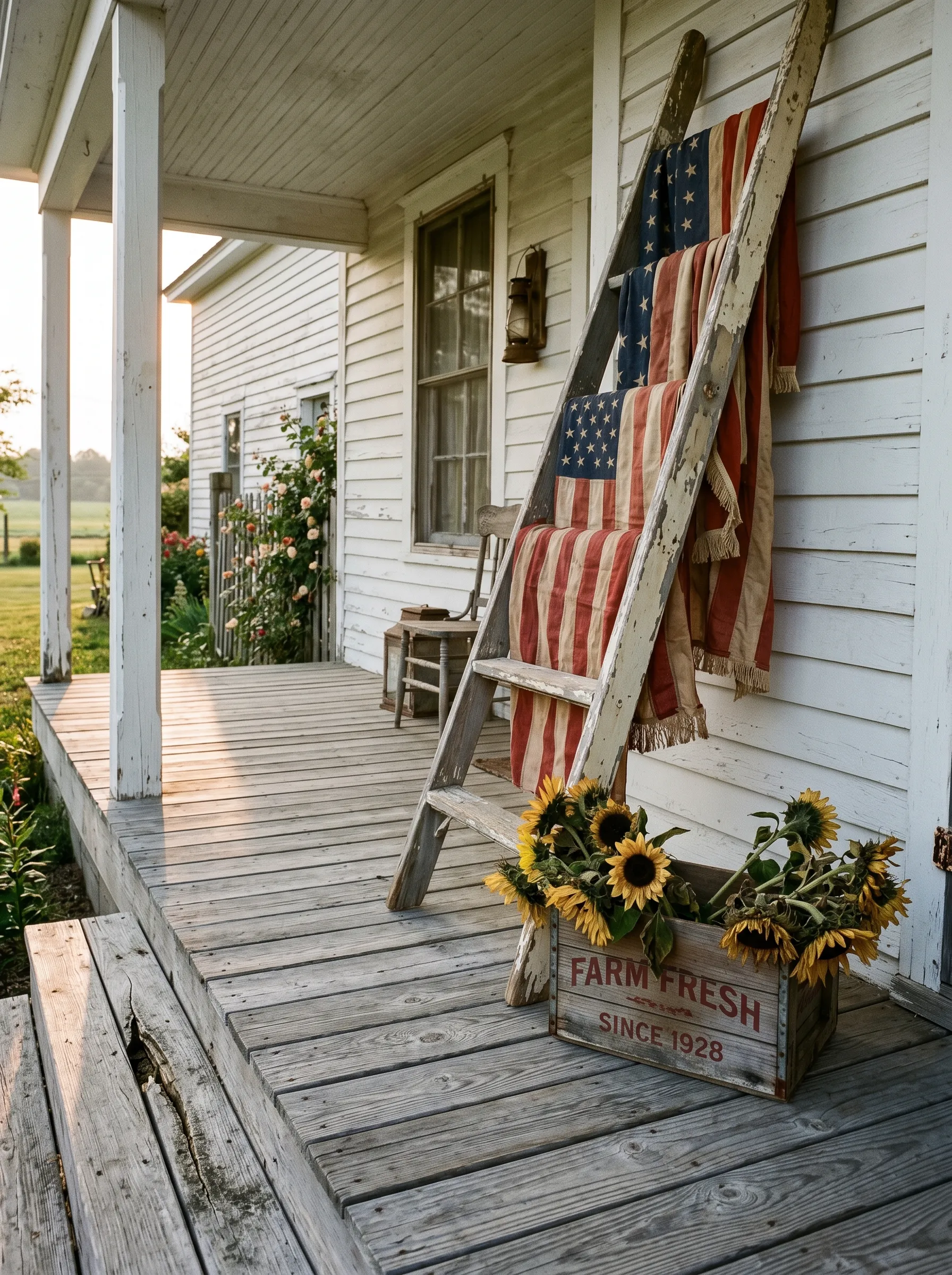
Lean a very old wooden ladder against the porch wall. This is not a decorative ladder bought from a home goods store. It needs to have paint on the rungs from painting projects, a bent side rail from a fall, a general sense that it has been used for its actual purpose for a significant number of years.
Drape a large vintage American flag over the upper third of the ladder, letting it fall naturally over two or three rungs. The flag should be soft cotton or wool, aged enough to have shifted from bright red to a warmer brick, from bright white to ivory. The flag isn’t hung. It’s rested. It looks like someone carried it out to air and leaned it there.
At the base of the ladder, place a wooden produce crate — the kind that held real produce, with stenciled text identifying the farm and the year. Fill it with fresh-cut sunflowers in full bloom, stems long enough that the flowers sit above the crate’s edge and fan outward. The sunflowers are not patriotic by palette, but they are absolutely American, and the combination of sunflowers, a faded flag, and a farm crate on a white clapboard porch on a July evening is the complete image.
The Distressed Porch Swing With Painted Slats and Enamelware Buckets
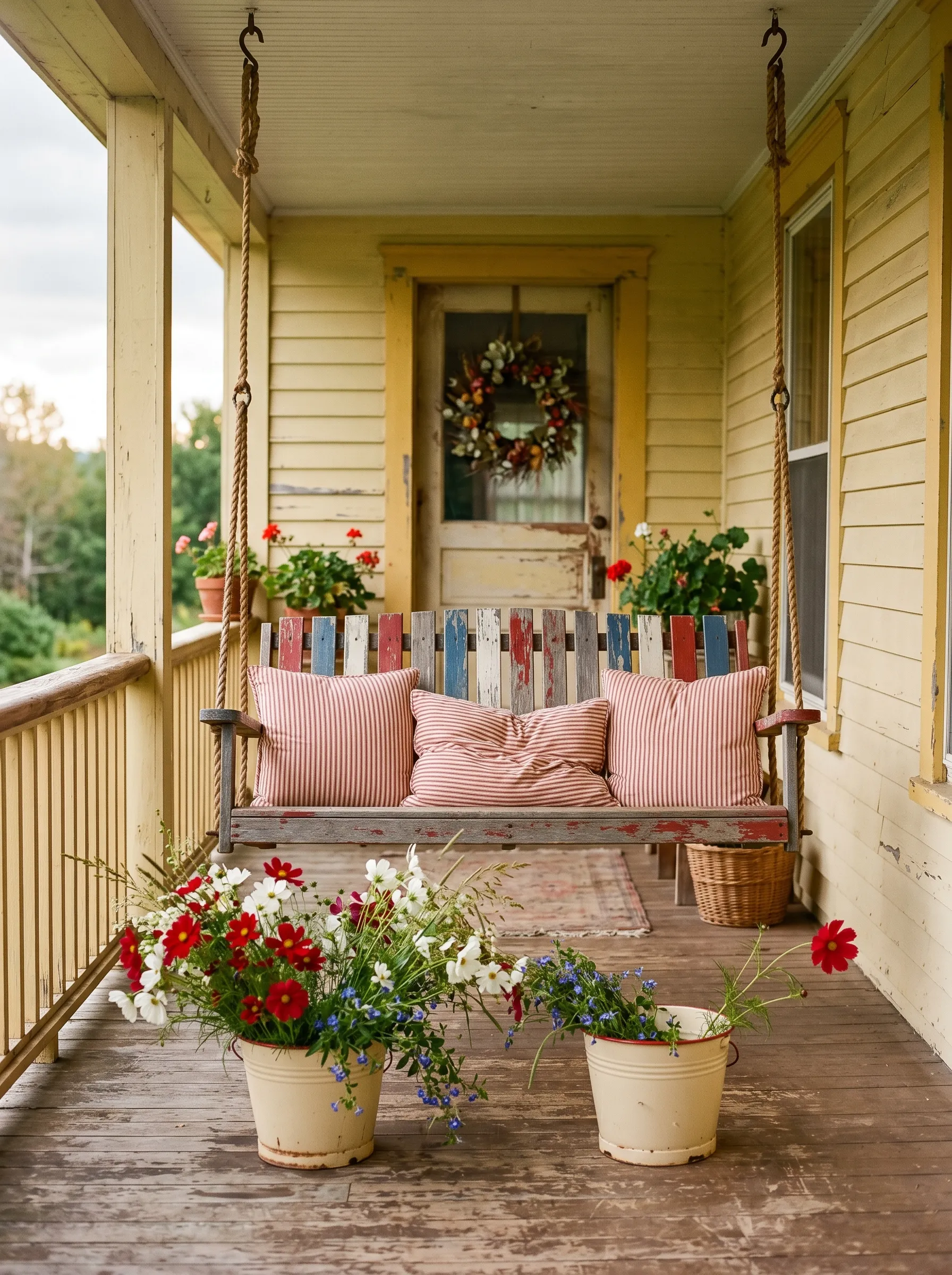
Take a rope-hung porch swing — natural hemp or sisal rope, not chain — and paint individual slats in different colors before assembly or distress them to look as if they’ve been painted over and repainted multiple times. The effect should show several generations of color under the current surface: slats in weathered red, faded navy, chalky white, and unpainted gray wood, each color visibly worn through to the one beneath.
Outfit the swing with red-and-white stripe ticking pillows — three or four of them, overlapping, not arranged. The ticking stripe pattern is specifically correct for this look. It’s historically accurate to the farmhouse era, it reads as worn and domestic rather than purchased and staged.
At the front of the swing, on the floor, place two cream-colored enamelware buckets with rust along the rim — these are the kind of buckets used in farm kitchens and dairies, not purchased as planters. Fill each one with a loose wildflower mix: red cosmos, white cosmos, blue forget-me-nots, whatever is available. Add a third, smaller enamelware bucket to one side as an accent.
Behind the swing, the door should be left in its aged yellow or original paint. The door wreath is botanical — dried botanicals or late-summer flowers, no flag colors needed. The wall color does the patriotic work. The swing does the American summer work. The flowers close the loop.
The Chippy Console Table Styled With a Galvanized Can and Barn Stars
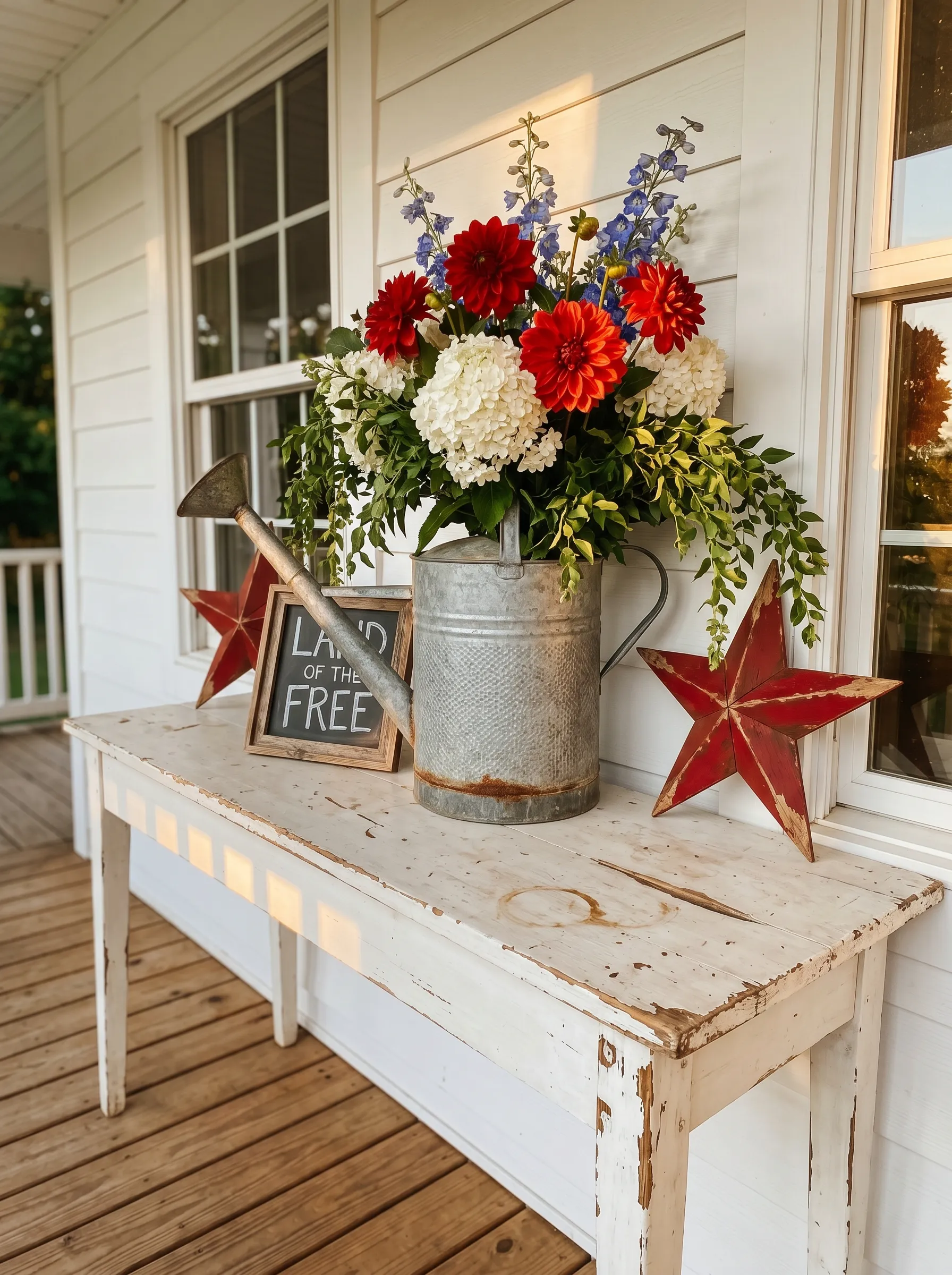
The star of this scene is a galvanized metal watering can — the old-fashioned kind with a long spout, wide body, hammered texture on the sides, and rust along the base seam where it sits in water. Use it as a vase.
Fill the can generously — not tightly arranged but generously stacked: white hydrangea clusters as the base mass, red dahlias at different heights in the middle, blue delphinium spiking upward at the back, and trailing jasmine or vining foliage falling forward over the can’s lip. The arrangement should be large enough to require both hands to carry and tall enough to block the middle portion of the window behind the table.
The table itself should be in the chippy-white farmhouse style: legs and apron painted white, surface worn down to raw wood in multiple spots, showing old finish beneath. Set it directly on the porch floorboards without a rug. Let the worn feet sit on the worn boards.
On either side of the watering can, place one small wooden-framed chalkboard sign with hand-lettered text. Lean it at a slight angle, not propped perfectly upright. Beside it, on the other side of the can, place two flat metal barn stars in red — five-pointed, the kind sold at farm stores as outdoor decorations, shown here without apology. One stands, one leans.
These stars are the only thing on this porch that reads as explicitly decorative rather than functional repurposed. That’s the right ratio.
The Whiskey Barrel Railing Corner Built on the Right Kind of Excess
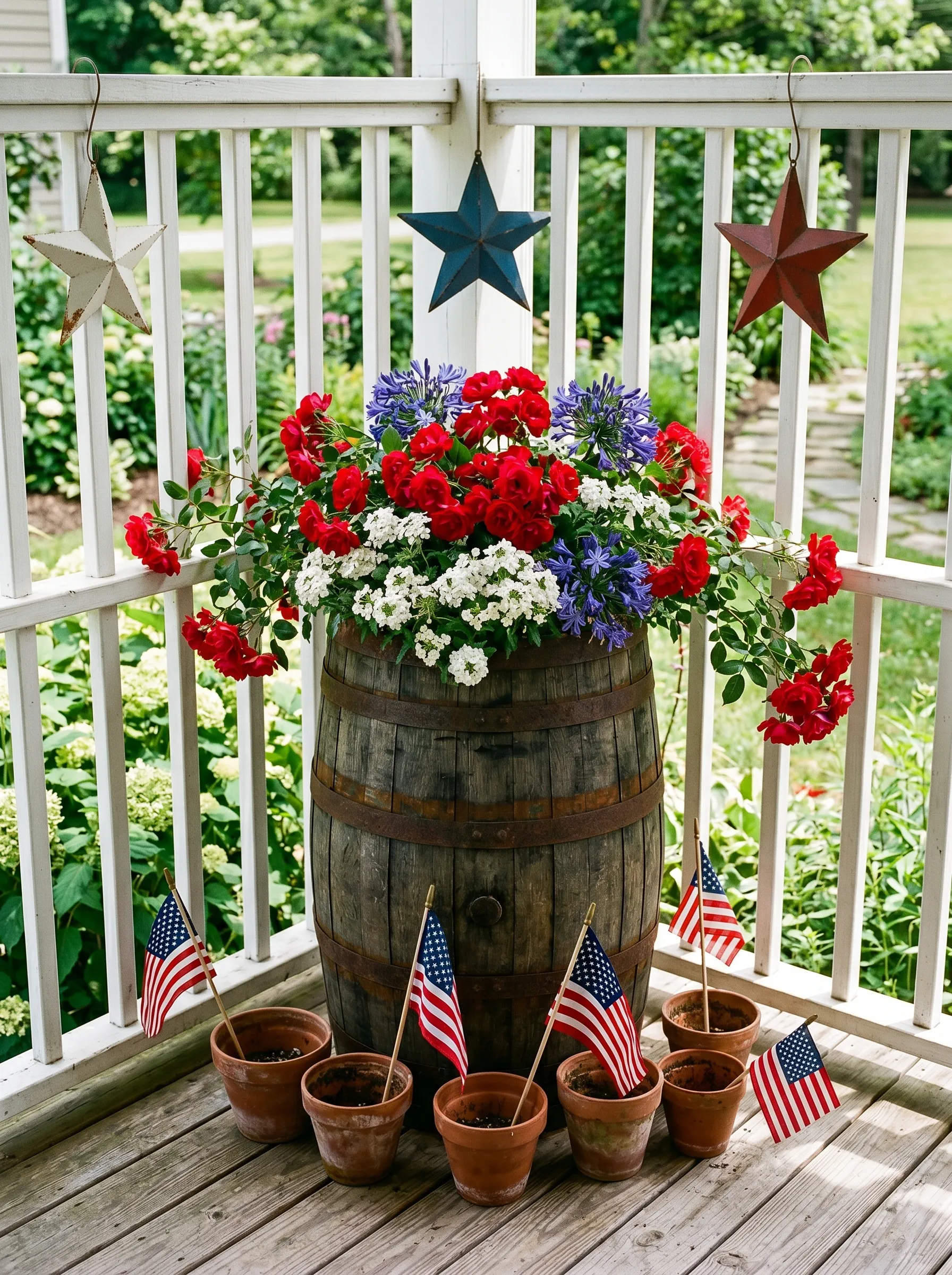
Plant the barrel. This is the decision.
Source a genuine used whiskey barrel or wine barrel — the dark-stained oak kind with iron bands, aged in actual use, not a decorative replica. Stand it upright against or near the porch railing. Into the top, install a liner pot or pack the cavity directly with potting mix.
Plant the top of the barrel with an extravagant mix: climbing red roses trailing over one side, white verbena as the middle layer, and blue agapanthus rising in tall stems from the center. Let the roses overhang the barrel edge by at least twelve inches so they rest against the exterior wood. The planting should look like it’s trying to escape.
At the base of the barrel, arrange five to seven small terracotta pots in a loose cluster on the floor. Each one has a single American flag stuck in soil or sand. These are utilitarian — terracotta pots with flags, nothing more. The simplicity of the base installation makes the extravagance of the barrel top work.
From the porch railing directly behind the barrel, hang three metal barn stars at different heights on a short cord: one white, one navy, one red. Mismatched sizes work. They should look hung, not installed.
The White Pedestal Table Set That Uses a Cloche as Its Entire Centerpiece
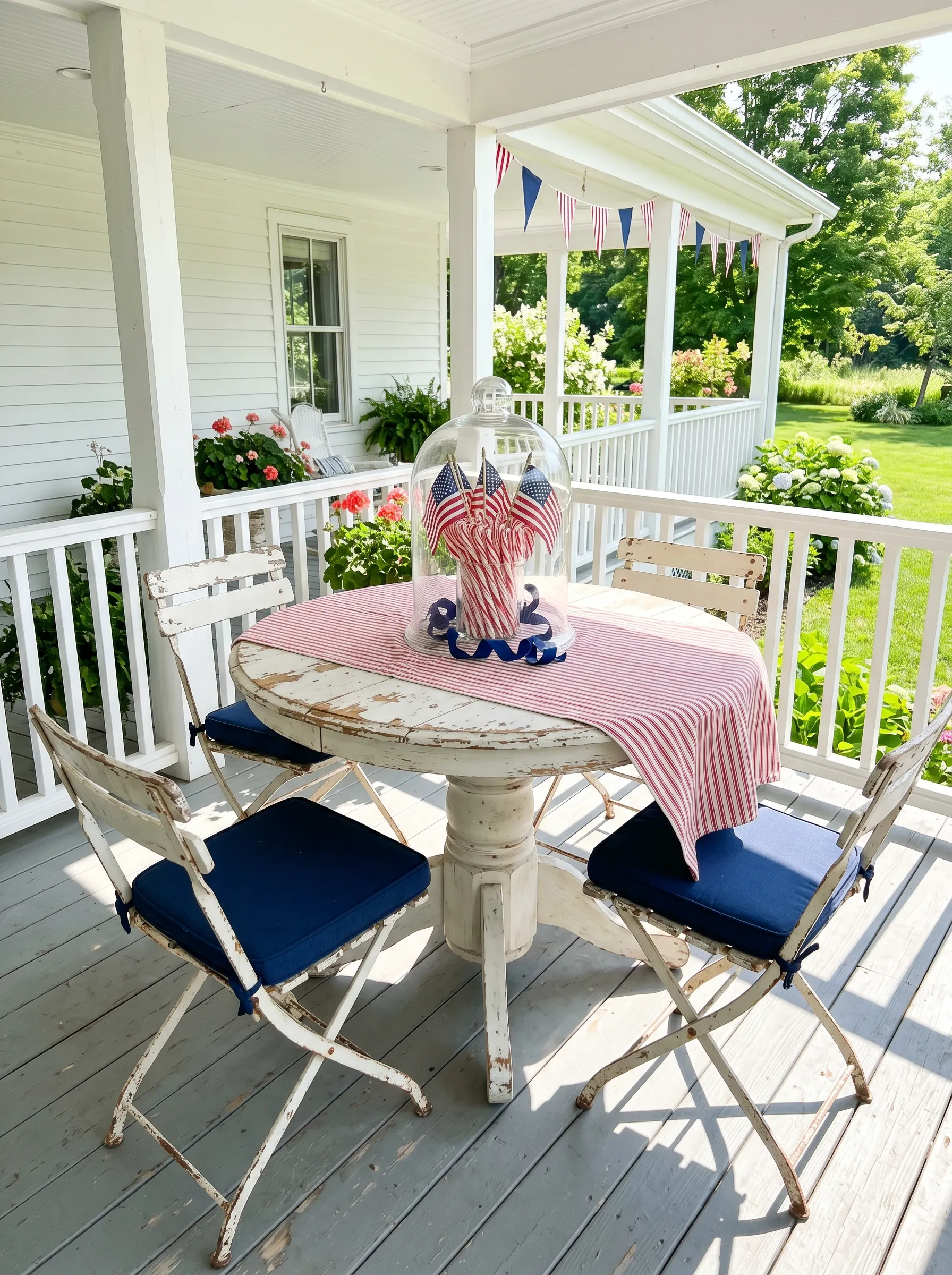
This is porch dining, not porch decorating. The distinction matters.
Arrange four iron folding chairs with navy canvas seat cushions around a white pedestal dining table — the antique or estate-sale kind with turned legs and a surface that shows decades of outdoor meals. The table doesn’t need painting or refinishing. The worn surface is part of the look.
Lay a simple red-and-white ticking stripe table runner across the center. It doesn’t need to be hemmed. It can hang slightly off-center. On top of the runner, center a glass bell jar cloche — a proper one, with a real glass dome and a footed stand. Inside the cloche, arrange a small handful of candy cane sticks with a few small American flags tucked behind them, and loop a navy blue ribbon around the base of the arrangement inside. The flags and candy canes inside the glass dome read as a found object installation even though they cost almost nothing.
Above the table, string a single strand of red-and-navy triangle pennant bunting across the open side of the porch. One strand. Not elaborate. Just enough to signal that this is a holiday table.
The Ranch Porch at Sunset With a Flag Throw and a Lemonade
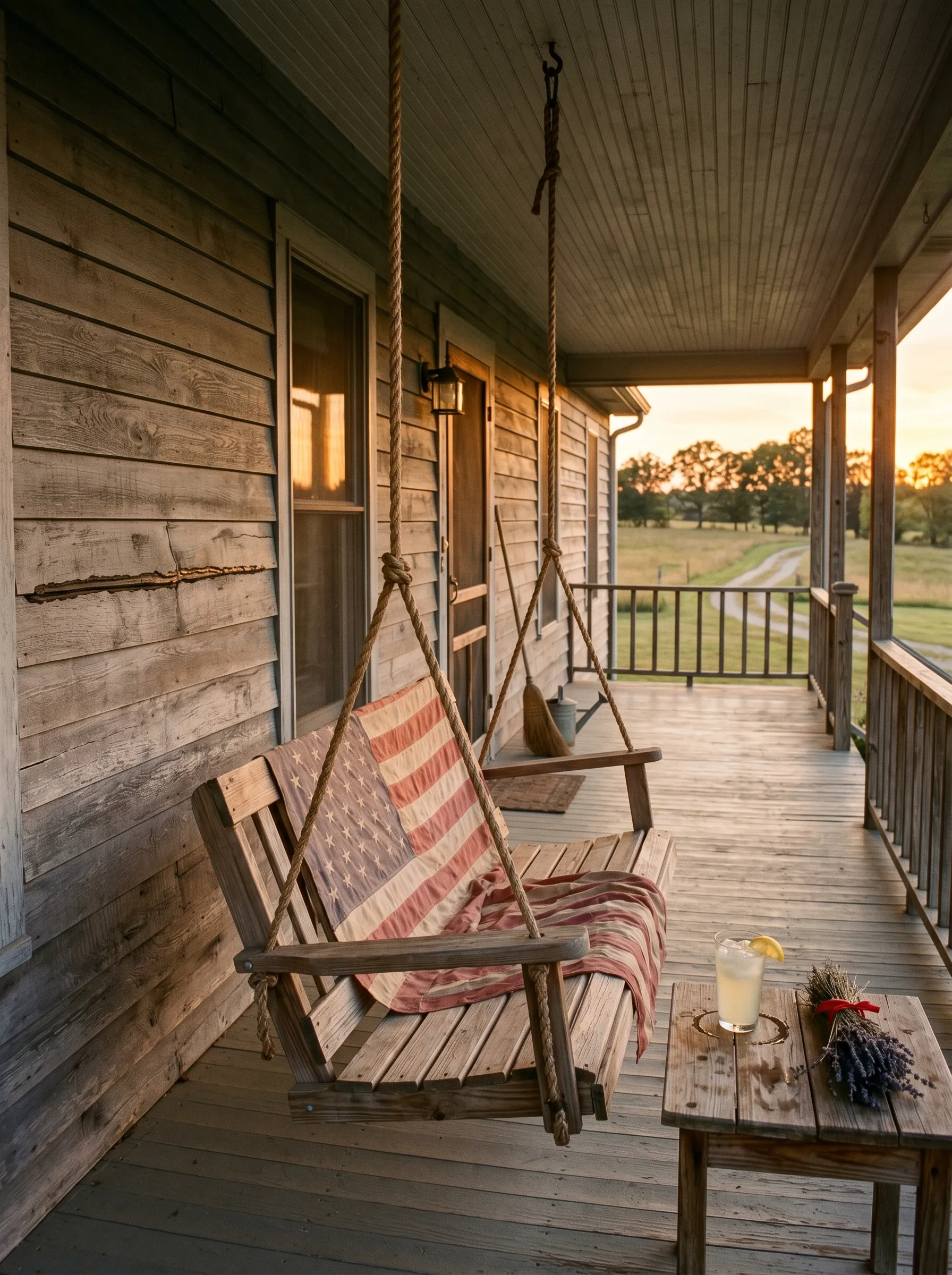
Most of what this porch is doing right is not decorating at all. It’s being still.
Two rope-hung wood single chair swings on a long weathered barn-board porch, open to a field and a gravel road. The material of the house itself — rough-cut cedar siding in gray-brown — is the entire backdrop. There is no door visible. There is no wreath. There is no bunting.
On one swing chair, lay a worn cotton American flag throw — the flag-printed kind, faded from washing, soft enough to actually use as a blanket. Drape it loosely across the seat, half on the back, half hanging forward. Next to the swing on a small rough-hewn side table: one glass of lemonade with ice and a lemon slice, one small bunch of dried lavender tied with a red ribbon, one slim gold bracelet left beside the glass. The table looks like someone sat here and then went inside for a minute.
On the second swing, nothing. Empty and moving slightly.
The only patriotic element is the flag throw. The flag throw is enough.
The Bucket Stair Installation That Uses the Steps as a Gallery Wall
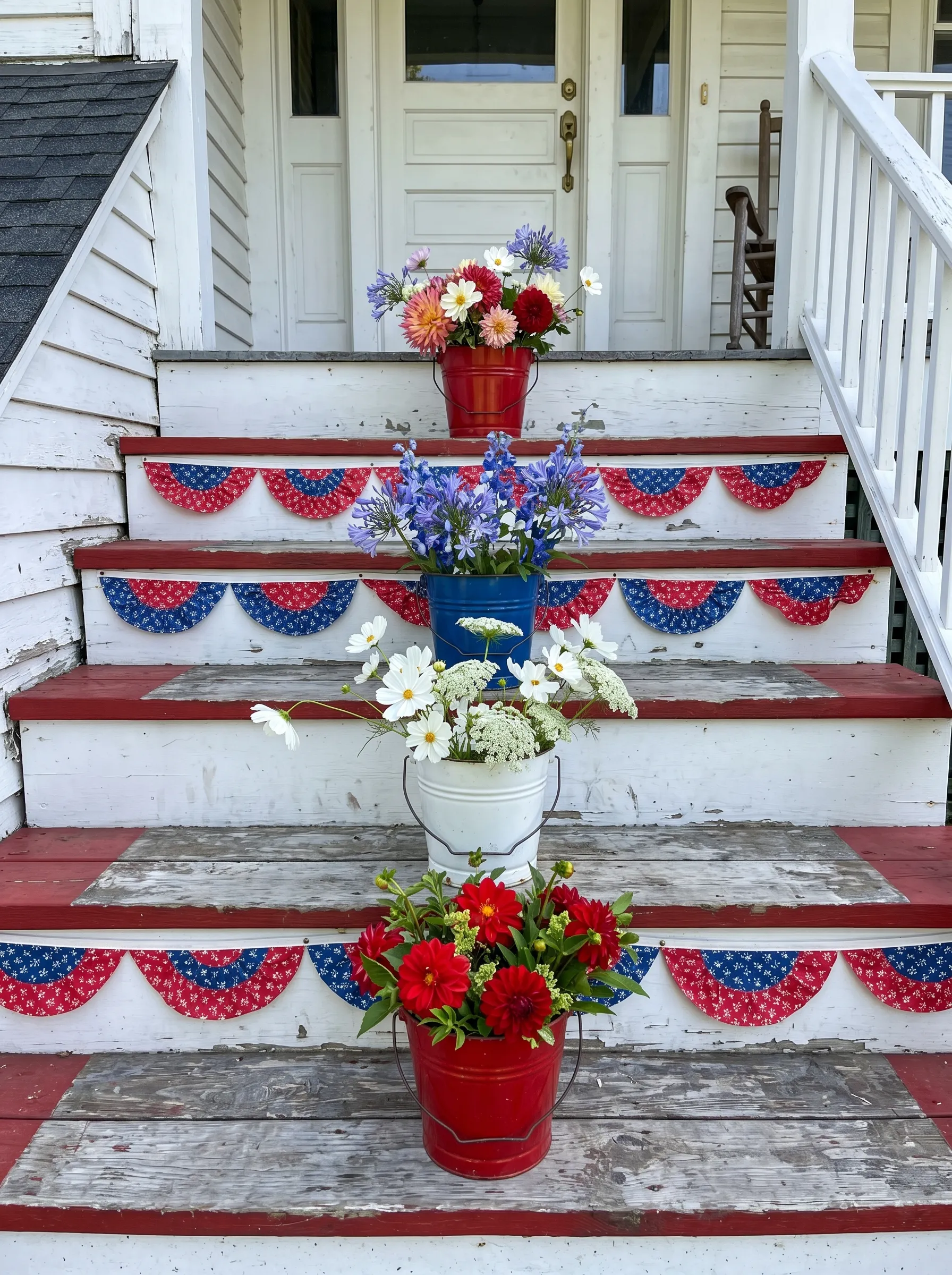
The steps are the display surface. Every tread is a shelf.
Paint the stair risers — not the treads, just the vertical faces — in alternating pattern: dark red paint with scallop-shaped fabric bunting tacked across each riser in alternating red and blue calico print. The bunting should be homemade-looking: fabric cut in a half-moon shape, folded at the top edge, tacked evenly across. Use calico prints rather than solid colors, which look too new.
On each tread, centered, place a single bucket of flowers. Three buckets for three risers. Make each bucket a different color: red enameled metal on the bottom step filled with red dahlias and orange zinnias, white enamelware on the middle step with white cosmos and Queen Anne’s lace, and a blue galvanized or painted bucket on the top step with blue delphinium and blue agapanthus. The color of the bucket should echo the color of the dominant flower. The whole staircase becomes a color progression from warm to cool, bottom to top.
The door at the top is not decorated. Plain door, plain siding. The steps are the show.
The Quiet Farmhouse Porch That Gets Dark Correctly
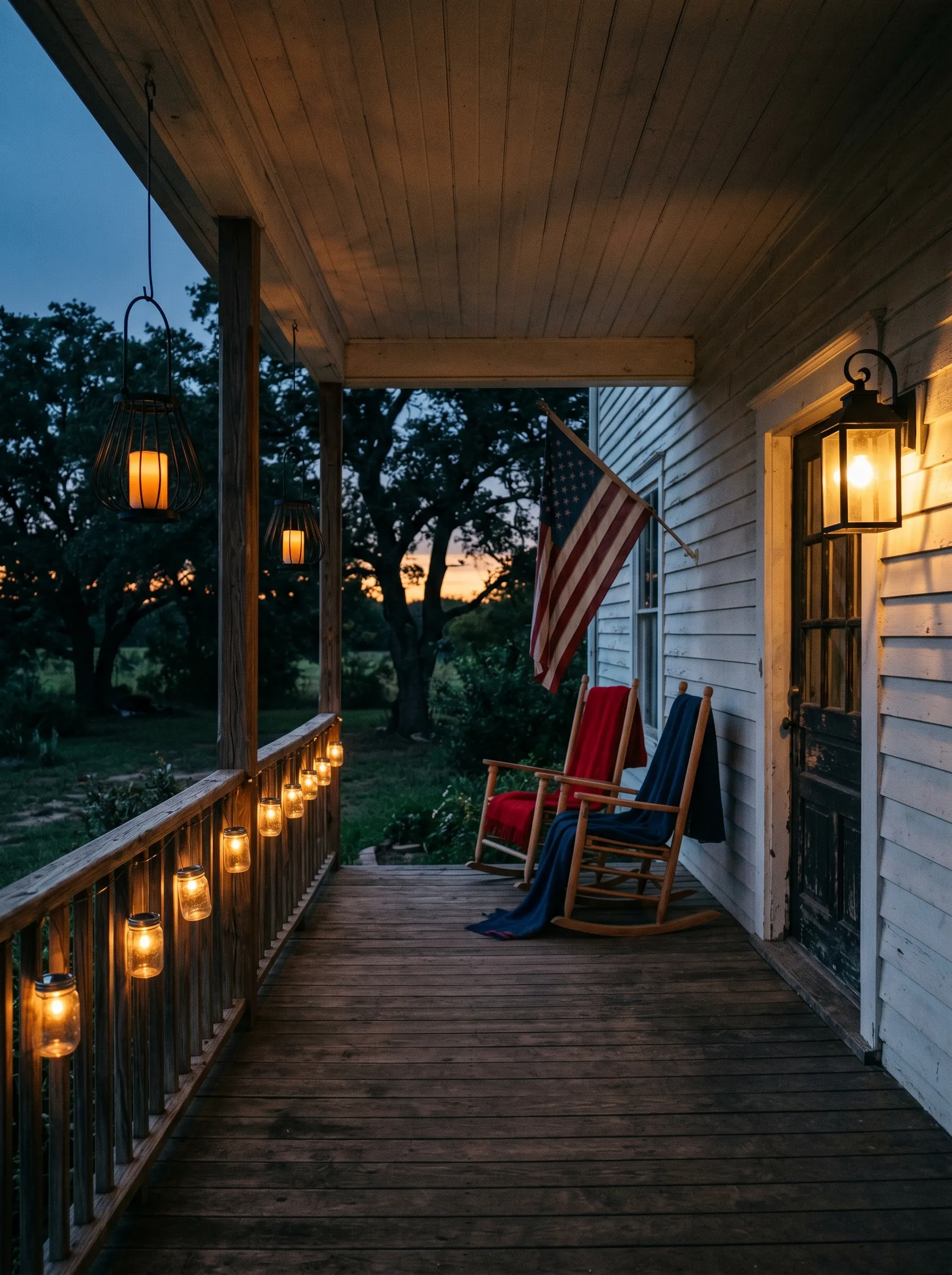
Lighting is a decision, not an afterthought. This porch made it the primary decision.
String mason jar solar or battery-powered lights along the entire length of the railing — mounted along the outer face so they hang below the rail’s top edge, at equal intervals, eight to ten jars for a standard farmhouse porch length. The mason jars should be regular Ball jars, clear or aqua glass, with a lid fitting that holds the light element. Use warm white LED inserts, not cool white.
From the porch ceiling at different points, hang two or three wire cage pendant lanterns — the kind with black or dark iron frames and an amber-toned bulb inside — at varying heights on different-length hooks.
Keep the mounted coach lantern beside the door, fitted with a warm incandescent or LED warm bulb.
Bring a standard wooden rocking chair out and angle it toward the yard. Drape a red and a navy folded blanket over the arms and back. On the wall above the chair, mount an American flag horizontally from a simple flag bracket.
That’s everything. The porch in full dark is all amber light and flag shadows. Nothing else is needed.
The Wire Basket Dried Flower Porch That Makes the Fourth Feel Ancient
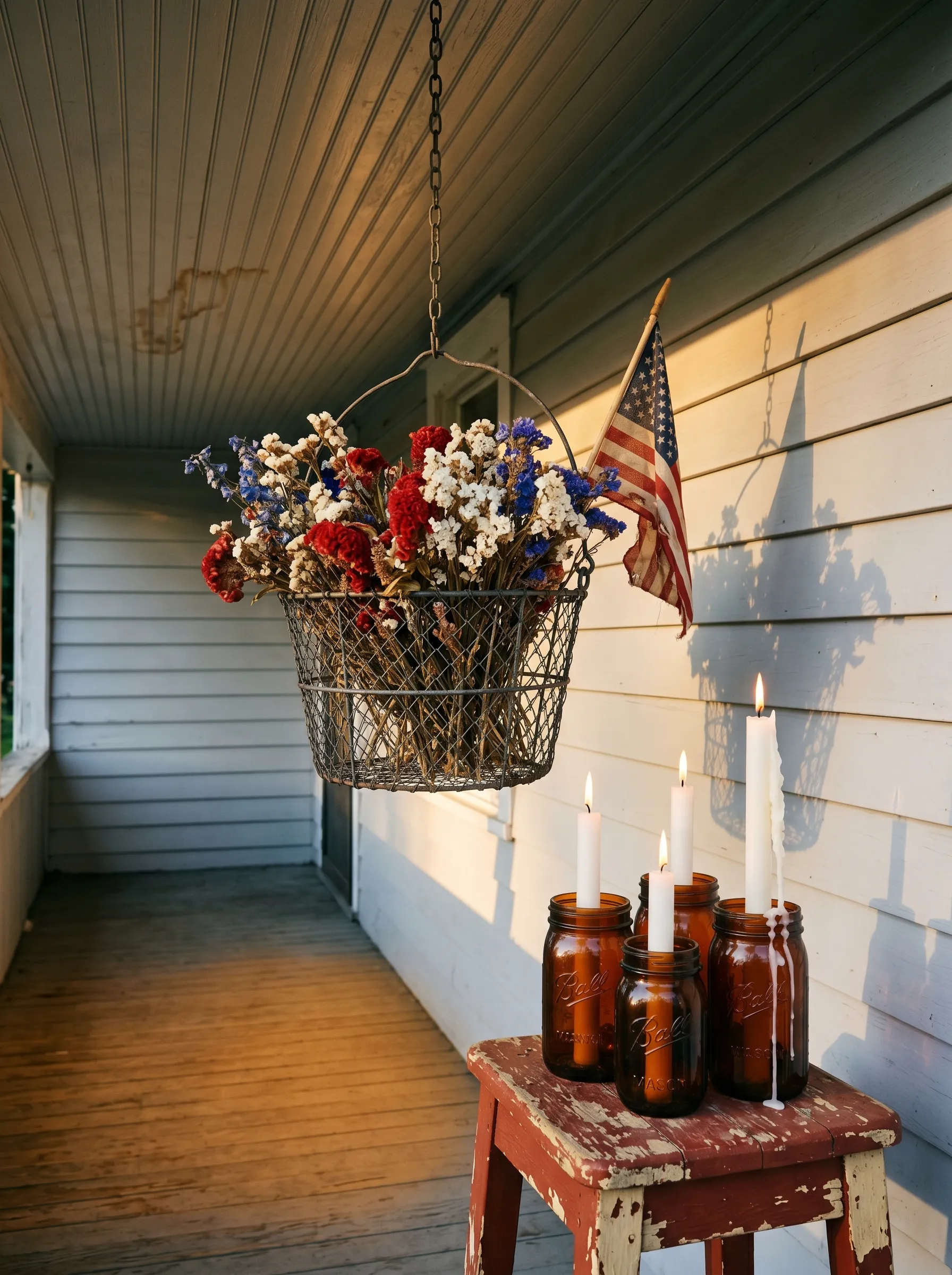
This look goes for something specific: the farmhouse in 1890 that hasn’t seen a craft store in its life.
Source a large wire market basket — the antique egg-gathering or produce type, round or oval, with a looped wire handle. Attach an S-hook and chain and hang it from the porch ceiling hook. Fill it with dried flowers in red, white, and blue — celosia in red, statice in blue, strawflowers in white, dried larkspur in blue, dried strawflower in red. The flowers should be genuinely dried, not artificial, and arranged loosely rather than packed. The wire of the basket should be visible through the sides.
On the floor below the basket, set a red-painted wooden stool — chippy, original, at least thirty years old. On the stool, group four amber Ball mason jars of different sizes, each with a white taper candle pushed into floral foam inside. Light the candles at dusk and leave them burning.
On the wall behind the stool, mount a small American flag on a wooden stick at a slight angle from a simple tack. The flag’s shadow on the white shiplap in the candlelight is the most beautiful thing on the porch.
The Railing Garland Porch That Uses the Sage Green House as a Fourth Color
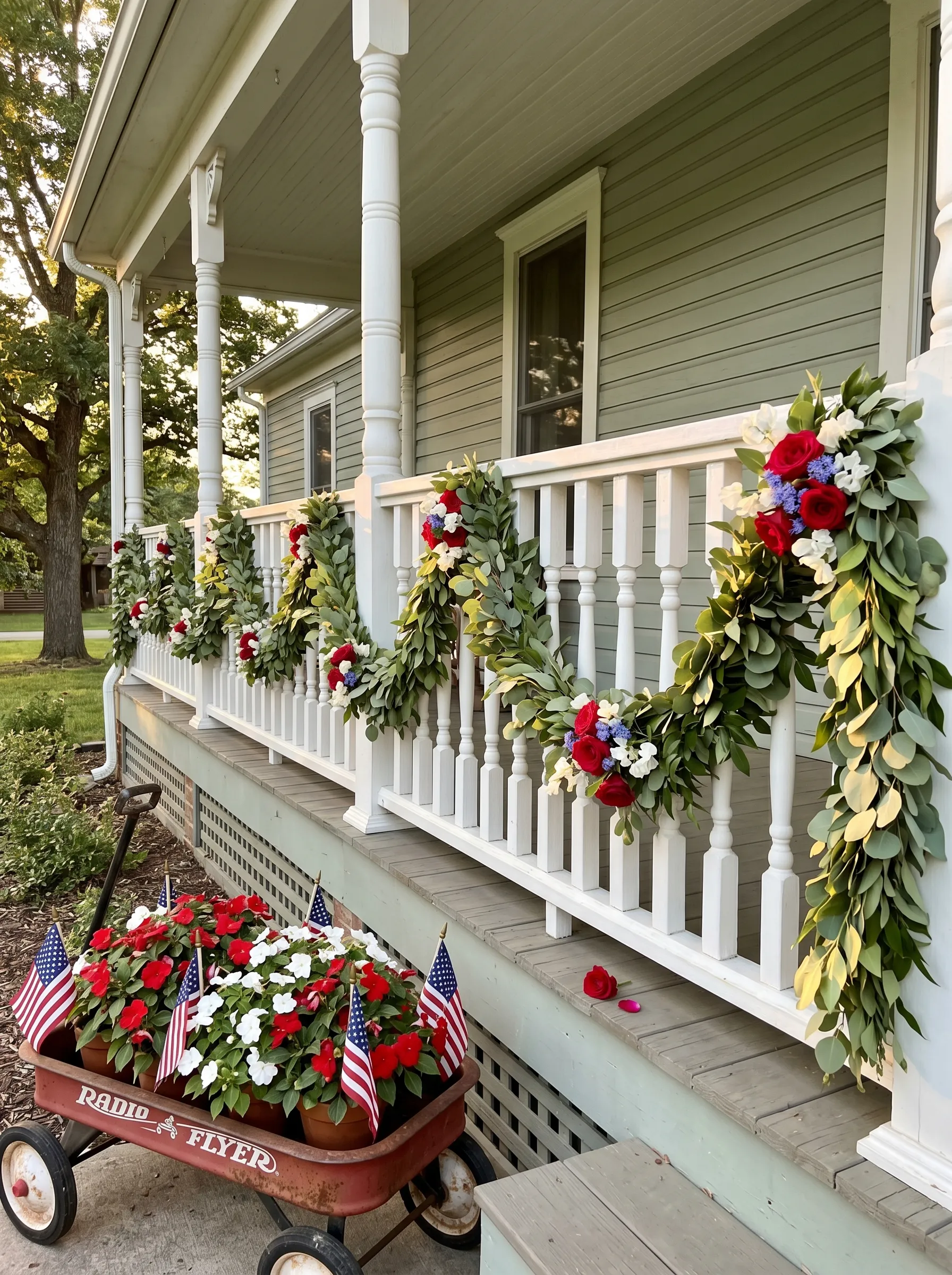
The house is sage green and that is working in your favor. Don’t fight it.
Build a continuous garland along the full length of the porch railing. Use seeded eucalyptus as the base — long trailing branches zip-tied to the top rail at eight-inch intervals, overlapping so they form a solid green mass along the full railing length. Work in clusters of red roses, white sweet William, and blue ageratum or cornflower at intervals — every eighteen to twenty-four inches — tucked deep into the eucalyptus so they read as growing from it.
At the transition point from the garland to the post on each end, let the garland drop down the post in a loose cascade rather than stopping abruptly at the corner.
In front of the porch, park a red Radio Flyer wagon loaded with terracotta pots planted in red impatiens and white impatiens. Tuck three small American flags into different pots, fanned slightly. The wagon’s red picks up the roses in the garland and the flags tie the whole thing to the holiday without being heavy-handed.
The Neoclassical Colonial Porch That Uses Star Medallions and One Herb Wreath
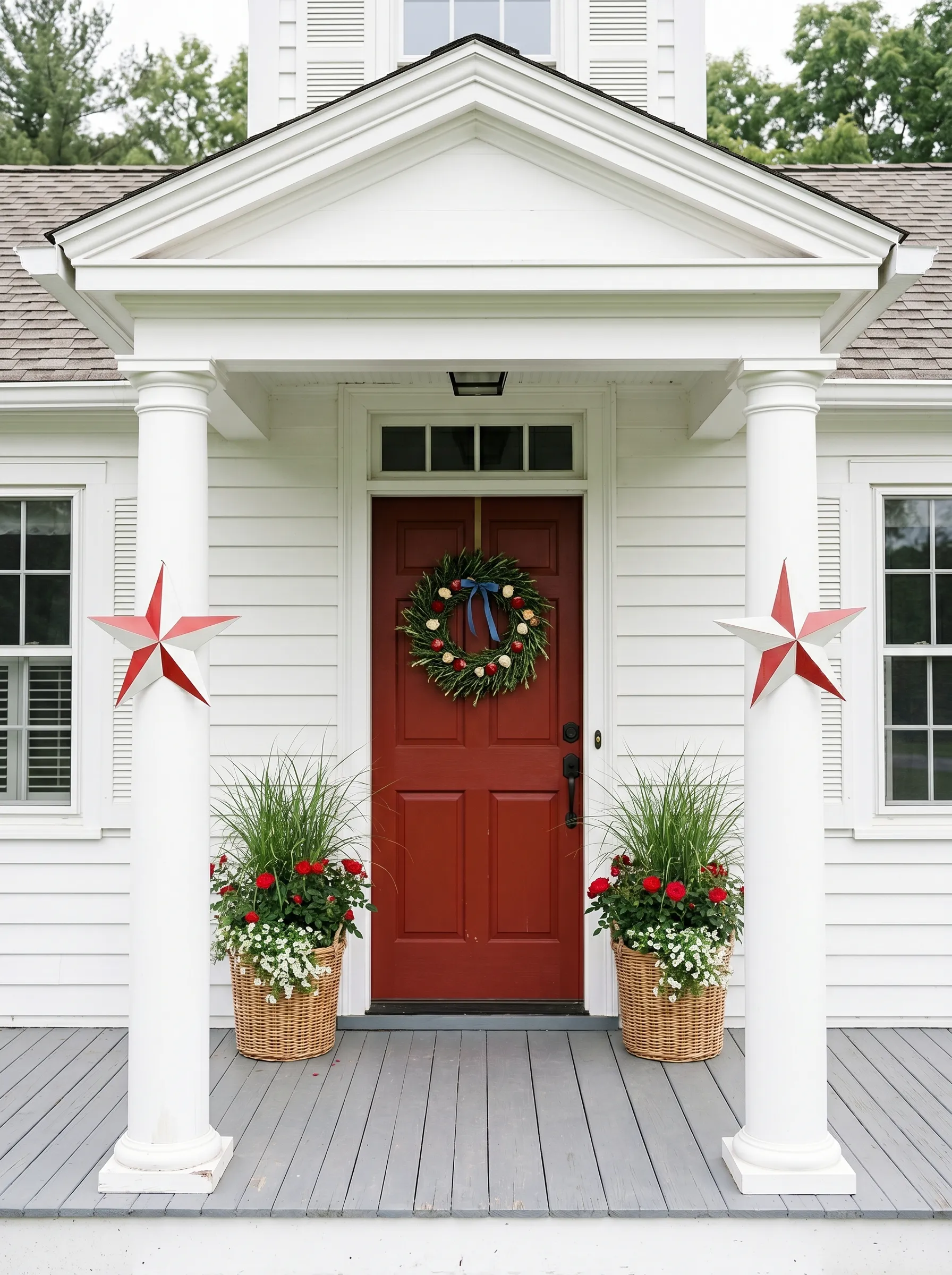
This is a white colonial with a pediment — clean lines, real columns, a formal portico that demands restraint. You do not drape bunting across neoclassical architecture. You add a few deeply considered elements and let the architecture do the rest.
Mount two oversized five-pointed metal star medallions, one on the exterior wall at the base of each column, at roughly table-height. These should be large — twelve to fifteen inches across — flat, and painted in a deep red. Not shiny. Matte. The scale matters. Small stars look like afterthoughts. These look like architectural details.
On the door, hang an herb wreath — rosemary, bay, or boxwood in a full round form — with a cluster of decorative objects tucked into it: small dried red and cream pom flowers, a loose navy satin ribbon bow. Keep the wreath botanical and its additions minimal.
Flank the door with two large wicker or market basket planters — the tall, open-weave kind — each filled with a container planting: ornamental grass for height, red geraniums and white bacopa at the midlevel, trailing white alyssum at the front. The wicker softens the formality of the architecture.
Nothing else. The neoclassical pediment is not a backdrop for decoration. It is the decoration.
The All-Lantern Railing That Makes Candle Fire the Only Decoration
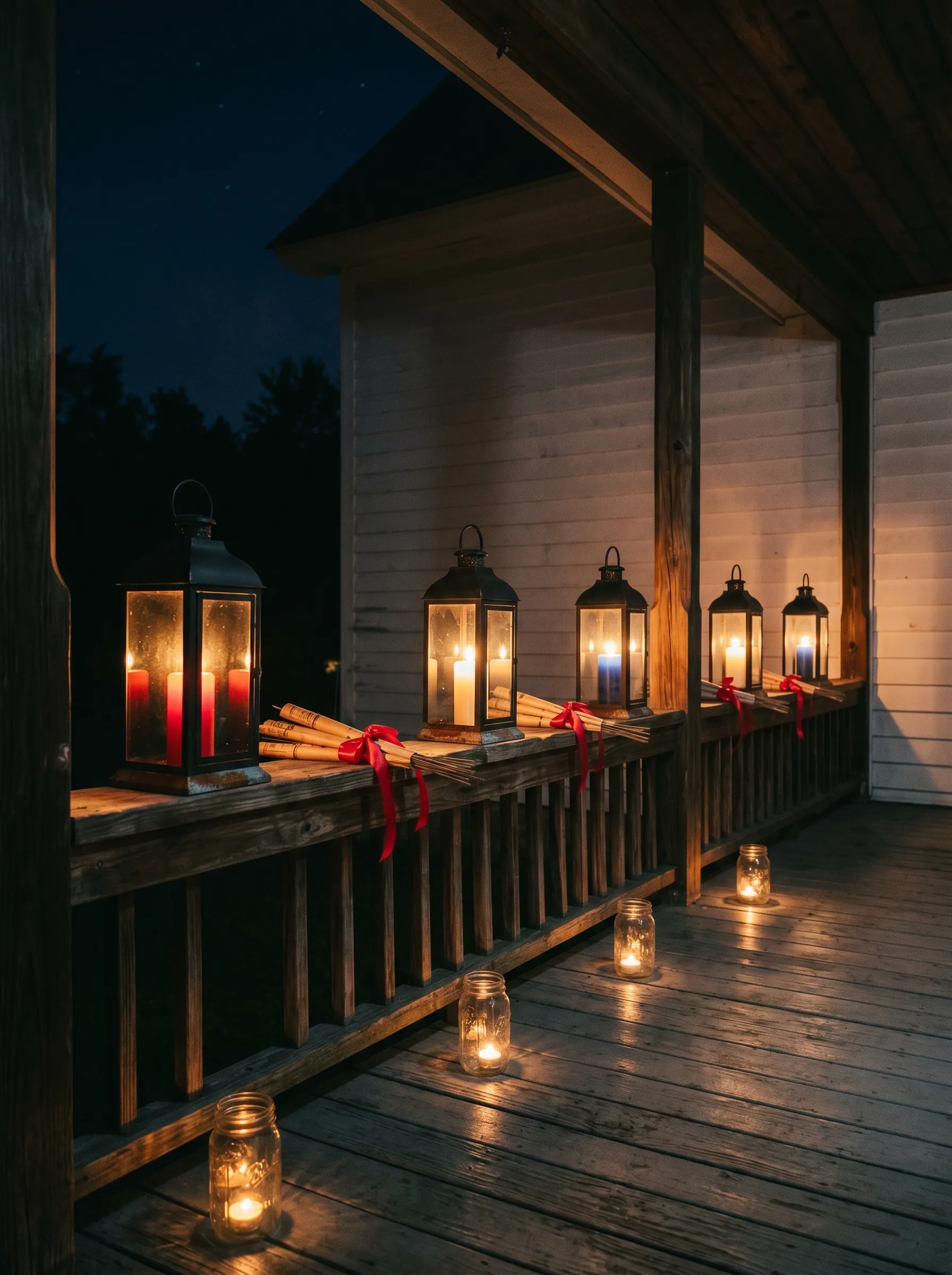
This is a study in what happens when you commit to one element and execute it completely.
Source five matching matte black iron lanterns — the classic rectangular farmhouse style with glass panels and a top hook — all identical in size and finish. Line them up along the top rail of the porch at equal intervals, spaced to give each one room to breathe. In each lantern, place a mix of candles: one red pillar in the largest lantern, a white taper in the next, a mix of both in the others. The candles need not match.
On the flat surface of the railing between the lanterns, lay bundles of rolled newsprint or sheet music tied with red satin ribbon bows — three to four per gap between lanterns. These are purely textural filler, but they warm the space between the light sources and soften the geometry of the lantern row.
On the floor in front of the railing, set three or four mason jar votive holders with tea light inserts, scattered informally rather than lined up. Their light reflects off the floor boards and adds a second layer of illumination below the lanterns.
Nothing else on the railing. Nothing else on the wall. When the candles are lit at full dark, this porch needs no other explanation.
The Salvaged Shutter Porch Where the Flag Is the Filling
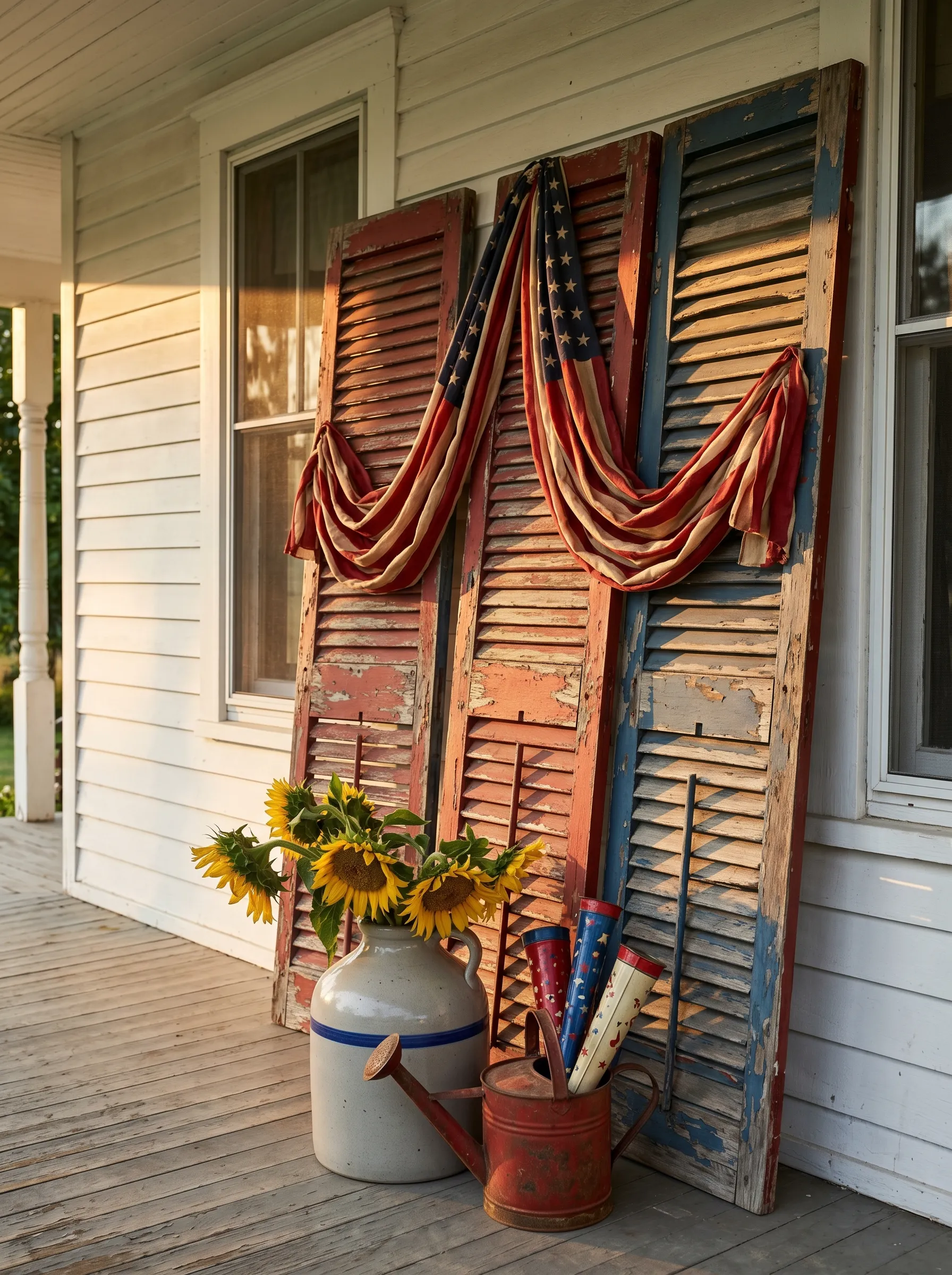
Find two large salvaged wooden shutters — louvered, full-length, heavily distressed with multiple paint layers visible. The best ones show red, blue, and gray-green in different sections of the surface, a happy accident of their history. Lean them against the porch wall at a slight angle, side by side, overlapping slightly.
Drape a large vintage or vintage-style American flag over both shutters, looped and tied at each side so it hangs in a natural swag between the two outer edges and pools gently in the center. The flag’s stripes and the shutter’s louvers create a visual texture together. The flag is not pinned flat. It drapes.
In front of the shutter installation, place a large stoneware or crock jug — the gray-and-blue banded farmhouse kind — filled with fresh-cut sunflowers, stems long enough that the blooms sit at eye level. Beside the crock, set a galvanized watering can with a rust ring at its base, holding nothing. Lean a vintage tin bucket with a handle at an angle against the crock. From the bucket, fan four or five hand-rolled paper firecrackers in red, cream, and blue — purely decorative, not functional.
The whole arrangement is three things leaning against two more things draped with one flag. It looks like a hundred and fifty years of American Fourth of July Julys.
The Thing All of These Porches Have in Common
Every one of these porches has something on it that couldn’t be bought new. A quilt, an old flag, an antique tricycle, a salvaged shutter, a barrel, a basket that belonged to someone’s grandmother. One thing with a story.
That object anchors everything around it. The new flowers defer to the old crate. The bright geraniums settle around the weathered urn. The fresh-cut sunflowers justify themselves in the cracked stoneware crock.
The farmhouse patriotic aesthetic is ultimately about the relationship between something old and something alive. The age tells you the place has been here. The flowers tell you people still live in it. The flag tells you what time of year it is.
You don’t need to buy a porch. You need to find the one old thing that’s already yours, and then arrange the summer around it.