
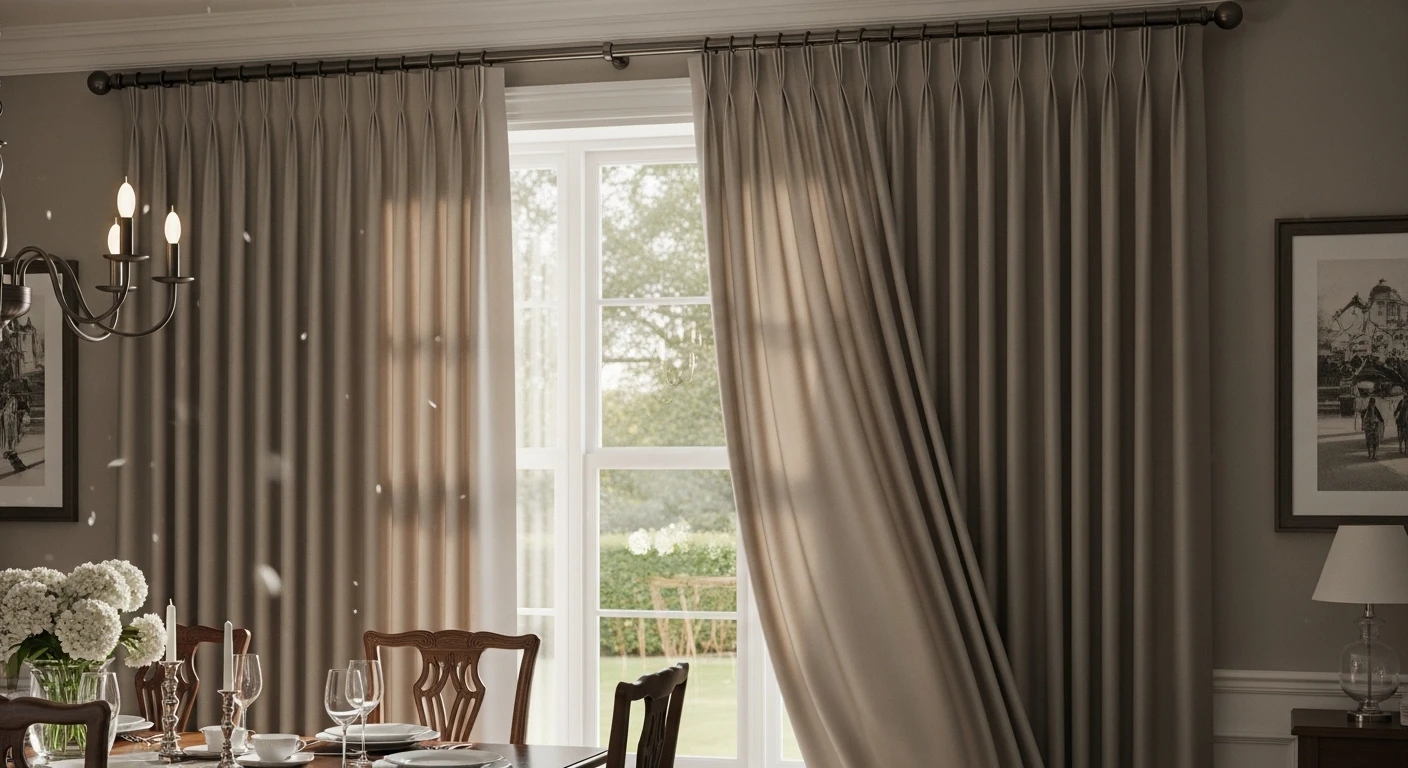
Most people spend months deciding on the dining table. They agonize over chairs. They research chandeliers. And then they hang whatever curtains are available in the right size, step back, and wonder why the room still doesn’t look finished.
The curtains are why.
Window treatments in a dining room aren’t a finishing touch. They’re a structural decision that affects how the room reads from the moment anyone walks in. The wrong curtains make a great room look unfinished. The right ones take an ordinary room and give it the kind of considered quality that makes people notice without knowing exactly why.
Whether you want full theatrical drama, quiet European elegance, or the kind of unfussy warmth that makes every dinner feel like a good idea — these ideas cover every direction a dining room curtain can go.
The Drapery Studio
Curtains are a structural decision. Manipulate height, width, and layering to give the room proportional weight.
Result
Details
Why Dining Room Curtains Are the Most Underestimated Decision in the Room
A curtain covers more wall surface than almost any other element in the room. In a dining room with floor-to-ceiling windows, the curtain fabric becomes the dominant visual element — more prominent than the wall color, competing with the furniture for attention, and setting the room’s entire atmospheric tone. Treating this as a minor decision is the reason so many dining rooms look almost right but never quite there.
The Height Rule That Changes Everything
Curtains hung at window frame height are the single most common mistake in dining rooms. Mount the rod as close to the ceiling as structurally possible — two to four inches below the crown molding or ceiling line — and let the fabric fall to the floor. This creates the illusion of taller ceilings, makes windows appear larger than they are, and gives the room a proportional weight that curtains mounted at window height simply cannot achieve. This one change, applied to any room with any curtain, produces immediate and significant improvement.
Layering Is Not Complicated — It Just Requires Two Decisions Instead of One
A sheer panel behind a heavier drape is not a complicated window treatment. It’s two fabric decisions that work together to give the window flexibility — full light diffusion when the sheers are closed, privacy and atmosphere when the drapes are drawn, and a layered depth that a single curtain can never replicate. Every dining room benefits from at least the option of this layering, whether the second layer is a blackout lining, a sheer voile, or a structured Roman blind underneath.
Dining Room Curtain Ideas
Lace Valance With Bow Ties and Horizontal Blinds:
Hang a wide lace valance in ivory or warm cream from a gold brass rod using fabric bow ties knotted at regular intervals — the ties add a soft, handmade quality that machine-made curtain headings can’t replicate. Choose a valance with intricate embroidered detail — classical motifs, architectural arch patterns, botanical scrollwork — so the fabric reads as decorative art rather than just a window covering. Underneath, install wide-slat horizontal blinds in a warm tone for practical light and privacy control. Let a single sheer panel hang to one side for softness. The combination of the ornate lace valance against the clean-lined blinds creates a tension between formal and functional that feels genuinely European rather than simply decorative. Pair with a glass dining table and upholstered chairs so the window treatment remains the room’s most characterful element.
Box Pleat Valance With Two-Tone Detail and Floor-Length Drapes
Choose a fabric with a subtle woven texture in charcoal and silver — a tonal pattern that reads as sophisticated from a distance and interesting up close. Construct a structured box pleat valance with a contrasting black band at the lower edge and small decorative studs or buttons along the join line between the two tones. Hang floor-length drapes in the same fabric below, drawn to each side with simple fabric tie-backs. The valance provides architectural structure at the top of the window while the flowing drapes frame the glass and the city view beyond. A sculptural multi-globe pendant chandelier above a marble-topped table in contrasting black and white makes the whole room feel considered. This treatment works because the valance construction is deliberate — not a gathered frill but a architectural element with clean lines and visible craft.
Deep Velvet Pelmet With Tassel Trim and White Sheers:
Install a deep gathered pelmet in dark charcoal velvet with a fringe of warm champagne tassels along its lower edge. Use the pelmet to frame the window architecturally — it should project from the wall like a cornice, giving the window actual depth rather than just a decorative border. Behind it, hang floor-length white sheers that gather in soft folds at the center and trail slightly on the floor — the contrast between the heavy dark pelmet and the billowing light sheers is the room’s entire design tension. A grand crystal chandelier set into a circular plaster ceiling medallion above. An ornate glass dining table with carved-back upholstered chairs. This is a formal dining room treatment for people who understand that drama and restraint are not opposites — they are complementary strategies applied to different surfaces in the same room.
Botanical Print Drapes With Woven Shade Underlayer:
Choose a bold botanical print in emerald green, blue, and cream — the kind of large-scale pattern that would be alarming on a sofa but is completely correct as a curtain. Install floor-to-ceiling pinch pleat drapes in the print and layer natural woven bamboo Roman shades underneath for light filtering and privacy. The woven shades in their natural honey tone create a warmth that the botanical print alone couldn’t achieve. Pair with a round pedestal dining table in warm wood, linen upholstered chairs in a solid complementary color, and a sisal rug below. Black and brass wall sconces beside a large chinoiserie panel artwork on the adjacent wall. The curtains and the art share a botanical vocabulary without matching — which is the exactly correct relationship between two strong pattern elements in the same room.
Floor-Length Cream Linen With Bamboo Roman Shades:
Mount a matte black curtain rod close to the ceiling and hang cream or ivory linen pinch pleat drapes in a full floor-length drop — generously wide so the fabric folds naturally when pushed to each side. Install dark woven bamboo Roman shades in the window recesses as the room’s primary light control layer. The dark bamboo against the cream linen creates a natural material contrast that is warm, considered, and works with virtually any dining room palette. A black dining table with black frame chairs and one leather accent chair introduces the same material relationship at furniture level. A faded vintage-style rug in cream and grey beneath. Simple white pillar candles on the table at varying heights. This treatment succeeds because it commits fully to the contrast between the cream linen and the dark bamboo rather than trying to match them — the difference in material, texture, and tone is the point.
Blue Roman Shades With Linen Café Curtains:
In a bay window eating area, install structured Roman shades in a soft chambray blue with a simple contrasting border detail across the base. Mount them within each window recess so the shades sit clean and flat when raised. Below each shade, hang a simple linen café curtain on a thin rod across the lower half of each window — the café curtain allows natural light to enter while providing ground-level privacy throughout the day. A white curved banquette seating the full bay, two sculptural midcentury armchairs at the table, and a round light wood pedestal table at center. An architectural multi-light pendant in black and brass above. A large fiddle leaf fig in a concrete planter in the adjacent corner. This is a layered treatment that feels light rather than heavy — the shades provide the structure, the café curtains provide the softness, and the bay window itself does the architectural work.
Floral Print Drapes With Woven Shade and Sisal Ground:
Choose a deeply saturated botanical print for the drapes — large-scale, high-contrast, with confident color — and hang them in a simple goblet or pinch pleat heading from a slim brass rod mounted near the ceiling. Install a warm woven shade underneath as the functional light-control layer. Let the floral drapes frame the window on each side rather than covering it — they are framing elements, not privacy elements. A round dark walnut dining table beneath, French country-style upholstered armchairs in natural linen, a sisal rug in a large generous size. Brass picture lights on the wall beside a large chinoiserie panel. A green ceramic lamp on a half-moon console. The secret of this treatment is that the floral print is big enough and saturated enough to hold its own against everything else in the room — a small or muted botanical print would disappear and look like a compromise. Go bold or use linen.
Full-Width Wave Fold Drapes in Warm Taupe:
Run wave fold drapes in a warm greige or taupe fabric in a full-width installation that covers the entire wall rather than just the window. Mount the track ceiling height to floor, wall edge to wall edge, so the curtain reads as a wall surface rather than a window covering. The wave fold heading creates even, consistent S-shaped folds that look deliberately tailored rather than casually gathered. Against this curtain wall, a marble-topped dining table, velvet upholstered dining chairs in a complementary warm tone, and a crystal and chrome chandelier above. A black display cabinet with glass fronts on one side wall with a circular dark-framed mirror above. The curtain wall is doing two jobs simultaneously — covering the window and creating a soft, textured backdrop that makes every other element in the room look more intentional by comparison.
Blush Outer Drape With White Sheer Layer:
Hang blush or soft rose outer drapes in a wave or pinch pleat heading from a warm gold rod mounted near the ceiling. Keep them tied back softly at mid-height on each side so the fabric drapes in a relaxed arc rather than hanging stiffly. Behind them, white sheer panels in a ripple fold heading filter daylight to a warm glow throughout the day. Tufted cream dining chairs against the sheer light backdrop. A white gloss dining table reflecting the soft color. White orchids as the table centerpiece — the restraint of a single orchid against all this softness is more effective than a generous arrangement would be. This treatment works because every element — the blush fabric, the white sheer, the cream chairs, the orchids — is operating in the same tonal family. The room’s sophistication comes from material quality and the consistency of the palette rather than from contrast or drama.
Gold Stripe Balloon Shades With Scenic Mural Walls:
In a dining room with a large-scale scenic landscape mural covering all four walls, treat the windows with balloon shades in a wide gold and cream stripe silk — the gathered, billowing form of the balloon shade reads as deliberately theatrical, which is exactly what a mural room requires. The gold stripe picks up the warmth in the landscape mural without matching it. Mount the shades to allow as much of the mural to remain visible as possible — the shade is a frame for the view, not a cover for the wall. Chippendale-style dark wood chairs with floral seat cushions around a reflective dark wood dining table. A half-moon console beneath the window with white roses in a silver vase and a celadon ceramic lamp. The balloon shade is the only window treatment with enough visual presence to hold its own against a full mural room — anything simpler gets absorbed into the landscape. Know when the treatment needs to be as dramatic as its surroundings.
Velvet Swag and Cascade With Embroidered Sheers:
Install a swag and cascade drapery treatment in warm champagne or taupe velvet — the swag loops across the top of the window in a series of graceful arcs, and the cascades fall vertically on each side in sharp waterfall pleats. The craftsmanship of this treatment is its entire point: it announces that this is a formal dining room that takes the meal, the occasion, and the guests seriously. Behind the swag, hang floor-length embroidered sheers with a damask or medallion pattern woven in white on white — visible in certain light and nearly invisible in others. A crystal chandelier in the room’s center. Floral-print upholstered dining chairs with carved frames. A polished marble floor. This is a treatment for a dining room that understands formality not as stiffness but as a form of hospitality — the effort the room makes is itself a welcome.
Toile Print Drapes With Iron Chandelier and Farm Table:
Choose a dark toile-de-Jouy print in brown and cream — the pastoral scenes woven into the fabric give the drapes narrative quality that plain textiles can’t match. Hang them in a simple pinch pleat from a black iron rod close to the ceiling and let them fall to the floor in a clean, straight line. No valance, no tie-backs, just the drapes themselves framing the window with quiet conviction. A solid wood farm table below — thick, scarred, genuinely aged — with cross-back or café chairs mixing in one leather accent chair at the head. A simple black iron chandelier above. A faded vintage rug underfoot. White walls throughout so the toile curtains carry all the pattern responsibility in the room. This treatment works because the toile is bold enough to stand alone and the rest of the room is disciplined enough to let it.
The Curtain Rules That Apply to Every Dining Room
Length is not negotiable. Floor length is the minimum standard in a dining room. Puddle is acceptable and often beautiful. Hovering above the floor is not. The gap between curtain hem and floor is the design equivalent of a hem coming undone — it reads as an error regardless of how deliberate it was.
Width matters as much as length. A curtain that barely covers the window when open looks mean and incomplete. Each panel should be at least one and a half times the window width so there is generous fabric when drawn and generous fullness when open. Skinny curtains are the second most common mistake after hanging them at window height.
The heading sets the room’s register. Pinch pleat reads traditional and tailored. Goblet pleat reads slightly more formal. Eyelet reads contemporary. Tab top reads casual. Wave fold reads modern and architectural. Choose the heading that matches the room’s overall intention — the heading is not a minor technical detail, it’s the curtain’s personality.
Lining is not optional. An unlined curtain in a dining room looks provisional regardless of how expensive the fabric is. A quality lining adds body, protects the fabric from sun damage, improves the way the curtain hangs, and makes the window look finished from both inside and outside the house.
The Window Is the Room’s Most Prominent Feature
More than the fireplace, more than the art wall, more than the furniture arrangement — the windows in a dining room are what the eye finds first when entering the space, because they are the source of natural light and the first thing silhouetted against it. What frames those windows determines how the entire room reads.
A dining room with great curtains looks designed. A dining room with the wrong curtains — or no curtains — looks like a room that hasn’t been finished yet, regardless of how much everything else cost or how carefully it was chosen.
The curtain is not the detail. It’s the decision that holds the whole room together.