
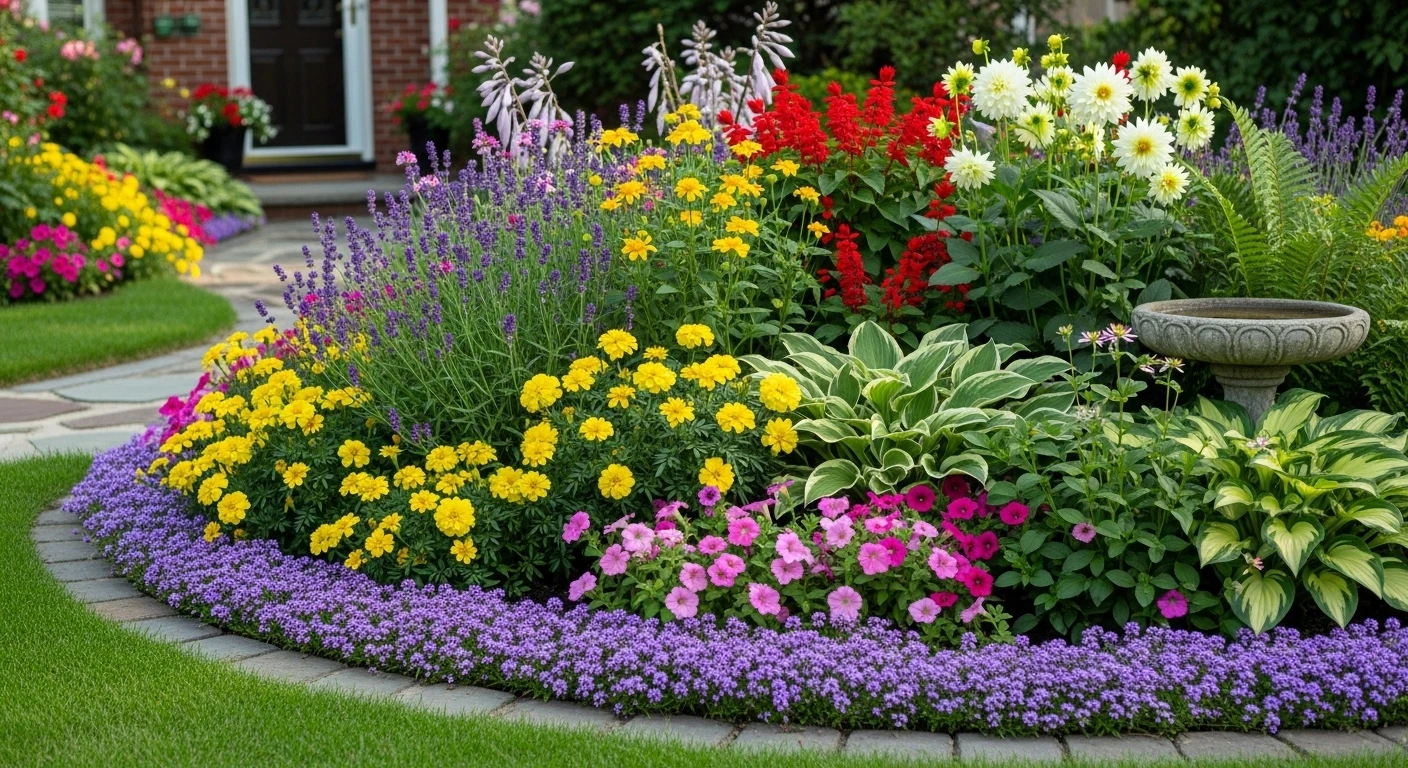
Most front yard flower beds are doing the bare minimum and calling it landscaping. A strip of mulch, three shrubs that came with the house, and maybe some impatiens planted in a panic every spring when you notice the neighbors have done theirs already. It’s not that anyone actively chose to make it look this way — it’s that nobody actually chose anything at all. The beds just sort of happened, and then everyone made peace with them.
Foundation planting is the layer of landscaping that sits closest to the house, which makes it the most visible, the most photographed, and the most capable of either elevating or undermining every other design decision you’ve made about your property. Get it right and the whole front of the house looks finished and intentional. Get it wrong — or more accurately, get it vague — and the house just floats above its lawn like nobody thought to connect the two.
The flower beds here range from restrained and considered to gloriously, unapologetically abundant, but they all share the quality of having been actually thought about rather than accumulated by default.
Why Front Yard Flower Beds Consistently Miss the Mark
The same design mistakes show up in front yard beds across every neighborhood and every budget range, which suggests the problem isn’t resources — it’s approach.
Planting for Spring and Ignoring the Other Eleven Months – Annual flowers look spectacular for six weeks and then demand replacement, leaving a bed that looks actively abandoned for the rest of the year. The best front yard beds are built on a backbone of permanent structure — evergreen shrubs, specimen trees, ornamental grasses — with flowering elements layered on top for seasonal punctuation rather than seasonal dependency.
Random Placement Where Layering Should Be – Plants scattered at equal intervals across a bed at equal heights look like a planting grid, not a garden. Height variation — tall specimens at the back, mid-height shrubs in the middle, low ground-level flowering plants at the front — creates the visual depth that makes a bed look professionally designed rather than randomly populated.
The Mulch Is Telling on You – Thin, pale, old mulch around otherwise decent plants makes the entire bed look neglected. Fresh, dark, properly deep mulch — applied annually, edged cleanly — does more for a flower bed’s visual quality than almost any individual plant choice. It is the background against which everything else is read, and it needs to be a good one.
The Decisions That Separate Good Foundation Planting From Great
Every front yard flower bed that stops people on the street made a handful of specific decisions that most beds never bother with.
Choose a Colour Story and Commit to It – A bed with every colour represented is a bed with no colour story. Choosing two or three colours — white and purple, pink and chartreuse, cream and burgundy — and repeating them through different plant varieties creates the visual coherence that makes a planting look designed rather than assembled from whatever was on offer at the garden centre that particular Saturday.
Give the Bed a Strong Silhouette – The outline of a flower bed against a lawn matters as much as what’s planted inside it. A sweeping curved edge reads as generous and naturalistic. A clean straight edge reads as modern and intentional. What doesn’t read as anything is a wavy, indecisive edge that can’t decide what it’s trying to be — which describes approximately seventy percent of all front yard flower bed edges currently in existence.
Scale Everything to the House – A single row of low annuals against a two-storey facade looks like a typo. Foundation planting needs to occupy enough vertical space to visually anchor the house to the ground rather than leaving a gap between architecture and lawn that makes the whole front elevation look unfinished.
What the Best Front Yard Flower Beds Have in Common
The beds worth photographing and the ones worth walking past without noticing are separated by one quality: the sense that the planting was chosen for this specific house rather than installed despite it. Beds that work are in conversation with the architecture — matching scale, responding to materials, repeating colours that echo what the house is already doing. The front yard and the house should look like they were designed together, because visually, they are.
Front Yard Flower Bed Ideas
Curved Limestone Edging and Mixed Planting:
Freshly built and planted flower beds.
by u/FairFela in landscaping
A white painted brick ranch sits much better in its landscape once someone decides the flower beds should actually be worth looking at, and this one made that decision with real commitment. Curved limestone edging runs the full length of the facade, creating a generous bed profile that gives the planting room to breathe and layer properly — silver dusty miller at the front for texture contrast, red and purple flowering annuals for seasonal punch, and dark-leaved ornamental plants providing structural continuity through the composition. The warm cedar porch columns overhead tie the outdoor materials together, and the bed runs right up to the covered porch edge, connecting architecture and planting in the way that makes a front yard feel complete rather than assembled in separate pieces.
Palm Island and Impatiens Ring:
Planting a trio of queen palms in a front courtyard lawn is not a decision you make halfway — it’s a commitment to a subtropical personality that every subsequent plant choice either supports or undermines. This one supports it completely, with a circular planting ring of mixed pink, red, and white impatiens surrounding the palm grouping and a timber birdhouse providing the single decorative accent that prevents the whole arrangement from feeling purely architectural. Concrete stepping pads running through the lawn, brick border edging, and a grass strip that’s maintained at the level of quality the rest of the design demands complete a front garden that knows exactly what it is. The grey rendered facade behind everything provides a clean, neutral backdrop that lets the palm canopy be the undisputed star.
Black Mulch Bed, Boxwood Structure, and White Alyssum:
Not every front yard flower bed needs to be an event, and this one proves that a composed, relatively quiet planting executed with real precision can be just as compelling as an abundant one. A foundation bed running the full porch length is planted with clipped boxwood mounds at intervals for structural rhythm, white-flowering alyssum and chartreuse foliage plants for contrast, and dark black mulch creating the graphic ground plane that makes every green tone read more intensely than it would against anything lighter. A single tall black planter on the porch itself echoes the mulch tone and adds a vertical element that connects ground-level planting to porch height. The whole thing is under-stated enough to look effortless and considered enough to look intentional — which is a harder combination to achieve than it appears.
Hydrangea Standard Tree, Boulder Grouping, and Layered Shrubs:
This front bed is doing the full layering job from ground level to almost ceiling height, and doing it with a confidence that comes from committing to individual plants that have enough presence to hold their own in the composition. A standard hydrangea tree underplanted with hot pink petunias forms the unmissable vertical focal point, flanked by a Japanese maple providing burgundy foliage contrast and rounded boxwood and golden spiraea mounds filling the mid-level. At the base, a naturalistic grouping of large weathered fieldstone boulders with river pebble fill creates an organic ground-level anchor that makes the whole composition feel rooted rather than planted in a flat bed. The result is a front yard that rewards looking at from any distance — impressive from the street and interesting up close.
Flagstone Path, Wrought Iron Obelisks, and Layered Perennial Border:
A curved flagstone path running along the front of a dark brick house creates both a practical route and a design spine that the planting organises itself around, and the planting that’s been installed against it takes full advantage of the opportunity. Low-growing purple phlox and aubrieta cascade right to the path edge, mid-height yellow-green mounding shrubs and mixed flowering perennials occupy the middle ground, and wrought iron obelisks in the upper section provide vertical structure that connects ground-level planting to a height that actually registers against the brick facade above. A multi-stemmed weeping tree visible through the path serves as the garden’s backdrop element, and the whole composition reads as something between a formal garden and a cottage border — structured enough to look intentional, exuberant enough to look alive.
Symmetrical Foundation Planting With Columnar Arborvitae and Black Mulch:
Some houses want symmetry and some houses want asymmetric planting, and this grey brick Colonial with its arched window centrepiece very clearly wants the former. Two columnar arborvitae frame the window on either side like bookends, providing the vertical structure that connects the planting to the architecture at a height that actually matters. White hydrangeas on the outer edges mirror each other, three clipped boxwood spheres in a diminishing row on each side create a rhythm that draws the eye toward the centre, and burgundy barberry shrubs between them provide the colour contrast that stops the composition from reading as monochrome. Lavender and pink flowering annuals at the very front add the ground-level colour note that brings the whole bed to life, and the black mulch ground plane makes every plant tone pop with a crispness that lighter mulch simply cannot achieve.
Channel Modern Minimalism With Geometric Concrete and Bright Blooms
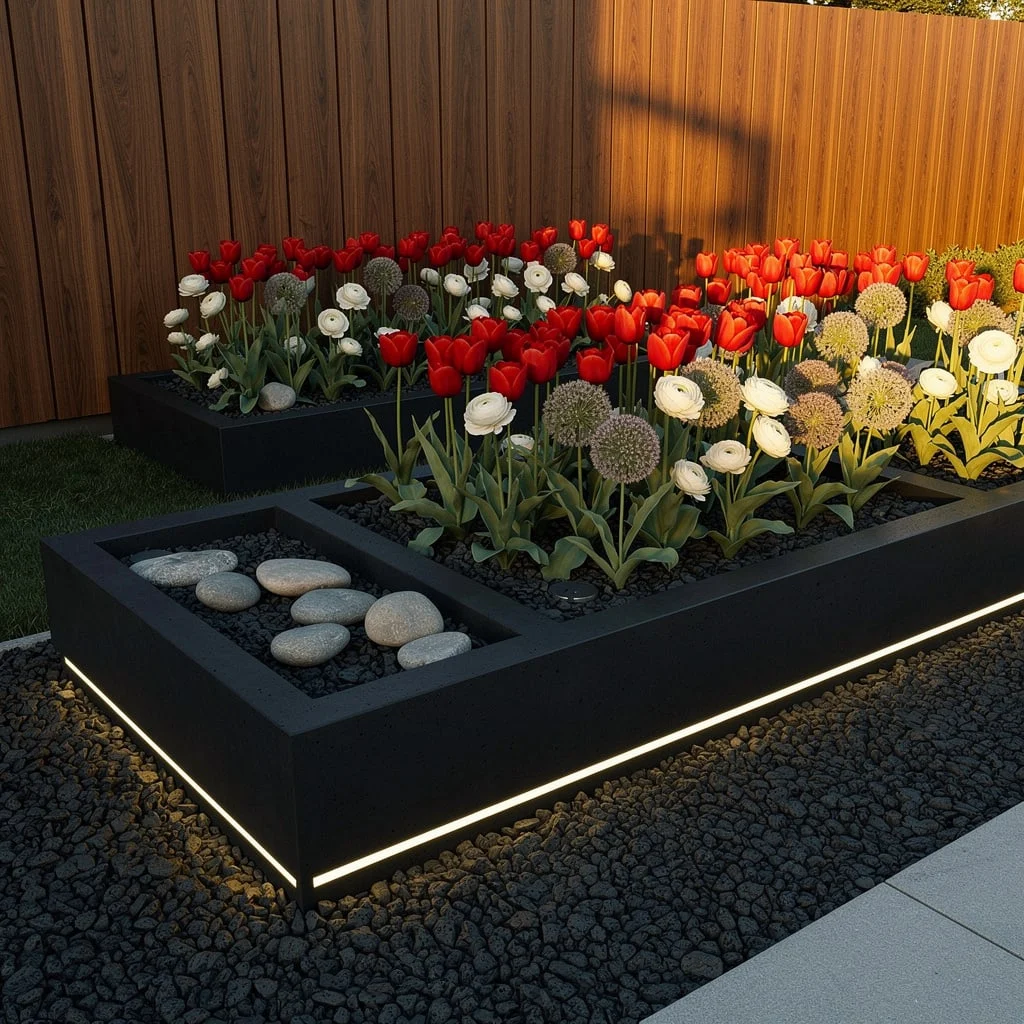
Ready to dump old-school flower beds? Build a series of matte black concrete planters, stagger them along a walnut fence, and stuff them full of red tulips, white ranunculus, and alliums for punchy contrast. Pour charcoal gravel inside and everywhere, because boring dirt is for boomers. Run in-ground LED strip lighting along the edges—hello, architectural shadowplay. Toss river stones here and there to break up the seriousness. Pro tip: Keep everything rectilinear for maximum urban drama; if it’s too organic, start over.
Coastal Chill With Driftwood, Sea Glass, and Lavender
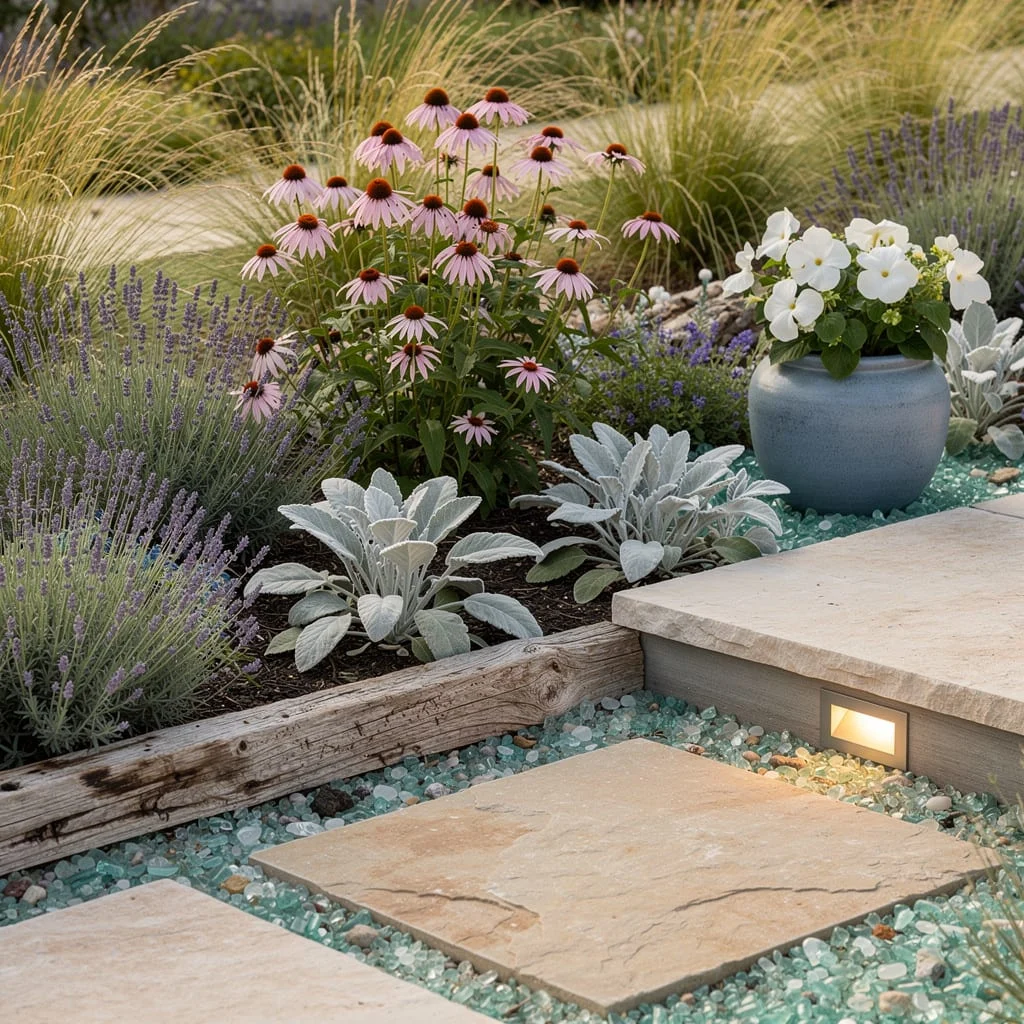
Ditch the seashell mailbox and create real coastal energy using driftwood borders. Grab mounds of lavender, lamb’s ear, and pink echinacea for washed-out, beachy color. Lay oversized limestone pavers in a winding path; nothing ruins the vibe faster than squares. Plug in sea glass mulch—watch it catch sunlight like your favorite summer memory. Drop in blue ceramics with white impatiens for bonus points. Pro tip: Plant ornamental grasses in the background for movement. Stillness is for museums, not front yards.
Rustic Edge, Designer Layer: Corten Steel Meets Cool Greens
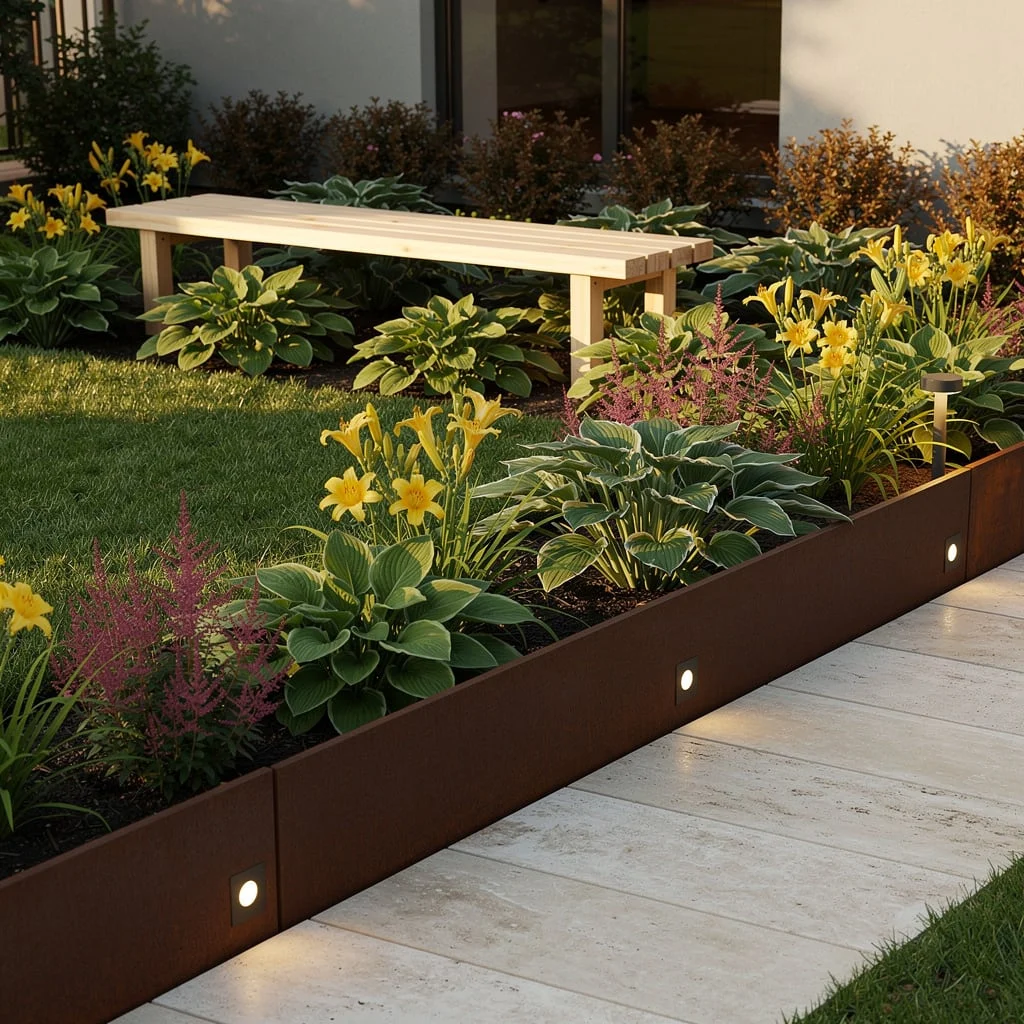
Forget plastic edging—rusty Corten steel borders are where it’s at. Pile green hostas, yellow daylilies, and fuchsia astilbe for knockout color. Slide in a pale cedar bench for grown-up relaxation, and connect everything with linear travertine tiles instead of basic stepping stones. Install mini uplights to show off foliage textures and keep your yard smudged in morning drama. Pro tip: Minimalist benches belong IN the bed, not next to it. If you stick yours on the sidewalk, revoke your designer status immediately.
Stone Waves, Ebony Mulch: Add Drama With Copper and Mist
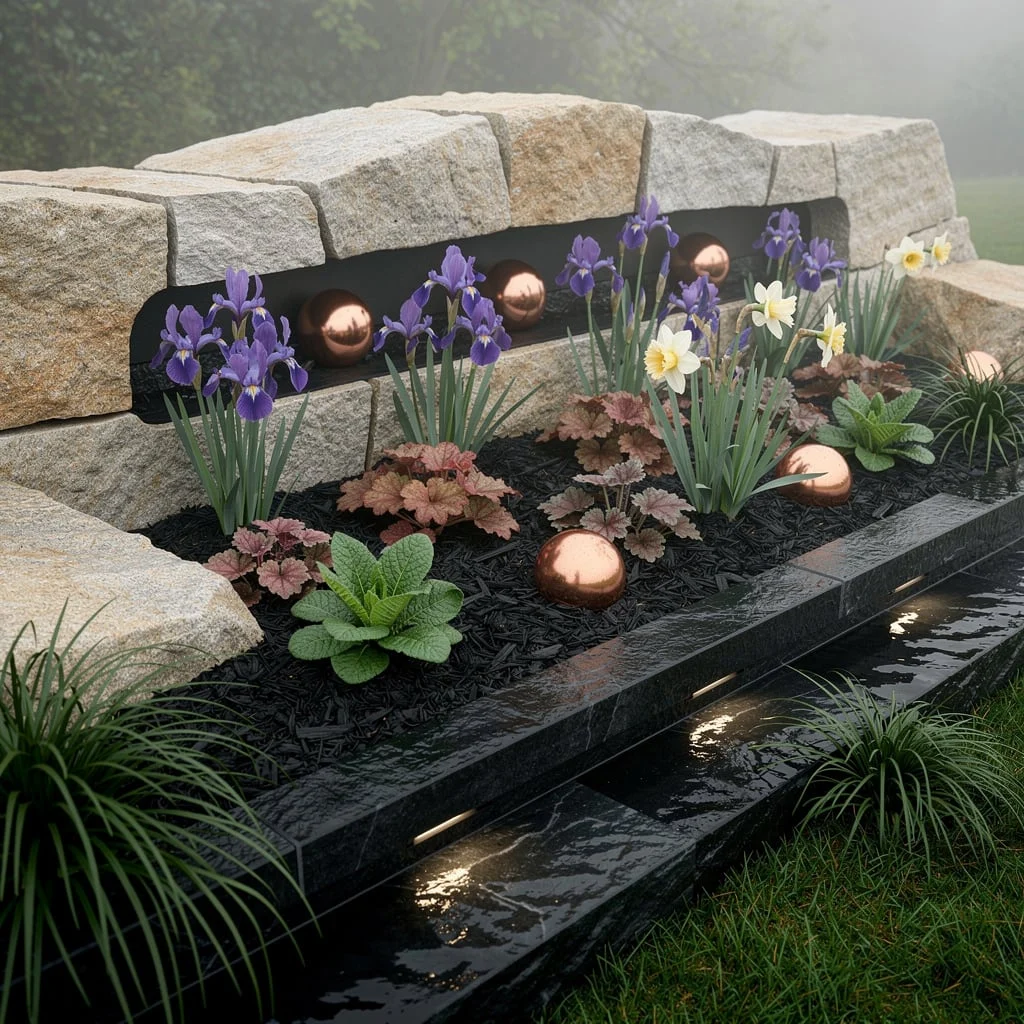
Wave goodbye to boring straight lines. Build undulating limestone walls, drop recessed planters bursting with violet iris, coral bells, and daffodils, then slap on ebony mulch for instant depth. Pepper copper orbs between blooms—yes, you need shine. Run a jet-black stone water rill parallel to the bed, and line it with hidden linear LEDs for nighttime mood. Plant mondo grass at the edges to soften everything. Pro tip: Don’t fear morning mist. In fact, hose things down for drama before guests arrive.
Vintage Bricks, Quartzite Pop: Make Pastels Look Stately
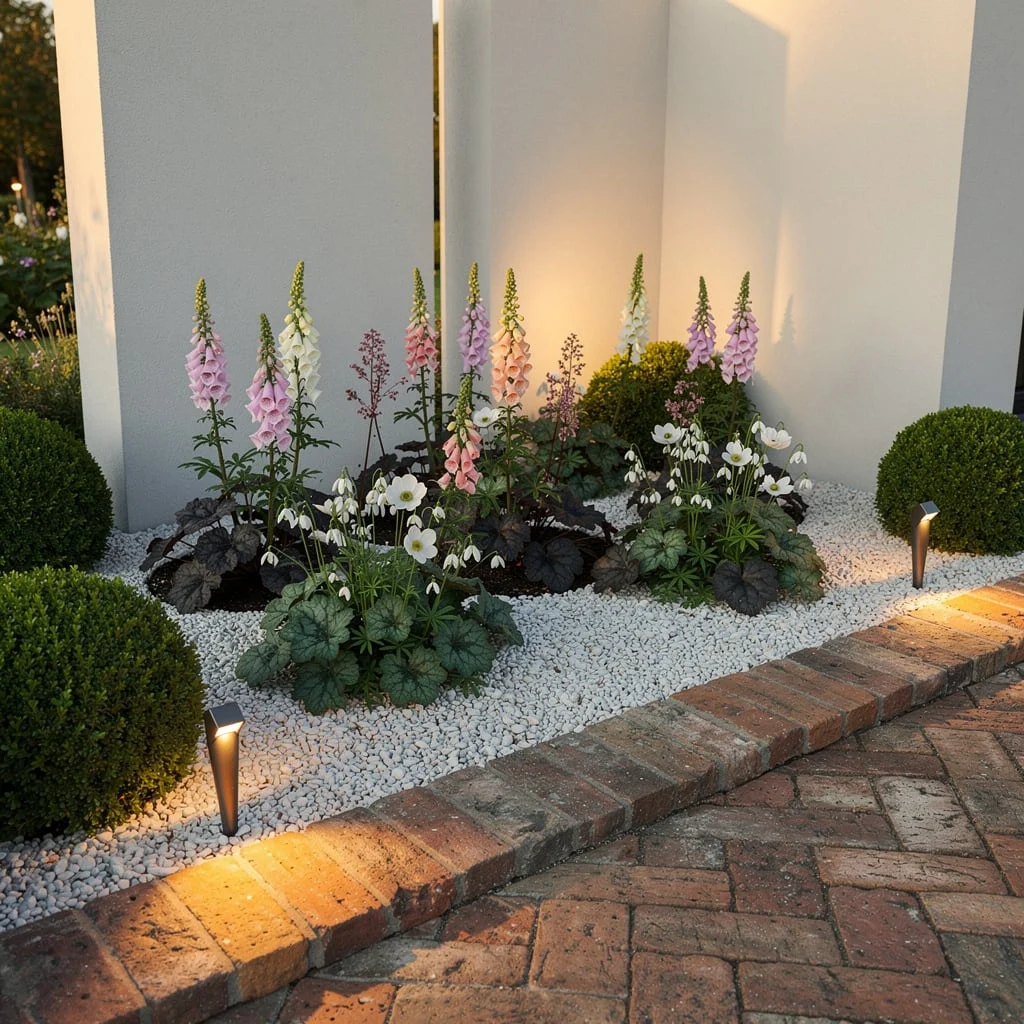
If you want elegance, start with herringbone reclaimed brick borders—never straight, always stylized. Cluster foxgloves, snowdrop anemones, and dark-leaved heuchera amid beds of quartzite gravel for contrast. Dot boxwood spheres along the edge for that precise, expensive vibe. Stick spike lights so your flowers glow and the brick texture pops. Pro tip: Structure is king; place plants in tiered layers so pastel isn’t wimpy. Let soft quartzite gravel cover the ground, but don’t let it touch your house foundation. Ever.
Stucco Chic: Blue Blooms & Stainless Steel for Instant Freshness
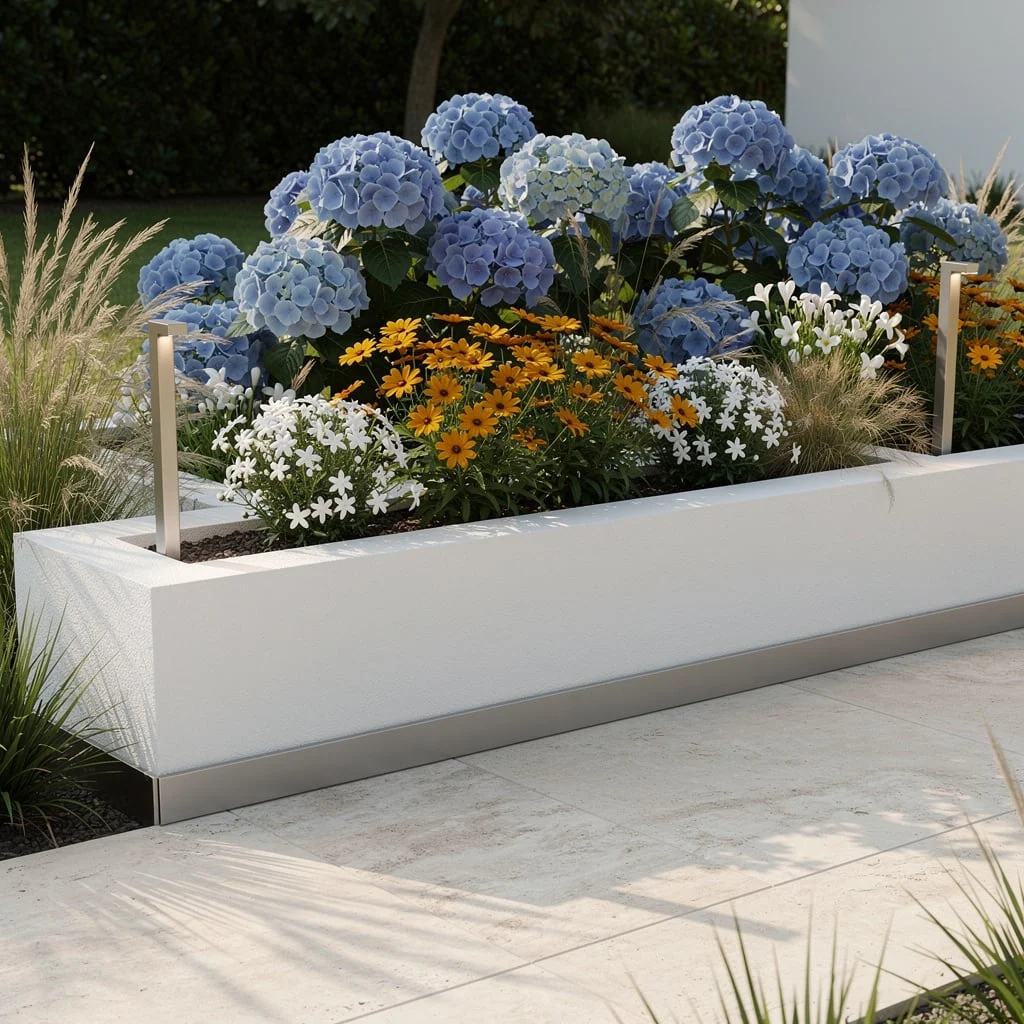
Give your box store shrubs the boot and install a crisp, low white stucco wall with linear planters. Push blue hydrangeas, coreopsis, and star jasmine into every inch. Edge everything with brushed stainless steel—if you don’t upgrade your hardware, what are you even doing? Use creamy travertine paths, and choose lamp posts that don’t look like they’re from the 90s. Pro tip: Always use ornamental grass for shadow drama. Do not skip bollard lights—the geometry and color need nighttime backup.
Charred Timber, Red-Hot Foliage: High-Contrast Is Where It’s At
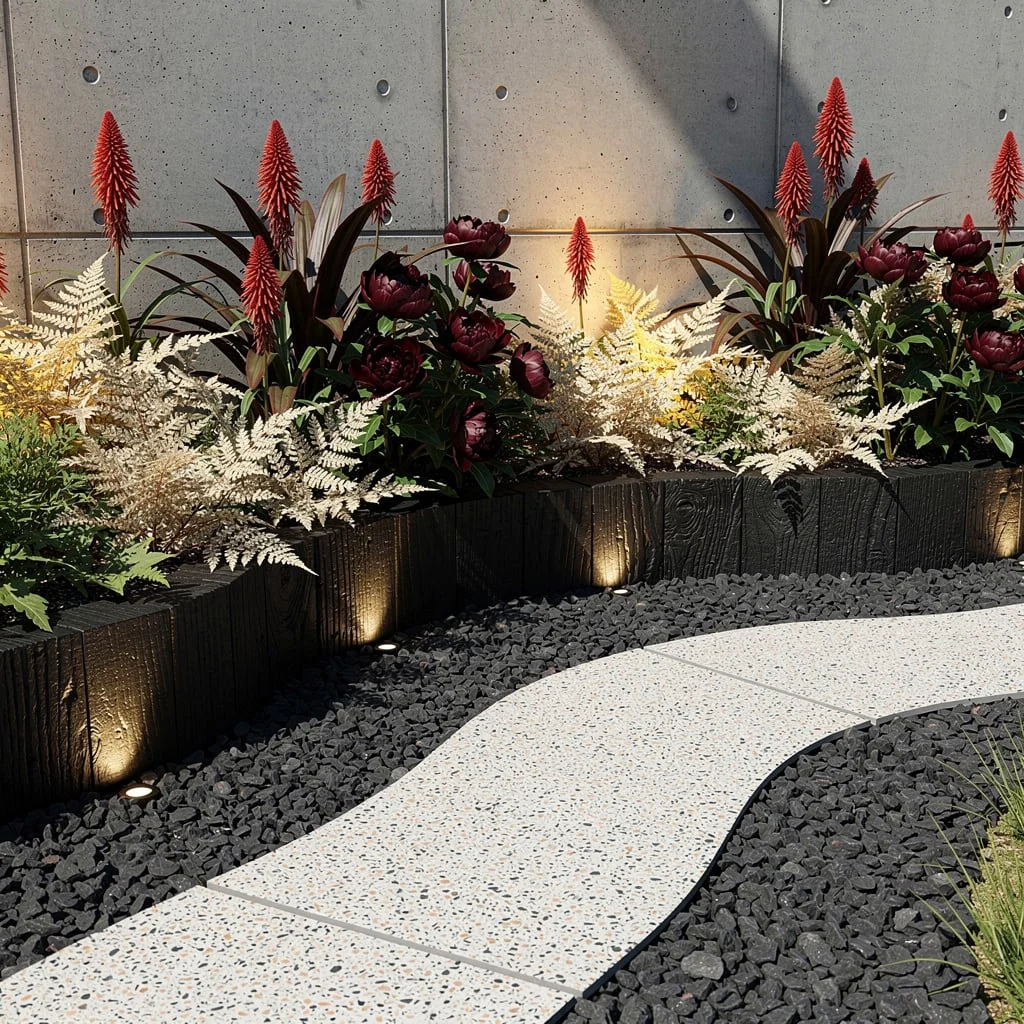
Build snaking raised beds from dark, charred timber—forget sad wood that looks ‘rustic.’ Plant red-hot pokers, Japanese painted ferns, and burgundy peonies so color hits from every angle. Spread black basalt chips, then wind pale terrazzo slabs for a path with attitude. Spotlight foliage shapes upward, making them pop against a concrete façade. Pro tip: Don’t use boring mulch—black basalt is bold and works better. Keep path lighting close to the ground. Anything higher screams suburban blandness.
Go Vertical With Tiered Steel Planters and Drama Lighting
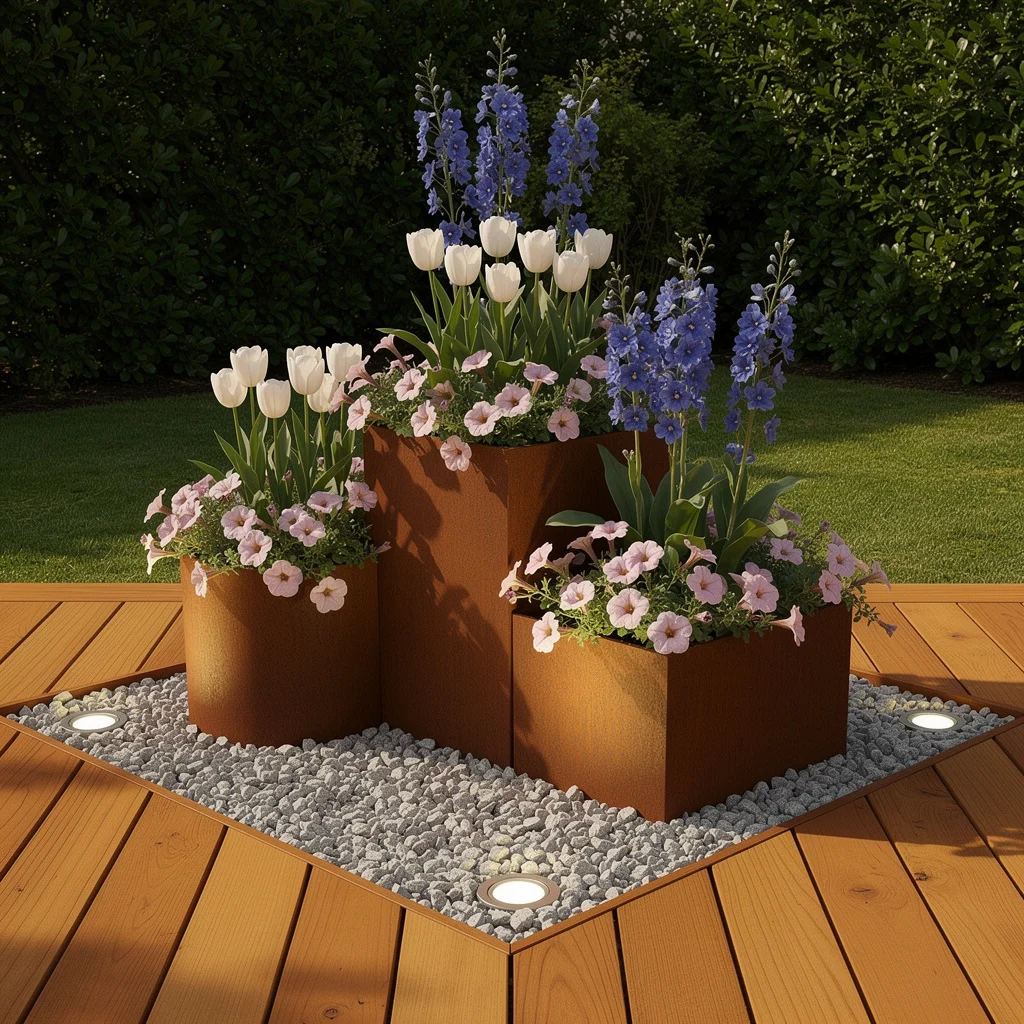
Show your neighbors what ‘refined’ really means. Arrange three corten steel planters at different heights, then fill with white tulips, tall blue delphiniums, and trailing pink petunias. Drop granite chippings between for crisp negative space. Blast them with dual-tone LED spots to get those moody evening shadows everyone loves. Add a honey-brown hardwood deck for warmth, and flank it all with hedges. Pro tip: Always use tiered planters. Flat beds are for people without imagination or Instagram.
Slate and Sculptures: Wild Cottage Goes Contemporary
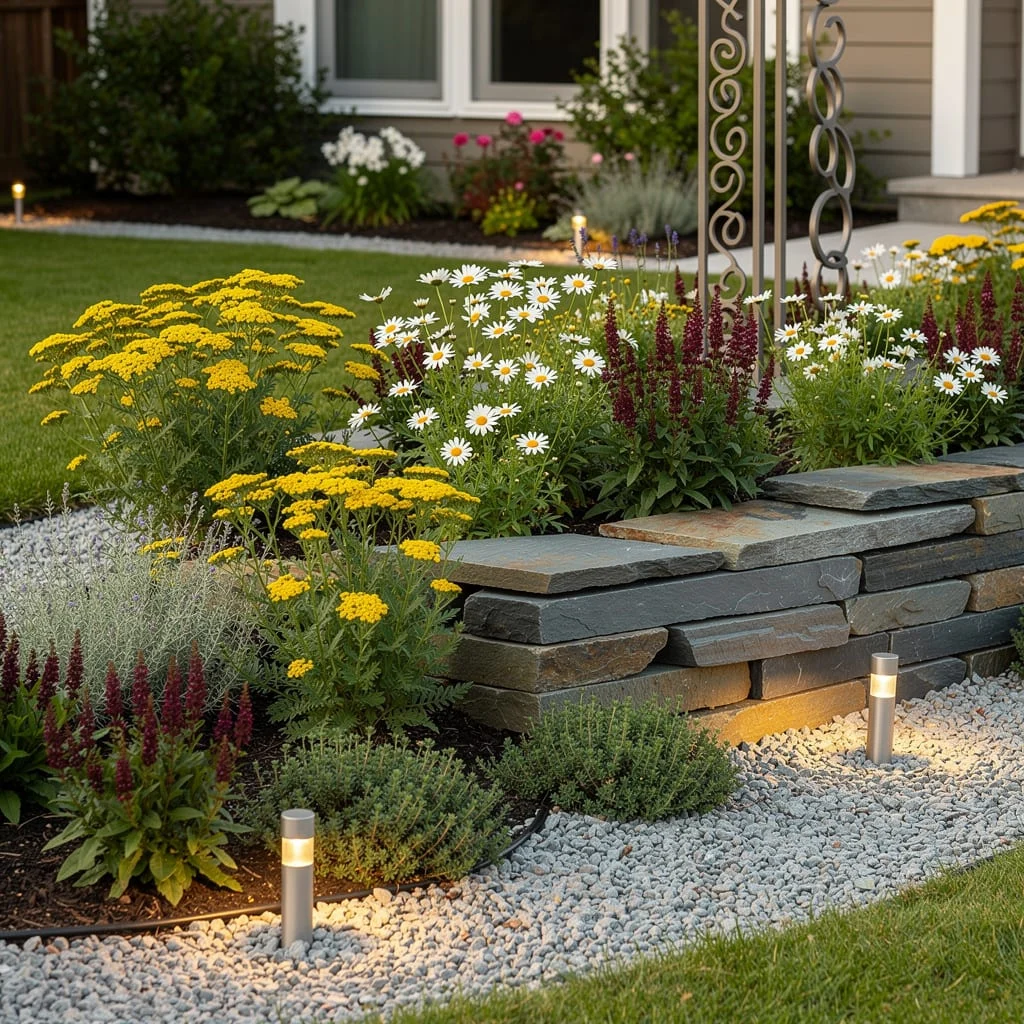
Stop dreaming of English cottage chaos and do it right. Build an asymmetrical dry-stacked slate wall, overflow it with yarrow, daisies, penstemon, and thyme. Lay silvery pea gravel as mulch and winding path—pretend you’re allergic to straight lines. Hide vertical garden sculptures in powder-coated steel for low-key art, and light up the path with low-voltage fixtures. Pro tip: Too much symmetry kills cottage charm. Keep flower groupings irregular and never use colored lights—diffused white only.
Golden Aluminum Edges and Architectural Blooms for Luxe Vibes
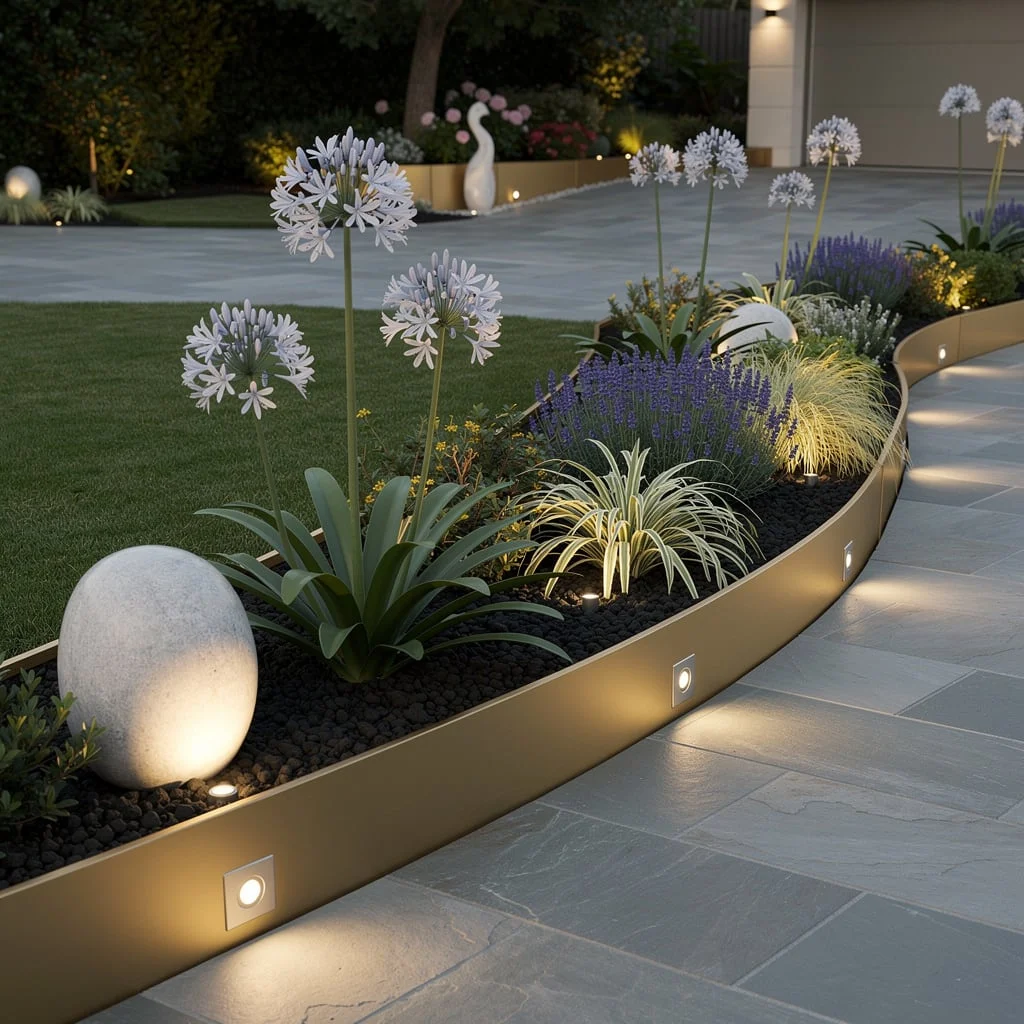
Tired of basic borders? Use golden aluminum panels with a brushed finish to edge your bed—curves required. Plant architectural agapanthus, blue nepeta, and variegated sedge for bold leaf texture. Spread black volcanic gravel to make colors look richer than your next-door neighbor. Drop waterproof LEDs at plant groupings, and anchor with minimalist stone sculptures. Pro tip: Repeat paneling and sculpture shapes for a unified look; random mixing is just lazy. Night lighting is mandatory—nobody pays attention during the day.
Final Thoughts
A front yard flower bed is not a maintenance obligation to be discharged as efficiently as possible. It’s the detail that tells anyone approaching your home whether the people inside care about it — and the good news is that caring about it doesn’t require unlimited budget or professional installation. It requires choosing plants at the right heights, giving the bed enough depth to layer properly, edging it like you mean it, and mulching it like you understand that the ground matters as much as what’s growing in it.
Every bed here made clear decisions about what it was going to be — the colour palette, the structural plants, the scale in relation to the house — and those decisions are exactly what make them worth looking at. Your front yard flower bed is making a statement whether you designed one or not. It’s considerably better to have designed one