

Somebody, at some point, decided the bathroom gets whatever’s left over. The mismatched hand towel. The picture frame from the garage sale. The single candle bought in a panic before guests arrived.
That decision has been quietly ruining small rooms for decades.
The restroom is the one space in your house every visitor uses alone, with the door shut, with nothing to do but look around. It is, statistically, the most scrutinized square footage you own.
Treat it like an afterthought and it will look like one.
Where the Money Should Actually Go
Spend on the thing at eye level
The mirror sits exactly where every visitor’s gaze lands first and lingers longest. It’s the one object in the room guaranteed full attention every single time.
Most people buy whatever mirror matches the vanity set and save the real spending for things nobody looks at directly, like the toilet. That’s backwards.
Put the budget into the mirror frame — the shape, the metal, the scale — before anywhere else.
Cheap fixtures announce themselves faster than cheap furniture
A slightly inexpensive sofa can hide in a busy living room. A slightly inexpensive faucet has nowhere to hide in a bathroom — it’s touched, looked at, and evaluated up close every single use.
Fixtures get more scrutiny per dollar than almost anything else you’ll buy for the house. It’s worth reallocating budget here even if it means a plainer mirror or a smaller rug.
Spend where hands and eyes actually go.
The floor is doing more than you’re paying it to do
Most renovation budgets treat flooring as a background decision — pick something neutral, move on. In a small room, the floor is nearly always visible in full, uninterrupted by furniture.
A floor with real material interest — veined stone, hexagon tile, aged wood — becomes a second focal point almost for free, since it was going to be tiled regardless.
Don’t default to the cheapest option just because it’s underfoot. It’s more seen here than in any other room.
Mistakes That Are Cheap to Avoid
Buying the matching three-piece set
Matching soap dispenser, toothbrush holder, and tumbler sets exist because they’re easy, not because they look good. They read instantly as “purchased as a bundle,” which is the opposite of considered.
Individually sourced pieces in a shared material or tone give the same coordination without the showroom effect. It takes slightly more effort and looks like exponentially more.
Buy the pieces separately, even if it takes three trips instead of one.
Hanging art at bathroom scale instead of real scale
People consistently under-size art for small rooms, assuming a tiny room needs a tiny picture. It’s the reverse — one confident, larger piece reads as intentional, while several small ones scattered around read as filler.
A room this size can carry a surprisingly large frame without feeling crowded, because there’s rarely competing furniture to fight it for attention.
Size up before you size down.
Forgetting the room has a smell as well as a look
A beautifully designed bathroom that smells like nothing, or worse, like cleaning product, breaks the illusion the moment someone walks in. Scent is processed before sight registers any of the details you worked on.
A considered candle or reed diffuser isn’t an accessory here — it’s doing first-impression work before the mirror or the tile gets any credit.
Don’t finish the visual design and skip this step. It’s the fastest way to undercut everything else.
Restroom Decor Ideas
Stone Wall Jungle Vanity
Cover the walls in rough natural stone tile or a stone-effect plaster and let it do the talking — no additional wallpaper, no competing pattern. Choose a warm, uneven stone finish, not the polished kind, so it reads as ancient rather than showroom.
Hang a round mirror wrapped in thick jute or rope rather than a plain frame. The texture softens the stone and keeps the whole thing from feeling like a cave.
Fill every gap with trailing plants — pothos, string of pearls, ferns — hung at different heights so they cascade down the stone instead of sitting in neat rows. Use woven baskets on the floor for towels and toiletries instead of cabinets.
Skip anything metallic and shiny here. Matte black fixtures and unfinished wood are the only hard materials that belong in this look.
Black Marble Moody Powder Room
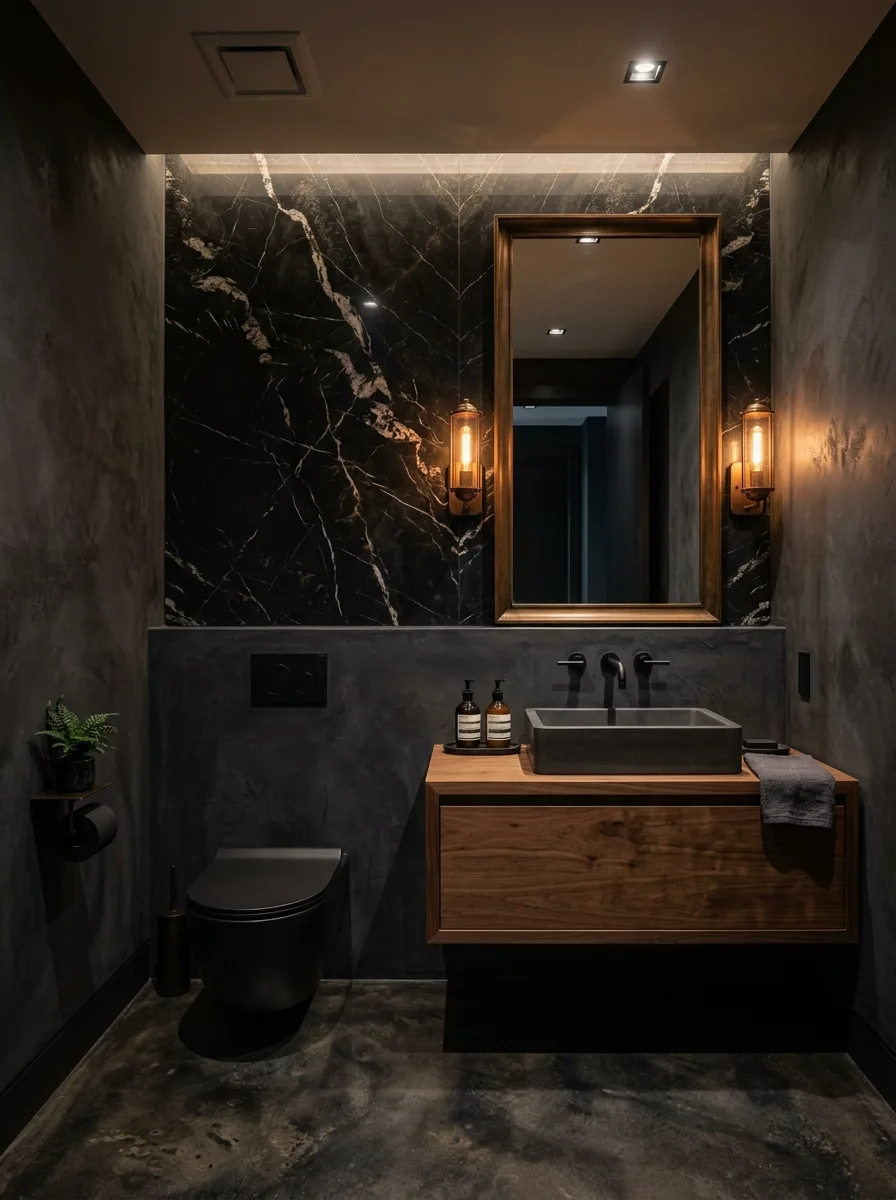
Choose a slab of dark, dramatically veined marble for one full accent wall and leave the rest of the walls a plain dark plaster or microcement. The vein pattern needs negative space around it to read as luxurious instead of busy.
Frame the mirror in warm wood or brass, never black — this is the one place metal or wood should contrast rather than match the room’s dark palette. Flank it with two small brass or bronze sconces for warm, low light.
Select a matte black toilet and a stone or concrete vessel sink to keep every fixture in the same tonal family as the walls. A single wood vanity cabinet breaks up the dark palette without lightening the mood.
Keep the floor dark too — polished concrete or dark stone. A moody room with a pale floor loses its nerve halfway through.
Coastal Blue Floating Shelf Loo
Paint the walls a soft off-white and bring in one framed coastal landscape as the anchor piece — a beach, a cliffside, something with real horizon in it. Mount two floating wood shelves above the toilet rather than one large cabinet.
Style the shelves with a single trailing plant, a blue-and-white ceramic vase, and a stack of two or three coffee table books. Leave visible negative space between objects — this look dies the moment shelves get crowded.
Choose brass fixtures and a striped blue-and-white towel to pull the palette together. A woven wastebasket grounds the whole thing in something tactile.
Fresh white hydrangeas in a simple glass vase on the toilet tank finish the look without costing much.
Pink Plaster Marble Console
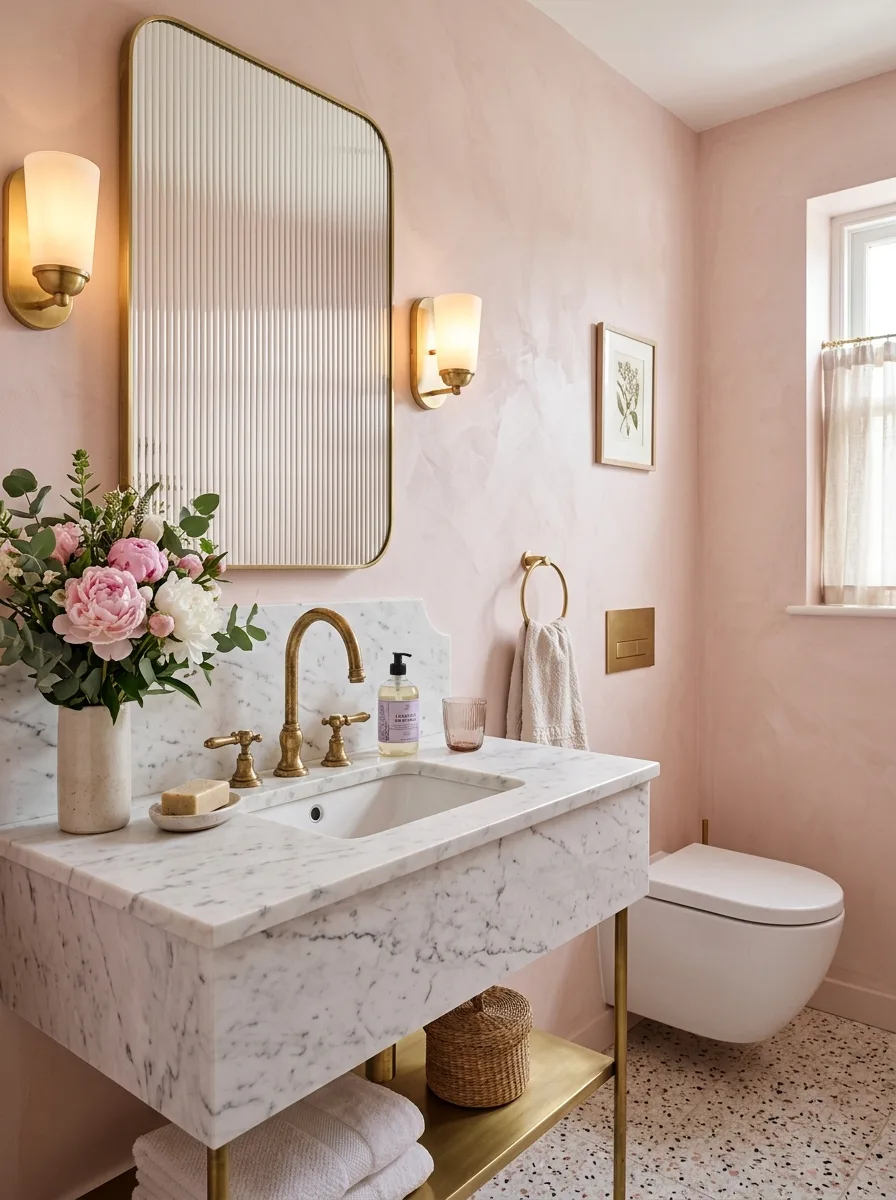
Coat the walls in a soft blush limewash or Venetian plaster with visible texture and cloud-like variation — avoid flat pink paint, which reads as juvenile instead of sophisticated. The texture is what makes it feel grown-up.
Install a marble-topped console vanity on thin brass legs rather than a boxed-in cabinet. The visible legs keep a small pink room from feeling closed in.
Choose an arched or rounded mirror with a brass frame, paired with fabric-shade brass sconces on either side. Bring in a loose, oversized arrangement of pink and white peonies — slightly overflowing the vase, not styled too tightly.
Terracotta floor tile or a fine speckled terrazzo keeps the floor from going too sweet. This room needs one grounding, slightly rough element or the whole palette tips into precious.
Neon Backlit Organic Mirror
Install an organic, freeform-shaped mirror with a built-in LED ring light around the edge — the kind that shifts between white and colour. This single object carries almost the entire room.
Paint or panel the vanity in matte black, then pair it with warm brass or gold hardware for contrast. Add strip lighting under the vanity’s toe-kick so the cabinet appears to float in coloured light.
Bring in one oversized floral stem arrangement in a tall glass or ceramic vase — the drama of the branches plays well against the glow. Layer in a handful of candles at different heights for texture when the LED is off.
The mistake to avoid: don’t do this in a room with any other loud pattern. The light is the pattern. Everything else should be a quiet, dark backdrop.
Marble Bench Window Nook
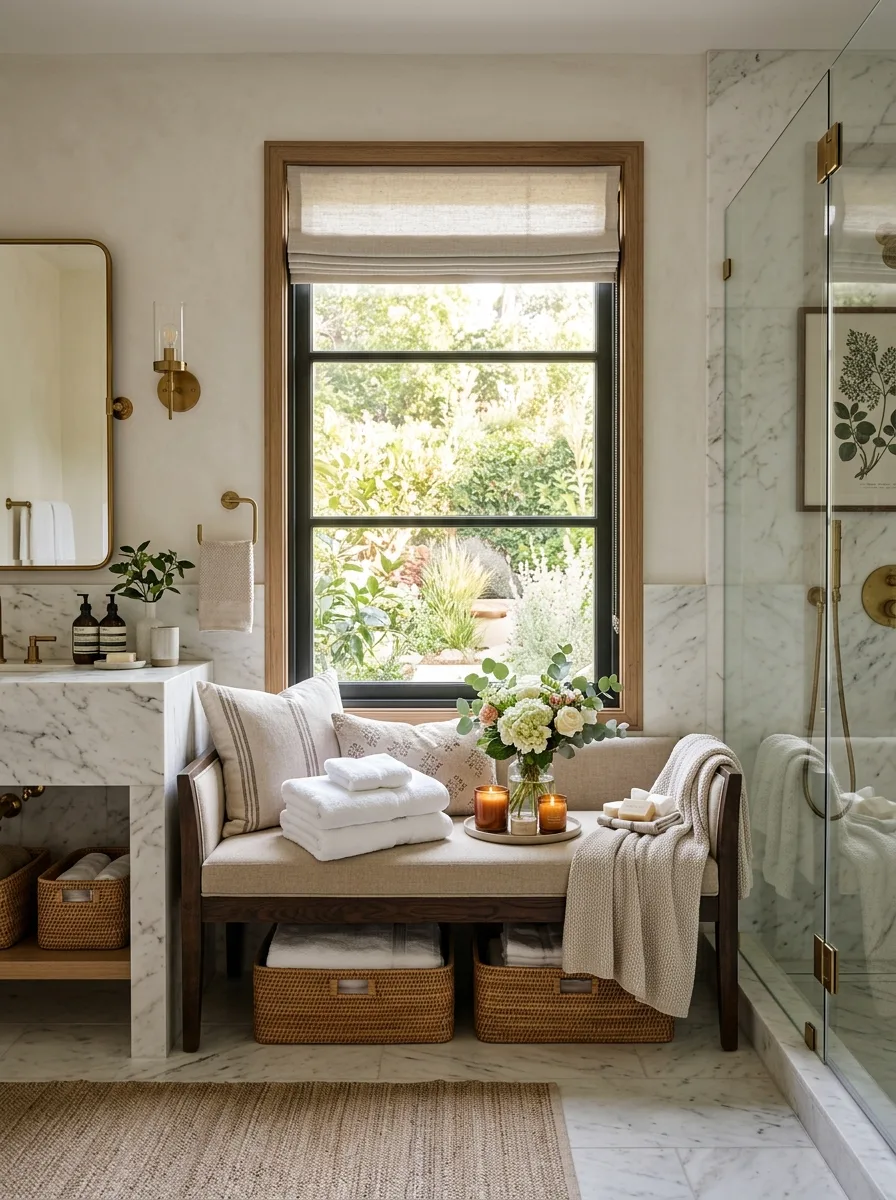
Build or place a upholstered wood bench directly under the bathroom window, sized to fit the sill exactly. This turns dead floor space into the room’s actual focal point.
Dress the bench with two linen-covered pillows and a folded knit throw draped over one arm, plus a stack of rolled towels styled like a hotel turn-down. A tray with candles and fresh flowers finishes the surface.
Slide woven baskets underneath the bench for towel or product storage — the baskets read as furniture, not overflow. Choose baskets with a visible label tag for a slightly more finished, boutique-hotel look.
Let the garden or view outside the window stay unobstructed; skip curtains here and use a simple woven roman shade instead. The window is doing decorative work too.
Ladder Shelf Towel Tower
Buy a tall, narrow ladder shelf — five tiers, black metal frame — and place it beside the tub or over the toilet where floor space is tightest. This one piece replaces an entire built-in cabinet.
Fold towels into thirds, not rolled, and stack them by size on alternating shelves so the eye has a rhythm to follow. Reserve one shelf entirely for a woven basket holding anything you don’t want visible — spare rolls, cleaning supplies.
Top the whole thing with a trailing plant and a candle so the top shelf doesn’t read as storage. Add one small framed print on the wall beside it, low enough to interact with the shelf’s height.
Never let more than two shelves go bare. Empty shelves on a ladder unit read as unfinished, not minimal.
Marble Tray Amenity Styling
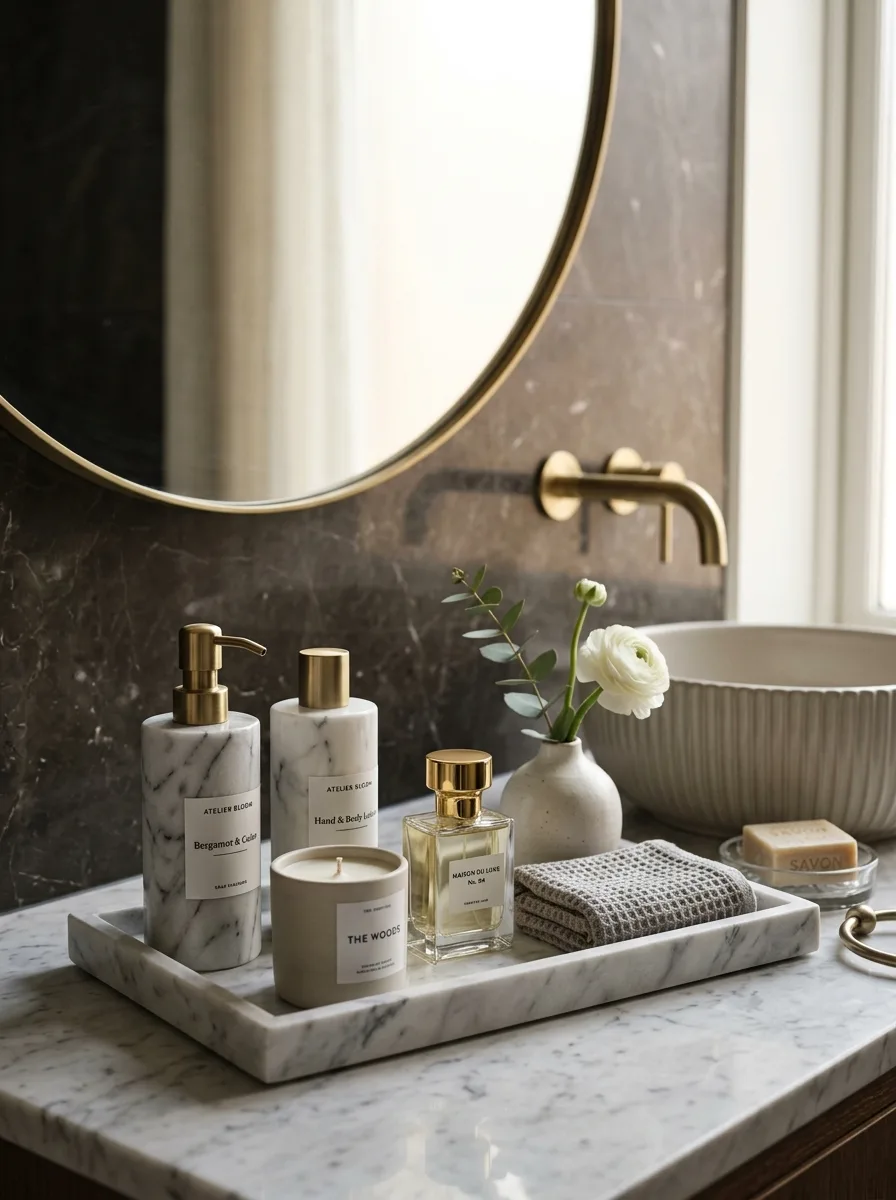
Group your everyday bathroom products — hand soap, lotion, perfume, a candle — onto a single stone or marble tray instead of leaving them scattered across the counter. The tray is the entire trick; it turns clutter into a display in under a minute.
Choose products with minimal, label-forward packaging in glass or ceramic bottles rather than plastic. Swap anything mismatched into a matching amber glass pump if the original packaging is too colourful.
Add one small stem of fresh greenery in a bud vase and a folded waffle-weave hand towel to break up the row of bottles. Height variation matters — mix a tall perfume bottle with a short candle so the tray has a silhouette, not a flat line.
Wipe the tray daily. A styled tray with water rings defeats its own purpose within a week.
Candlelit Freestanding Tub Corner
Position a freestanding oval tub against a plain tiled wall and build the entire mood around firelight — no overhead lighting on when this look is doing its job. Cluster candles of mismatched heights along a wood tray that spans the tub’s width.
Add a tall floor lantern with a mesh or glass shell beside the tub, plus a second smaller lantern on a narrow black plinth nearby. The plinth height variation is what keeps candlelight from looking flat.
Hang two or three framed botanical or palm prints above the tub, all in matching dark frames so they read as one gesture rather than scattered art. A single piece of playful wall type nearby keeps the room from feeling too serious.
Finish with a patterned round rug on the floor — this is the one spot pattern is allowed, since everything else in the room stayed quiet.
Floral Wallpaper Cottage Loo
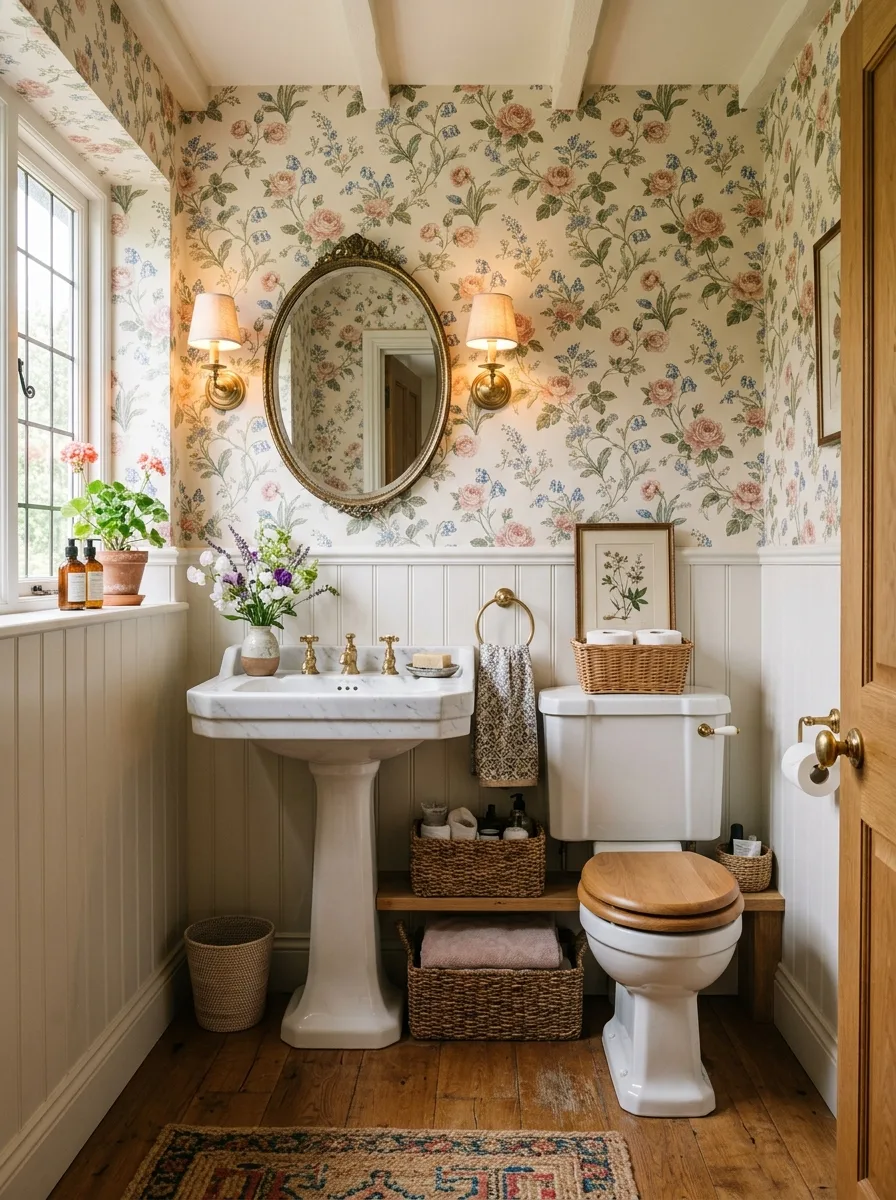
Choose a busy, large-scale floral wallpaper and run it floor to ceiling above a painted wood wainscot — this look does not work as an accent wall, it needs full commitment. Keep the wainscot a soft off-white so it doesn’t compete with the print.
Hang an oval mirror in an ornate gilt or gold frame, slightly tarnished-looking rather than brand new. Flank it with two simple fabric-shade sconces in brass.
Fill a pedestal sink’s edges with fresh flowers in a ceramic jug rather than a formal vase — the slightly wild arrangement matches the wallpaper’s energy. Use wicker baskets under the sink and beside the toilet for visible, textural storage.
Swap a plastic toilet seat for a wood one. It’s a small material change that makes the whole room feel like it belongs in a farmhouse, not a rental.
Wood Slat Wall Stone Sink
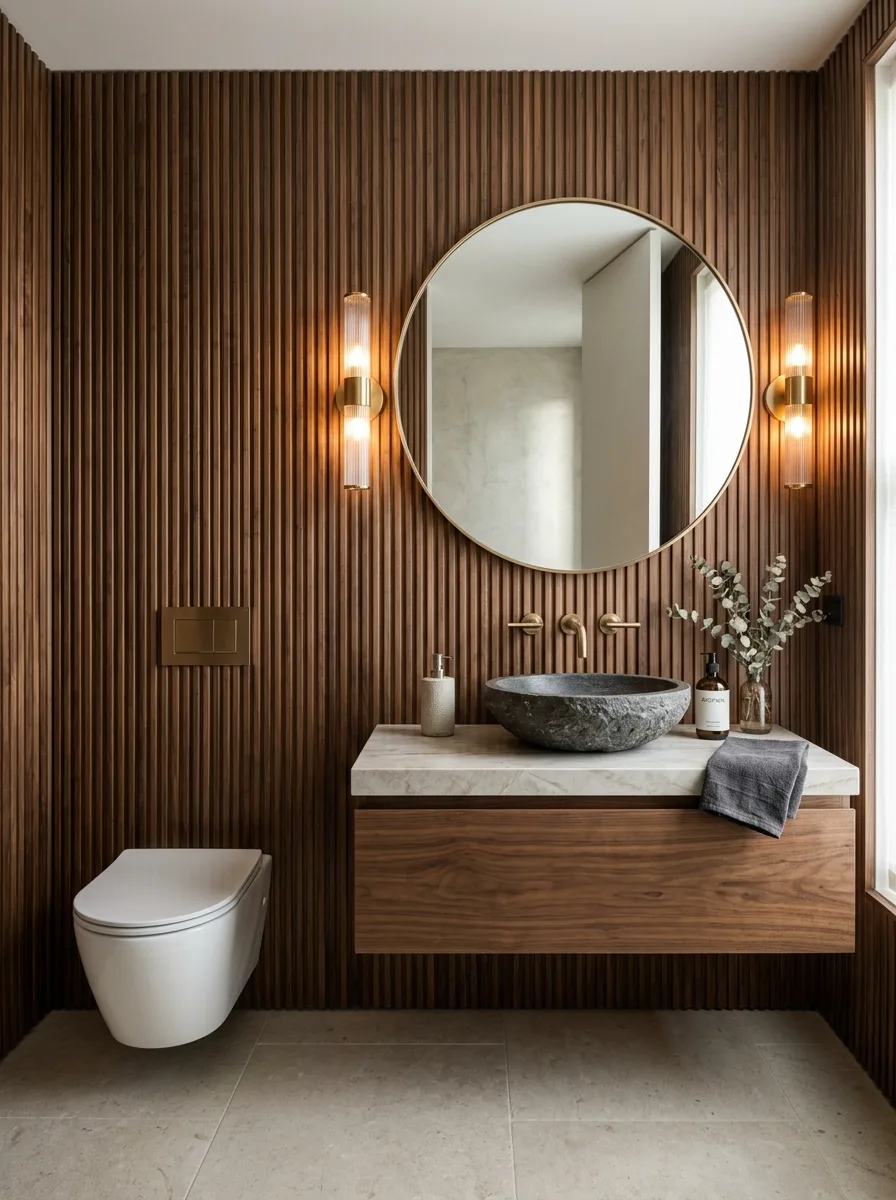
Panel one full wall in vertical wood slats, running floor to ceiling, and let the grain variation be the room’s only real pattern. Everything else stays plain and pale.
Mount a large round mirror in a thin brass frame directly against the slats — the round shape softens all those straight vertical lines. Flank it with slim fluted glass sconces rather than anything boxy.
Choose a raw, unpolished stone vessel sink instead of ceramic. The rough texture against the smooth wood grain is the entire trick of this look, and it costs nothing extra to source that finish over a standard basin.
Keep the countertop almost empty — one soap pump, one small vase of eucalyptus. This look fails the moment the surface gets busy.
Backlit Panel Wall Powder Room
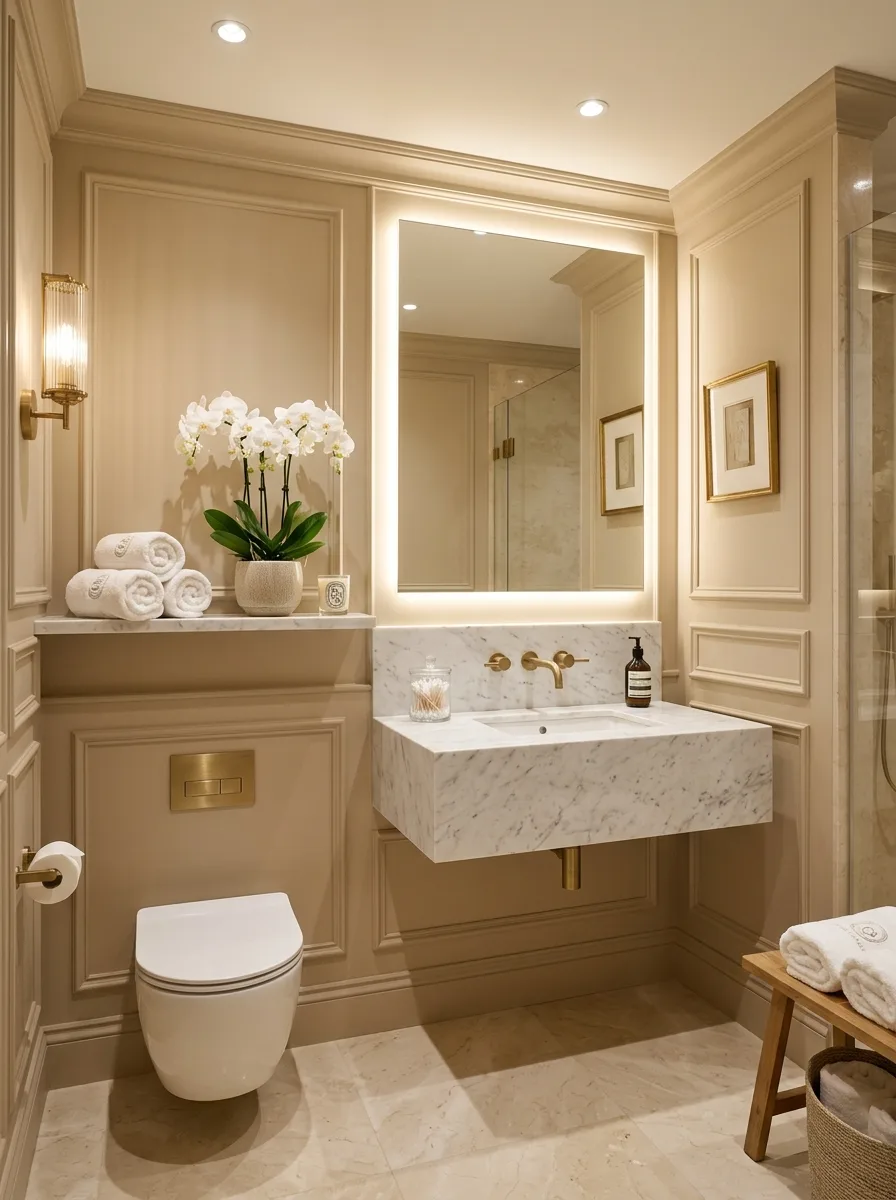
Install classic wall panelling — raised rectangular mouldings — across every wall in a warm neutral tone, then run a slim strip of hidden LED lighting around the vanity mirror. The backlight against the panelling is what elevates this from generic to hotel-grade.
Mount the vanity as a floating marble slab with no visible legs or cabinet front, just a clean brass pipe support. The floating effect keeps a small, panelled room from feeling boxed in.
Add a single tall orchid in a ceramic pot on a shelf beside the mirror, plus a stack of rolled white towels. Restraint is the entire point of this look — one flower, one candle, nothing else competing with the architecture.
Warm gold hardware throughout, no exceptions. Cool metal against warm panelling breaks the mood instantly.
Fluted Vanity Double Sink Suite
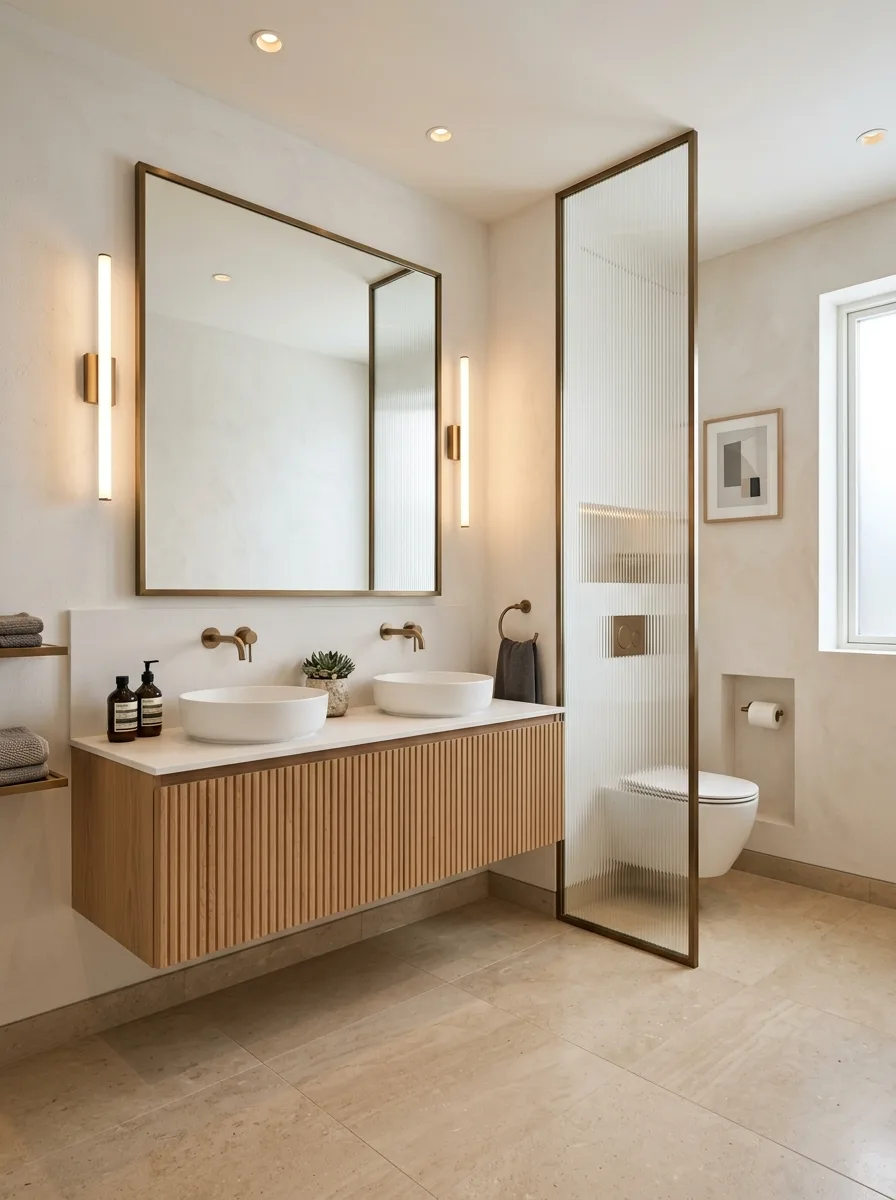
Choose a wide floating vanity front in vertical fluted or ribbed wood, paired with two round countertop basins rather than one long trough sink. The fluting adds texture without adding pattern, which keeps a large mirror wall from feeling cold.
Install a fluted glass shower divider instead of a solid wall — the texture repeats the vanity’s ribbing and lets light move through the whole room. Use a thin brass frame on the glass to tie it to the tapware.
Keep countertop styling to matching amber glass bottles and one small potted succulent. Symmetry matters more than variety in a double-vanity layout.
Large-format pale travertine tile on the floor, run wall to wall with minimal grout lines, makes a small footprint read as considerably larger.
Vintage Gold Mirror Subway Tile
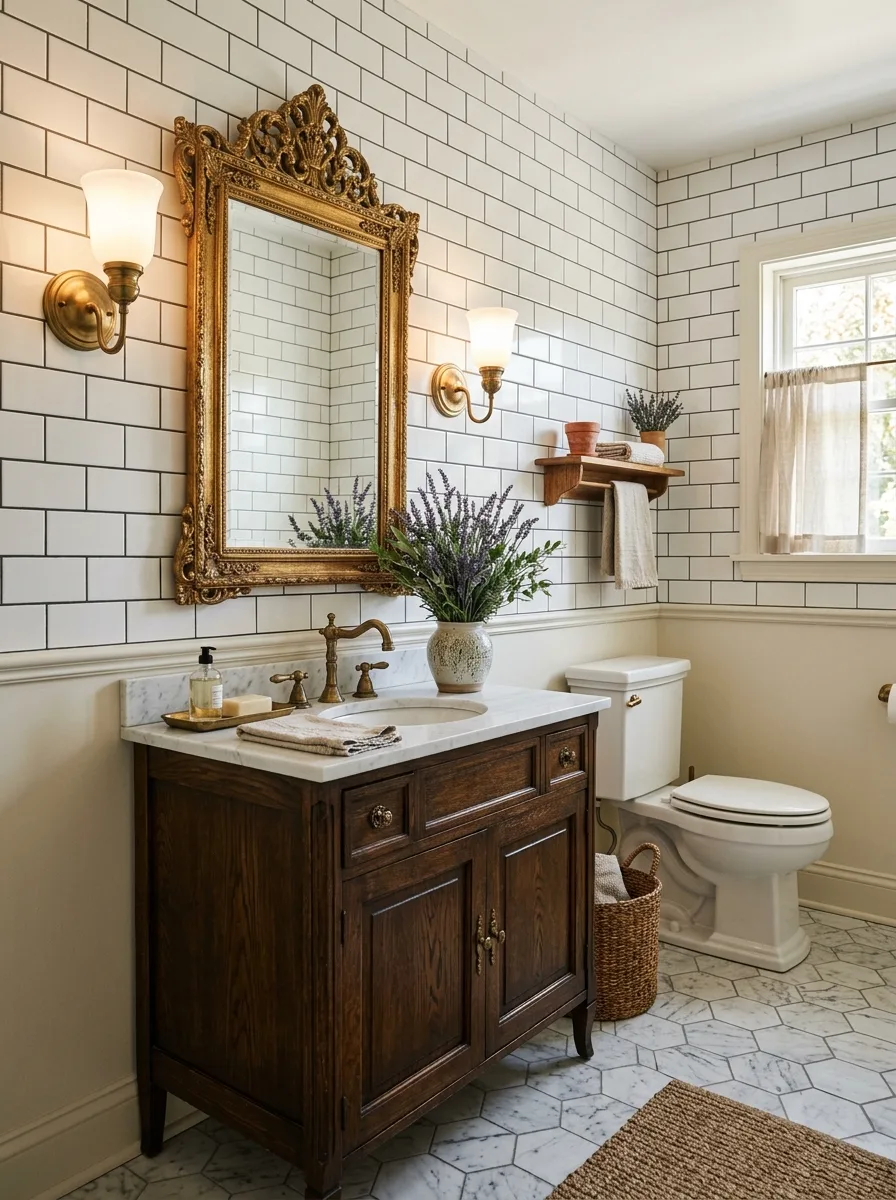
Tile the walls in classic white subway with dark contrasting grout, stopped at a chair-rail height with painted wainscot below. The grout colour is doing more work here than people expect — it’s what gives plain subway tile any personality at all.
Source an ornate antique gold mirror, the more elaborate the better, and hang it slightly larger than feels safe. Oversized ornate frames against plain tile is the classic contrast that makes this style work.
Choose a dark stood cabinet vanity instead of a modern floating one — furniture-style pieces read as collected over time rather than bought as a set. Top it with a ceramic pitcher stuffed with lavender or dried florals.
Hexagon marble floor tile finishes the vintage note without adding another busy pattern to compete with the subway walls.
Travertine Stool Spa Corner
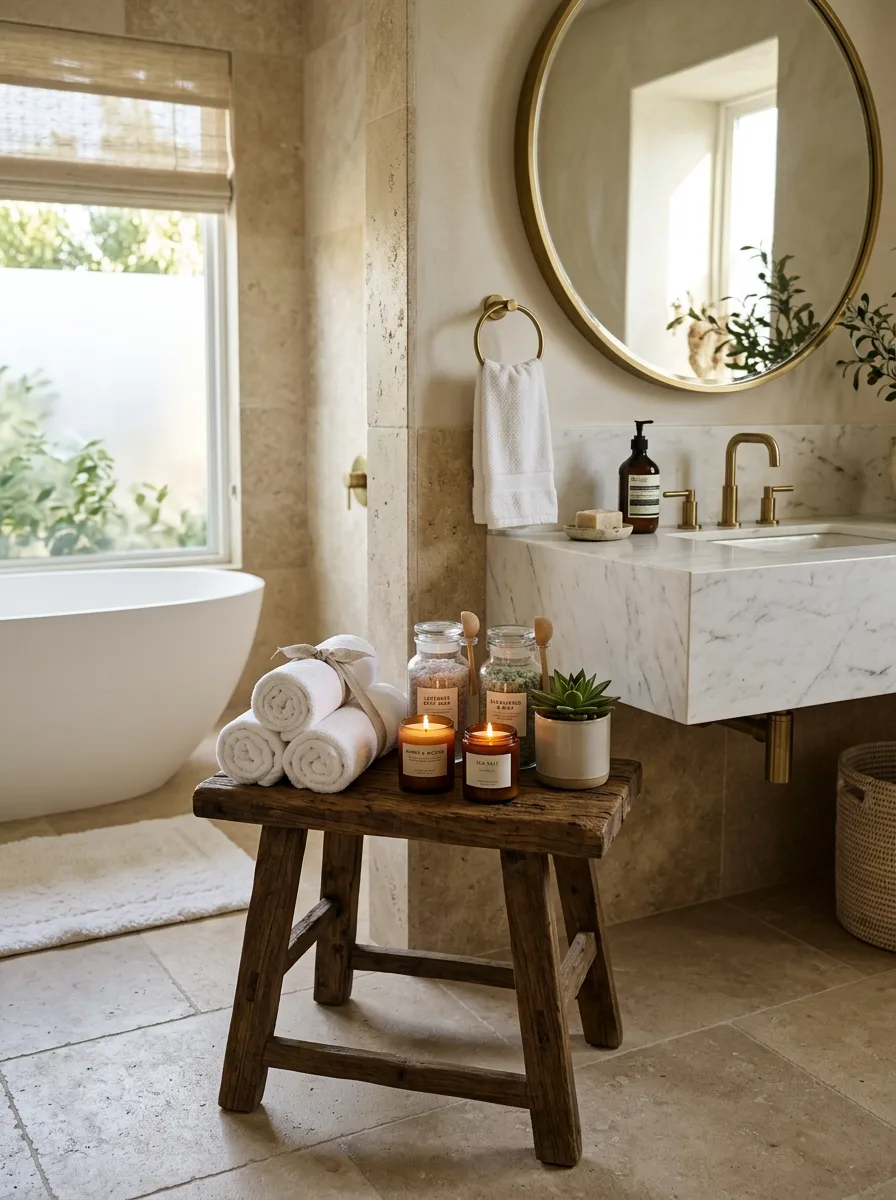
Tile the walls and floor in warm, veined travertine and let the stone’s natural variation be the room’s only real decoration — resist adding wallpaper or paint accents on top of it. This material wants to be seen uninterrupted.
Place a small rustic wood stool beside the tub instead of a side table. The rough, worn wood against the polished stone is the contrast that sells the whole spa mood.
Style the stool with a stack of rolled white towels tied in raffia string, a small potted succulent, and two amber glass candles with visible labels. Keep the labels facing outward — this is a detail people copy without realizing why it works.
A woven roman shade on the window, rather than curtains, keeps the natural-material story going all the way to the light source.
Abstract Art Molding Wall
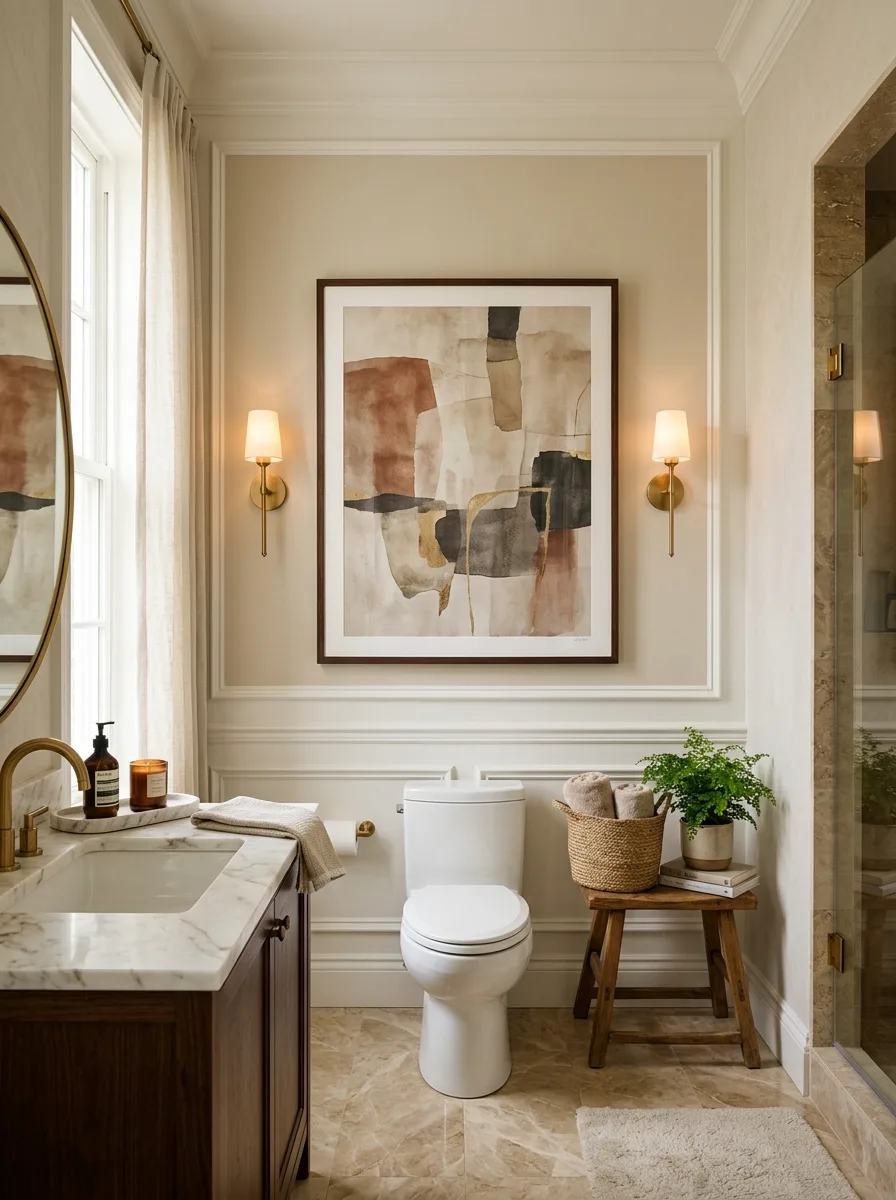
Build a single oversized moulding frame directly into the wall — paint the inset a slightly different tone than the surrounding wall — and hang one large abstract art print inside it. The built-in frame is what makes a single piece of art feel like a real architectural moment.
Flank the artwork with two matching brass sconces at eye level, positioned to wash light across the print rather than the toilet below it. This draws the eye up and away from the room’s least glamorous fixture.
Add a low wood stool beside the toilet topped with a woven basket and a stack of two hardcover books. It’s a small, human touch that keeps the composed wall from feeling like a museum.
Pick art with the same warm-neutral-plus-one-accent palette as the room’s tile. Art that clashes with the floor tone will always look like an afterthought, however good the piece is on its own.
Botanical Gallery Shelf Wall
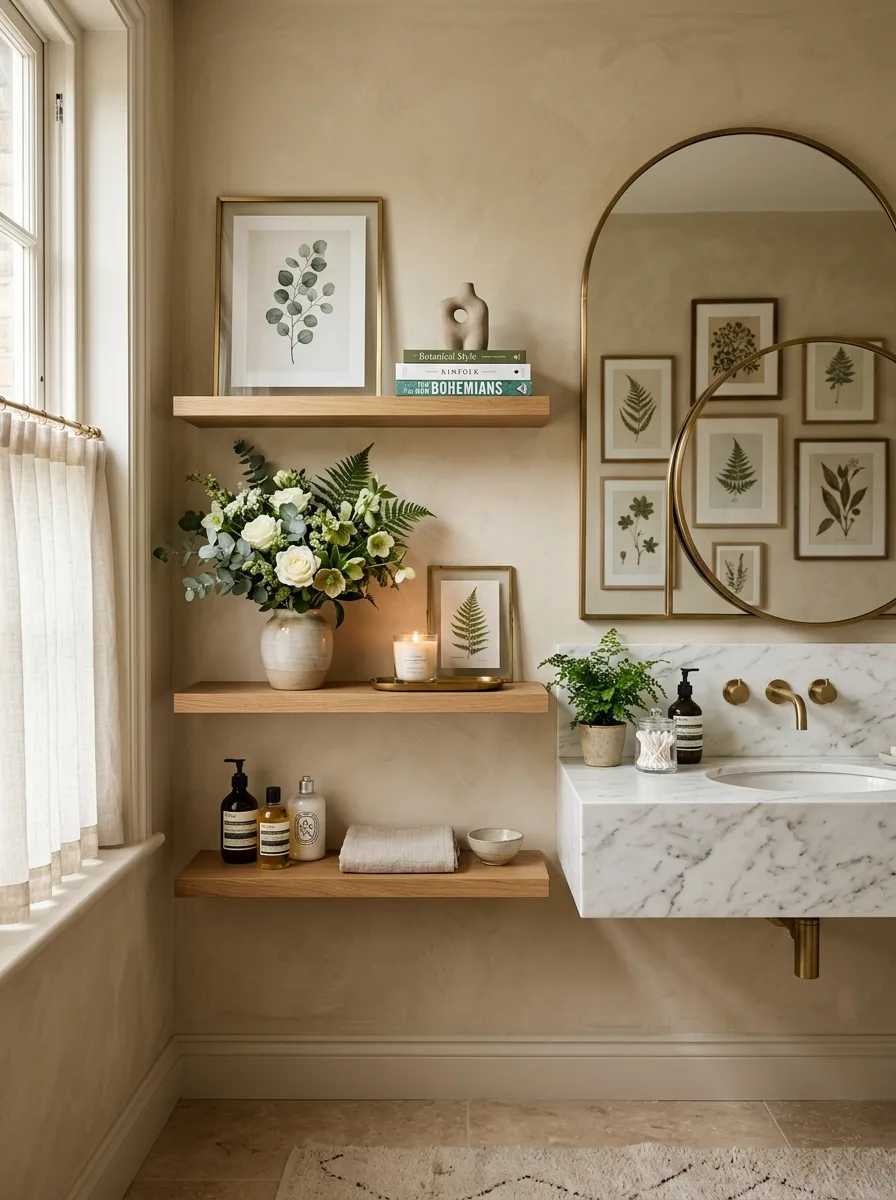
Install two or three slim floating wood shelves stacked vertically beside the vanity, rather than one wide shelf — the vertical stack draws the eye up in a narrow room. Style each shelf with a slightly different height object so the silhouette varies top to bottom.
Cluster a small gallery of framed botanical prints directly on the wall beside or behind a round mirror, letting a few frames overlap the mirror’s edge. The slight overlap is what makes a gallery wall look curated over years instead of bought in one trip.
Fill in with a loose garden-style bouquet in a simple ceramic vase, a lit candle, and a stack of design books turned spine-out. Keep the palette to sage, cream, and warm wood — no bright colour breaks this look.
Leave a few inches of bare shelf on each tier. A fully packed shelf reads as cluttered even when every object is beautiful.
Rustic Wood Vanity Amenity Tray
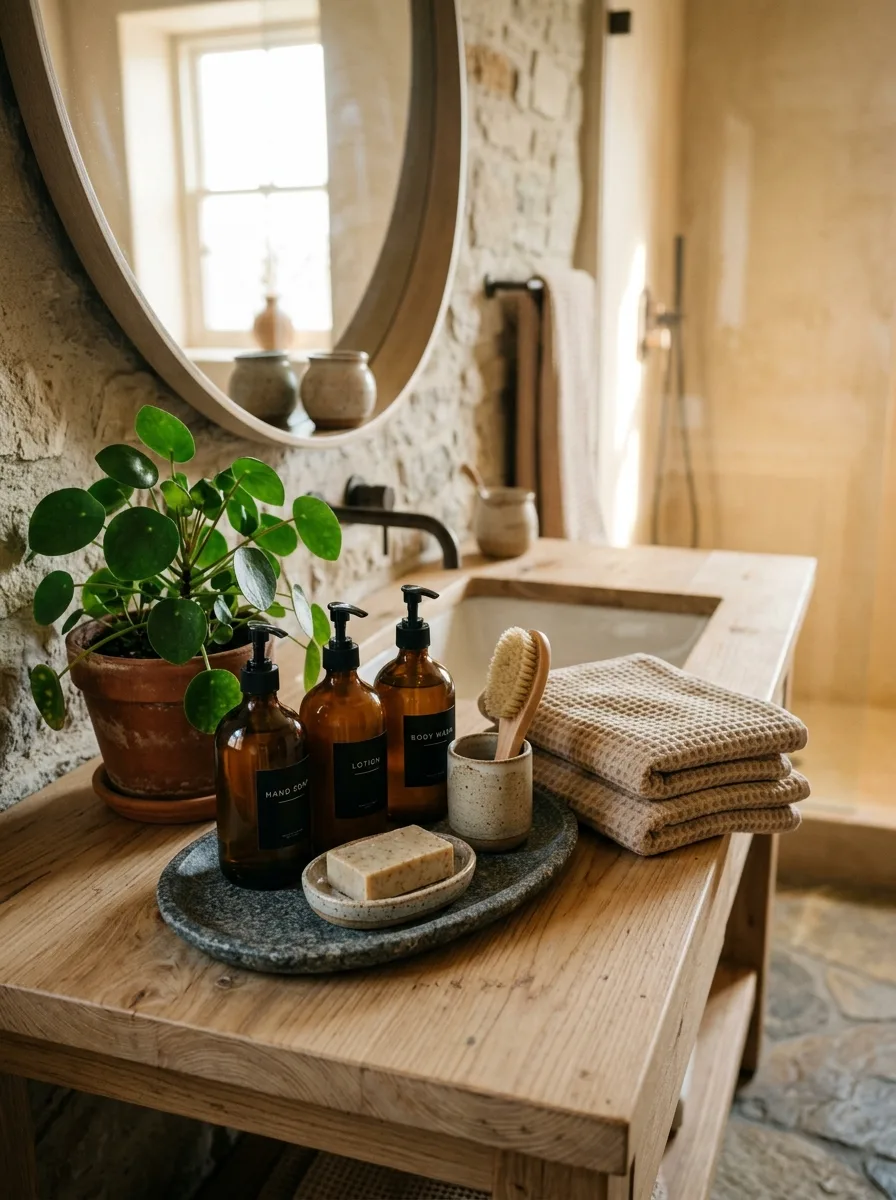
Build a vanity from raw, minimally finished wood — visible grain, slightly uneven edges — rather than a smooth painted or lacquered piece. The imperfection is the whole point of a rustic look; a too-polished wood vanity undercuts it immediately.
Group amber glass pump bottles labelled by hand or with simple printed tags on a round stone tray, alongside a natural bristle brush and a bar of visibly handmade soap. Mismatched-but-related bottle heights read better than a uniform set here.
Add a large round-leafed potted plant at the vanity’s edge — something with big, simple foliage rather than delicate leaves, to match the wood’s heft. Stack waffle-weave towels beside it, left unfolded at the edges rather than pressed flat.
Pair with black matte fixtures only. Anything shiny fights the deliberately worn, weathered mood this vanity is going for.
Sage Green Over-Toilet Shelf
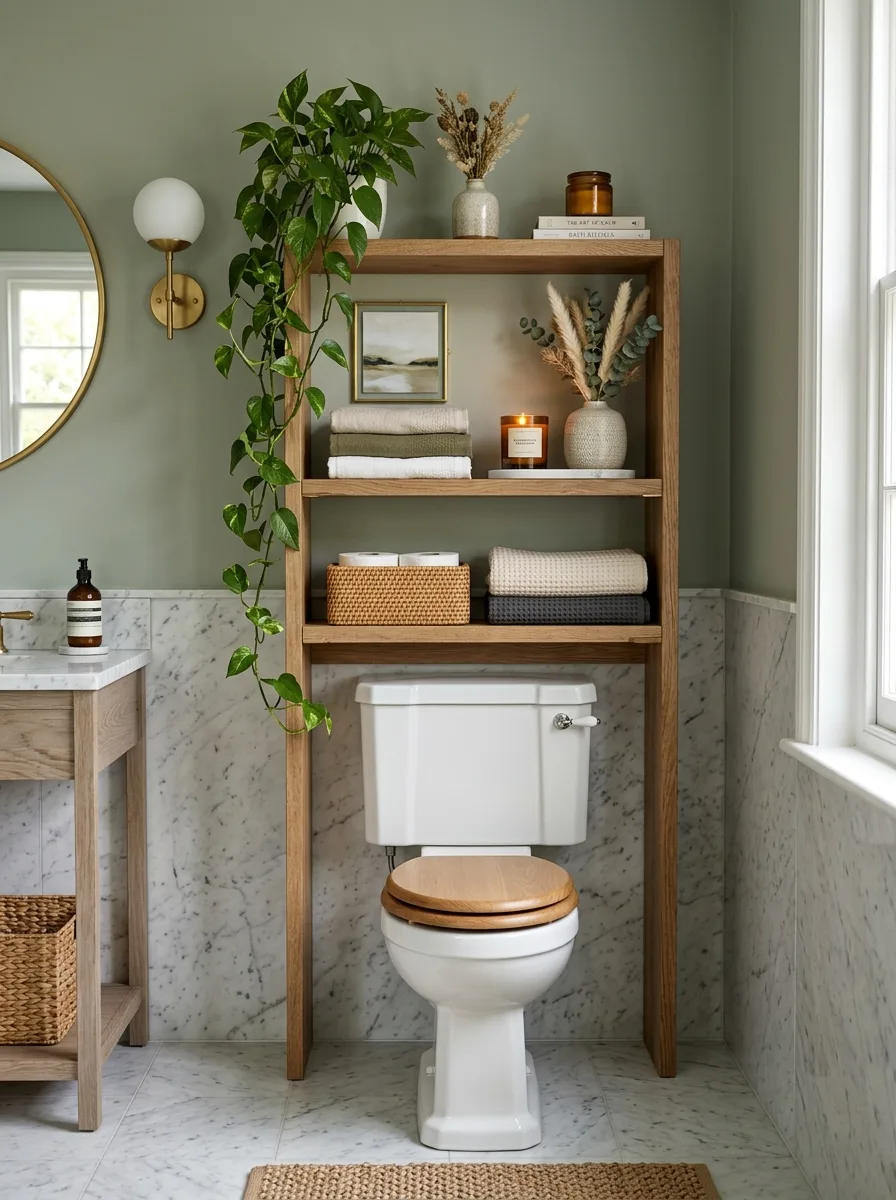
Paint the walls a muted sage green above a marble or marble-effect half-wall tile, and build a tall open wood shelf directly over the toilet to reclaim that dead vertical space. Two shelves is usually enough — more starts to feel like storage rather than styling.
Let one trailing plant spill down the side of the unit from the top shelf, unpruned enough to look alive rather than arranged. Balance it with a small framed landscape print and a dried pampas arrangement on the opposite side for symmetry.
Fold towels in two tones — cream and a deeper charcoal or olive — and stack them together on the lower shelf for contrast. A lidded woven basket underneath holds the spare rolls out of sight.
Swap the toilet seat to a matching wood finish if the budget allows. It’s a small detail that ties the fixture into the wood tones above it instead of leaving it looking store-bought and separate.
Bergamot Bottle Vanity Flatlay
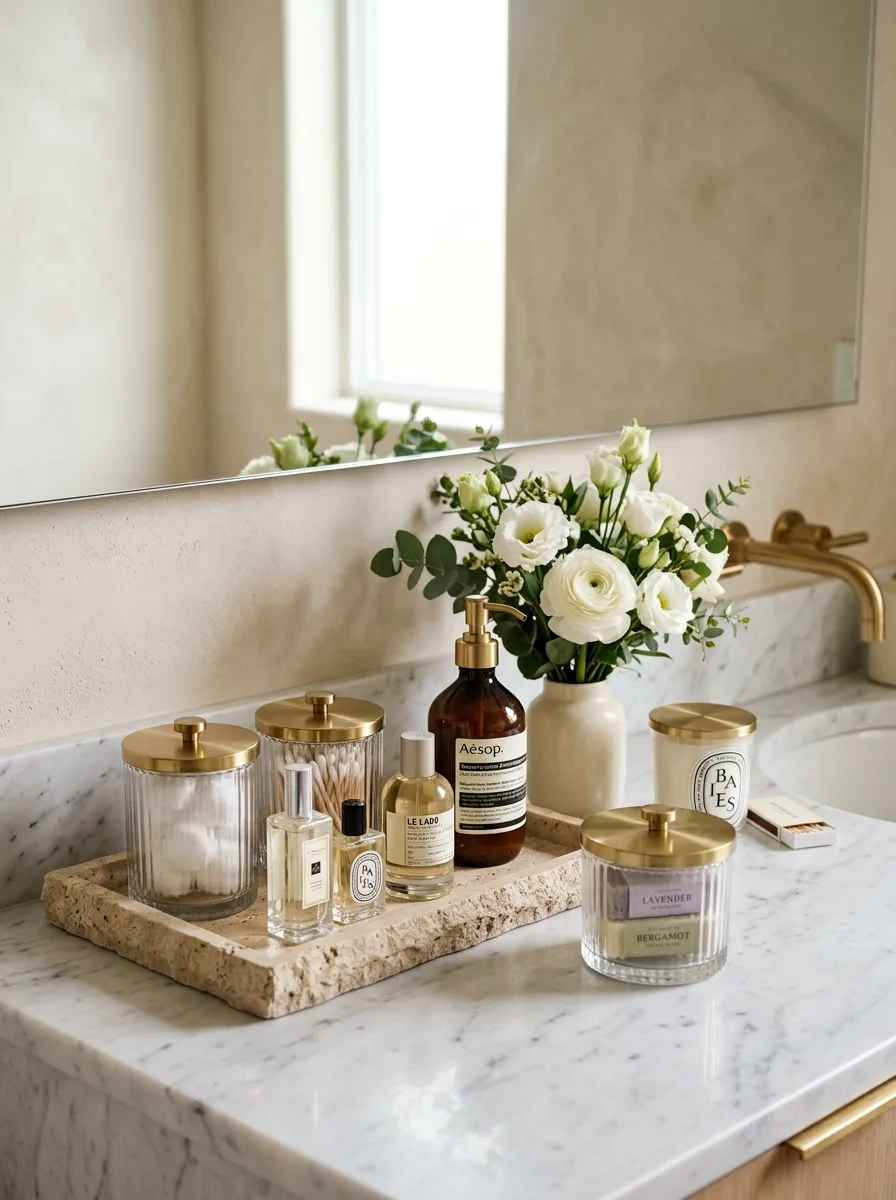
Line up three or four amenity products — soap, lotion, perfume, candle — from a single named line so the labels read as a coordinated set rather than random purchases. A shared brand or font across the labels is doing more than people give it credit for.
Rest them on a plain white or grey marble tray with visible veining, positioned just off-centre from the sink rather than dead centre. Off-centre placement looks considered; centred placement looks default.
Tuck in a small bud vase of white ranunculus and eucalyptus, angled to lean slightly rather than standing perfectly upright. A stray, unlit match box beside the candle adds a lived-in, hospitality-brand touch.
Keep the surrounding counter otherwise completely bare. This entire look depends on everything else in the frame staying empty.
Final Thoughts
None of these rooms are large. Most of them are smaller than a walk-in closet. That’s exactly why they work as well as they do — small spaces punish indecision and reward commitment in equal measure.
Every one of these looks is built on the same three choices repeated with different materials: pick a palette and hold it, pick a texture story and layer it, pick a lighting mood and protect it from anything that dilutes it.
What separates a forgettable bathroom from a memorable one is never budget. It’s whether every object in the room was actually chosen, or just placed.
Walk back into your own bathroom and ask which one you’re looking at. The answer is usually obvious within about four seconds — which, coincidentally, is about how long a guest spends deciding the same thing about you.