
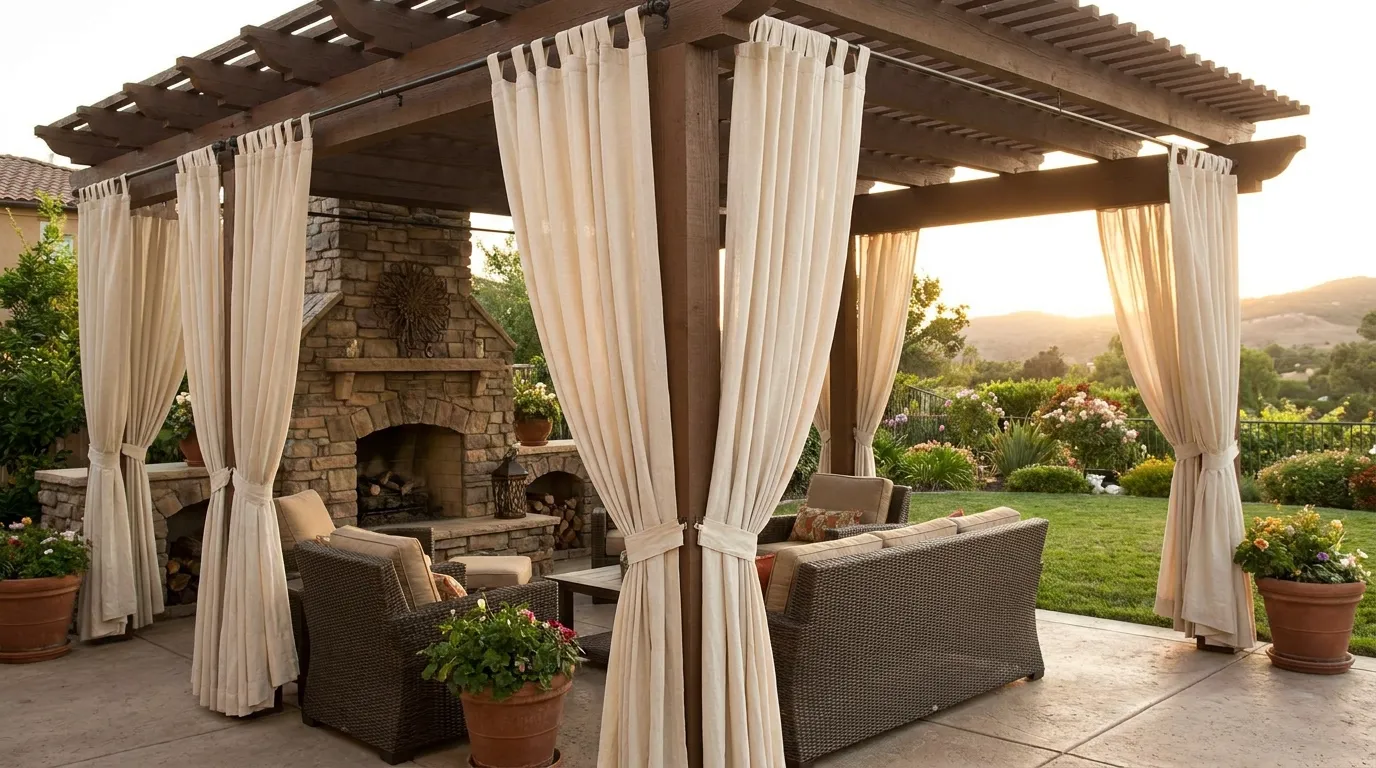
Your pergola is structural. It’s also, right now, probably doing the bare minimum.
It has posts. It has beams. It has that satisfying shadow pattern on the patio at two in the afternoon. What it does not have is any sense that someone lives here and made a decision.
Outdoor curtains are the decision. They are the difference between a pergola and a room. Between a patio and a destination. Between furniture that happens to be outside and a space that actually pulls you out of the house.
The part nobody tells you is how easy this is to get wrong. The wrong fabric, the wrong length, the wrong colour — and the whole thing looks like you stapled tablecloths to your fence. The right choices, and your backyard looks like a hotel you’d actually want to stay at.
The Curtain Decisions That Change Everything
There are approximately twelve thousand outdoor curtain options available and most of them look fine in a product photo and terrible in a real garden. Here is what separates the ones that work.
Fabric Is Not Just Aesthetic
The single most important decision is whether your fabric can actually live outside.
Solution-dyed acrylic — most commonly sold under the Sunbrella brand — is the gold standard. The colour is baked into the fibre rather than printed on top, which means it fades very slowly, resists mould, and cleans with soap and water. It handles rain, UV, and the kind of general outdoor neglect that destroys lesser textiles within a season.
Polyester outdoor fabric is the more affordable alternative. It performs well enough in covered spaces where it won’t be rained on directly. In an uncovered or partially covered setting, it will start to degrade in the second or third season.
Cotton and linen curtains belong indoors. They look beautiful for approximately one month before the damp sets in and the mould begins. If the aesthetic of natural linen is what you want — and it is genuinely lovely — buy an outdoor fabric that replicates the look. They exist. Use them instead.
The Length Matters More Than You Think
Outdoor curtains should graze the floor or puddle very slightly. The instinct to hang them short — to keep them off the ground, away from dirt and moisture — produces a curtain that looks like it shrank in the wash.
Floor-length curtains make a pergola feel like a room. Curtains that stop at mid-post height make a pergola feel like it has a curtain problem.
The practical workaround is to hem them to just touching the patio surface — no puddling, no gap. Hire this out if you’re not confident with a sewing machine, or use iron-on hem tape. The difference in the finished look justifies the extra step.
Hanging Method Sets the Tone
Tab-top and loop curtains have a relaxed, unfussy quality that suits natural and coastal settings. They work on a simple rod or wooden dowel and require nothing more technical than threading.
Grommet-top curtains slide more easily, have a cleaner silhouette, and suit modern or structured pergola styles. The rings need to be a size larger than the rod to move smoothly.
Clip rings give you maximum flexibility because you can use any top treatment — a flat panel, a sewn heading, even a piece of fabric with no heading at all.
What you should avoid: curtains that bunch at the top because the rod is too thin, or that sag in the middle because the rod spans too wide without a centre support. A 3-metre span of curtain rod with no bracket in the middle will bend visibly under the weight of the fabric. Add a centre bracket.
Getting the Structure Right Before Anything Goes Up
The curtains will only look as good as the hanging system that supports them. This part most people rush.
Rod Placement Relative to the Beam
Mount the curtain rod as close to the top of the pergola beam as possible. A rod hung six inches below the beam produces a gap of bare wood above the curtain that looks like a measurement error.
Use a rod that finishes flush with — or just inside — the pergola post on each side. Curtains that extend beyond the post edge flutter outward in wind and look untethered from the structure.
For a pergola with exposed beams, heavy-duty conduit or simple black steel pipe works better than decorative indoor curtain rods. Decorative rods look domestic and thin next to the scale of timber pergola beams.
How Many Curtains Per Opening
Each opening — the gap between two pergola posts — should have enough fabric to close fully if you want it to, plus enough to look generous when open.
The rule for fullness is that the total curtain width should be 1.5 to 2 times the width of the opening. A 1.2-metre opening needs at least 1.8 metres of curtain fabric, divided across however many panels you’re using. Two panels of 90cm each gives you the right fullness.
Panels that are exactly the width of the opening look flat and thin. You want enough fabric that the closed curtain looks rich and the open curtain ties back in a generous bundle.
Weight and Hem Weighting
Outdoor curtains catch wind in a way indoor curtains never have to handle.
If your patio is exposed or catches a regular breeze, add curtain weights to the hem. These are small metal discs sewn into the bottom hem at intervals of roughly 30cm. They cost almost nothing and are the difference between a curtain that drapes elegantly and one that billows horizontally every time someone opens a door.
Alternatively, leave a generous hem pool on the patio surface. The weight of fabric on the ground acts as its own anchor. This only works in sheltered spots and requires accepting that the hem will get dirty and worn over time.
Outdoor Patio Curtain Ideas
Cream Pergola With Rattan Shades
Hang floor-length curtains in an unbleached natural white on two facing sides of a dark-stained timber pergola using tab-top loops on a simple wooden dowel. The fabric should be a medium-weight outdoor canvas in cream — not stark white, not ivory, but the colour of undyed cotton. Use a solution-dyed acrylic in this tone if possible; it resists yellowing from UV exposure.
Pair the curtains with a slatted rattan shade cloth across the top of the pergola, the kind that comes on a tension wire system. The shade cloth allows dappled light through while taking the direct sun off the space below. For seating, choose black iron chairs with white cushions. Hang two or three woven rattan pendant lights within the pergola at different heights on a simple pendant cord. The resulting palette — cream, warm wood, black metal, rattan — is about as close to effortless as outdoor design gets.
Deep Green With Hanging Ferns
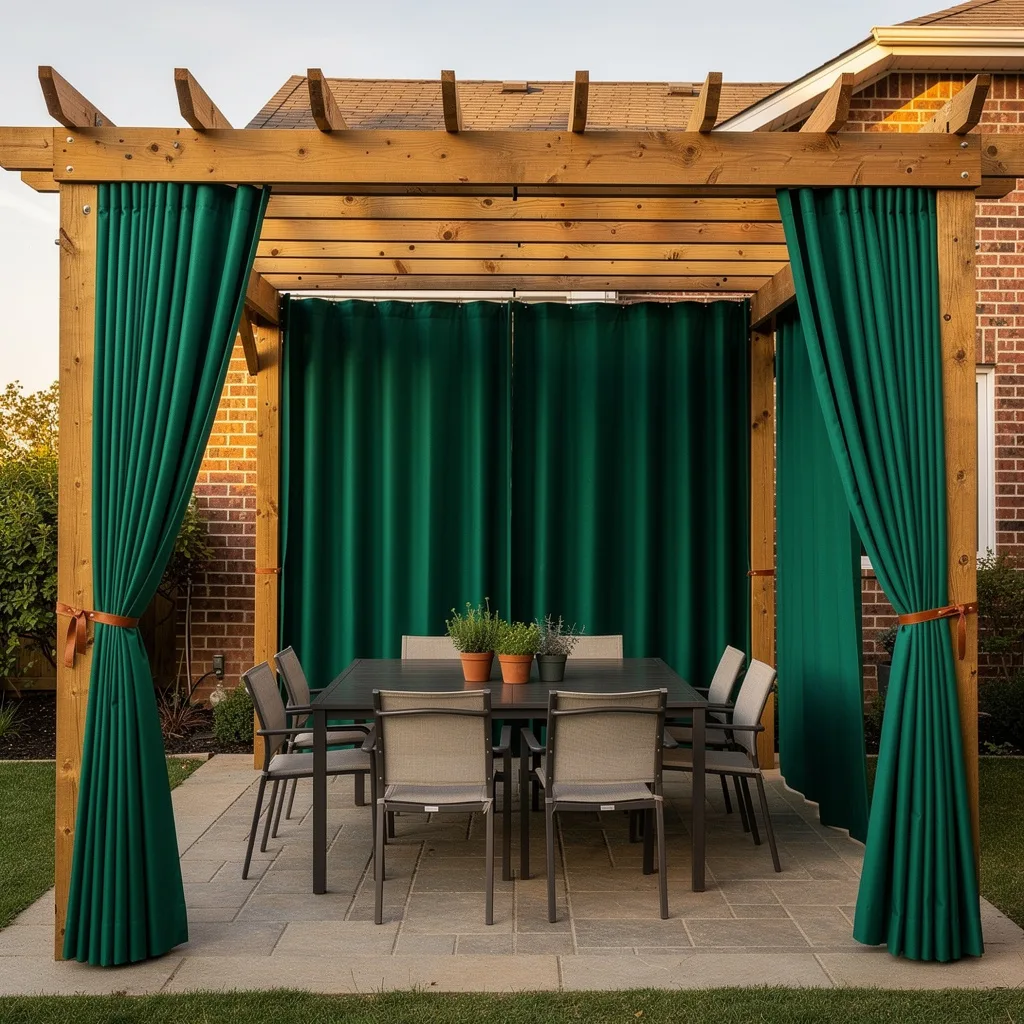
Mount a single wide blackout panel in deep khaki green across the full back width of a timber pergola using grommet tops on a matte black rod. This acts as a backdrop panel rather than a privacy curtain — it defines the rear of the space and gives the eye somewhere to rest.
From the same black rod, hang three hanging basket ferns — Boston or sword ferns work well — using black chain at staggered heights between 40 and 70cm below the rod. The ferns cascade in front of the curtain panel, layering texture against the flat fabric. The combination of the dark solid green behind and the lacy fronded green in front creates depth with almost no effort. On the sides, leave the pergola open or add a lighter panel in a warm neutral.
White Sheer With String Lights
Use sheer outdoor voile in white — specifically, a voile rated for outdoor use, which is different from indoor sheer linen. Hang two wide panels from a pergola beam using tab tops, gathered loosely at about two-thirds of the post height and tied with a simple knotted rope tieback. Allow the rest of the panel to fall freely to the ground.
String commercial-grade bulb string lights across the top of the pergola frame above the sheers. These are the lights with exposed bulbs spaced 30–40cm apart, not the small fairy-light variety. The light passing through the sheer voile at night creates a diffuse, milky glow that is genuinely beautiful and easy to achieve. Add a hanging basket planter or two between the post and the house wall for softness.
Macramé as Curtain Panels
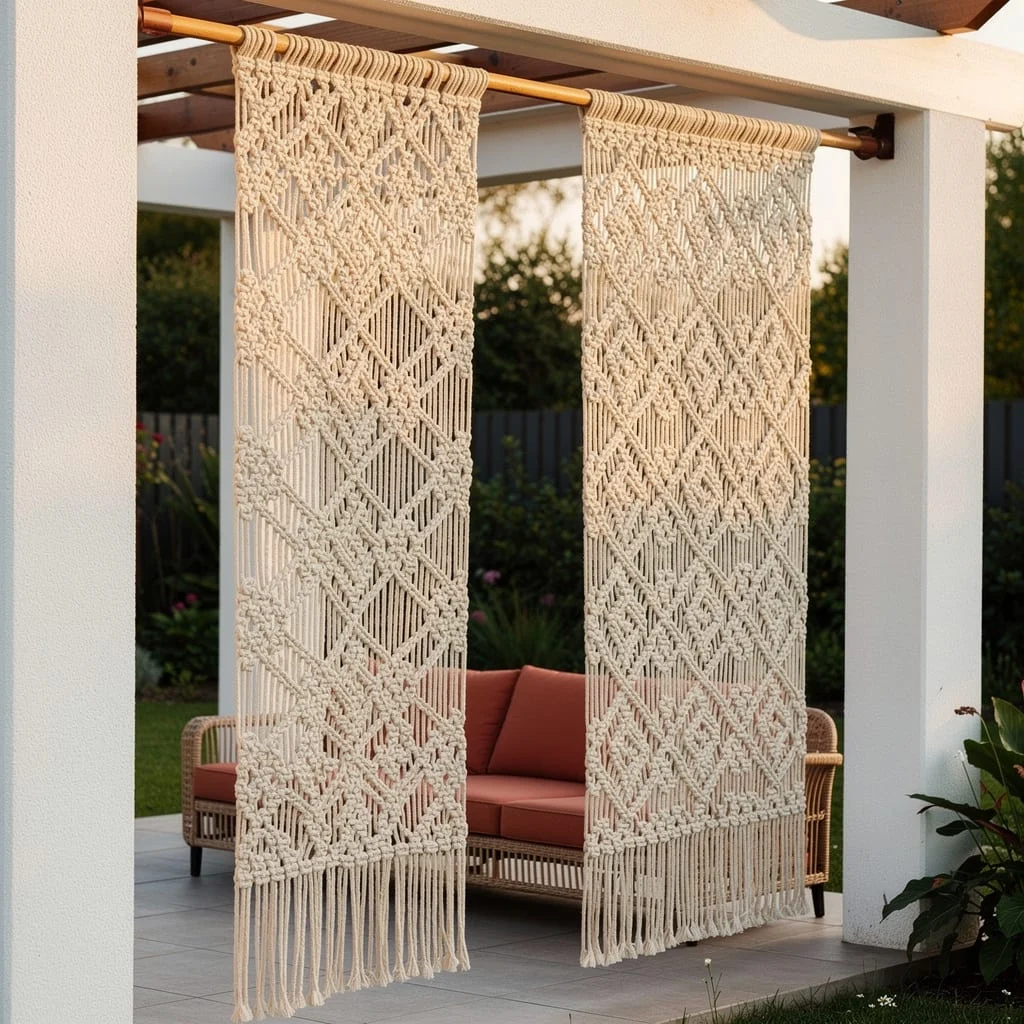
Source or commission macramé wall hangings in a diamond knot pattern, wide enough to fill each opening between the pergola posts. These should be hung from a natural timber dowel — oak or bamboo — mounted to the pergola beam using chunky wall-mount brackets in a copper or bronze finish.
Macramé panels allow wind through, filter light without blocking it, and add texture that no woven or printed fabric can replicate. They are not weatherproof in the traditional sense and should be brought inside if heavy rain or sustained wet weather is expected. In a covered pergola or a climate with dry summers, they last well.
The key styling decision is what sits behind them. A simple terracotta sofa, woven rattan seating, or linen cushions in dusty pink all work because they let the texture of the macramé read clearly. Too much competing pattern behind the panels and the whole effect collapses.
Terracotta Linen-Look Pergola Wrap
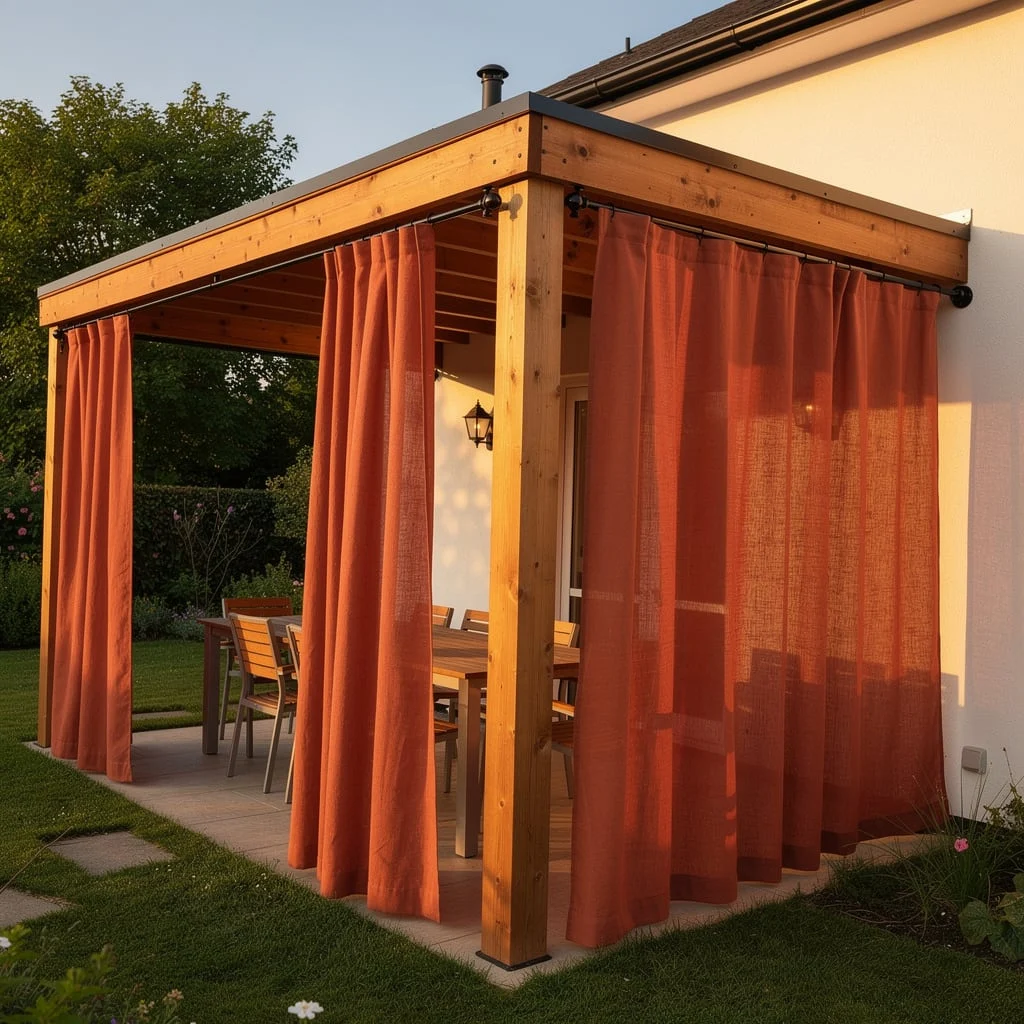
Dress an entire freestanding timber pergola in terracotta curtain panels on three sides, leaving the entry side open. Use a medium-weight outdoor fabric in a linen texture — the goal is warmth and earthiness, not slickness. Mount a curtain rod along each beam face and hang the panels using clip rings so each curtain can be slid open fully.
At dusk, terracotta curtain fabric catches the warm ambient light and glows. It pairs with the natural pine or cedar timber in a way that feels genuinely harmonious rather than colour-matched. The back two panels form the wind-blocking sides; the front two panels frame the entry. Inside, use a timber dining table with simple benches. Keep the accessories sparse — a few terracotta pots, nothing else.
Black and White Stripe Beside the Pool
Use a bold alternating black and white stripe in a 5cm repeat — not a narrow ticking stripe, not a broad awning stripe, but something firmly in the middle. Hang a single full-length panel from each post of a white-painted pergola. The curtain should be wide enough to close fully if needed but is primarily shown open and held back with a fabric self-tie in the same stripe.
Echo the stripe in the chair cushions: choose seating upholstered in the same or closely related fabric. The yellow accent pillow in the chair does the work of stopping the scheme from feeling too graphic — add one warm-toned throw pillow or cushion in mustard, amber, or terracotta. This scheme demands commitment. Half-doing it — a few panels, mixed with plain fabric — loses the theatrical quality that makes it work.
Charcoal Mesh on a Modern Pergola
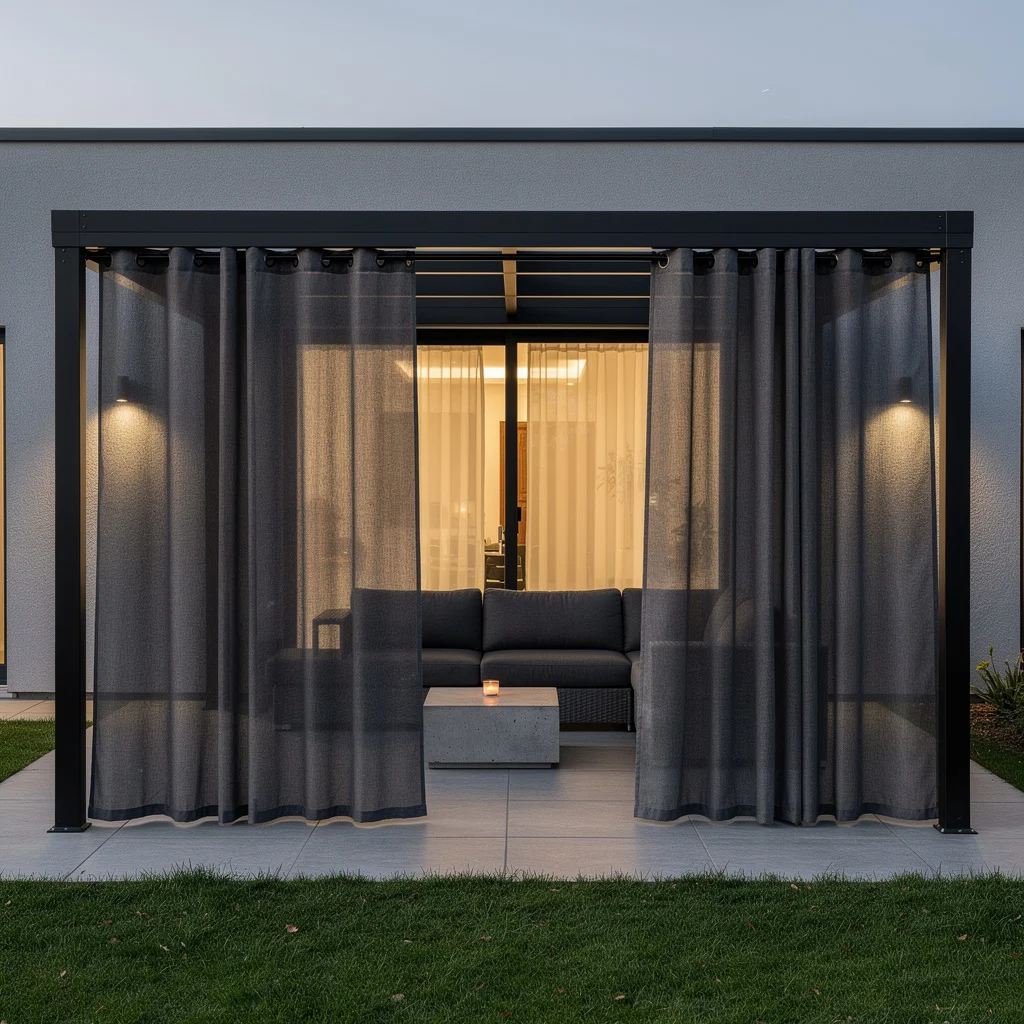
This setup is for a powder-coated aluminium pergola with clean lines and no decorative detail. Hang charcoal grey outdoor mesh panels on grommet tops from the pergola’s horizontal rails. The fabric should be a semi-transparent mesh — not blackout, not fully sheer — that filters the view rather than blocking it completely.
The transparency serves a purpose. From outside at night, the warm light of the interior glows through the mesh in a way that is genuinely cinematic. Two slim wall-mounted exterior sconces on the house wall inside the pergola provide directional light. A concrete-topped coffee table and charcoal modular sofa complete the setup. Nothing in this scheme competes with the architecture.
Forest Green Stripe Cabana
This is a pool cabana approach. Hang wide-stripe curtains in a deep forest green and white from every post of a white-painted pergola, with enough panels per opening to close the space fully into a cabana. Use curtain tiebacks in the same fabric to hold each side panel back when the space is open.
Match the cushion colour exactly to the curtain stripe — the same green, the same white, the same proportion. This kind of total colour coordination, where the curtains and the furniture fabric feel like they came from the same bolt, is what makes outdoor spaces look styled rather than assembled. Inside the closed cabana, add a simple dining table and timber chairs. The enclosed effect, with striped curtains on all four sides, turns a patio structure into a destination.
Reed Rollup Blinds
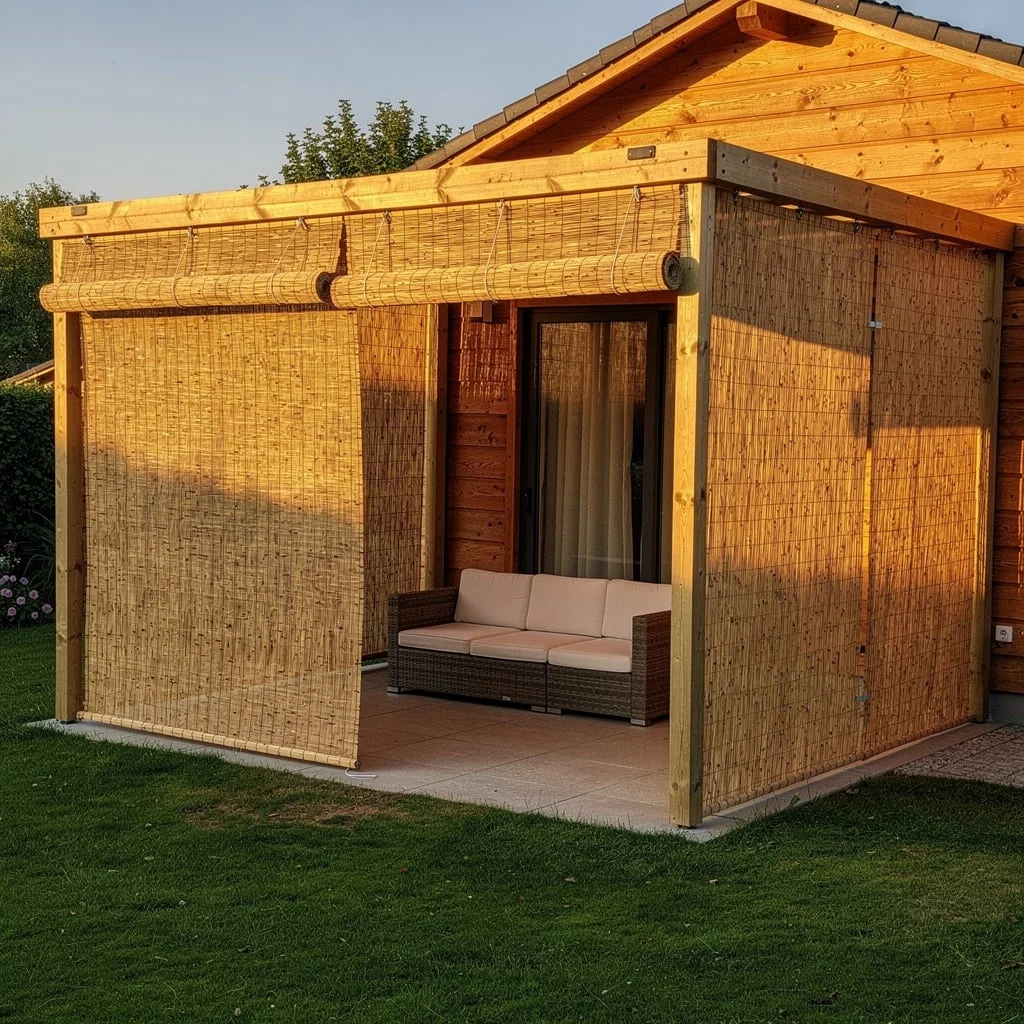
Source exterior reed blinds — made from stripped and woven river reed or bamboo reed — wide enough to cover each face of the pergola. These roll up at the top using a simple cord-and-cleat system, identical in function to a Roman blind but operating at a much larger scale.
Mount the blinds inside the pergola frame so each one is recessed within the beam rather than hanging in front of it. This gives a neater finish. When fully lowered, the reed panels create a warm, amber-tinted enclosure that filters sunlight beautifully. At golden hour, light through reed blinds is one of the most atmospheric effects available in outdoor design, and it costs a fraction of what fabric curtains do.
Mixed Neutral Linen Panels
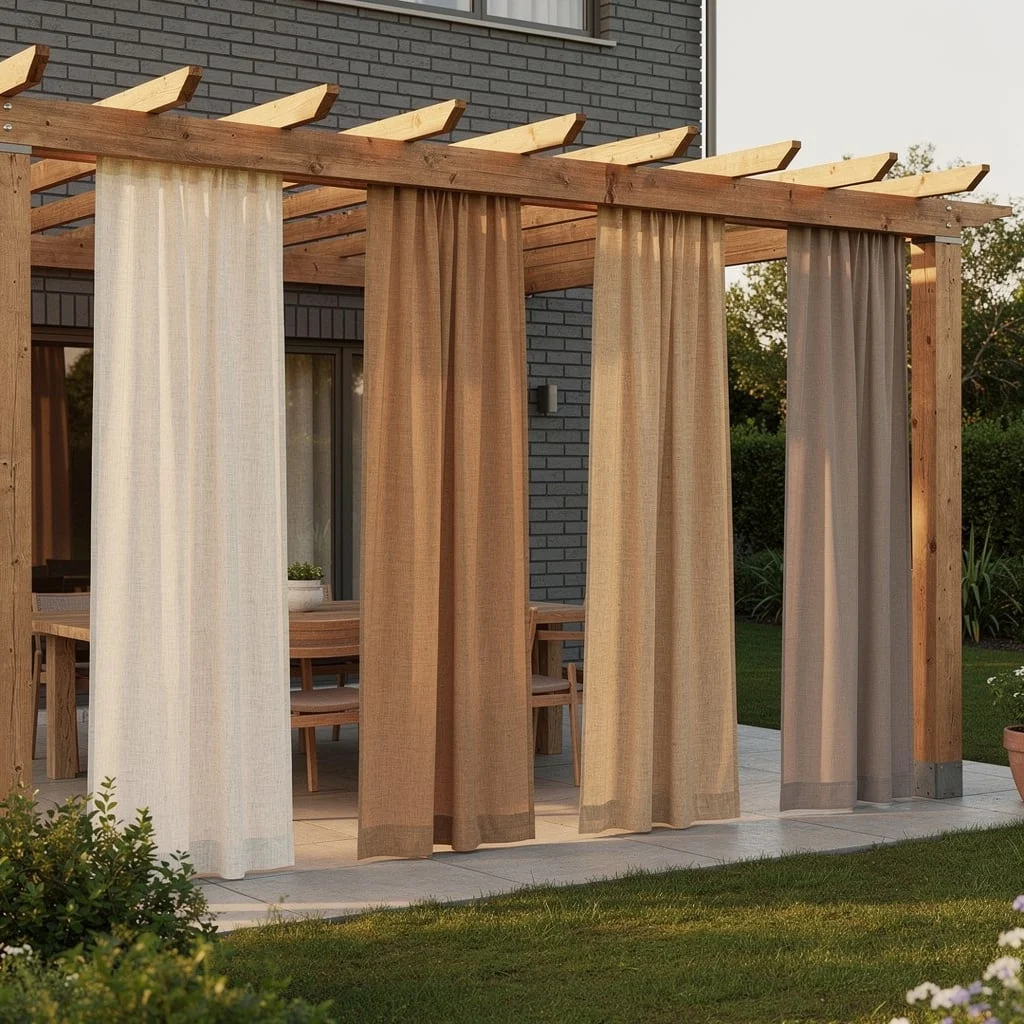
Use two different but adjacent tones of outdoor linen-texture fabric — one in off-white and one in warm greige — and hang them alternating across the pergola openings. Not patterned. Not striped. Just two different neutrals, alternated per panel.
The visual effect is subtle and interesting: close enough in tone to read as one cohesive scheme, different enough that the eye catches the variation. Mount on a simple wooden or natural-look rod with tab tops. This approach works particularly well on a traditional timber pergola because the material warmth of the fabric matches the warmth of the wood.
Olive Green With Fern Detail
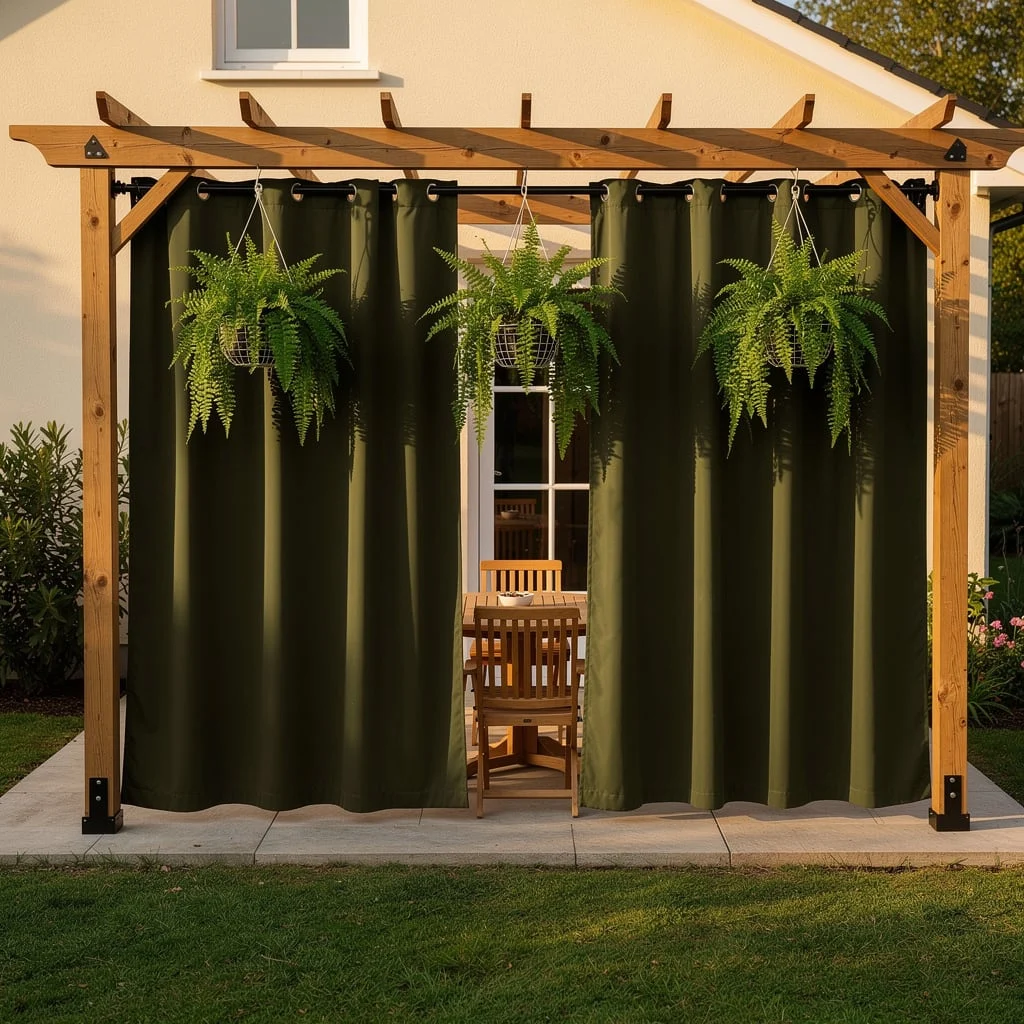
Run a full-width panel of solid olive green outdoor fabric across the back of a cedar pergola, using grommet tops on a matte black rod that spans the full interior width. Use this as the privacy and wind-blocking element at the rear, leaving the two side openings and the front face unenclosed.
Hang three hanging fern baskets from the same rod at evenly spaced intervals, each on a length of black chain. The fern fronds trail down across the upper third of the olive curtain. This is the opposite of the maximalist all-around curtain setup — it’s a single anchoring element that does the decorative and practical work simultaneously.
White Sheer Coastal Deck
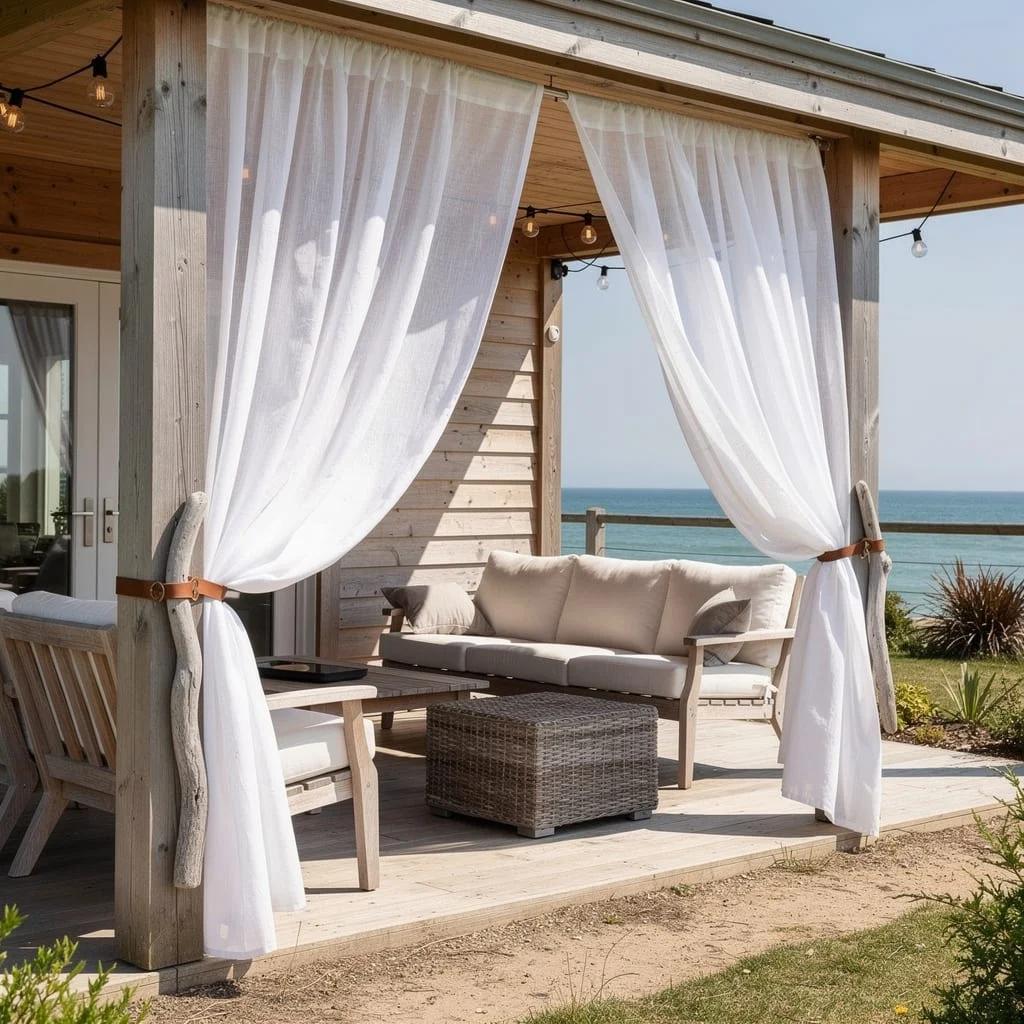
On a weathered timber deck structure — pale, silvered wood, not dark stained — hang sheer white outdoor curtains from a ceiling-mounted rod using tab tops. Use a cotton-look outdoor voile that has genuine movement in the breeze. The fabric should be loose and lightweight rather than structured.
Tie each panel back at roughly hip height using a strip of tan leather — a single loop, knotted or press-studded — rather than a fabric tieback. The leather detail against the white sheer is the design element that elevates this above generic beach-house styling.
Inside the structure: weathered teak furniture, linen-toned cushions, a woven rattan coffee table. The key to this look is restraint in every other element. The curtains are the feature. Everything else supports them.
Cream Curtains With Edison Lights
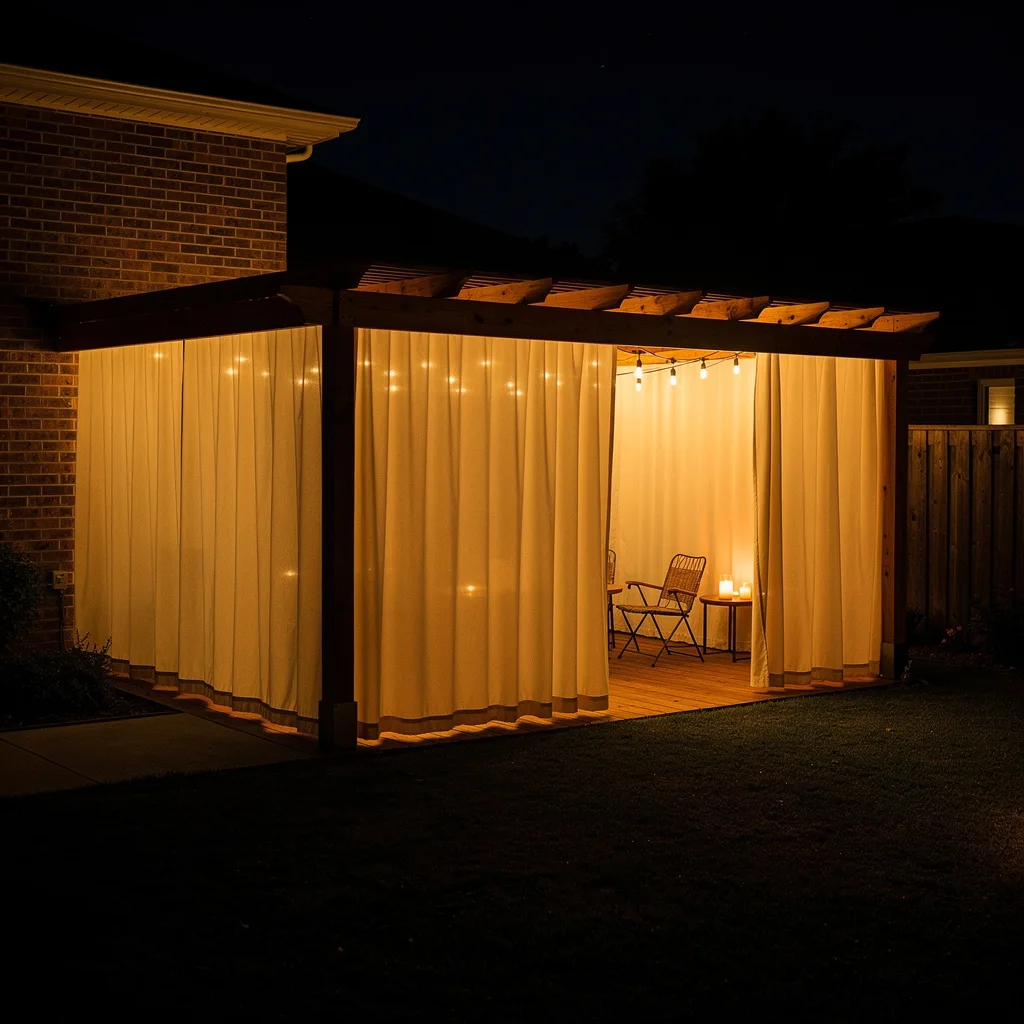
Hang floor-length cream outdoor curtains across all four faces of a dark timber pergola on a black curtain rod, leaving one face partially open at the front as the entry. Use a medium-weight solution-dyed fabric, not sheer, that diffuses rather than blocks light.
String Edison-style filament bulb lights in a simple zigzag pattern across the interior ceiling of the pergola, attached to small screw hooks in the beams. At night, the warm amber glow of the Edison bulbs passes through the cream curtain panels and illuminates them from inside, turning the structure into a glowing lantern visible from the house and garden. The effect requires almost no additional styling — the lit curtains do all the work.
Charcoal Freestanding Curtain System
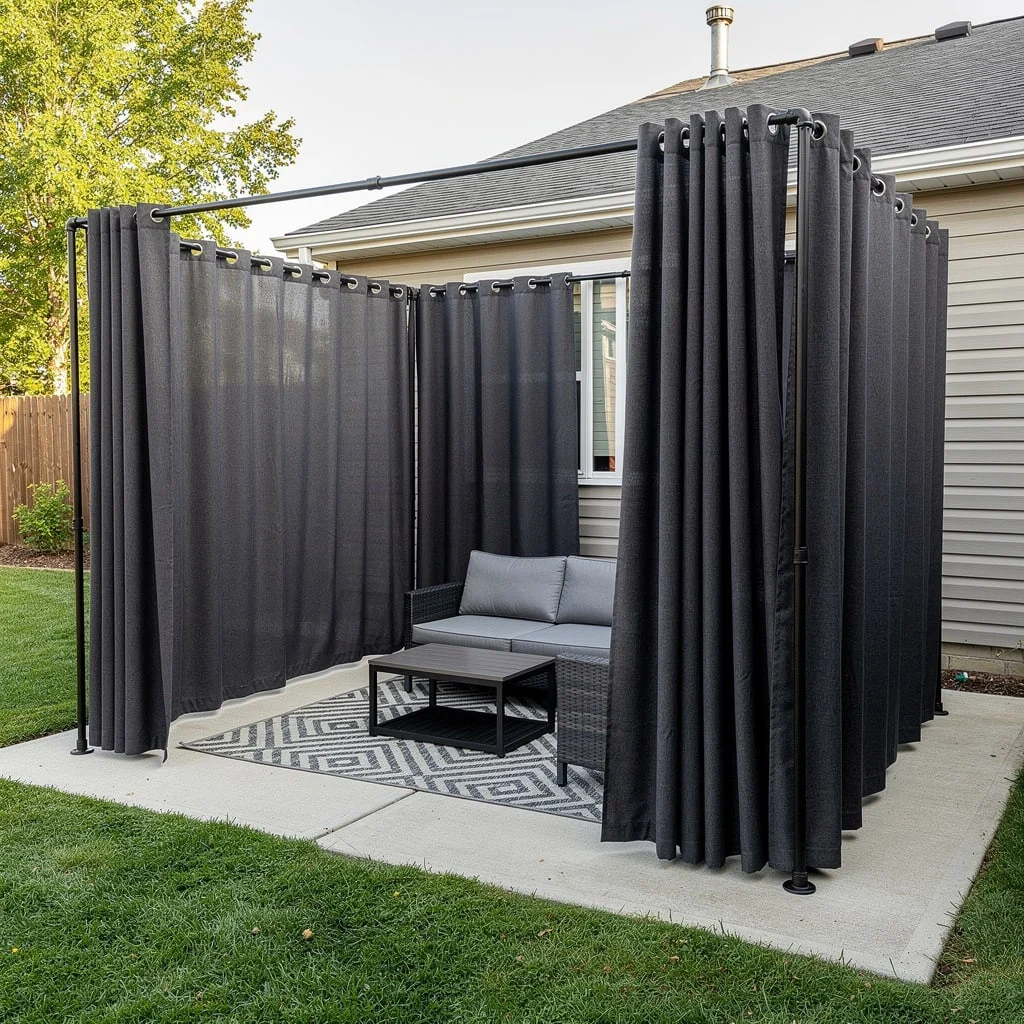
Use a freestanding curtain system built from industrial black pipe — the kind used for loft-style clothing racks — assembled into an L-shaped or U-shaped frame. Install adjustable feet on each pipe leg so the frame sits level on the patio surface without drilling.
Hang charcoal grey outdoor curtains in grommet tops from the horizontal pipe rails, packing the curtains fully to achieve maximum coverage when closed. The freestanding system means this can work on any patio without a pergola structure. The all-dark palette — charcoal curtains, black pipe frame, grey modular furniture — requires one point of visual contrast to avoid reading as heavy: a geometric patterned outdoor rug in a pale tone laid within the space.
Sheer Balcony Wrap
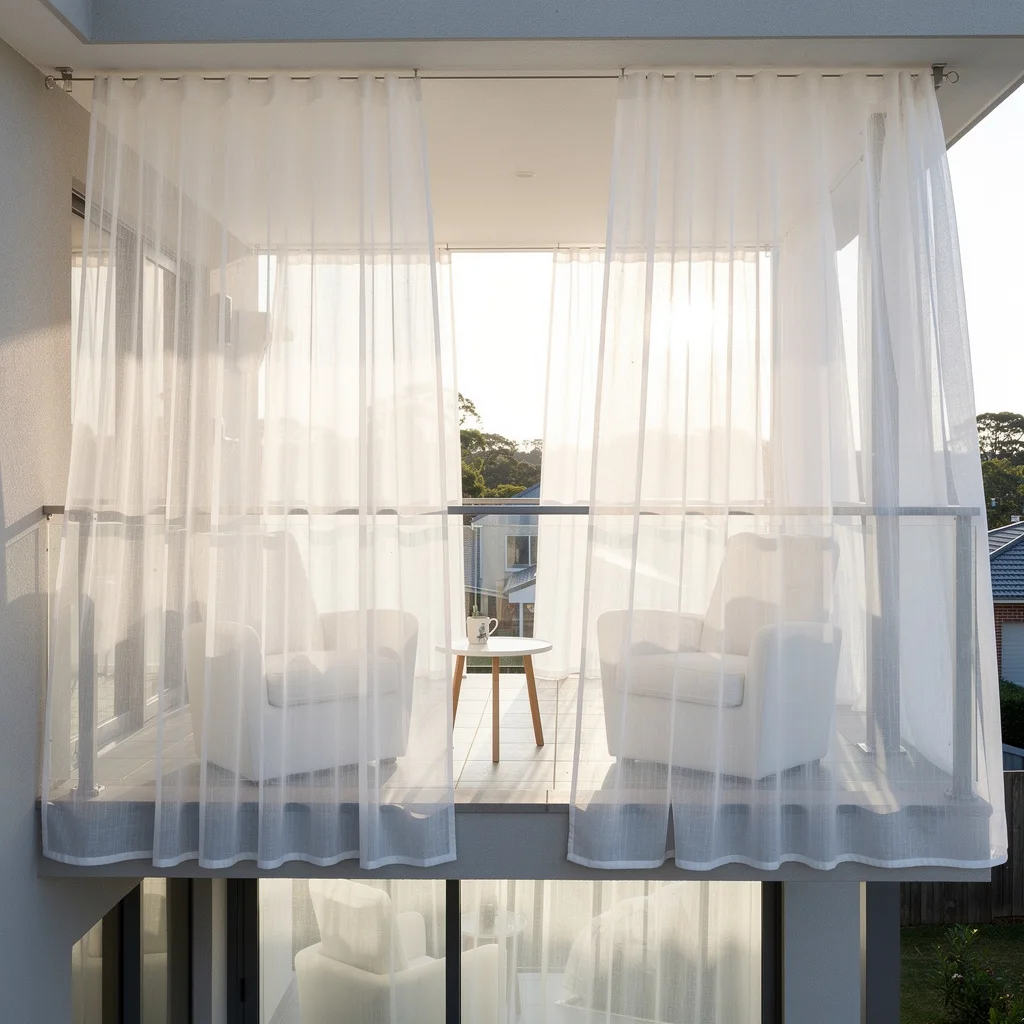
For a first-floor balcony with a ceiling-mounted curtain track, run multiple panels of white outdoor voile across the full perimeter of the balcony opening. Mount the track flush to the ceiling so there is no gap between the top of the curtain and the soffit.
The curtains should overlap at the corners so there are no gaps when drawn. Use a track system with a simple cord draw rather than a rod, because rod-on-rod corners always have a gap problem. In morning light, the sun passes directly through the sheers and fills the balcony with diffused light. Two armchairs and a small side table is all that’s needed inside. The sheers frame the view while taking the edge off wind and direct sun.
Dusty Pink With Rattan Lights
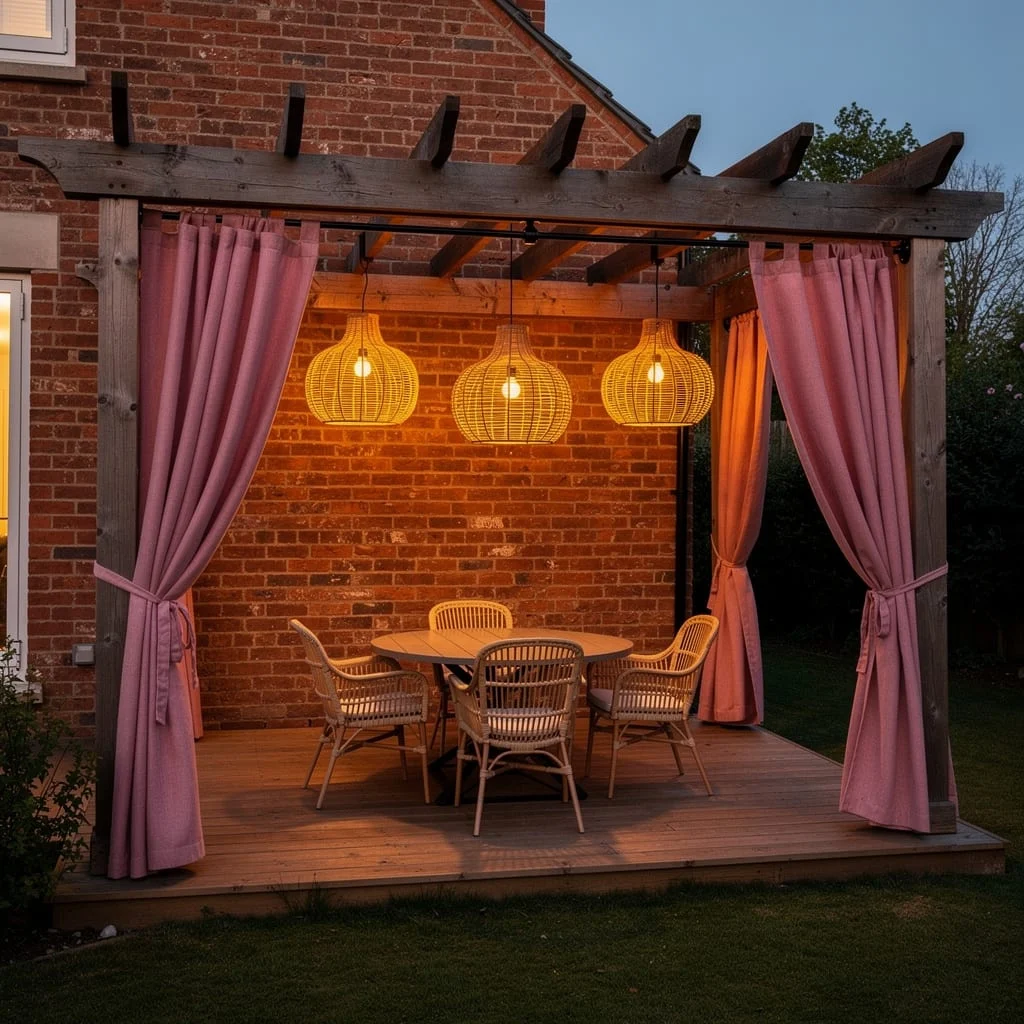
Hang dusty pink — not bright pink, not nude pink, but the specific muted rose tone — outdoor curtain panels from a black metal rod mounted to a dark-stained timber pergola. Two panels on the front face, tied back at mid-height, and two panels on each side that close fully.
Three large woven rattan pendant lights hung at the same height from the pergola beams provide the ambient lighting. The rattan acts as a natural tiemaker between the warm timber and the rose pink fabric. At dusk, the warm bulb light from inside the rattan shades turns the whole scheme — red brick wall behind, pink fabric, warm timber — into something that looks genuinely expensive.
Tropical Print Monstera Panel
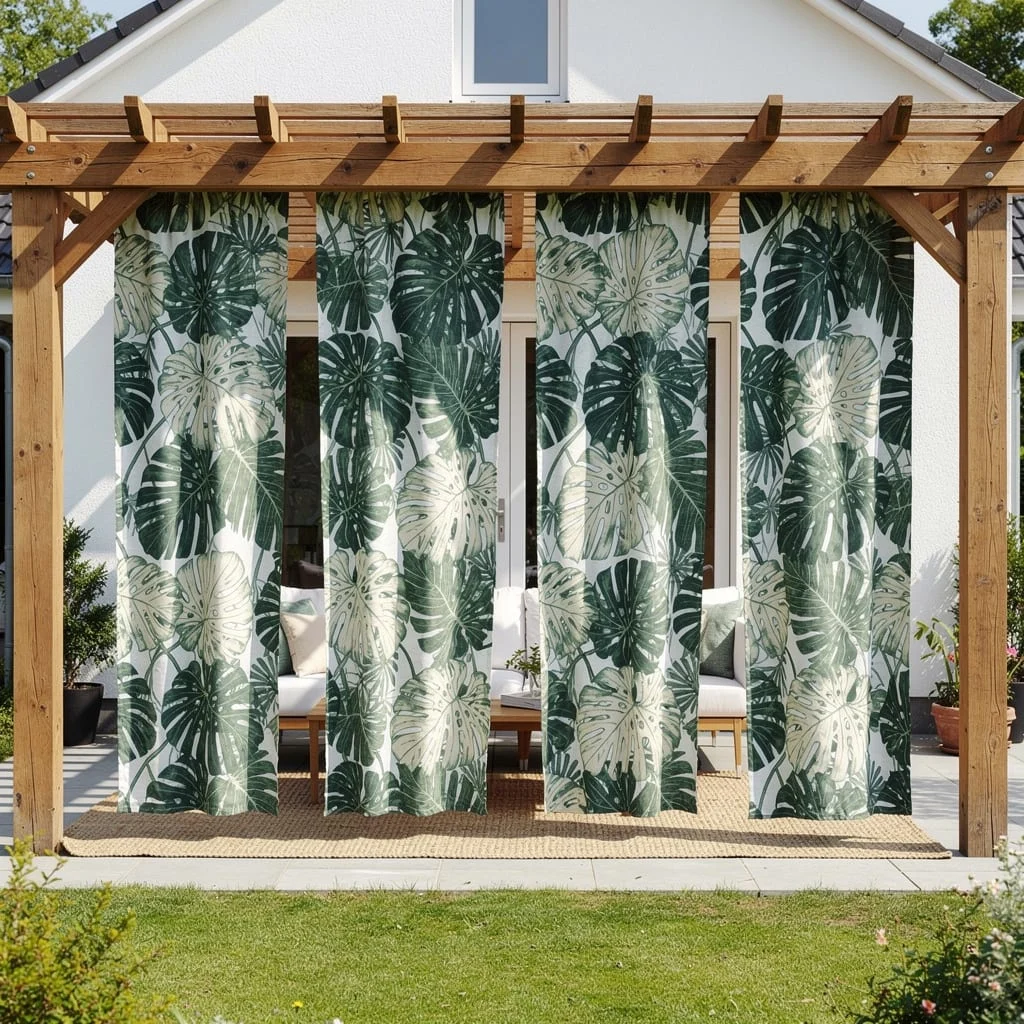
Use a large-scale tropical print in dark green and white on an outdoor-rated fabric — monstera leaf patterns work because the bold graphic scale reads clearly from a distance and doesn’t get lost in the outdoor context the way small patterns do.
Hang two wide panels from the front face of a pale timber pergola on grommet tops, set so the panels sit inward from the posts rather than flush with the outer face. Leave both sides fully open. The print is doing all the work here; the structure just needs to stay out of its way. Choose furniture in plain white with minimal cushions. The curtain is the statement. Everything else is quiet.
Final Thoughts
Every curtain in this post is doing the same basic job: turning an outdoor structure into a place.
The patio exists whether you hang curtains or not. The pergola posts and beams are there regardless. What curtains add is enclosure, intention, and the sense that someone decided how this space should feel.
That is, ultimately, what design is. Not the objects you buy. The decisions you make about how a place should be experienced. Curtains are one of the faster, cheaper, and more reversible ways to make that decision well.
Pick the fabric first. Then the colour. Then everything else follows.