
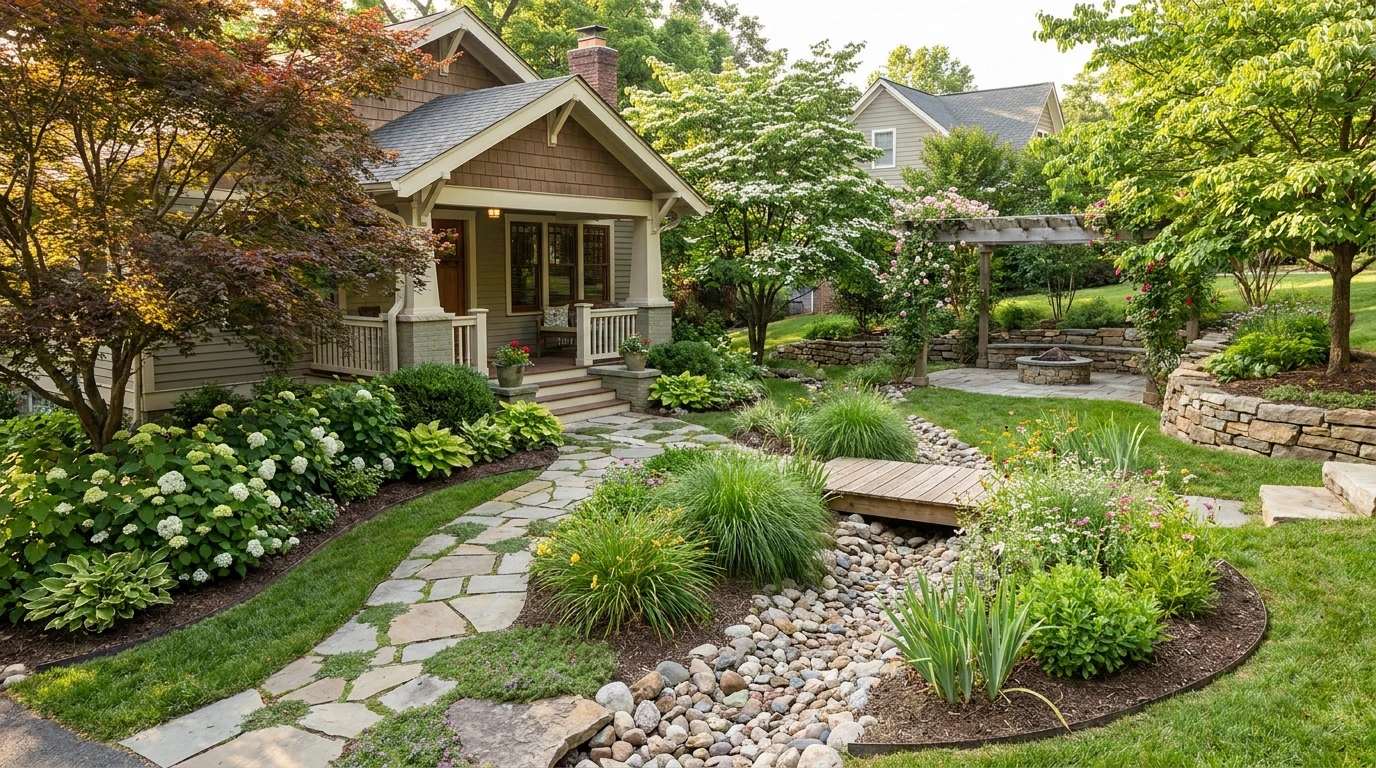
There is a version of the front yard rock bed that involves a bag of pea gravel, three shrubs from the clearance rack, and hope. It doesn’t work. The gravel gets weeds in it within six weeks, the shrubs sulk, and the whole thing reads as a half-finished project that nobody wants to finish.
Then there is the version where someone chose the rock deliberately, chose the plants to work with the rock, and understood that the ground plane and the plant are one composition — not two separate decisions made at different times at different stores. Those front yards are the ones that stop you while walking the dog.
All twenty gardens in this collection made the second kind of decision. Here is exactly how.
Rock Is Not Mulch With Better Branding
Most people approach rock as a mulch substitute — something to cover the ground so they don’t have to mow it. That mindset produces beds that look maintenance-free and also joy-free. Rock as a design material is something different. It is a colour, a texture, a contrast agent, and in some cases a structural element. It does not go down flat and get forgotten. It participates in the composition.
The Colour of Your Rock Changes Everything
White marble chips against dark stucco, black lava rock against vivid croton foliage, warm river pebbles against red brick — each of these combinations works because the rock colour is in a deliberate relationship with the house colour and the plant colour. None of them are accidents.
Before choosing a rock, hold a sample bag next to your house wall. The rock should either contrast clearly — dark house, light rock — or harmonise — warm stone house, warm river pebble. The combinations that fail are the ones where the rock and the wall compete in the same mid-tone without enough contrast to read as intentional.
Rock Depth Matters More Than Rock Choice
A 3-centimetre layer of any rock — no matter how beautiful — will have weeds growing through it within one season. The minimum effective depth for weed suppression without landscape fabric is 8 to 10 centimetres. With commercial-grade woven geotextile fabric underneath, 5 to 7 centimetres is sufficient.
Lay the fabric before the rock. Secure every edge and every overlap with 15-centimetre landscape staples. Cut planting holes with an X-cut rather than a circle, which leaves less fabric edge exposed to heave and unravel over time. A rock bed installed on proper fabric with adequate depth will stay weed-free for years. One installed without fabric will be a weed bed by August.
The Edge Is the Announcement
The boundary line between your rock bed and your lawn is where the design announces itself. A ragged, wandering edge between rock and grass tells everyone that the yard is a work in progress. A clean, consistent, intentional edge — whether cut, blocked, or bordered — tells them that someone made a decision here and followed through on it.
Steel edging, concrete block edging, stone edging, or a sharp hand-cut lawn edge are all acceptable. What is not acceptable is no edging decision at all. Choose a material, commit to it across the full bed perimeter, and maintain it.
Choosing Plants That Work With Rock, Not Against It
Rock beds run warm in summer. Dark-coloured rocks — lava, black pebbles — absorb heat and radiate it upward through the day. White or light rocks reflect heat but increase soil temperature at the root zone. This thermal environment favours drought-tolerant and heat-tolerant plants significantly over moisture-loving ones.
The Plants That Thrive
Lavender, agave, blue fescue, ornamental grasses, croton, catmint, dianthus, roses, sedum, and succulents of all kinds perform exceptionally in rock beds because they prefer drier conditions and are not damaged by reflected heat. These are not compromise plants. They are the plants that look their absolute best in the context rock provides.
The plants that suffer in rock beds are the ones that want consistent moisture and cool roots: impatiens, hostas in full sun, astilbe, and most woodland perennials. Use these in mulched beds or containers where you can control moisture. Do not fight the thermal environment of a rock bed — choose plants that find it comfortable.
Scale the Plant to the Rock
A single large aloe or agave planted in a bed of black lava rock reads with the authority of a sculpture. Three small aloes planted in the same bed look like they got lost. The scale relationship between the dominant plant and the surrounding rock matters.
Large-format rocks — boulders, white marble chunks — want large, architectural plants beside them. Small pebble groundcover — fine gravel, polished river pebbles — works with smaller, denser plantings. Matching the scale of the plant mass to the scale of the rock material is one of the most reliable rules in this design category.
Rock Flower Bed Ideas
The Tipped Pot Rock Trick
The defining element here is a large terracotta pot — minimum 50 centimetres in diameter — laid on its side and partially embedded into the rock bed at a slightly forward angle, as if it tipped over and spilled its contents. The spill is arranged as a river of mixed river pebbles — warm tan and brown stones — flowing outward from the pot mouth and merging into the surrounding white and black gravel ground plane.
Bury the back edge of the pot 10 to 15 centimetres into the bed to stabilise it and prevent rolling. Fill the interior of the pot with the same river pebbles used in the spill arrangement, so the eye reads the pot-interior and the spill as one continuous mass. The surrounding bed is divided into two zones: white polished marble chips on one side of the spill, and dark charcoal or black lava gravel on the other, which creates the visual contrast that makes the pale river pebble spill read clearly. Plant compact flowering groundcovers around the perimeter of the bed — pink alyssum, blue lobularia, orange thyme — keeping them close to the bed edge so the rock surfaces in the center remain visible. The composition works because it has a clear narrative: the pot tipped, the rocks poured out, and the garden grew around the accident.
Curved Block Island With Young Tree
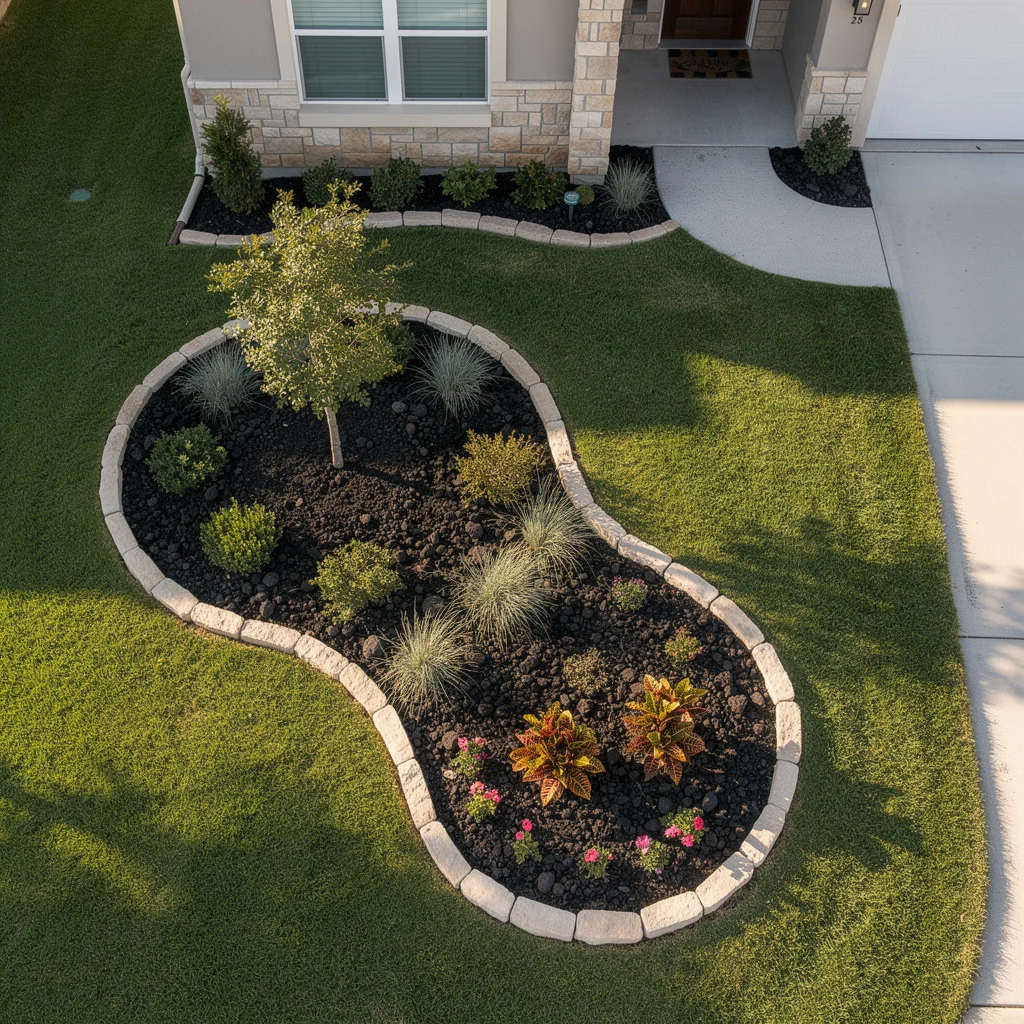
The double-oval or peanut shape of this island bed is its primary design statement — visible from above and from the street. The warm limestone-coloured split-face concrete block edging follows the curve without interruption, requiring careful block placement and corner cuts that keep the outer line smooth rather than angular.
Mark the bed shape using spray paint on the turf, adjusting the outline until both lobes of the double-oval read as generous and proportional from the street. The narrowest point between the two lobes should be no less than 80 centimetres wide. Install the split-face concrete edging blocks on a tamped gravel base along the full perimeter, checking alignment after every fourth block. Fill the interior with dark lava rock mulch or very dark bark mulch to 8 centimetres. Plant a single slender ornamental tree — birch, ornamental pear, or multi-stem serviceberry — at the wider lobe of the bed as the vertical focal point.
In the surrounding mulch, plant blue fescue grasses in a loose cluster near the tree trunk, and add two or three croton or Heuchera for foliage colour accent. Keep the foundation bed against the house wall visible from the street as a separate, complementary planting zone — the island bed and the foundation bed should read as related but distinct elements in the same front yard composition.
Circular Lawn Island Bed
The defining element of this bed is its container: a large-diameter circular black flexible edging ring — available from garden centres as a prefabricated garden bed form — set directly on the lawn surface and filled with a base of red or terracotta-toned decorative gravel. The dark black edging ring provides a clean geometric boundary that makes the bed read as a considered object placed in the lawn rather than an excavated area.
Position the bed in the lawn where it will be visible from the primary viewing angle of the house — typically from the street looking toward the facade or from inside looking out from the main window. Fill the interior with terracotta-toned angular gravel to a depth of 8 centimetres. Plant a single upright architectural plant in the center — a variegated agave, a Phormium, or a compact Cordyline — as the vertical anchor. Around it, arrange potted annuals set directly into the gravel in a loose circle: yellow Gazania, magenta petunias, orange Zinnia, and white Nemesia. Setting pots rather than planting directly into the gravel allows you to replace individual elements as they finish flowering without disturbing the whole bed. Place one or two smooth large grey river pebbles within the gravel surface as decorative accents that provide scale contrast to the small pebble ground.
Stone Foundation Bed With Iron Obelisks
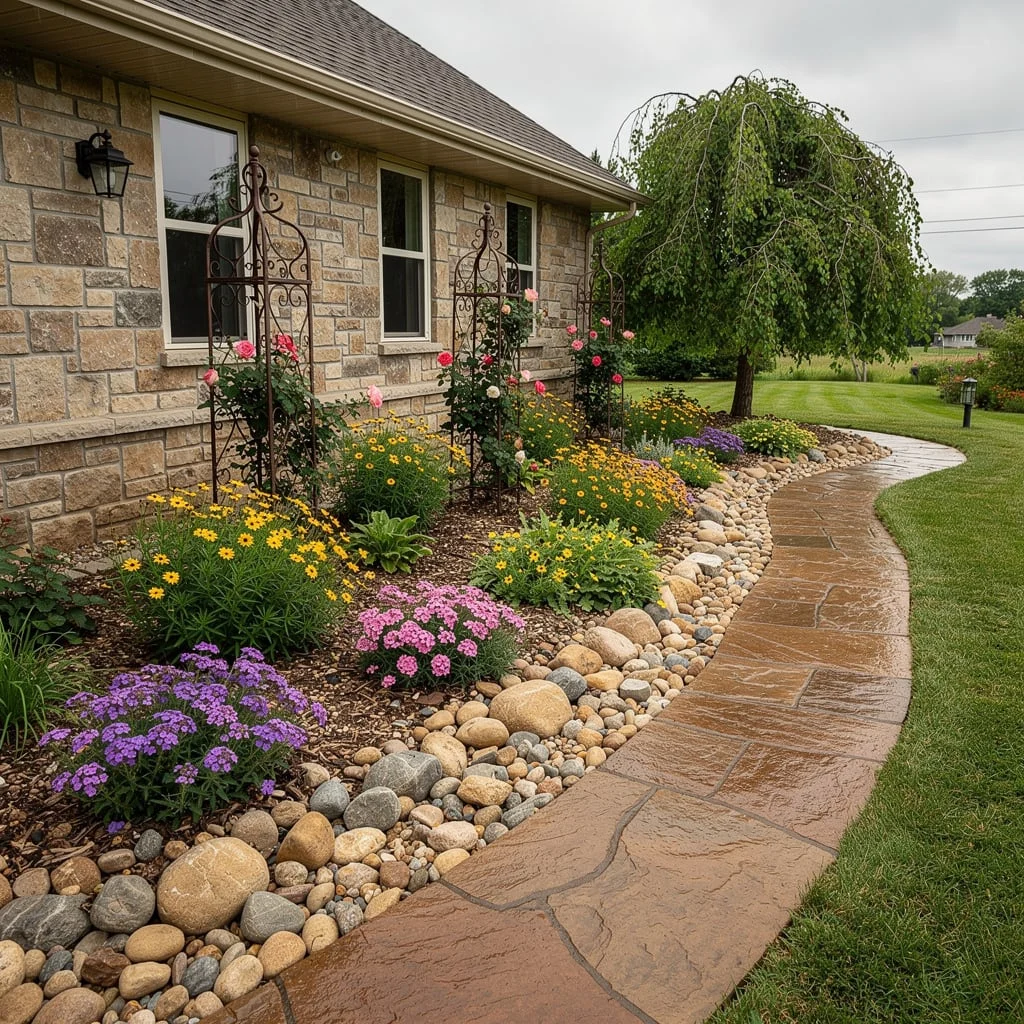
The brown wrought-iron or powder-coated steel obelisk trellises mounted at intervals along the stone house wall are the vertical element that transforms this from a foundation bed into a garden. They provide height, structure, and a climbing surface that allows the bed to reach the window level — something no free-standing perennial can consistently do.
Choose matching obelisks in a scrollwork or cathedral arch design, all at the same height — minimum 120 centimetres — and mount them against the wall at consistent spacing using masonry anchors. Plant a single climbing rose or compact clematis at the base of each obelisk, choosing a repeat-blooming variety in a colour that works within the overall bed palette. In front of the obelisks, build a relaxed perennial border using yellow rudbeckia, pink Phlox paniculata, and compact purple ageratum as the three primary species. Allow the bed boundary on the path side to be defined by mixed river pebbles and small boulders in varying sizes rather than a block edging, which gives the composition its cottage-garden naturalism.
The path running beside the bed should be laid in warm-tone flagstone rather than concrete — the stone path connects visually to the river pebble bed boundary and to the stone wall behind the planting.
Backyard Rock Garden With White Gravel Surround
This is the most ambitious garden in this collection — a large-scale naturalistic rock garden occupying a significant portion of a rear yard, using substantial fieldstone boulders of varying sizes to create a raised rocky spine down the center, with white polished gravel as the surrounding ground plane and a flagstone path running alongside.
Begin by setting the largest stones first — the anchor boulders at least 60 centimetres across — in a loose irregular spine following the length of the bed. Work outward from these with progressively smaller stones, filling in the spaces between the large boulders with medium and small rocks of similar character. The entire stone arrangement should read as a natural rock outcrop that the garden has grown around, not as rocks placed decoratively in a garden. Fill the surrounding white gravel surround to a depth of 8 centimetres after laying landscape fabric. Plant the crevices between the stones with drought-tolerant alpines and rock-garden perennials: dwarf conifers, Japanese maples, compact sedums, and heathers. Add a small bird bath or garden ornament as the visual focal point at the far end of the rock spine, visible from the entry to the garden. Install low-voltage path lights along the white gravel perimeter for evening ambiance.
Florida Corner With Cream Pebbles
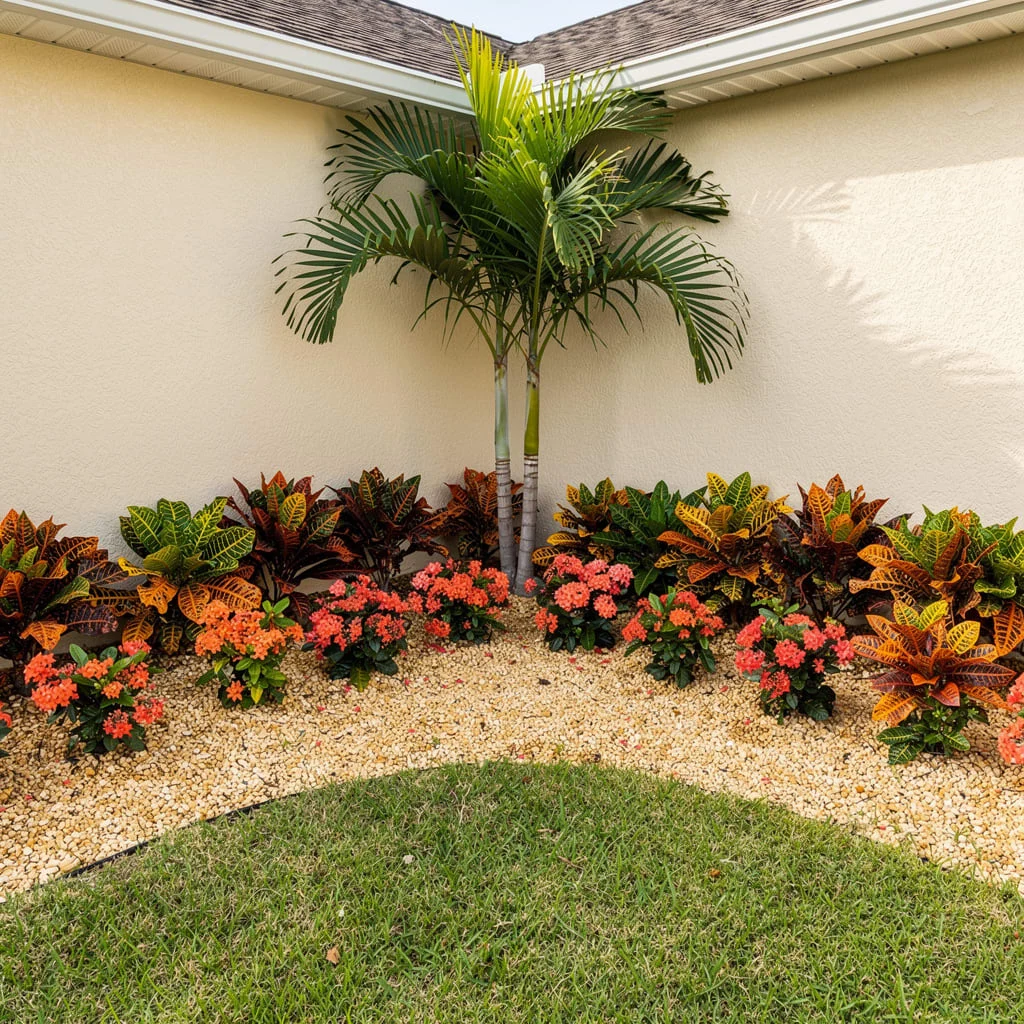
A corner of a house where two walls meet is often the most awkward landscaping zone on a property. It has no natural focal point, the space is usually shaded for part of the day, and any planting tends to get swallowed by the angular transition between wall faces. This bed solves that problem with three moves: a double-trunk palm centered exactly on the corner as the vertical anchor, croton planted in mirrored groupings on each side wall, and cream-coloured river pebbles as the entire ground surface.
Plant the multi-stem palm directly at the building corner, allowing its canopy to spread outward over both wall faces equally. Choose an Areca or Majesty palm for moderate climates, or a Pygmy Date Palm for smaller spaces. Position groups of four to five croton plants of consistent size on each side of the palm, spacing them in a single row along each wall face. Choose two or three croton varieties with warm orange, red, and yellow foliage for the outer positions and a darker bronze-leaf variety closer to the palm trunk. Between the croton clusters, plant compact Ixora in deep orange or coral for low-level flower colour.
Fill the bed base with cream or buff river pebbles — not white, which would be too stark against the warm cream stucco wall. The cream pebble ground reflects warmth upward into the planting, which suits the tropical palette perfectly.
Black Lava With White Pebble Border and Boulders
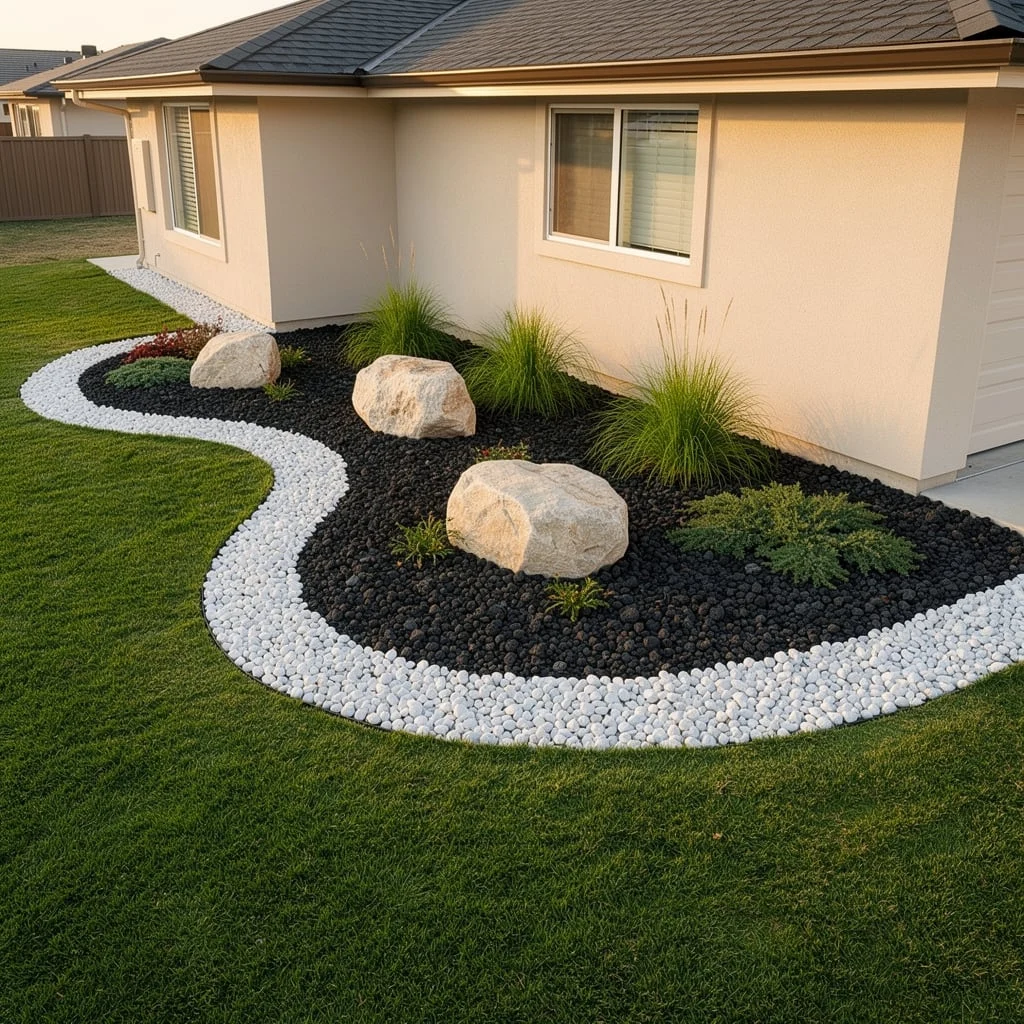
The design decision here is a two-zone rock ground plane: a wide outer ring of white polished river pebbles following the curved boundary of the bed, and a dark black lava rock interior that forms the primary planting surface. The white ring functions as both edging and a zone of contrast that visually separates the dark planting area from the green lawn.
Install standard flexible steel edging along the lawn boundary of the white pebble zone, bent to follow the s-curve or arc of the bed shape. Inside the white zone, install a second steel edging strip to contain the black lava rock separately. Lay both zones to a depth of 8 centimetres. Within the black lava interior, place three granite or limestone boulders — each partially buried — in an asymmetric triangle: one near the house wall, one near the center of the bed, and one closer to the outer edge. Plant feather reed grass or blue oat grass between the boulders, and fill any remaining spaces with compact low groundcovers: creeping thyme or dwarf juniper.
Keep the plant palette to two species in addition to the grasses. The restraint of the planting against the graphic two-tone rock ground is what makes this bed read as modern rather than simply minimal.
Tiered Fieldstone With Peonies and Roses
The structural logic here is a naturally stacked dry-stone retaining wall in rough-cut fieldstone — large, irregular blocks with genuine variation in size and face texture — creating two or three flat terraces descending from the porch level to the lawn. Each terrace functions as a raised planting bed with the stone forming both the retaining wall and the decorative edge.
Source the fieldstone in warm grey granite or limestone in blocks weighing 40 to 80 kilograms each — large enough that the wall reads as substantial rather than token. Lay them in a dry-stack configuration: no mortar, each course set slightly back from the one below, joints staggered between courses. The wall face should have natural texture variation, with no two blocks identical in profile. Plant the upper terraces with full peony varieties in pale pink and white — Paeonia lactiflora cultivars in Sarah Bernhardt, Bowl of Beauty, or Festiva Maxima — allowing the large flower heads to spill over the stone edge when in full bloom. On the lower terraces, plant lavender in drifts between the boulder groupings, with white shrub roses for height and structure at the wall base. The flower palette is restricted to pink, white, and purple, which together create a soft, romantic composition that sits harmoniously against the warm grey stone.
Red Roses With River Pebbles
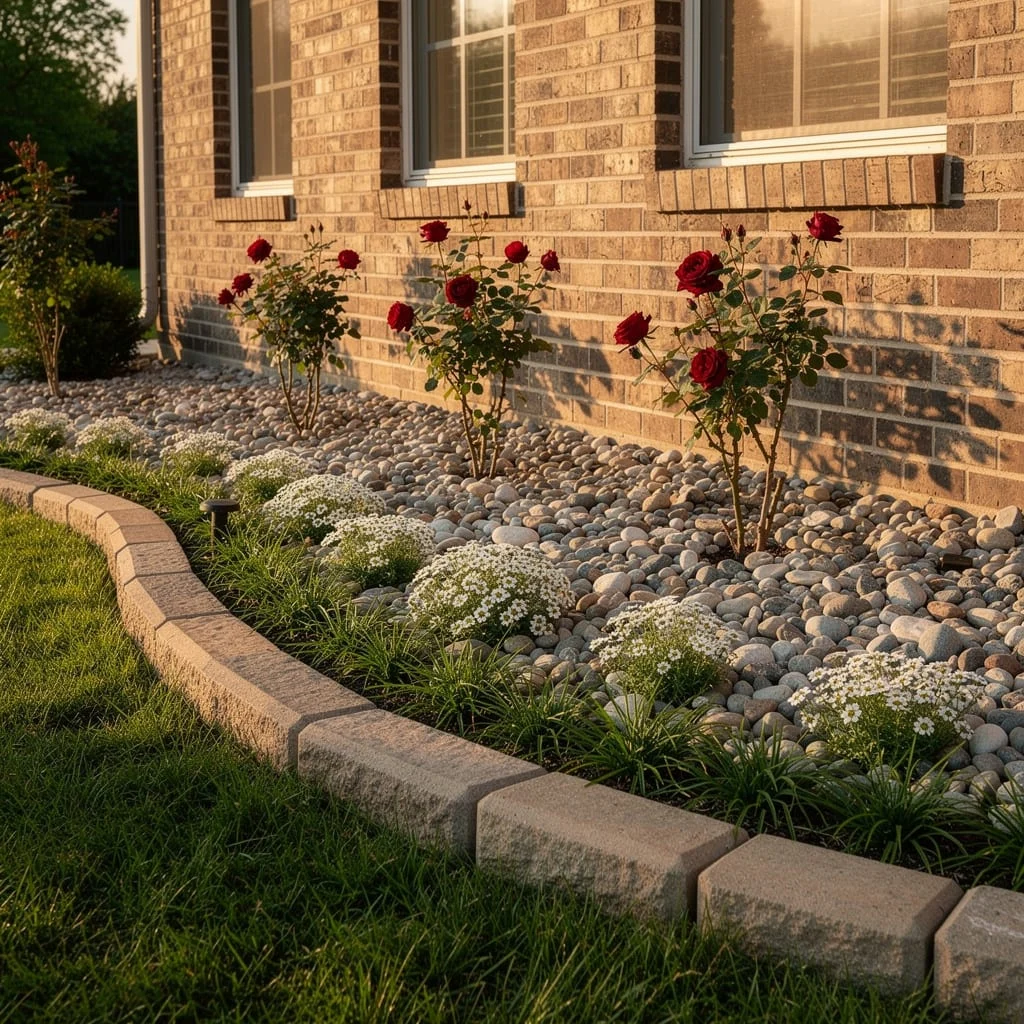
This combination — deep crimson red standard roses planted in a river pebble foundation bed, with white alyssum or baby’s breath spilling at their base — achieves its effect through the simplest possible colour contrast: red flower, white stone ground. The warm brick wall behind the planting amplifies the red of the blooms while the pebble surface keeps the bed clean and maintenance-free between the rose plants.
Install concrete edging blocks — one course high, in a warm stone tone that sits comfortably between the pebble colour and the brick colour — along the bed boundary. Fill the interior with natural river pebbles in the 20 to 40-millimetre range to a depth of 8 centimetres over landscape fabric. Plant the roses at 80-centimetre centres — choose a compact repeat-blooming shrub rose in deep crimson, such as Black Magic, Mr. Lincoln, or Red Ribbon — and cut a wide X-shaped fabric opening at each planting position. Between the rose plants, cut small holes in the fabric and plant white sweet alyssum, allowing it to spread naturally across the pebble surface between plants.
Install low-voltage solar path lights at the front edge of the bed so the rose stems and blooms are illuminated from below at dusk.
Succulent and Cactus Rock Garden
This is a collector’s garden — a dense, layered composition of succulents, cacti, agaves, and drought-tolerant architectural plants arranged across a mixed gravel and rock surface. The bed uses multiple rock types in deliberate zones: flat dark slate shards, smooth grey river pebbles, rough granite gravel, and individual placed boulders — all visible as distinct materials within the same bed.
Prepare the bed with a sharply free-draining substrate: two parts coarse horticultural grit to one part topsoil. No organic matter. The drainage is what allows the succulent roots to stay healthy in wet weather. Lay the mixed gravel surface in organic zones — not by strict colour boundary, but in flowing areas that overlap at their edges. Place the large boulders first, burying one-third of each into the prepared surface. Position the largest architectural plants — agaves, yuccas, tall columnar cacti — near but not symmetrically beside the boulders, using them as the vertical anchors around which the surrounding smaller succulents and groundcovers are arranged. Include terracotta pots of small succulents set directly into the gravel surface as moveable elements that can be changed seasonally. The layered complexity of this garden rewards close inspection and looks extraordinary from above — it is a garden designed to be looked into as much as looked at.
Black Gravel With White Marble Boulders
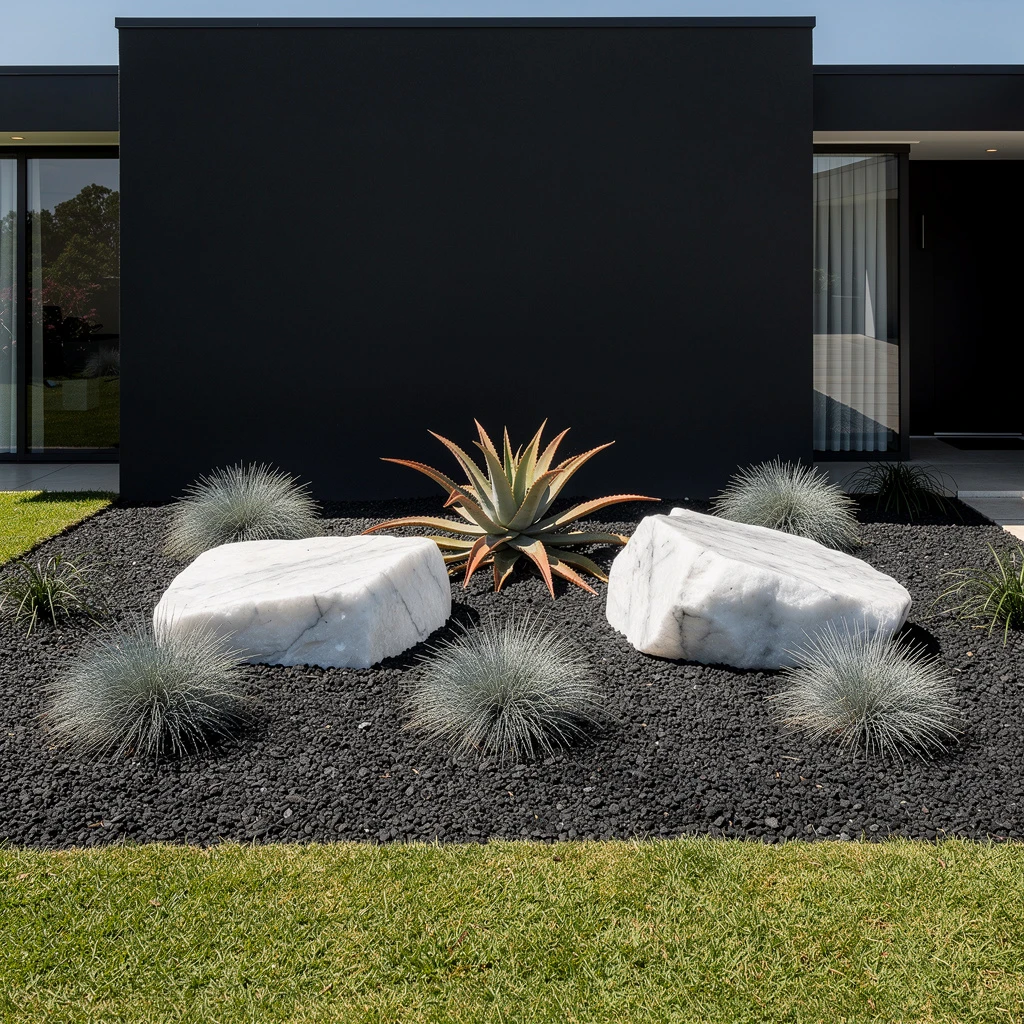
This is the most architecturally minimal composition in this collection. Against a solid matte black wall, a diamond-shaped bed of black lava rock or black rubber mulch contains exactly five elements: two large white Carrara or white marble boulders, one aloe vera or Agave americana as the central architectural plant, and four blue fescue grasses placed at the outer corners of the composition. Nothing else.
The white marble boulders are the defining investment. These are not standard landscaping stones — they are quarried white marble slabs or rough-faced marble chunks weighing 30 to 80 kilograms each, sourced from a stone or monument supplier. Their pure white against the black rock and black wall creates a contrast so stark it reads as intentional at 50 metres. Position them slightly off-center relative to each other — one further back and one more forward — rather than side by side at the same distance from the viewer.
Place the aloe or agave between and slightly behind the two marble stones, so the plant reads as emerging from between them. Plant the blue fescue grasses at the four outer positions within the bed perimeter, their silver-blue tone creating a cool transitional note between the white marble and the black ground. No edging other than a clean cut lawn edge at the bed boundary. Nothing added.
Gravel With Roses, Lavender, and Ground Phlox
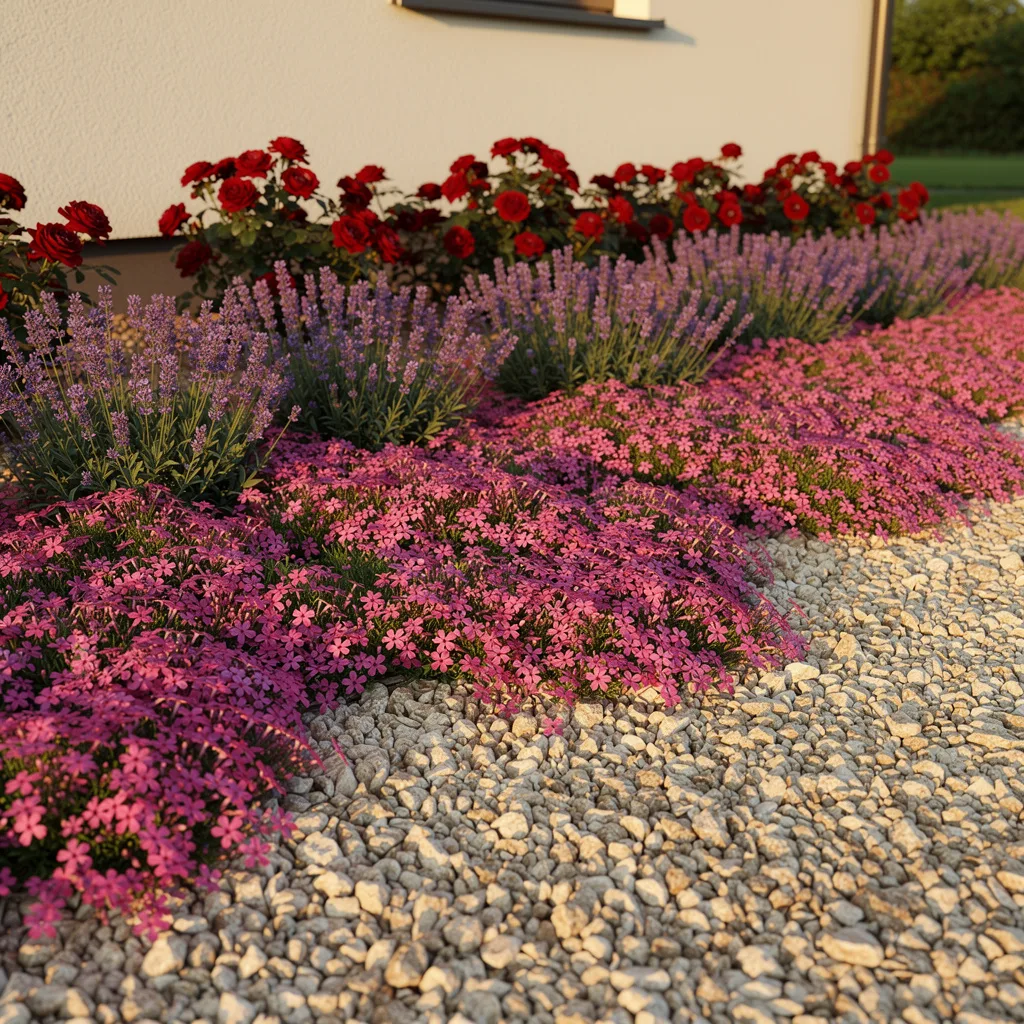
Three species, three heights, three textures — and a single warm-toned gravel ground that ties them all together. Tall red shrub roses at the wall face provide the colour anchor and the height. Mid-height lavender in a continuous band in front of the roses provides the silver-purple middle layer. Low-spreading ground phlox in deep pink or magenta forms a continuous flowering carpet across the gravel at the front of the bed.
Use medium-grade gravel in a warm limestone or cream tone — not white marble, which would be too cool against the red roses — laid to 7 centimetres depth over fabric. The gravel ground plane should remain visible between the plants rather than being covered by them, which is what maintains the character of a rock garden rather than a standard perennial border. Plant the roses at 80-centimetre centres against the wall, choosing compact floribunda varieties that stay under 90 centimetres in height. Plant lavender at 30-centimetre centres in front of the roses, selecting a variety that blooms in deep purple rather than pale lilac for maximum colour impact against the red.
Plant the ground phlox at 25-centimetre centres at the front edge, allowing it to spread across the gravel surface as it matures. The three plants bloom in slightly different sequences — ground phlox in late spring, lavender through summer, roses from early summer to frost — ensuring something is always performing.
Agave and Grass With Lava Rock
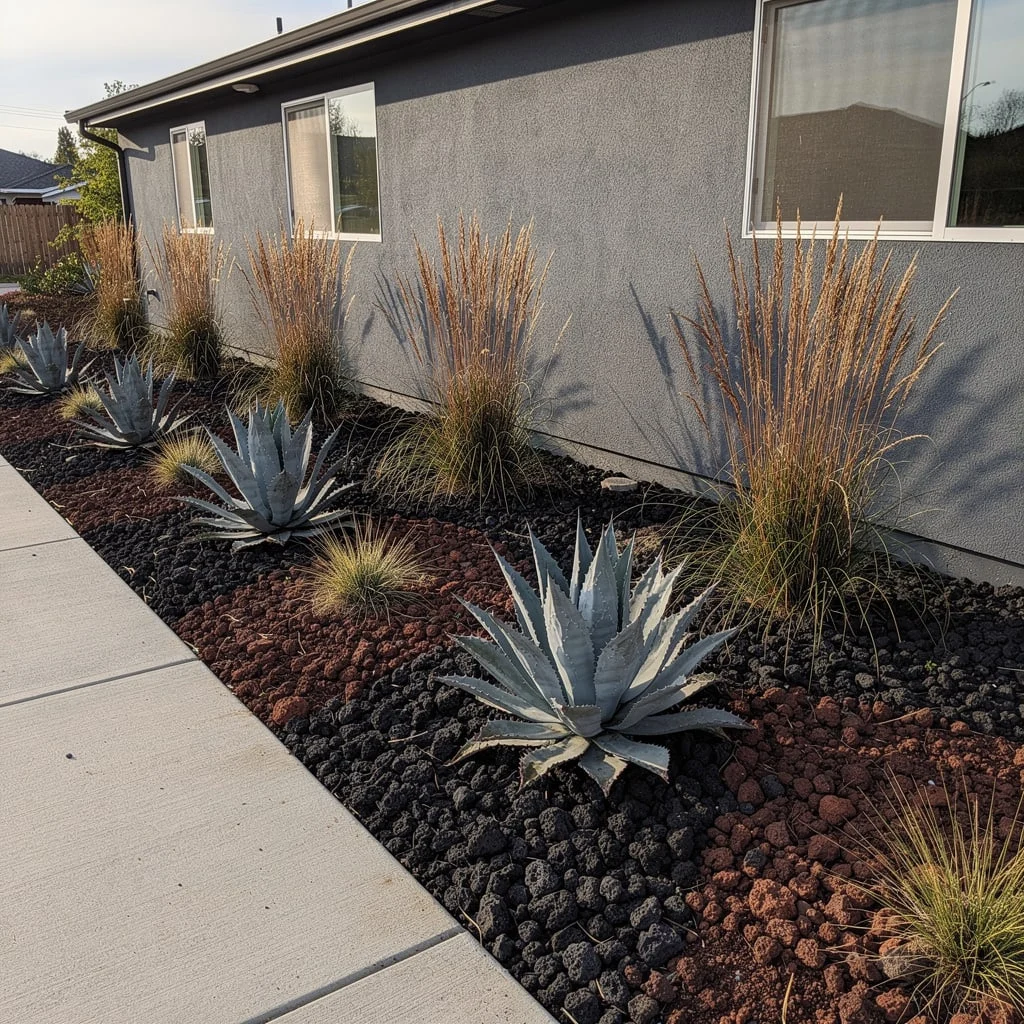
Two species, two rock types, one house wall, and the discipline to stop there. Blue agave — Agave americana or the smaller Agave parryi — and tall ornamental grass, alternating in a single row against a grey stucco wall, with a mixed ground of black and red-brown lava rock as the planting surface. No other plants, no decorative objects, no seasonal additions.
The lava rock ground uses both black and red-brown lava pebbles in organic, blended zones — not strict colour separation, but flowing areas where the two tones mix at their boundaries. This soft blending prevents the ground surface from reading as artificially patterned while still creating subtle tonal interest across the bed. Plant the agaves at 90-centimetre centres against the wall base — they will expand to fill that space fully within three to four years. Between each agave, plant a single ornamental grass — Calamagrostis Karl Foerster for upright vertical height, or Pennisetum for the softer arching form.
Install flat steel edging at the lawn boundary, bent to follow a straight line parallel to the path edge. The composition reads as contemporary, drought-tolerant, and completely resolved.
Mixed Perennial Bed With River Pebble Ground
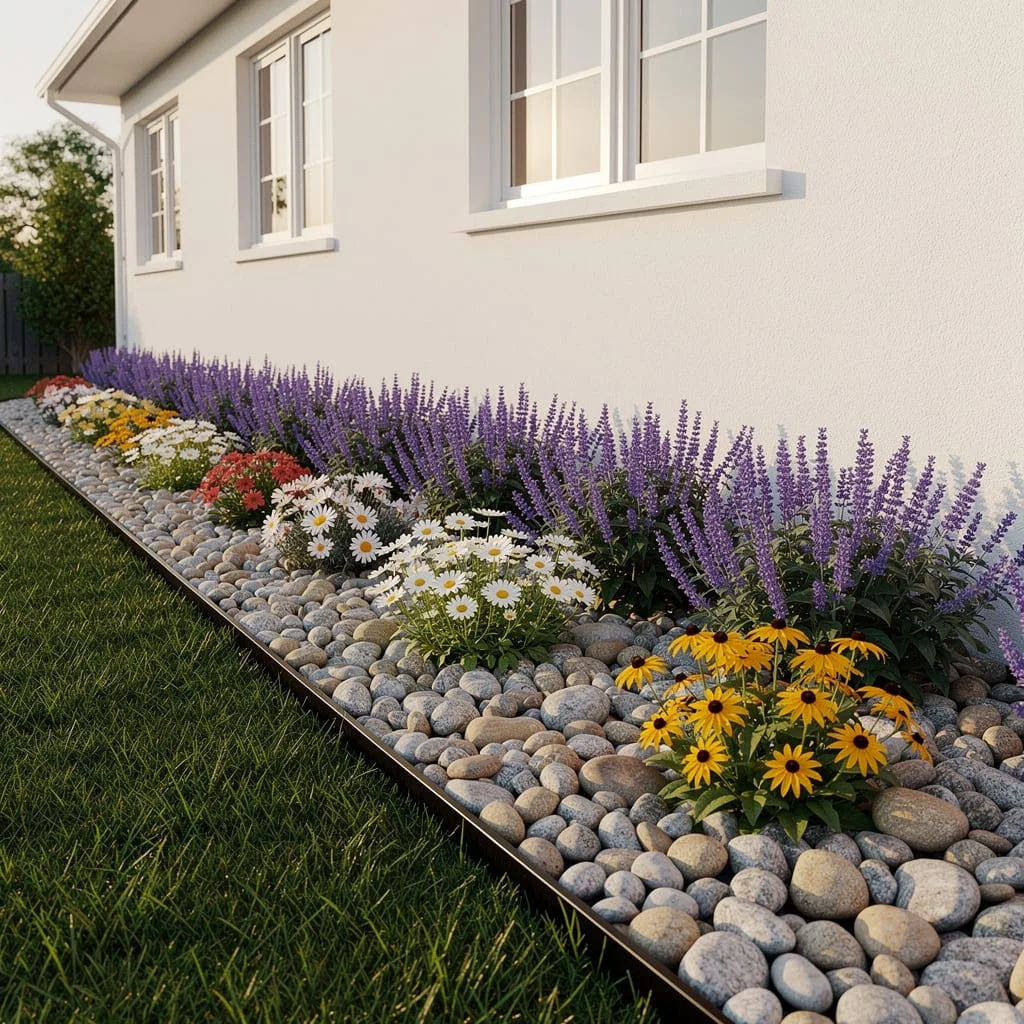
River pebbles in a warm grey-white tone, laid as the complete bed ground surface over landscape fabric, with flowering perennials planted through the pebble layer in irregular grouped positions. The pebbles visible between the plant groups are as important to the composition as the plants themselves — they provide the ground plane that makes each cluster of flowers read as deliberately placed rather than randomly scattered.
Install steel edging along the full lawn boundary of the bed before laying the pebbles. Cut fabric X-openings at each planting position. Use a minimum of four perennial species in clearly differentiated heights and bloom times: tall purple salvia at the back, yellow Rudbeckia at mid-height, white Leucanthemum at mid-height, and compact catmint or blue ageratum at the front edge. Plant each species in clusters of three to five plants rather than individually.
After planting, infill around the plant bases with additional pebbles so no fabric is visible. The pebble colour — warm grey — sits comfortably against white or cream stucco and allows the flower colours to read clearly without visual competition from the ground surface.
Dark Brick With Black Lava, Croton, and Impatiens
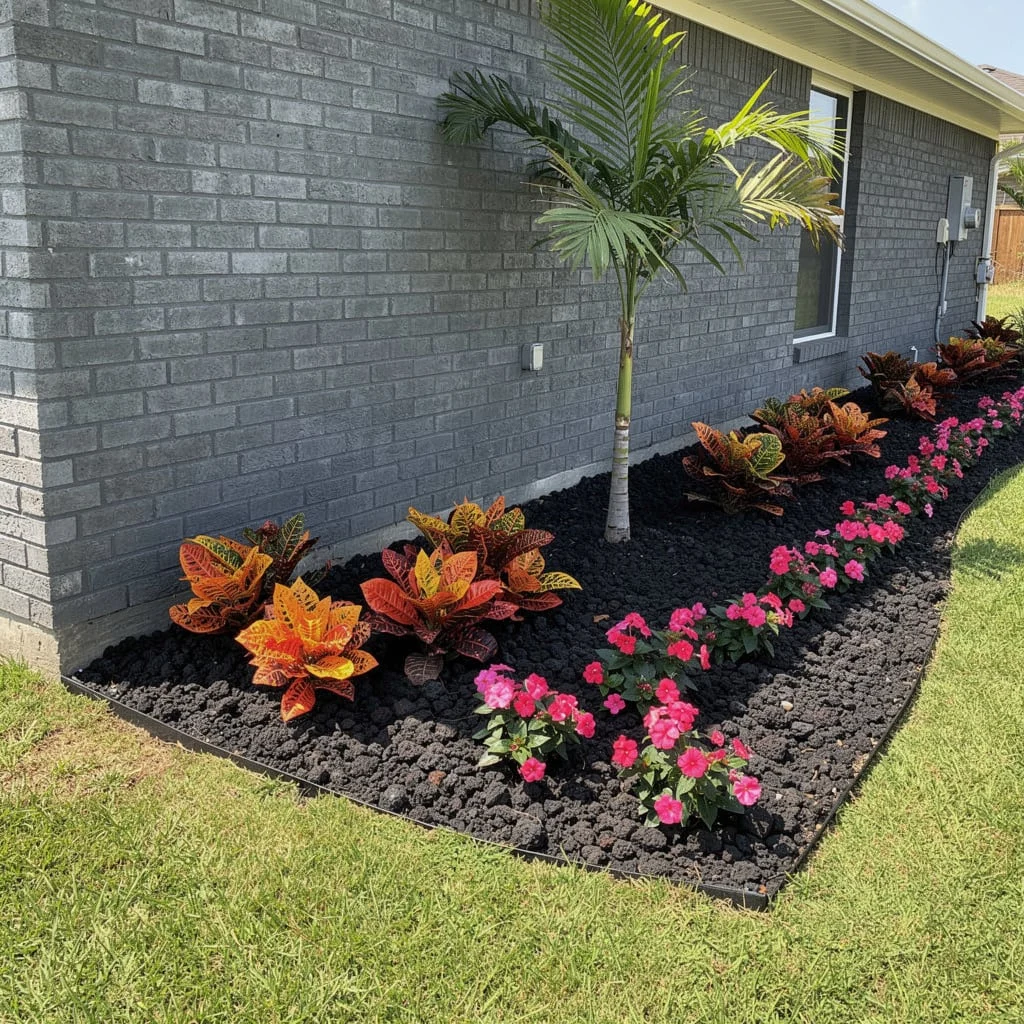
Dark grey painted brick is one of the most demanding house walls to landscape against, because most plant colours — green, pale pink, white — are absorbed into the darkness rather than standing out from it. The solution is warm tropical colour: the orange, red, and yellow of croton foliage, the hot pink of impatiens, and the black of lava rock. All three elements are in the same warm, saturated register, and together they create a composition that reads with genuine intensity against the dark wall.
Fill the bed with black rubber mulch or black lava rock to 8 centimetres over landscape fabric. Plant a single-trunk palm at the midpoint of the bed length, centered between the window and the bed end, as the vertical anchor. On each side of the palm, plant four to five croton shrubs in a compact variety — Codiaeum variegatum in the Petra or Gold Dust cultivar — spaced 50 centimetres apart in a single row against the wall. In the foreground of the bed — between the croton row and the lawn edge — plant hot pink impatiens in a continuous band, spacing plants 20 centimetres apart.
The impatiens provide the one component in the bed that changes seasonally and reads as maintenance. Replace them each spring with fresh transplants in the same colour. Everything else in the bed requires minimal intervention.
White Gravel With Boxwood and Dianthus
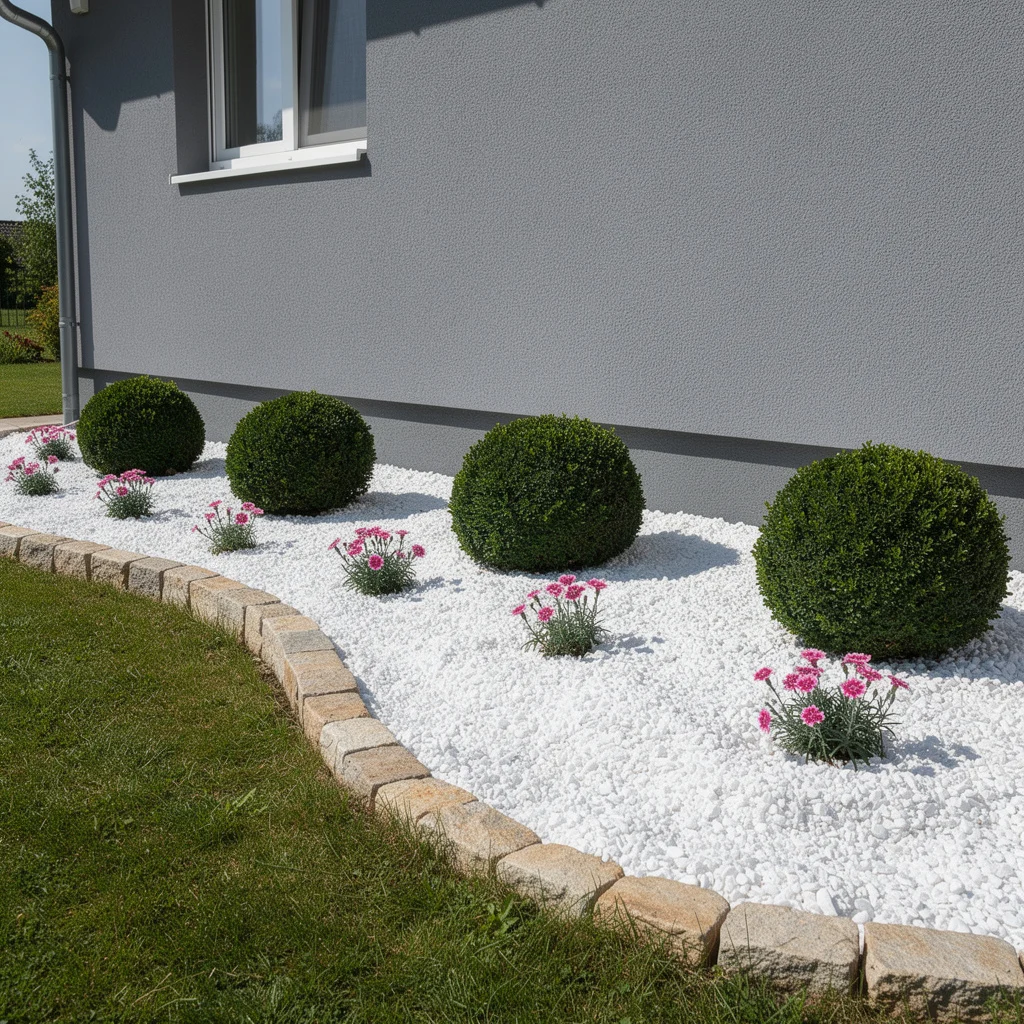
White marble chips as the full bed ground surface, boxwood spheres as the architectural evergreen structure, and compact pink dianthus as the seasonal flowering accent between the boxwood. Three elements. One simple, permanent-looking result.
Choose the boxwood specimens carefully: buy plants that are already close to the desired sphere shape — approximately 35 to 40 centimetres in diameter — so the clipping required to maintain them is minimal. Clip them once in early spring and once in late summer. Do not clip in autumn, which can encourage soft growth that gets caught by frost. Plant them at consistent centres — 80 centimetres between plants — in a single row against the wall. Between each boxwood pair, plant a cluster of three dianthus plants in pink or cerise — Mountain Pinks or the compact Festival Star series work well in this application.
Fill the entire bed to 8 centimetres with white marble chips over landscape fabric. Install warm-toned stone block edging at the front of the bed. The composition is the quintessential European formal foundation bed — geometric, clean, and quietly extraordinary.
Hydrangeas With White Block Edging and River Pebbles
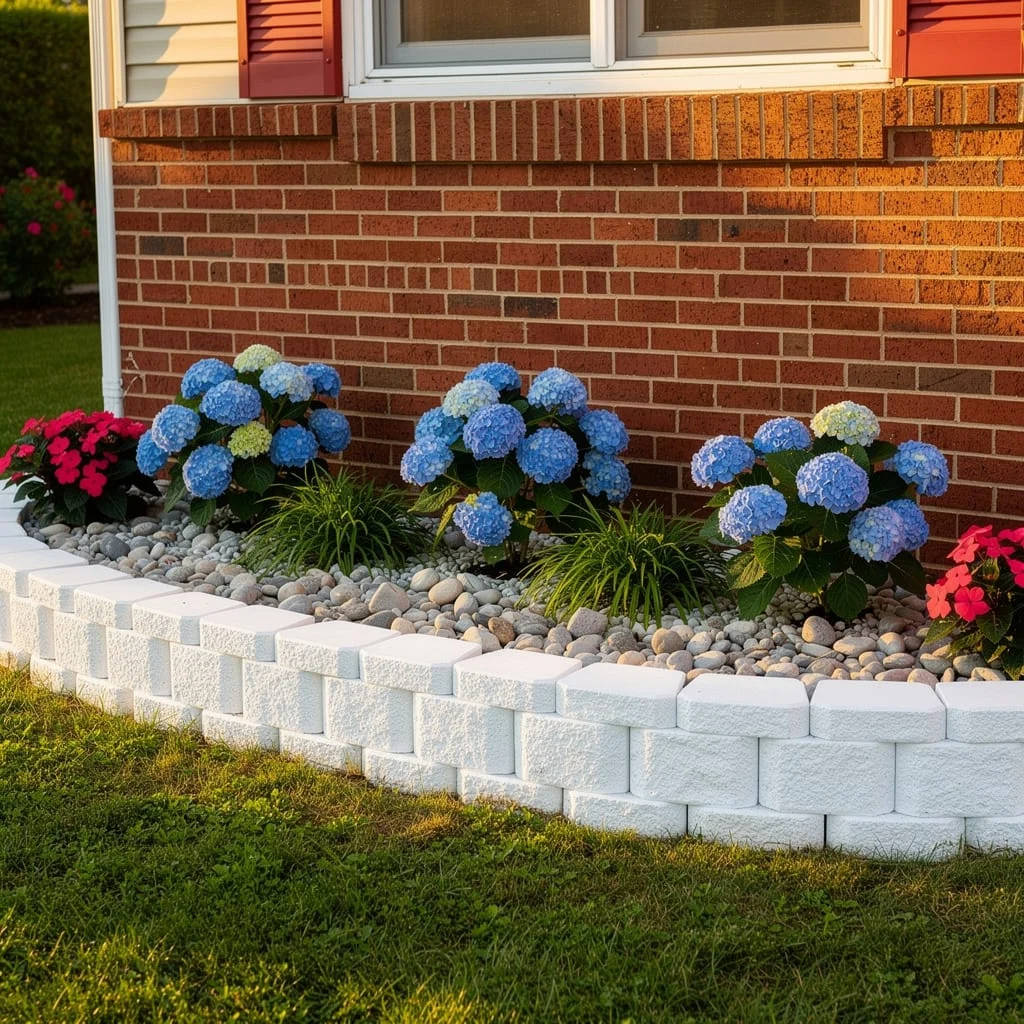
The white painted or rendered masonry block retaining wall — two courses high — creates a raised bed platform that elevates the planting above the surrounding lawn. This small change in ground plane has a large visual impact: the hydrangeas read as planted in a feature rather than simply growing at the base of the house.
Build the wall from standard smooth-face concrete retaining blocks, applying two coats of exterior white masonry paint after installation. Lay a footing of compacted gravel before the first course to prevent settling and tilting over time. Fill the raised bed with a moisture-retentive planting mix — equal parts topsoil and compost. Plant bigleaf hydrangeas at 80-centimetre centres, choosing a blue-toned variety — Nikko Blue or Endless Summer — to work with the blue-grey tone of the river pebble ground. Fill between the hydrangea plants with natural round river pebbles in the 20 to 40-millimetre range.
The river pebbles retain moisture around the hydrangea root zone, which these water-loving plants strongly benefit from. Add hot pink impatiens at the outer edges of the bed where the planting transitions to the block wall — their saturated pink against the white wall and blue hydrangeas creates a sharp, composed colour accent.
White Pebble Bed With Red, White, and Blue Annuals
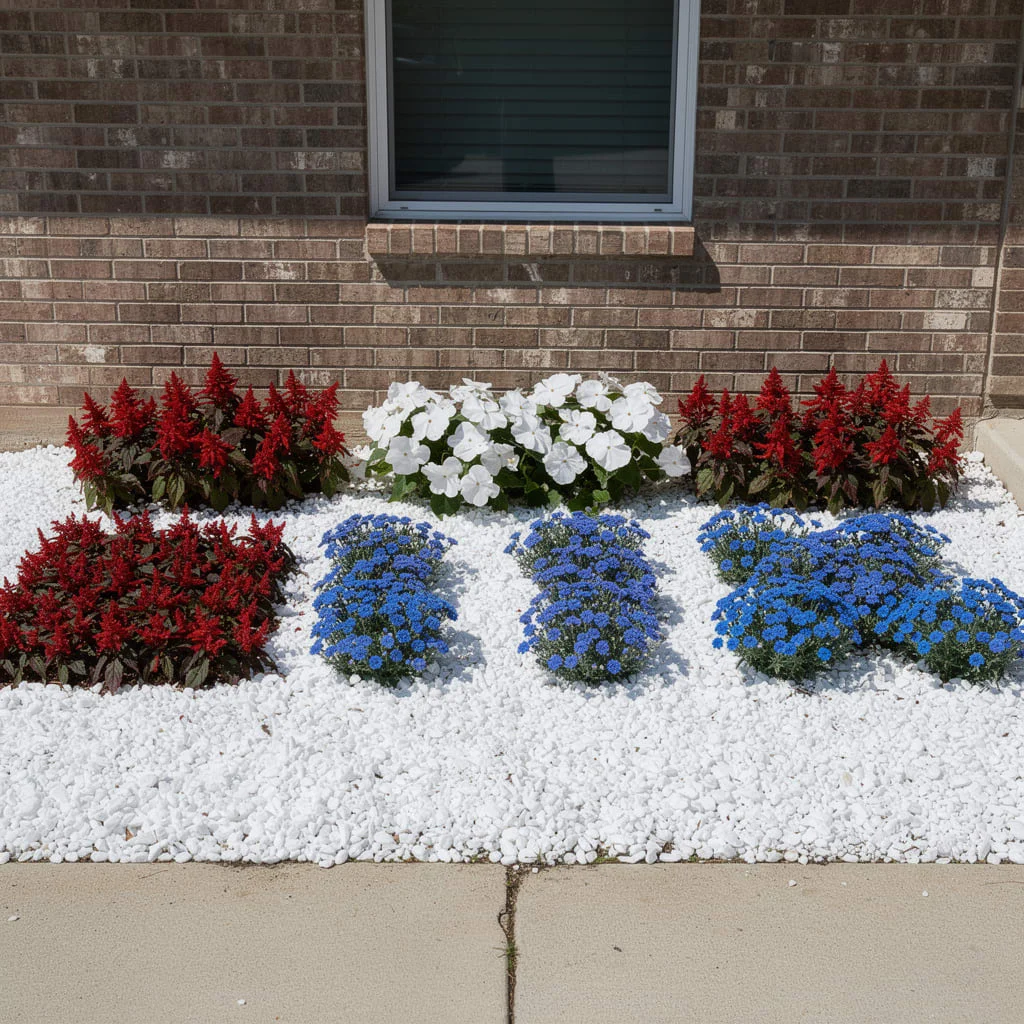
White polished marble chips as the entire bed ground surface, with annual flowers planted through the pebble layer in a structured colour arrangement that reads as graphic from above and from across the garden. Red salvia at the back and sides, white impatiens at the center, and blue ageratum in three evenly spaced clusters in the foreground. The three colours sit in the white pebble ground without competition, each reading at full saturation.
Prepare the bed with landscape fabric and fill with white marble chips to 7 centimetres depth. Cut X-shaped planting holes at each position — precisely where the design requires, not approximately. Plant the red salvia in a continuous row against the wall face, choosing a compact variety such as Red Hot Sally or Victoria that stays under 35 centimetres. At the center of the bed, plant a single large-headed white begonia or white impatiens cluster as the visual focal point. In the foreground, place three evenly spaced blue ageratum clusters — five plants per cluster — at consistent distances apart.
The even spacing of the blue clusters is not optional: it is what makes the foreground read as a composed arrangement rather than scattered plants. Fill any planting gaps with additional white marble chips so the white pebble ground remains fully visible around and between the plant bases. Replace the annuals completely each spring.
White Farmhouse Siding With Gravel, Boxwood, and Grasses
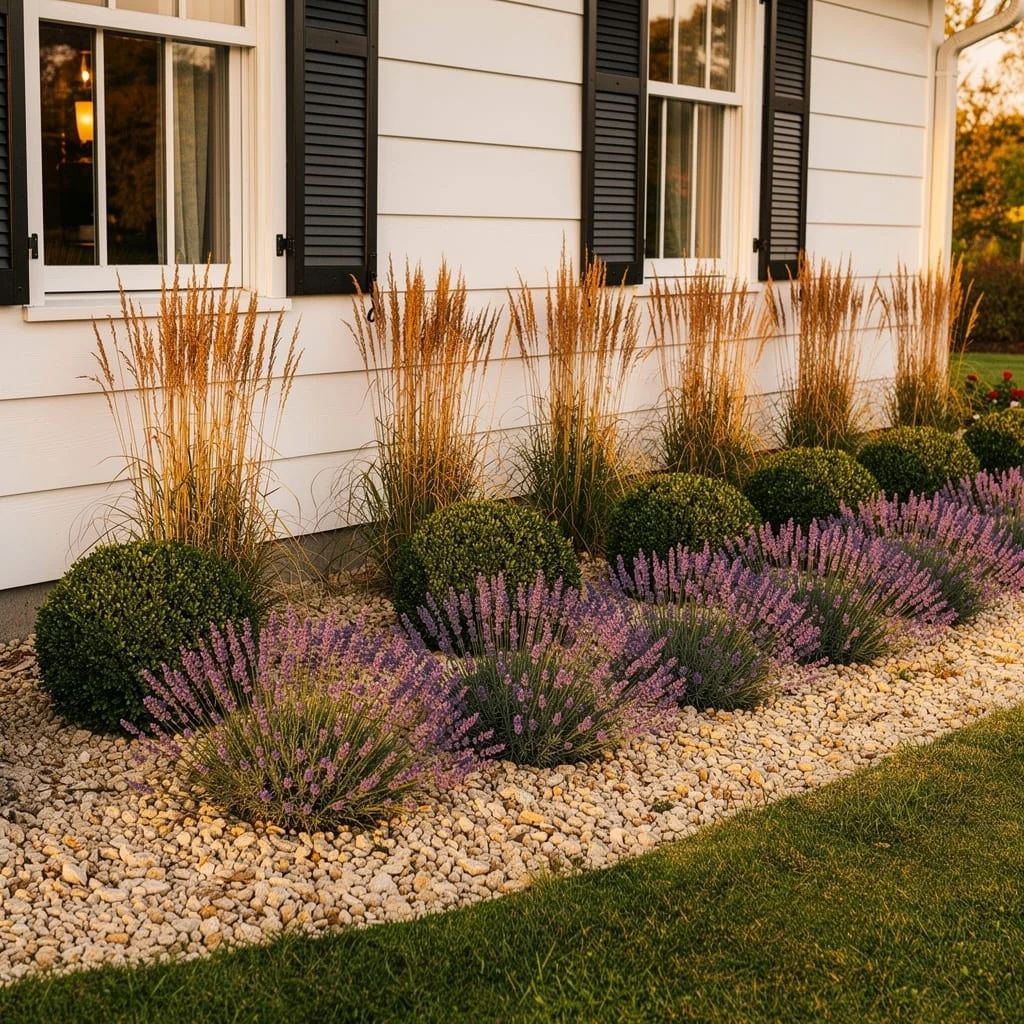
The warm limestone or cream gravel ground surface — finer in texture than river pebbles, which suits the relaxed farmhouse character of the white board-and-batten siding — provides the base plane for an alternating rhythm of clipped boxwood spheres and tall ornamental grasses with lavender filling the spaces between them.
The alternating pattern — grass, boxwood, lavender, boxwood, grass — runs the full length of the bed without variation. This repetition is not monotonous. It is architectural. It is what makes a long foundation bed read as a composed element rather than a series of unconnected plants. Use Calamagrostis Karl Foerster for the grasses — upright, narrow, with warm amber seed heads that photograph beautifully at golden hour against white siding. Clip the boxwood into consistent sphere shapes at 35 to 40 centimetres diameter. Plant Hidcote or Munstead lavender in the spaces between the boxwood and the grass tufts at 30-centimetre centres.
Fill the entire bed with cream limestone gravel to 7 centimetres over fabric. Install steel edging at the bed boundary. At dusk, the amber grass seed heads against the white siding with the dark shutters above are a combination that rewards every decision that went into installing it.
White Pebble Border Edging With Black Mulch and Alliums
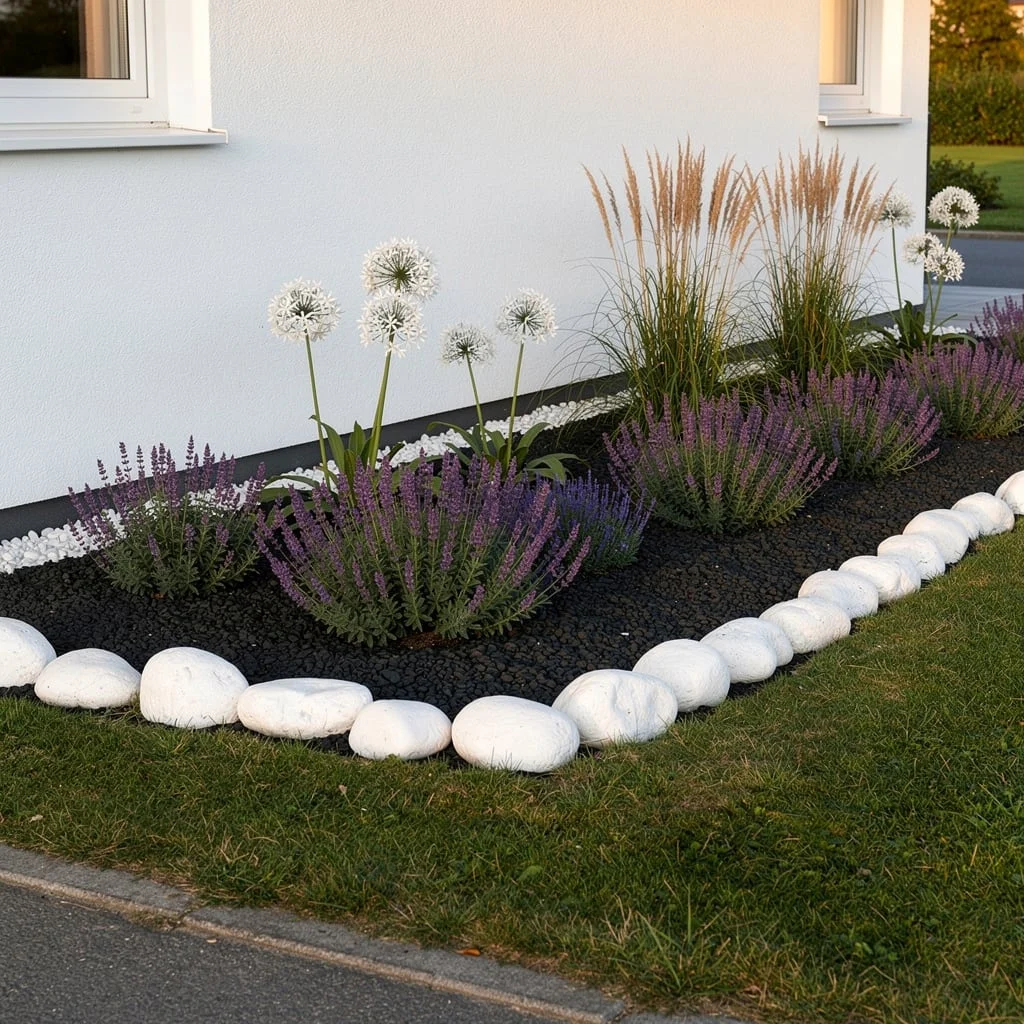
Large white stones — each 15 to 25 centimetres in diameter — placed side by side in a continuous single row following the bed boundary create an edging that is both functional and decorative, softening the transition between the dark planting bed and the lawn without the manufactured appearance of masonry block.
Source the white stones from a local stone supplier or landscape yard — choose pieces that are genuinely rounded with no sharp faces, in a consistent white or near-white tone. Lay them in a single layer following the bed curve, pressing each stone into the soil slightly so they sit stable rather than perching on the surface. The row should be consistent in height, which requires selecting stones of similar size or adjusting the placement depth of larger pieces. Inside the stone border, fill the bed with near-black dark lava rock or black rubber mulch to 7 centimetres over fabric. Plant tall white alliums — Allium stipitatum or Allium ‘Mount Everest’ — in clusters of five to seven bulbs as the primary vertical element.
In the mid-layer, plant purple and mauve lavender or salvia in loose groups, allowing them to fill approximately one-third of the bed area. Plant one clump of ornamental grass — pennisetum or stipa — at the outer corner of the bed where it transitions from the house wall to the open lawn, as the naturalising element that softens the composition’s edge.
Final Thoughts
Every bed in this collection made the rock an active participant rather than a passive background. That is the distinction that matters.
When rock is background — when it is just something to cover the ground so you don’t have to mow — it reads as background. When it is a deliberate colour, a deliberate texture, a deliberate contrast agent chosen in relation to the wall behind it and the plants in front of it, it reads as design.
The difference in effort between those two approaches is smaller than you think. The difference in result is everything.
Choose your rock first. Then choose the wall. Then choose the plants that live between them. Work in that order and the composition will come together in a way that working in any other order never quite produces.