
You’ve been staring at your front yard for three years. You know something is wrong with it. You just haven’t committed to fixing it.
The problem is usually not a lack of plants. It’s a lack of structure. People buy hydrangeas because they’re beautiful and easy, then plant them in a vague cluster near the foundation and wonder why the whole thing still looks unfinished. Hydrangeas without a framework are just expensive shrubs doing nothing.
Boxwood is the framework. That’s the entire secret.
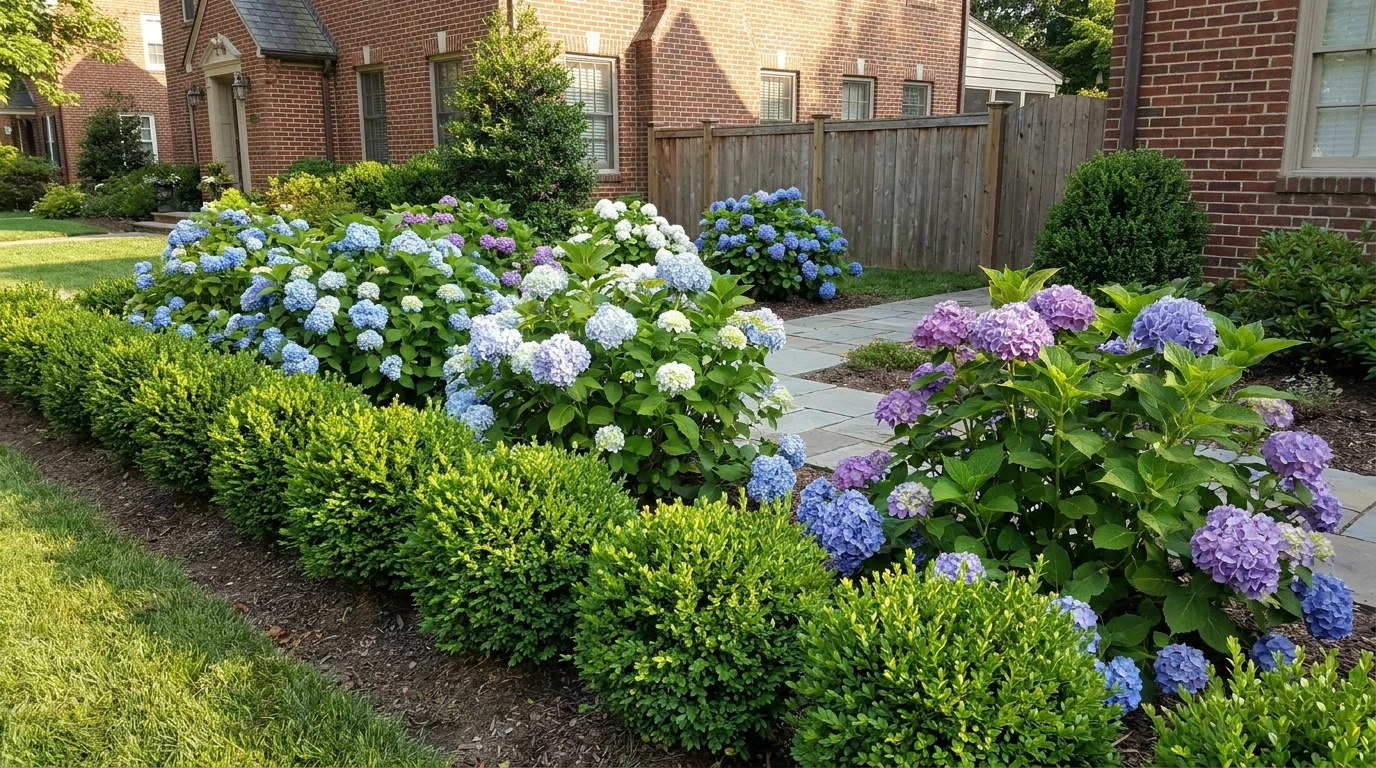
These two plants together form one of the most reliable pairings in residential landscaping. The boxwood holds its shape and color through every season. The hydrangea gives you the drama, the bloom, the thing that makes people slow down when they drive by. One is the architecture. The other is the event.
Here’s how to use both without making the mistakes everyone else makes first.
Read Your House Before You Plant Anything
The single most expensive landscaping mistake is buying plants before you understand what your house is asking for.
Your Facade Sets the Rules
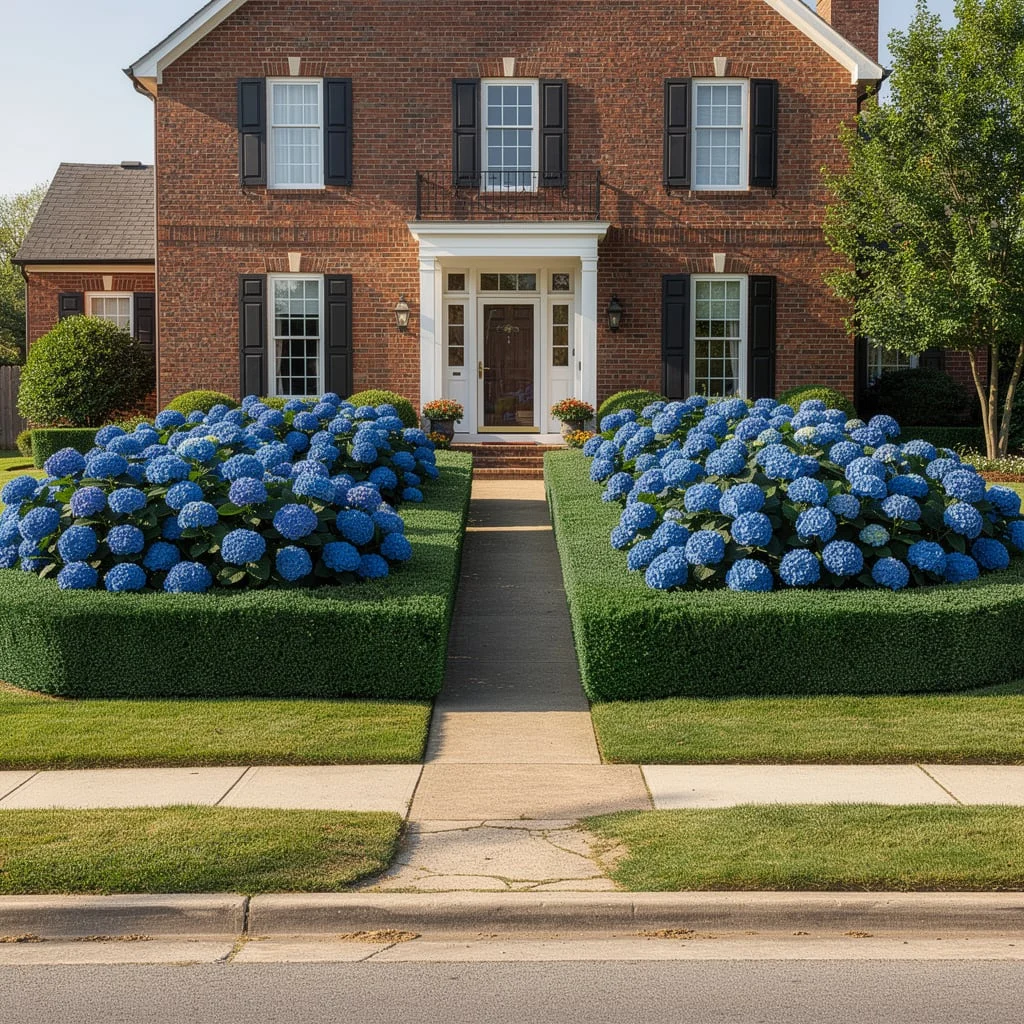
A white clapboard colonial reads differently than a brick Georgian. White houses with dark shutters want crisp contrast — clean boxwood geometry, white or cream hydrangeas, dark mulch, brick paths. The composition should feel like it was drawn with a ruler. Brick houses want softness to counterbalance the hard texture of the facade. Blue and lavender hydrangeas work here in a way they simply don’t against painted siding. They pick up the cool tones in the mortar and make the whole house look more intentional.
Modern houses — white render, flat rooflines, grey window frames — are the most flexible. A formal parterre of boxwood with hydrangeas planted into the geometric sections can look extraordinary against a white modern facade, as long as the lines are razor sharp and the planting is dense.
Symmetry vs Asymmetry
Symmetrical planting works when your front door is centered on the facade. It’s forgiving, architectural, and feels resolved. Asymmetrical planting works when your facade already has strong visual interest and you’re softening it rather than structuring it. Trying to force symmetry onto an asymmetrical house looks like a mistake. Going asymmetrical on a symmetrical colonial looks like you ran out of plants.
Identify which category your house falls into before you buy a single boxwood ball.
Sun Exposure Is Non-Negotiable
Bigleaf hydrangeas (the mophead variety that produces the classic round blooms in blue, pink, and white) need morning sun and afternoon shade. They will sulk in full afternoon sun. Panicle hydrangeas, which produce the elongated cone-shaped blooms, handle sun far better and will tolerate six-plus hours without complaint. Smooth hydrangeas like Annabelle fall in between.
Boxwood needs at minimum four hours of direct light. Below that, it thins out, grows slowly, and becomes susceptible to disease. Know your sun before you commit.
Hydrangea and Boxwood Landscaping Ideas
Boxwood Allee With Pink Roses
Along a long fence line or property boundary, plant a row of standard trees — crape myrtles, serviceberries, or any small tree with a clean upright habit — at regular intervals of twelve to fifteen feet. In the bed below them, alternate round boxwood balls with upright rose shrubs in a soft pink. The roses should be repeat-blooming varieties that carry color from late spring through fall. Keep the bed width consistent at about five feet, mulch it deeply in near-black, and maintain a clean straight edge along the lawn. The trees provide height and a canopy effect without a structure. The boxwood provides rhythm. The roses are the thing people stop for.
Curved Driveway Island
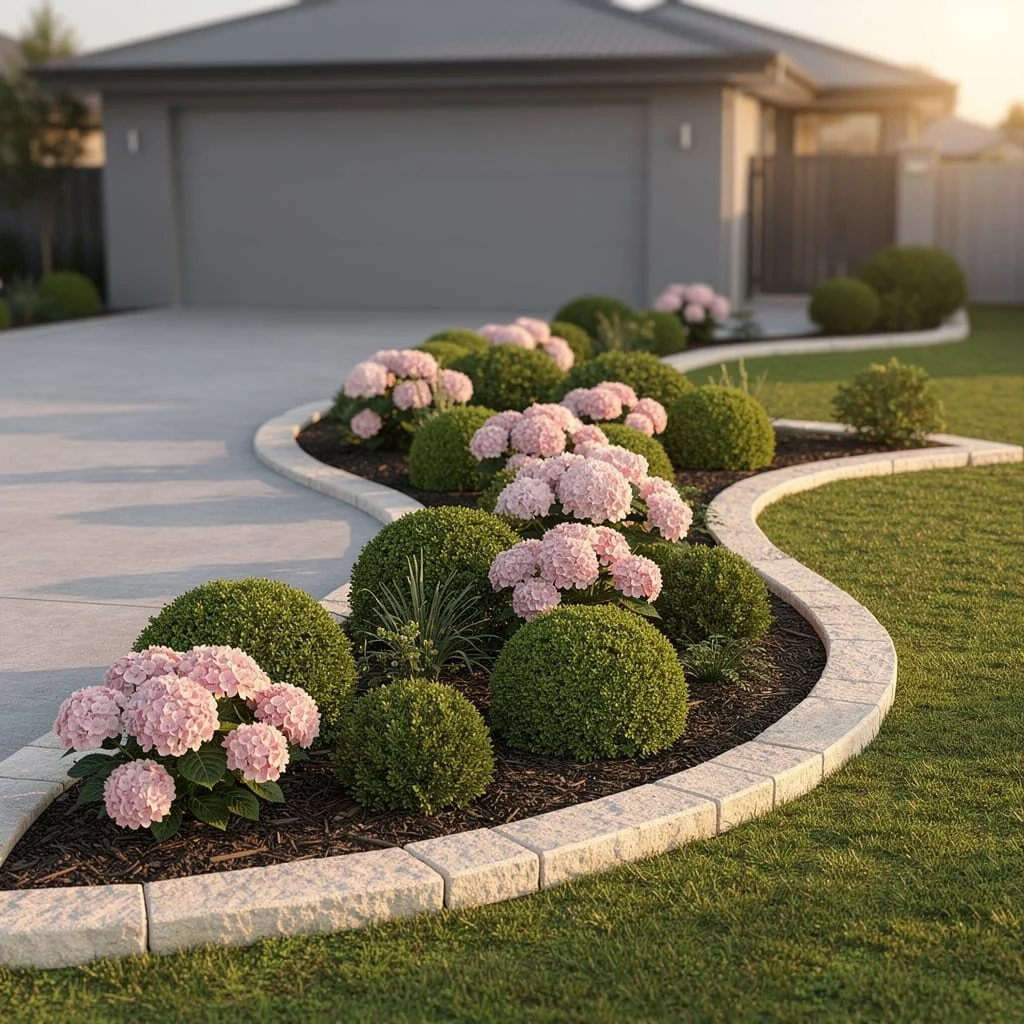
Where a driveway curves, there is typically an awkward triangular or crescent-shaped patch of grass that nobody knows what to do with. Edge it in a continuous row of tumbled stone pavers set flush with the ground — a proper bed edge, not a corrugated plastic strip. Inside the bed, plant alternating round boxwood balls and compact pink bigleaf hydrangeas, mulched heavily in dark brown. The curved geometry softens the hard lines of the driveway and gives the approach to the house a finished quality. Keep the plant heights modest — nothing over three feet — so the composition reads as tailored rather than wild.
Climbing Rose Front Entry Arch
Build or commission a steel arch over your front door — a simple curved arch in matte black or dark bronze that extends about eighteen inches from the facade on each side. Train a climbing white rose onto it. Ramblers like New Dawn or Iceberg Climbing are reliable choices that cover quickly and bloom generously. Flank the path leading to the door with parallel rectangular boxwood hedges, kept at knee height and sheared square. Behind the hedges on each side, plant white hydrangeas and soft lavender. The arch frames the door. The hedges frame the path. The lavender blurs the hard edges of the boxwood. The result is layered rather than planted-by-committee.
Formal Parterre With Blue and White
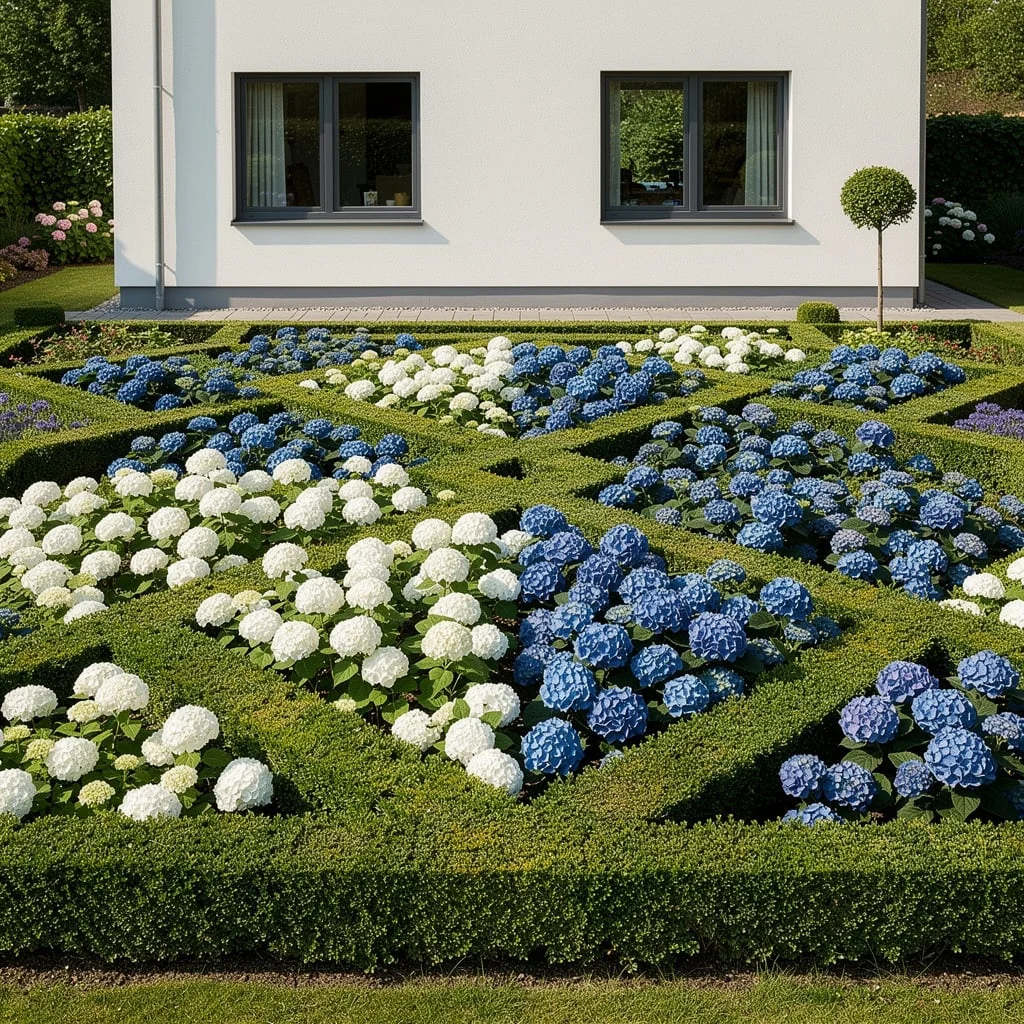
Lay out a formal parterre — a grid or geometric pattern of low boxwood hedges dividing a flat bed into sections — and plant alternating sections with blue mophead hydrangeas and white mophead hydrangeas. The boxwood grid holds the two colors apart and gives each section definition. Without the boxwood partitioning, a mix of blue and white hydrangeas reads as accidental. With it, the alternation becomes a deliberate pattern that reads from any distance. This requires a modern or classically formal house and a flat site. It will not work on a slope or against a fussy Victorian facade.
Panicle Hydrangea and Boxwood Border
Along a driveway edge or against a house foundation, plant a continuous rectangular boxwood hedge at twelve to fourteen inches tall. Behind it, plant panicle hydrangeas — Limelight or Quick Fire are excellent varieties — in a dense row. Allow them to reach their natural height of four to five feet without cutting back hard. The cone-shaped blooms open in cream, shift to white, and age to soft pink-green as autumn approaches, giving you months of changing color from a single planting. The boxwood hedge in front remains constant and keeps the whole planting anchored even when the hydrangeas go dormant. This combination handles full sun far better than mophead varieties and requires less intervention.
Blue Hydrangea Sandstone Entry
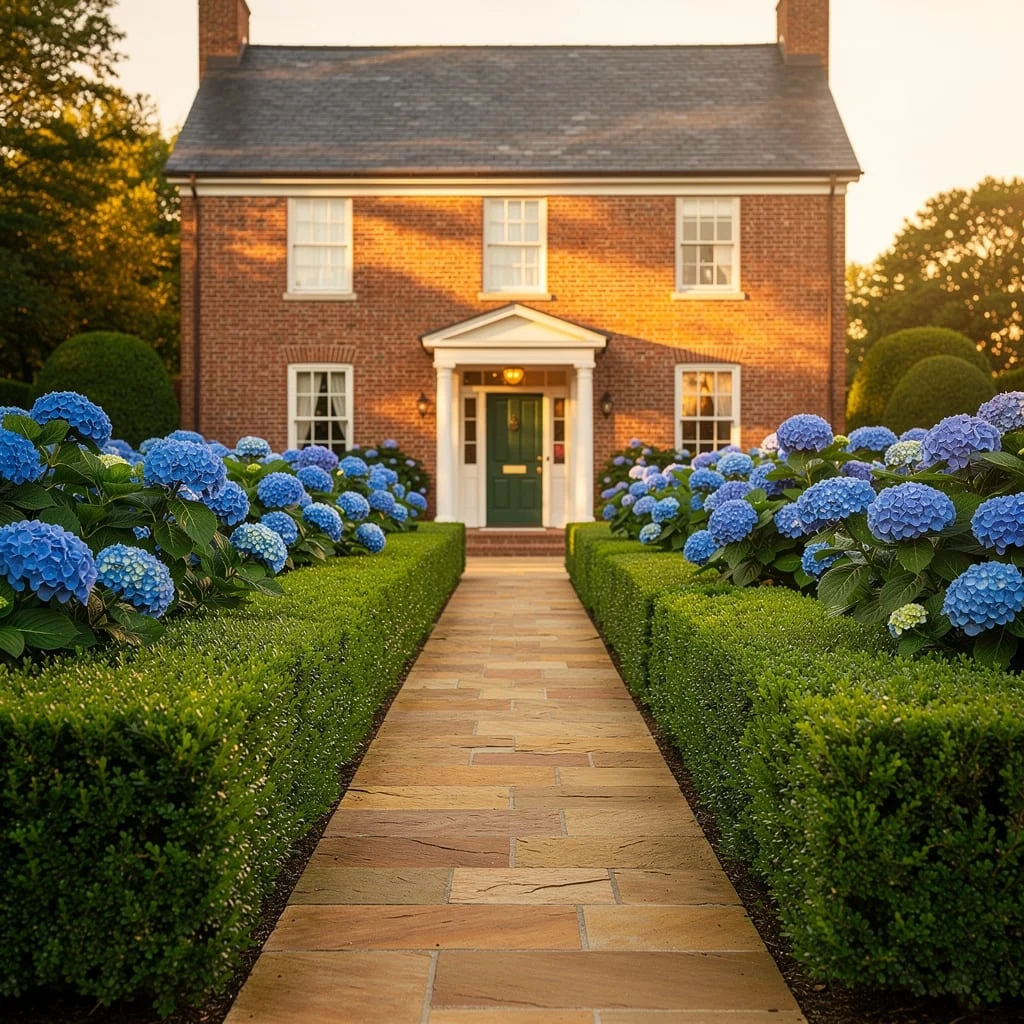
Lay a sandstone path in large irregular flags from the sidewalk or gate to the front door. On both sides of the path, plant rectangular boxwood hedges at a consistent fourteen-inch height, kept rigidly flat on top. Behind and above the hedges, plant blue bigleaf hydrangeas in a dense double row. For a brick house, the warm red of the facade makes the cool blue of the hydrangeas look extraordinary — they operate on opposite ends of the color wheel and each makes the other more vivid. Keep the soil acidic to maintain blue color. This is the most photographed combination in residential landscaping for a reason.
Stone Balustrade Garden Room
Use low stone balustrade sections — reproductions are widely available in cast stone — to define the perimeter of a formal garden bed, roughly fifteen by fifteen feet. Inside the perimeter, plant a low boxwood hedge as the front layer and fill the interior with white mophead hydrangeas in generous groups. Place a single carved stone urn on a pedestal at the center, planted with a conical boxwood topiary. The urn should be substantial — at least twenty-four inches tall on its pedestal — or it will read as decoration rather than architecture. This is the kind of composition that looks more expensive than it is, because the stone elements signal permanence and the white hydrangeas against the dark green background do the rest.
White Hydrangea Gravel Corridor
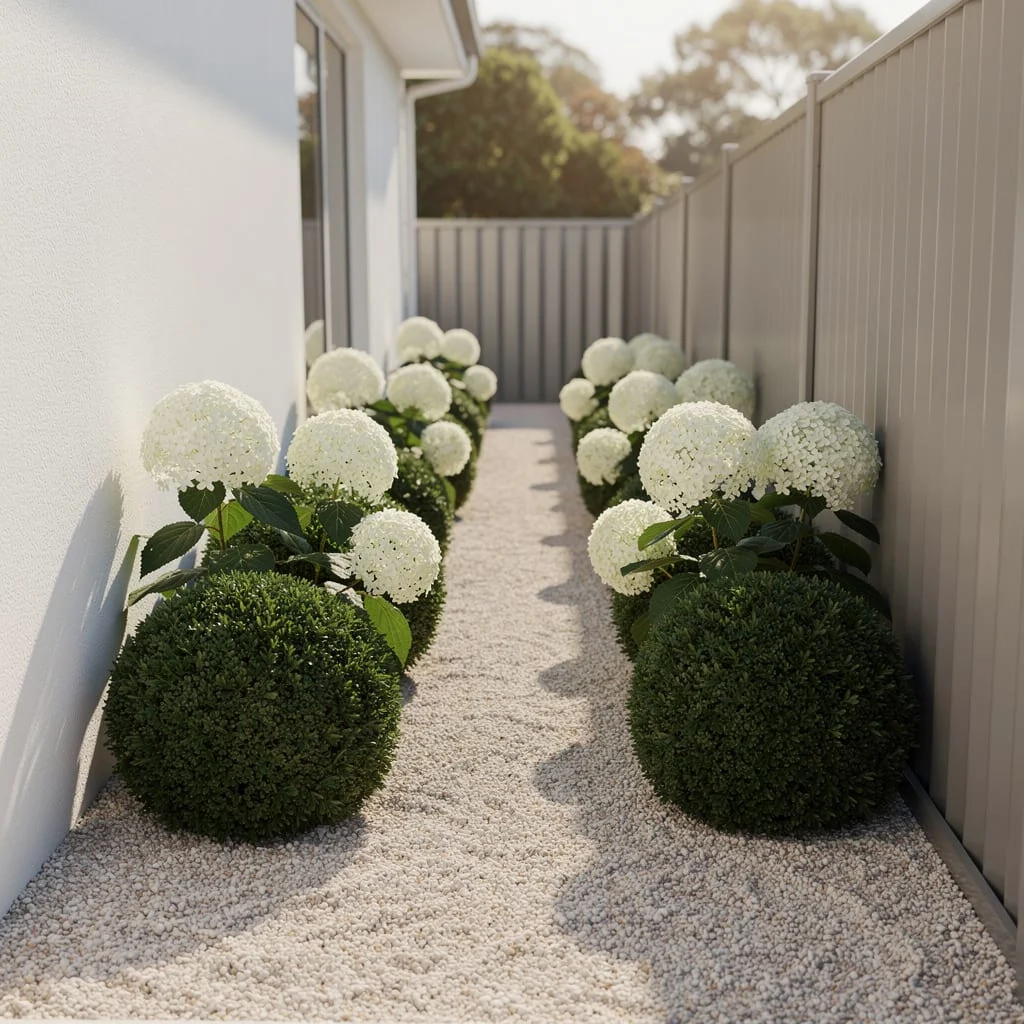
In a narrow side passage between your house and a fence — any width from four to six feet — lay a continuous bed of fine white gravel or pea gravel as the ground surface. Against each wall, plant alternating round boxwood balls and white smooth hydrangeas directly into the gravel over landscape fabric. The white gravel reflects light into what is often a dim corridor and makes the white hydrangea blooms glow. The boxwood balls at equal spacing create a rhythm that makes the narrow passage feel like a designed element rather than a forgotten gap. This works particularly well on modern houses where the grey fence and white render already establish a neutral palette.
Brick Path With Hydrangea Borders
Lay a brick path in a simple running bond pattern from a rear deck or back door to a garden gate or lawn edge. On both sides of the path, plant white Annabelle-type hydrangeas in a dense single row, backed by low boxwood hedge sections. Keep the hedge below the bloom height of the hydrangeas so the relationship between the two layers stays legible. At the base of deck stairs, flank with potted topiaries in simple white pots. The brick path’s warm red tone is what makes white hydrangeas look spectacular rather than just adequate — the contrast is warm rather than cold.
White Porch Pots With Boxwood Topiaries
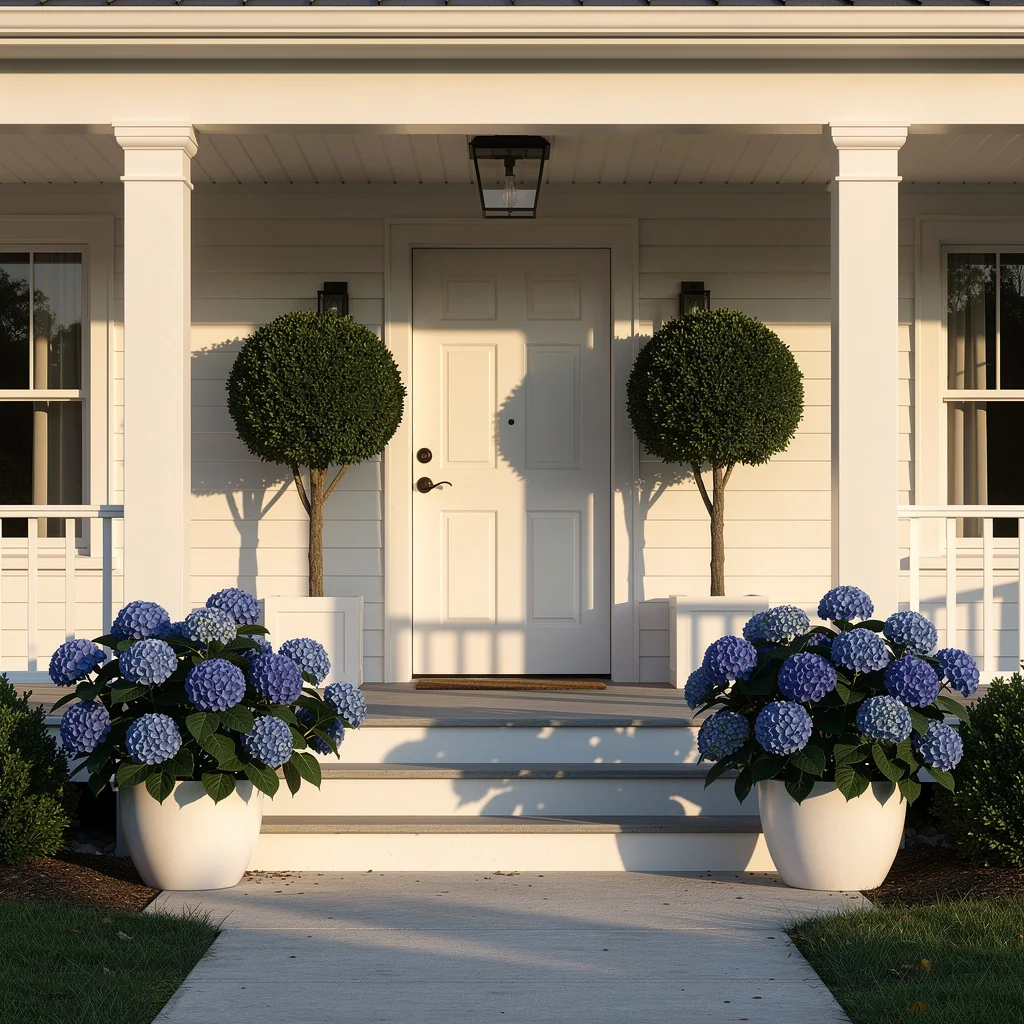
Flank your front door with a pair of large white fiberglass or stone pots — at least eighteen inches in diameter, round with a gently flared rim rather than ornate. Plant each with a standard boxwood topiary: a single clean stem topped with a clipped sphere. At the base of the topiary, fill in with blue or purple mophead hydrangeas, planted densely enough that they overflow the pot edge slightly. The combination of the vertical topiary and the rounded hydrangea blooms in a single pot creates layered height in a constrained space. The white pots against a white house facade are the correct choice; they disappear into the architecture and let the plants do the work.
Corner Foundation Planting
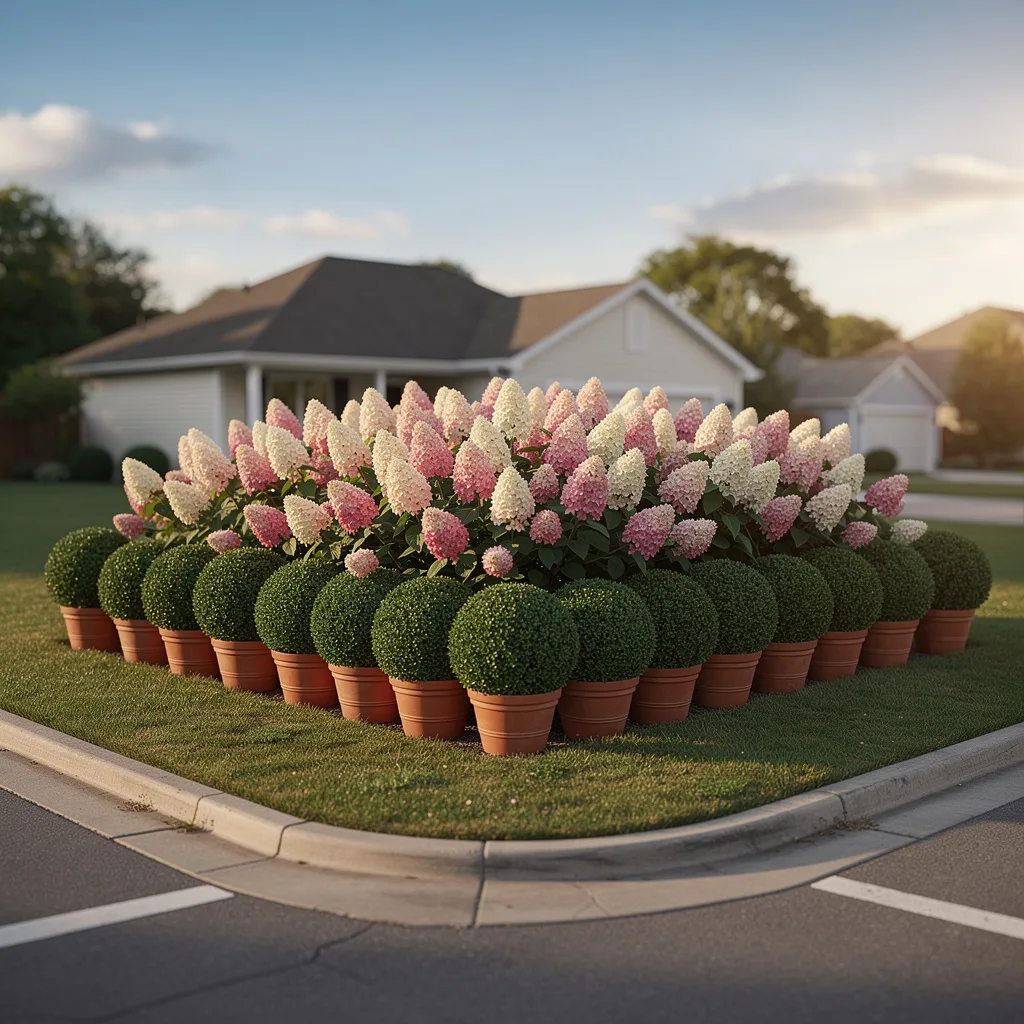
At the corner of a brick house where two foundation beds meet, plant a single large panicle hydrangea at the corner as the anchor, its eventual size and loose form softening the hard angle of the building. Flank it on each side with three or four round boxwood balls, decreasing in size as they move away from the corner. Tuck blue mophead hydrangeas between the boxwoods, their cooler tone contrasting with the lime-cream of the panicle variety at the center. The key to this planting is the variation in hydrangea type — different bloom forms at the same time of year create texture rather than uniformity.
Corner Foundation Planting
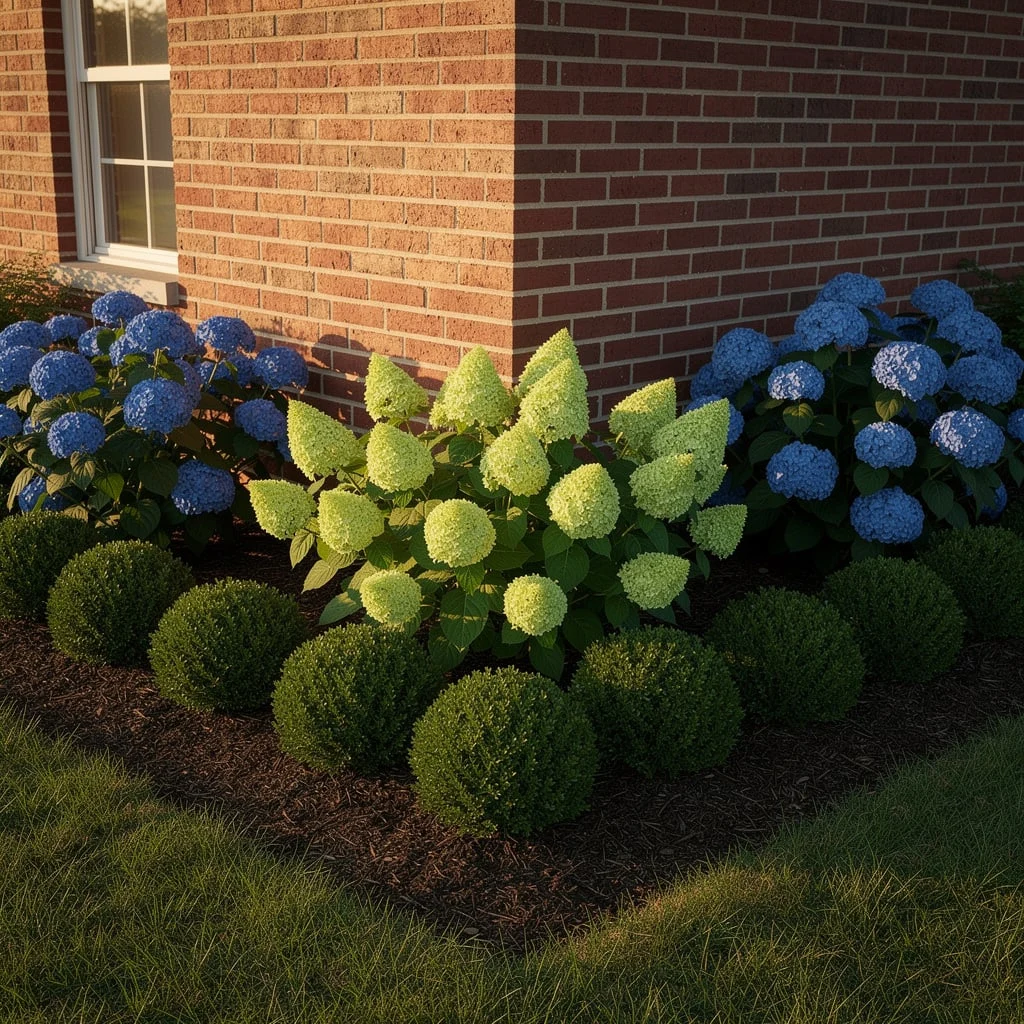
At the corner of a brick house where two foundation beds meet, plant a single large panicle hydrangea at the corner as the anchor, its eventual size and loose form softening the hard angle of the building. Flank it on each side with three or four round boxwood balls, decreasing in size as they move away from the corner. Tuck blue mophead hydrangeas between the boxwoods, their cooler tone contrasting with the lime-cream of the panicle variety at the center. The key to this planting is the variation in hydrangea type — different bloom forms at the same time of year create texture rather than uniformity.
Blue Hydrangea Hedge Beds Against Siding
Along a long foundation wall or barn-style siding, plant a single row of evenly spaced boxwood balls as the front line — all the same variety, all the same size, all sheared to the same sphere diameter of roughly fourteen inches. Directly behind each boxwood ball, plant a blue bigleaf hydrangea. The result is a two-layer planting that reads as continuous from the street: a row of green spheres in front, a row of blue flower heads rising above them. The combination works specifically because the boxwood geometry anchors the loose, abundant blooms behind it. Against white horizontal siding at golden hour, the blue hydrangeas glow in a way that photographs better than almost any other combination in residential landscaping.
White Hydrangeas With Conical Evergreens
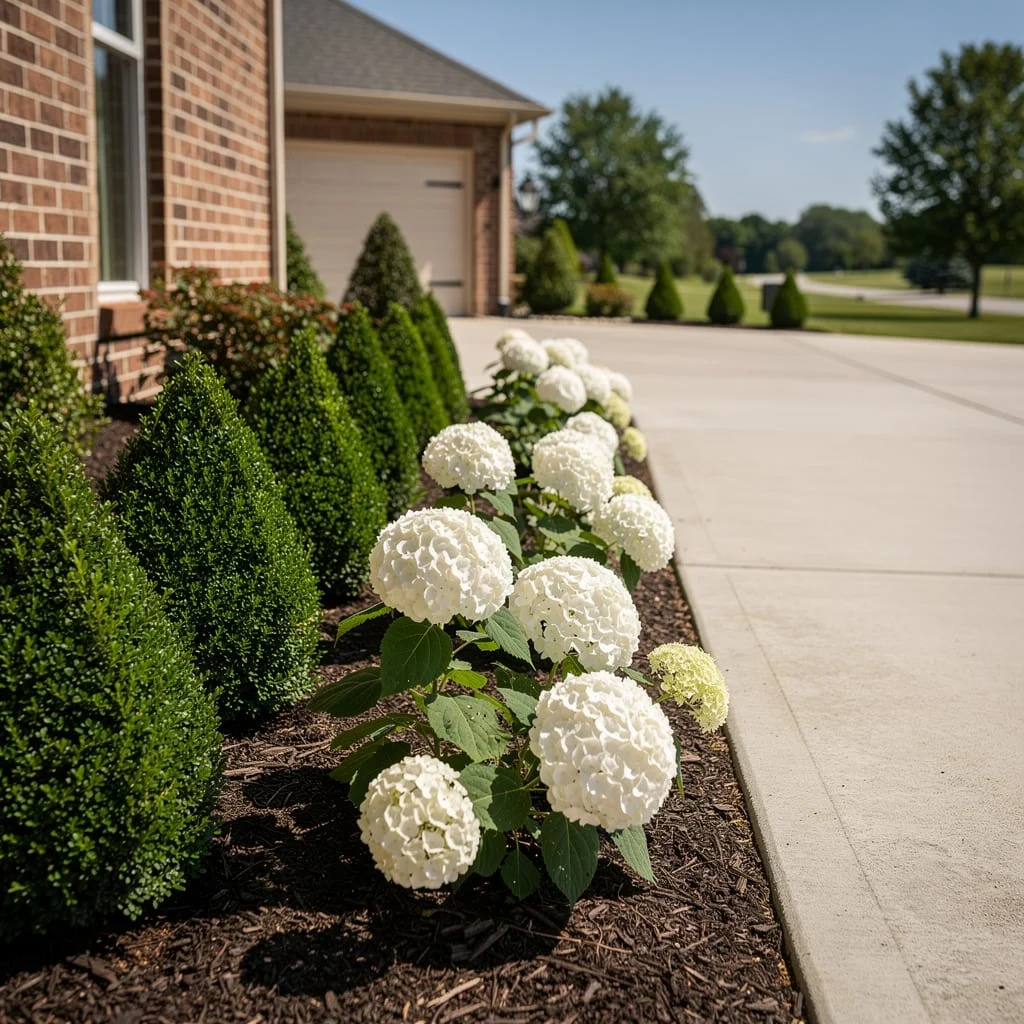
Along a driveway foundation bed, plant a row of conical evergreens — arborvitae or Sky Pencil Holly are both good choices — spaced every six to eight feet as the vertical element. Between each evergreen pair, cluster three compact white Annabelle or Incrediball hydrangeas. At the front of the bed, plant a single row of boxwood balls at eighteen-inch spacing. The three-layer structure — boxwood front, hydrangea middle, conical evergreen back — gives the planting year-round interest. The evergreens hold the composition through winter when everything else has gone dormant. The hydrangea seedheads in autumn and winter have their own beauty and should be left rather than cut.
Oval Island Bed From Above
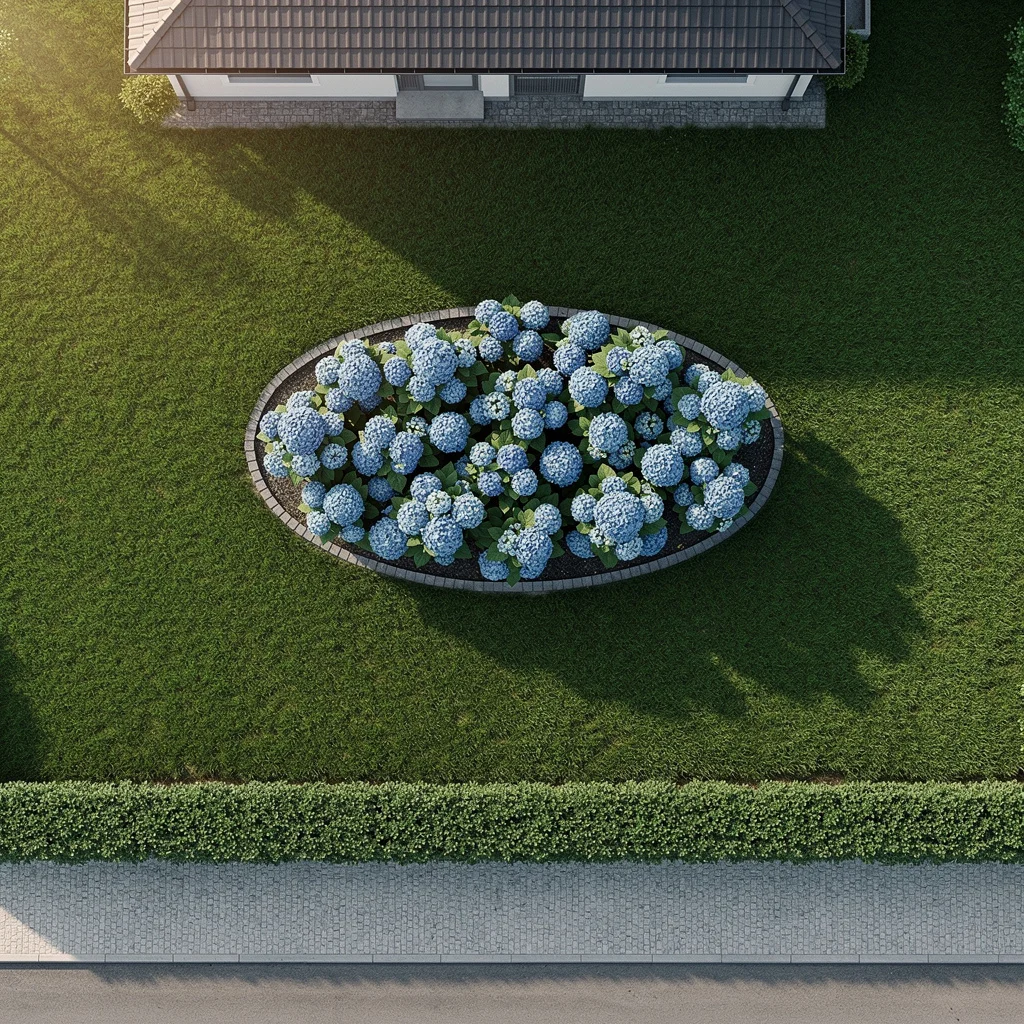
In a front lawn with enough clear ground, mark out a precise oval using spray paint and a long string as a compass. Edge it in a continuous row of smooth cobblestone pavers set on edge, mortared in place. Inside the oval, plant blue bigleaf hydrangeas in a dense mass, starting from the outside edge and working inward in concentric rings. Apply dark mulch generously between plants. From eye level, the oval reads as a clear architectural gesture — a deliberate form placed in the lawn. From above or from an upstairs window, the geometry is unmistakable. A single lollipop topiary at the center would provide the vertical anchor the composition needs, but the oval works without it.
Blue Hydrangea Hedge Beds Against Siding
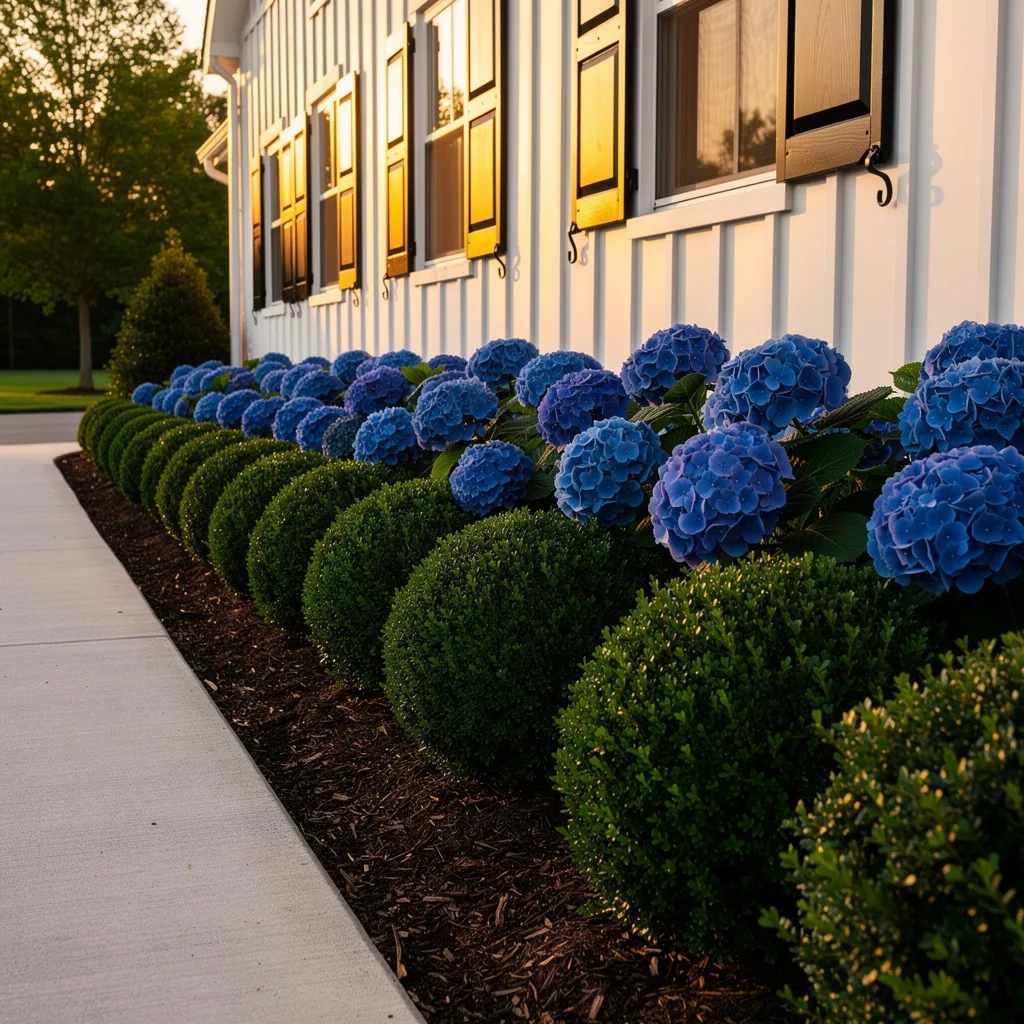
Along a long foundation wall or barn-style siding, plant a single row of evenly spaced boxwood balls as the front line — all the same variety, all the same size, all sheared to the same sphere diameter of roughly fourteen inches. Directly behind each boxwood ball, plant a blue bigleaf hydrangea. The result is a two-layer planting that reads as continuous from the street: a row of green spheres in front, a row of blue flower heads rising above them. The combination works specifically because the boxwood geometry anchors the loose, abundant blooms behind it. Against white horizontal siding at golden hour, the blue hydrangeas glow in a way that photographs better than almost any other combination in residential landscaping.
Limelight Hydrangea Fence Border
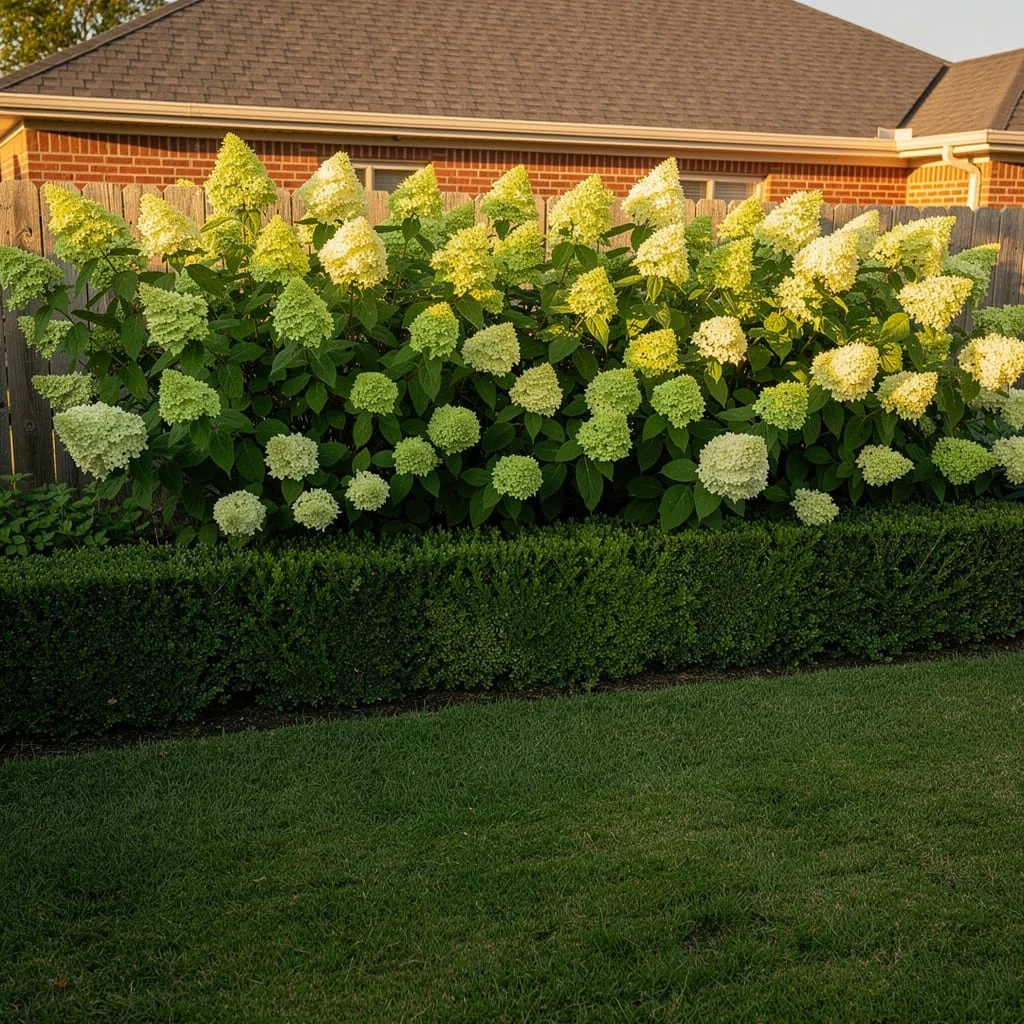
Along a wooden privacy fence, plant a flat-topped boxwood hedge at approximately eighteen inches tall and eighteen inches wide, running the full length of the fence. Behind it, plant Limelight panicle hydrangeas in a single dense row, spaced roughly three feet apart. Allow them to grow to their natural four to five feet, which puts the bloom heads well above the top of the fence and creates a layered effect: fence, then hedge, then blooms against the sky. The lime-cream and soft green tones of Limelight hydrangeas age beautifully through the season and require no deadheading to look good. This is the correct combination for privacy fence planting because the panicle hydrangea tolerates full sun, which fence lines typically receive all day.
Pink Hydrangeas Against Tall Hedge Columns
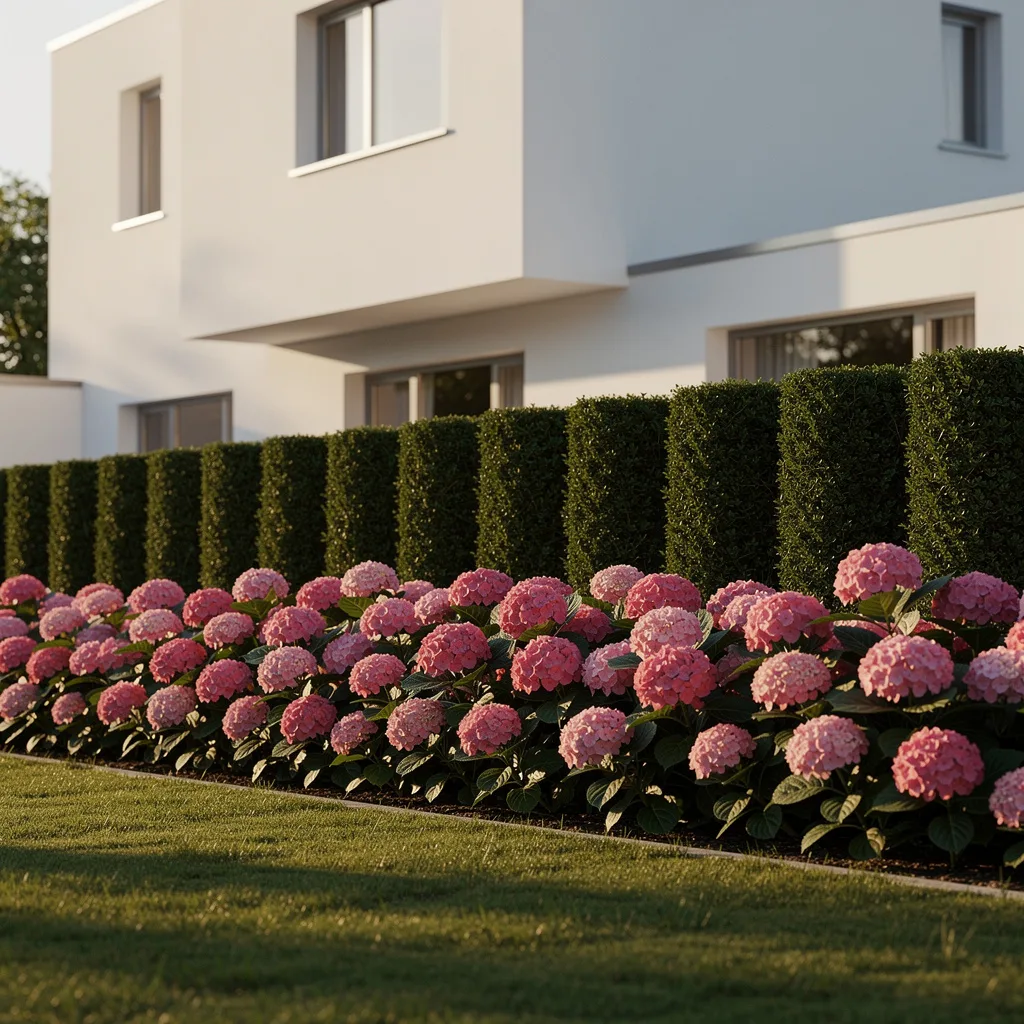
Plant a series of freestanding boxwood or yew columns — each column roughly two feet square and six feet tall — at equal intervals along a bed border, with gaps between each column. In front of the columns and filling the gaps between them, plant a continuous mass of pink bigleaf hydrangeas. The columns provide a repeating vertical rhythm and a formal structure. The hydrangeas in front provide the horizontal mass and the color. The composition reads as architectural because the columns give it a clear vertical element that most planting schemes lack entirely.
What All of These Have in Common
Every garden in this collection made the same choice. Softness and structure in the same bed.
Hydrangeas alone produce beautiful blooms and a mess of a planting. Boxwood alone produces order and visual dullness. Together they accomplish something neither can do independently: a garden that looks designed rather than assembled, that holds its character in July and in January, that gets better as both plants mature and fill in.
The urge to add more — more colors, more varieties, more layers — is usually what unravels it. These combinations work because they’re edited down to two plants and a palette. They’re not trying to be everything. They’re trying to be one thing, completely.
That’s almost always enough.