
The planter you choose says more about your design sensibility than the plant inside it. Most people have this backwards. They spend forty-five minutes choosing the perfect petunia color and then drop it into whatever plastic pot is on sale at the hardware store.
The result is a garden that looks accidental. Like things just ended up there.
A well-chosen planter does half the design work before a single seed goes in. It anchors the space, complements the architecture, and makes even a modest plant look like a decision was made. The plant completes the planter. Not the other way around.
Here’s how to actually think about it.
The Container Earns Its Place First
A planter sitting in front of your house is a permanent design decision. It is not decoration. It is architecture at a smaller scale. And like any architectural choice, it either belongs to the building behind it or it fights against it.
Your House Style Narrows the Field Fast
A dark corrugated steel contemporary facade calls for something severe. Tall matte black or graphite planters with pencil-thin cypress trees. Anything round, terracotta, or quaint will look like a mistake someone failed to fix.
A white farmhouse with black metal roofing can go either traditional or modern. It’s one of the rare house types that gives you genuine range. Wicker baskets work. Black steel long planters work. Half-barrels work. That flexibility is a trap — because without a committed point of view, you end up with all three and none of them talking to each other.
Brick asks for warmth. Terracotta, oxidized corten steel, dark wood boxes — materials that share the brick’s earth tones. Cobalt blue ceramic will fight it. Bright white concrete will fight it. Stone and rust will not.
Material Is Texture, Not Just Color
Two black planters can feel completely different. A matte powder-coated steel planter reads urban and architectural. A cast-iron planter with ornate detailing reads Victorian garden. A dark wicker basket reads tropical or bohemian. They share a color family and share nothing else.
Before choosing a planter by color, choose it by texture. What texture does the surface of your house, your deck, your path have? Your planter should relate to at least one of those surfaces, even loosely.
The Proportion Question Nobody Asks
A planter that is too small looks apologetic. A planter that is too large looks like compensation. The right size is always slightly larger than your first instinct.
For a front entry, the planter should reach at least hip height when sitting directly on the ground. For a deck or patio, it should hold enough soil to take a serious planting without appearing to strain. For a railing, the box should span at least two-thirds of the visible railing section. Anything shorter looks like it was placed by someone who was unsure.
Outdoor Planter Ideas
Sage Railing Clip Box
Buy a railing planter box in sage green — the matte, slightly chalky shade, not bright green. The clip-on bracket system should fit snugly over the top rail without wobbling. Plant it densely with a single variety: hot pink or coral impatiens for shade, or calibrachoa for full sun. Plant edge to edge so the box overflows slightly.
The sage green against a white railing is the entire color relationship. Nothing else is needed. The contrast between the muted container and the vivid flowers is what makes it work from the street.
Wicker Basket Tropical Cluster
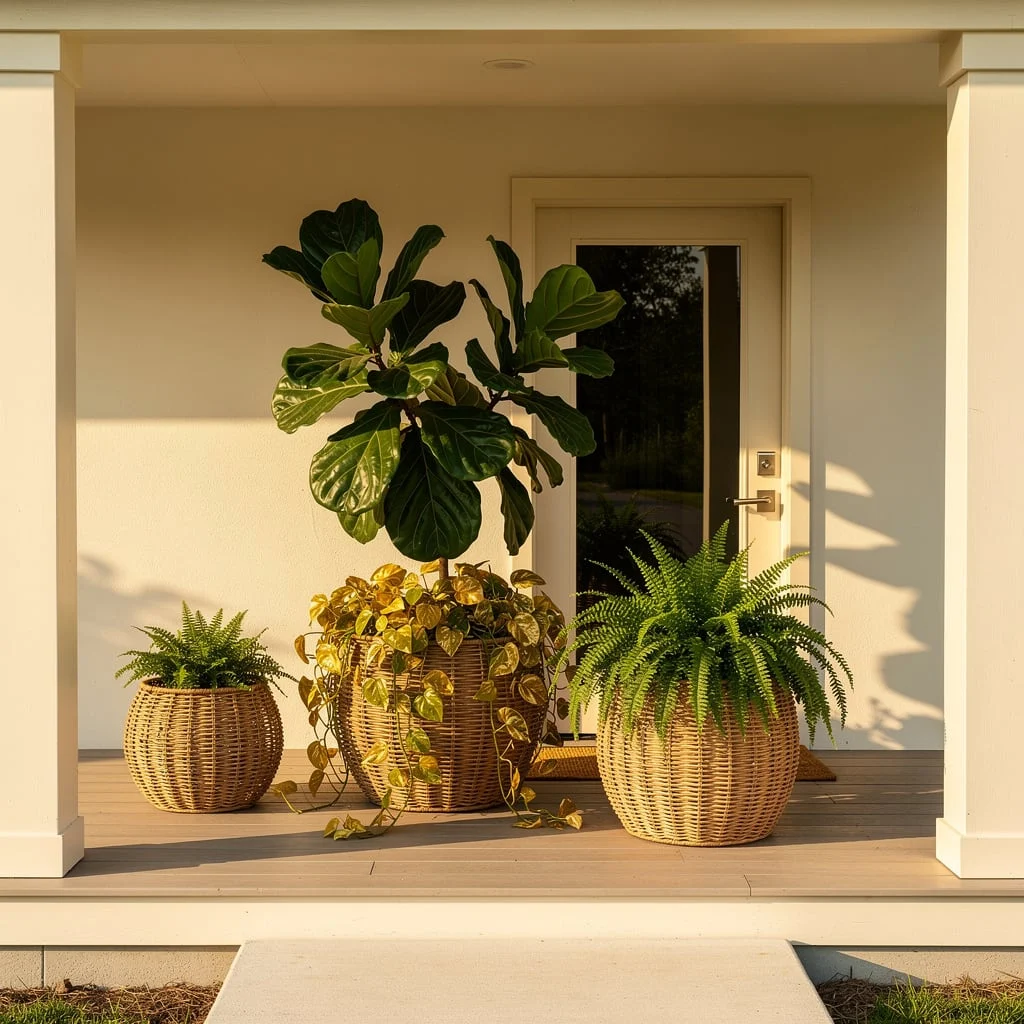
Group three wicker-look outdoor basket planters of varying heights directly in front of an entry door. Put a fiddle-leaf fig in the tallest central basket. Plant golden pothos with long trailing vines in the mid-sized basket flanking it. Fill the third with Boston fern. All green, all tropical, all in the same warm wicker tone. No flower color. This arrangement works because the leaf shape variation — the broad fiddle-leaf, the heart-shaped pothos, the feathery fern — provides all the visual interest. Place it on a covered porch only: none of these plants tolerate direct sun or heavy rain.
Anthracite Olive Tree Bench
Place two matching anthracite steel square planters of equal size with a cedar or iroko slatted bench bridging the gap between them. Plant each pot with a single standard olive tree — choose trees of matching height and form. Underplant with low white flowers like alyssum or white erica.
Lay fine blue-grey gravel around the base of both planters, extending out into the surrounding area. The grey stone, the anthracite steel, the silver-green olive foliage, and the warm wood bench are all in the same cool, restrained palette. The result looks designed rather than planted.
White Sphere Lavender Row
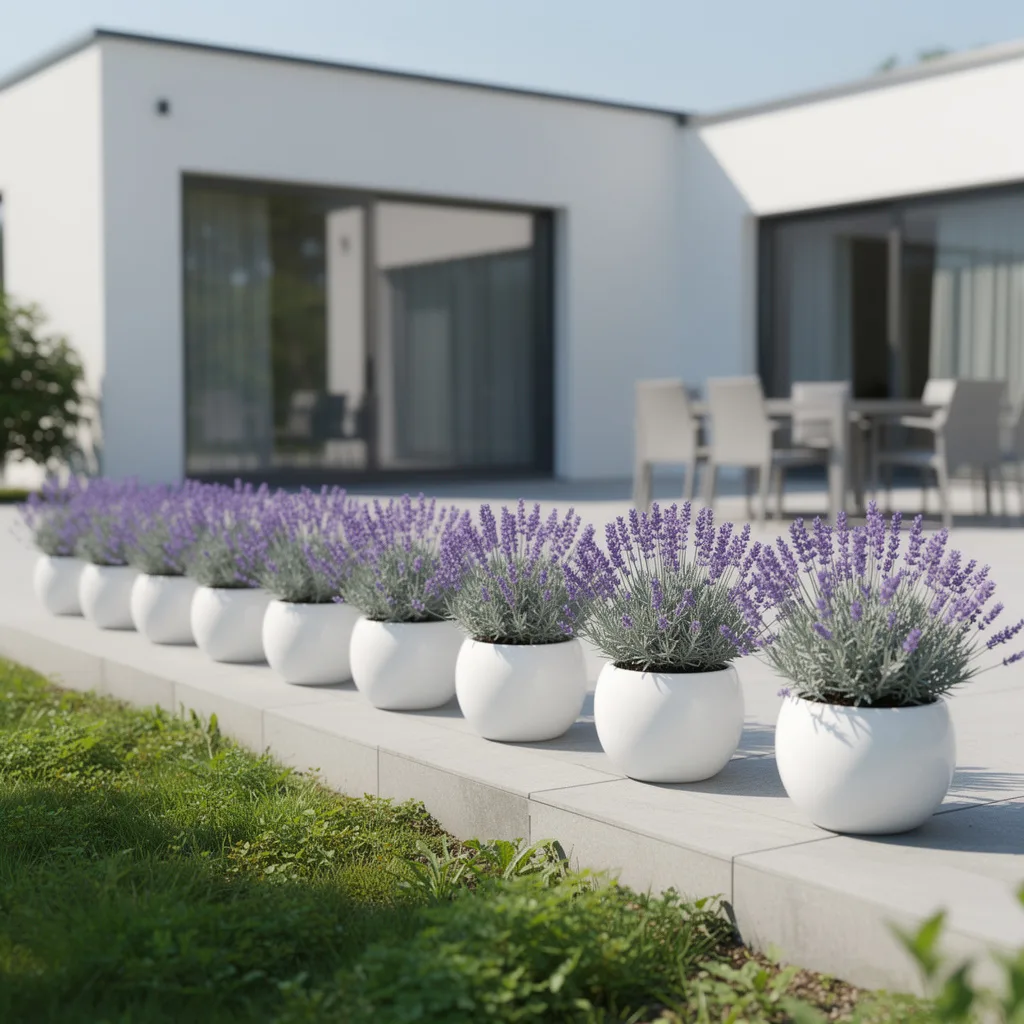
Along a pale concrete or stone ledge in front of a white rendered modern house, place eight to ten matching white matte sphere planters in a continuous line, each planted with a single lavender plant at the same growth stage. Space them evenly, roughly one pot-width apart. This arrangement works because it turns repetition into a design feature. Any single one of these pots is unremarkable. Eight of them in a row against a white wall is a considered landscape statement. Use Hidcote or Munstead lavender — compact varieties that stay tight and mounded without sprawling.
Long Dark Deck Planters with Uplighting
Use two long matte dark grey or black rectangular planters placed end to end along the edge of a covered deck or porch. Plant with miscanthus or pampas grass as the central spine — densely enough that the plumes rise well above the planter rim. Add lower flowering plants like helenium or rudbeckia in warm orange and rust tones as the filler layer.
Install low-voltage spike uplights inside each planter, angled upward into the grass. At dusk, the effect is architectural. The grass catches the light from below and the plumes glow. This is one of the few outdoor planting ideas that looks better at night than during the day.
Galvanized Tub Deck Planter
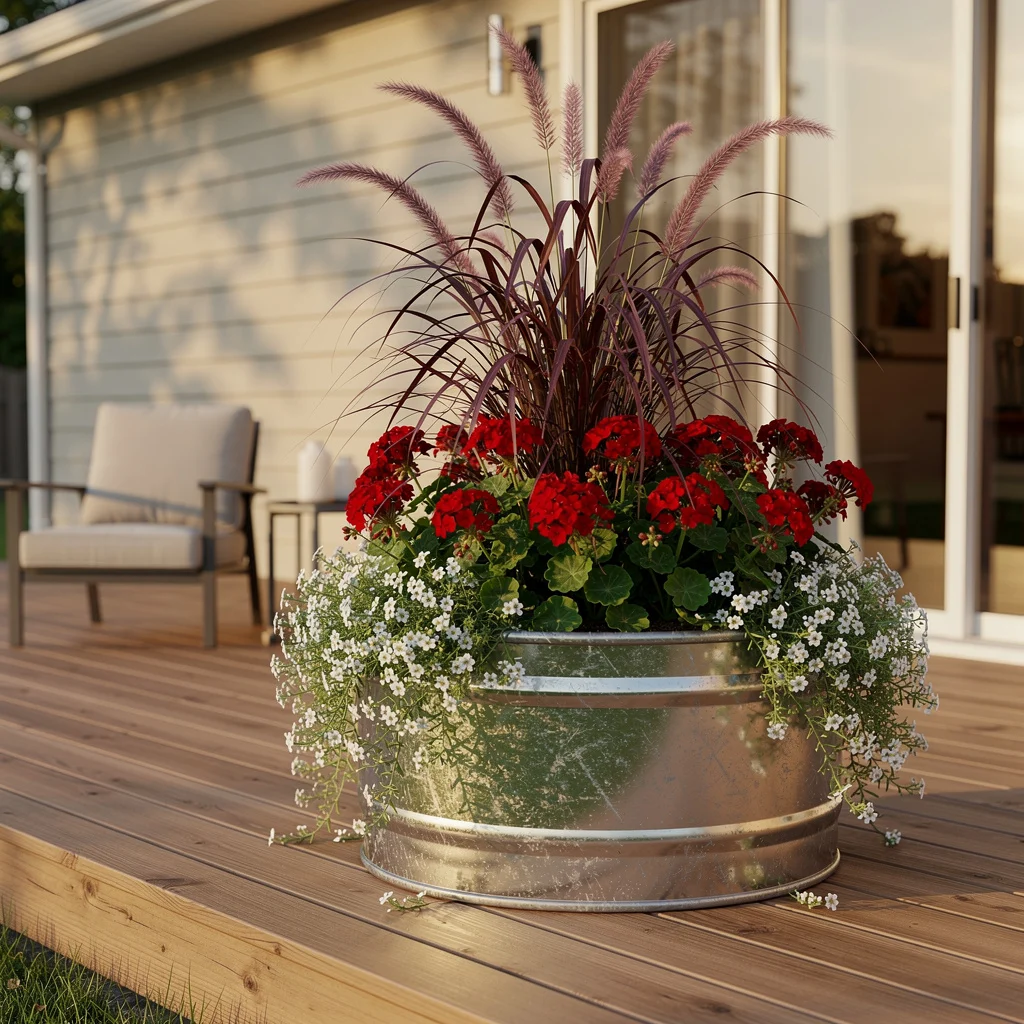
In a large round galvanized steel tub — the kind used for livestock water — plant purple fountain grass as the central thriller. Surround it with a full ring of red geraniums as the filler. Edge the entire rim with trailing white bacopa so it drapes over the galvanized edge. Drill several drainage holes in the base of the tub before planting. Place it as a standalone feature on a timber deck. The galvanized surface is the material story — it belongs on a deck, in a backyard, anywhere informal. The three-layer planting (grass above, geraniums around, bacopa trailing) makes it look full and considered rather than thrown together.
White Egg Pots at Night
Group five or six white matte egg-shaped or bowl-shaped planters of varying sizes along a white rendered wall, with ground-mounted upward spike lights positioned in front of each pot. Plant with a mix of white and cream flowers — white roses, white hydrangea, lavender, and baby’s breath — with one standard lollipop tree in the largest pot for height.
At night, the white pots glow against the wall as if lit from within. The light catches the leaf textures and casts dramatic shadows upward. Leave white pebble gravel as the ground cover around the cluster so the lit effect extends across the surface.
Wine Barrel Gateway Pair
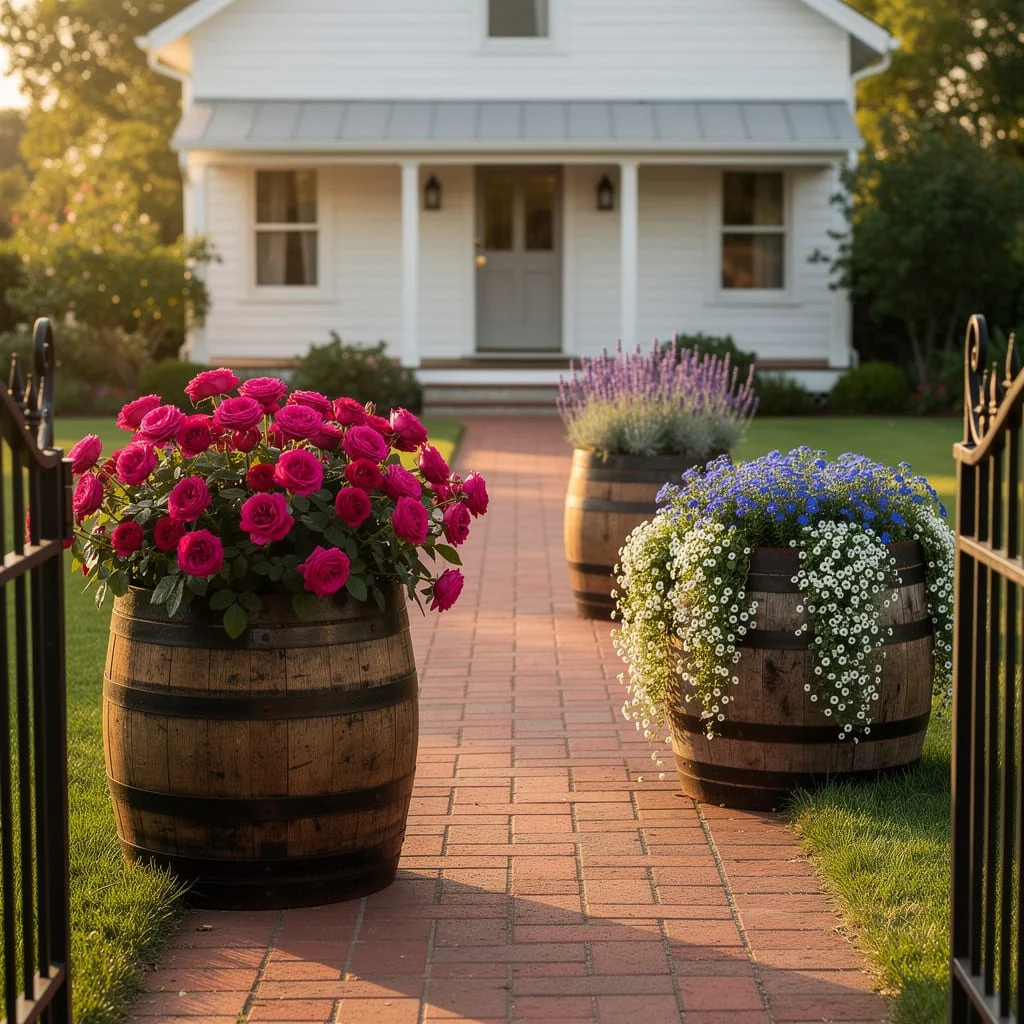
Place two half wine barrels on either side of a gate or garden entrance. Plant one barrel with climbing roses — choose a compact, bushy variety rather than a climber that needs support. Plant the second with a combination of blue ageratum and white alyssum, with a single lavender plant for height. The barrels are the statement. They are heavy, warm, and deeply textured. The roses on one side and the blue-white planting on the other are intentionally not matching — which is what makes the gate feel like an entrance to something rather than a matched set.
Terracotta Urn with Spilling Vine
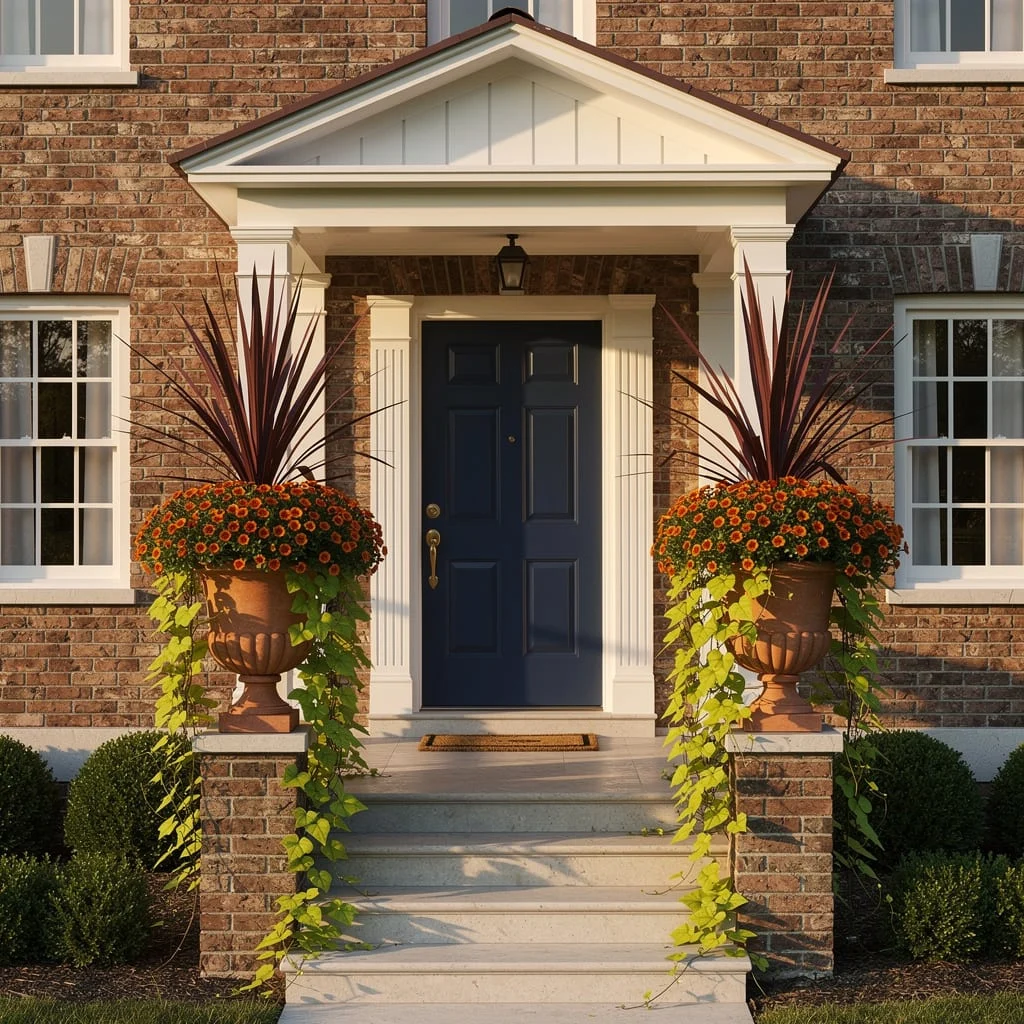
On raised brick or stone pedestals flanking a formal front entry, place large terracotta campana-style urns. Plant each with one burgundy-red New Zealand flax or cordyline as the spike. Ring it with deep orange mums as the filler layer. Allow chartreuse sweet potato vine to cascade dramatically over the edge of the urn, trailing all the way down the pedestal to the step. The vine trail is the key element. It should be long — at least fifty centimetres of trailing stem by the time it is established. The warm terracotta, the deep orange bloom, and the chartreuse spill create a palette that is warm and autumnal without being explicitly seasonal.
Black Columnar Cypress Pair
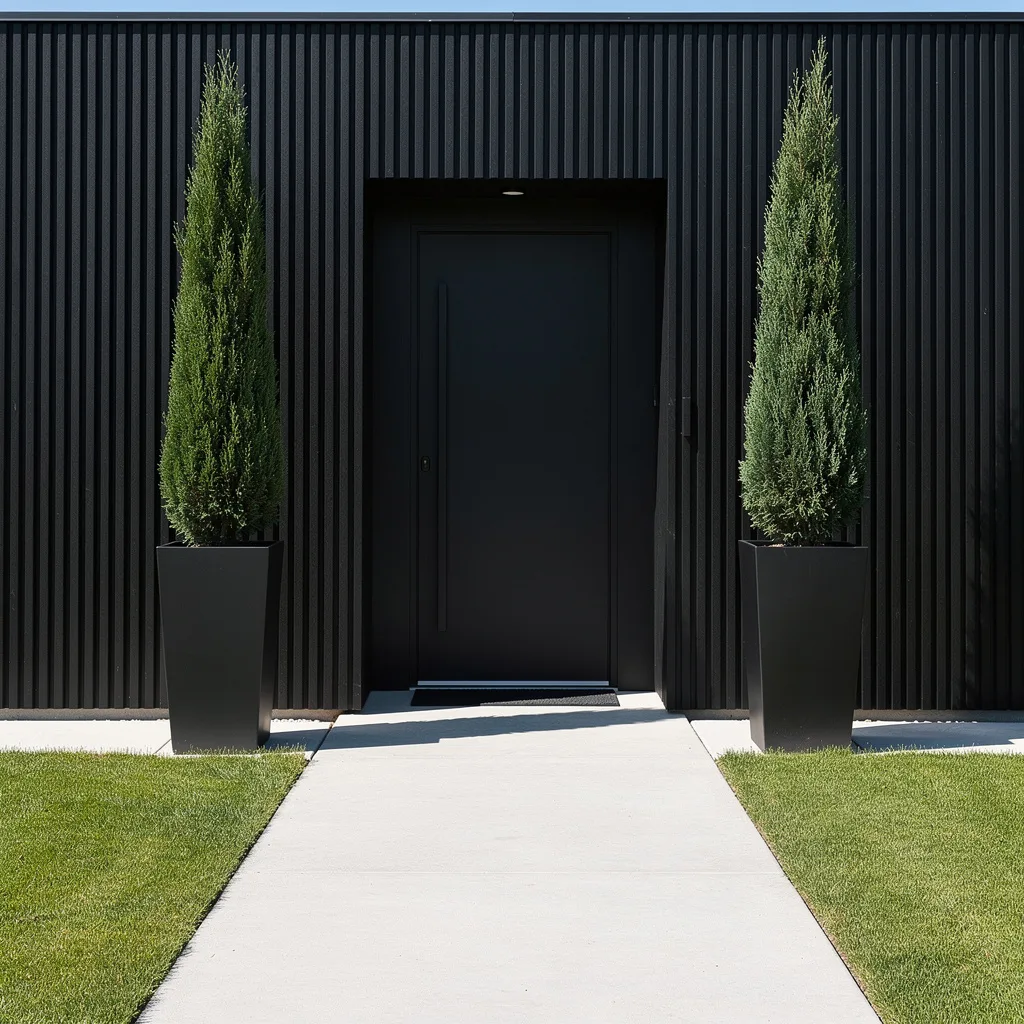
Flank an all-black front door on dark corrugated metal cladding with two identical tall matte black tapered square planters, each containing a single Italian cypress or slender juniper pruned into a tight pencil form. No underplanting. White gravel as the ground surface around the base. This is the most restrained arrangement in this collection and also the most architecturally correct for contemporary dark facades. The black containers vanish against the wall, leaving only the clean vertical green columns on either side of the door. The effect is like two punctuation marks defining an entrance.
Rough Stone Succulent Cluster
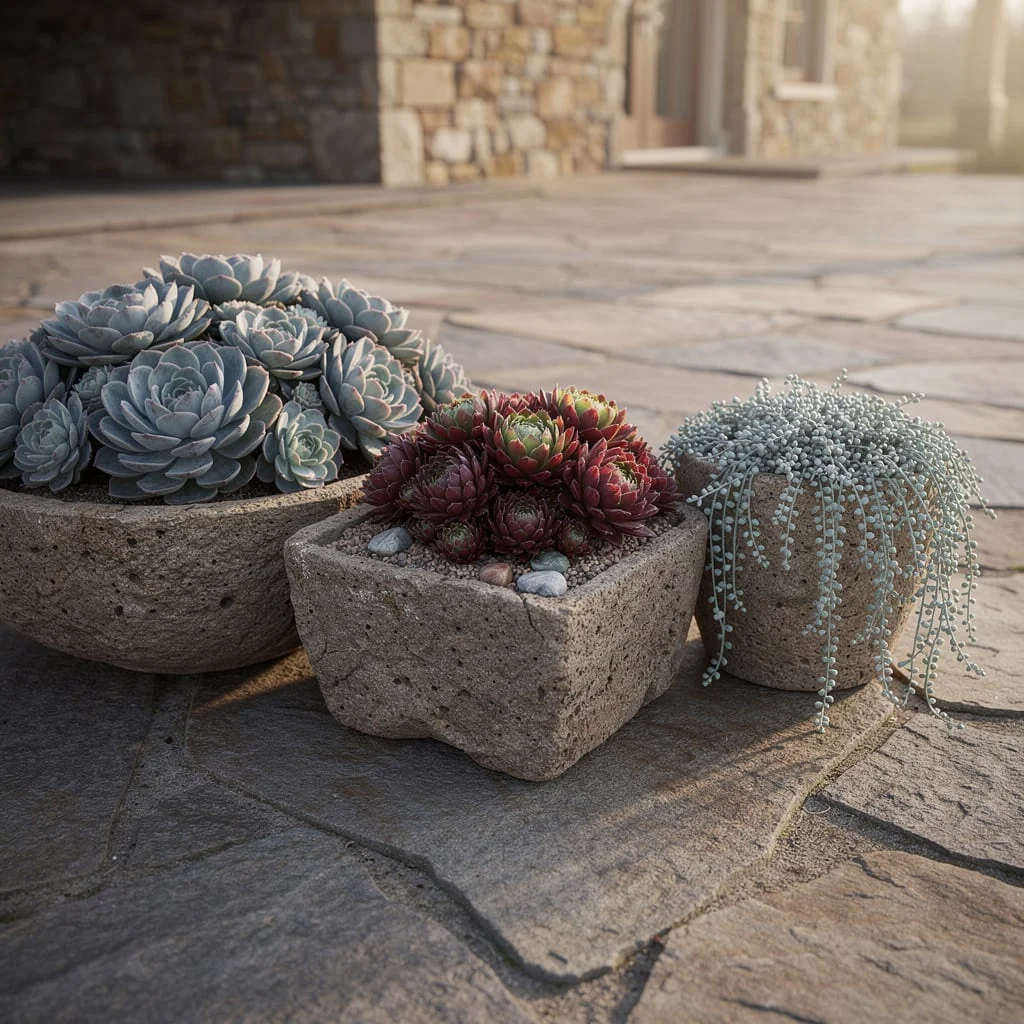
Group three rough-textured stone or hypertufa containers — a wide low bowl, a mid-height irregular square, and a smaller round — directly on a flagstone patio. Plant the bowl with silver-blue echeveria packed edge to edge. Fill the square with deep burgundy sempervivum, topped with small pebbles around the base of each rosette. Plant the round with string of pearls so it drapes over the edge. Stone containers belong on stone surfaces. The visual logic of material meeting material is what makes this grouping feel placed rather than arranged. Use a succulent-specific gritty compost and do not overwater.
Mixed Hanging Farmhouse Baskets
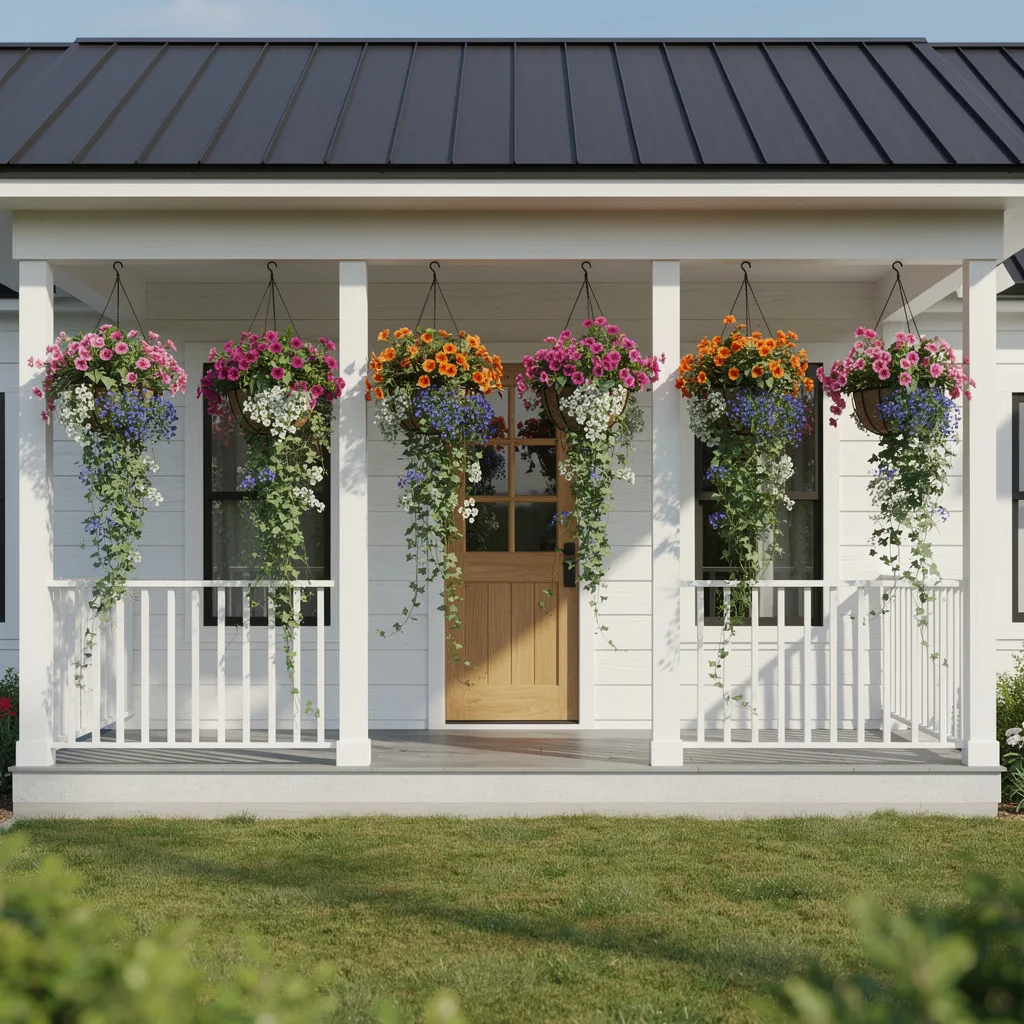
Under a white porch with a natural wood entry door, hang four mixed hanging baskets from the ceiling at even intervals. Each basket should combine three varieties: a compact upright bloom in pink or orange at the centre, a trailing blue lobelia as the secondary, and white bacopa or sweet alyssum as the spillover at the rim. Allow the trail to grow long — well past the basket base. The farmhouse porch tolerates mixed color in hanging baskets in a way that more architectural porches cannot. The wood door, white columns, and white railing create a neutral backdrop that absorbs the color riot above it without fighting it.
Upcycled Colander Pergola Hangers
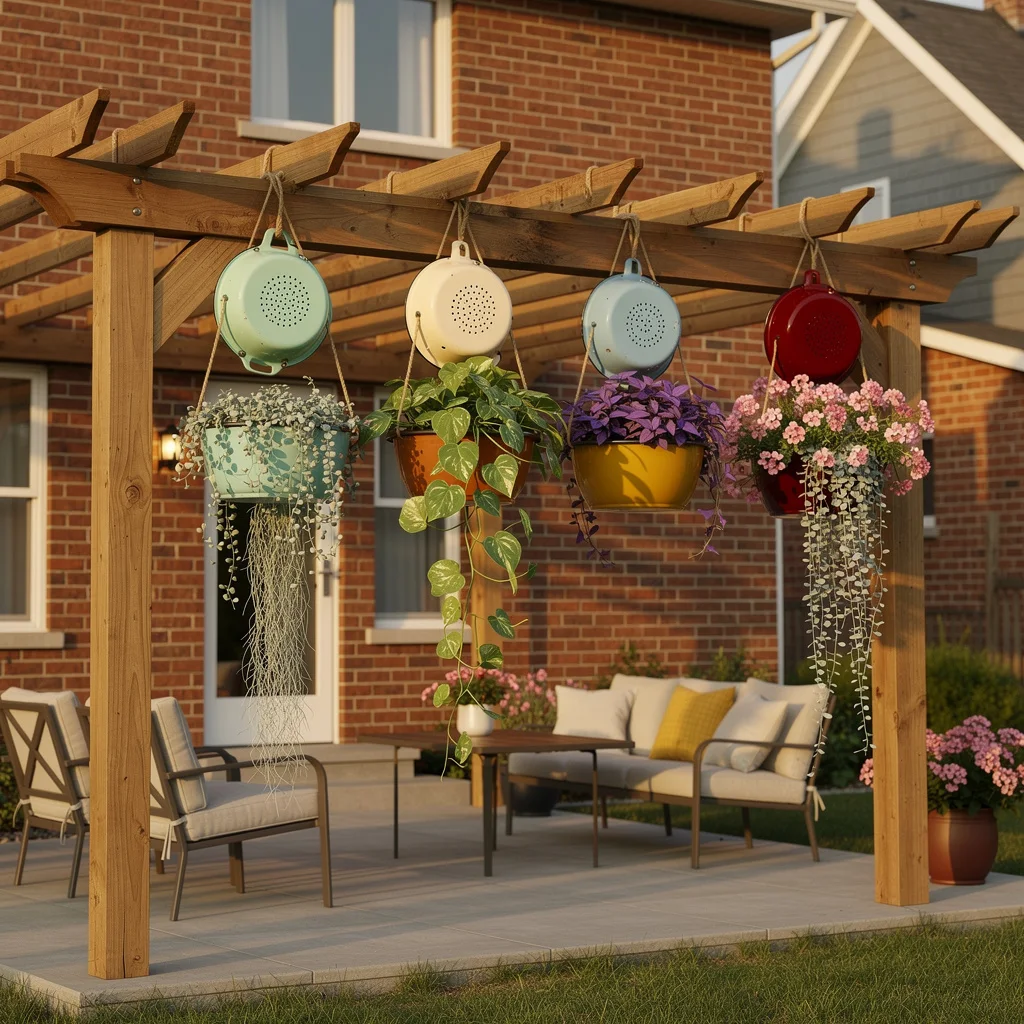
From the beams of a cedar pergola, hang four or five vintage or reproduction enamel colanders in different colors — mint, cream, sky blue, deep red — as the outer casing. Inside each, nestle a planted inner pot. Plant string of pearls in the mint colander, trailing pothos in the cream, purple oxalis in the blue, trailing pink pelargonium in the red. Suspend them on thick natural jute rope at slightly varied heights — not all the same. The colanders read as whimsical without being cute, because the plants themselves are real and lush. The pergola provides the structure; the hangers bring color into a space that would otherwise be only overhead wood.
Dark Fence Planter Trio
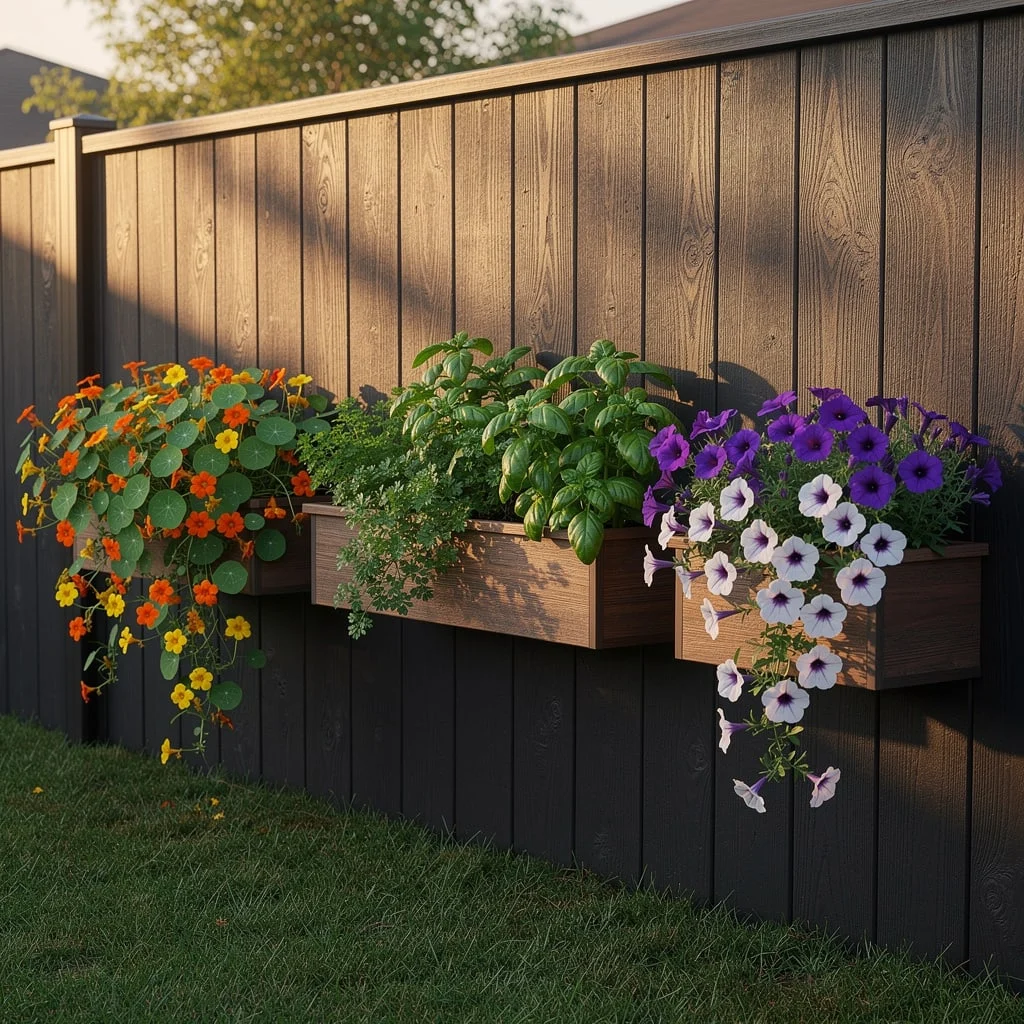
Mount three wooden window boxes horizontally along a dark stained timber fence panel at the same height, spaced roughly thirty centimetres apart. Plant the left box with trailing nasturtiums in orange and yellow. Fill the center box with basil and mixed culinary herbs. Plant the right box with purple and white trailing petunias. Each box has a different purpose — ornamental, edible, ornamental — but the dark wood box ties them together visually. The fence-mounted arrangement is the most space-efficient planting solution in this collection. It turns a flat fence into a vertical garden without any structural modification beyond two screws per box.
Concrete Bowl Desert Garden
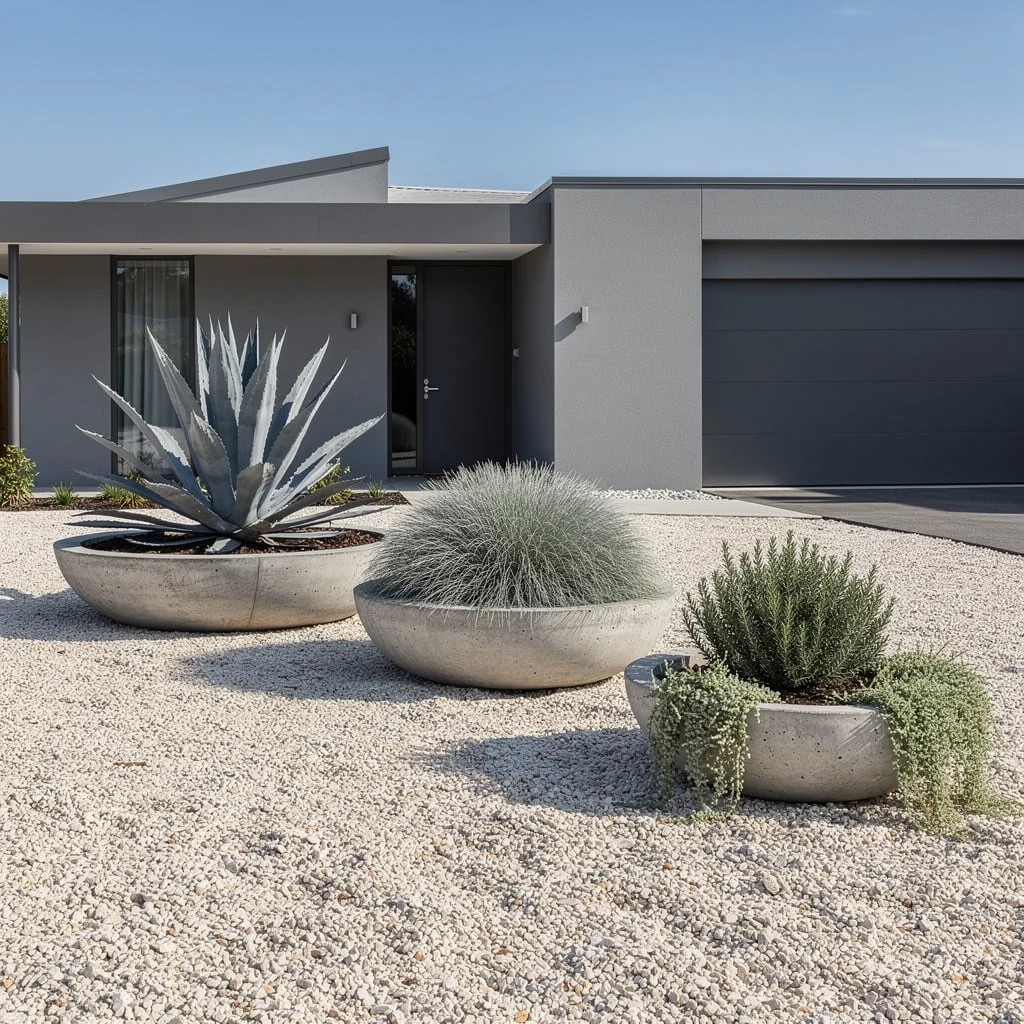
On a white gravel driveway in front of a grey rendered contemporary house, arrange three large low concrete bowl planters of descending size. Plant the largest with a silver blue agave — choose a variety whose mature width fits the bowl without cramping it. Fill the second bowl with blue fescue grass in a tight mound. Plant the third with a trailing rosemary and let it drape slightly over the bowl edge. The planters sit directly in white gravel with no mulch, no border, no edging. The gravel is the ground. The concrete bowls echo the gravel color and the rendered wall. The plants are all grey-green, silver, or blue-grey. This is a monochromatic palette in every sense — container, ground, wall, and plant all belong to the same cool family.
Silver Tapered Topiary Pair
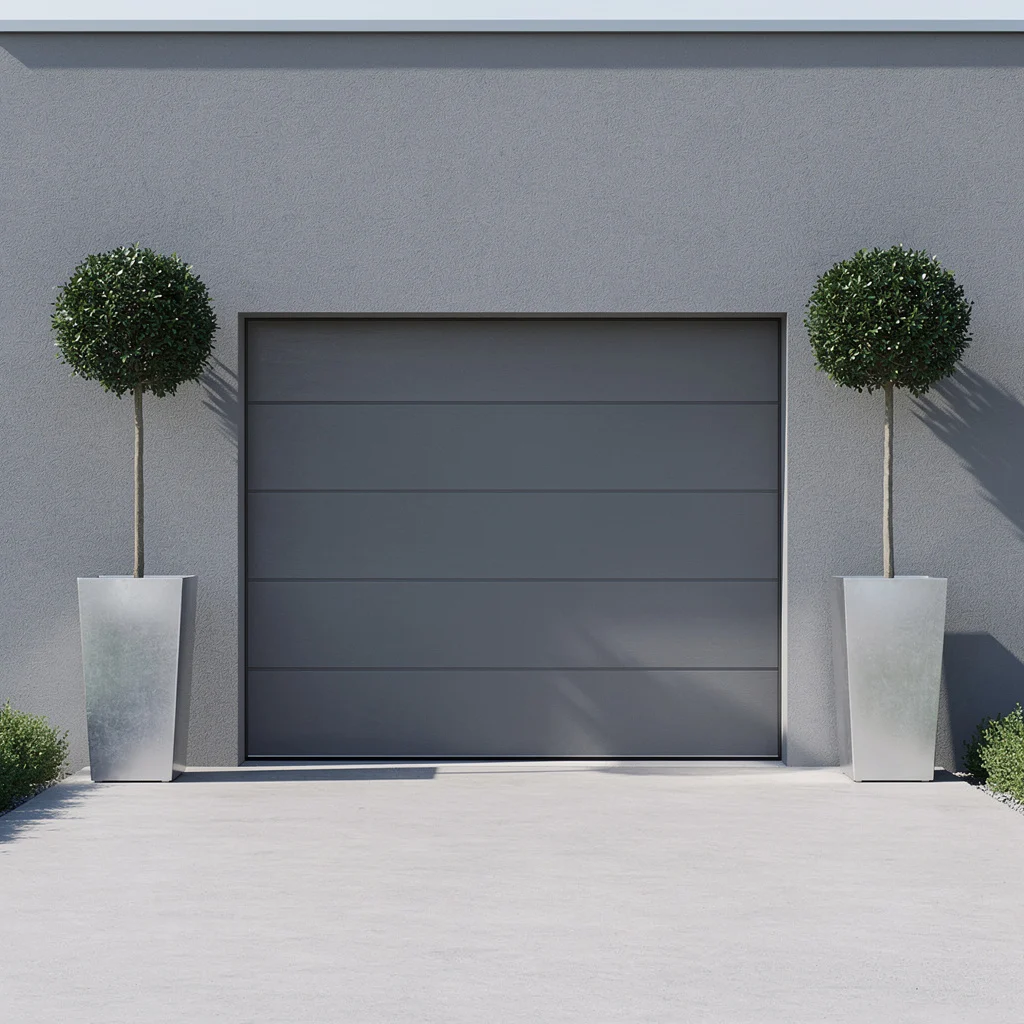
Flank a grey sectional garage door with two matching silver-toned tapered square planters — galvanized or brushed aluminium finish. Plant each with a single standard bay tree or box ball topiary, clipped to a perfect sphere. No underplanting. Grey house. Grey door. Silver planters. Green spheres. The color count is three. This is the correct number for a modern exterior. Adding anything else — a stripe of flowers, a ground cover, a decorative mulch — would be one decision too many.
Corten Steel Grass Screen
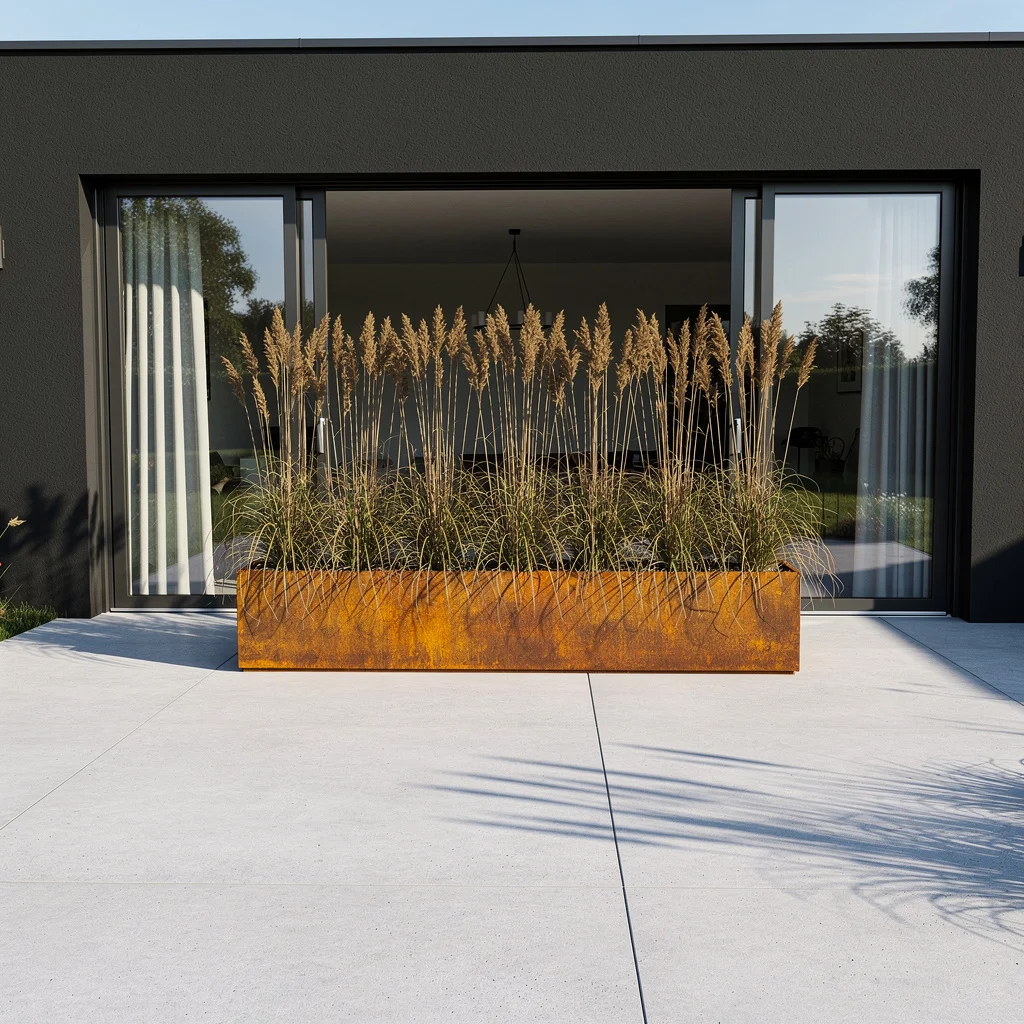
Position a single long rectangular corten steel planter perpendicular to a floor-to-ceiling glass sliding door, running parallel to the house. Plant it end to end with a single variety of tall airy grass — Calamagrostis or Stipa gigantea work well — at close spacing so the plants form a continuous visual screen. The corten develops its deep rust patina over the first season outdoors. By the second year it has set to a stable warm brown-orange that does not transfer to the surrounding paving. Against dark concrete paving and dark rendered walls, this orange becomes the only warm color in the composition. The grass above it catches wind movement. It is both privacy screen and kinetic sculpture.
Final Thoughts
There is a version of outdoor planting that is purely decorative. Seasonal flowers in a terracotta pot, replaced when they fade, replaced again when seasons turn. That approach has its place.
But the outdoor spaces in this collection are doing something more. They’re not just growing plants. They’re establishing material relationships. Container to wall. Plant to ground surface. Texture to texture.
A corten steel trough in front of dark concrete reads as a single composed thought. Concrete bowls on a gravel drive, everything in the same grey-silver-green palette, reads as a landscape decision not just a plant decision.
That’s the difference between a yard that looks tended and one that looks designed.
Plants grow. Decisions hold.