
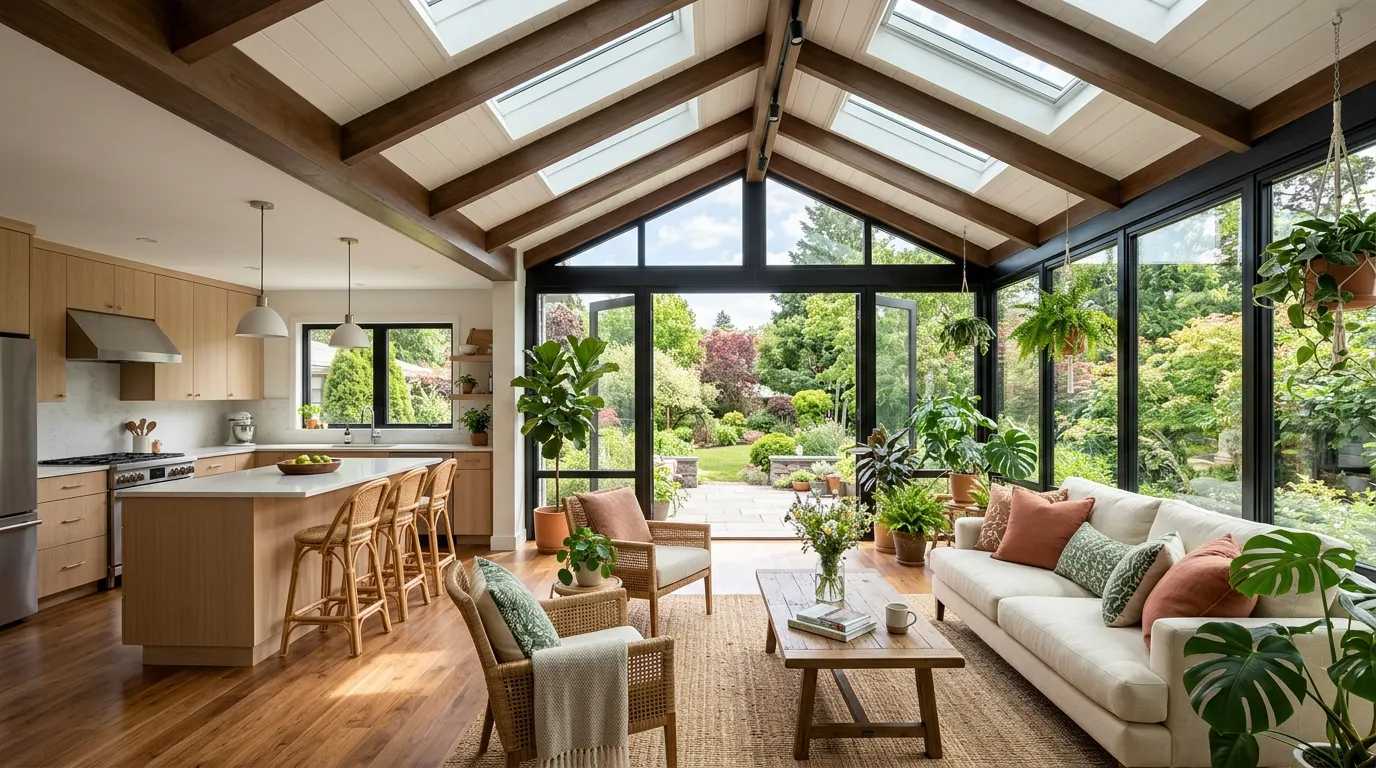
There is a room in your house that doesn’t exist yet. It sits between your kitchen and your garden, in the gap where a wall currently decides — without asking you — that the indoors end here.
A four season room addition off the kitchen fixes that decision. It extends the place where people already gather, adds a room that earns its keep in January just as much as July, and gives your kitchen a view it probably doesn’t have right now. Not a screened porch. Not a sunroom that only functions in May. A real room, with real glass, real insulation, and a real reason to be there at every hour of the year.
The design range is wide. These twenty rooms prove it — from a white cathedral-ceilinged addition with skylights the size of a dining table, to a dark forest green room that wraps a velvet sofa in candlelight and tree views, to a Japanese-inspired room that turns a raked gravel garden into the most compelling wall in the house. Different aesthetics entirely. The same underlying logic.
That logic is what this blog is about. The design decisions that determine whether your addition feels like a proper room or a glassed-in afterthought. The principles that the best four season rooms share, even when they share nothing else visually. And twenty very specific ways to make yours the room that earns every square foot.
How the Room Earns Its Place Next to the Kitchen
A four season room off the kitchen is a specific type of addition with a specific brief. It has to work as an extension of the place where life already happens — where people eat, prepare food, drink coffee, gather without deciding to gather. It earns its place by being usable, not by being beautiful. The two things should coincide, but usability comes first.
The Floor Has to Make Sense for Both
The kitchen floor and the addition floor will be seen together. If your kitchen is on dark hardwood, a pale travertine addition floor creates a jarring visual break. If your kitchen has terracotta tiles, continuing that material into the addition creates a seamless flow. Matching exactly isn’t always possible or even desirable — but the floors should have a clear relationship, whether it’s continuation, contrast, or transition.
In practical terms, the addition floor takes more traffic than most rooms. Coffee is brought out here. Muddy gardening boots arrive from the garden. Children use it as a cut-through. Stone, tile, and sealed concrete are the honest choices. Very light colours will show every mark. Very dark colours will show every speck of dust. The middle ground — warm stone tones, natural wood, grey-green slates — earns its pragmatism.
The Furniture Scale Has to Be Right
Four season rooms are frequently under-furnished. People buy one sofa, one coffee table, and call it done — then wonder why the room feels like a waiting area. A proper room requires proper furniture density. That means a primary seating group — sofa and chairs arranged around a coffee table — and enough individual pieces nearby to make the room feel inhabited rather than staged.
The scale of the furniture should match the scale of the room, which means the scale of the room needs to be generous enough to take real furniture. An addition that’s only ten feet deep will always struggle to hold furniture that reads as significant. Twelve feet is workable. Fourteen is comfortable. Sixteen gives you genuine room to design around.
Lighting After Dark Is Non-Negotiable
A four season room with only natural light is a room with a curfew. The light dies, and the room becomes a dark, reflective box of glass that nobody wants to sit in. The design has to account for evenings as deliberately as it accounts for mornings.
Overhead fixtures provide the ambient layer. Table lamps provide the warmth and intimacy that makes a room feel like a room after dark. Floor lamps fill vertical corners that would otherwise recede into darkness. String lights or candles add a third layer for evenings that are supposed to feel like occasions. Every well-used four season room has at least three lighting sources operating simultaneously in the evening. Every under-used one has one overhead light and a lot of empty, reflective glass.
Four Season Room Addition Ideas
White Cathedral Skylight Room
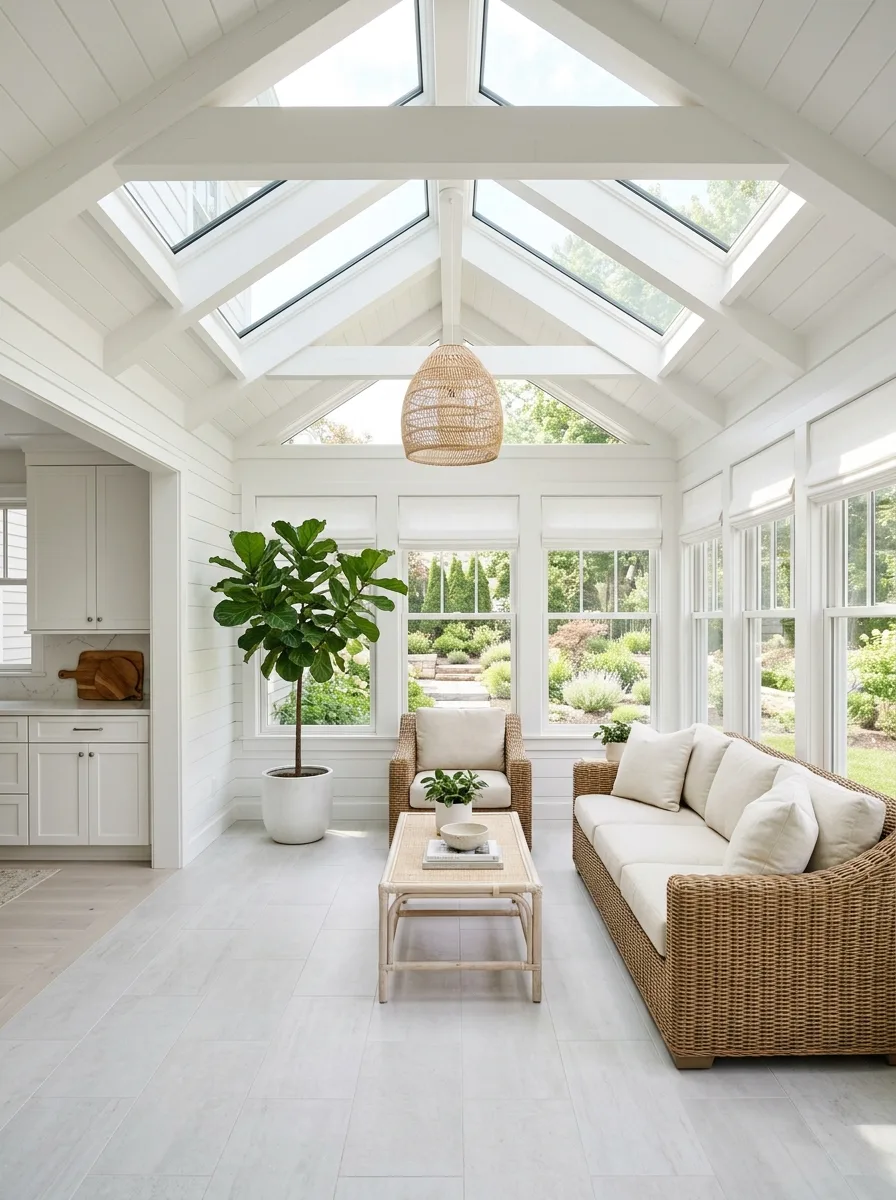
Frame the addition with a vaulted ceiling — a true gabled cathedral profile, not just a high flat ceiling — and install two or three large skylight units running parallel to the ridge line on both sides of the peak. The skylights should each be at least four feet wide and run nearly the full length of the roof pitch. The light that falls into this room is not standard window light. It comes from above and it changes constantly throughout the day, and it makes the room feel three times larger than its actual square footage.
Finish the ceiling, the beam structure, and the walls entirely in white — tongue-and-groove shiplap on the walls, painted beams, painted ceiling boards. The contrast with the green garden beyond the windows makes the white interior feel intentional rather than blank. Use large-format light grey or white marble-effect porcelain on the floor for easy maintenance and reflectivity. Choose wicker or rattan furniture — a deep sofa and a high-backed chair — in natural honey tones, with white linen cushions throughout. Add a single oversized rattan pendant at the gable apex.
Plant a large-specimen fiddle leaf fig in a white planter at one corner. It earns its place because the scale of the tree matches the scale of the ceiling, and the deep green of its leaves is the only strong colour the room allows itself.
Forest Green Candlelight Retreat
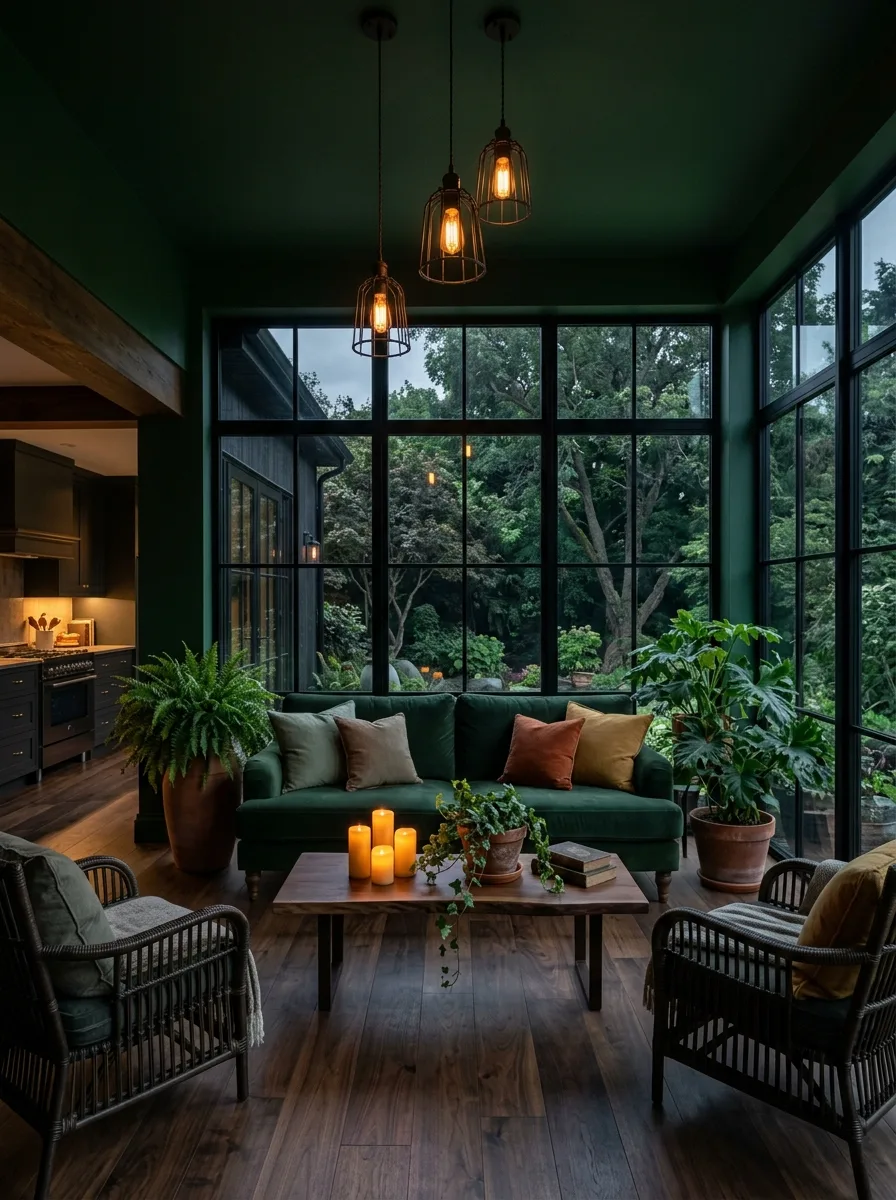
Paint the walls and ceiling in the same deep forest green — not a light sage, not a muted olive, but a true hunter or bottle green with significant depth. Apply it to the ceiling as well as the walls. The effect when the room is lit in the evening is enveloping and intentional. This is not a casual colour choice. It requires full commitment.
Frame the addition with floor-to-ceiling black steel windows on the garden side and large panes on the adjacent wall. The black frame disappears against the dark green interior. The garden visible through the glass reads as a continuation of the colour palette rather than a contrast. Install dark hardwood flooring throughout — wide-plank, in a warm dark tone — and hang two or three industrial cage pendants with Edison bulbs from a black ceiling rose. Cluster candles on the coffee table.
Choose a deep forest green velvet sofa as the primary seating — the sofa should be the same family of colour as the walls, so it sits in the room rather than against it. Add rattan or dark cane armchairs on either side. Bring in large-leaved plants — a tree fern, a monstera — in terracotta pots. This room works because it commits completely to a mood that most addition designs are afraid to attempt.
Farmhouse Swing Porch Room
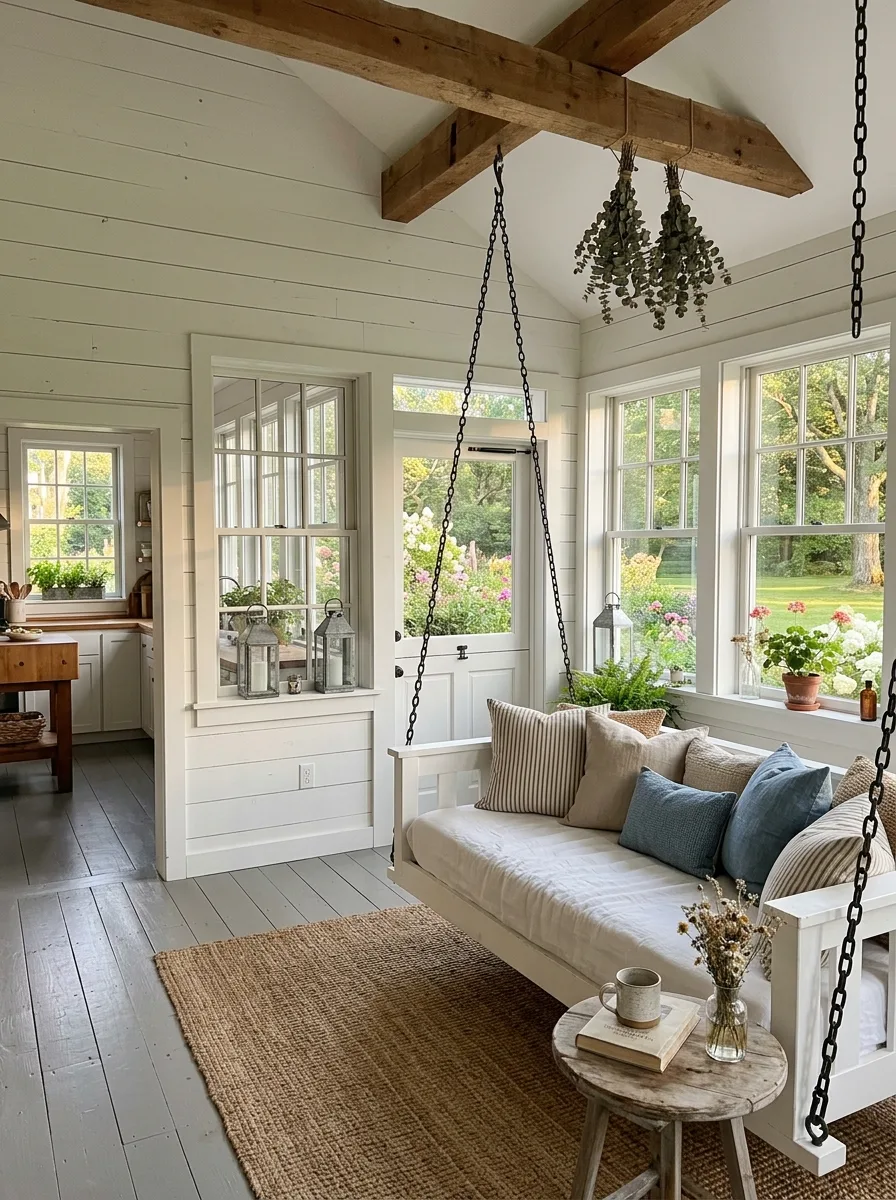
Install a hanging porch swing — a full-size daybed version, not a two-person loveseat — suspended from the structural ceiling beam with heavy black chain. This single element transforms the room from a sitting room that happens to have nice windows into a room with a purpose that couldn’t exist anywhere else in the house. The swing is the design. Everything else supports it.
Build the addition with white shiplap walls, a painted white vaulted ceiling, and wide grey-painted hardwood floors — the kind that show their knot and grain through the paint, not a flat grey finish. Frame the windows in white with generous sills wide enough to hold a lantern and a small plant. Connect the room to the kitchen through a large opening that shows the butcher block island on the other side.
Hang two or three bundles of dried eucalyptus from the beam alongside the swing chains. Place a small weathered round side table beside the swing. Run a jute rug underneath. Keep the palette deliberately spare — white, grey, and natural — so the view through the windows and the swing itself carry all the visual weight.
Japandi Garden Room
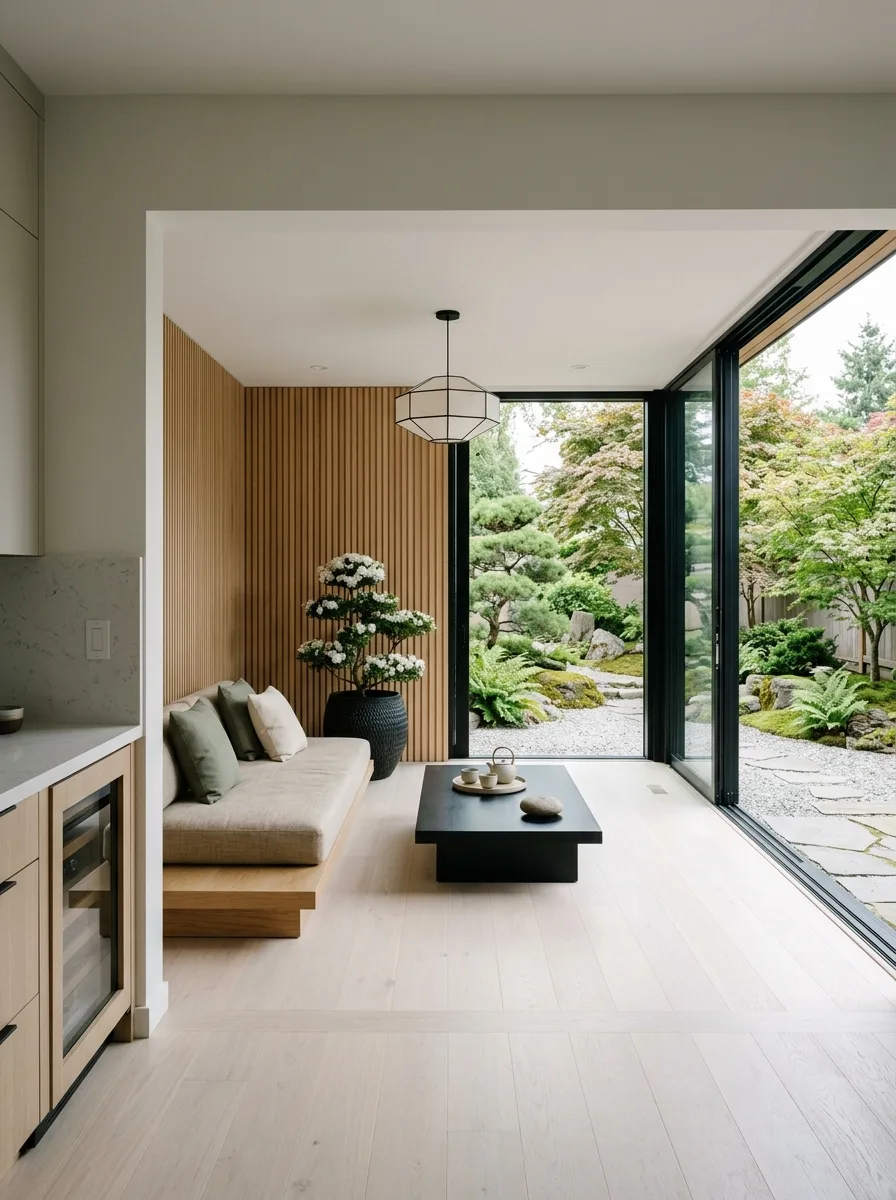
Install a slatted timber accent wall on one side of the room — vertical oak or cedar slats in a pale, barely-there stain, floor to ceiling. This wall does two things: it adds warmth and texture to what would otherwise be a white interior, and it provides a backdrop for the single sculptural element the room is built around — a large flowering bonsai or topiared specimen plant in a dark ceramic pot placed low to the ground against the slats.
Frame the addition with black steel sliding doors that retract fully into the wall to open the garden side entirely in warm months. When closed in winter, the black frame profiles create a grid composition that reads as architectural drawing rather than window. Use light wide-plank hardwood throughout — bleached or barely-stained oak — and a low platform sofa in natural linen with sage green cushions. Choose a single geometric pendant in black metal above the coffee table.
Keep the kitchen connection visible — pale cabinetry, a wine fridge — so the two spaces read as one extended room with two functions. The key rule for this design: nothing is placed on a surface unless it deserves to be there. One bonsai. One tea set. One book.
Terracotta Conservatory
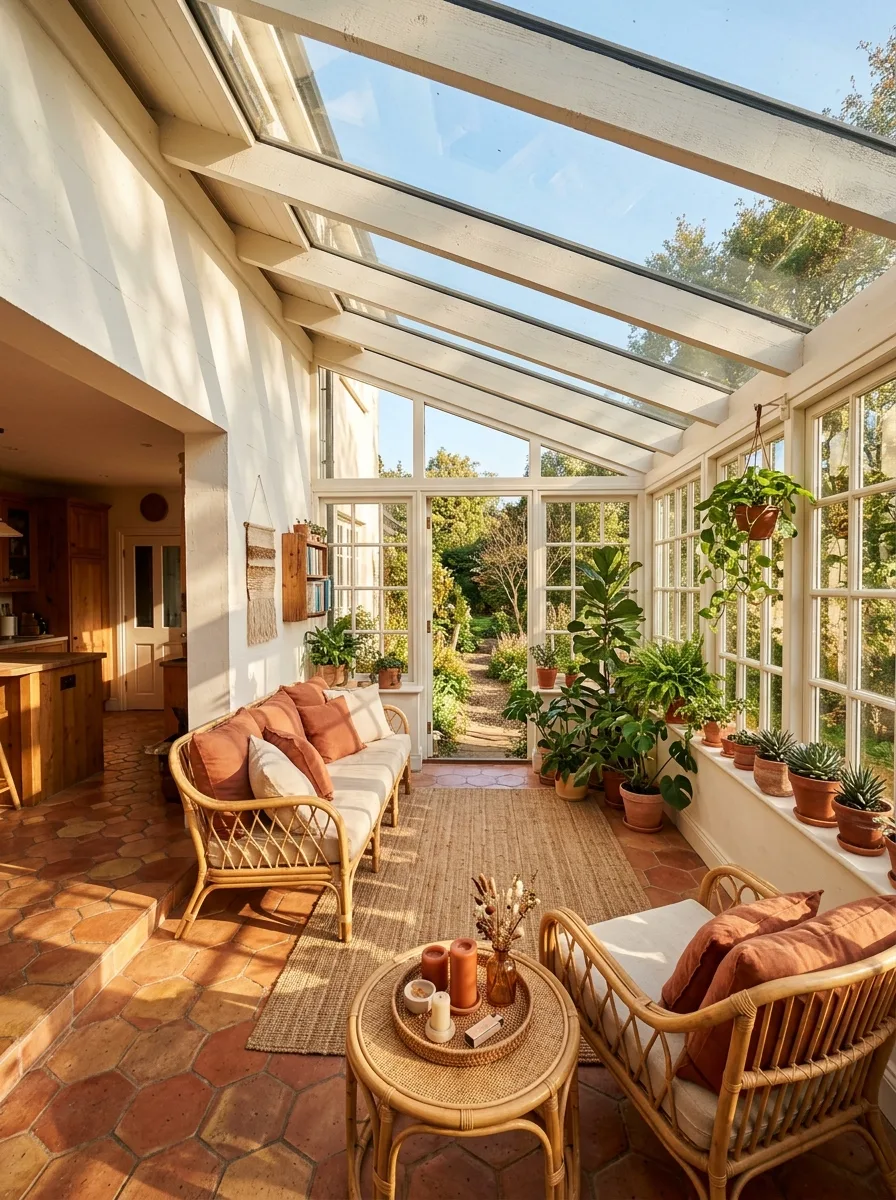
Run the glass roof at a low pitch on a timber frame finished in off-white — not stark white, but a warm cream that doesn’t compete with the terracotta floor. The floor tiles should be large, hexagonal, unfilled terracotta — the kind that develops a patina over years of use and looks better at decade ten than at installation. Seal them lightly with a penetrating sealer rather than a surface finish so the clay reads through.
Furnish the room with natural rattan and cane furniture in honey and light amber tones, with rust and terracotta linen cushions that echo the floor. Place potted plants — succulents, aloe, trailing ivy, a small olive tree — directly on the windowsill and along the base of the windows. Stack a tray of candles and a small bowl on the wicker coffee table.
Hang a macramé wall piece on the one solid wall. Add a single woven pendant above the seating area. Run a jute rug under the furniture. The room should look like a conservatory that a botanist lives in — practical, plant-filled, pleasantly chaotic in its plant collection, precise in its colour palette.
Scandi White Garden Room
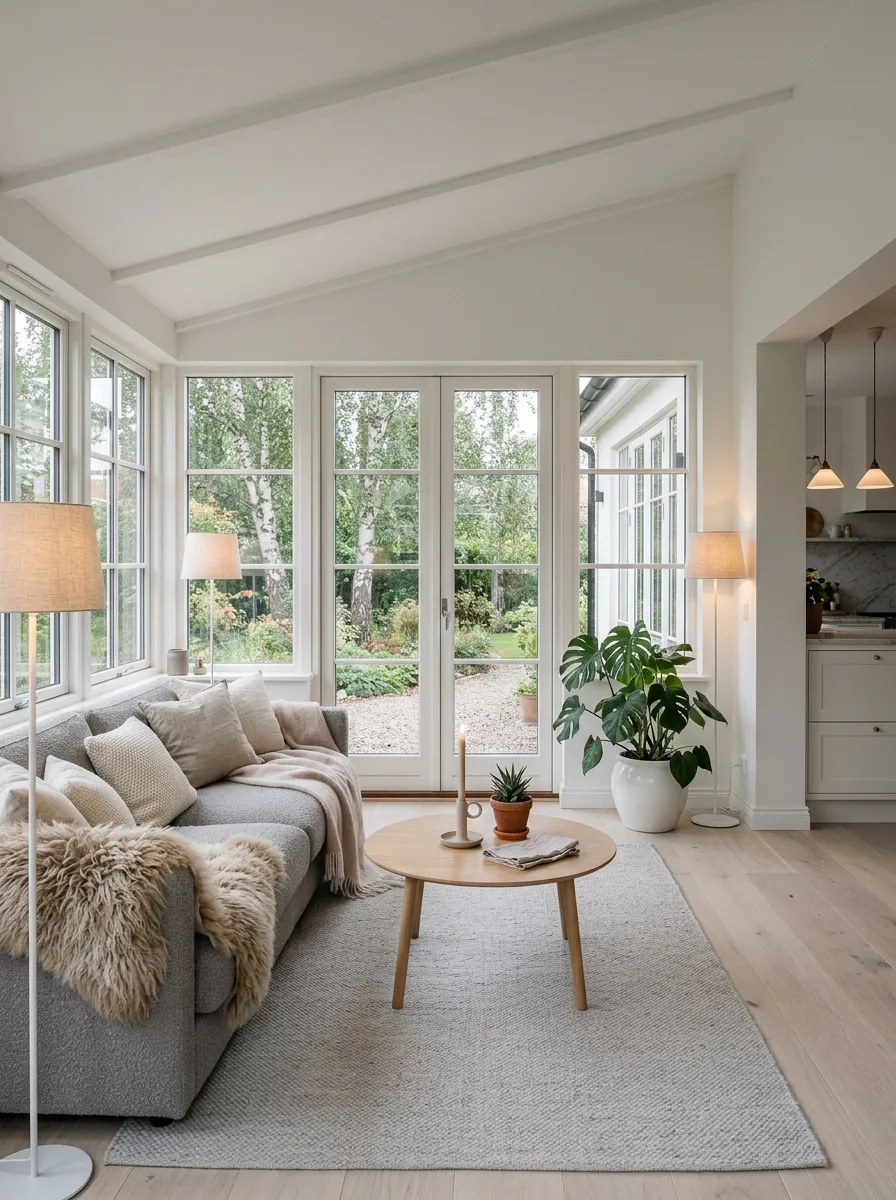
Use white throughout, but not the same white. The walls are a warm bright white. The beams and ceiling trim are a cooler true white. The sofa is a soft grey-white boucle. The floor is a pale whitewashed or blonde hardwood. The layering of these near-white tones gives the room depth without introducing colour.
Frame the garden side with large double-hung or tilt-turn windows and a set of French doors in the center, all in white with minimal sight lines. Fill the room with late-afternoon light and birch trees. The birch trees are not optional — they are the reason the view works in this design. Plant three or five slender birch specimens in the garden directly in the sightline from the main seating position.
Use a single round blonde wood coffee table with tapered legs at the center of the seating group. Add a sheepskin throw over the sofa arm. One potted monstera in a large white ceramic planter. Two floor lamps with drum shades. No overhead fixture. This room is lit entirely from floor level, and it is a deliberate choice — overhead light would kill the softness that makes it work.
Mountain Lodge Glass Room
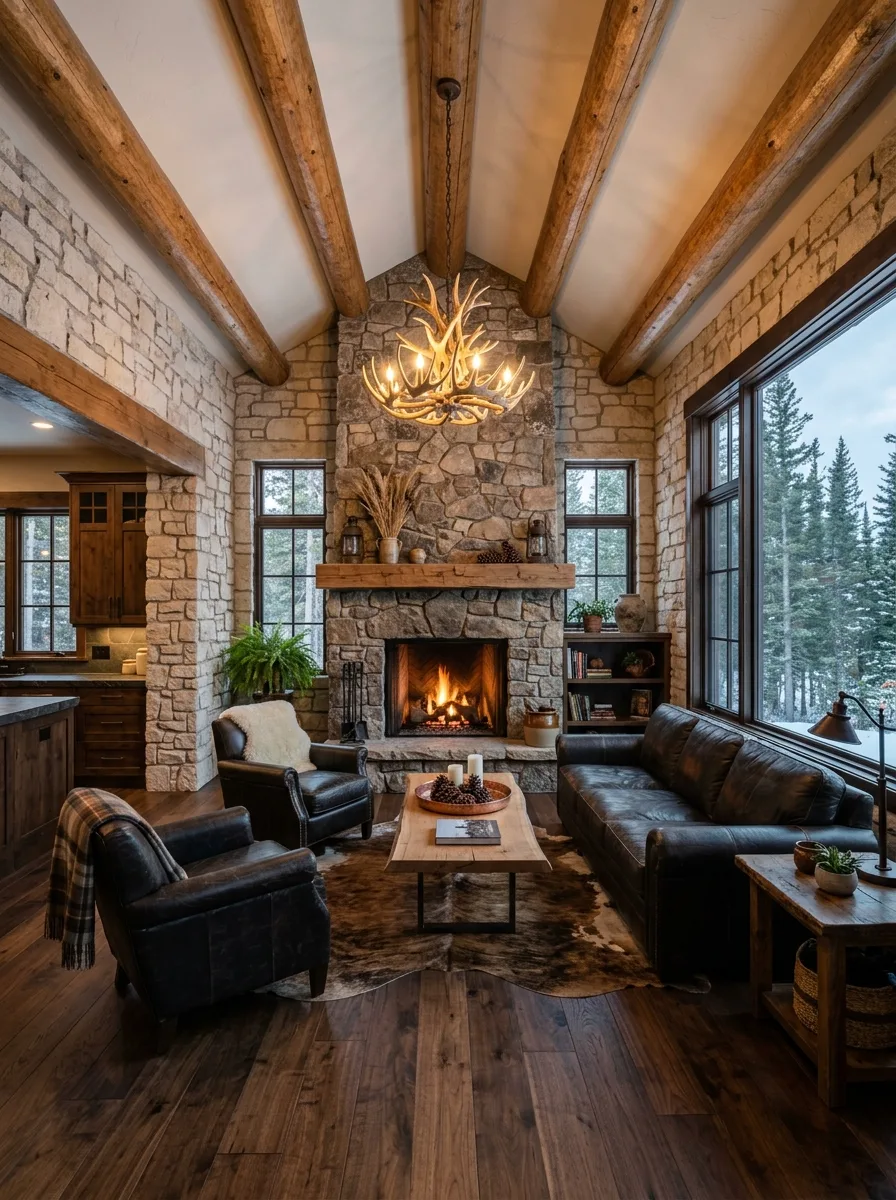
Sheathe the interior walls of the addition in large-format natural or cultured stone — the same stone or a complementary pale sandstone that reads as structural rather than decorative. Run it floor to ceiling on at least two walls. This is not a backsplash or an accent. It is the primary surface material, and the room is built around its texture and tone.
Install a full stone fireplace on the interior wall where the addition meets the kitchen — a proper masonry firebox with a wood beam mantle and a natural stone surround that rises to the ceiling. This is the focal point, not the view, which is unusual for a glass room and is exactly what makes this design distinctive. The view becomes the backdrop.
Use log-cut or rough-hewn timber beams across the ceiling in a natural stain. Dark hardwood floors. Deep leather furniture in black or dark saddle brown. A cowhide rug. An antler chandelier hung from the central beam. The windows should have dark-stained timber frames. Bring in cast iron, pine cones, and plaid throws. This room should feel like the inside of something old and solid, even though it was built last year.
Victorian Botanical Conservatory
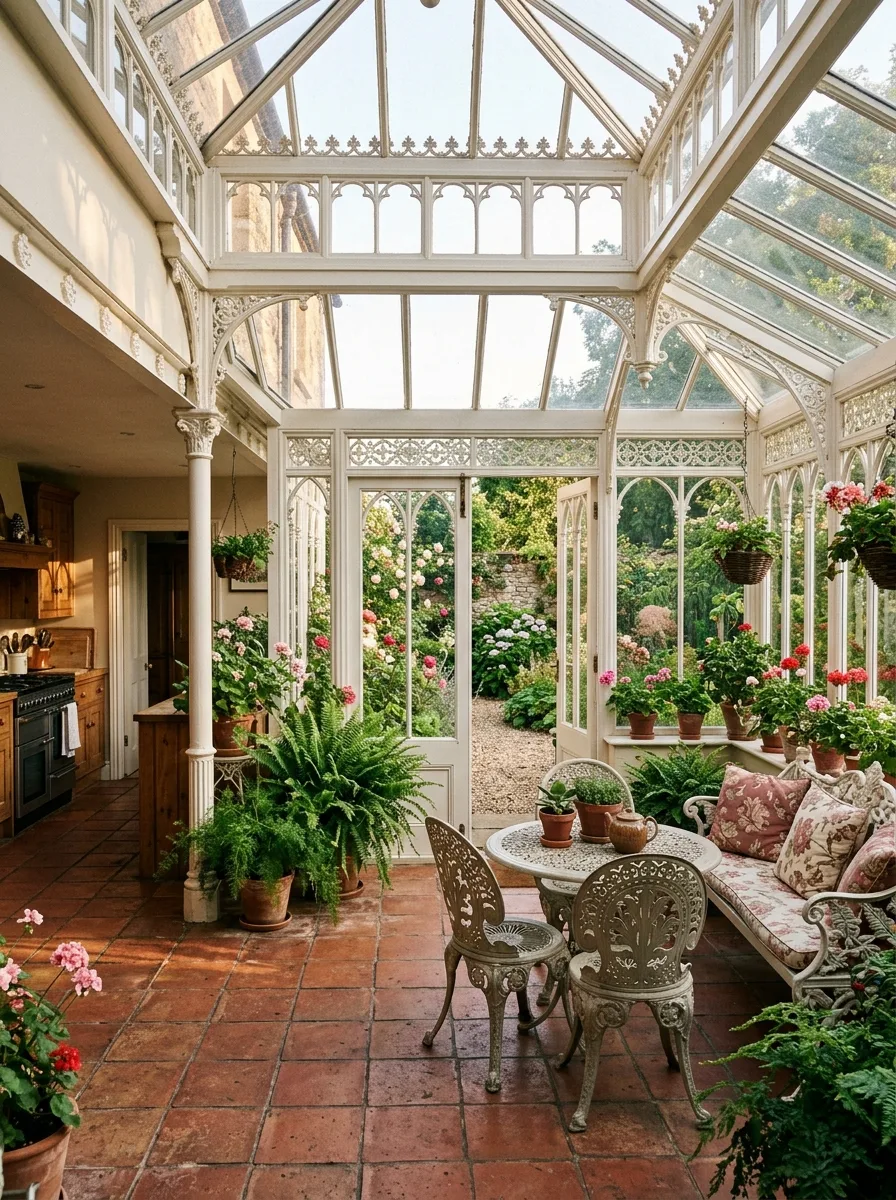
The frame is the design. Specify a traditional Victorian conservatory kit — white-painted cast iron or powder-coated aluminium in a period-accurate profile, with decorative finial details at the ridge and ornamental tracery at the column capitals. These kits are available from specialist suppliers and they cannot be approximated by a standard glass room. The detail in the ironwork is the entire aesthetic foundation.
Run terracotta quarry tiles on the floor — full size, four to six inch squares, in a pattern that extends from the threshold outward. Fill the room with plants. Not three plants, not five. Twenty plants in varying sizes — hanging ferns, potted geraniums and pelargoniums, a large floor fern, specimen roses in terracotta pots, climbing plants trained to the ironwork columns. The room should look like a working greenhouse that someone has put furniture in.
Use white-painted cast iron garden furniture — a table and two chairs — rather than indoor-style upholstered pieces. The furniture should look like it belongs outside, because the room is a deliberate blur of the boundary between inside and the garden beyond the glass walls.
Coastal Shiplap Sunroom
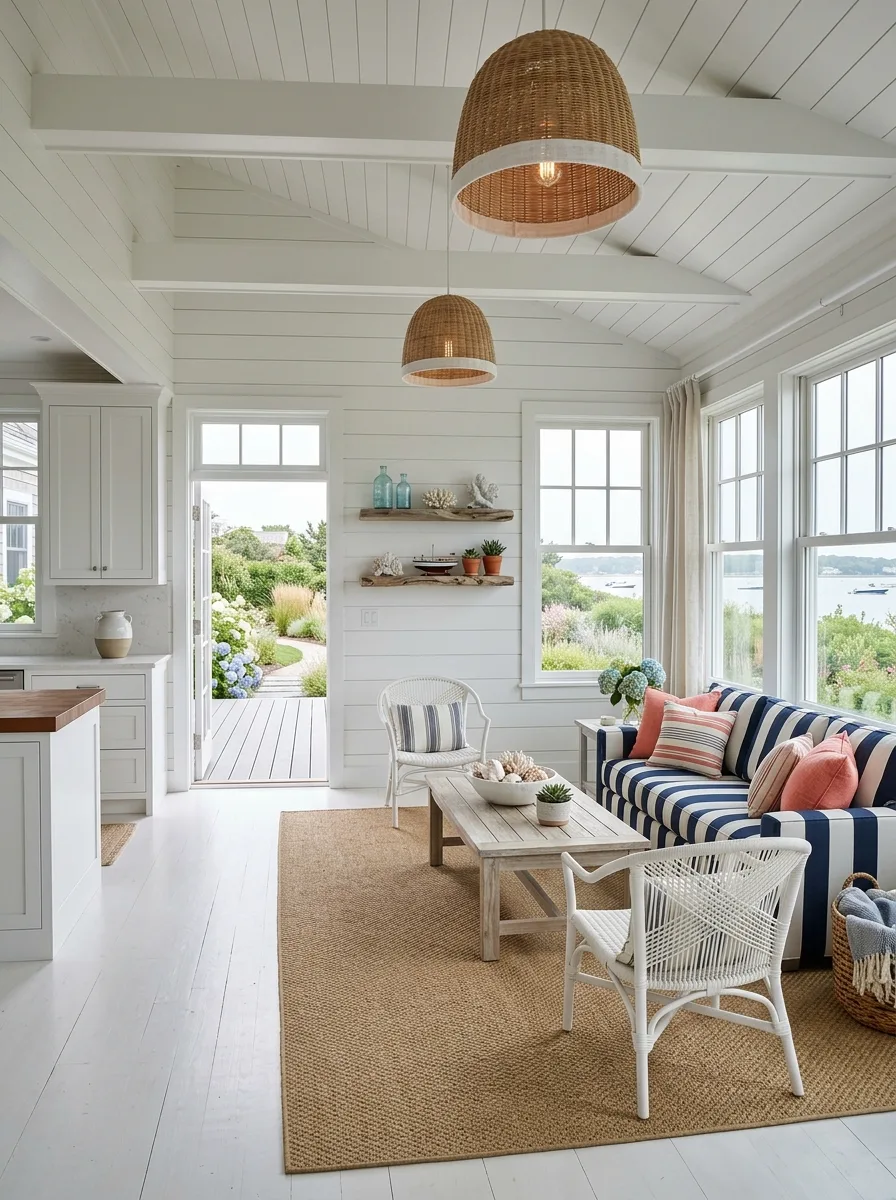
Run white shiplap horizontally on every wall surface — not just the back wall or one accent wall, but every wall from floor to ceiling. Install a white tongue-and-groove ceiling. Use white-painted floors, either wide-plank painted hardwood or white-washed composite decking. The room should be entirely white before a single piece of furniture enters it.
Then make every design decision in navy and natural. A navy and white wide-stripe sofa. White wicker and rattan chairs. Driftwood-finish shelving mounted directly to the shiplap wall, styled with blue glass bottles, white coral, and small found-object marine pieces. Oversized wicker dome pendants hanging from the white ceiling — two or three of them, evenly spaced. A jute rug in a natural sand tone.
Keep the kitchen visible through a wide pass-through opening so the white-painted cabinetry on the other side reads as part of the same palette. The coastal quality of this room comes not from decorative anchors or shells but from the precise material and colour logic. Everything is either white, natural fibre, or navy. Nothing else gets in.
Contemporary Marble Garden Room
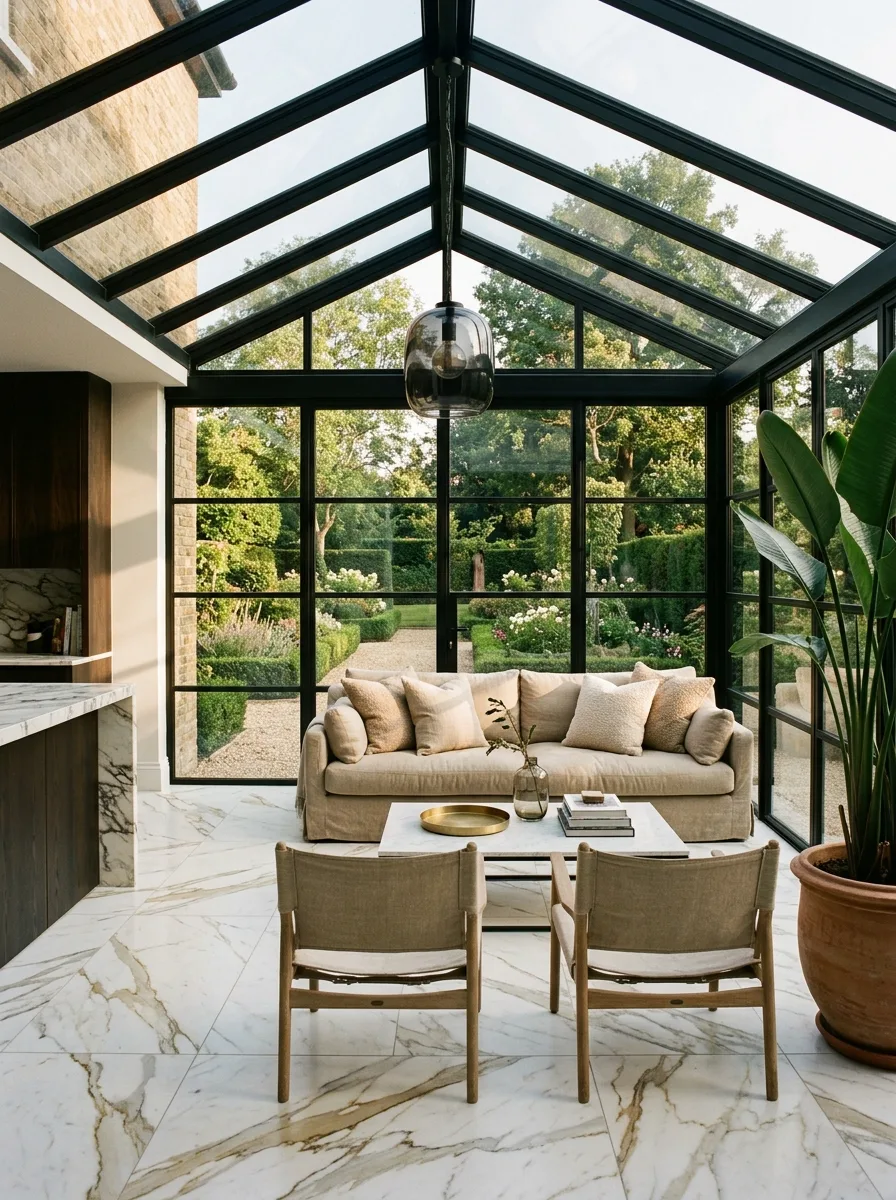
Build the addition with a full steel and glass frame — matte black profiles throughout, in a traditional lantern-style grid pattern that references Victorian greenhouse construction while reading as contemporary. The grid pattern of the black frames against the garden becomes the primary visual when the room is viewed from outside. Install a single large smoked glass pendant at the center of the ridge.
Use large-format marble-effect porcelain on the floor in a veined white and gold tone — large slabs, minimal grout lines, running continuously from the kitchen into the addition. Use the same or a complementary marble on the kitchen island overhang visible from the addition. The floor material ties the two spaces together without requiring identical treatment elsewhere.
Furnish with linen — a loose-cushion sofa in warm sand linen, two low slung wood-and-canvas accent chairs in the same tone. A low square white coffee table with a single tray. A large ceramic pot with a bird of paradise or banana leaf plant at one corner, echoing the garden plantings beyond the glass. Keep the material palette to three things: black steel, white marble, and warm linen. Anything additional weakens the composition.
Terracotta Arch Garden Room
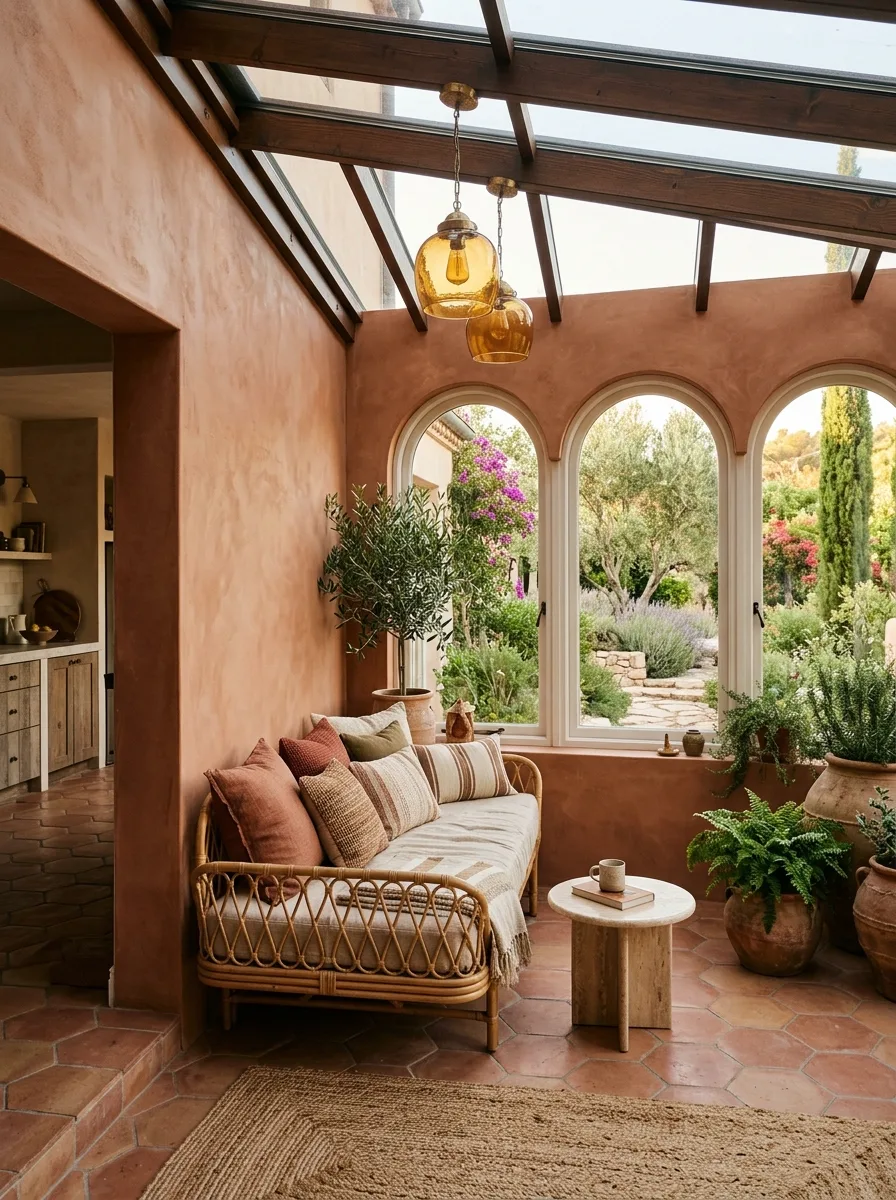
Build arched window openings rather than standard rectangular glazing — three arches in a row on the garden side, each with a radiating keystone detail in the white plaster surround. The arches are load-bearing design elements, not decorative. Frame them in timber with a simple white casement window within the arch profile.
Render all interior walls in warm terracotta limewash plaster — a mineral-based finish that allows the wall to breathe and develops beautiful variation in tone over time as the plaster ages. The colour should be in the range of old terracotta roof tile — warm reddish-brown with pink and amber undertones. Install terracotta hexagonal floor tiles throughout.
Place a rattan daybed sofa against the plaster wall with layered linen and striped cushions in rust, olive, and sand tones. A small round stone or travertine side table beside it. A potted olive tree in a large terracotta pot under the arches. Hang amber glass pendants from the ceiling beam that catches the light and warms the room even on grey days. This addition should feel like a room attached to a farmhouse in the south of France, regardless of the postcode.
French Provincial Garden Room
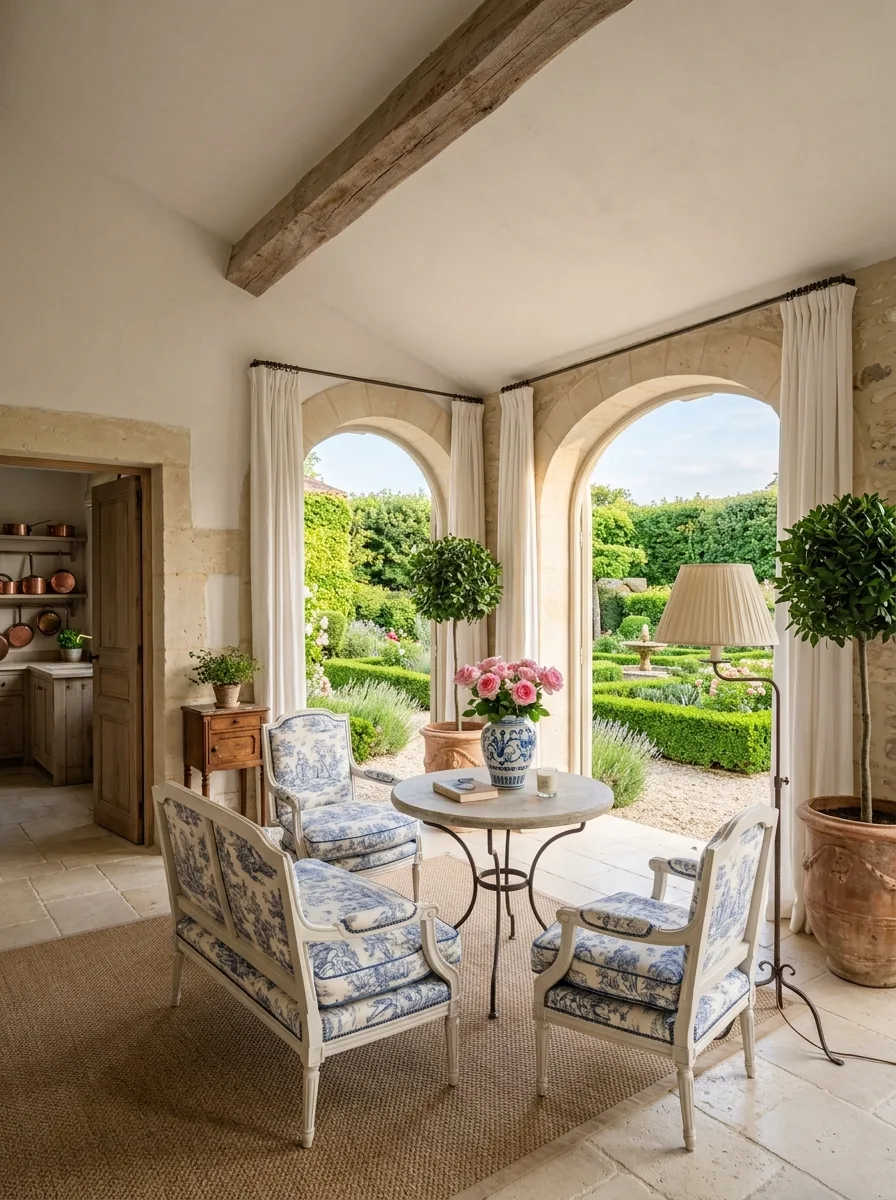
Cut two full masonry arches into the exterior wall of the addition — not windows set into arches, but open arches with full-height curtain panels that draw closed in the evening. The arches face the garden and the curtains hang from an iron pole mounted inside the reveal. When the curtains are open in summer, the room and garden are effectively continuous. When drawn in winter, the room becomes a warm enclosed interior with an unusually graceful window profile.
Use limestone flag floors throughout — real limestone if the budget allows, or a convincing large-format porcelain. Install exposed limestone or sandstone block walls on the solid interior walls. Run simple limestone-coloured plaster on the ceiling with one or two rough timber beams left natural. Furnish with toile-upholstered bergère armchairs and a small iron bistro table with a marble top.
Place standard bay trees in terracotta pots at either side of each arch opening. Put a blue and white ceramic vase of garden roses on the bistro table. Mount a pleated shade floor lamp beside one chair. Use only materials that could have been in this room for sixty years. Nothing contemporary, nothing synthetic, nothing that required the internet to source.
Sage Green Garden Sitting Room
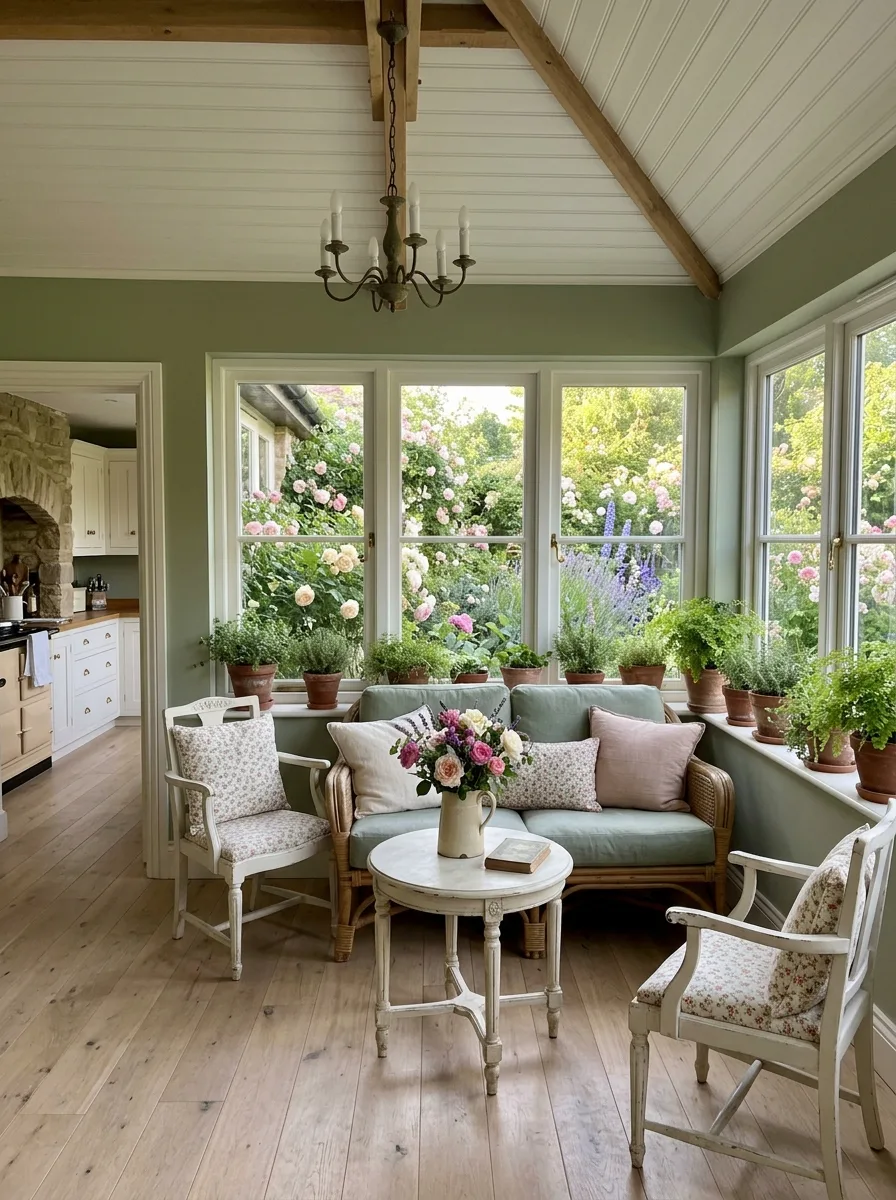
Paint the walls in a rich sage green — not a cool grey-green, but a warm yellow-leaning sage with genuine depth and saturation. Apply it behind the picture rail if there is one, or to full ceiling height without a break. Paint the ceiling in a near-white that has a faint green undertone so the ceiling doesn’t read as a jarring white box above the coloured walls.
Furnish with a low rattan sofa with a sage linen cushion set. Use white-painted vintage-style wooden armchairs with small floral-print cushions on either side. Install a beadboard or tongue-and-groove ceiling in white. Expose a single raw timber collar tie or beam across the ridge — it should be untreated light oak rather than stained dark, so it sits comfortably against the white ceiling rather than dominating it.
Run a low continuous window sill shelf along the garden wall and pack it entirely with terracotta pots of growing herbs — thyme, rosemary, sage, mint. The herbs in the addition connect to the kitchen immediately next door. Their smell fills the room when the sun warms them in the afternoon. A small patinated bronze chandelier with candle-style bulbs hangs at the center. The overall effect is an English kitchen garden that has come inside.
Tropical Plant Room
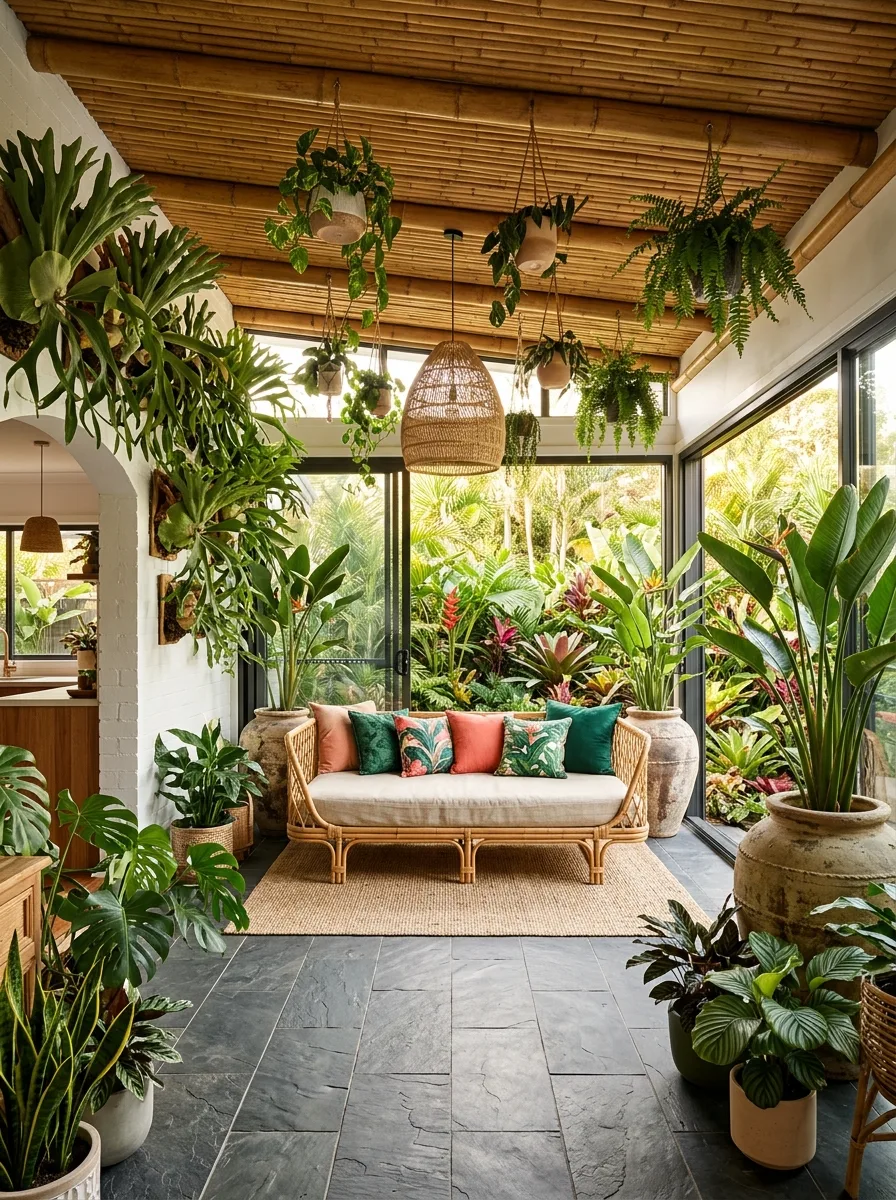
Install a bamboo panel ceiling — not painted bamboo, not bamboo effect, but actual bamboo pole panels fixed between timber ceiling joists. The ceiling becomes warm, textured, and biophilic in a way that no painted surface can replicate. Run large dark slate floor tiles throughout in an irregular pattern. Use white-rendered walls as a neutral backdrop.
Then fill the room with plants. Not arranged plants. An abundance of plants — large, medium, small, hanging, floor-standing, shelf-sitting, wall-mounted. Monstera, fiddle leaf figs, philodendrons, bird of paradise, pothos in hanging baskets, ferns in wall-hung brackets, calatheas in grouped floor pots. The room should look more like a garden room than a plant room — as if the planting happened first and the furniture arrived later.
Place a natural rattan daybed sofa at the center with botanical-print and plain coral and teal cushions. A single large wicker pendant above. Large ceramic urns at the corners of the room. This addition is connected to the kitchen but feels like a departure from it — a room that insists on its own rules and its own atmosphere from the moment you step through the doorway.
Colonial Garden Room with Coffered Ceiling
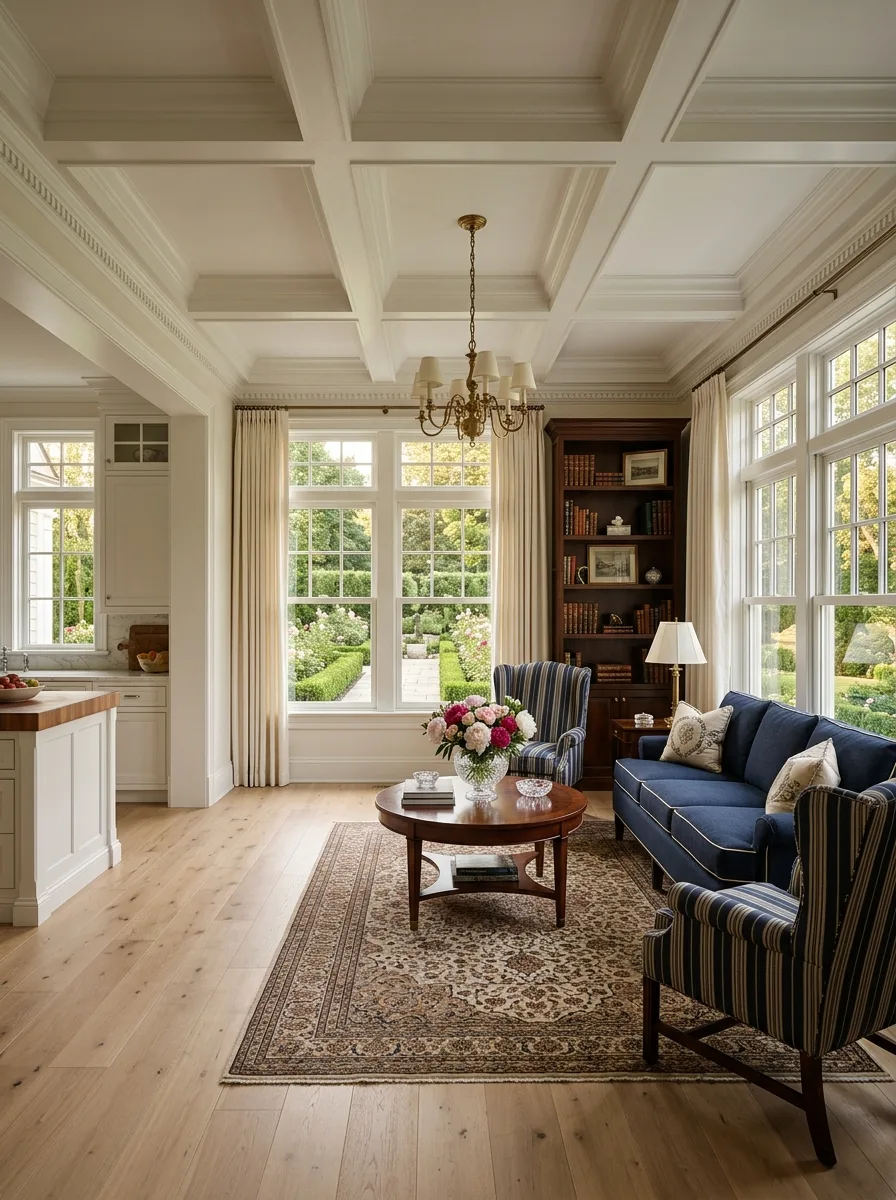
Install a coffered ceiling — a proper grid of beams creating rectangular recessed panels — in a classic profile with a dentil or egg-and-dart moulding detail at the beam edge. Paint the entire coffered ceiling in off-white or bone, with the recessed panels in a slightly warmer tone. The ceiling is the architectural statement of this room, and it earns its cost in the character it gives the space.
Frame the addition with large divided-light casement windows in white with cream linen curtains hung from black iron poles above each window group. Use light oak wide-plank hardwood floors throughout and layer a traditional Persian or Turkish rug at the center of the seating group. Furnish with a navy linen sofa, navy and cream stripe wingback chairs, a cherry wood round coffee table, and a bookcase with dark-stained shelving in one corner.
Add a brass chandelier with candle-style bulbs at the center of the coffered grid. Arrange a vase of garden flowers on the coffee table. Keep the room bookish and composed. This is not a casual room — it is a room that takes the act of sitting in a glass room seriously and provides the architecture to match.
Library Window Seat Room
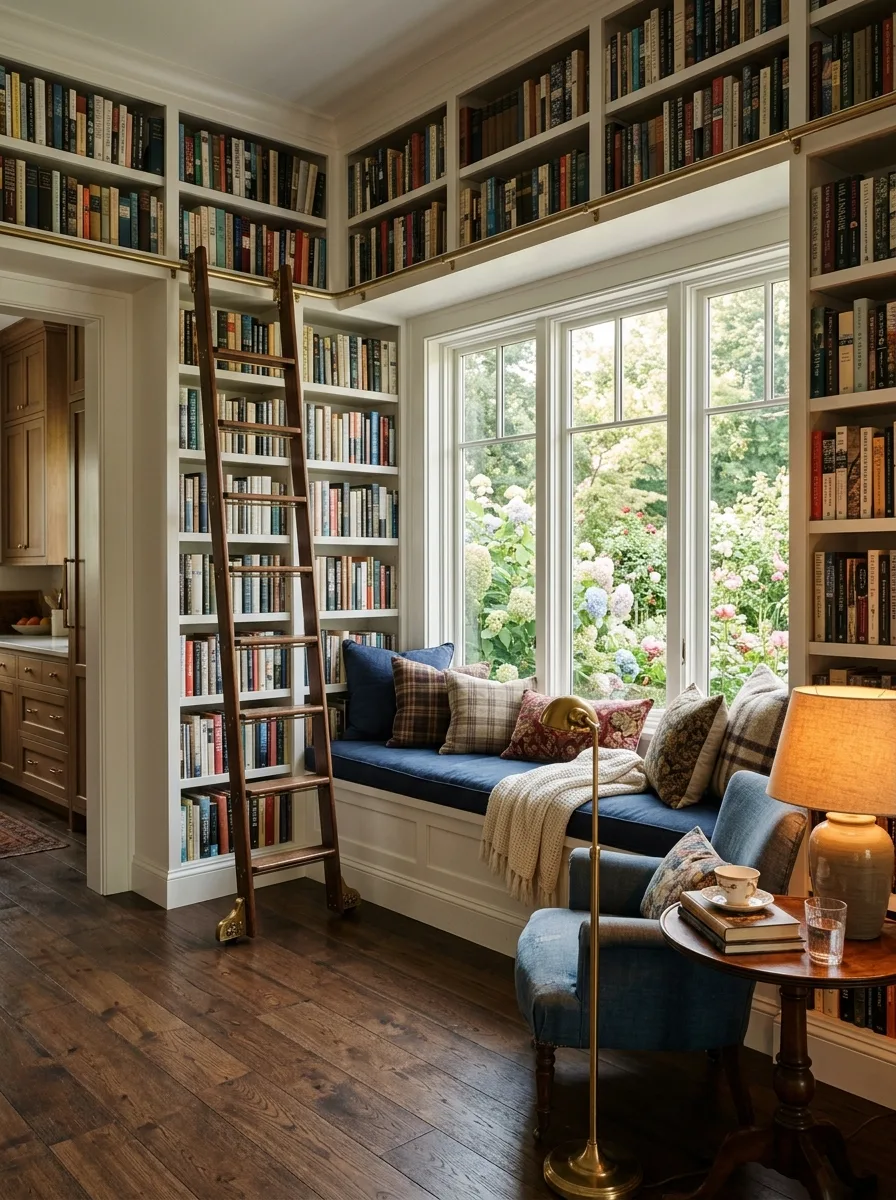
Build a continuous window seat along the entire garden-facing wall of the addition — the seat should be at least twenty-two inches deep and sit at standard bench height, with a cushion in midnight blue or deep navy velvet. Box storage below with lift-up lids. This window seat is the room’s purpose. Everything else supports the act of sitting here with a book and a view of the garden.
Build floor-to-ceiling bookshelves on every solid wall of the room — including the wall on either side of the window seat. Install a rolling library ladder on a brass rail that runs the full length of one shelf wall. The shelves should be genuinely full. Not styled full with ceramic objects and one row of books, but actually full — the way a library becomes full over years of use.
Install dark hardwood floors, a warm medium-toned wood stain rather than dark espresso. Use a single brass swing-arm or adjustable floor lamp beside the window seat chair. Add a small vintage side table within arm’s reach with a teacup, a glass of water, the things a person needs when they’re planning to stay.
Mid-Century Walnut Glass Room
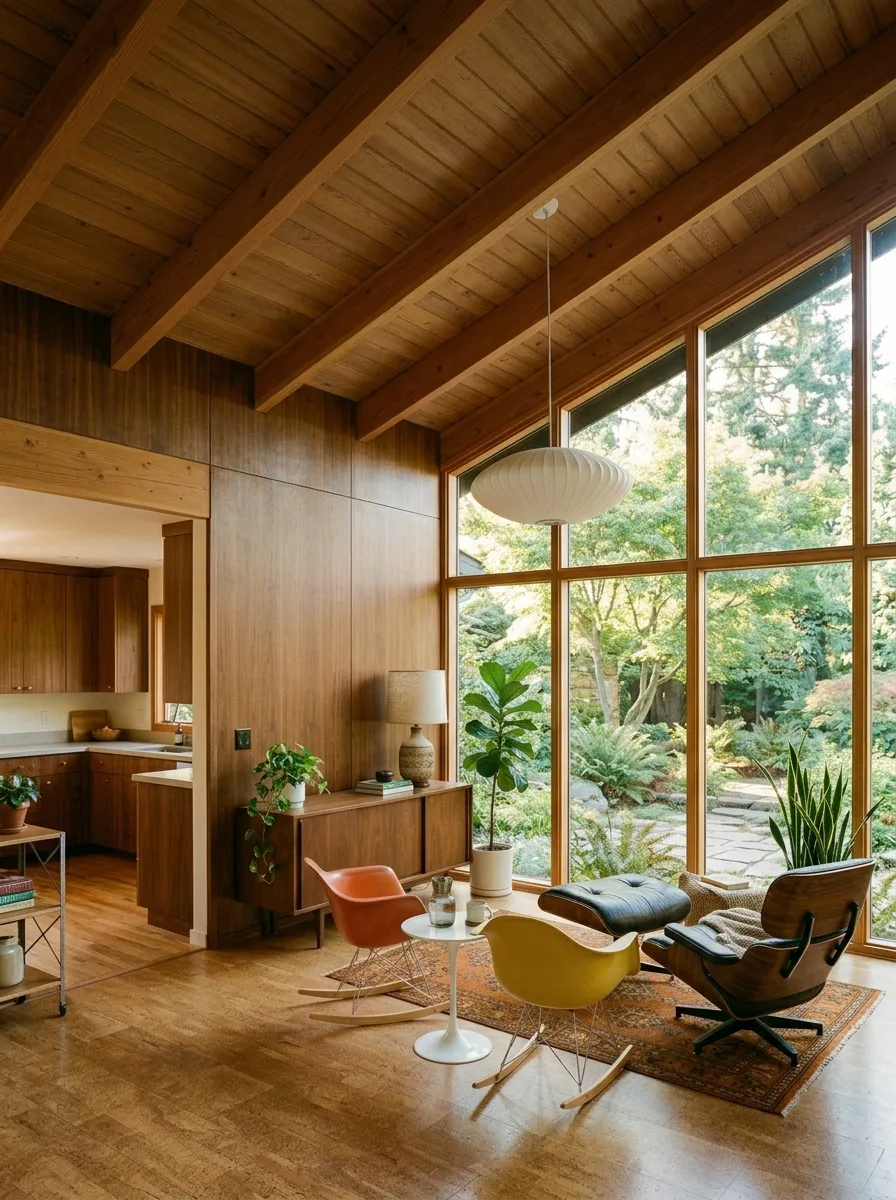
Line the interior walls of the addition in walnut panelling — real walnut veneer on MDF boards, applied horizontally in wide planks. Run the walnut from floor to a high chair rail and then plaster above, or floor to full height on the partition wall. The warmth and grain of walnut against the glass and the garden is the design move this room is built on.
Install a full-height glass wall on the garden side — a system of fixed glass panels and a large sliding or folding door section, all with walnut timber frames. The walnut frame detail on the exterior side should be visible and intentional. Install cork or light hardwood on the floor throughout.
Choose classic mid-century seating — an Eames-style lounge chair and ottoman in dark leather, a low-slung orange moulded chair on white wire legs, a Saarinen-style round white side table. A large Nelson or Noguchi-style paper pendant above. A low walnut credenza against the solid wall with a ceramic lamp and a single plant. This room has design integrity. It knows what era it belongs to and it doesn’t apologise for being particular.
Floral Cottage Sunroom
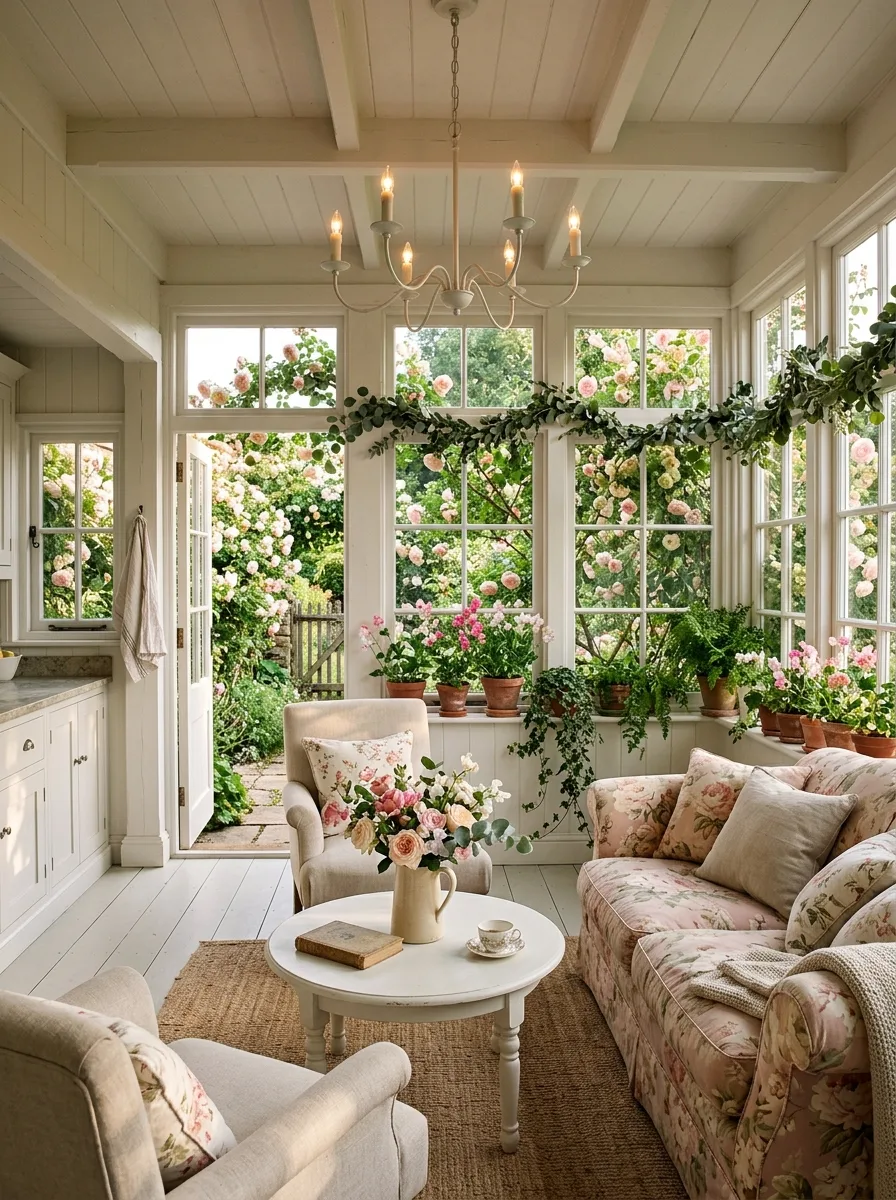
Use a floral chintz or vintage rose-print fabric for the primary sofa upholstery — a full scale floral in pinks and greens on a cream ground, not a subtle small repeat but a proper big-bloom English garden print that fills the eye. This is the design decision most people are too nervous to make, and it is the reason rooms like this one are memorable while their beige alternatives are not.
Run white tongue-and-groove on the ceiling and walls. Paint the floors white. Hang a white five-arm chandelier with candle bulbs from the center of the room. Install large white-framed windows with wide sills on all sides, and line every sill with terracotta pots of pink geraniums, trailing ivy, and small flowering plants. Train a garland of greenery or a climbing plant across the top of the central window opening if possible.
Use a round white painted coffee table at center. Floral armchairs in a companion print or a tonal plain that pulls one colour from the sofa fabric. A white painted small side table with a ceramic jug of fresh cut roses from the garden. The garden outside should be abundant — roses, hydrangeas, anything in the pink-to-white range. The garden and the room should be in conversation, and the conversation should be about flowers.
Modern Zen Shoji Room
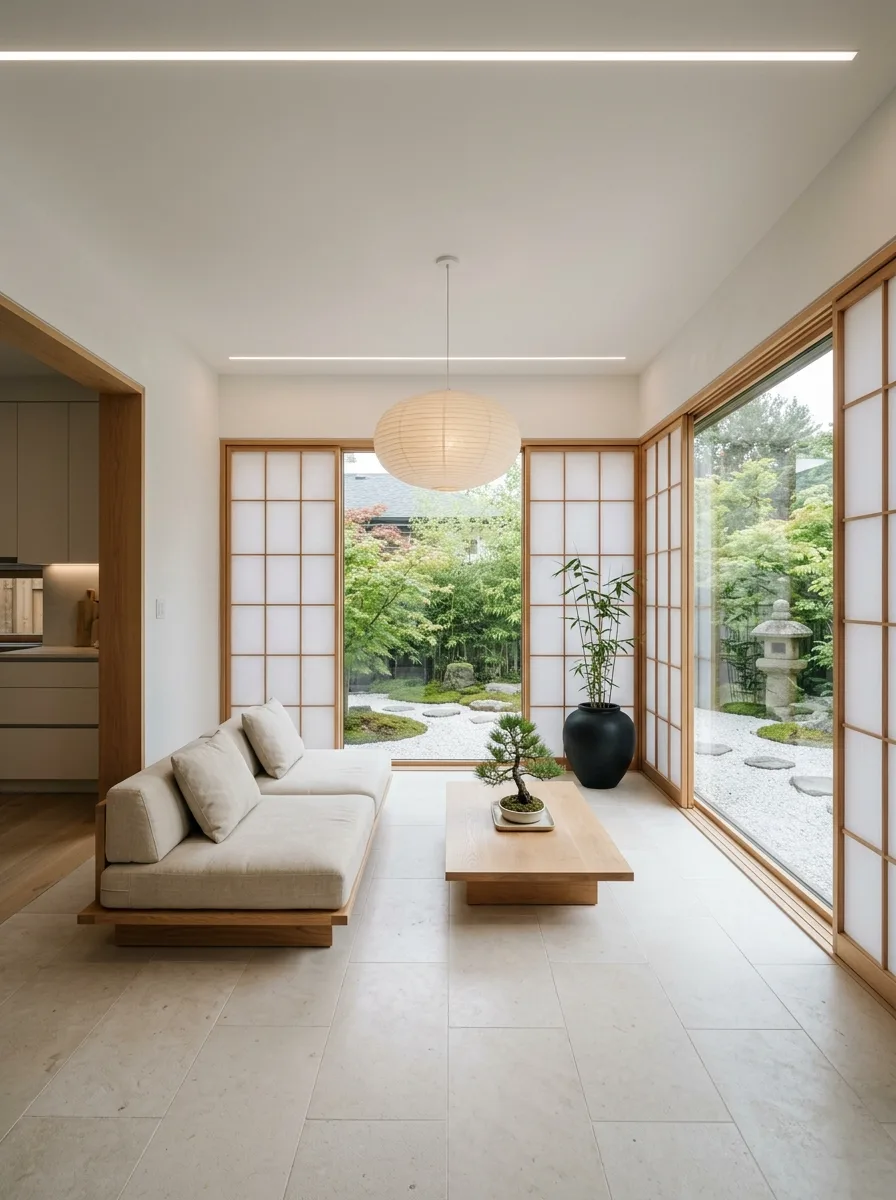
Install shoji-style screens — framed panels with a translucent fibreglass insert rather than traditional paper, for longevity — on two or three walls of the addition. These screens are not decorative panels placed in front of a wall. They are functional sliding screens that move on tracks and can cover or reveal windows and the garden view at will. Filtering the view through the shoji screens is the design move that defines this room.
Use large-format pale limestone or travertine tiles on the floor throughout — a light warm tone, honed not polished. Install continuous cove lighting at the ceiling perimeter, invisible as a fixture, providing a soft even ambient layer with no visible source. Add one large paper globe pendant at center, hung low.
Build a low platform sofa frame in natural oak — the kind that sits fifteen inches off the floor rather than the standard eighteen — and fit it with a thick off-white linen cushion. A low black lacquered coffee table. A bonsai specimen in a shallow ceramic dish on the coffee table. A large black ceramic pot with bamboo or a cloud-pruned pine at one corner. No clutter. No collections. Every surface that isn’t deliberately occupied is left empty.
Eclectic Botanical Sunroom
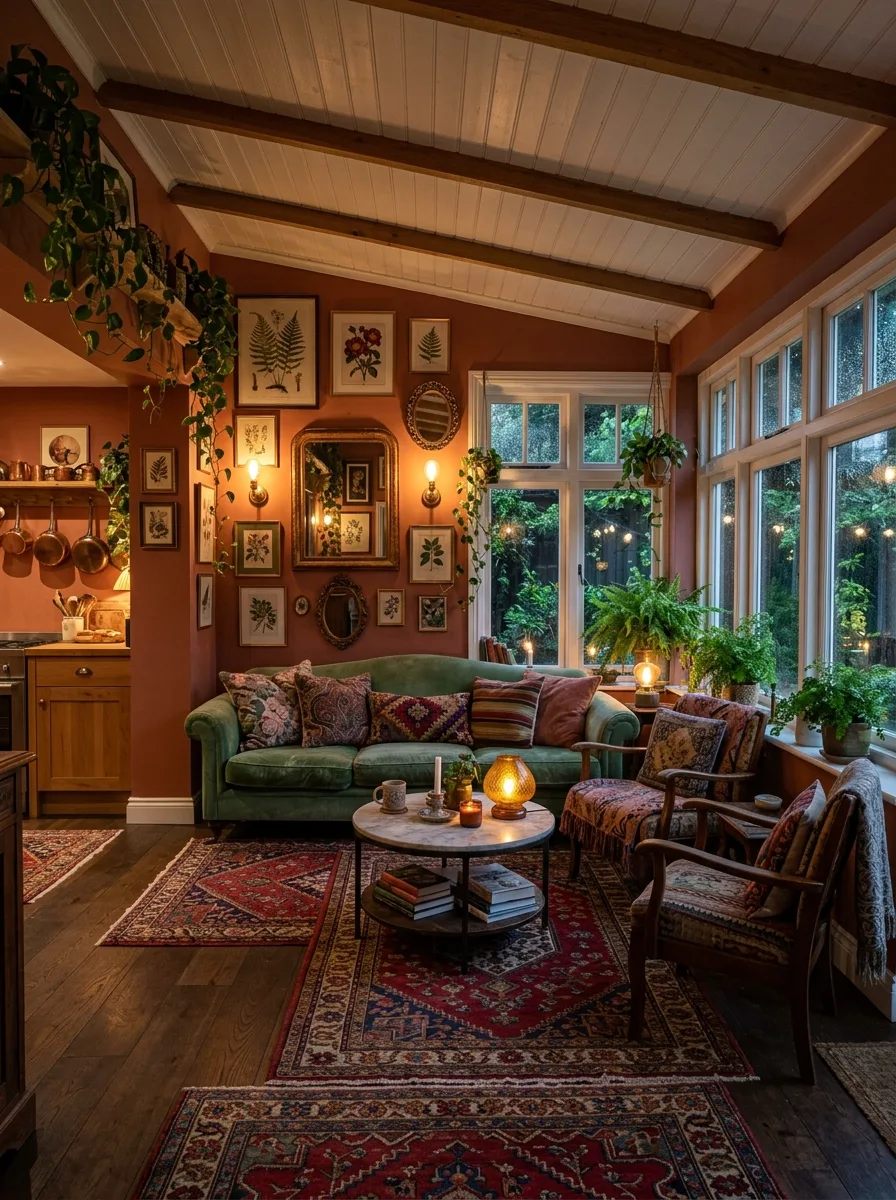
Paint the walls in a rich burnt terracotta or warm cinnamon — a deep saturated orange-red that reads as earthy and deliberate rather than aggressive. Use a white tongue-and-groove ceiling with raw timber beams to keep the room from feeling enclosed. Install large white-framed windows on the garden side and let the green of the garden read as a strong colour contrast against the warm walls.
Cover the walls in framed botanical prints — proper vintage-style pressed plant illustrations in simple frames, massed together in an irregular salon hang above and around the sofa. Add antique mirrors with gilt or ornate frames placed between the botanical prints to bounce the candlelight. Run several Persian or Turkish rugs layered over dark hardwood floors — a large one at the center and a smaller one overlapping at the edge.
Choose a deep green velvet scroll-arm sofa as the primary seating, with layered patterned cushions in jewel tones. Two mismatched vintage armchairs with tapestry or woven upholstery flanking a small marble-top round coffee table. Wall sconces with warm amber light bulbs. String lights in the garden visible through the windows. Multiple hanging plants — devil’s ivy, ferns, string of pearls — in macramé hangers from the beam hooks. This room accumulates rather than edits, and it works because the accumulation follows a deliberate colour logic from the first decision to the last.
What All These Rooms Quietly Agree On
The twenty rooms on this list cover a range that shouldn’t be summarised. A white cathedral skylight room and a dark forest green velvet room have almost nothing to say to each other about aesthetics.
But they share something. Every one of these rooms was designed around a single commitment — a ceiling type, a material, a piece of furniture, a view. The skylights in the first room are not one detail among many. They are the reason the room exists. The hanging swing in the farmhouse room is not an accessory. It is the whole idea. The shoji screens in the zen room are not decorative panels. They are the logic of the space.
A four season room off the kitchen earns its place in the house when it has a reason to be the room it is. Not when it has nice glass and comfortable furniture, though it needs those too. When it has a commitment.
Make that commitment first. The rest of the decisions fall into place around it.