
The grill has been sitting on your patio for four years. You wheel it out in summer, cook next to it while squinting into the sun, and wheel it back when fall arrives. That is not an outdoor kitchen. That is a grill with ambitions it can’t act on.
A real outdoor kitchen is a room without walls. It has structure overhead, surfaces that hold their own, and a layout that makes cooking outside feel deliberate instead of improvised. The covered part is not optional — it’s the thing that transforms the whole idea from seasonal activity to permanent space.
Most people skip straight to appliances. They price out built-in grills and refrigerators before they’ve decided anything about the bones of the structure. That’s how you end up with a beautiful grill sitting under a trellis that does nothing when it rains and looks like an afterthought the rest of the time.
This blog won’t do that. We’re starting with structure, working through the principles that make outdoor kitchens actually function, and then showing you twenty different ways to get it right — from a stone farmhouse setup in Provence to a Japanese-inspired garden kitchen with shoji screens and a bonsai the size of your ego.
Covered Outdoor Kitchen Ideas
Cedar Roof Rain Chain Station
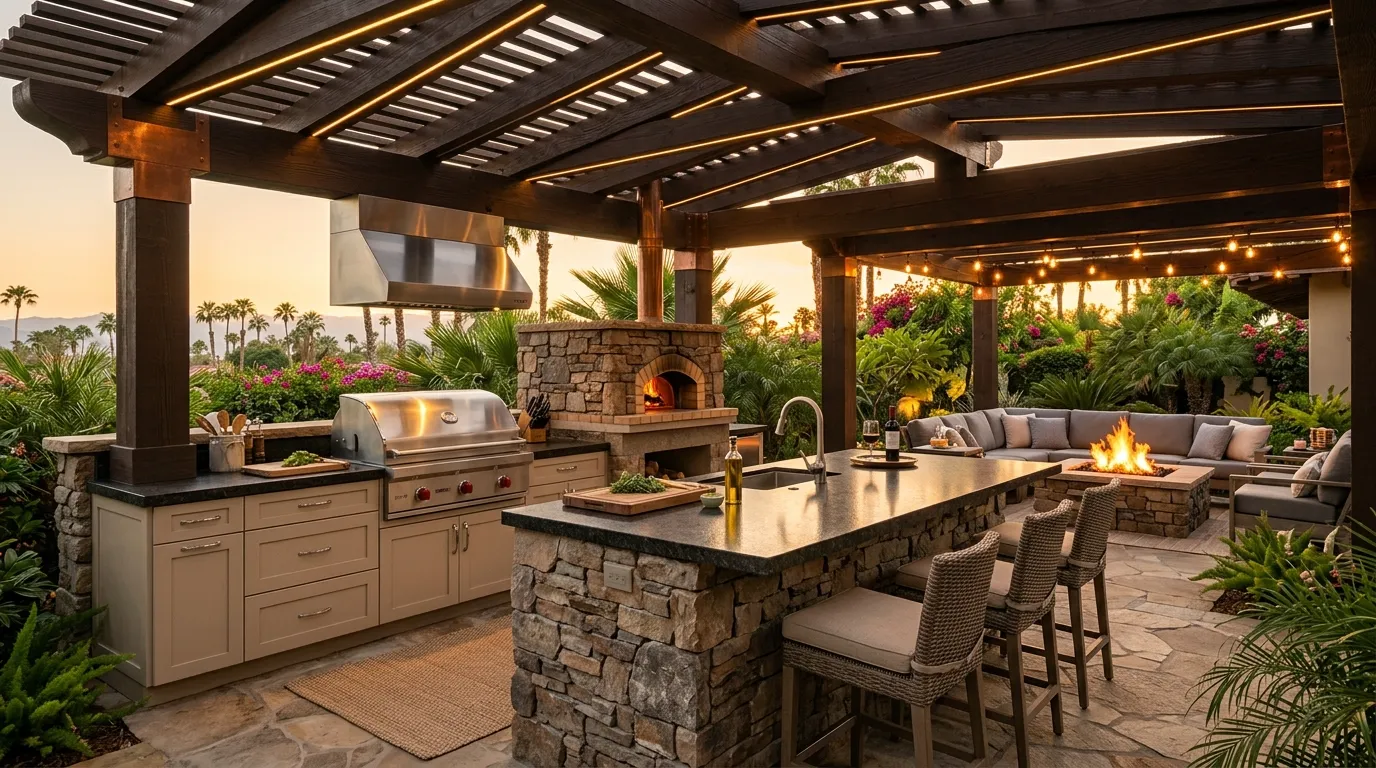
Use cedar tongue-and-groove boards to sheathe the underside of a lean-to roof structure — not just the ceiling, but the interior surface of the rafters where they’re visible. Cedar takes stain or oil beautifully and develops a silver-grey patina over time if left natural. For the posts, use steel tube columns in a warm rusted finish rather than wood — the contrast between the warm ceiling and the industrial uprights reads as intentional rather than rustic.
Build the kitchen island with a ledge-stone veneer base in buff and sand tones, with a honed black granite countertop that runs long enough for both prep and serving. Install a rain chain at the corner of the roofline rather than a conventional downspout — copper rain chains with cup-shaped links are beautiful in rain and add movement and sound to the space even in a light drizzle.
Choose large-format slate or concrete pavers for the floor in a dark charcoal tone. Avoid stone that’s too light — it will show grease, and you will be grilling. The one thing that ties this together is the rain chain. Do not omit it. It’s the reason the design reads as considered rather than competent.
White Rose Pergola Kitchen
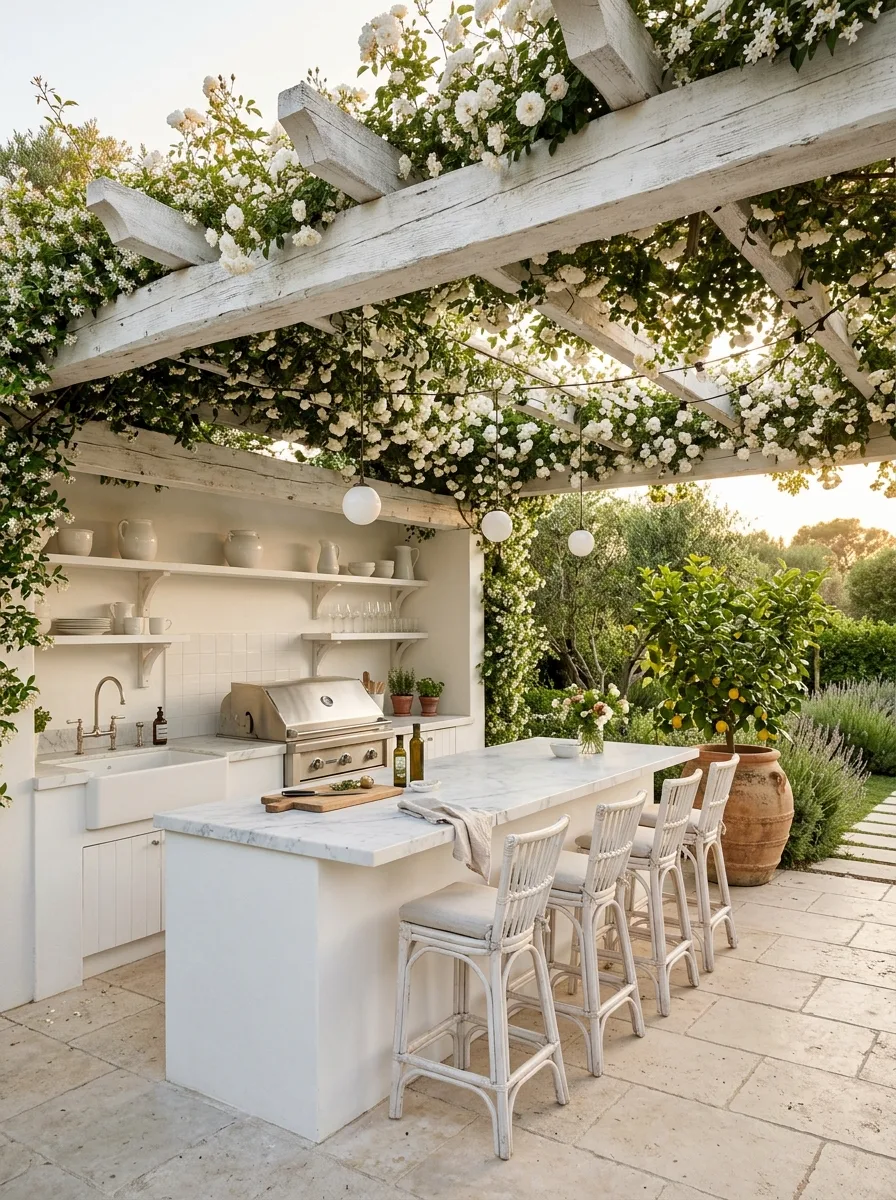
Build a traditional painted timber pergola in white or near-white — use rough-sawn lumber rather than smooth dimensional lumber to keep the texture from reading as suburban. Treat the timber with a limewash or white exterior paint that allows the grain to read through rather than covering it. Plant climbing roses at each post and along the base of the beams, selecting a variety that will bloom at the scale of the structure — ‘Climbing Iceberg’ or ‘Kiftsgate’ are both appropriate and both reliably cover a structure within three seasons.
Below the pergola, run the kitchen entirely in white and marble — white-painted shaker cabinetry, a honed Carrara marble countertop for the island, and a white apron-front sink. Install open bracket shelves in white-painted wood on the back wall and line them with cream ceramic pitchers, plates, and glasses. The styling on those shelves is the kitchen’s editorial moment — keep it to a single colour family and avoid anything that introduces a competing palette.
Hang globe pendant lights from the pergola beams rather than the structure itself — the globes echo the rounded silhouette of the roses overhead. The single non-white element permitted in this kitchen is a large terracotta pot with a citrus tree at one end. It earns its place.
Timber Frame Gazebo Kitchen
Build a full timber frame gazebo structure with a peaked gabled roof — use rough-sawn cedar or Douglas fir in structural dimensions, at least 6×6 for the posts and 6×8 for the beams. The joint work at the gable peak and the corner braces is what makes this structure beautiful, so use traditional timber frame joinery or steel brackets that are visible and honest about what they’re doing.
Run the kitchen in an L-shape with the open side facing the garden. Use the same ledge-stone veneer on the kitchen bases as the timber frame, keeping the palette to warm tan stone and natural wood. Install a flat black granite countertop and run string lights from post to post across the interior of the gable — the lights provide ambient illumination and emphasize the structure’s geometry at night.
Keep the roof board-and-batten or corrugated metal over the structural roof sheathing. The material choice matters less than the proportion. This gazebo only works if it’s large enough to feel like a room — go a minimum of twelve by sixteen feet.
Black Glass Greenhouse Kitchen
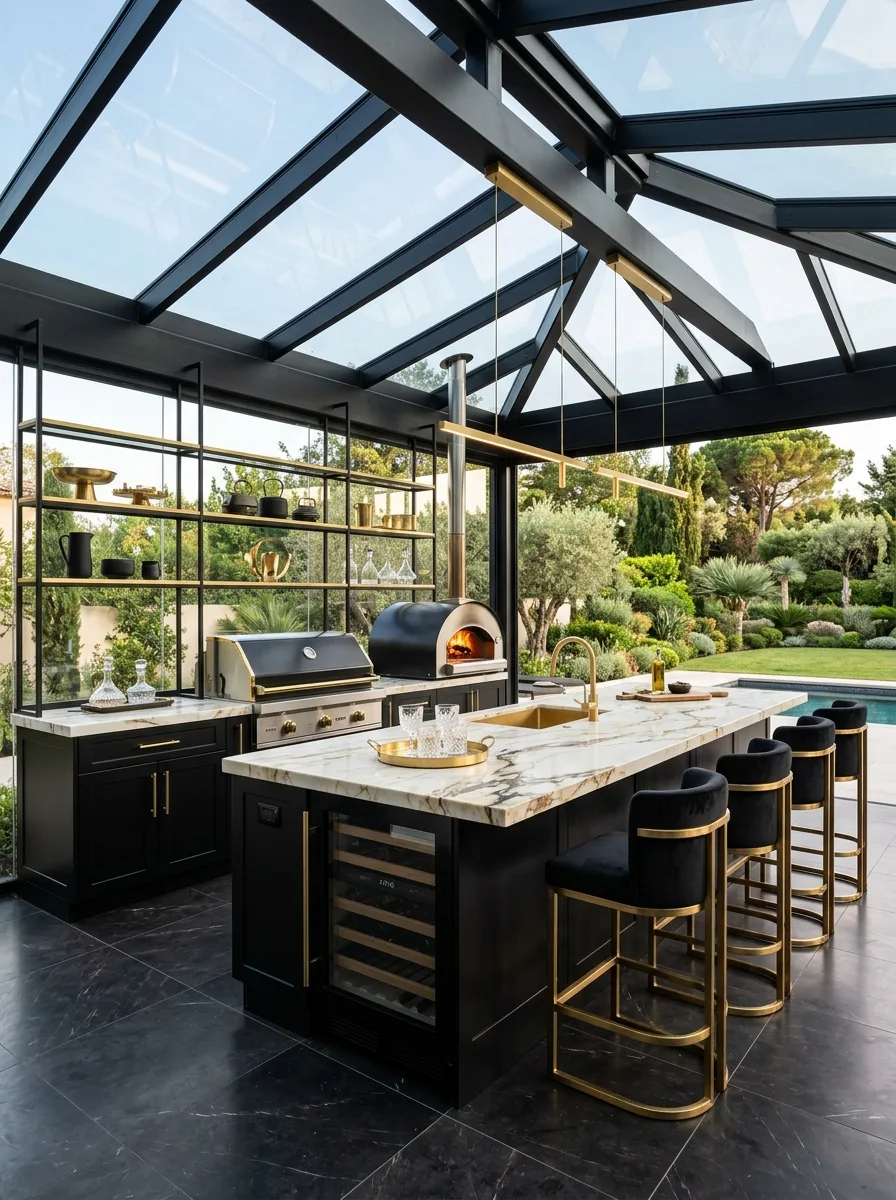
This is not an outdoor kitchen. It is an indoor kitchen built entirely from glass and steel and opened to the garden on one side. Build a conservatory-style structure with a steel frame and glass roof panels — the kind of structure sometimes called a lean-to greenhouse or garden room. Use black-painted steel or aluminium for every frame member. Install fully retractable glass panels on at least one side so the space can open completely to the outside.
Run the kitchen in matte black cabinetry with bold veining marble countertops — Calacatta or a marble with a strong graphic pattern, not a subtle one. Build a freestanding island with the same marble top and gold hardware throughout: faucet, cabinet pulls, pendant fixture arms. Install two or three long bar pendants in matte gold with clear glass from the highest point of the glass roof.
Place a pizza or wood-fired oven as the second cooking station beside the grill, with a steel chimney flue running up through the glass roof. The view through the glass walls should be a proper garden — formal, with structure. This kitchen is too serious for a lawn with a few hostas.
Exposed Beam Outdoor Kitchen Room
Attach the structure to the house and run it as a covered porch addition with a proper shed or lean-to roof. Finish the interior ceiling in dark-stained tongue-and-groove boards with exposed structural beams in an even darker stain — espresso or ebony — that contrast against the ceiling. The exposed beam structure overhead is the anchor for everything else in the space.
Hang two or three oversized outdoor ceiling fans with white or off-white blades from the beams rather than the ceiling surface — the fans drop from the beam, not from a standard electrical box. Below, run the kitchen in white or off-white shaker-style cabinetry rated for exterior use with a dark stone countertop. Clad the back wall in grey ledge-stone and mount a matte black range hood over the grill. Put an outdoor rug on the floor.
The rug is not decorative. It signals that this is a room, not a patio. It’s the single element that crosses the psychological threshold from exterior to interior, and it’s what makes this design work as a genuine living space rather than a cooking station.
Garden Cottage Pizza Oven Kitchen
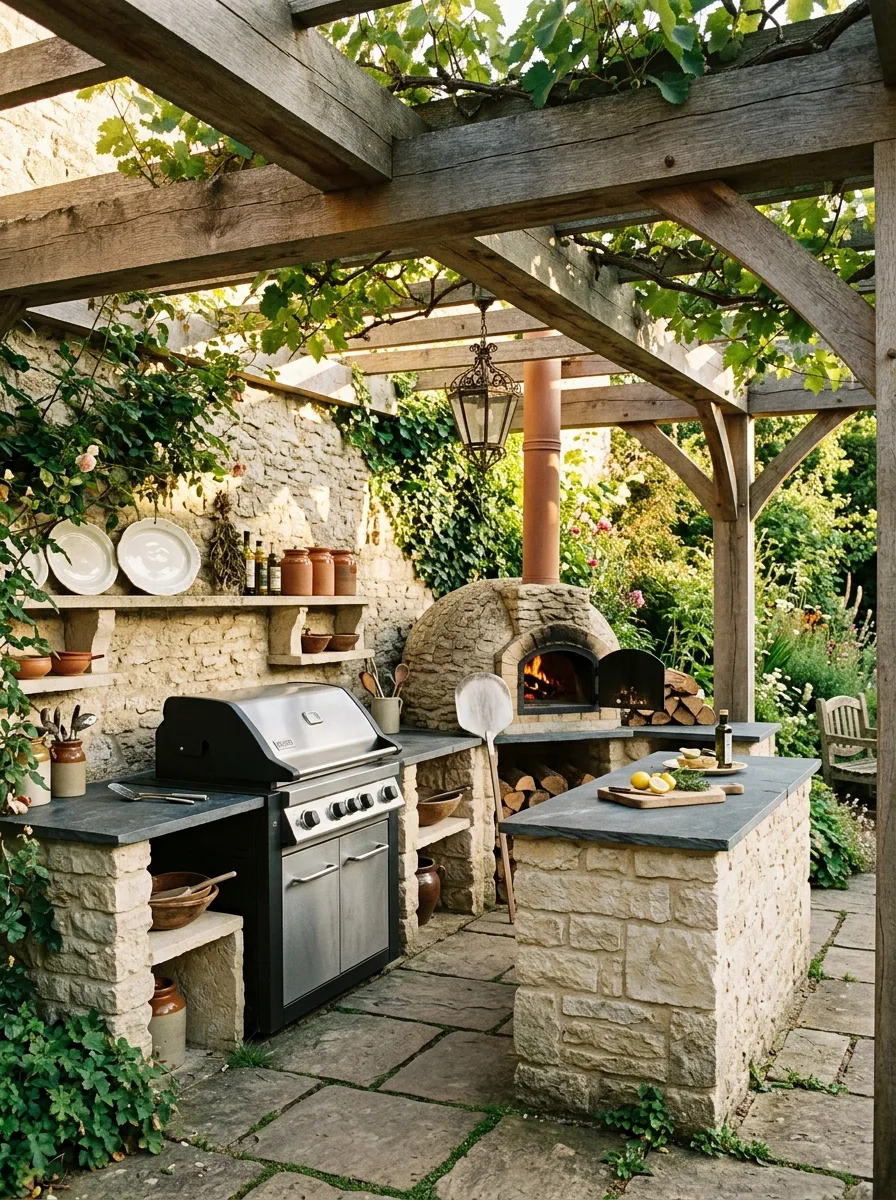
Build a freestanding open pergola structure in weathered or reclaimed timber and run vines — grapevine or climbing roses — across the top over several growing seasons. This is not a one-weekend project. The pergola goes up in a weekend; the lush overhead canopy takes two to four years to establish. Plan for it from the beginning and the payoff is a structure that looks older and more beautiful every year rather than newer.
Build the kitchen base in natural fieldstone or limestone block — not veneer applied to a steel frame, but actual stacked masonry if the budget allows it. Run a flat dark slate countertop. Place a dome-shaped wood-fired pizza oven as the centerpiece, built from a firebrick core rendered in mortar and finished in natural stone. The oven is not an appliance — it’s the architectural focus of the whole kitchen. Place it at the back, centered, and run an open prep counter on either side.
Hang a wrought iron or antique iron lantern pendant from the pergola structure overhead. Add open shelving in matching stone along the back wall for plates and cookware. The rule for this kitchen is that every element should look like it was there before you arrived.
Matte Black Louvered Pergola Kitchen
Frame the structure entirely in powder-coated matte black aluminum square tubing — posts, header beams, and cross members all the same profile and color. Install a louvered roof system in the same black finish so the slats open for ventilation while cooking and close against rain when needed. The louvered roof is the defining element here. It’s the difference between a structure that sits outside and one that actually controls the environment under it.
Run the kitchen in a corner L-shape with flat-front matte black cabinetry rated for exterior use — look for marine-grade or powder-coated aluminum cabinet boxes with composite fronts. Use a honed grey stone countertop throughout, avoiding anything with high variation or movement; the design depends on restraint. Add a range hood in the same black as the frame, a wine fridge built into the lower cabinetry, and herb pots along the prep counter as the only soft element in the palette.
Add horizontal louvered panels on one or two sides of the frame for privacy and wind protection. The whole structure should feel like a piece of architecture that was designed to be outside, not an interior kitchen concept that got moved to the patio.
All-Black Concrete Garden Kitchen
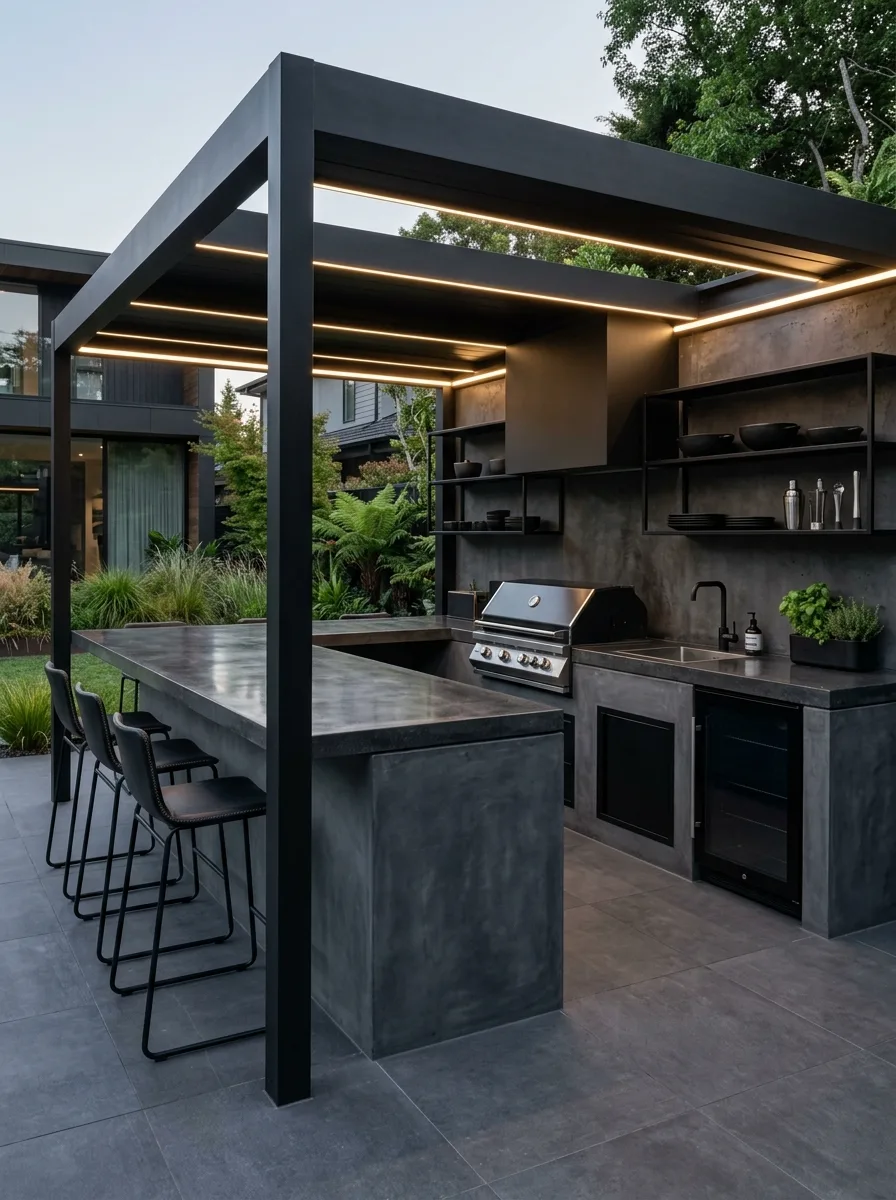
Build a flat-roof pergola frame in welded black steel square tubing with clean 90-degree corners and no decorative detail whatsoever. Embed linear LED strip lights in channels routed along the inside face of the roof frame members — the light appears as glowing lines when switched on, with no visible fixture. This is the lighting choice that distinguishes this kitchen from everything else on this list.
Cast or source the entire kitchen — countertops, island surfaces, and the vertical panel behind the cooking station — in poured concrete, troweled smooth and sealed to a low sheen. Use a single dark grey tone throughout, avoiding colour variation. Build open black steel shelf brackets on the back wall, mount matte black plumbing fixtures, and choose a matte black undermount sink. The only permitted material break is the grill hood in stainless and the rattan bar stools at the island.
Surround the kitchen with dense, dark green plantings — tree ferns, clipped box hedges, or bamboo — so the contrast between the precise architecture and the lush garden is obvious and intentional. The whole point of this kitchen is discipline. Do not add anything soft, warm, or rustic.
Tuscan Stone Arch Kitchen
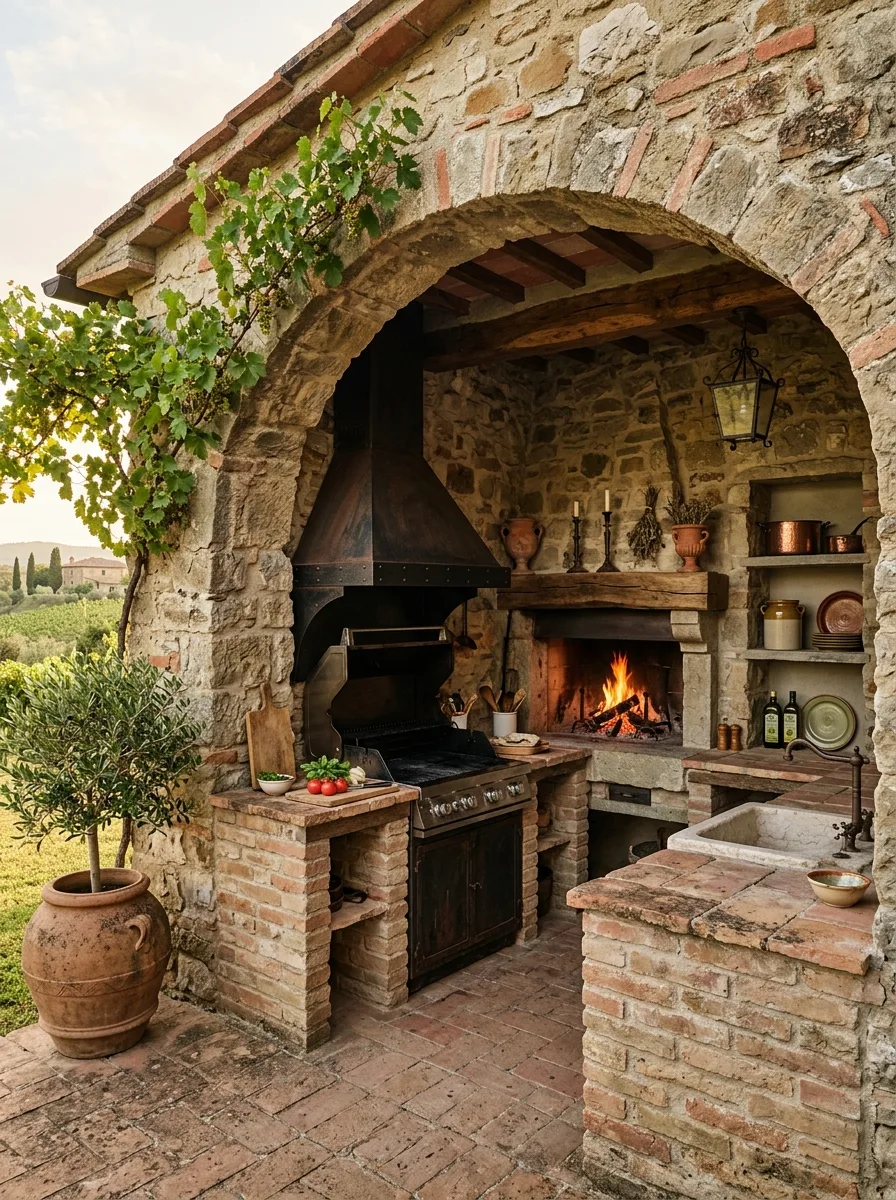
The structural element that makes this kitchen what it is is a full masonry arch — built in rough rubble stone or reclaimed brick, spanning wide enough to frame the entire kitchen and serve as its defining architectural gesture. This is a serious structural commitment. It requires a footing, a formwork for the arch while the mortar cures, and either a mason or someone willing to learn the craft. It is worth it.
Build the kitchen base in brick with open lower shelving and a stone or slate countertop. Place a freestanding gas grill on the left-hand side and a deep stone sink with a vintage-style tap on the right. Mount a hand-hammered copper range hood over the cooking station, connected to a flue pipe that exits through the masonry above the arch. Inside the arch, build an open masonry fireplace — a proper fire, with a lintel and an iron surround. Place a rustic wood beam mantle above the firebox and style it with candlesticks, terracotta pots, and bundles of dried herbs.
The floor is old brick or worn stone flags, not modern pavers. This kitchen must feel like it has been in the same place for a very long time, even if you built it last year.
Dark Timber Pendant Kitchen
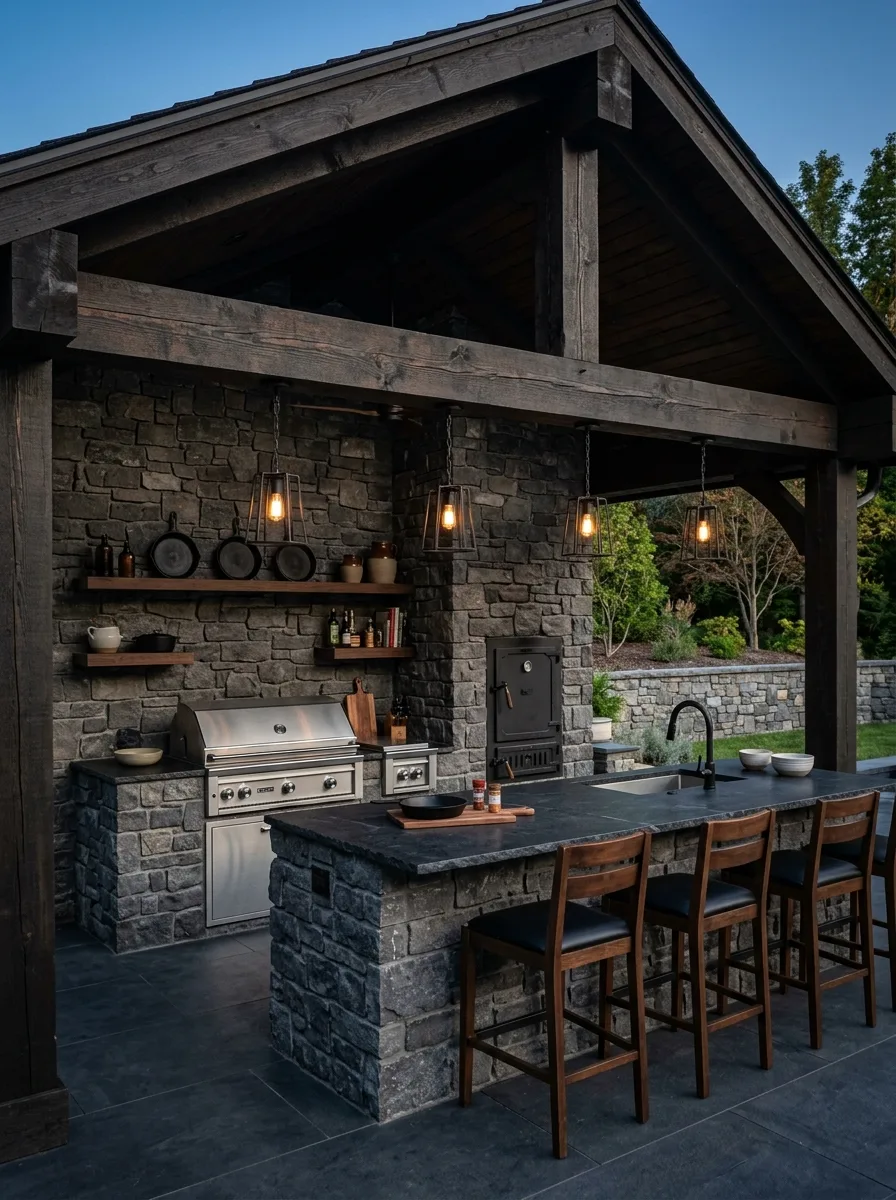
The lighting is the first decision here, not the last. Choose oversized industrial cage pendants with Edison bulbs — three pendants on a horizontal run, hung at around seven feet, from the structural ridge beam of a gabled timber frame pavilion. The pendants should be large enough to be read as a statement from across the yard, not fixtures that disappear into the structure. This is the move that makes this kitchen look intentional after dark, and it looks extraordinary after dark.
Build the kitchen base in natural grey stone veneer with a honed dark slate or soapstone countertop and a bar-height seating extension. Run the frame in grey weathered timber — stained or naturally silvered cedar — with thick exposed braces at the gable corners. Install a cast iron or aged steel firebox door into the stone wall as an accent element, even if it’s non-functional. Mount open walnut shelving above the grill wall and style it with cast iron cookware, vintage bottles, and ironstone crocks.
The perimeter of the pavilion should have low stone retaining walls that double as additional seating. This kitchen wants to feel like a gathering place, not just a cooking station.
Scandinavian Blonde Wood Kitchen
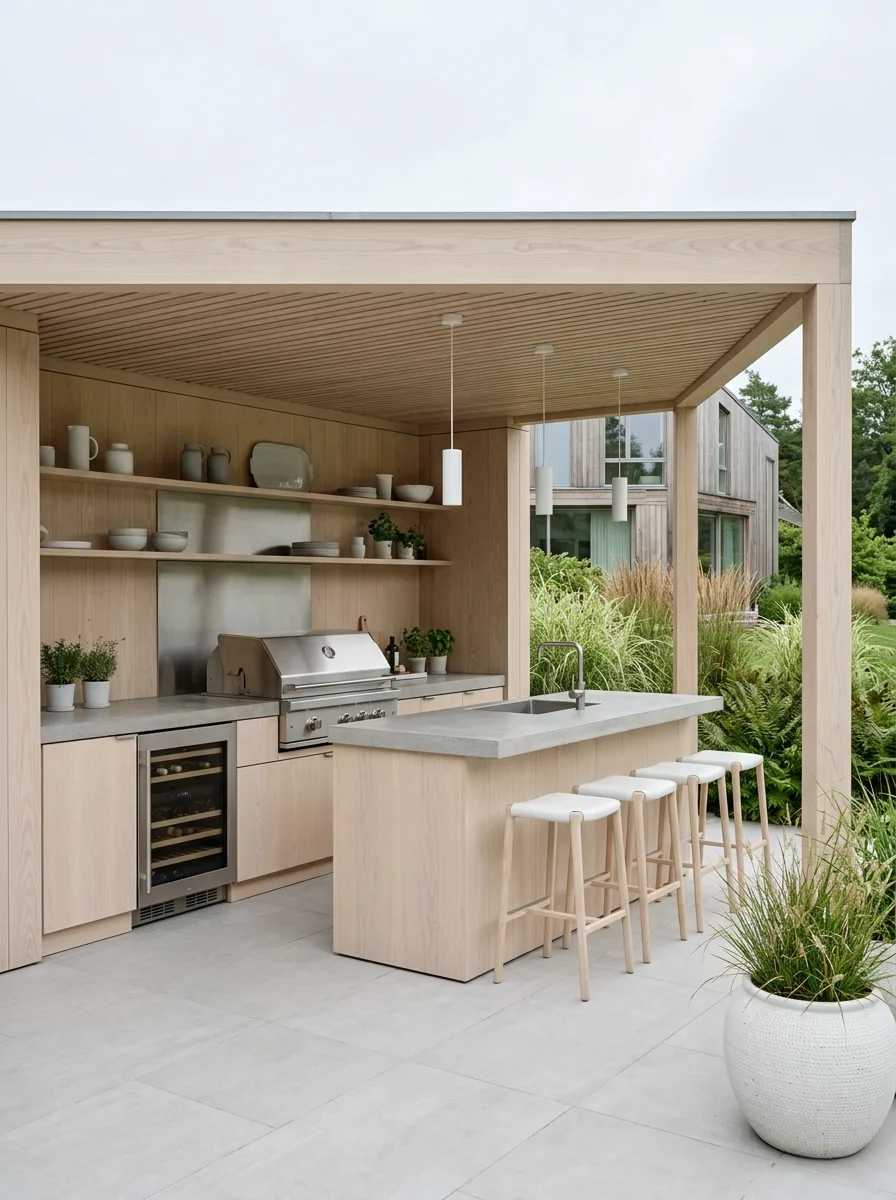
Build a lean-to structure with a single shed roof in pale, lightly finished timber — ash or light oak in tone. Line the entire interior ceiling in narrow horizontal boards in the same pale tone, running the grain parallel to the length of the structure. The effect is a warm but quiet envelope that makes everything under it feel calm. Use no stain darker than a light honey tone on any wood surface in the entire kitchen.
Install pale flush-front cabinetry in white oak veneer or a close composite match, rated for exterior exposure. Use a honed concrete countertop in a light grey-beige tone — not pure white, not dark grey. Hang two or three cylindrical pendant lights in matte white from the ceiling with no visible hardware. Add a wine fridge and an undermount stainless sink. Line open shelves with sage green ceramics in a single neutral pattern.
Surround the perimeter with ornamental grasses and low prairie-style plantings rather than structured hedging or sculpted shrubs. The soft movement of grasses against the precise architecture is what makes this design breathe.
Modern Farmhouse Shiplap Kitchen
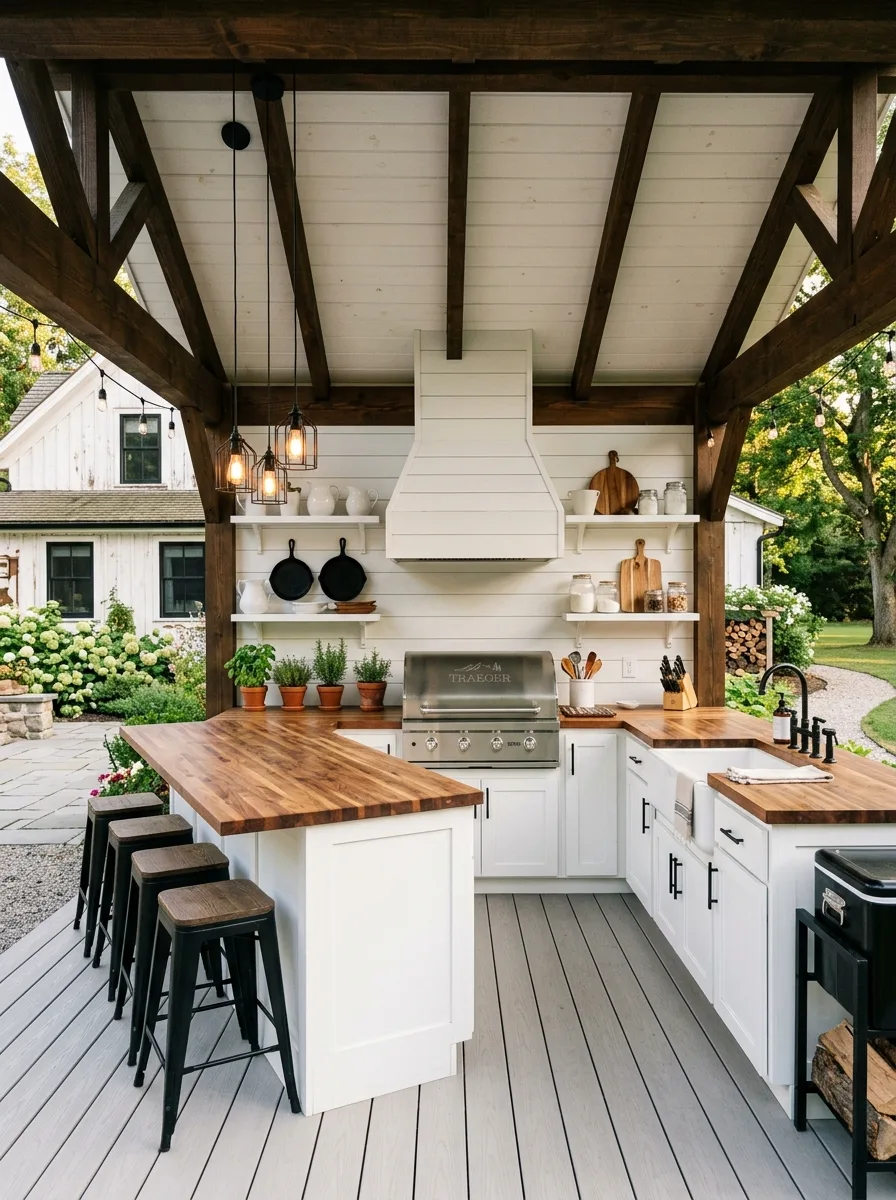
The key decision in this kitchen is the white shiplap back wall that runs floor to ceiling behind the cooking station. Install horizontal shiplap boards in a painted white exterior-rated finish across the entire back wall of the structure — cover every inch of it, including the area above the range hood. This creates a backdrop that reads as interior and that makes everything mounted against it look intentional.
Use white-painted shaker cabinetry below and open white-painted bracket shelves above. Mount a white custom range hood in the center — not stainless, not black, white — with a wide, generous proportional base that commands the wall. Install a butcher block countertop throughout rather than stone. It will need oiling. Oil it. The warmth of the wood against all that white is the thermal element the kitchen needs.
Hang industrial cage pendants in black from the structural beams overhead. Use black hardware on every cabinet door. The contrast between the clean white surfaces and the black accents is what gives this farmhouse kitchen its edge — without it, it’s just white.
English Garden Pergola Kitchen
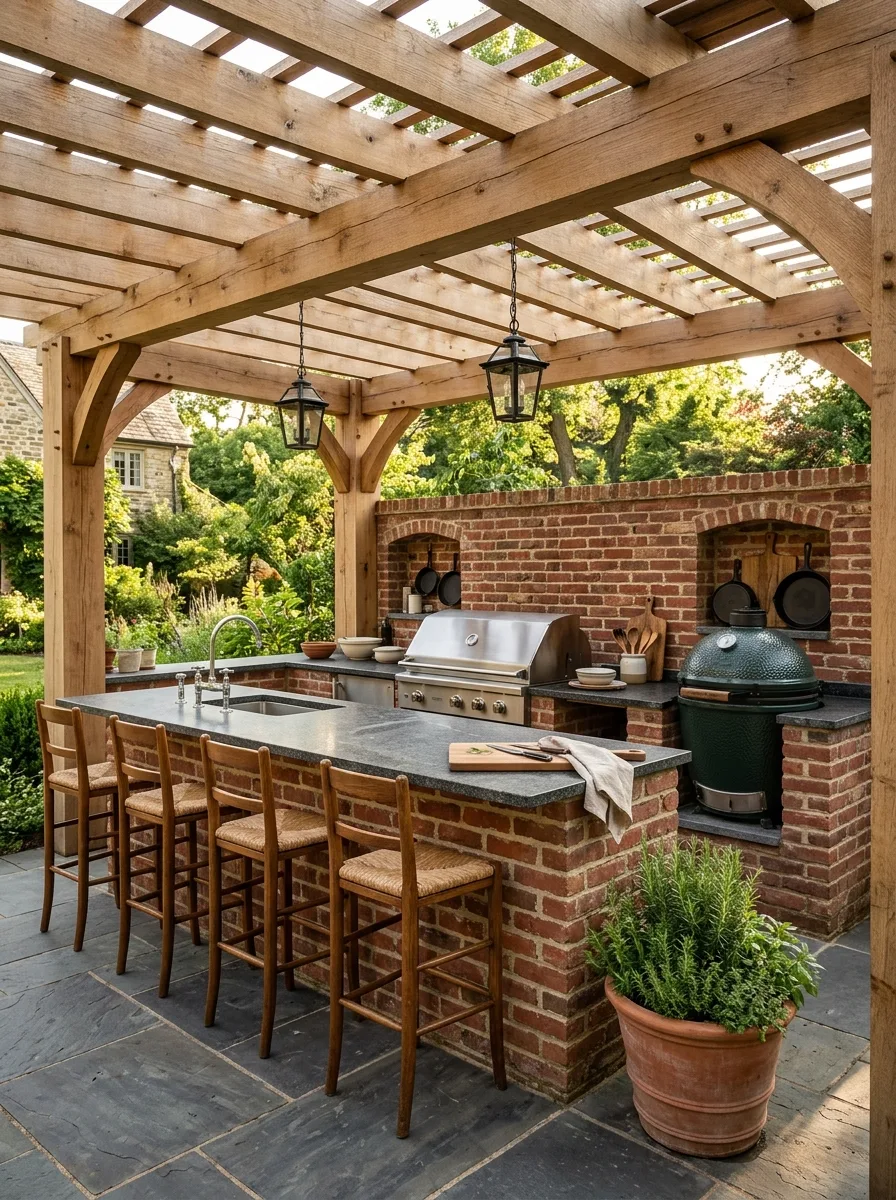
Use a natural unfinished oak timber pergola with cross-lattice joinery at the top — not rectangular slats but a proper diagonal lattice that creates diamond-shaped apertures. Cut the arch profiles at the interior corners of each post-to-beam junction to give the structure a slightly ecclesiastical quality. This kind of detail in the joinery is what separates a carpenter-built structure from a kit structure.
Build the entire kitchen base in full red or buff brick — no veneer, actual structural brick. Run a long continuous soapstone or dark slate countertop the full length of the kitchen, including across the back wall. Build two arch niches into the back wall above counter level in the same brick — these become open storage for cookware and serving pieces. Install a Green Egg or kamado-style ceramic cooker at one end of the counter as a second cooking station alongside the primary grill. Hang lantern pendants from the pergola beams.
Plant rosemary, lavender, and climbing roses at the base of every post. The plants are not optional — this kitchen requires them. Without the planting, it’s a brick structure with a nice counter. With them, it’s a garden kitchen.
Boho Terracotta Kitchen
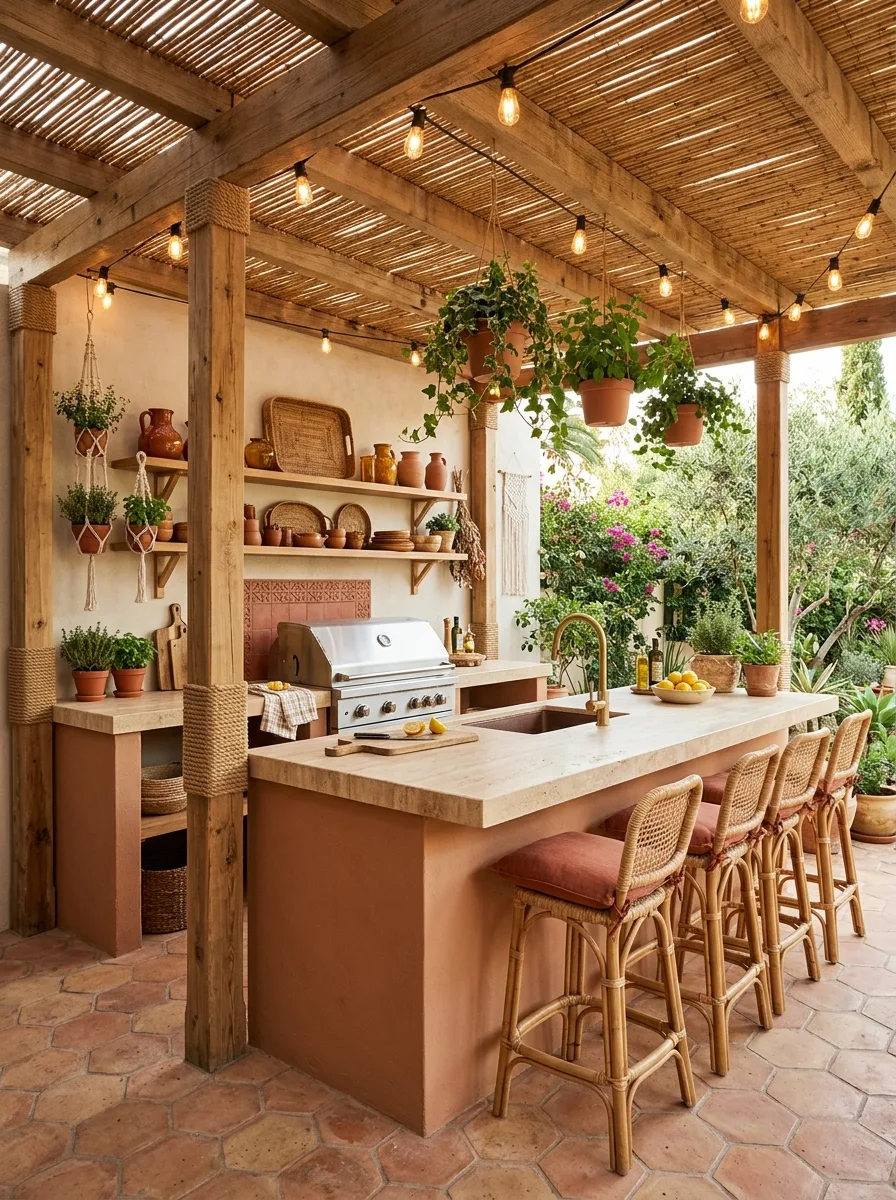
Render the vertical surfaces of the kitchen structure in warm terracotta plaster — the same tone throughout, applied over concrete block or steel-frame construction. Smooth, not textured. Use limewash or mineral plaster for an exterior application. This rendered surface is the canvas for the whole kitchen.
Build the island and back counter in the same rendered terracotta base with a travertine or light limestone countertop — the contrast between the matte warm base and the slightly veined stone top is the material relationship this kitchen is built on. Install bamboo cladding on the cabinet fronts, set into the rendered surround. Hang rattan wicker pendants from the timber and bamboo overhead structure. Run terracotta hexagonal floor tiles throughout.
Add three to five rattan bar stools with terracotta or rust linen cushions at the island seating. Put macramé plant hangers at the posts with trailing pothos or ivy. Stack open shelves with terracotta pots, woven baskets, and ceramic pitchers in warm amber and clay tones. The ceiling above should be bamboo matting laid between timber cross-beams — bamboo reed mat panels are sold for this purpose and give a warm, light-filtering overhead surface.
Andalusian Tile Fireplace Kitchen
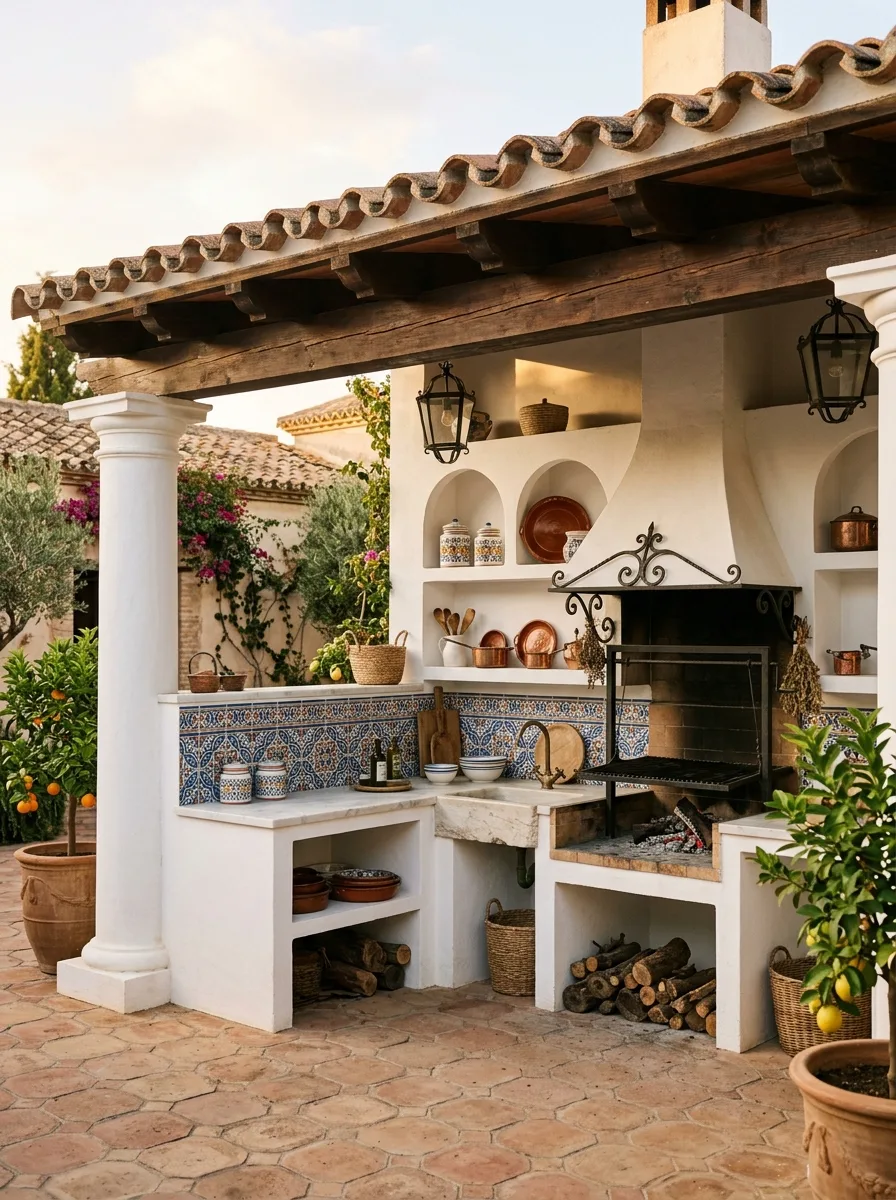
Build the kitchen entirely in white-rendered masonry — stucco over concrete block, smooth and painted in warm white. Run a continuous counter in white marble or a light stone with minimal variation. Tile the backsplash area between counter and the first shelf line in hand-painted Moorish tiles — blue and white or polychrome, in a repeating geometric or floral pattern. The tiles are the design story of this kitchen. Everything else exists to support them.
Build an open masonry fireplace and raised grill into the main cooking wall, with a decorative iron surround and a traditional chimney. Add arched storage niches in the rendered masonry above the counter line, lined in the same tile pattern. Install wrought iron lantern pendants above the counter. Use terracotta hexagonal floor tiles or large terracotta squares throughout. Plant a potted lemon tree and a potted orange tree on either side of the cooking station.
The only rule for styling this kitchen is this: if it isn’t copper, terracotta, woven, or ceramic, it doesn’t belong here. Keep chrome, stainless, and synthetic materials entirely out of the design.
White Subway Blue Accent Kitchen
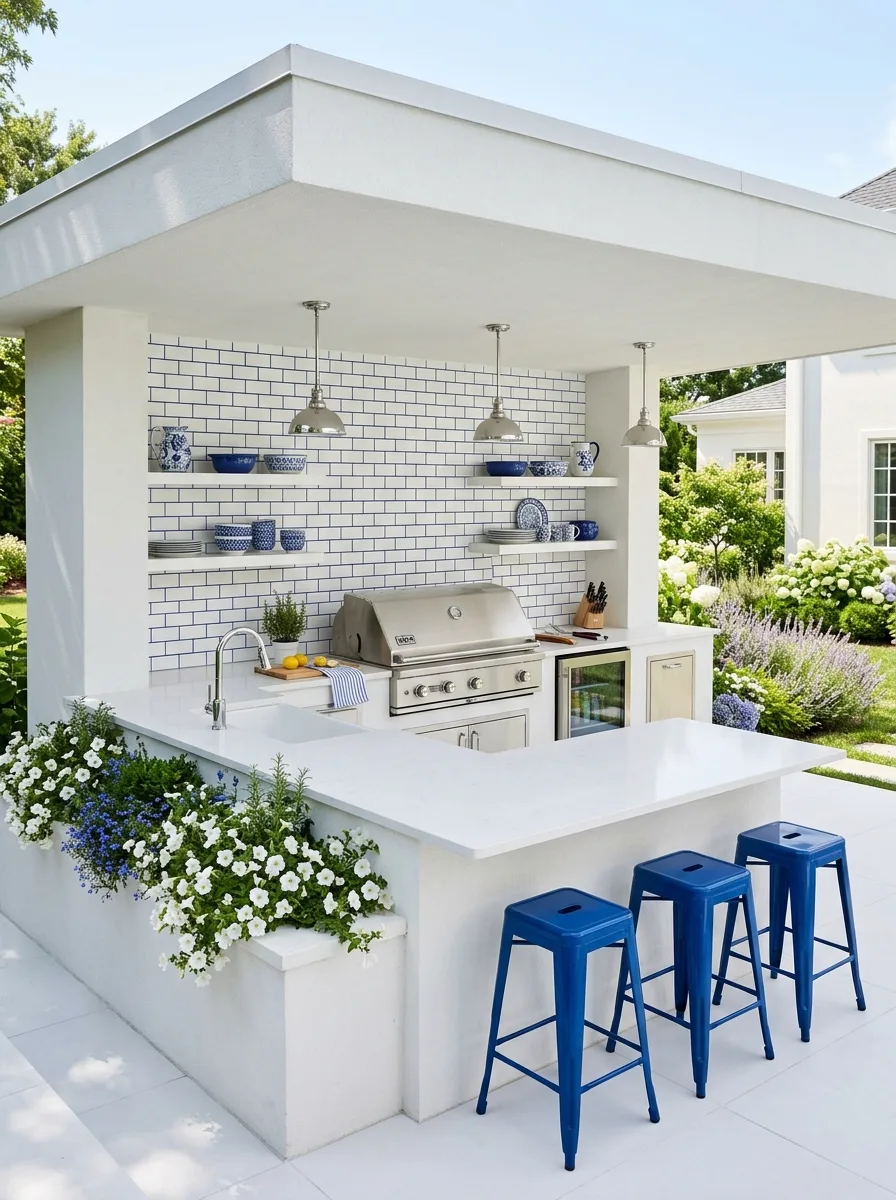
Build a flat-roof pavilion structure in poured or rendered concrete — the roof should have a clean, knife-edge overhang with no visible structure at the eaves. Everything about the architecture of this kitchen should be simplified to the point of abstraction, because the kitchen itself will carry all the visual interest.
Tile the entire back wall — floor to ceiling — in classic white subway tiles with a dark navy grout. This single material decision makes the wall legible as a real interior surface rather than a patio backdrop. Run open white shelves across the tile wall and style them exclusively in blue and white tableware — cobalt blue ceramic bowls, blue-and-white transferware plates, navy mugs, white pitchers. No other colours on those shelves.
Install chrome pendant lights in a barn-lamp profile and pair them with cobalt blue powder-coated metal stools at the island. Build a planter box into the front face of the island and fill it with trailing white petunias and blue lobelia so the planting mirrors the colour scheme of the kitchen. The island and structural surfaces stay pure white. The blue elements are the styling layer.
Balinese Thatched Kitchen
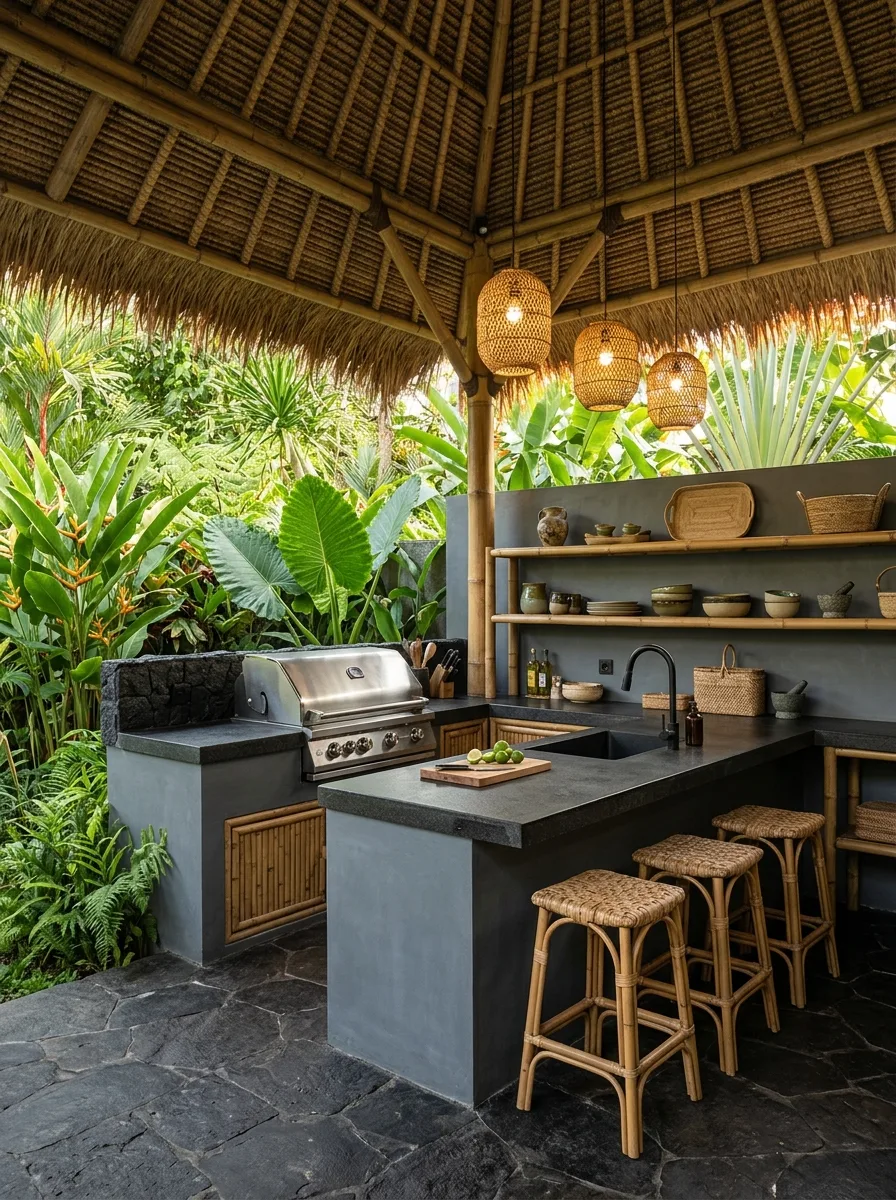
Install a circular or octagonal thatched-roof pavilion structure — a bale, in Balinese terminology — with bamboo upright posts. Authentic alang-alang thatch provides excellent insulation and rain resistance and has a layered, dense texture overhead that no other material replicates. The bamboo posts should be round, not square, and can be left natural or finished with a clear sealer.
Build the kitchen base in poured and polished dark grey or charcoal concrete — the tone should be almost black when wet. Run the countertop in the same material at bar height on one side for seating. Install bamboo-framed cabinet fronts set flush into the concrete base. Use a matte black undermount sink with a matte black faucet. Hang woven bamboo or rattan pendant lights in graduated sizes — three pendants in a cluster, slightly staggered in height.
Edge the lava rock or split black slate floor at the base of the grill station with a low wall of volcanic stone for both structural support and design authenticity. Flank the open sides of the pavilion with large-leafed tropical plantings — banana palms, bird of paradise, heliconia. This kitchen does not exist without its garden.
Provençal Stone Herb Garden Kitchen
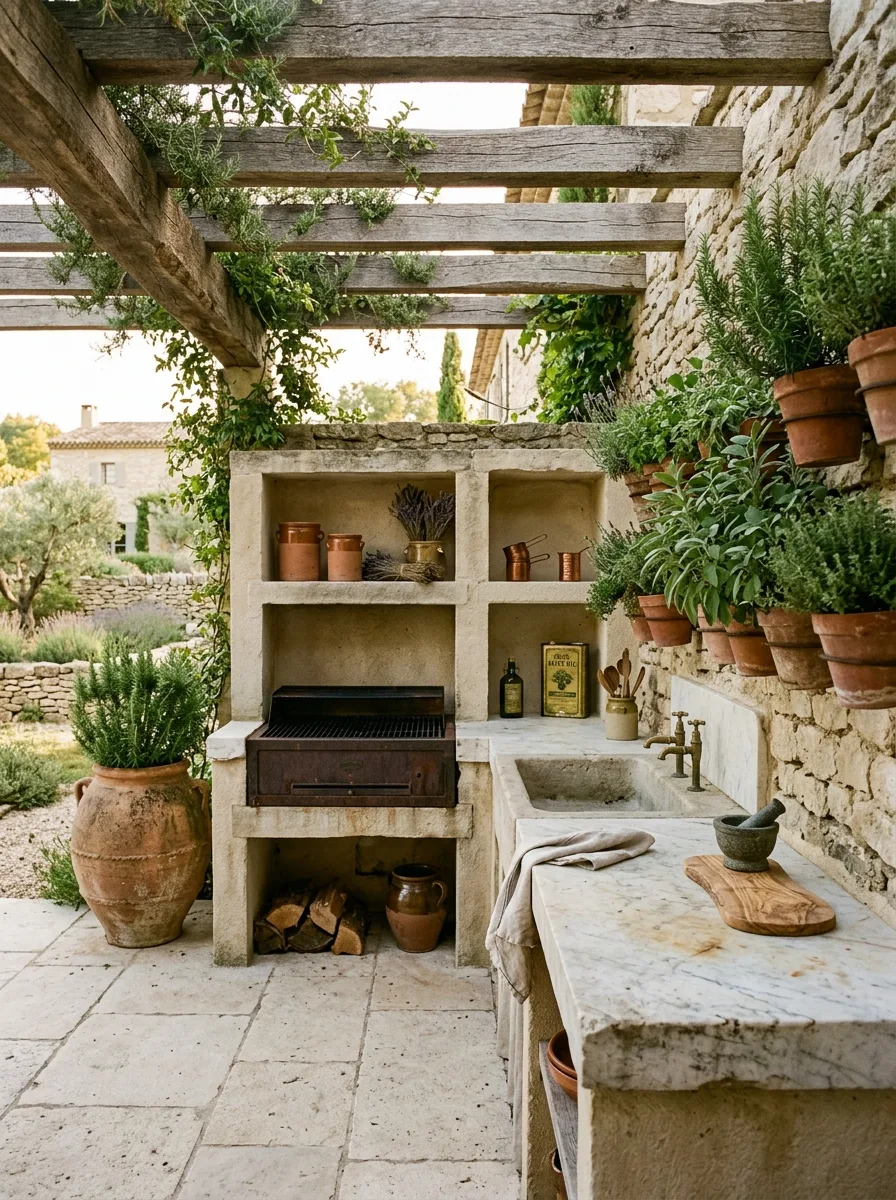
Build a rustic open pergola in reclaimed or rough-hewn timber and plant it with hanging herbs — thyme and rosemary trained across the cross-beams in summer, lavender in pots at every post. The smell of the kitchen should be as deliberate as the look.
Build the entire kitchen structure in raw concrete with a rough, almost formwork texture — not poured-smooth concrete but béton brut, the unfinished, honest concrete you see in French farmhouses where form boards have left their texture on the surface. Build open niches into the concrete structure above the cooking area — three or four rectangular recesses — and fill them with copper pots, antique tins, and dried bundles of lavender. Run a honed marble slab as the countertop and embed a shallow stone sink with a bridge-style brass tap.
Run the side wall in actual coursed stone — the same pale limestone or sandstone as the masonry around you if you’re using this in a genuine rural context, or a reclaimed stone veneer if not. Stack terracotta pots with herbs on every flat surface available. The kitchen should look like something you stumbled onto, not something you designed.
Japanese Garden Kitchen
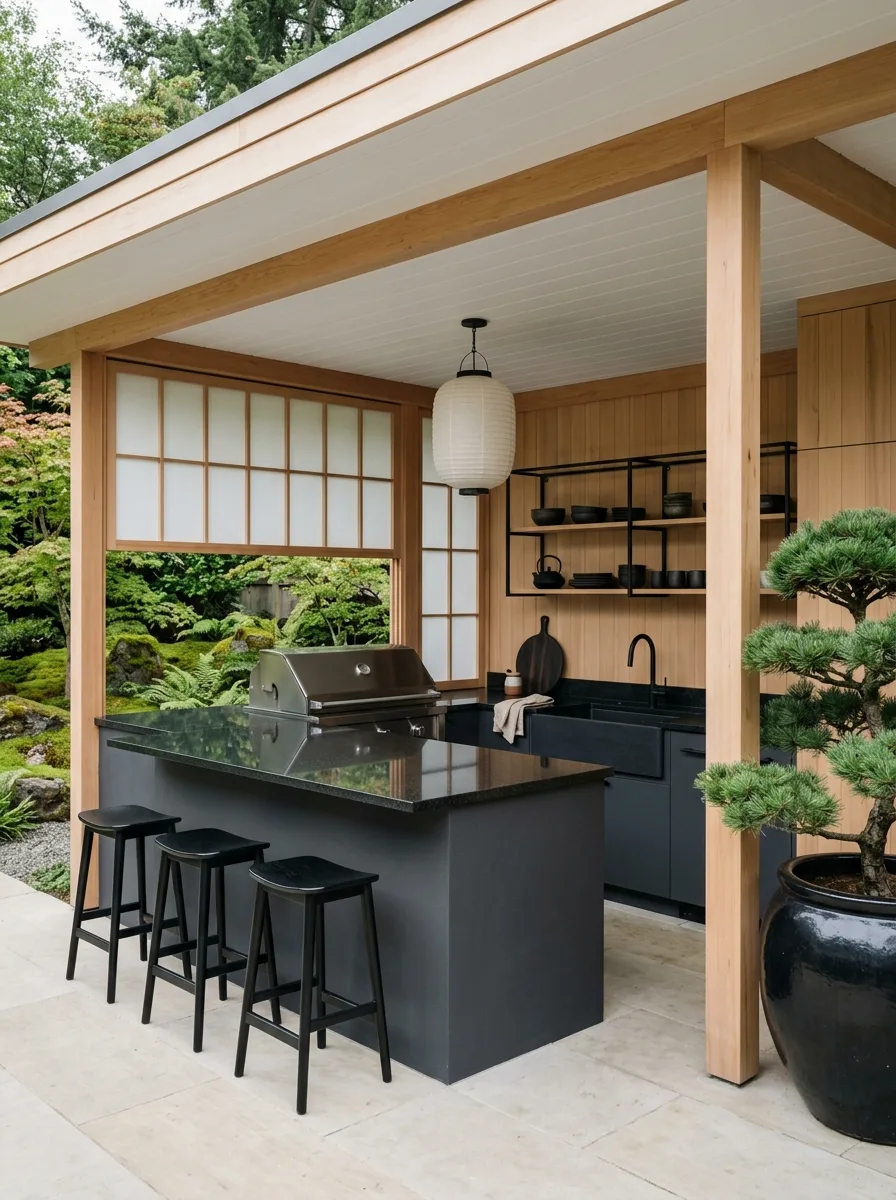
Build the pavilion structure in unfinished or lightly oiled light timber — hinoki cypress if the budget allows, Douglas fir or pine if not — with clean post-and-beam joinery and a flat or very slightly pitched roof with deep overhanging eaves. Install shoji-style sliding panels on one side of the pavilion — translucent fibreglass or genuine shoji paper in an exterior frame — that can be pulled closed to block wind and create a soft, filtered interior light.
Build the kitchen in matte charcoal or near-black flat-front cabinetry with no visible hardware, with a polished dark granite countertop. Install open black steel shelf brackets above the cooking station and style them minimally — black cast iron teapot, matte black bowls, a single cutting board standing upright. Use a white paper lantern pendant, single, large, hung from the centre of the pavilion.
Place a large black-glazed ceramic pot with a sculpted pine or bonsai specimen at the corner of the seating area. Run raked gravel or decomposed granite around the edges of the pavilion perimeter. This kitchen is the most restrained thing on this list. Every element earns its place or it doesn’t make it past the door.
Timber Arch Chandelier Kitchen
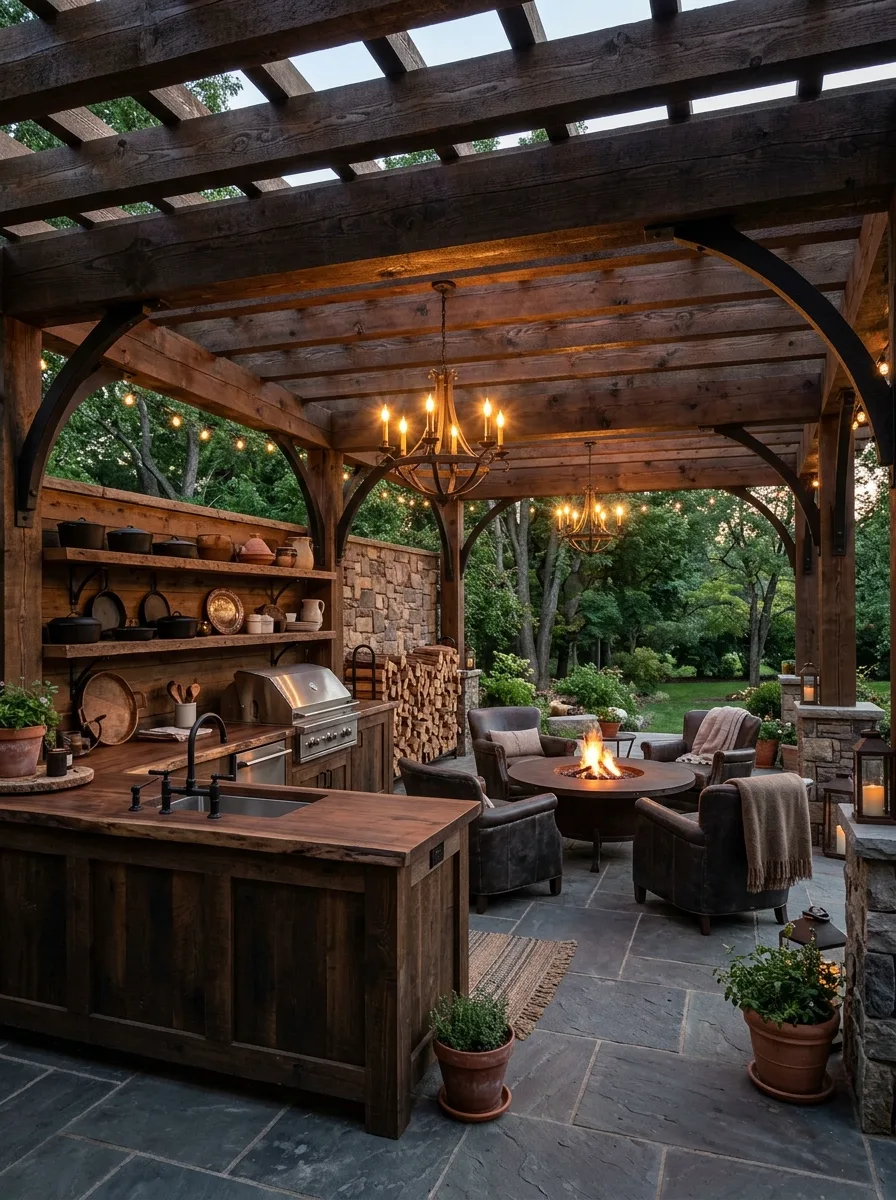
The chandelier is the first decision. Choose a wrought iron or black metal candelabra-style chandelier — the kind with candle bulbs arranged in a horizontal wheel — and hang it from the centre of the pergola structure. Not a pendant. Not string lights. A chandelier. Outside. That’s the move.
Build the timber frame pergola with generous arched braces at each interior corner, connecting post to beam with a graceful curved profile. Use dark-stained or weathered barn-wood-grey timber throughout. Clad the back kitchen wall in the same reclaimed timber. Build the kitchen island in matching reclaimed wood with an integrated sink and butcher block counter. Run open iron bracket shelves on the wall behind the cooking station and style them with cast iron, terracotta, and wooden pieces.
Place a round stone fire pit table in the seating area directly beneath the chandelier, flanked by deep leather armchairs. Run string lights from post to post as a secondary layer of lighting around the perimeter. The chandelier, the fire pit, and the arched timber frame are three concentric gestures toward the same idea: this space is meant for evenings, and the evening is the whole point.
Final Thoughts
Look at what every one of these kitchens has in common, and it isn’t the grill or the counter material or the seating. It’s the decision to make the space a destination rather than an accessory.
The outdoor kitchens on this list feel the way they feel because someone committed to a point of view. The Balinese kitchen is committed to tropical materiality. The Andalusian kitchen is committed to tile and render and iron. The Japanese kitchen is committed to restraint with the kind of resolve that most people save for more dramatic gestures.
The kitchens that don’t work are the ones that made reasonable decisions — a bit of stone here, some composite cabinet fronts there, a standard pergola overhead. Reasonable decisions aggregate into a space that has no reason to make you stay.
You’re building a room. It happens to be outside. Hold it to the same standard you’d hold any room in your house: a clear point of view, a consistent material palette, and at least one thing in it that you can’t quite explain except to say that it’s exactly right.
That’s the standard. Everything else is covered.