
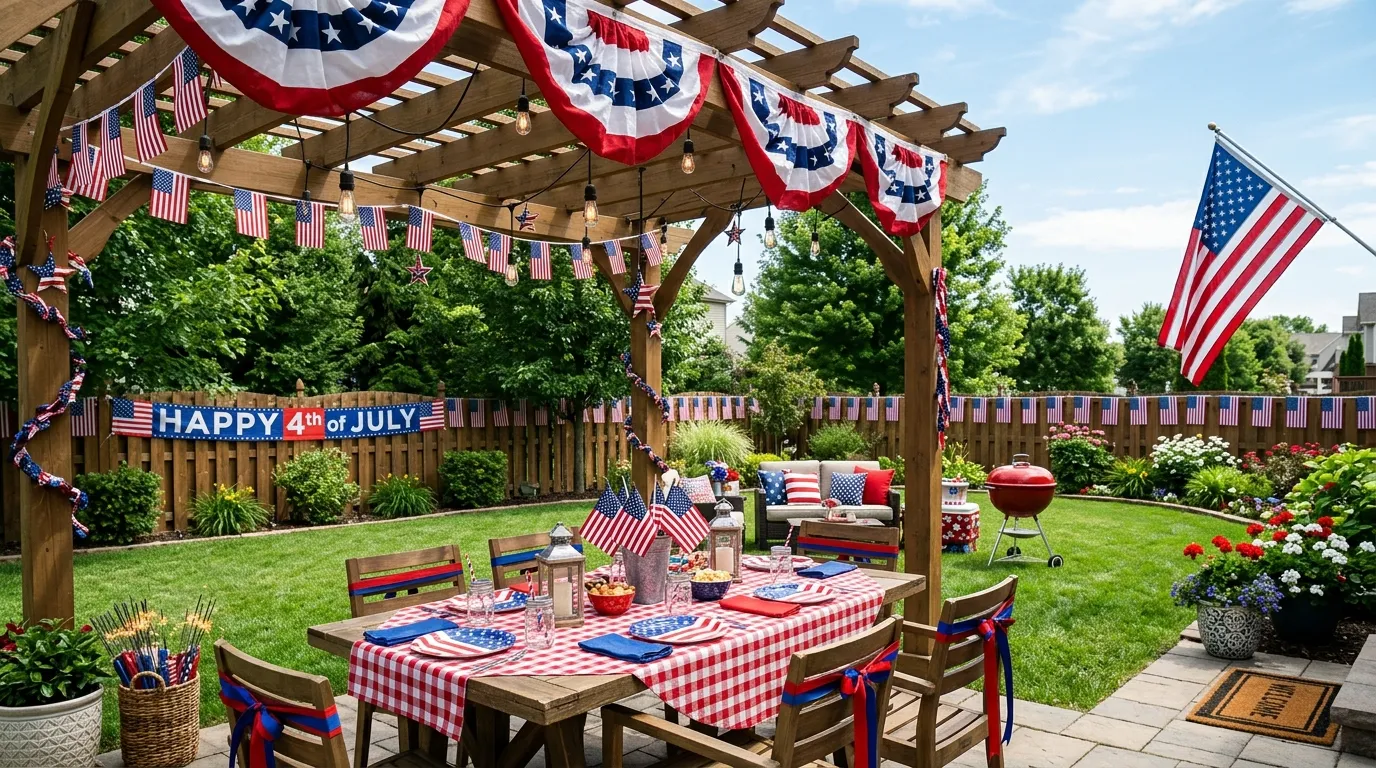
Somewhere along the way, outdoor entertaining became about the checklist.
Red tablecloth: check. Mini flags: check. Bag of red, white, and blue M&Ms someone put in a bowl: check. The result is a yard that says “we are aware of this holiday” rather than one that says anything worth feeling.
The difference between a backyard that photographs well in July and one that actually makes people want to stay is not money. It is not a balloon arch or a galvanized trough full of flower arrangements — though both of those things can help. It is the difference between elements that were placed and elements that were considered. Between a yard assembled and a yard designed.
July 4th is actually one of the most generous holidays to decorate for. The palette is strong. The setting is outdoor. The time of day — evening, usually, with fireworks coming — practically does half the work. What follows is how to use all of that correctly.
Why Most 4th of July Backyards Look Like a Theme Park Parking Lot
The backyard is harder to decorate than the front porch. There’s more space to get wrong.
The Perimeter Problem
Front porches have architecture to anchor decoration. They have a door, columns, a frame.
Backyards don’t. The average backyard is a lawn, a fence, maybe a deck or patio, and nothing giving you any organizational structure whatsoever. Most people respond to this by spreading decorations across all of it in equal density. Flags in the garden beds. Bunting on the fence. A tablecloth on the table. A sign somewhere near the shed.
The result is noise. No focal point, no visual hierarchy, nowhere for the eye to land.
A backyard needs a designed anchor. One deliberate zone that reads as the center of the whole arrangement — usually the dining or seating area — with everything else existing in relation to it. Once you have that anchor, everything else becomes easier because you know what it’s supporting.
The Daytime-Only Problem
Most people decorate for a 2 p.m. backyard barbecue. The food comes out, the burgers get eaten, and by 9 p.m. when the fireworks start, nobody is looking at the décor anymore because it’s dark and the tablecloth has mustard on it.
The backyard that actually works for July 4th has a lighting plan. Not necessarily an elaborate one. String lights, candles, tiki torches, colored luminaries — something that makes the space feel intentional after the sun goes down.
The most memorable July 4th backyards aren’t the ones that look great in afternoon photographs. They’re the ones people are still sitting in at 10 o’clock because the light is warm and the space feels like a place worth being.
The Decoration-Without-Function Problem
A decoration that doesn’t do anything is a thing to look at. Fine.
A decoration that also does something is a thing to be in. Better.
The best backyard elements for July 4th serve double duty. The seating arrangement that’s also color-coordinated. The flower buckets that double as aisle markers. The food table that’s also the backdrop for photographs. When an element serves a functional purpose and a decorative one simultaneously, the whole yard reads as richer than the sum of its parts.
The Design Principles Backyard Party Decorating Actually Runs On
Understanding why things work is more useful than copying them.
Zones Over Coverage
A well-decorated backyard has distinct zones. Dining zone. Seating zone. Activity zone. Bar or food zone.
Each zone has its own decorative logic. Each is complete on its own terms. The transitions between zones — a change of rug, a change of lighting, a cluster of planters — mark the boundaries without requiring walls or permanent structures.
Trying to apply uniform decoration across the entire yard produces the coverage problem described above. Working zone by zone produces a yard that feels curated.
This also gives you permission to leave some areas alone. Not every corner of a yard needs a patriotic element. The garden beds don’t need flags if the dining zone is fully realized. The grass doesn’t need anything if the pergola overhead is doing its job. Restraint in one zone makes intensity in another zone read as intentional rather than overwhelming.
Vertical Dimension
Most backyard decorating is horizontal. Things sit on tables, on the ground, on railings.
The backyards that photograph beautifully and feel most immersive have a vertical dimension. Something overhead: a pergola with flowers spiraling up its posts and plants spilling from its beams. Balloon columns that break the ground plane. Illuminated star lanterns hanging from a porch ceiling. Even tiki torches, which are fundamentally just vertical candles, give a yard height and mark its perimeter.
Without vertical elements, everything in a yard looks like it’s been laid flat. Like a table that was tipped over.
The Backdrop Principle
Every yard has a dead zone — a fence, a wall, a garage door — that becomes the visual background for everything in front of it.
Most people ignore these surfaces. A fence is a fence. A wall is a wall.
A white fence becomes a gallery wall. A garage door becomes a banner backdrop. A wood-paneled wall becomes a surface for a flag installation. The smartest backyard decorators look at their background surfaces first, because decorating the background gives the whole yard depth that no amount of foreground decoration can produce.
4th of July Backyard Decoration Ideas
The Garden Party Table That Looked Like It Grew There
The hardest thing to achieve in outdoor entertaining is the look of effortless abundance. This table achieves it by using the garden as the dining room.
Source a large centerpiece vase — a navy or cobalt blue container, striped or ribbed for texture — and fill it generously with a mixed arrangement: red gerbera daisies and dahlias, white hydrangeas and allium spheres, blue delphinium and salvia. The allium spheres provide height and an architectural quality that soft flowers can’t. Let two or three allium stems extend a full 12 inches above everything else.
Cover the table with a red-and-white gingham or check tablecloth — not a stripe, not a solid, specifically a check. The check pattern has a casual, outdoor, farmhouse quality that reads as intentional at a garden table in a way it never quite achieves indoors.
Set the table with mismatched but coordinating glassware: cobalt blue water glasses, red tumblers, clear glass with blue-and-white striped straws. The deliberate mix of glass colors signals that this table was assembled with consideration, not grabbed from a rental company’s matching sets.
Lay the serving elements on the table organically — not in a straight line, but overlapping, with the napkin in one pile rather than folded at each setting. The slight informality tells guests that this meal is meant to be lingered over.
Place two or three small American flags — standard 4×6 inch stick flags — in bud vases or as standalone elements on the far end of the table. Not arranged, not matched in height. Just there, the way flags show up on a table at a house where someone actually lives.
The Pergola Dinner Table That Makes Sunset Look Like It Was Planned
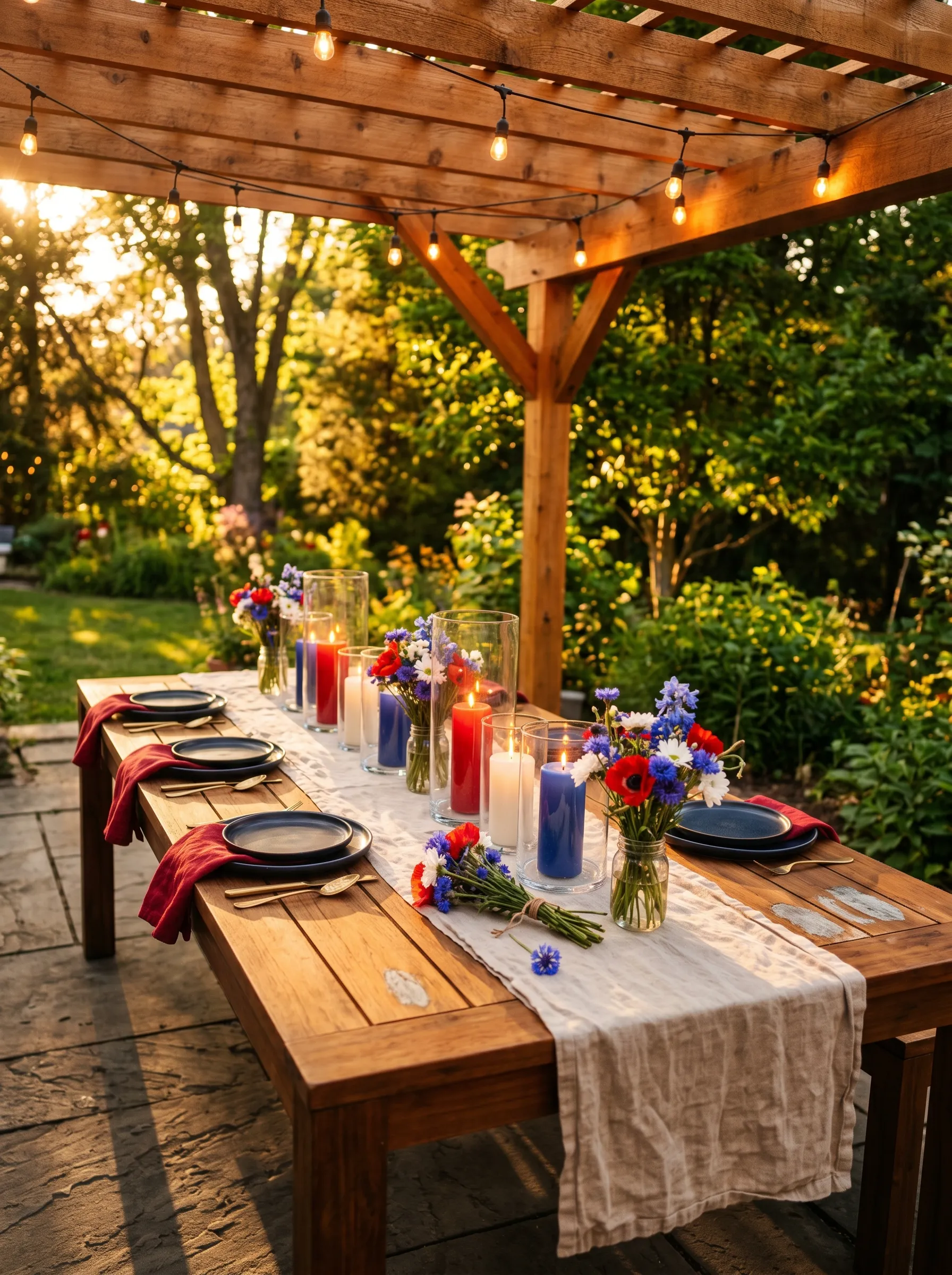
The outdoor dining setup under a pergola succeeds because it works in layers: warm overhead light, an anchored table surface, and natural color at the centerpiece.
Drape Edison-bulb café strings across your pergola in multiple parallel runs from beam to beam. Warm white bulbs only. Cool white kills the golden quality that makes outdoor evening dining feel special. You want a ceiling that glows amber, not one that mimics a parking garage.
For the table, lay a wide linen or muslin runner down the center — natural, not white — so the wood grain shows on either side. The runner grounds the centerpiece cluster and prevents the patriotic elements from floating against bare wood.
Build the centerpiece down the table’s length. Alternate small glass vases of wildflowers — red poppies, blue cornflowers, white daisies — with tall glass hurricane candles holding red, white, and navy pillar candles. The alternation creates rhythm without uniformity. Vary the candle heights. A cluster of candles at the same height looks like a birthday cake.
Set the plates in dark navy or charcoal — the contrast with the red napkins and natural linen runner reads as sophisticated rather than festive. Fold napkins loose, not into origami shapes. Loose napkins signal that this table exists to be used, not photographed and cordoned off.
The Dessert Table Balloon Flag Backdrop
A dessert table needs a backdrop that reads from across a party, communicates that this is the destination, and gets out of the way of the food itself.
Build the balloon wall against a flat exterior surface — a shed wall, house siding, or a freestanding wooden frame. The wall should be approximately four to five feet wide and three feet tall, which is sufficient to fill the visual field behind a standard six-foot table without dominating the whole space.
Lay the balloon flag pattern: the canton (upper left) in navy blue balloons with white star vinyl stickers pressed onto alternating balloons after inflation. The stripes field uses alternating rows of red and white balloons, varying the balloon sizes within each row for organic texture. Smaller accent balloons fill the gaps between larger ones.
Beneath the balloon wall, add a tassel garland in red, navy, and white along the front table edge — this provides a frilled visual connection between the wall and the table surface.
Arrange the dessert table in visual height order: the tallest element (a cupcake tower or tiered stand) at center or slightly off-center, cookie platters and cake stands at the sides stepping down in height, glass candy jars as flanking anchors at each end. No element on the table should be the same height as its neighbor.
Hang small 3D star ornaments from the ceiling or overhead structure near the table — red, white, blue — on fishing line at varying drops. They’ll catch any light and move in the slightest breeze without requiring any permanent installation.
The Backyard Movie Night Setup That’s Actually About the Chairs
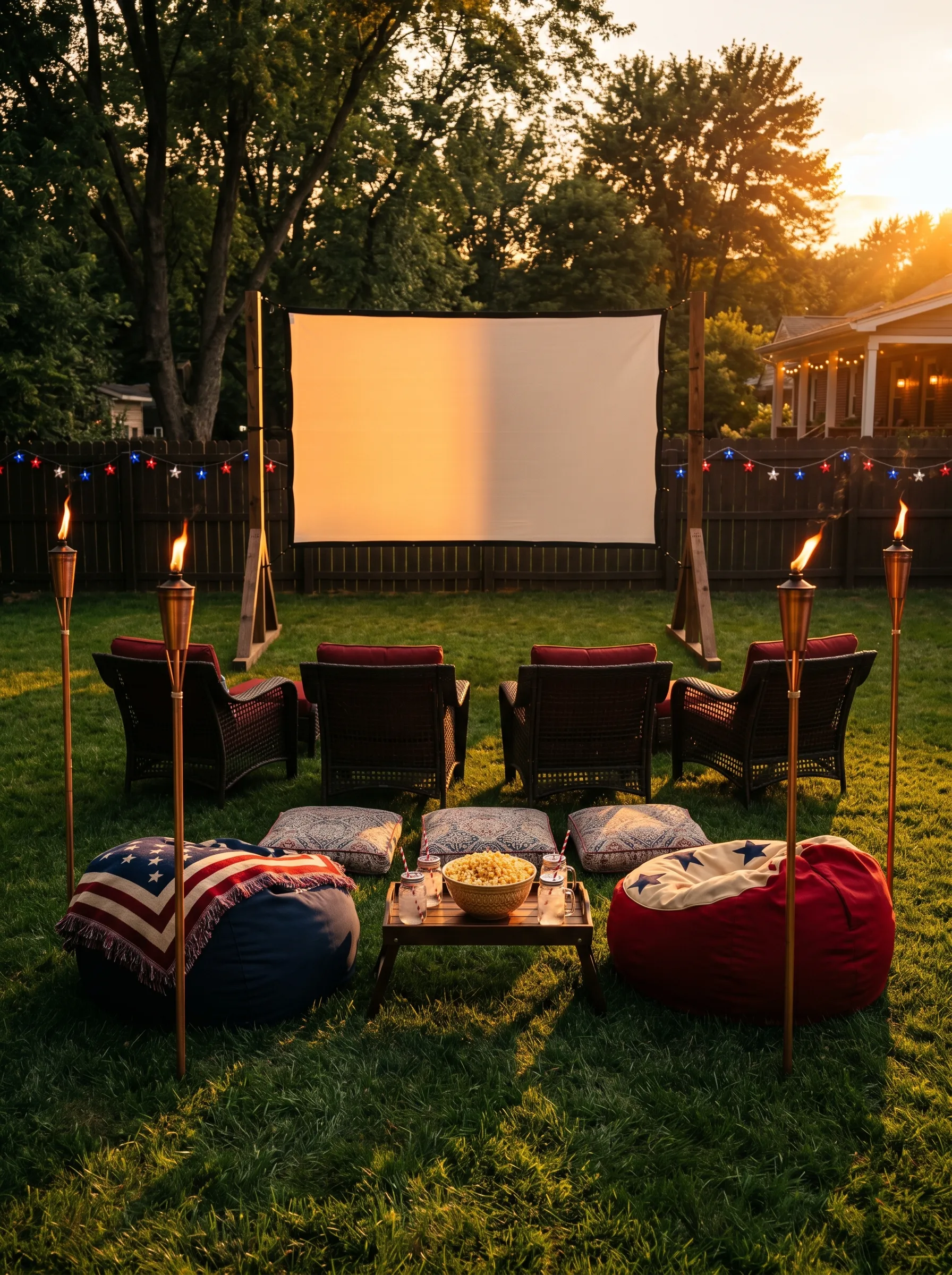
An outdoor movie setup sounds like it’s about the screen. It is not. It is about where people sit and how that seating makes them feel.
Mount or build your projection screen at the far end of the yard using a wood frame and a 9-foot white drop cloth — taut, not sagging, with the upper corners tied off with rope. The screen itself needs no decoration.
Arrange seating in two tiers. The back tier: four or six wicker or rattan chairs with dark cushions and a single coordinating throw draped over each back armrest. The front tier: large bean bags or floor cushions in navy, red, and flag-print fabric. The two-tier arrangement means everyone has a clear line of sight and the setup looks intentional from behind.
Set the table piece on the ground between front-tier seating: a low wooden tray with a popcorn bowl, mason jars, and a few small snack dishes. The low table reads as casual and thought-through simultaneously.
Flank the seating area with two tiki torches set back far enough not to create glare on the screen — roughly 6 to 8 feet to the sides. Their warm light anchors the perimeter of the seating zone and eliminates the flat darkness that makes outdoor nighttime spaces feel unfinished.
String the star and patriotic light garlands along the fence behind the screen. At night, the fence glows. The screen glows. The torches flicker. Nothing else is needed.
The Cape Cod House That Let Architecture Do Everything
This is the porch and fence that understood something most holiday decorating gets wrong: if your architecture is already strong, the decoration is just punctuation.
A white clapboard house with navy shutters and a navy door already has the palette. Red is the one addition the exterior needs, and it arrives through plant material rather than manufactured decoration.
The key installation is the picket fence. Mount fabric fan buntings — the semi-circular pleated style, not printed flat panels — at regular intervals along the entire fence run, including the gate. Use buntings with real pleats that hold their drape. The buntings should nearly touch so the fence reads as one continuous draped installation rather than individual flags with gaps.
Behind the fence, let hydrangeas do their July best. A mature hydrangea planting in full bloom — blue, purple, green, and cream — provides more natural patriotic color than any manufactured decoration. This is not something you install two weeks before the holiday. This is something you plant and tend for two years before the holiday. The payoff is an exterior that looks like it decorates itself.
On the door, mount a vertical flag — a proper printed fabric flag panel hung from a flag hanger bracket above the window glazing. This is the only door decoration needed.
Plant black urns flanking the door with full flower arrangements that carry the garden palette — nothing rigid, nothing matching the exact red-white-blue formula. The garden already has the color. The urns echo it, loosely.
The fence bunting and the hydrangeas are the whole design. The house does the rest.
The Raised Bed Garden That Made the Lawn the Decoration
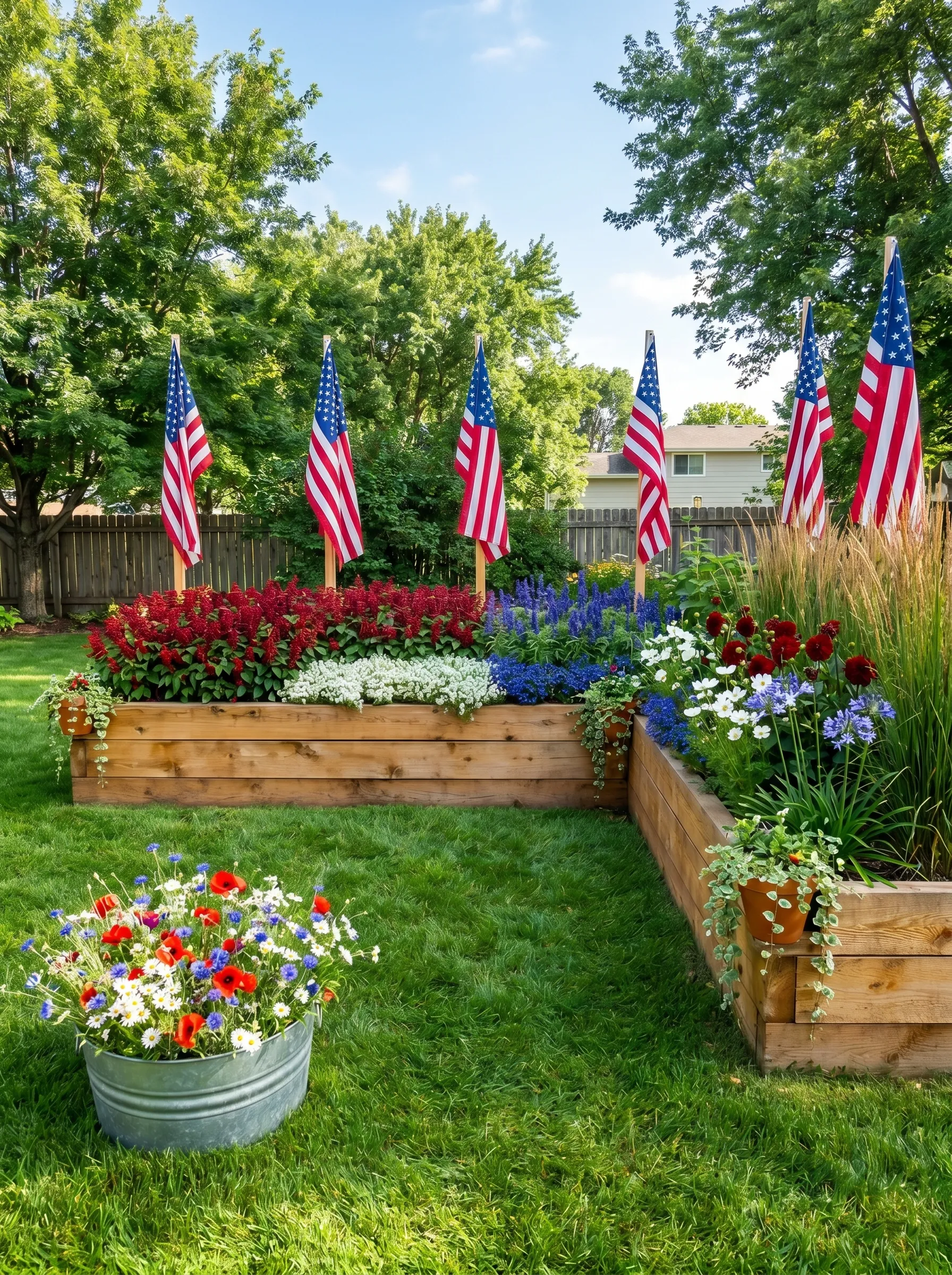
This approach commits to the garden itself as the primary decorative element, which most people overlook because gardens require lead time.
Plant your raised beds in early June with the three-color formula: red salvia or dahlias as the tall back row, white alyssum or sweet william as the middle-height layer, and blue lobelia or ageratum as the trailing front edge. Plant densely — the beds should look full by the Fourth, not sparse and recently installed. Tight planting also suppresses weeds, which become the enemy of a yard you want to photograph well.
Push full-sized American flags on wooden dowels into the back of the bed, spacing them evenly. The flags should be the tallest element in the arrangement. This creates a natural visual rhythm: flags at the top, color below, greenery at the base.
For the foreground, place a galvanized wash tub or large basin filled with a loose wildflower arrangement — red poppies, white daisies, blue bachelor’s buttons. This functions as both a compositional anchor for the full garden view and a cut flower station for the party table. If anyone wants a bud vase for the dining table, they pull from here.
Keep the lawn mowed tight and the bed edges clean. Messy edges undermine everything the planting is trying to do.
The Marquee Sign Poolside Backdrop That Said the Quiet Part Loud
Marquee letters are either rented or purchased flat-pack and assembled. Either way, the letters are only half the installation.
Arrange large illuminated marquee letters spelling your message — “LET’S PARTY” is an honest option — against a flat wall, fence, or the house exterior. The letters need a flush backing surface; propping them in the middle of an open yard looks unstable and the light from the bulbs doesn’t read correctly without a surface behind them.
Build the balloon garland around the letters, not behind them. The garland should frame the letters — heavier on one side, arching over the top, lighter on the other — so the letters remain fully readable. The common mistake is to pack the garland so densely that the letters get buried.
Use matte latex balloons in red and cobalt blue as the garland’s base balloons, with white as a secondary color. Accent with blue metallic starburst balloons — the exploded foil star variety — and silver disco balls as weighted ground elements that reflect the marquee bulbs.
Position the whole installation against a dark or neutral surface so the bulb warmth shows up. A white wall competes; a dark exterior or dark fence lets the marquee glow read as warm and visible.
Set an American flag on a pole as a standalone vertical element to one side of the installation — not attached to the letters or garland, just present nearby as a grounding element.
The Draped Canopy Seating Nook That Turned a Fence Corner Into a Room
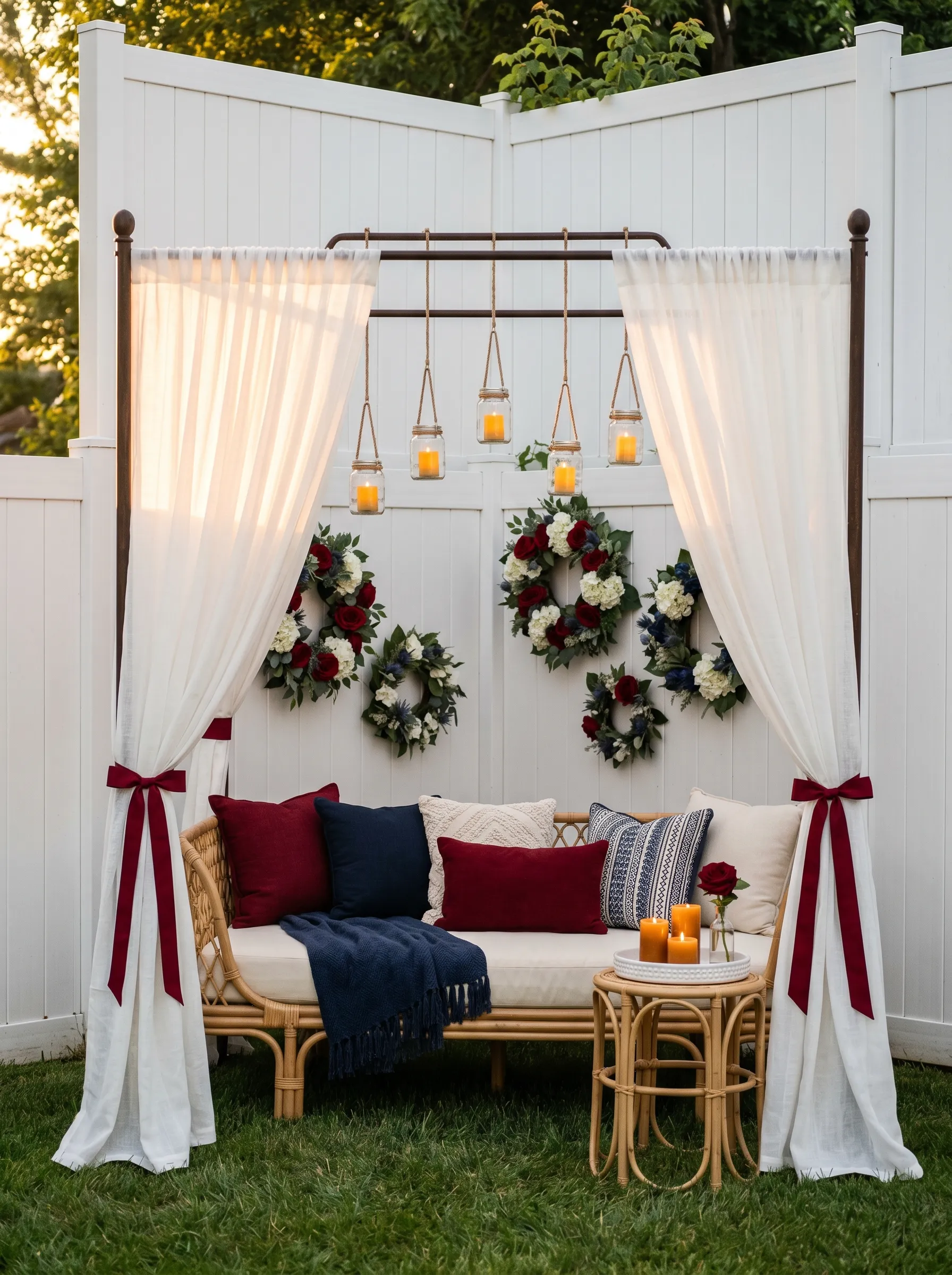
A fence corner is dead space in most backyards. This turns it into a destination.
Install a free-standing canopy frame — a simple rectangular garment-rack style with two vertical posts and one horizontal crossbar — in front of the fence corner. Position it so the fence panels form the back wall of the nook. The frame becomes the ceiling of your outdoor room.
Drape sheer white curtain panels from the crossbar — two per side, long enough to pool slightly on the ground. Tie each panel back with a wide burgundy or deep red velvet ribbon, left in a loose bow. Do not tie them tightly; the fabric should still move in a breeze. The curtains create walls without blocking airflow or sight lines.
Hang mason jar luminaries from the crossbar at staggered heights using jute twine. Three to five jars, each holding a pillar candle or LED candle. These are your ceiling lights.
On the fence behind the nook, mount three mismatched patriotic wreaths at varying heights — this is where you use the mixed-style wreaths that would look chaotic on a front door but read as intentional in this curated gallery context. The wreaths become wall art for your outdoor room.
Furnish with a rattan loveseat or daybed, loaded with a cream base cushion and throw pillows in burgundy, navy, and a textural cream or ivory. A small rattan side table holds three pillar candles on a round tray. This nook is where guests disappear to when they want to actually have a conversation.
The Balloon Arch Garden Party Backdrop That Did One Thing Perfectly
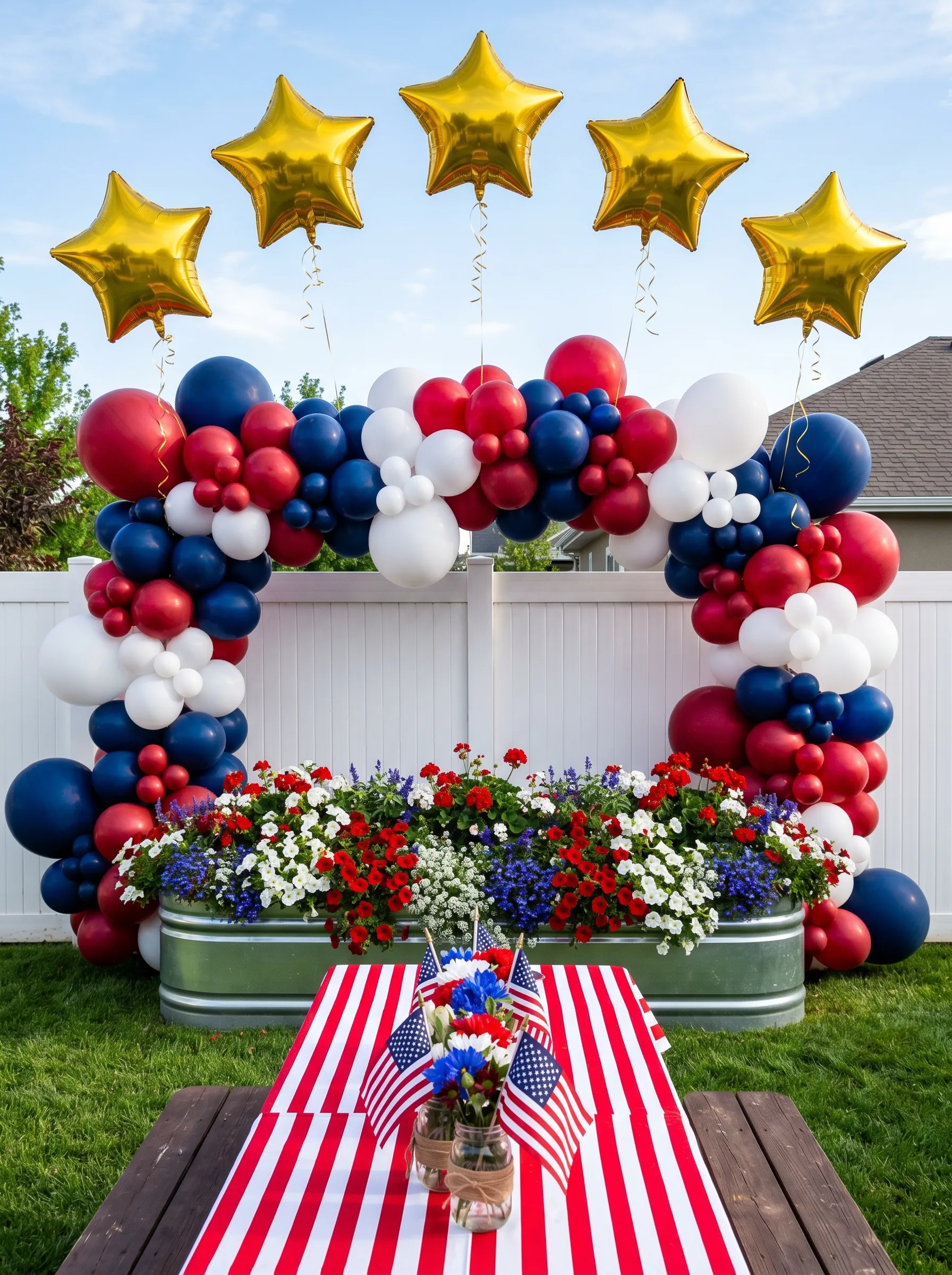
A balloon arch’s only job is to be the backdrop. Everything else in the space should support that, not compete with it.
Build the arch on a balloon strip tape armature stretched across a metal or PVC pipe frame anchored with sandbags or tent stakes. Start with your largest balloons — 11-inch latex in navy, crimson, and white — and work them onto the tape in organic clusters rather than rigid color alternation. True organic distribution means no two adjacent balloons of the same color, but the groupings still appear random rather than patterned.
Float five to seven gold foil star balloons from the top of the arch on gold curling ribbon cut to varying lengths — 12 inches, 18 inches, 24 inches. The stars should appear to drift upward from the arch rather than sit at a uniform height. This vertical extension is what makes the arch look finished from across a yard.
In front of the arch, position a picnic table covered with a red-and-white stripe tablecloth — the thick stripe version, not the thin pinstripe. Add a simple mason jar centerpiece with flags and a small mixed bouquet. The table surface is intentionally simple because the arch is already doing everything visually.
Below the arch, place the focal planting element: a long galvanized trough or stock tank planted with red geraniums, white alyssum, and blue lobelia at full density. The trough grounds the arch at the base and prevents it from reading as a floating element disconnected from the yard.
The Charcoal Patio Seating Area That Let the Pillows Do the Talking
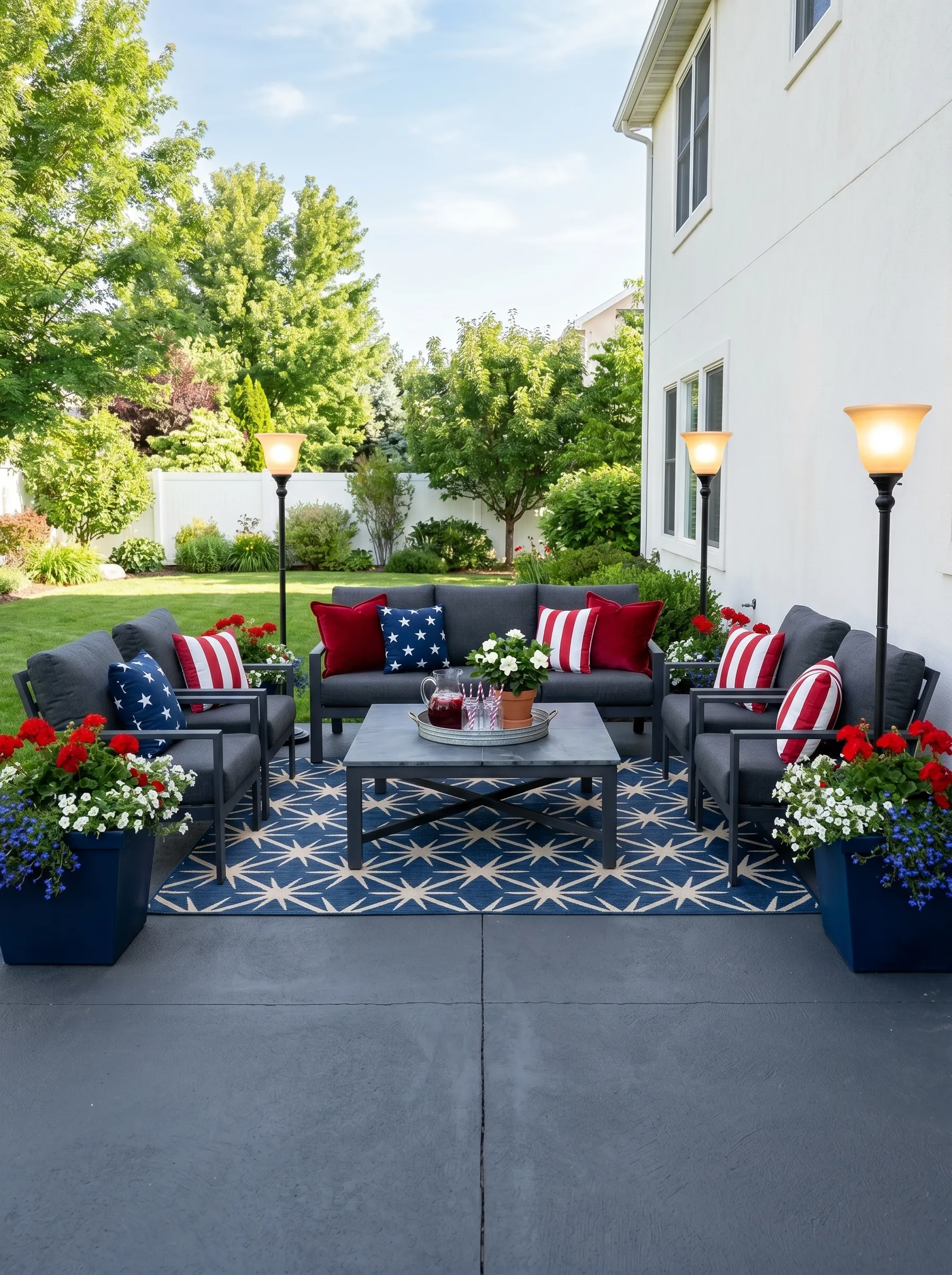
Neutral outdoor furniture is an asset. Most people don’t know how to use it.
Start with what you have: a gray or charcoal sectional with matching side chairs. This is not a problem to solve — it is a neutral foundation. The chairs’ dark upholstery gives every patriotic accent maximum contrast.
Layer the seating with pillows in three distinct patterns: solid crimson, horizontal red-and-white stripe, and navy with white stars. Use at minimum two pillows per seating surface. The pattern mixing is intentional — identical pillows on every chair read as a showroom; mixed patterns read as a home. The rule is that the palette stays consistent even when the patterns vary.
At each corner of the seating arrangement, position a large navy planter filled with the three-flower combination: red geraniums at the tallest point, white calibrachoa or alyssum mid-level, and blue lobelia trailing over the planter edge. These planters serve as visual anchors for the seating zone, marking its perimeter without any physical barrier.
On the coffee table, place a galvanized tray with a glass lemonade pitcher, a few red-striped paper straws, and a small potted white flower. The tray corrals the table surface into something that reads as set rather than scattered.
Add two outdoor floor lamps — the kind with a wide upturned bell shade — at the outer corners of the arrangement. They provide ambient light at party height and define the zone’s outer boundary in a way that ground-level lighting cannot.
The White Fence Gallery Wall That Charged Admission with Wreaths
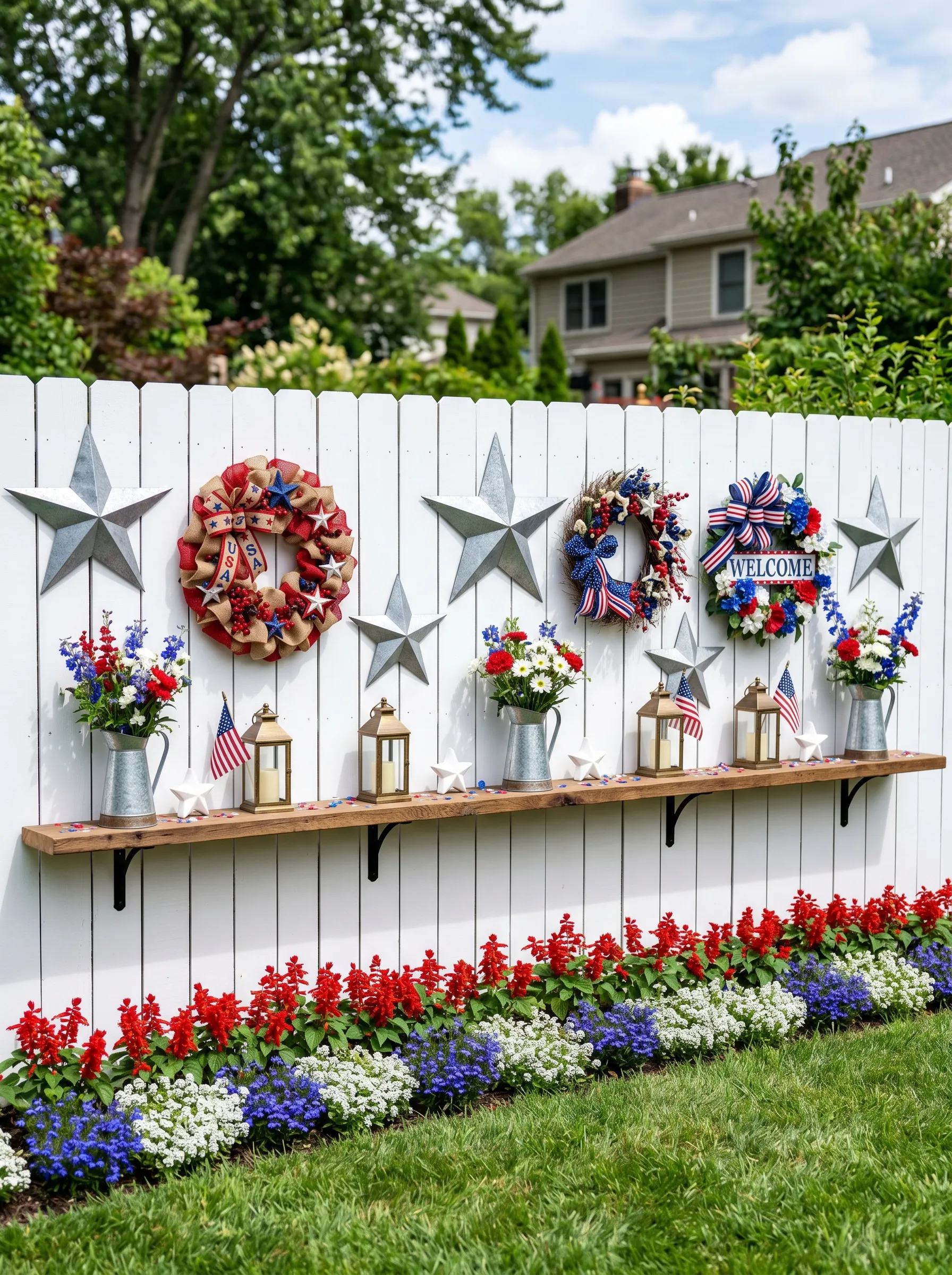
A white fence is the most underused decorating surface in backyard design. It’s clean, it’s large, and it takes ornamentation the way a gallery wall takes art.
Mount a long floating shelf bracket and board directly to the fence at about hip height, running roughly eight to ten feet. Stain the board a warm walnut rather than painting it — the wood tone breaks up the white fence without adding another pattern to manage.
On the fence above the shelf, alternate galvanized barn stars and patriotic wreaths at irregular spacing. The stars should be mounted directly to the fence slats with sturdy hooks. Use three different wreath styles — a burlap and mesh wreath, a mixed floral wreath, and a berry-and-bow wreath — so the gallery reads as collected rather than purchased as a set.
On the shelf itself, build a display in two-and-a-half dimensions: galvanized watering can vases with patriotic flower arrangements as the taller elements, black iron lanterns with pillar candles as the medium elements, and small ceramic or wooden star ornaments as the low elements. Vary these elements in groupings of two or three rather than spacing them evenly, which always reads as rigid.
Along the fence base, plant a border of red salvia, white alyssum, and blue lobelia in a loose sweeping edge — not straight rows, but a natural flowing line that follows the fence. The planted border connects the fence installation to the ground and prevents the gallery wall from looking like it was bolted to a fence above bare mulch.
The Deck Party That Understood the Railing Was a Design Element
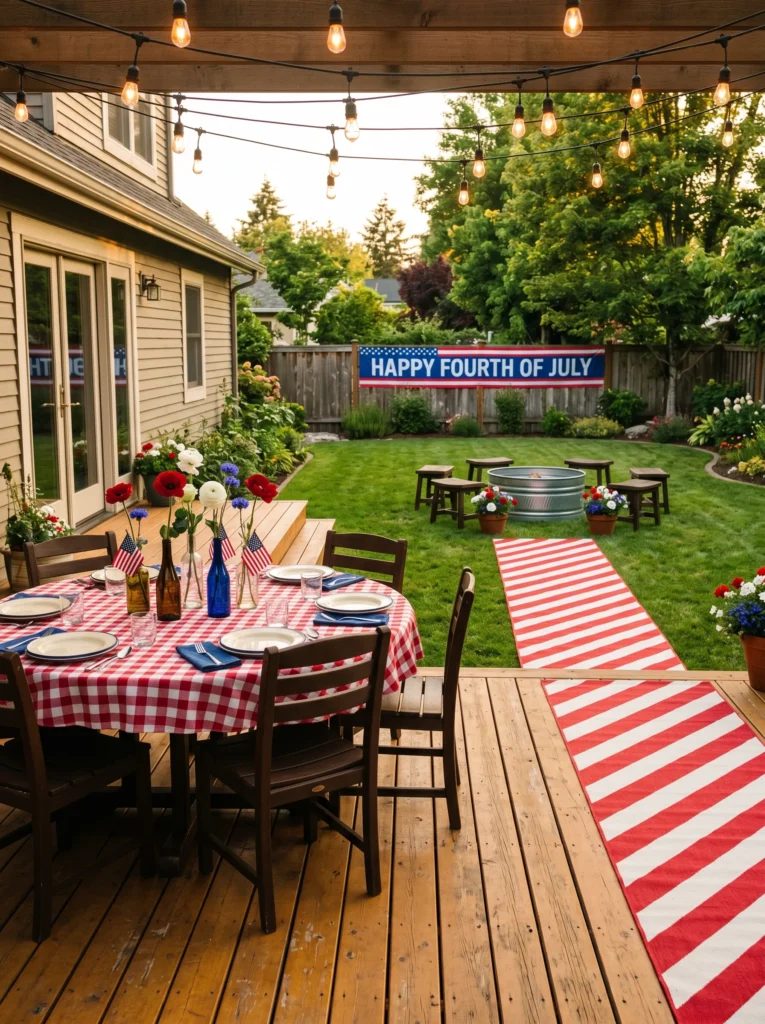
Most decks have railings. Most people wrap them in bunting and consider the job done.
Hang fabric fan buntings — the proper semi-circular fan style with pleated red, white, and blue layers — at even intervals along both deck railings. These are not the cheap paper version; they’re the fabric variety with actual structure that holds its shape in heat and humidity. Space them so they overlap slightly at the corners, creating a continuous draped line rather than isolated decorations with gaps.
On the deck surface, center a star-print outdoor rug under the primary seating. The rug anchors the seating zone and tells guests where the conversation area is.
Arrange the seating as a defined group: a sectional or sofa facing outward toward the yard, with throw pillows in navy and burgundy. Place terracotta pots filled with red, white, and blue flowers at the deck corners and at the foot of the seating group.
At the railing corners, tie clusters of three balloons each — one red, one white, one blue — to the post caps using white curling ribbon. These balloon clusters are the lightest, most temporary-feeling element in the composition, and that contrast with the fabric bunting actually reads well. The bunting says “permanent arrangement,” the balloons say “this is a party.”
On a low bench or side table near the seating, arrange a galvanized tray with LED color candles in red, white, and blue — the battery-operated kind — and a small vase of flowers. The tray collects elements that would look scattered if placed individually.
The Patriotic Charcuterie and Drinks Table That Was Also a Visual Set
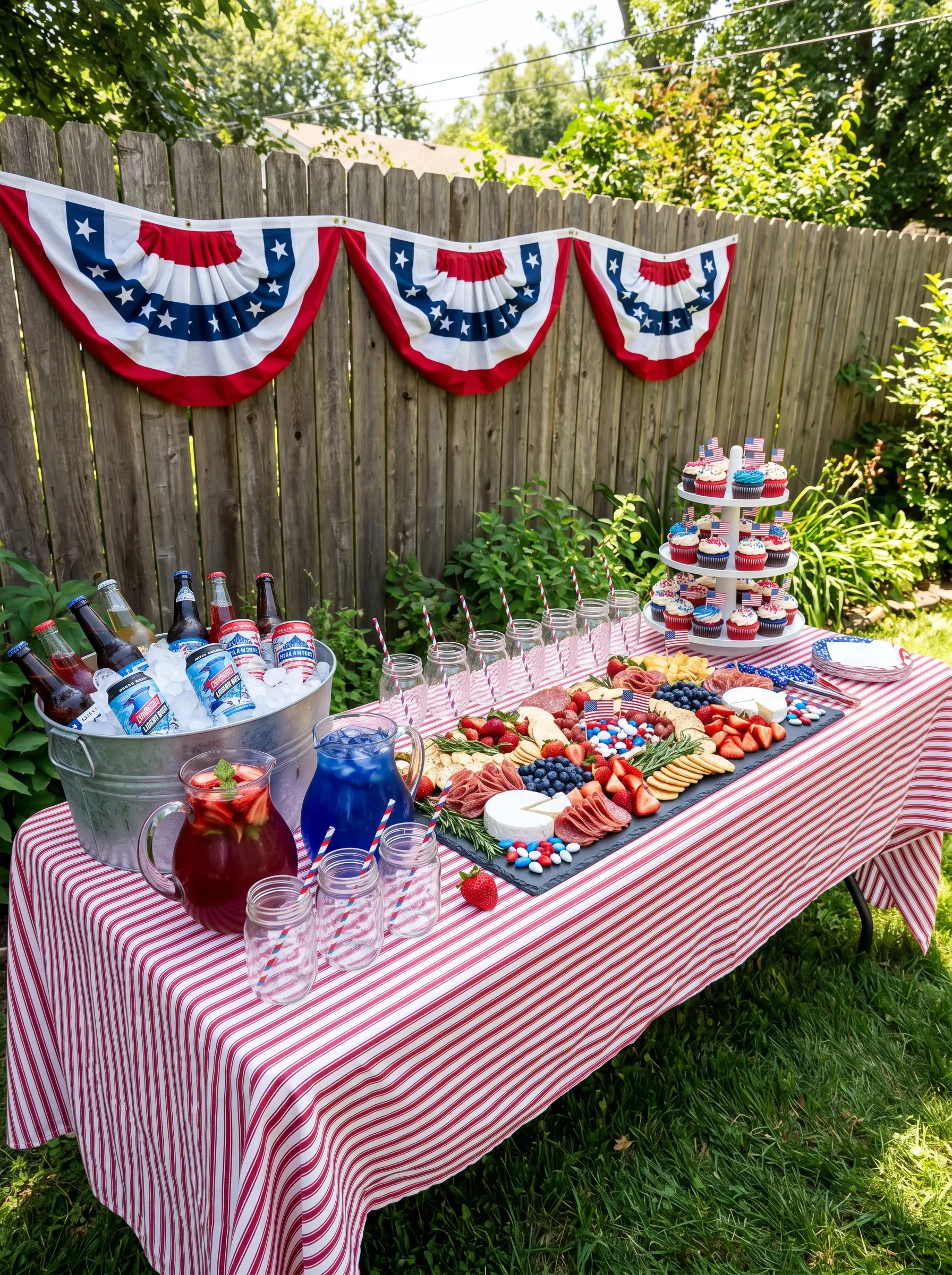
A party food table is the most photographed zone in any outdoor gathering. It should be designed like one.
Start with the tablecloth: red-and-white ticking stripe, not a thin candy-stripe but a bold half-inch stripe. The stripe provides consistent horizontal structure that anchors every element placed on top of it.
Build the centerpiece as a charcuterie board on a dark slate or black walnut serving board. Work the food into the color palette — strawberries and salami for red, white brie and cauliflower florets, blueberries for navy. This is not an accident. It is a deliberate design decision that makes the food surface read as part of the decoration. Lay three rosemary sprigs along the board’s edges as greenery. Push two small flags into the center cluster.
On one side of the board, place the drink station: a wide galvanized bucket filled with ice and bottles, flanked by a large glass pitcher of a red beverage with mint and strawberries. On the other side, the dessert tier: a three-tier server holding cupcakes with white frosting and patriotic sprinkles and picks. Stagger the heights so neither side looks flat.
Running the full length of the table, intersperse mason jar glasses with paper striped straws upright in them. These serve double duty as table décor and guest glassware, which means the table looks ready even before anyone pours a drink.
Behind the table, hang three large fan buntings along the fence as the backdrop. The bunting provides color and motion without requiring any shelf or frame construction.
The Floral Pergola Seating Area That Turned Structure Into a Garden
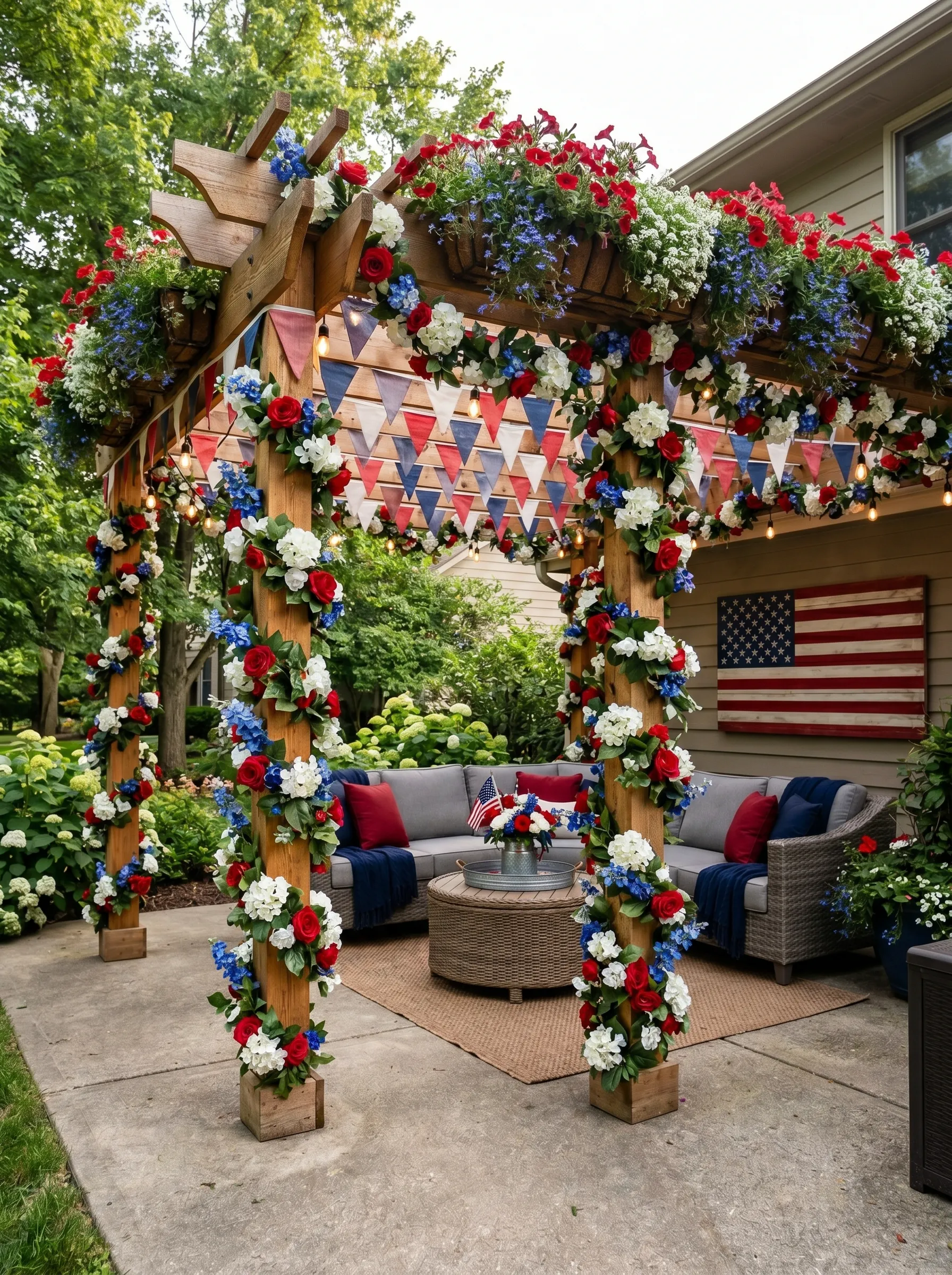
A pergola post is not a post. It is a trellis waiting to happen.
Build floral spirals for each post by cutting a length of rope garland — the kind sold pre-made with foam or wire core — to the post height plus six inches for securing top and bottom. Zip-tie the garland to the post at the top, middle, and base. Then work silk flowers into the rope: white hydrangea clusters, red roses, and blue delphinium, alternating as you spiral upward. Vary the spacing so the flowers cluster more densely at the middle of each post — the thinnest points at top and base look most natural.
On the pergola overhead beams, build hanging baskets: wide coco-fiber basket liners in a metal ring, planted with red petunias, white calibrachoa, and blue lobelia. Fill them densely and let the trailing elements cascade downward past the basket edge. The underside of your pergola should become a garden ceiling.
String triangle flag bunting along the interior of the pergola’s beam perimeter, running horizontally between posts. Use fabric bunting in red, white, and navy — the triangular pennant style. Run it loose enough to drape naturally rather than pulled tight.
On the house wall behind the seating area, mount a wooden pallet flag — the reclaimed wood American flag made from boards painted in stripes and stars. This serves as both décor and a backdrop for photographs of guests in the seating area.
The seating itself needs to be simple. A sectional or sofa with navy and crimson throw pillows. A galvanized tub as a coffee table, filled with ice and flowers or beverage bottles. The richness is all in the structure above — the seating just needs to be a comfortable, neutral place to be inside of it.
The Adirondack Fire Pit Circle with a Fence That Worked for Once
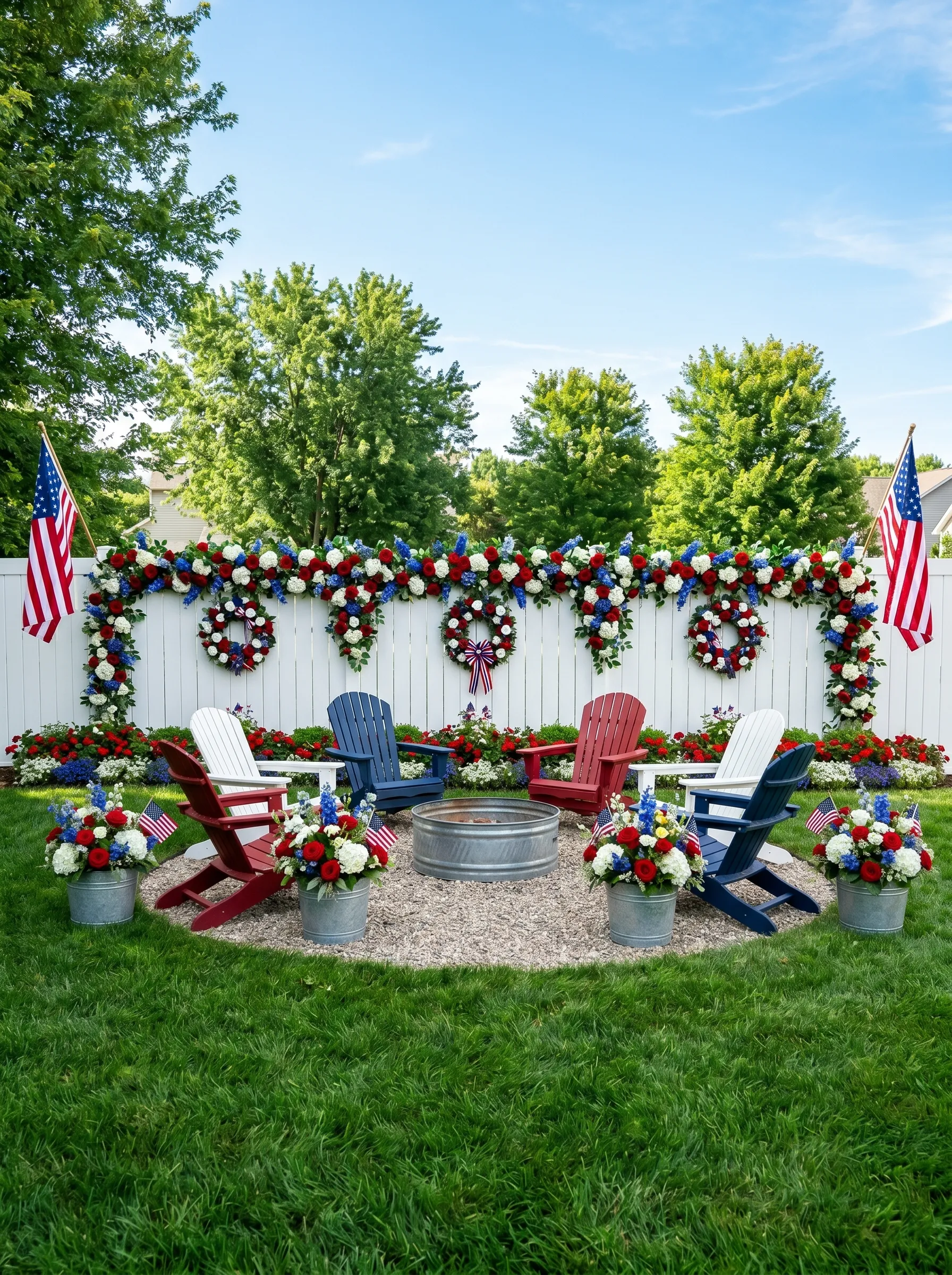
The fire pit circle has a seating logic problem: everyone faces inward toward the fire, which means they’re facing away from whatever decorative backdrop you’ve created.
The solution is to make the backdrop the decoration for the approach to the fire pit, not the destination.
Line the fence with a horizontal floral garland at roughly head height — running the full fence width. Build it by zip-tying a rope base to the fence rails at regular intervals, then working in mixed greenery followed by hydrangea clusters in red, white, and blue. Space the flower clusters at roughly 18-inch intervals so the garland reads as abundant without looking dense.
Hang three or four matching floral wreaths below the garland, evenly spaced. The wreaths should match the garland in palette but vary in size — a larger center wreath flanked by smaller ones gives hierarchy to the fence composition.
Choose Adirondack chairs in a deliberate color sequence rather than a single color: one red, one navy, one white, repeat. This means the seating circle itself becomes the patriotic element rather than requiring separate decoration. Place galvanized bucket planters between alternating chairs, each holding the same flower combination.
At the two outer edges of the fence composition, mount full-size American flags on poles angled outward. They flank the scene the way columns flank a door.
The gravel ring around the fire pit should be clean and raked. The fire pit itself — a galvanized steel round fire ring — needs no decoration. It is already doing its job.
The Flag Garden Circle That Made the Lawn a Focal Point
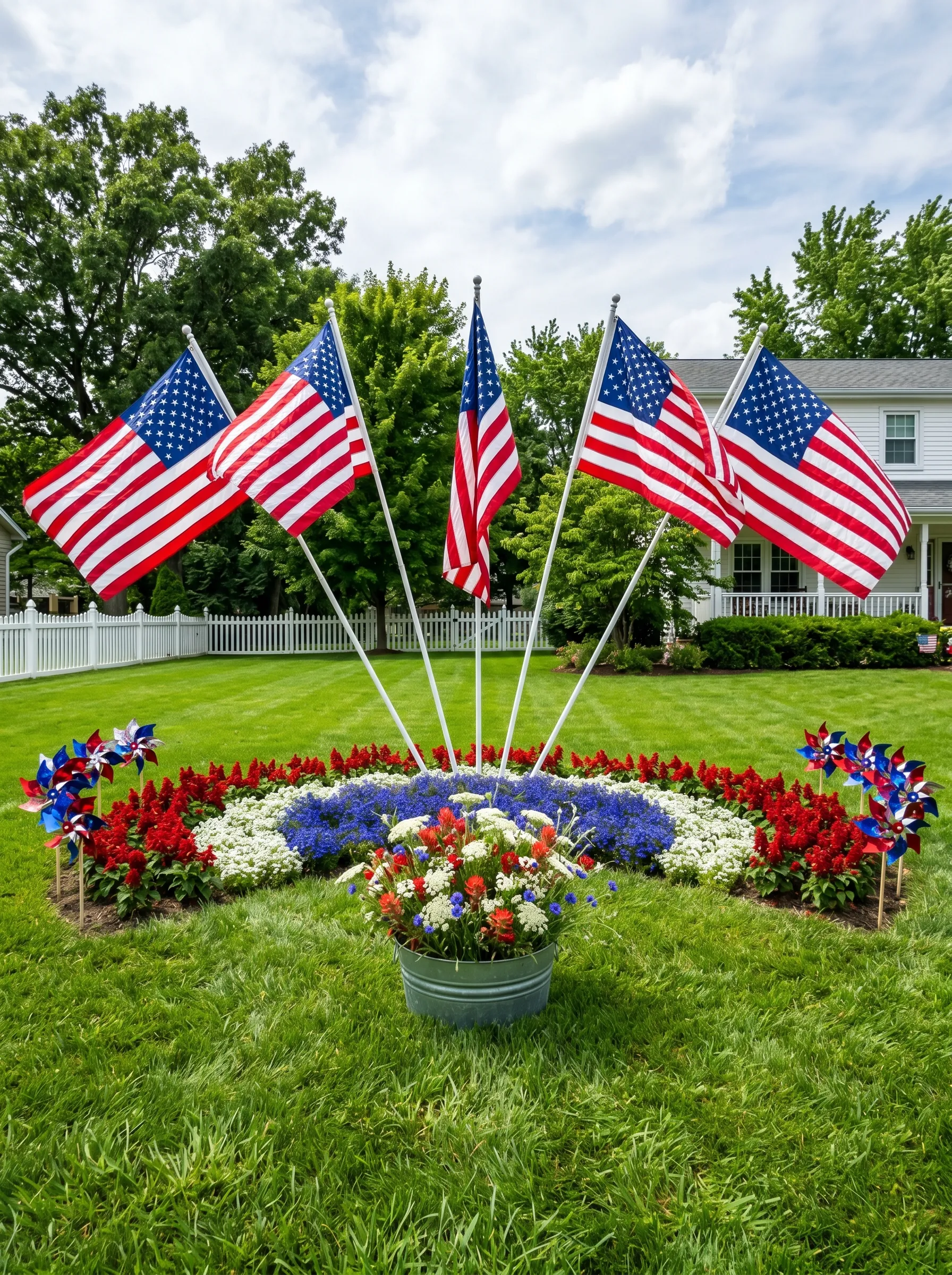
This approach treats the lawn as a canvas, which it is.
Designate a circle in the lawn — roughly eight feet in diameter — as a planting bed. Edge it cleanly with a half-moon edger. Fill with amended planting soil mounded slightly above the surrounding lawn grade; this gives the plants drainage and makes the circle read as a raised element even without a raised border.
Plant in concentric rings. Outer ring: red salvia in dense planting, the full circumference. Middle ring: white alyssum or sweet alyssum as a secondary band. Inner cluster: blue lobelia or blue salvia filling the center. The ring pattern is visible from above and from any standing angle.
Push five garden flags on white poles into the center cluster at a spread angle, so they fan outward from a common base. The tallest flag is center, the flanking ones slightly shorter. The fanned arrangement gives the installation height and motion.
In front of the flag circle, place a galvanized tub planted with a loose wildflower mix — poppies, daisies, cornflowers — as the foreground element that draws the eye toward the installation. Flanking the tub on either side, push red and blue patriotic pinwheels into the ground. They spin in the slightest breeze.
This installation reads as intentional from a distance — from inside the house, from the street, from anywhere on the lawn. It is its own destination. No table, no party, no pergola required.
The Deck Seating Setup That Used the Balloons as Architecture
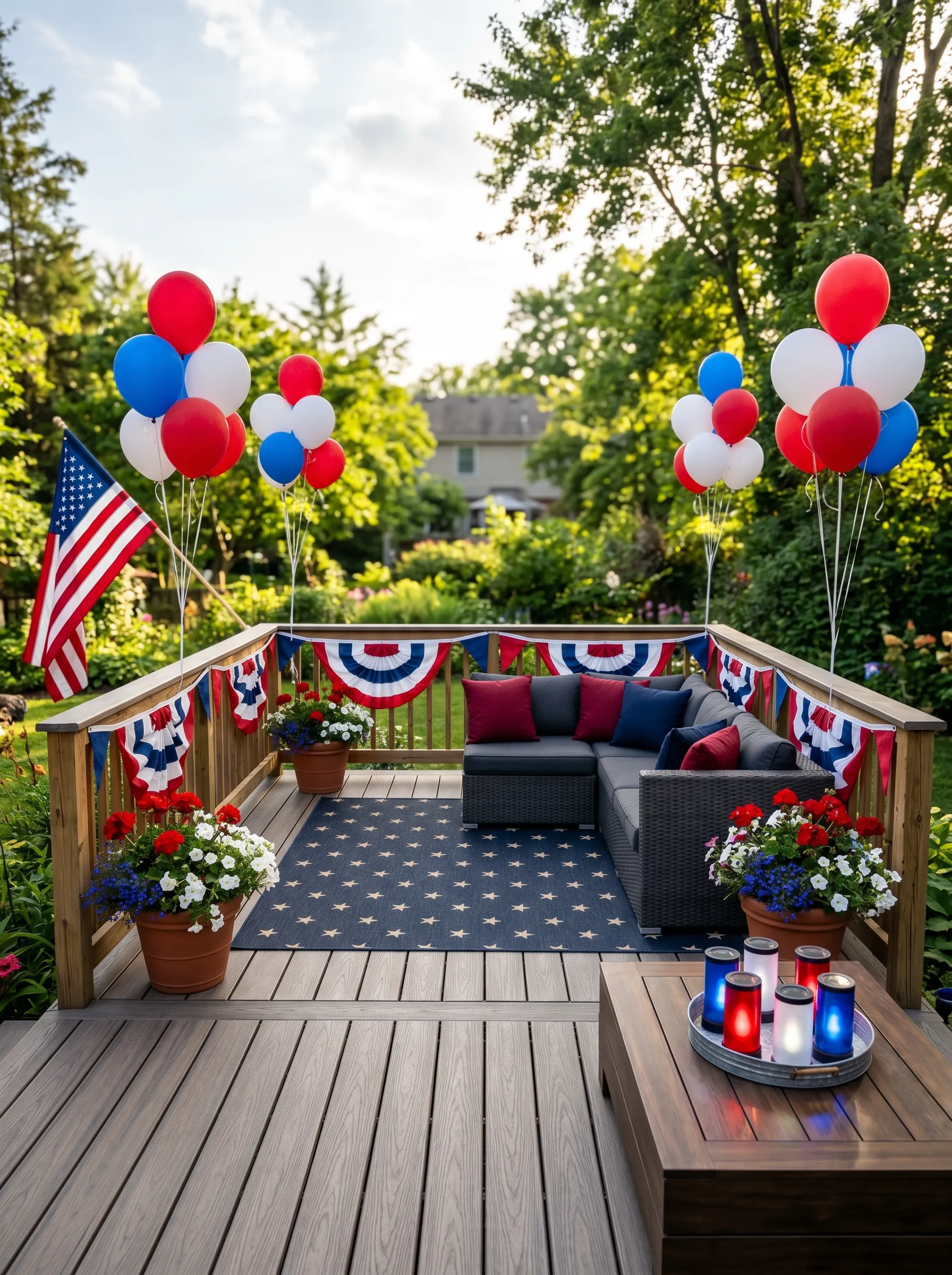
Balloons at ground level look like party clutter. Balloons at column height look like architecture.
Tie clusters of three balloons — red, white, and blue — in groups to each deck post at the railing caps. Use heavy-gauge curling ribbon so the clusters hold their position in a breeze rather than wrapping around the railing. The clusters should be compact — three balloons per cluster, not six — so they read as punctuation rather than an announcement.
Lay a navy star-print outdoor rug as the floor anchor for the seating zone. A star print is strong enough to read as patriotic without requiring anything else patriotic in the seating area.
Set the sectional simply: navy and crimson throw pillows, a navy throw folded over one arm. Avoid over-pillow-ing. The balloon clusters at the railing posts are already doing decorative work; the sofa should look like it’s for sitting.
On a low side bench or outdoor coffee table, build a tray vignette with color-filled candle luminaries in red, white, and blue. LED versions are better for a surface where someone might brush against them. The lit tray gives the seating zone a centerpiece without using height that would compete with the balloon clusters above.
Plant terracotta pots with the three-flower combination at the deck’s outer corners and at the steps. The pots provide ground-level color and signal that the deck has been tended to rather than just furnished.
The Pergola Light Show That Peaked at Midnight
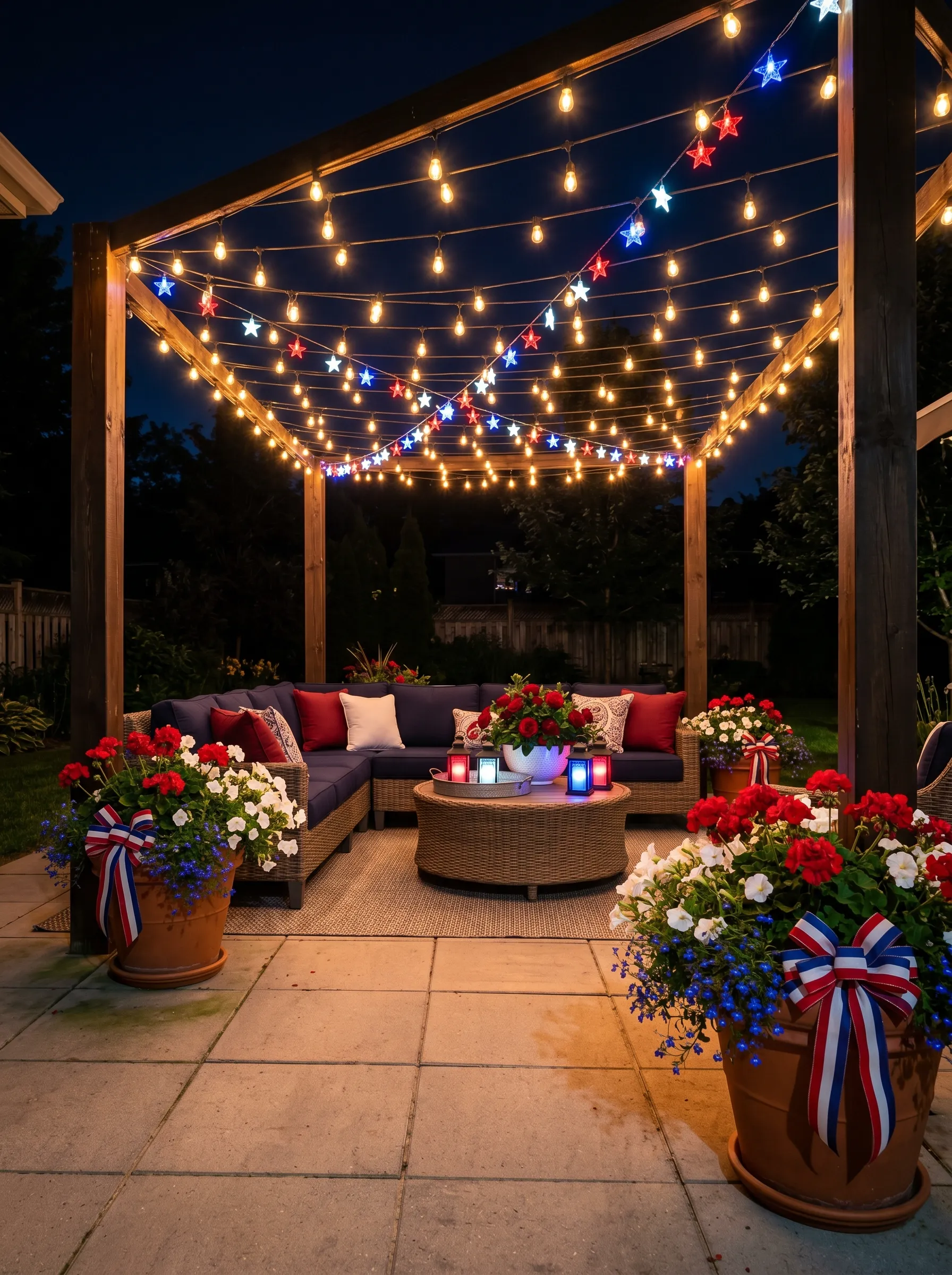
This patio is designed specifically for after dark, which means every daytime decision is subordinate to what it looks like at 10 p.m.
Run dense Edison-bulb café strings across the pergola in a grid pattern — both directions, not just one. The grid gives you light coverage rather than parallel bands of light with dark gaps between them. Use bulbs with visible filaments for the warmest possible color temperature.
Run secondary strings of LED star lights in red, white, and blue along the pergola beam perimeters. These will be barely visible in daylight and will become the dominant feature at night — a constellation of colored stars overhead.
Set the seating simply: a wicker sectional with navy cushions and crimson throw pillows. Large terracotta planters at each corner, filled with red geraniums, white petunias, and blue lobelia, each tied with a wide striped ribbon bow in red, white, and blue.
On the coffee table, place a round tray with three LED colored lanterns — red, white, and blue — grouped at the center. These are the table’s only decoration. They glow at table height while the ceiling constellation glows overhead.
During daylight, this patio is pleasant. After dark, it is something people photograph and can’t entirely explain why it looks the way it does. The answer is the layered light: warm amber from the Edison bulbs, cool colored points from the star strings, and intimate glow from the table lanterns. Three different light sources at three different heights. That is the whole secret.
The Pool Party Setup That Knew Floats Were the Decorations
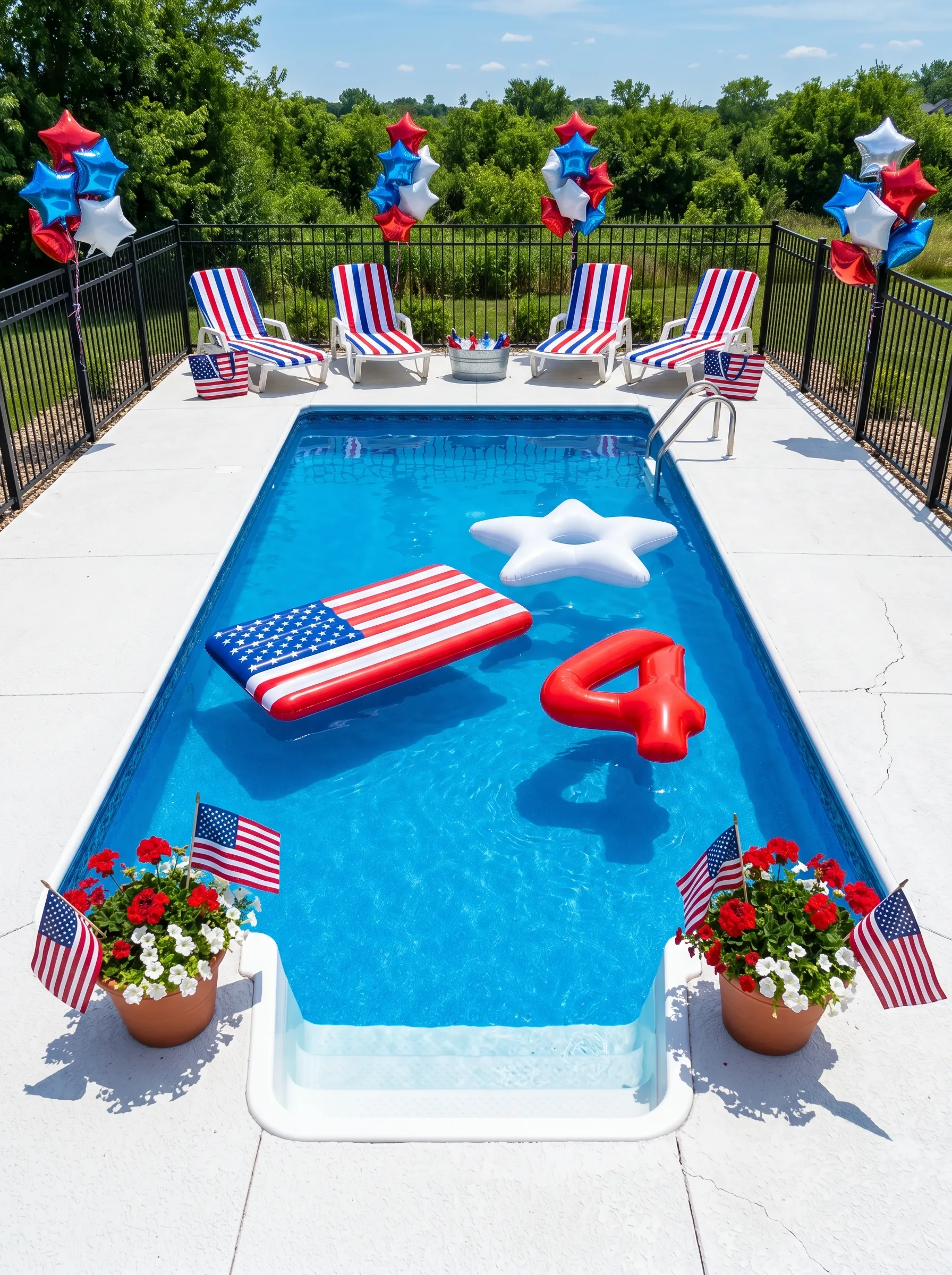
A pool is already blue. It does not need decorating in the traditional sense. It needs props.
Float a flag-print pool mattress — the full-size rectangular kind in flag stripe — in the center of the pool. This is your largest decorative element and it cost under forty dollars. Add a white star-shaped float ring and a red numeral “4” float. Three floats. That’s the pool installation. They will move around throughout the day, which is fine — moving elements are part of the charm.
At the pool’s shallow end, position terracotta pots with red geraniums, white petunias, and small flags tucked in at angles. These frame the entry point and are close enough to the water that their reflection reads in the surface on calm days.
Line the long sides of the pool fence with balloon clusters on weighted bases: bunches of three foil star balloons in coordinating colors at regular intervals along the fence. These are tall enough to be visible from inside the pool and from across the yard.
Set the long side of the pool with stripe-upholstered chaise lounges — the red, white, and blue flag print variety are appropriate here in a way they wouldn’t be on a sober patio. Between the chairs, place a small galvanized ice bucket for bottles.
Keep everything on the pool surround simple. The water surface, the floats, the fence balloons, and the lounges create the composition. The pool party that fails is the one where someone tried to put candles and flowers on the pool coping, where the wind knocked them in.
A Backyard That Earns Its July
There’s a version of July 4th outdoor decorating that takes two weeks to plan and one day to execute. There’s another version that takes twenty minutes and a box of mini flags.
Both exist. Neither is wrong. What is wrong is doing the second version and expecting the results of the first, or doing the first version without understanding why certain decisions work and others collapse.
Every backyard in these pages works because someone asked one question before starting: what is this space actually for? A dinner party under a pergola wants warm light and a table that says stay. A pool party wants floats and chair comfort and cold drinks in reach. A fire pit wants seating that faces inward and flowers that make the approach feel intentional.
The decoration follows from the answer to that question. Not the other way around.
Red, white, and blue is not a design plan. It is a starting point. What you do with those colors — where you put them, at what scale, against what backdrop, in what light — is the actual work. It is also the work that makes the difference between a yard that looks like a grocery store display and one that people are still talking about in August.
Your backyard already has everything it needs to be something this July. It just needs someone to make a few deliberate decisions about it.