
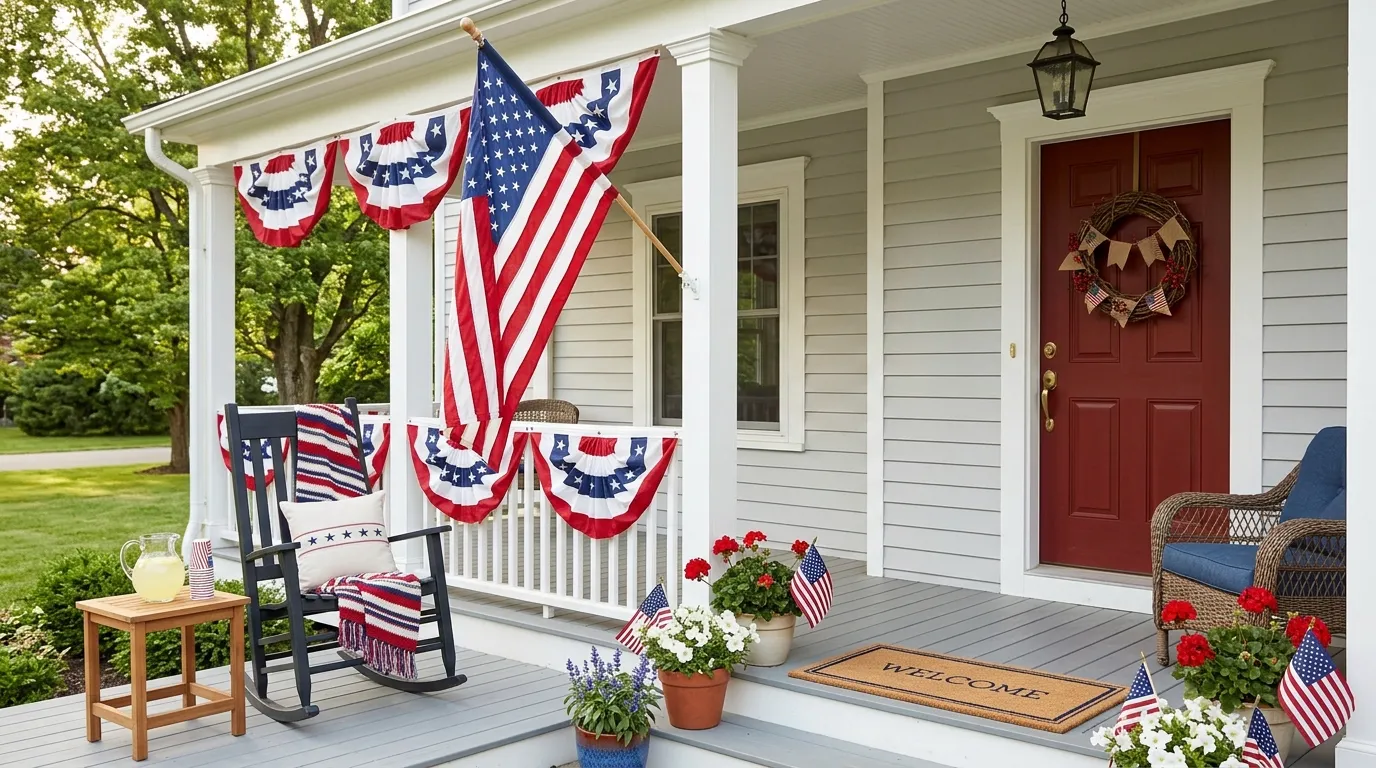
The problem isn’t patriotism. It’s proportion.
Every July, front porches across America get attacked with the same kit of parts: a plastic flag from a gas station, a pot of wilting geraniums, maybe a wreath that arrived in a box and never fully recovered. The result looks less like a celebration and more like an afterthought someone panicked about the night before.
The good news is that a small porch is actually easier to get right. You don’t need square footage. You need intention. A tight space forces you to commit — to a color story, a focal point, a material — in ways that sprawling porches never have to. Small porches done well look deliberate. Done badly, they look sad. The gap between the two is smaller than you think.
Here’s what actually separates a porch that stops people on the sidewalk from one they politely ignore.
Why Most 4th of July Porches Look Like a Party Supply Store Exploded
Patriotic decorating fails in a specific way. It fails loudly.
The Color Balance Problem
Red, white, and blue is three colors. Three strong, opinionated colors that all want to be in charge at the same time.
Most people deploy them in equal measure. Everything gets a third. The result is visual noise — no rest for the eye, no clear focal point, nowhere to land.
The fix is simple but requires some discipline. Pick one color to dominate and let the other two serve. Navy as the dominant with red and white as accents is the classic move for a reason. It reads as rich and intentional, not frantic.
White as the dominant — with a navy door and red flowers — produces a cleaner, more modern result. Red as the dominant tends to read as aggressive unless you’re very careful with scale.
Think of it as a ratio: 60/30/10. One color carries most of the weight. One color provides contrast. One color shows up as a detail. That’s the whole formula.
The Everything-Is-Decorative Problem
When everything on a porch is trying to be a decoration, nothing registers.
A wreath, a garland, two urns, three flags, bunting, a doormat, a welcome sign, and a star ornament is not a design. It’s inventory. Each element cancels out the next because there’s no visual hierarchy to follow.
Good porch decorating works like a paragraph. There’s a main idea — usually the door and whatever’s directly on it — and then supporting details that don’t compete. The supporting details exist to frame the focal point, not to become their own focal points.
On a small porch, this matters twice as much. Every square foot counts. Something being cute is not sufficient reason for it to be there.
The Afterthought Problem
A plastic tablecloth bunting stapled to a porch railing is not decor. It is evidence that you remembered July 4th was coming at some point during the previous 48 hours.
The porches that actually look good have one thing in common: you can tell someone made decisions. Not necessarily expensive ones. The materials don’t have to cost much. But something in the arrangement says this was chosen, placed, and considered.
That quality — intentionality — is what people are responding to when they stop and take a photo. Not price. Not scale. The decision that someone made.
What Nobody Explains About Front Porch Decorating
The rules sound obvious once someone states them. Until then, most people are guessing.
Your Door Is the Canvas
Everything on a porch exists in relation to the door.
The door is the largest, most centrally positioned surface on most front elevations. Paint color, material, and hardware all set the baseline. Everything else responds to those choices.
A white door gives you flexibility — it will accept any palette. A navy door is already doing the heavy lifting; a wreath and flanking plants may be all you need. A red door means you’ve already used one of your three colors at architectural scale; pull back on red elsewhere or you’ll lose all contrast.
If you’re decorating around a door color you can’t change, work with it rather than against it. Introduce materials that complement rather than compete. A natural wicker basket wreath reads as neutral against almost any door color. So does unpainted wood, galvanized metal, and raw linen.
Symmetry Earns Its Clichéd Reputation
There’s a reason every well-photographed porch uses a matching pair of something flanking the door.
Symmetry creates order instantly. On a small porch, it makes the space read as complete even when it isn’t full. Two matching planters say “this is intentional.” One planter says “I ran out of room or money.”
This doesn’t mean identical. A pair of matching containers can hold different plants — a trailing element in one, a vertical accent in the other — and still read as symmetrical because the structure is the same. The symmetry is in the frame, not necessarily the content.
When you only have room for one item on a side, make it something with enough visual weight to justify the asymmetry. A single large galvanized bucket packed tightly with flowers reads very differently from a lone small pot.
The Wreath Is Not Decoration. It’s Architecture.
Most people treat their front door wreath as an accessory — something chosen to match the season and hung as an afterthought.
The wreath is actually the most important design decision on the door. It’s roughly the same scale as a window. It determines whether the door reads as complete or as a slab with something attached to it.
A wreath that is too small for the door disappears. It looks like it’s apologizing for being there. The general rule: a wreath should span roughly one-third to one-half the door’s width. On a standard 36-inch door, that’s a 12 to 18-inch wreath minimum — most standard wreaths run 18 to 24 inches, which is correct.
Beyond size, the shape of the wreath tells you what kind of porch you have. A perfectly round, tight boxwood wreath says clean and considered. A loose, over-spilling floral wreath says abundant and romantic. A mesh deco wreath says maximalist and festive. All are right. None of them work if the scale is wrong.
Getting the Foundation Right Before You Buy a Single Red Ribbon
There are three decisions that determine whether everything else works. Make them first.
Know Your Porch Personality
A porch is attached to a house and the house has an aesthetic. Working against it is always a mistake.
A Craftsman bungalow wants natural materials: grapevine wreaths, terracotta pots, galvanized buckets, burlap ribbon. A white colonial wants symmetry and polish: matching urns, proper potted topiaries, classic ribbon bows. A modern farmhouse wants clean geometry and restraint: tight boxwood wreaths, matte planters, one well-placed flag and nothing more.
Fighting your architecture produces the visual equivalent of wearing a tuxedo jacket with athletic shorts. The individual pieces might be fine. Together they send conflicting information.
Decide on Living or Silk Before You Start Shopping
Live flowers and silk flowers require completely different approaches.
Live flowers — geraniums, petunias, lobelia, begonias — look lush, smell right, and change over time. They require watering. They may look tired the morning after a hot Fourth. If you’re committing to live flowers, plant them 3 to 4 weeks early so they have time to fill out and look established rather than freshly purchased and scared.
Silk flowers allow for controlled arrangements that hold their shape through heat and humidity. The quality range is enormous — the cheap version looks like the inside of a gift shop. The better version, especially with good greenery mixed in, is genuinely convincing from six feet away. For wreaths, where you can control every stem, silk usually outperforms live because no live flower will keep its form on a door through a July afternoon.
Decide which you’re doing before you start shopping. Mixing the two without intention tends to highlight the weakness of each.
Establish Your Scale Before Everything Else
On a small porch, one large element usually reads better than several medium ones.
A single oversized wreath — 24 inches of abundant flowers and ribbon — makes the door look like a statement. Three medium-sized decorative elements of similar visual weight cancel each other out and make the porch look cluttered.
Start with the biggest thing: the door treatment. Decide its scale. Everything else should be smaller, or large enough to clearly anchor a different zone (the floor, the columns, the railing). When two things compete for the same visual zone, both lose.
4th of July Front Porch Ideas Worth Stealing
The Wicker Basket Porch That Went All In on Lushness
Start with a natural wicker basket — the taller the better, with a generous mouth — and hang it directly on the door using a sturdy over-door hook. This replaces the wreath entirely and gains you significant depth and volume.
Pack the basket with a base of lush fern fronds to create a full, overflowing green backdrop. Work in your patriotic florals in layers: blue hydrangeas or cornflowers first, then large white anemones with dark centers, then deep red blooms — dahlias or gerberas hold well. Let stems extend past the basket rim in every direction so the basket appears to be barely containing what’s inside.
Wrap a small American flag fabric or bandana around the front of the basket below the rim, tucked under the florals. Thread wired ribbon — stars-and-stripes pattern plus a plain red — through the floral stems so it trails downward, cutting the vertical line of the door.
Flank the door with matching wicker urn planters at floor level. Fill with the same color palette plus trailing greenery that spills toward the ground. Tuck two small American flags at angles into each urn, not straight up but tilted slightly outward so they catch any breeze.
Finish with a layered doormat situation: a wide stripe runner as the outer frame with a coir “Welcome” mat on top. The layering adds depth and makes the floor zone read as a destination rather than just what you stand on.
The Cottage Porch with Galvanized Buckets and a Deco Wreath
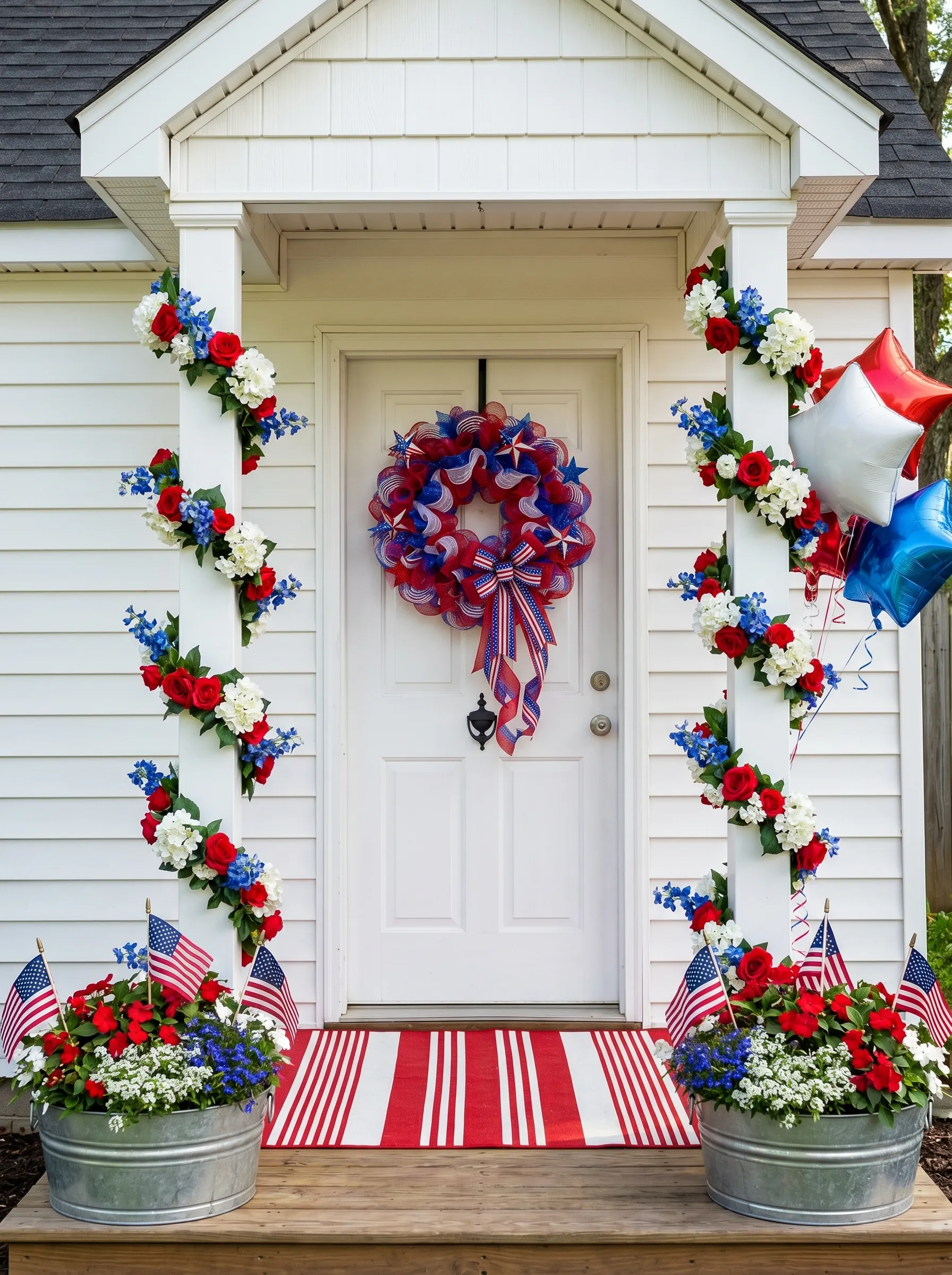
A cottage porch has columns instead of a formal door frame. Use the columns.
Build two flower garlands — one per column — that spiral upward from base to capital. Use a rope garland as your armature, securing it to the column with clear zip ties at top, middle, and base. Work in silk roses, white hydrangeas, and blue delphinium along the length, pushing stems through the rope and securing with floral wire. Leave the bottom third lighter so the garland appears to get more abundant as it climbs.
Cap each column at the top with a cluster of foil star balloons — red, silver, blue — attached to the column capital with a zip tie. Keep them small enough that they read as punctuation, not declaration.
On the door, a deco-mesh wreath in red and white mesh with blue star accents and a striped bow with trailing tails. Fill it fuller than you think you need to. Under-full mesh wreaths look defeated.
At floor level, galvanized metal buckets — the wide-mouth kind used for garden planting — fill with the same red, white, and blue flower palette. Add mini flags at angles. Layer a red stripe outdoor rug under them so the floor zone reads as intentional.
The Double Door Porch with Flags as Architecture
When you have double doors, the natural instinct is to put a wreath on each door and call it a day.
Go further. Source two full-length flag panels — the kind made for vertical display, with stars at top — and mount them directly to the masonry on either side of the door frame, one per side, using removable adhesive strips or a temporary tension rod. Let them hang floor to ceiling, or as close to it as your overhang allows. This turns the entire door surround into the decoration.
Place matching deco-mesh wreaths on each door — keep them the same but don’t obsess over perfection. The movement of the ribbon tails will read as lively rather than mismatched. Use navy, red, white, and star-print ribbon pulled through a wire wreath form in loops, working your way around until the base is invisible.
On the floor, lay a bold star-print rug — deep blue field, white stars, red border — that covers most of the entrance width. Small white lanterns with pillar candles on either side of the rug add a finished quality to the floor zone without adding height that would compete with the vertical flag panels.
Round globe topiaries in cobalt-blue square planters anchor the outer corners. Keep them simple — you don’t need flowers when you have this much pattern everywhere else.
The Candlelit Evening Porch That Actually Gets Better After Dark
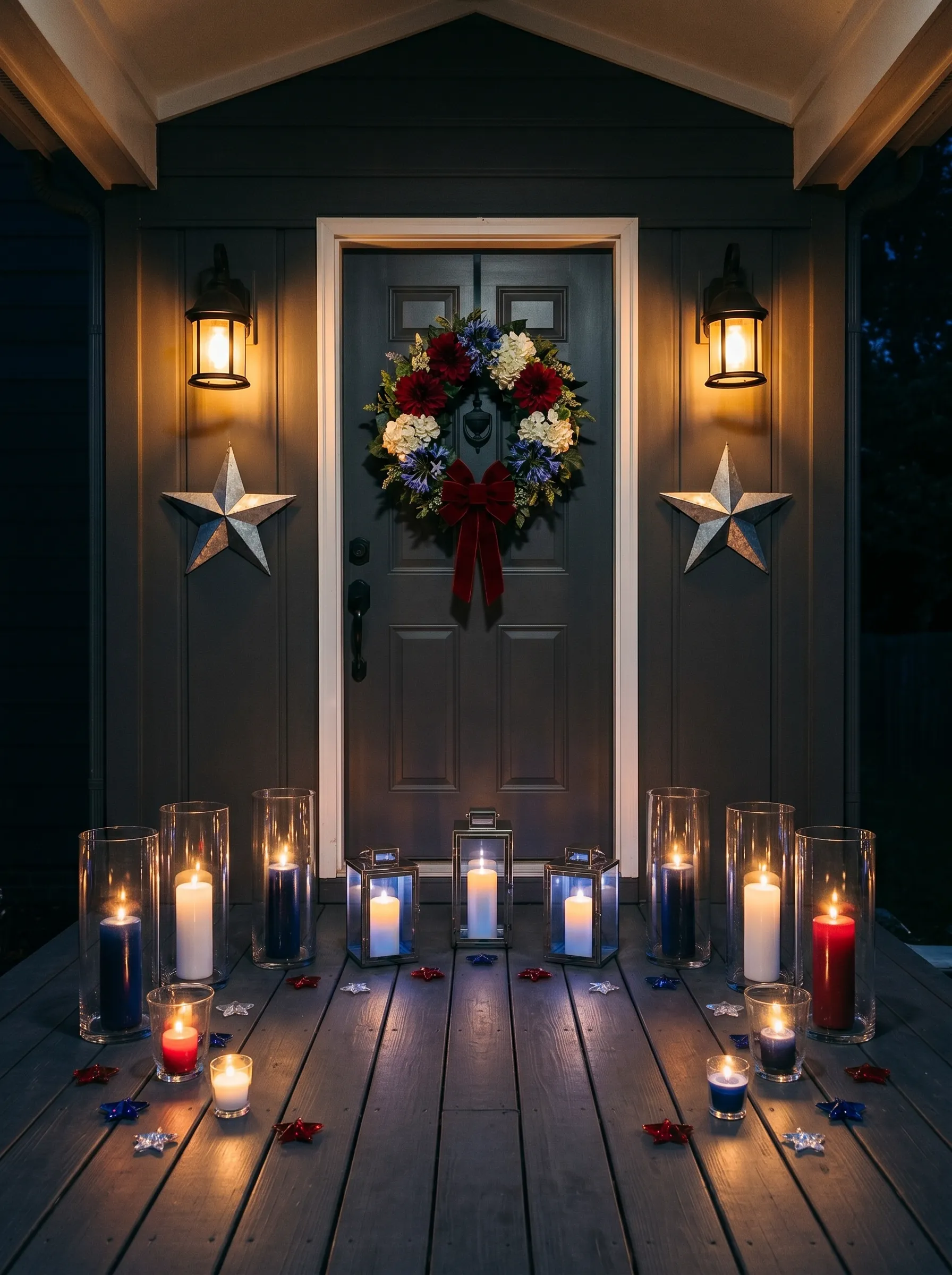
Most Fourth of July porches are designed to be seen in daylight. This one is designed for the evening.
Start with existing wall sconces. If they produce warm amber light, everything else follows from that.
Mount a hydrangea and floral wreath on the door — red gerberas, white hydrangeas, blue delphinium, with a velvet red bow at the bottom. During the day it reads like any other holiday wreath. After dark, the wreath’s colors catch the sconce light and deepen.
Mount two galvanized metal barn stars on the wall between the sconces and the door frame, one per side, at shoulder height. These reflect ambient light and add geometric contrast to the soft floral wreath.
The floor is where this porch operates differently. Arrange glass hurricane vases and lanterns across the porch floor in an arc or loose grouping centered in front of the door. Fill the hurricanes with pillar candles in navy, white, and red — alternate colors so they intersperse. Fill smaller glass votives with tealights. Scatter metallic star confetti between the candle groupings at low density — just enough to catch the light.
The effect is fire and stars. Which is, after all, the point of the holiday.
Light everything as darkness falls. This porch does not announce itself from the sidewalk in the afternoon. It reveals itself when it’s ready.
The Red Tobacco Basket Door That Made Architecture the Decoration
A tobacco basket is one of the most useful things in seasonal decorating. It’s large, flat, latticed, and instantly architectural.
Source one, paint it red — a flat or chalk finish reads more intentional than glossy — and mount it directly on the door glass or flat panel using a wreath hanger. It fills the door the way a window does.
Build a cascading floral swag that starts from the top of the basket and pours downward past the bottom edge. Use a foam floral base or vine wreath form as your armature. Layer in fern fronds and arching greenery first to establish the cascade shape. Then add blue hydrangeas at the center for color mass, white snapdragons or stock for vertical height, and red roses or ranunculus for depth.
The bow is a layered construction: one wide red wired ribbon as the base bow, then a smaller star-print ribbon looped through the center knot, then trailing lengths of red-and-white stripe and a plain blue ribbon cut to varying lengths. A gold star garland threaded through the ribbon tails catches light and adds warmth.
At floor level, repeat the wicker urn planters with matching floral arrangements — blue hydrangeas, white flowers, red roses, and flags tucked in at angles. Let the trailing greenery cascade over the edge of the urn.
The Balloon Arch Porch Built for a Party
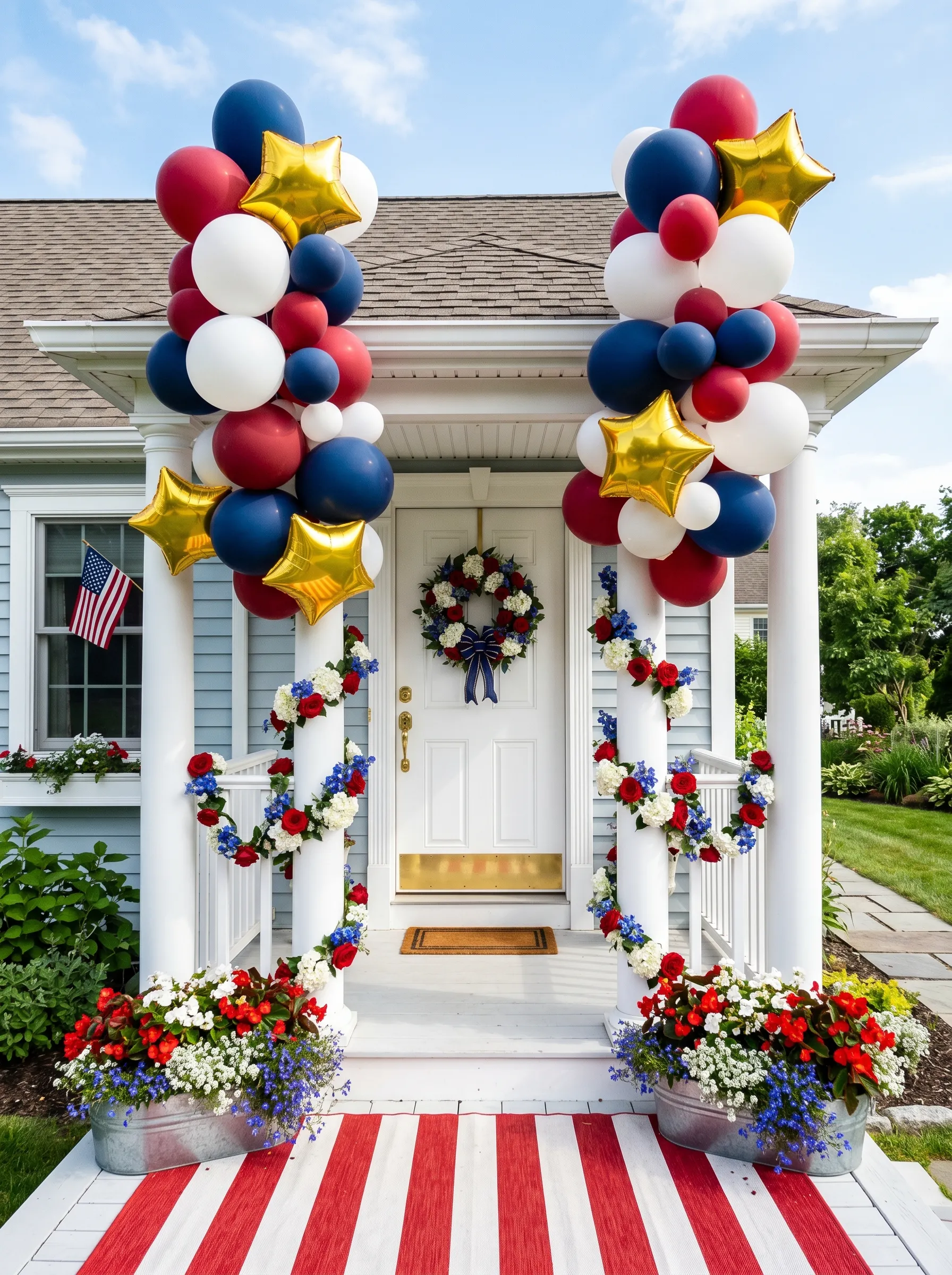
Nobody has a balloon arch on their front porch because they didn’t feel like it. They have one because they have opinions.
Build two balloon columns flanking the porch, one per structural column. Start with a balloon column stand and base, or use a balloon strip tape adhered to the column with mounting putty. Work navy, red, and white 11-inch latex balloons in a loose pattern — no rigid color alternation, just organic grouping with all three colors represented. Add gold foil star balloons of varying sizes as accent balloons, pushing their ribbon tails into adjacent latex groupings so they appear anchored.
Spiral a flower garland up each column below the balloons — red roses, white hydrangeas, blue delphinium — using the same rope-and-zip-tie method. The flowers provide texture contrast to the balloons and give the columns a layered quality.
On the door, a simple flower wreath — nothing competing with the balloons — with a single navy bow. The columns are the statement. The door treatment should frame them, not compete.
At floor level, galvanized tubs with tight arrangements of red, white, and blue flowers. Lay a red stripe outdoor rug for the stair approach. Hang small American flags from window boxes if you have them.
Balloon columns deflate over time and require monitoring for events longer than a few hours. Install them the morning of the event, not the day before.
The Navy Door Classic That Earns the Navy Door
A navy blue door is doing the work of a color anchor. It says: start here.
Pick a pre-made boxwood or greenery wreath — full, round, consistent. At the top of the wreath, tie a single wide navy satin ribbon into a generous bow that sits above the wreath rather than on it. This lifts the visual weight of the bow to the top of the door and creates a flag-like quality: the bow as the canton, the wreath as the field.
Fill the wreath with red roses, white hydrangea clusters, and small blue delphinium tucked at intervals. Keep the color placement loose and uneven — exact symmetry within the wreath reads as fake from across the street.
Run small triangle flag bunting along both porch railings — the kind with individual flags rather than the cheap painted-on version. Space them evenly. Anchor the ends at the corner posts.
Pair terracotta pots at floor level with a recipe that gives you all three colors: red geraniums as the upper story, white bacopa or alyssum as the mid-layer, blue lobelia trailing over the edge. This combination is genuinely hard to kill in summer. It’s the porch plant that earns its spot.
Lay a flag-print coir mat — the horizontal stripes and stars one, not the vertical portrait flag — directly in front of the door. The flag mat provides the ground-level patriotic signal so nothing else needs to.
The Rustic Farmhouse Porch with a Floral Star Wreath
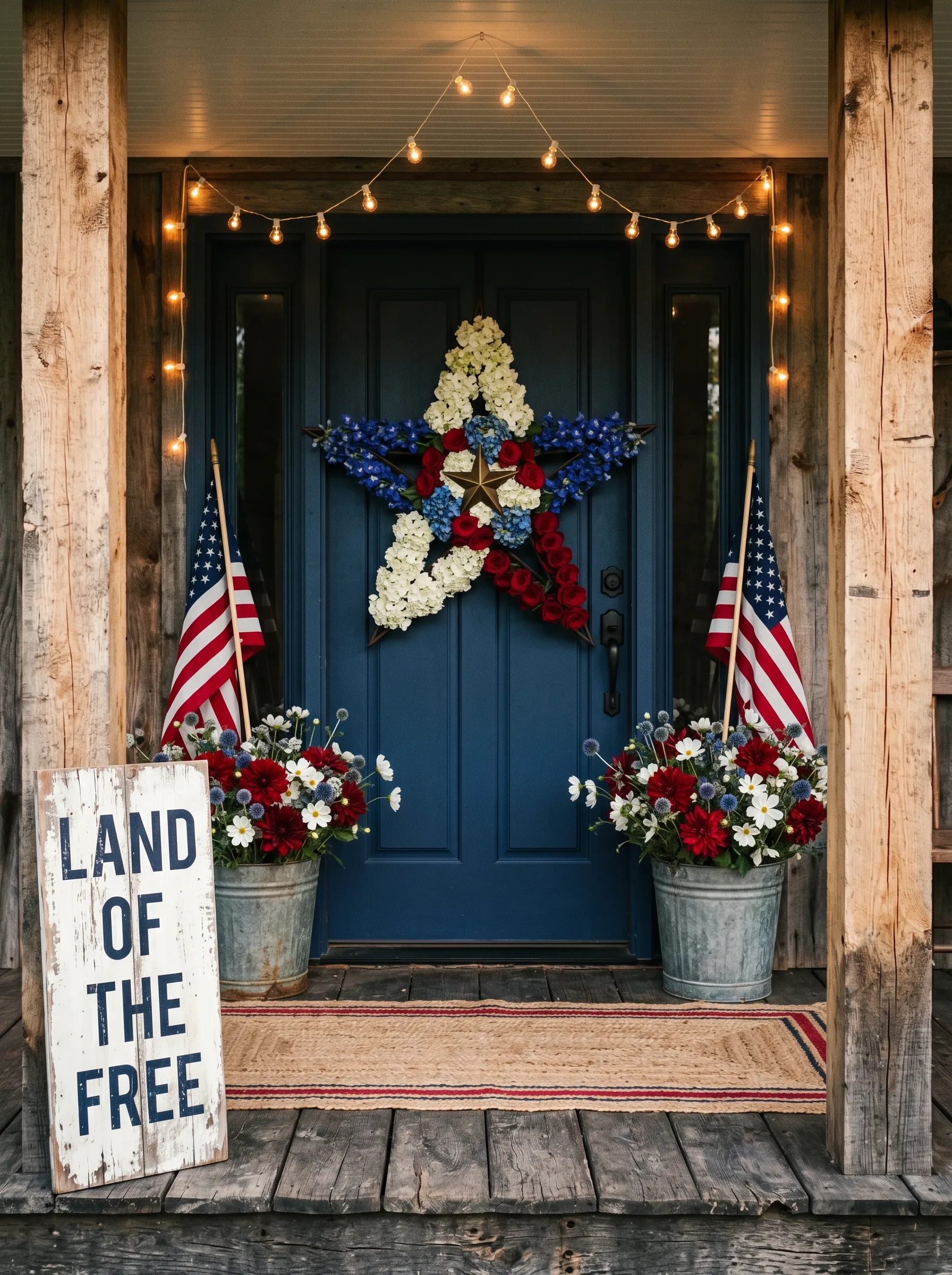
A star-shaped wreath form is not for every porch. For a farmhouse or rural aesthetic, it’s exactly right.
Source a wire star frame — the five-point kind, large enough to nearly fill the door width. Wrap the frame sections with floral tape or thin wire to create a surface for flower stems to attach. Work in sections, one point at a time.
For the upper point and its adjacent arms, use white hydrangea clusters and cream ranunculus — a pale, cool section. For the lower left arm, use deep blue delphinium and blue hydrangeas. For the lower right arm, use red roses and red dahlias. The star reads as striped in the flag’s colors when complete. A small antique brass star ornament at the center intersection adds a focal detail.
Surround the frame with rough-cut barn wood post columns if your architecture supports it, or lean into the raw wood quality of any exposed structural elements by keeping everything else organic and unfinished.
At floor level, galvanized bucket planters filled with red gerberas, white cosmos, and globe thistles for the blue note. Lean a painted wood sign against one planter. Keep the typography simple: a phrase that reads as old and true from across the street.
String Edison bulbs across the porch ceiling in a loose swag. The warm glow against the deep blue door at evening turns the whole arrangement into something people remember.
The Deco Mesh Everything Porch That Knew What It Was
Some porches decide to go big and refuse to apologize for it. This is one of those.
A deco-mesh garland runs the full perimeter of the door frame, across the top and down both sides. Build it on a wire frame starting with the center of the top run and working outward and down. Pull mesh — alternating red, white, blue, and star-print patterns — into loops of roughly 6 inches, securing each loop with pipe cleaners to the wire. Vary the mesh patterns as you go so no two adjacent loops use the same print.
Add embellishments as you work: metal hat picks in Uncle Sam top hat shapes, wooden star ornaments, popsicle signs, miniature flag picks. Tuck these into the loops at irregular intervals. The garland should be so full that the wire base is entirely invisible.
The center-door wreath uses the same mesh-loop construction on a round wire form. Make it as full as the garland so the door reads as one unified decorated surface rather than a wreath plus a frame.
At the floor level, plant white hydrangeas in black lanterns for a grounding contrast to all the color. Add red flowers — if you’re still adding anything — in dark planters that disappear against the base of the garland.
Keep the floor zone deliberately quiet. One striped mat, no flags, no extras. The door is already speaking at volume. The floor needs to be the pause.
The Red Door Minimalist Modern Porch
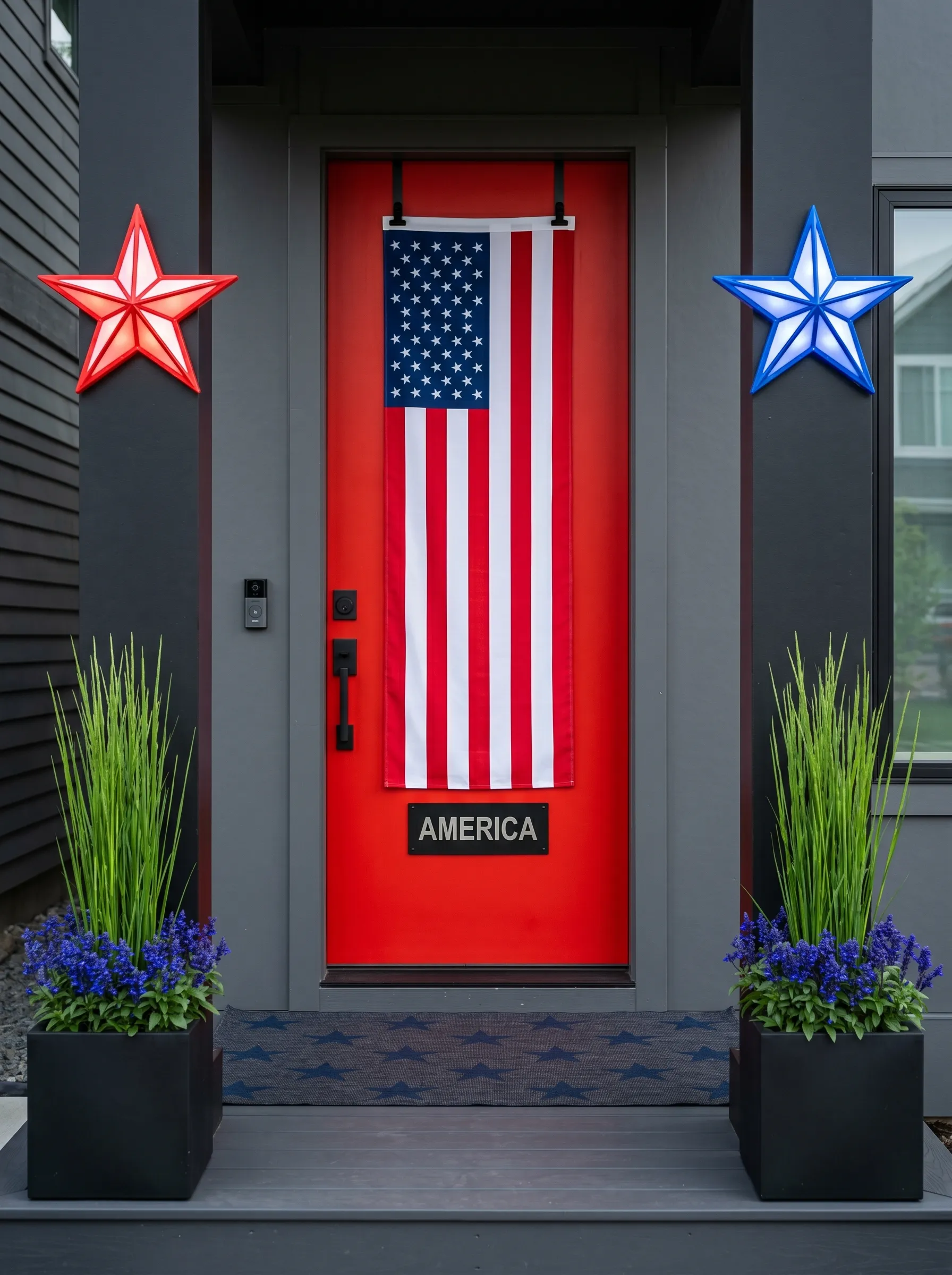
A red door wants to be left alone to do its job.
Mount a flag — a real one, properly sized, horizontal — directly above the door frame using brass bracket hardware. Center it. No flags in the windows, no flags on poles, just the one correctly placed flag with the canton in the upper left.
On the door itself, a vertical flag panel hung from the top rail gives the door surface a textile quality without adding bulk. This works best on doors without prominent hardware in the center.
Install illuminated metal barn stars on the exterior wall flanking the door — one red on the left, one blue on the right. These are available with bulb inserts for electric lighting or can be used unlit for a more architectural look. Size matters: go bigger than you think. A 16-inch star is the minimum; 24 inches reads correctly from the street.
Pair identical matte black rectangular planters with ornamental grass for vertical height, underplanted with deep blue salvia. No red in the planters. The red is already doing its job at door scale. Repeating it at ground level dilutes the hierarchy.
The White Porch and Blue Door Painted Simply
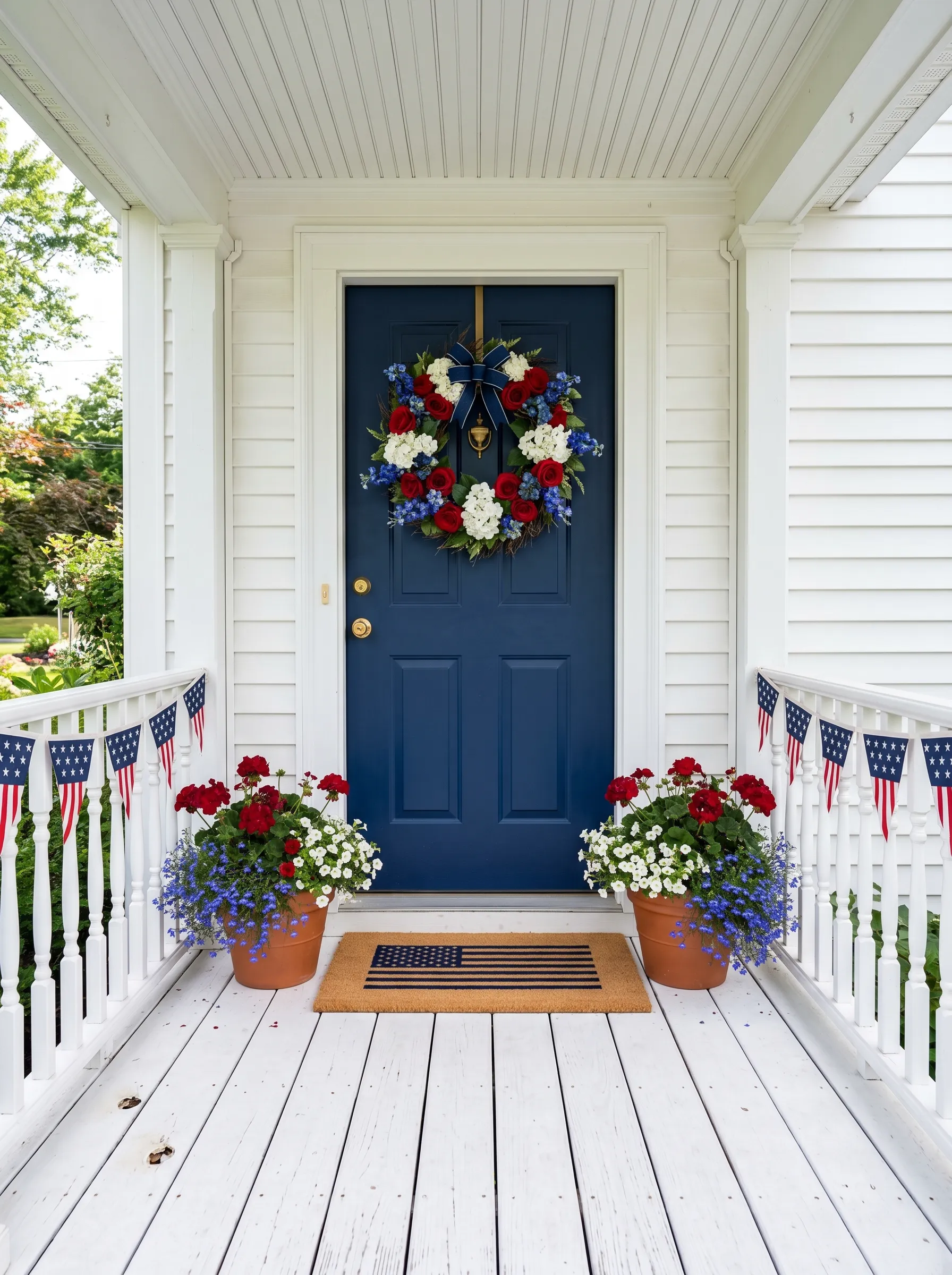
This is the porch for people who would rather not decorate at all but have made peace with the fact that July 4th is coming regardless.
The navy door does most of the work. Hang a flower wreath with red roses, white hydrangeas, and blue delphinium on a simple grapevine base. Tie a navy velvet or grosgrain bow at the top. No ribbon tails. No layering. One bow, done.
Pair two terracotta planters with the three-flower combination: red geraniums, white alyssum, blue lobelia. Place them symmetrically, directly flanking the door at floor level. Not to the side. Right next to the door, close enough to anchor it.
Drape mini flag bunting along the porch railing — the triangle pennant style in actual fabric, not the cheap printed version. Attach it loosely so it swags naturally between posts.
Flag-motif doormat at center. That is the entire porch. The restraint is the point.
The Farmhouse Porch That Understood Restraint
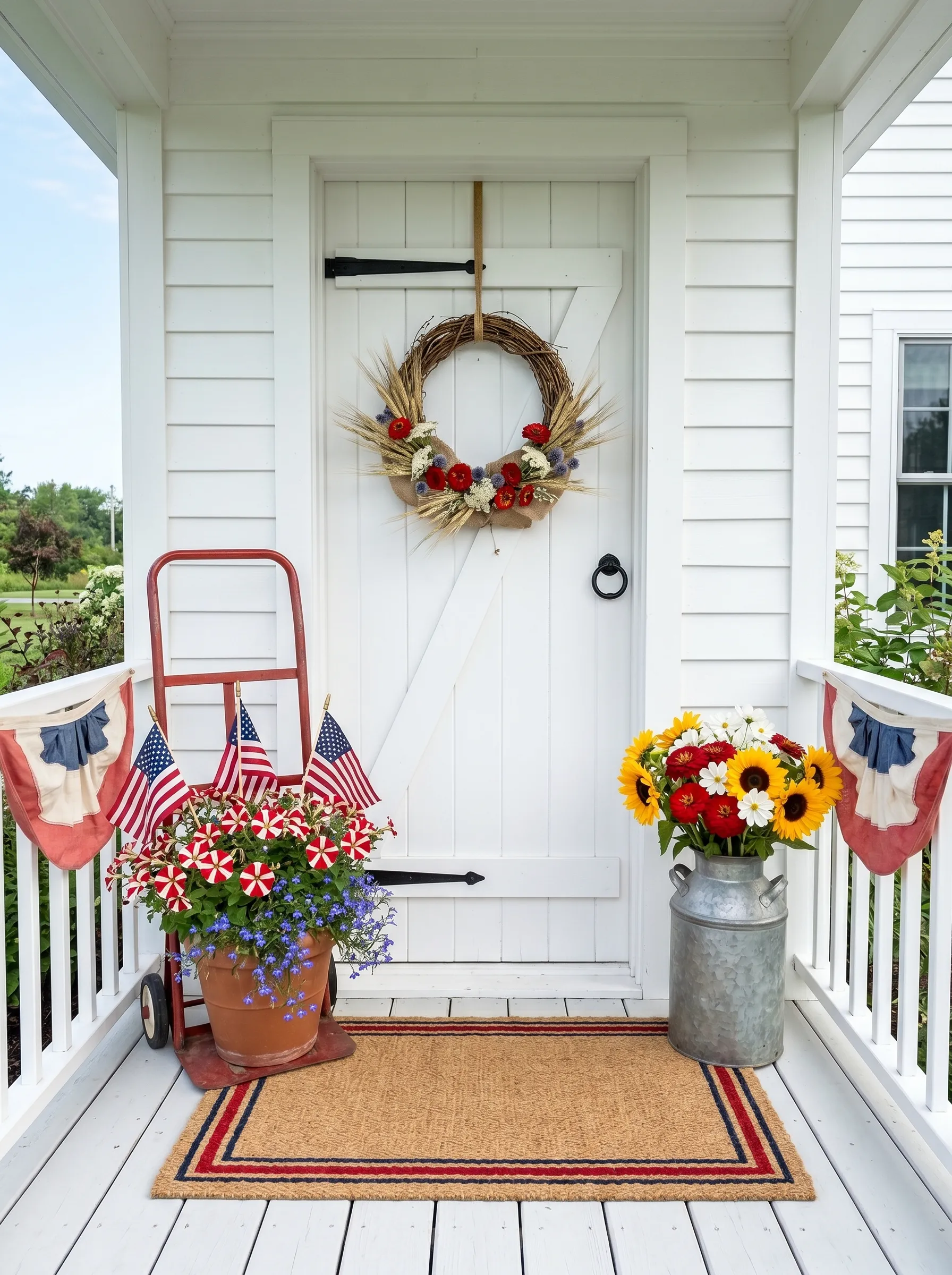
The distinguishing quality of a good farmhouse porch is what’s not on it.
Start with the door. A white plank-and-batten door — or one painted to read as such — calls for a natural base wreath: grapevine ring, not foam, not wire. Mount it with a jute twine loop. On the wreath, work in dried wheat stalks extending outward from the top and sides for texture, then add red poppies or dahlias, white queen anne’s lace or globe flowers, and a sparse scattering of dried blue thistles or echinops.
The wreath needs no bow if the florals are strong enough. If you want one, use raw linen ribbon in a single-loop bow — not wired, not elaborate, just tied.
On one side of the door, a vintage red hand truck or garden cart serves as the plant stand. Load it with a terracotta pot of peppermint-striped petunias and a cluster of small flags. This is charming without being cute. There’s a difference.
On the other side, a galvanized milk can or large cream can becomes the vase. Fill it with sunflowers, white daisies, red zinnias. Let it be abundant and slightly imperfect.
At the railing, use actual American bunting if you can find it — the fabric variety with fabric construction, not the paper or plastic version. Drape it loose and casual, not tight. Farmhouse things are allowed to sag a little.
A bordered coir mat in natural with red, white, and navy stripe framing grounds the whole entry without adding another pattern to manage.
The Architectural Minimalist Porch with a Boxwood Wreath
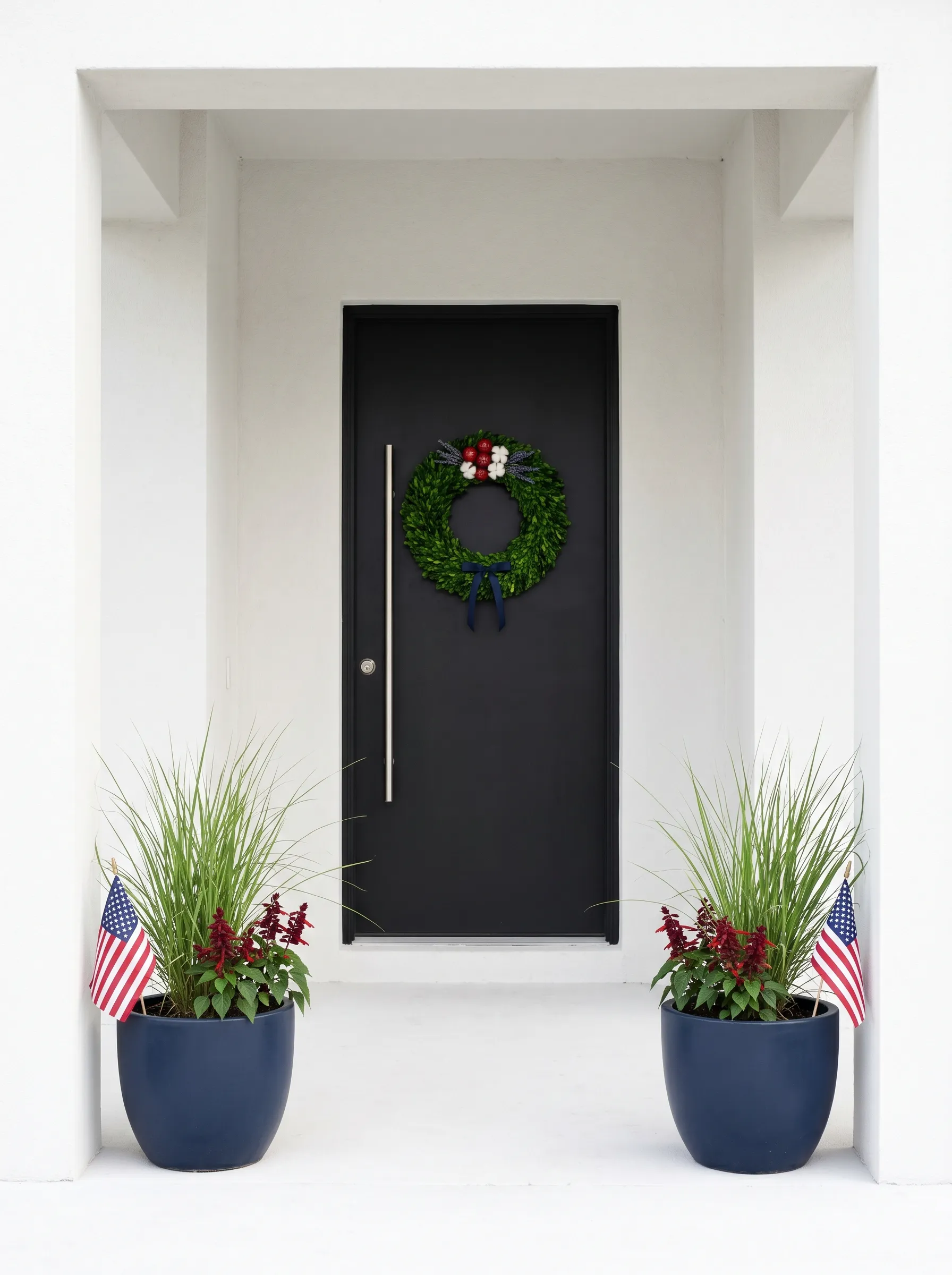
The easiest porch to get wrong is the minimal one. You have nowhere to hide.
Source a preserved boxwood wreath — preserved, not silk, not fresh. The preserved ones hold for months and maintain a deep forest green that looks intentional in a way fresh and silk both struggle to match. Size up: at least 22 inches.
At the top of the wreath, cluster a small grouping of elements: red berry picks, white cotton stems, and two or three small blue lavender stems. Keep this accent at roughly the one o’clock or eleven o’clock position, not centered at the top — center placement looks like a Christmas wreath and you’re going for something more refined.
Tie a single narrow navy grosgrain ribbon bow at the bottom of the wreath. No tails longer than 6 inches. Precision matters here.
Pair identical deep navy rounded planters — not urns, not square, just round low bowls — with a compact plant combination: red salvia at center for height, trailing white bacopa, and a single small American flag. Keep the planting tight and deliberate.
The flag above the door — mounted horizontally on the fascia with proper brass brackets — completes the composition. No bunting, no garland, no additional elements. The white wall, the black door, the green wreath, the navy planters, and the flag. That’s the whole design.
The Whimsical Summer Porch with Hanging Stars and a Wagon
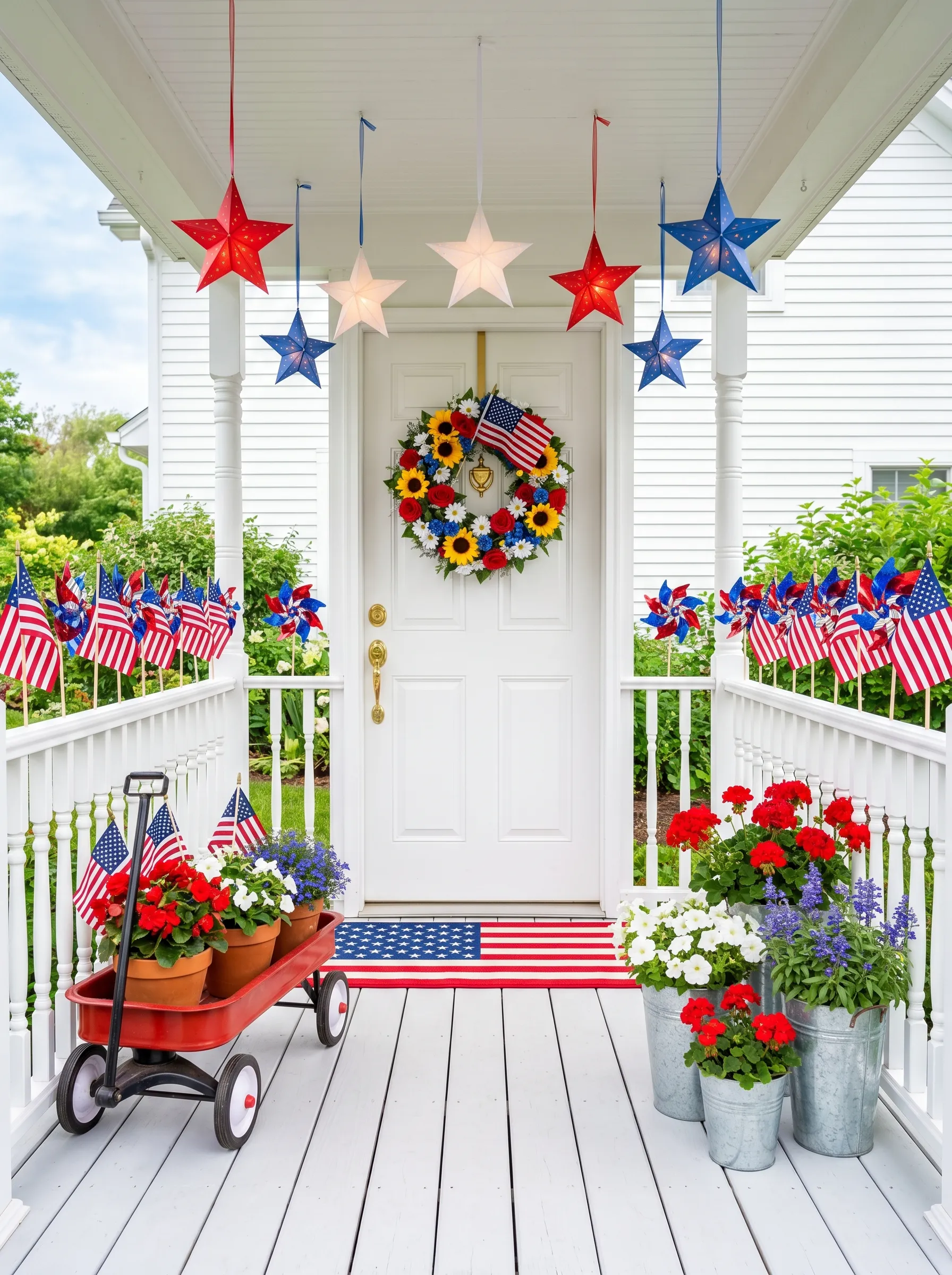
This porch treats patriotism as pure delight, and pulls it off because of commitment.
Hang illuminated paper or fabric star lanterns from the porch ceiling joists using clear fishing line at varying heights. Use at least seven: a mix of red, white, and blue. Vary the drop lengths so they create a layered canopy effect when viewed from the street. During daylight the stars add graphic color overhead. At night, with the bulb inserts lit, they become the entire mood.
On the door, a mixed sunflower and patriotic wreath: a foam base, sunflowers as the primary flower, then red roses and blue delphinium tucked in at intervals, small white daisies as fillers, and a few small American flags pushed into the wreath at angles. The gold of the sunflowers prevents this from reading as simply patriotic — it reads as summer.
A red vintage wagon sits to one side of the door, used as a planter cart. Load it with several terracotta pots of varying sizes filled with red, white, and blue flowers. The wagon reads as playful and memory-laden without being kitschy because it’s serving a function.
On the other side, galvanized buckets hold red geraniums, white petunias, and blue salvia. Keep them grouped close together rather than spread apart — density creates the lush quality you’re after.
Line the porch railing with alternating American flags and red-and-blue pinwheels pushed into the soil of small pots attached to the railing, or secured to the railing top with adhesive putty. Pinwheels move in the slightest breeze and give the porch an animation that static decorations can’t provide.
Lay an American flag motif doormat and call the floor done.
The Sage and Roses Porch That Made Patriotism Feel Like Heritage
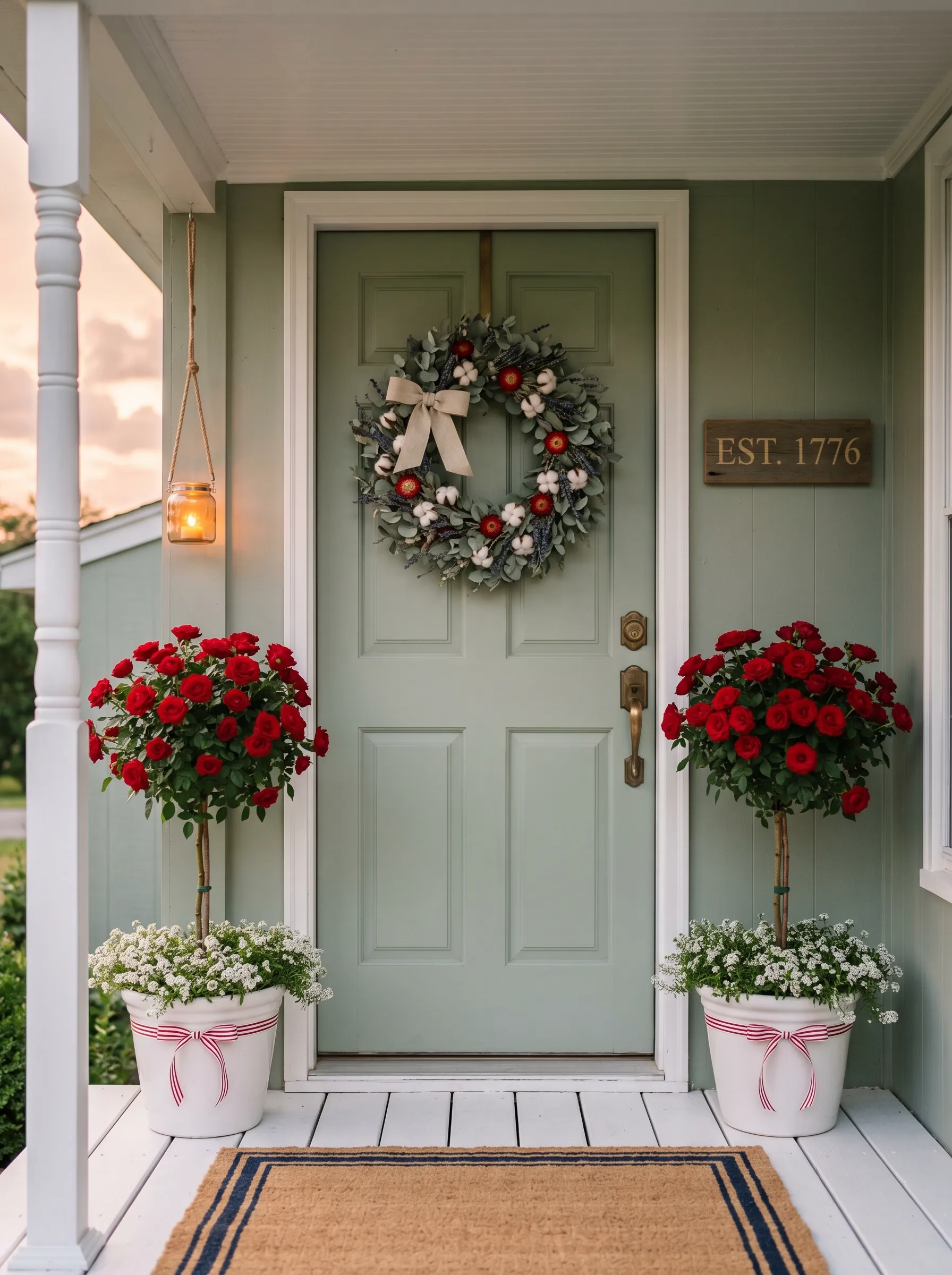
This is the porch that trusts one decision completely.
A sage green door is a studied choice. It says the person who lives here is not following a trend. It says they made a considered decision about their exterior some time ago and decorated around it rather than in spite of it.
Rose topiaries — full ball heads on clear stems, planted in tall white pots with white alyssum trailing at the base — flank the door with the specificity of something inherited. Wrap each pot with a wide red-and-white striped ribbon tied in a loose bow. The stripe ribbon is the only overtly patriotic element at ground level.
On the door, a dried eucalyptus and cotton wreath with a natural linen bow, accented with just a few red anemones and dried lavender. The wreath is soft and botanical. It reads as all-season with patriotic notes rather than purely seasonal.
An “Est. 1776” wooden sign on the wall beside the door provides the historical signal with understated authority. A hanging jar lantern with a warm bulb adds evening warmth.
A striped navy doormat at the threshold and a gardenia in a terracotta pot on the floor complete the composition. The gardenia has no patriotic function. It smells extraordinary and that counts.
The Hanging Basket Porch That Stacked Every Level
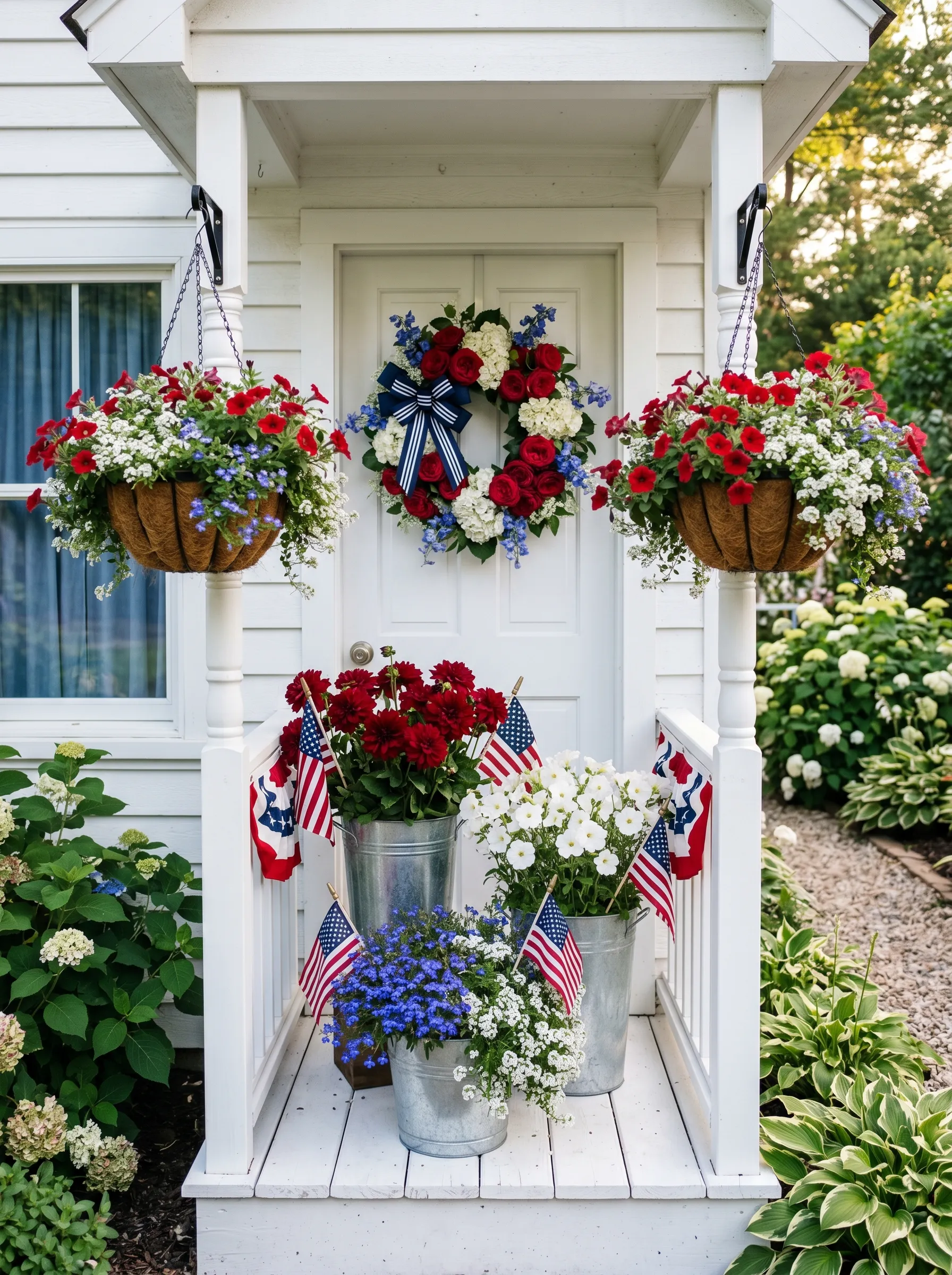
A porch with overhead mounting points has a vertical dimension most people ignore entirely.
Source two large coco-fiber hanging baskets — the deep bowl kind, not the flat saucer style — and mount them from the porch ceiling brackets or joists flanking the door. Pack them tightly: red petunias and trailing red verbena at the outer edges, white alyssum and white calibrachoa at the middle layer, blue lobelia cascading downward at the front. The goal is a hemisphere of color so dense the basket liner disappears completely.
On the door, a full floral wreath with red roses, white hydrangeas, and blue delphinium anchored by a navy stripe bow at center. Keep the wreath tighter and more structured than the hanging baskets — the baskets are the lush element, the wreath is the composed one.
At floor level, group three galvanized buckets of varying heights in a cluster rather than spreading them apart. Fill the tallest with deep red dahlias and American flags. Fill the middle with white petunias. Fill the shortest with blue lobelia spilling over the sides. Clustering creates the impression of a single abundant arrangement rather than three separate pots.
Tuck small American flag picks into each bucket at varying angles. Lay a red stripe outdoor runner as the floor anchor. The three vertical levels — hanging baskets above, door wreath at eye level, bucket cluster at floor — give a small porch the visual weight of a much larger space.
The String Light Porch That Turned Ordinary into Evening Magic
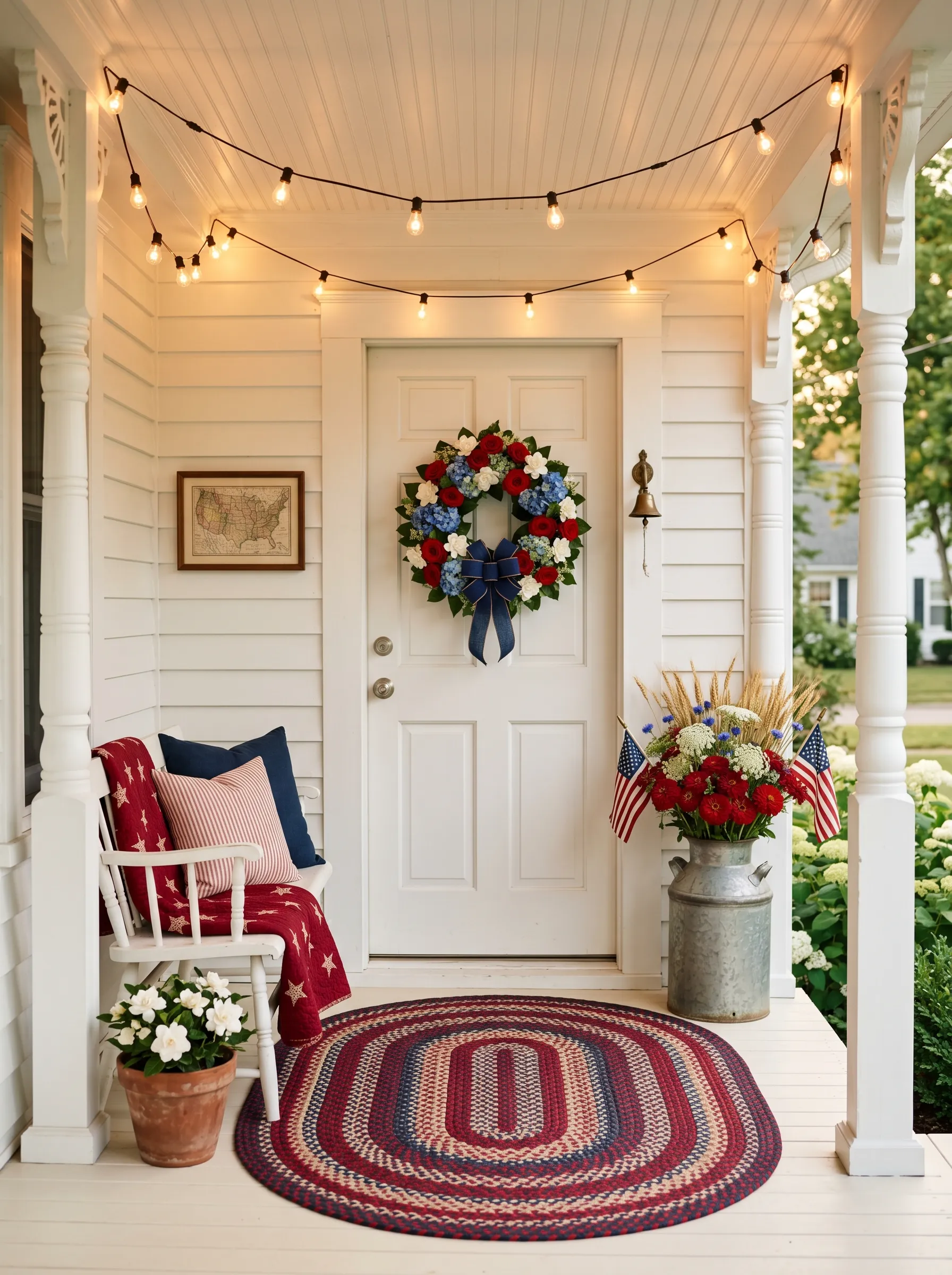
String lights deserve more credit than they get in seasonal decorating.
Drape Edison-bulb café lights across the full porch ceiling in gentle swags, anchored at the outer columns and running back to the house wall. Use two or three parallel runs so the ceiling coverage feels full rather than sparse. Warm white bulbs only — the cool white variety kills the golden quality that makes string lights worth using at all.
On the door, a tight floral wreath: red roses, blue hydrangeas, white gardenias or large white blooms, finished with a wide navy grosgrain bow. The bow’s tails should hang about eight inches — long enough to move in a breeze, not so long they compete with the wreath body.
One side of the porch gets a white painted wood chair with a throw — red with white stars, or a ticking stripe — layered with a navy pillow and a red ticking stripe pillow. A small terracotta pot of white gardenias sits on the floor beside the chair legs. The chair says someone actually uses this porch.
The other side gets the statement piece: a large galvanized milk can or antique cream can used as a cut flower vase. Fill it generously with red zinnias or dahlias, white queen anne’s lace, blue cornflowers, and dried wheat stalks for height variation. Push two small flags into the arrangement at angles. The milk can’s patina reads as something found rather than purchased, which is exactly the quality you want.
A vintage map of the United States in a simple frame on the wall adds a historical note without announcing itself. A braided oval rug in red, white, and navy at the floor grounds the whole porch in texture. The string lights pull every element together after dark. That’s when this porch is actually itself.
The Clean White Porch That Let the Flag Be the Flag
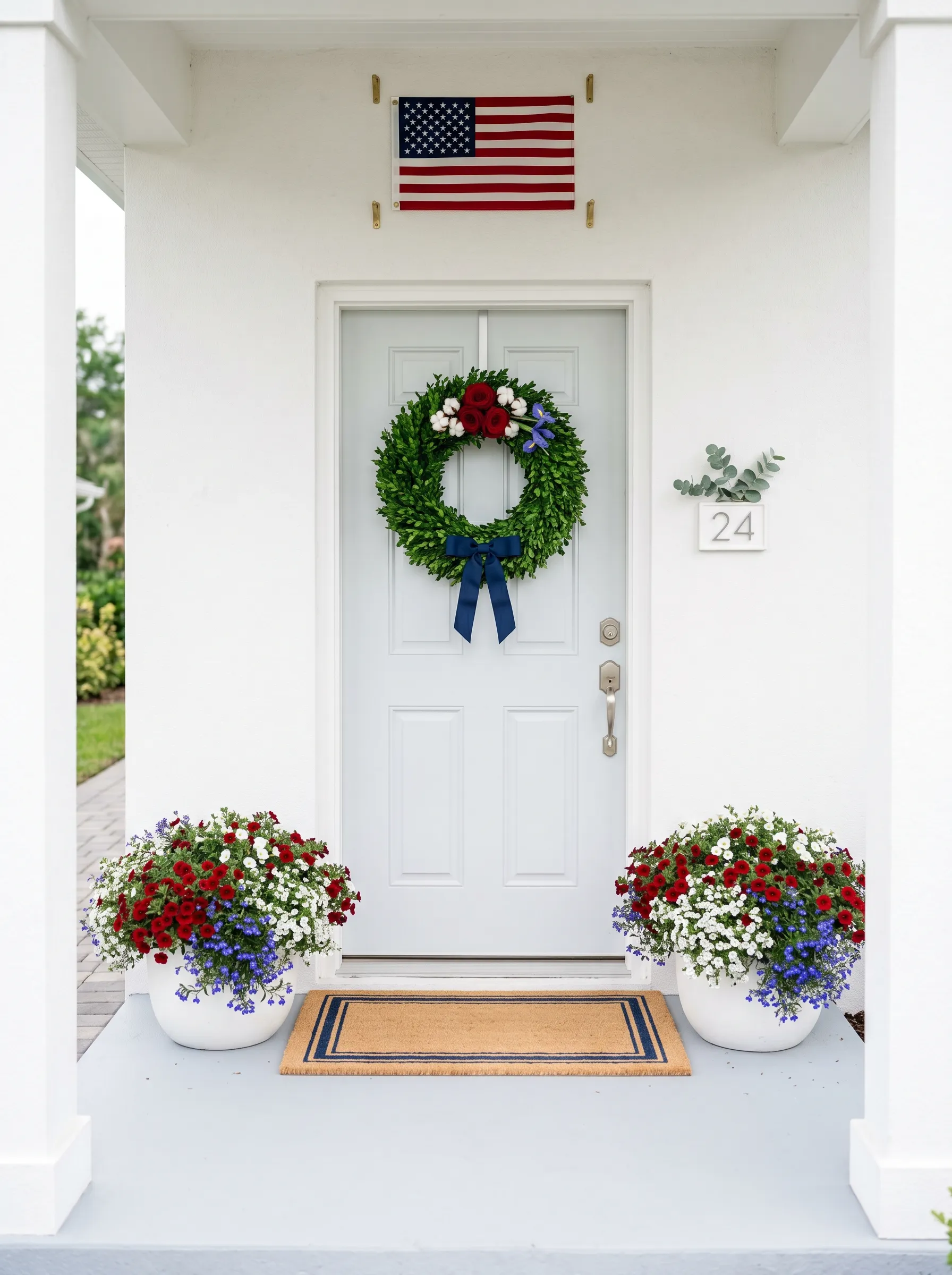
There is a version of patriotic decorating that requires almost no effort and produces an almost unfair amount of visual payoff.
Mount an American flag — properly sized, properly proportioned — horizontally above the door using brass wall-mount flag brackets. Center it on the fascia board. The canton goes upper left. The flag should be the first thing a person sees when they approach, before they see the door, before they see the wreath, before they see anything else.
On the door, a preserved or high-quality silk boxwood wreath: dense, full, consistent green. At the upper portion of the wreath, cluster a small accent grouping — two or three red roses, one or two cotton stems, a small spray of blue iris or delphinium. Tie a single narrow navy ribbon bow at the bottom with tails no longer than five inches.
Pair two identical round white ceramic or fiberglass bowl planters, sized generously — at least 14 inches across. Plant them with a combination that runs all season without much intervention: red miniature roses or verbena, white bacopa or alyssum, and blue lobelia. Set them symmetrically flanking the door, close enough to anchor it.
A simple bordered coir mat — natural ground with navy stripe frame — at the threshold. That’s it. No bunting, no signs, no extra flags, no lanterns.
The restraint is not laziness. It is a considered decision that the flag, at proper scale above the door, renders everything else redundant. Let it do its job.
A Final Word on All of This
What all the porches that work have in common is not matching sets or a big budget or a particular style.
It’s that someone looked at their door, their space, their house, and made choices that responded to what was already there. The basket wreath worked on the white colonial door because they’re both abundant and traditional. The minimal boxwood wreath worked on the contemporary black door because both things understand that less can be enough.
Red, white, and blue is not an excuse to stop thinking. The flag deserves better than that. What it deserves is a porch that uses those colors the way any good designer would: with intention, with restraint where restraint is called for, and with commitment when commitment is the point.
Your front porch is roughly eighty square feet. You see it every day for the rest of the time you live in your house. Getting it right once, even for three weeks in July, is worth the trouble.