
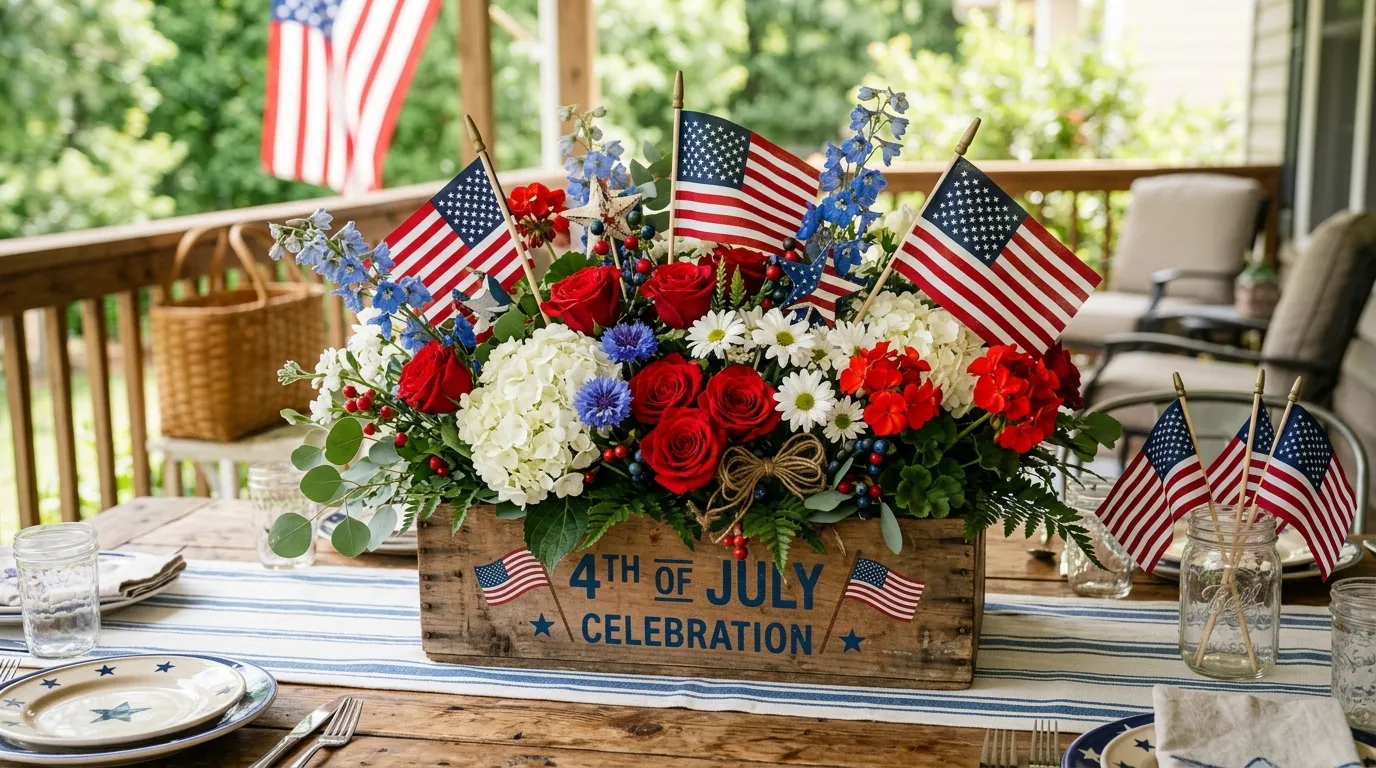
Red, white, and blue is harder than it looks. Three colors that belong on a flag don’t automatically belong on a dinner table. Yet every July, people pile the same carnation bouquet into a mason jar, prop a couple of mini flags in it, and call it festive.
It’s not festive. It’s a gas station flower impulse buy with a flag stuck in it.
The difference between a table that looks intentional and one that looks like a grocery run is the same as always: it’s not the colors, it’s the decisions. The container. The proportion. The moment of restraint or the moment of commitment. This blog is about those decisions — and then, once you understand them, eighteen ways to make them work.
Why Most Patriotic Centerpieces Look Like an Afterthought
The problem isn’t effort. Most people put real effort in. They buy flowers. They hunt down mini flags. They fold napkins. The problem is that patriotic decorating has a gravitational pull toward sameness that actively resists personality.
The Color Trap
Red, white, and blue in equal measure produces visual noise. It doesn’t produce harmony. Your eye bounces from the red carnation to the blue ribbon to the white vase and never settles anywhere.
Good color work picks a dominant and lets the other two support it. If your room already leans warm — wood tones, cream walls, brass hardware — let white lead, with red as the accent and blue as the quiet depth. If your space is cooler or more formal, let navy carry the weight while red energizes and white opens it up.
Equal thirds is the amateur move. Dominance and accent is the design move.
The Container Afterthought
People choose their flowers first and their container second. That’s the order that produces bad results.
The container sets the tone for everything that follows. A galvanized bucket says farmhouse abundance. A crystal vase says formal elegance. A brass urn says dramatic and old-world. A mason jar says casual and American in the best possible way. An amber wine bottle says golden hour garden party.
Decide what your table is saying before you buy a single stem. Then choose flowers that fit that container — not the other way around.
The Proportion Problem
Most people build their centerpiece too small for the table it lives on, then pad it with flags to fill the space. The flags aren’t doing design work. They’re doing volume work.
A centerpiece should feel like an intentional anchor. That doesn’t mean it needs to be tall. It can be low and lush and wide. It can be a collection of vessels instead of one. But it needs to hold the table, not apologize to it.
What Nobody Tells You About Patriotic Floral Design
Understanding red, white, and blue as design elements rather than a costume changes everything you reach for at the flower market.
Blue Is Your Most Valuable Ingredient
True blue is the rarest color in flowers. Navy and royal blue are even rarer. This scarcity is what makes blue hydrangea, blue delphinium, blue anemones, and agapanthus worth seeking out rather than substituting.
The moment you swap real blue for purple — which is easy to accidentally do — you’ve lost the palette. Purple-hydrangea with red carnations reads more like a bruise than a flag. Spend the extra money or effort on true blue. Blue hydrangea, deep cobalt hydrangea, delphiniums that are genuinely blue rather than lavender. It’s the anchor of everything.
White Does More Work Than You Think
White isn’t the background. White is the breath. White ranunculus, white peonies, white garden roses — these are what give the composition room to exist. They separate the red from the blue. They keep the whole thing from clenching.
The more opulent your whites, the more luxurious the entire arrangement looks. A white peony does more work than three white carnations. It’s not elitist, it’s geometry — larger blooms read as intentional weight, not filler.
Texture and Greenery Are Not Optional
A purely floral arrangement without greenery is tight and airless. Ferns, eucalyptus, dusty miller, ivy, mint, pampas grass — these are what make an arrangement feel like it was assembled by a person and not a machine.
Let greenery escape the edges. Let ivy trail. Let pampas lean. The looseness is the point
4th of July Centerpiece Ideas
The Kitchen Island Patriotic Vignette Built on a Cutting Board
Start with a large charcuterie-style wooden board — the rectangular kind with a handle notch — and use it as your staging surface on the kitchen island or counter. Fill a stout white ceramic pitcher or crock with white blossom branches and dark berry stems, keeping the arrangement tall and airy rather than tight. Tuck two small American flags into the stems at opposing angles so they splay outward like casual parentheses.
In front of the pitcher, stand a small arched wood-framed print — something Americana-themed, a farmhouse, a landscape with a flag — propped against the vase base. Add a loose cluster of red tulip stems or small red bloom heads scattered on the board surface as if they tumbled there. Tuck a blue-and-white decorative ceramic sphere or orb on the opposite side as a counterweight.
The whole composition should feel like an organized collection, not a formal arrangement. Keep everything slightly off-center and slightly imperfect. A small glass inkwell or salt cellar on the edge adds depth without clutter.
The Triple Cylinder Vase Statement Using Color Blocking
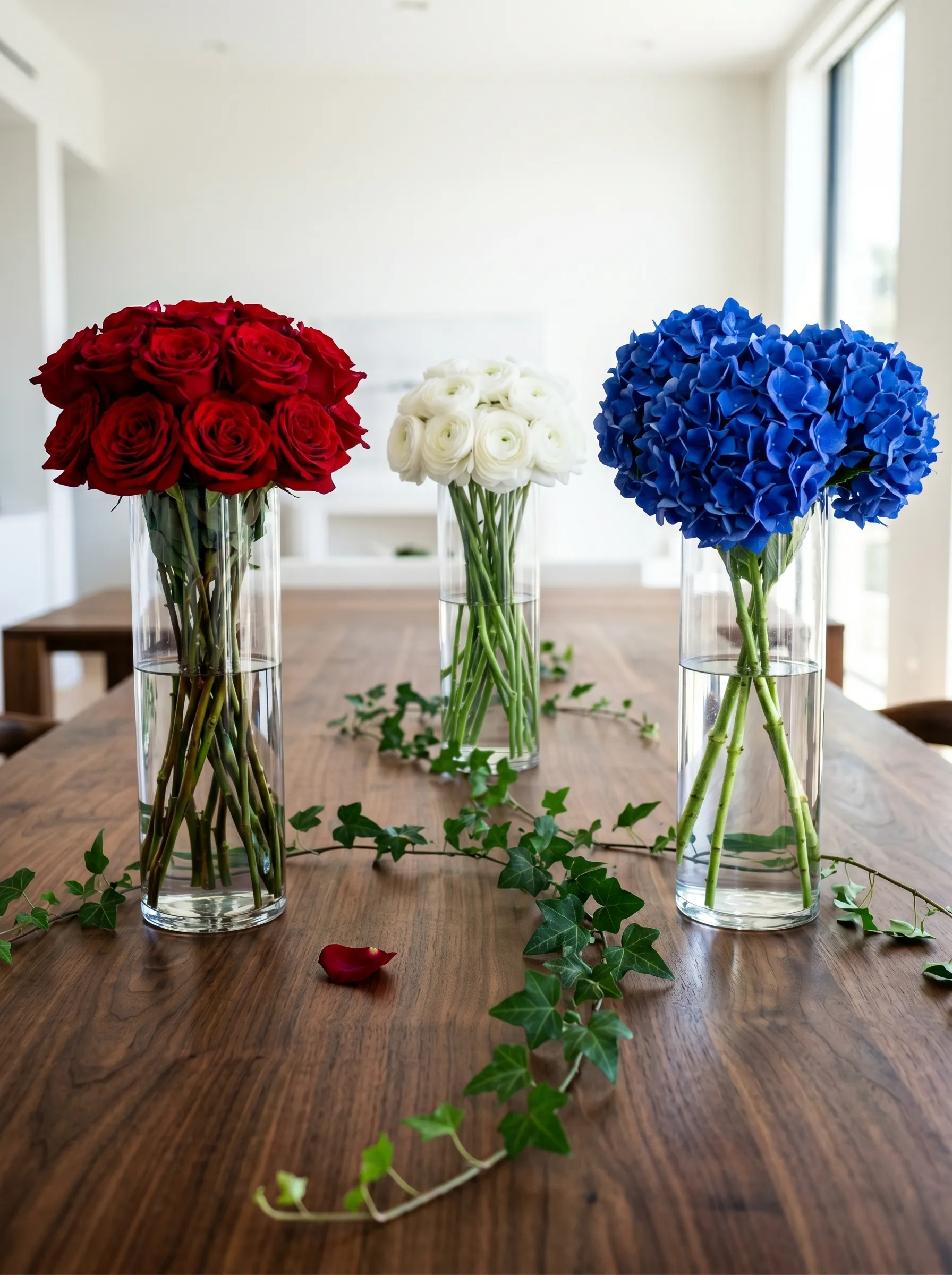
Buy or gather three tall, matching glass cylinder vases — identical in height and diameter is important here. This only works as a set. Fill the left vase with red roses only, cut to the same height, standing dense and generous. Fill the center vase with white ranunculus only. Fill the right vase with deep cobalt blue hydrangea heads only.
Place the three vases in a row down the center of a long dining table, with an inch of space between each one. Trail a single long ivy vine loosely across the table surface, weaving between the vases and extending past both ends.
Let a single red petal fall on the table. Leave it. It makes the whole thing feel real.
The purity of this concept depends entirely on resisting the urge to mix. Keep the zoning absolute. No red in the blue vase. No blue in the white. The separation is the statement.
The Striped Round Vase With Structured Patriotic Florals
Find or paint a round, ball-shaped ceramic vase in navy with white vertical stripes — this silhouette is essential because the roundness keeps the arrangement feeling balanced even when the florals are asymmetrical. Fill it with a structured arrangement: red carnations clustered tightly in the center-front, blue hydrangea heads filling the right side, cream or white roses and calla lilies on the left, and tall green snapdragons or bells-of-Ireland providing vertical escape at the top.
The key is that each flower type occupies a distinct zone rather than being mixed evenly. This tricolor zoning reads immediately and clearly as intentional without being stiff. Tuck a 405-style branded pick or small flag stake into the arrangement for a personal touch if this is for an event.
Keep the container elevated on a small round placemat to give the round vase a formal footing.
The Outdoor Night Table With Bud Vase Rows and Tea Lights
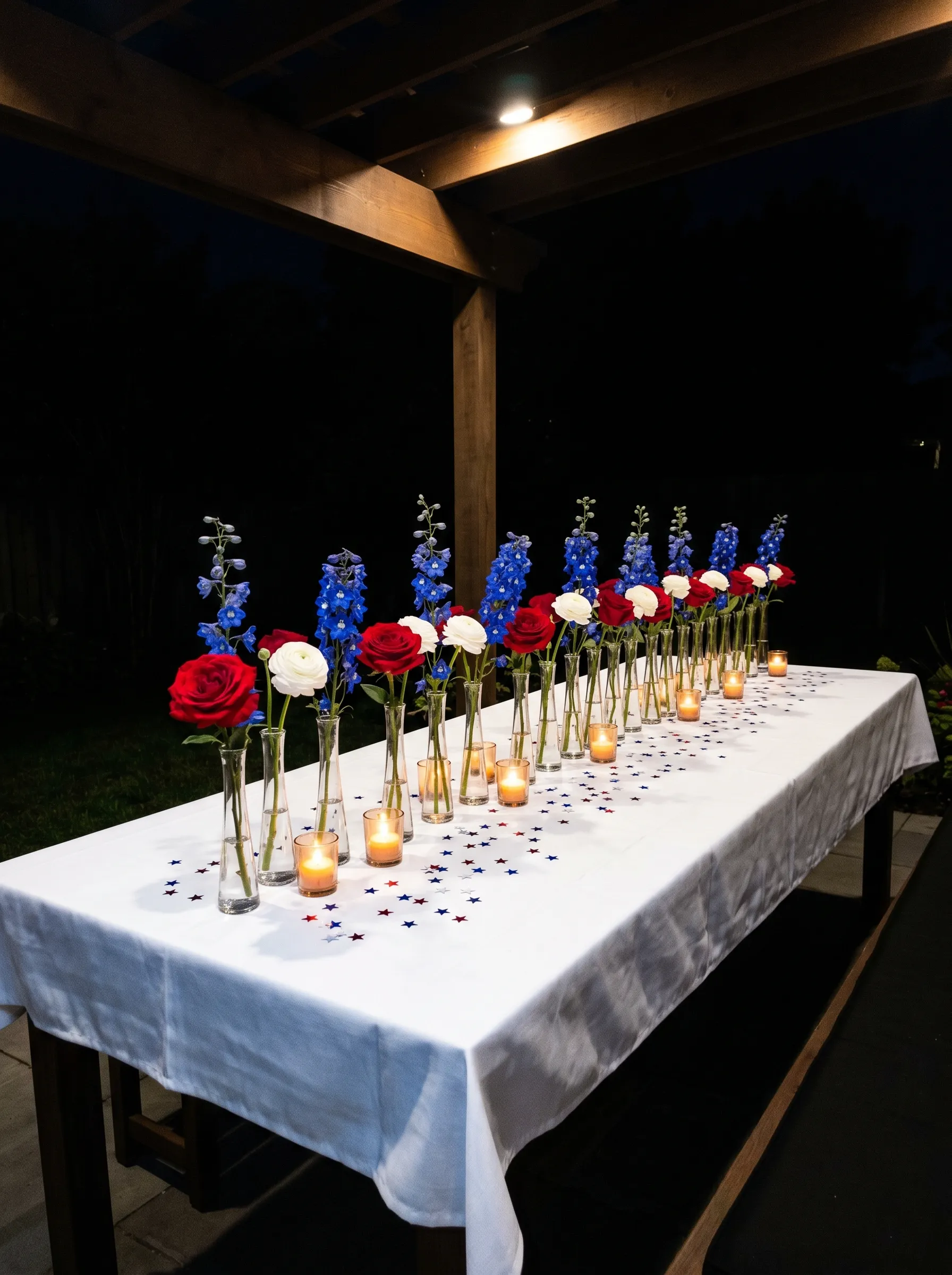
Collect twenty to twenty-five thin glass bud vases — the tall, narrow kind — and place a single flower stem in each one. Alternate through the palette: a red rose here, a white ranunculus there, a blue delphinium spike next. Group them loosely in a long row down the center of a white-linened table.
Between every two or three vases, set a small glass tea light holder with a lit votive. Let the tea lights be slightly irregular in placement — this is not a military lineup.
Scatter a handful of red, white, and blue metallic star confetti across the tablecloth surface, letting it drift naturally toward the edges and underneath the vases. The confetti at this scale reads as texture, not party supply.
The whole effect works because the individual stems are given room to be singular. Each flower is the whole point of its vase. There’s nothing crowding it.
The Aqua Mason Jar With Garden Blooms and Felt Accents
Use a classic aqua Ball mason jar — the larger quart size works best — and fill it with a generous mixed arrangement: large heads of blue hydrangea taking up most of the back and sides, red geranium clusters filling the lower middle, and small white filler flowers (wax flowers, white alyssum, or small white daisies) threading throughout. Tuck in one American flag on its gold-tipped stick, angled slightly to the side.
The accent that makes this specific: add two or three felt floral picks or decorative felt shapes — in red, white, and blue — on short stems distributed through the arrangement. These add a handmade, whimsical quality that keeps the mason jar from reading as generic.
Set it in a bright window-adjacent spot where natural light hits the aqua glass. The color the jar throws when sunlit is part of the composition.
Tie a short length of baker’s twine or thin red-and-white ribbon around the jar’s neck — just a simple knot, not a bow.
The Brass Tray Overhead Tablescape With Floating Florals
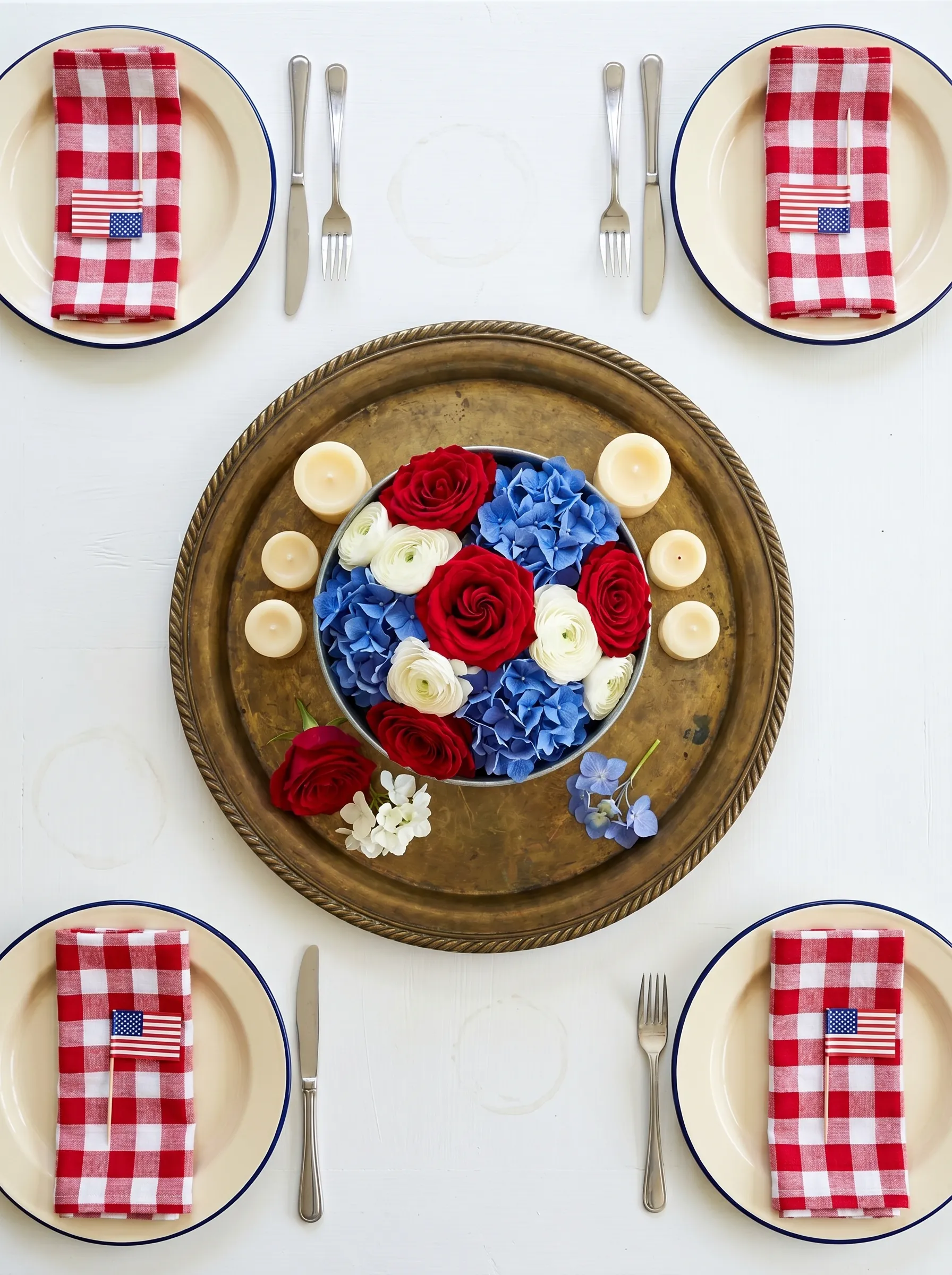
Take a large, aged brass tray — rope-edged or hammered, the kind with visible patina — and place it in the center of a white or linen tablecloth. Set a galvanized or stainless metal bowl inside the tray and fill it with water just deep enough to hold the flower heads in place. Arrange red roses, blue hydrangea clusters, and white ranunculus heads loosely across the water surface.
Surrounding the bowl on the tray, place six to eight small pillar candles or votive candles — unlit for daytime, lit for evening — distributed evenly around the bowl’s circumference.
At each place setting, fold a red gingham check linen napkin in thirds, then fold it again into a wide rectangle and tuck a small American flag through the fold so it stands upright against the plate. Cream-colored enamelware plates with a navy rim complete the look.
The brass tray allows for the occasional fallen bloom or scattered petal to exist gracefully. Let it.
The Patriotic Cowboy Boot Vase With Wild Mixed Stems
Source a ceramic or resin decorative cowboy boot in red, white, and blue — this is the kind of novelty container that actually earns its place because the boot itself does the patriotic work, freeing the flowers to be more interesting. Fill the boot with a wild, garden-gathered-looking mix: red poppies or carnations for height, blue wildflowers or delphinium spikes, variegated fern and pale-tipped greenery for movement.
Add several curled red-and-white striped decorative stems — like coiled ribbon or twisted fabric stems — throughout the arrangement for graphic interest and vertical drama. Wrap a full-width stars-and-stripes ribbon around the neck of the boot and let the ends trail down. The ribbon should be wide, at least two inches, and substantial in length.
Place it on a simple jute runner with no additional staging. The boot needs breathing room to read as a design object and not a tchotchke. This one works best as a dining table centerpiece on a long farmhouse-style surface.
The Galvanized Bucket With Garden-Gathered Peonies and Dahlias
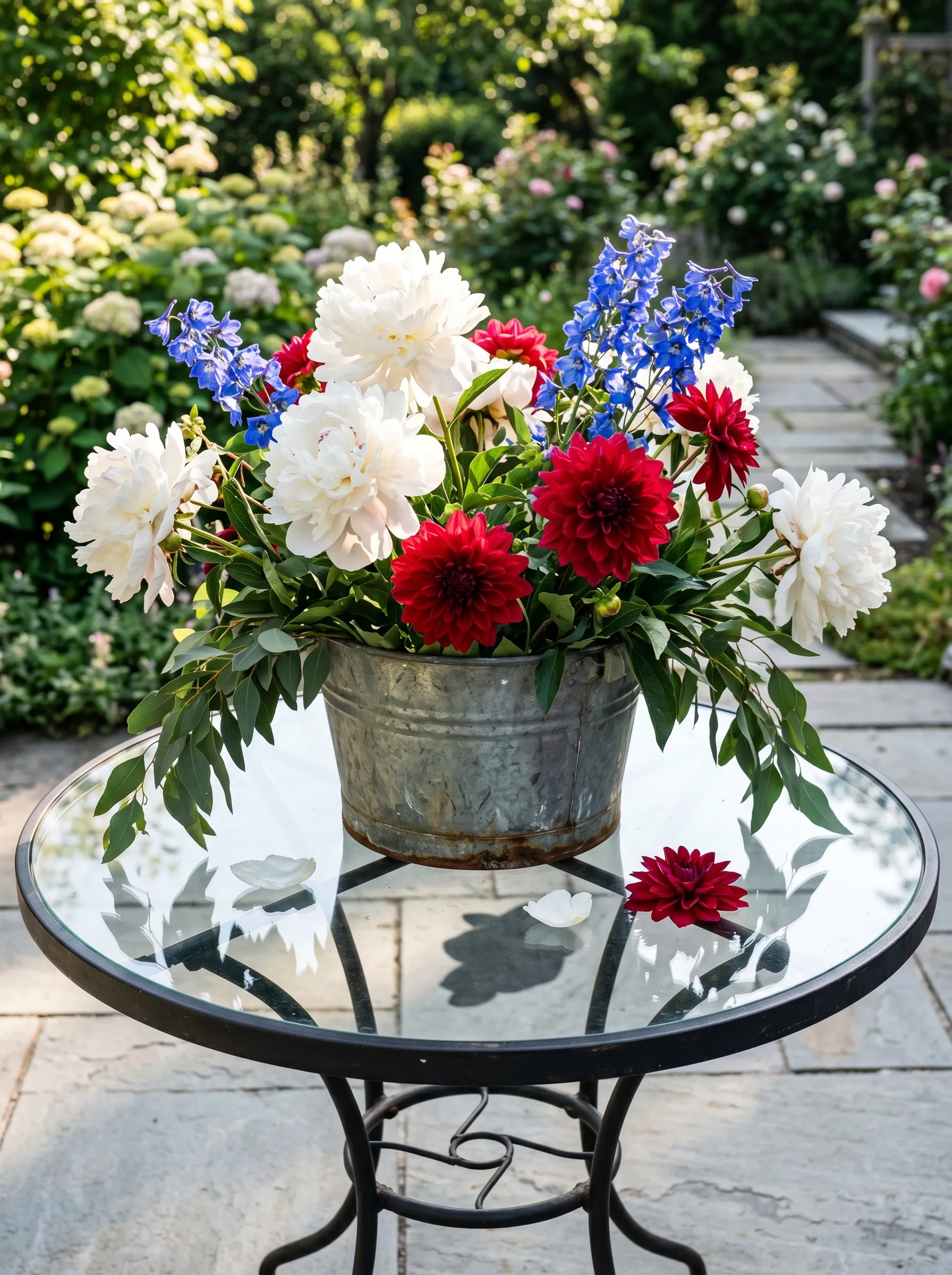
Use a wide galvanized metal bucket with visible texture — not the smooth florist kind, but the genuinely worn kind — and fill it with a generous, loosely structured arrangement. White peonies are the lead bloom; use the fully opened ones that are almost blown, because their softness is what makes the arrangement feel abundant rather than tight.
Add dark red dahlias throughout in clusters of two or three — pompom variety rather than cactus, for density. Finish with tall blue delphinium spikes extending well above the rest of the arrangement, uneven in height, and long stems of eucalyptus or greenery draping over the bucket’s edge.
Place the bucket directly on a glass-top bistro table outdoors, or on a stone surface in the garden. The raw metal against the natural setting is the entire point. No tray, no runner, no staging. Let it sit on the surface alone like it was carried in from a cutting garden.
The Wall Art and Vignette Pairing That Uses Vertical Space
Frame a large navy-background print with the letters “USA” — each letter filled with a different textile pattern, stars on the U, floral on the S, gingham on the A — and hang it at eye level on a white wall. Below it, place a warm wood console or side table.
On the table, set a substantial white ceramic pitcher — the classic kind with a wide body and a short spout — filled generously with blue and white hydrangea heads, with three to four American flags tucked in at staggered heights. The flags should stand taller than the flowers on their wooden sticks.
To the left of the pitcher, stack three or four vintage-looking hardcover books in dark, worn tones — navy, burgundy, cream — and set a single brass candlestick with a white taper on top of them or beside them. The candlestick and book stack together are doing the grounding work that makes the whole composition feel complete rather than just a vase on a table.
The art above is the ceiling; the vignette below is the floor. Everything between them is negative space.
The Aqua Ball Jar With Peonies, Mint, and Baker’s Twine
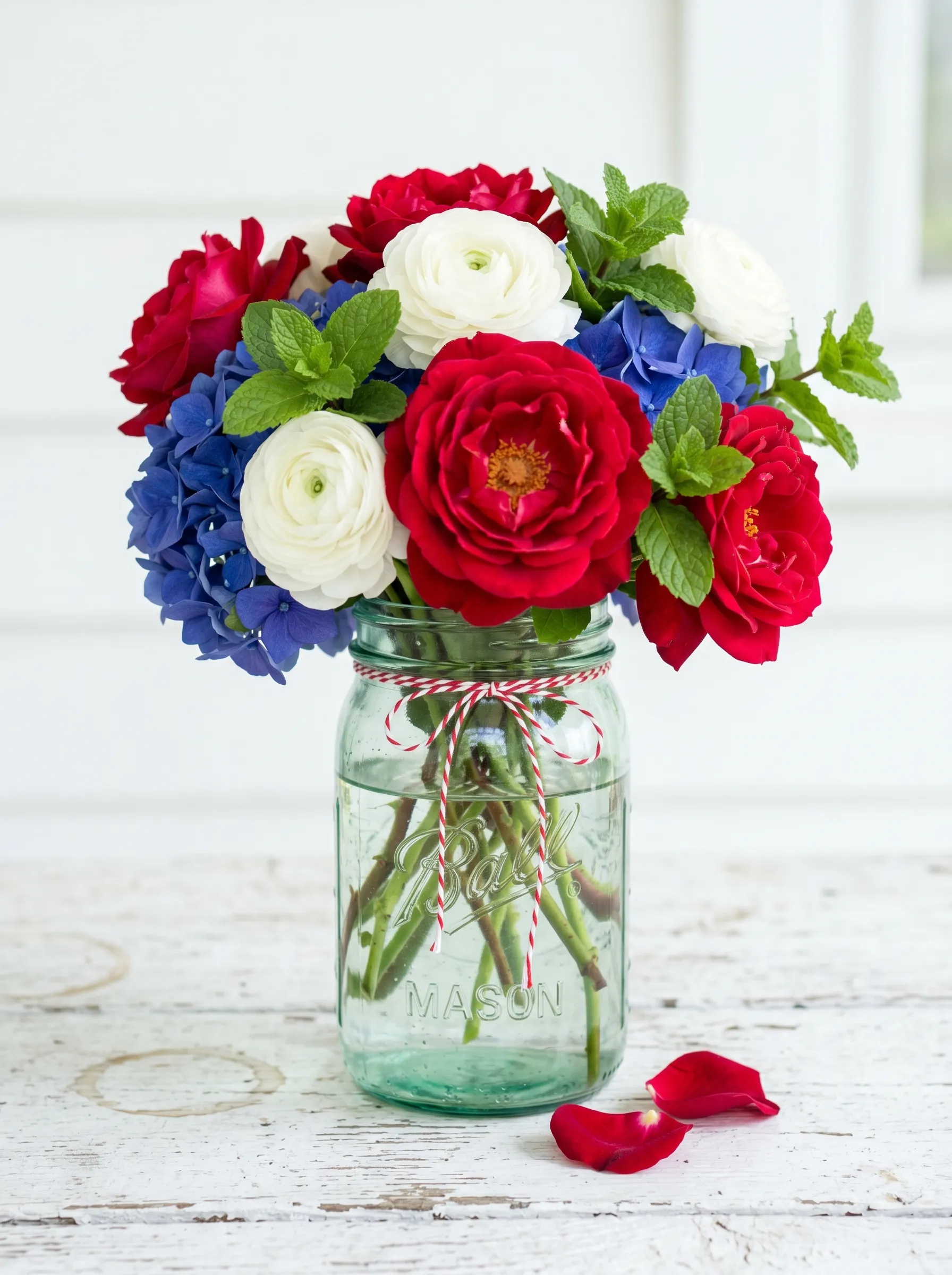
Use a wide-mouth quart Ball mason jar in aqua glass. Gather stems of deep red peonies and large red garden roses — the English rose variety if possible, for their scrolled petal density. Add white ranunculus throughout for roundness and white contrast. Fill the gaps with blue hydrangea florets broken off the main head and tucked in low.
The unexpected touch: add several fresh mint stems throughout the arrangement, leaves and all. The mint adds a bright green that is more alive than typical greenery, and it won’t be visible from a distance but will be noticed up close.
Wrap the jar neck with a length of red-and-white baker’s twine — the thin candy-stripe kind — and tie it in a simple bow rather than a loop. Place the jar on a white-painted wood surface for maximum contrast with the aqua glass.
This is one of the most accessible centerpieces to build. Everything in it is findable at a grocery store, a hardware store, and a craft shop.
The Coastal Sand Garden With Flag Rocks and Pillar Candles
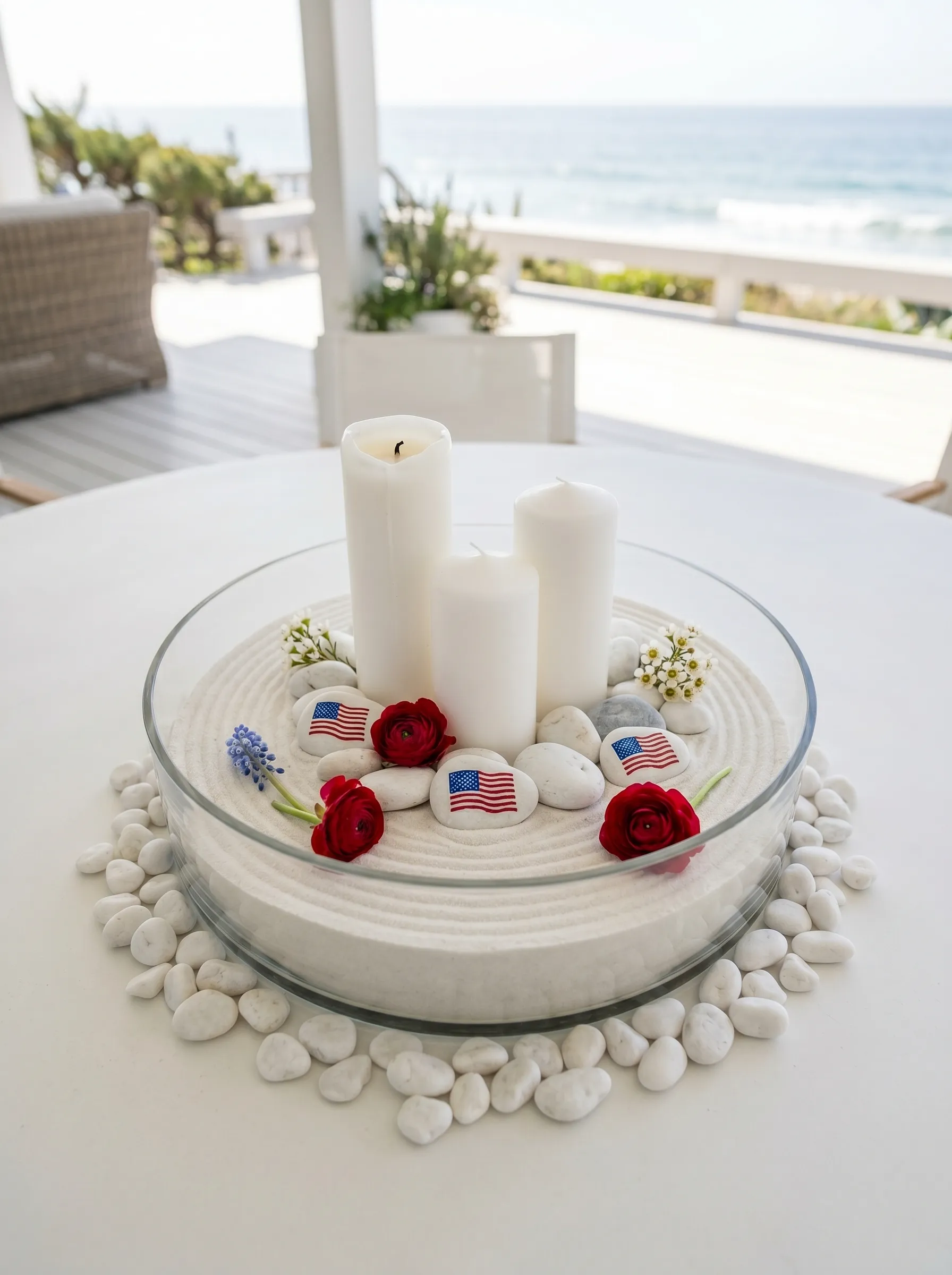
Fill a wide, shallow glass bowl — the kind used for floating candles, at least 14 inches in diameter — with fine white sand to a depth of about two inches. Use a chopstick or pencil to rake a simple concentric circle pattern into the sand surface.
Set two or three white pillar candles directly in the sand, varying the heights — one tall, one medium, one short, angled slightly together. Tuck red ranunculus heads or small red roses into the sand in a loose ring around the candle bases. Add a few stems of grape hyacinth or blue muscari at the sides. Nestle several smooth white river rocks into the sand; paint or stamp small American flags onto the rock faces using acrylic paint.
Ring the outside of the bowl with additional white pebbles, placed closely together to form a natural border.
Place this on a white outdoor table with an ocean or pool view if available — the setting amplifies the coastal reading. Indoors, it works best on a white or pale surface with minimal surrounding decor.
The Hurricane Glass and Geometric Terrarium Candle Cluster
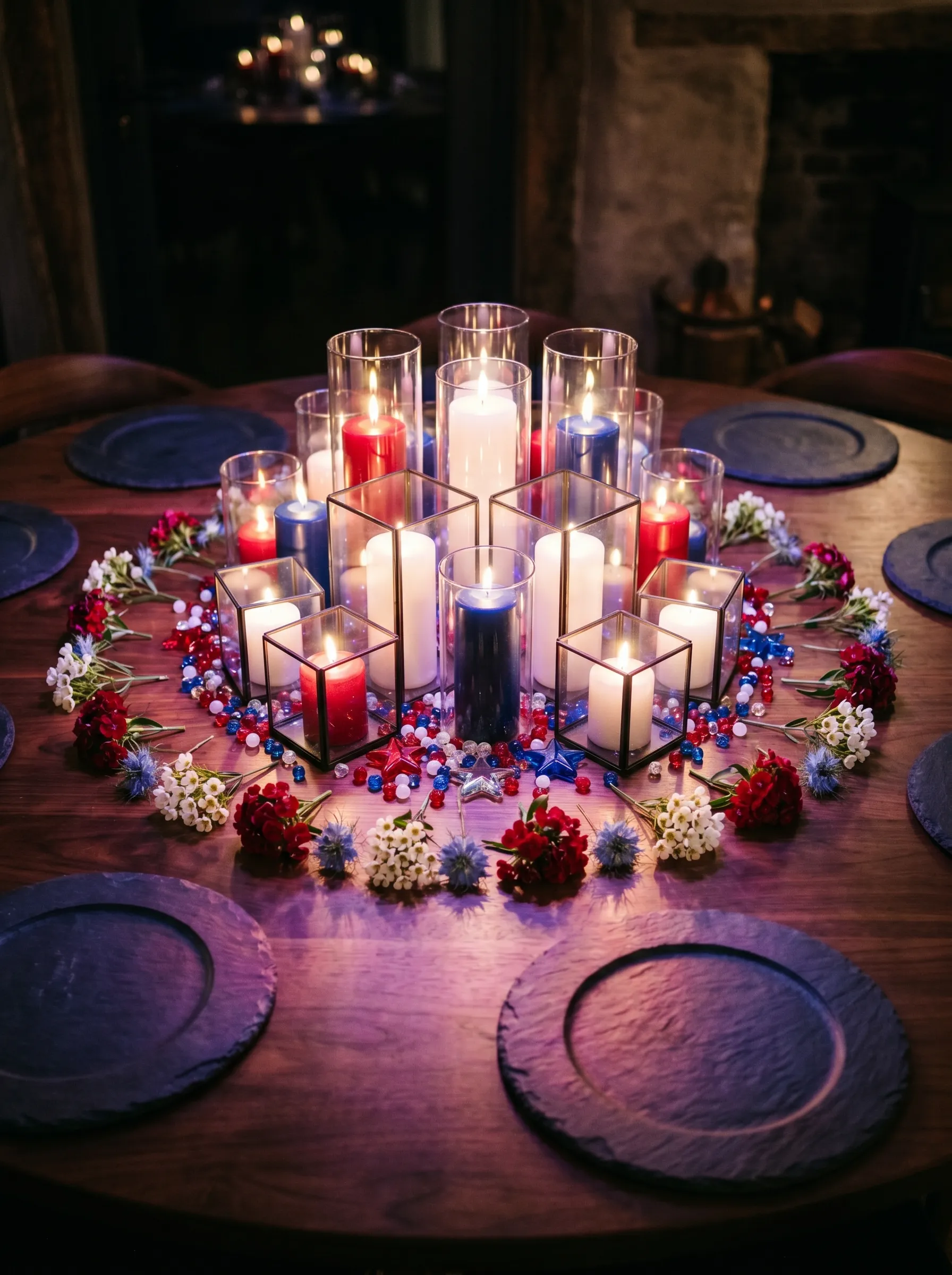
On a round dining table, build a centerpiece of mixed glass vessels containing red, white, and blue candles. Use a combination of tall cylindrical hurricanes and small square geometric terrariums — brass-edged glass cubes work best. Arrange them in a cluster, tallest in the center, working outward and downward in height.
Place a deep navy pillar candle at the absolute center, surrounded by white pillars at varying heights, and red votives at the outer ring. Leave the glass sides clear so the candlelight refracts through.
Surround the entire candle cluster with a loose garland of small mixed blooms laid flat on the table — red berry clusters, white wax flowers, small white pompom flowers, blue eryngium or thistle. Red, white, and blue transparent bead scatter and small metallic star shapes at the base of the arrangement provide sparkle without bulk.
The genius of this centerpiece is that it reads as maximally elaborate from a distance but is entirely achievable with votives from a dollar store and blooms from a garden.
The Full Backyard Setup That Works as a System
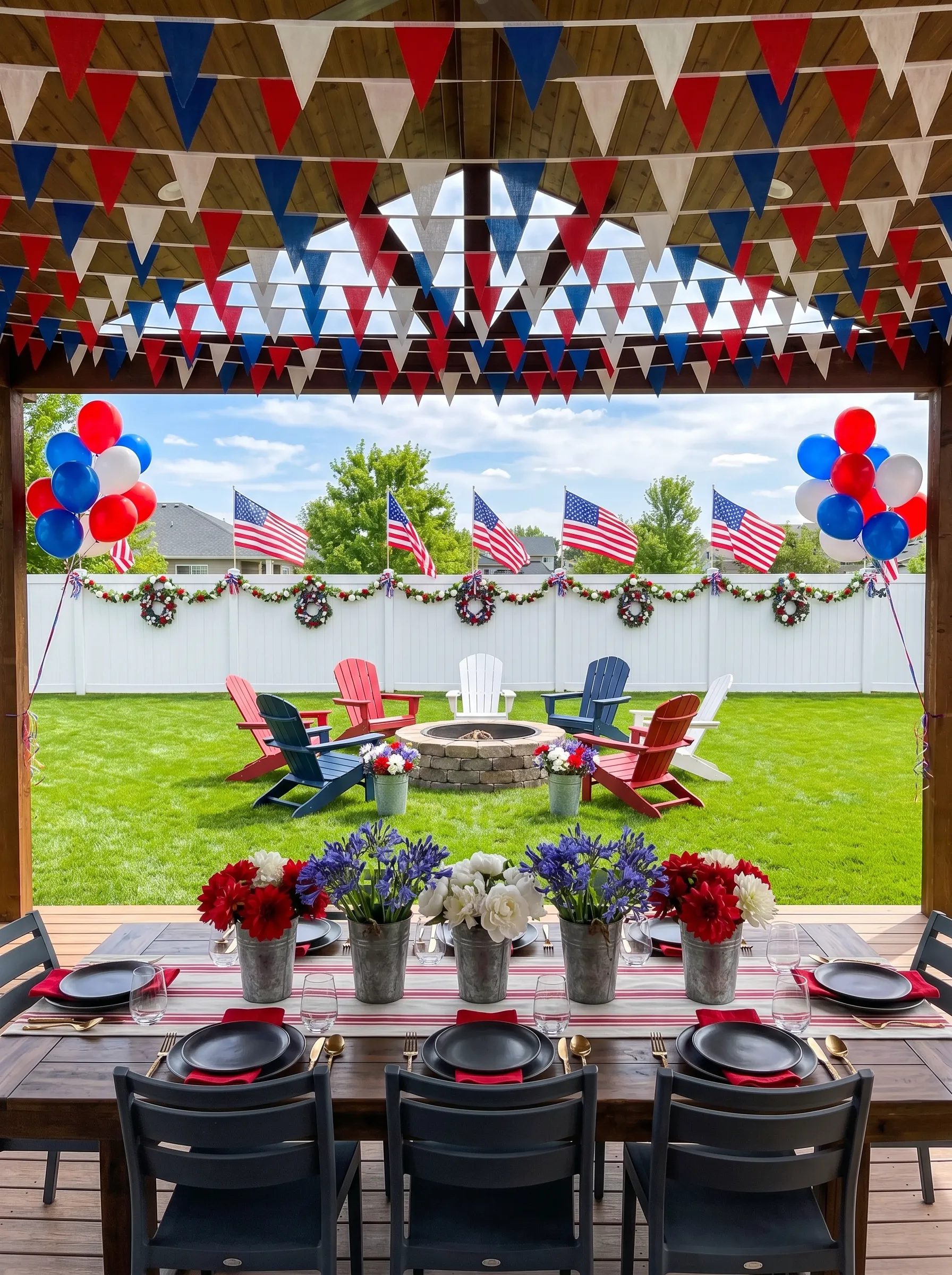
This isn’t a single centerpiece — it’s a full outdoor installation built on one decision: commit to the overhead plane. String multiple rows of red, white, and blue triangular pennant bunting across the ceiling of a covered pergola or patio overhead, running them in both directions to create a full canopy of pattern.
Once the ceiling is decided, everything below it can be relatively simple. Run a red-and-white striped table runner the full length of the dining table. Fill multiple galvanized metal buckets with coordinated flower groupings — one with red dahlias, one with white peonies, one with blue agapanthus or blue salvia — and place them in a row down the table center, evenly spaced.
In the yard beyond the table, paint or arrange Adirondack chairs in red, white, blue, and natural wood. Line the fence with American flags at regular intervals and string a greenery-and-wreath garland between them.
Red, white, and blue balloon clusters at the outer corners of the patio provide height and color without requiring anything structural. Fire pit seating with galvanized planters at each side mirrors the table palette.
The principle here: when you control the ceiling, you control the entire visual atmosphere of the space.
The Brass Urn With Dark Florals and Trailing Ivy
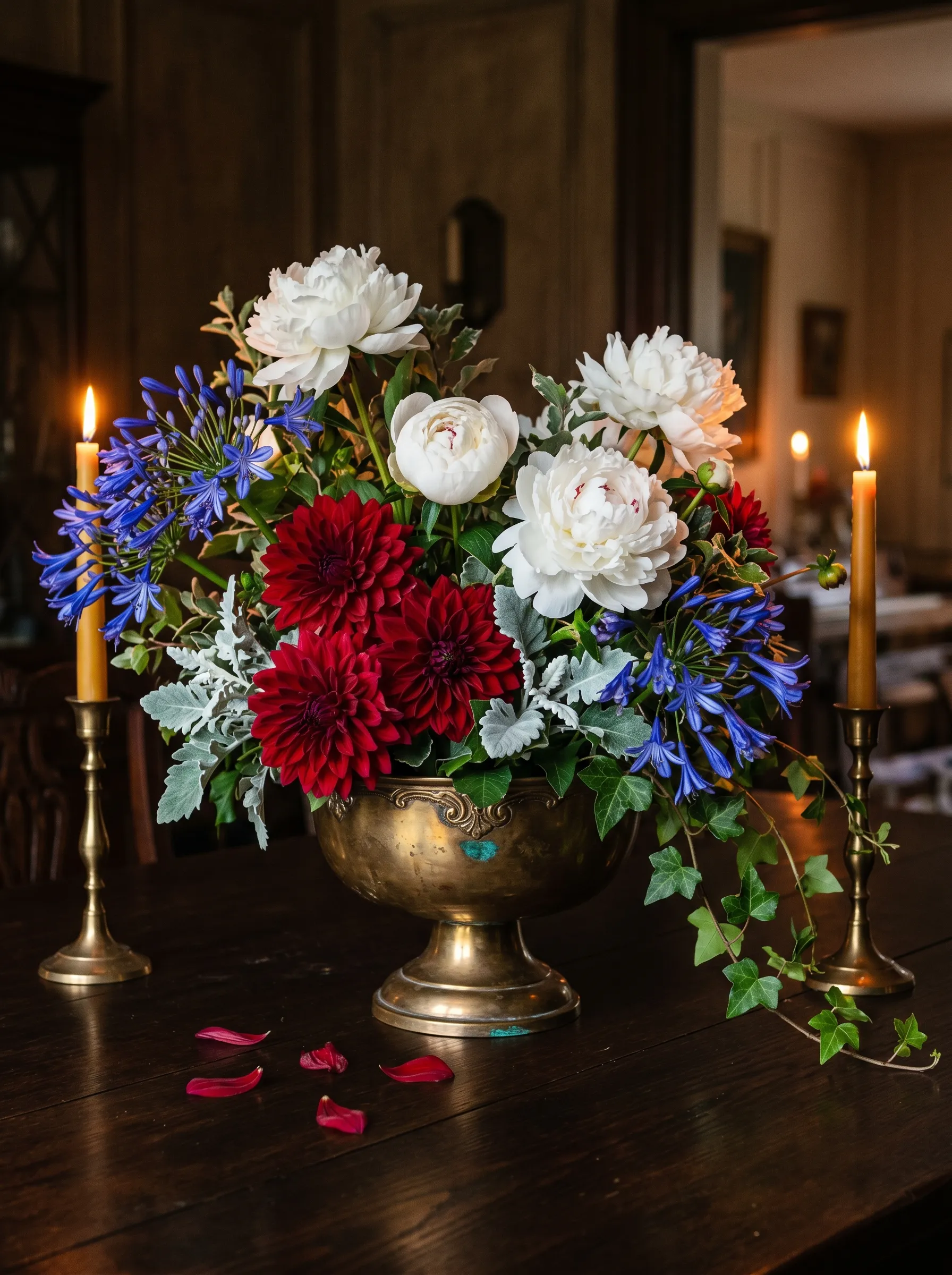
Source a substantial footed brass urn — the real kind, with patina and weight, not the spray-painted kind — and use it as the vessel for a dinner party centerpiece. Fill it with a dramatic, old-world arrangement: deep burgundy dahlias in pompom form clustered at the front, large white peonies arching at the back and sides, blue agapanthus or blue delphinium providing the tall reaching lines, and dusty miller threading throughout for silver-grey texture.
Allow ivy to trail out of the arrangement and down over the urn’s body, continuing across the table surface on both sides. Let it go further than feels comfortable. Two feet of trailing ivy on each side is not too much.
Flank the urn with two simple brass taper candlesticks at equal heights, with cream-colored tapers.
This is the centerpiece for a grown-up dinner party. It belongs on dark wood, by candlelight, with cloth napkins. It does not belong at a picnic, and that’s completely fine.
The Boho Low Table With Eucalyptus Garland and Pampas
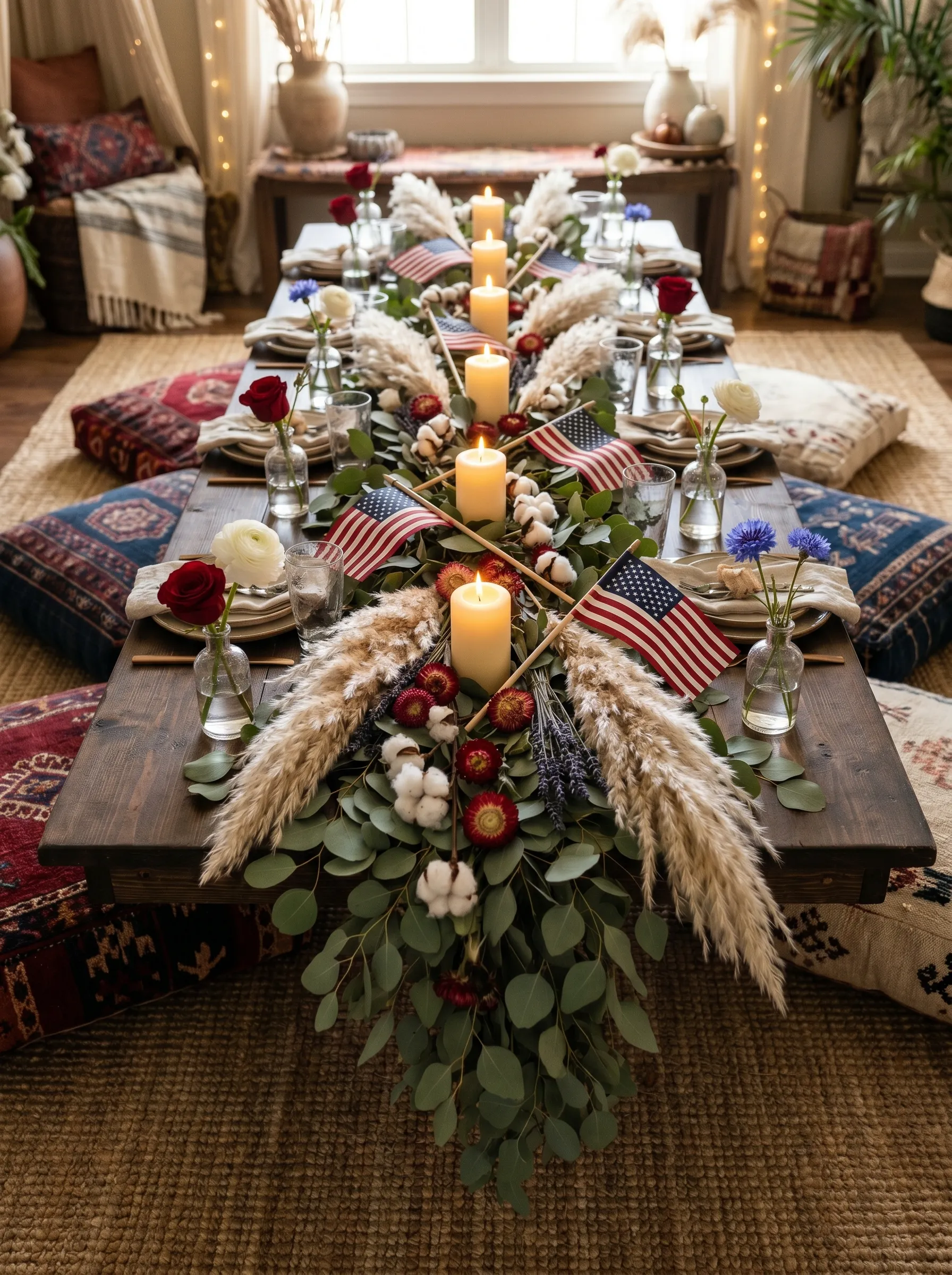
Build a living garland runner for a low dining table by laying a long eucalyptus stem base first — seeded or silver dollar eucalyptus, in a dense line running the table’s full length. Add to this dried pampas grass sprays inserted at intervals throughout, angling outward. Tuck dried white cotton stems, bundles of dried lavender, and small dried red strawflower clusters through the garland.
Down the center of the garland, set four or five cream pillar candles at irregular heights directly on the table surface. Add small individual glass bud vases at each place setting containing a single red rose or white ranunculus. Thread two or three mini American flags on wooden sticks into the garland at varying angles.
Floor cushions — kilim-patterned, Persian rug-style — replace chairs at the table sides.
This is the patriotic centerpiece for the person who is always more boho than traditional but still wants to lean into the holiday. The flags don’t feel incongruous here because everything else is earthy and natural. The flag is the one graphic element in an otherwise organic composition.
The Amber Bottle Collection With Single Wildflower Stems
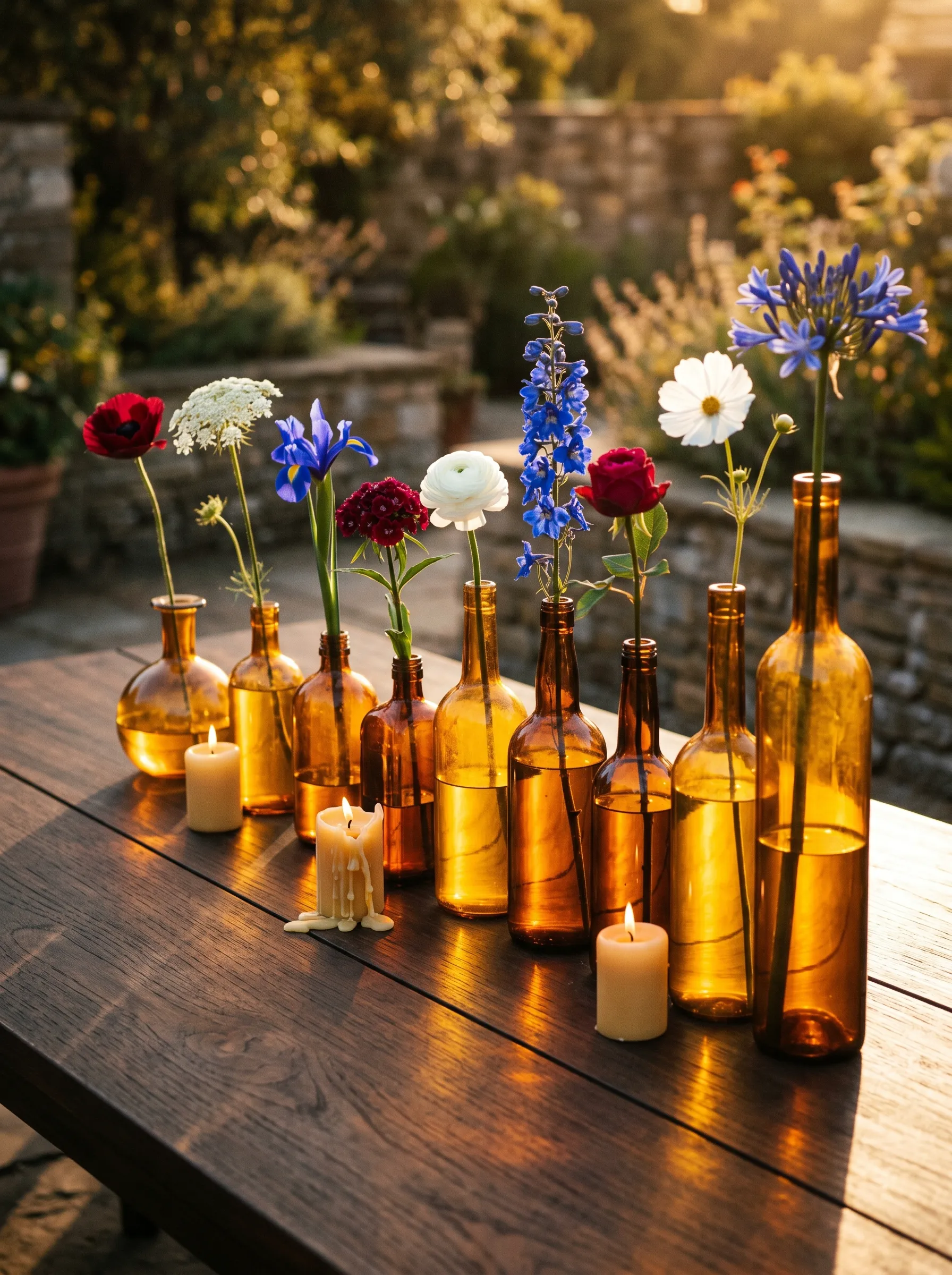
Gather a collection of amber glass bottles in varied sizes — beer bottles, wine bottles, small round bottles, tall skinny bottles. Wash them and remove any labels. Arrange them in a loose, overlapping row down the center of an outdoor table, mixing heights and silhouettes so the group reads as a collection rather than a lineup.
In each bottle, place a single flower stem. Vary the flower choice across the palette: a red poppy in one, a white Queen Anne’s lace in another, a blue iris in the next, a white ranunculus, a blue delphinium spike, a deep red sweet William, a white cosmos. Each bottle gets one stem, one decision, and full ownership of it.
Between and in front of the bottles, set three or four short white pillar candles at varying stages of being used — let the wax drip. The dripping wax is the detail that makes this look curated rather than styled.
The amber glass catches the golden hour light like nothing else. Photograph this one at sunset.
The Folded Flag Shadow Box Memorial Table
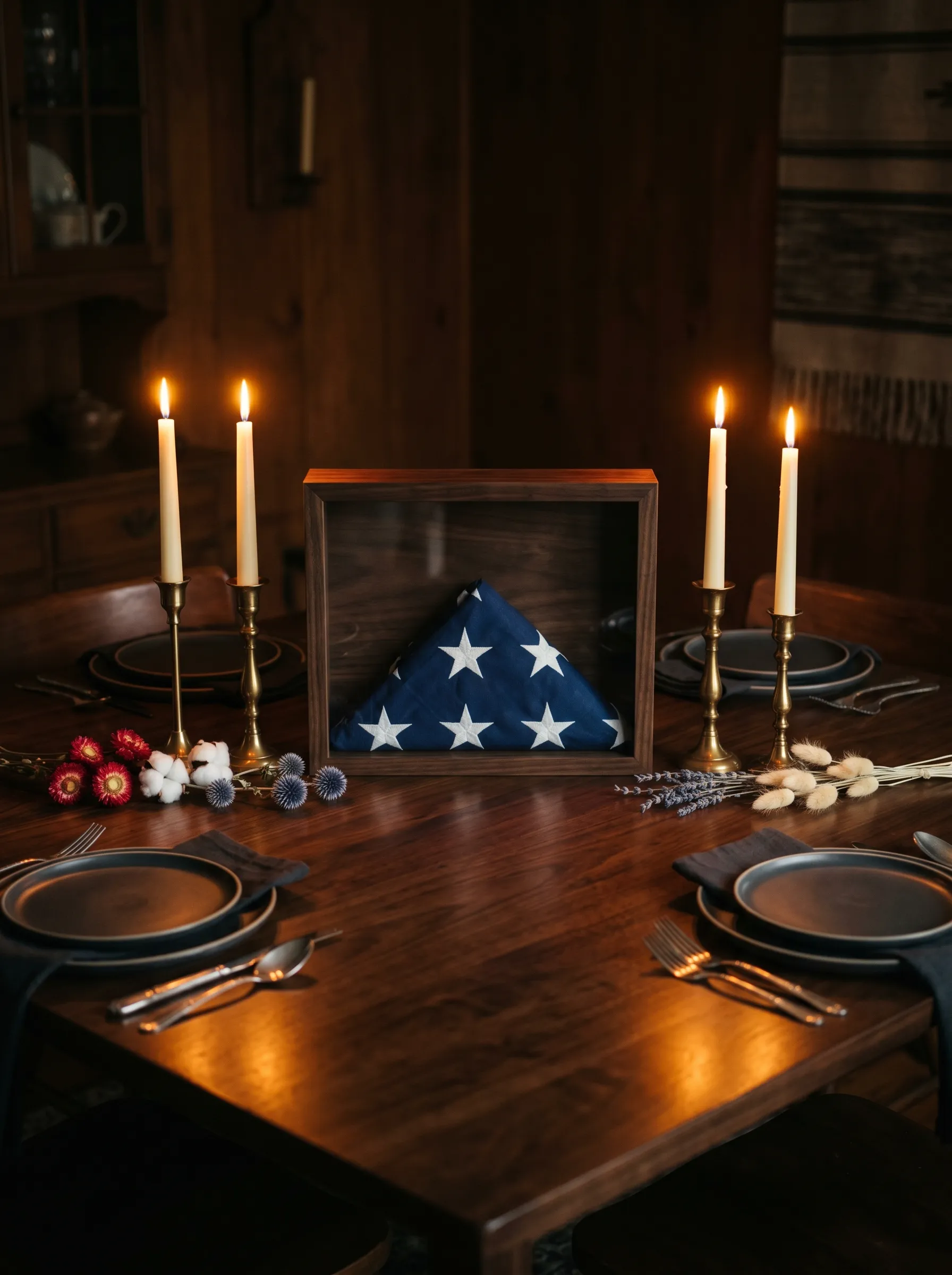
Source a wall-mounted shadow box frame — the kind designed to display a ceremonially folded military flag — in dark walnut or cherry stain. Place the folded flag inside it and stand the framed box upright at the center of the table rather than mounting it on a wall. It becomes an architectural focal point rather than a wall piece.
Flank the shadow box with two matching brass candlestick holders, each with a tall cream taper candle lit. The candlesticks should stand at the same height as or slightly shorter than the shadow box frame.
Scatter dried botanicals loosely across the table surface: red strawflower heads, white cotton bolls, blue-grey eryngium thistle, dried lavender bundles, bunny tail grasses. These should feel naturally fallen rather than arranged.
This is not a cheerful centerpiece. It’s a respectful one. It is appropriate for Memorial Day or a Fourth of July where the gathering wants to acknowledge meaning rather than just party. The dark wood table and candlelight do the rest of the work.
The Crystal Vase With Garden Roses and Dark Anemones
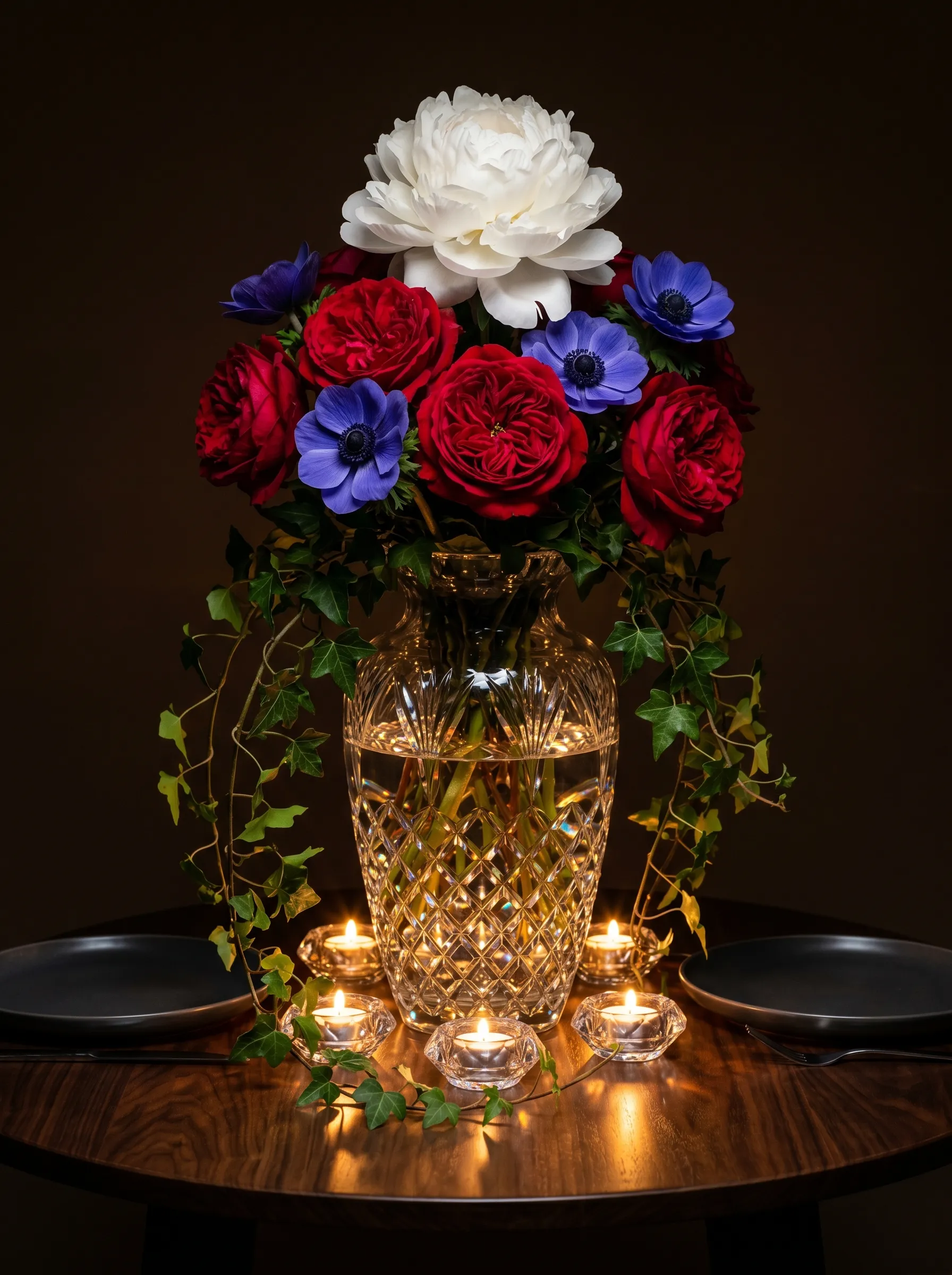
Use a heavy cut-crystal vase — the diamond-facet type that refracts light dramatically — as the centerpiece vessel. The crystal is doing substantial design work here and should be at least 10 to 12 inches tall. Fill it with deep red English garden roses cut to an asymmetrical mixed height, full heads opening rather than tight buds. Add deep blue-purple anemones throughout — the papery ones with the black eye at center — at slightly varying heights. Crown the arrangement with one oversized white peony at the top, allowed to sit well above everything else as the clear focal point.
Thread trailing ivy stems through the arrangement and allow them to cascade down the crystal vase sides onto the table surface. Place four or five clear crystal tea light holders directly around the vase base and light them.
This centerpiece is for a dining table in a formal or semi-formal setting. It is not casual. It is direct about its own beauty. The contrast between the dark room, the glowing crystal, the saturated red and blue flowers, and the single enormous white peony is a deliberate statement about what the holiday can look like when you stop being polite about it.
What Every Good Patriotic Centerpiece Actually Has in Common
Looking at all of these, the thing none of them are doing is performing patriotism. They’re not piling on symbols in hope that quantity adds up to conviction. They’re each making one clear decision — about a vessel, a color weight, a texture, a setting — and then following it through without flinching.
That’s what separates the table that photographs well and the table everyone remembers from the one that just had red flowers in it.
Red, white, and blue is not a decoration strategy. It’s a constraint. Great design has always done its best work under constraints. The palette is fixed. Everything else — the vessel, the scale, the texture, the light, the supporting details — is entirely yours to decide.
The flag doesn’t do the work. You do.