
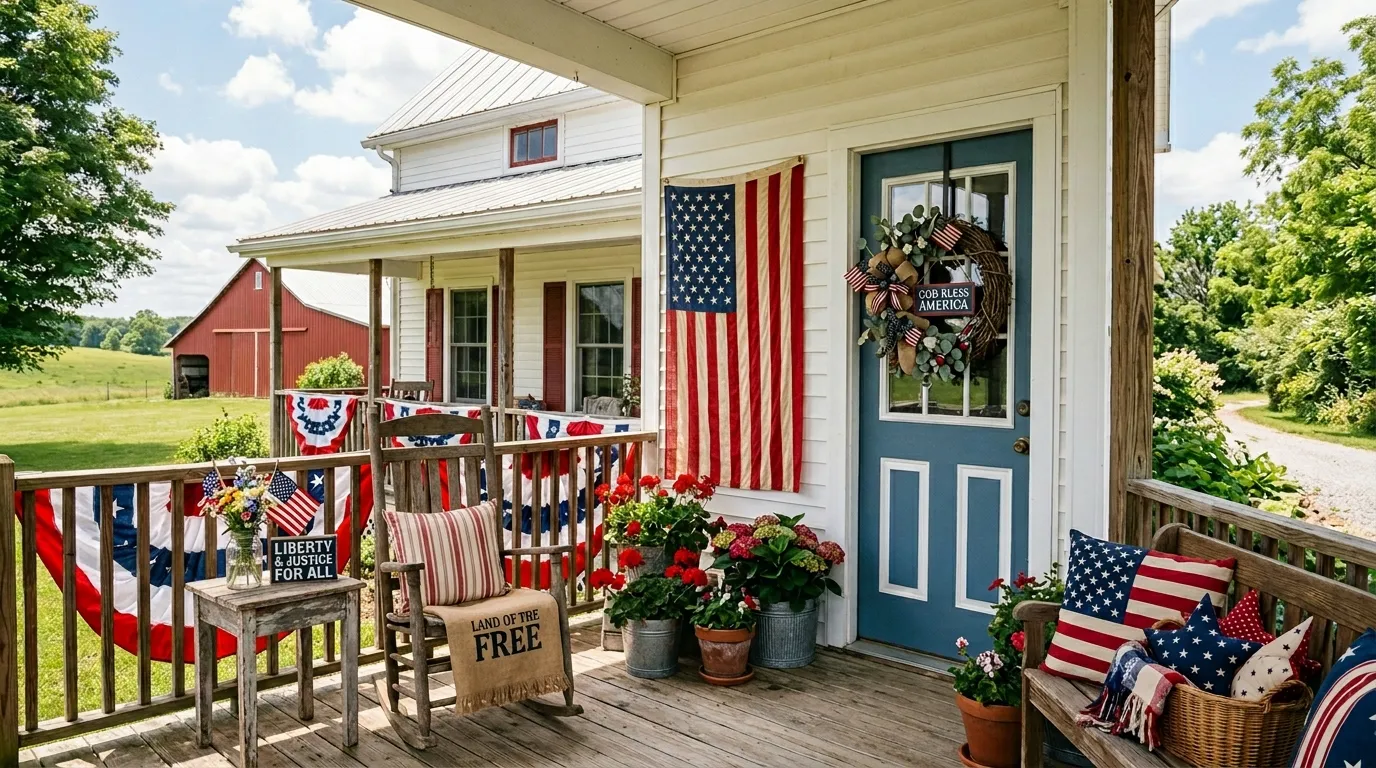
Farmhouse decorating has a test that most seasonal décor fails.
The test is: does this look like it belongs here, or does it look like something someone brought in for the holiday and will remove on July 5th? Plastic banners fail. Generic themed tablecloths fail. Anything that could be described as “kit” fails.
What passes is harder to define but easy to recognize. It’s the worn crockery crock holding zinnias and cornflowers. It’s the old flag on the shiplap wall that wasn’t bought for the occasion. It’s the gingham napkin that’s been washed enough times to go soft. It’s the braided rug underfoot that would be there any other week of the year.
Farmhouse decorating for July 4th succeeds when the patriotic elements read as additions to a home that already exists, rather than a temporary overlay applied to a neutral surface. The home’s character stays intact. The holiday adds to it rather than erasing it.
Here’s how to get that right.
Why Farmhouse Patriotic Décor Usually Fails
The failure mode is specific and consistent. Once you see it, you can’t stop seeing it.
The Theme Store Problem
Farmhouse style is built on authentic, collected, used things: the crock that held pickles before it held flowers, the pitcher that was a wedding gift and has a chip on the handle, the flag that belonged to someone’s grandfather and has yellowed at the edges.
The moment you bring in manufactured items that are designed to look farmhouse — the distressed wooden sign that says “America the Beautiful” with precisely calibrated paint wear, the mason jars with “Patriotic” printed on the label in a font that knows what it’s doing — the whole aesthetic deflates. You can’t fake the authentic. You can only use what’s actually authentic and add seasonal color through flowers, textiles, and natural materials.
This doesn’t mean you can’t buy anything new. It means the new things need to be genuine functional objects — a red enamel coffee percolator, actual gingham, a real crock — not decorative items performing the role of genuine objects.
The Over-Theming Problem
A farmhouse styled for July 4th in every room simultaneously stops being a farmhouse and becomes a themed attraction.
The porch, the dining table, and the mantel together are plenty. The kitchen can have a gesture — flowers on the island, flags in the utensil crock. The bedroom might have a flag quilt, nothing more. The bathroom earns its small moment with a few roses in a jar and a framed flag print.
Spreading patriotic decoration into every corner of the house produces a saturation that works against the farmhouse sensibility, which is inherently about restraint and function. A farmhouse is a working house. It does not exist to be decorated. The decoration exists within it, quietly, alongside everything else the house does.
The Material Mismatch
Farmhouse materials are specific: aged wood, white enamelware, galvanized metal, linen, cotton, cast iron, cane, wicker, braided cotton.
Patriotic decorating defaults to plastic, paper, vinyl, and synthetic fabric. When those materials appear in a farmhouse context, they announce themselves as out of place. The cheap flag bunting on a porch railing that already has weathered wood columns and a braided rug — the bunting is fine, but if it’s the plastic printed kind rather than fabric, every other element in the composition notices.
Material choice is the fastest way to elevate farmhouse July 4th decorating. Replace the paper with fabric. Replace the plastic with metal. Replace the printed vinyl banner with a worn cotton one. The palette stays identical. The result is entirely different.
The Design Logic Behind Farmhouse Patriotic Decorating
What makes the best examples in this collection feel like they grew from the house rather than being applied to it.
The Found Object Principle
Every farmhouse has a vocabulary of objects that belong to it — things that have been used, repaired, kept. The crockery crock. The galvanized milk can. The wicker basket. The cast iron skillet on the wall. The worn wooden cutting board.
These existing objects become the vessels and containers for seasonal color. The crock holds zinnias instead of kitchen tools. The milk can becomes the vase for a wildflower arrangement. The wooden cutting board sits on the kitchen island with a bread loaf beside it and a small mason jar of cornflowers at the corner.
The seasonal color arrives through flowers and textiles. The objects themselves are permanent residents.
The Flag as Furniture
In farmhouse decorating, the American flag doesn’t function as decoration in the conventional sense. It functions more like furniture — a large, permanent-feeling object that anchors a wall the way a dresser anchors a bedroom.
Framed in a shadowbox or simple wood frame, an aged cotton flag hung on a shiplap wall behind a dining table doesn’t look like someone prepared for a holiday. It looks like part of the house’s character, as permanent as the fireplace or the wide-plank floors.
The flags that read as seasonal decoration are the small stick flags tucked into a flower arrangement or the folded flag in a case on a bedroom wall. The large flag presented on the wall as near-architectural — that one reads as belonging.
Wheat, Cotton, and Natural Dry Goods
The material palette unique to farmhouse July 4th styling is the inclusion of agricultural dry goods alongside the patriotic florals. Wheat stalks extending from the same crock as the red zinnias. Dried cotton stems alongside roses and thistle. A bound bundle of red wheat tied with a ribbon on an open shelf.
These materials remind you where farmhouses come from. They are not decorative accessories designed to look like wheat. They are wheat. They grow in July. They belong in a farmhouse kitchen without explanation.
4th of July Farmhouse Decor Ideas
The Weathered Red Door with Crossed Flag Wreath
A weathered red door is its own patriotic statement before anything touches it. The peeling paint, the aged brass knob, the patina of years — all of it reads as American in the original sense, before decoration was invented for the occasion.
Build a wreath on a grapevine or eucalyptus ring base — the kind that looks like something pulled from the hedgerow rather than manufactured. Work in blue hydrangea clusters at the three and nine o’clock positions, leaving the top and bottom of the ring as primarily green. Tuck red berry picks — bittersweet or winterberry — throughout the greenery in a loose scatter. Add a layered bow at the base: natural burlap as the outer bow, a flag-print ribbon inside it, and a stars pattern ribbon as the inner loop. Three ribbons, but only one bow structure.
Push two full-size American flags on wooden or brass dowels through the wreath at crossed angles, so the flag cantons appear above the wreath’s top arc and the stripes extend outward from the center. The crossing point sits behind the bow.
Plant terracotta pots at the porch base with the three-flower combination: red geraniums, white petunias, blue lobelia. Keep the pots relatively small — not the oversized dramatic planters, just honest-sized terracotta. The door is the statement. The pots acknowledge the season.
The Farmhouse Kitchen Sink Vignette with a Statement Sign
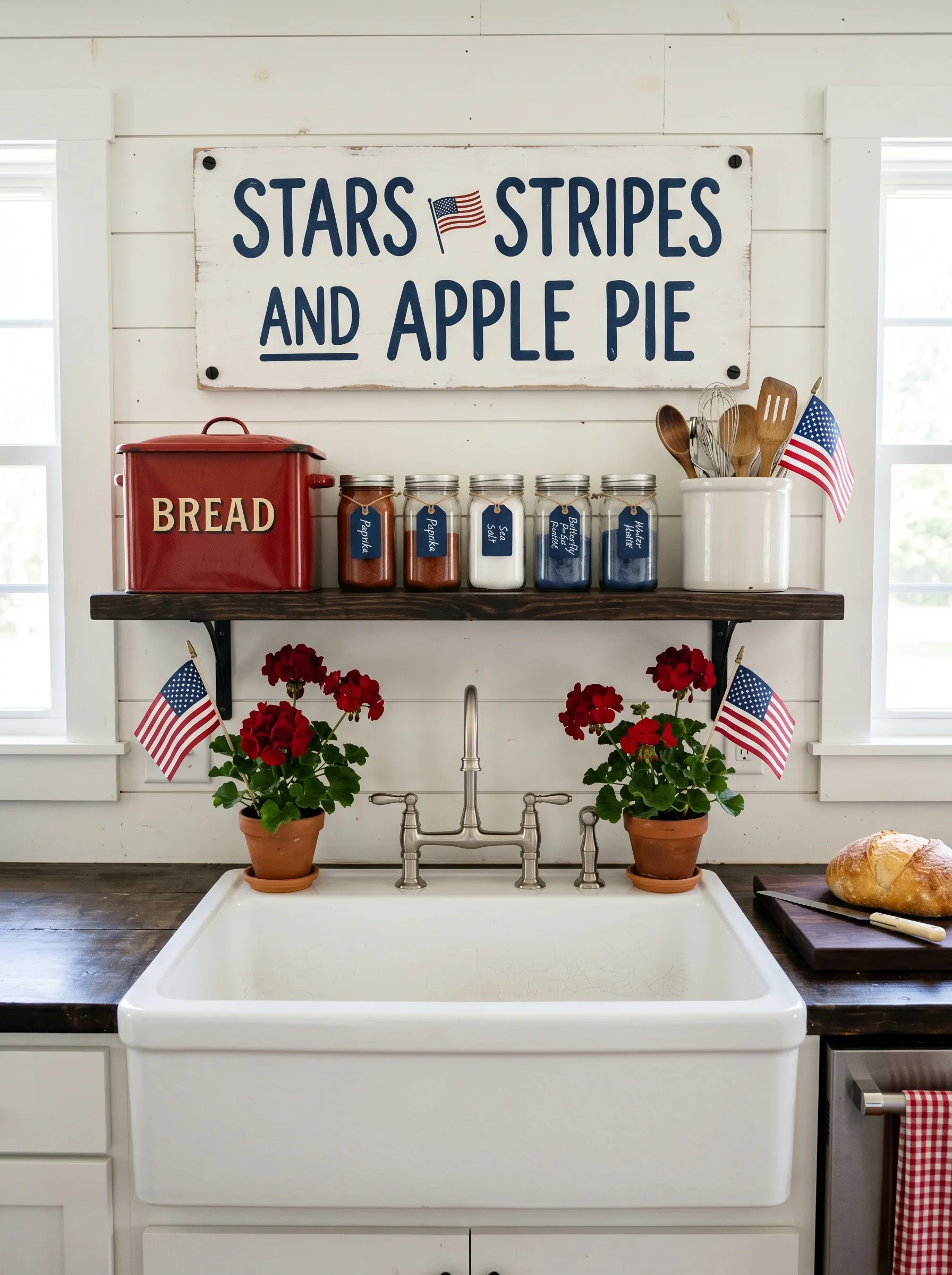
A farmhouse kitchen sink is the most-photographed interior surface of any farmhouse, and for good reason. The apron front sink, the bridge faucet, the window above — it is already a designed composition. July 4th gets one addition to each side and one statement above.
Mount a large painted wood sign above the sink — a board sign with hand-lettered words in navy on white, with deliberate but not manufactured paint wear. The specific text is less important than the typography quality and the sign’s material honesty. A sign that looks printed on wood is not the same as a sign painted on wood.
On the shelf above the sink: on the left, the red enamel bread box. In the center, a row of glass mason jars labeled with spice names, filling the shelf in an orderly line. On the right, a white ceramic utensil crock with wooden spoons, a whisk, and two small American flags tucked among the utensils.
On the countertop flanking the sink: two small terracotta pots of red geraniums, one on each side, each with an American flag pushed in at the back. The geraniums are in full bloom and look like they live there permanently — because in a farmhouse kitchen, they might.
The rest of the kitchen surface: a sourdough loaf on a dark wood cutting board at the far end of the counter, knife beside it. The loaf is not decoration. It is lunch. But it reads as perfect here.
The Coastal Farmhouse Living Room with a Flag Bundle Centerpiece
This room is a farmhouse that sits near water, and the decorating knows it.
The living room mantel holds a fabric banner: red felt letters spelling out a phrase on a white fabric ground, framed by a rag garland — strips of red, white, blue, and patterned fabric tied in a loose line from corner to corner of the mantel edge. The rag garland is hand-knotted from fabric scraps. It looks like something that took twenty minutes to make and cost nothing.
On the mantel, a landscape painting in a wood frame dominates — something with a white house, a garden in bloom, the suggestion of summer. Next to it, a brass candlestick and a blue pot with a living plant. The mantel says: this is someone’s home, not a holiday installation.
On the coffee table below: a dark glass vase or bottle filled densely with small American flags, the 4×6 stick variety, all pointing in the same direction. A white ruffle-edged bowl beside it holds a few shells or small stones. A stack of books with a meaningful title visible provides the reading-life signal.
Throw pillows and baskets elsewhere in the room provide the texture and warmth that July 4th adds without announcing itself.
The Pergola at Night with Star Lights and Fence LEDs
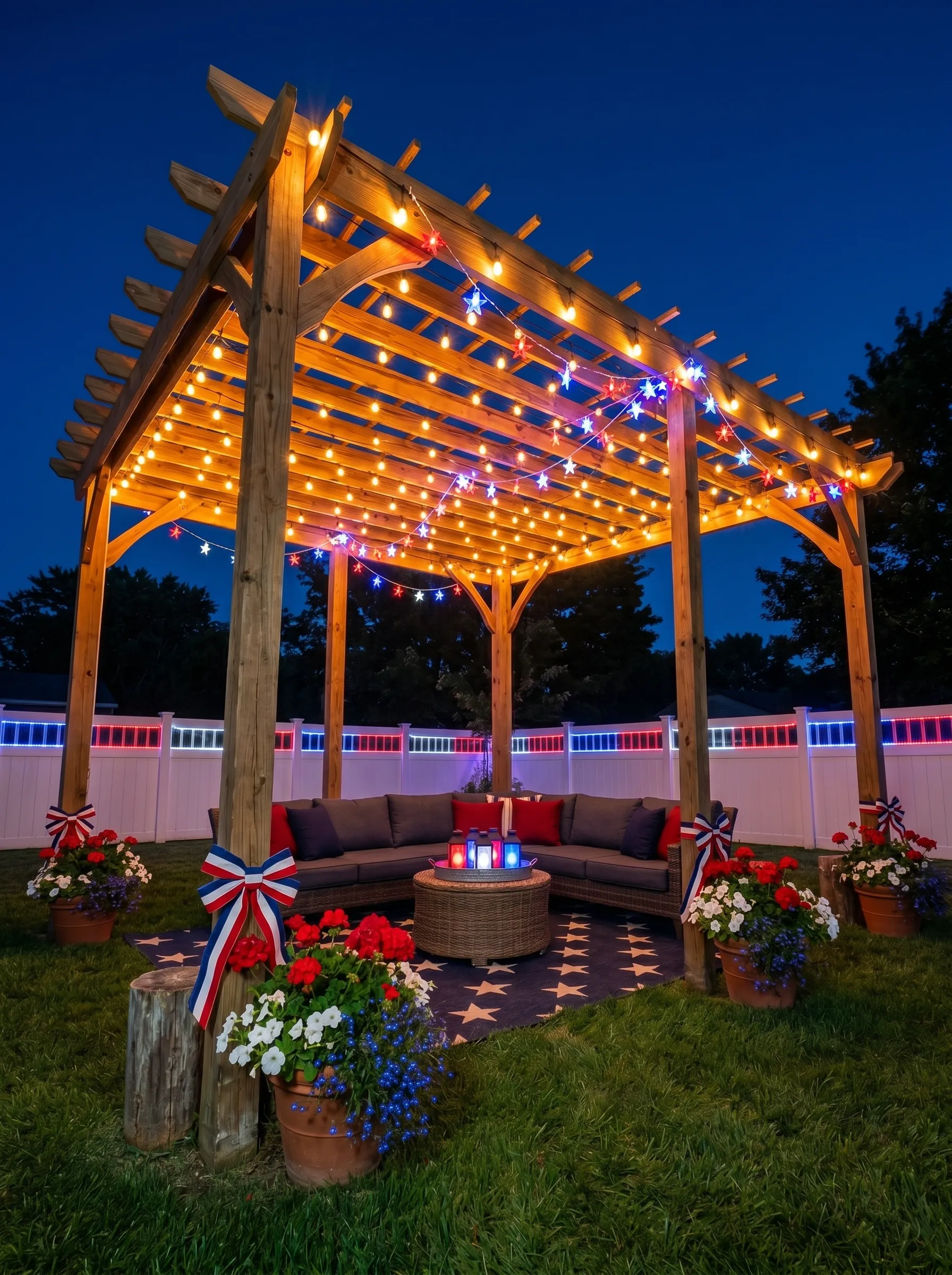
This is the outdoor space that understands lighting is the whole decoration after dark.
Run dense Edison-bulb café strings across all four beams of a pergola in a grid pattern, with bulbs at roughly 8-inch intervals rather than the sparse 12-inch standard. The density of warm light from the cedar pergola beams at night produces a quality of overhead illumination that is genuinely extraordinary against a deep blue summer sky.
Separately, run a string of star-shaped LED lights — in red, white, and blue — diagonally across one axis of the pergola canopy, cutting across the amber Edison grid at a contrasting angle. The colored stars against the warm amber create the two-layer lighting effect.
Along the white vinyl fence behind the space, mount LED strip lights in three runs: red at top, white at center, blue at base. The fence glows in stripes. From inside the pergola, sitting on the sectional with red pillows facing outward, the backlit fence reads as an art installation.
At the pergola posts, tie fabric bows in red, white, and blue wired ribbon. Terracotta pots of geraniums, white petunias, and blue lobelia at each base. The bow is the only explicitly decorative element on the post itself; the flowers are functional plants.
On the coffee table inside the seating: a galvanized tray with three colored glass lanterns — red, white, and blue — each with a pillar candle. A star-print outdoor rug on the ground.
This space looks like a photograph at 9:30 p.m. in July. Plan it for that moment.
The Layered Pattern Farmhouse Table with Collected Objects
This table succeeds because it breaks the rule that patterned surfaces shouldn’t be layered. In a farmhouse, they always are.
The base tablecloth is navy-and-white plaid — the kind of large check that reads as grain sack or picnic cloth. Over it, a red-and-white ticking stripe runner lays diagonally or straight down center. Under two place settings, a navy star-print fabric creates individual place mat zones within the larger pattern. Three different patterns on one table, all in the same two-color palette. This is farmhouse layering at its most unapologetic.
At the centerpiece, collect genuine farmhouse objects rather than purchasing new ones: a large white ceramic ginger jar as the tallest element, a small wicker basket holding greenery and flag pennants, a wooden star cut from scrap lumber, a small copper bell. These objects together tell a story of a house rather than a holiday store.
The place settings use stoneware plates with a slight texture — not perfect, not matching in the manufactured sense — and the napkins are charcoal linen with fringe, secured with a small copper bell tied in a leather cord. Gold flatware against the stoneware and the layered patterns reads as warmly as the objects deserve.
Red glass tumblers provide the red note at the table height while keeping everything else in the natural, worn palette.
The Balloon Arch Backyard Party with Cornhole Boards
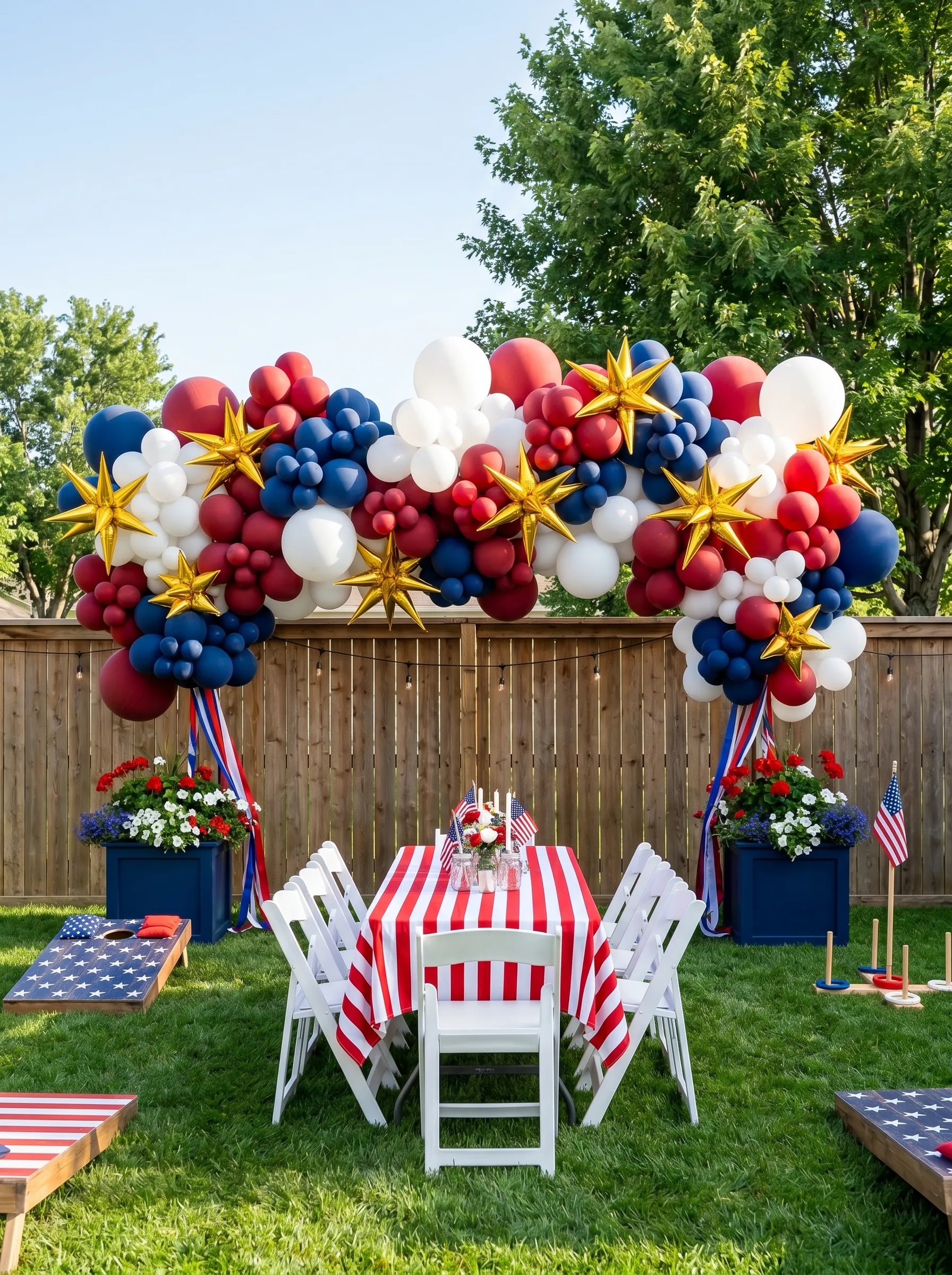
When a backyard is set up for a genuine outdoor party — lawn games, a stripe-tablecloth table, kids running — the balloon arch is appropriate in a way it would not be in a living room.
Build the balloon arch against the wood fence using a freestanding frame anchored with ground stakes. Organic distribution: crimson, navy, and white in 11-inch latex, with 5-inch accent balloons filling gaps. The arch should peak at roughly 7 to 8 feet — visible from the yard’s far end without dominating the seated table’s view.
Pull gold starburst balloons — the exploded six-point foil variety rather than round foil stars — through the arch at irregular intervals. Their unexpected shape reads as festive without being exactly cute, which is the tone a backyard party needs.
At the arch base on either side, position navy square planters filled tightly with red geraniums, white petunias, and blue lobelia. Trailing red, white, and blue ribbons secured at the base of each arch column extend to the ground, adding motion.
The dining table below the arch: red-and-white stripe tablecloth, white folding chairs, a simple mason jar centerpiece with flags and mixed flowers, one red pillar candle in a glass. The table is subordinate to the arch. The game boards flanking the lawn — patriotic-print cornhole, ring toss with striped poles — are the activations that make the space feel like an actual party rather than a set.
The Old Farmhouse Interior Table with Flag Wall
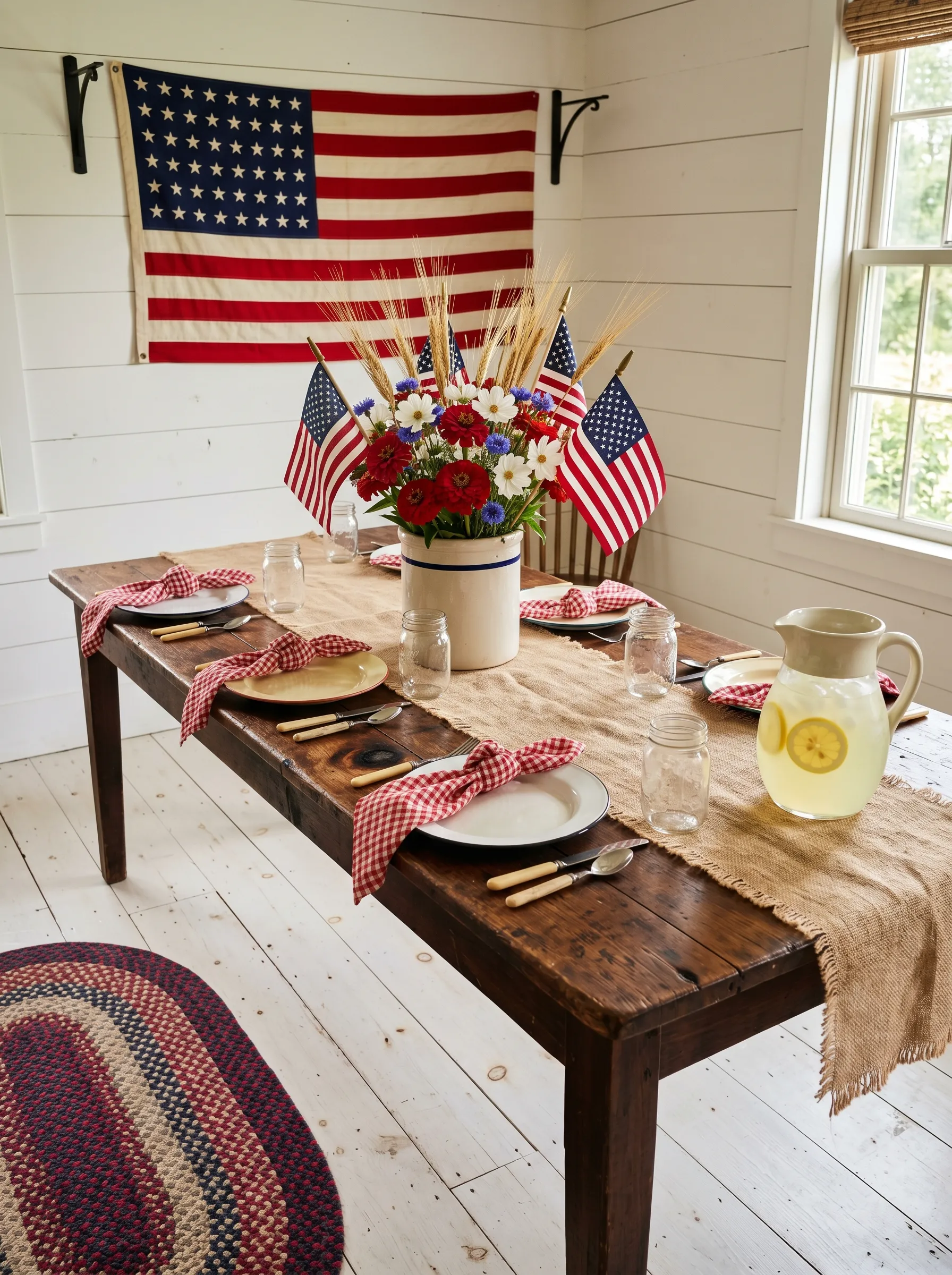
This is the most elemental farmhouse July 4th table. It needs no explanation because everything in it already belongs.
A vintage American flag — 48 stars or earlier, cotton, with some age to the fabric — mounted horizontally on the shiplap wall behind the table using two iron or wooden bracket mounts. The flag has clearly been in this family for a long time. It is not a decorative item. It is a flag that someone once flew and now displays with the same matter-of-fact permanence as a family portrait.
The table itself is raw dark farmhouse plank — no tablecloth, bare wood visible. A burlap runner with fringe down the center is the only surface treatment. In the center, a large stoneware crock with a blue ring — the everyday kind used for years before repurposed — holds a loose wildflower arrangement: red poppies or zinnias, white daisies, blue cornflowers, plus wheat stalks extending 6 to 8 inches above the blooms. Four or five American stick flags pushed in at varying angles complete the arrangement.
Enamelware plates — white with a thin colored rim — at each setting, mason jar glasses beside each, bone-handled flatware on the burlap. Red-and-white gingham napkins tied in a loose bow rather than folded formally.
A stoneware lemonade pitcher with lemon slices visible sits at one end, fulfilling the dual function of beverage service and table decoration.
The braided rug visible at the floor, the white-painted floorboards, the view of the yard through the window behind the flag — everything in this scene has been there before July 4th and will be there after.
The Sunset Patio with Milk Can Centerpiece and Torch Perimeter
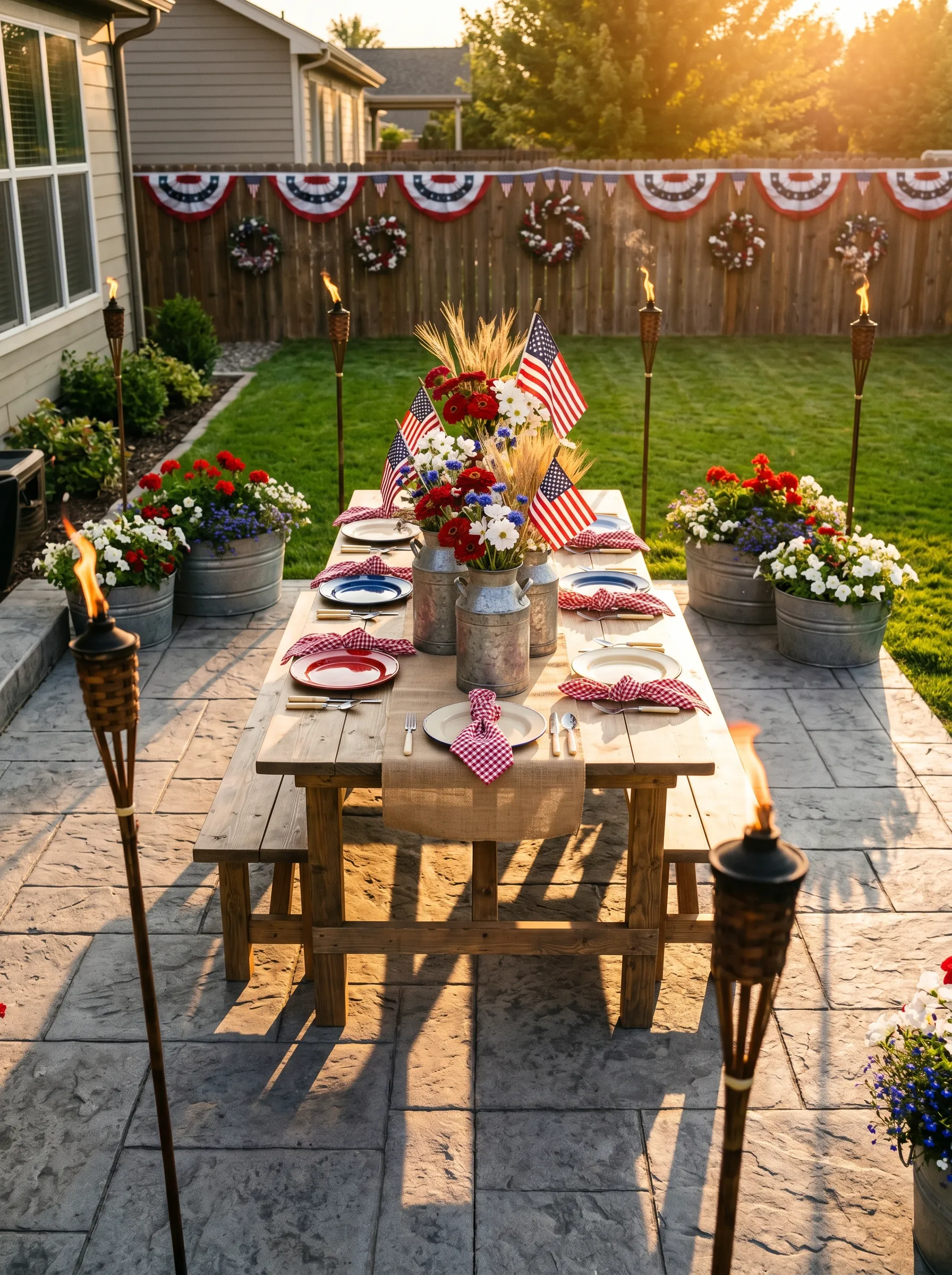
This outdoor patio table at golden hour uses the sun itself as a design element — the warm amber light is half the decoration.
A raw pine or oak farm table on a stone patio, with simple bench seating, needs no tablecloth. The wood grain is the surface. Run a burlap runner with a fringed edge down the center, covering roughly the center third of the table’s width.
The centerpiece is a grouping of three vintage galvanized milk cans in varying heights — the large, medium, and small can variety — each holding a wildflower arrangement. The tallest holds wheat stalks and American flags at height. The medium holds red and white flowers. The small holds a loose mixed arrangement at close range. Three milk cans together read as a collection found in a barn, not purchased for an occasion.
Around the table, line the patio perimeter with tiki torches at 6-foot intervals. The torches serve as lighting and as markers of the party’s outdoor boundary. At golden hour, their flames are barely visible. By 8 p.m. they are the primary ambient light.
On the surrounding fence, hang fabric fan buntings and three mixed patriotic wreaths at intervals, creating the fence backdrop that makes the patio read as a defined outdoor room rather than an open space with a table in it.
Enamelware plates in red, white, and the natural cream tone at each setting, gingham napkins tied with simple twine bows, a wooden cutting board at each seat in lieu of chargers.
The Victorian Porch with Rocking Chairs and Milk Can Flowers
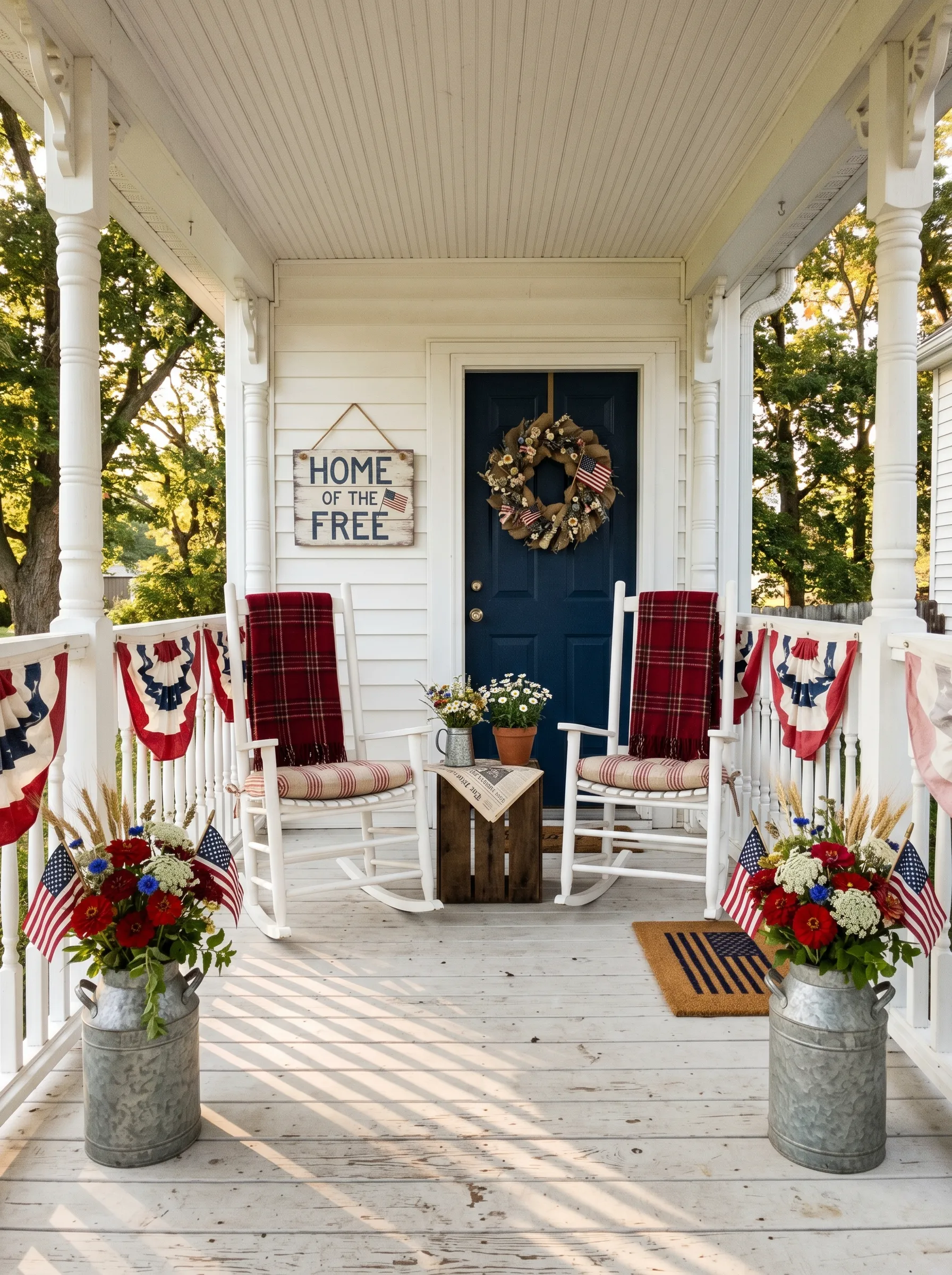
A Victorian farmhouse porch has structural character that most decorating only needs to acknowledge rather than cover.
Two white rocking chairs face outward from the porch, each wearing a red plaid wool throw draped over the back and a ticking stripe seat cushion. A small wooden crate between them serves as a side table, holding a galvanized cup of daisies and cornflowers and a folded newspaper. This vignette says: two people have been sitting here all summer and will continue to do so.
At each rocking chair’s outer side, a large galvanized milk can or tall bucket serves as the floor arrangement: red zinnias, white queen anne’s lace or daisies, blue cornflowers, and wheat stalks extending above the flowers, with American flags pushed in at angles. The milk cans read as borrowed from the garden shed.
Along the railing, hang three fabric fan buntings — the proper pleated kind, not printed panels. Keep the spacing even but not rigid.
On the door, a natural material wreath — grapevine base with burlap flags, small dried flowers, and a layered ribbon bow. No deco mesh on this porch. The architecture is too specific for it.
Beside the door, a painted wood sign on a jute cord: a phrase, hand-lettered, about home and freedom. Not manufactured distress. A sign that someone actually made.
A coir doormat with a flag silhouette at the threshold. A braided rug just inside the door visible through the screen. That’s the whole porch.
The Entry Hall with Flag and Floating Shelf Vignette
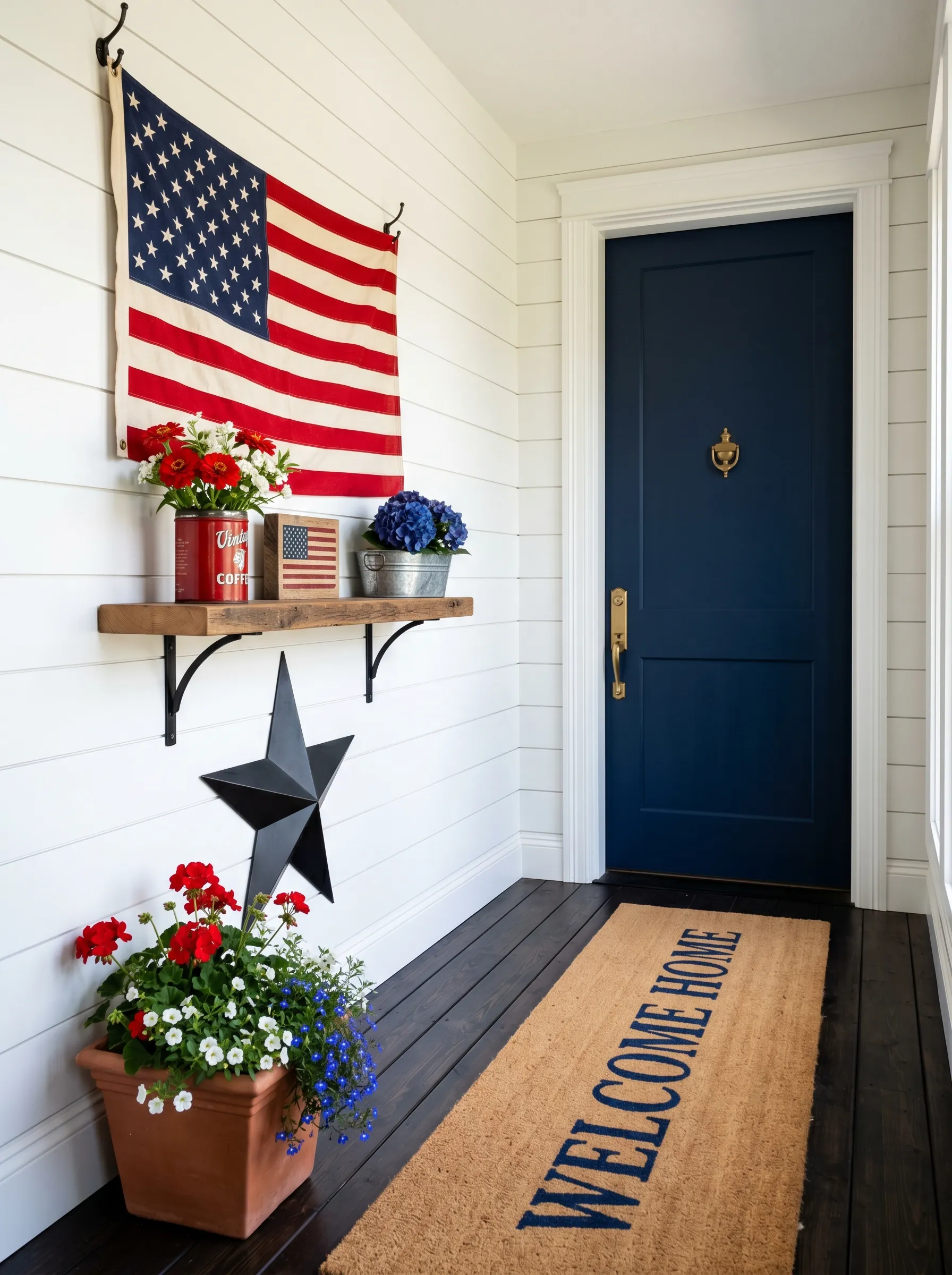
An entry hall is the first interior space a guest sees. On July 4th, one well-placed gesture in this space communicates the occasion without turning the hallway into a themed corridor.
Mount an American flag on two heavy black iron hooks at the top of the shiplap wall, letting it hang at a slight angle that reveals the canton at upper left. The flag should occupy roughly two-thirds of the wall width. Below it, a single floating shelf on black iron brackets holds the holiday vignette.
On the shelf: a vintage red enamel coffee tin used as a flower vase, holding red gerbera daisies and small white flowers — nothing arranged, just dropped in. A small wooden flag box or framed flag art piece at center. A small galvanized bucket with a cluster of blue hydrangeas. The arrangement on the shelf reads as: someone put these things here because they looked right together.
Below the shelf on the wall, two matte black metal barn stars mounted at slightly different heights — not symmetrically placed, just hung where they felt right.
On the floor at the entry: a large terracotta pot with the three-flower combination, pushed to one side rather than centered. A long coir “Welcome Home” mat in front of the navy door. The navy door is already doing the patriotic work. Everything else acknowledges it.
The Open Kitchen Shelf Styling with Labeled Mason Jars
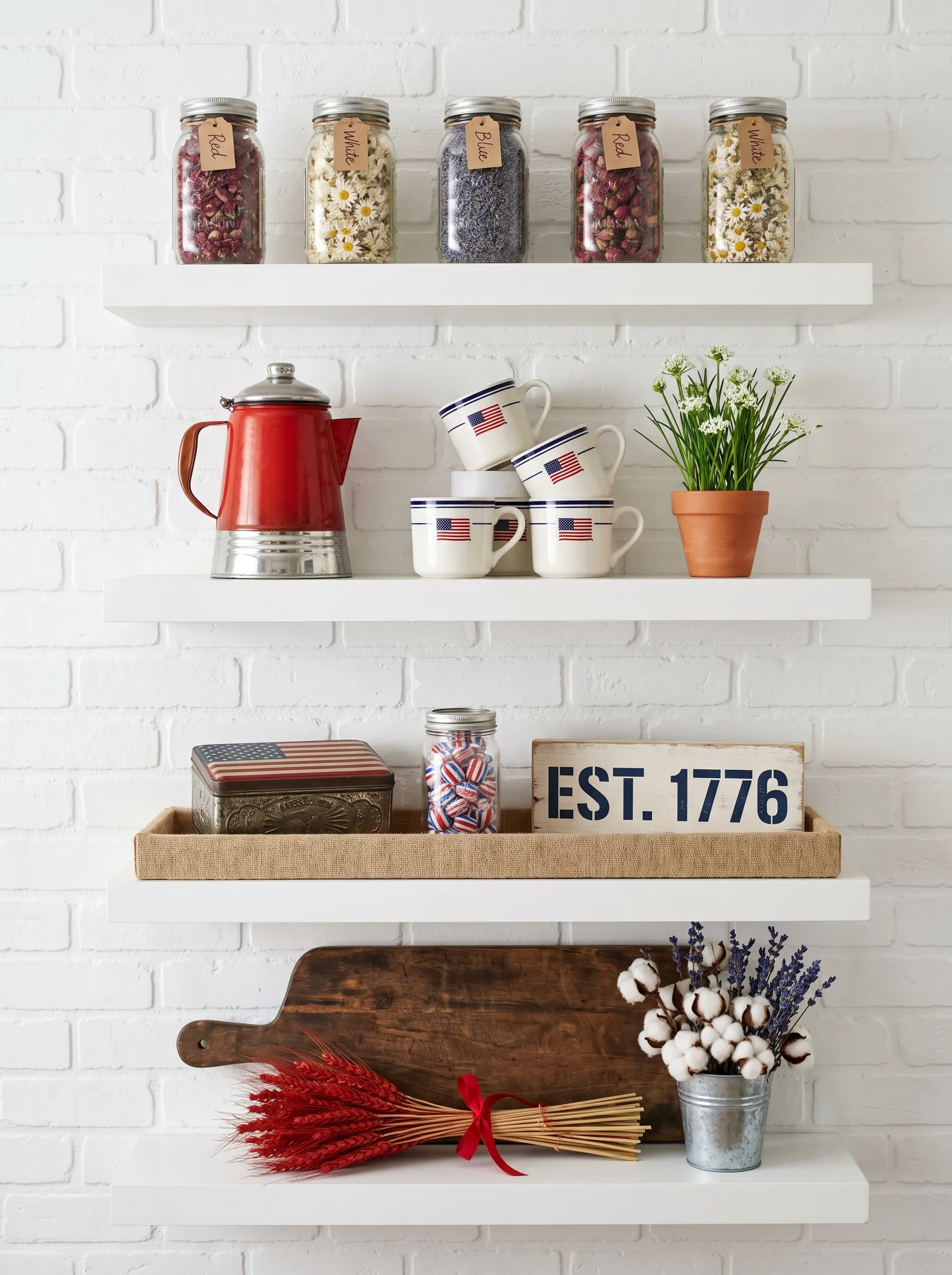
Open shelving in a farmhouse kitchen is the most available surface for quiet, considered July 4th styling. It requires nothing new and costs almost nothing.
On the top shelf, line five identical mason jars with silver lids, each filled with a different dried flower or botanical: dried red rose petals, white chamomile flowers, dried lavender labeled blue, more red rose buds, white daisy petals. Each jar has a small kraft tag tied at the neck with a label: “Red,” “White,” “Blue.” The labeled jars read as pantry organization rather than décor, which is the farmhouse quality you’re after.
Middle shelf: a red enamel coffee percolator anchors the left side. Three flag-print mugs stacked in a cluster at center. A small terracotta pot of chives or any culinary herb at the right edge.
Third shelf: a burlap-lined wooden tray holds a flag-print tin box, a mason jar of red-white-blue striped hard candies, and a painted wooden “Est. 1776” sign. The tray groups these objects into a single unit rather than leaving them scattered.
Bottom shelf: a wide dark cutting board laid flat, taking up most of the shelf length. At one end, a bundle of red wheat stalks tied with a thin red ribbon. At the other, a small galvanized bucket holding a cotton stem and dried lavender.
Nothing on these shelves was purchased specifically for the holiday except possibly the wheat bundle and the labeled candy jar. Everything else is existing kitchen equipment styled with seasonal attention.
The Farmhouse Bathroom Vanity with Three Red Roses
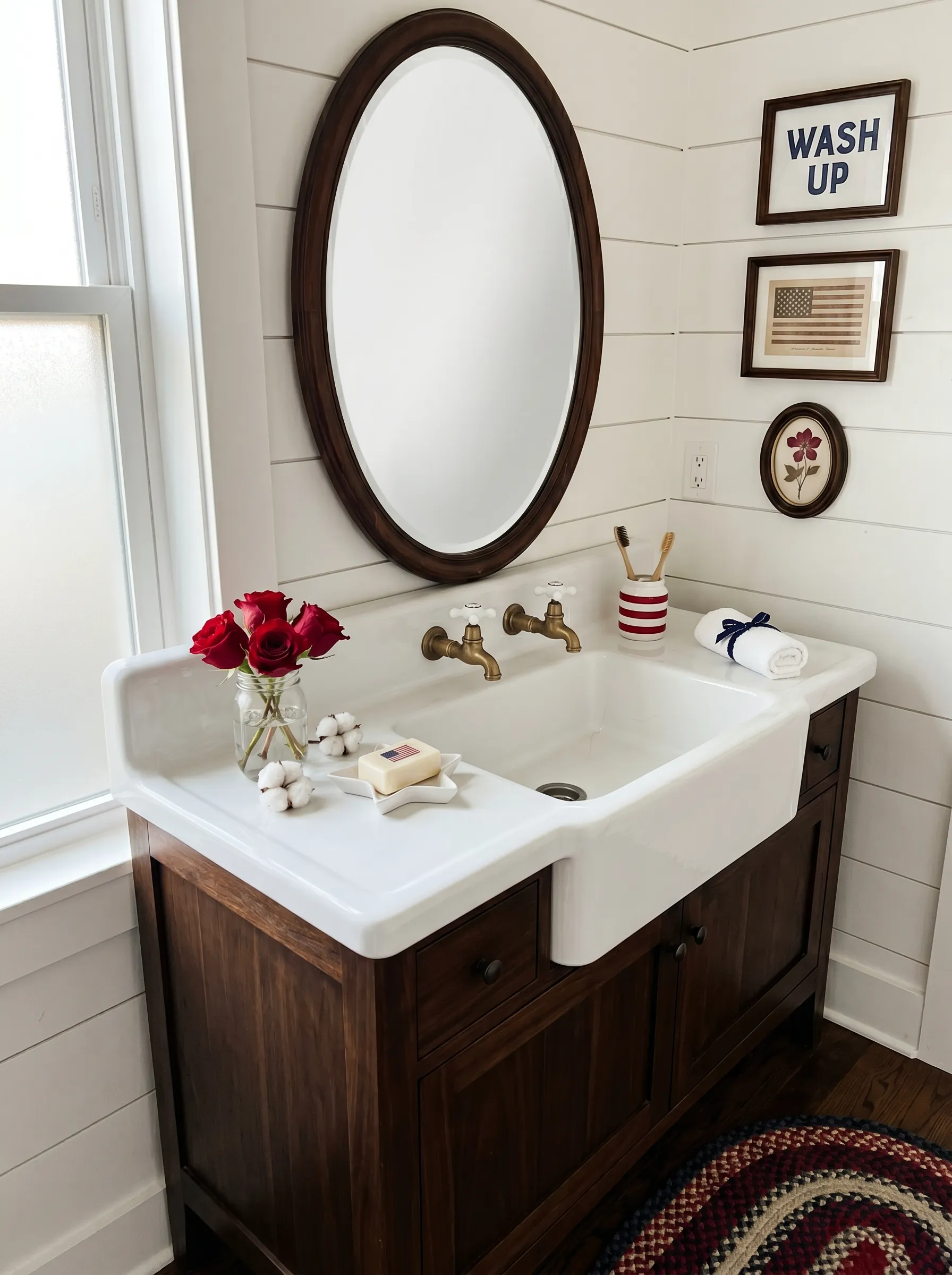
The bathroom is the room where most farmhouse July 4th decorating either overshoots dramatically or doesn’t show up at all. Both are wrong.
Three red roses in a small mason jar on the vanity surface. That is enough.
But place that jar thoughtfully. It sits to the left of the farm sink apron, on the white marble or painted wood surface, with two cotton stems laying naturally beside the jar base — stems only, no arrangement, just placed. A star-shaped white ceramic dish holds a bar of soap and a small American flag on a pick. A red-and-white stripe ceramic toothbrush holder near the faucet.
Fold a white hand towel tightly and tie it with a narrow navy grosgrain ribbon bow. Set it to the right of the sink.
On the wall, a small gallery: a “WASH UP” sign in a dark wood frame at the top, an antique-look flag illustration print in a matching frame below it, a small oval botanical print at the bottom corner.
The braided rug in red, navy, and cream on the floor completes the bathroom without requiring it. The whole setup takes ten minutes. Its effect on a guest using this bathroom is disproportionate to the time invested.
The Flag Quilt Bedroom with Folded Honor Case
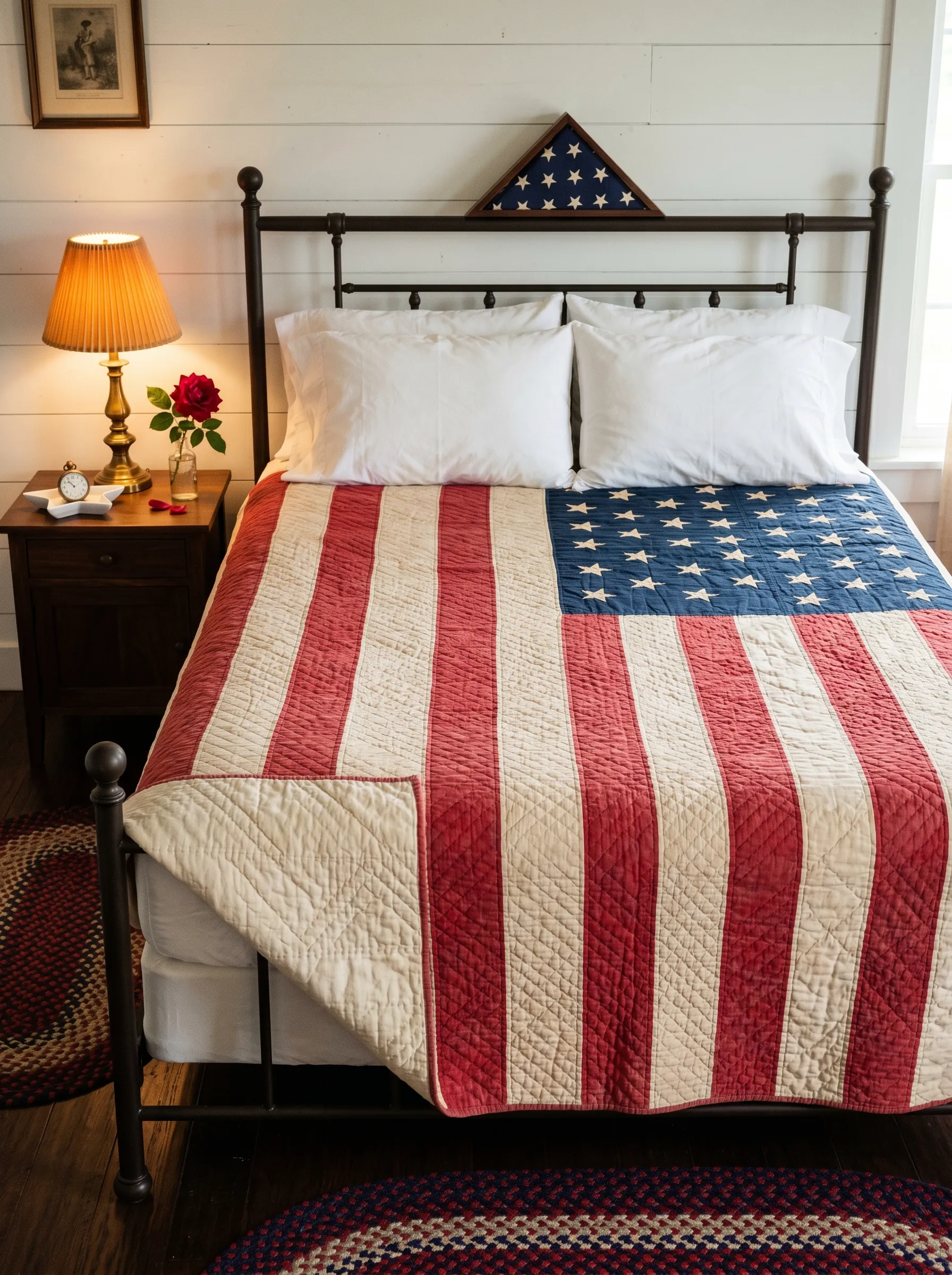
The bedroom has one job on July 4th: to feel like it has always held what it holds.
Lay a flag quilt — the woven cotton kind with genuine quilted stitching in the flag pattern — across the lower two-thirds of a bed with an iron or dark wood headboard. The quilt should not be perfectly placed. One corner drags slightly toward the floor. The folding line at the foot is casual rather than crisp.
White cotton pillowcases on the pillows — no shams, no pillow stacking. The pillows are for sleeping, not display.
On the wall above the headboard: a military flag case containing a folded flag — the triangular presentation case with the canton visible through the glass front. If you have one from a family member’s service, this is the moment it belongs on the wall. If you don’t have one, a similarly simple framed vintage star element reads with the same gravity.
On the nightstand: a single brass lamp with an amber shade. A small mason jar with one red rose stem. A white ceramic star dish. A windup clock. A worn leather journal.
The braided rug at the bedside — the same kind you’d find in this bedroom any other month — provides the floor note.
No flags on sticks. No bunting. No banner. The flag quilt is doing all of it.
The Farmhouse Kitchen Island Styled for July
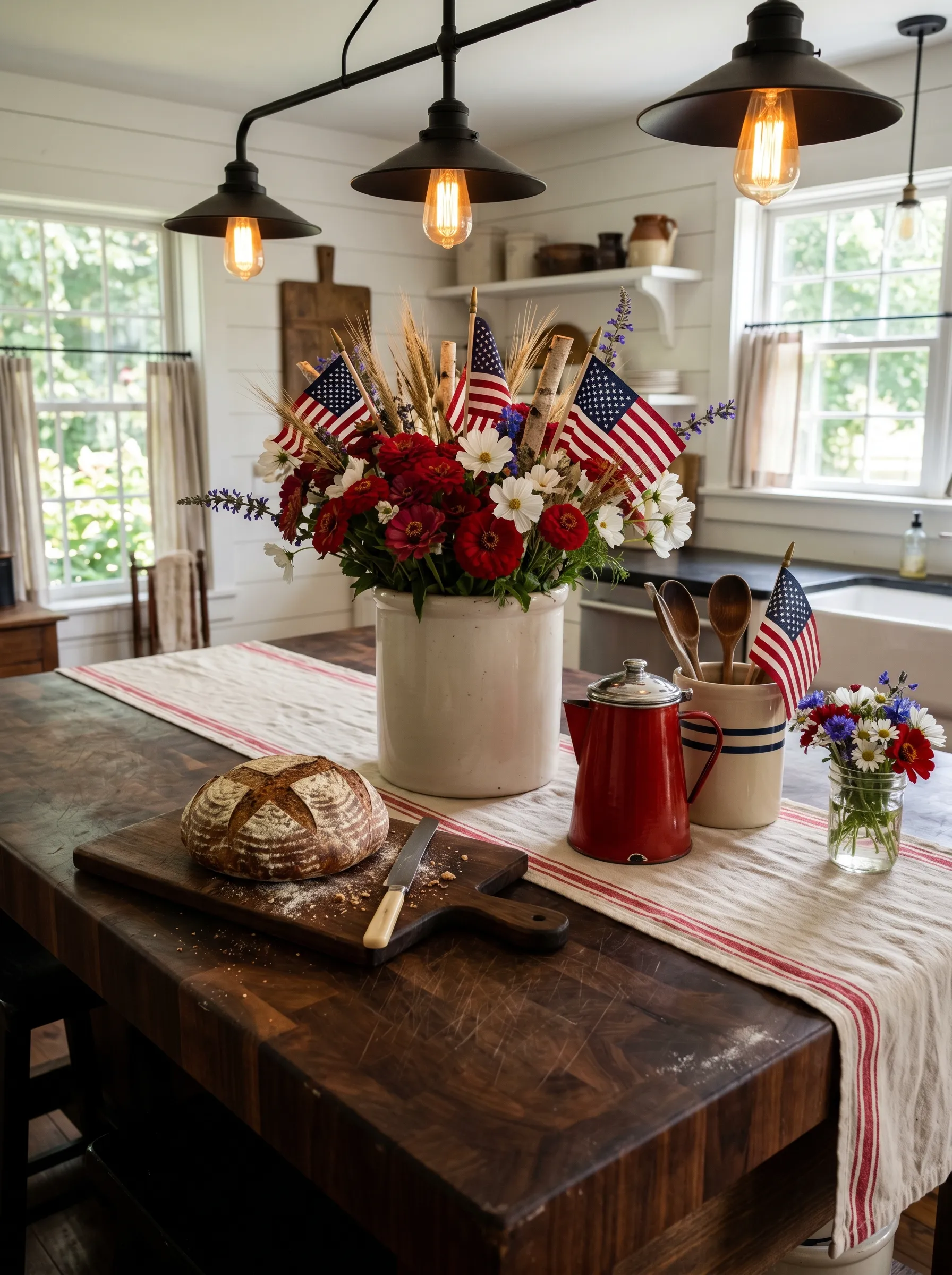
A farmhouse kitchen island at its best looks like it’s mid-morning on a July day when someone just came in from the garden.
The surface is raw butcher block — wide enough that you see the grain. A red-and-white ticking stripe runner lies down the center, slightly off-axis rather than perfectly aligned, which says this is a working surface.
At the far end of the runner, a large stoneware crock holds the hero arrangement: red zinnias and dahlias, white cosmos and daisies, blue lavender, wheat stalks extending at height, three American flags on wooden sticks pushed in among the stems. The arrangement spills generously past the crock’s rim on all sides. Nothing about it is tightly constructed.
Beside the crock, a red enamel coffee percolator and a small blue-rimmed stoneware crock holding wooden spoons. At the runner’s near end, a small mason jar with a few wildflowers — the scraps of the main arrangement, dropped in for good measure.
A sourdough loaf on a dark wood bread board at the counter’s edge, knife alongside it, a light dusting of flour.
Three black industrial pendant lights overhead with Edison bulbs. Their filaments visible. The light they cast is warm and already suited to the material palette below them.
The Farmhouse Laundry Room That Knew Its Moment
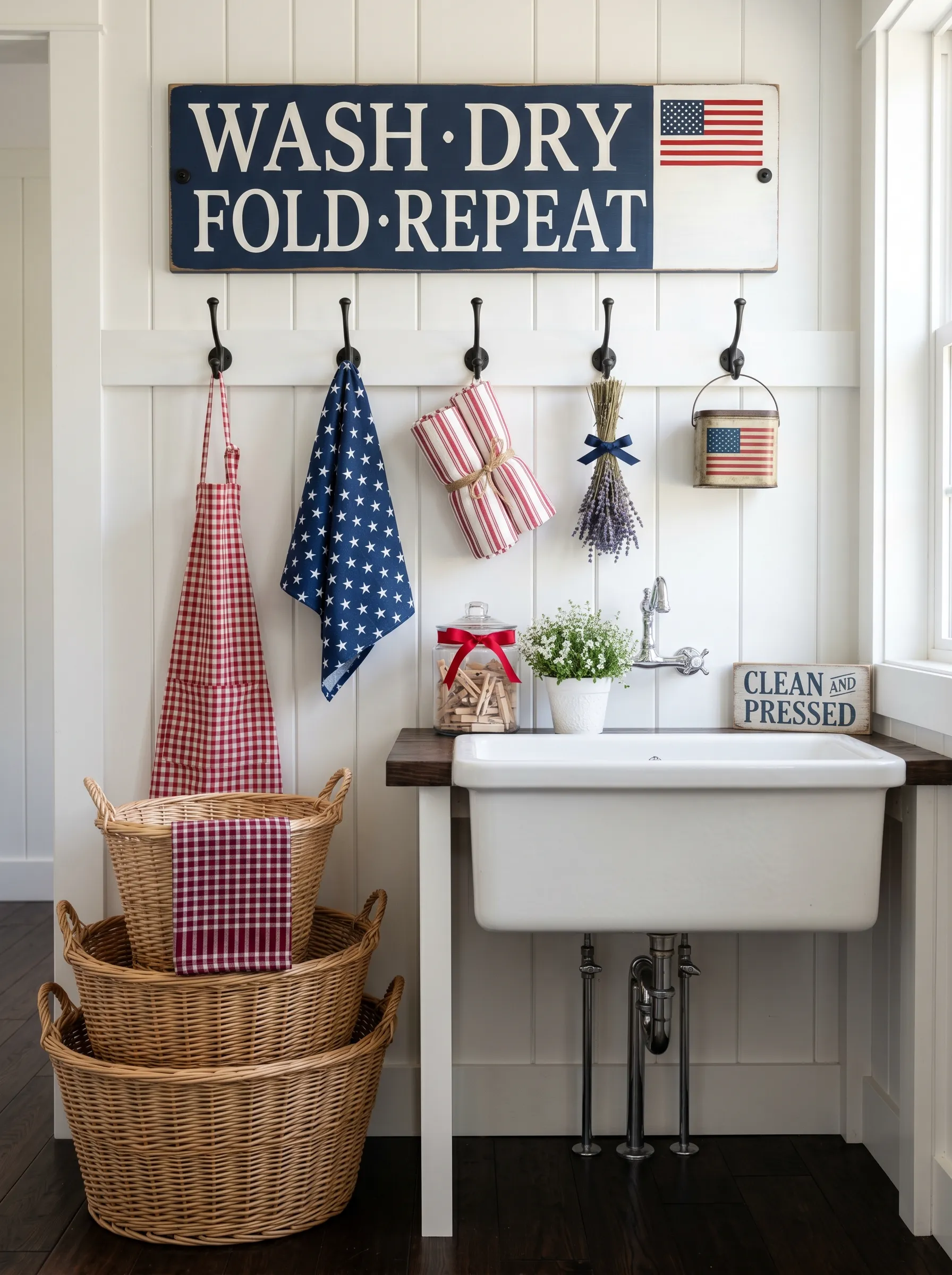
The laundry room is the room that nobody thinks to decorate for the Fourth. This one argues for a reconsideration.
Mount a large painted sign above the hook-and-sink wall — “WASH DRY FOLD REPEAT” in stencil-block navy on white, with an American flag in the upper right corner. The sign works year-round; it is functional wall art. For July, it becomes patriotic.
On five black iron wall hooks below the sign, hang: a red-and-white gingham apron, a navy star-print tea towel, a bundle of red-and-white stripe linens tied with jute twine, a small dried lavender bouquet tied with a navy ribbon, and a vintage tin with a flag print.
On the small utility sink countertop: a glass apothecary jar of wooden clothespins tied with a red ribbon bow, a small white pot of baby’s breath or white flowers, and a “CLEAN AND PRESSED” small wood sign.
Two wicker laundry baskets at floor level with a red-and-white check dish cloth draped over the outer basket.
The laundry room is used every day. A few objects placed with intention make it feel like part of a home that takes the holiday seriously even in the rooms nobody photographs.
The Reading Corner with Flag Wall and Plaid Throw
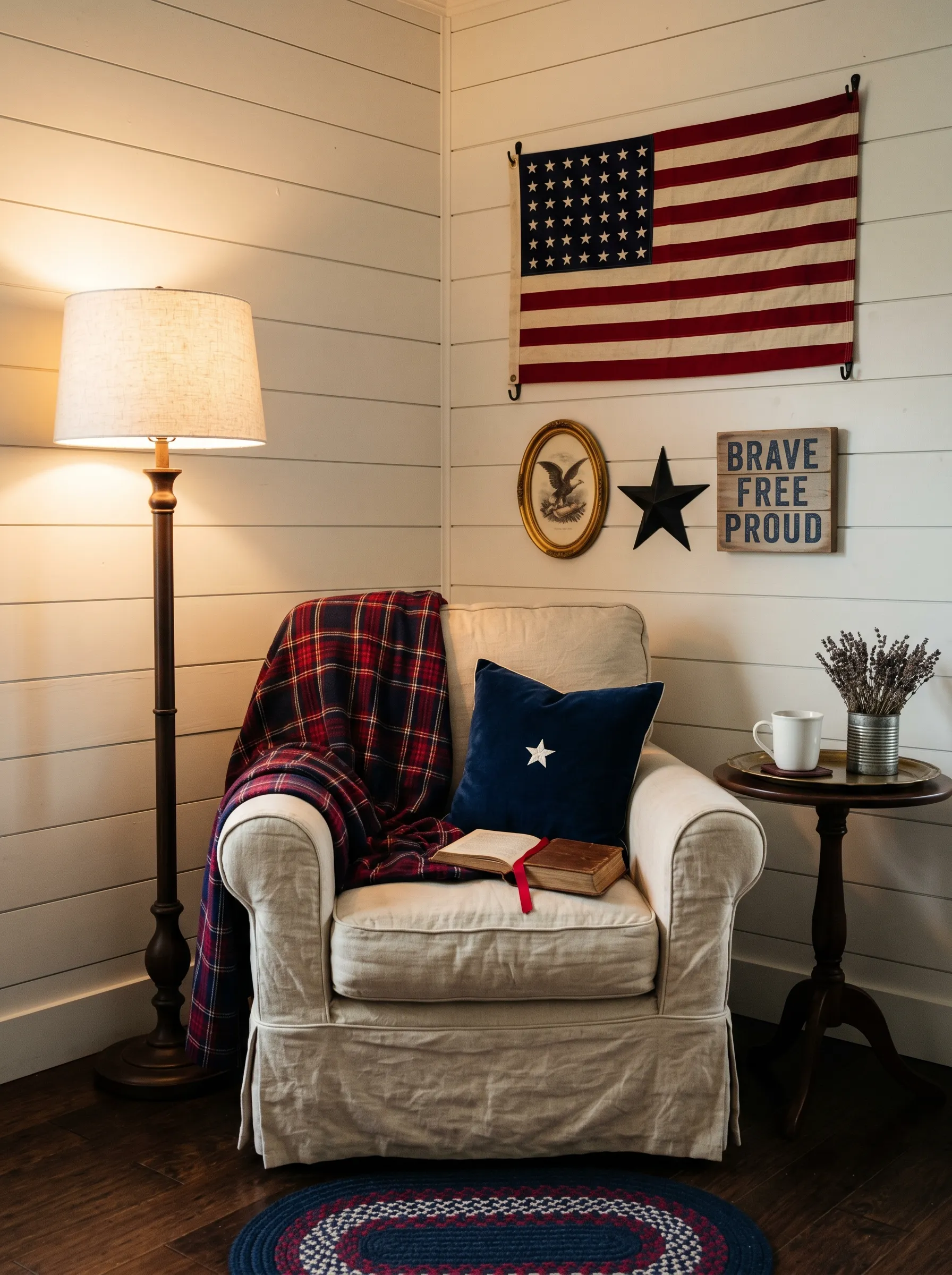
Some spaces in a farmhouse aren’t for entertaining. They’re for living in quietly.
A cream linen armchair in a corner of the living room — the kind that’s been sat in enough times to have a softness around the cushion edges — receives a red tartan plaid throw draped over one arm and a navy velvet pillow with an embroidered white star at center, placed on the seat. A worn leather-covered book and a thin red ribbon bookmark sit on top of the pillow, as if someone got up mid-chapter.
On the wall above: a vintage flag on two black iron hooks, as described before — large, cotton, aged. Below it on the same wall: a gilt oval frame with an eagle engraving, a matte black iron barn star, and a small painted wood sign reading simply three words in weathered letters.
Beside the chair: a small round pedestal side table holding a white ceramic mug, a small tin bucket with dried lavender, and a brass tray.
On the floor: a braided oval rug in navy, red, cream, and tan — the kind that makes the farmhouse feel complete from the ground up.
A standing brass floor lamp with a linen shade provides the reading light. Its warm pool of illumination covers the chair and nothing else.
This corner exists for one person, quietly. The July 4th additions are: the flag, the plaid throw, the star pillow. Everything else belongs here always.
The Farmhouse Round Table with a Crock Centerpiece and Flag Wall
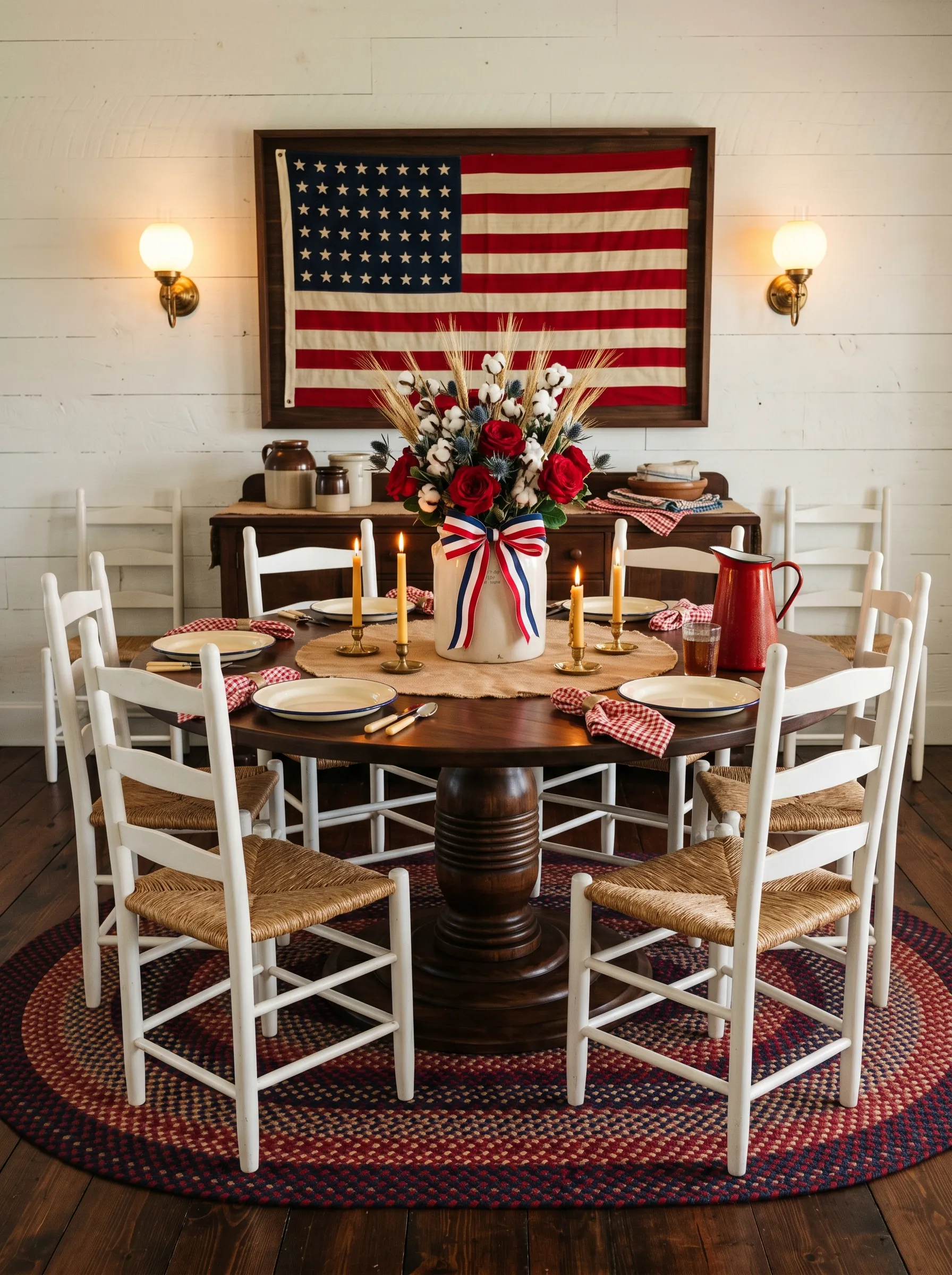
A round pedestal dining table in dark walnut with white painted ladder-back chairs and rush seats is inherently farmhouse. The July 4th version of this table requires almost no purchase.
The centerpiece: a large stoneware crock — the glazed pale gray variety with a red-orange rim — holds a full arrangement of red roses, dried cotton stems, dried blue thistle, and wheat stalks. A layered ribbon bow in red, white, and navy is tied around the crock’s upper neck. The bow is the one concession to the holiday; everything else in the crock is available from a farm market or dried goods shop any time of year.
Two brass candlesticks at the table flanking the crock, holding beeswax tapers in amber.
Enamelware plates — the cream variety with a navy or charcoal rim — with red-and-white gingham napkins folded simply and laid flat. A red enamel pitcher at one side of the table serving double duty as water jug and decorative object.
On the wall behind the table, a vintage flag in a wide dark wood frame — the flag filling the frame as if framed art rather than a piece of fabric. Two brass wall sconces flank it at even height, providing the warm supplemental light that makes this wall read as a composed installation.
On the floor, a braided round rug in the farmhouse palette underscores every chair.
The Farm Porch Table at Sunset with Flag Poles in the Meadow
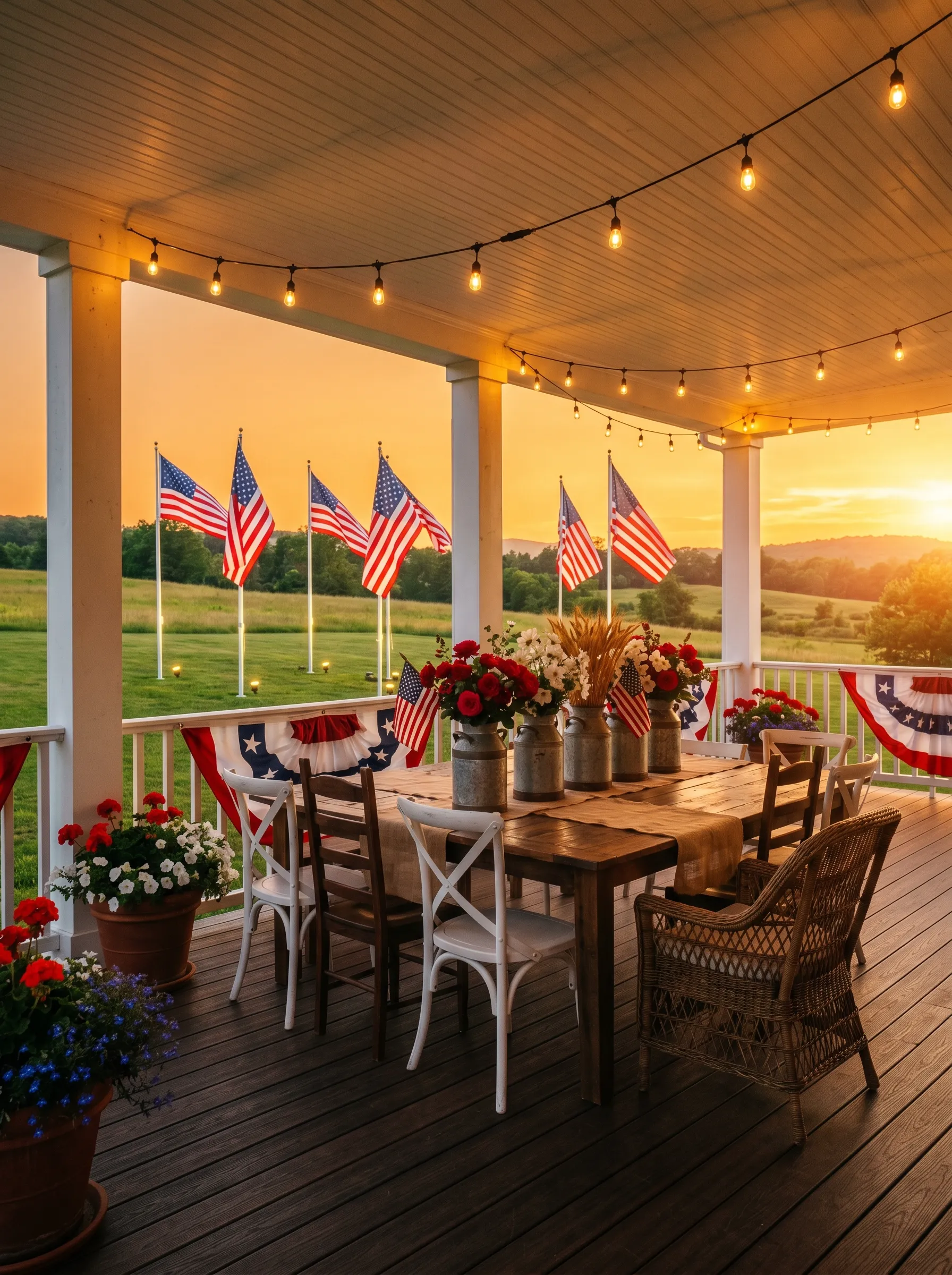
This porch table sits at the edge of a view — a field, a meadow, rolling hills at golden hour — and the decoration knows not to compete with what’s outside.
The table is raw farmhouse wood, open grain. A burlap runner. The centerpiece is three galvanized milk cans in a cluster, filled with wildflowers and flags. The railing has two fabric fan buntings at the ends. String lights swag from the porch ceiling in a single loop.
That is enough for this porch, because the meadow beyond holds a row of full-size American flags on tall white poles, spaced evenly in the grass. The flags catch the sunset light and move in the evening breeze. They are visible from the table. They are doing everything.
The porch decoration exists to frame the view of the flags, not to replace it. This is the one table in this collection where the best thing the decorator did was restrain themselves and let the landscape speak.
The chairs at the table are mismatched — a cross-back, a ladder-back, a wicker arm chair — which is correct for a farmhouse porch that has been sat at for years rather than staged recently.
The Fireplace Mantel with Chippy Star and Layered Bunting
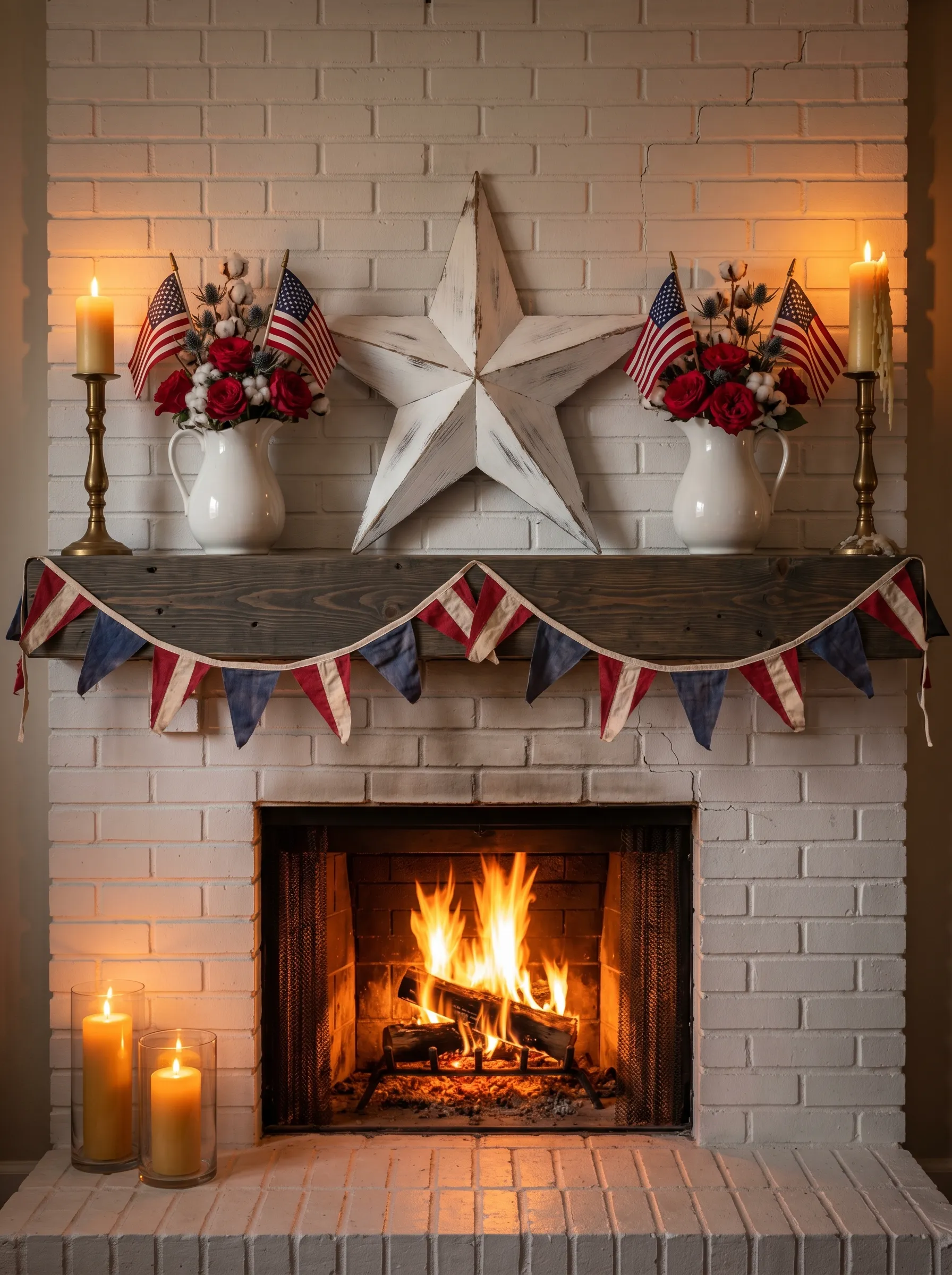
The farmhouse fireplace mantel at July 4th asks for one large statement and everything else in support.
The large statement is a chippy-painted wood barn star — oversized, roughly 24 to 30 inches, in a distressed white — mounted directly to the painted brick above the mantel. The star should look like it has been painted and repainted and worn back to bare wood in spots. It should look old.
On either side of the star on the painted brick surface: nothing. Let the star have the wall.
On the mantel shelf itself: two matching white ceramic pitchers, each holding an arrangement of red roses and dried cotton stems, with small American flags on picks pushed in among the flowers. A pair of brass candlesticks flanking each pitcher, set at varying heights. Small American flag picks distributed lightly among the candlesticks.
At the mantel’s front edge, a fabric pennant bunting — the worn linen kind with individual triangular flags in red, white, navy, and faded prints — draped in a loose swag from corner to corner. The fabric should sag at the center the way old bunting does.
Before the fireplace, two glass hurricane cylinders on the hearth hold large cream beeswax pillar candles. With a fire lit behind them, the amber glow from the firebox and the candle flames together create a warmth that no amount of red-white-blue can manufacture.
The Farmhouse Living Room with Braided Rug and Mantel Gallery
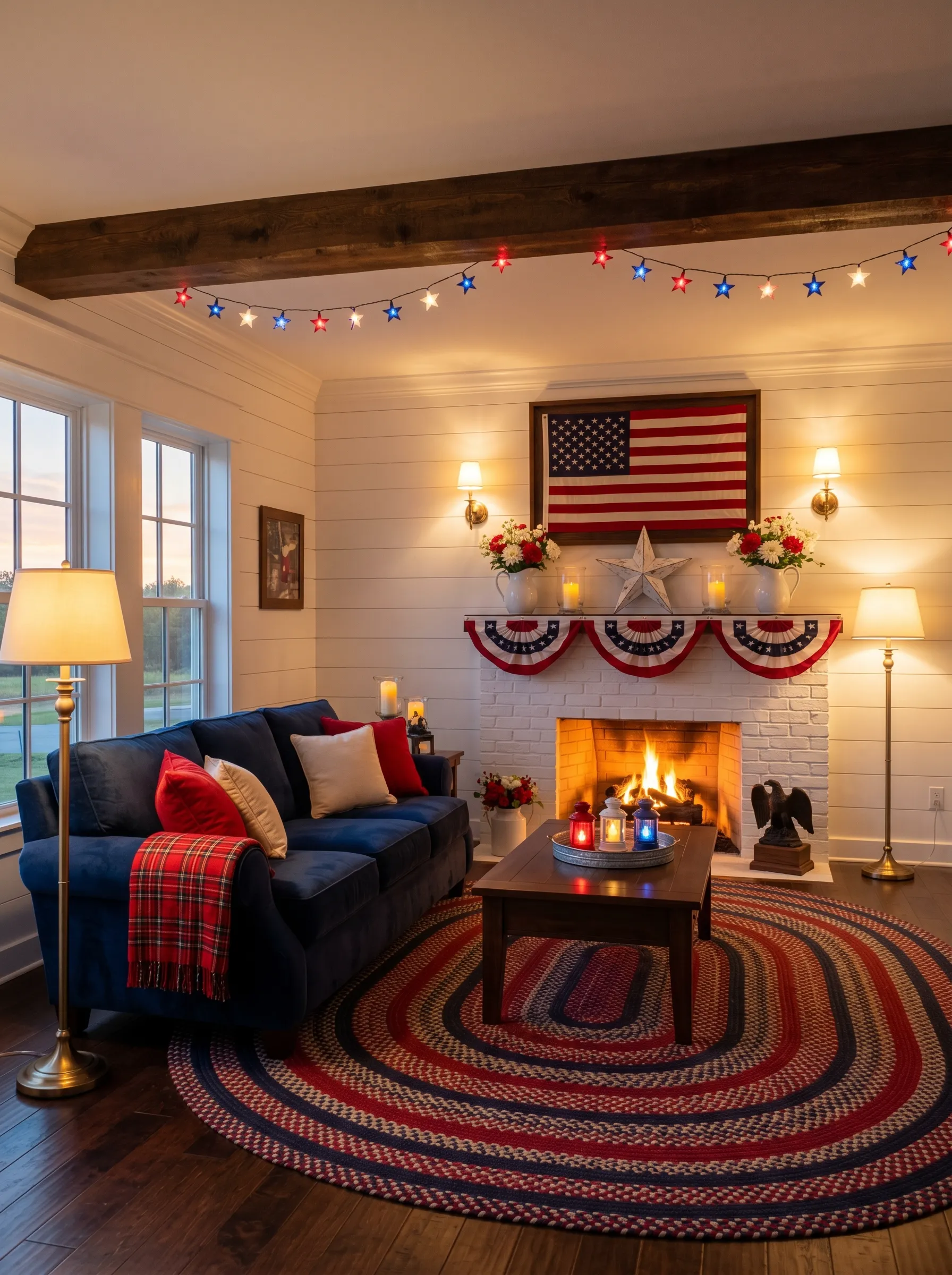
The fully realized farmhouse living room for July 4th is not a room set for the holiday. It is a room that lives in the holiday the same way it lives in any other season — through the permanent things that give it character and the few seasonal additions that acknowledge the occasion.
A navy velvet sofa, already in residence. Red throw pillows, already in the palette. A cream linen pillow with a simple embroidered motif, already there. A red tartan blanket draped over the sofa arm, already there in some form. These furnishings require no change for the Fourth.
On the coffee table: a galvanized tray holding three colored glass lanterns in red, white, and blue. Three small candles inside them. This is the one purchased addition.
At the fireplace, a flag in a wood frame mounted above the mantel serves as the wall’s primary element. The mantel itself is dressed simply: two white ceramic pitchers with flowers, a galvanized barn star, and two pillar candles on either side. Small fabric fan buntings draped at the mantel edge.
Star string lights — in red, white, and blue — hung along the exposed beam above the fireplace wall, visible from the seating area and above.
An oversized braided oval rug in the traditional farmhouse palette — red, navy, tan, and cream — fills the living room floor. It is there every month. In July, it reads as patriotic. For the other eleven months, it reads as home.
The flag in the frame is the only element that would not be there on any other day. Everything else is the house.
What Farmhouse Decorating Gets Right That Other Styles Miss
Farmhouse July 4th decorating at its best is not about the holiday. It is about the home.
The holiday becomes visible through the home’s materials and character rather than through decorative items purchased to announce the season. A flag quilt on a bed already in the room. A crock that usually holds spoons now holding zinnias. A flag hung on the wall the way a painting is hung — because it belongs there, not because July 4th is coming.
The goal is a home that looks like it has always celebrated this holiday rather than one that has been prepared for it. That difference is visible in every material choice, every vessel selection, every decision to use what’s already there rather than buying what looks like the part.
The farmhouse that decorates correctly for July 4th doesn’t look decorated at all. It looks like home.