
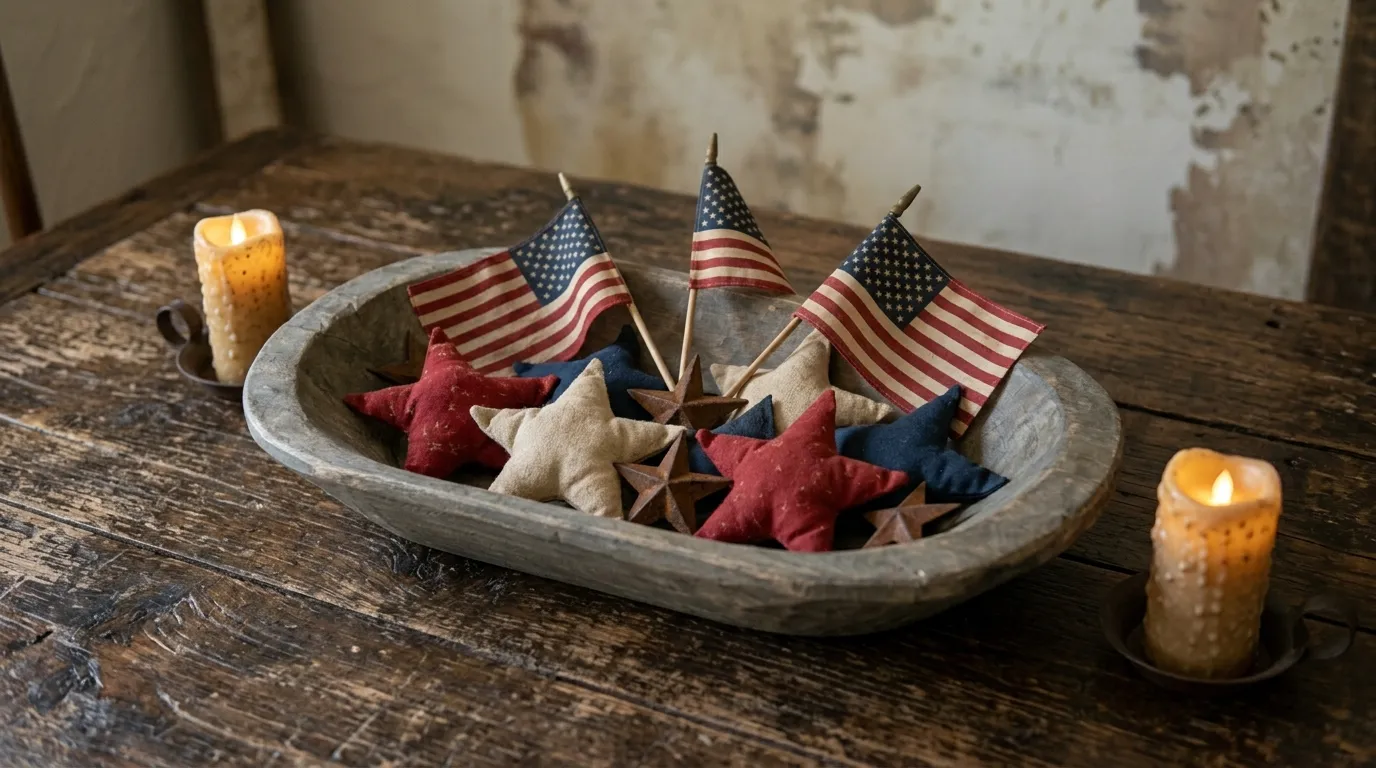
There’s a version of patriotic decorating that involves plastic table covers and inflatable eagles. This is not that.
The homes that do it right understand something most people miss: the colors of the flag were never meant to be loud. They were meant to be earned. When you root them in rough-hewn wood, hand-stitched textiles, and objects that look like they came from a century of honest use, those colors stop being a seasonal gesture and start being a way of living.
This is about primitive patriotic decor — the kind that was never trying to impress anyone. It just was.
Here’s how to get it right.
Why Most Patriotic Decorating Looks Like a Party Supply Store Exploded
The problem isn’t the palette. Red, white, and blue are genuinely beautiful together. The problem is finish, scale, and context.
Everything Is Too New
Shiny flags and freshly printed bunting carry zero weight. The eye reads them as disposable. Primitive patriotic decor works because the objects look like they’ve been somewhere. The faded stripes on an aged flag, the worn edge of a stoneware crock, the uneven hand-lettering on a barn board sign — these details signal permanence. They tell the room that this isn’t a holiday mood. It’s a household identity.
When you buy new patriotic pieces, buy them in materials that age well: raw wood, cotton fabric, salt-glazed pottery, wrought iron. Then let them live. A cotton flag left in light will do its own work over time.
The Scale Is All Wrong
People buy small. A single tiny flag pinned to a shelf. A miniature star. A six-inch wooden sign.
Patriotic primitives demand scale. The original objects they reference — flags, quilts, barn stars — were never small. They were designed to be seen across a field. Shrink them and you shrink the effect. The rooms that work in this aesthetic commit to oversized pieces: a flag that covers most of a wall, a barn star that commands an entire outbuilding door, a quilt that takes up a full bed. Give these objects room to mean something.
The Wrong Surfaces
Smooth white drywall kills the primitive look. These objects were designed to live against rough plaster, log walls, weathered barnwood, and stone. If your house is modern, you don’t have to gut it. You do need to work harder with layering — a rough-textured throw, a piece of weathered reclaimed wood leaned against the wall, anything that breaks the perfection of the background.
What Nobody Explains About the Primitive Aesthetic
The word “primitive” in American folk art doesn’t mean crude. It means intentional simplicity. It means someone made a deliberate choice to honor their home with what they had.
Pattern Carries the Weight That Color Can’t Alone
The rooms in this aesthetic that feel richest are not the ones with the most red, white, and blue. They’re the ones where every textile has a distinct pattern: a geometric quilt, a plaid wool throw, a braided wool rug, a cross-stitch sampler. Pattern creates visual complexity. It’s how a room that uses only three colors never feels thin.
Stack patterns deliberately. Put a geometric quilt against a plaid drape. Pair a star-patterned rug with a woven coverlet. The trick is keeping the color palette locked — three colors, no exceptions — while letting the textures and patterns do the visual work.
Handmade Objects Are the Point
A wall of mass-produced patriotic signs reads as a theme park. One hand-painted barn board sign reads as a homestead.
The materials that define this aesthetic — cross-stitch, rag wreaths, hand-thrown stoneware, carved wooden stars — are handmade or convincingly handmade in their finish. The imperfections are not flaws. They are the entire argument. An uneven painted letter on a plank of reclaimed wood is doing something a vinyl decal never could. It says a person made this, in this place, for this home.
Seek out actual handmade pieces when you can. When you can’t, choose pieces with visible texture, uneven finish, and natural materials.
The Flag Is Not Decoration. It’s the Anchor.
Every space in this aesthetic is organized around a flag. Not a flag as one element among many, but the flag as the dominant focal piece that everything else supports. This is why scale matters so much. The flag earns its position by claiming the largest surface in the arrangement — the full width of a mantel, the center of a wall, the length of a fence line.
Once the flag is in place, you work outward. Stoneware crocks below it. Candle lanterns flanking it. A braided rug on the floor before it. The flag is the reason the room exists.
Getting the Foundation Right Before You Buy a Single Star
Commit to Your Materials Palette First
This aesthetic runs on a very short list of materials: aged wood, salt-glazed stoneware, hand-dyed cotton, wrought iron, and beeswax candles. Before you buy anything, decide which of these will anchor your space. The stoneware-and-iron combination reads formal colonial. The barnwood-and-plaid combination reads frontier farmhouse. The whitewashed brick-and-woven-textile combination reads New England saltbox. Pick your version and stay in it.
Mixing material families — say, whitewashed brick with rough-hewn log wall pieces — creates confusion. The aesthetic is already asking you to walk a careful line between historical and livable. Keep the materials consistent.
Decide on Your Era Reference
American primitive spans a lot of territory: 1776 colonial, 1800s frontier, Civil War-era farmhouse, turn-of-the-century rural homestead. The flag styles change across these eras. The Betsy Ross thirteen-star circle flag reads colonial. The distressed 48-star flag reads early twentieth century. The fully faded and tea-stained flag reads timeless.
Pick one era and let it guide your choices. This is not historical reenactment. It’s design coherence.
Build Around One Hero Piece
Every successful arrangement in this aesthetic has one object that earns the rest. It might be a hand-stitched star quilt. An oversized primitive folk art painting. A massive carved wooden barn star. A grandfather clock with a flag motif. One piece that is irreplaceable. Everything else exists to support it without competing with it.
When people get this aesthetic wrong, it’s usually because they have fifteen interesting pieces and no anchor. The room becomes a collection instead of a home.
Primitive Patriotic Decor Ideas
The Window Seat Dressed in Layers of Pattern
Build up a window seat with layers rather than matching sets. Start with a base of red gingham check pillows — large scale check, not mini check — across the back. In front of those, place block-print floral pillows in blue and white with a ruffle edge. In front of those, a single flag-patterned pillow in the center, lower than the rest, in the classic stars-and-stripes format with a fringe edge.
Hang a simple green-and-white summer wreath on the window, tied with a long-tailed bow in wide red-and-white striped ribbon. The bow should have generous tails — twelve inches or more hanging down.
Above the window, layer two banner garlands: a primitive-style pennant banner in red, white, and cream and a fan bunting garland in the same palette below it. The layering of banners doubles the visual weight of the window treatment without adding curtains. This keeps the light coming in while still making the window feel dressed and deliberate.
The Heritage Kitchen Garden With a Flag Standard
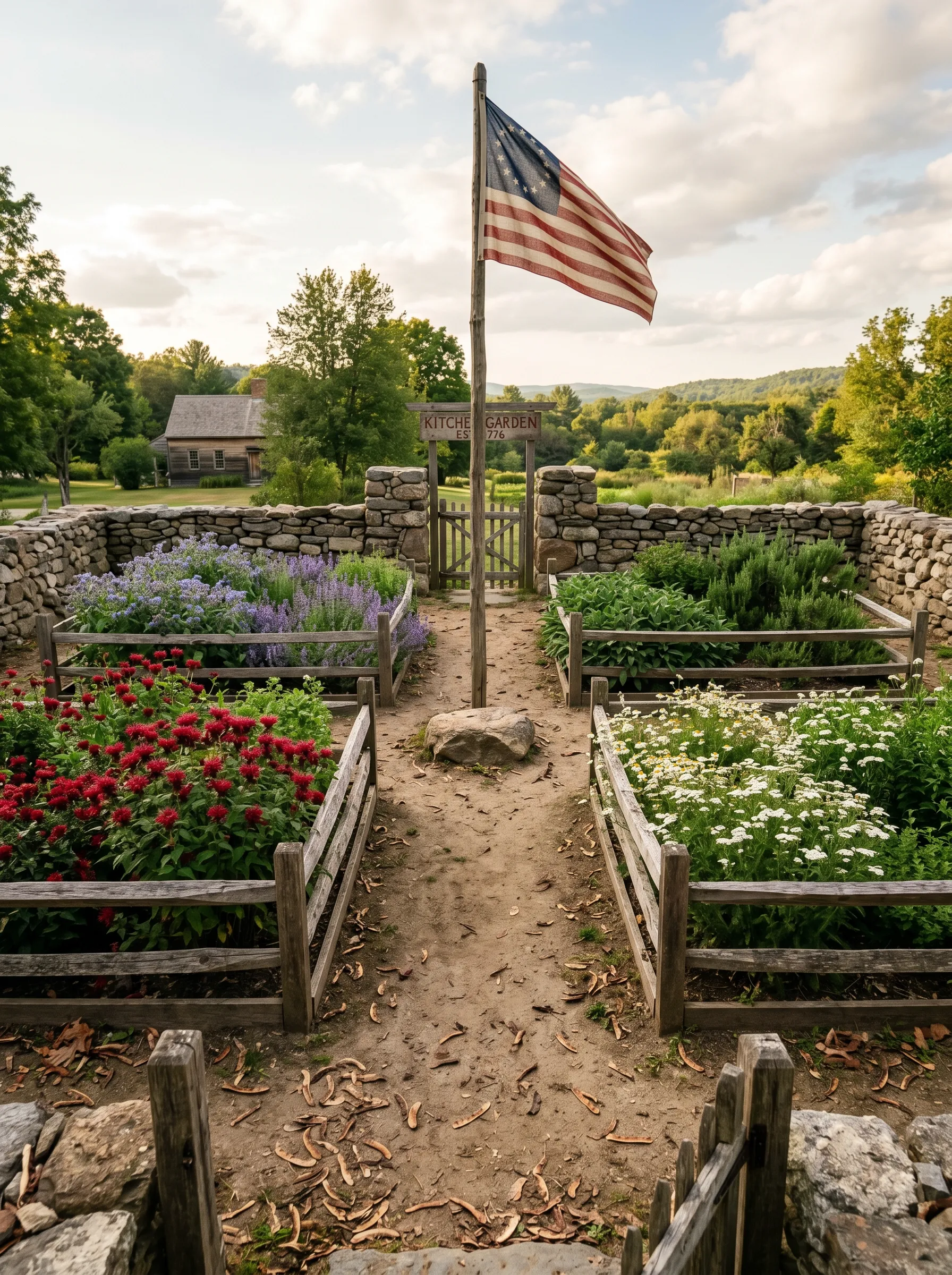
Build raised beds from rough-cut lumber, no wider than four feet so you can reach the center without stepping in. Surround the entire garden with a dry-stack stone wall at knee height, using whatever local stone is available — imperfection in the stacking is correct.
At the center convergence point of two crossing paths, drive a wooden pole and fly a colonial-era reproduction flag — the thirteen-star Betsy Ross version or the earlier Betsy Ross flag with stars in a circular arrangement. Hang a hand-lettered board on the pole reading the name of the garden and its founding date.
Plant in the colonial kitchen garden tradition: one bed of herbs, one of flowers for cutting, one of vegetables. Choose varieties in red and purple tones where possible — bee balm, scarlet runner beans, red zinnias, purple sage. The garden should look like it was planted to be useful and beautiful in equal measure.
The dirt path between beds is correct. Do not mulch it or gravel it. A swept-earth path is part of the historical authenticity.
The Porch Plant Wall Dressed With Patriotic Bunting
Install three to four horizontal wooden shelves on the wall of an enclosed porch or covered outdoor space, spaced roughly sixteen inches apart vertically. Fill every shelf with an assortment of potted plants — ferns, pothos, ivy, any trailing green — in terra cotta, concrete, and ceramic pots. Mismatched is correct. More plants is more correct.
Between each pair of shelves, thread a length of wide red, white, and blue fabric bunting — not store-bought flag bunting, but actual fabric cut into wide swaths in solid colors — through the shelf supports and let it drape in deep, loose swags across the wall. The plants should spill over and through the fabric, so the bunting and the greenery become entangled. This is the entire effect.
Below the shelves, place a vintage dresser or chest of drawers topped with more plants. Add a vintage metal watering can on the floor, a large glass demijohn in green, and wicker furniture in front. One small handheld flag tucked into a pot finishes the reference without overdoing it.
The Barn Door That Needs Only Three Pieces
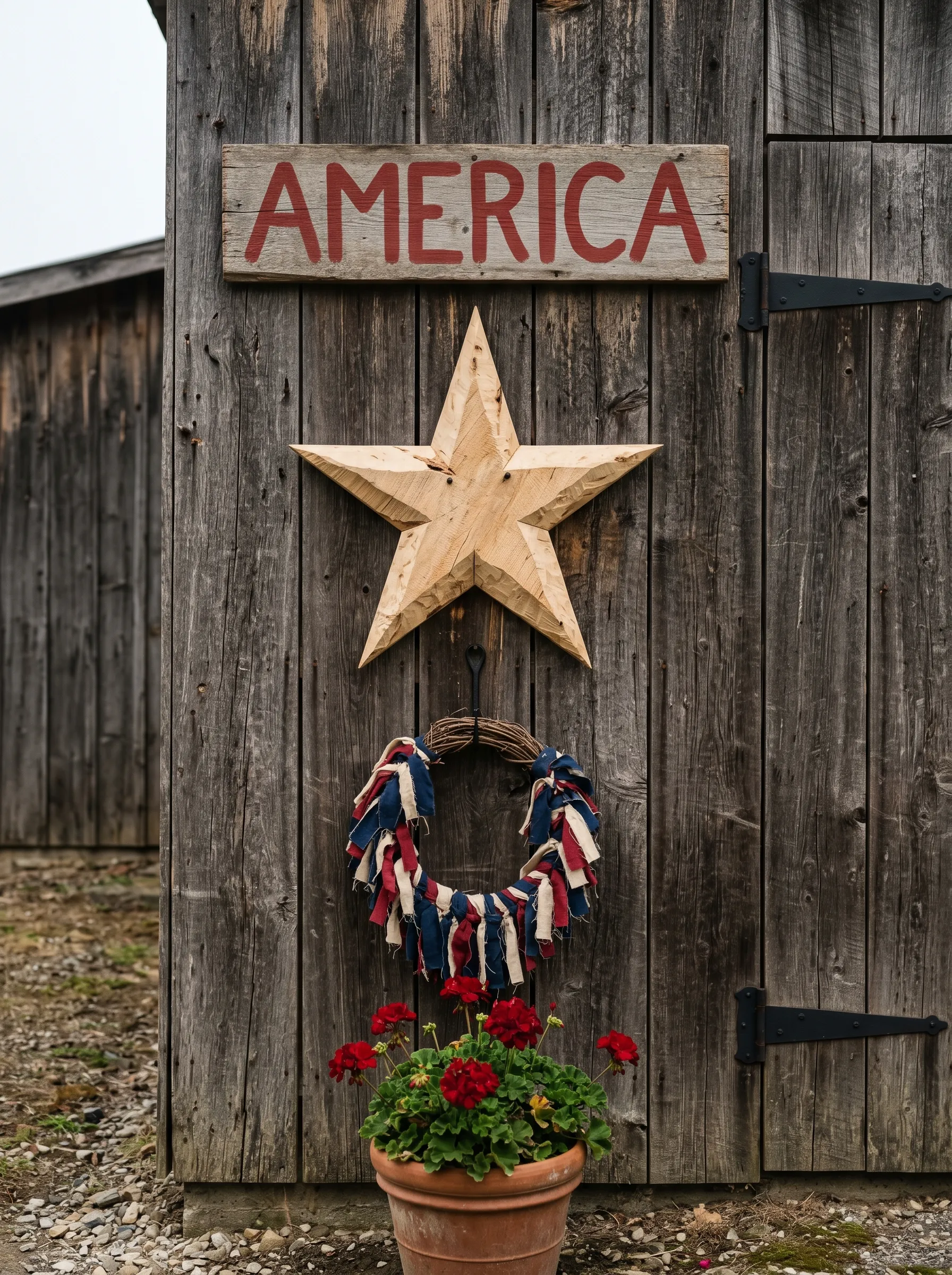
Mount a hand-carved barn star — natural unfinished wood, not painted — at eye level on weathered barn siding. The star should be large: minimum eighteen inches point to point, ideally closer to thirty. Let the raw wood grain show completely. Do not stain or seal it.
Below the star, hang a grapevine wreath with strips of torn cotton fabric tied through it at intervals — use only red, navy, and cream fabric torn into rough two-inch strips, not cut clean. The torn edge is intentional. Tie each strip in a double knot and leave the ends loose.
Above the star, attach a length of reclaimed barn board cut to roughly four feet and letter it in a deep barn red — a simple single word or short phrase painted freehand with a wide brush. “AMERICA” is correct. “LIBERTY” works. The imperfect hand-lettering is what makes this piece, not in spite of it but because of it.
At the base, a single terracotta pot of red geraniums. That is all this arrangement needs.
The Layered Patriotic Textile Vignette With Cross-Stitch
The centerpiece of this arrangement is a framed cross-stitch sampler in the traditional American folk art format — a saltbox house, a willow tree, a flagpole, a decorative border, and a patriotic phrase such as “In Memory of Our Heroes.” Source an antique one if you can. A quality reproduction in a distressed dark frame is the next best option.
Behind and around the sampler, layer a faded American flag as a backdrop and fold a navy-and-cream star quilt so it drapes softly at the front base. On either side, salt-glazed stoneware crocks with dried wildflowers — baby’s breath, dried red clover, dried globe amaranth. Stack old leather-bound books beside the sampler. The books do not need to be about anything in particular. Their spines simply add vertical rhythm and a sense of accumulated time.
Place the whole arrangement on a rough wooden crate or a low antique chest. The layers of textile, ceramic, and paper in this vignette work because they share one thing: they are all the products of someone’s hands, made with care, over time.
The Stone Fireplace Mantel Dressed for the Hearth Season
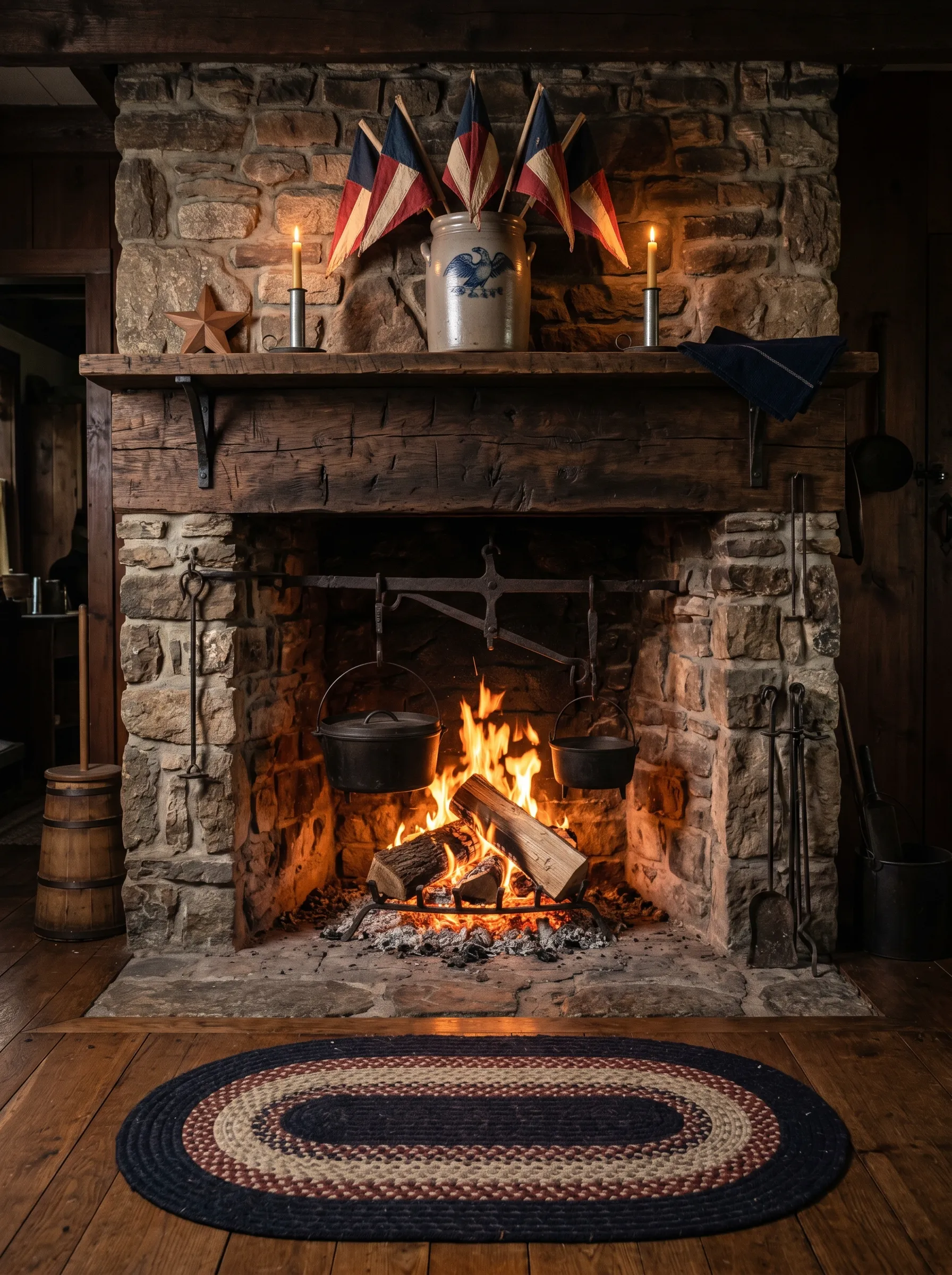
An open stone fireplace with cast iron cooking equipment — a crane arm, hanging pots, iron tools — is its own complete visual statement before you add anything. Work with it rather than over it.
For the mantel beam, which should be a single rough-hewn timber of significant depth, place a large salt-glazed stoneware crock at center and fill it with four to six small parade flags — not identical, varied in size and slight variations in print. On either side of the crock, a single taper candle in a simple pewter or tin holder. On the far left, a small cast iron or tin barn star. Leave the right side empty.
On the floor before the fire, an oval braided rug in navy, cream, and dark red — this is the exact combination to look for. The braided oval is the correct shape. No rectangular rug, no round rug.
The Painted Cabinet With Garland and Framed Art
Take a chippy-paint or heavily distressed cabinet — the kind with visible layers of old paint showing through in cream, grey, and taupe — and use it as the base for a mantel-style display without a fireplace.
Above the cabinet, lean two framed patriotic art pieces at slightly different heights: one a larger impressionist-style street scene with flags, one a smaller watercolor flag study. Let the frames overlap slightly. Below the art, on the cabinet top, place a layered garland: string a long strand of natural wooden beads with a mix of navy felt balls, cream felt balls, and small red felt or painted wooden stars. Drape it in deep swags across the cabinet face, letting it hang well below the cabinet surface.
Supplement with a small blue felt pennant in a red-lettered word — “FREEDOM” is shown — tucked into a bunch of red geraniums in a simple blue-and-white printed tin or ceramic container. This garland-and-printed-art combination works for anyone who wants the primitive patriotic spirit without the commitment to actual antique objects.
The Split-Rail Fence Line That Decorates the Whole Property
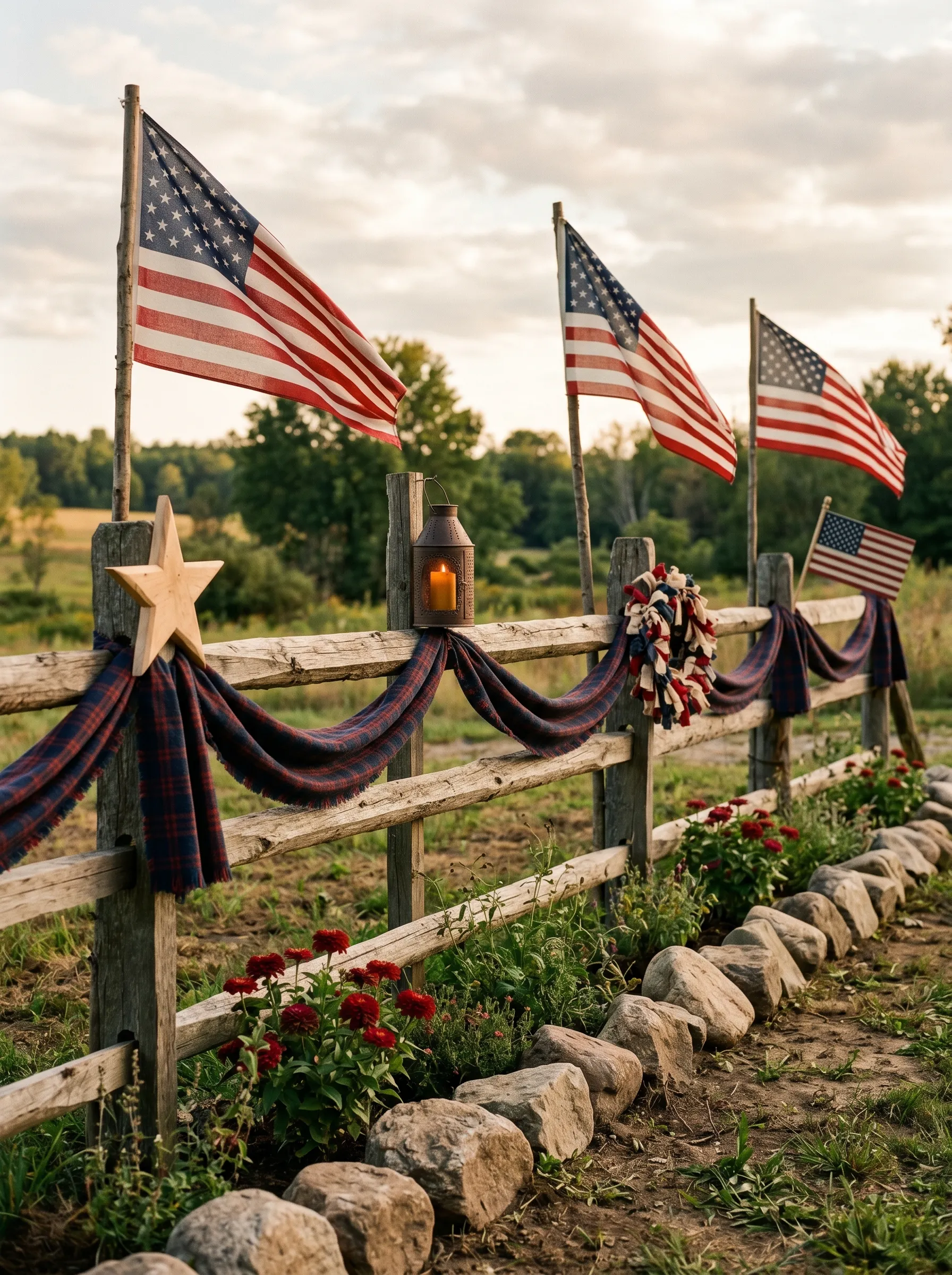
Run a length of split-rail fence — either an existing one or a new section installed along a garden path or driveway edge — and treat it as a continuous display surface. Mount full-sized American flags at intervals of four to five feet, using raw tree branch poles driven directly into the ground at a slight forward angle so the flags catch the light well. Between each flag, drape a wide plaid wool scarf or blanket over the top rail, letting it pool generously on both sides — not a neat tie, but a loose, heavy drape as if someone just set it down.
At each fence post, add a single element at mid-height: a small wooden star, a tin punched lantern with a lit taper candle inside, or a simple rag wreath made from strips of cotton in red, navy, and cream tied onto a grapevine ring. Alternate these three elements across the posts to create rhythm without uniformity.
At the base of the fence, establish a low border of fieldstones and plant a single variety of red flower — zinnias or bee balm — in a continuous ribbon. No mixed plantings. One color, one plant, repeated with intention.
The Patriotic Vignette Built on White Ironstone
Collect a base layer of white ironstone: pitchers of multiple sizes, crocks, mugs, compotes. White ironstone unifies everything that sits beside it. Arrange these on a painted or distressed white sideboard or buffet against a shiplap wall, with a large ornate gold mirror behind to multiply the depth.
Work flags into the collection as vertical accents: small handheld parade flags tucked into the mouths of the pitchers, one larger flag leaning against the mirror. Add a single cast iron eagle figure, a small scroll tied with ribbon, a few terracotta pots with living herbs.
Drape one aged American flag loosely across the front face of the sideboard so it falls asymmetrically onto the floor. This is the anchor. Everything above it is secondary. The flag on the floor reads as deeply intentional in this context, not careless.
The Colonial Bedroom Built on a Woven Coverlet and Plaster Walls
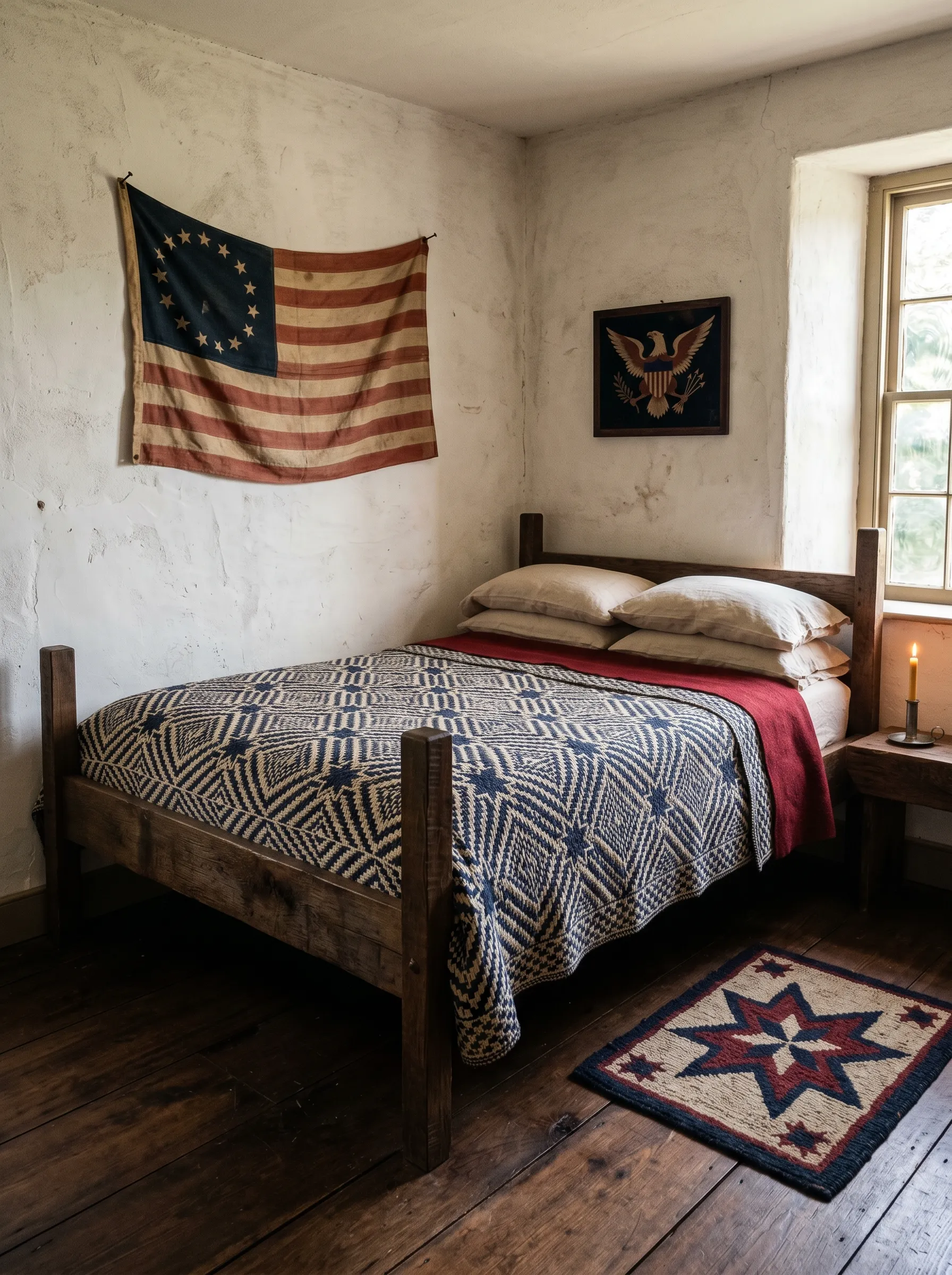
Build the bed frame from rough-sawn lumber in a simple mortise-and-tenon four-post design without a headboard — just four plain posts. The mattress sits directly on rope or board slats, and the whole bed sits lower to the floor than a modern bed. Paint the walls in a flat, chalky off-white — actual lime plaster if possible, or a flat latex in a warm bone tone if not. The texture in the wall matters more than the exact color.
The coverlet is the hero. Source a reproduction jacquard woven coverlet in navy blue and natural cream, or a handmade geometric quilt in the same palette. Fold a solid red wool blanket across the foot of the bed. Keep the pillow count low — two linen-cased pillows, no decorative cushions.
On the wall above the head of the bed, hang a folded or loosely pinned thirteen-star Betsy Ross flag. Supplement with a single piece of framed patriotic folk art — an eagle rendering or federal seal — beside the window.
On the floor, a small hand-hooked rug in star pattern in red, navy, and cream. One taper candle on a simple chamber stick on the bedside bench. Nothing else.
The Log Wall Vignette With a Faded Stripes Flag
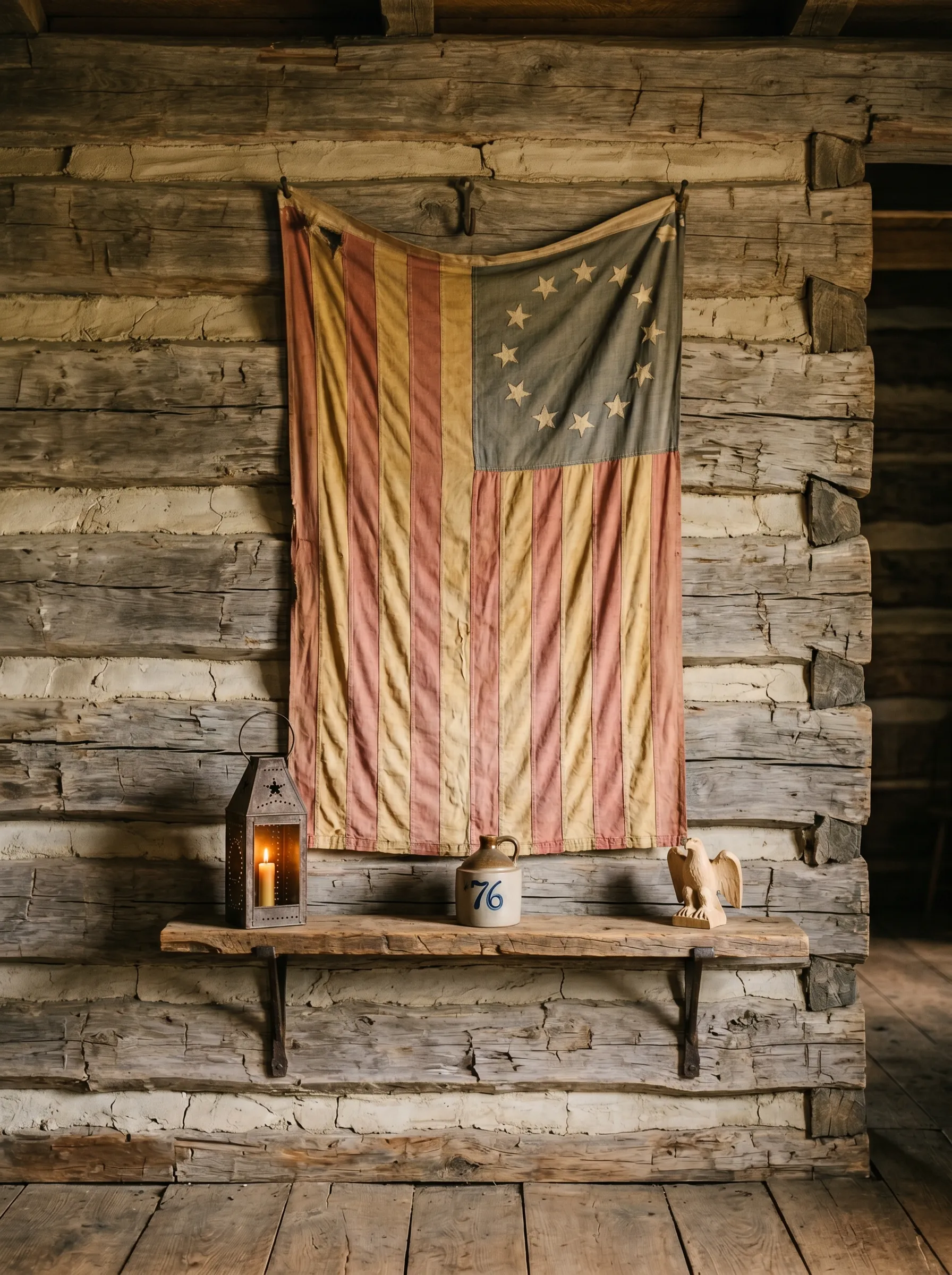
Source a reproduction aged-cotton flag — the kind sold as a “distressed” or “primitive” flag — in a thirteen-stripe vertical-hanging format, meaning it will hang taller than it is wide. The colors should read as faded rose and dusty sage rather than sharp red and bright navy. Hang it loosely on two forged iron hooks driven directly into the mortar between log courses. Let it drape slightly rather than stretching it flat.
Below the flag, build a shelf from a single rough-cut plank of reclaimed lumber supported on simple iron shelf brackets. Keep the plank no more than eight inches deep. On the shelf, place three objects with intentional spacing: a tin punched lantern with a candle to the left, a salt-glazed stoneware jug stamped with “76” or a maker’s mark in the center, and a small carved wooden eagle to the right.
Do not add more than these three objects. The restraint is the design.
The Rope-Hung Barn Board Sign With Stoneware Flanking
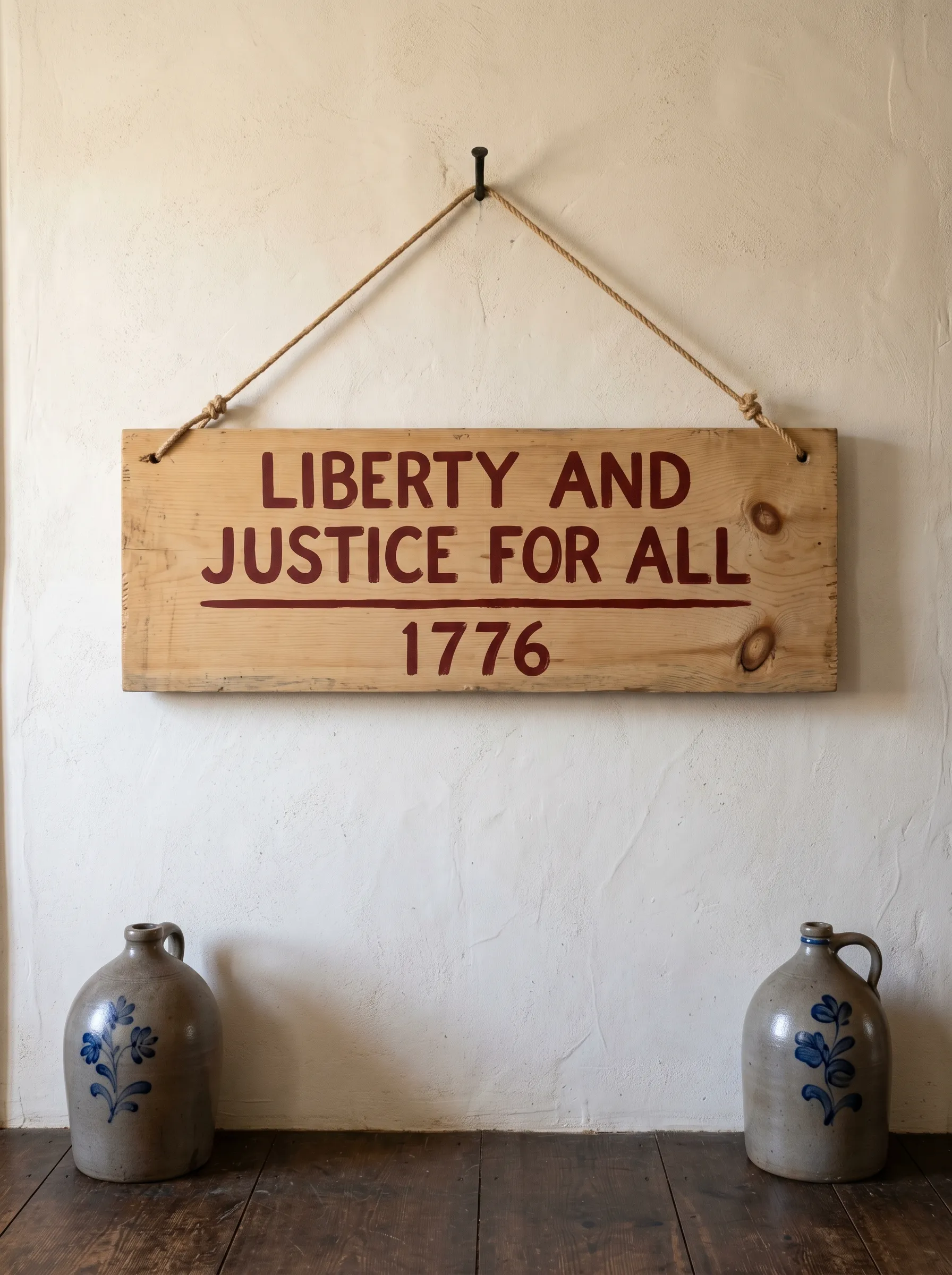
Cut or source a plank of clear pine approximately thirty-six inches wide and fourteen inches tall. Drill a hole at each top corner and thread through a length of natural jute rope, knotting on the underside. Hang from a single nail or hook at the apex.
Paint the lettering freehand using a medium-width brush and an oil-based barn red or dark iron oxide red. The text should be a short patriotic phrase and a date — “LIBERTY AND JUSTICE FOR ALL / 1776” works as shown. Use block capital lettering, imperfectly spaced and slightly uneven. Add a painted rule line between the phrase and the date using the same brush, also freehand.
On the floor or shelf below the sign, place two salt-glazed stoneware jugs of different heights — the kind with blue cobalt floral or leaf decoration. They should bookend the sign without touching the wall directly beneath it. The composition works because the rough organic lettering above and the wheel-thrown ceramic below share the same handmade ethic.
The Hallway Anchor Built on One Oversized Folk Art Painting
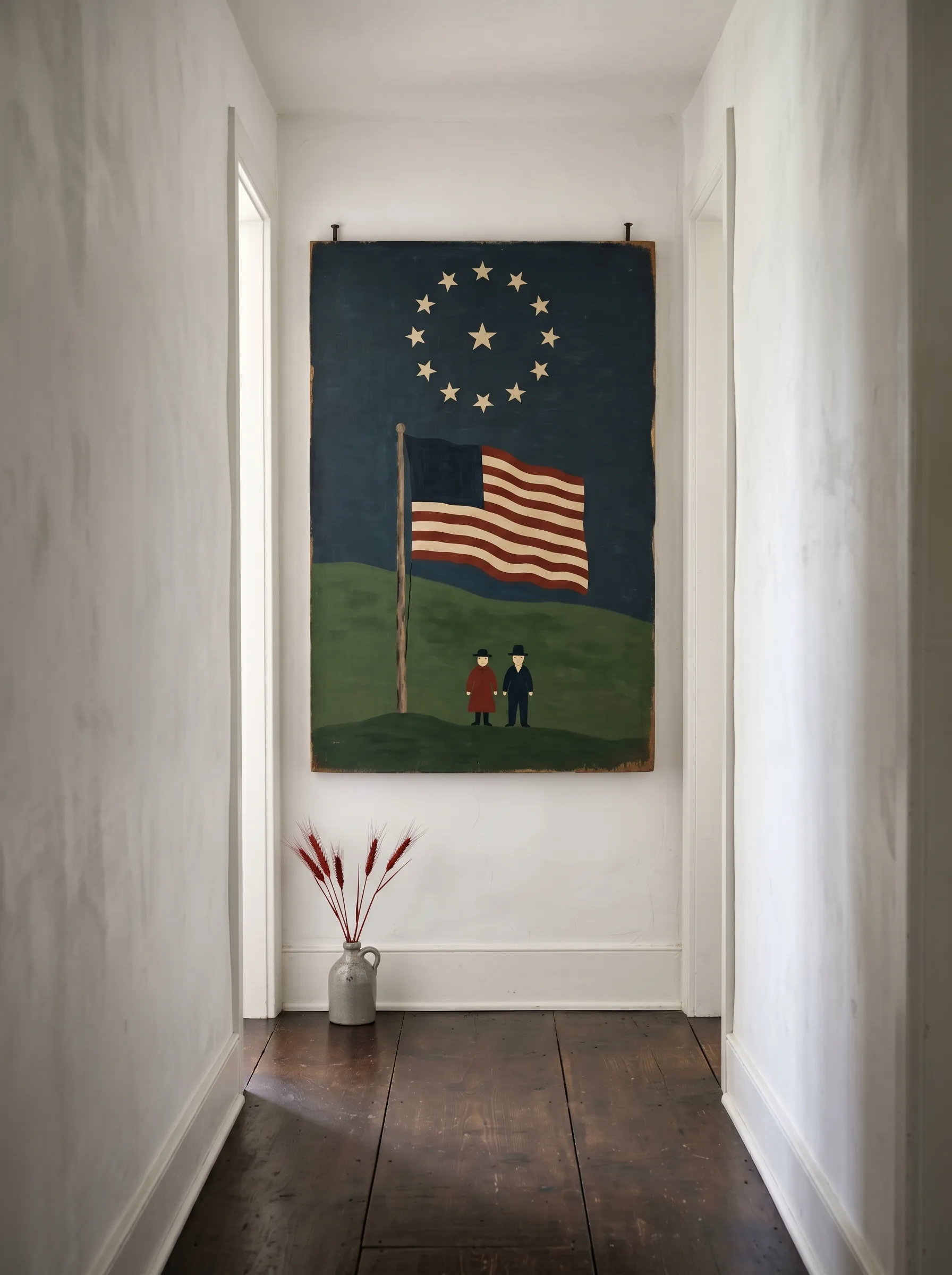
A long, white hallway wants exactly one thing: a single massive piece of art that takes all the visual energy of the space and focuses it. Source or commission a piece of American folk art painting — the naive tradition, with flat perspective and simple human figures — depicting a flag scene. The painting shown here, with a flag on a pole over a green hill and two small figures standing beneath it, surrounded by a ring of stars, is the exact format to look for. It should fill at least two-thirds of the wall height in a standard eight-foot hallway.
Hang it on two nails with no frame, or a simple thin wood frame that does not compete with the painting. Below the painting at floor level, a single salt-glazed stoneware jug with a few stalks of dried red wheat grass or dried grasses — nothing fussy, nothing arranged. Just stems dropped into a jug.
The walls stay bare. The floor stays bare. This is not a gallery. It’s a hallway that knows what it’s doing.
The White Brick Mantel That Earns Its Drama Through Light
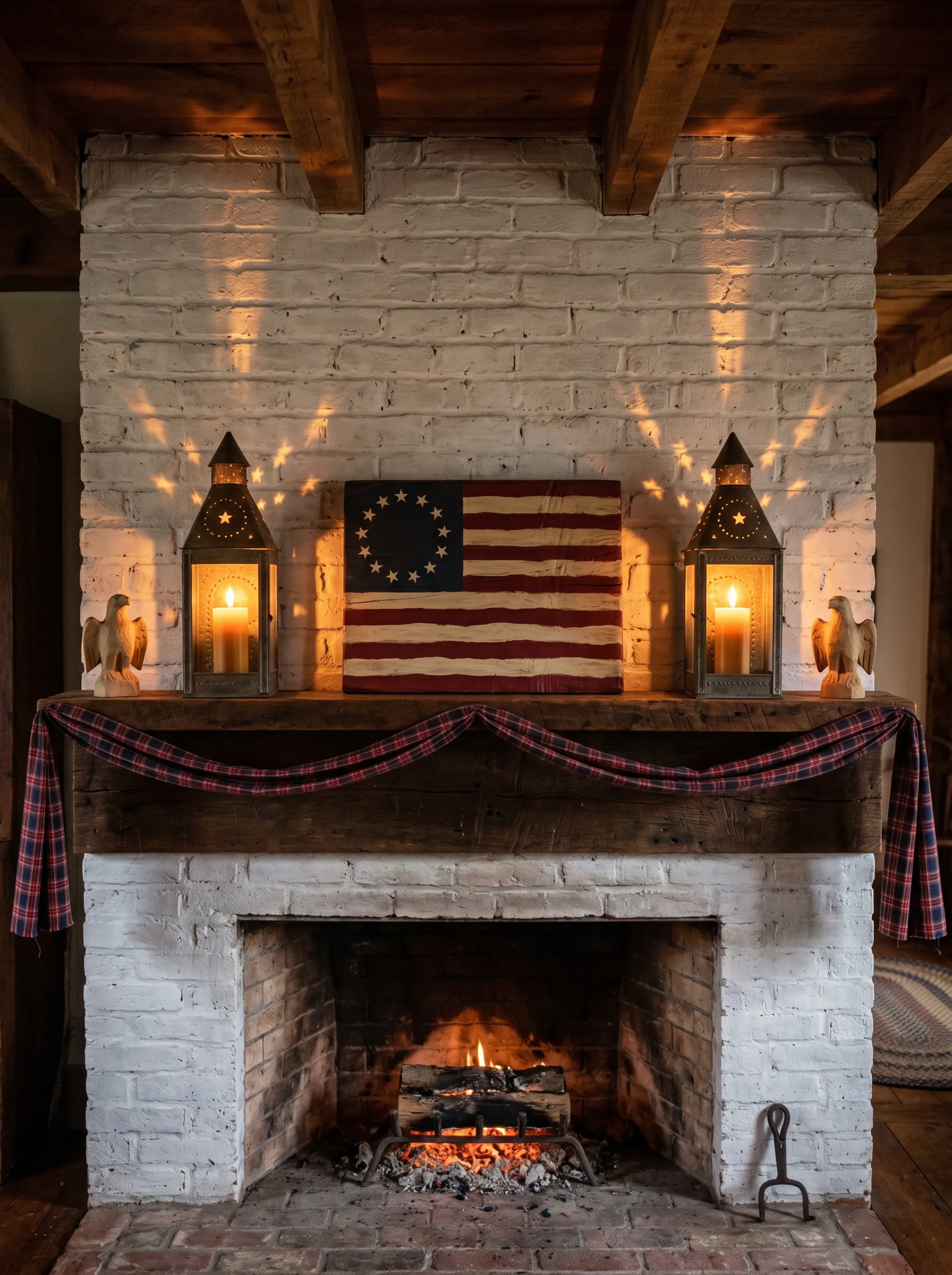
Paint a full fireplace surround — brick, mortar, and all — in flat white. Not off-white. White. The contrast between that clean white surface and a rough-hewn dark timber mantel beam creates the tension this look runs on. The white also amplifies candlelight in a way that untreated brick does not.
On the mantel, place a carved wooden Betsy Ross flag rendering at center — the kind cut and painted in relief so it has physical depth, not a flat print. On either side, a tall tin punched lantern with pillar candles inside. The punched holes in the tin will throw star patterns on the white brick behind. On the outer ends of the mantel, small carved wooden eagles facing inward.
Drape the front face of the mantel beam with a length of dark plaid wool — navy, red, and cream plaid — looped loosely so it hangs in a single natural swag. Pin at the corners, let it drape in the middle. Exposed beamed ceiling above completes the architecture.
What Makes This Work
Every space in this collection has something in common, and it is not the colors.
It is the conviction that a home should carry the memory of the people who lived in it. That objects should earn their place by lasting. That beauty and usefulness do not have to be in competition.
Primitive patriotic decor done well is not sentimental. It is not nostalgic in the soft, hazy way. It is specific. It names a year. It stitches a phrase by hand. It builds a wall from stones pulled out of a field.
The red, white, and blue are just the surface. What’s underneath is the argument that a home is worth the effort of making it mean something.
That is a design principle worth keeping all year.