
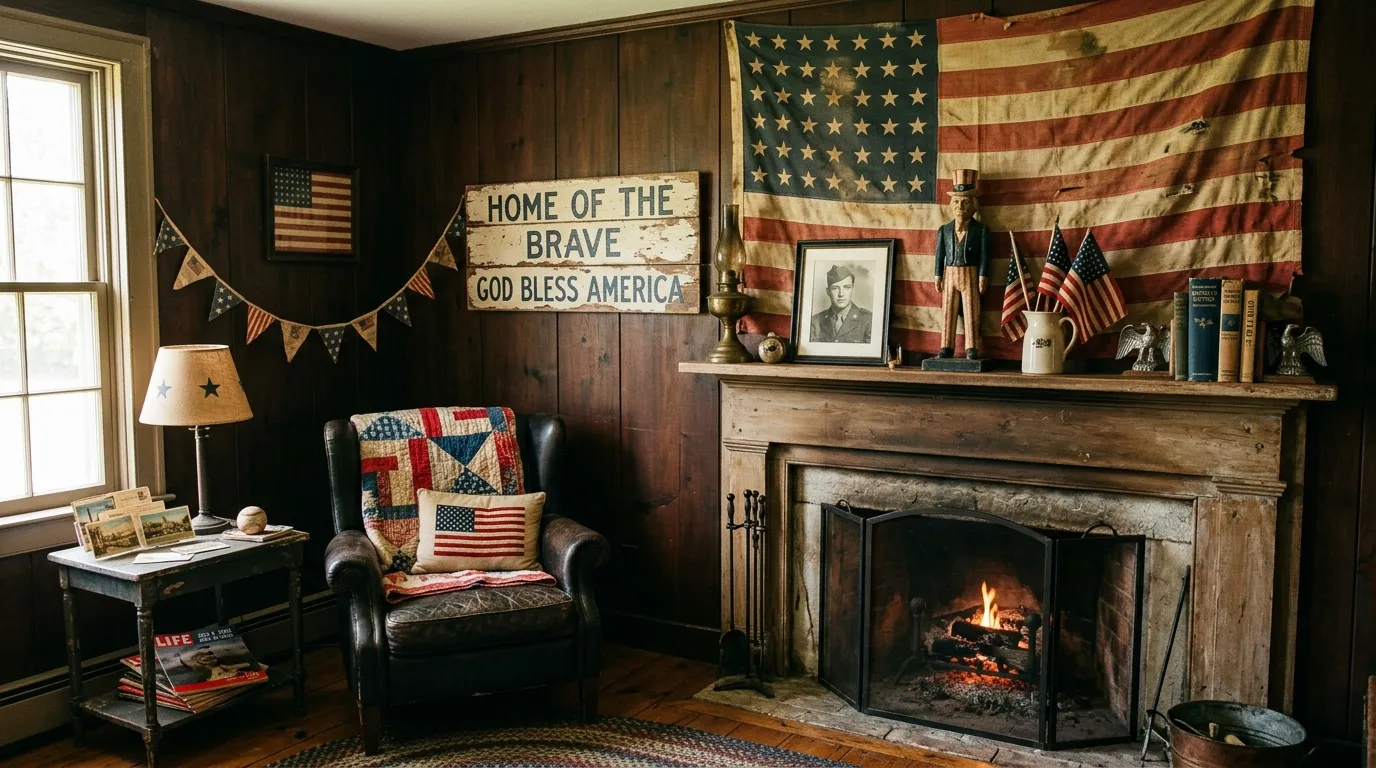
The flag gets put out once a year and then everyone panics about what to do with the rest of the porch. Red, white, and blue sounds simple until you’re standing in front of a display that looks like it was assembled by someone who has only seen July 4th described in a catalog. The colors are right. The feeling isn’t.
Patriotic decorating fails for a specific reason. It mistakes the palette for the concept. You get the hues without the history, the colors without the weight. Everything looks purchased rather than lived in. The homes in these images don’t look like they were decorated for a holiday. They look like the holiday just happens to belong there.
The difference is almost never what you buy. It’s what you keep, layer, and refuse to throw away. The most convincing patriotic spaces are built from things that predate the current owner — vintage tins, worn flags, books that actually have a history inside them. The decoration isn’t performing patriotism. It’s simply been here long enough to mean something.
This is how you get there.
Why Your Patriotic Decorating Looks Like a Retail Display
You Bought the Theme Instead of Building It
Everything matching is the first warning sign. When every piece in a patriotic vignette comes from the same seasonal aisle — the same distressing style, the same flag proportions, the same coordinated red — it reads as a kit, not a home. The human eye knows the difference between things that arrived together and things that arrived over decades. It doesn’t need to articulate the distinction to feel it.
The fix is contamination. You want pieces that don’t obviously belong together but somehow do. A Morton’s Potato tin next to a galvanized watering can. A gilt-frame mirror beside a white ironstone pitcher. The incongruity is what makes it convincing.
You Used Too Much Flag
There is a limit to how much flag a space can absorb before it starts looking like a campaign headquarters. The flag itself is powerful precisely because it’s specific. When it’s everywhere, it becomes wallpaper.
One flag — properly placed, properly sized — does more work than five small ones scattered around a tabletop. The exception is when you’re using flags as a collection, a deliberate accumulation with compositional intention. Even then, they need an anchor piece that isn’t a flag.
Your Colors Are Too Clean
The real red, white, and blue of lived American life is faded. It’s a flag that’s been folded in an attic. It’s a tobacco tin gone soft with age. It’s bunting that’s been in the sun for three summers. Saturated, bright, plastic-looking patriotic color is the telltale sign of a recent purchase.
If you’re starting with new items, you have two options: buy vintage, or wait. There is no shortcut to age. You can lightly distress painted wood, but you cannot convincingly fake the way cotton flag fabric goes soft and streaky after years of handling. Buy the old thing, or accept that it will take time.
Patriotic Home Decor Ideas
The Galvanized Crate Tower Porch With Flag Clusters in Every Vessel
Start with a wire milk crate as your floor-level base and stack a weathered wood crate on top of it. The combination of materials — rough wood slat sides, galvanized metal edges — creates the textural foundation the whole arrangement needs. Set a large galvanized metal bucket or washtub on top as your primary planter, filling it generously with trailing greenery and red flowers so it spills over the sides.
Source a vintage wooden stepladder for the right side of the arrangement. This is your vertical spine. On each step, position white enamel or galvanized metal containers in varying heights — old milk cans, painted buckets, small tin pails. Plant or arrange red and white flowering annuals in each one, and add one or two miniature flags to every container. The flags look intentional in multiples this way, each one belonging to its vessel rather than being scattered at random.
The center column needs a vintage red tin — something with original lettering visible through the aging. A potato chip canister, a coffee tin, anything red with worn typography. This becomes the eye-level focal point. Crown the entire ladder arrangement with a tiered galvanized display at the top.
Against the blue-painted front door, the warm rust and galvanized tones land with real impact.
The Rope-Hung Porch Swing With a Faded Quilt and a Wicker Basket
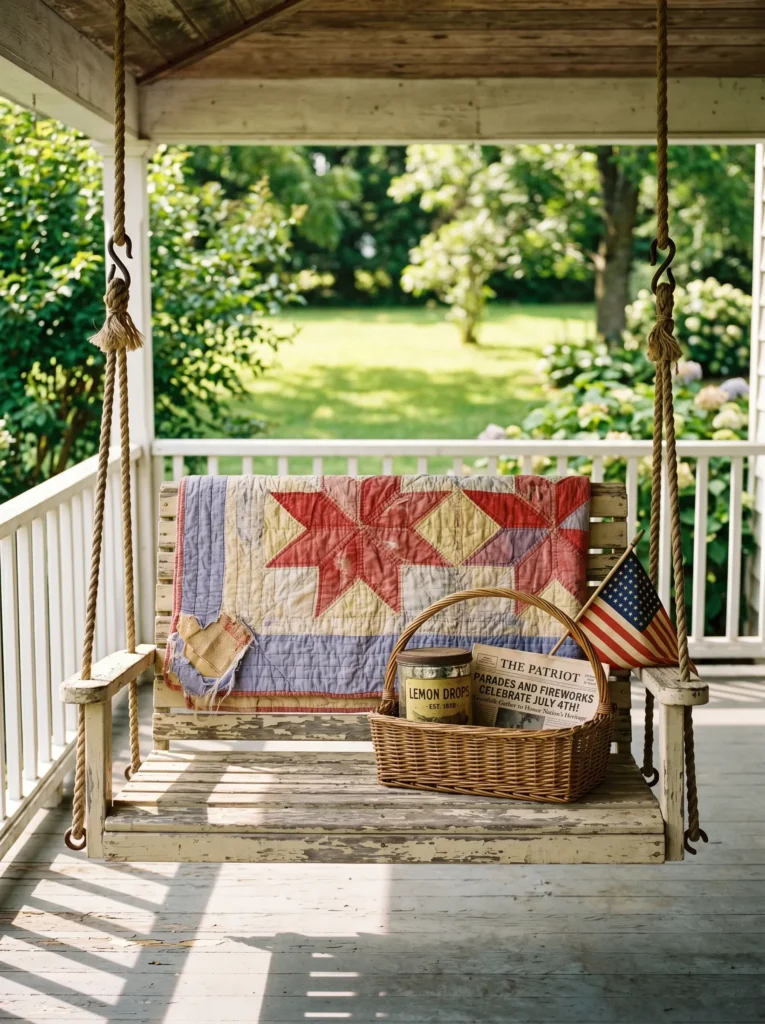
The swing itself needs to be genuinely aged. Peeling cream or white paint, visible wood grain, the kind of surface that looks like it’s been in sun and rain for thirty years. Hang it on thick natural rope rather than chain — rope adds warmth and visual texture that chain undercuts. Drape a genuine patchwork quilt over one arm and part of the seat. It needs to be the worn kind — a star or pinwheel pattern in faded red and blue cotton that’s been washed so many times the colors have gone dusty and the edges have frayed. Don’t fold it. Lay it casually, as if someone just set it down. On the seat beside it, place one wicker market basket. Inside the basket: a vintage tin with printed label, a folded newspaper with a headline relevant to the holiday, and one small flag tucked against the side at a low angle. The basket and its contents should look like they belong to someone who’s about to sit down. That sense of interrupted use is what makes the arrangement feel lived-in rather than styled.
The Vintage Book and Ironstone Mantle With Gilt Mirrors and an Antique Scale
The anchor of this mantle is a large gilt-framed mirror with ornate carved detailing — not a clean modern gold, but the darkened, slightly rough gilt that comes from genuine age. Lean it against the wall rather than hanging it. It reads as considered rather than installed.
In front of and beside the mirror, arrange four to six hardback books standing upright with their spines showing. These need to be genuine antique books — red cloth spines, blue cloth spines, gilded lettering faded to near-nothing. You’re not after decorative books with fake spines. You want books old enough that their bindings have warped and their spines have gone slightly irregular.
At the base of the books, place a white ironstone pitcher — the kind with scalloped or shell-impressed edges, slightly heavy in the hand. Put a miniature flag inside it at a slight angle. To the right, add a genuine antique scale with brass mechanisms visible. This single industrial piece provides the necessary non-patriotic neutral.
Drape a large flag fabric over the left mirror edge or the wall behind — enough to show the stripe pattern without covering everything. Add fresh or dried lilacs in a heavy vessel for the organic element. The whole thing relies on nothing being too clean or too coordinated.
he Weathered Ladder-Back Chair With a Draped Antique Flag and Lavender Bunch
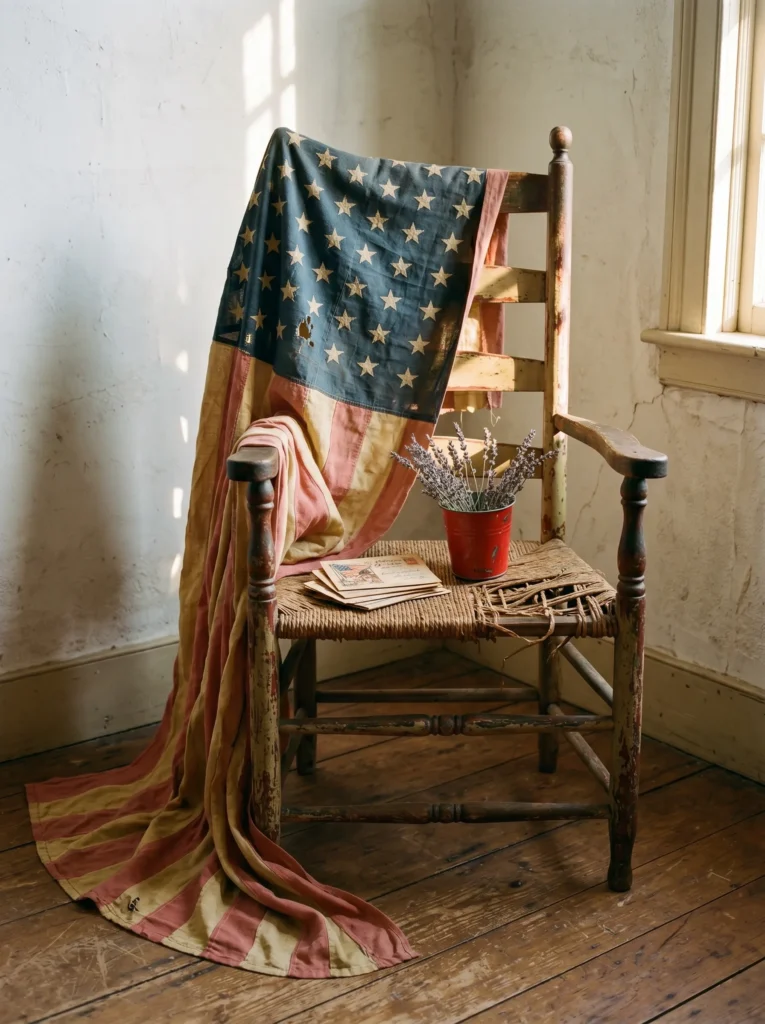
Source a genuinely aged ladder-back armchair — the kind with a woven rush seat that’s unraveling at the edges and peeling green or yellow paint on the arms. This chair needs to look like it belongs in a building that hasn’t been renovated since the 1940s. Drape a large antique flag over the chair back so it falls down to the floor on both sides. The flag should have at least 48 stars and genuine fabric aging — the navy section faded and spotted, the red stripes gone to dusty rose, the white stripes yellowed. The age and the scale are everything. A new flag or a small flag ruins the composition entirely. On the rush seat, lay two or three old letters or postcards slightly overlapping. Then place a small red tin bucket containing four or five stems of fresh or dried lavender directly on top of the papers. That single pop of color — the red tin — anchors the composition against all the muted tones. Leave the background bare. White plaster walls and bare wood floors are the ideal setting. Any styled or decorated background competes with the chair arrangement itself.
The Dark Tarnished Urn With Massed Flags and Dried Roses on Lace
Find a heavily oxidized silver-plate or cast metal urn with handles — a trophy style with a pedestal base. The darker and more tarnished the better. The oxidation is doing structural work. Set it on a table covered with a white crocheted or lace tablecloth so the darkness of the urn reads against something light.
Fill the urn with a thick layer of crumpled parchment, burlap, or brown paper — enough material to anchor the flag sticks upright. Then pack in eight to ten small cotton flags with wood sticks in a fanned arrangement, the sticks going in at varying heights so the flags layer over each other. Add dried cream roses tucked in around the base of the flags, just above the filling material.
Surround the base of the urn with additional objects: a dark leather Bible, a small lantern, a few buttons or coins scattered on the lace. A vintage dress form in the background holding a striped USA sash pulls the whole arrangement into something theatrical without being loud. Keep the surrounding palette very neutral — raw wood, white lace, dark brown leather — so the urn and flags carry all the color.
The Light Blue Bedroom With Red Stripe Bedding and Cherry Motif Lamp
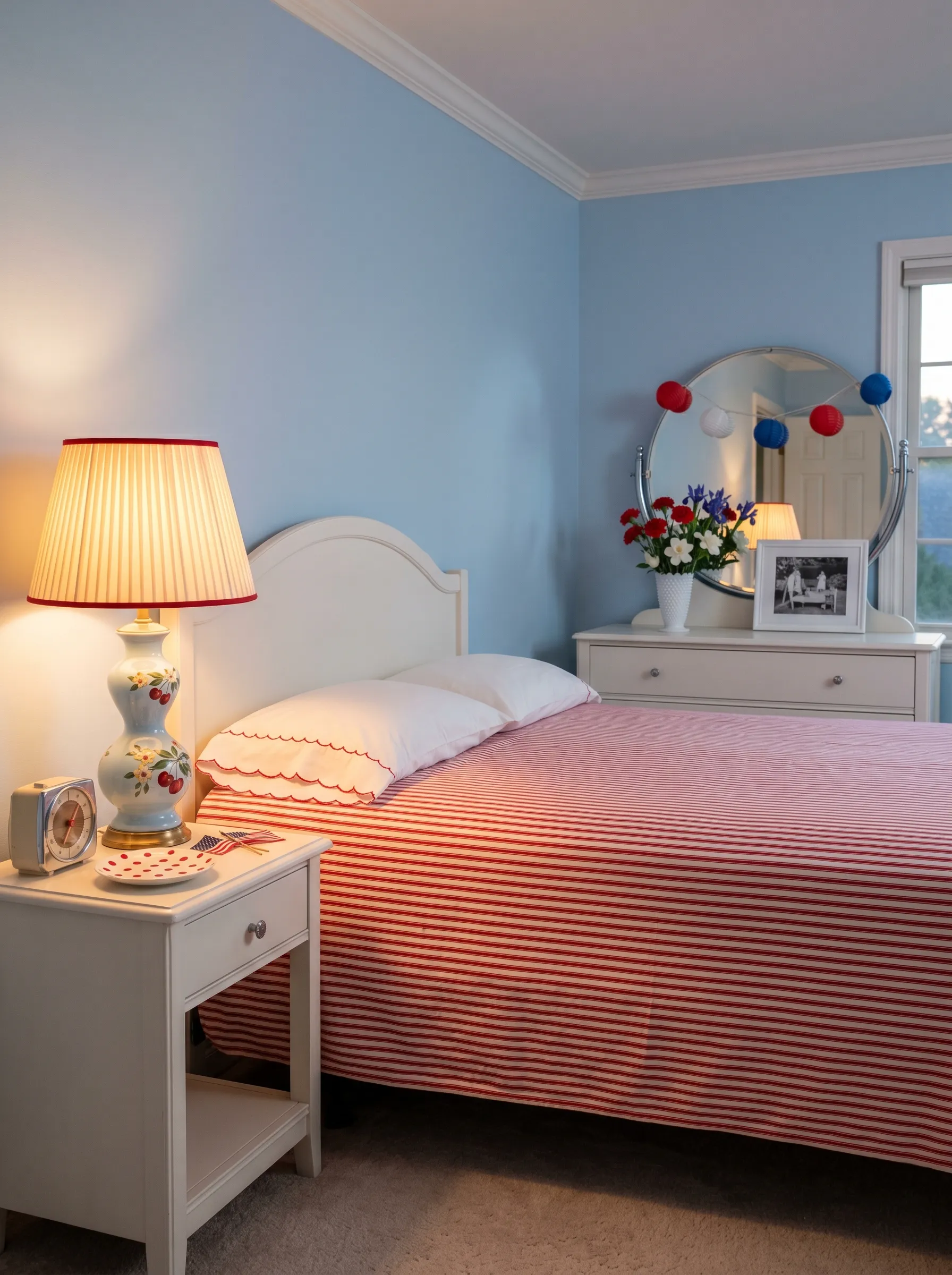
Paint the bedroom walls in a soft, desaturated sky blue — not bright, not grey-blue, something in between. The precise shade is the thing everything else responds to. Too bright and the red-white contrast goes harsh. Too muted and the whole room goes cool and flat. The bed is white painted wood — headboard with a simple arched top, no carved detail. Dress it with a red and white narrow-stripe coverlet in a fine candy-stripe width. The stripes should run the length of the bed. Add one or two white pillow shams with a scalloped or embroidered edge — this white-on-white softness against the hard stripe of the coverlet is the textural balance the bed needs. The nightstand lamp is the character piece. Source a ceramic lamp base with painted florals — cherries, strawberries, small red fruit against a cream background. Top it with a pleated white shade that has a thin red trim band at both top and bottom. The red trim echoes the bedding without repeating it exactly. On the dresser against the opposite wall, place a round silver mirror and a white milk glass vase with a mixed red, white, and blue flower arrangement. Loop a simple red, white, and blue ball garland over the mirror frame. Everything in this room is modest in scale. Nothing competes.
The Deep Oak Hutch Styled With Vintage Tins, Draped Flag, and Layered Collections
An open-shelf hutch or bookcase in dark oak is the furniture piece. The entire staging depends on having enough depth in the shelves to create front-to-back layering.
Start with the top of the hutch. Place three to four large wicker-wrapped jugs and demijohns at different heights. Drape a large vintage flag — the kind where the blue has faded to near-grey and the red has gone terracotta — loosely over the edge of the top so it cascades down one side. The drape should look accidental, not arranged.
The middle shelf is for tins. Vintage food and tobacco tins with original labels: coffee, marshmallows, pipe tobacco, anything with old American typography. Cluster them in groups of three, varying heights. Tuck one small flag behind a tin rather than in front of it. Add a small metal bell or inkwell between clusters for scale variation.
The bottom shelf is for books — genuinely old, spines worn — and ironstone serving pieces. A gravy boat, a small cream pitcher, a cake stand. These should be the whitest, cleanest things in the whole piece. Their brightness reads as intentional contrast against the worn tins above.
The Raw Wood Crate Labeled “Liberty” With Mismatched Vintage Bottles and Dried Botanicals
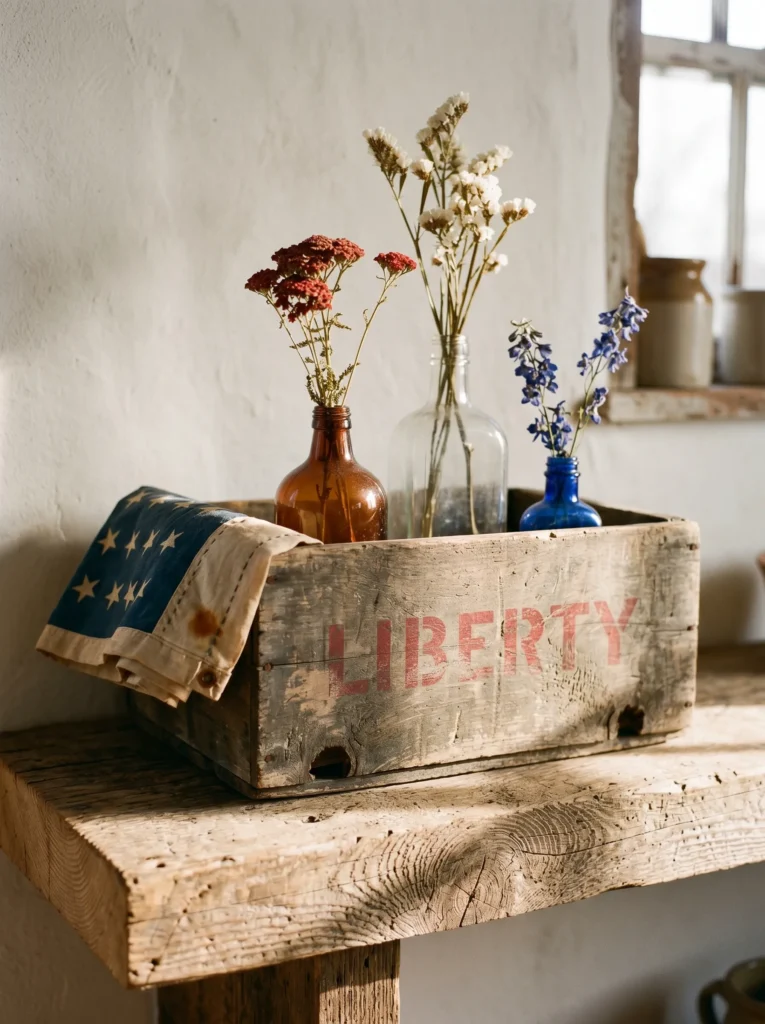
Find a raw barn-wood crate with enough age that the wood grain is visible and the joints are slightly rough. If you can find one already stenciled or hand-painted with a word — LIBERTY, USA, AMERICA — that’s the piece you want. If not, paint the word directly onto the front face using a brush and red paint, working loosely so the letters show brush texture rather than a stencil’s clean edge. Inside the crate, arrange three glass bottles of different shapes and colors: an amber apothecary bottle, a clear tall-necked bottle, and a small cobalt blue bottle. In each bottle, place a different dried flower in a patriotic color: dried red yarrow in the amber, dried white statice or baby’s breath in the clear, dried blue delphinium or larkspur in the cobalt. The color-to-bottle pairing is the design decision that makes this work — the color of the glass and the color of the flower reinforce each other. Tuck a small folded vintage flag canton — just the star section — into one corner of the crate so it drapes slightly over the side. Keep everything else off the surface. The crate needs empty space around it on a raw wood workbench or table to read correctly.
The Pioneer Storefront Facade With Painted Flag Panel and Bunting Swags
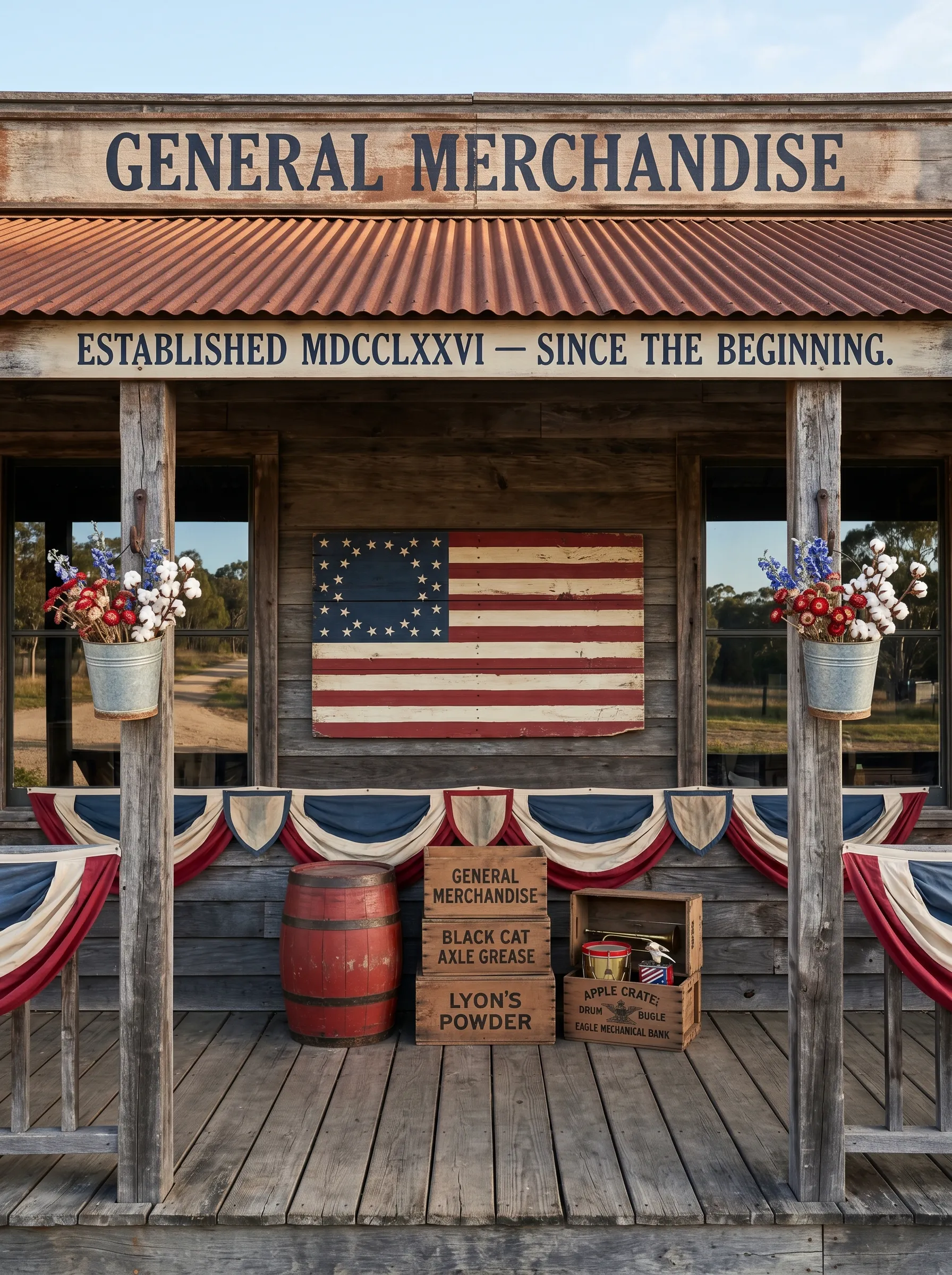
This is an outdoor structural vignette built around a rough-hewn plank building face. The foundation is the signage: hand-painted or printed lettering across a wide fascia board, something declarative about place and founding date. The typography should be wide, clean, utilitarian — the kind of lettering a sign painter in 1876 would have made. The hero piece is a large painted flag made from rough planks. Sand the boards, prime lightly, then paint the stripes directly in barn red and aged cream — not bright white. The blue canton gets a slightly dusty navy. The stars are stenciled in off-white. Distress the entire surface with sandpaper after painting, focusing on the edges and any area where real wear would happen. Hang it centered on the facade wall. Install fabric bunting swags below the fascia in the red, cream, and navy colorway — the kind with a loose, heavy drape rather than a tight, trim one. On the vertical posts, hang galvanized buckets containing cotton stems and dried red flowers. At floor level, group a dark red barrel with stacked wooden crates bearing vintage text. The layering of surfaces — corrugated metal roofing, weathered plank walls, painted flag, fabric swags, galvanized metal — gives the arrangement structural richness that makes even simple accessories read as considered.
The 1976 Bicentennial Corner With Vintage TV Cabinet and Era-Specific Collectibles
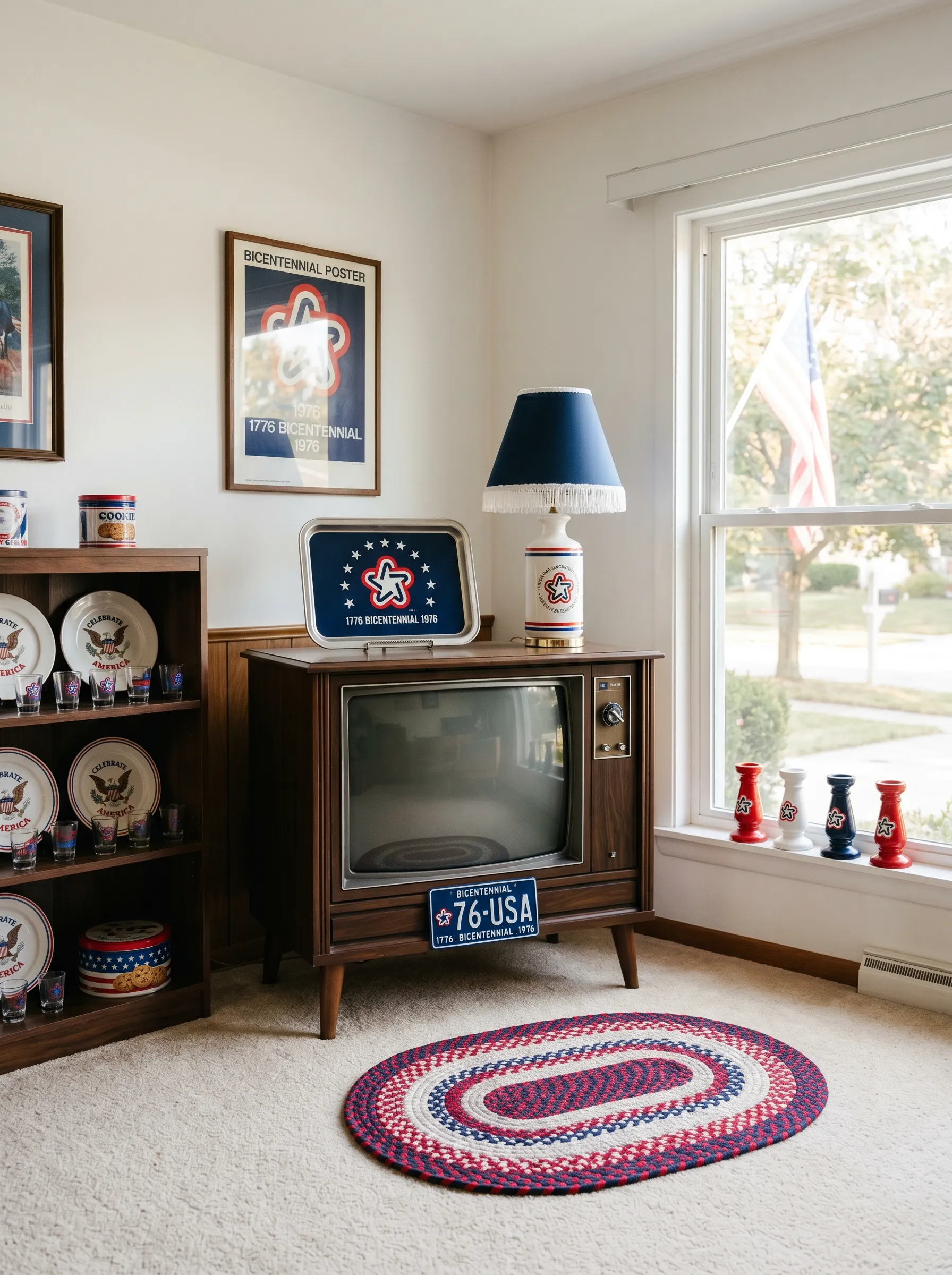
Find a mid-century television console in walnut veneer — the kind with a rounded CRT screen and dial tuner — and use it as the display base. The television is not plugged in. It’s furniture. On top of the TV, place a vintage Bicentennial metal serving tray with the 1776/1976 graphic, and alongside it a tall ceramic lamp with the same Bicentennial commemorative decal or printing in red, white, and blue with fringed shade in navy. The shade detail is important — it’s a period-specific detail that signals the era precisely. On the adjacent bookcase, arrange a collection of Bicentennial plates, glasses, and ceramic pieces — all from the same 1976 anniversary year, all in the same graphic language of that era’s patriotic design. Group them by type: plates together, glasses together, tins together. Coherence within category, variety across the shelves. On the window sill, line up small patriotic ceramic figures — candlesticks, vases, anything in the Bicentennial colorway. At the floor, place a braided oval rug in red, white, and blue. The rug defines the corner as a dedicated space rather than an accumulation.
The Modern Rooftop Dining Setup With Star Tablecloth and Tulip Chairs
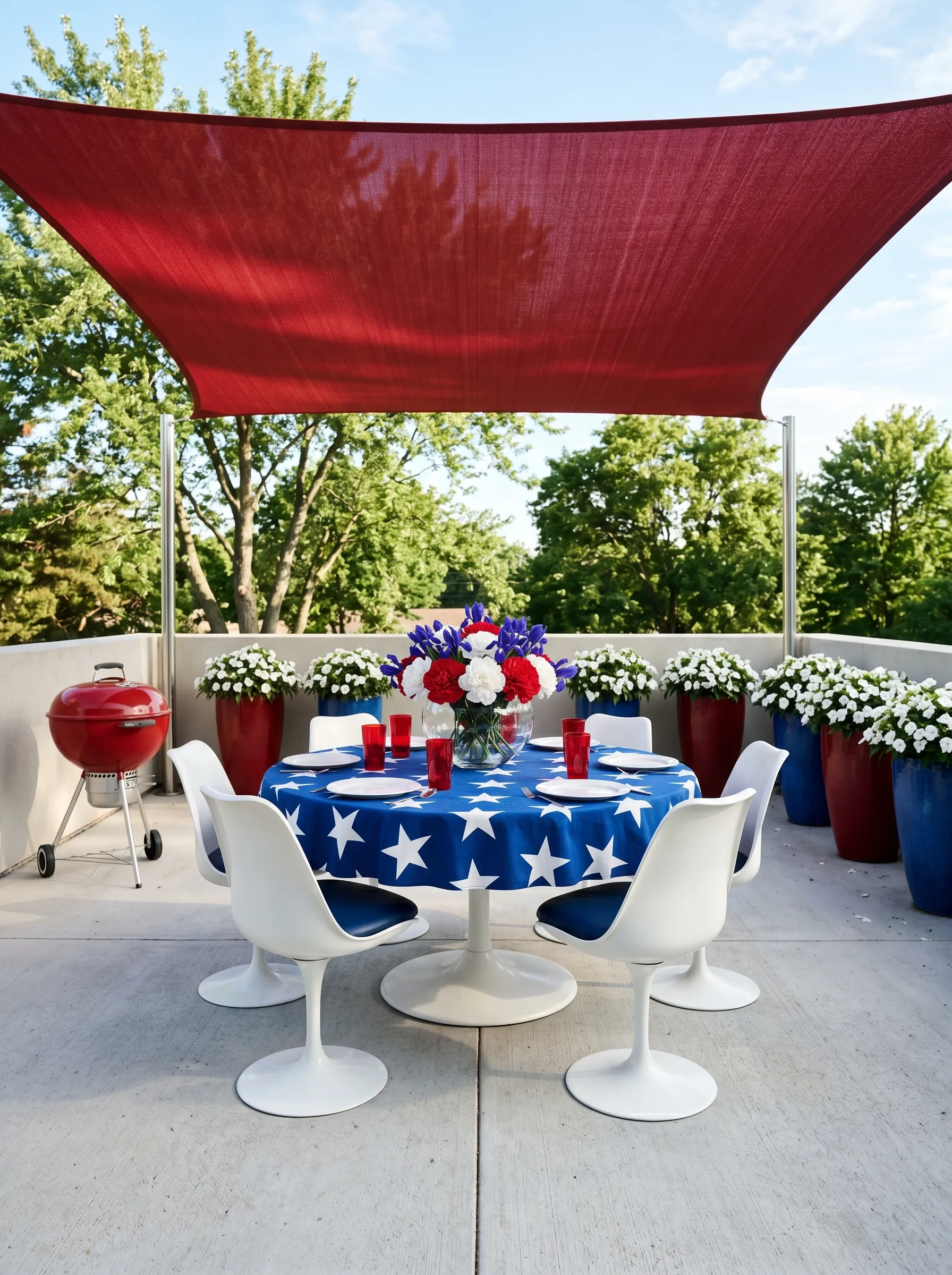
This is the contemporary approach. It requires restraint in a different direction: the patriotic elements must be graphically bold and architecturally clean or the whole thing collapses into themed. The table is a round pedestal in white with Saarinen-style tulip chairs surrounding it — all white, all matching, no wood, no wrought iron. Purity of furniture silhouette is the foundation. Cover the table with a deep blue star-print tablecloth — large white stars on royal blue. The graphic weight of this cloth is carrying the entire patriotic moment. Set the table in all-white dinnerware. The only color on the table surface, beyond the cloth, comes from red glass tumblers and a central arrangement of red carnations, white blooms, and blue iris in a clear glass cylinder vase. Install a large deep red sun sail overhead — a solid square sail in a rich red, not a bright one. This creates the ceiling of the outdoor room and ties the overhead plane into the color scheme. At the perimeter, line large planters in alternating red and navy filled with white flowering annuals. The all-white floor and all-white furniture provide the white element. You don’t need anything else.
The 1970s Wood-Panel Bedroom With Patriotic Patchwork Quilt and Macramé Wall Hanging
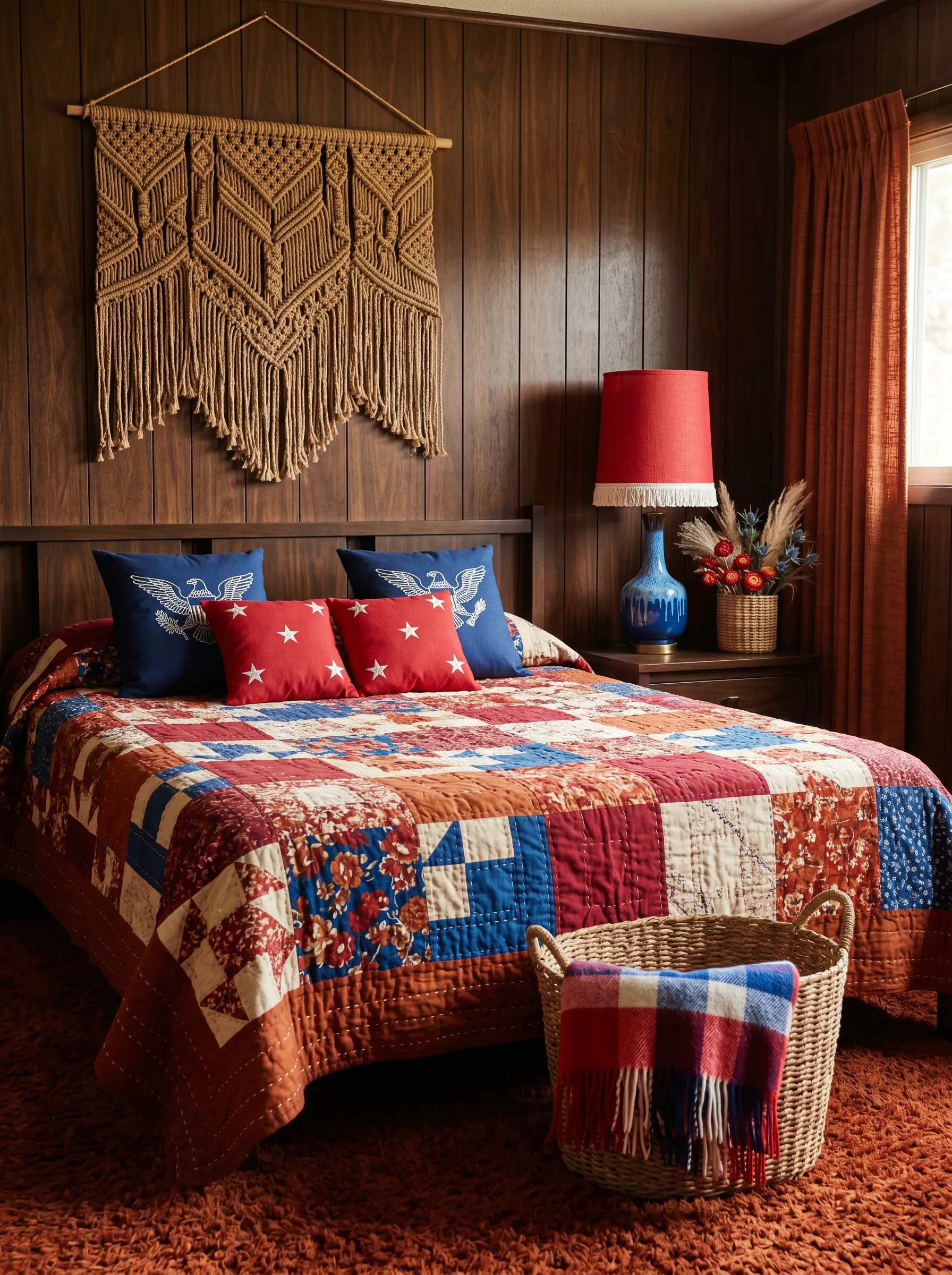
Work with the dark wood paneling, not against it. This is a warm, tobacco-brown base and it’s what makes the red in this palette go deep rather than harsh. Find a large patchwork quilt in red, blue, cream, and brown — specifically one where the red has the dusty quality of cotton that’s been washed many times and the blue is a medium value rather than navy. Lay it across the full bed with no tuck, letting it fall to the floor on both sides. Layer throw pillows in two types: blue pillowcases with a white eagle embroidery, and red pillowcases with white embroidered stars. Four pillows total — two of each. The embroidery is critical. Printed designs flatten. Embroidered details have texture that catches light. Above the headboard on the paneled wall, hang a large macramé wall hanging in natural undyed cotton. The warm tan of the cotton against dark walnut paneling is the anchor for the whole room’s warmth. It introduces texture without color and makes the patriotic pieces below read as richer. The bedside lamp base in cobalt blue drip glaze ceramic with a red shade and fringe trim is the accent that makes the room feel designed.
The Retro Diner Kitchen With Red Island Counter and Mint Beadboard Walls
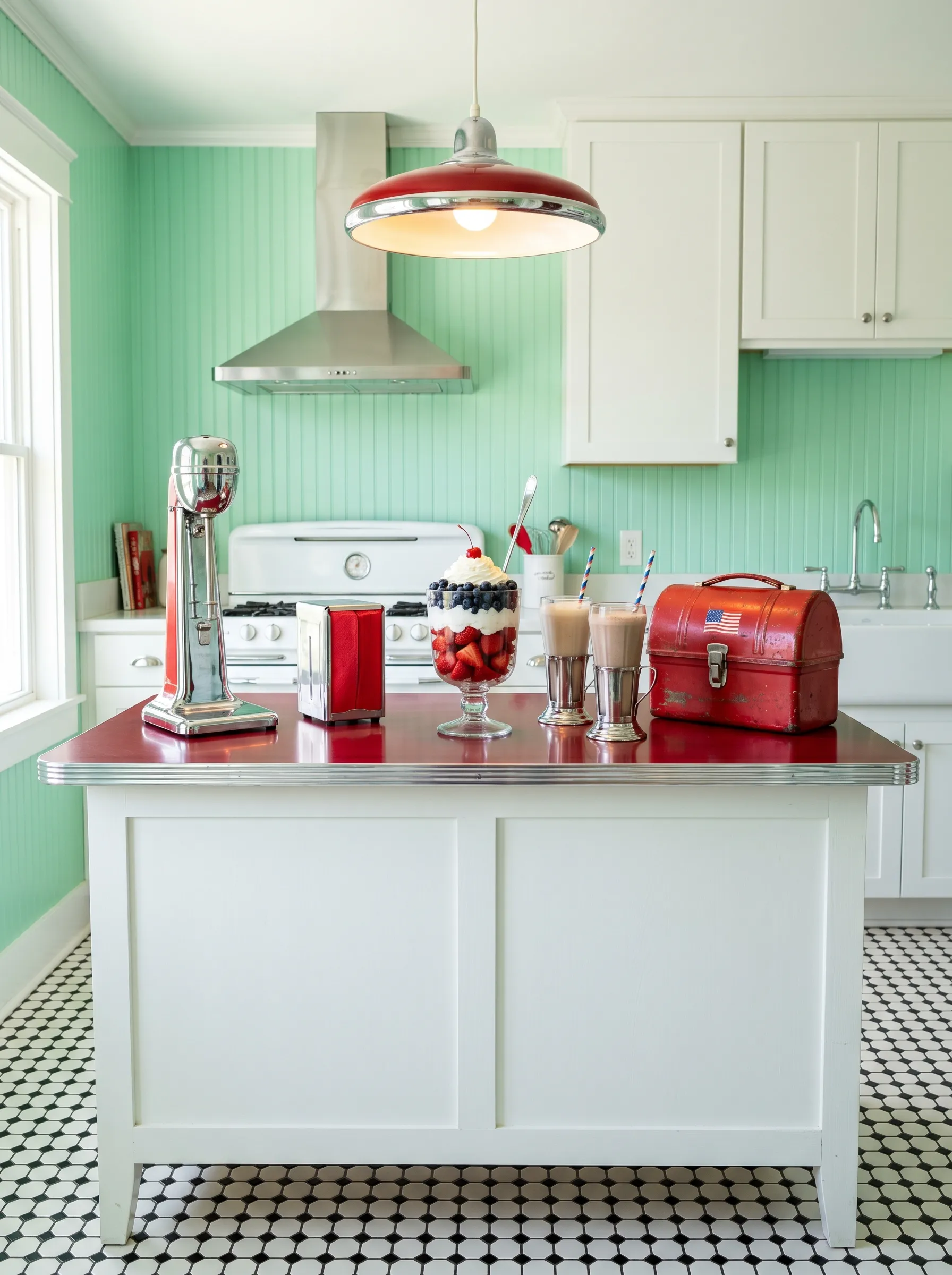
Paint the walls in pale mint green — a 1950s soda fountain tone, slightly cool and very specific. Apply vertical beadboard paneling over the walls before painting so the texture adds depth to the mint color. This is the background everything reacts against. The kitchen island is white shaker-panel base with a red Formica or lacquered countertop edged in chrome banding. The red and chrome combination is purely mid-century American diner and it’s the piece that pulls the entire room into its era. Overhead, hang one industrial-style dome pendant light in red enamel with a chrome ring. The floor needs black and white octagon tile or round-edged hex tile in the same combination. On the counter, stage a vintage milkshake machine in chrome and red alongside a parfait glass of layered berries and cream in red, white, and blue. Add two tall soda glasses with red and white striped paper straws. Place a red metal lunchbox with a flag detail to anchor the right side. This is a diner counter moment. It’s specific enough to be convincing.
The Candlelit Colonial Dining Table With Brass Candelabra and Blue Eagle Plates
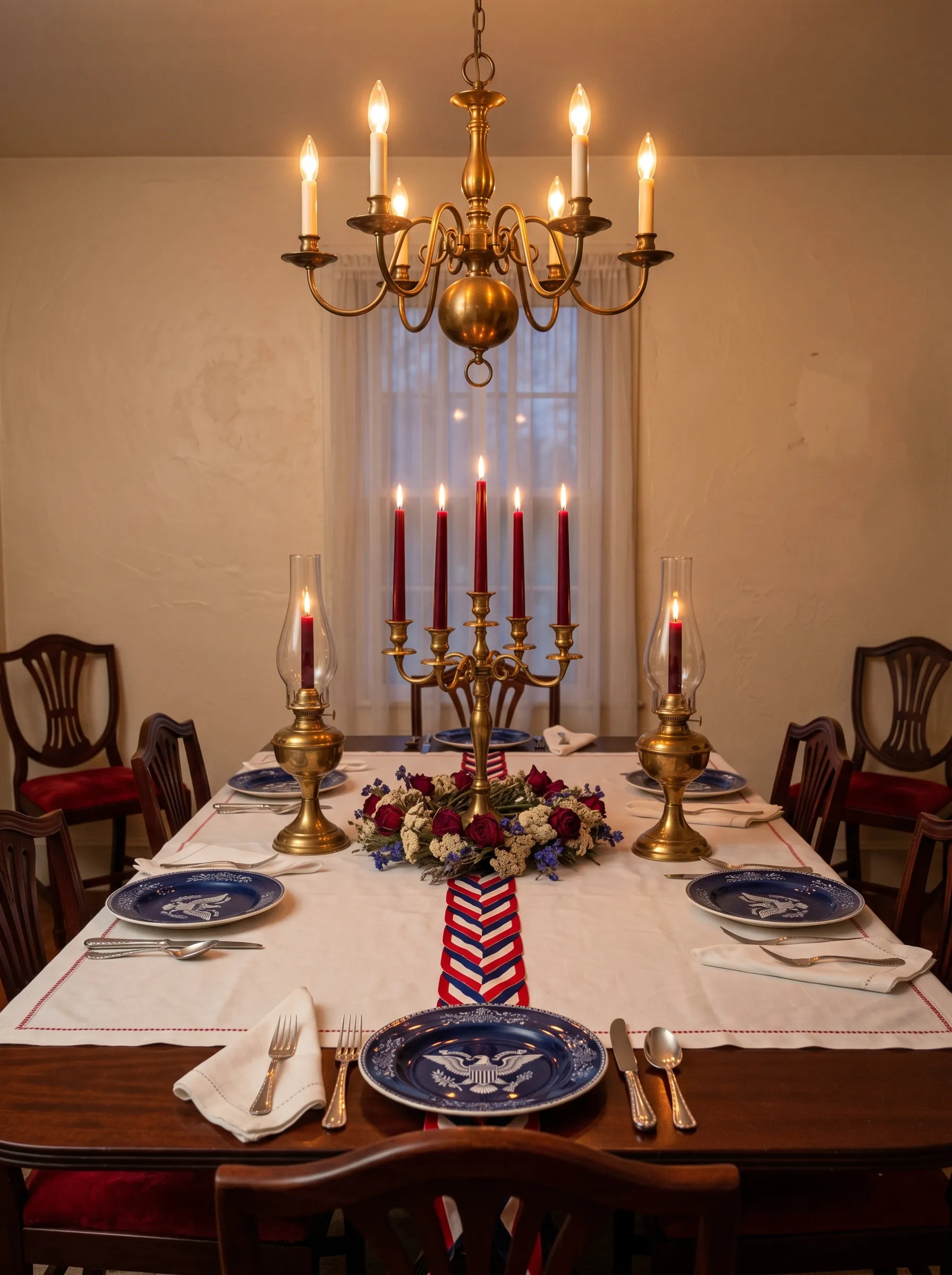
The table is a dark mahogany or cherry extension dining table in a traditional style — nothing contemporary, nothing stripped or bleached. The chairs are shield-back in the same dark wood with red velvet seat cushions. The tablecloth is white linen — good weight, slightly textured, not bright white. Run a narrow red hand-stitched hemstitch border around the edge so the detail reads at close range. Down the center, lay a braided or woven table runner in a red, white, and blue chevron pattern. The place settings use genuine Wedgwood Blue or Staffordshire-style plates with eagle and shield motifs in cobalt and white. Use silver-plate cutlery — not stainless steel. The difference in warmth and weight is noticeable. For the centerpiece, place a brass candelabra in the center holding five to seven deep red tapers at varying heights. Surround its base with a wreath-style arrangement of dried flowers: cream yarrow, dark red roses, blue statice, and lavender. On either side of the candelabra, place individual brass hurricane lamps with single red candles. Light everything. The entire effect of this table depends on candlelight.
The Farmhouse Porch Swing With Gingham Bunting and Red Garden Trug
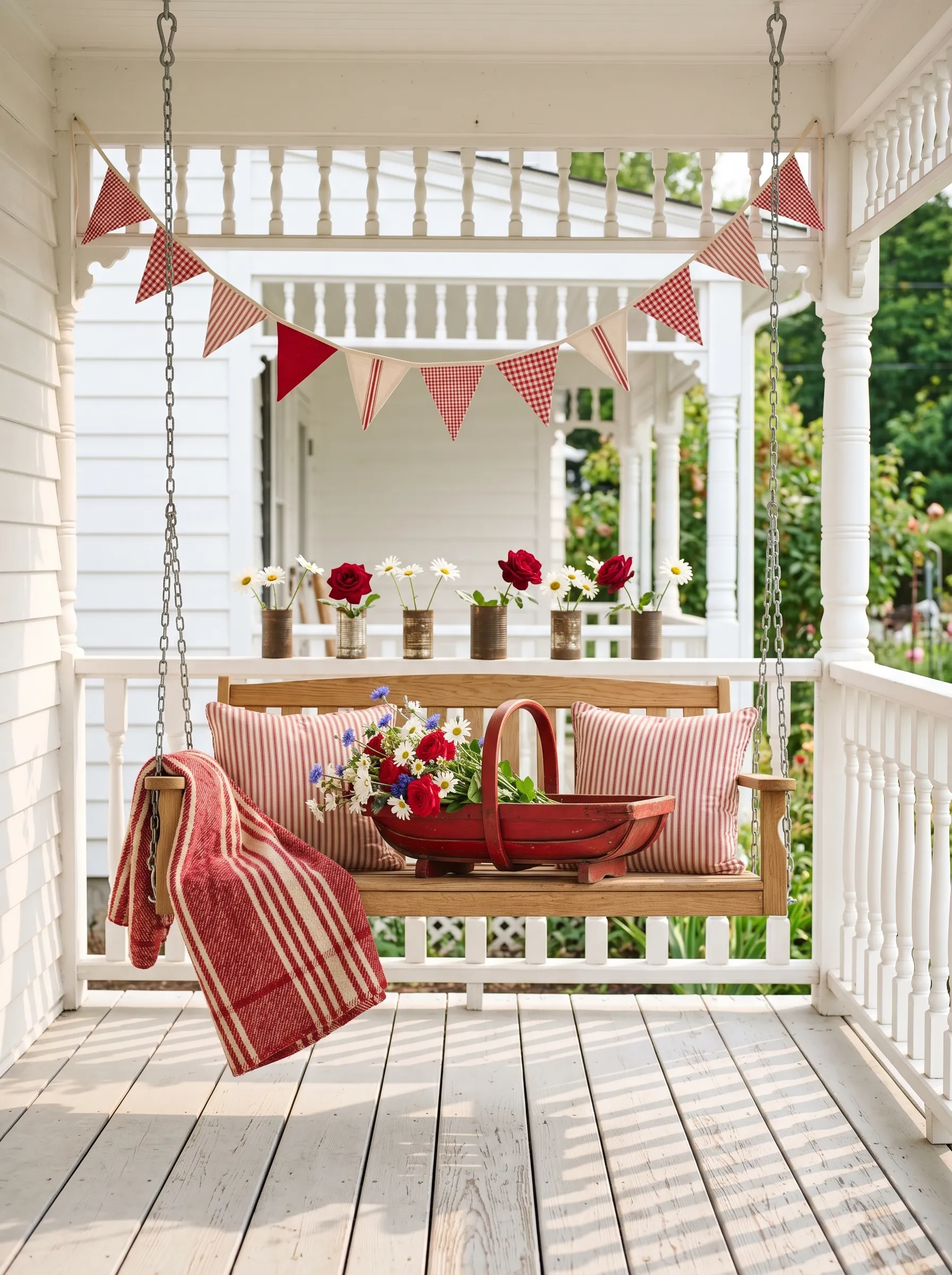
The porch is white painted wood — railing, floor boards, turned balusters. The swing is natural oak or maple, unsealed, with a clean slatted back. Hang it with silver chain rather than rope for a slightly crisper look. String a mixed bunting of gingham flag pennants across the porch ceiling, running from the swing chain to the nearest column. Use three different red and cream gingham fabrics — one solid red, one fine gingham, one stripe — alternating randomly. The variation in pattern within the same colorway is what keeps it from looking like a party supply purchase. On the swing, place two striped red and cream ticking pillows. In the center of the seat, set a red-painted wooden garden trug filled with a loose bunch of mixed summer flowers: daisies, red roses, a few stems of cornflower blue. The trug doesn’t need to be overflowing — five or six stems, casually arranged as if just picked. On the porch railing behind the swing, line up four to five vintage tin cans — cleaned, labels still on if you have them — each with two or three flower stems. The casualness of the tin-can vases against the white painted railing is the detail that makes the whole porch feel like a real place to be.
The Backyard Patio With Gingham Cloth, Red Igloo Cooler, and Barber-Pole Umbrella
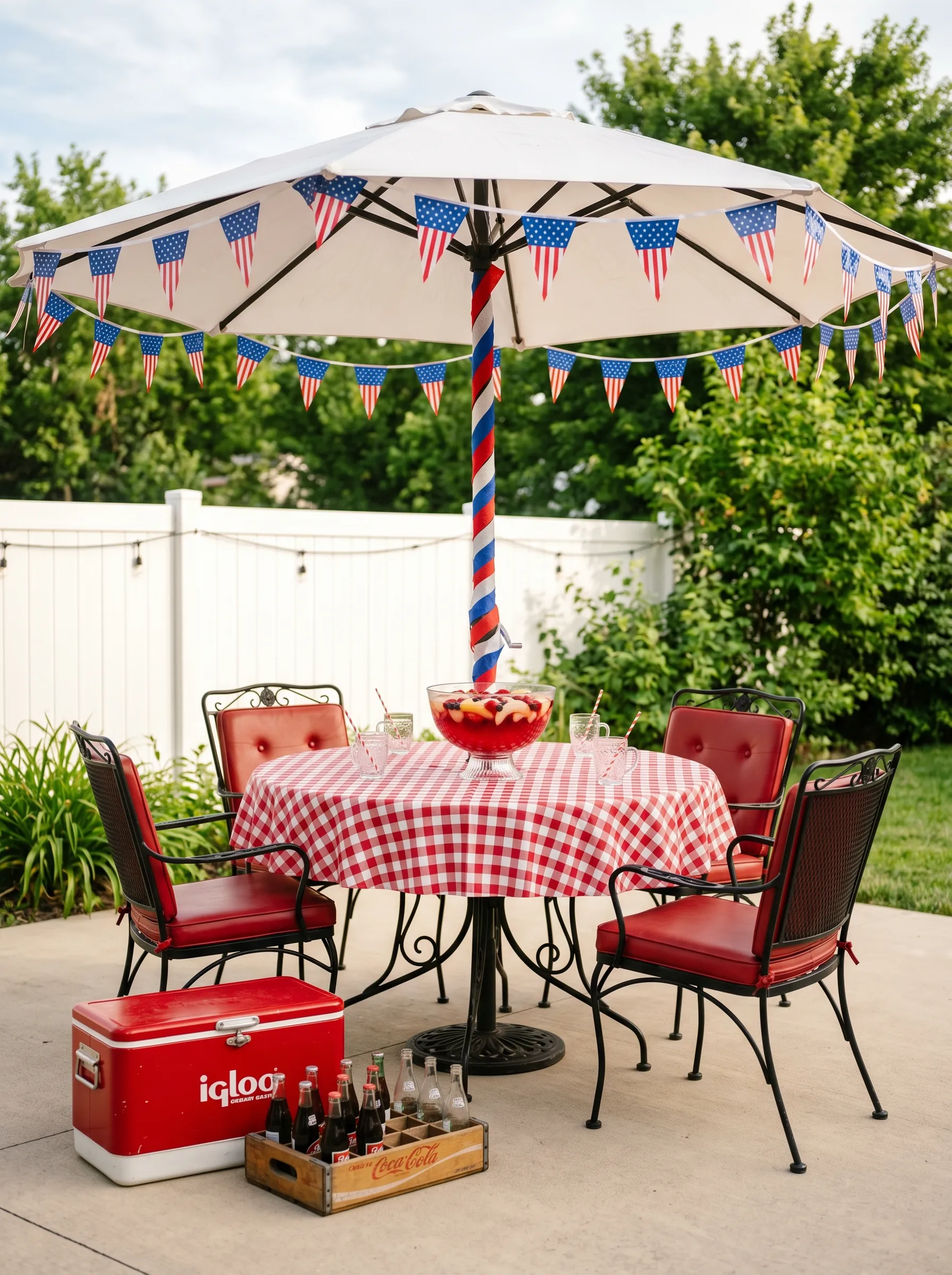
This is a deliberately nostalgic setup. The umbrella pole is wrapped in a barber-pole spiral of red, white, and blue ribbon or tape — thick enough to read clearly from a distance. String flag pennant bunting from the pole outward to the umbrella ribs, layering two rounds of bunting at different lengths so the canopy underside is fully decorated. The table is wrought iron in black with a red vinyl cushion seat set. Cover the table with a red and white check gingham cloth — large-scale check, not fine gingham. In the center, place a footed glass punch bowl filled with red punch and floating fruit. At the base of the table: a red Igloo cooler in metal, vintage-style, and beside it a wood bottle crate containing glass-bottle sodas in the crate’s compartments. The crate and cooler at floor level add another visual layer below the table and make the arrangement feel set up for actual use rather than display. Keep everything else minimal. Two to four chairs maximum. No additional decorations on the fence or surrounding surfaces. This arrangement is complete.
The Mid-Century Sideboard With Burnt Orange Walls and Blue Ceramic Lamp
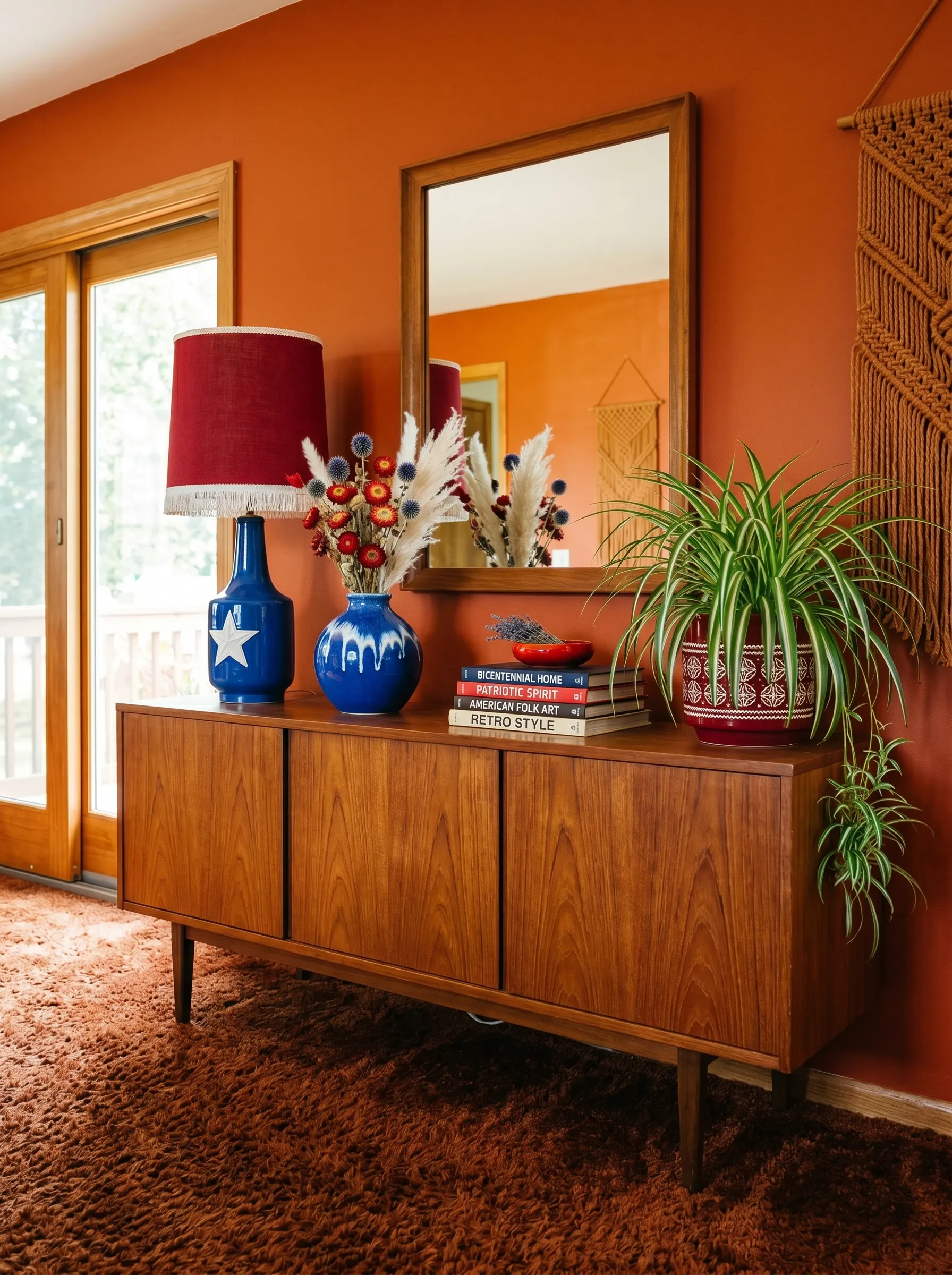
Paint the room in a deep burnt sienna or terra cotta orange — a warm, saturated 1970s shade that has real pigment depth. This is not salmon, not peach. It’s the orange of a Mexican pot. Everything else in the room reacts to this wall color. The sideboard is teak or walnut veneer, low and long with sliding panel doors and tapered legs. On the surface, arrange three groupings: left, center, and right. Left grouping: a tall ceramic lamp with a cobalt blue drip-glaze body and a star motif. The blue against the burnt orange wall is the defining color moment of the room. Top it with a deep red shade and white fringe trim. Center grouping: a cobalt blue round ceramic vase filled with a loose arrangement of pampas grass, dried red globe amaranth, blue thistle, and a few stalks of dried wheat. Lean four books spine-forward in front of the vase — their red spines create a horizontal color band. Right grouping: a large spider plant in a red and white geometric pattern ceramic pot. The green of the plant against orange and red is the necessary natural relief. Add a small red dish at the base.
The White Farmhouse Porch With Milk Can Flag Display and Red Barrel Planter
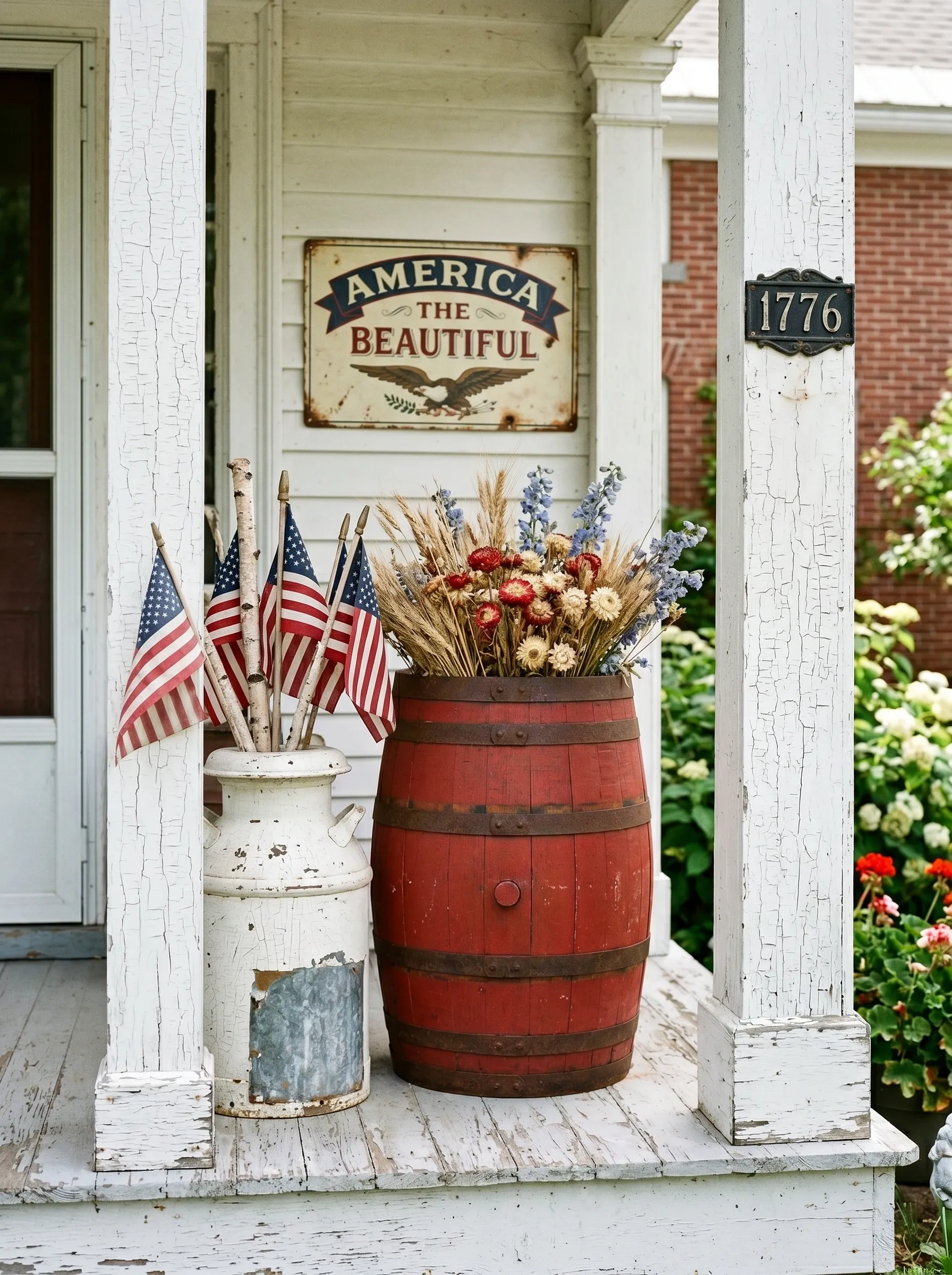
The columns and railings are white painted wood, and crucially, the paint is failing — chipped and cracked to reveal the layers below. This is the backdrop. Don’t paint it. The peeling is doing structural work. Source a vintage white or galvanized milk can in a medium size — the kind with a lift-off lid and a slightly battered body. Fill it with five to seven miniature flag sticks, their poles going to different heights so the flags layer and overlap. Add a few birch twigs among the flag sticks for variation in the vertical lines. Beside it, position a red barrel — a genuine barrel, darkened iron hoops visible, the red paint worn to reveal raw wood at the edges. Fill the barrel opening with a generous arrangement of dried materials: wheat stalks, strawflowers in red and cream, blue delphiniums, dried lavender. This needs to be a full, abundant arrangement, not a sparse one. The barrel should look like it’s overflowing. Between the two pieces on the wall behind, hang a vintage tin or embossed metal sign with American text — something that’s been in the sun long enough that the paint has faded at the raised edges. Let it be legible but worn.
Final Thoughts
Every space in this collection commits to something. Not to a color, not to a style — to a point of view. The farmhouse porch that used galvanized crates as risers committed to the logic of repurposing. The colonial dining table committed to the gravity of the occasion. The mid-century sideboard committed to the wall color that everything else is in conversation with.
Patriotic decorating fails when it tries to please everyone. It tries to hit all the notes — rustic, modern, vintage, graphic — without choosing. The spaces that work chose. They decided what story they were telling and then told it with everything they had, including the things that didn’t obviously fit.
The American flag is not a simple object. It has age. It has connotation. The best spaces in here treat it that way — not as a prop to prove a point, but as the artifact it actually is. Something that means more when it’s been somewhere.
That’s the only rule worth following.