
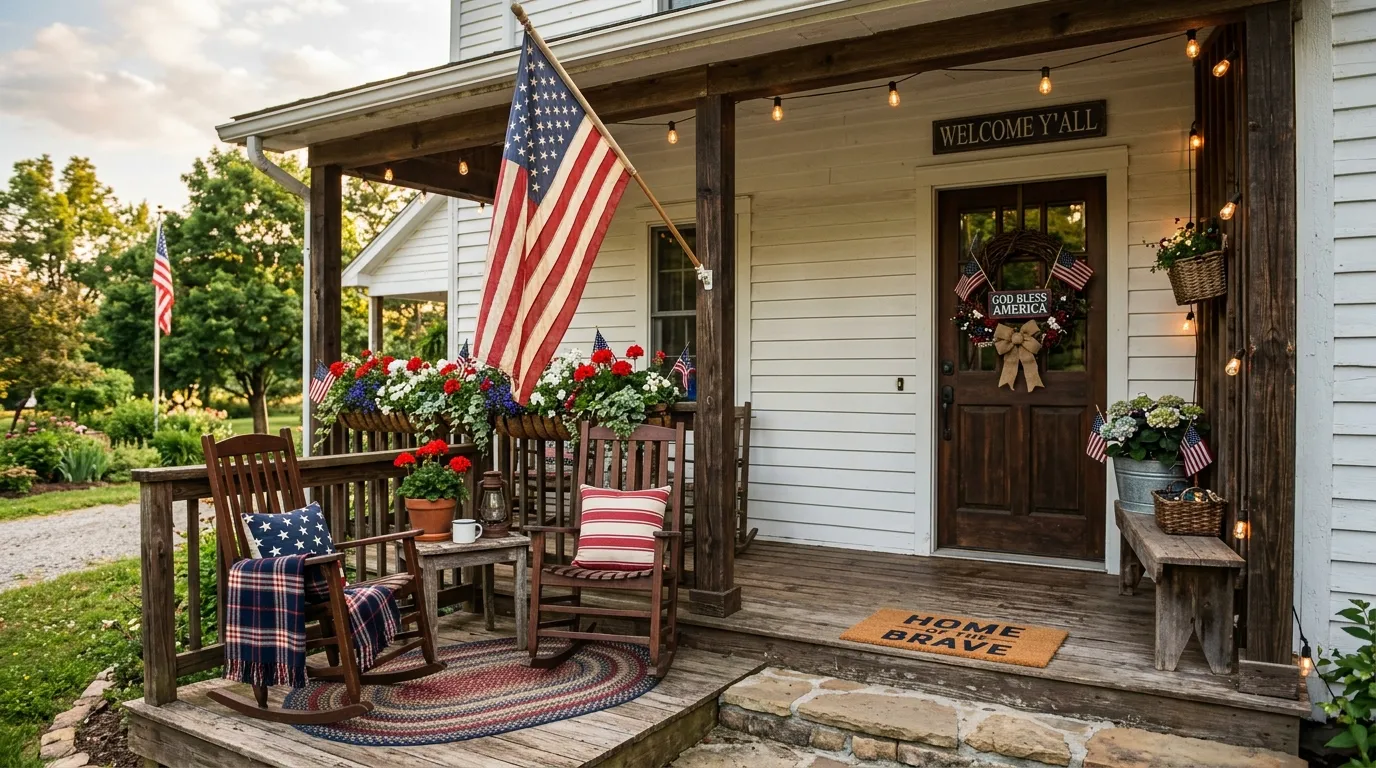
Nobody woke up one morning and decided to make their porch look like a hundred years had happened to it. That’s not how it works. The porches in these images look the way they do because the people who live in them stopped caring whether everything matched and started paying attention to what was already there.
That’s the first thing to understand about rustic patriotic decorating. It isn’t a style you install. It’s a relationship between old materials, living plants, and a flag that has probably been washed more times than anyone can count.
The second thing to understand: these porches are not competing with each other. A clapboard farmhouse that survived three owners and two paint colors is doing something completely different from a stone-column craftsman or a chinked log cabin. Each one draws from what it already is. That’s why none of them look generic.
What follows is how each of these porches achieved what it achieved — not what’s in the photograph, but what you would actually need to do to get there.
Why Rustic Patriotic Porches Fall Apart Before They Begin
The aesthetic seems easy. It consistently isn’t.
You Reached for New When the Whole Point Is Old
There’s a specific failure mode in rustic decorating: spending money on things made to look old rather than spending time finding things that actually are. The reproduction grain sack. The factory-distressed crate. The galvanized “vintage-style” bucket from a chain home goods store.
These things look like what they are. The rust isn’t where rust actually accumulates. The fading doesn’t go where sun actually reaches. The stencil is too perfect. Your eye catches it even when your brain doesn’t, and the result is a porch that reads as themed rather than lived-in.
The real version of this look requires sourcing. It requires patience. One genuine thing — one actual antique crock, one real tobacco-leaf-dried shelf, one flag that has actually been folded and stored in an attic — does more work than twenty reproductions. Go find the one real thing first. Build around it.
You Put Too Many Elements in the Same Weight Class
Rustic styling has a visual hierarchy, and when everything is the same scale and visual weight, nothing reads. A five-star constellation of barn stars on a wall works when they vary in size from eight inches to twenty-four. Line up five identical twelve-inch stars and you’ve got a pattern, not a composition. A porch with four equally-sized galvanized buckets at equal intervals is a fence, not a porch.
One thing has to be the anchor. Everything else is smaller, quieter, or literally lower. The antique flag mounted on the wall outranks the stoneware crock on the crate below it. The large barn star on the door dominates the smaller ones flanking the entry. The whiskey barrels filled with towering botanicals command the space in a way that the small lanterns beside them clarify rather than compete with.
Figure out your anchor and make it unambiguously the most important object in the frame.
You Forgot the House Itself Is the Decoration
This one matters especially for rustic and antique structures. A clapboard farmhouse with a century of paint layers and a porch that sags slightly in the middle doesn’t need decoration. It needs curation. The architecture is doing more expressive work than anything you could buy.
The correct move on a structurally characterful porch is restraint. The chipping columns, the weathered boards, the corrugated metal roof edge with its rust bleeding down — these are the visual story. Your decorations are supporting characters. The moment you pile on more than the porch can absorb, you cover up the most interesting thing about the space.
Understand what your house is saying before you decide what you want to add to it.
Rustic Patriotic Porch Ideas
The Modern Farmhouse Entry That Uses Ferns and a Flag Scarf Instead of a Wreath
Take a grapevine wreath form — natural, unwrapped, showing its twig structure — and instead of filling it with flowers, drape a worn American flag through the interior of the ring. The flag shouldn’t be folded or arranged. Pull it through the center so the stars canton falls across the upper left of the ring and the stripes drape through and below. Secure it with thin wire at two points on the grapevine. The flag is doing the decorating. The wreath is the frame.
Flank the door with substantial Boston ferns in the largest pots you can find — these should overflow generously, fronds falling to knee height. In front of each fern pot, place a sleek matte black iron garden lantern holding two or three thick white pillar candles. The lanterns are architectural and contemporary; they contrast with the organic fern without fighting it.
The brick steps and the warm wood grain of the door absorb the red in the flag and make the whole entry cohesive without adding a single explicitly patriotic element beyond the flag itself.
The Pioneer Homestead That Uses Five Objects to Say Everything
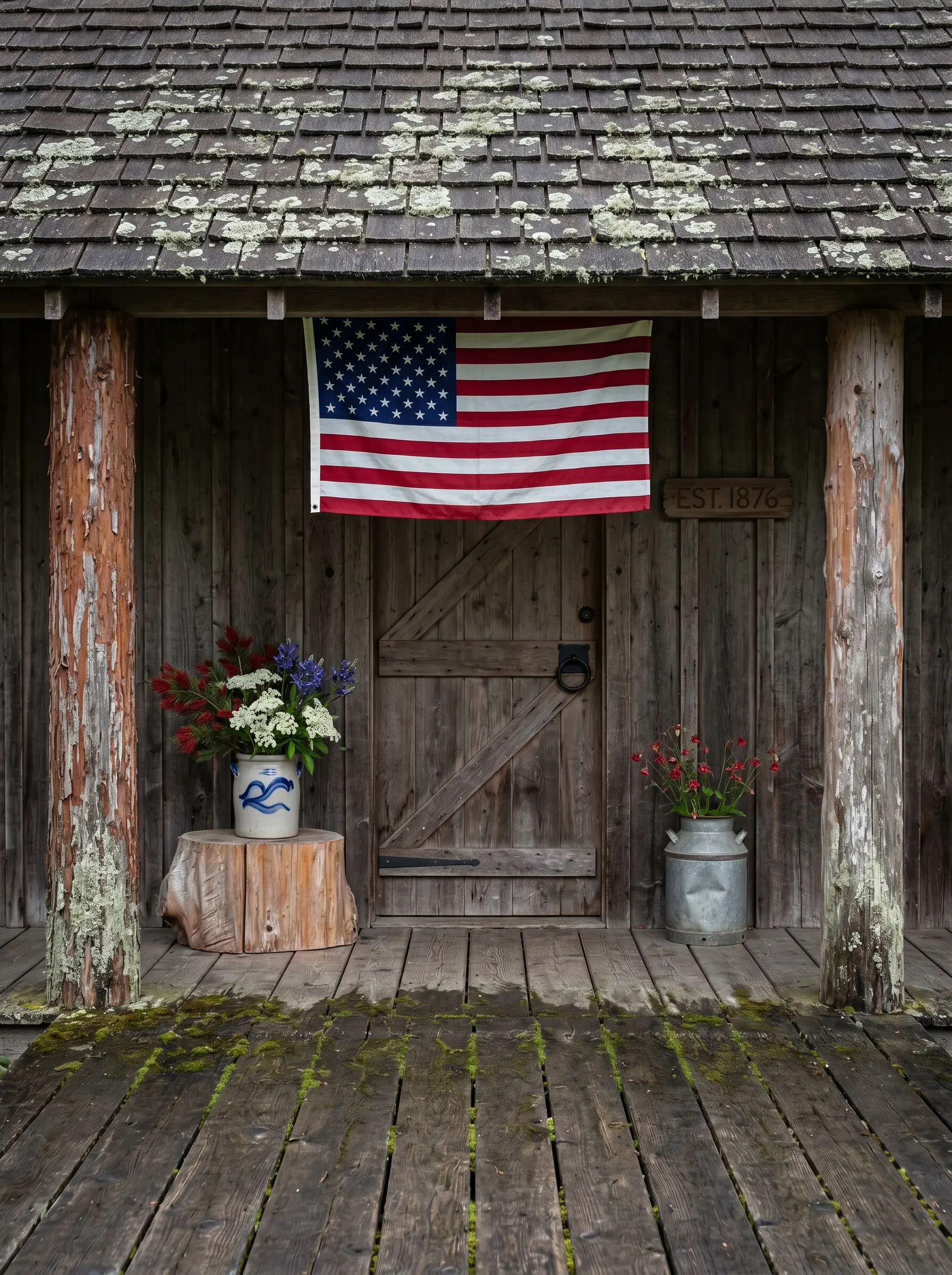
Five objects. No more.
A wooden produce crate — stenciled with the original shipper’s name and destination — placed directly on the porch floor. On top of the crate, a stoneware jug in the classic country pottery palette of cream with blue cobalt decoration. In the jug, a loose handful of dried mixed botanicals: red cockscomb, white yarrow, blue statice, a few stems of dried lavender.
Against the wall, centered above the door: a large vintage or heirloom American flag mounted flat and horizontal with a wooden or metal rod through its upper hem. The flag should show age — softened colors, light creases from folding, the texture of cotton rather than synthetic. On each column, at mid-height, mount a flat five-pointed metal star in a rusted iron or dark red finish.
At the far right of the floor, a wooden wagon wheel leaning against the wall. Beside it, a bundle of dried wheat standing upright, tied at the base with a simple red bandana.
That’s the composition. The gray weathered boards of this structure — walls, floor, columns, door — are the fifth element. They provide the context that makes everything else meaningful.
The Antique Tricycle Entry With Aged Cast Stone Urns
This is the same image as the first farmhouse blog but it earns a separate entry here because the approach is fundamentally about sourcing before styling, which is the core lesson of rustic decorating.
The aged cast stone urns are everything. Source them from an architectural salvage yard if at all possible. The weathering pattern on cast stone is specific — white mineral bloom against the original gray, heavier at the top where water pools, darker and drier at the base. You cannot fake this convincingly. Real cast stone urns from a garden that’s been planted for thirty years will look precisely right. New reproduction urns will look like new reproduction urns regardless of what you put in them.
Fill the urns with a layered planting: deep green boxwood as the base mass, trailing ivy or creeping Jenny to soften the urn edge, red geraniums and smaller white flowering plants at the top. Add flags at the back of each planting, pushed in at a slight backward lean.
Place the red tricycle beside rather than in front of the left urn. It should look parked, not displayed. The harlequin-patterned jute rug goes down first, under everything. The galvanized watering can with a hydrangea bloom and flag goes at the far right of the scene, lower than everything else, as a quiet period at the end of the visual sentence.
The Heirloom Porch That Needs Only Quilts and Three Wildflowers to Say Everything
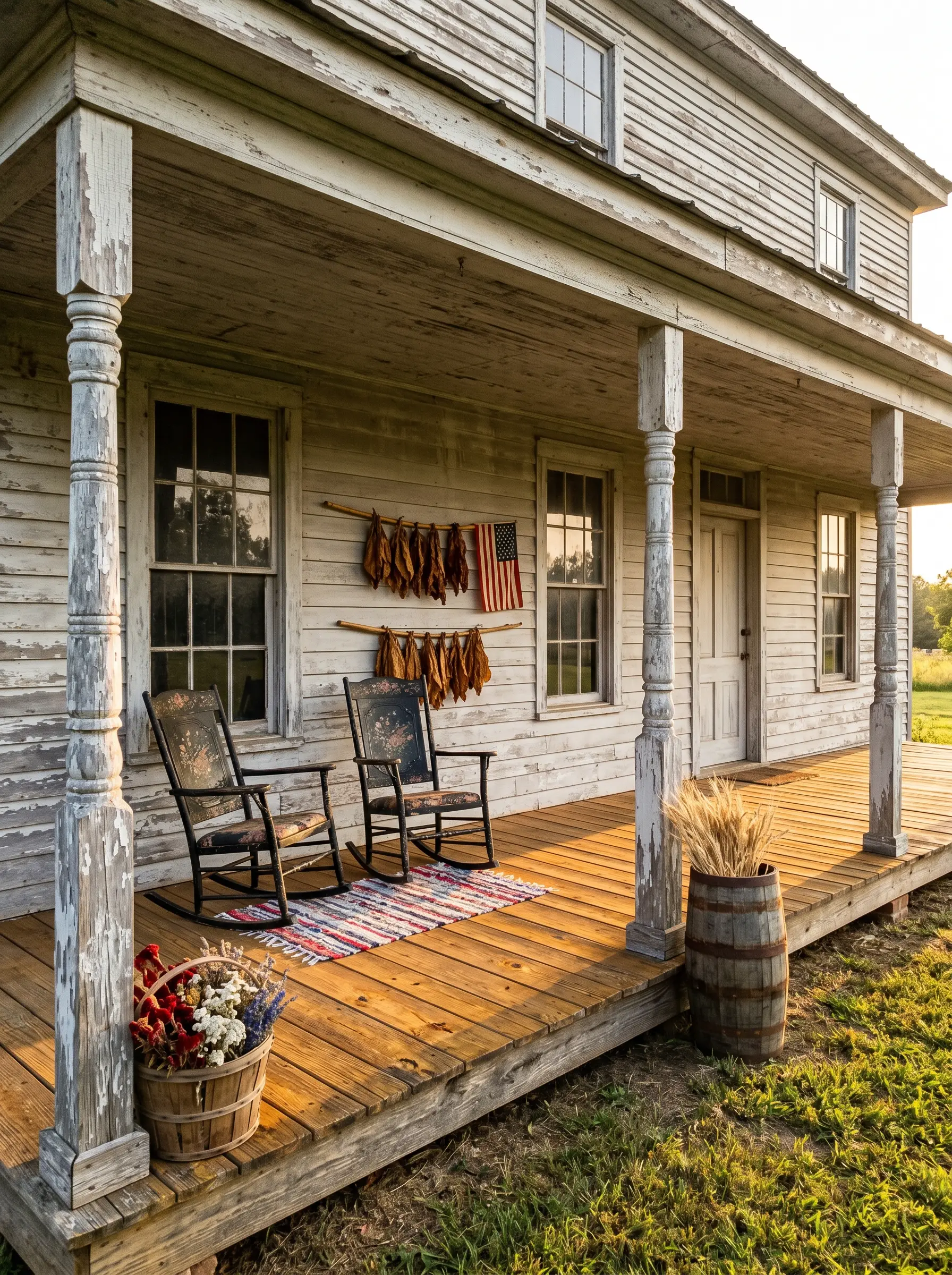
Two rocking chairs, two quilts, one small table, one mason jar of wildflowers, and a single American flag. This is the complete materials list. It is also a complete Fourth of July porch.
The chairs must be genuinely old — the kind with hairline cracks in the wood and a layer of white paint that’s been sanded through to gray on every surface that gets touched. The quilts must be vintage star-block pattern, faded but intact. If you are inheriting these things from someone, use them as found. If you are sourcing them, find them at an estate sale rather than a craft store.
The wildflower arrangement should look cut from wherever wildflowers grow near where you live. Red gerbera daisies, white daisies, blue salvia, whatever is seasonal. Glass mason jar, no vase. Flag pushed into the bouquet from the rear corner.
The porch itself — white clapboard, green trim, wooden turned columns — is the backdrop. The golden-hour light does the photography. Your job is to put the right things in the right places and then not add anything else.
The Two-Structure Vintage Collector’s Entry That Celebrates Found Objects
The key move here is building at two different heights and letting the resulting display read as a collection rather than a styled arrangement.
On one side of the door, source a wire milk crate — the industrial kind with a steel grid exterior — and stack it with a second wooden produce crate on top, metal corner brackets showing. On top of this two-crate tower, set a large galvanized wash bucket planted with dark-leaf coleus, trailing sweet potato vine, and small red annuals. Flags pushed upright into the soil at different angles.
Beside this stack, position an antique step stool or small A-frame ladder. On each step, place a different container: a vintage potato tin with faded red commercial lettering on the middle rung, a blue enamelware pot on the lowest step, a white enamelware bucket on the floor beside the base. Each container holds a different planting — white petunias, orange and red geraniums, mixed compact annuals. Add flags at irregular intervals. The whole assembly should feel discovered rather than installed.
The blue door behind this collection provides the only solid, clean color in the composition. Everything else is texture.
The Weathered Homestead That Earns Everything With Dried Tobacco and One Flag
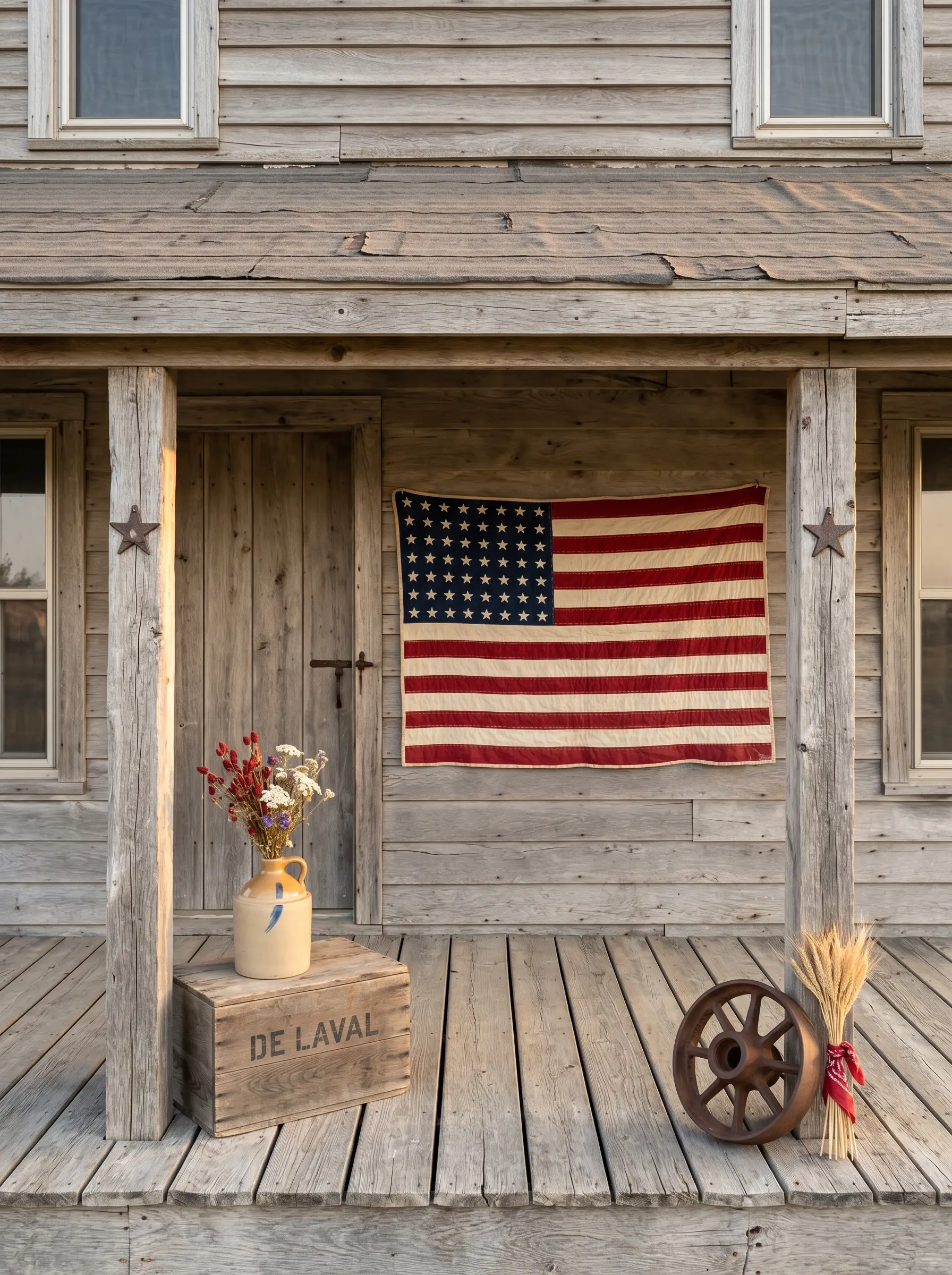
This is the hardest porch on this list to recreate because it requires a house that has genuinely aged without intervention. The peeling columns, the chalky board-and-batten walls, the porch floor that has been walked on for ninety years — these are not achievable through any decorating choice. The house either has this quality or it doesn’t.
If yours does: hang bundles of dried tobacco leaves, dried corn husks, or dried botanicals from a simple suspended rod or branch between two hooks on the wall. These agricultural materials signal real farming history and nothing else in the world signals it as clearly. Beside them, hang a small faded American flag on a simple bracket. That’s the wall.
On the floor: two antique black rocking chairs, the kind with original needle-point seats in a faded floral pattern. In front of them, a worn flat-weave rag rug in muted red and cream stripes. At the far end of the porch, a wooden barrel with dried wheat standing upright inside it. At the front edge of the steps, a wooden bushel basket with dried mixed botanicals in red, white, and blue — strawflower, yarrow, statice.
If your house doesn’t have this quality: take nothing from this entry. It requires the house to do the work.
The Ancient Log Structure That Lets the Flag and Two Crocks Do All the Work
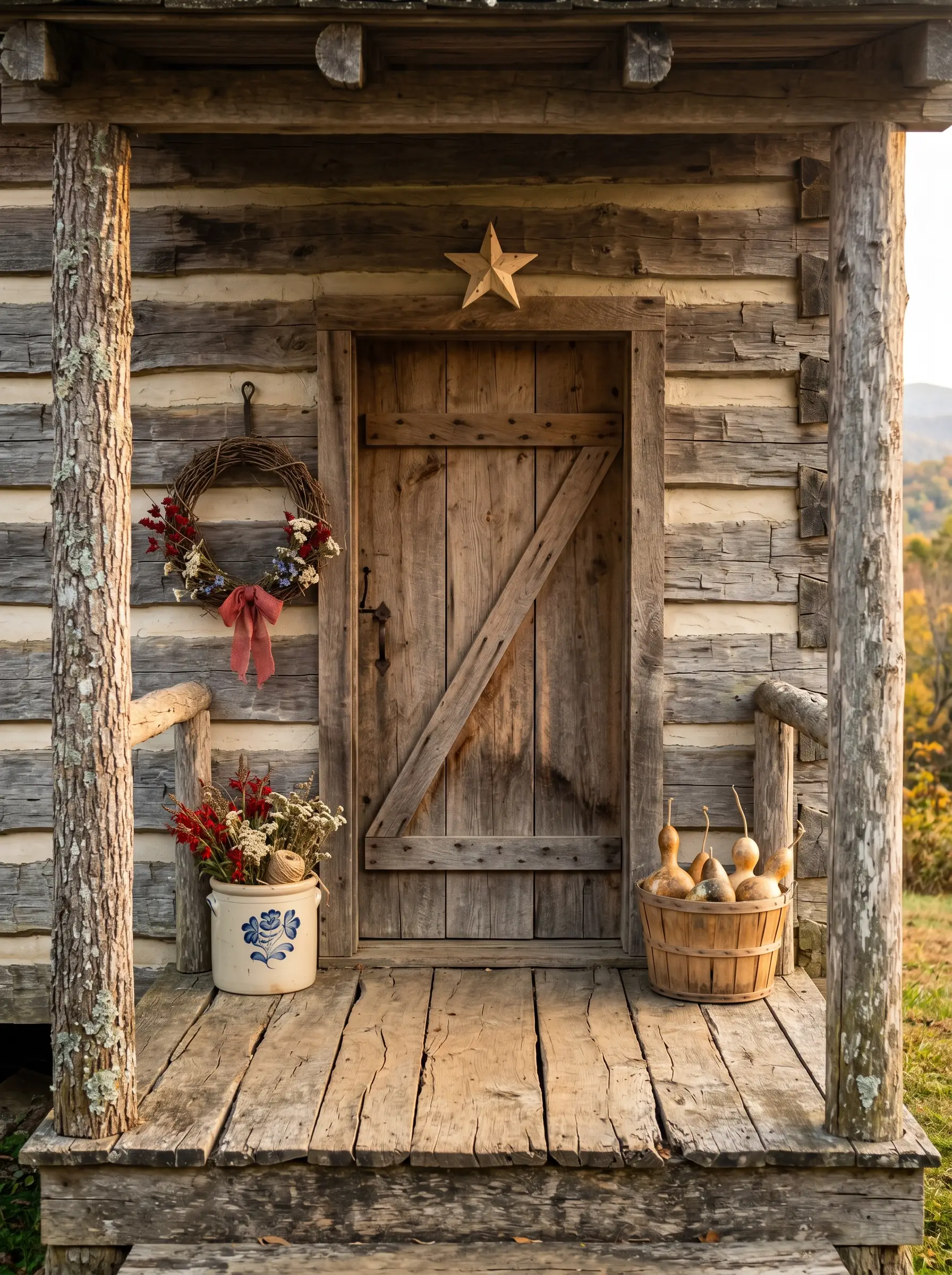
Moss on the floor boards. Lichen on the shake roof. Bark still on the posts. This porch belongs to a structure that predates the concept of decorating for a holiday.
The correct response is radical minimalism.
A full-size American flag hung horizontally from two small hooks or a mounted rod, centered above the plank door. The flag is the entire decorative statement for the wall. Everything that follows serves it.
On the left side of the door, a natural tree cross-section — a thick round cut from a substantial trunk — serves as a stand. On it, a medium stoneware crock in blue-on-cream pattern, filled with a wildflower mix that leans red and white in front and blue behind: red yarrow, white Queen Anne’s lace, blue cornflower, with a few sprigs of mixed greenery.
On the right side of the door, a galvanized milk can at floor height holding red-branched small wildflowers — bittersweet, dried red berry stems, whatever is seasonal and local.
To the left of the whole scene on the wall, a bare grapevine wreath form with dried flowers loosely worked in at the bottom third — red, white, and blue in dried form — finished with a simple torn red linen bow. No elaborate bow. Just a length of cloth knotted once.
Above the door, a small wooden plaque with a date. The moss floor, the lichen roof, the bark posts, and the age of the plank door are doing ninety percent of the work. The three objects and one flag are the remaining ten.
The Southern Clapboard Porch That Puts a Stoneware Crock Center Stage
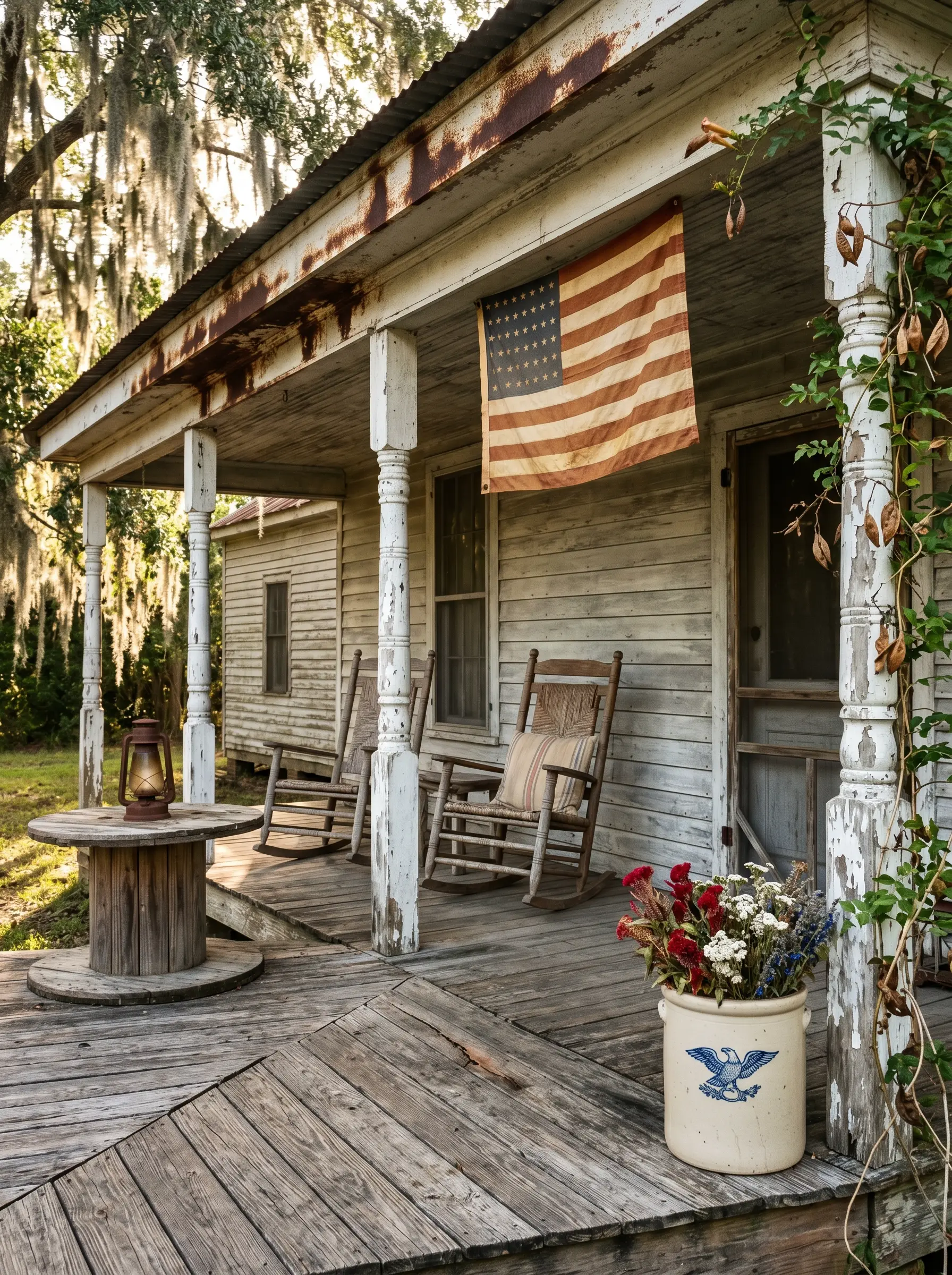
On this porch the southern live oaks with their Spanish moss canopy are architecture. The porch doesn’t need to compete with the landscape. It needs to be still enough that the landscape reads.
Source a large antique stoneware crock — the two to four gallon size, blue cobalt eagle or floral decoration, cream ground. Place it directly on the floor of the porch, near one column rather than centered. In the crock, arrange a generous mixed wildflower bunch: red carnations or celosia, white babysbreath or Queen Anne’s lace, blue lobelia or cornflower, with some loose greenery for volume. The arrangement should overflow the crock’s mouth generously.
On the wall above and slightly behind the crock, mount a vintage American flag on two hooks — horizontal, flat, showing every stripe. The flag’s pale colors against the weathered white clapboard create the composition.
On the far side of the porch, place a large cable spool on its side as a table. On the spool, set a red railroad lantern with an amber bulb. Two rocking chairs face the yard, not the door — because in the South in summer, you face the trees and the air.
Let the climbing vine on the far column continue climbing. It belongs there.
The Decorative Ladder Porch That Uses Every Rung as a Display Shelf
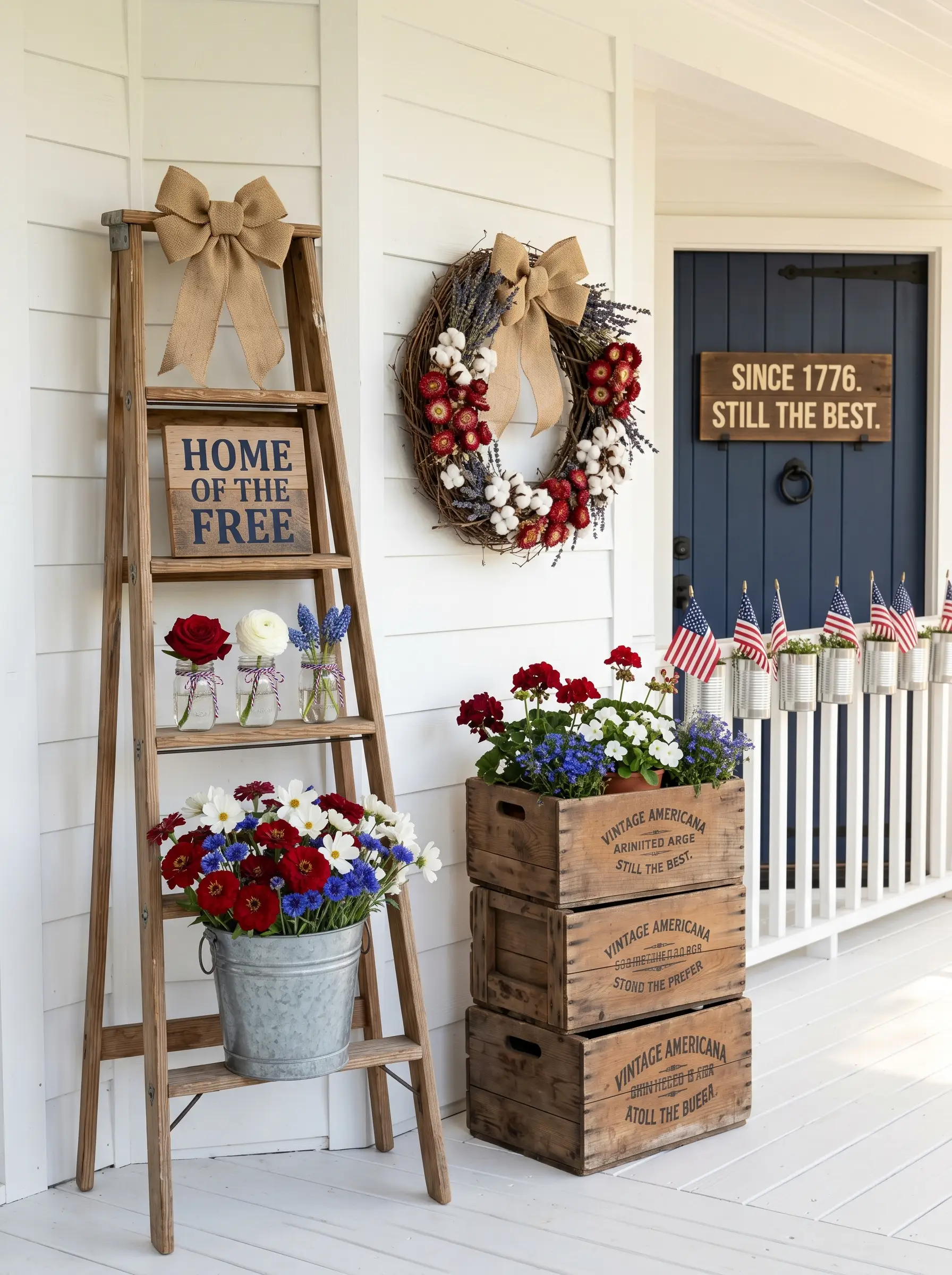
Source an A-frame decorative ladder in natural wood — the kind sold in farmhouse decor stores as a blanket ladder, five to six feet tall. This is one case where a new piece is acceptable because it’s being used as furniture rather than as a vintage object. Lean it against the porch wall at a slight angle.
At the very top of the ladder, tie a generous burlap bow — wired so it holds its shape, tails at least twelve inches long. This bow anchors the visual weight of the ladder at its top.
On the upper rungs, lean a wooden sign with navy stenciled lettering on a burlap or natural wood background. On the middle rungs, arrange three mason jars of different heights tied with simple red-and-white twine: one with a red rose, one with a white ranunculus, one with a stem of blue muscari. On the bottom shelf or rung, set a galvanized bucket loosely filled with a mixed patriotic wildflower bunch.
Beside the ladder, stack three wooden crates with stenciled text — not matching, different sizes, slightly offset — and set a terracotta pot of mixed red-white-blue geraniums and lobelia on top of the stack. On the porch railing beyond, line a row of tin cans — recycled food tins, labels removed — each holding an American flag, equally spaced.
On the door, hang a grapevine wreath base filled with cotton bolls, dried strawflowers in red and white, dried lavender, and finished with a large burlap bow matching the one on the ladder.
The Dark Barn-Board Entry That Turns Barn Stars Into Architecture
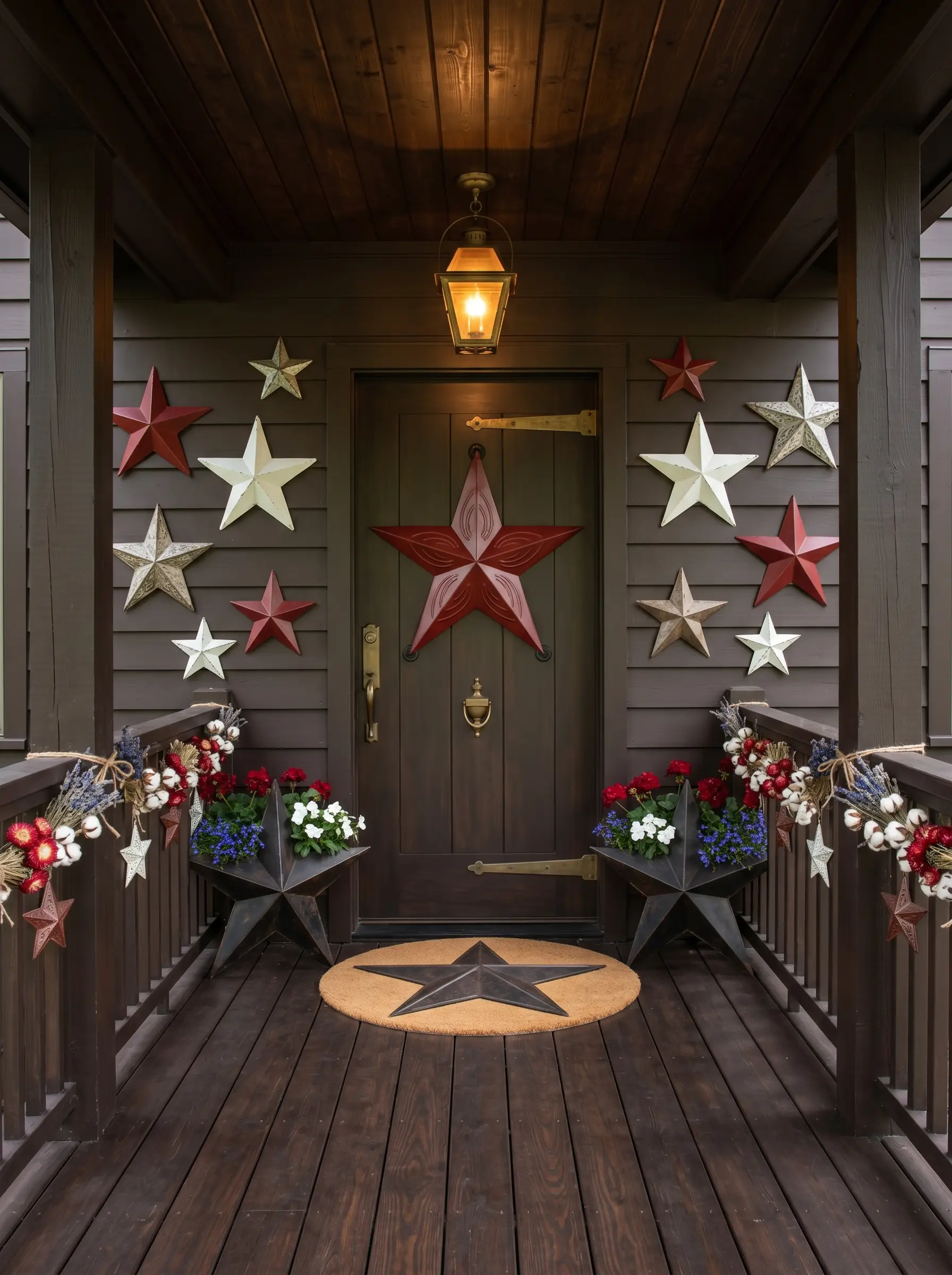
This porch earns the star constellation wall by committing to it completely.
Source metal barn stars in three finishes — dark red, aged white or cream, and weathered silver-gray — and in three sizes: eight, twelve, and sixteen inches. You need approximately twelve to fourteen total. Mount them on the wall on both sides of the door in an asymmetric scatter pattern — not a grid, not a perfect ring, but an actual scatter, as if someone stuck one where it felt right and kept adding. Vary sizes and finishes within the scatter. Two large ones near the outer columns, smaller ones filling in, a medium one at the lower interior edges where the wall meets the railing.
On the door itself, mount one large decorative star — twelve to sixteen inches across — in a contrasting finish to the ones on the wall. If the wall stars are dark red and silver, the door star is cream. If the wall stars are red and cream, the door star is a carved or embossed dark red.
At floor level on each side of the door, mount a large five-pointed star planter or use a star-shaped container to hold a planting of red geraniums, white impatiens, and blue lobelia.
On the porch floor, centered in front of the door, a round coir mat with a star stamped or woven into the center. From each railing on each side, hang bundles of dried botanicals and cotton stems tied with burlap twine. One hanging per post section. Simple, uniform, quiet — serving the star wall without competing with it.
The Stone Cottage Entry That Lets the Architecture Win
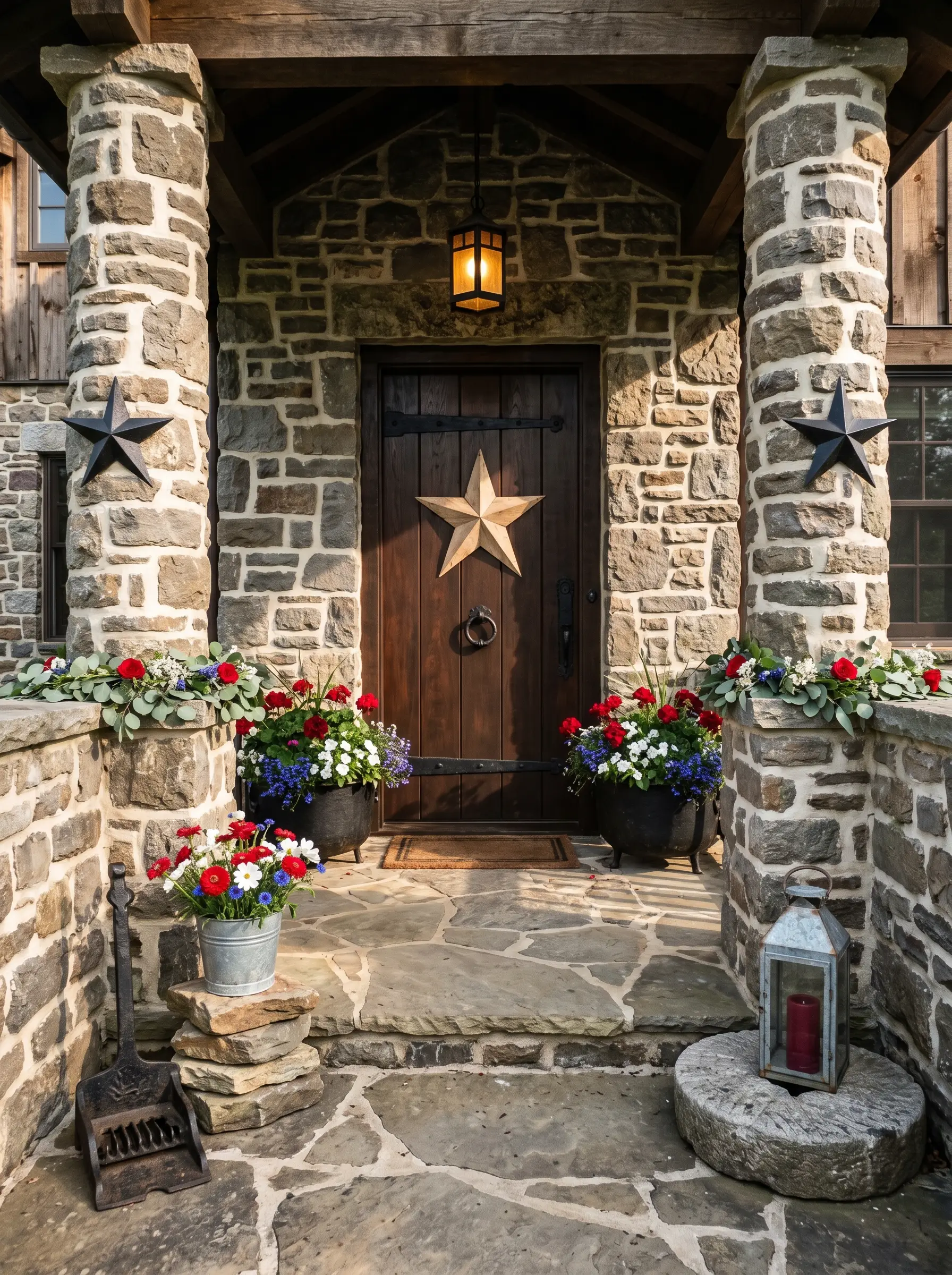
Dry-stacked fieldstone columns. Flagstone floor. Heavy timber beam header. Iron strap hardware on the door. This is a setting that has absolutely nothing to prove.
Mount two small matte black barn stars, one on each column face, at mid-height. These are accent marks, not decoration. They gesture toward the holiday.
On the door, mount a single large unfinished wood or natural-toned star — twelve to fourteen inches, in a raw material that reads as part of the door rather than added to it. Carved wood or natural wicker, not painted metal.
In the two large cast iron or heavily aged metal planters on either side of the door, plant a full summer combination: red geraniums upright in the center, white alyssum and daisy as the middle layer, blue lobelia trailing over the front. Let the arrangement be full enough that the container almost disappears into the planting.
On the extended stone ledge or step on each side, lay a short run of eucalyptus garland with a few red roses tucked in, flowing from the base of the column along the ledge edge. On one side at the lower level, a galvanized bucket with a looser wildflower mix in the same palette. On the other, a stone or concrete lantern with a red pillar candle.
The hanging lantern between the stone columns, centered above the door, does its job without explanation.
The Dark Craftsman Cabin Porch Built Around Corn Stalks and Pumpkins
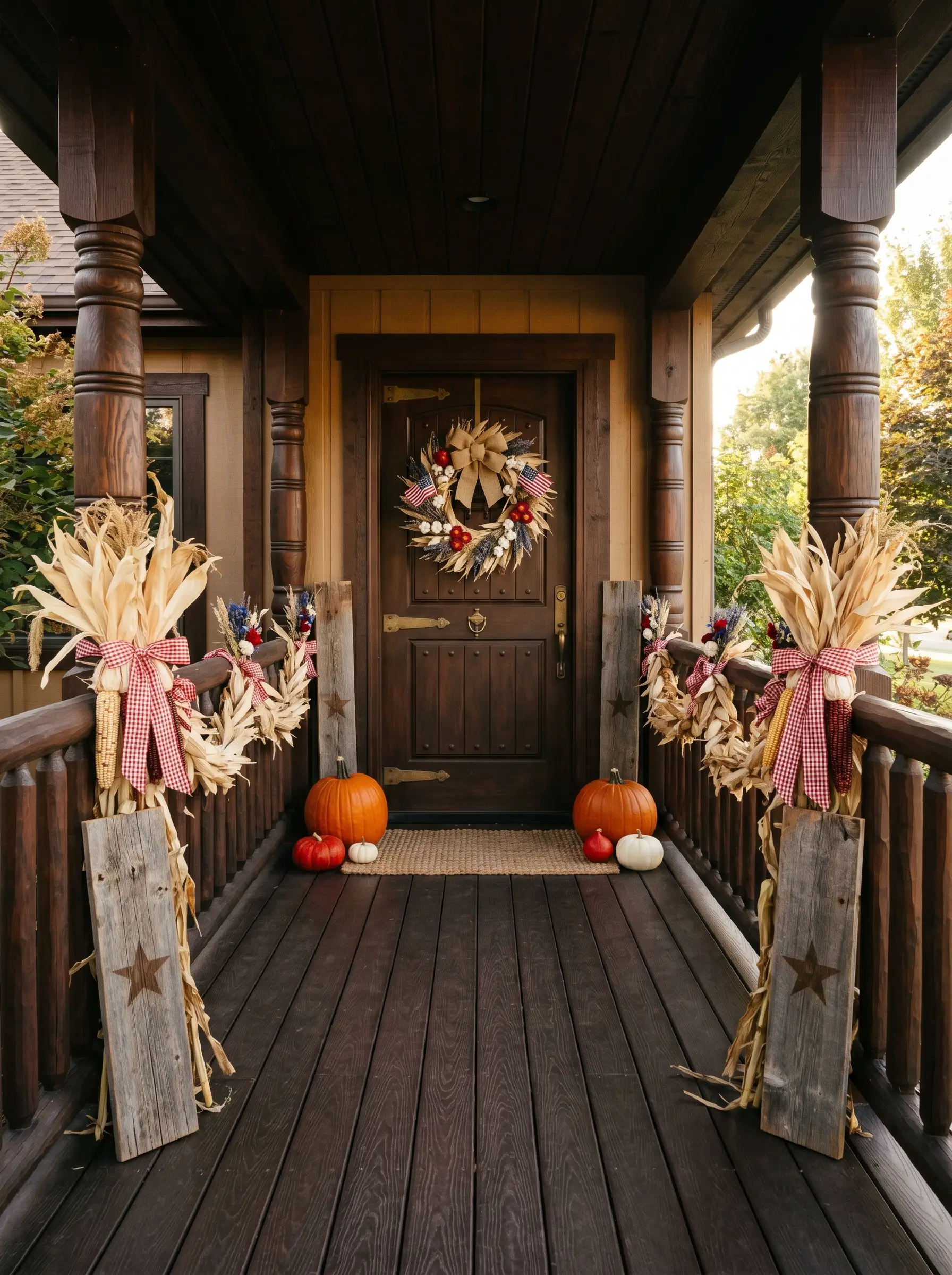
This one is doing something slightly different: it’s pushing the patriotic holiday into harvest territory, which creates a richer, earthier result than the straight summer approach.
On each side of the door entry, mount a tall vertical piece of rough-cut weathered barn wood or reclaimed fence post as an anchor stake. To each stake, bind a full corn stalk bundle — dried corn stalks with husks still attached, ears of Indian corn or dried yellow corn with their husks pulled back, tied together with heavy jute twine and finished with a full red-and-white gingham bow.
Tuck small American flags and blue dried flower stems into the top of each corn bundle where the tassels are.
At the base of each corn bundle, arrange a cluster of heirloom pumpkins in different sizes: one large orange, one medium white, one small red. The variety of pumpkin colors brings in the patriotic palette without flags or banners.
On the door, hang a wreath built on a dried wheat or straw base — full and round, substantial enough to read from the street — with small American flags tucked at intervals, dried red berries or strawflower, dried white cotton, and blue-lavender statice. Finish with an oversize burlap bow at the top.
The Warm Cedar Porch That Makes Candles and a Star-Quilt Its Entire Argument
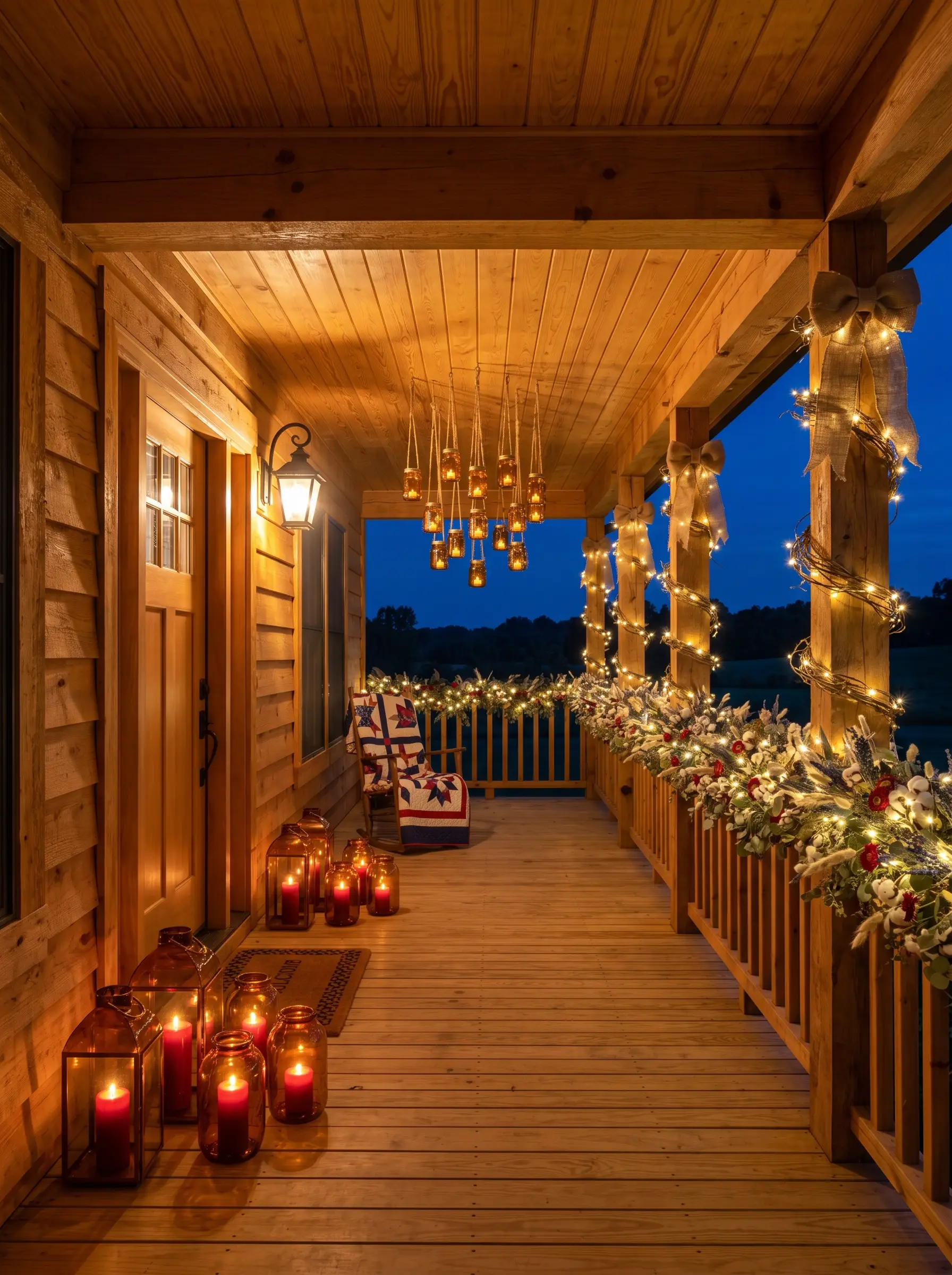
This is a nighttime porch built entirely from amber.
From the ceiling of the covered porch, suspend a hanging cluster of mason jars at different lengths — twelve to sixteen jars, clear or amber glass, connected to a central point with individual jute or wire cords of varying lengths, three to six inches of variance between the shortest and longest. In each jar, fit a battery-operated or real tea light. The cluster should hang at eye-plus height so the candlelight falls downward.
Along the entire length of the railing: a continuous garland of mixed evergreen and eucalyptus threaded with warm white LED fairy lights, studded with dried red flowers, white cotton bolls, and dried lavender bundles. This garland carries the pattern of the natural wall coach lantern from the left side of the door through the full length of the porch.
On each column, wrap grapevine garland in an upward spiral and thread LED lights through it, with large burlap bows attached at the top of each column’s vine section.
At floor level beside the door, cluster a mix of glass hurricane lanterns and amber glass vessels of varying heights, each holding a red pillar candle. Group them closely — six to eight vessels — so the collective candlelight reads as a pool of light rather than scattered points.
In the rocking chair at the far end: a vintage star-pattern quilt draped over the back and seat. The color of the quilt — red stars, blue triangles, cream ground — is visible from across the porch. It is the only explicitly patriotic textile element. Everything else is amber and natural.
The Cabin Macramé Porch That Tells the Holiday Through Fiber Art
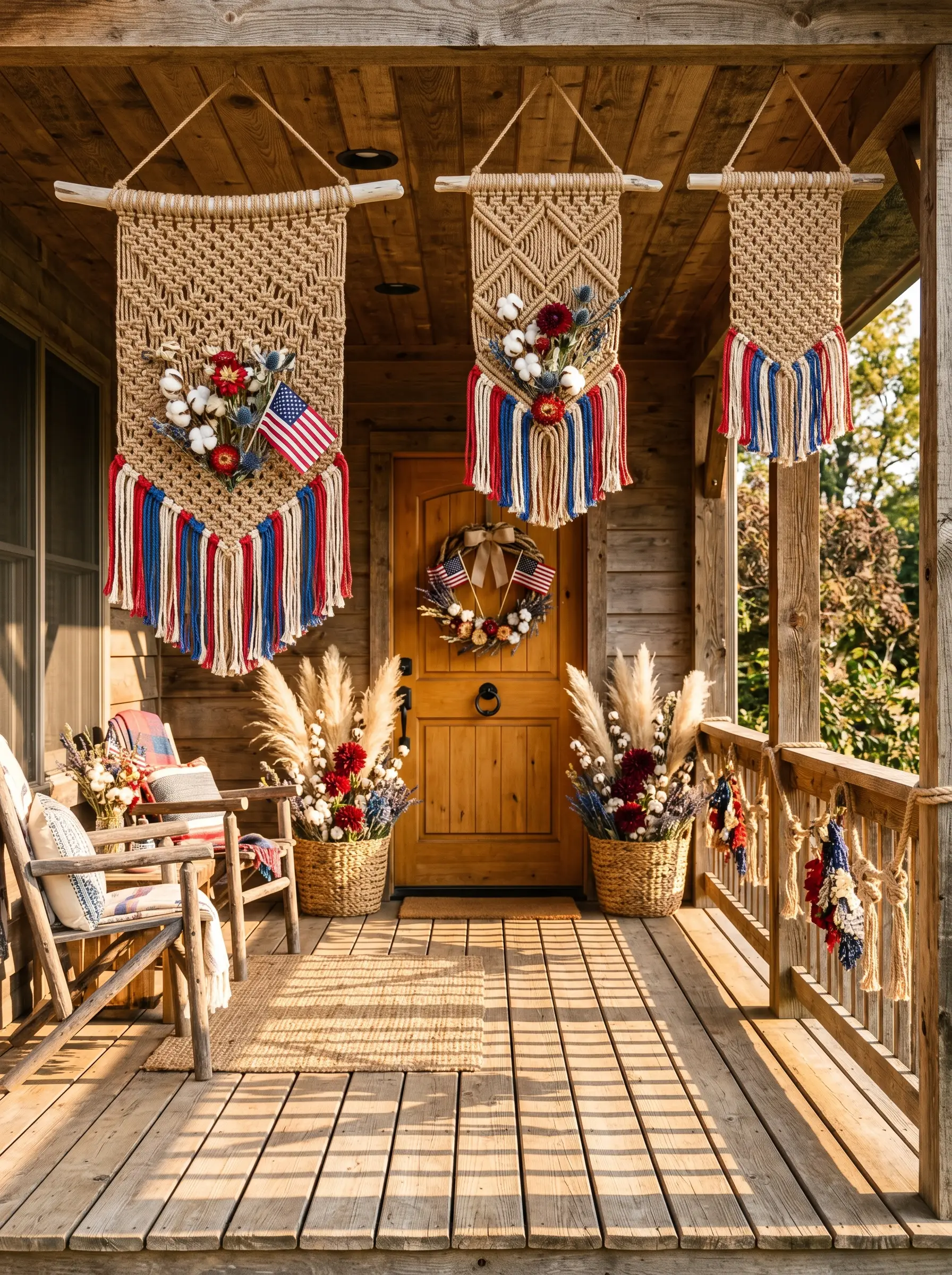
Three macramé wall hangings, each mounted from its own driftwood or birch branch, suspended from the porch ceiling at evenly spaced intervals spanning the full width. Each piece in the same jute cord, each in a different knotting pattern — square knot, half-hitch diamond, chevron — so they read as a series rather than a repetition.
The lower fringe of each hanging is dyed: the left one in red and blue with natural center, the center one in the same palette with slightly different proportions, the right one with more natural jute and narrower color sections. The dyeing should be intentional but imperfect — uneven uptake is correct.
Into the body of each hanging, tuck a small gathered bundle of dried botanicals: cotton bolls, a dried dahlia head, a teasel, a small American flag. These additions should be minimal — two or three elements per hanging — so they read as embellishment rather than crowding.
Below each hanging, on the floor: a large woven seagrass market basket filled with a loose, generous arrangement of pampas grass plumes, red dahlias, lavender bundles, white cosmos, and blue agapanthus. Let the pampas grass plumes rise above the basket rim by at least eighteen inches.
On the door, a small grapevine wreath with dried botanicals and two small flags crossed behind it, finished with a simple burlap bow. Quiet, compared to the ceiling installation. Correct.
In the rustic chair to one side: a striped blanket in natural tones draped over the arm. A few small dried flower bundles on the railing beside it. The jute runner on the floor in front of the door has a woven geometric pattern — no flags, no stars, just pattern.
The Red Barn Porch That Goes Fully Committed and Earns It
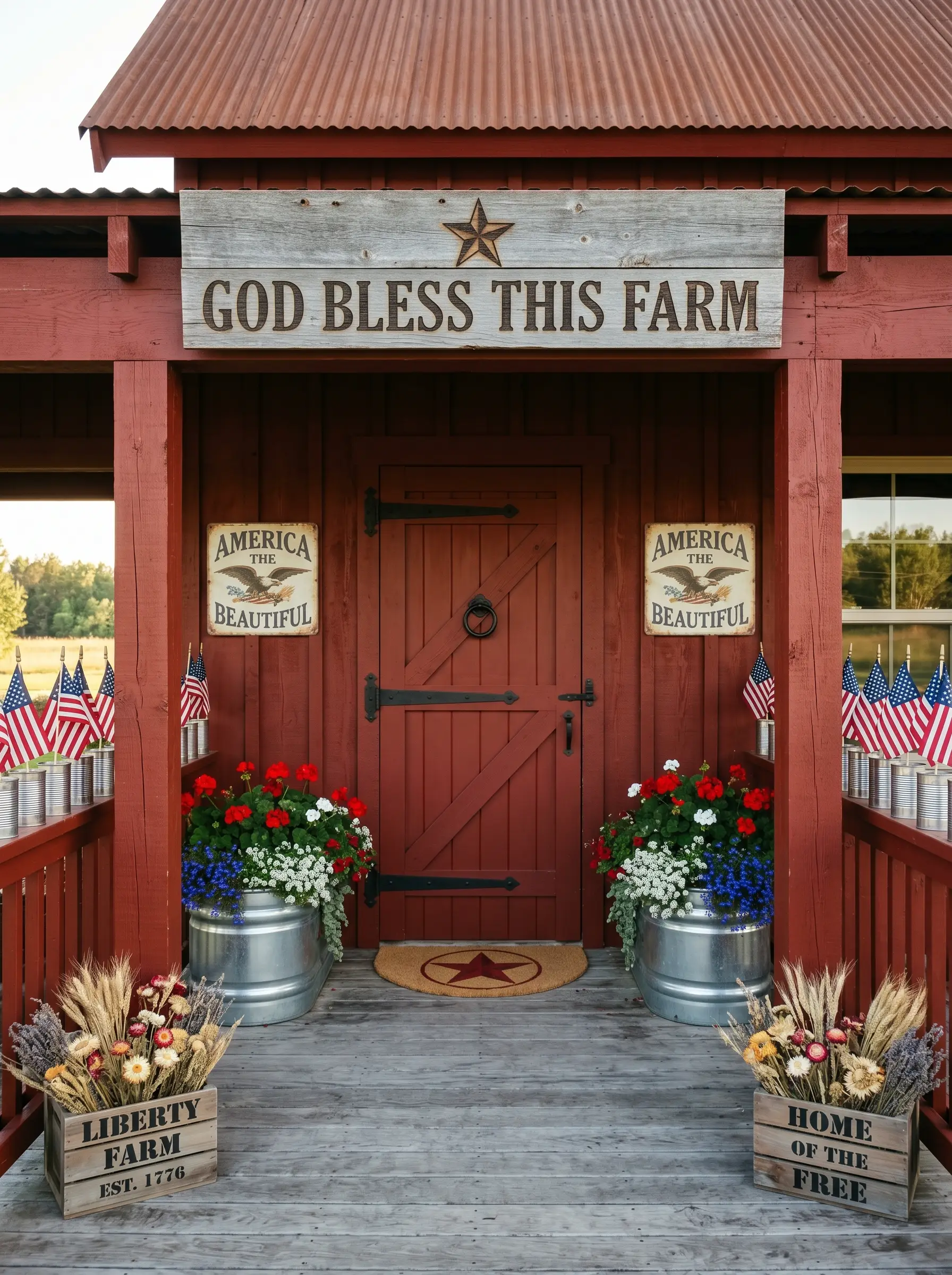
The structure is barn red. Everything on it leans into that decision.
Mount a large central sign above the entire entry — aged barn board or whitewashed plank — with substantial lettering in a font that reads as hand-painted even if it isn’t. The message is direct and the scale is generous; it should span the full width of the entry opening.
On the wall flanking the door, mount two matching vintage-style tin signs in the patriotic theme — the kind with eagle imagery and classic typeset lettering that reads as reproduction of an earlier era of commercial printing. Mount them symmetrically, at eye height, one per side.
At the door, place two large galvanized stock tank containers or galvanized utility drums, one on each side. Plant each one heavily: red geraniums as the upright layer, white alyssum or sweet William as the middle, blue lobelia trailing over the front. These are working containers, not decorative planters. The difference is visible in the material.
On the railing shelving on each side, line a row of standard recycled tin cans — soup can size, rinsed and with their labels removed, their bare steel showing — and in each one, stand an American flag upright. Twelve to sixteen cans per side, closely spaced.
At floor level on each end of the porch, place a stenciled wood crate — painted or marked with patriotic text in the style of old commercial crating — and fill it with dried mixed botanicals: wheat, strawflower, lavender, dried gaillardia.
The Gray-Board Porch That Celebrates Saying What You Mean
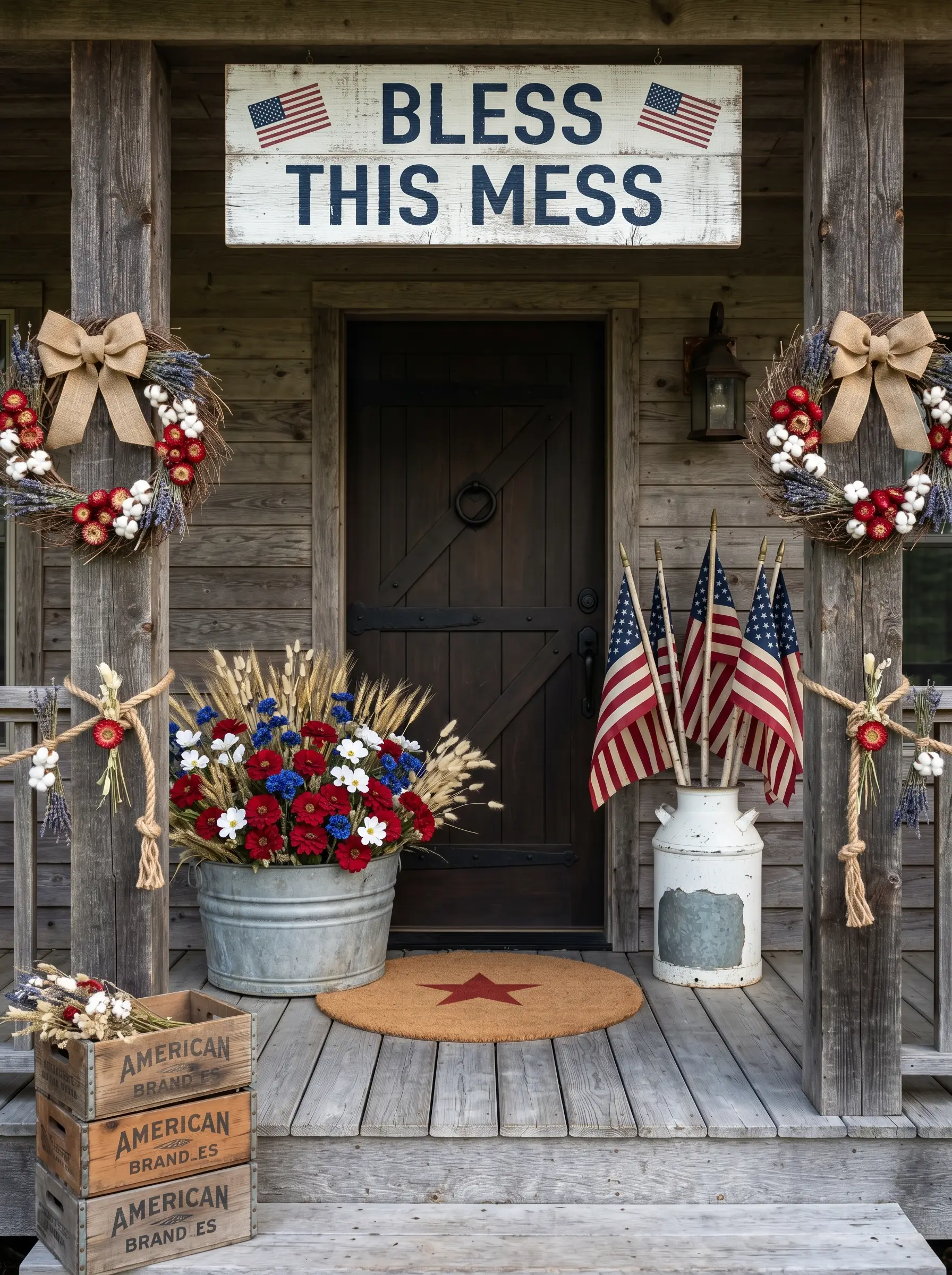
The barn board is unfinished gray, the door is Z-brace construction in the same material, the railing is jute rope — and the porch has no apologies to make.
On the wall above the entry, mount a large sign on reclaimed white-painted board with bold navy lettering. What it says is less important than that it says it directly, in a font that looks like it was made by someone who cares about words rather than aesthetics.
On each column, hang a grapevine wreath — not on the door, on the columns — filled with cotton bolls, dried red strawflower, and lavender, finished with a natural burlap bow. Two identical wreaths at the same height on each column.
At the left of the door, a large galvanized wash tub or stock tank, three to four times the size of a bucket, filled with an extravagant mixed flower arrangement: red zinnias, white cosmos, blue bachelor’s buttons, with dried wheat stalks standing above everything at the rear. This is the primary flower element and it should be generous.
At the right of the door, a large antique milk can — the tall, narrow kind with a lid and a dented side — holding a fan of multiple American flags standing upright. Seven to nine flags, different heights, fanned outward.
On the floor in front of the door, a round coir mat with a single star stamped in dark ink. On the left of the mat, stacked wooden crates with stenciled brand lettering — two to three high, slightly offset — holding a small dried botanical arrangement on the top surface. On the railing, at intervals, more cotton and dried botanical bundles tied with jute.
The Red-Painted Log Porch That Makes Barrels Do All the Heavy Lifting
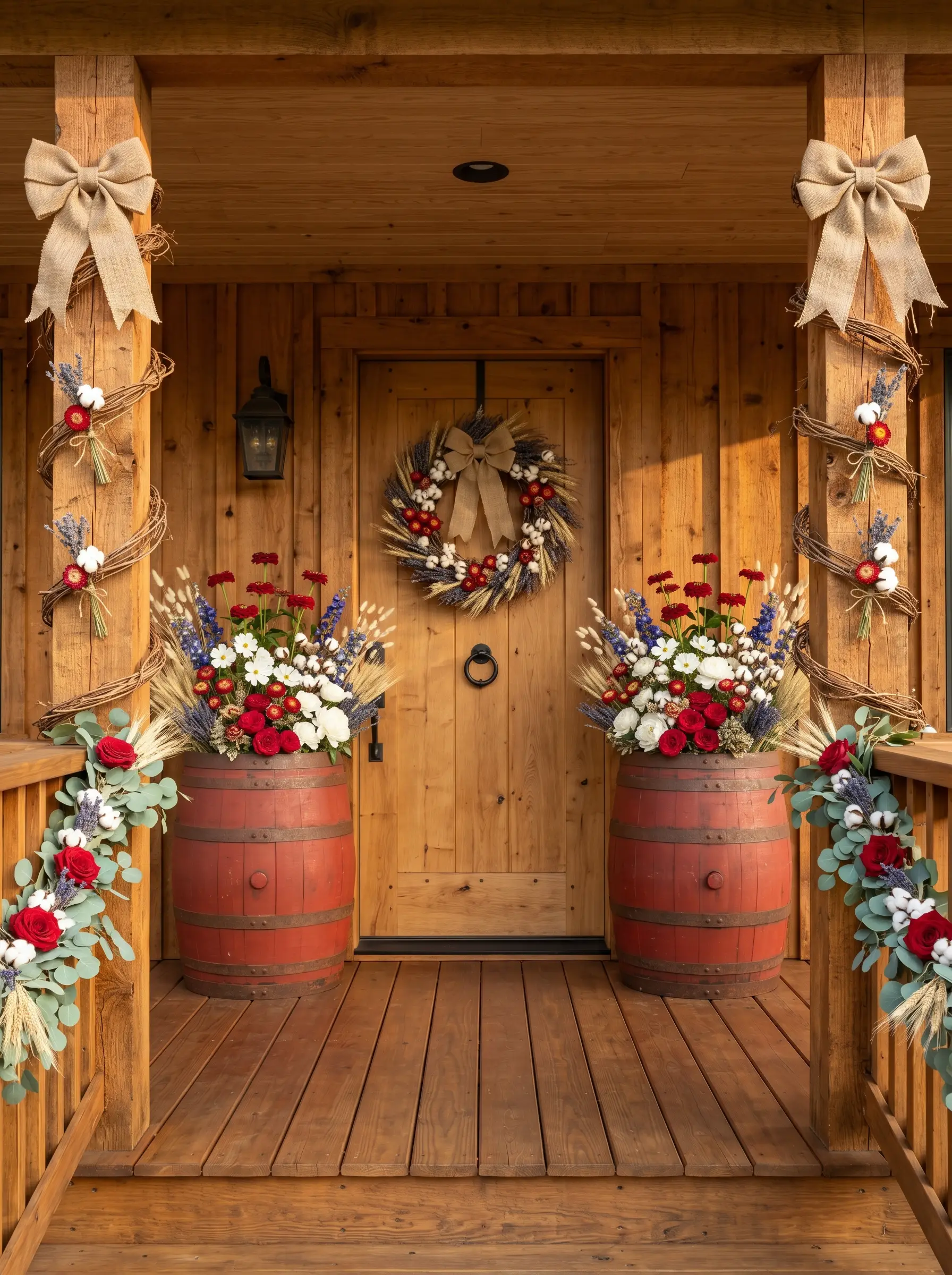
The porch is warm cedar or pine, the columns are turned hardwood in a dark chocolate stain, and the door is warm honey-toned wood with iron hardware. This is a high-warmth, high-texture setting. Everything on it needs to match that energy.
Two wine or whiskey barrels, painted a warm red that matches or complements the structure — not bright red, but barn-red or cranberry, the kind of red that reads as pigmented wood rather than paint. Position one barrel on each side of the door. Into each barrel, insert a liner or pack the top directly with potting mix and fill generously with a mixed botanical arrangement: dried wheat stalks and pampas grass for height at the back, red roses and white cosmos in the body, lavender bunches and cotton bolls as texture, blue salvia or agapanthus providing the blue note.
On each column, spiral a grapevine vine from base to capital and attach at intervals: small dried botanical bundles — rose hip, eucalyptus, red ranunculus, cotton — tied with jute. At the top of each column, tie a large natural burlap bow with full wired tails. These bows mark the top of the column arrangement and frame the porch ceiling from below.
On the door, hang a wreath built on dried wheat or rye grass base — full and round, generous in scale — with cotton bolls, dried red berries, lavender, and a burlap bow matching the column bows. The door wreath and the column bows should use the same burlap so they read as a unified family.
The porch has no flags, no bunting, no stars. The palette, the season, and the material make the statement.
On Doing Less and Meaning More
Every porch that succeeds in these images knows what it is. The ancient log structure doesn’t pretend to be the styled farmhouse. The weathered homestead doesn’t compete with the stone cottage. Each one works within the terms of its own character.
The Fourth of July gives you a palette and an occasion. The rustic approach gives you permission to use old things, imperfect things, things that have been washed and stored and carried through multiple generations of the same holiday. Put those things on your porch and they will do the rest.
You don’t need a flag that matches your bunting. You don’t need a wreath that matches your pillow. You need one thing that’s genuinely old, one thing that’s alive, and enough restraint to let them talk to each other without interference.
That’s the whole secret. It always has been.