
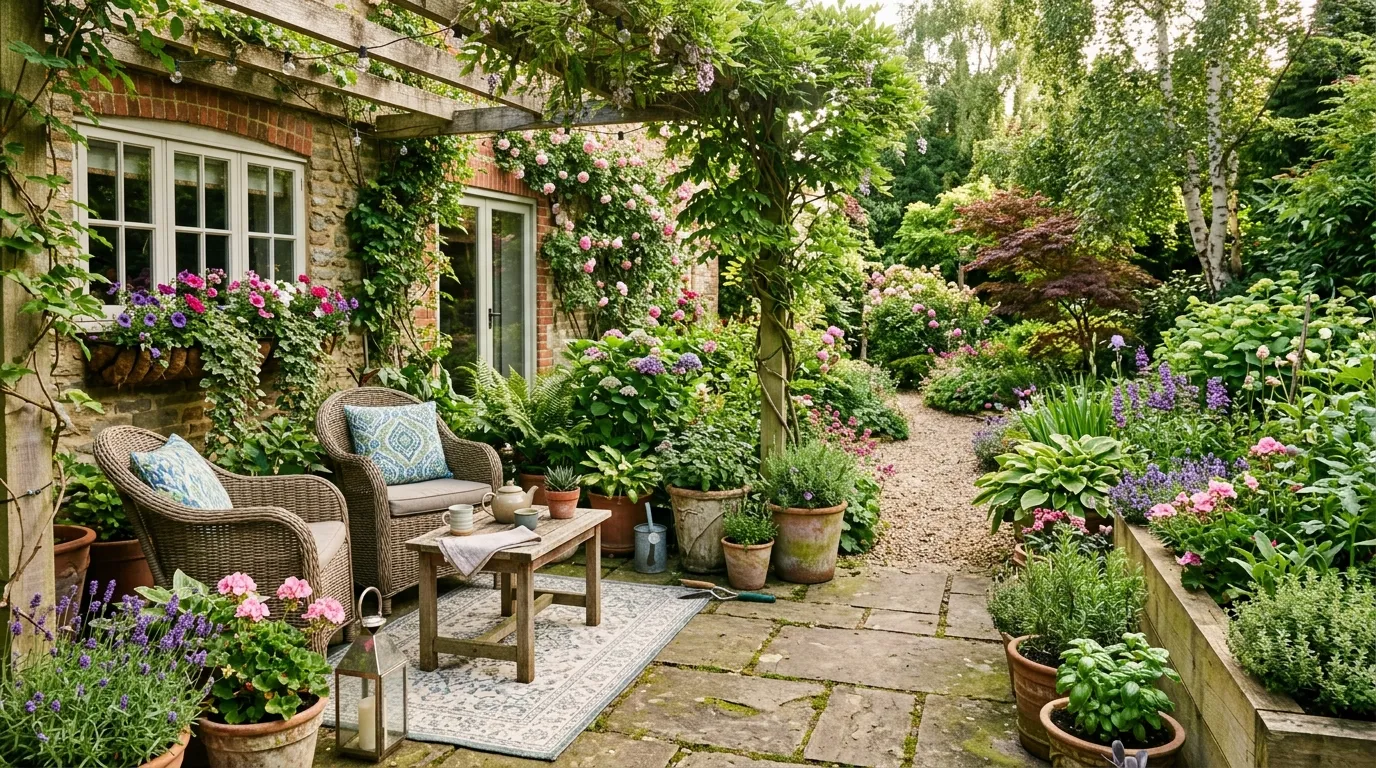
Concrete and disappointment. That’s what most patios offer. A slab of grey, a couple of chairs nobody sits in, and a vague sense that something is missing. The outdoor space that was supposed to be a retreat turned into somewhere you walk through to get to the bins.
The problem isn’t the size. It’s never the size. Small patios in this collection are some of the most compelling spaces you’ll see. The problem is the thinking. Most people treat a patio like furniture shopping. They buy things. They put them down. They wonder why it doesn’t feel like anything.
A patio is a room. It has walls, whether those walls are fences or hedges or vertical planting. It has a ceiling, whether that’s a pergola or a sail shade or just the sky. It has a floor that either does work or doesn’t. Once you start thinking in those terms, everything changes.
These fifteen ideas will show you exactly what that looks like in practice.
Why Patio Gardens Fail to Feel Like Anything
The Furniture Problem
Buying a matching outdoor furniture set and calling it done is the fastest route to a patio that looks like a hotel lobby. Coherent, inoffensive, and completely devoid of personality.
Good outdoor spaces layer. They combine materials that have lived different lives — worn wood alongside galvanized metal, wicker next to weathered stone, rattan with raw linen. The mix is where the character comes from. A set from a single manufacturer gives you coordination without soul.
It also doesn’t help that most patio furniture is scaled for a showroom, not a real garden. Those enormous L-shaped sectionals swallow small spaces completely. Scale down. Use individual chairs rather than built-in sectionals. Let the garden breathe.
The Plant Afterthought
Here is the single most common mistake in patio garden design: people decide the furniture layout first and add plants wherever there’s leftover space.
Plants are structural. A large banana plant or a mass of elephant ears doesn’t decorate a patio — it defines it. A wall covered in climbing sweet peas is not an accent — it’s a boundary. Get the planting in the plan before the furniture goes down, not after.
When plants are afterthoughts, they look like afterthoughts.
The One-Level Error
Every patio that feels flat has the same problem: everything lives at the same height. Chairs, tables, pots, and plants all occupy the same visual band. The eye has nowhere to go.
Great outdoor spaces have drama in the vertical dimension. Something very tall. Something at mid-height. Something that spills low and trails across paving. A hanging cluster of lights above. A ground-level glow from candles and lanterns.
Think in three bands: above head height, eye-level to waist, and ground to knee. Fill all three, and the patio stops feeling flat.
Patio Garden Ideas Worth Stealing
Boho Flowers-Everywhere Garden Room
Start with the largest outdoor rug you can find in a warm Persian or kilim pattern — the print needs to be complex and colourful enough to anchor the whole space. Lay it on clean, level paving as the centrepiece of your seating area.
Arrange mismatched wooden chairs around a low round table, each seat cushioned in different fabrics that pick up colours from the rug — burnt orange, faded red, botanical print. Bring the chairs close together, closer than feels instinctively right, so the group reads as intimate rather than sparse.
The planting is the architecture. Layer climbing plants up and over every fence and wall surface — clematis, jasmine, climbing roses — until the boundaries dissolve into green. At ground level, pack mixed cottage garden flowers in dense drifts directly into border beds that push right up to the paving edge: dahlias, zinnias, chrysanthemums, roses. Hang wall planters on the fence filled with trailing ivy and pink geraniums.
The goal is a room entirely wrapped in living walls. Lighting: clip small lanterns to the fence at irregular heights.
Sage Green Pegboard Herb Wall
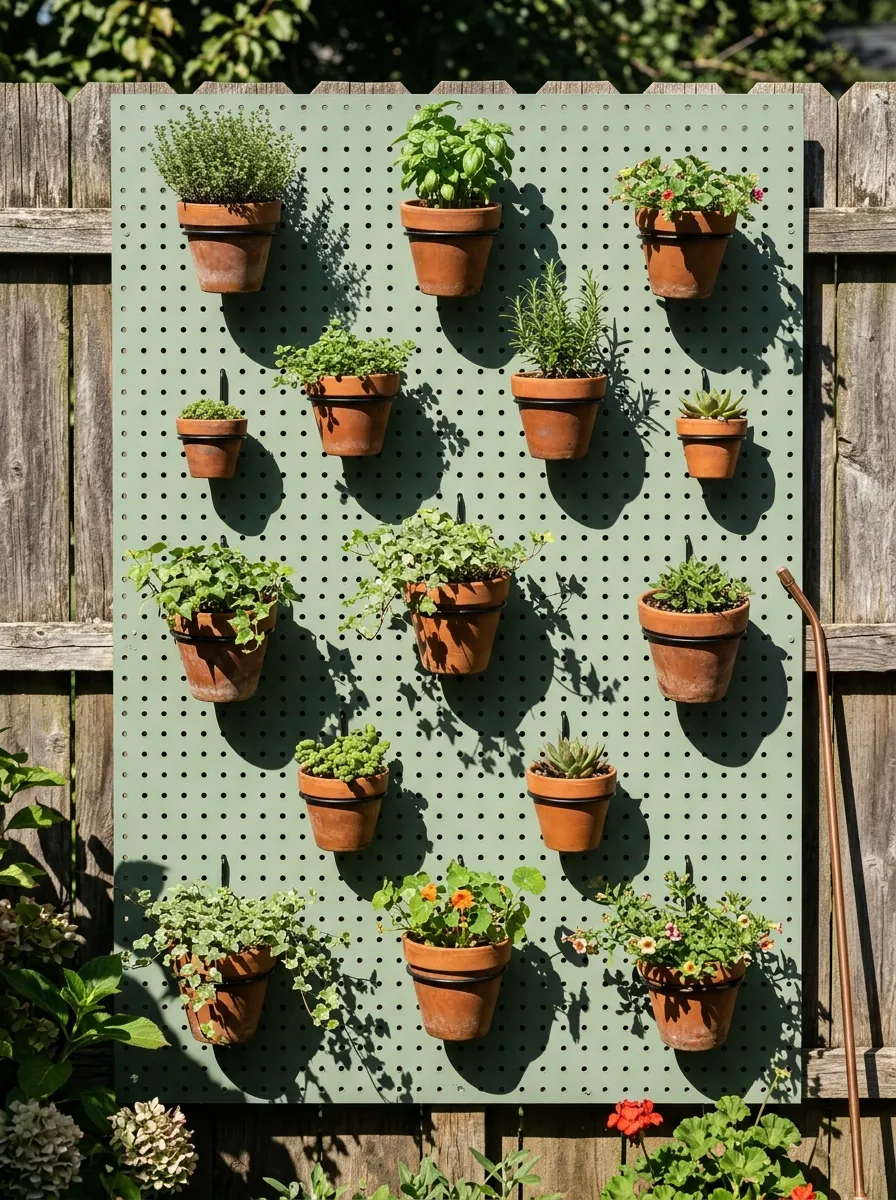
Cut or purchase a sheet of steel or aluminium pegboard — the kind with small round holes on a regular grid pattern — and spray paint it a muted sage green on both sides before mounting. Mount the panel flat to a fence or wall using timber battens that hold it slightly proud of the surface, so pegboard hooks can engage from the back.
Hang standard terracotta pots on purpose-made pegboard pot holders — these hook into the board and support the pot from below. Arrange the pots in an asymmetric grid: not perfectly aligned rows, but slightly organic in placement. The cast shadows at midday are as decorative as the plants.
Plant entirely in herbs that can be harvested and used — basil, thyme, rosemary, marjoram, mint (in its own contained pot), and chives. Add one or two nasturtiums for colour and because the flowers are edible. Keep a copper watering can permanently beside the board.
Mason Jar Edison Chandelier
Source ten to twelve wide-mouth quart mason jars. Acquire pendant lamp cord kits with individual bulb sockets — these are widely available online and at hardware stores. Thread one cord through the metal lid of each mason jar, securing it so the socket sits inside the jar and the bulb is visible through the glass.
Attach all the cords to a single overhead mounting plate or a short length of thick timber, varying the cord lengths so the jars hang at different heights — some short, some reaching low. When lit with warm Edison bulbs (the visible filament type, not plain LED), the glass amplifies the glow and creates extraordinary reflections.
Mount the whole assembly to a pergola beam or a ceiling hook above your main seating area. Combine with low string lights in the surrounding foliage for depth.
This is an evening-only installation that transforms the perceived quality of any patio space. The furniture beneath it becomes almost irrelevant.
Pebble-Edged Rain Garden Pond
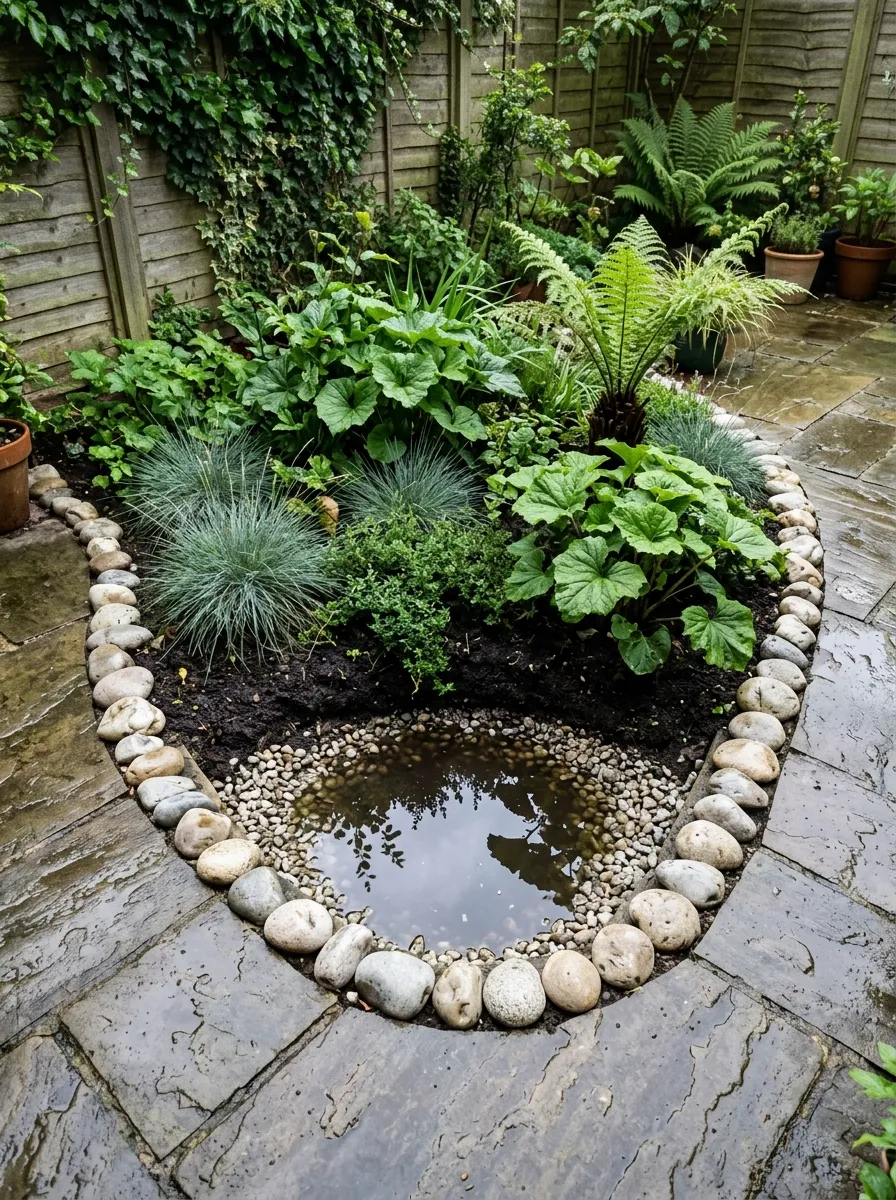
This is a planted bed with a shallow depression at its heart — not a formal pond, but a small collected-water pool that fills after rain and drains slowly. Excavate a shallow oval or kidney-shaped bed to a depth of about thirty centimetres. The front section nearest the paving should be scooped to form a slightly deeper basin — perhaps fifteen centimetres below the surrounding bed level. Line only the basin section with a small pre-formed pond liner or a sheet of butyl rubber buried below a layer of pea gravel.
Edge the entire bed perimeter with large smooth rounded river pebbles laid tightly together. Edge the inner basin separately with smaller pea gravel that grades down into the water.
Plant the bed densely with moisture-tolerant species: ferns, hostas, Gunnera manicata, blue fescue grass, and sedge. The contrast of the fine-leaved grasses against the broad Gunnera leaves is the textural anchor.
Long Narrow Garden Zones
The challenge of a long narrow garden is not the length — it’s the temptation to treat it as one space.
Divide it into three distinct zones running front to back. Zone one at the house end: a hardscaped seating area with pale stone paving, lounge furniture, and a small side table with candles. Zone two in the middle: a narrow strip of lawn or artificial grass flanked by planted beds, with a single suspended egg chair as a focal point. Zone three at the far end: a utility or growing area screened from the lounge with planting.
Install a sail shade over zone one, anchored to the house wall and two freestanding posts. Run festoon lights from the house, dipping low over zone two, and reattaching at the far fence.
Plant the border beds flanking the central grass with bold structural plants — feather grass, tall lavender, architectural ferns — rather than fussy flowers. White flowers only if you want them: they show up dramatically at dusk.
Reclaimed Wood Block Table
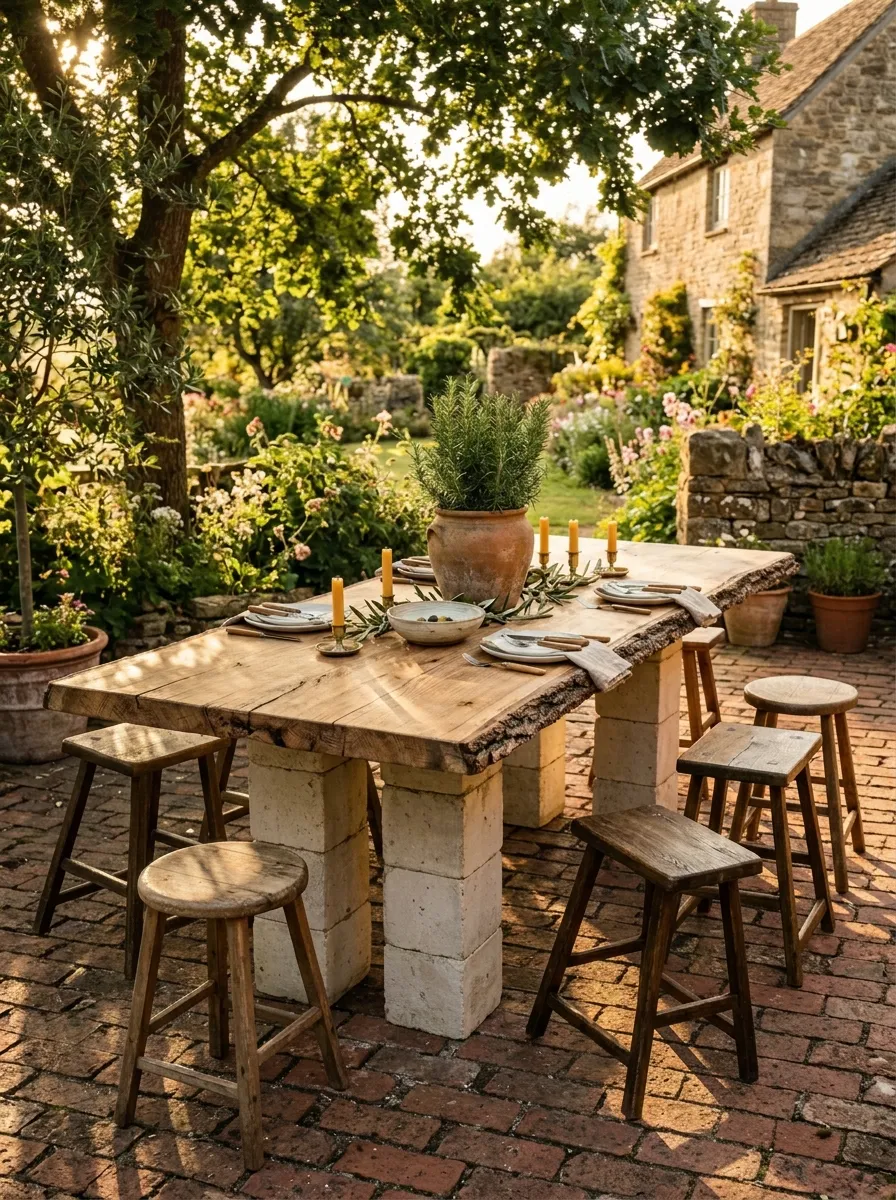
Build the table base from stacked limestone or concrete blocks — two stacks of three, each approximately the width of a house brick, positioned to provide stable support at either end of your timber slab.
The tabletop is a single piece of reclaimed wood with live edge intact — the natural bark edge left on one or both long sides. Source this from a reclaimed timber merchant or architectural salvage yard. Sand the surface smooth enough to eat from while preserving the character of the wood grain and any natural fissures.
Seal with a food-safe outdoor hardwax oil rather than varnish, which would make it look artificial. For seating, use simple low wooden stools — all the same height but not necessarily matching. Set the table with matte ceramic plates, slim taper candles in terracotta holders, and a large terracotta pot of fresh rosemary or herbs as the centrepiece.
Rose Pergola French Courtyard
The pergola structure comes first. Build or install a rectangular timber pergola with four posts, no roof panels — just open beams. The beams are the trellis. Plant climbing roses at the base of each post and along the perimeter, choosing a single variety for visual coherence — a soft blush or apricot tone works best against warm stone.
Hang three or four large wicker pendant lights from the beams at varying heights, bunching them toward the centre. These do double work: they look extraordinary by day as sculptural objects and provide ambient downlight at night.
On the paving below, layer a large botanical-print outdoor rug. Set a round iron table and four or five mismatched iron chairs — the ornate scrollwork kind, not the modern bistro variety. Upholster cushions in floral and stripe fabrics.
Edge the perimeter in large terracotta urns planted with standard olive trees, standard roses, and trailing geraniums. The olive trees create height and structure that the furniture can’t provide.
Tropical Foliage Sanctuary
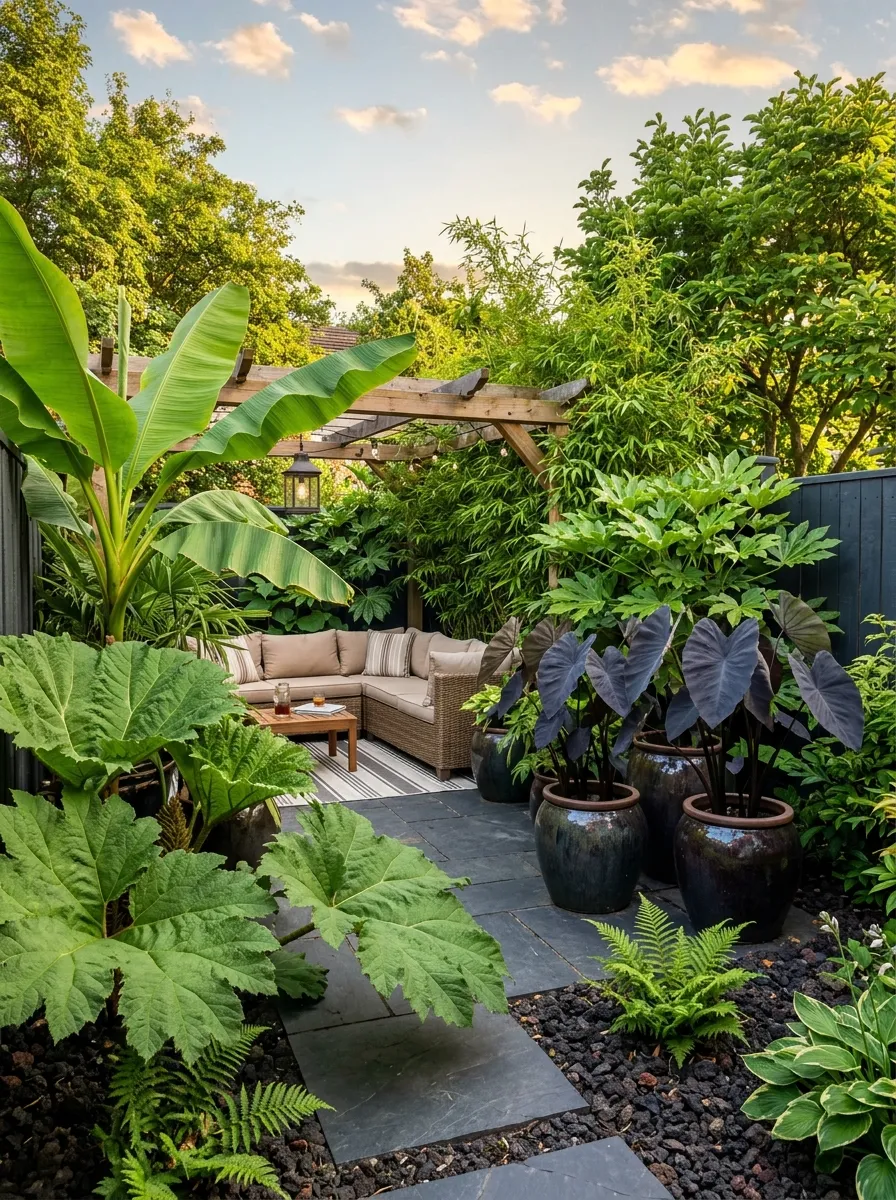
The key to a convincing tropical look in a temperate climate is scale. Large leaves, not many plants.
Choose three to five species with genuinely large foliage and plant them in oversized glazed black or very dark brown ceramic pots. Musa basjoo (hardy banana), Colocasia Black Magic (elephant ears), Tetrapanax papyrifer, Fatsia japonica, and tree ferns all provide scale and tropical texture while surviving temperatures below zero.
For non-hardy plants — birds of paradise, Strelitzia, Canna — grow them in containers that can be moved inside before the first frost. Lay large dark slate paving stones as stepping pads through black lava rock or dark gravel mulch. The dark ground reflects no light and makes the green foliage pop. Install a small pergola over the seating area but resist the urge to plant it immediately — let the potted specimens do the architectural work.
Dark Courtyard Green Wall Room
Paint every fence panel and wall surface in your courtyard a deep charcoal or near-black. This is the single decision that makes everything else work.
Against the dark backdrop, green plants become extraordinarily vivid. Install a powder-coated black metal pergola over the seating area — lightweight, not heavy timber — and allow climbing plants to colonise it quickly: golden hops, climbing hydrangea, and Clematis viticella are all fast and reliable.
Choose furniture with black frames and emerald green cushions. The colour match with the surrounding foliage makes the seating feel embedded in the garden rather than sitting in front of it.
Add hanging planters at multiple heights on the dark walls: white metal or terracotta both read well. Thread warm-white festoon bulbs across the pergola roof.
At ground level, pack the perimeter in pots of bold tropical foliage — banana plants, large-leaf philodendron, bird of paradise — that you overwinter indoors.
Wine Crate Composting Station
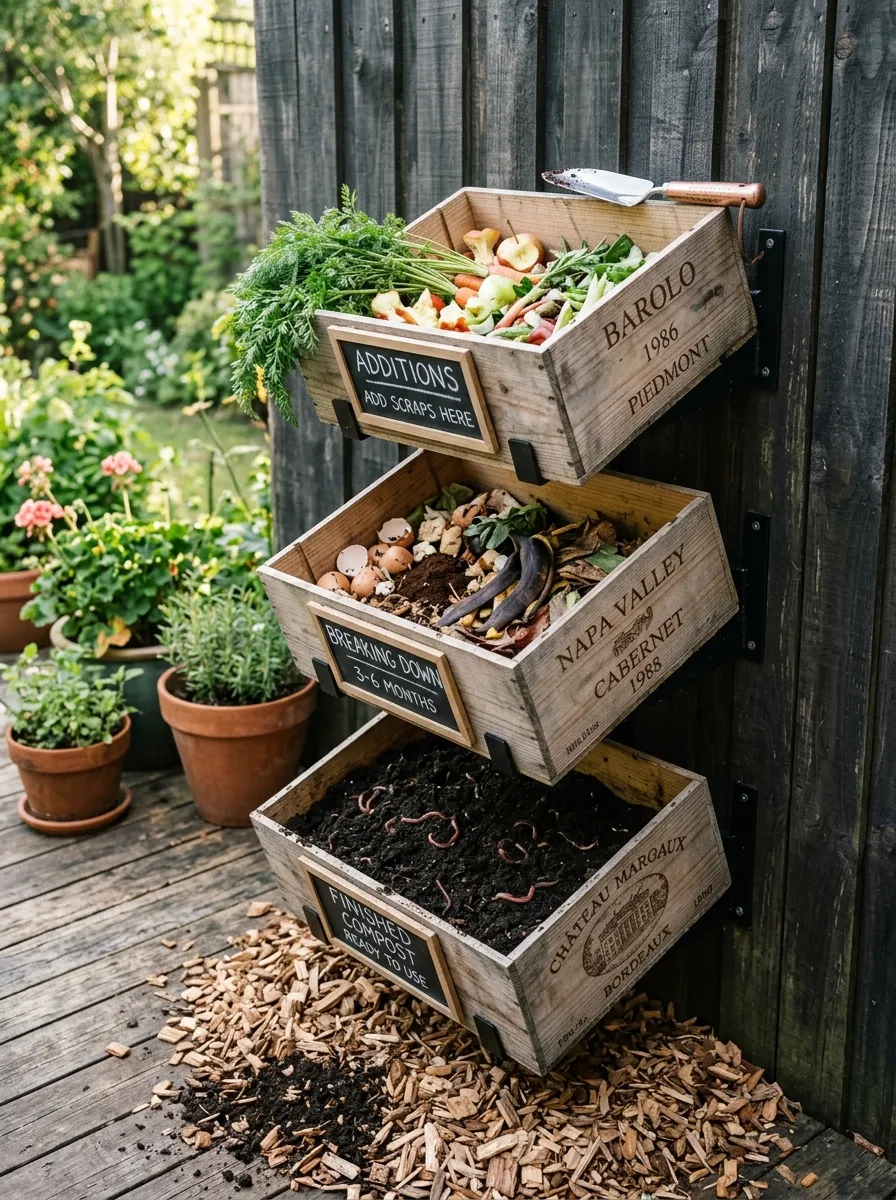
Mount three wooden wine crates to a fence or shed wall using heavy-duty L-bracket hardware, spacing them diagonally — one high on the right, one centred in the middle, one low on the left. Each crate should tip slightly forward so the contents are visible and accessible.
The top crate is where fresh kitchen scraps go. The middle crate holds material that’s been breaking down for two to four months. The bottom crate contains finished compost ready to use. Add small chalkboard labels to the front of each to mark the stage.
Line each crate with permeable landscape fabric before filling to prevent soil escaping through the wood joints. Line the bottom with a layer of wood chip or cardboard before adding your first scraps. Scatter additional wood chip on the deck surface below the bottom crate to contain any overflow. This turns a functional necessity into a genuinely handsome feature.
Zen Gravel Sphere Corner
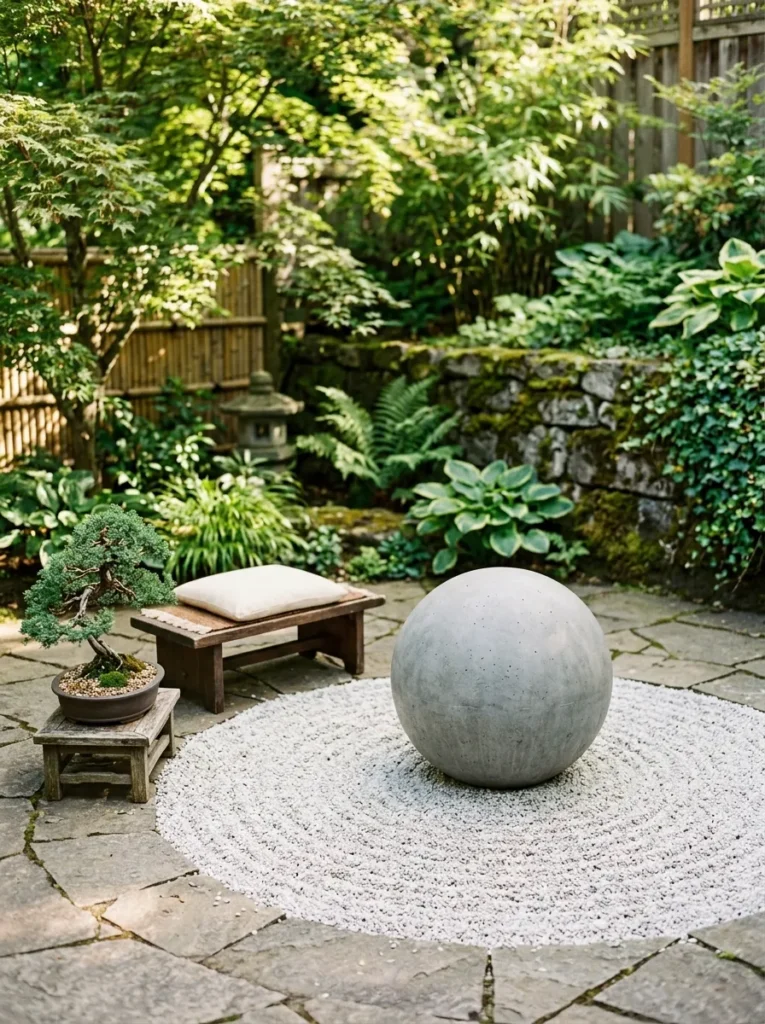
Clear and level a circular area of your patio, or choose a corner where two paving edges meet. Pour fine white or pale grey gravel — the kind used in Japanese garden raking — in a circle approximately one and a half metres in diameter. Contain it at the paving edge with a buried metal edging strip.
Into the centre of the gravel circle, place a single large concrete sphere. The sphere should be substantial — at least forty centimetres in diameter. Cast concrete, not reconstituted stone. The weight and matte texture are essential. A glossy fibreglass copy will not work.
Beside the gravel circle, position a low wooden meditation bench — a simple rectangular platform raised on short legs, not a decorative seat — with a single natural linen cushion. Add a small bonsai tree on a separate low stool to one side. That is the entire composition. Its power comes from what’s not there.
Galvanized Trough Herb Table
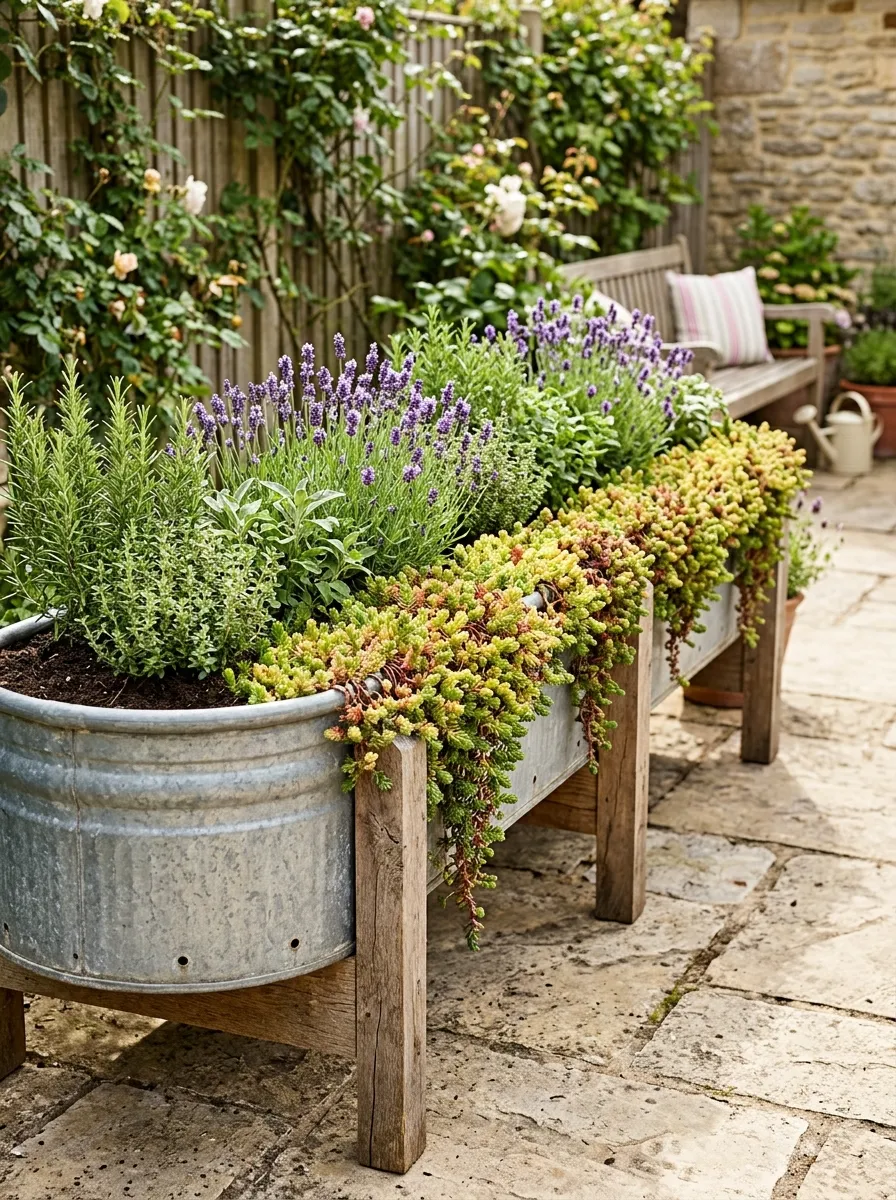
Source a galvanized metal animal feeding trough — the long rectangular kind used in farming, approximately one and a half metres long. Drill drainage holes in the base at thirty centimetre intervals. Build a simple stand from rough-sawn timber: four legs cut to a height that positions the trough at approximately waist level, connected by horizontal stretchers. The wood should be left natural or treated with a dark oak oil rather than painted.
Fill the trough with a mix of sixty percent topsoil and forty percent horticultural grit for drainage. Plant in a deliberate pattern along the length: aromatic herbs that will grow upright — rosemary, sage — at intervals, with flowering lavender between, and trailing sedums and succulent groundcovers at the front edge that will cascade over the galvanized rim.
Position it along a fence line or against a wall, leaving a garden bench at one end so you can sit beside it.
Bamboo Linen Canopy Structure
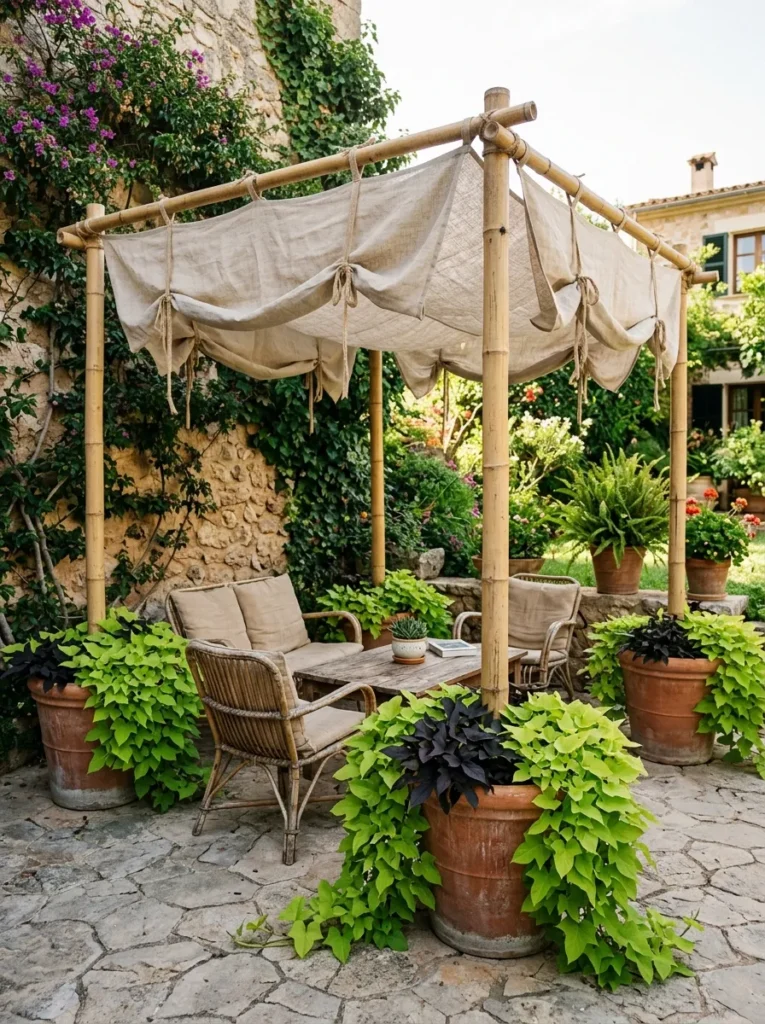
Source four lengths of large-diameter bamboo pole — at least eight centimetres across — in matching heights of approximately two and a half metres. Set them in the ground using metal post spikes to form a four-post square, approximately two metres on each side. Lash the tops together using natural jute rope, first connecting the four tops with horizontal bamboo crosspieces at the same height, then adding diagonal bamboo lashing for stability. This becomes your canopy frame.
For the shade cloth, use a piece of natural undyed linen approximately twice the size of the frame opening. Tie it to the frame at regular intervals using jute, allowing it to drape generously in the centre — not pulled taut but falling in soft natural folds.
Set rattan furniture beneath: a two-seater sofa and two armchairs with sand-coloured cushions. Surround all four posts with enormous terracotta urns planted with trailing sweet potato vine in chartreuse and deep purple — the colour contrast between the two varieties does all the work.
Bean and Sweetpea Living Arch
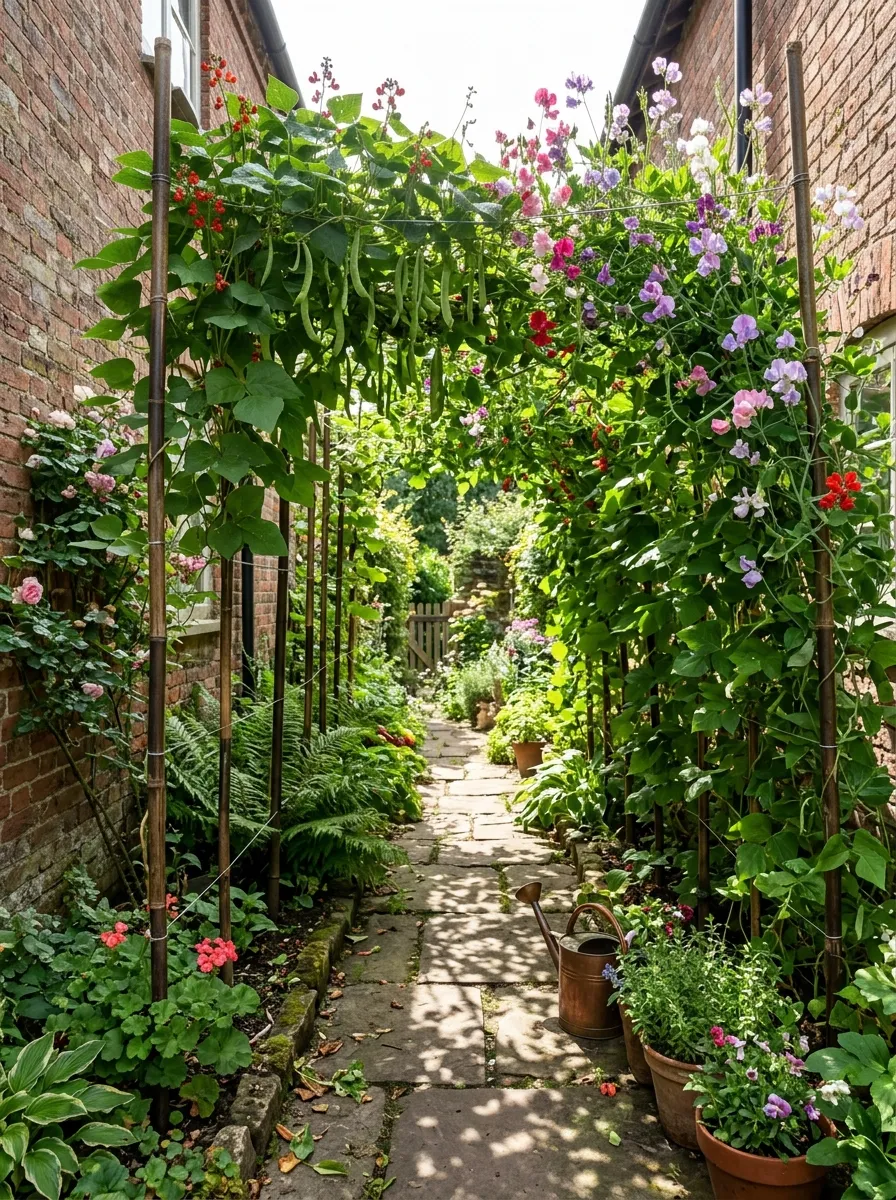
Between two walls or two posts, run horizontal wires at twenty centimetre intervals from ground level to the top of the opening, tensioning them with eye bolts. The spacing is important — too far apart and the plants won’t cover.
Plant runner beans at the base of the left side and sweet peas at the base of the right, in ground-level beds or deep containers. Both are fast climbers and will reach the top within one season. The beans provide structure and produce a harvest. The sweet peas provide colour and scent, flowering prolifically from midsummer onward. As they grow, weave the stems loosely through the wire framework rather than tying them too tightly. They will find their own way.
Underplant with shade-tolerant ferns, hostas, and geraniums on the ground below. The effect of light filtering through a living arch overhead into a stone path beneath is one of the most beautiful things a garden can produce.
Seed Station Potting Bench
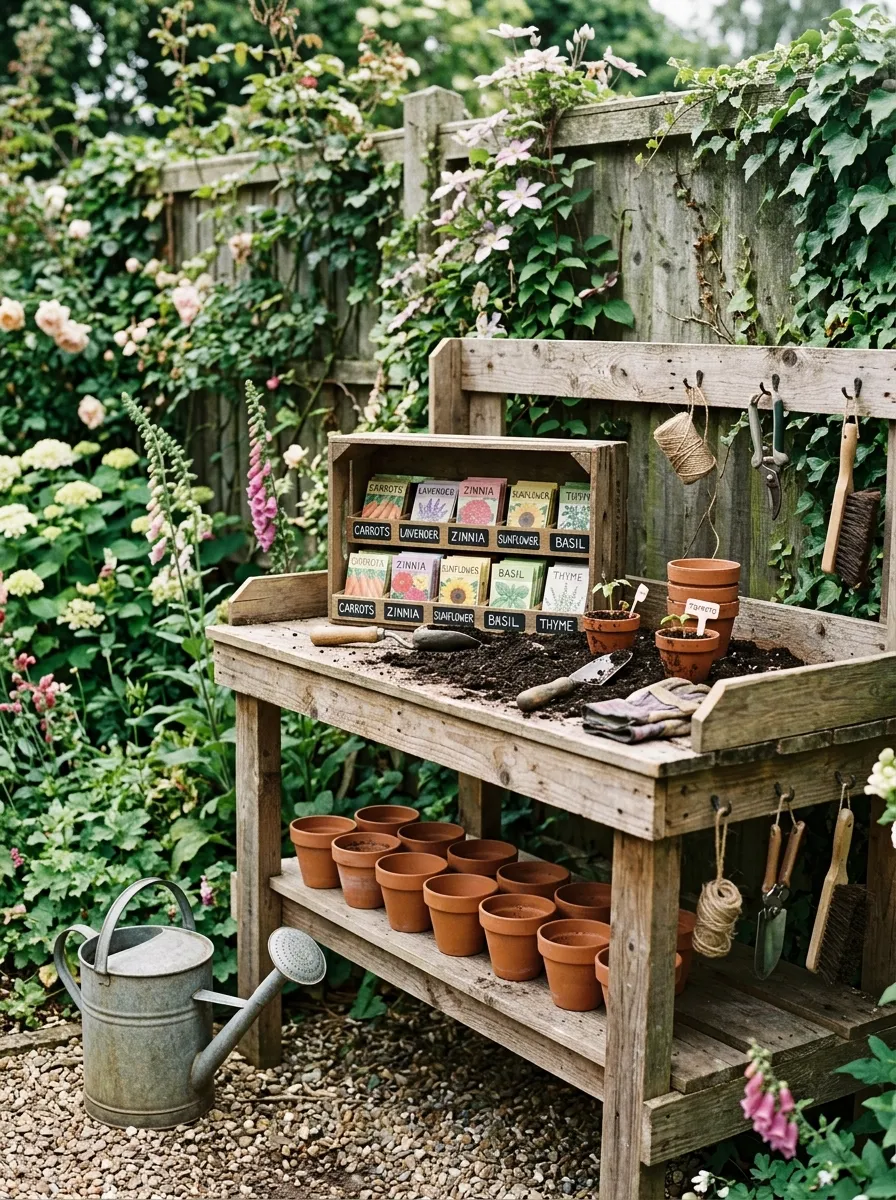
Build or source a freestanding potting bench in rough-sawn timber — two shelves and a work surface, with a simple backboard fitted with cup hooks. The wood should be unfinished or treated with a natural oil that allows it to weather.
Mount a shallow open-fronted display box to the backboard and fill it with labelled seed packets, sorted by type and arranged so the illustrated fronts face outward. This is not just storage — it is a display. On the work surface: a small mound of potting compost, a trowel, a pair of leather gloves. A row of small terracotta pots on the lower shelf, stacked in sizes. A ball of jute twine and a small pair of scissors hanging from the cup hooks.
Position the bench on a gravel surface at the edge of your garden, preferably against a fence covered in climbing roses and clematis. The bench should look used. A pristine potting bench is a contradiction in terms.
Final Thoughts
Every garden in this collection understood the same thing: a patio is not finished when the furniture arrives.
It’s finished when the space has been lived in enough to know where the afternoon shadow falls. When the climbing plant has reached the top of the arch. When the terracotta pots have weathered to that particular shade of grey-orange that no new pot ever has. When there’s a permanent mark on the table from a coffee cup, and you’ve stopped trying to clean it off.
Good outdoor spaces don’t come from a single shopping trip. They accumulate.
Start with the bones — the paving, the shade, the zones. Then let the rest build over seasons. A patio garden that looks like it grew rather than appeared is always the more interesting one.