
Every summer, front porches across America commit the same crime. A plastic flag here. A generic wreath there. A doormat still crusty from last year. The result is a porch that says “I remembered it was July” and nothing else.
Patriotic decorating has a bad reputation it didn’t entirely earn. The color palette is genuinely great — bold, graphic, saturated. The problem isn’t the red, white, and blue. The problem is the execution. Cheap materials, no cohesion, and the kind of effort that looks like it took eleven minutes.
These ideas take the same holiday colors and do something with them. Something intentional. Something that will make your neighbors slow down and actually look.
Here’s what good patriotic porch decor actually requires — and then twenty ways to do it properly.
Why Most Patriotic Porches Fall Apart
The Disposable Materials Problem
Plastic bunting and paper flags are the enemy. They flutter cheaply in the breeze, fade by the fifth, and make the whole porch feel like a temporary installation rather than a considered design.
The moment you commit to real materials — burlap, galvanized metal, painted wood, woven fabric — the entire look shifts. These surfaces have weight. They have texture. They signal that someone put actual thought into this.
Natural rope, jute twine, clay pots, and reclaimed wood don’t cost much more than their plastic equivalents. They just look a thousand times better.
The Everything-At-Once Trap
A wreath, a flag, a banner, a doormat, potted flowers, spinning whirligigs, and a sign reading “AMERICA” in block letters is not a decorated porch. It’s a visual emergency.
Patriotic decor is particularly vulnerable to this because every individual piece seems modest on its own. Add them together and suddenly you’re living inside a fireworks stand.
Pick one hero piece and let the rest support it. Everything else should make the main thing look better, not compete with it.
The Scale Blindness Issue
A twelve-inch wreath on a nine-foot front door is not decorating. It’s a suggestion.
Scale is the thing most people get wrong more consistently than anything else. Your front door is architecturally significant. The entry to your porch makes a statement. Whatever you put there needs to hold its own against the structure it’s hanging on.
Go bigger than feels comfortable. You will not regret it.
What Nobody Actually Says About Patriotic Color
Red, White, and Blue Needs an Anchor
The three colors together are inherently high-contrast. Without something to ground them, a porch decked in red, white, and blue reads as chaotic rather than festive.
The anchor is almost always a neutral. Natural jute and burlap absorb the energy. Galvanized metal gives the eye somewhere to rest. Weathered wood provides the warmth that keeps the palette from feeling cold.
Without that neutral foundation, you’re just waving three loud colors at each other and hoping for the best.
Navy Outperforms Primary Blue Every Time
Royal blue looks like a bouncy castle. Navy looks like a flag.
Any time you have a choice between the two, choose navy. It reads as serious, graphic, and sophisticated rather than festive-in-a-toddler-birthday-party way. Navy paired with deep crimson red and clean white is a different palette entirely from the primary-color version most people default to.
White Needs to Breathe
White elements — flowers, painted surfaces, fabric — do the most work in patriotic decor. They separate the red from the blue, they lighten the whole composition, and they prevent the scheme from feeling oppressive.
Make sure at least a third of your decor surface is white or near-white. If you’re heavy on red and blue and light on white, the entire thing will feel claustrophobic.
Getting the Foundation Right
Start with the Door
Your front door is the compositional center of your porch. Before you buy a single decoration, stand in front of your entry and look at what that door actually demands.
A large, flat door wants a large wreath. A door with an arched window above it wants something that responds to that arch. A rustic door with dark wood wants farmhouse materials — jute, burlap, galvanized metal — not shiny plastic.
Let the architecture tell you what belongs there. Every door gives you a brief.
Layer Height into Your Design
Flat porches — everything at floor level or everything at door level — are boring. The eye wants something to travel.
Use vertical height to your advantage. A tall ladder display, oversized foam rockets in a planter, wall-mounted boards at varying heights — these all give the eye a journey. The porch becomes a composition rather than a collection.
Even simple moves work. Staggered pots of different sizes. A banner hung at ceiling level above floor-level blooms. The vertical dimension costs nothing and changes everything.
Plan for Night
Most porches get their most traffic and attention in the evening, when people are moving between parties or sitting outside after dark. A porch that looks good in daylight but disappears at night is a missed opportunity.
Mason jar lanterns, outdoor string lights threaded through garlands, solar stake lights — these are not afterthoughts. They’re half the display. Build your lighting into the plan from the start.
Patriotic Porch Ideas Worth Stealing
Burlap Bag Flag Blooms
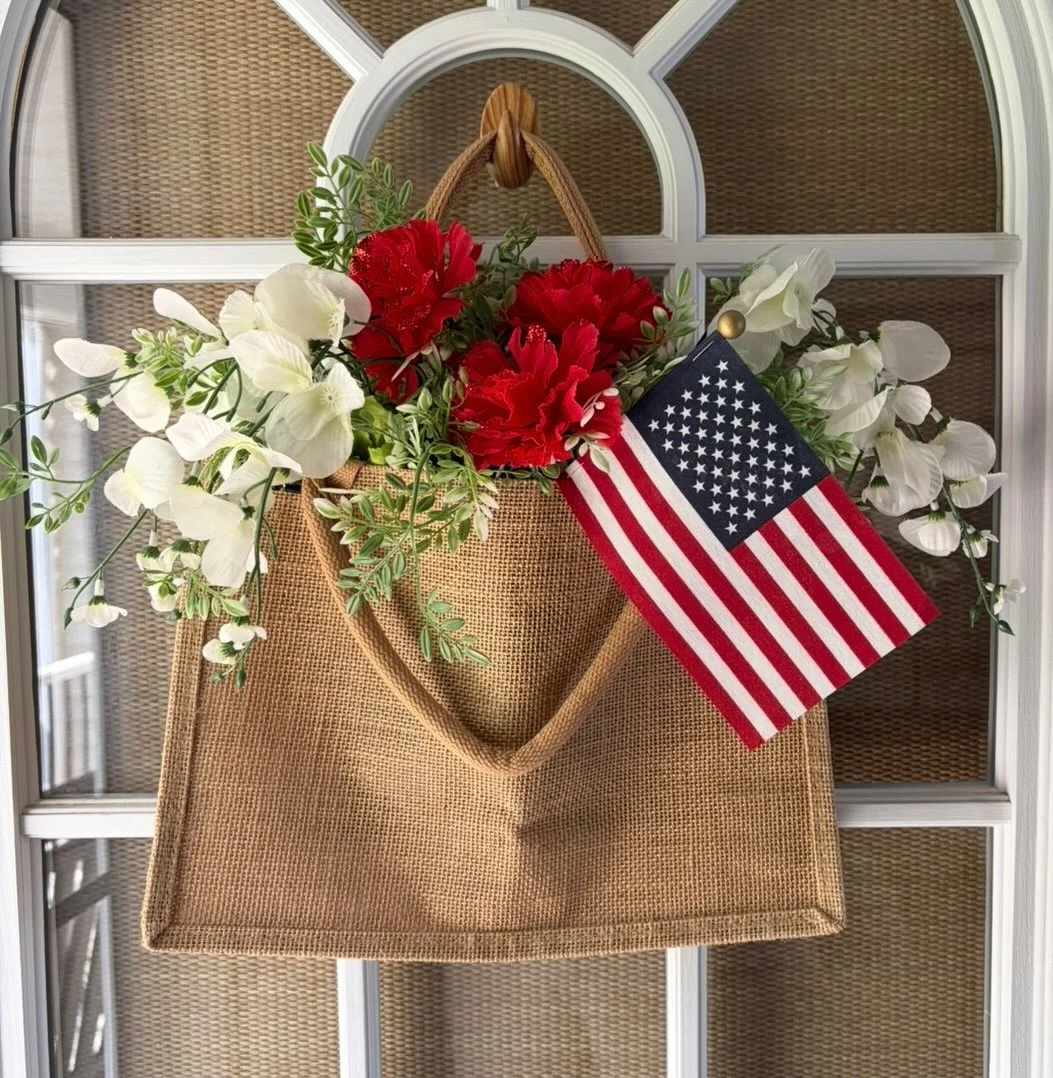
Hang a natural burlap tote bag from a hook on your front door using the bag’s own handles. The bag should be large enough that it reads clearly against the door — at least fourteen inches across. Open the bag wide and fill the interior with a foam block to hold the stems.
Layer silk or faux flowers in red and white starting from the edges, tucking stems deep so the blooms spill generously outward. Add trails of green foliage and eucalyptus sprigs for movement. Finish by inserting a small American flag on a wooden dowel directly into the center.
The key is generosity — you want the arrangement to overflow the bag, not sit neatly inside it. The burlap acts as the neutral anchor. Keep the hook simple: a wooden or brass door hanger, nothing plastic.
Painted Cinder Block Planter Row
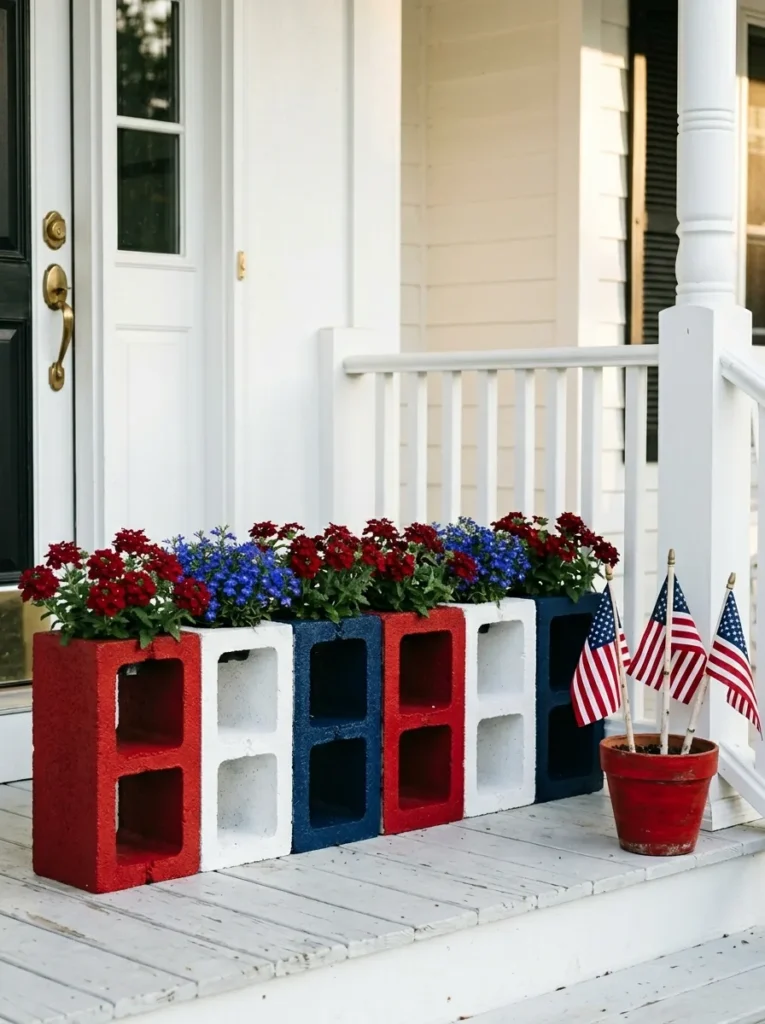
Line up six standard cinder blocks side by side along your porch steps, with the open cells facing upward to act as planting pockets. Spray paint them in an alternating red, white, navy sequence.
Fill each cell with potting soil and plant small annual flowers directly in the cavities — deep red verbena, white alyssum, and blue lobelia all work well and stay compact. Give each block its own planted cell rather than trying to bridge plants across blocks.
The graphic quality of the painted blocks does most of the work. Keep everything else around them simple. A small cluster of flags in a terracotta pot beside the row is all the additional decoration this needs.
Pool Noodle Rocket Cluster
Take five or six pool noodles in blue, red, and white. Wrap them diagonally with ribbon in the contrasting color — a blue noodle wrapped with red ribbon in wide stripes, a white noodle wrapped with red ribbon in a spiral. For the nose cone, roll a sheet of cardstock into a cone shape and tape it firmly over the top end of each noodle.
Stand all the noodles upright inside a tall white planter box, angling them outward in different directions as if launched simultaneously. Pack the base with floral foam or pool noodle scraps to hold the angles. Fill in around the base with metallic red, white, and blue tinsel picks and small pom-poms.
The success of this depends on a real planter — not plastic. A white fiberglass or painted wood box grounds the otherwise cartoonish rockets and makes the whole thing read as intentional rather than chaotic.
Stacked Star Terra Cotta Towers
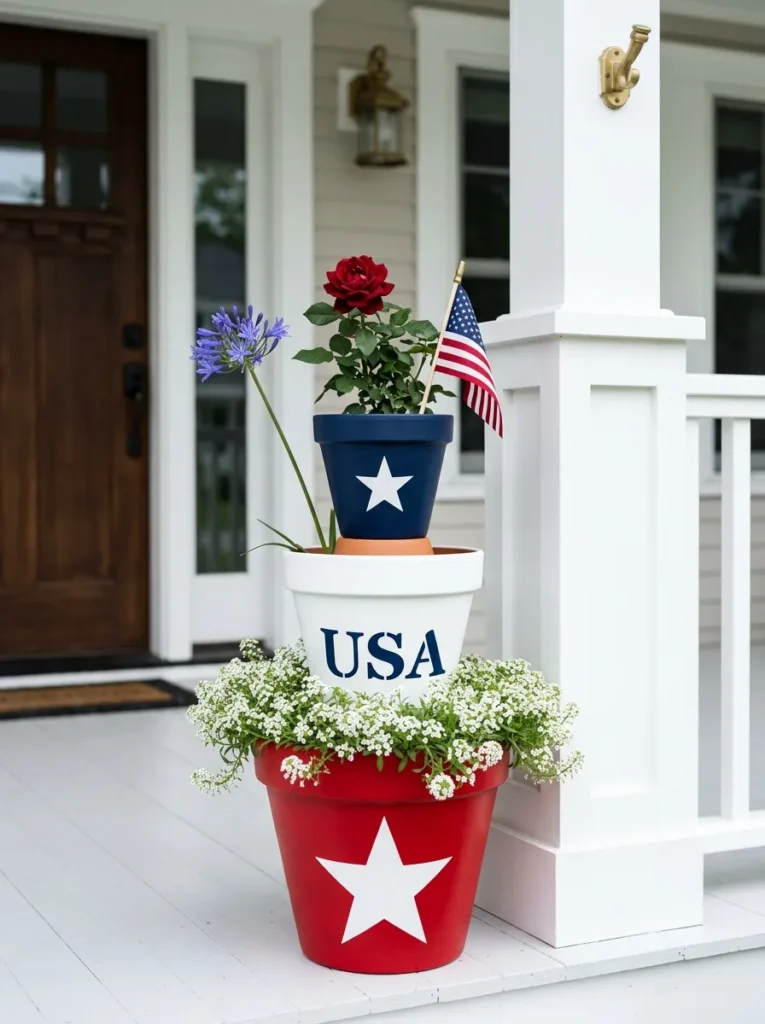
Take three standard terra cotta pots in graduated sizes. Paint the largest red, the middle white, and the smallest navy. Use exterior chalk paint for a matte, non-shiny finish that reads as more considered than glossy.
On each pot, paint a large five-pointed star centered on the front face. Use the contrasting color for the star: white star on the red pot, navy star on the white pot, white star on the navy pot.
Stack them directly on top of each other, each pot sitting upright in the drainage hole of the one below — the largest at the base, the smallest on top. Plant white alyssum or sweet potato vine in the large base pot so it cascades over the rim. Plant a single dark red rose or deep red geranium in the top navy pot. Thread a small American flag on a stick into the top arrangement.
Set against a white porch column or railing where the color contrast is at full effect.
Layered Patriotic Doormat
Lay a large red-and-white buffalo check cotton rug flat on your entry floor. This is the base layer. On top of it, centered, place a natural coir doormat in a standard size.
The coir mat should have a painted or printed design — scattered stars in red, white, and blue with a hand-lettered phrase work better than anything overly formal. Use acrylic craft paint to add stars directly onto a plain coir mat if you prefer the DIY route: cut a simple five-pointed star from adhesive shelf liner, press it to the mat surface, and stipple paint over it with a stiff brush. Remove the template before the paint fully dries.
The layered rug approach — check pattern visible around the coir edge on all four sides — frames the mat like a picture. It costs almost nothing and makes the entry feel completely intentional.
Navy Pallet Flag Sign
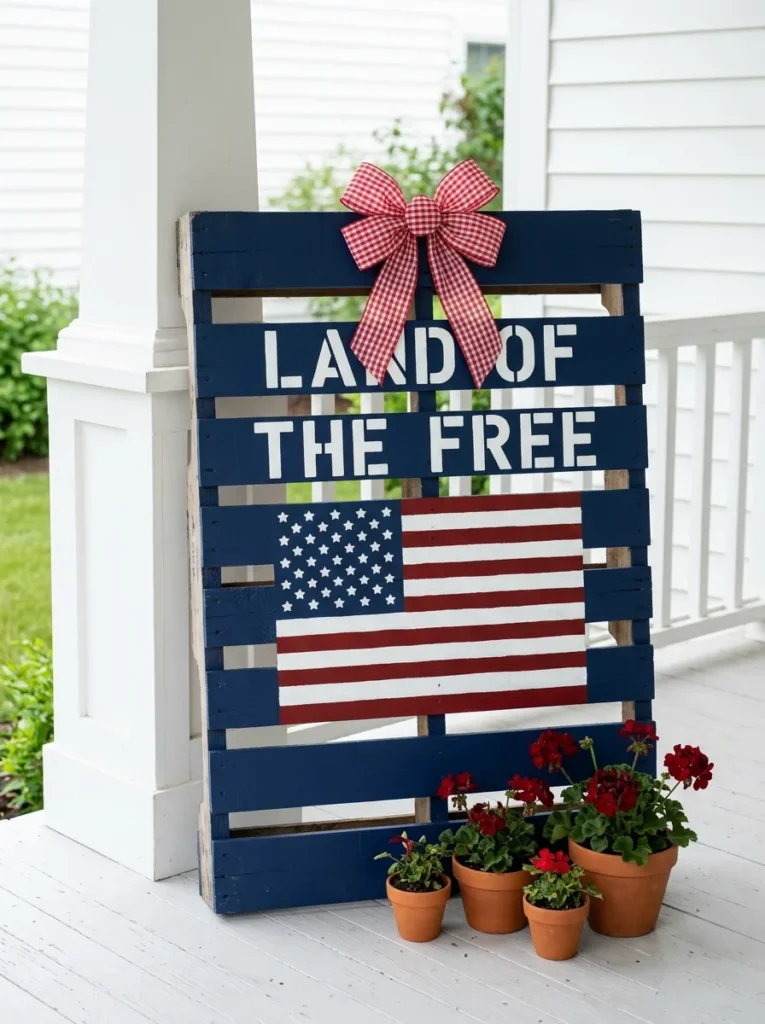
Source a standard wooden shipping pallet in good condition. Sand the slats lightly but leave the grain visible. Paint the entire face navy blue using exterior-grade paint, working paint into the gaps between slats rather than filling them.
Once dry, use a broad stencil brush and white exterior paint to letter your text directly across the slats — the text will break across the gaps, which looks intentional and graphic rather than imprecise. In the lower half, paint a simplified American flag: a navy rectangle for the canton, fifty white stars in rows, and alternating red and white stripes extending across the remaining slats.
Lean the finished pallet against your porch railing or post rather than mounting it. Leaning reads as more casual and considered than hanging. Add a large red gingham or buffalo check bow tied at the top center.
Anchor the base with three small terracotta pots of red geraniums.
Hanging Star Spiral Garland
Run a length of natural jute twine horizontally across your porch ceiling or between two posts. From this main line, suspend individual drops using monofilament or thin twine at varying heights.
For each drop, attach a large flat star cut from stiff navy cardstock or thin craft foam directly below a small saucer-shaped cap (the kind used in party decor, painted navy with white star dots). Below the star, let a spiral of red, white, and blue metallic curling ribbon hang freely so it catches the breeze and rotates.
Space five to seven drops evenly across the line. Vary the total length of each drop slightly — some shorter, some reaching almost to railing height — for a cascading effect rather than a rigid horizontal line.
Multi-Ribbon Loop Wreath
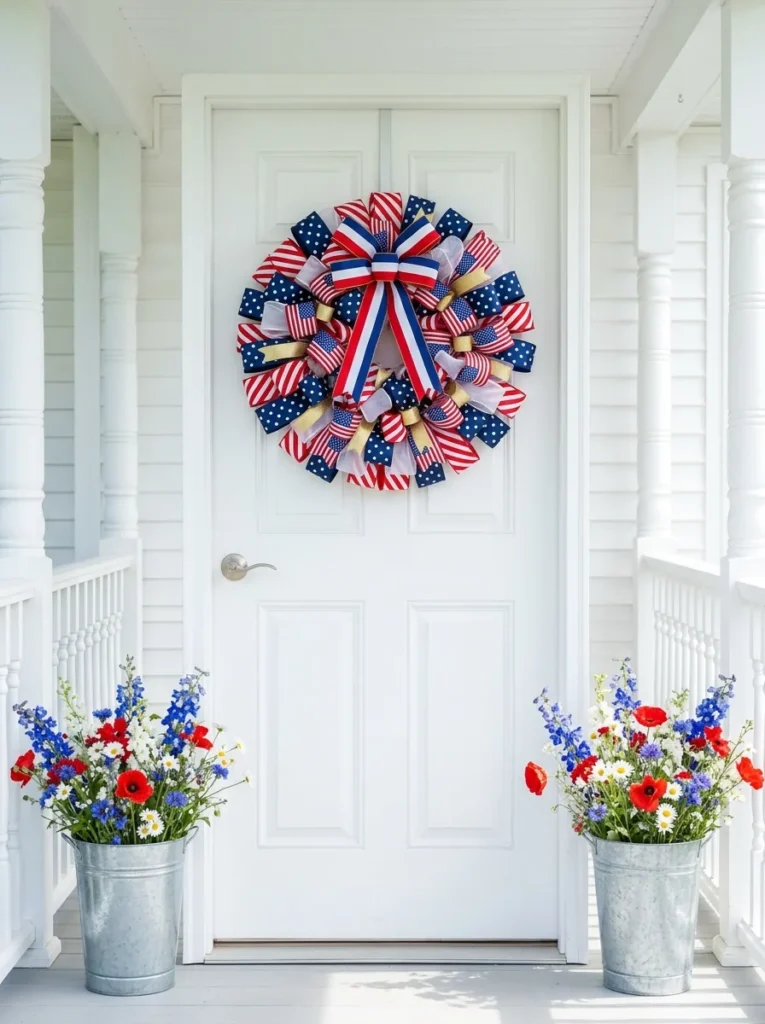
Start with a sixteen-to-eighteen-inch wire or foam wreath form. You will need ribbon in at least five different patterns: wide-stripe red and white, navy with white polka dots, flag-print ribbon, solid crimson, and solid white or gold. Cut all ribbon into lengths of approximately ten inches.
Fold each piece into a loop and attach it to the wreath form using a pipe cleaner or floral pin, packing the loops tightly so no form shows through. Distribute patterns randomly rather than in strict rotation — the richness comes from the variety, not from a predictable sequence.
For the center bow, layer two complementary ribbons and tie a full, generous multi-loop bow. It should be large enough to crown the wreath without being swallowed by it.
Pair the door wreath with two galvanized buckets of wildflowers at floor level — red poppies, white daisies, blue salvia — one on each side of the door.
Patriotic Painted Tin Can Porch
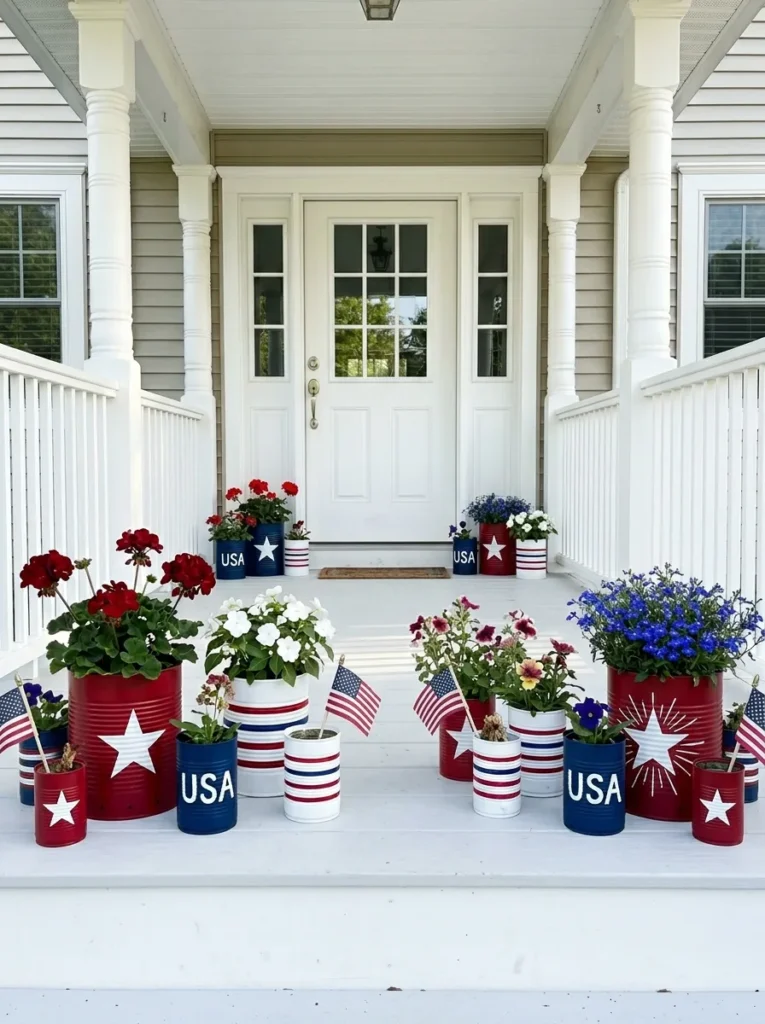
Collect large tin cans in a range of sizes — the kind from bulk grocery items or restaurant supply stores work best. Clean and dry them completely. Paint each one in solid red, solid navy, or solid white using spray paint formulated for metal.
Once the base coat is fully cured, add design details: stencil a large star on the front, paint horizontal red and white stripes around the circumference of white cans, or letter “USA” in block capitals across the navy cans. Use a foam brush and acrylic paint for details rather than spray, which gives you cleaner edges.
Plant directly into the cans using a layer of drainage gravel at the base. Mix sizes across your porch steps — large cans on lower steps, smaller ones higher up, never a perfectly matched pair at the same height.
Tuck a small American flag on a wooden dowel into several of the arrangements.
Galvanized Tub Lantern Arrangement
Start with a large galvanized metal wash tub — the kind stenciled with numbers or text works especially well. Place a short metal stand or stack of bricks inside to raise the height, then set a tall wood-and-glass lantern directly on top of it.
Pack a grapevine wreath around the base of the lantern inside the tub. Thread green garland loosely through and over the wreath, then add cream or ivory silk hydrangeas on one side, clusters of deep burgundy berry picks on the opposite side, and dusty blue bloom clusters in between.
Tuck two or three small American flags throughout. Add wooden bead garland with jute tassels draped over the front of the tub for texture. Light the lantern with a pillar candle or a battery-operated candle insert.
The combination of materials — galvanized metal, raw wood, glass, jute, dried-looking florals — does the heavy lifting. This is a farmhouse aesthetic, not a party-store aesthetic.
Ribbon Curtain Door Backdrop
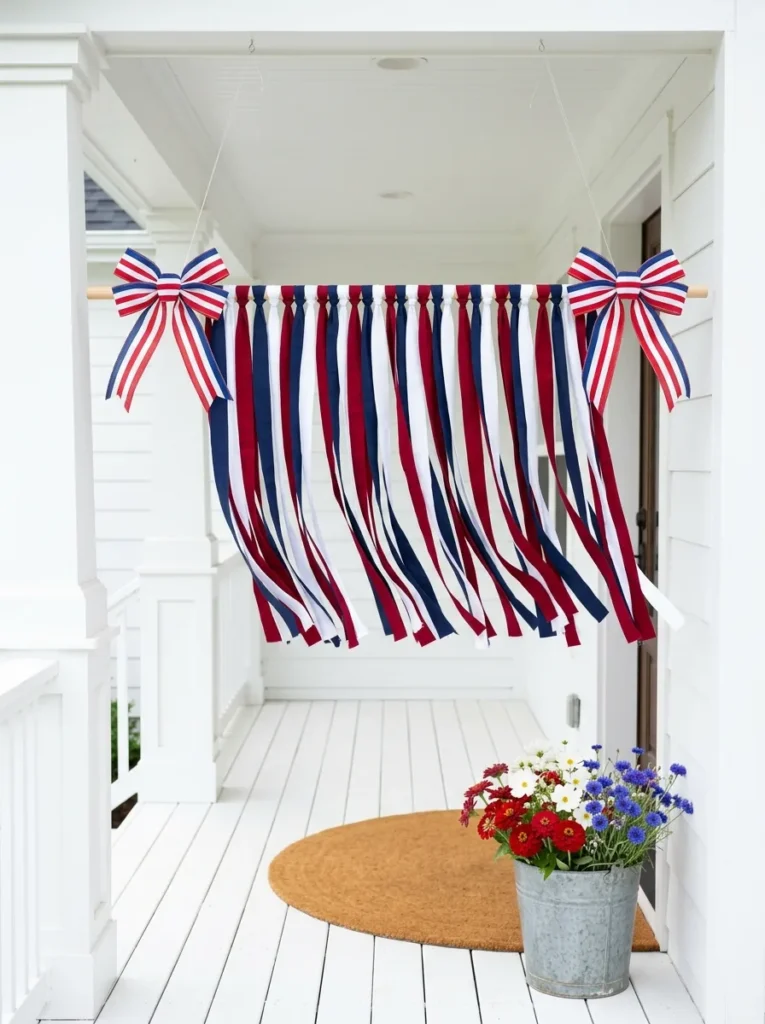
Cut lengths of grosgrain ribbon — in navy, deep red, and white — to a uniform length of about thirty-six inches. Fold each piece in half and attach it to a wooden dowel rod using a simple lark’s head knot, pulling the two tails down evenly.
Pack the ribbons tightly together across the full width of the dowel, alternating colors in a deliberate but slightly irregular pattern. The density matters. Sparse ribbons look cheap. Dense ribbons look intentional.
Hang the dowel from two ceiling hooks so the ribbon curtain fills the porch opening below. Tie a striped ribbon bow at each end of the dowel.
A single galvanized bucket of red, white, and blue wildflowers on the porch floor at one side completes it.
Vintage Ladder Display
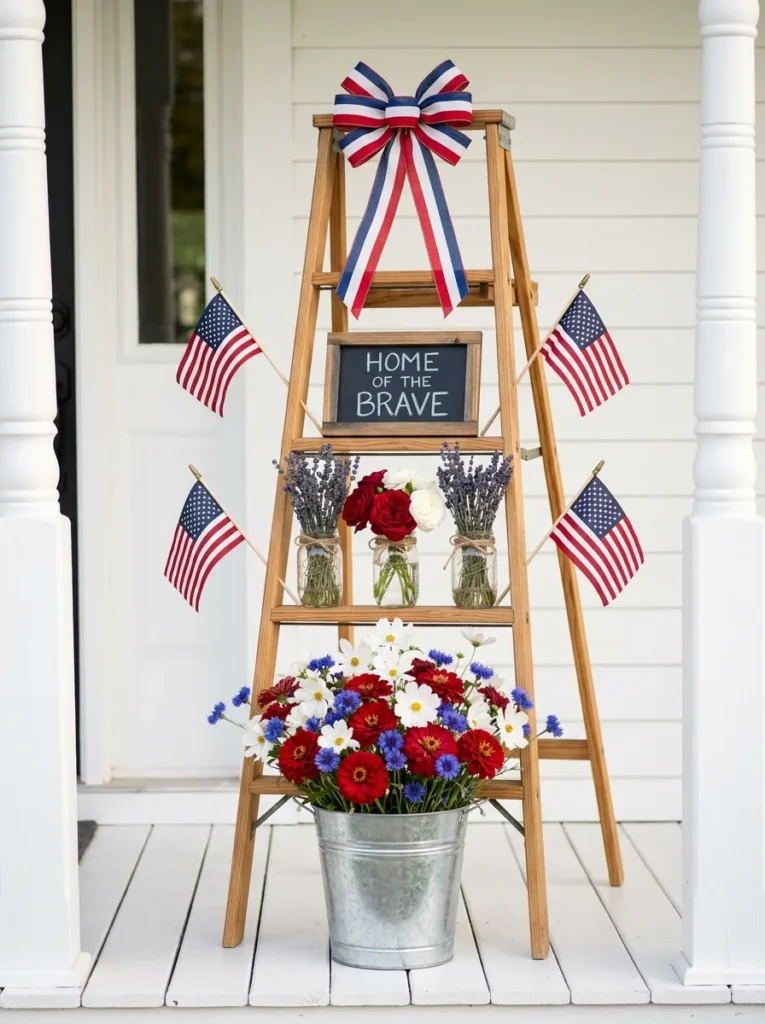
Source an old wooden A-frame stepladder — flea markets and estate sales almost always have them. Do not paint it. The natural warm wood is the point.
Tie a large multi-loop bow in red, white, and navy grosgrain ribbon to the very top of the ladder. On the upper shelf, place a small chalkboard sign with a hand-lettered phrase. On the middle shelf, arrange three mason jars — tie twine around the necks — and fill them with lavender bunches, white ranunculus, and deep red roses.
On the floor at the base of the ladder, set a large galvanized bucket overflowing with red zinnias, white cosmos, and blue cornflowers.
Slide small American flags on sticks diagonally through the ladder rungs at multiple heights on both sides, so they fan outward like a salute.
Deco Mesh Rolled Wreath
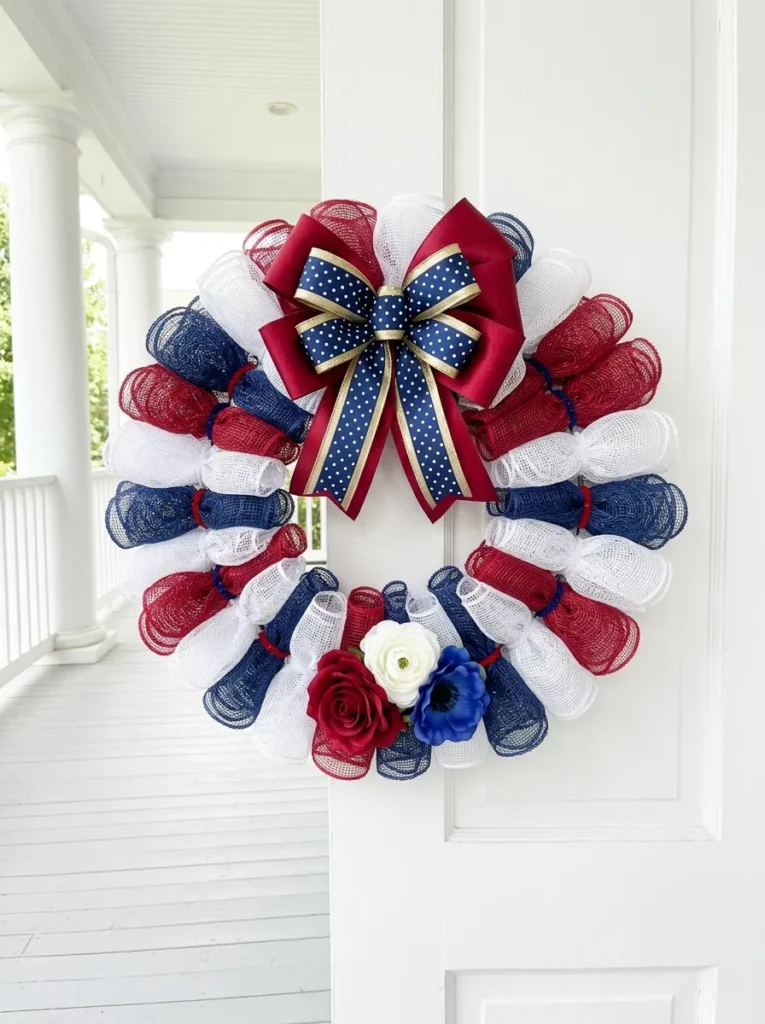
Buy a sixteen-inch wire wreath frame and three rolls of deco mesh — one each in red, white, and navy. Cut the mesh into twelve-inch sections.
Fold each section into a loose roll and attach it to the wire frame using a pipe cleaner through the center hole of the frame. Pack them densely, alternating colors as you go around the full circle.
At the six o’clock position, before you finish filling the wreath, wire three faux flowers directly to the frame: one deep red rose, one white ranunculus, and one blue anemone.
For the bow, layer a wide crimson ribbon over a narrow navy polka-dot ribbon and tie a full, generous bow with long tails. The bow should sit at twelve o’clock and be at least as wide as the frame is thick.
Star-Print Pennant Bunting
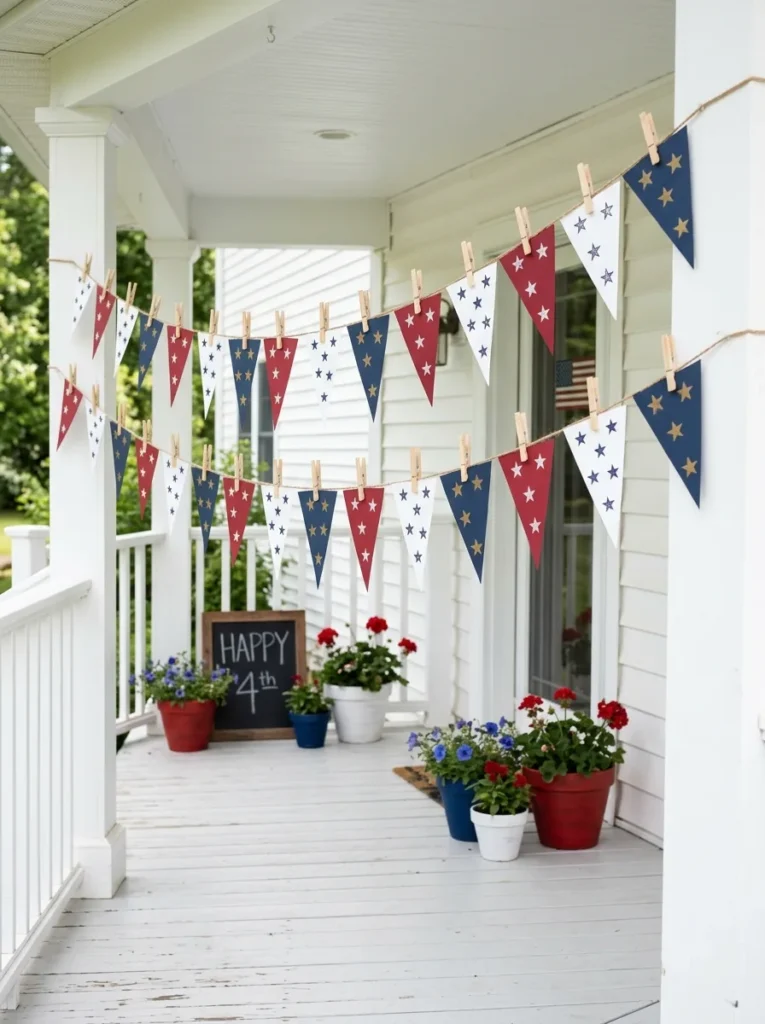
Cut equilateral triangles from cardstock in navy, red, and white. Each triangle should be at least six inches on each side — smaller and they’ll disappear at a distance. Stamp or paint small stars onto each pennant using gold, white, or contrasting-color paint. Mix star sizes: large statement stars and small scattered stars on the same pennant look richer than a single repeated stamp.
Attach each pennant to jute twine using a wooden clothespin, clipping through the flat top edge. Space them evenly but not with rigid precision — a slight unevenness reads as handmade.
Drape the bunting in two or three rows across the full width of the porch. The clothespins are part of the look, so use natural wood ones, not plastic.
Add a small chalkboard sign on a painted pot at floor level, and cluster painted terracotta pots at both ends.
Painted Wine Bottle Bud Vases
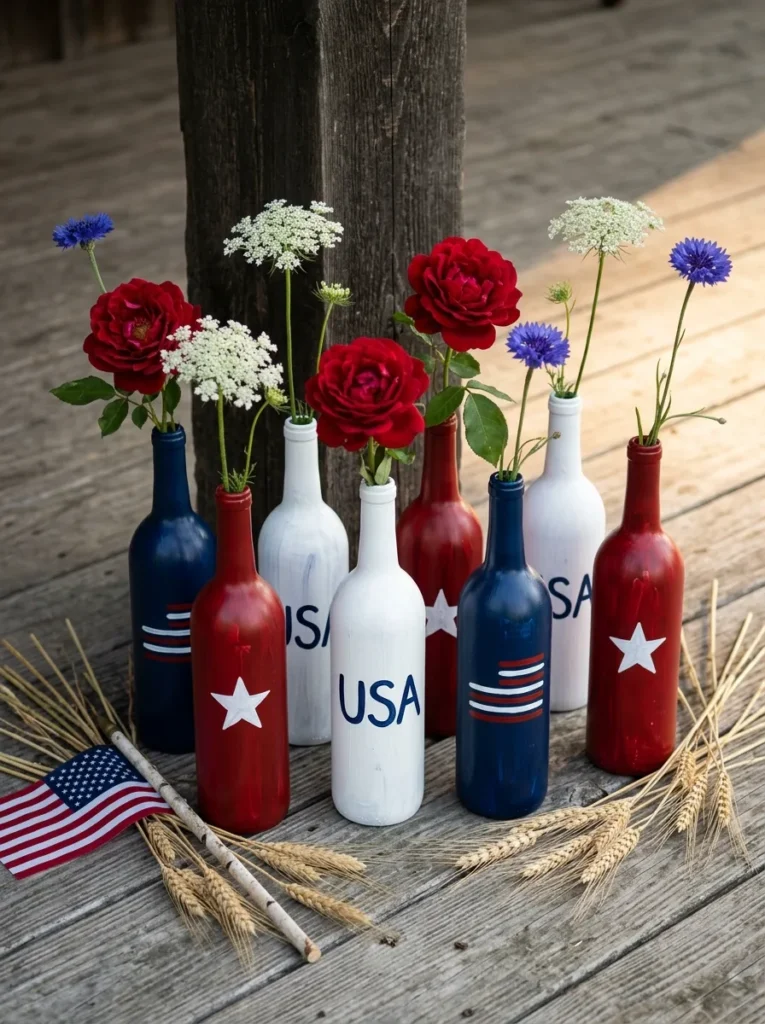
Collect eight to ten wine bottles. Remove the labels completely. Spray paint in solid navy, solid red, and solid white — varying the colors so no two adjacent bottles in your final arrangement match.
Once dry, add design details with a small brush and contrasting paint: a white star on a navy bottle, thin red and white stripes on a navy bottle, “USA” lettered in navy on a white bottle, a simple stripe band on a red bottle. Keep each design to one element only. Less is more here.
Arrange the finished bottles in a loose cluster on a wooden surface — a porch step, a side table, a stump. Vary the heights by using bottles of different sizes. Fill each bottle with a single stem or two: deep red dahlias, white Queen Anne’s lace, blue cornflowers.
Fan a small American flag and a few dried wheat stalks into the base of the cluster.
Bandana Garland Swag
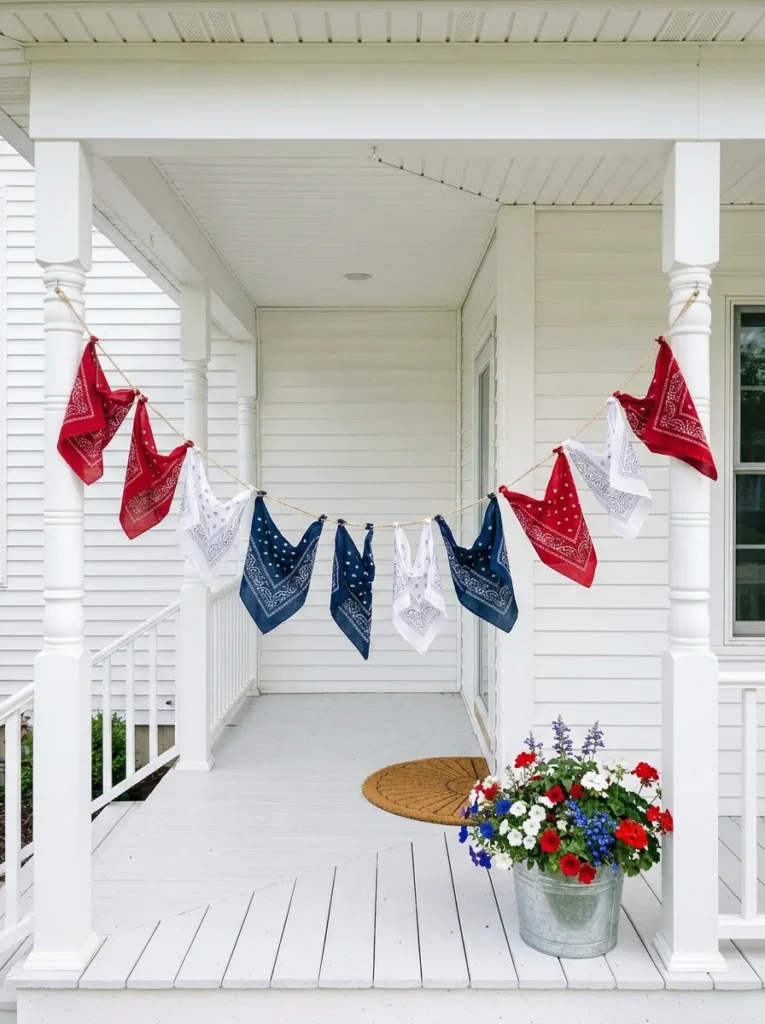
Buy red, white, and navy bandanas — the traditional paisley print, not plain fabric. You will need approximately twelve to fifteen for a standard porch width.
Fold each bandana diagonally into a triangle. Attach the folded edge to a length of jute rope using binder clips, wooden clothespins, or simple overhand knots tied directly through the corner of the bandana.
Alternate the color pattern loosely as you go — not a rigid red-white-blue repeat, but a more casual alternation with occasional doubles or reverses. Let the bandanas hang freely rather than pinning them flat. The movement and drape is the point.
Hang the rope from porch post to porch post at a height where the bandanas hang well clear of anyone walking underneath. Finish with a single galvanized bucket of red, white, and blue flowers at one end.
Tissue Paper Mason Jar Lanterns
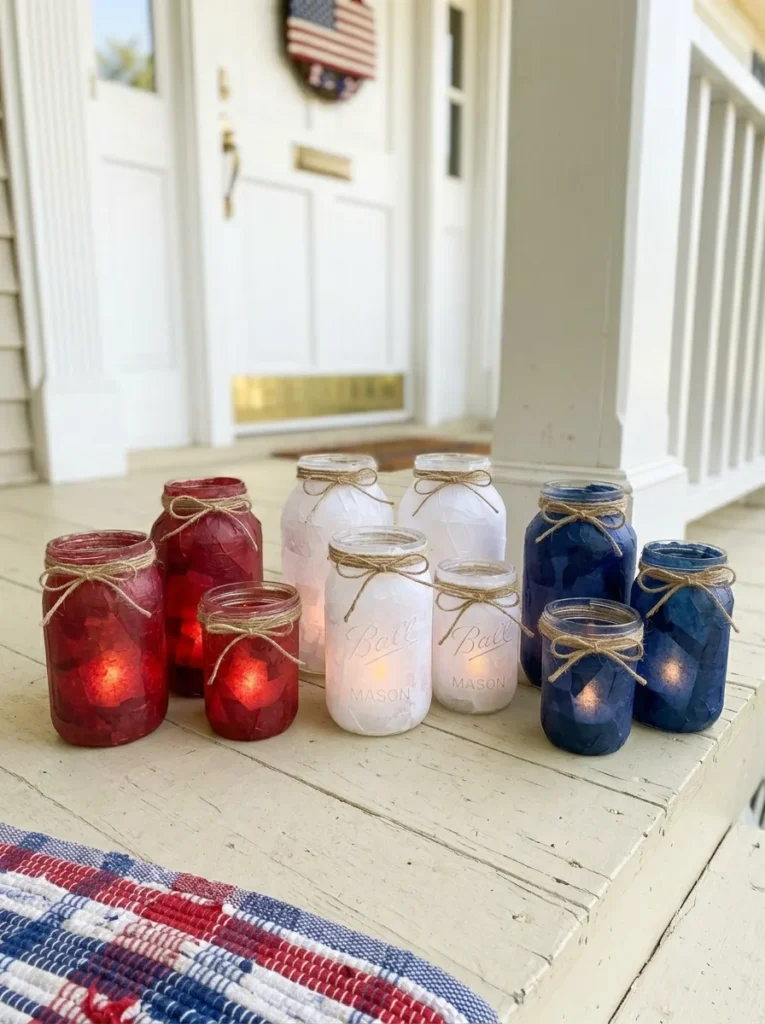
Take a collection of mason jars in both quart and pint sizes. Working with a diluted craft glue mixture (one part glue to one part water), tear tissue paper into irregular three-to-four-inch pieces in red, white, and navy.
Brush the outside of each jar lightly with the glue mixture and press the tissue pieces directly onto the glass, overlapping them and smoothing each piece flat. Cover the entire outer surface. Apply a final coat of glue mixture over the top to seal. Let dry completely.
Group jars by color — reds together, whites together, navies together — in three distinct clusters on your porch steps. Place a small tea light or battery-operated votive candle inside each jar.
Tie jute twine bows around the necks of the larger jars. At night, the tissue paper diffuses the candlelight into a warm, muted glow rather than a harsh point source.
Fan Plank Star Wall Art
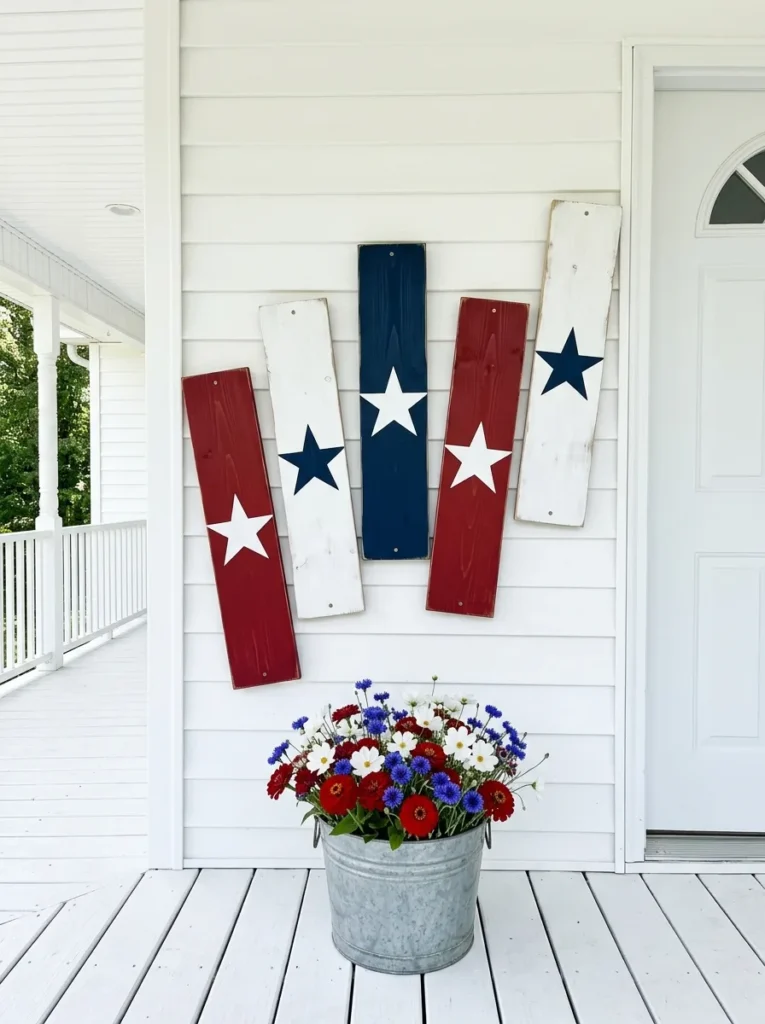
Take five fence pickets or rough-cut boards of uniform width — around four to five inches wide, twenty-four to thirty inches long. Sand them lightly. Paint two red, two white, and one navy.
On each board, paint a large five-pointed star in the contrasting color, centered on the face. Keep the star simple and bold — a stencil works better than freehand here.
Mount the boards to the exterior wall of your porch in a fan arrangement: the center board perfectly vertical, the adjacent pair angled outward fifteen degrees each, and the outermost pair angled out thirty degrees. Use exterior-grade screws directly into the siding or mount to a backing board first.
Place a single large galvanized bucket of mixed red, white, and blue flowers centered directly below the fan on the floor.
Balloon Cluster Wreath
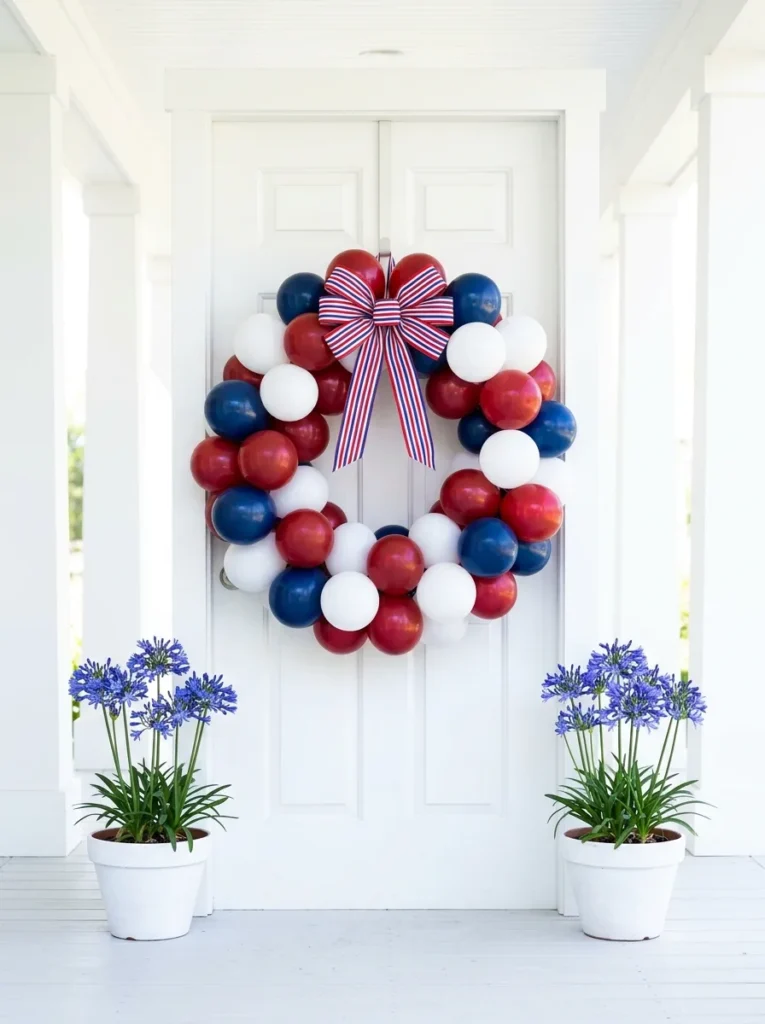
Start with a standard wire wreath frame — sixteen or eighteen inches. Inflate small balloons (the four-inch or five-inch variety) to a consistent size using a hand pump rather than your lungs, which gives you more size control. Use red, white, and navy balloons in roughly equal proportions.
Tie each inflated balloon at the knot and attach it to the wreath frame using the knot itself, wrapping it around the wire. Pack them tightly enough that the wreath frame is completely hidden and the balloons hold each other in shape.
Tie a wide striped ribbon bow — red and white stripes on a navy background or the reverse — at the twelve o’clock position. The tails should be long enough to hang below the wreath by a few inches.
Note that this wreath has a limited lifespan — balloons will begin to deflate or wrinkle after a week or so. For a one-to-two day holiday display, it’s perfect. For longer, make it the day before and plan to refresh or replace it.
Final Thoughts
Every one of these ideas works for the same reason. They commit.
Half-hearted patriotic decor is everywhere. A wilted flag here, a single limp balloon there. These all choose a material, commit to a scale, and follow through on the details that separate decoration from design.
The best porch decor doesn’t announce that it’s decorated for the holiday. It looks like it was made with care for a specific place by a person who knows what they’re doing. The holiday is in the colors. The craft is in everything else.
You already have the palette. Red, white, and blue are not subtle. They do not need help being noticed.
What they need is a porch that respects them enough to put in the work.