
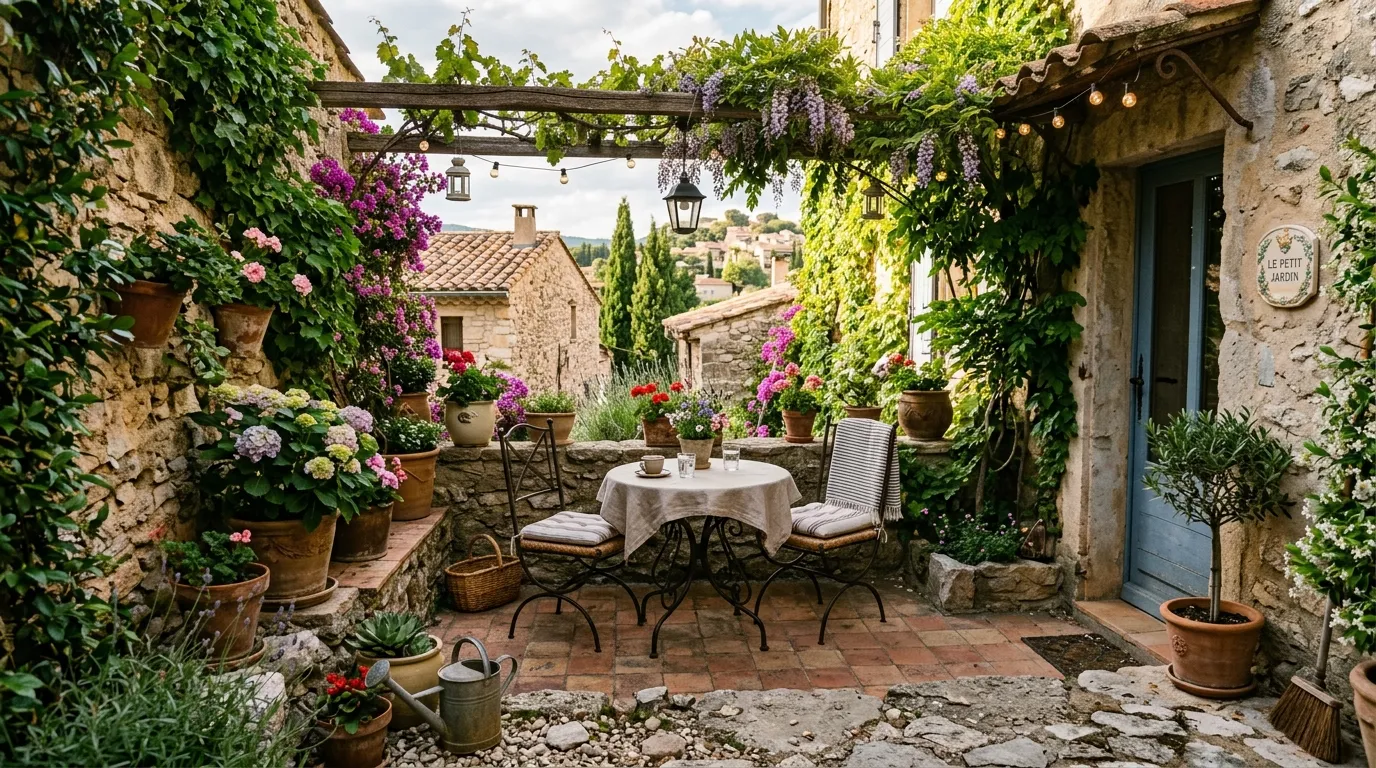
There’s a specific feeling you get sitting in a European courtyard that’s almost impossible to manufacture from scratch. The walls have lived a few hundred years. The stone underfoot has been walked on by people who are long gone. The wisteria wasn’t planted last spring — it was planted by someone who understood they wouldn’t see it in its prime.
You can’t replicate age. But you can understand what creates that feeling and build deliberately toward it. The patios in this collection come from different countries, different aesthetics, different climates. What they share is an understanding that outdoor living is not about the furniture. It’s about atmosphere. It’s about the quality of light at six in the evening and whether the space feels like it has earned its right to exist.
That’s a design problem. And it has design solutions.
Why European Patios Feel Different From Yours
The Permanence of Materials
You can tell a European patio from a North American one within three seconds. Not because of the style — because of the materials.
Reclaimed stone, old brick, rendered lime plaster, terracotta, cast iron, weathered timber with a century of grey in its grain. These are materials that have been somewhere before. They carry history in their texture.
The problem with most modern patio design is not the budget or the taste. It’s that everything is new and nothing looks as if it belongs in its place yet. A freshly laid concrete patio and a set of furniture from a garden centre is not a patio. It’s a waiting room for a patio that hasn’t arrived yet.
European outdoor design understands that materials need to have weight — visually, physically, historically. When you can’t afford the authentic thing, you find the salvaged version. And if you have to use new materials, you choose the ones that will age rather than deteriorate.
The Role of the Vertical Surface
Walls in European patios are not merely enclosures. They’re surfaces to be activated.
A white-rendered Andalusian wall covered in hand-painted azulejo tiles is not a background. It’s the centrepiece. A mossy stone wall in an Irish garden corner is not neglected — it’s the thing the whole scene is built around. A stucco wall in the South of France with climbing roses growing up the stone is carrying as much of the aesthetic weight as anything at ground level.
Most contemporary patio design ignores the vertical plane entirely. The floor gets all the attention, the furniture gets the budget, and the walls are left bare or fenced off with generic panelling.
Look at every wall surface you own as a design opportunity. Some want climbers. Some want tiles. Some want wall-mounted terracotta and trailing plants. Some want nothing except to be left to weather.
The Weight of Scale
European patios rarely look scaled for magazine shoots. They’re scaled for life. Tables that can seat ten. Stone troughs that weigh three hundred kilograms. Antique terracotta urns that require two people to move. Overhead beams with actual structural mass.
The furniture and objects are in proportion to the architecture, not to a wish for things to feel spacious. Scale confidence is what makes these spaces read as assured rather than tentative.
European Patio Ideas Worth Recreating
Moss-Stone Fireplace Pergola Room
The fireplace is the structural centrepiece. Source or build an outdoor stone fireplace — not a kit fireplace but a proper masonry structure in irregular fieldstone, built with slightly irregular courses that allow moss and ferns to establish over time in the joints.
Above the firebox, build a wide mantel shelf wide enough to hold large iron lanterns and a terracotta pot of dried hydrangeas.
Construct a pergola over the seating area using rough-sawn timber beams in a warm grey tone — the kind that has been left to weather rather than painted. Plant climbing roses at the base of each post and run festoon lights along the beams at irregular heights, not in a rigid line.
Furnish with a mix of pieces that don’t match: a deep sofa with dark grey upholstery, French-style armchairs with botanical print fabric, mismatched rugs layered on flagstone. Stack terracotta pots of Boston ferns and dark-leaved houseplants on the floor around the edges.
The combination of fire, living green, and warm overhead light is what makes this look feel lived in rather than styled.
Lavender and Climbing Rose Bistro Corner
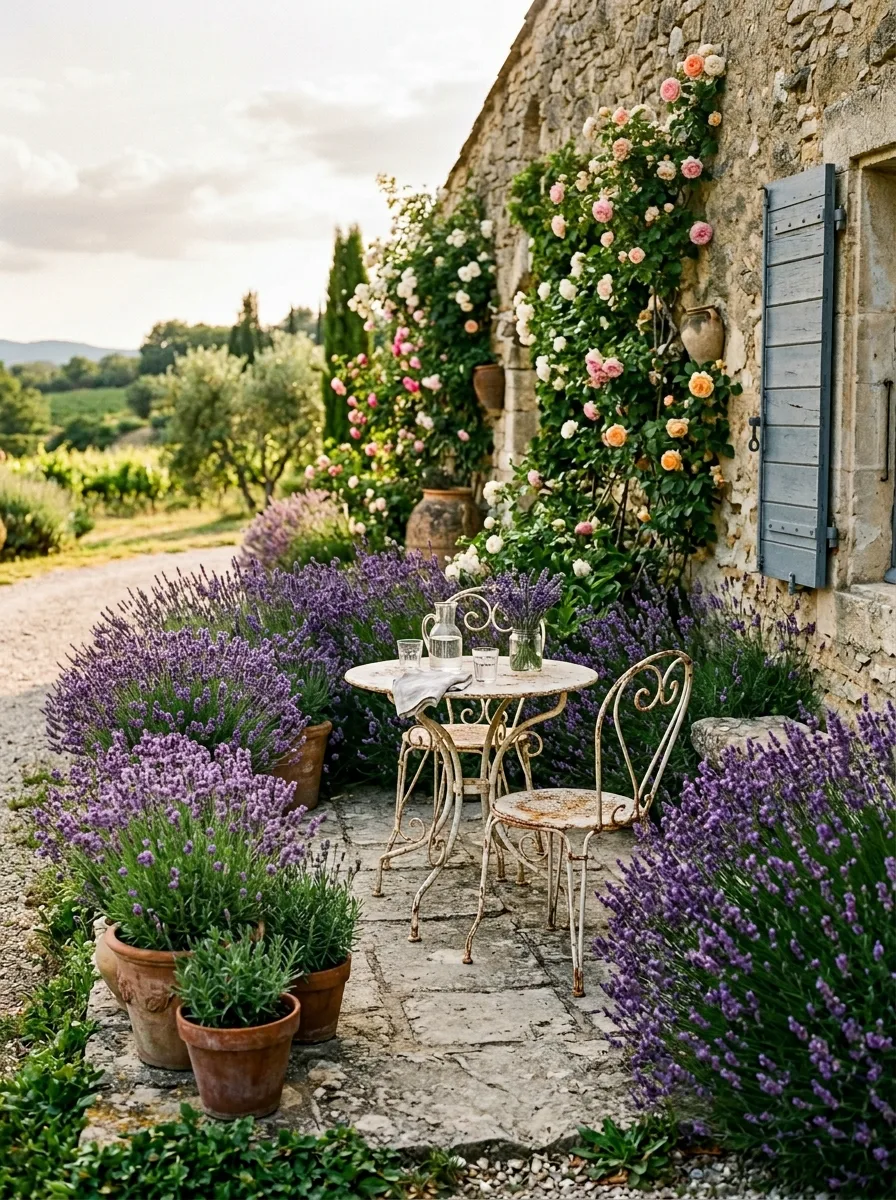
Two chairs and a small round table are enough. The planting does everything else.
Choose a section of wall — ideally stone or old render — and train a climbing rose up it. David Austin varieties in blush, apricot, and pale yellow are the most appropriate for a French aesthetic. The rose should be allowed to grow without rigid constraint, just guided loosely to stay on the wall.
Pack the ground around the seating area densely with lavender — not a single pot, but a mass planting that makes the chairs feel embedded rather than placed. The lavender should billow against the legs of the table and chair and smell overwhelming in warm afternoon sun.
Set a pair of aged iron bistro chairs and a matching round table on old stone or cobble paving. Place nothing else except a small terracotta pot of fresh-cut lavender on the table and a small glass of water.
This is the most minimal entry in the collection. It works because the planting is completely committed and the setting is completely appropriate.
Provençal Toile Lunch Table
The setting does most of the work, but the table setting signals the rest.
Begin with a formal outdoor dining table — either a stone-topped or marble-topped table at a generous length. Cover it fully with a printed toile or botanical-print tablecloth in white and soft blue or grey, hanging to at least mid-thigh length.
For seating, use bamboo or cane bistro chairs with woven seat pads in a soft aqua or duck-egg blue. The chair colour should echo something on the tablecloth — not match it precisely, but rhyme with it.
Centre the table with loose-arranged flowers in mismatched vessels: one taller arrangement of dahlias and cosmos in a bronze vase, shorter clusters of pink and white in simple glass jars. Use real linen napkins, not paper.
The context matters enormously here: position this table on pale gravel or stone, with large terracotta urns of clipped box spheres flanking the house entry behind. The topiaries provide formality that keeps the relaxed table setting from reading as careless.
Andalusian Tile Fountain Courtyard
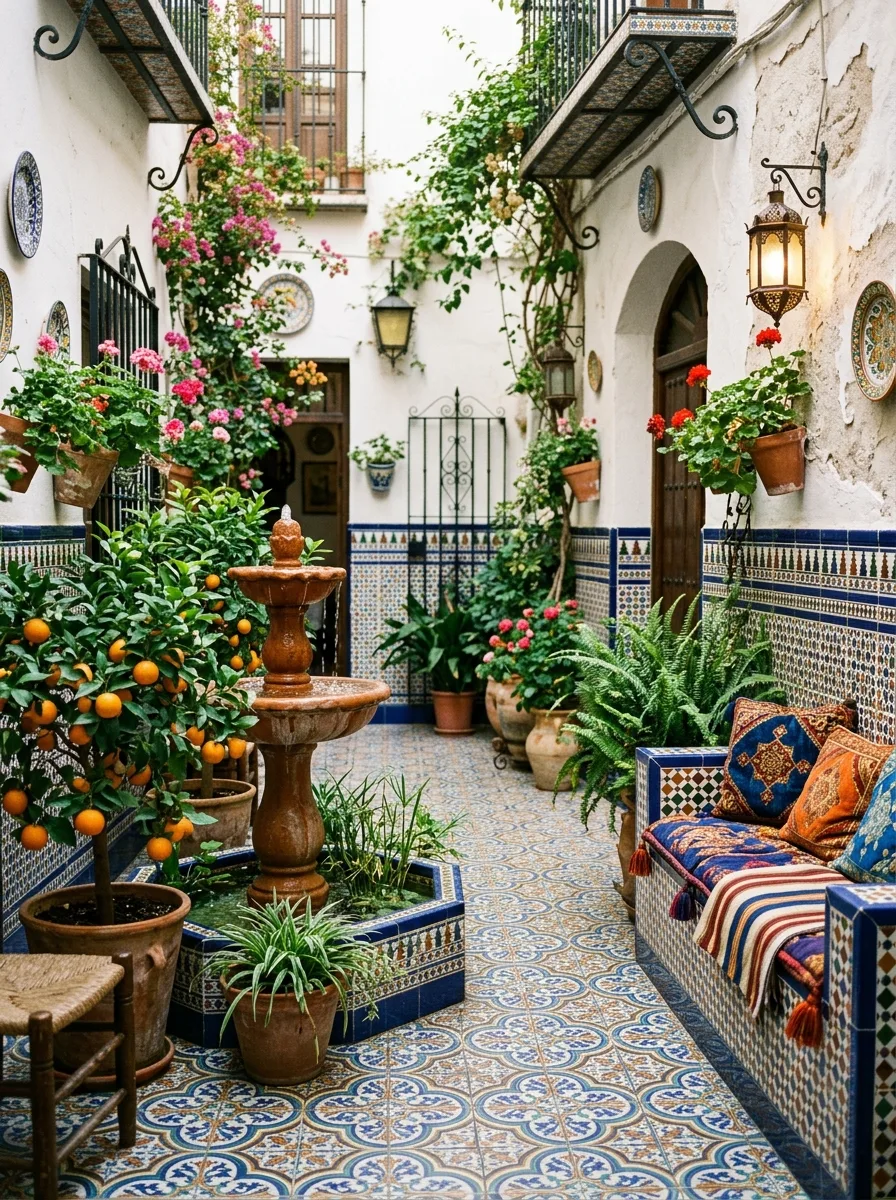
Begin with the floor. Source encaustic cement tiles in a geometric blue-and-white or blue-and-terracotta pattern. These tiles set the entire colour register of the space and they need to be authentic or high-quality reproduction — not cheap ceramic approximations.
Tile the lower third of at least one wall in a complementary geometric pattern, setting the tiled band like a dado course around the perimeter.
Install a wall fountain with a Moorish-arched tile surround: a terracotta spout feeding into a small hexagonal basin, with the surrounding tile work in blue-and-white geometric design. Run the pump to maintain a constant quiet flow.
Fill every remaining surface with terracotta pots of overflowing plants: orange trees, red geraniums, ferns, citrus. Stack pots at different heights using small stone plinths and old wooden crates. Hang iron wall brackets with more terracotta.
Set a low tile-inset bench or a simple wooden settee with richly patterned cushions and tasselled throws as the seating.
Gravel Courtyard with Box and Fountain
Lay the ground in fine pale gravel — oyster or champagne-toned decomposed granite raked to a smooth surface. The gravel should extend beyond the dining area into a wider courtyard space.
Plant the perimeter in clipped box hedging — low, formal, and very precisely maintained. The box provides the architectural backbone that allows everything else to be less controlled.
Place a carved stone wall fountain at the far end as a terminal focal point: the space should look directly toward it from the main entrance. Run the pump continuously at low pressure so the water trickling into the basin is audible from the dining table.
Set a zinc or pewter-topped dining table in the gravel centre with mismatched iron café chairs — the scrollwork French variety, allowed to rust naturally. Set the table sparsely: simple white plates, plain glasses, a small vase of hydrangeas.
The contrast between the formal structure (box hedging, central fountain, gravel geometry) and the worn, casual furniture is what gives this style its particular tension and appeal.
Bruges Urban Courtyard
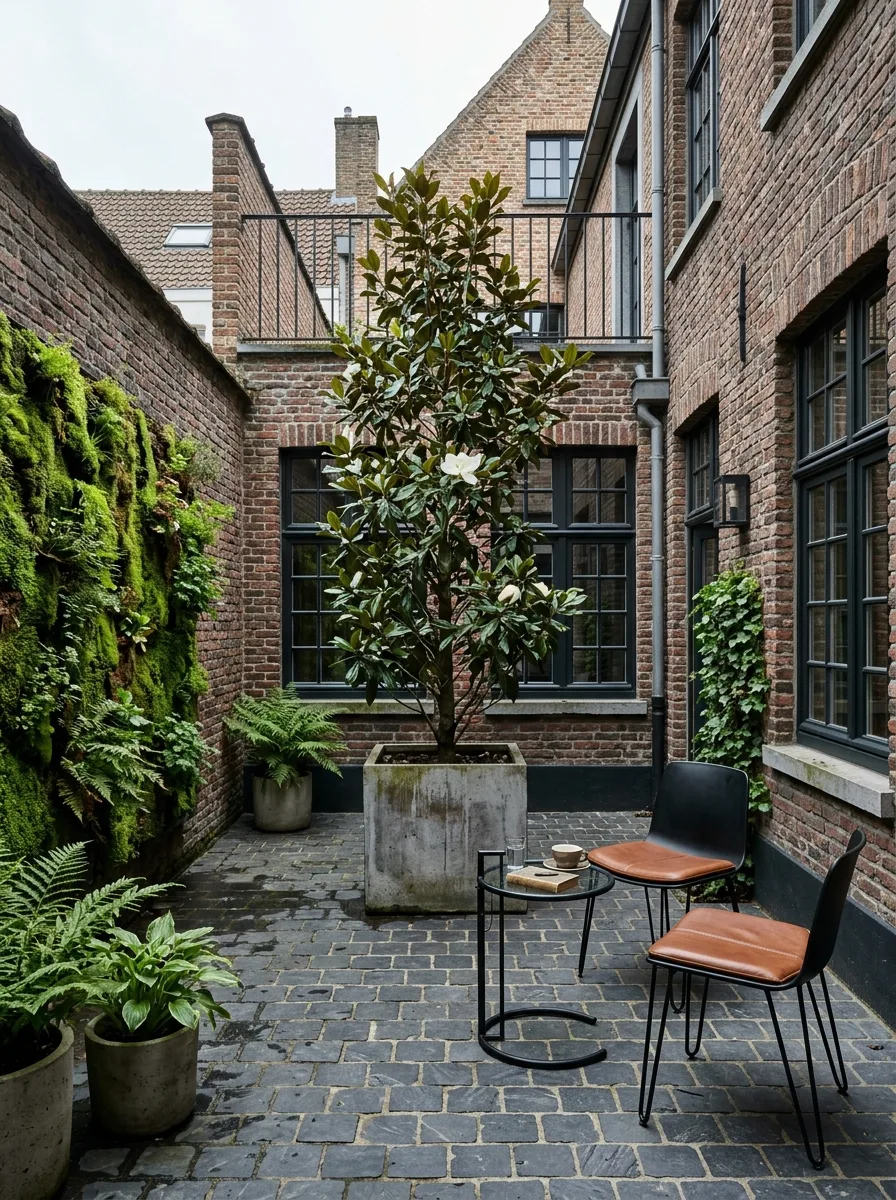
This style is defined by restraint imposed by architecture. The cobblestone courtyard between old brick walls needs almost nothing — and should receive almost nothing.
Set one large cast concrete cube planter and plant a single tall specimen tree — a magnolia grandiflora for year-round glossy foliage and architectural presence. The tree is the design. Everything else serves it.
Against one wall, install a living moss panel — vertical sheets of preserved or growing moss attached to a metal frame, creating a textured green vertical surface without the root competition of a climbing plant.
Add two minimal black metal chairs with tan leather seat pads and a small glass-topped hairpin-leg table. Stack one or two books on the table. A cup of coffee. Nothing more.
The cobblestone floor, the brick walls, the single specimen tree, and the green moss wall are four elements that don’t need anything added.
Stone Terrace Olive Tree Lounge
This space works because it refuses to compete with what’s already there.
If your setting involves a mature tree — or if you are willing to plant a large specimen olive, fig, or bay in a substantial container and wait — design the seating arrangement beneath it. The canopy is the ceiling. Everything else submits to it.
Set two deep wicker or synthetic rattan sofas facing each other across a low wide timber coffee table. Upholster in heavy natural linen — off-white, not bright white. Add a small round dining table and folding chairs behind the primary seating area for eating.
Leave the floor in whatever material already exists — rough-dressed limestone, river pebble, cobblestone. Don’t add a rug. Don’t add planters. Don’t add anything that draws attention away from the tree, the stone, and the view.
The restraint is the entire design.
English Walled Garden Tea Patio
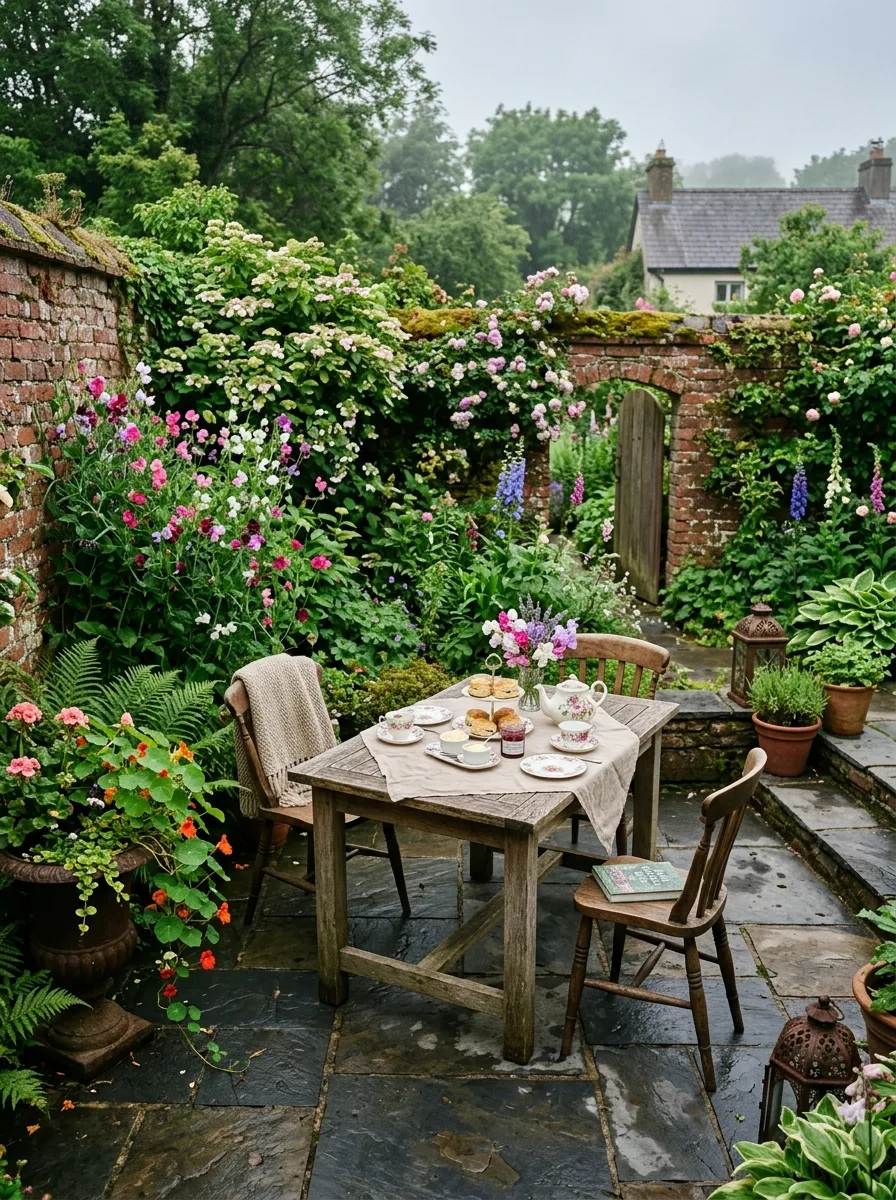
Source a small slate or stone patio area — or create one by laying irregular large-format flagstones with wide joints filled with planting. The stone should be as old as you can find.
Set a small square table in bleached teak or bare wood with two mismatched wooden chairs — one with a small floral cushion, one without. Lay a wrinkled linen cloth. Set two cups, a teapot, a small plate of scones, a pottery jug of garden flowers.
The planting around the patio does everything. Sweet peas trained up cane wigwams. Foxgloves self-seeded at the border edge. Hostas spilling their broad leaves onto the stone. Rosa ‘Cecile Brunner’ scrambling over the old brick wall above. Ferns in terracotta urns at the corners.
Add a filigree iron lantern on each side of the table. A garden trug left casually with tools near one wall. Leave a book on a chair.
The point of this look is that it doesn’t look designed. It looks occupied.
Wisteria and String Light Dining
This is the entry-level version of the rose-covered pergola, and it is achievable in any garden with a wall or fence to attach to.
Build or install a simple lean-to timber pergola against an existing wall or the house rear elevation — just four posts and open beams, nothing elaborate. Plant Wisteria sinensis or W. floribunda at each post base, allow three to five years of training, and the beams will be covered.
In the first years while the wisteria establishes, plant quick climbers — jasmine, Clematis montana — to provide immediate coverage.
Thread festoon lights in loose catenary curves along and below the beams, plugging in to a weatherproof outdoor socket. Use globe or Edison-style bulbs at maximum spacing of about forty centimetres.
Set a long wooden table with a full linen cloth underneath. Dress simply with a few terracotta pots of geraniums, a pair of candles in heavy holders, and linen napkins. The lamplight caught in the wisteria racemes above is one of the most beautiful effects a garden can produce.
Tuscan Herringbone Courtyard
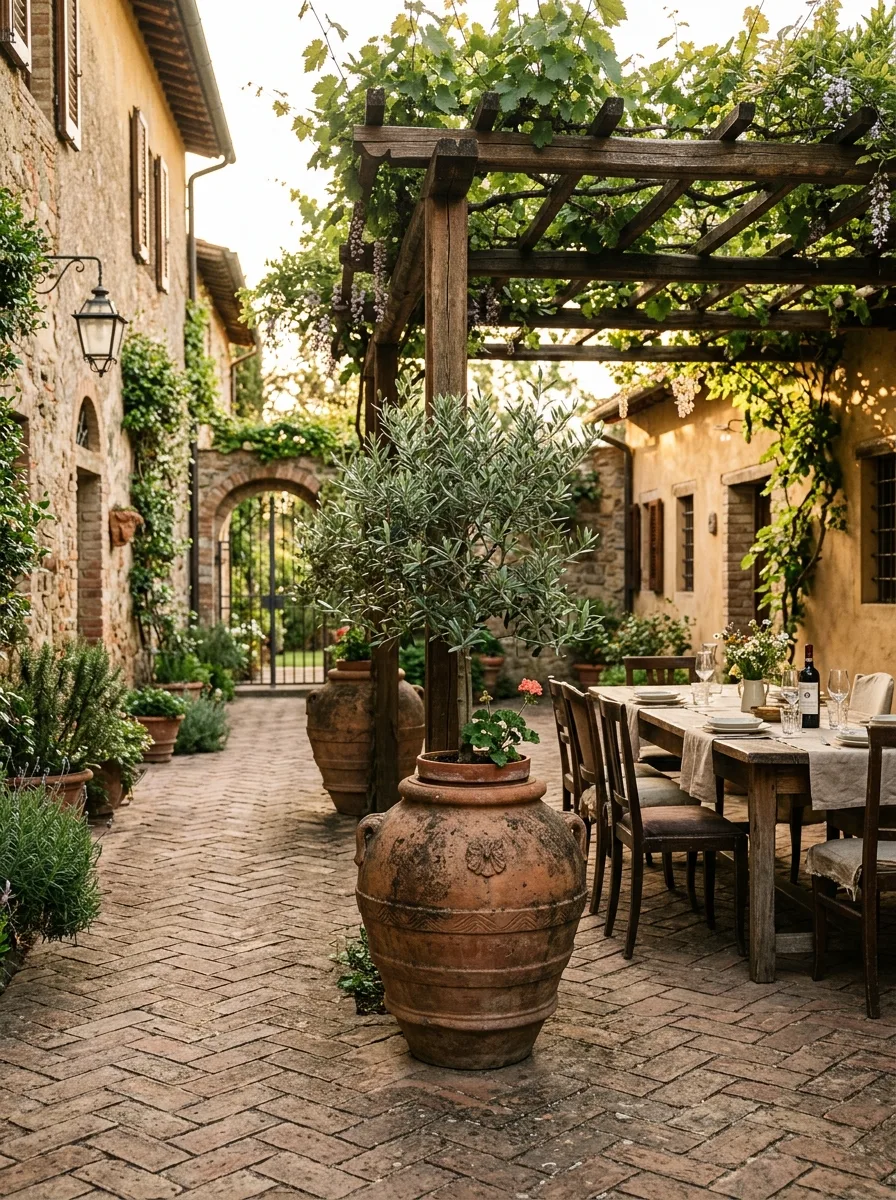
The floor is the beginning and the argument.
Lay reclaimed or reproduction terracotta brick in a traditional herringbone pattern across the full courtyard area. The warm red-orange tone of the brick must be consistent — no mixing of pale new brick with old, which creates visual noise.
Set one enormous antique terracotta olive jar — the kind used for oil storage in Italian farmhouses, often one hundred centimetres or taller — near the centre or at one corner. Plant an olive tree or standard rosemary directly inside it, with a small geranium tucked in at the base.
Build a timber pergola overhead, vine-covered — Vitis vinifera is the correct choice here — and set a long refectory table beneath with mismatched wooden chairs.
Line the courtyard perimeter with terracotta pots of varying sizes planted with herbs, scented geraniums, and small lavenders.
Amsterdam Canal House Garden
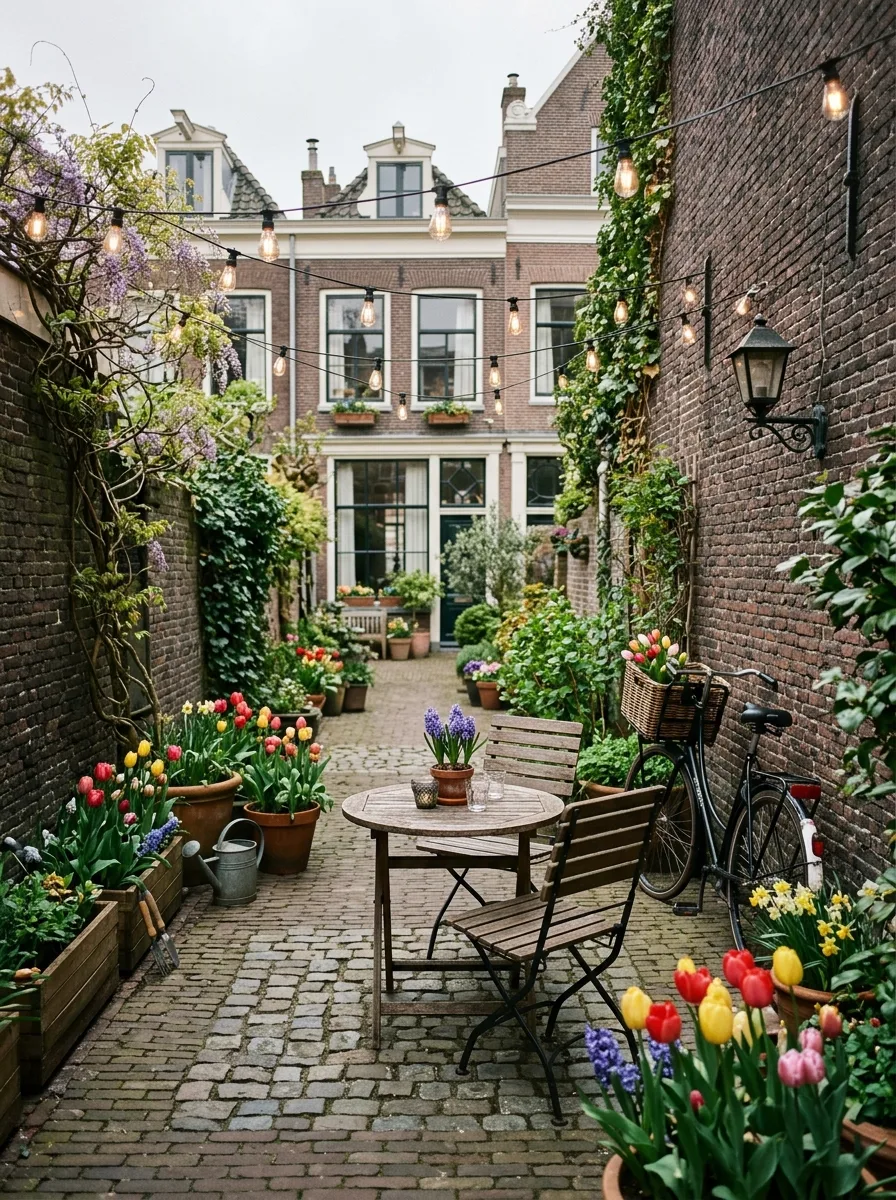
The charm of this aesthetic is its particular combination of formality and clutter.
Lay cobblestones or old brick across the garden floor, using genuine reclaimed material if possible. The surface should be uneven enough to be clearly historical without being uncomfortable underfoot.
Set a small bistro table and two weathered wooden chairs in the centre. Dress the table simply — a single hyacinth in a terracotta pot is sufficient.
The real work is done by the planting. Line both walls with wooden raised beds or collections of terracotta and enamel pots filled with seasonal bulbs: tulips in red, yellow, and pink in spring, followed by dahlias and cosmos in late summer. Plant wisteria and climbing roses on the walls, with ivy covering the brickwork between.
String festoon lights from wall to wall across the full width at ceiling height. Add one traditional cast-iron wall lantern on a bracket.
Leave a bicycle leaned against one wall, not as affectation, but because this is a space where people actually live.
Scandinavian Timber Deck
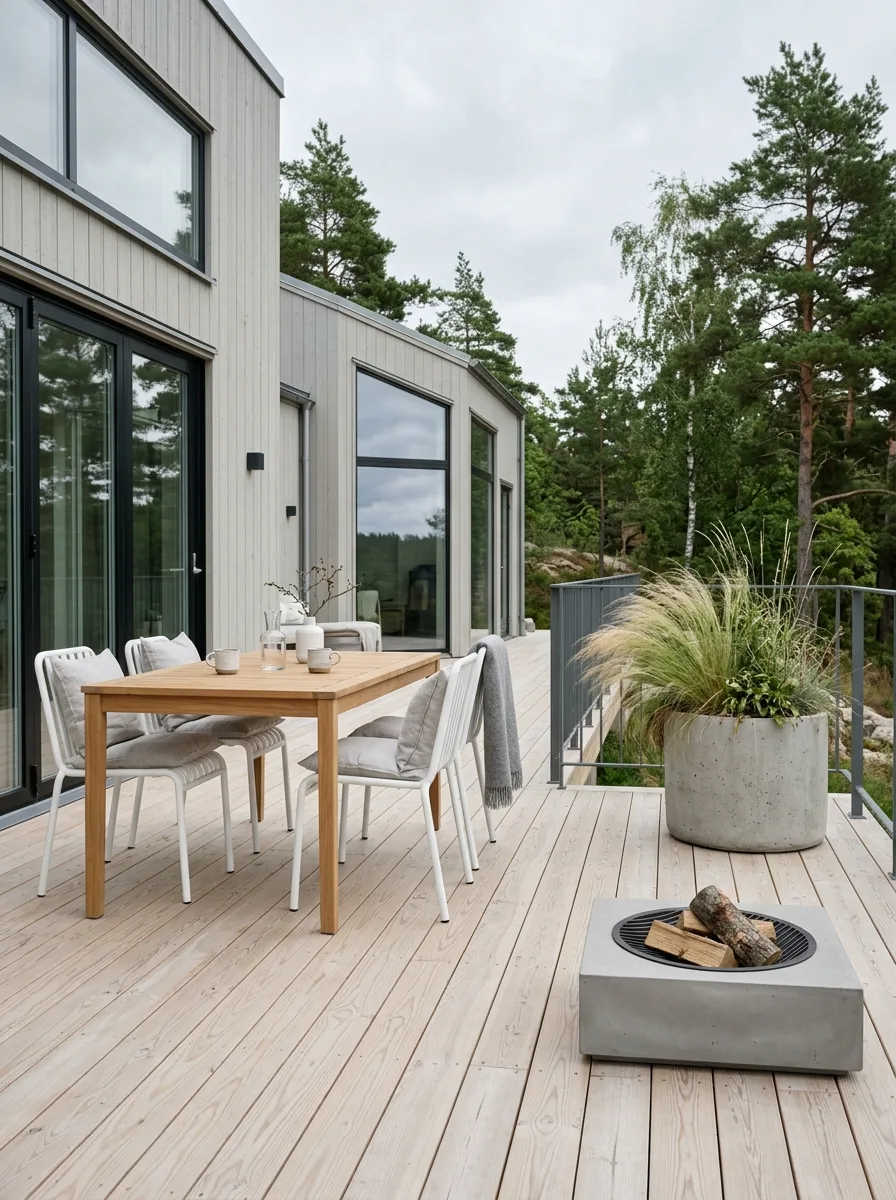
This is the one antidote to all the other entries in this collection. Its confidence comes not from accumulation but from subtraction.
Build a deck in pale ash or pine, weathered to a silver-grey tone with a UV-resistant oil rather than a stain. The deck boards should be wide, not narrow. The surface should be immaculate.
Set one teak dining table and four white powder-coated metal chairs. No rug. No cushions on the floor. One large cast concrete planter holding feather grass or Stipa tenuissima in a generous mass.
Add one small concrete fire bowl set on the deck surface with a stack of split logs beside it. Nothing else at the furniture level.
The borrowed landscape is the decoration. The deck faces the pine forest, the rocky outcrop, the water view. Everything on the deck is quiet so the view can speak.
Tuscan Lemon Bench Alcove
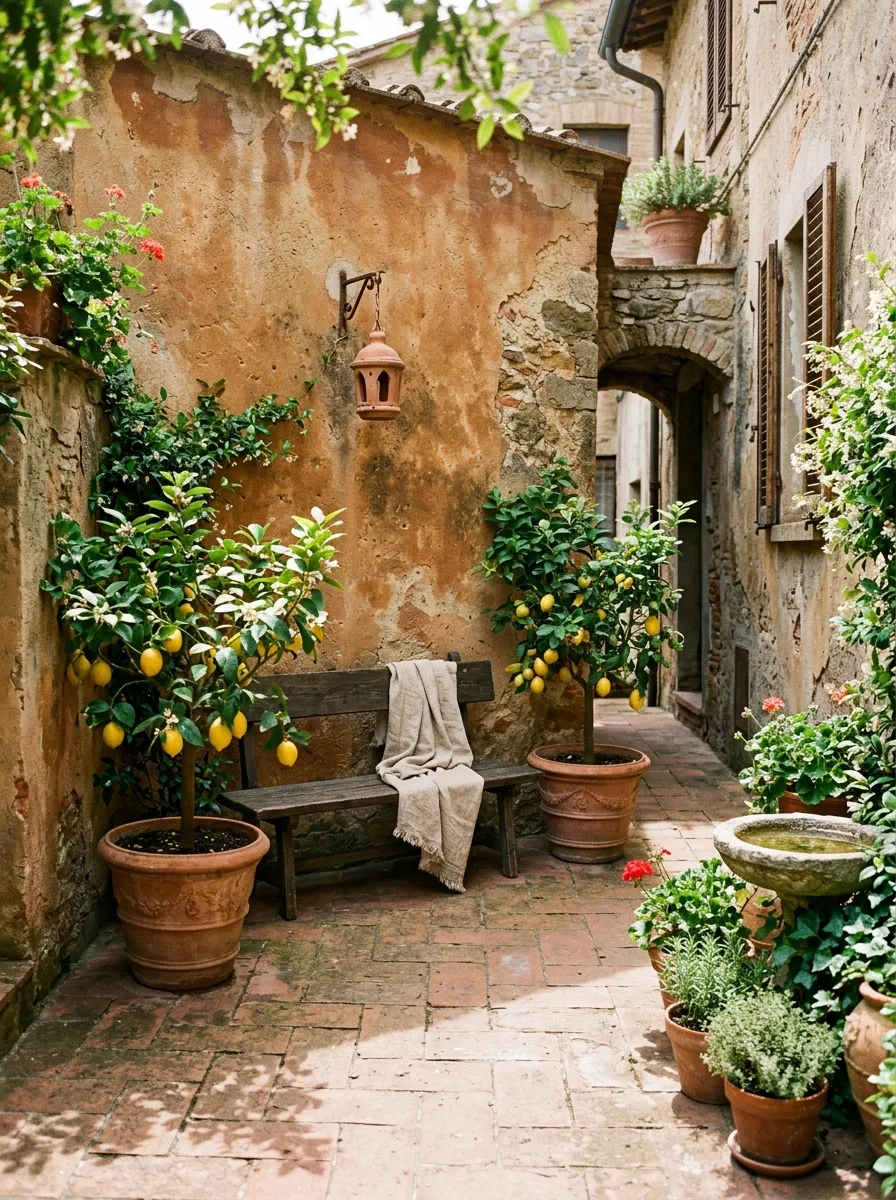
Find — or create — a corner where two walls meet. This alcove is the entire design concept.
Scrub or render the back wall in a warm ochre or terracotta-toned limewash. Allow the surface to be slightly uneven and show tool marks — this is not a flaw. Hang a single clay or terracotta wall lantern on a simple iron bracket above the bench position.
Set a weathered wooden bench against the back wall — nothing ornate, just a simple plank-and-leg construction with a plain linen throw over one arm.
Place two large terracotta pots — minimum sixty centimetres in diameter — one on each side of the bench. Plant a lemon or dwarf citrus tree in each. In winter climates, these will need to overwinter indoors, which is a genuine commitment.
Fill the remaining floor space with smaller terracotta pots of herbs: rosemary, sage, thyme, and oregano. Add one stone bird bath in a worn concrete style.
The alcove framing the bench and the symmetry of the citrus trees is all the composition this needs.
Provençal Village Herb Corner
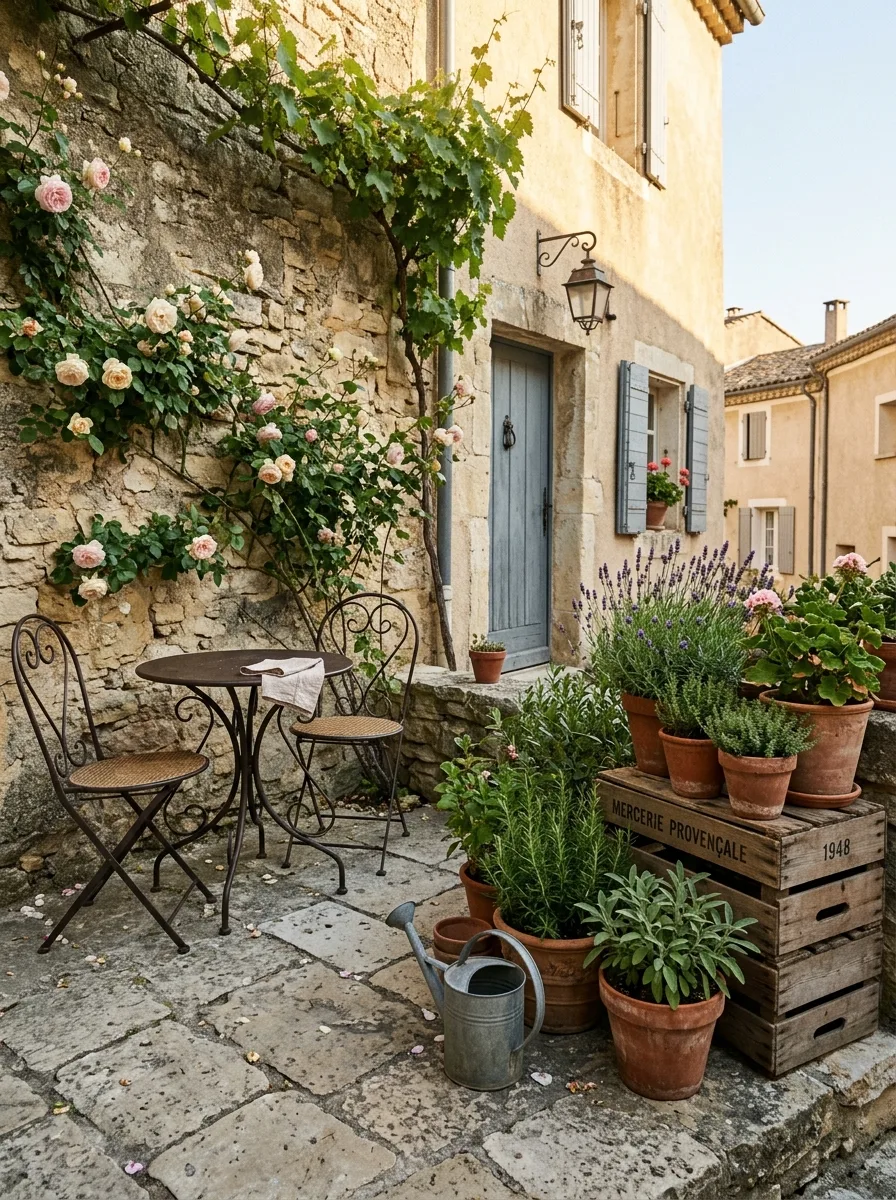
This is the most achievable look in this collection. It requires two chairs, a round table, and conviction.
Source an aged wrought iron bistro set — two chairs and a round table in the classic French style with scrolled backs and perforated seat discs. Do not clean the rust. Do not paint it. Allow it to be exactly what it is.
Buy or source an old wooden wine or produce crate — the kind stencilled with text in French or Italian. Stack three to four terracotta pots on it at varying heights, planted with culinary herbs: rosemary, lavender, sage, and thyme.
Set this composition against a stone or rendered wall near a door. Hang an old iron lantern from a wall bracket above.
The watering can left beside the table should be galvanized tin, not plastic. It matters.
English Cottage Bench and Gate
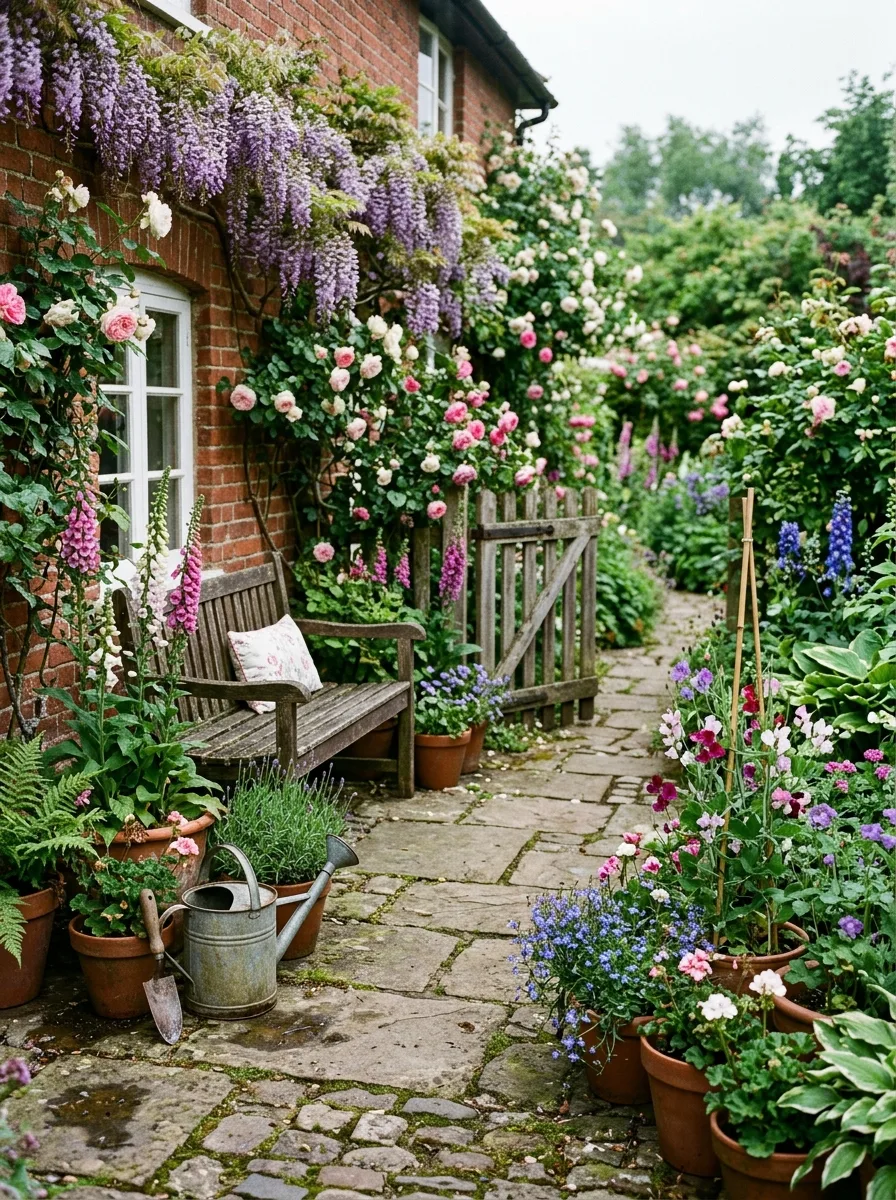
The composition is a found corner, not a designed one.
Take the most atmospheric corner of your garden — the point where a stone wall meets a garden gate, where a climbing rose meets a window, where the view into the next part of the garden begins. Place a single bench there.
The bench should be wood — unpainted, unvarnished, left to go silver. Add one flat floral cushion that looks as if it has been through several summers.
Build up the planting around the bench rather than around the concept. Wisteria on the house wall. Climbing roses on everything else. Foxgloves and delphiniums in the border. Sweet peas on bamboo canes. Pots of lavender, salvia, and geraniums clustered loosely at the bench ends.
Add a galvanized watering can left at the foot of the bench, a trowel resting on the wall, a kneeling pad. These are not props. They’re the evidence of an actual garden.
Lisbon Azulejo Reading Nook
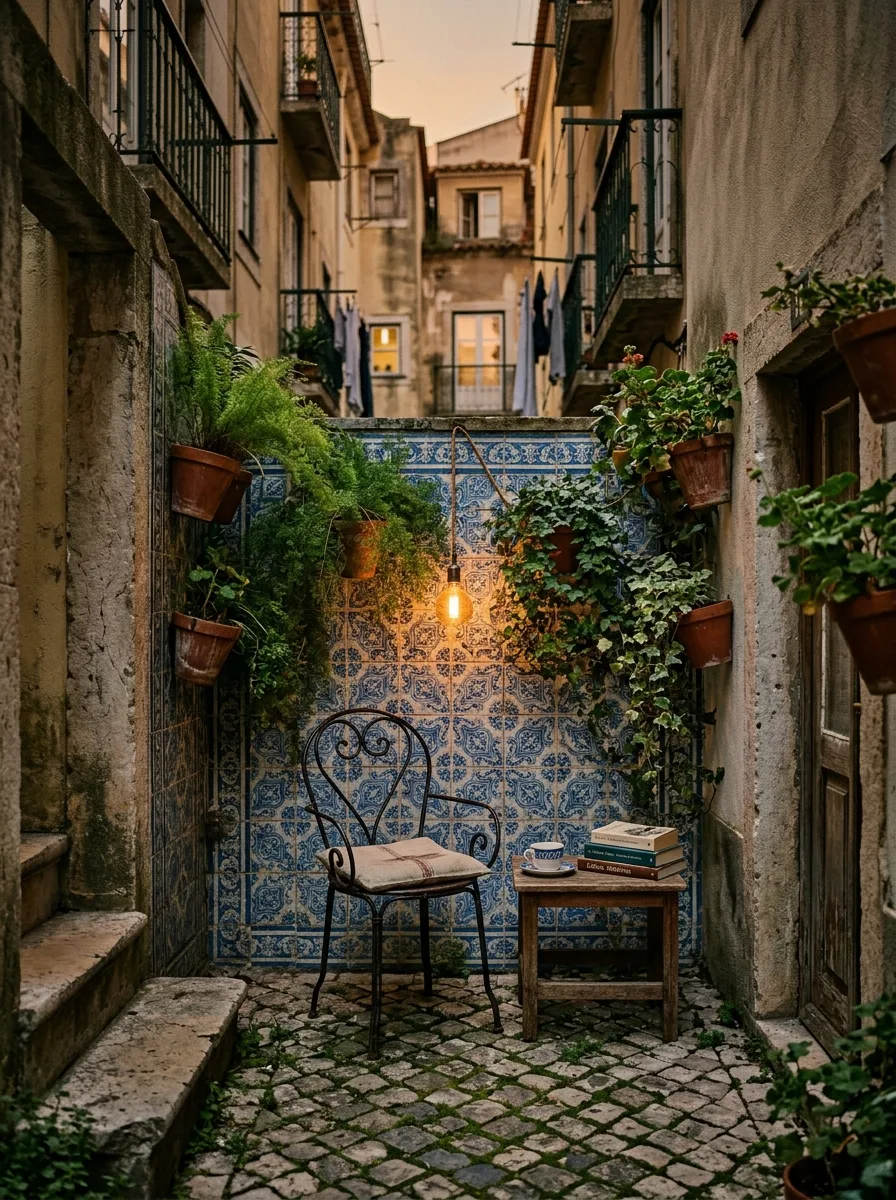
One chair. One tile wall. One lightbulb.
That’s the entire brief.
Cover the rear wall of a small courtyard or corner in traditional hand-painted azulejo tiles — large-scale blue-and-white geometric patterns in the Moorish-Portuguese tradition. The tiles should cover the full face of the wall from approximately knee height to above head height. A single panel of approximately one and a half by one and a half metres is sufficient.
Hang a single pendant bulb on a cloth cord in front of the tile wall at head height — an Edison-style bulb that glows warm and visible rather than being recessed and anonymous.
Set one scrolled iron bistro chair with a thick linen seat cushion facing the tile. Place a small wooden stool beside it with a stack of books, a cup, and a small succulent.
Mount terracotta wall pots on the flanking plain walls and fill them with maidenhair ferns and trailing ivy.
Andalusian White Fountain Patio
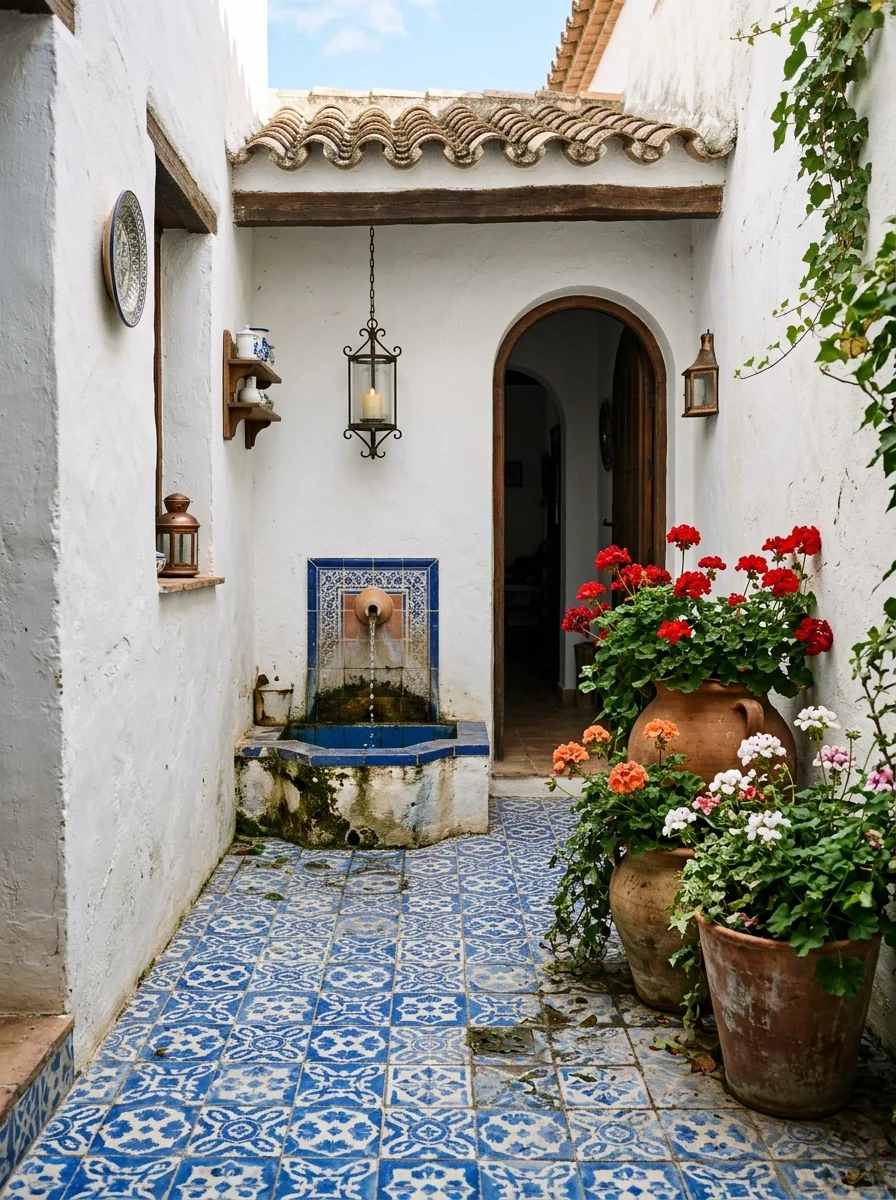
Everything white. Everything light.
Render all walls in brilliant white lime plaster. Use white as the dominant tone without compromise — this aesthetic fails entirely when the walls are a cream or warm white rather than true white.
Set the floor in hand-painted blue-and-white azulejo tiles throughout the full patio area.
Build or source a wall-mounted fountain: a terracotta spout head set into a blue-and-white tile panel, feeding into a small octagonal or hexagonal basin at approximately waist height. Run the pump continuously.
Hang a traditional Moorish iron lantern on a chain from the centre of the courtyard at head height, fitted with a large pillar candle or battery-operated equivalent.
Cluster terracotta pots of red and orange geraniums — the more the better — at the base of the walls. White walls, blue tile, terracotta, red geranium. These are the only colours in the palette.
Irish Wet-Stone Corner
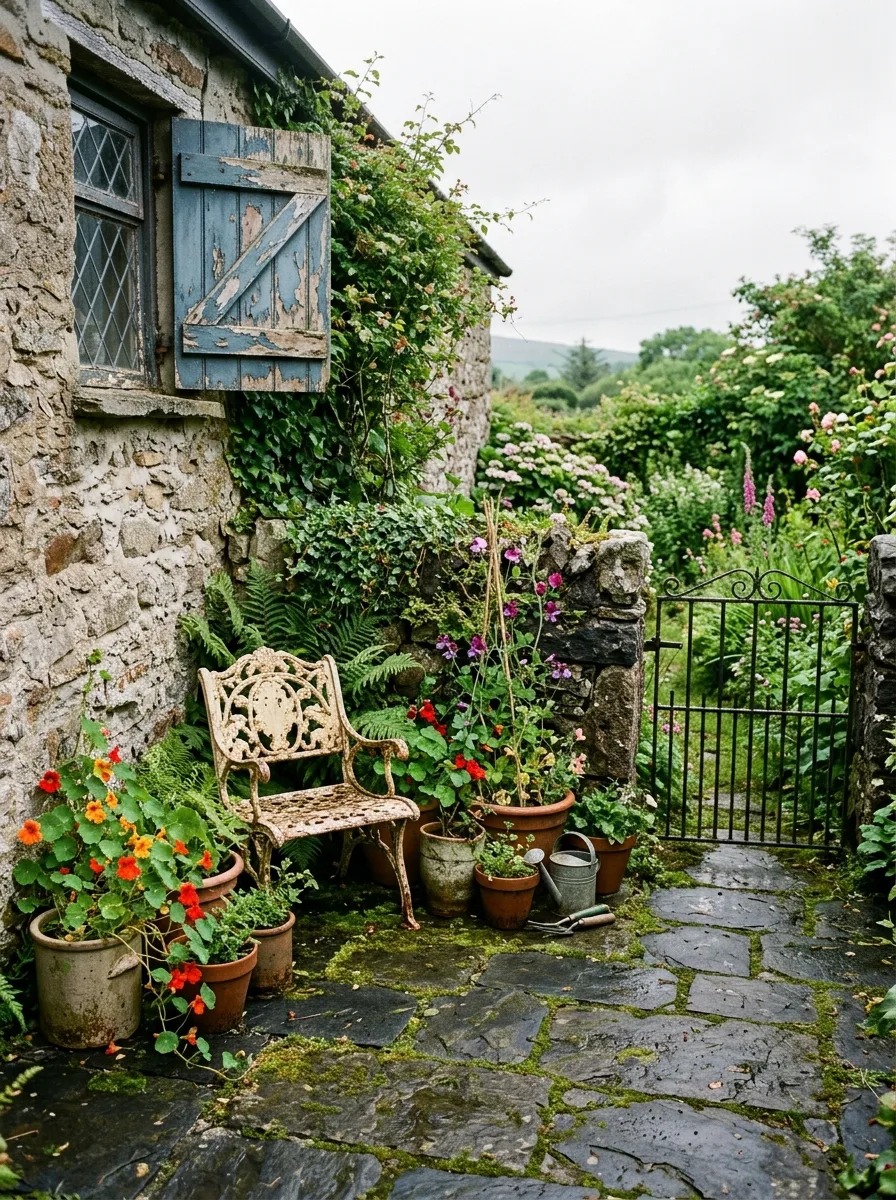
Expect the rain. Design for it.
Choose a corner where two walls of old limestone or local stone meet. Do not clean the stone. Do not point the joints. Allow moss to grow. Allow the slate paving to be dark with moisture.
Set a single cast-iron decorative chair — the kind with an ornate back and scrolled arms — against the stone wall. Allow it to rust. Allow the white paint that may have been on it to chip and peel. This is the look.
Cluster terracotta pots around the chair: nasturtiums trailing from a large pot on one side, geraniums in three or four pots of graduated sizes on the other, a zinc bucket with garden tools, a small clay pot of thyme tucked at the base of the wall.
Open a wrought-iron gate at the edge of the patio to reveal more planting beyond — foxgloves, hydrangeas, and roses visible in the distance.
The view through the gate into a garden beyond is essential. It implies a world that continues.
Final Thoughts
There is a reason people travel to places like Provence, Tuscany, Córdoba, and the Cotswolds and come home with photographs of courtyards and doorways rather than the tourist sites they planned to visit.
The patios in those places are not aspirational spaces waiting to be used. They are places where actual life has happened, repeatedly and unhurriedly, for a long time.
The chairs are worn because someone sat in them through many evenings. The table is stained because someone spilled wine and it didn’t seem worth worrying about. The rose grew over the door because someone planted it there when they were young and now they are old and the rose is magnificent.
You cannot manufacture that history in a single season. But you can make decisions that point toward it. You can choose materials that will age rather than degrade. You can plant things that will take years to reach their potential and trust that the years will pass anyway. You can design a space for living rather than for looking at.
A good patio, like a good life, is mostly made of ordinary time spent in it.