
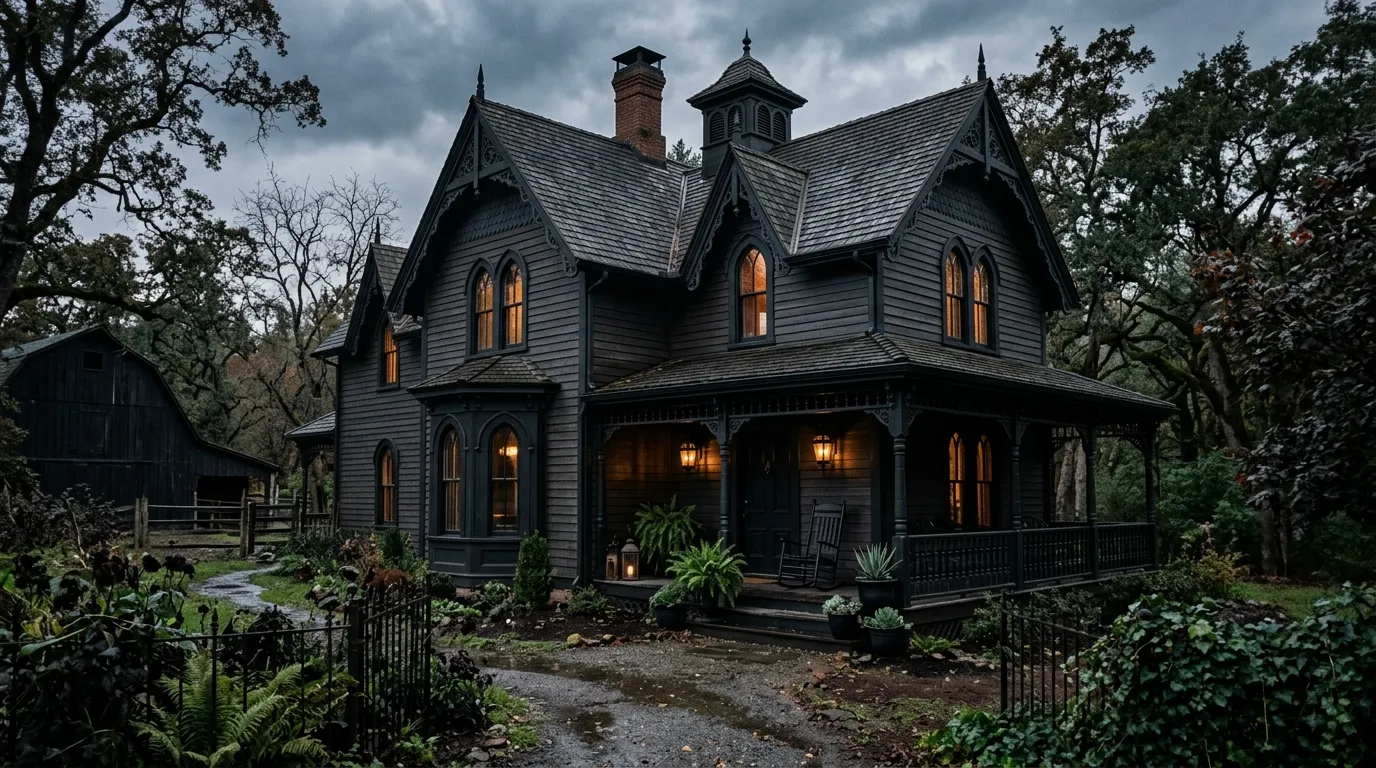
Black paint is not a personality. Everyone with a can of Tricorn Black and a Pinterest board thinks it is.
The difference between a room that reads moody and expensive and a room that reads like a dentist’s basement comes down to about four decisions, made before the paint ever goes on the wall. Wood tone. Metal finish. Window shape. Light source. Skip one and the whole thing collapses into cosplay.
This look works because it refuses to pick a century. Gothic arches sit next to farmhouse benches. Candlelight sits next to a five-thousand-dollar espresso machine. Nothing about that should work, and somehow it does, because every material in the house is telling the same story about age and weight and use.
Here’s how the story actually gets told, room by room.
Why Black Walls Read Expensive, Not Gloomy
A dark wall does one of two things. It either swallows a room whole or it makes the room feel like the inside of a jewellery box. The variable is contrast, not colour.
The wall needs something to fight against
Black paint on its own is inert. It needs a bright, reflective object to push against — a white farmhouse sink, a cream duvet, a marble countertop. Without that fight, the eye has nothing to land on and the room just reads flat and heavy.
Sheen matters more than shade
Matte black absorbs light and disappears into shadow. A soft eggshell or satin finish catches candlelight and lamp glow along its surface, which is what turns a wall from a void into a backdrop. Skip the flat finish unless the room gets serious natural light from somewhere else.
Warm undertones, not true black
True black paint next to warm wood beams looks like a mistake. The best versions of this look lean into a black with a warm undertone — something closer to a very dark brown or bottle green in certain light — so it sits comfortably next to reclaimed oak instead of fighting it.
Goth Farmhouse Ideas
Antique Mirror Stone Mantle
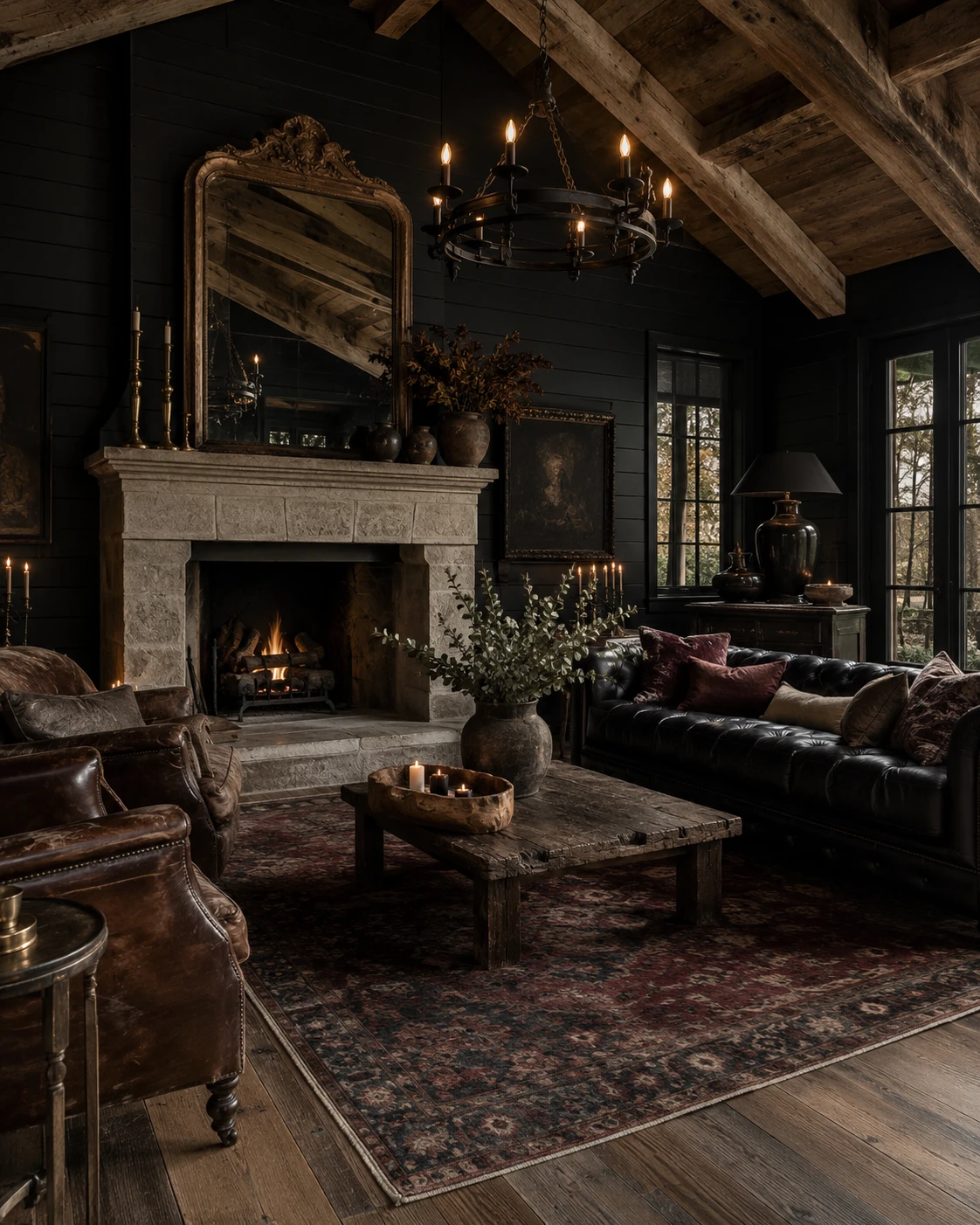
Start with a fireplace that’s actually oversized for the room — a chunky stone surround with visible tool marks, not a smooth manufactured one. Lean a tall, gilt-framed antique mirror against the wall above it instead of mounting it flush; the slight tilt catches the firelight and makes the whole wall feel curated rather than installed.
Anchor the seating with a tufted black leather chesterfield and a pair of worn brown leather club chairs that don’t match it exactly. A round iron chandelier with candle-style bulbs, hung low, replaces every other light source in the room.
Layer an oxblood Persian-style rug under a chunky reclaimed-wood coffee table, and finish with a cluster of oxblood and olive velvet pillows. Nothing in this room should look bought last month.
Gothic Arch Kitchen Window
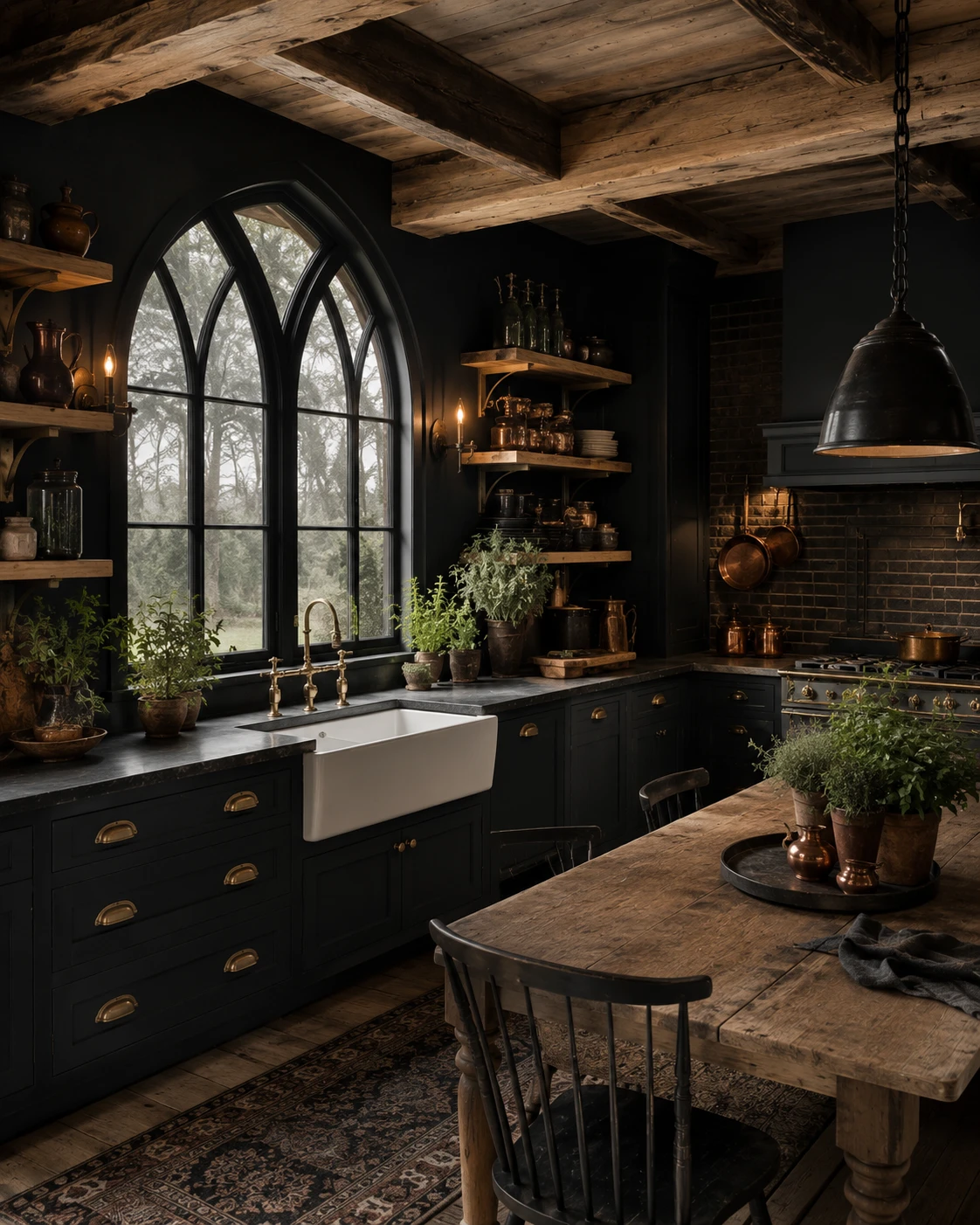
Install black shaker cabinets floor to ceiling, then break up the run with open wood shelving on at least one wall — closed storage below, displayed jars and copper above. The contrast between concealed and exposed is what keeps a full black kitchen from feeling like a cave.
Source a double gothic-arched window for the sink wall specifically, since a sink is the one spot in a kitchen where you’re guaranteed to be standing still long enough to appreciate a view. Pair it with an oversized bridge faucet in aged brass.
Hang copper pots directly on the brick backsplash near the range instead of tucking them in a drawer. Function becomes decoration the moment it’s visible.
Candlelit Iron Chandelier Ring
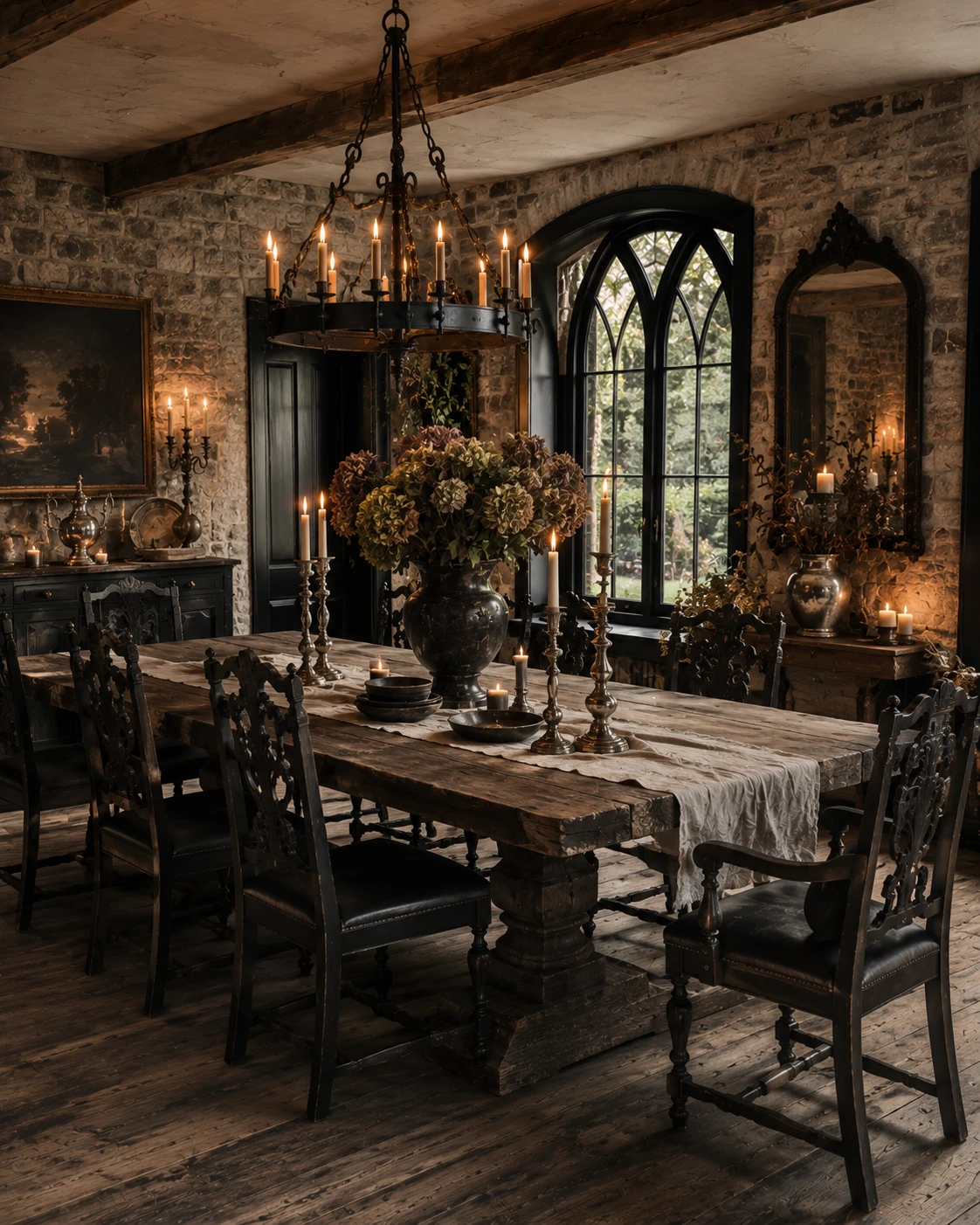
Build the dining room around raw fieldstone walls left largely unpainted — the texture alone does most of the atmospheric work. A long trestle table in dark reclaimed wood, paired with high-backed carved chairs upholstered in black leather, keeps the room formal without tipping into stiff.
Suspend a wrought-iron ring chandelier low over the table and load it entirely with real candles, no bulbs. Flank it with a floor candelabra in the corner so the room never depends on a single light source.
Fill an oversized dark ceramic urn with dried hydrangea instead of fresh flowers. Dried arrangements read as intentional in a room this moody; fresh flowers read as an afterthought.
Plaster Walls Black Door Frame
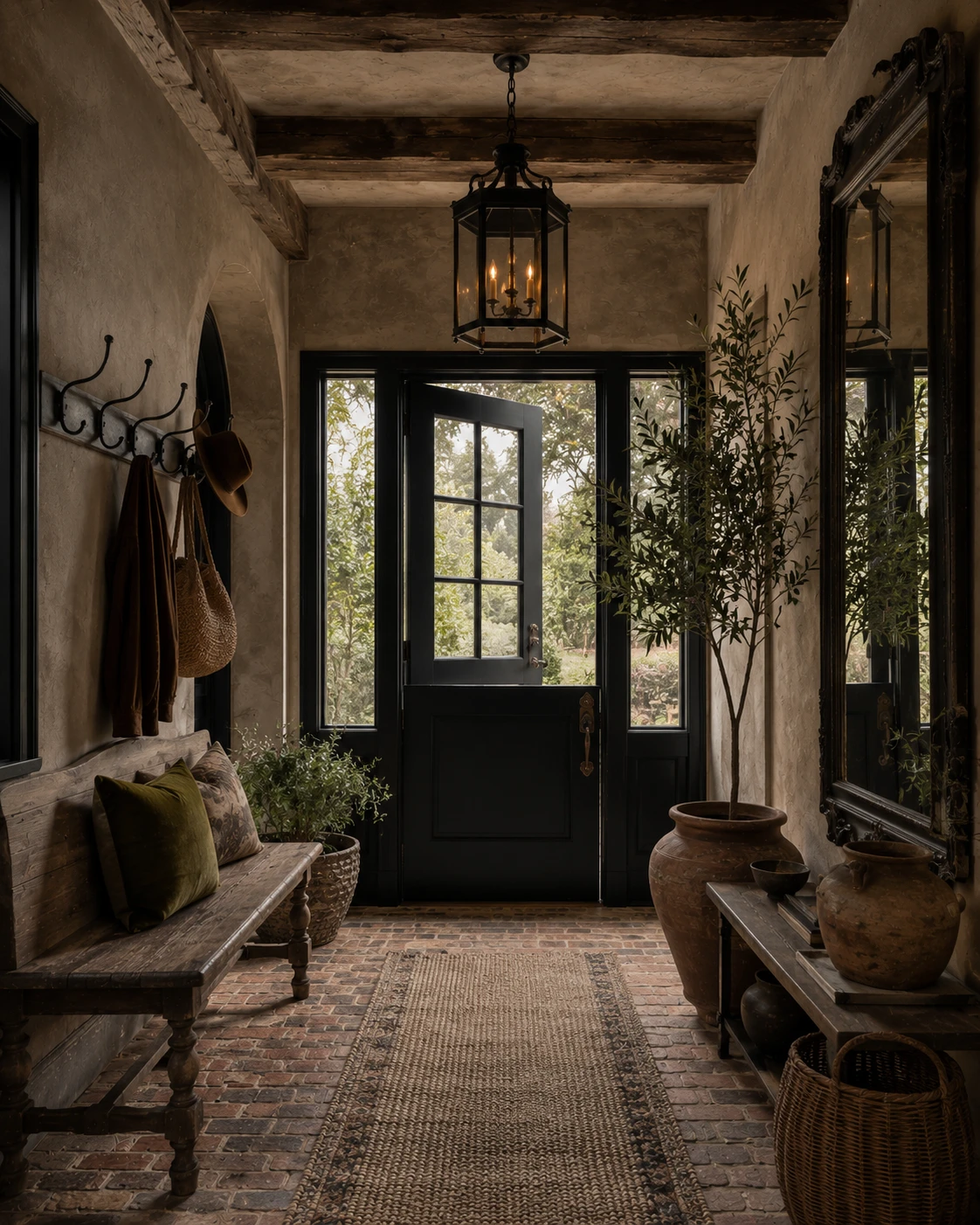
Leave the entryway walls in raw, textured lime plaster rather than painting them black — the lighter surface gives visitors somewhere to land before the rest of the house goes dark. A single black Dutch door with a full-glass upper half lets light spill straight down the hallway.
Flank the door with oversized terracotta urns instead of the usual matching planters, and let one hold a small potted olive tree that’s clearly outgrown its pot. Hang a rustic wood bench along the opposite wall with iron coat hooks mounted directly above it.
Skip the doormat entirely and run a woven jute runner the full length of the hall. It reads far less staged than anything with a border.
Clawfoot Tub Gothic Window
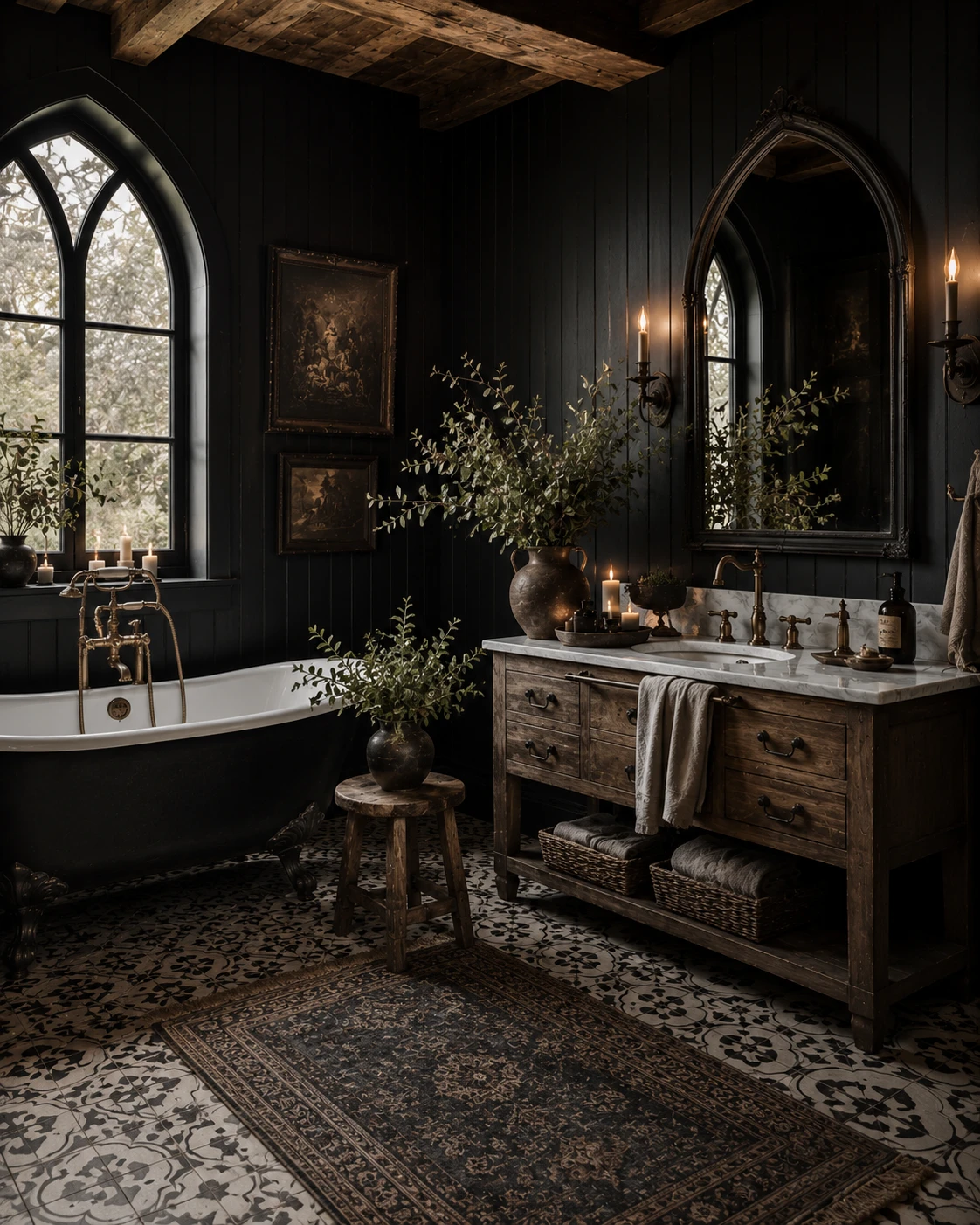
Paint the bathroom in the same black shiplap as the rest of the house, then position a black clawfoot tub directly under a single arched window so the room gets one dramatic light source instead of several small ones. Skip a shower curtain here entirely; this is a soaking-tub room, not a daily-shower room.
Choose a black-and-white encaustic tile for the floor and let it be the one busy pattern in an otherwise dark space. A freestanding wood vanity with a marble top and a tall arched mirror above it keeps the storage warm instead of clinical.
Fill an oversized ceramic vessel with eucalyptus branches and set it on a low stool beside the tub. The greenery is doing more work against all that black than any towel colour ever could.
Library Ladder Black Shelving
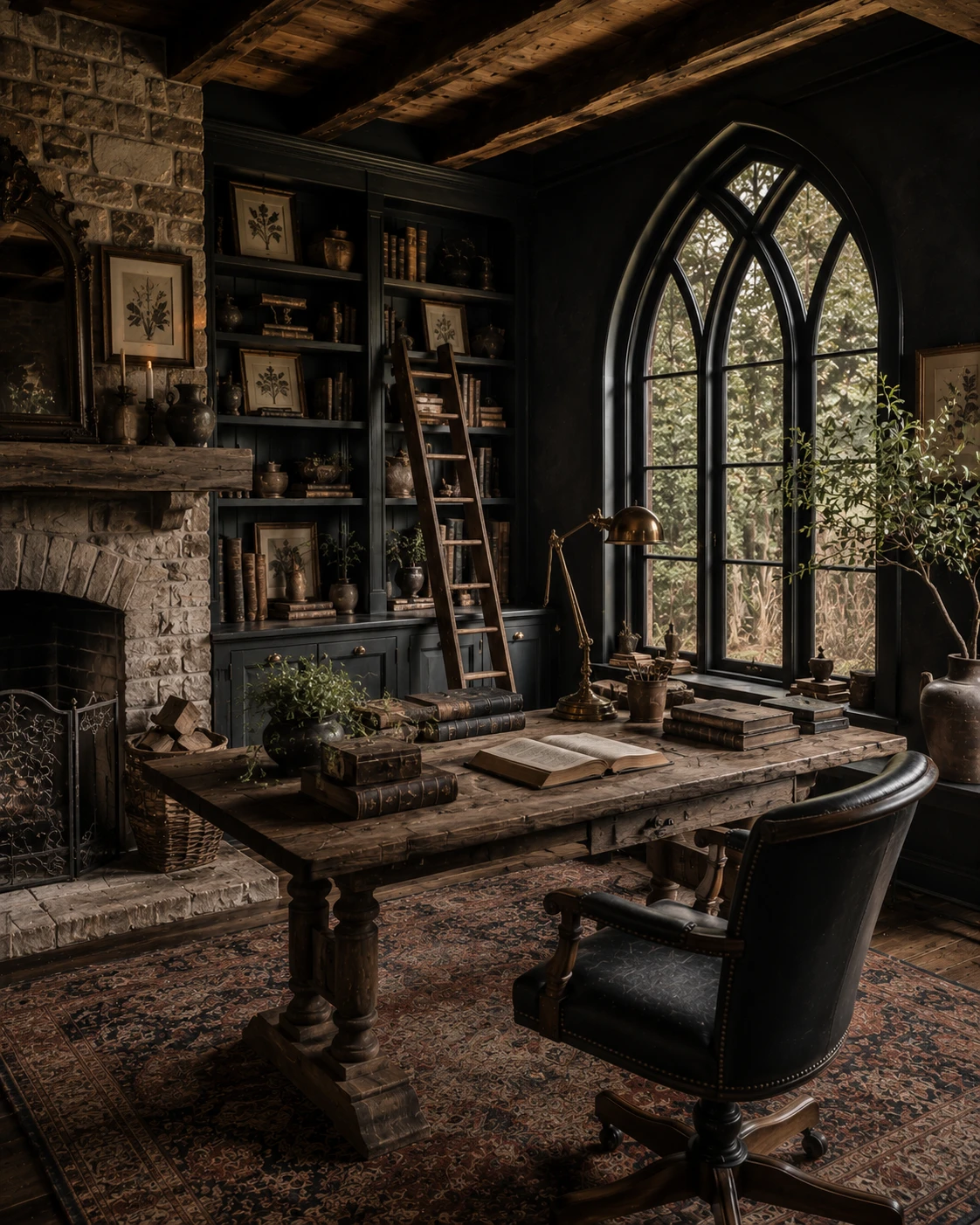
Commit an entire wall to black built-in bookshelves, floor to ceiling, and install a rolling library ladder even if the top shelf isn’t technically that hard to reach. The ladder is a mood, not a necessity.
Position a heavy reclaimed-wood desk facing the window rather than the fireplace, so natural light hits the work surface instead of your back. A brass articulating desk lamp, the kind with visible joints, beats a sleek modern one in this setting every time.
Stack real, worn leather-bound books rather than staging them for colour. Mismatched spines and cracked leather are the entire point.
Leather Wingback Reading Corner
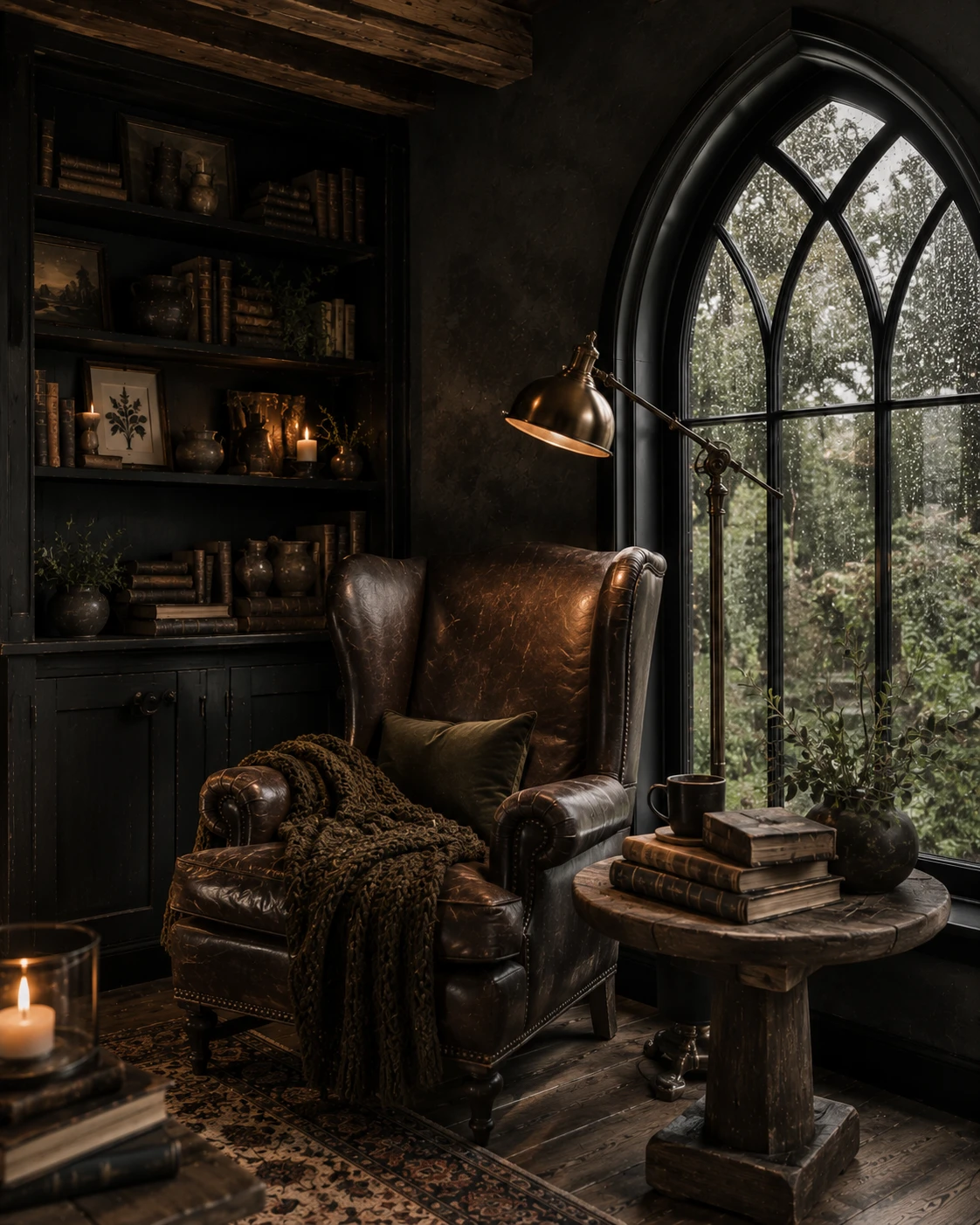
Tuck a worn brown leather wingback chair into the corner nearest a tall arched window, with nothing but a low round wood table beside it. The table only needs to hold two things: a stack of books and a mug.
Drape a chunky knit throw over one arm of the chair, not folded flat but left slightly rumpled, as though someone just stood up. Overhead, mount an articulating brass reading lamp rather than relying on a floor lamp that eats up floor space.
Set a single pillar candle in a glass hurricane on the floor nearby. It’s a small detail, but a lit candle at floor level does more for a reading nook than any overhead fixture could.
Built-In Bench Gothic Window
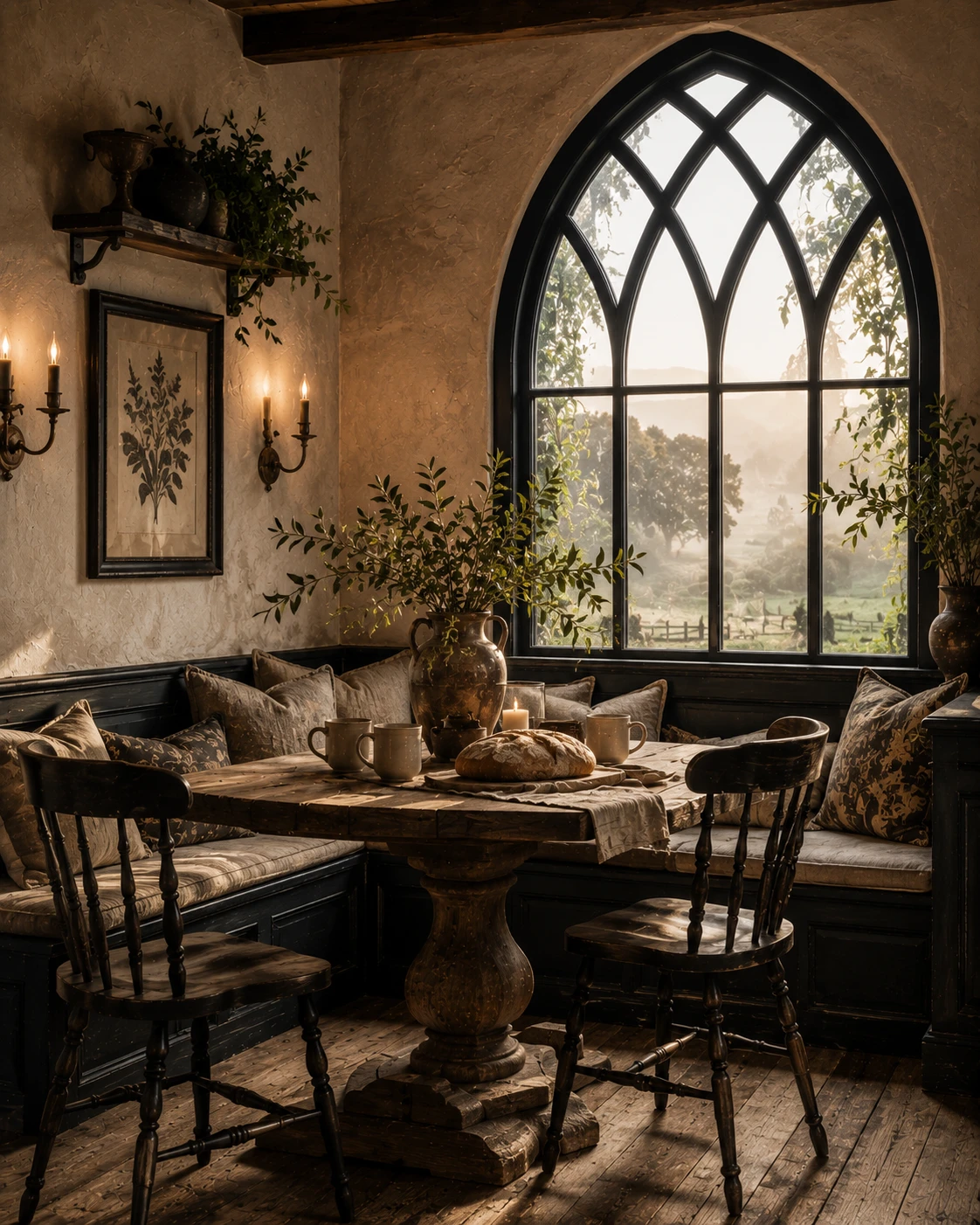
Frame a breakfast nook with an L-shaped black built-in bench instead of freestanding chairs on every side — it makes a small space feel intentional rather than crowded. Cushion it in a muted striped or floral fabric that’s soft against all the black woodwork.
Center a round pedestal table under the widest available arched window and keep the tabletop nearly bare — a loaf of bread, two mugs, one candle. This is a room meant to photograph like breakfast just happened, not like it’s staged for a shoot.
Mount wall sconces on either side of a small botanical print rather than hanging overhead lighting. Morning light through the arched glass should be doing most of the work anyway.
Rough-Hewn Mantle Brass Candlesticks
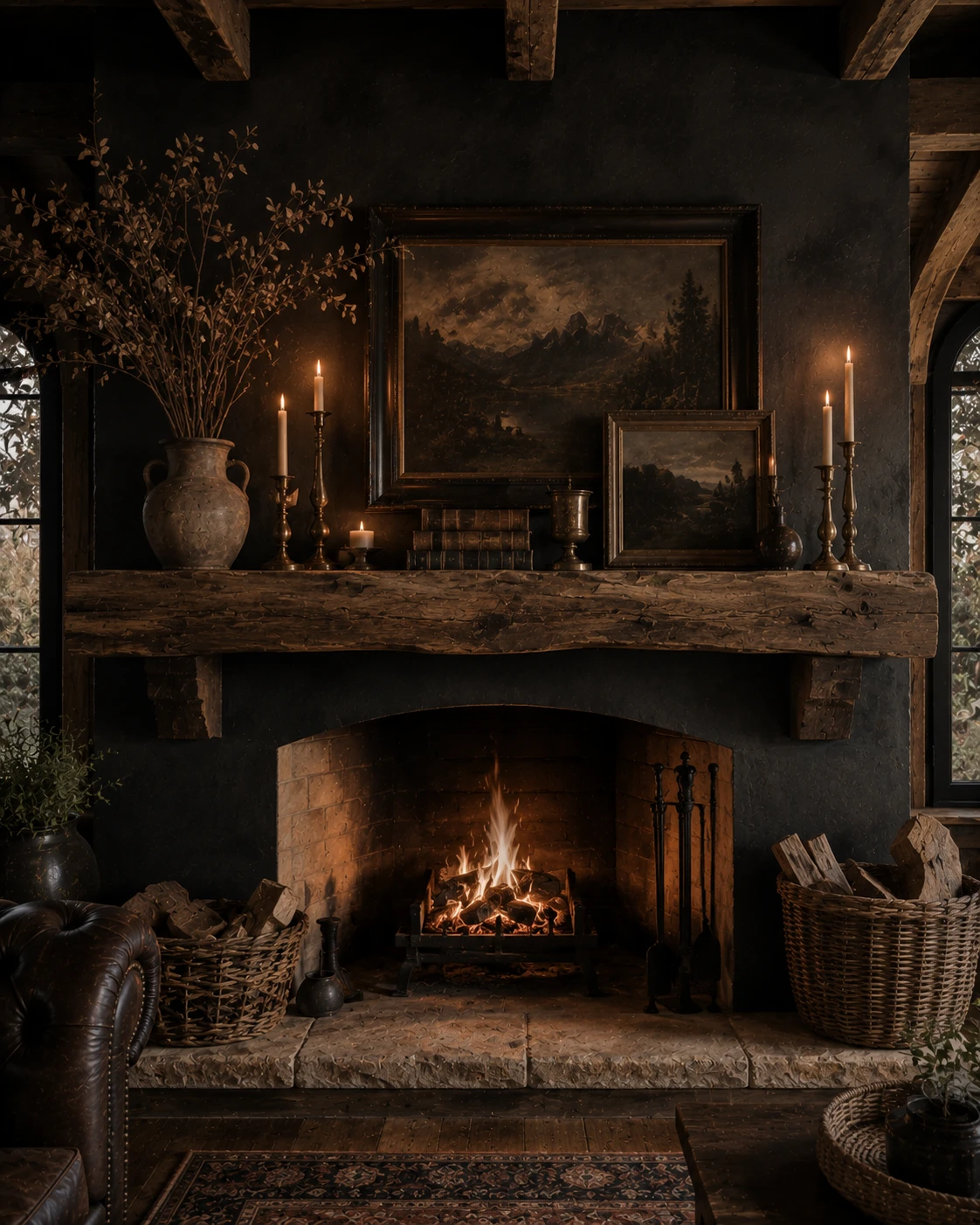
Source a mantle beam that still shows its saw marks and bark edges — the rougher the better, since it’s standing in contrast to the finished stone below it. Skip a single large painting above it in favour of two smaller framed landscapes, offset rather than centered, leaning slightly rather than hung dead level.
Cluster mismatched brass candlesticks at varying heights along the mantle length instead of a matched pair at each end. Uneven heights read as collected over years; a matched pair reads as bought in one trip.
Set a large aged ceramic vessel at one end filled with dried branches instead of anything symmetrical. The whole arrangement should look like nobody measured it.
Patterned Tile Laundry Floor
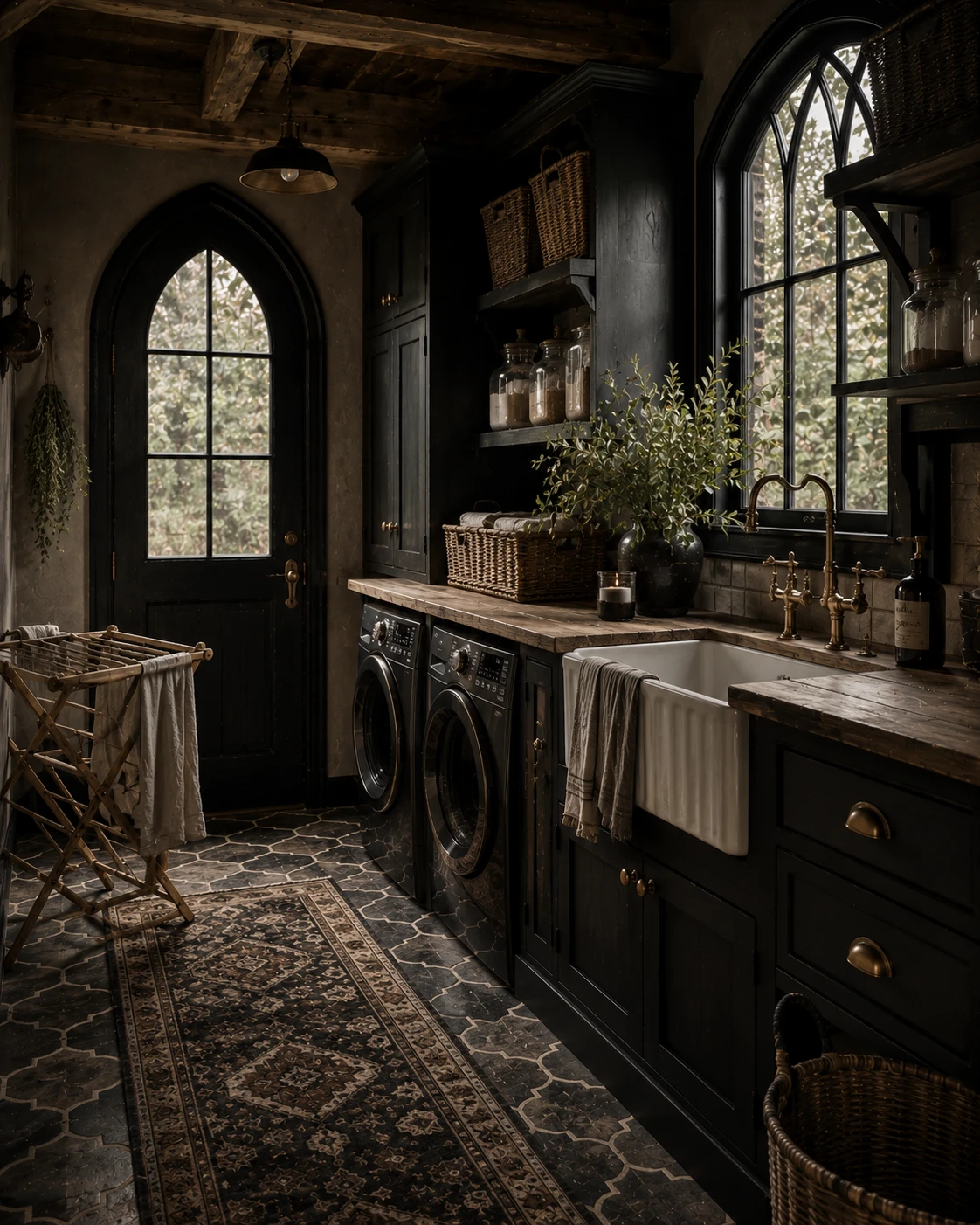
Lay a heavily patterned encaustic tile across the entire laundry floor and let it be the loudest surface in the room, since everything above it — cabinets, machines, counters — stays matte black. A reclaimed wood countertop over the machines gives you folding space that doesn’t look like a countertop at all.
Install an arched window directly above the farmhouse sink, the same gothic profile used everywhere else in the house, so even the most utilitarian room doesn’t feel like an afterthought. Pair it with the same aged brass faucet used in the kitchen.
Hang open shelving loaded with glass apothecary jars for detergent and pins rather than keeping everything behind closed doors. A room this small benefits from texture at eye level.
Olive Velvet Bench Nook
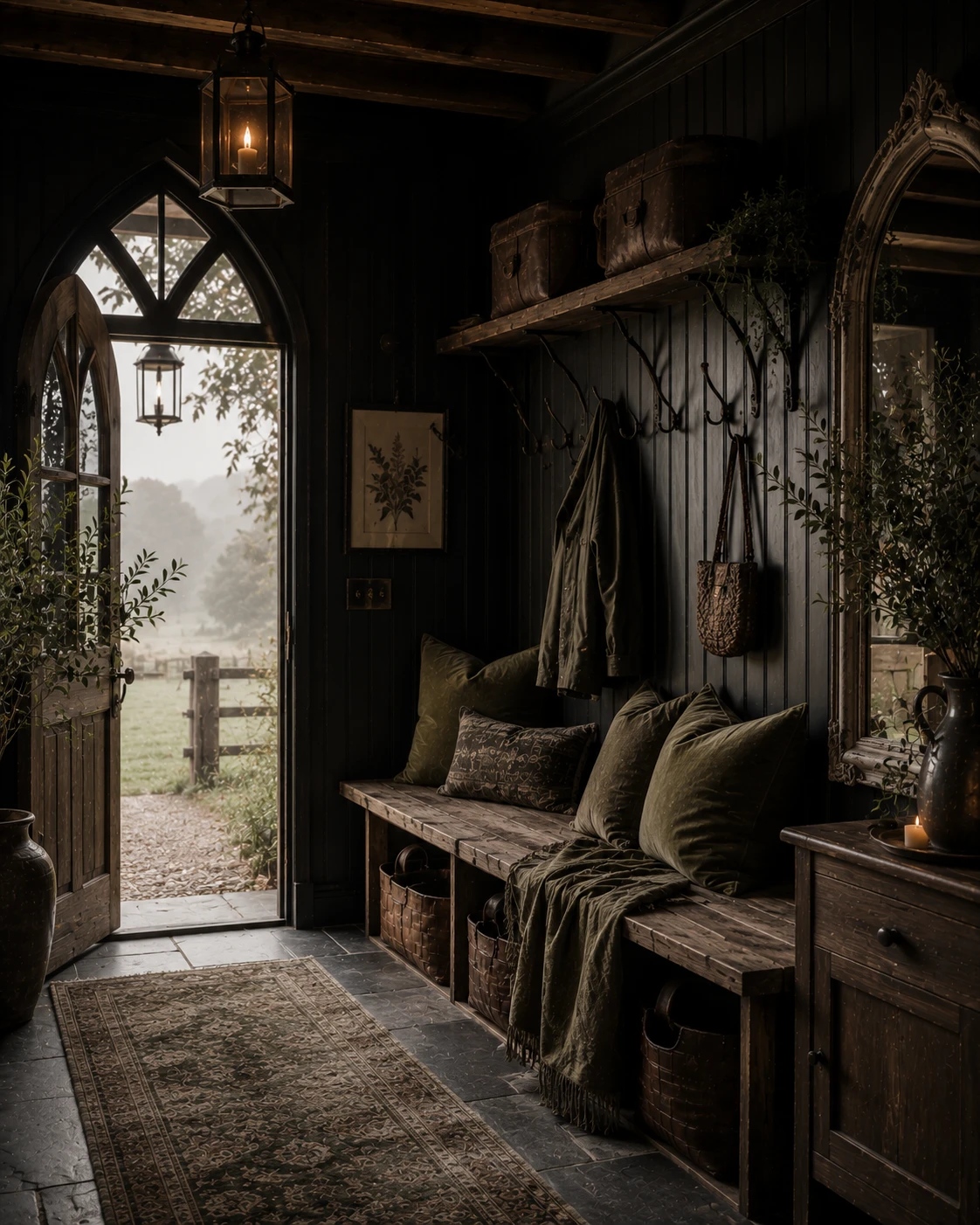
Build a mudroom bench long enough for two people to sit and remove boots at once, upholstered in deep olive velvet rather than the expected canvas or leather. The unexpected fabric choice is what keeps a purely functional room from feeling purely functional.
Mount open iron hooks above the bench instead of a closed cubby system, and let one coat and one woven bag hang there permanently, mid-use. Storage baskets tucked beneath the bench hide the actual mess.
Hang a single lantern-style pendant near the door rather than a flush-mount fixture. It should look like something you’d carry outside if the power went out, even though it’s wired in.
Black Staircase Patterned Runner
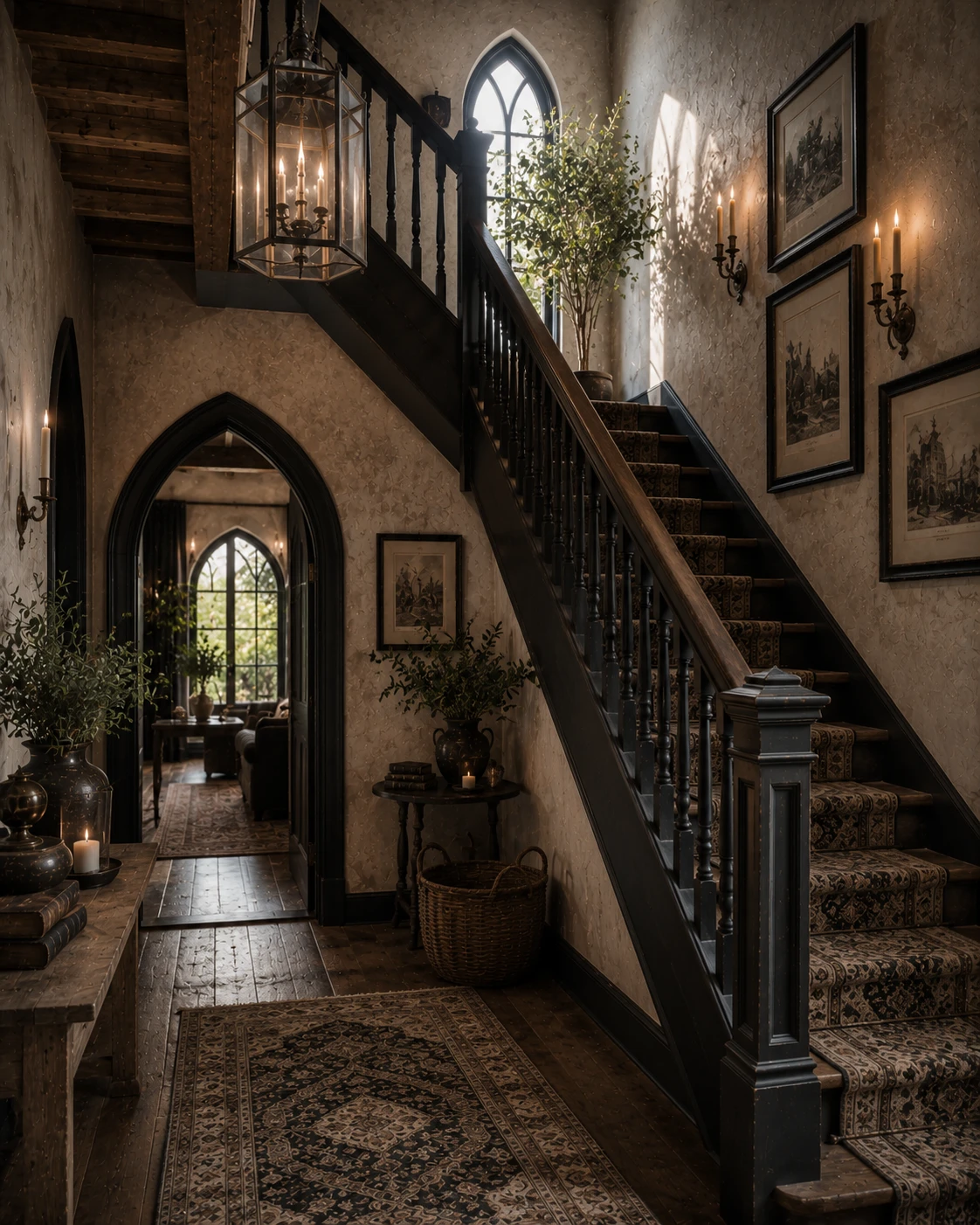
Paint the staircase itself — treads, risers, and railing — in the same black as the walls, then break up all that darkness with a heavily patterned runner in warm reds and creams. The runner is doing the job a lighter wall colour would normally do elsewhere in the house.
Hang a run of framed botanical or landscape prints up the stairwell wall at a consistent height, rather than in a scattered gallery arrangement. A staircase this steep needs the visual rhythm to feel intentional rather than chaotic.
Suspend an oversized lantern pendant at the base of the stairs, sized larger than feels reasonable for the space. Undersized lighting is the fastest way to make a dramatic staircase look apologetic.
Brick Arch Coffee Nook
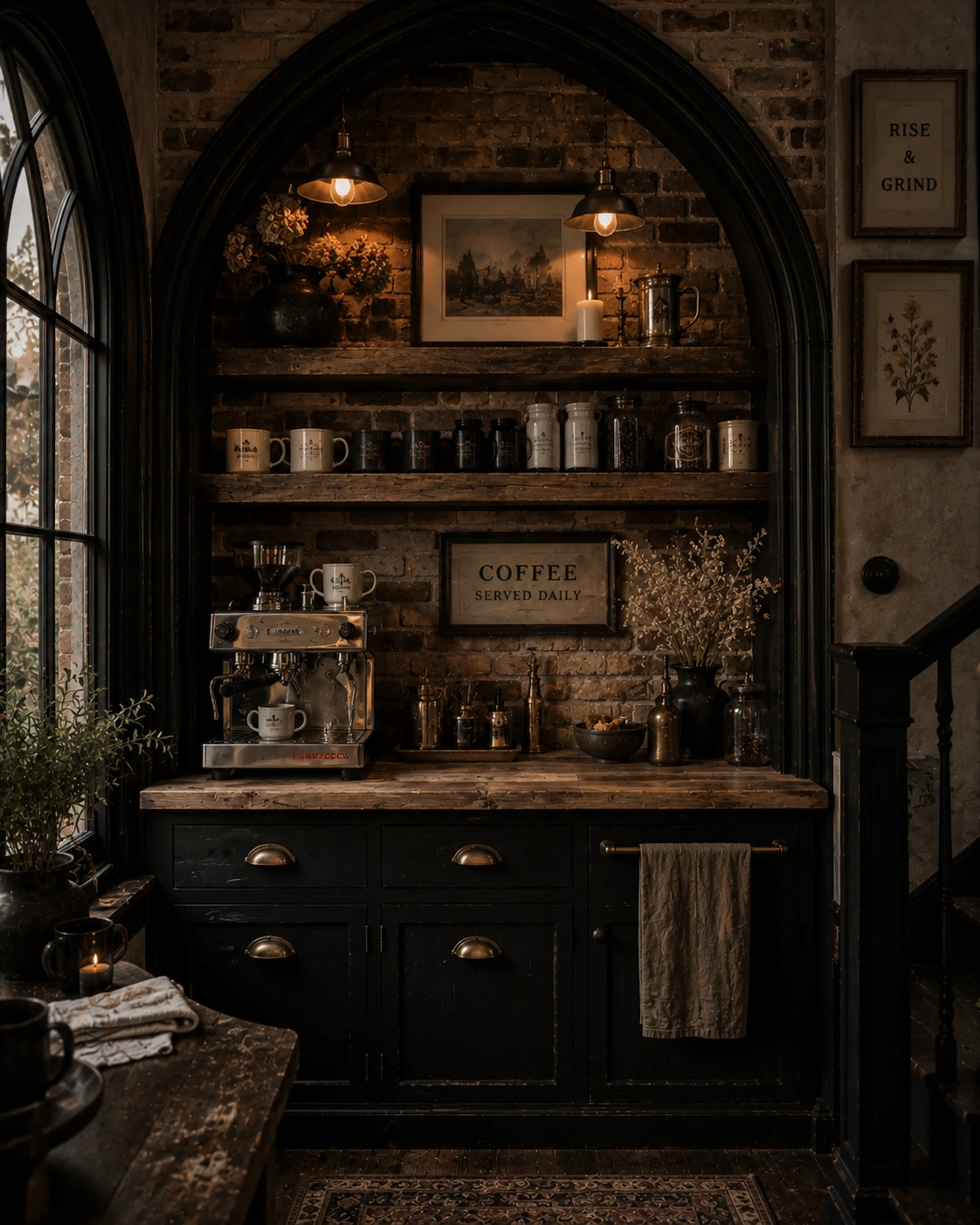
Frame a coffee station inside an actual brick archway rather than a flat wall nook — the curve softens what would otherwise be a very square, very black room. Leave the brick exposed and unpainted; it’s the one warm material doing all the work against the black cabinetry below.
Mount two small pendant lights directly over the machine rather than lighting the whole nook evenly. A coffee station gets used for five minutes at a time; it doesn’t need to be lit like a kitchen.
Add a small printed sign or piece of framed type on the wall instead of open shelving there. One graphic element breaks up what would otherwise be an unbroken run of mugs and jars.
Gothic Arch Pantry Door
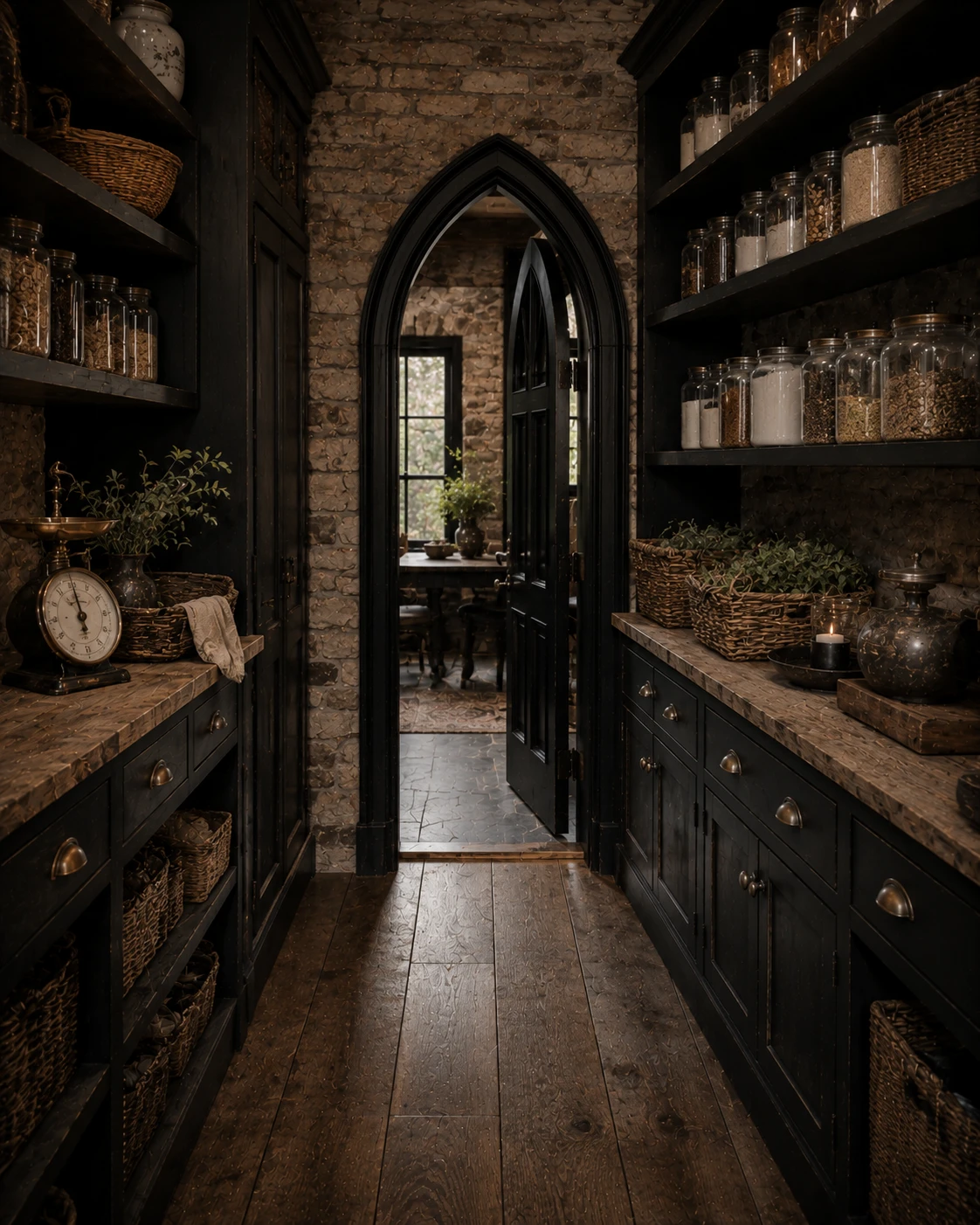
Install a black gothic-arched door at the pantry entrance even though nothing about pantry function requires an arch. This is the room where the house’s architectural language gets to be a little excessive, because nobody’s entertaining guests in the pantry.
Keep the shelving open rather than behind cabinet doors, and store dry goods in matching glass jars so the visual noise stays consistent even with dozens of different ingredients on display. Woven baskets on the lower shelves handle anything that doesn’t look good in glass.
Leave the stone walls bare here, unlike the rest of the house. A pantry earns the right to feel a little more raw and a little less finished than the rooms meant for guests.
Ivy-Covered Stone Facade
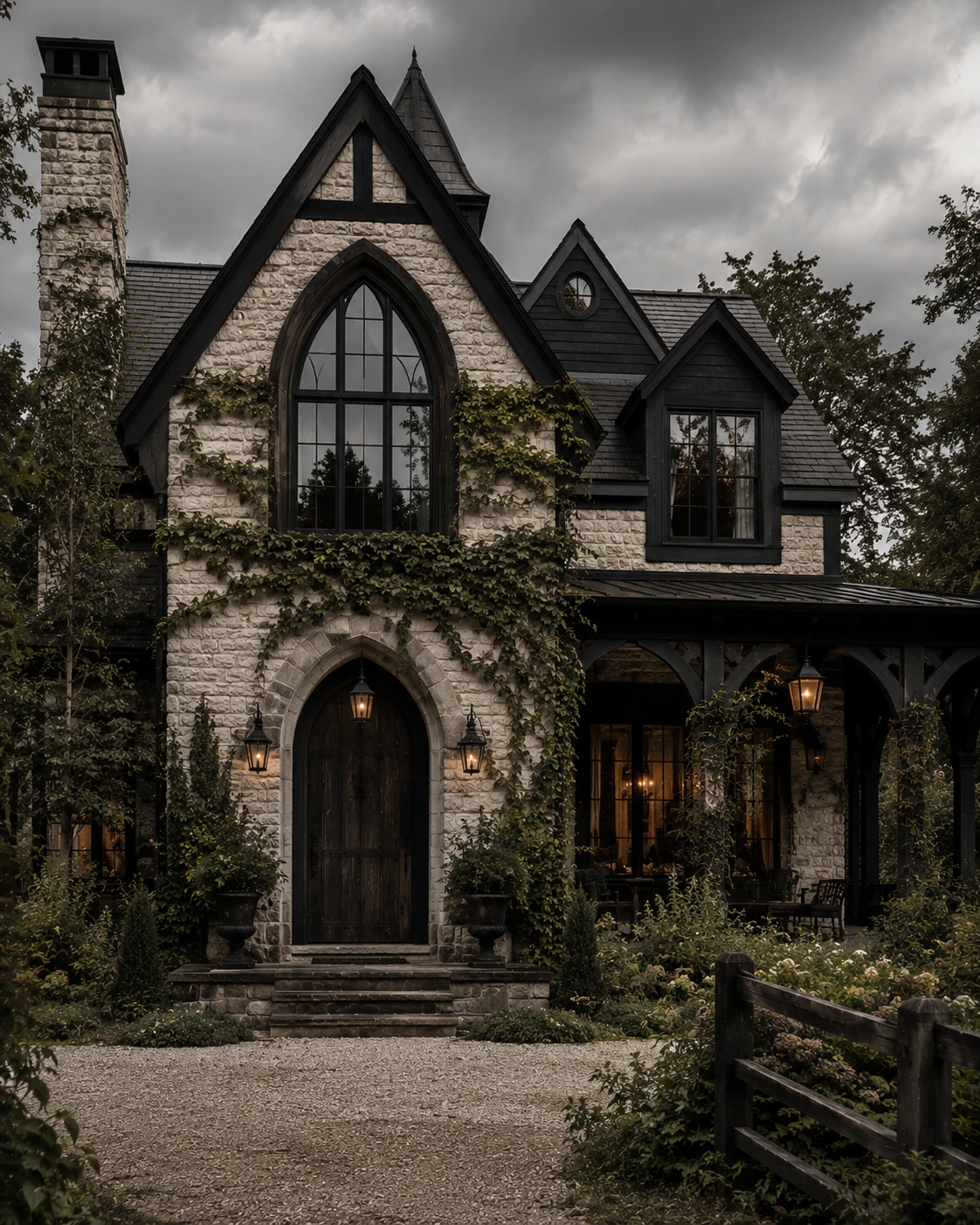
Choose a fieldstone exterior and let ivy climb at least one full storey up the front, rather than trimming it back for a tidy look. An overgrown facade is what separates this house from a new-build trying to look old.
Paint the timber trim, window frames, and front door in matte black, and keep every window on the front elevation arched to match the interior language. Flank the entrance with black urns holding simple, unfussy greenery rather than seasonal flowers.
Install lantern-style sconces on either side of the door and leave them lit even during the day. A lit lantern at noon signals the house is occupied and cared for, not staged for a listing photo.
Black Rocking Chair Row
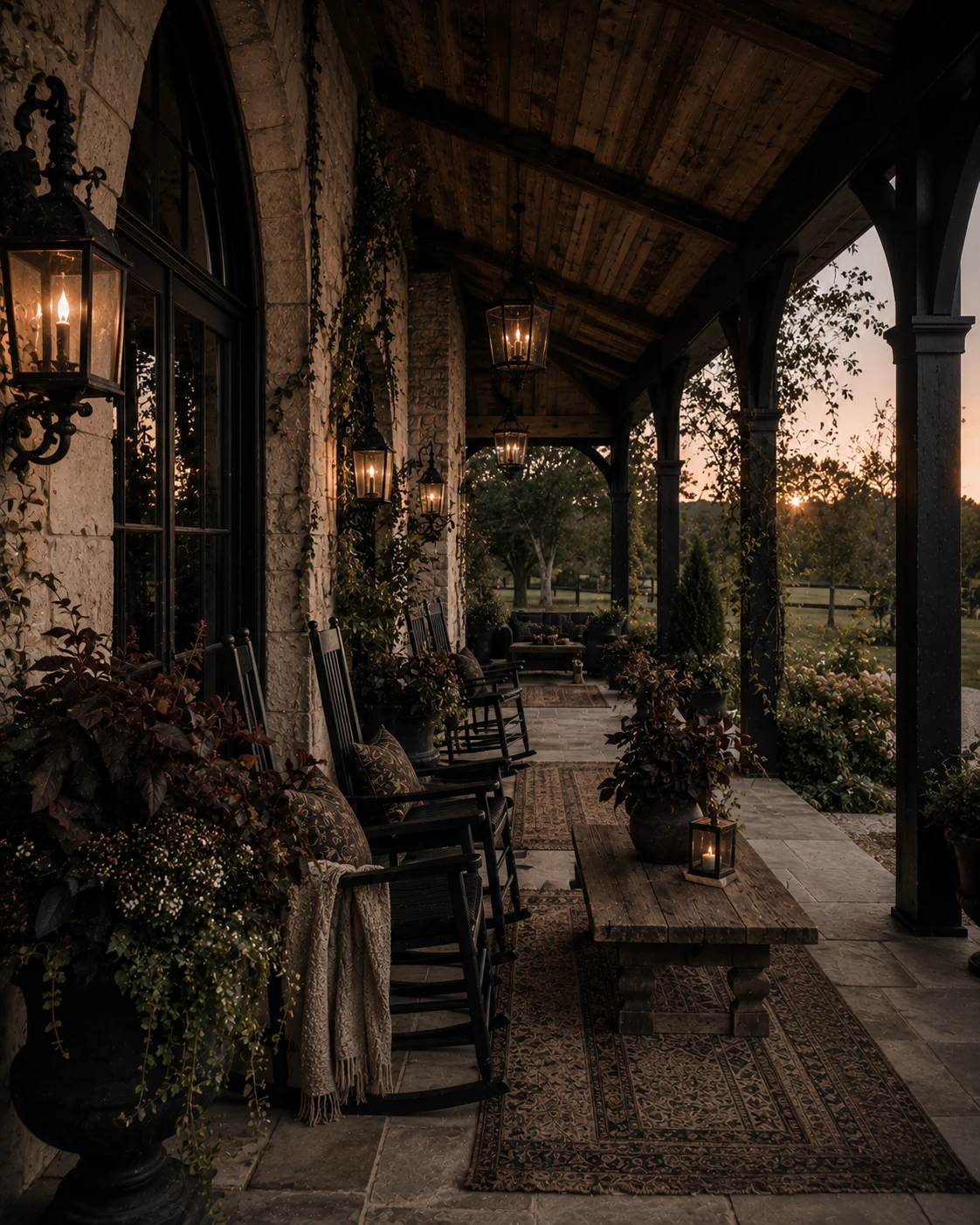
Line a covered porch with black wooden rocking chairs, spaced for conversation rather than pushed against the wall. A row of identical chairs reads more intentional than a mismatched seating arrangement out here, unlike inside the house.
Hang lantern sconces along the stone wall at a consistent height and let them be the only artificial light once the sun drops. Layer a patterned runner rug beneath the seating area to keep bare feet off cold stone.
Fill oversized black urns with dark, moody foliage — burgundy and deep green rather than anything bright — planted right at the porch’s edge. The plants should feel like they’re guarding the entrance, not decorating it.
Sunset Field Porch View
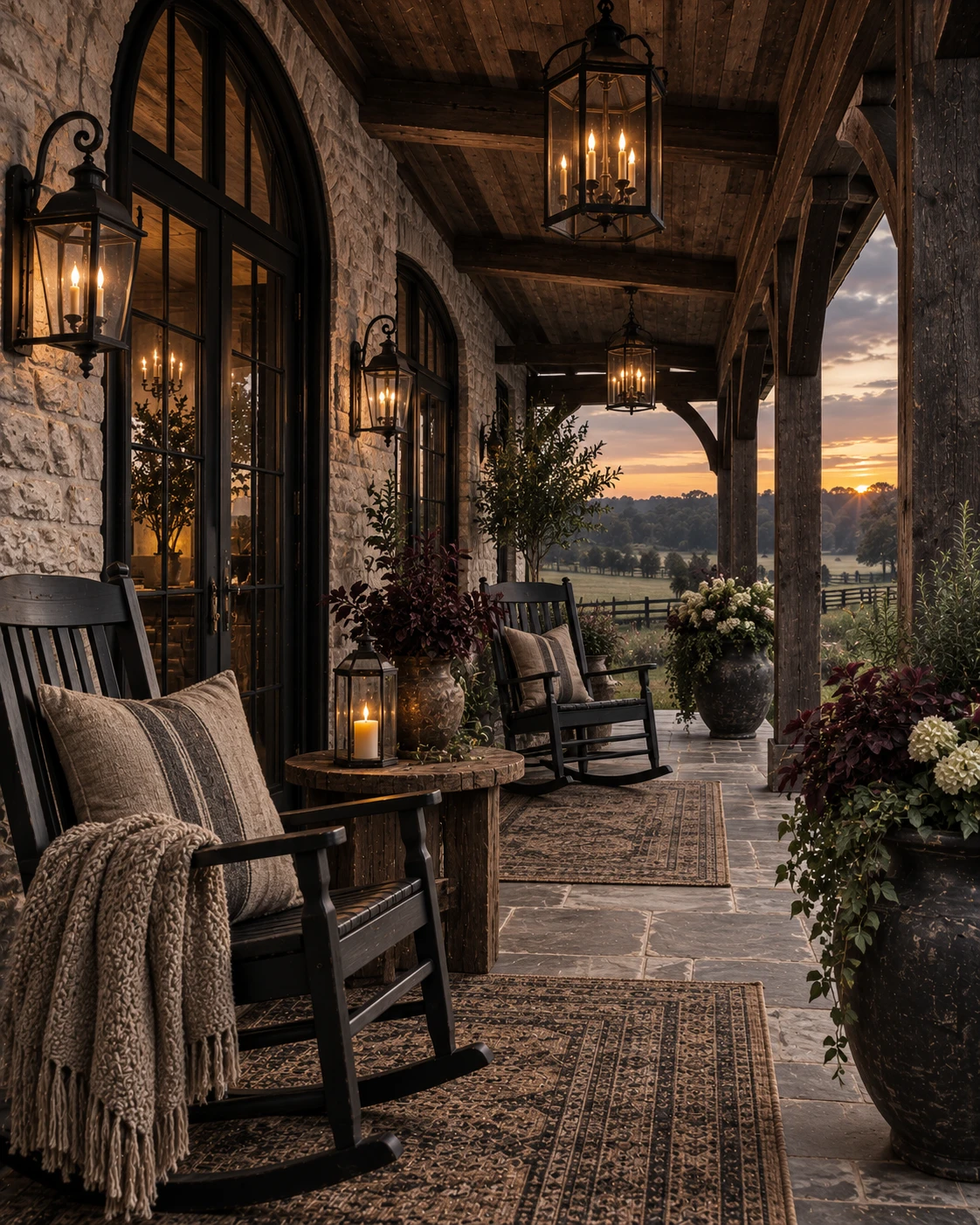
Orient the seating toward whatever view the property actually has, even if that means the furniture faces away from the house. A porch this deep can afford to prioritize the field over the facade.
Cluster a low wood coffee table between two rocking chairs and set a single lantern directly on it rather than reaching for a table lamp that would need an outlet. Battery or candle only, out here.
Layer two overlapping rugs of slightly different pattern instead of one large one. It reads as though the porch has been furnished over several seasons, not decorated in a single weekend.
Wicker Fern-Filled Sunroom
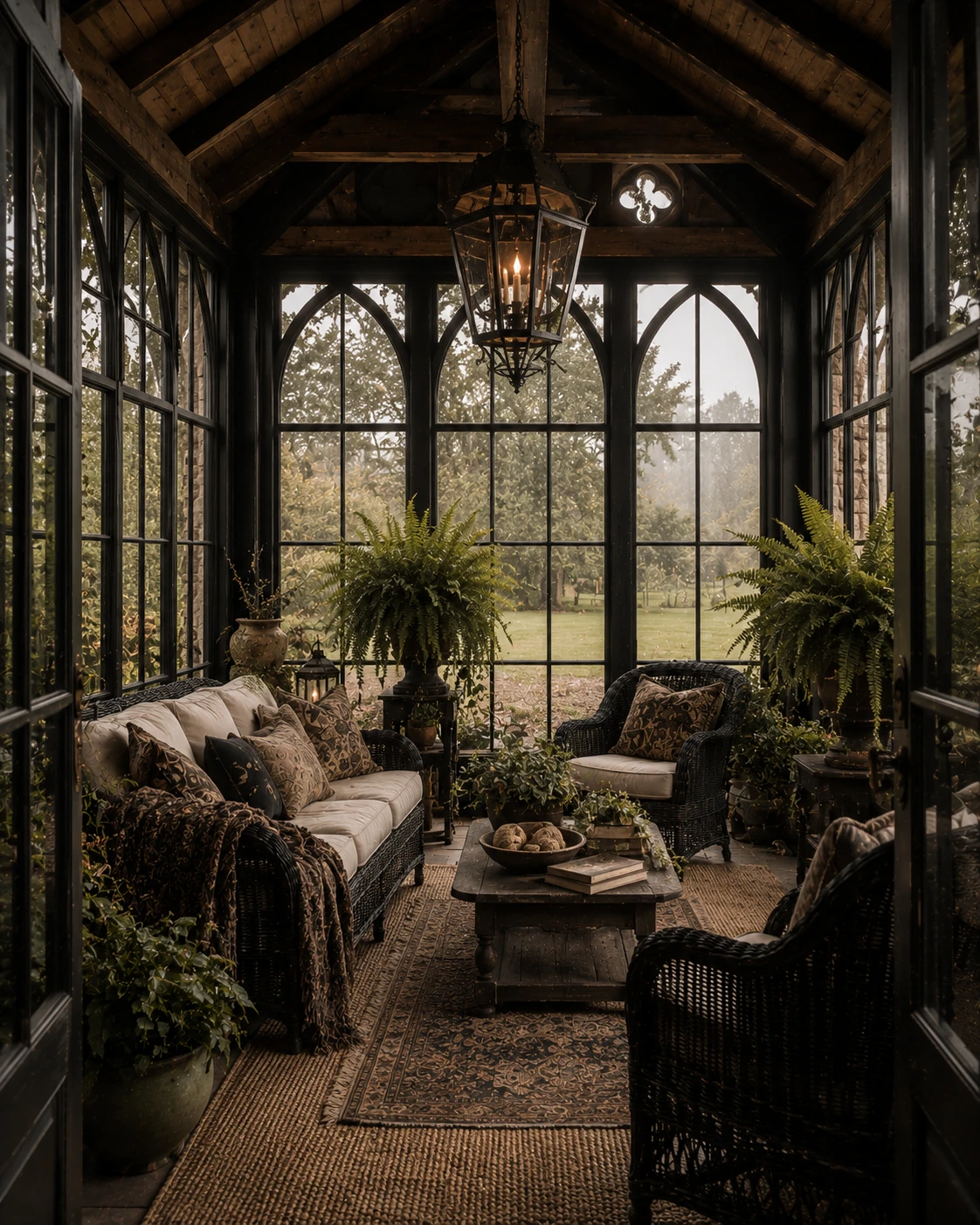
Frame a sunroom entirely in black steel-look windows on three sides, floor to peaked ceiling, so the room reads more like a greenhouse than an extra living room. Furnish it in black wicker rather than upholstered pieces, since wicker can handle the humidity that comes with this many plants.
Fill the corners with oversized Boston ferns in aged terracotta pots, chosen specifically for their size rather than trimmed to fit. A sunroom this architectural needs plants that compete with the windows, not ones that apologize for existing.
Keep the rug woven and natural rather than patterned. Every other room in the house can afford a busy floor; this one needs somewhere for the eye to rest.
Iron Bed Gothic Mirror
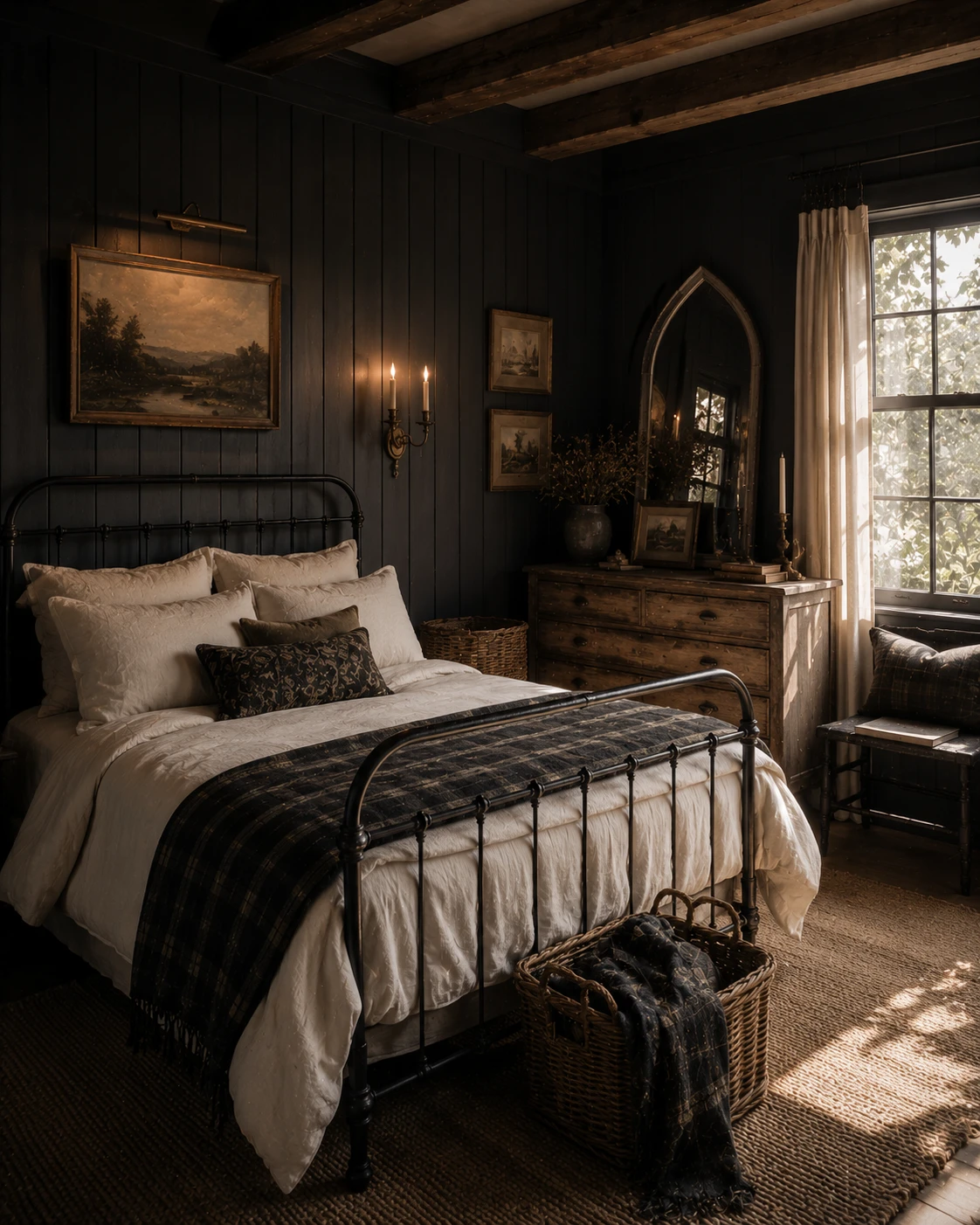
Choose a black iron bed frame over an upholstered headboard — it’s lighter visually and lets the dark shiplap walls stay the dominant material in the room. Dress it in unbleached linen bedding with a single plaid wool throw folded across the foot, the one deliberately imperfect texture in an otherwise crisp bed.
Hang a tall arched black mirror above the dresser to echo the window shape used everywhere else in the house, angled slightly rather than perfectly plumb. Flank it with a pair of small framed landscapes instead of one large piece.
Leave the windows in sheer linen rather than heavy drapery. A bedroom this dark needs every scrap of morning light it can get.
Vaulted Beam Great Room
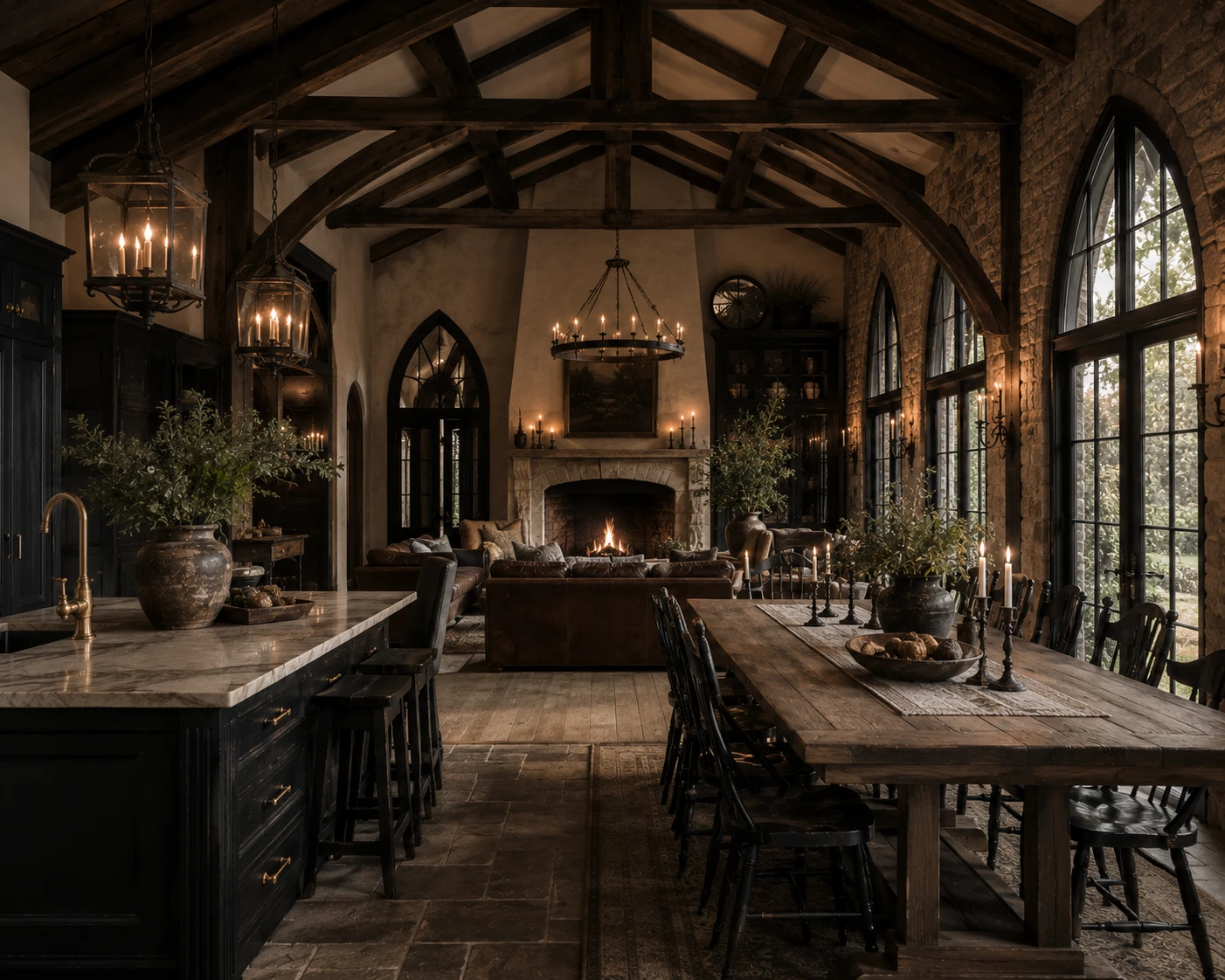
Combine kitchen, dining, and living into a single vaulted space with exposed timber trusses left completely unpainted against black lower cabinetry. The contrast between raw wood overhead and painted black below is what keeps a room this large from feeling like one flat colour block.
Hang two oversized lantern pendants over the island at different heights rather than matched, and repeat the same fixture style over the dining table for continuity across the whole room. A stone fireplace at the far end, sized to actually heat the space, anchors the sightline from every seat.
Run a long farmhouse table down one side rather than a smaller round one. A room built at this scale needs furniture willing to match it.
Final Thoughts
None of this works because of the black paint. It works because every dark surface in the house is arguing with something warm — old wood, aged brass, real fire, a plant that hasn’t been trimmed into submission.
That’s the actual principle underneath all of it. Drama needs friction. A room that’s uniformly dark just disappears; a room that’s dark and fighting a stone mantle, a brass tap, a shaft of morning light, holds your attention because your eye keeps finding new contrast to resolve.
The other thing worth stealing, regardless of whether black walls are your thing, is the discipline. One metal finish. One window shape, repeated until it becomes architecture instead of decoration. One light temperature, kept warm and low, everywhere. Most rooms fail not because the individual choices are bad but because there are too many of them competing at once.
Commit to fewer decisions and make each one count harder. That’s the whole trick, dressed up in candlelight and stone.