
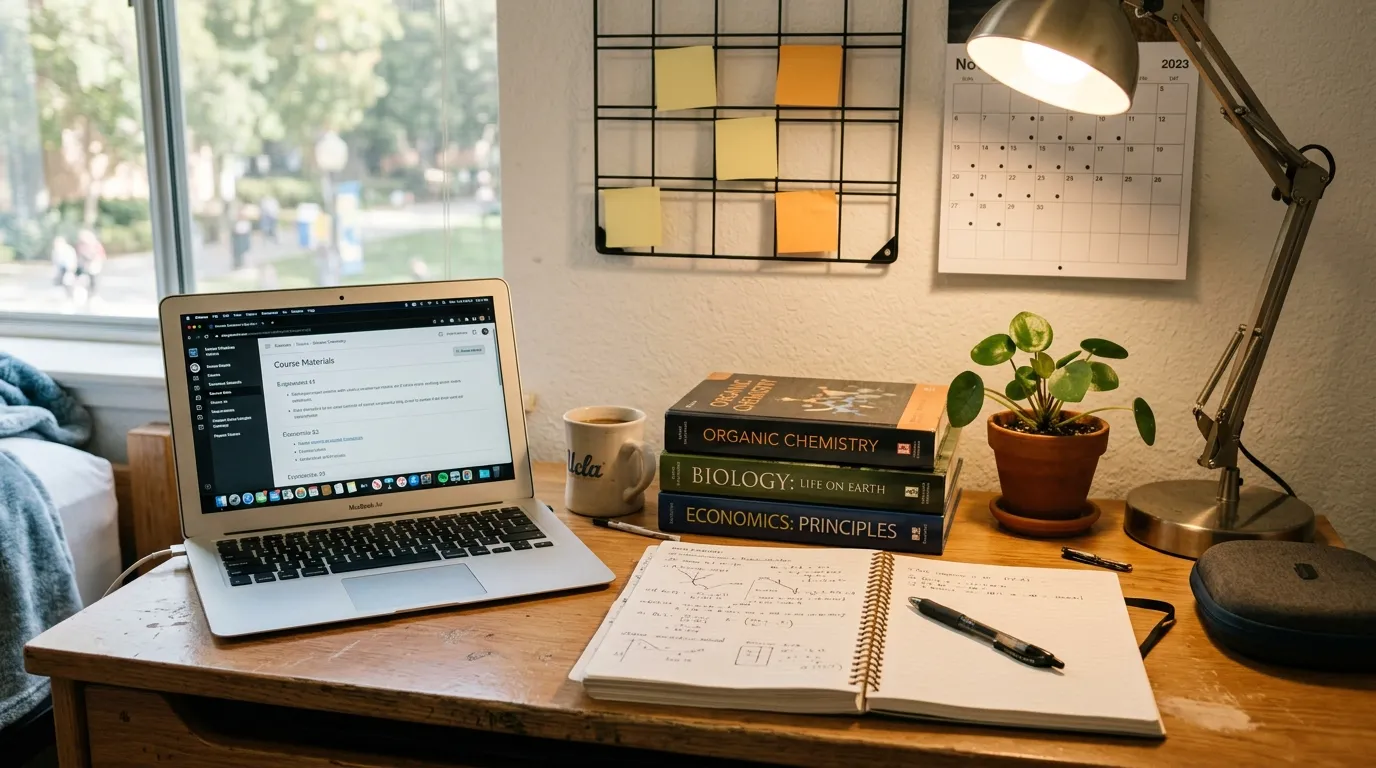
The desk you’re assigned when you move into a dorm room is, without exception, a beige rectangle with the personality of a parking ticket. Nobody told you that what happens on top of and around that desk is one of the most consequential design decisions of your college years.
You’ll spend more hours at that desk than anywhere else. More than your bed, more than the dining hall, more than that one couch in the common room that everyone avoids. And yet most students shove a laptop on it, stack some textbooks at an angle, and wonder why they can’t focus.
The desk isn’t just storage. It’s the thing that decides, every single morning, whether you feel like working or whether you feel like going back to sleep. That’s not dramatic. That’s just how environments work on the human brain.
Why Most Dorm Desks Fail Before You Even Sit Down
The problem isn’t the space. It’s not even the furniture. It’s that students treat the desk as an afterthought and then expect it to perform like a priority.
The Clutter Compromise
Most students accumulate things on their desk rather than curate them. A charger here. A half-eaten granola bar there. Three textbooks for classes they’re not in today. The water bottle they keep forgetting to refill.
Clutter isn’t neutral. It competes for attention constantly, even when you think you’re ignoring it. Every object on your desk is a micro-decision your brain has to make — does this belong here, should I move it, am I going to deal with this later? Multiply that by thirty objects and you’re exhausted before you’ve opened a single book.
The Lighting Blind Spot
Overhead dorm lighting is designed to keep you awake, not to help you think. It’s flat, it’s harsh, and it creates a working environment with all the warmth of a fluorescent-lit DMV waiting room.
A desk lamp isn’t decorative. It’s functional in ways that genuinely affect how long you can sit there. Warm, directional light keeps you calmer and more focused than overhead panels. This is the single most impactful upgrade any desk can get, and it costs almost nothing.
The Wall Void Problem
The wall behind a desk is almost always blank. Students treat it as empty space when it’s actually the most valuable real estate in a small room. Nothing in front of you while you work means nothing to anchor your attention when your eyes need to rest. A bare wall during a study session is an invitation to look at your phone.
Dorm Room Desk Setup Ideas
Scallop-Edge Pink Corner
Source or build a corner desk with gently curved or scalloped edges rather than sharp right angles — this specific shape is what makes a corner desk feel intentional rather than like a space compromise. Paint it or choose it in a muted dusty pink, not bubblegum.
The legs should be raw wood, not pink, to break the total colour saturation and keep it from reading as children’s furniture. Position a grid wire memo board on the adjacent wall for hanging photos without making holes. A matching pink Eames-style chair completes the set. Keep the desk surface genuinely minimal — one open laptop, one small plant.
The desk shape is the statement. It doesn’t need anything else to prove itself.
Pastel Acrylic Stationery Tower
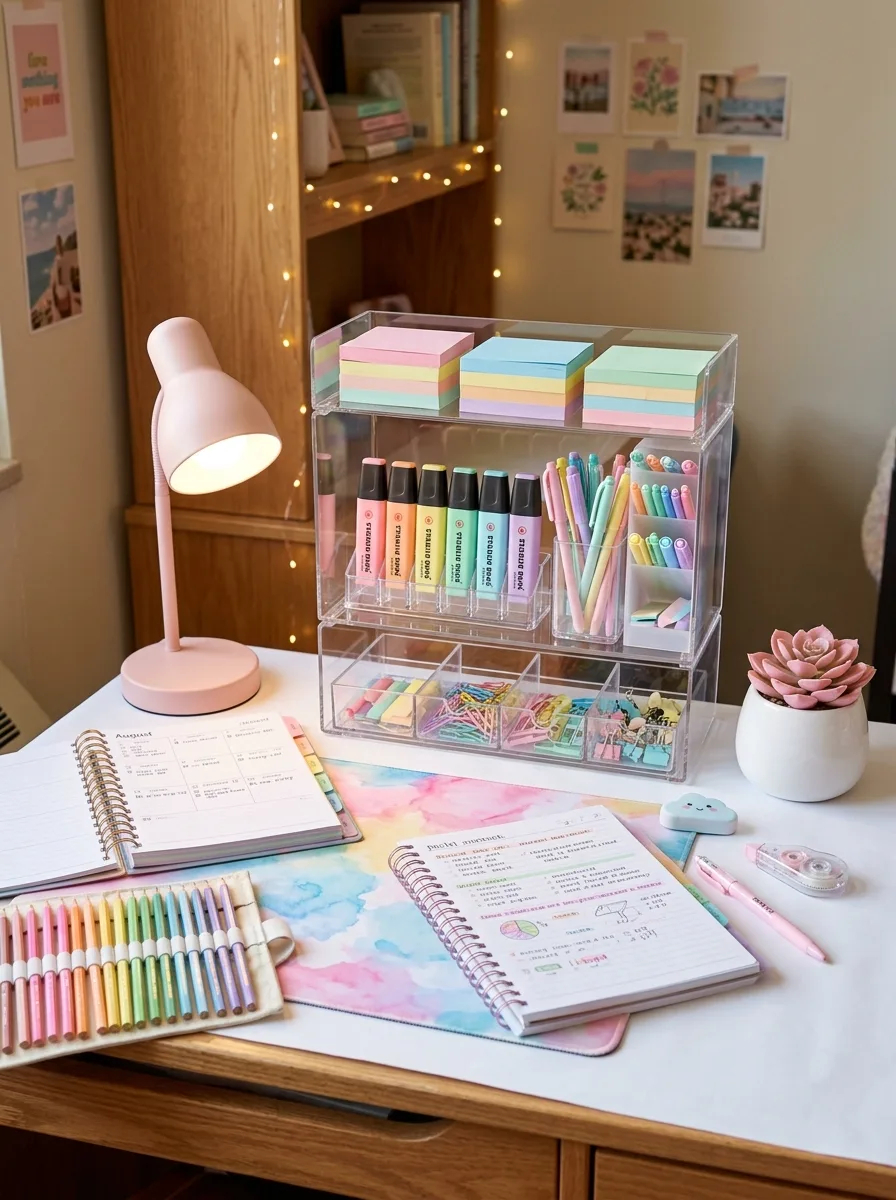
The acrylic tiered organiser is the statement piece and it must be fully loaded — pastel sticky note blocks on top, pastel highlighters and pens sorted by colour in the middle tier, clips and small tools in the bottom drawers. This is a piece of furniture as much as it is storage. The desk itself stays white. The lamp is a single-shade pink or lilac mushroom lamp shape.
The notebooks open on the desk should be decorated with watercolour washes — printed or hand-done — so the paper itself reads as art. Hang printed photos and botanical prints on the wall in an irregular grid without frames, using washi tape at the corners. The fairy lights behind the organiser create a halo effect that elevates the whole setup from functional to aspirational.
Pastel Pegboard Full System
Install a full pegboard across the wall behind the desk — floor to ceiling if possible, or at minimum 90cm x 120cm. Paint it white. Add peel-and-stick LED strips along the underside of the shelf above it for backlight. Into the pegboard, insert hooks for white buckets of pencils sorted by type, small floating shelves for plants, and a small corkboard inset for reference cards.
Above the pegboard install a full-width floating shelf in wood, lined with pastel ring binders sorted by colour from warm to cool, interspersed with small plants and storage boxes. The desk below sits on grey or white cabinets and holds only the laptop and the lamp.
Everything else lives on the wall. This is the setup that works for people who need both maximum storage and maximum working surface — the trick is to move all the storage vertical so the desk itself stays clear enough to think.
Pre-Med Flashcard Command
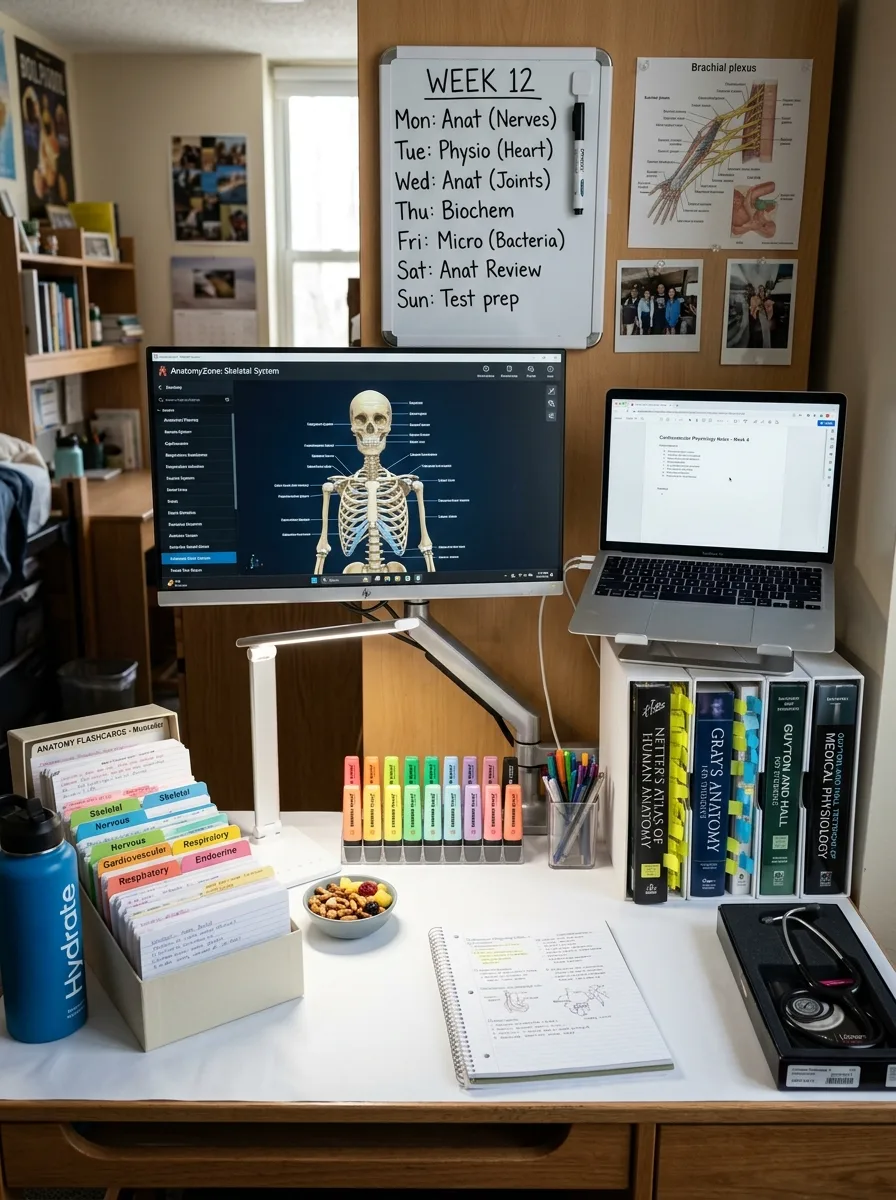
The desk surface is a working surface, not a display surface — the only decoration allowed is intentional colour. Get a row of highlighters in every colour lined up precisely across the rear of the mat, sorted by spectrum. Colour-coded flashcard organiser boxes go to the far left, with tabbed dividers by body system.
The monitor arm lifts the screen to eye level, which is mandatory — hunching over a flat screen for hours is not a study habit, it’s a back injury waiting to happen. The laptop sits on a separate stand to the right, angled for secondary reference. A stethoscope laid across the corner is functional and also tells the desk — and the person sitting at it — what they’re here for.
The whiteboard behind carries the weekly schedule by subject.
Audiophile Minimal White Studio
Position two studio-quality bookshelf speakers flanking the monitor in a symmetrical setup, with equal spacing from the screen on both sides. The speakers should be white, not black — this is not a gaming setup. A monitor light bar clips directly to the top of the screen and throws light down onto the desk surface without touching the screen, which eliminates glare.
The desk mat covers the full surface in a neutral grey or beige. A vintage-style keyboard in cream or off-white goes centre front. To the left, a closed laptop on a stand. To the right, a small control panel device for audio settings alongside a mushroom-style warm lamp.
The shelving system behind holds only things worth looking at — arranged books, a few ceramic objects, a Polaroid camera, a small clock. Every single object earns its place. The desk communicates that quality matters here more than quantity.
Brass Banker Lamp Scholar
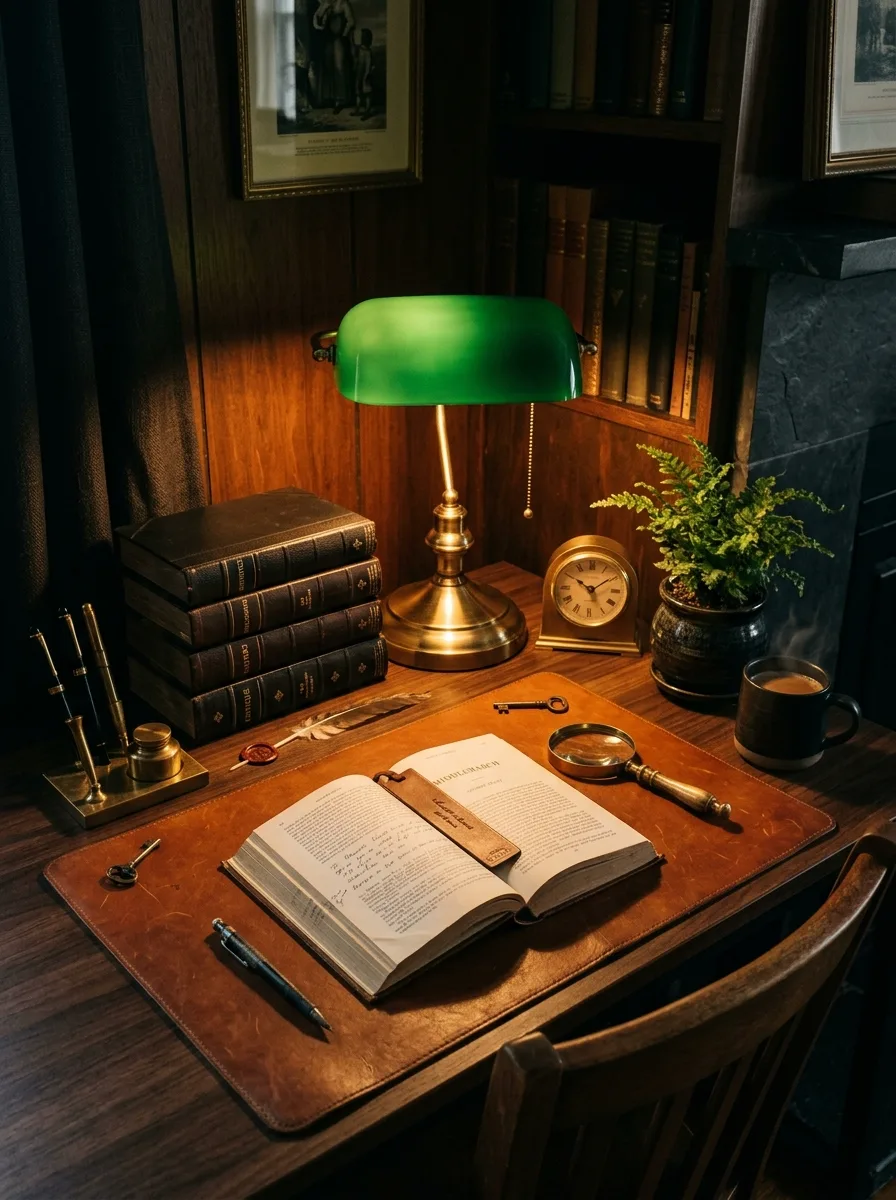
Start with a leather desk mat in cognac or deep brown — not a mousepad, a full desk mat that covers most of the working surface. This is the foundation everything sits on. On the left rear corner, place a small stack of hardback books to create height variation.
The brass banker’s lamp with its green glass shade goes centre-left, positioned so the light pools across the mat rather than shining directly into your eyes. Add a small quill-style pen holder in brass, a magnifying glass as a decorative object, and a desk clock with a visible face.
Keep only the books you are actively working with on the surface. The wall behind can hold a single framed print with a dark or antique feel. Everything reads as intentional scholarship rather than clutter.
All-White Dual Monitor Command
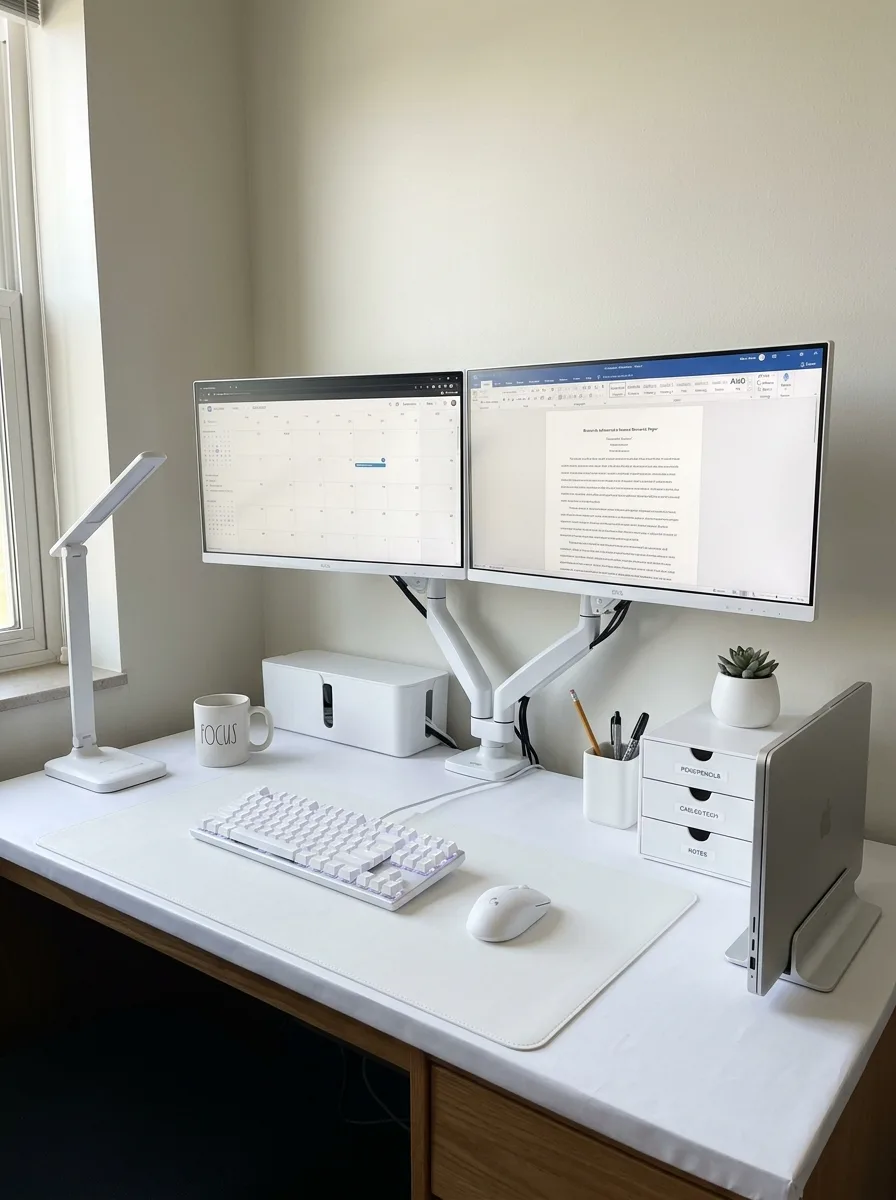
The surface needs to be completely clear of personality — this setup is about function. Get a full-coverage white or light grey desk mat that protects the surface. Mount two monitors on a dual arm mount so both screens float above the desk at eye height, which frees up the entire desktop surface below them.
Every single accessory — lamp, pen cup, cable management box, laptop stand — must be white. No exceptions. A single small succulent in a white pot is the only permitted warmth. The FOCUS mug earns its place because the sentiment functions as a visual anchor. When every object is the same colour, the eyes stop cataloguing them and your brain can get to work.
Boho Rattan Terra Cotta
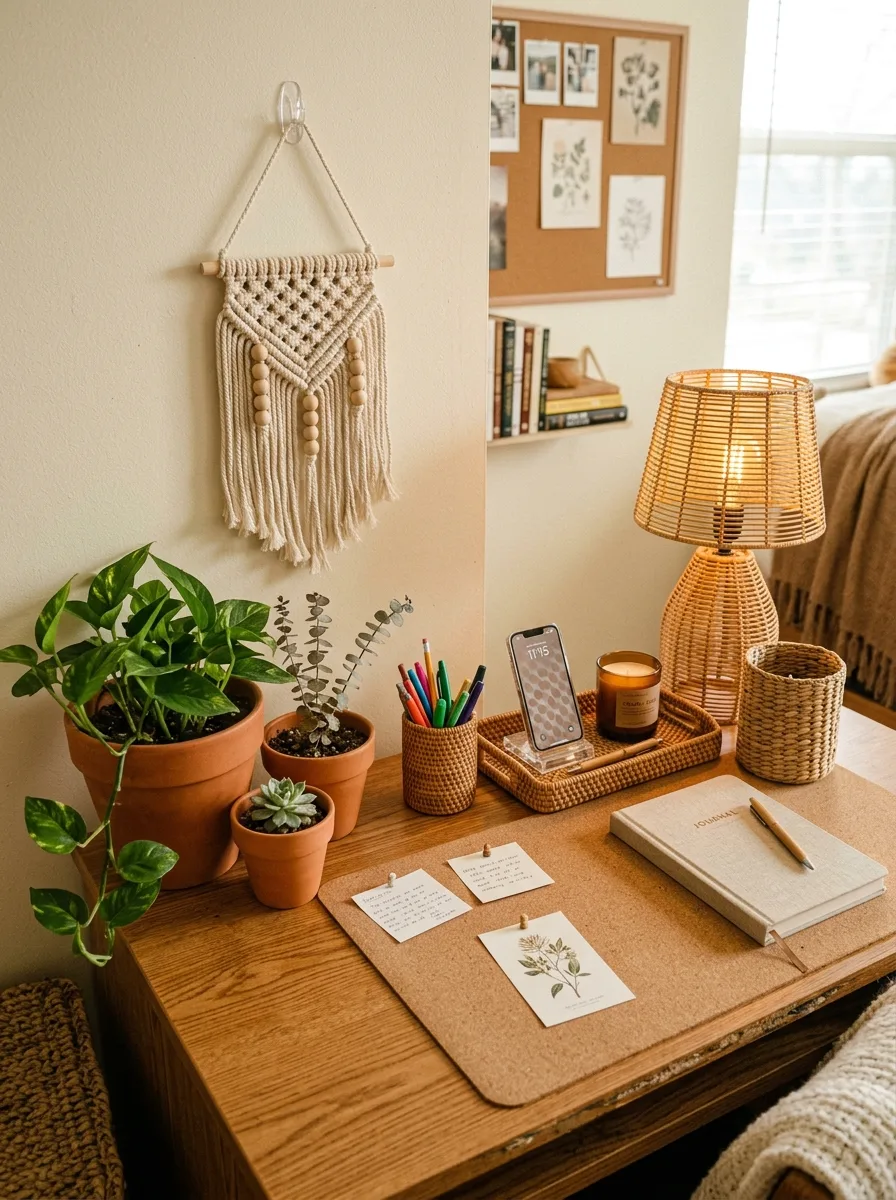
The desk surface itself should be visible wood — don’t cover it completely. Get a square cork mat rather than a full desk mat, which doubles as a pin board for notes and botanical cards. On the left, cluster two or three terracotta pots with trailing pothos and a small succulent, creating a gradient of heights.
The rattan tray corrals the things you reach for: phone stand, woven pen cup, a lit candle. Source a rattan table lamp with a visible bulb — the warm glow it casts is the defining element of this setup. Hang a small macramé piece directly on the wall above at eye level, and install a single corkboard nearby for photos and botanical prints.
The key to this look is that every container is either terracotta, rattan, or woven seagrass. No plastic visible anywhere.
Sage Green Cohesion Setup
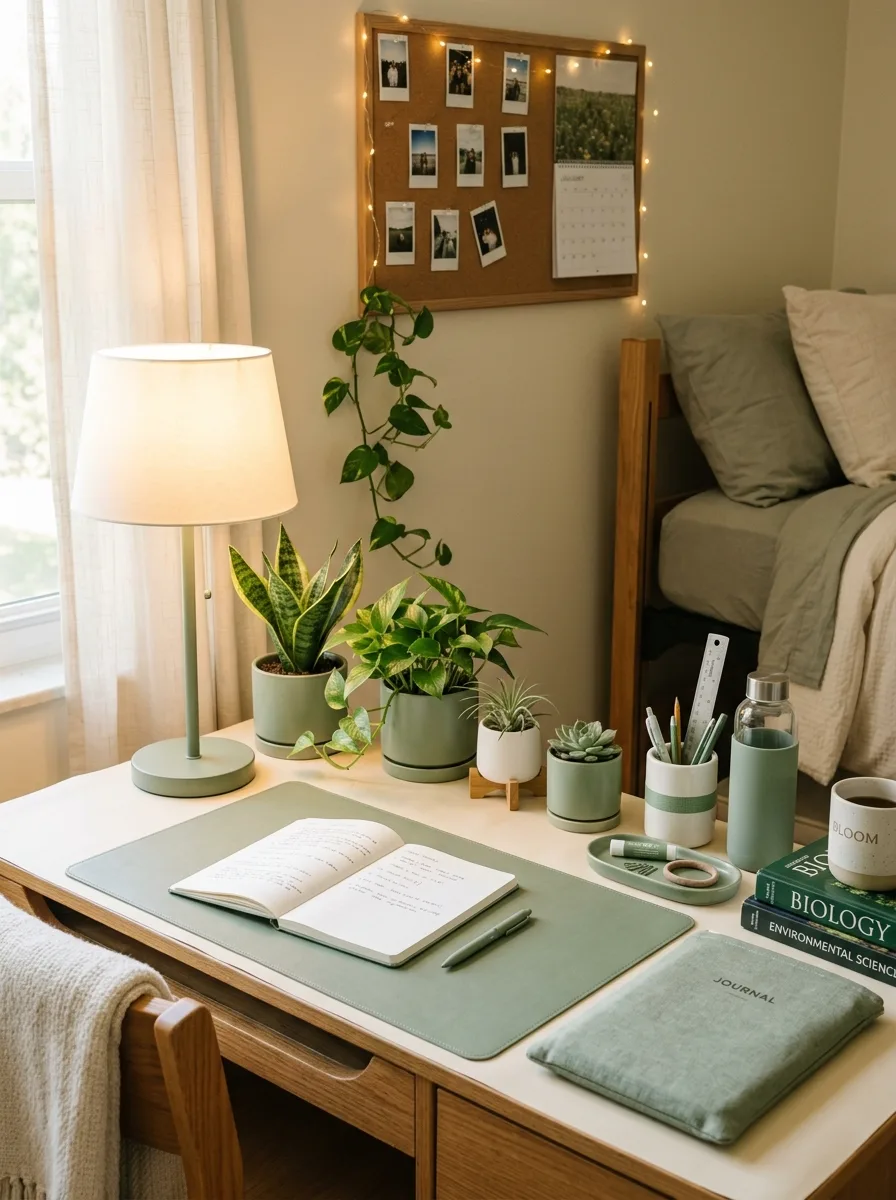
Pick your accent colour — sage green — and buy everything in it. Not approximately sage. Not moss, not olive. One specific shade of sage, tested against each other before purchase. The desk mat goes down first in sage or pale grey. The lamp base should be sage or neutral, the succulent pots sage ceramic, the pen cups sage matte.
The corkboard on the wall behind gets fairy lights around its frame for warmth rather than overhead lighting. Plant life anchors the left side — a snake plant and a trailing pothos for different heights. The open journal goes on the mat, never stacked, because this setup is always in-use, always mid-thought. The visual message is focus and calm in a single, unbroken colour story.
Ultrawide Ambient Gaming
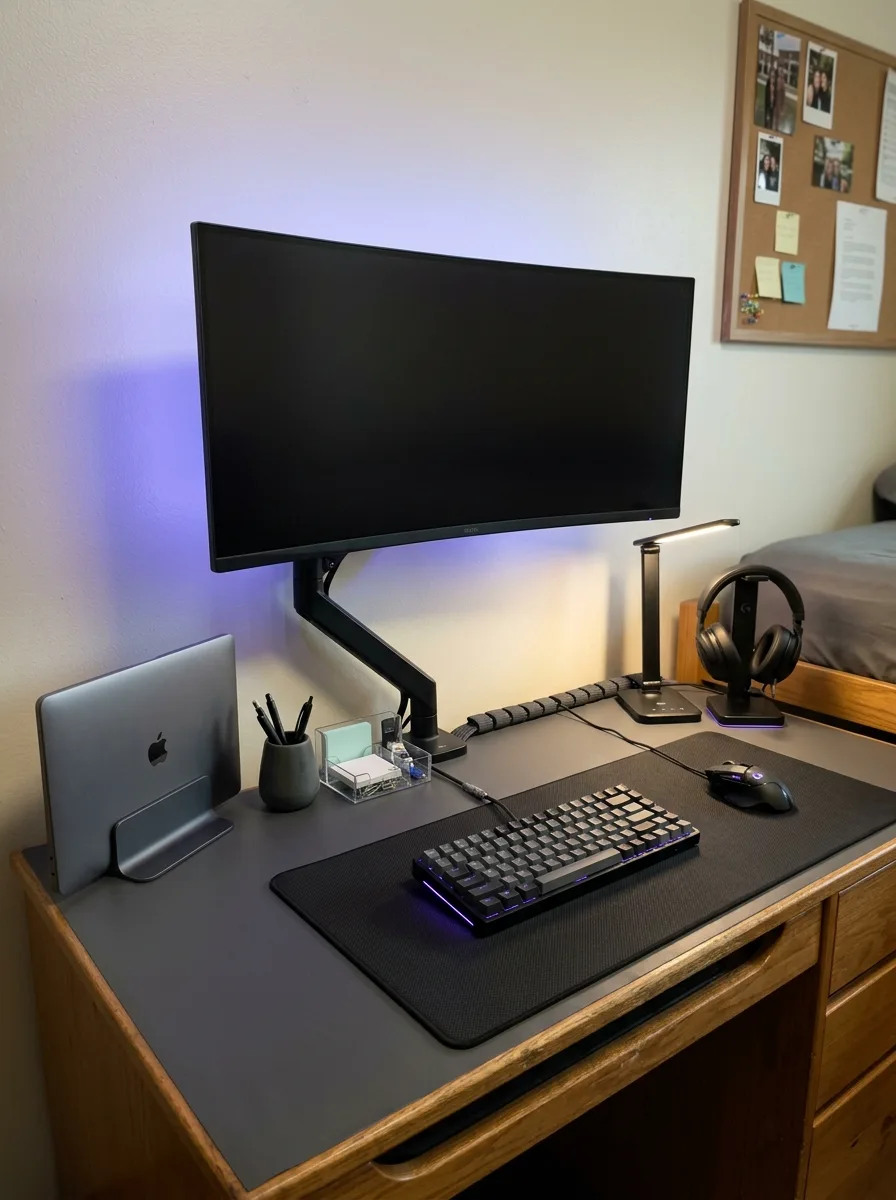
Mount an ultrawide curved monitor on a single arm at eye height. The desk mat underneath should be oversized and a single dark colour — charcoal, black, or deep grey. Run an LED strip behind the monitor, against the wall, in a single bias colour — a cool blue-purple that bleeds softly into the background.
This ambient backlight is not decoration. It reduces eye strain during long sessions and makes the monitor appear to float. On the left, a vertical laptop stand in brushed aluminium. In front, a 65% or 75% mechanical keyboard with RGB that echoes the ambient colour. Headphone stand to the right.
Cable management is not optional in this setup — every visible cable is either routed through a spine or hidden. A single desk lamp on an adjustable arm provides task lighting separate from the ambient glow.
Hollywood Mirror Vanity Hybrid
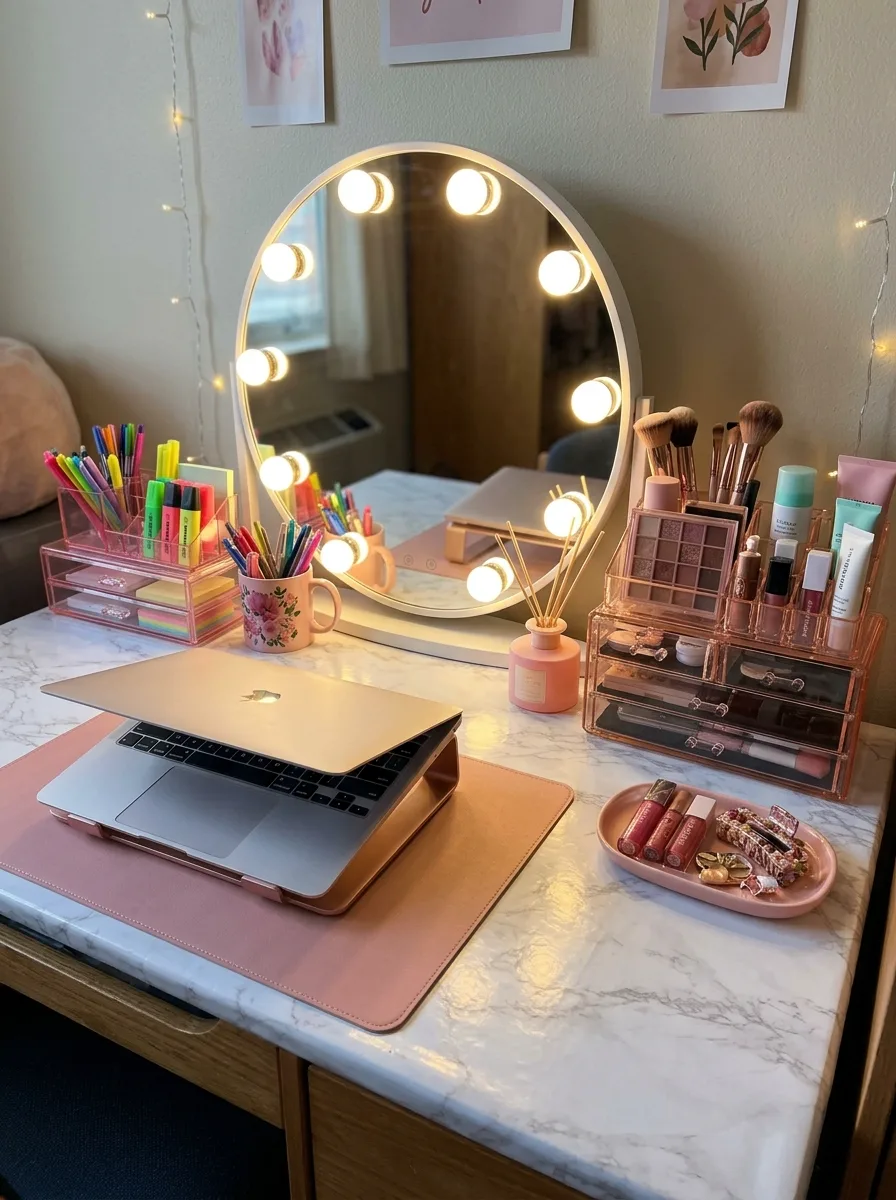
The surface needs to be marble contact paper over the existing desk, applied smoothly with a squeegee to eliminate bubbles. This is the single most transformative and affordable change any desk can get. The Hollywood-style ring mirror goes at the back centre — choose one with dimmer bulbs if possible, so it works for both studying and getting ready without being blinding.
Every organiser on this desk is either acrylic in rose gold trim or pink blush. Keep the makeup and the stationery in separate quadrants — left for study, right for beauty — so the desk functions in both modes without one invading the other. A pink leather desk mat in the working zone signals the division. The fairy lights around the perimeter stay, but they should be on a dimmer or a smart plug.
Corkboard Command Centre
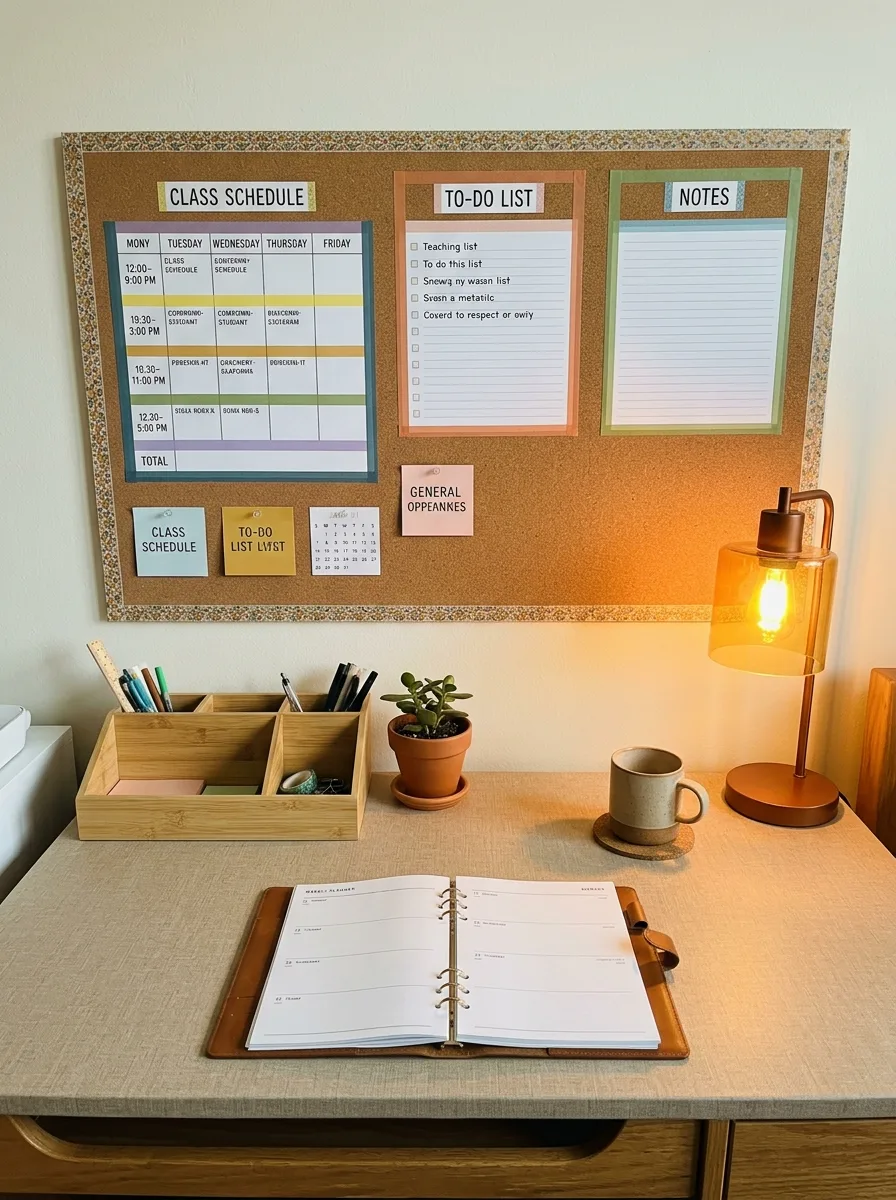
Take a large corkboard — at least 60cm x 90cm — and frame it with fabric trim or washi tape in a pattern that suits the palette. This is the centrepiece of the setup, not a secondary thing hung as an afterthought. Divide the board into three labelled sections: schedule, to-do, and notes.
Print, don’t handwrite, the section headers for visual consistency. On the desk below, use a bamboo desk organiser with multiple compartments rather than a single pen cup — this keeps the desk surface organised at the tool level. The lamp should be warm, not cold, and on the far right to cast light left across the working zone.
A neutral planner sits open on the desk, not stored, because this setup is built around visible systems rather than digital ones.
Royal Typewriter Vintage
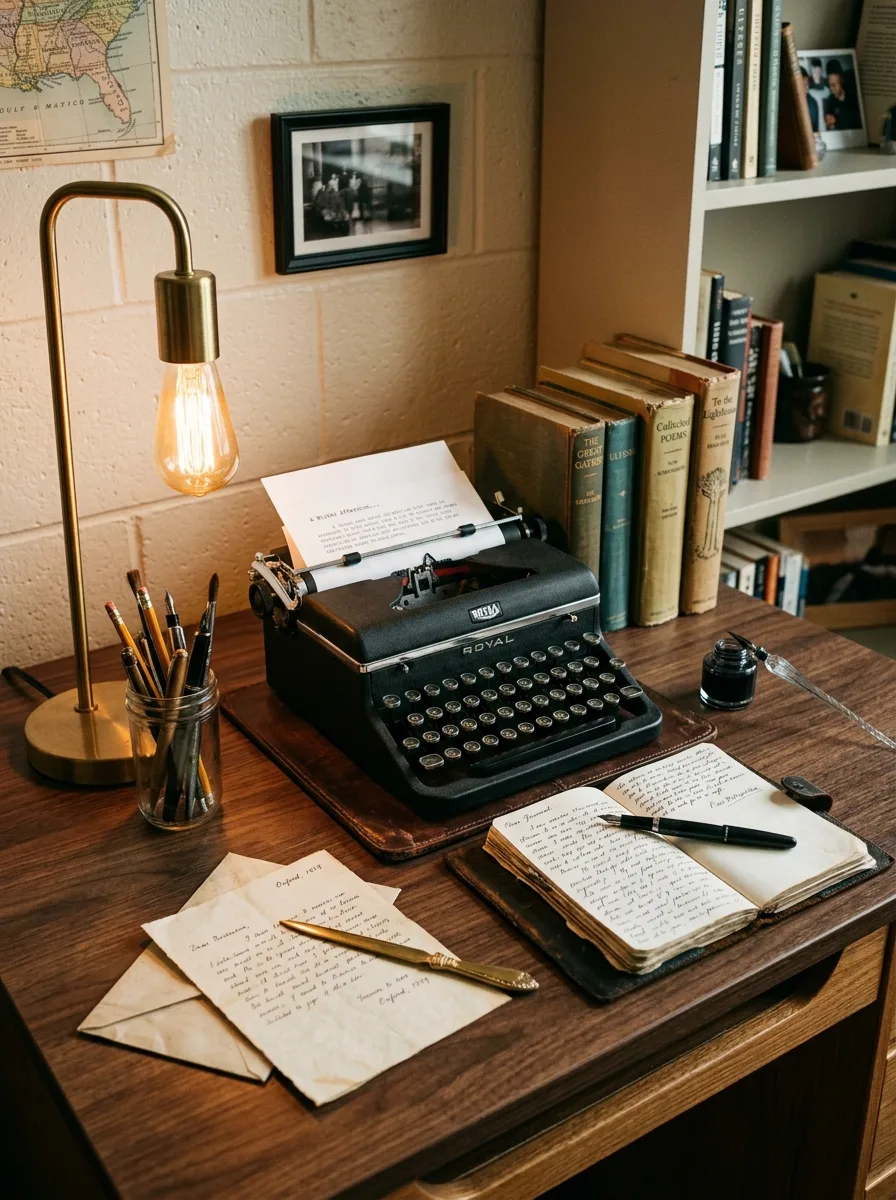
Anchor the setup with a vintage mechanical typewriter — Royal and Underwood are the most commonly found in good working condition. It goes centre-rear, not centre-front, because it needs to be a presence, not an obstacle. A glass Edison bulb on a bent brass stem goes to the left and casts its warm orange glow across the dark wood desk surface.
Use a leather pad rather than a full mat — it should look worn and functional, not pristine. A mason jar of pencils sits beside the lamp, not a formal pen cup. Letters in progress, a handwritten journal, and loose papers are part of this setup’s aesthetic — but they need to look purposeful, not forgotten. Lean a small collection of hardback books against the wall to the right.
An old map or black-and-white framed photograph goes on the brick or plaster wall behind.
All-Black Minimal Monochrome
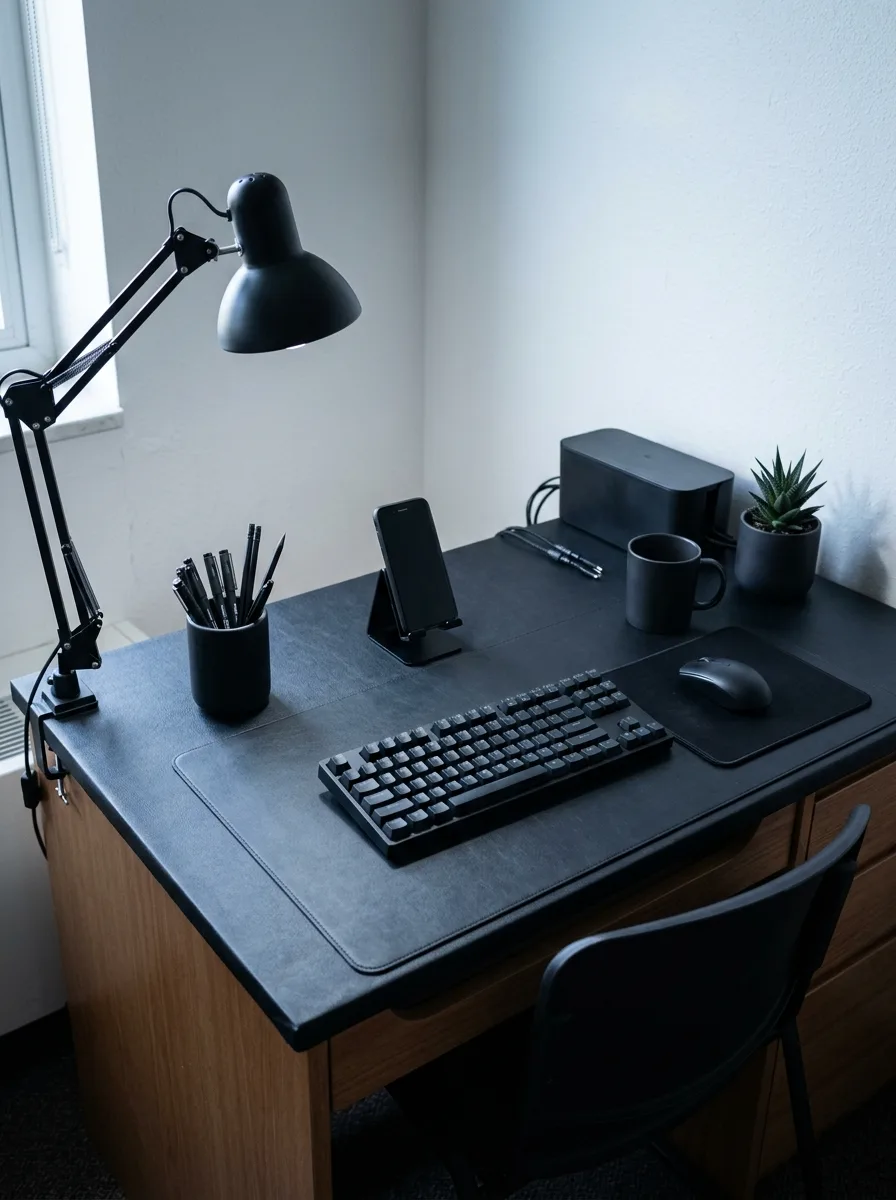
Cover the entire desk surface in a single black leather mat that reaches to every edge. The wall stays white. Every object is black — lamp (articulated, matte black), pen cup (matte black cylinder), phone stand (black), keyboard (black), mouse (black). A cable management box in black sits to the rear.
The only permitted deviation is one small aloe or cactus in a black ceramic pot — green against black is the one contrast this setup allows because it reads as oxygen, not noise. The articulated lamp goes on the far left corner, clamped to the desk edge rather than standing, to keep the surface clear. Zero paper on the desk unless actively in use. When the desk is not in use, it should look empty.
Cottagecore Pressed Botanical
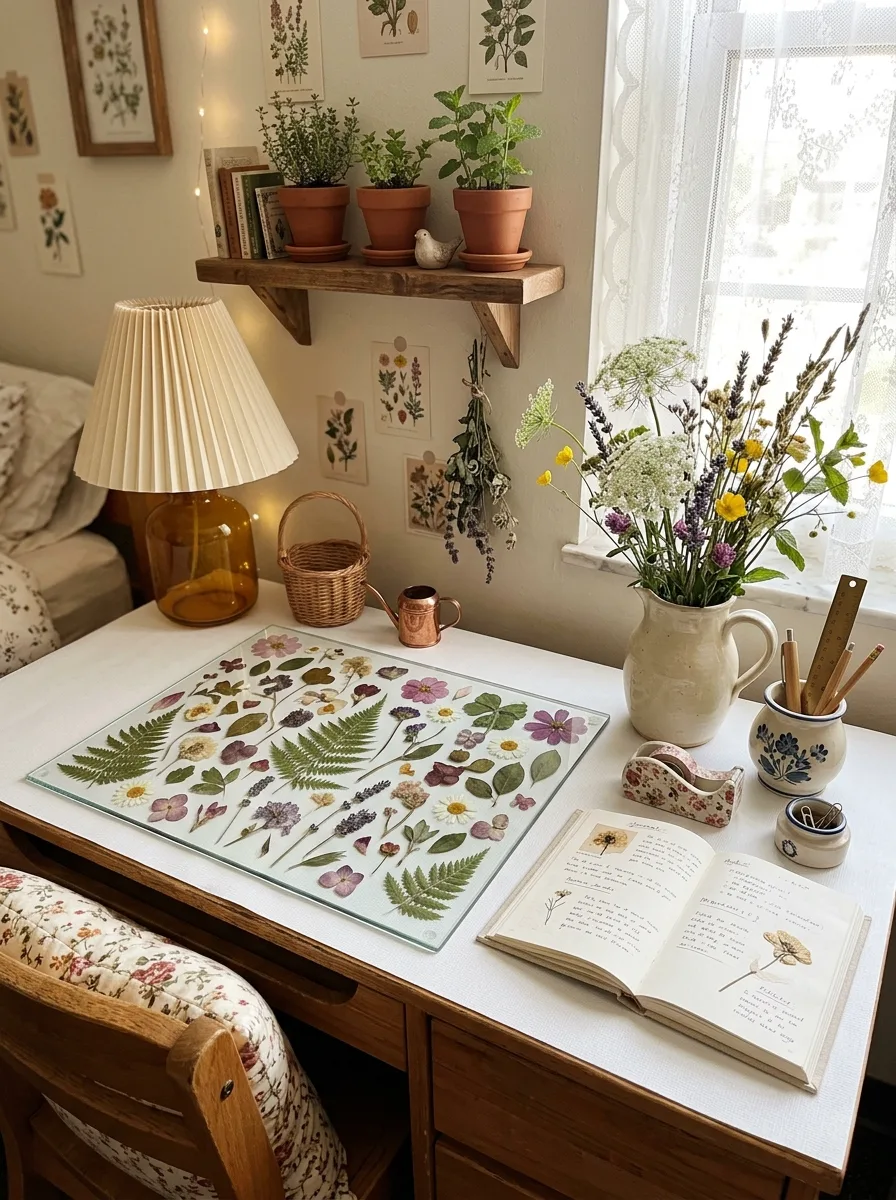
The desk surface should be white or pale — the bones need to be quiet so the botanical elements read clearly. Get a glass-topped pressed flower desk mat — a sheet of glass cut to size over a flat display of pressed flowers, ferns, and leaves arranged on white paper.
The glass protects it and creates a display that functions as a working surface simultaneously. A pleated-shade amber glass lamp goes to the left for warmth. Source a ceramic pitcher for flowers from charity shops or markets — one that is imperfect, not matching — and keep real seasonal flowers in it. Use a wooden floating shelf above the desk for terracotta pots of herbs.
A floral-print journal sits open. Every pen holder and small storage vessel should be ceramic with a hand-painted or folk art quality to it. The wall gets botanical prints, not posters.
Navy Gold Scholar Flat
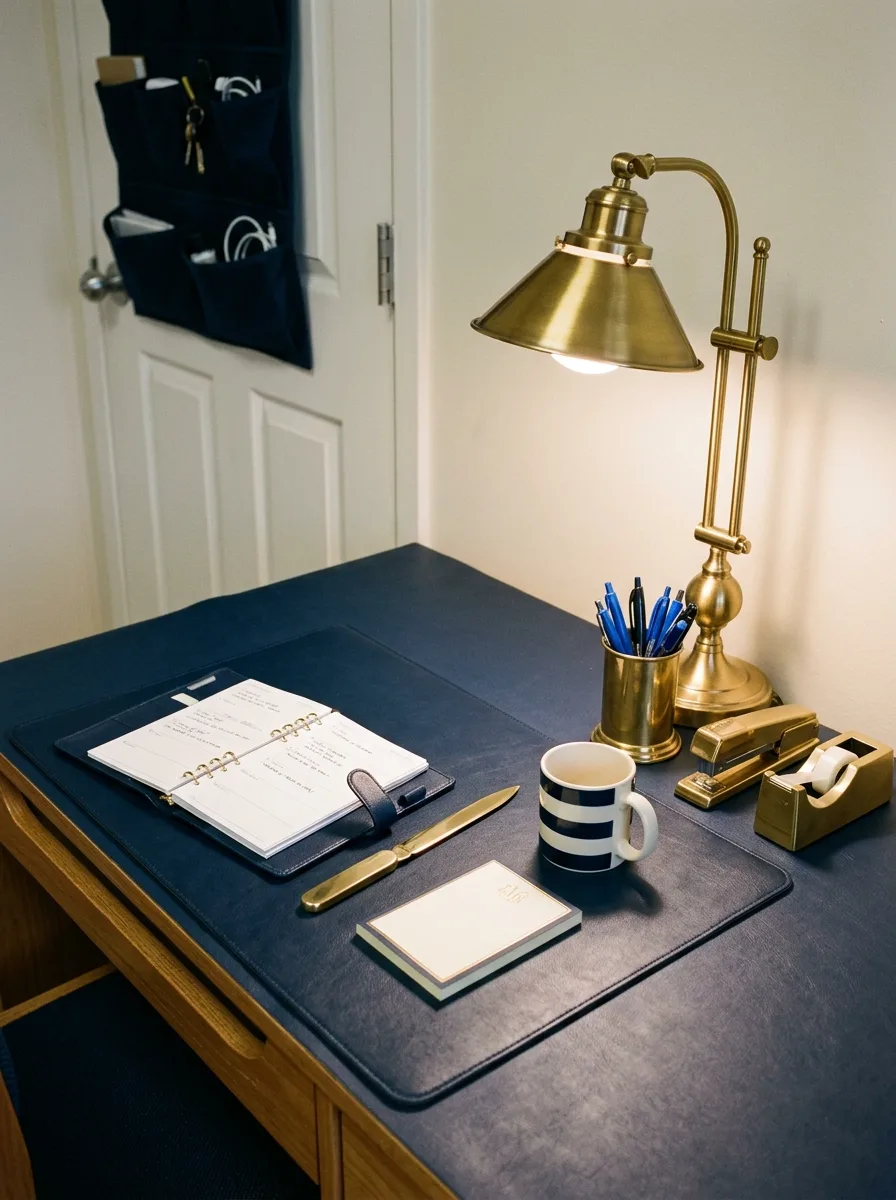
The full-coverage navy blue leather desk mat is what makes this setup. It replaces the entire desk surface visually and turns any beige desk into something that reads as expensive and considered. Every metal accent must be aged brass — the lamp (a tall adjustable scholar style), the pen cup, the letter opener, the stapler, the tape dispenser.
No chrome, no silver, no black metal. The desk accessories stay sparse: the open planner on the left, the striped navy and white mug to the right of centre, a small notepad for loose thoughts. A navy door organiser handles all the cables, chargers, and small utility items that would otherwise creep onto the desk. Keeping the desk surface clear is the entire discipline of this setup.
Engineering Dual-Screen War Room
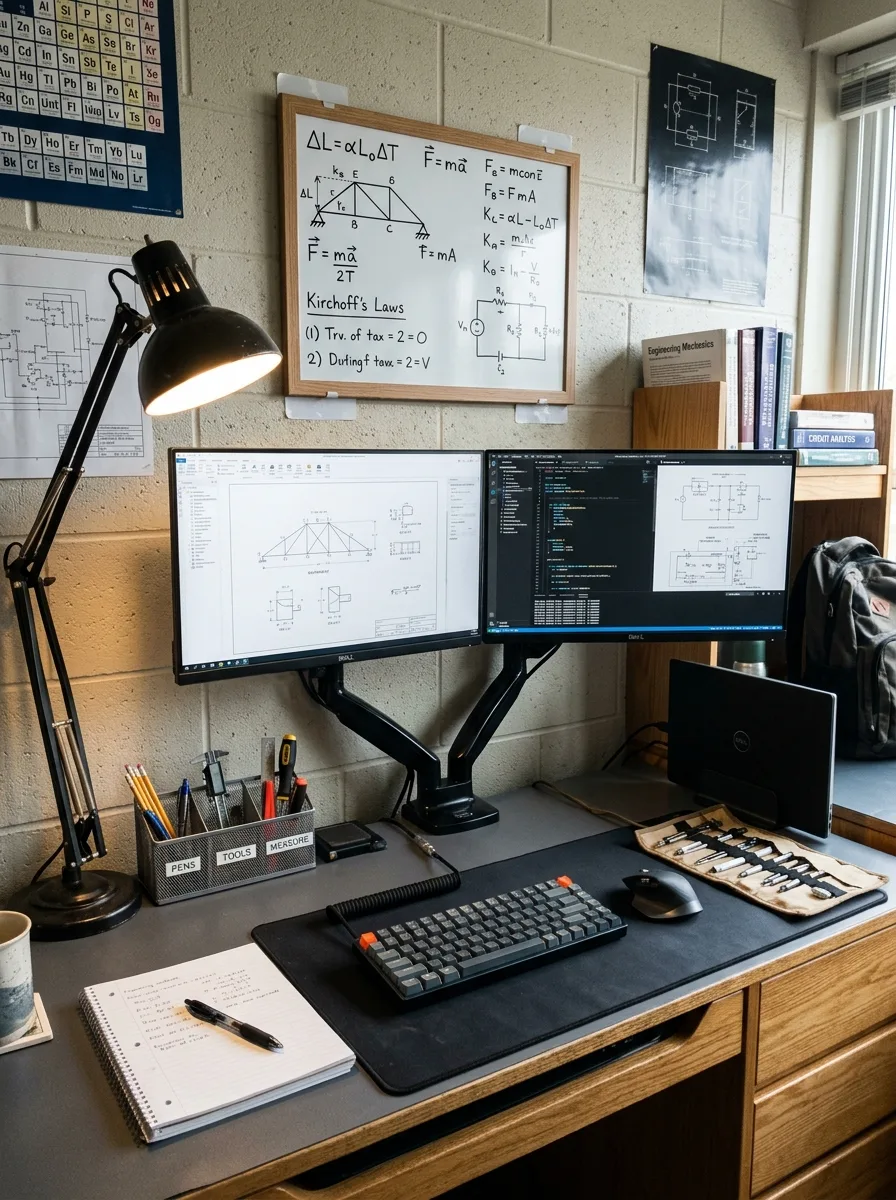
Mount two monitors side by side on a dual arm — the left for reference material, the right for working documents or code. A whiteboard directly above on the wall is not optional — it’s the workspace for equations, diagrams, and the things too complex to hold in a text document. Pin a periodic table and a circuit diagram to the cinder block wall alongside it.
The desk itself should have a full dark mat to unify everything. An adjustable clamp lamp on the far left provides working light. Organise desk supplies with labeled dividers — pens, tools, measuring instruments kept separate and visible. A mesh wire pen organiser with multiple compartments handles the variety. The desk needs to communicate that multiple kinds of work happen here and that each kind has its place.
Fairy Light Memory Wall
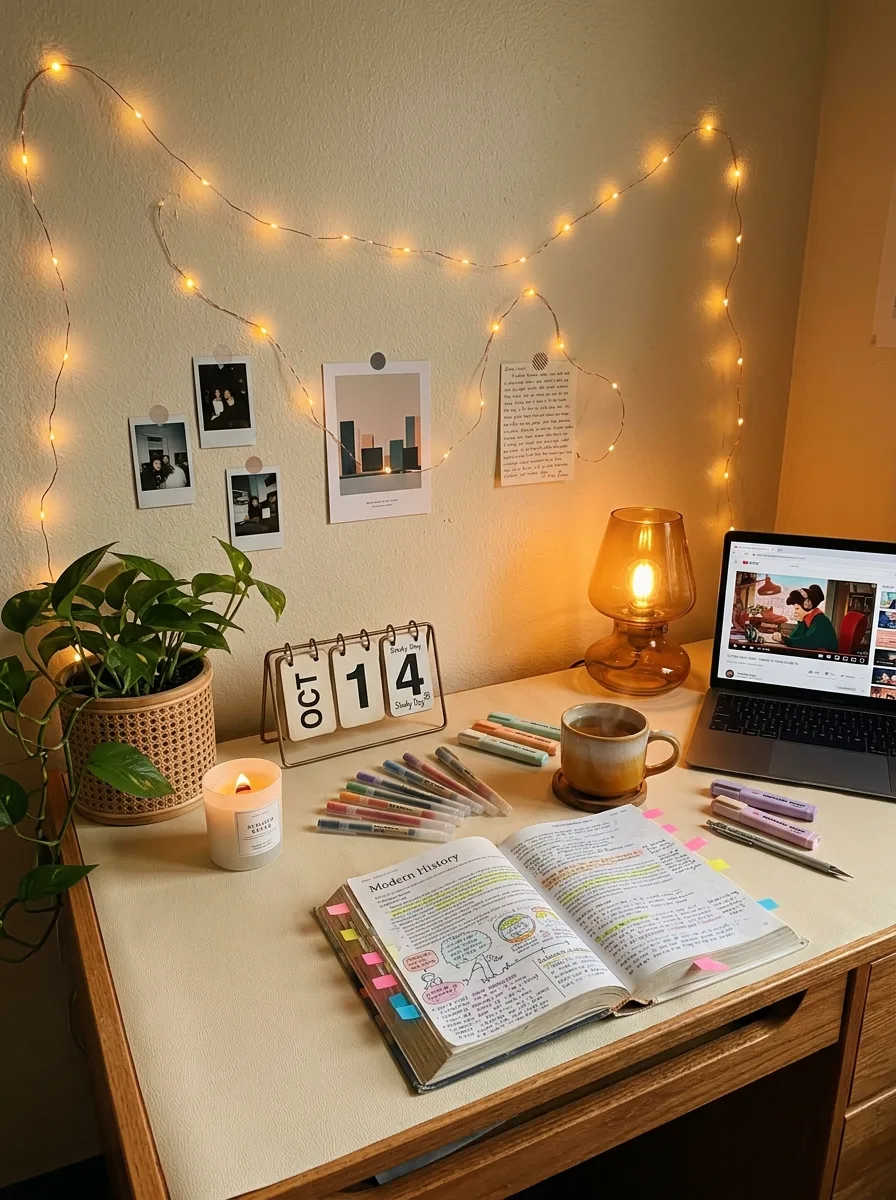
String warm white fairy lights in a loose drape across the entire wall behind and above the desk, anchored at each corner and allowed to sag naturally in the centre — not stretched taut in a grid. This is the ambient element that makes everything else glow. Below the lights, use magnetic or tape-mounted hooks to display polaroid photos, a small print, and a handwritten quote.
On the desk itself, an amber glass mushroom lamp provides task light. An open book of colour-tabbed notes sits centre-left. A desk calendar functions as both functional and decorative. Keep a candle in the working zone — it sounds indulgent until you realise it signals to your brain that this session has started, the same way turning on the same lamp every night signals it’s time to sleep.
The warm light from three different sources — fairy lights, mushroom lamp, candle — creates a layered glow that no overhead light can match.
Final Thoughts
What every one of these setups has in common isn’t a colour or a lamp or a particular kind of organiser. It’s commitment.
The setups that don’t work are the ones built by accretion — a little bit from one inspiration, a little bit from another, a bit of what was already there, a bit of what was on sale. Rooms built by accretion don’t have a point of view. And a desk without a point of view doesn’t hold your attention.
Your desk doesn’t have to be expensive. But it does have to be decided. Pick a direction and follow it, even when it means returning a thing that doesn’t fit.
The students who sit down and actually work aren’t doing it through sheer willpower. They’ve built an environment that makes working feel like the natural next thing. That’s not a trick. That’s just design doing what design is supposed to do.