
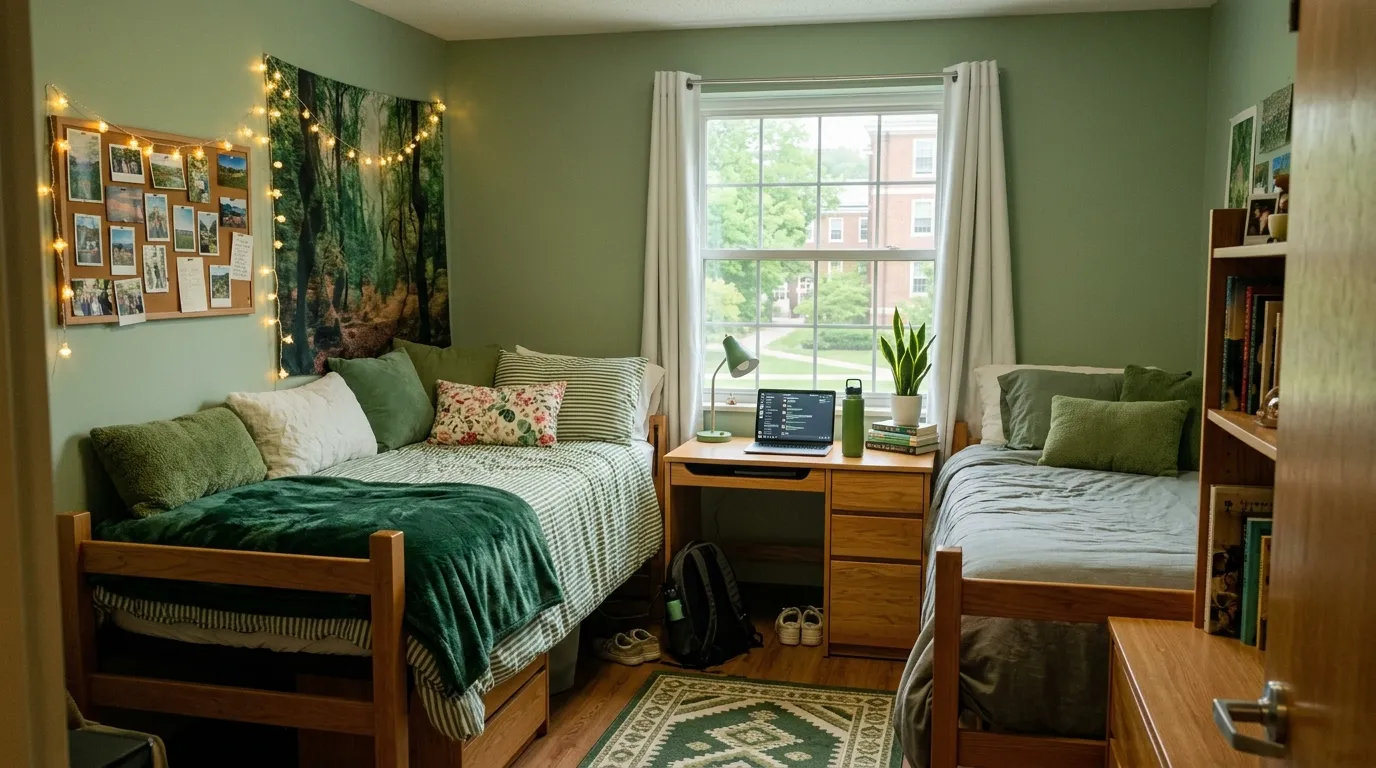
The standard dorm room exists to humble you. Cinder block walls. Fluorescent overhead lighting. A mattress that has absorbed the ambitions of seventeen previous tenants. The university has done its worst. Now it’s your turn.
Most people respond to this by buying a string of fairy lights and calling it a day. And then they spend nine months in a room that looks like a sad Pinterest board from 2014. The lights stay up, the room stays beige, and the space never becomes anything more than a place to sleep between classes.
Green changes that. Not a scattered accent here and there — actual commitment to a colour with depth, range, and personality. Green runs from ink-dark emerald to dusty sage to mossy olive. It works with warm wood, with brass, with white, with rattan, with literally everything that isn’t trying too hard. It is, quietly, the most liveable colour in a dorm context.
This blog is about doing it properly.
Green Dorm Room Ideas
Sage Green Gallery Wall Collage
The bed is a floor mattress — a quality foam or futon-style mattress set directly on the floor, Korean-style. This is not laziness. It is a design decision. A floor bed expands the perceived height of the room, makes the wall behind it appear taller, and creates a different spatial relationship with the space.
Around and above the mattress on the wall, build a layered gallery of images. Large landscape prints — skies, forests, cities from above, architectural details. Smaller photographs, film stills, watercolour postcards. A few handwritten notes. A plant shelf at head height with a trailing pothos. A small green skateboard mounted as a sculptural object.
The desk beside it is low and simple with a rattan or cane-back chair. The setup on the desk is personal and specific: a mechanical keyboard in sage green, a laptop, a small speaker, a tiny lamp. These are not decoration — they’re just the desk of someone who uses it daily and has arranged it exactly as it needs to be. That specificity reads as design.
Let the room look lived in. The aesthetic depends on it.
All-In Emerald Envelope
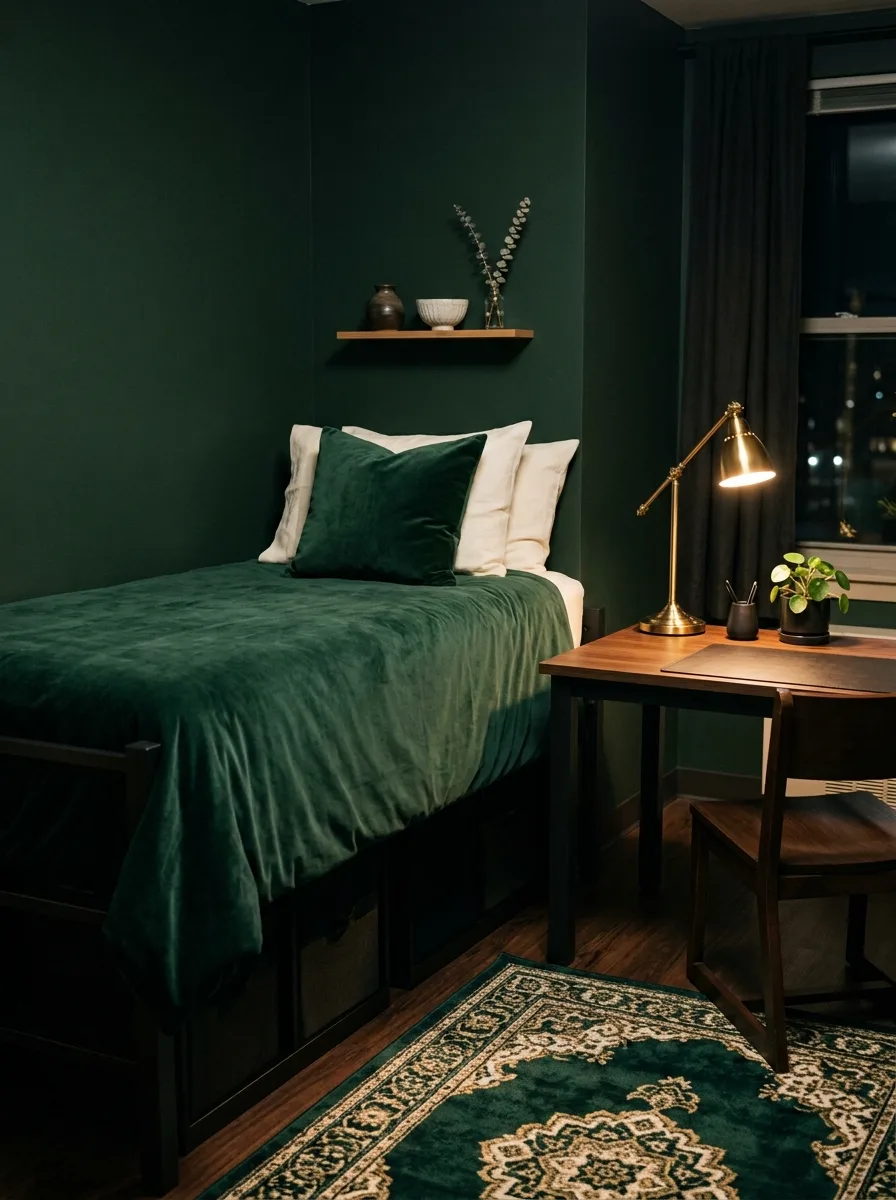
Paint every wall — and I mean every wall — in a deep, saturated emerald. Not one accent wall, not a feature behind the bed. Every single wall. Buy a litre of Benjamin Moore’s Tarrytown Green or Sherwin-Williams Jasper and commit completely.
The ceiling stays white. That contrast is what prevents the room from going claustrophobic.
The bedding keeps entirely to emerald as well — a velvet or microfibre duvet in the same family as the walls. Layer in cream or ivory pillow cases rather than white ones; white is too sharp against a wall this saturated and reads as a mistake rather than a contrast. The creamy tones bridge the gap between the deep wall colour and the bedding.
Warm the room with a walnut or mahogany-finish desk and chair in medium brown, not black. Add a brass desk lamp with a swing-arm or articulated neck — the kind that looks borrowed from a library reading room. A Persian-style rug in green and ivory on the floor ties the wood and the walls together.
Keep the shelf above the bed minimal: one ceramic vase, one small bowl, one dried stem. The room is already making a statement. The accessories don’t need to fight for space.
Sage Bunk Built-In Maximalist
The built-in bunk is painted in a single sage — walls, frame, slats, trim, and the band of decorative Greek key moulding along the bunk divider all in the same tone. The ceiling is papered in a small-scale geometric pattern in sage and cream. When everything is the same green, the architecture becomes a room inside a room.
The bedding on each bunk pulls in earth tones against the sage: a heathered grey wool or camp blanket in grey and olive stripes on the lower bunk, mixed with cream gingham-check and pattern-on-pattern on the upper. The contrast in pattern between bunks reads as a deliberate decision rather than a mismatch.
The window gets a layered treatment: a Roman shade in the sage-and-cream medallion fabric as the inner layer, and a floor-length panel in a large-scale version of the same pattern in teal and cream as the outer layer. Mounting the panels at ceiling height makes the window appear to run floor to ceiling.
A white ceramic garden stool serves as a beside table. A globe pendant in white hangs with a brass fitting above. The rug on the floor is a low-profile natural fibre stripe in cream and taupe. This room commits to its own internal logic entirely. Everything is intentional and none of it is restrained.
Mint and Crate Pragmatist
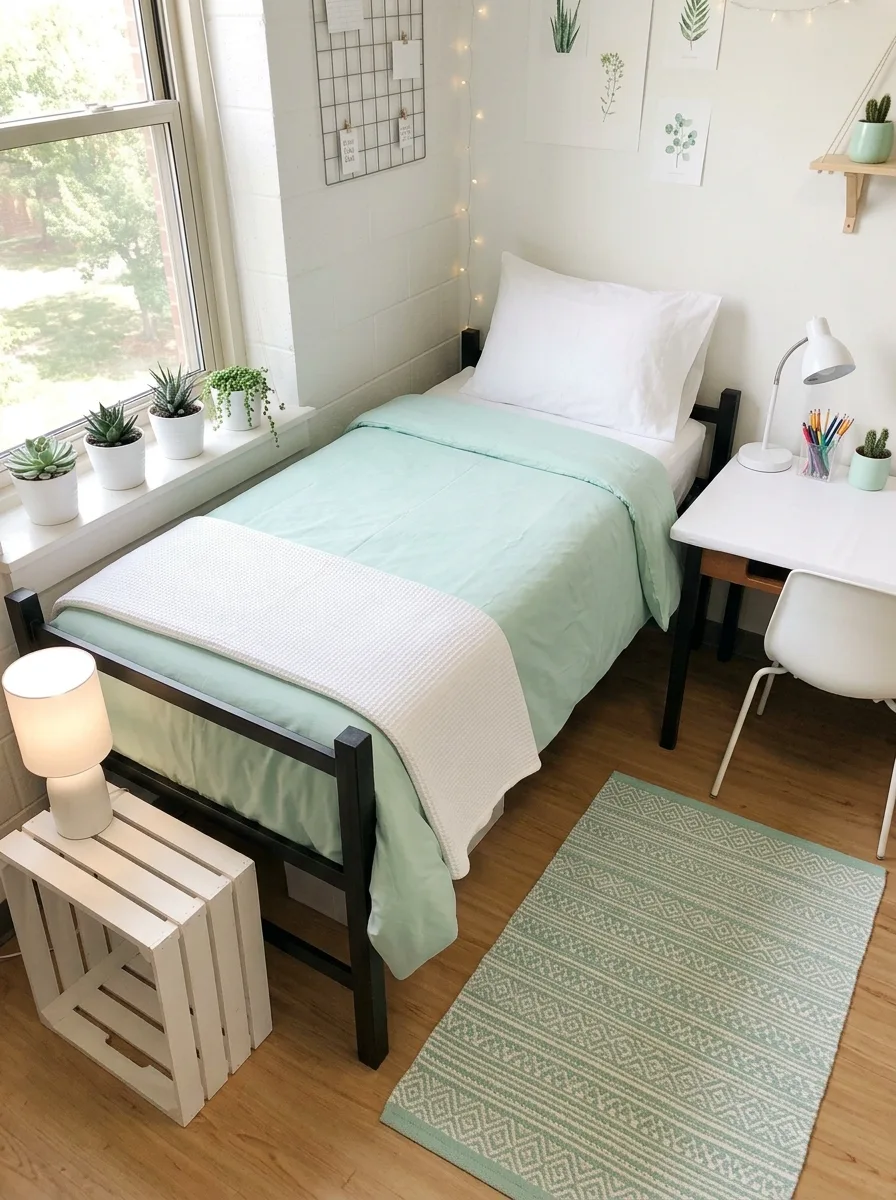
Start with a metal bed frame in matte black — the kind with a simple, clean silhouette. Dress it in a mint or pale sage comforter layered with a white waffle-knit throw folded across the foot. One white pillow, pillow cases that match the comforter, no decorative cushions. The simplicity is the point.
Use a wooden crate as your nightstand. Unfinished pine or whitewashed — available from any craft or home store for under fifteen dollars. It gives you one shelf and a surface. Put a simple cylinder lamp on top, the kind with a white fabric shade. It’s quiet and functional and adds warmth without competing with anything.
Line the windowsill with four or five succulents and trailing plants in matching white ceramic pots. Space them evenly. The greenery does the decorating so the rest of the room doesn’t have to. Run a small grid wire panel on the wall above the desk with a few clips for notes, prints, or cards — but keep it sparse.
The rug is mint and white geometric, pulled out from under the bed and toward the desk to claim the entire floor area as one zone.
Sheer Room Divider Landscape Rug
Use a ceiling-mounted tension curtain rod to hang a sheer or mesh curtain as a room divider, separating the sleeping zone from the workspace or seating area in a studio or large single room. Choose a fabric with a nature print — a landscape photograph printed on sheer mesh, an abstract botanical — so the divider itself is an object of interest rather than just a partition.
Place a glass-topped coffee table in the central zone between the two areas. Fill it with a few objects visible through the glass: a book, a small plant, a card. This creates a visual ground between the two zones without adding bulk.
The rug on the floor anchors the seating side: a deep moss or forest green rug — the kind that photographs like a field of grass and actually behaves like one underfoot. Thick, saturated, low pile or medium pile, the colour entirely even across its surface. The rug defines the lounge zone and provides the room’s strongest and most grounded colour statement.
On the sleep side, white bedding on a low-to-the-ground frame. Plants on the windowsill. The division of the room is the design concept.
Sage Wall Scandi Quiet
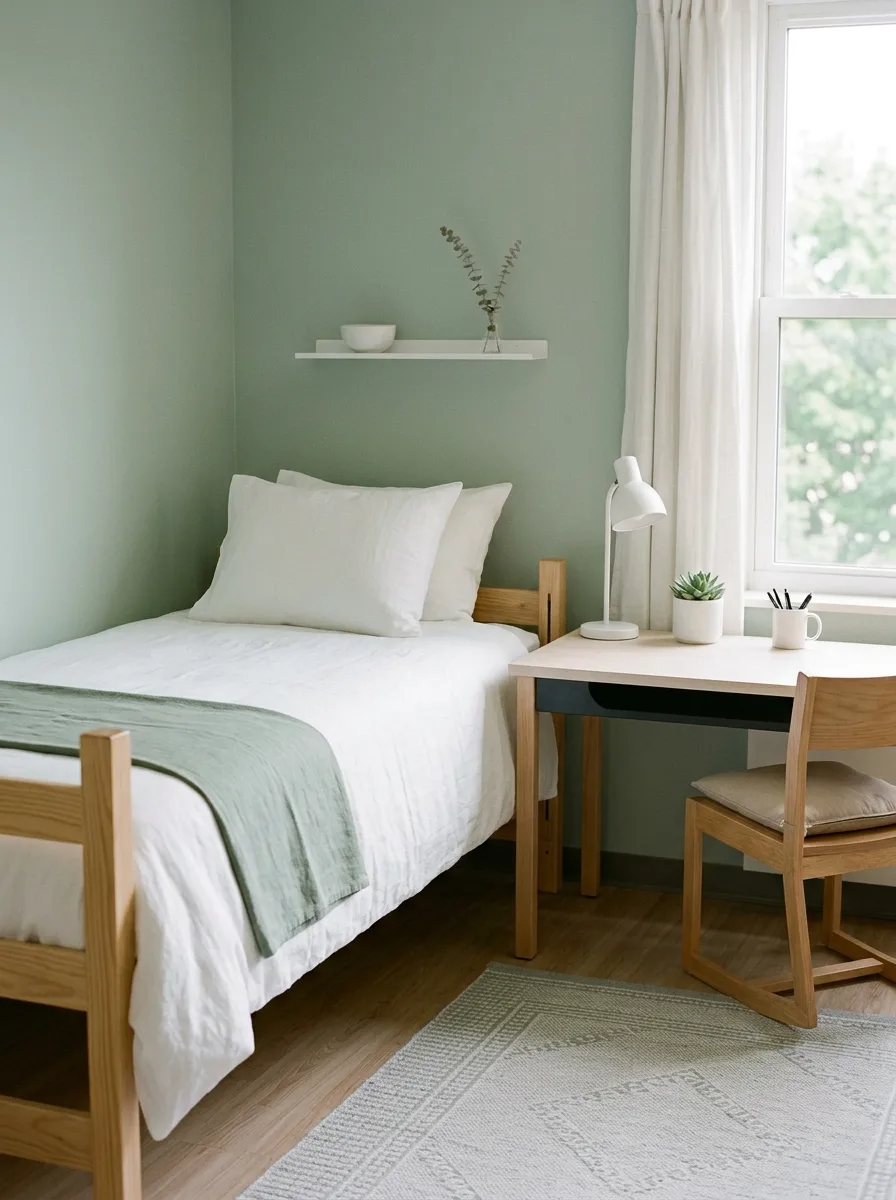
Paint the walls in a muted, grey-leaning sage — something like Farrow & Ball Mizzle or a mid-tone sage from any hardware store. The grey in the undertone keeps it calm rather than bright. The room should feel like breathing out.
The furniture is all natural oak or birch. If the dorm-supplied desk and chair are oak-toned, you’re already most of the way there. Keep them. Add an oak or light wood bed frame if you’re able to bring one. A floating shelf in white above the bed, mounted level and with clean edges, not the chunky rustic kind.
Dress the shelf with three white ceramic objects — a small vase, a bowl, a geometric shape — and one tiny stem of eucalyptus or dried botanicals in a glass bud vase. The shelf against sage looks like a still life.
White bedding, always. Linen rather than cotton if the budget allows — the texture reads as intentional. One sage linen throw draped across the lower third of the bed adds colour back without breaking the palette. A succulent on the desk in a white mug or small ceramic pot. Linen curtains long enough to pool slightly on the floor, in either white or natural.
The room achieves its effect through restraint and precision. Nothing is there by accident.
Cottagecore Vine Canopy Bookshelf
Start with the curtain canopy. Hang two white sheer curtain panels from ceiling hooks above the bed, draping them down and outward to create a four-poster tent effect. These don’t need a frame — they’re simply anchored at the ceiling and gathered at the corners of the bed with a loose knot or tied-back ribbon. Through and around the sheers, weave artificial ivy vines — the kind with small, realistically shaped leaves — from the ceiling hooks downward. Add warm fairy lights woven in the same path.
Behind the bed on the wall, attach as many prints, postcards, and botanical illustrations as you like in a dense floor-to-ceiling gallery. This wall should feel crowded in the best way — a wall that has been accumulating things, not decorated in an afternoon.
Beside the bed, a white shelving unit filled with books colour-sorted from warm reds and pinks at one end to greens and neutrals. A small lit-from-inside shelf using a battery-operated LED light strip across the back of one shelf. Florals, candles, small figurines between the books.
The bedding is floral and soft — ditsy green and white on sage, or a pale green botanical print. The entire room is trying to turn into a forest. Let it.
Prep School Plaid and Velvet
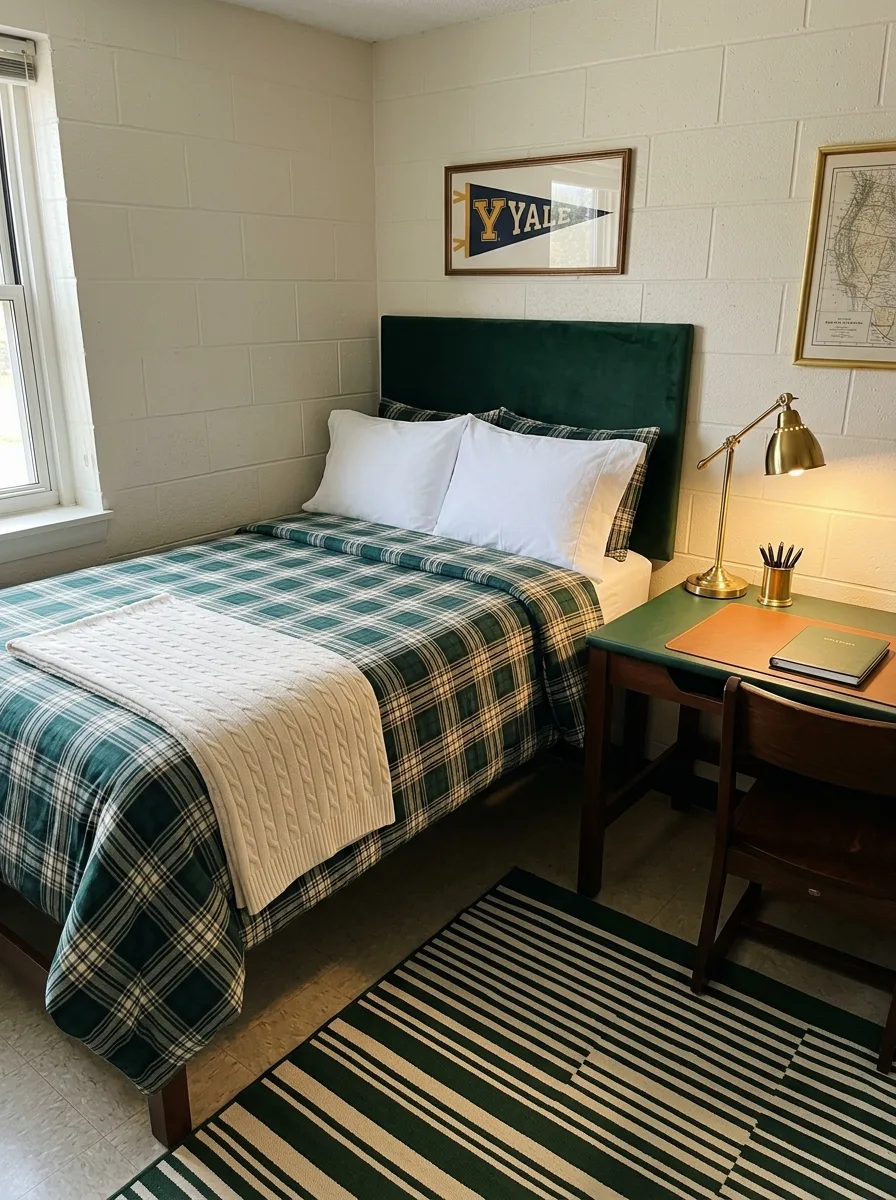
Get a dark emerald velvet headboard — either purchase a standalone panel or use a standard foam headboard kit covered in emerald velvet fabric. Install it behind a twin or full metal bed frame.
The bedding is plaid. Green, cream, and white tartan — the kind that looks like a rugby pitch in textile form. Layer it with a chunky cable-knit throw in cream or ivory folded at the foot. Two white standard pillows, pillow cases in a matching plaid or solid white.
The desk gets a green leather or faux-leather desk pad — the kind with a tooled or rolled edge. A brass articulated desk lamp with a dome shade. A simple pen cup in brass or ceramic. A leather-bound notebook. Stack two or three books and leave them without tidying.
Frame a vintage-style pennant or a small antique map in a simple gold frame and hang it above the desk. Not over the bed — that wall stays clean to let the headboard read clearly.
The rug on the floor is striped in forest green and cream — a flat-weave cotton runner or a low-pile striped rug positioned at the end of the bed, running perpendicular to the length of the room.
DIY Wood Panel Ivy Ceiling
Build a low horizontal console out of pine plank boards — the unfinished tongue-and-groove kind sold at any hardware store for a few dollars a board. Stack and glue four or five planks together until the panel is roughly eighteen inches tall, then stand it against the wall to act as a room divider between the sleeping area and the desk. You don’t need to mount it or finish the wood. Leave it raw. The unfinished pine reads as intentional in a room where everything else is collected rather than purchased.
For the ceiling, use adhesive Command hooks rated for light loads, placed every eight to ten inches across the entire ceiling in a loose grid. Through the hooks, weave long strands of artificial trailing ivy — the kind sold by the metre in home décor shops. Let the vines drape naturally between hooks so they hang at different depths, some close to the ceiling and some dropping eight to ten inches lower. The goal is coverage, not precision. The ceiling should look like it grew that way.
Run fairy lights along the same path as the ivy — just threaded loosely through the same hooks. When both are up together, the lights catch the leaves and the ceiling becomes its own atmosphere.
Keep the desk simple and white, pushed against the wood panel wall. Mount a small horizontal shelf above the desk at eye level for a single trailing plant, a few photos tucked without frames, and one object that means something to you. The wall behind the desk gets the same treatment as everything else: more things pinned directly to the wall until the wall disappears.
Emerald and Brass Hotel Room
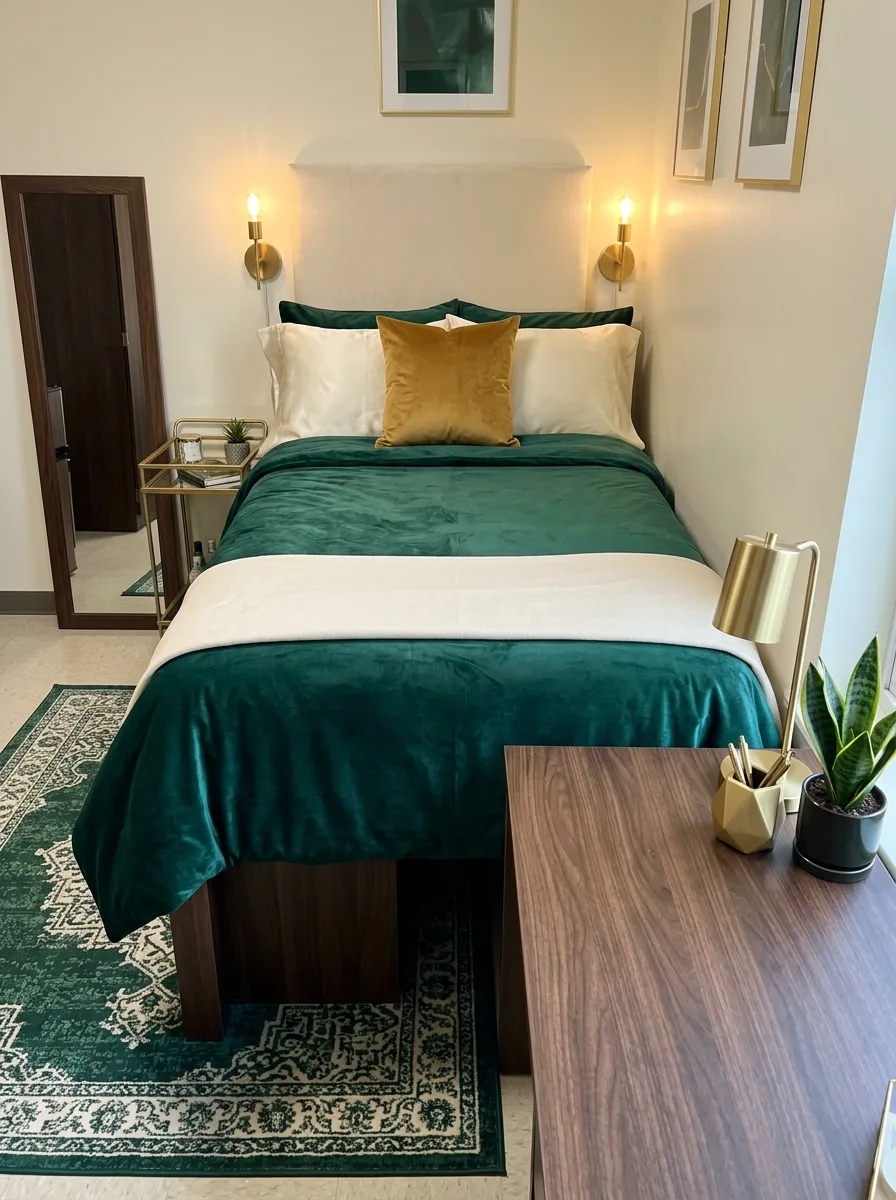
Mount two brass wall sconces on either side of the bed at bedside-lamp height. The sconces don’t need to be hardwired — battery-operated candelabra-style bulbs in brass fixtures plug into a standard outlet and work identically. They are the single item that elevates this room from student space to something that reads as adult.
The headboard is upholstered in pale linen or a neutral cream fabric — a simple rectangular panel that you can DIY with plywood, foam, and fabric. Behind it, keep the wall neutral: cream or warm white. The drama comes from the bedding, not the architecture.
Layer the bed in deep emerald velvet. A duvet or coverlet in bottle green, then one central throw pillow in amber or mustard velvet — the contrast between the two makes both colours vibrate. White fitted sheet visible at the top adds the hotel crispness.
Beside the bed, a brass or gold-finish bar cart used as a side table adds both storage and a design moment. Fill it with a small plant, a journal, and one object of interest — a crystal, a small framed photo, a candle. On the opposite side of the room, a dark walnut desk with a brass desk lamp.
The green and cream traditional rug underfoot completes the circuit.
Fairy Light Ceiling Perimeter
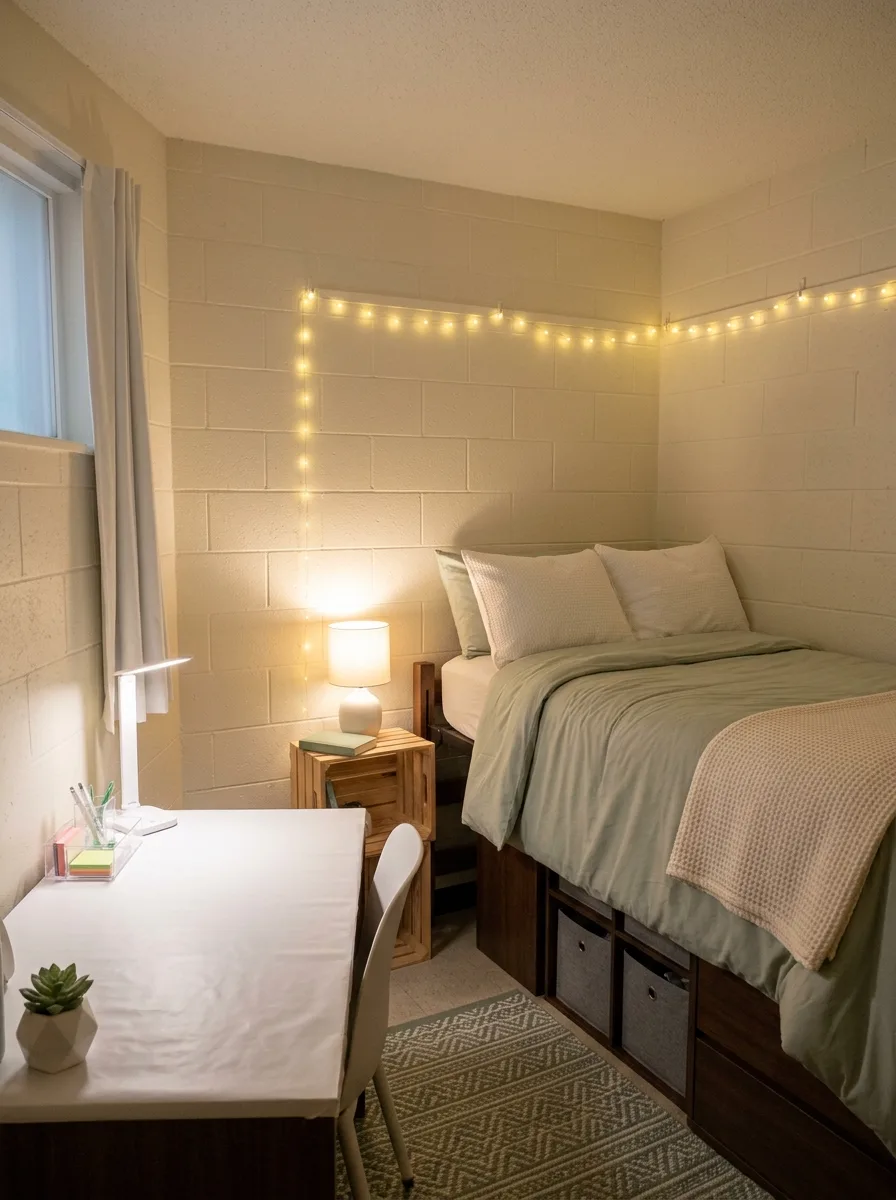
Run a single strand of globe string lights around the entire perimeter of the ceiling — not hanging down, but tracing the line where the wall meets the ceiling. Use Command adhesive hooks spaced every eighteen inches to hold the strand tight and level. The goal is a consistent glowing border that replaces the overhead light entirely once the sun goes down.
The rest of the room keeps to sage and cream neutrals. Light sage bedding, layered with a blush or pink waffle-knit throw. A wooden crate nightstand at mid-height with a small round table lamp. The warm glow from the ceiling perimeter and the bedside lamp together create an evenness of light that makes the room feel significantly larger than it is.
Raise the bed on bed risers to create under-bed storage. Use fabric cube bins in grey or sage to keep the storage tidy and intentional. Keep the space below the bed fully utilised — this is your closet overflow.
A single succulent on the desk in a white pot. A diamond-pattern rug in sage and cream on the floor. No other decoration. The light does all the work.
Sage Wall Dried Botanicals Gallery
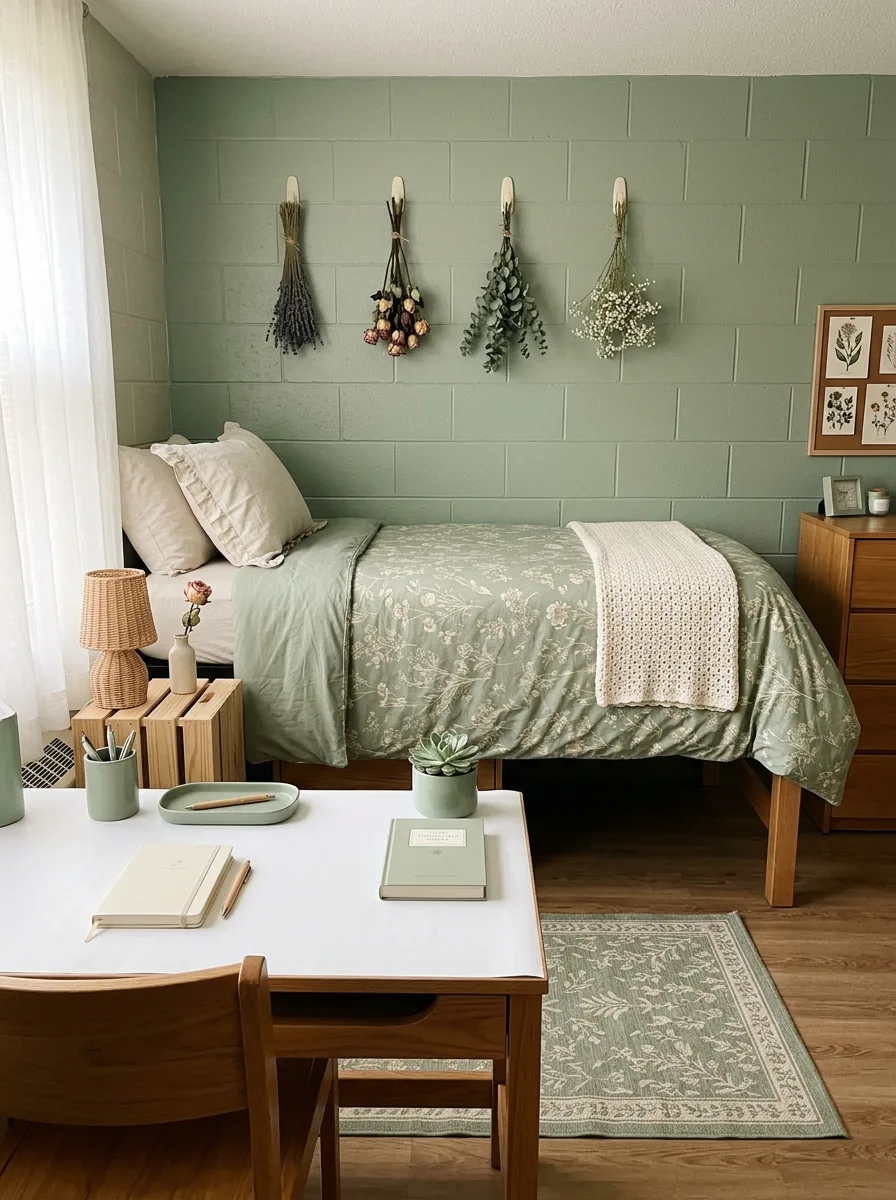
Paint the cinder block walls in sage. Then, rather than trying to hang art on the irregular surface, use round wooden adhesive hooks spaced evenly across the wall above the bed — five hooks in a row, evenly spaced, at the same height.
From each hook, hang a bundle of dried botanicals tied with twine. Source dried lavender, dried roses, eucalyptus, baby’s breath, and dried grasses separately and bundle each variety together. Tie them with a natural jute or hemp twine and let the stems hang downward. The result is an installation that reads as deliberately considered rather than decorative filler.
The desk below stays uncluttered. A rattan or woven table lamp in amber or warm tan. A sage ceramic mug for pens. A small tray. One stem in a tiny bud vase. The botanical wall does the talking — the desk just listens.
The bedding is floral-print in sage and cream — a ditsy floral or botanical illustration pattern. Layered with a cream woven throw at the foot. A sage and cream rug with a botanical pattern at the foot of the bed grounds the whole room in the same visual language.
Teal Headboard White Hotel Bed
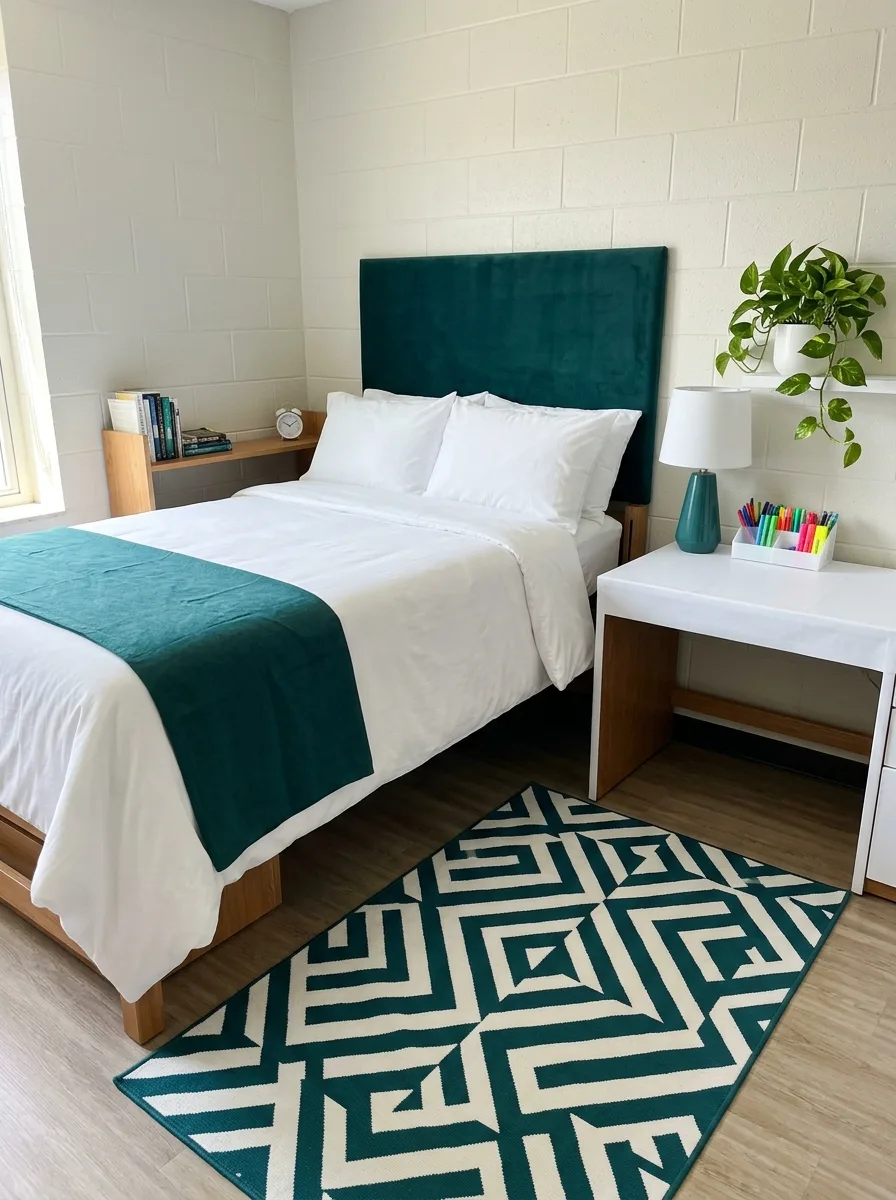
The move here is separation: put all the colour in one place and let everything else go clean.
Get an upholstered headboard panel in deep teal — a fully saturated blue-green, not dark green, not blue, but the exact midpoint between them. Either purchase one or build it with a plywood base, a thick layer of upholstery foam, and performance velvet or boucle fabric in teal. Lean it against the wall rather than mounting it, which allows for renter-friendly repositioning.
The bedding is entirely white. White duvet, white pillow cases, white fitted sheet. Hotel-made, tightly tucked, crisp. A single teal velvet throw pillow at the centre provides the only point of colour on the bed.
On the desk beside the bed, a teal ceramic lamp base with a white drum shade. A small trailing pothos in a white planter, the leaves spilling over the desk edge. A tray in white or light wood holding desk essentials.
The rug is the pattern moment: a teal-and-white bold graphic — a maze-like geometric or high-contrast interlocking shapes. Teal and white, nothing else. Everything in the room is either teal or white, and the room is more interesting for the constraint.
Dark Olive Moody Study Cave
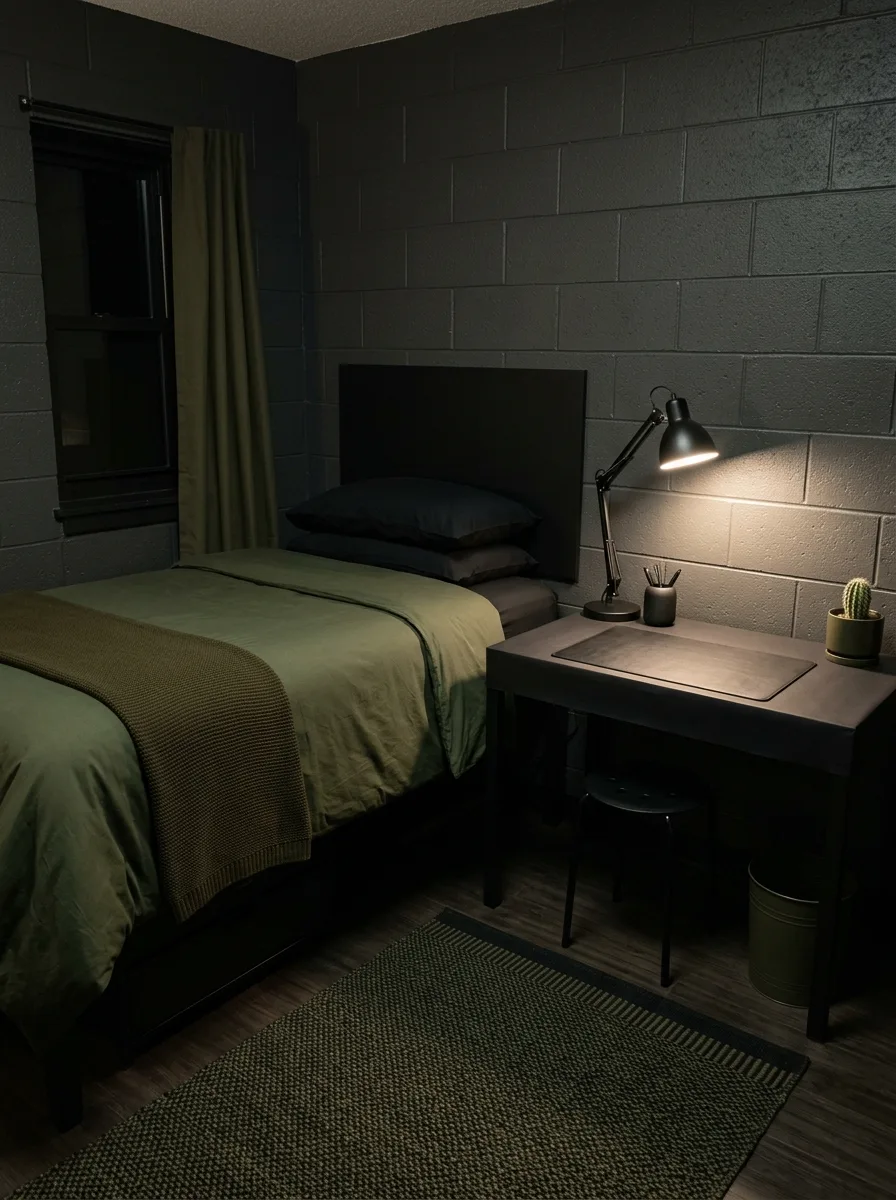
Paint the cinder block in the darkest olive-charcoal you can find — something nearly black but green in certain light, like a room that can’t quite decide if it’s army surplus or luxury. If painting isn’t possible, achieve the same effect with a dark woven rug, dark olive bedding, and a black headboard panel together.
The bed stays low and dark. Olive duvet in linen or cotton, a khaki or brown knit throw layered on top. Dark charcoal or near-black pillow cases. No decorative cushions — this room has no patience for decorative cushions.
The desk is black or matte charcoal, flat surface, no ornament. One articulated architect’s lamp in matte black, angled directly at the work surface. A small matte black ceramic cup for pens. One small cactus in a dark matte pot — the only living thing in the room, and it’s the easiest living thing to care for.
The rug on the floor is dark, tightly woven, no pattern. The room creates its effect through mood and commitment rather than through decoration. Keep the window treatments in olive or dark khaki. Everything in the room is saying the same quiet thing.
Sage Green Marble Vanity Desk
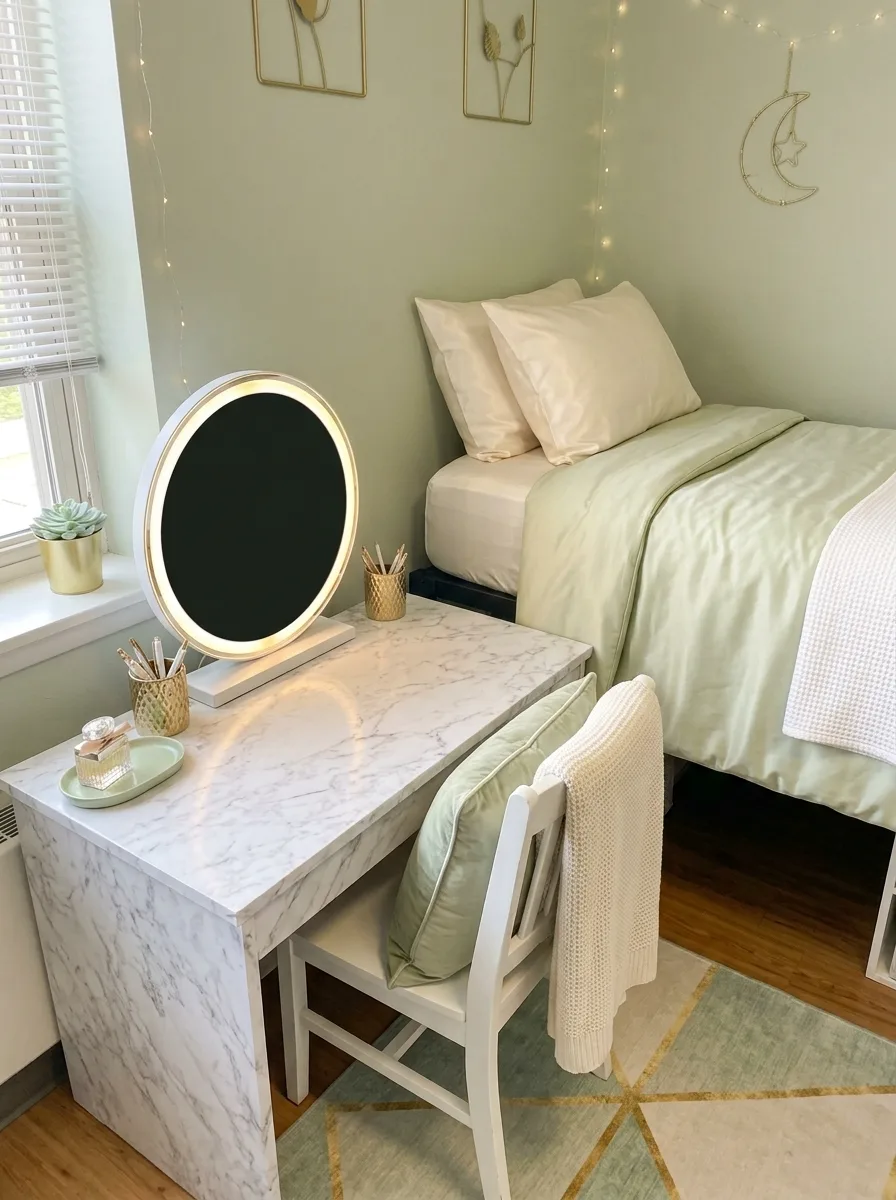
Cover a standard dorm desk completely in adhesive marble contact paper — the kind with grey veining on a white background. Wrap it over the top surface and down the front panel. The transformation is complete and removes cleanly when you leave.
On the desk, place a round Hollywood-style vanity mirror with a built-in LED ring — available for under forty dollars on any home goods site. The ring light does double duty as a morning routine essential and as the desk’s ambient light source, eliminating the need for a separate desk lamp during morning hours.
Coordinate the desk accessories in gold: a gold pencil cup, a small gold ring dish or tray, a gold-capped perfume bottle if you wear fragrance. Everything on the desktop is either white, marble, or gold. Nothing else.
The bed beside it picks up the sage — silky sage-green pillowcases and a matching duvet in the same colour family, topped with a white waffle-knit throw. A pale green succulent on the windowsill in a gold-rimmed ceramic pot. A cream-and-gold geometric rug on the floor.
Wall decor above the desk or bed stays in gold-frame wire shapes — simple botanical outlines or abstract geometric frames. The room speaks in sage, white, gold, and marble.
Jungle Wall Pampas White
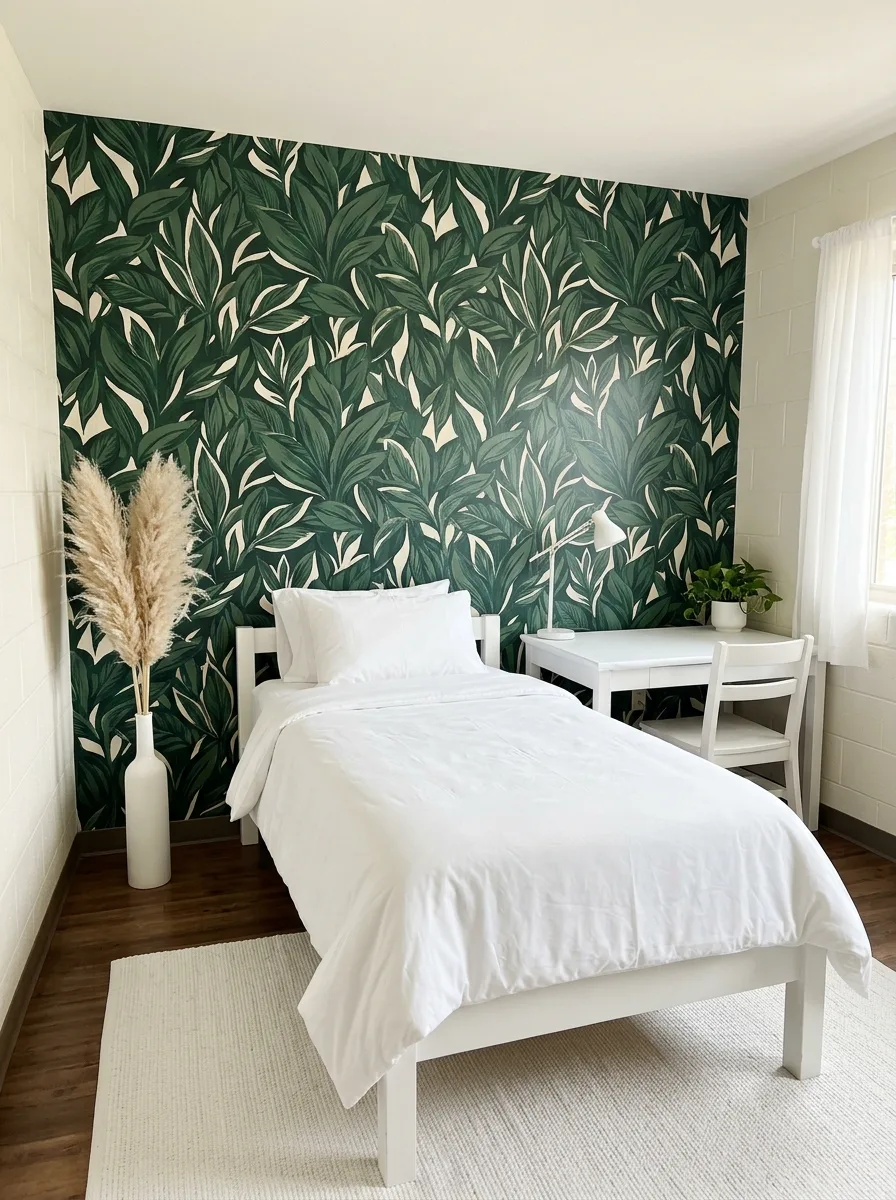
Source a large-format peel-and-stick botanical wallpaper in deep forest green and cream — a large tropical leaf pattern with bold, graphic foliage. Apply it to the wall directly behind the bed, from floor to ceiling, covering the entire face of that single wall. Peel-and-stick removes cleanly without damage. This is your feature wall.
Every other wall stays exactly as the dorm left it. The wallpaper is strong enough that the plain walls beside it don’t read as unfinished — they read as the rest of the room giving it space.
The bed goes entirely white. White duvet, white pillow cases, white everything. No colour competing with the wall. At the side of the bed, a single tall white floor vase filled with dried pampas grass — the feathery, neutral plumes provide texture and height without adding a competing colour.
A small pothos or philodendron on the desk adds real greenery that echoes the wallpaper without duplicating it. The desk itself is white. White chair. White rug. The principle is simple: the wallpaper is the entire room’s personality. Everything else steps aside.
Sage Pink Crate Nightstand
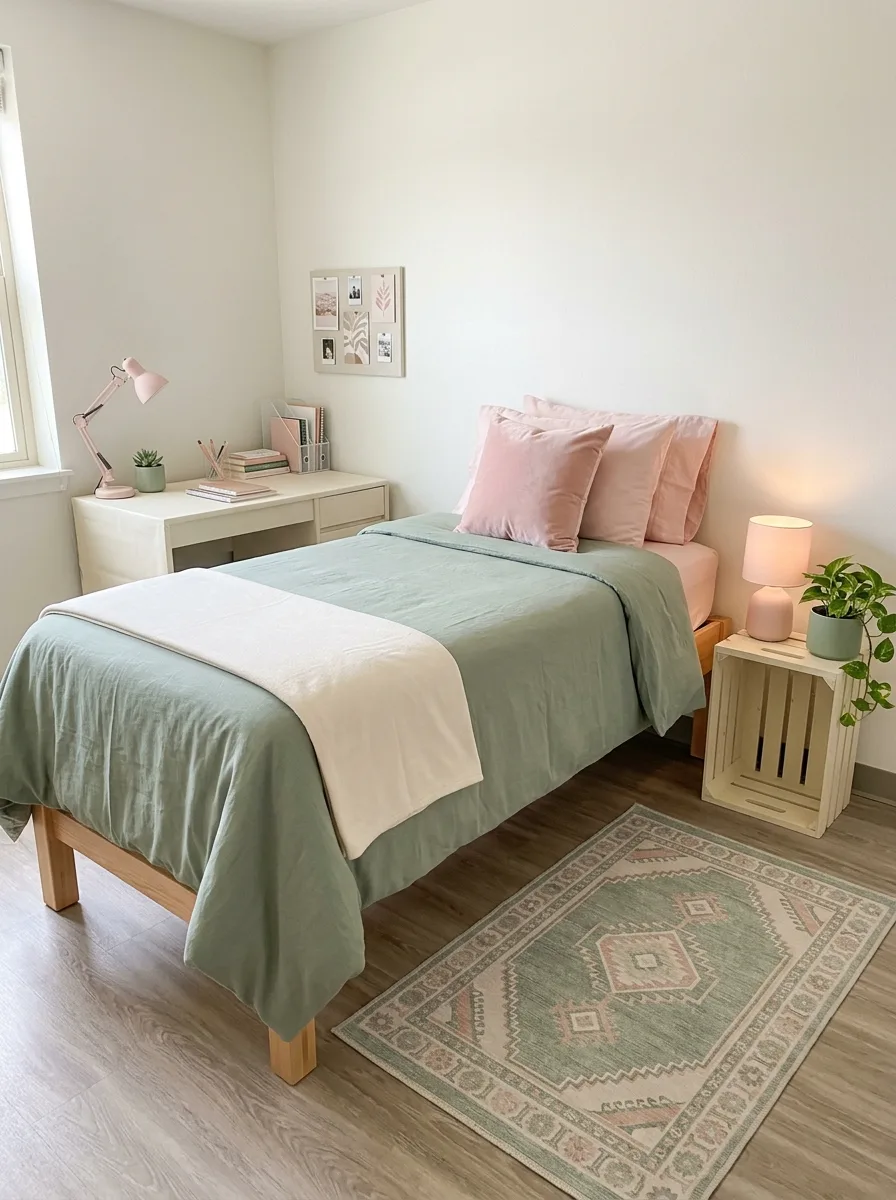
Use the bed as the place where two colours meet. Start with a sage or mint duvet — something soft and muted, not saturated — and layer in pillowcases in a washed blush pink. The two colours together produce a palette that reads simultaneously youthful and sophisticated, warm and calm.
The nightstand is a wooden crate, unfinished or whitewashed, set on its side to create a shelving surface. On it: a small pink ceramic lamp with a linen shade, a trailing pothos in a sage ceramic pot, and nothing else. The crate provides a visual texture that the rest of the room’s smooth surfaces don’t have.
The desk beside the window gets a small pink articulated lamp — the accent colour carried to the work area so the room reads as planned rather than accidental. A small collection of books on the desk, stacked flat and upright together. Botanical prints or a small mood board in a simple matte frame on the wall above.
The rug is a vintage-style medallion in sage and dusty rose — the same palette as the bed, but in a traditional pattern that grounds the whole room and makes it feel collected rather than fresh out of a student discount website.
White Shelf White Ceramics Sage Calm
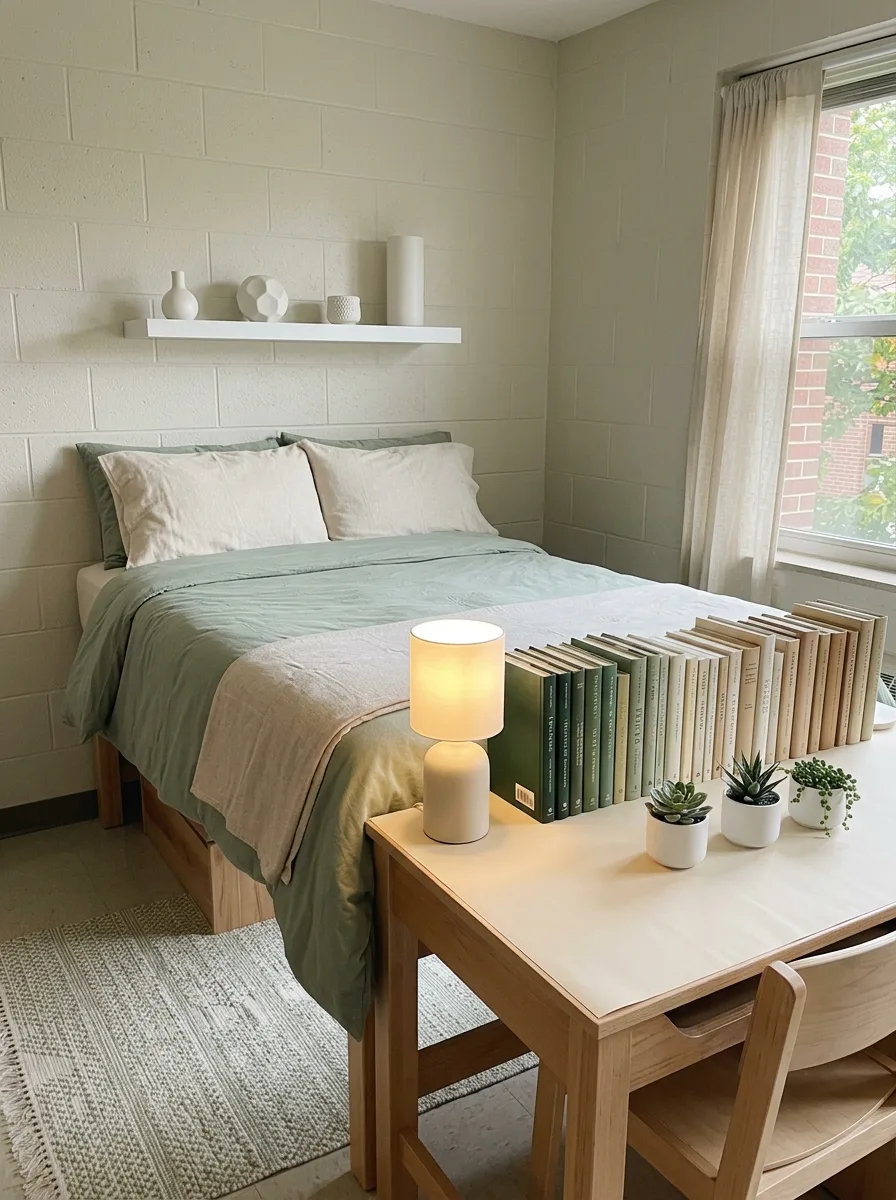
This room uses restraint as a design strategy. The walls are sage. The furniture is all light oak or birch. The bedding is entirely white.
The single floating shelf above the bed is white, level, and populated exclusively with white ceramic objects. A small rounded vase. A squat geometric form. A bowl. A skinny bud vase with one dried stem. A small cylindrical candle holder. Nothing that isn’t white, nothing that isn’t ceramic, and nothing that isn’t interesting in shape.
The desk in front of the window holds the same discipline: a small round table lamp in white ceramic with a white shade, a short row of succulents in white pots spaced evenly, and a stack of books along one edge. The desk’s surface is clean beyond those three categories.
The rug on the floor is white and cream, flat-weave, barely-there pattern. The room earns its effect through discipline. Nothing fights anything else. The sage wall is the only colour and it’s enough.
Forest Green Velvet Gold Lux
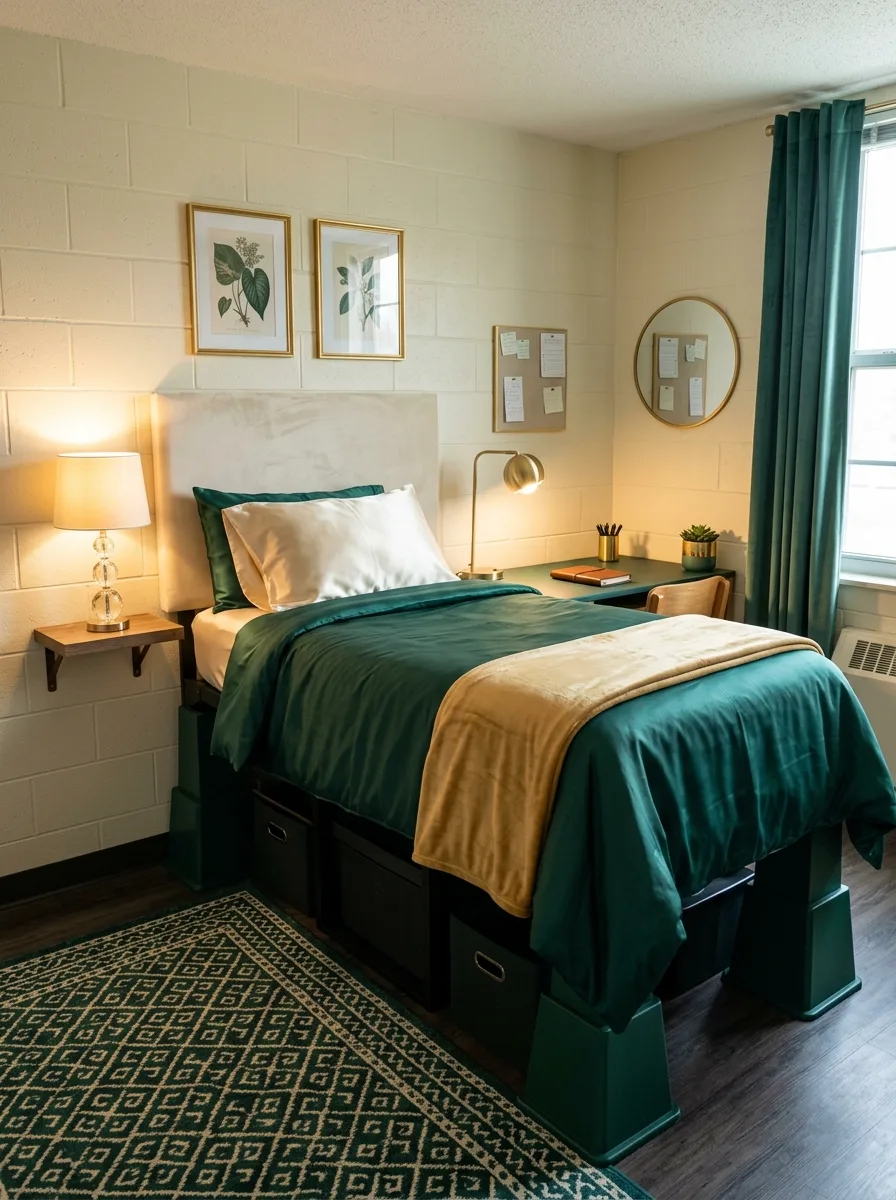
Lofting the bed is the first step. Get your bed as high as the university allows — most institutions permit lofting to around six feet — and use the space beneath it as a fully functioning zone. The desk goes underneath, pulled out from the wall slightly to create a small study alcove. Position a gold-base desk lamp on the desktop, angled up and toward the work surface.
At bed level, dress the mattress in deep forest green velvet or high-pile fleece. A single gold or amber throw across the lower third of the bed. The velvet at height, seen from below, makes the bed feel like a platform in a way that no floor-level bed can match.
On the wall beside the desk space, hang two gold-framed botanical prints at eye level when seated. Beside them, a round gold-frame mirror. A small corkboard with a few notes pinned, contained and intentional. A teal velvet curtain panel at the window — floor length, mounted high on the window frame so it falls with intention rather than covering half the view.
The rug on the floor runs under the desk and outward: a dark green and cream geometric or kilim-style runner. The storage underneath the bed uses teal risers and black cube fabric bins, flush and tidy.
Macramé Hanging Pothos Canopy
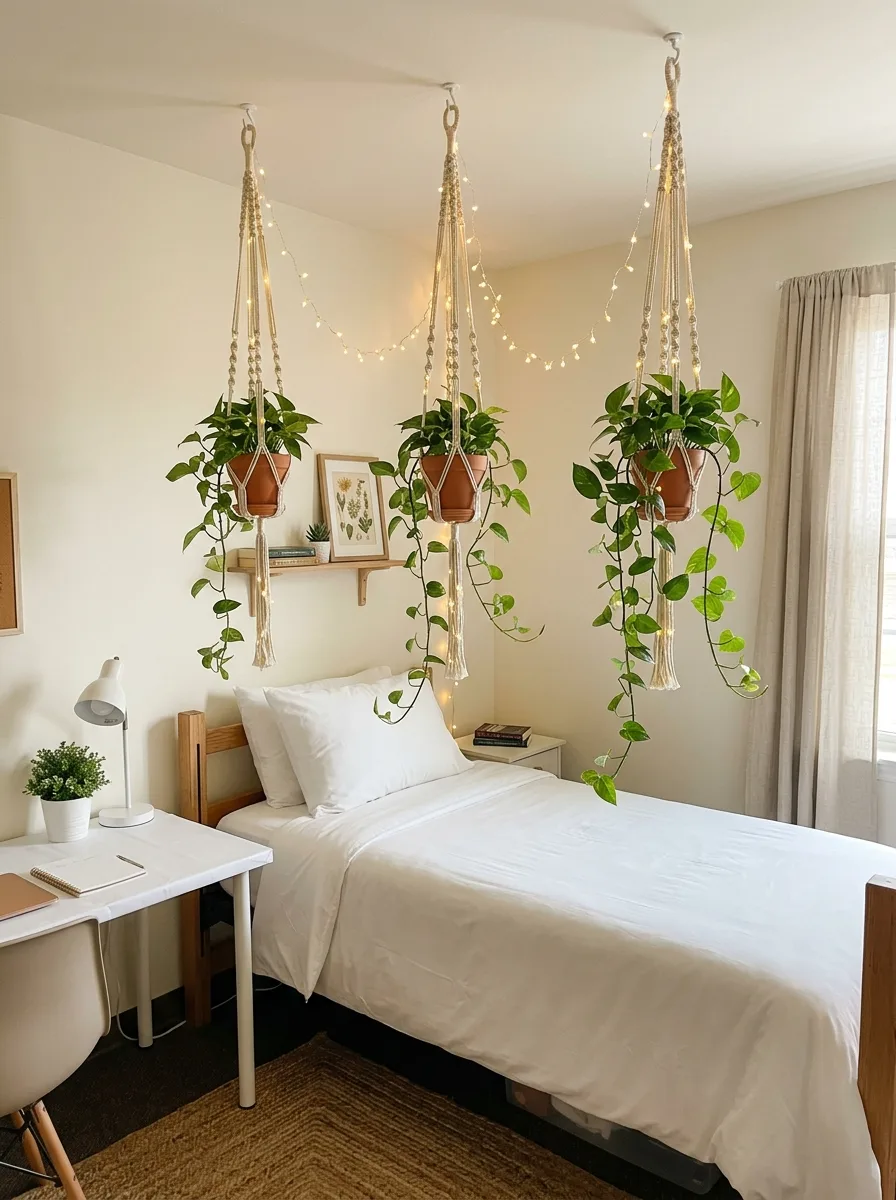
Buy three macramé plant hangers — the natural cotton rope kind, with beading and fringe detail. They should each be at least three feet long when hung. Into each one, place a four-inch terracotta pot containing a pothos. Pothos is the correct choice: it trails down naturally, grows fast in low light, and survives the inevitable forgetting.
Mount three ceiling hooks in a curved line above the head of the bed, spaced about eighteen inches apart. Use the kind rated for at least five pounds — a heavy-duty Command ceiling hook or, if permitted, a small screw-in hook into the ceiling. Hang the macramé hangers at slightly varying heights — not identical, but within six inches of each other. Weave a strand of warm fairy lights loosely through and between the hangers.
The rest of the room is intentionally calm. White bedding, a simple wood bed frame, a white desk, a natural-fibre jute rug. One shelf on the wall with a botanical print and a small plant. The hanging canopy is the room’s entire personality; everything else is backdrop.
Final Thoughts
Every room in this collection chose something and committed to it. The dark emerald room painted every wall and didn’t apologise. The minimal sage room bought five ceramic objects and called it done. The vine canopy let the ceiling become a garden.
The thing they all share is the decision. Not the colour — the decision to treat a small, institutional, temporary space as if it deserved real attention.
A dorm room is where you live during years that tend to matter more than they seem to at the time. You eat there, sleep there, study there, cry there, figure things out there. It is worth making it a place you chose rather than a place you were assigned.
Green rooms have a particular quality in the evening. When the overhead light is off and the desk lamp is on and the room is the colour of something growing, there is a sense that the space is working with you rather than against you.
That is what decoration is actually for.