
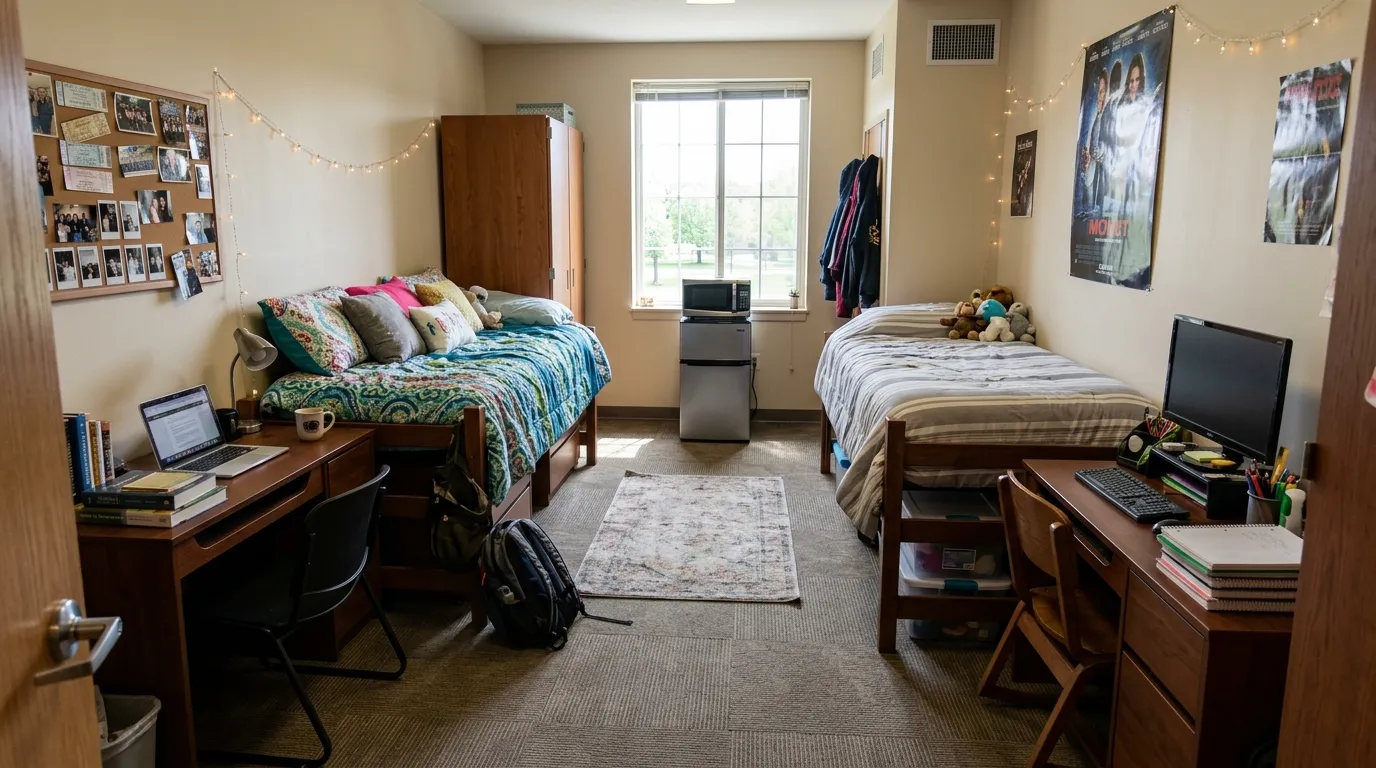
A double dorm room is one of the harder design problems you will ever encounter. You have roughly 200 square feet, two people with potentially different aesthetics, zero privacy, and a roommate situation that ranges from best-friend-in-the-making to diplomatically tense. The university has given you two beds, two desks, and the same cinder block walls it gives everyone.
The rooms that fail treat this as a decoration problem. They spend the budget on matching bedding sets and call it done. Three weeks in, the room looks like a budget hotel that ran out of money halfway through the renovation, and nobody can figure out why.
The rooms that work treat it as a spatial problem first. How do two beds, two desks, and two people coexist in a room this size in a way that feels intentional rather than cramped? Get the layout and the light right, and the decoration almost takes care of itself.
That’s the job this blog is trying to do.
The Conditions That Make Shared Rooms Work
Beyond the mistakes, there are a few things that the successful rooms in this collection consistently do.
Each Side Gets a Light Source
The overhead light in a dorm room is fluorescent, institutional, and hostile to human wellbeing. Left as the only light source, it makes everything look like an evidence locker.
Each occupant needs their own warm light source at desk level and ideally a second one near the bed — whether that’s a table lamp, a plug-in sconce, a rattan pendant, or a simple bedside lamp. When both warm light sources are on and the overhead is off, the room doubles in warmth and apparent size. This is the single most impactful change available to any dorm room and it costs under forty dollars per person.
It is not optional.
The Rug Does the Floor Planning
In a double dorm room, the rug is the architect. A runner between the two beds creates a corridor and defines the beds as a pair. A large area rug under both beds unifies the room as one zone. Two smaller rugs — one per side — grant each occupant visual territory of their own.
The choice between these approaches is a design decision. It determines whether the room reads as unified or divided, shared or individual. Make the choice deliberately rather than buying whatever rug happens to be on sale.
The Window Is Everyone’s
In most double dorm layouts, the window falls between or behind the two beds, which means it belongs to neither person specifically and frequently belongs to nothing at all. Plants on the windowsill, a shared desk surface running along the window wall, or a pair of coordinated plants placed at either end of the sill are the most efficient ways to make the window zone feel intentional.
This is also the best natural light source in the room. Whoever controls the window controls the quality of the shared space’s daytime atmosphere. Sheer curtains that diffuse light rather than block it make the window a gift rather than a complication.
Double Dorm Room Ideas
Neutral Elevated Glamour Shared
This room is trying to suggest that a shared dorm room can feel like a hotel suite, and it mostly succeeds. Both beds are positioned facing each other across a shared social zone — not parallel against opposite walls, but oriented inward, creating a living-room-style arrangement with the beds acting as sofas. Between them, a glass-topped coffee table on a brass base holds one orchid plant. In front of the window, a small loveseat or two-person settee in cream fabric.
Both beds dress in identical cream — quilted white duvet, cream pillow cases, two textured throw pillows each in a champagne or warm grey pattern. The identical dressing is the point here: the hotel-room effect depends on the two beds reading as one composed unit rather than two individual spaces.
Behind each bed, a linen headboard panel in a warm greige or taupe — wide, flat, with a simple outline. Two brass table lamps flank a shared console table between the beds, with a small framed abstract print in gold above it. The rug is an animal-print in sage and cream — subtle, sophisticated, visible under the coffee table. Two small upholstered ottomans at the foot of each bed provide flexible seating.
This room requires a particular kind of roommate conversation: both parties agreeing that the room will look good over being maximally functional. It rewards that agreement with the closest thing to actual luxury available in a student housing context.
Split Wall Two Personality Room
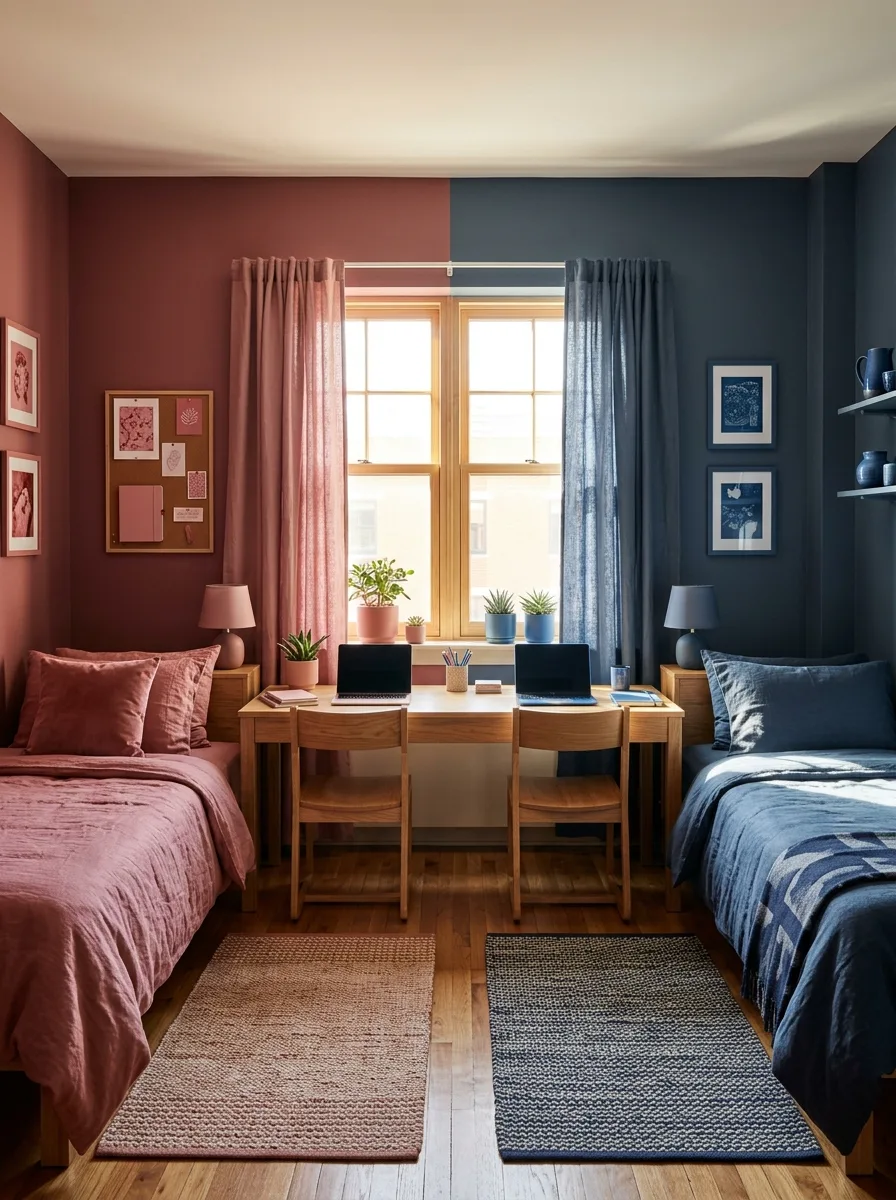
This room acknowledges something most double dorm rooms pretend isn’t true: two people with genuinely different aesthetics can share a room, but only if the room owns that difference rather than trying to hide it. Paint the wall behind each bed in a different colour. One side gets a deep, warm terracotta-red. The other side gets a slate or ink blue. The paint line runs exactly down the centre of the room — at the window, where the two colours meet, the curtain panel on the left is rose-pink linen, and the panel on the right is grey-blue linen.
Each side has its own tone: one warm, one cool. One has a corkboard on the wall in warm frames; the other has floating shelves with blue-grey ceramic pieces. The bedding on each side matches its wall — dusty rose on the warm side, denim-blue on the cool side.
The shared element is the desk surface at the window: a long, continuous table in pale birch that runs across the full width of the room, shared by both occupants. Two chairs, one on each side, in matching natural wood. The plants on the windowsill are the room’s common ground — green, belonging to nobody and everybody, sitting at the exact point where the two colour worlds meet.
The effect is intentional and surprisingly harmonious. The room isn’t trying to reconcile the two aesthetics. It’s celebrating the fact that two people live here and they’re different people.
School Spirit Plaid Matching Dark
This room has committed to an identity so completely that the decoration becomes easy. It is a sports-fan room, and everything in it knows that. Both beds dress identically: dark navy or maroon base colour, with a plaid runner in the school colours across the lower third of each bed. Matching throw pillows with the school monogram or crest. The matching is not a failure of creativity — it is the aesthetic premise. This room is a team room.
The wall behind the shared nightstand between the beds holds the school flag or pennant on one side, a framed action photograph or campus poster on the other. The shelf above the nightstand has a small plant, a clock, and one or two school-branded objects arranged with enough space between them to read as intentional rather than crammed.
Both desks are natural wood — birch, oak, or the institutional wood-finish the dorm provides if it happens to be warm enough. One black task chair per person, matte-finish, functional. One lamp per desk in black or the school’s accent colour. The rug is a plaid or tartan runner in the school’s colour palette, running between the two beds.
The room works because it has a concept and everything is in service of that concept.
Opposite Aesthetics Shared Jute
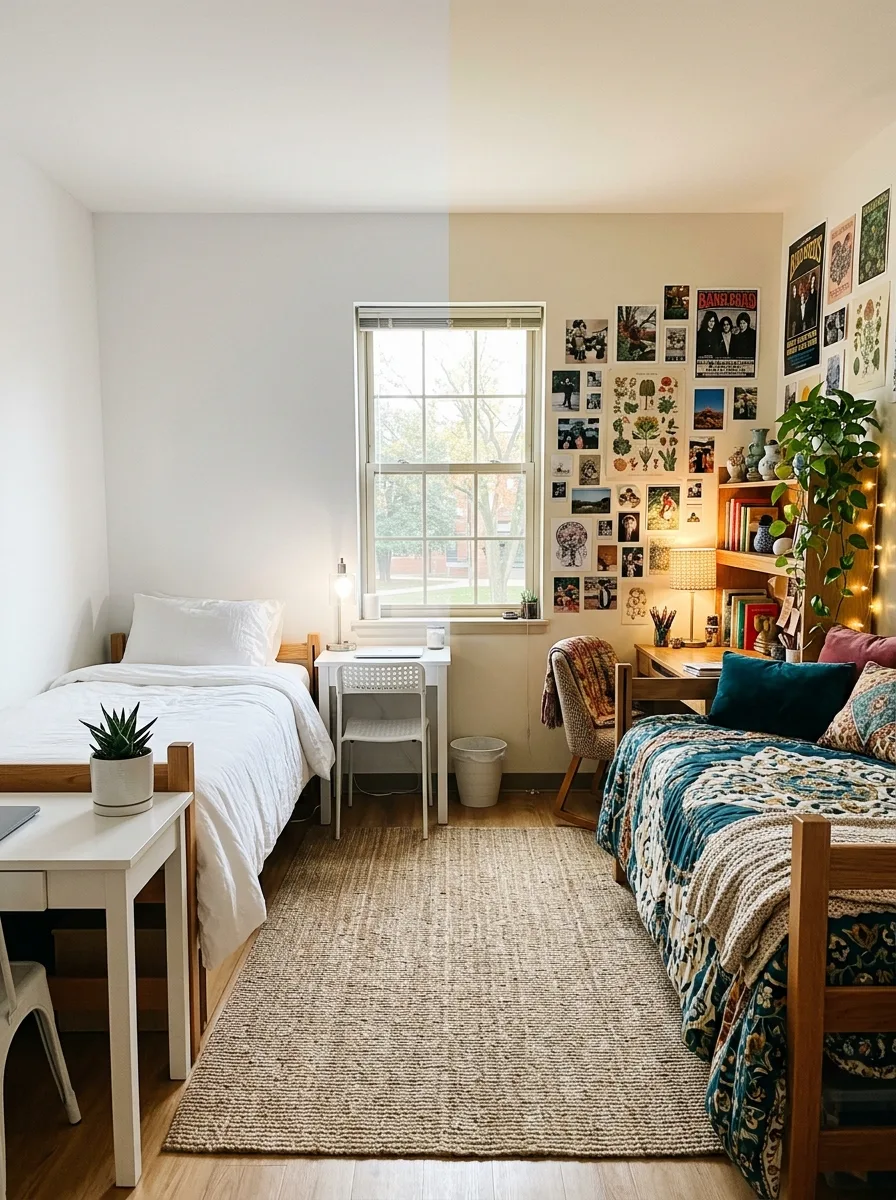
This room doesn’t try to reconcile two different approaches to decoration. It places them side by side and uses a shared rug to hold the room together. One side: clean and white. White bedding, white desk, simple white lamp, one small plant in a white pot, nothing else. The other side: warmer and more layered. Teal and jewel-tone layered bedding, a wood bookshelf unit at the head of the bed loaded with colour-organised books and various objects, a patterned lamp, a wall covered in a dense collage of posters, prints, photos, and pinned notes.
The two sides are visually distinct in every respect. They don’t try to match. What they share is a large, flat-weave jute rug — natural, undyed, running the full length of the room under both beds and the floor between them. The rug is the shared element, and because it is neutral it makes no claim on either side’s aesthetic.
The window is a shared zone: two small plants on the sill, one white and one terracotta pot, belonging to each person respectively. The overhead light, if it must be on, is a shared compromise. The individual lamps are personal.
This room is successful because it is honest. Two people live here. They didn’t choose each other’s taste. The room doesn’t pretend otherwise.
Lavender Green Neon Good Vibes Double
This room is doing the most, and it knows it. Paint or wallpaper both sides of the room in a soft sage green — the same tone across the full space, so the room reads as unified despite everything that follows. The wall art does not coordinate with anything. It explodes outward from the bed zones: framed prints in varying sizes, canvas art, hanging plants with trailing ivy, a city skyline photograph, motivational text signs, a small neon sign in pink reading something brief above one of the beds.
The beds dress in contrasting purple and green on white. One bed has a white base duvet with lavender or purple polka-dot throw pillows and a green knit throw. The other mirrors it: white base with green sage pillows and a lavender throw. The two beds are symmetrical in structure but colour-flipped.
Between the beds, the shared nightstand doubles as a mini fridge surface — a common dorm situation handled here by making the fridge itself a design object in white or pink, topped with the nightstand items: two lamps, fresh flowers in a white vase, a framed photo or two, a personal letter or card. The rug runs the length of the room in a traditional medallion pattern in lavender and cream.
The room is maximalist by nature and it doesn’t apologise for it. The sage green walls are the restraint that makes everything else manageable.
Triple Loft Boho Floor Lounge
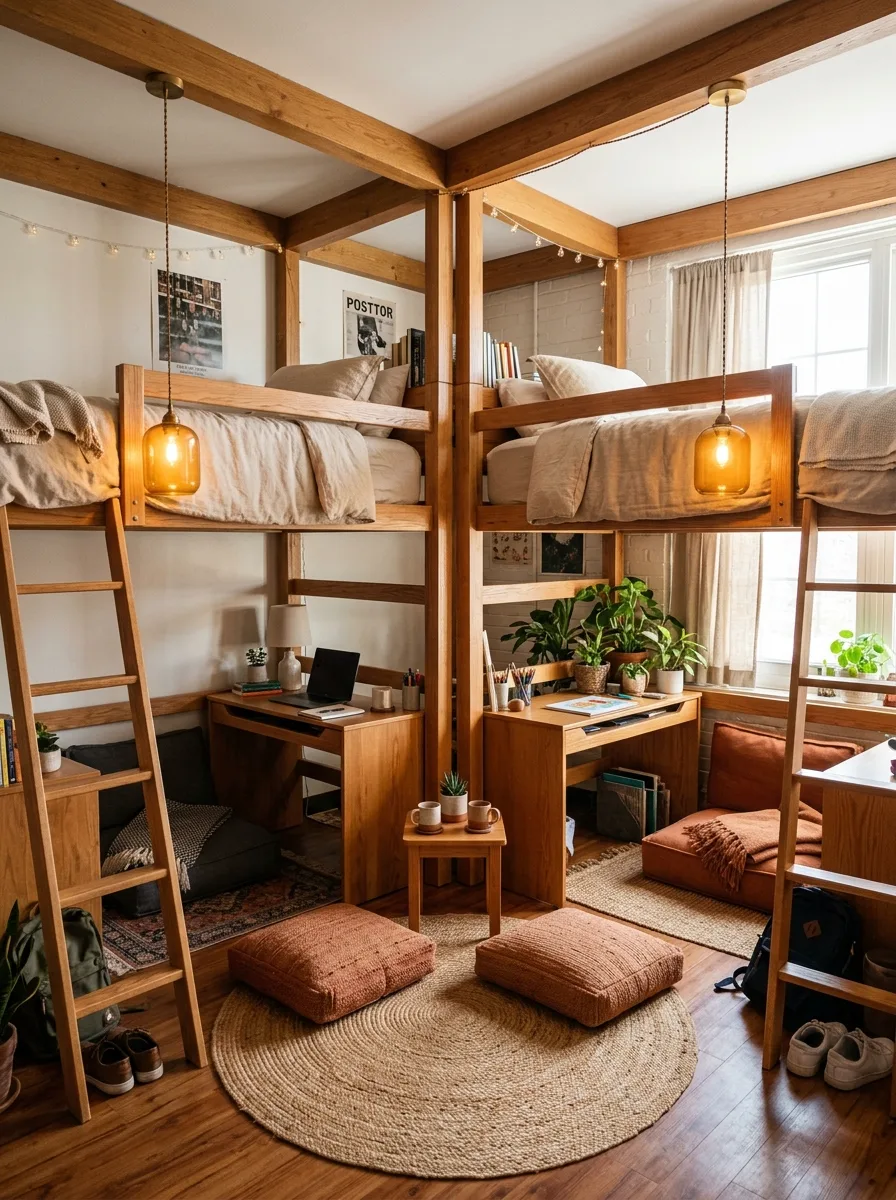
This room takes the most drastic approach to the double room floor plan problem: get both beds off the floor entirely and treat the floor as living space. Build or assemble loft frames for both beds — the kind with integrated desk and shelf units built into the frame, so each occupant has their sleep zone above and their study zone below in a self-contained vertical unit. Source matching frames in natural oak or pine for visual consistency.
Below each lofted bed is a dedicated alcove: desk surface, a small shelf for books and objects, a task lamp in amber glass, and enough space for a rolling drawer unit of storage. The under-bed zone is private study territory for each person.
In the shared floor space between the two loft structures — what would normally be the middle of the room — place a round jute rug with two large floor cushions in terracotta-orange or rust. A small coffee-table-height wooden stool holds two mugs. This is the social zone. It belongs to neither person and both people. String lights run along the ceiling beams of the loft frame, providing ambient light at mid-height.
Plants go on every available surface — desktops, the space between the two lofts, the windowsill. The room has the atmosphere of a treehouse that happens to also be a study space.
Hot Pink Headboard White Graphic Glam
This room works the way a fashion shoot works: every element is chosen for visual impact, and the arrangement is about picture-perfect symmetry. Both headboards are upholstered in hot pink — saturated, unapologetic magenta — in a linen or textured fabric with a white piping detail at the edge. The piping is what elevates this from simply bold to precisely tailored.
The bedding is entirely white. White quilted duvet, white fitted sheet, white dust ruffle. On the white beds, one abstract-print throw pillow in mixed coral, orange, and pink, and one orange ikat-stripe lumbar pillow. The pillows are the only items that are not white, pink, or graphic.
The curtains at the window match the headboards: wide horizontal bands of hot pink alternating with white, on a gold curtain rod. The pattern is bold enough to be visible from across the room and precise enough to look expensive. Between the two beds, a tall white cabinet with a flat-front panel acts as the shared storage and surface unit. On top: one white cylinder lamp with a pink-fill acrylic base, one orchid in a white pot, and nothing else.
Two white chairs with gold hairpin legs at the foot of each bed add seating without adding visual weight. The rug in coral and white greek-key or geometric pattern runs the full floor zone. The overall effect is a colour editorial in a room.
Warm Gallery Runner Double
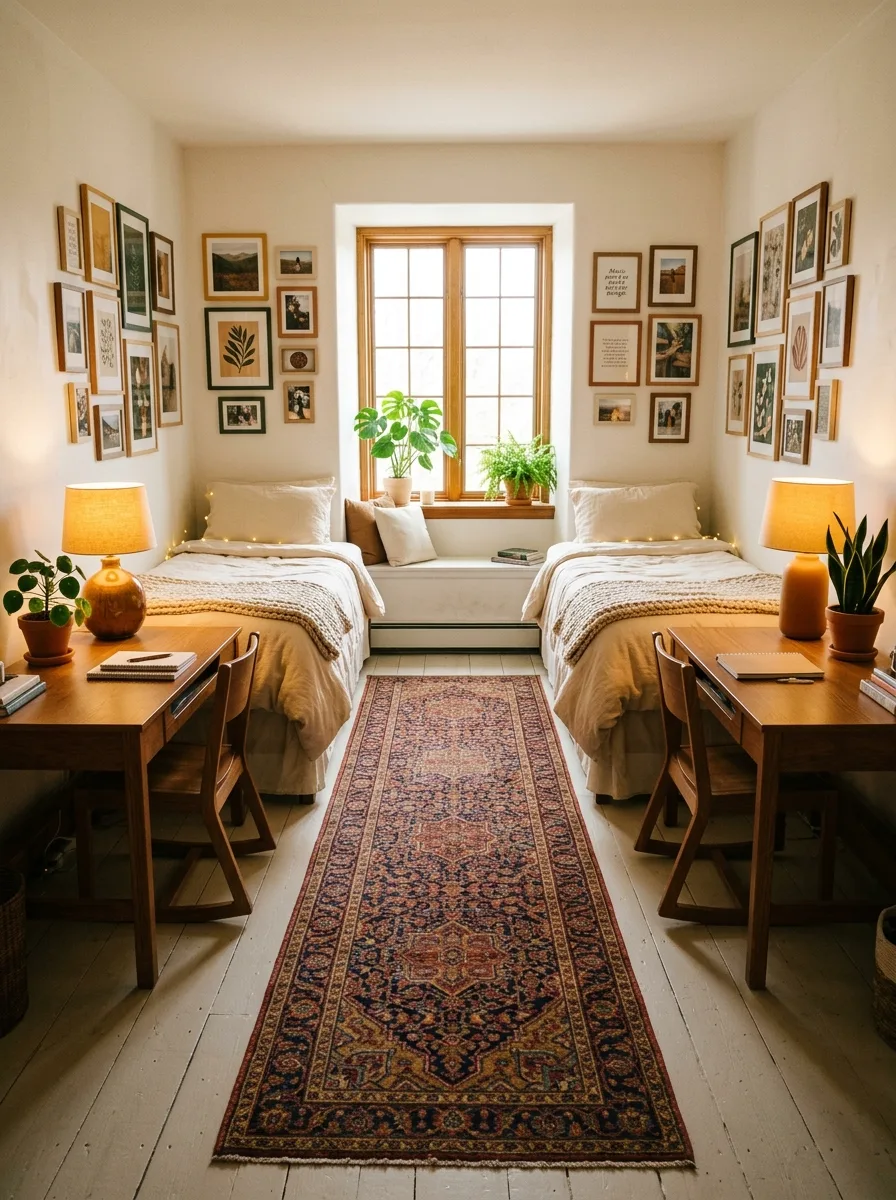
The key decision here is symmetry — not matching symmetry, but mirrored symmetry. Two beds running parallel along opposite walls, one desk flanking each bed at the far end, a runner rug connecting them down the centre of the room. The beds dress identically in tone but not in detail: warm white linen on both, with one draped in a cream chunky-knit throw and the other in a camel or honey waffle-weave.
Both desks are the same warm walnut or honey-toned wood. Each desk gets one amber or warm-toned ceramic lamp in roughly the same size — not the same lamp, but the same scale and temperature. A plant on each: one terracotta pot with a trailing pothos, one white pot with a succulent or aloe.
The walls flanking each bed get the gallery treatment — warm wooden frames in varying sizes, holding photographs, botanical prints, art prints, landscape photography. Neither gallery is curated to match the other. They are personal. But because both use warm wood frames and the same wall tone, they read as belonging to the same room rather than two separate personalities colliding.
A classic Persian-style runner in burgundy, navy, and cream runs the length of the room between the two beds. The window behind the beds holds potted plants on the sill. Fairy lights run loosely along the top of the gallery wall.
Boho Rattan Pendant Botanical Double
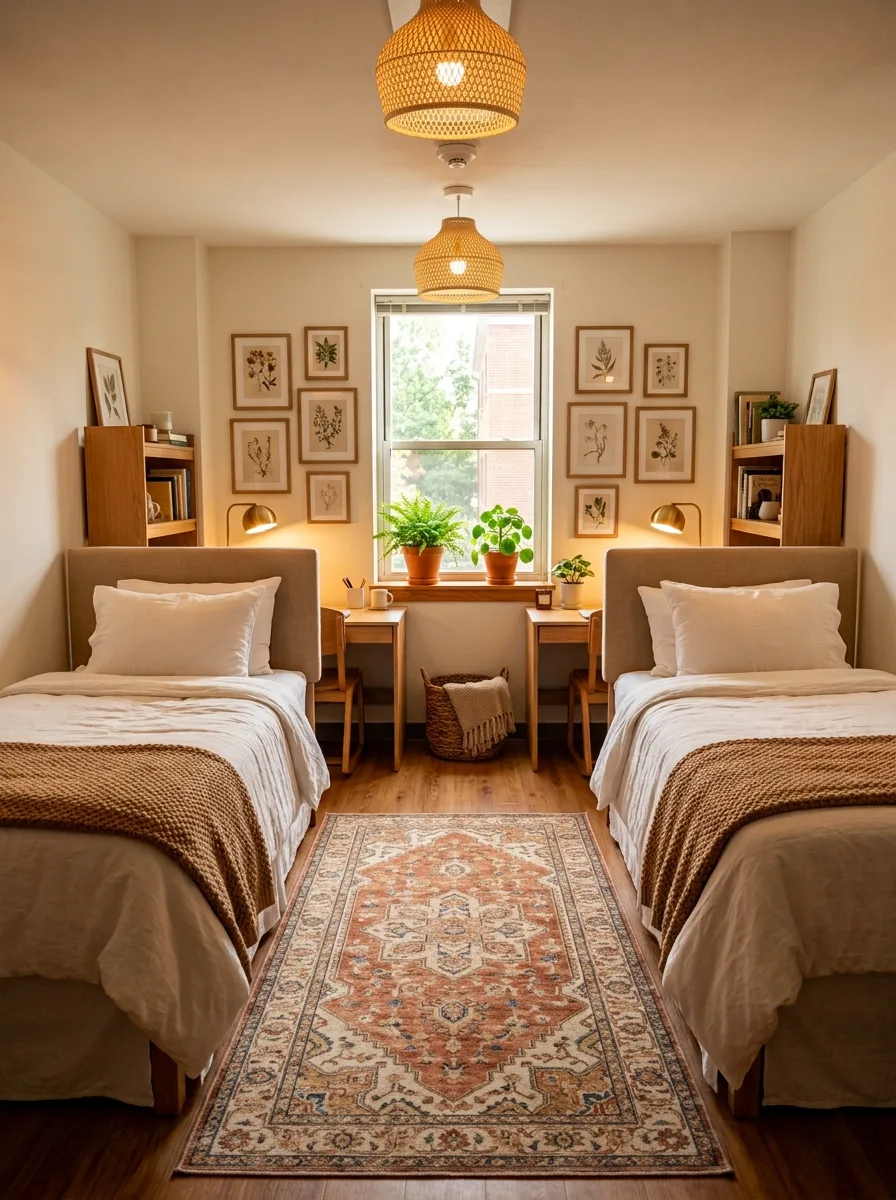
The defining move in this room is the ceiling, which is where most double rooms stop caring. Install two matching rattan or bamboo pendant light shades over each bed zone — these clip onto standard bulb sockets and don’t require any electrical work. The pendants provide warm, diffused light from above and turn the ceiling into part of the room’s design.
Behind both beds, on the shared wall between them and the window, create a gallery of framed botanical prints in medium oak or warm-toned frames. Eight to ten prints, varying sizes, arranged in an arc that spreads from behind one bed to behind the other, centred on the window. The prints are all botanical — herbarium illustrations, pressed plant studies, vintage field guide pages.
Both beds dress in warm white linen with honey-brown or caramel knit throws folded at the foot. Each desk is birch or oak, small and clean, with one gold dome desk lamp angled at the surface. A shared wicker basket sits on the floor between the desks holding a knit throw. On the windowsill, two terracotta pots — a fern on one side, a pilea or pothos on the other. A medallion rug in dusty terracotta and cream runs between the two beds.
The room achieves warmth through material consistency — every hard surface is warm wood, every soft surface is cream or caramel, and the botanical prints tie everything back to something growing.
All-White Minimal Shared Clean
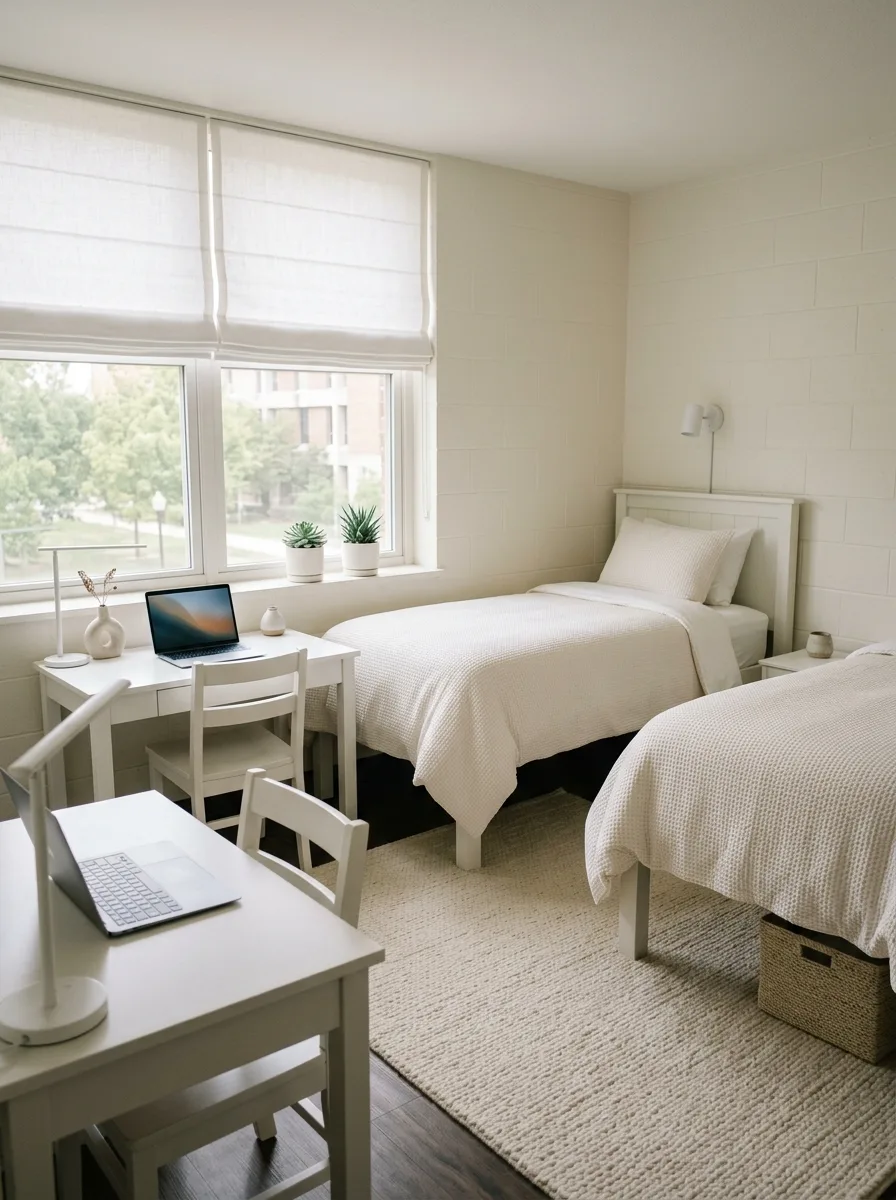
This room works precisely because it refuses to do anything interesting. Every surface is white or cream. Both beds: white waffle-weave or cotton-quilted bedspreads, white pillow cases, white fitted sheets. Both desks: white. Both chairs: white. Both headboards: white panel or white wood frame. The walls stay the colour the university left them — which, if you’re lucky, is close enough to white to work.
The distinction between sides is subtle and material rather than visual. One bed has a sheepskin or faux-fur throw in natural white, adding texture at the foot. The other has a cream waffle-knit, adding a different texture in the same tone. The lamps are the same model, the same white ceramic base with a white drum shade. Each desk has exactly two items on its surface: a lamp and one plant in a white pot.
The rug is a large natural fibre weave — jute, sisal, or a low-pile wool in undyed cream — covering both bed zones and the floor between them. On the wall, one plant sconce per side. A single white roller blind at the window. No other wall decoration.
The room earns its effect through the courage to stop. It looks expensive because every surface is precisely maintained at the same restrained level. The moment anything breaks the white rule — a coloured throw, a bright plant pot — the whole effect unravels. Keep it white. Keep it quiet.
Dark Moody Shared Gallery Study
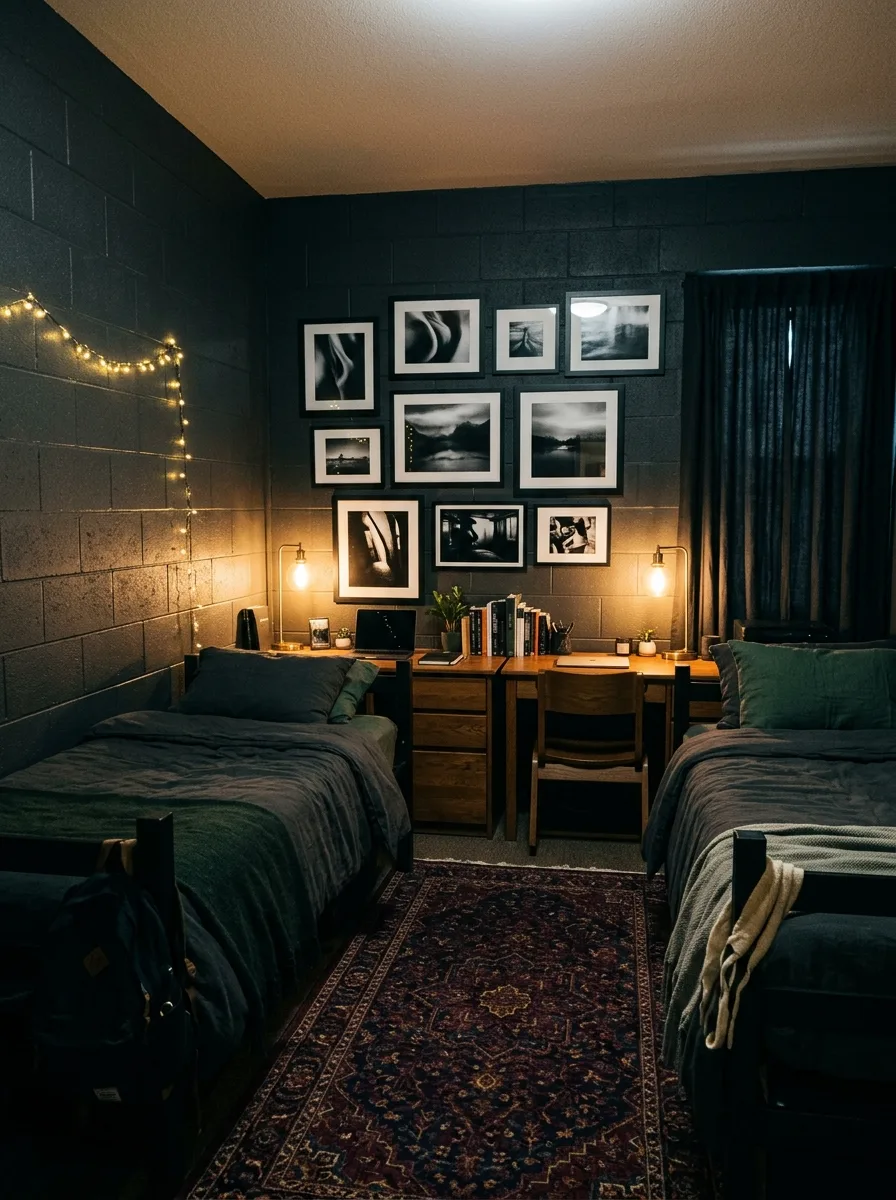
This is the most committed room on the list and requires both occupants to agree on an atmosphere, which is the harder ask. Paint all three walls visible from the doorway in the same dark tone — near-black, dark charcoal, or the darkest navy or slate available. The ceiling stays white. The cinder block texture beneath the paint adds visual interest to the painted surface.
Between the two beds, centred on the shared wall, create a gallery of black-and-white photographs in white frames. The images should be landscape, abstract, or architectural — nothing too personal, since this wall is shared territory. Eight to ten frames, arranged in a loose cluster that runs from shoulder height to ceiling height.
Both beds dress in charcoal or dark linen. Dark green throw pillows on each. Minimal. Between the beds, a shared walnut desk spans the full width of the room — a long, continuous surface for both occupants to use simultaneously. One brass desk lamp on each end. A shared bookshelf at the centre of the desk with spines organised by colour.
A Persian-style rug in deep burgundy and navy anchors the floor. The fairy lights on the side wall are the only non-functional decoration and they are necessary.
White Birch Line Art Scandi Double
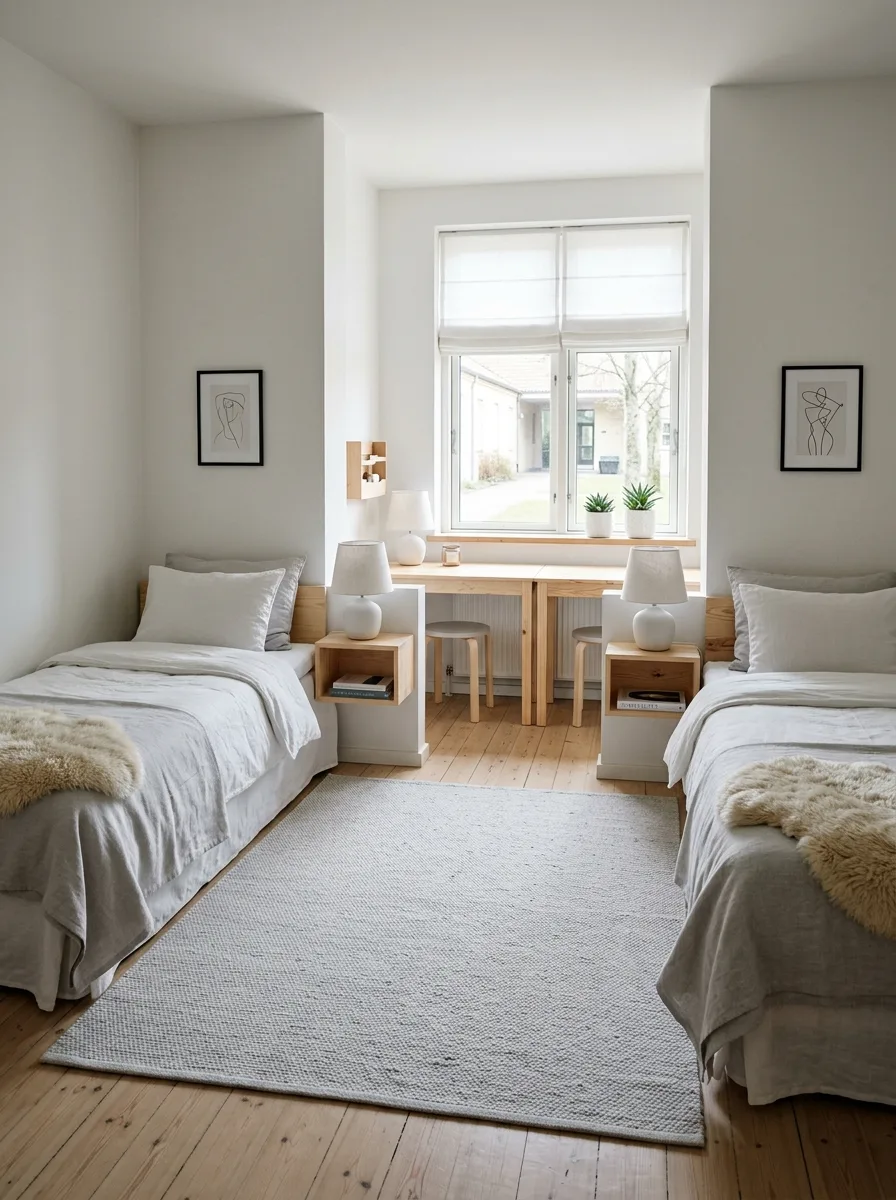
The room’s philosophy: one of each thing, properly chosen, rather than many things in the hope that quantity compensates for quality. Both beds are in natural birch frames with a low profile and exposed wood legs — the kind that look like they were built by someone who respects timber. Both beds get grey-white linen bedding, a sheepskin throw in natural white at the foot of each, and one pillow each.
Between and flanking the beds, the wall architecture is the decoration. Each bed zone gets one piece of framed art in a simple black frame: a line drawing, a contour sketch, an abstract in black ink on white paper. Nothing coloured. The art is there to provide scale, not interest.
The shared desk setup is the most architectural element. A long, low birch plank runs the width of the window, creating a shared desk surface for both occupants. Two matching bar stools or Aalto-style stools in birch sit beneath it. Two matching globe-base white lamps provide identical study lighting. Two open-cube birch shelving units — one per bed, at headboard height — provide nightstand function and a small amount of book storage.
The rug is a large, low-pile textured piece in warm off-white. No pattern. No fringe. The room’s quality comes from the wood grain, the textile texture, and the careful editing out of everything unnecessary.
Art Student Studio Room
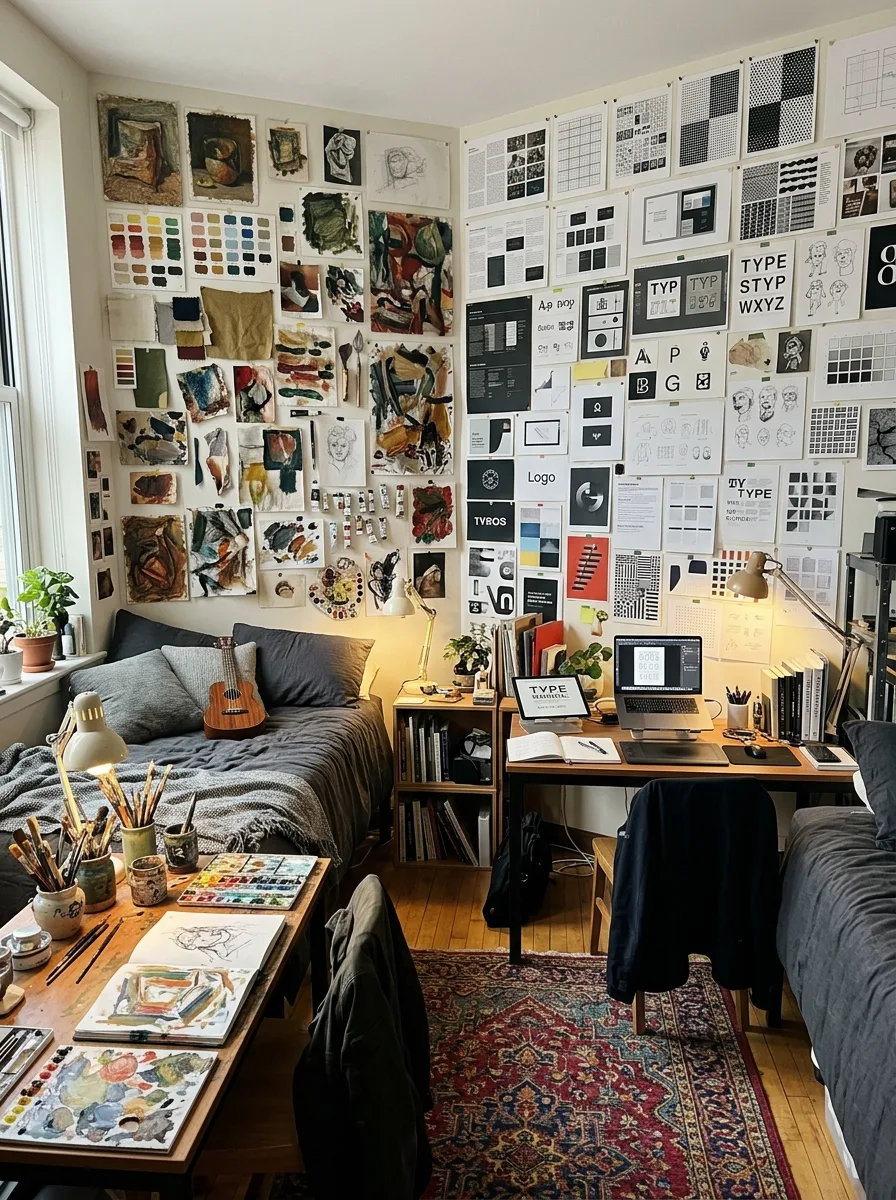
This room does not pretend to be a bedroom. It is a studio that contains two beds. Cover the entire shared wall floor to ceiling with work — art pieces, design projects, colour studies, typography experiments, reference images, pinned fabric samples, sketches, prints, photographs. This is the working wall. It grows and changes throughout the year. It is the room’s identity.
Both desks are positioned facing this wall, side by side, creating a shared studio workspace at the centre of the room. Each desk is loaded with the tools of active work: paint palettes, brush cups, sketchbooks, laptops, pencil holders. The desks are not decorated. They are used.
The beds are on the outer walls, low-profile, in dark or neutral tones that recede visually. No elaborate bedding. Grey linen. A single blanket. The beds are for sleeping. The studio is for living. The floor is covered by a large Persian-style rug in deep red and blue that provides warmth underfoot in what is otherwise a visually busy room.
This room is only successful if both occupants are actually making work. If they are, it becomes the most interesting room in the building. If they’re not, it’s just a room with a lot of stuff pinned to the wall.
Dried Botanical Chandelier Floral Double
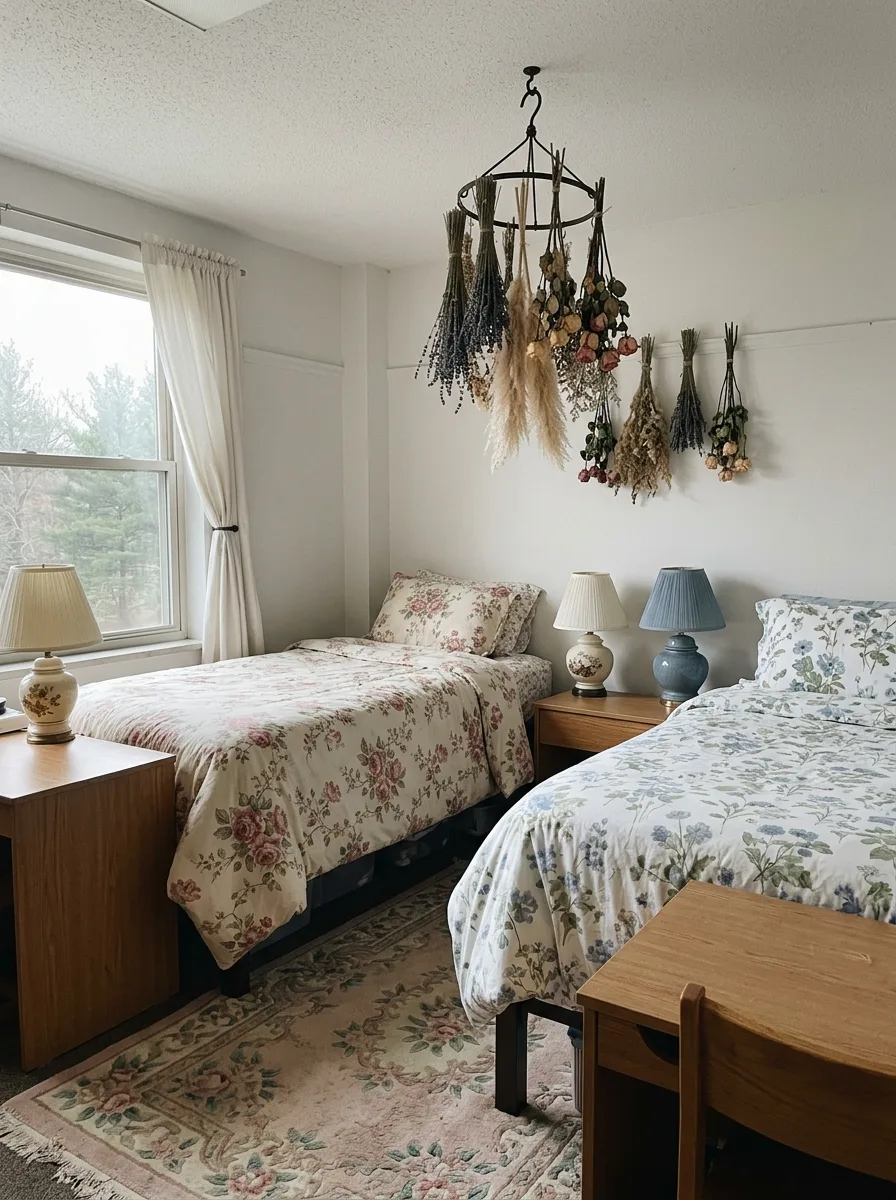
The centrepiece of this room is an object that should not, technically, exist in a dorm room ceiling: a dried botanical chandelier. Source a circular metal hoop or ring from a craft store — the kind used for wreath-making, in a diameter of twelve to eighteen inches. From the ring, hang multiple bundles of dried botanicals using varied-length twine or jute cord: lavender, pampas grass fronds, dried roses, dried eucalyptus, bundles of wheat or oat grass. Suspend the finished piece from a single ceiling hook, positioned over the shared floor space between the two beds.
This installation has no electrical component. It requires no drilling. It hangs from a single removable hook and costs under thirty dollars in materials. It looks like something from a boutique hotel in Tuscany.
Both beds dress in different floral patterns — one in a traditional rose print on cream, one in a botanical wildflower print in blues and soft greens. The patterns don’t match. They share a botanical vocabulary. Both beds have small vintage-style lamps with floral or patterned shades — again, not matching, but belonging to the same sensibility.
A floral medallion rug in pink and cream, a simple wood side table between the beds with a blue ceramic lamp on it. The window gets a half-drawn cream curtain and a small vase of fresh flowers on the sill. The room looks like it was assembled by someone who grew up spending summers in a garden.
Black White Terracotta Graphic Double
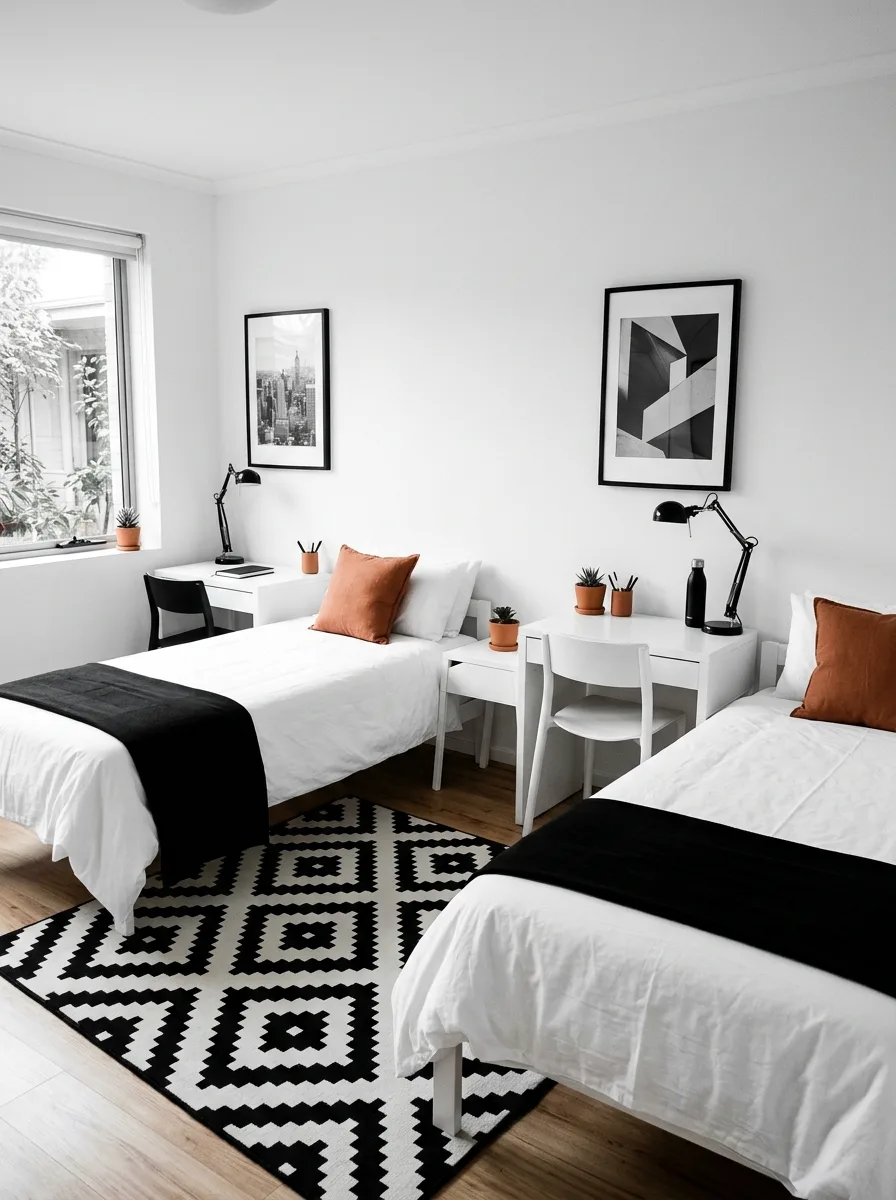
Two beds, two desks, maximum graphic clarity. The walls stay white. Both beds dress in an identical scheme: white duvet, white fitted sheet, one black runner throw across the lower third of the bed, one terracotta-orange velvet throw pillow at the centre. The matching scheme is a deliberate choice here — not because matching is always better, but because this room’s whole premise is graphic simplicity, and matching beds against a white wall creates the cleanest possible version of that premise.
Both desks are white. Both desk lamps are matte black articulated architect lamps. Each desk holds one terracotta pot with a small cactus and one pen cup. Nothing else on the desk surfaces. Two framed prints hang above each bed: black-and-white photographs in black frames. On the left bed: a cityscape. On the right bed: an abstract architectural photograph. Both in the same frame size, hung at the same height.
The rug is the room’s strongest visual statement: a large-scale black-and-white geometric in a diamond or Aztec pattern, running under both beds and the full floor space between them. It is bold. It is the pattern note the otherwise all-neutral room needs.
The terracotta is the only warm colour in the room and it appears in exactly three places: the throw pillow on each bed and the plant pots on the desks. Nothing else uses it. The restraint is what makes it work.
Navy Brass Scholar Double
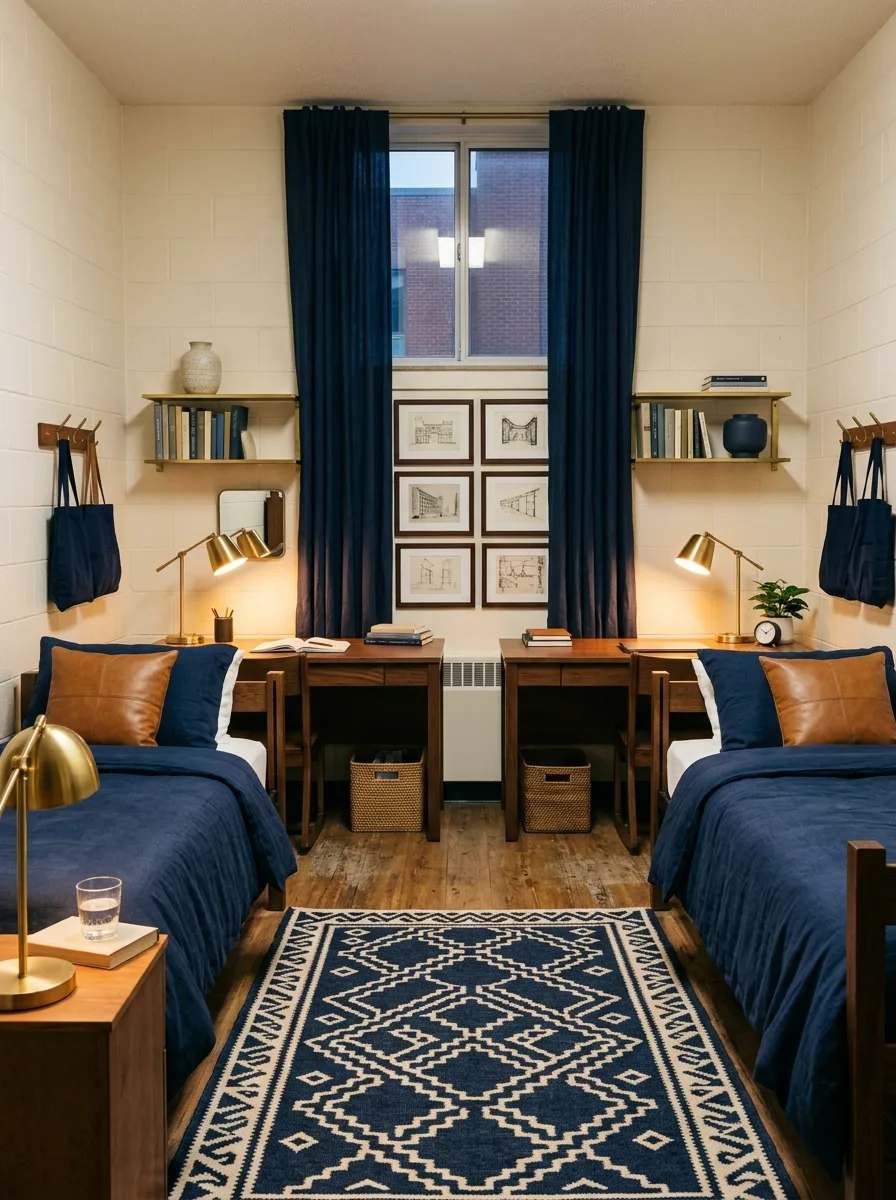
This room knows what it is, and what it is is a serious place for studying. Both beds dress in navy — a deep, saturated navy duvet in cotton or microfibre, layered with a white duvet underneath visible at the top edge for the hotel-tuck effect. One leather or faux-leather pillow in cognac or saddle-brown per bed. The combination of navy and brown is the room’s entire palette, and it is enough.
Both desks flank the window and run along the same wall, creating a study zone that spans the width of the room. Above the desks, two brass floating shelves run along the wall at eye level when seated — holding books in navy and brown spines, a small vase, one or two objects of personal significance. Two brass desk lamps, one per desk. All lamps are brass with dome shades, in the same family if not the same model.
On the wall above the desk area: a set of framed architectural drawings or blueprint-style prints in medium brown frames, arranged in a grid. Three across, two down. Even spacing. They look like they belong in a club room at an old university. The curtain at the window is a single long navy velvet panel. On the wall beside each bed, a simple adhesive hook holds a navy tote bag — functional, colour-coordinated, unobtrusive.
The rug between the beds is a navy-and-cream Aztec or geometric runner.
Forest Green Botanical Scholar Double
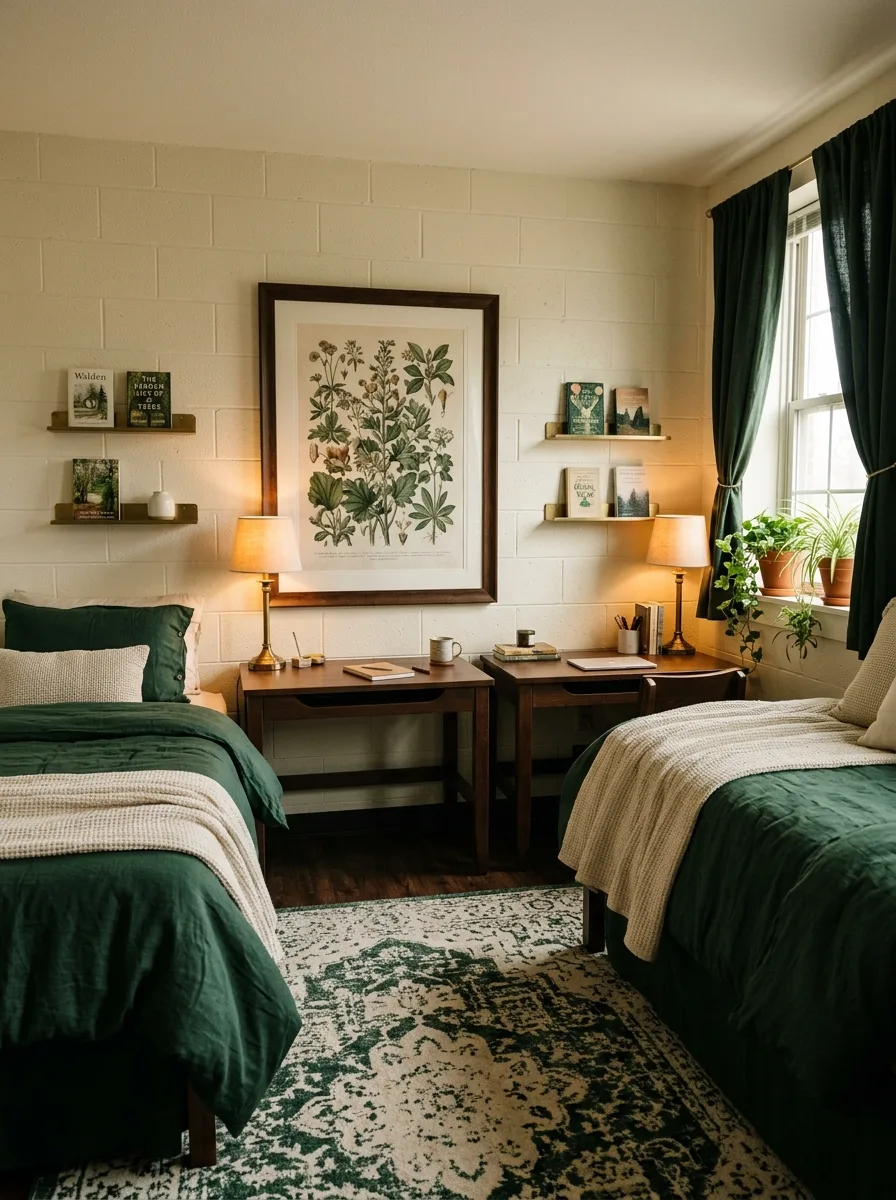
The decision that structures this entire room is made before anything is purchased: find the largest botanical print available — an oversize herbarium illustration, a vintage natural history plate, a full-colour botanical chart — and source a frame for it. This print becomes the centrepiece of the shared wall, positioned exactly between the two beds at the spot where both occupants’ eyes land when they look up from their desks.
Both beds dress in forest green. Not matching sets — one in a washed linen duvet and one in a microfibre duvet of a similar tone, so each has a slightly different surface finish. Both are layered with a cream or oatmeal waffle throw. The bedding is similar enough to read as coordinated, different enough to belong to two different people.
Two walnut or dark-wood desks sit between the beds, creating a shared study zone. Each gets a brass desk lamp with a cream shade. Above the desks on either side of the central botanical print, two small wall-mounted shelves in walnut hold books with their covers facing forward — the books are chosen and displayed as objects, not stacked as storage.
The rug is a large green-and-white medallion, faded, traditional, the kind that looks like it was pulled from a library that’s been there since 1889. The plants on the windowsill are in terracotta pots. The curtain is forest green linen. This room is for people who read.
Mauve Linen Sconce Symmetrical Warm
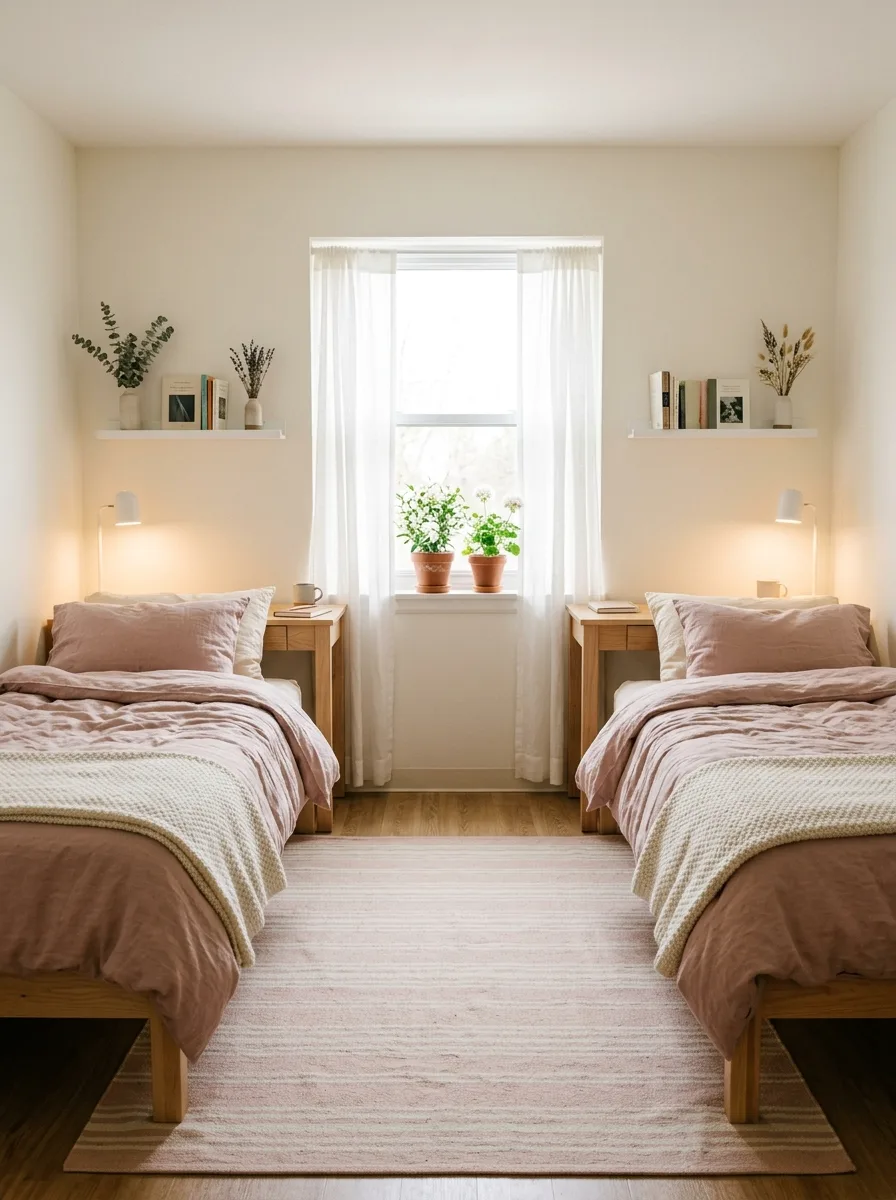
The most functional double room layout is often the most overlooked: both beds against the same wall, headboards together, creating a shared headboard zone that feels unified rather than divided. Mount a plug-in wall sconce above each pillow — one per person, positioned so the light falls directly on their reading zone without disturbing their roommate. Brass or warm-toned metal. The sconces replace bedside lamps and free up the floor and nightstand surface.
Both beds dress in the same dusty mauve or blush-brown linen — a warm, muted pink-brown that reads as neutral rather than pink in most lighting conditions. The pillowcases are cream. One cream waffle throw folded at each foot. Above the shared headboard zone, two white floating shelves run at the same height, one per bed. Each shelf holds a small collection of books, a white bud vase with one sprig of dried botanicals, and nothing else.
The shared nightstand surfaces between and at the ends of the beds are small drawer units in birch or white, each holding one lamp — a warm round-base lamp with a cream drum shade. In front of the window, two small terracotta pots of potted plants. The rug beneath and between the beds is a very pale pink stripe in linen-weave flatweave. White sheer curtains, floor-length.
The room is the warmest one on this list. It looks like it would smell like a linen closet in a farmhouse, and that is a compliment.
Wabi-Sabi Bonsai Twin Minimal
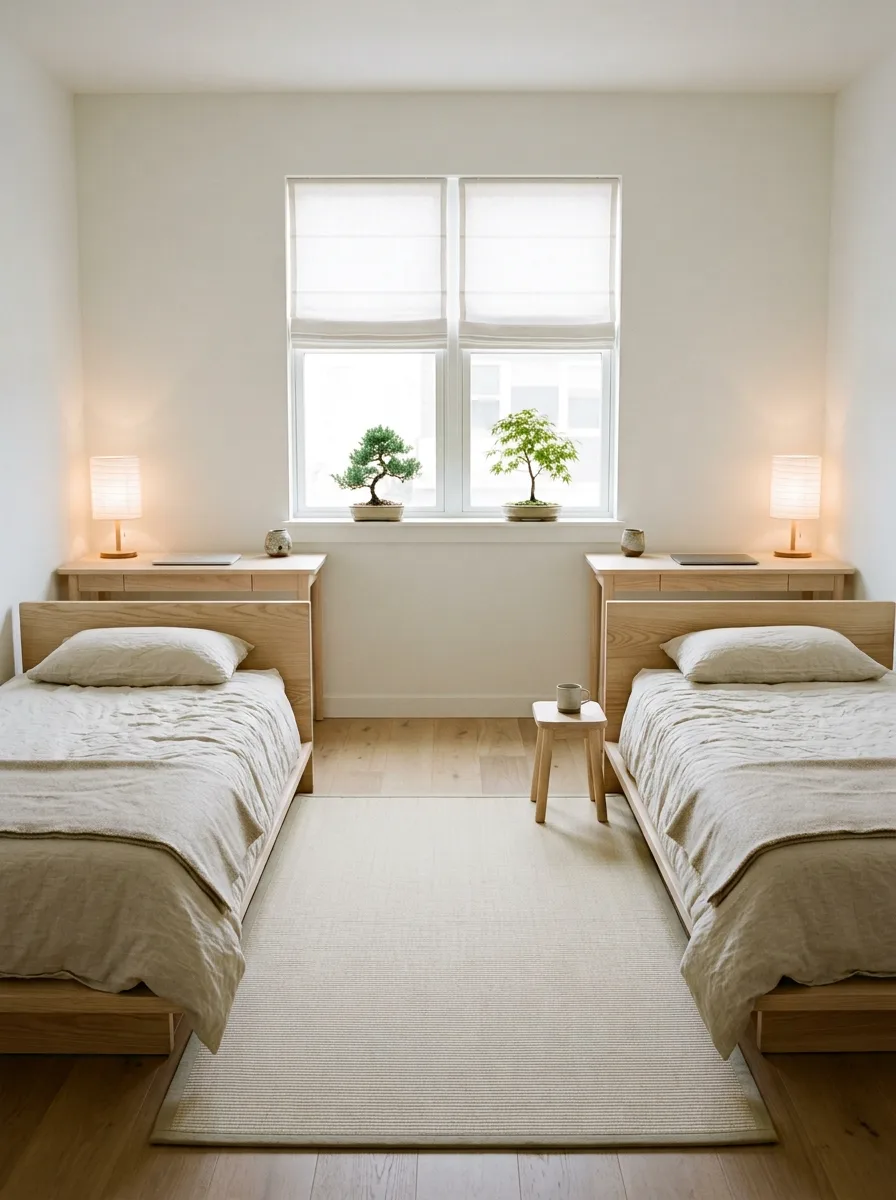
This room takes the concept of shared minimalism further than any other room in this collection. Both beds are in natural ash or maple frames, low platform style, with a headboard that is simply the bed frame extended upward by six inches — no upholstery, no panel, just wood. The bedding is undyed linen in the natural, unbleached colour — the warm beige-grey of linen before anyone has done anything to it.
Between the two beds, the integrated desk units form a shared work surface connecting the two bed units. The desk is one continuous surface in the same ash or maple as the beds. On each end of the desk, a paper lantern lamp — the kind with a fabric-covered cord and a warm LED bulb inside. Simple. Quiet. The light they cast is even and diffused.
On the windowsill, one bonsai tree per person. Not a large plant. Not a trailing pothos. A single, carefully tended bonsai in a traditional shallow ceramic pot. This is the room’s central character statement — two people who chose to care for a plant that requires attention. A small wooden stool between the beds holds one ceramic mug.
The rug is a large flat-weave in undyed cream or natural wool. The window treatment is a linen roller blind in natural. No art on the walls. The room is as quiet as it is possible for a room to be, and the bonsai trees are the only things that give it life.
Floor-to-Ceiling Colour-Sorted Library
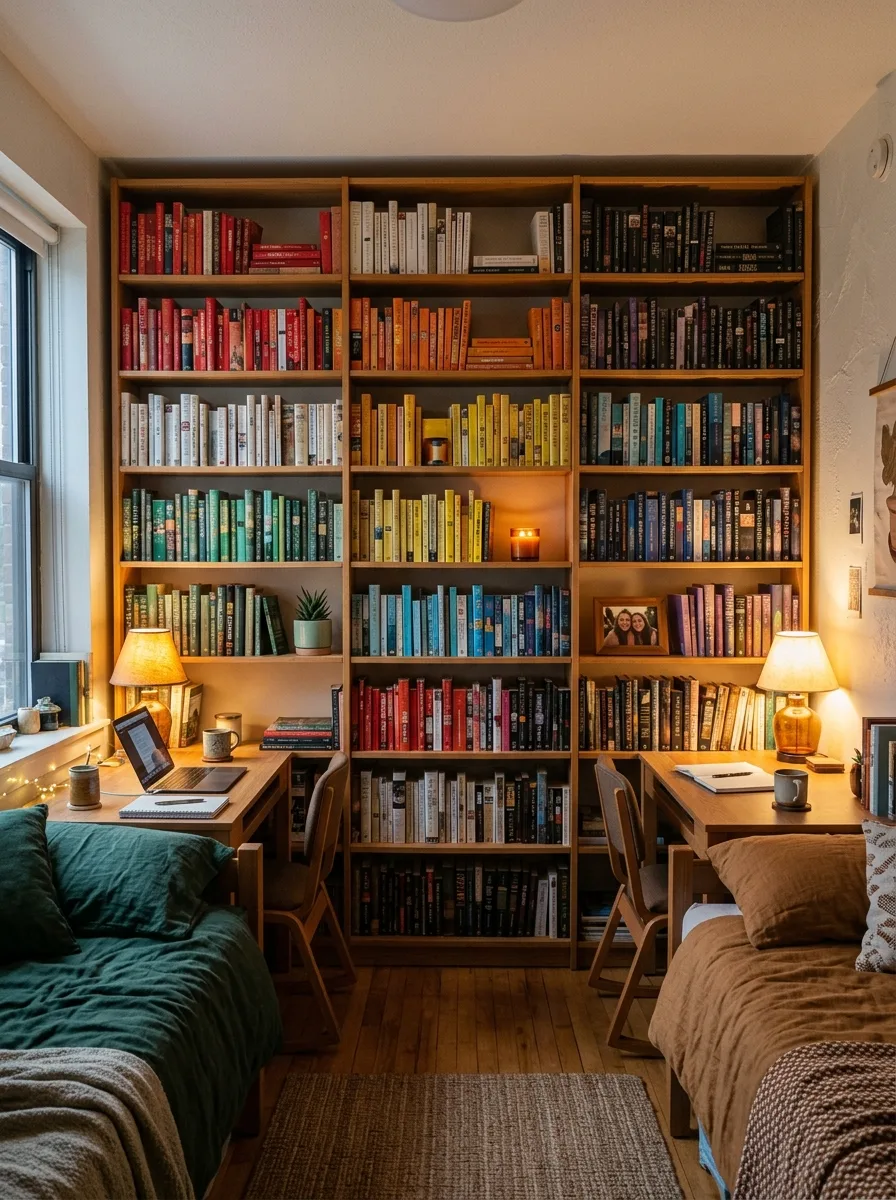
This room has made a single decision and dedicated an entire wall to it. Install a floor-to-ceiling bookshelf unit — the kind made from flat-pack components assembled into one continuous shelving wall — covering the entire shared wall between the two desk zones. Every shelf from floor to ceiling is loaded with books, sorted strictly by colour: red books together, orange, yellow, green, blue, navy, black. The colour-sorted rainbow bookshelf is the room’s only wall decoration. It is enough.
Both desks sit in front of the bookshelf, one on each side, with their chairs facing the shelf. Both occupants study facing their shared library. The lamp on each desk is a warm amber ceramic or glass piece that throws a reading-friendly glow across the books.
The beds against the outer walls dress in contrasting but compatible tones — one in teal linen, one in warm tan or brown — both keeping their palettes out of the way of the bookshelf’s colour display. The rug is a simple, tightly woven flatweave in warm grey or natural that doesn’t compete with the rainbow above it. No wall art anywhere else. The books are the art.
This room requires approximately 200 to 300 books to work. If you and your roommate can collectively provide that, this is one of the most successful double room schemes available.
Final Thoughts
A double dorm room is not a single room. It’s a negotiation that happens to have walls around it.
The rooms in this collection that work have figured out something the rooms that don’t work haven’t: the negotiation doesn’t have to result in compromise. It can result in a concept. Two people agreeing on a temperature, a mood, a shared object, or even a shared commitment to making their respective sides as different as possible — any of these produces a room with an identity.
An identity is what separates a room you’re excited to come back to from a room you’re just sleeping in.
You’re going to be in this room for nine months. You’re going to have the conversation about the layout, the rug, the shared plant, and who controls the overhead light at 2am whether you plan to or not.
Have it before move-in day. Show up with a plan. Make the room yours.
Both of yours.