
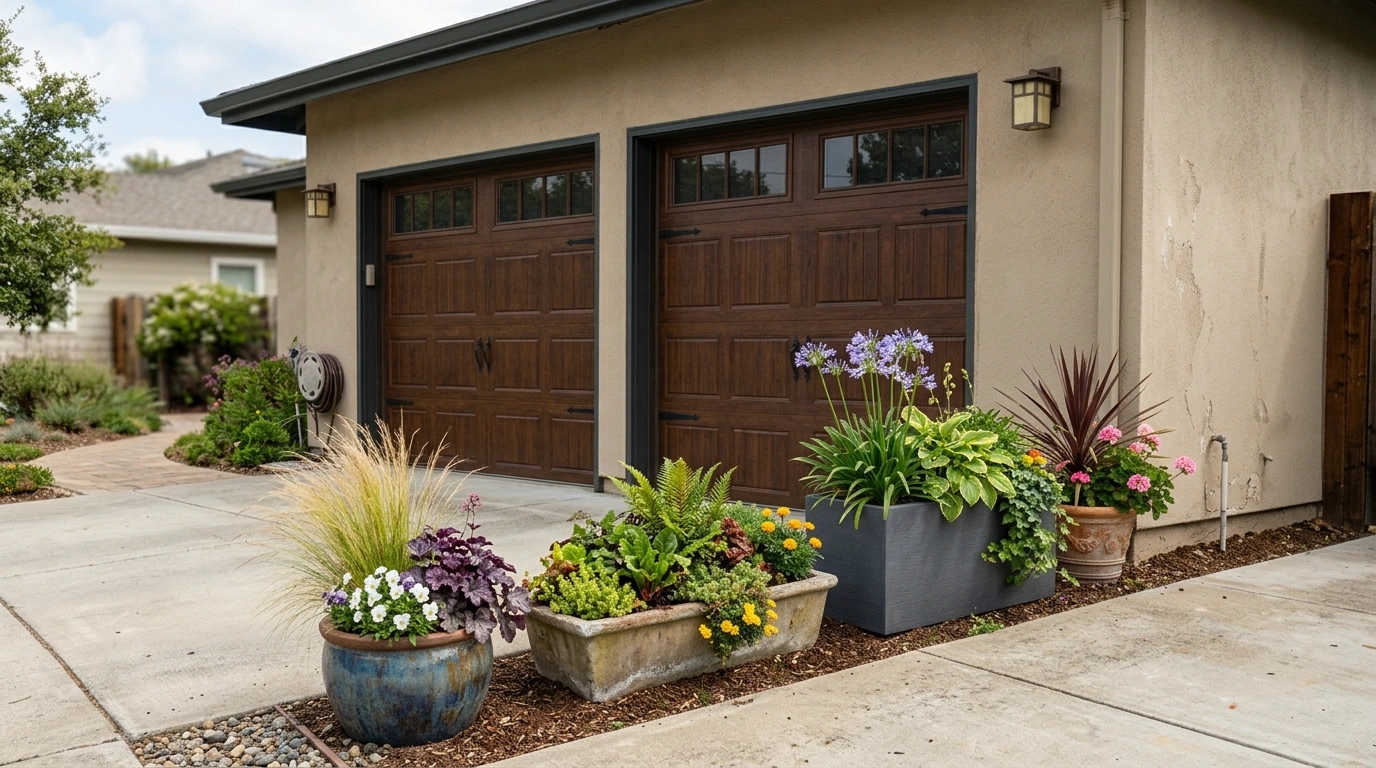
A garage can have a great door, a clean driveway, and a perfectly decent facade, yet the whole frontage can still look weirdly unfinished.
Then come the planters. One tiny pot gets dropped near the corner, another appears beside the garage door, and suddenly the landscaping looks less like a plan and more like several unrelated decisions made five minutes apart.
The problem isn’t that the containers are bad. It’s that the composition has no clear relationship to the scale of the garage, the driveway, or the rest of the house.
Planters in Front of Garage
Dark Planters With Boxwood Topiaries
Sleek rectangular dark containers elevate this classic white garage facade, framing the dark doors with crisp geometry. The combination features tailored boxwood topiaries, lush cascading greenery, textured stone paving, and classic coach lights that tie the whole exterior palette together.
The secret here is the contrast between the sharp architectural lines of the boxes and the soft, organic spill of the lower foliage. It brings a refined formality to the garage entrance without feeling overly stiff or unwelcoming.
Keep the surrounding landscaping understated to let the structured containers shine. When the pots and topiary shapes do this much heavy lifting, extra lawn decorations are completely unnecessary.
Oversized Concrete Planters Framing a Modern Double Garage
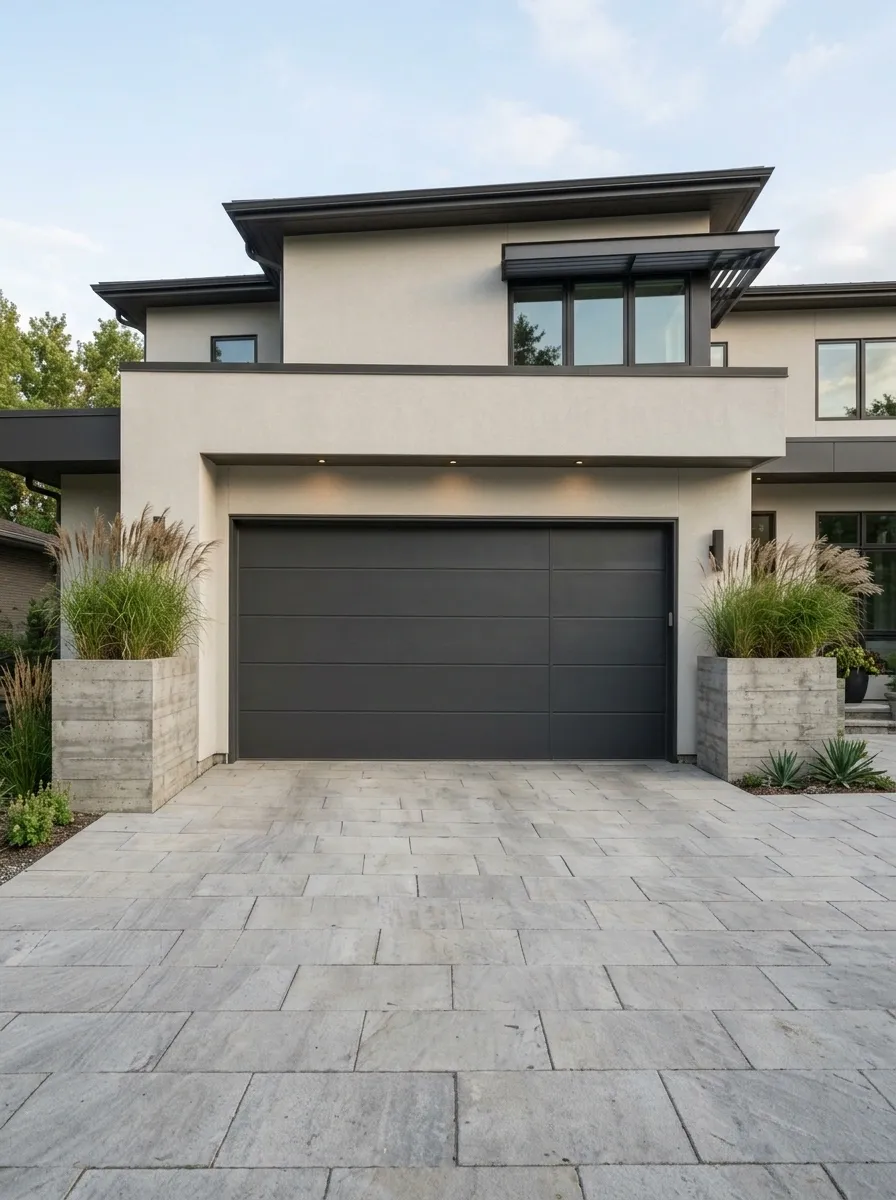
Two oversized concrete planters give a wide double garage the visual weight it needs without filling the driveway with clutter. The finished scene uses tall architectural grasses, a dark garage door, pale walls, broad paving, and clean lines around the planting.
The important detail is scale. Small containers would disappear against a garage this wide, while giant shrubs would start fighting the architecture. These planters land in the middle, creating strong vertical anchors at the outer edges.
The rest of the facade stays quiet so the planting reads as part of the architecture.
Basically, the garage gets two very serious sidekicks.
Wooden Planter Post With Hanging Basket
This multifunctional wooden planter box combines a structured garden bed with an integrated lamppost and hanging floral basket, creating a charming focal point right beside the garage entrance. The composition uses rich stained wood, warm exterior lighting, vibrant multi-colored blooms, and a sleek companion pot tucked neatly against the wall.
The real genius lies in vertical layering. By stacking ground-level planting with a suspended hanging basket and an illuminated post, you get maximum visual impact and warmth in a surprisingly compact footprint.
Match the wood stain to your front door or surrounding trim for a cohesive look. Because nothing ties a garage entrance together quite like a planter that doubles as a beacon of light.
Warm Terracotta Planters With an Olive-Tree Style Courtyard Entrance
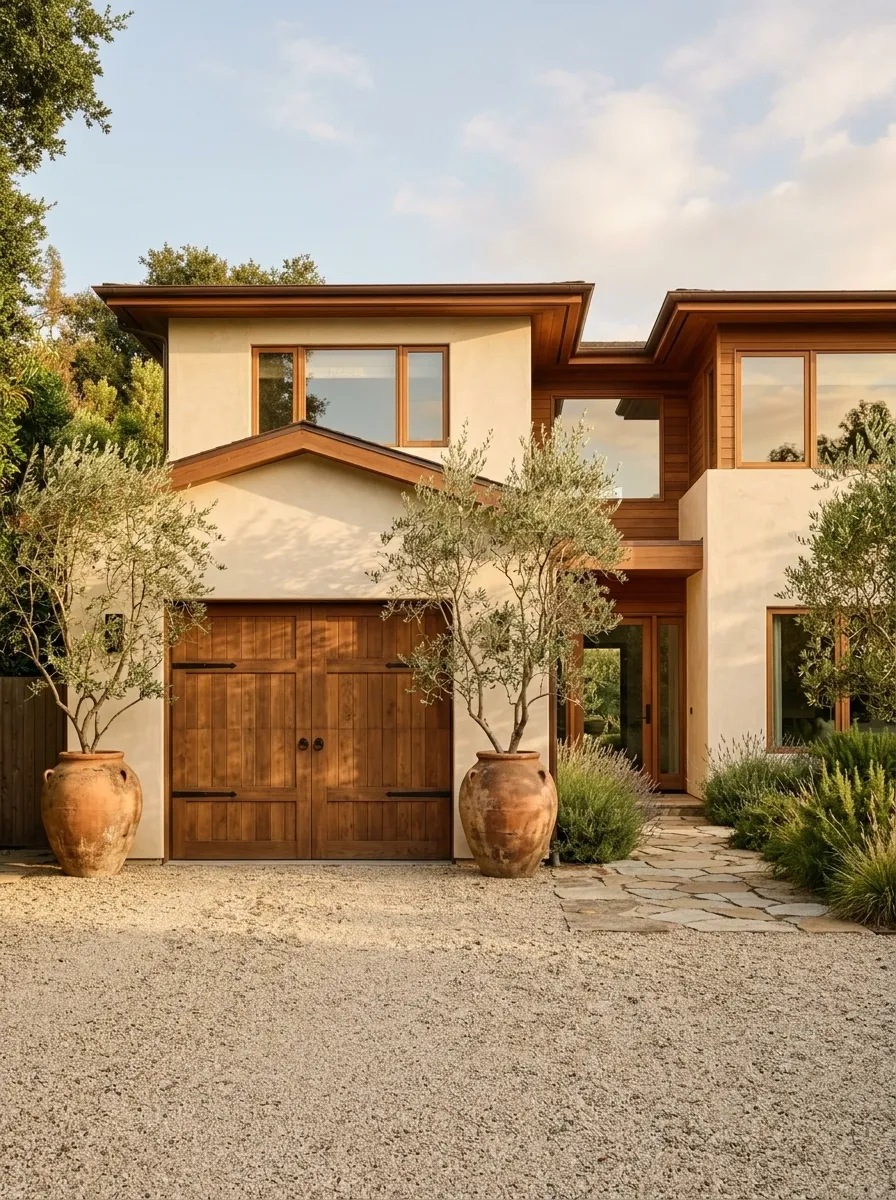
Warm terracotta vessels completely change the mood of a plain garage frontage. Here, the planters hold airy olive-tree style greenery and sit against creamy walls, warm wood details, gravel, and a softly textured driveway.
The finished composition feels relaxed because the materials share a sun-warmed character instead of competing for attention. The planting stays sculptural and relatively restrained, so the pots remain part of the architecture rather than becoming a collection of unrelated garden decorations.
This direction works especially well when the rest of the exterior already leans warm and natural.
Terracotta beside cold gray concrete? That argument has already been settled. Warm materials win this round.
Textured Tall Planters With Mixed Foliage
Tall charcoal planters packed with an artistic mix of dark grasses, trailing vines, and bright seasonal blooms instantly elevate a rustic wood-toned garage exterior. The setup balances rich natural wood siding, dark trim details, earthy gravel ground cover, and deeply textured containers that anchor the sprawling facade.
The magic here is the variety of texture and height. Fine grasses reach upward while colorful annuals and trailing greenery spill over the edges, keeping the arrangement dynamic instead of flat.
Anchor both sides of the garage doors to create symmetry and balance across a wide driveway. It is the easiest way to make a utilitarian workshop look like a custom architectural statement.
Cottage Garage With Loose Flower-Filled Planter Beds
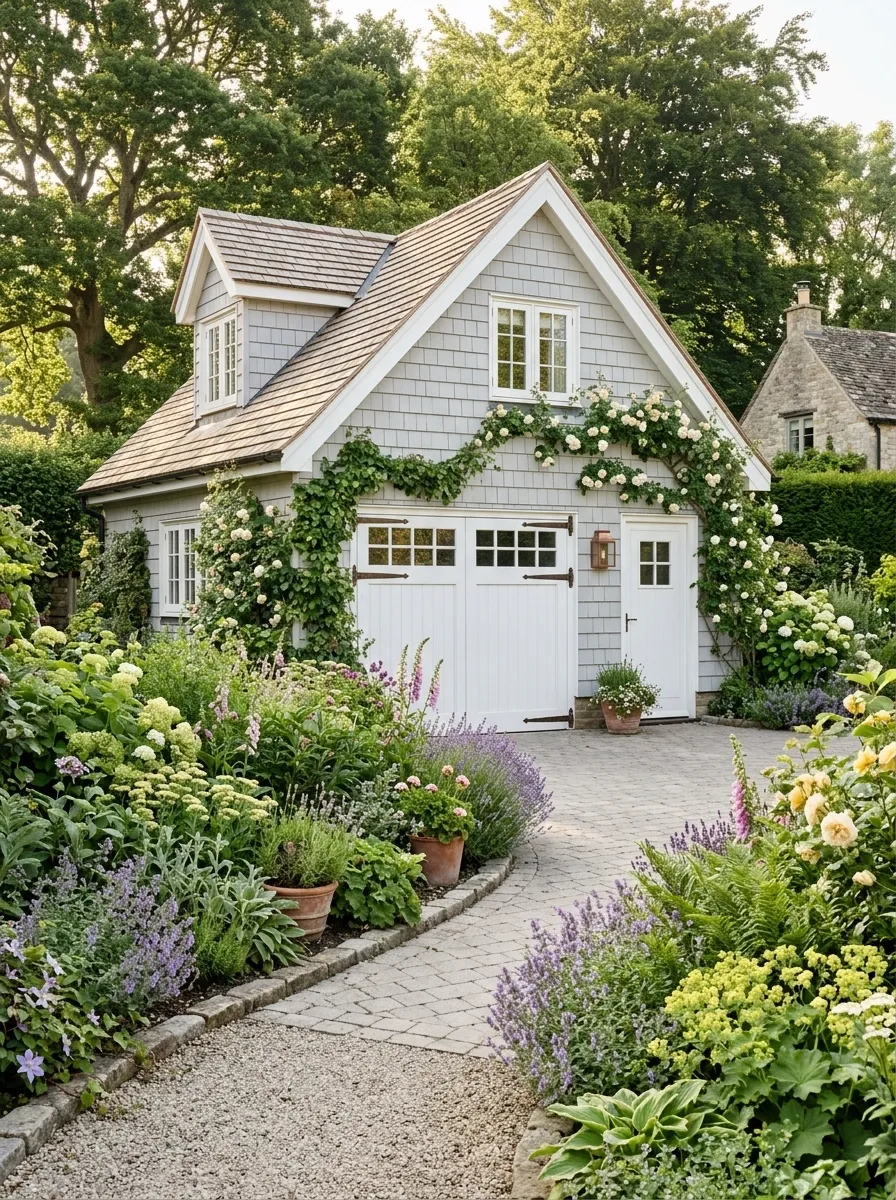
A cottage-style garage looks better when the planting feels slightly relaxed instead of clipped within an inch of its life. This composition combines pale siding, stone edging, flowering plants, climbing greenery, and generous planter beds that spill naturally toward the driveway.
The architecture remains simple while the plants provide most of the softness and movement. A few stronger vertical shapes keep the arrangement from turning into one giant blob of flowers.
The trick is controlled looseness. The beds can look abundant, but the path and garage opening stay clearly defined.
Wild enough to look charming. Organized enough to avoid looking like the plants have taken legal ownership of the property.
Black Planters and Architectural Grasses Against a White Garage Door
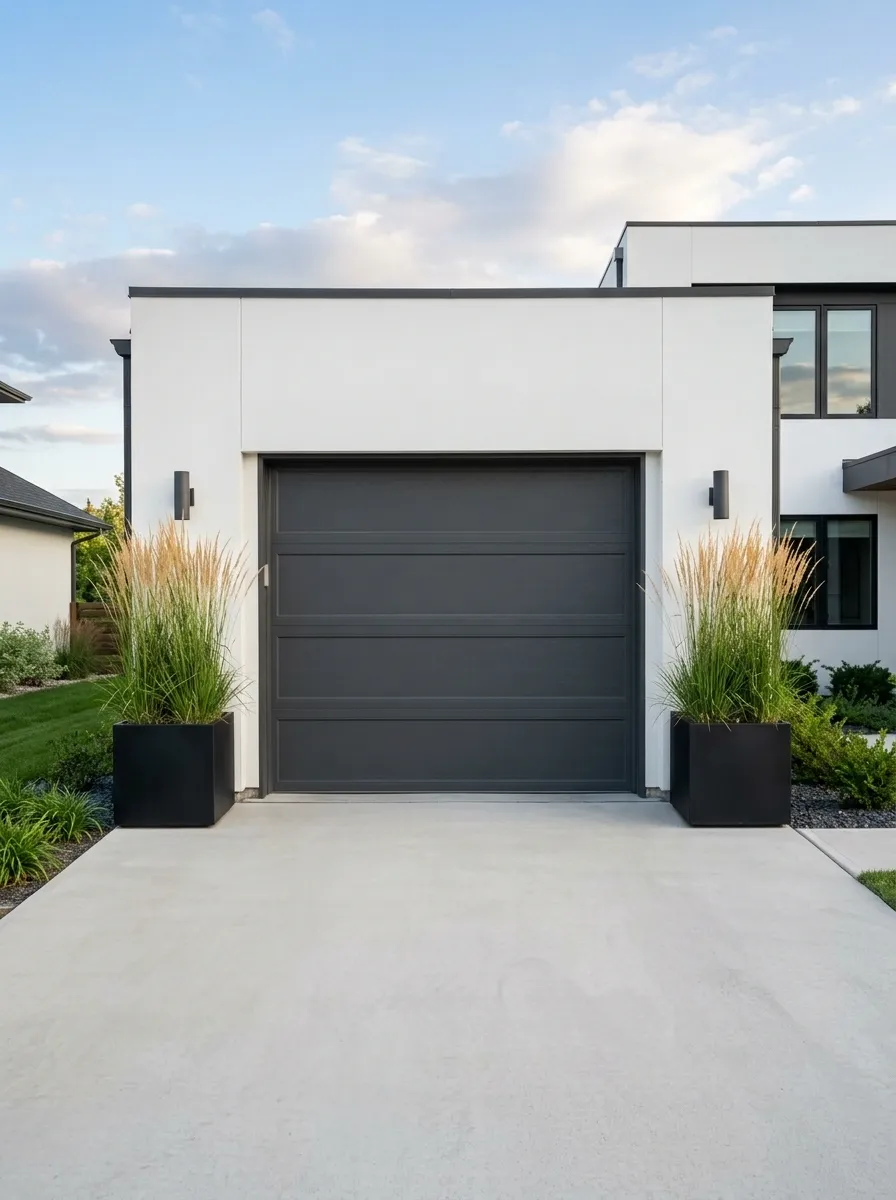
Few combinations look as crisp as matte-black planters, tall grasses, and a clean white garage facade. The finished composition uses repeated dark containers on either side of the entrance, upright planting, dark trim, and a simple paved foreground.
The greenery adds movement without breaking the monochrome structure. The tall shapes also pull the eye upward, which helps a flat garage facade feel more architectural.
Keep the rest of the landscaping restrained here. Once the planters, trim, and garage door are doing the visual work, extra decorative objects start sounding like a group chat nobody asked to join.
Low Brick Planter Beds Built Into a Traditional Garage Front
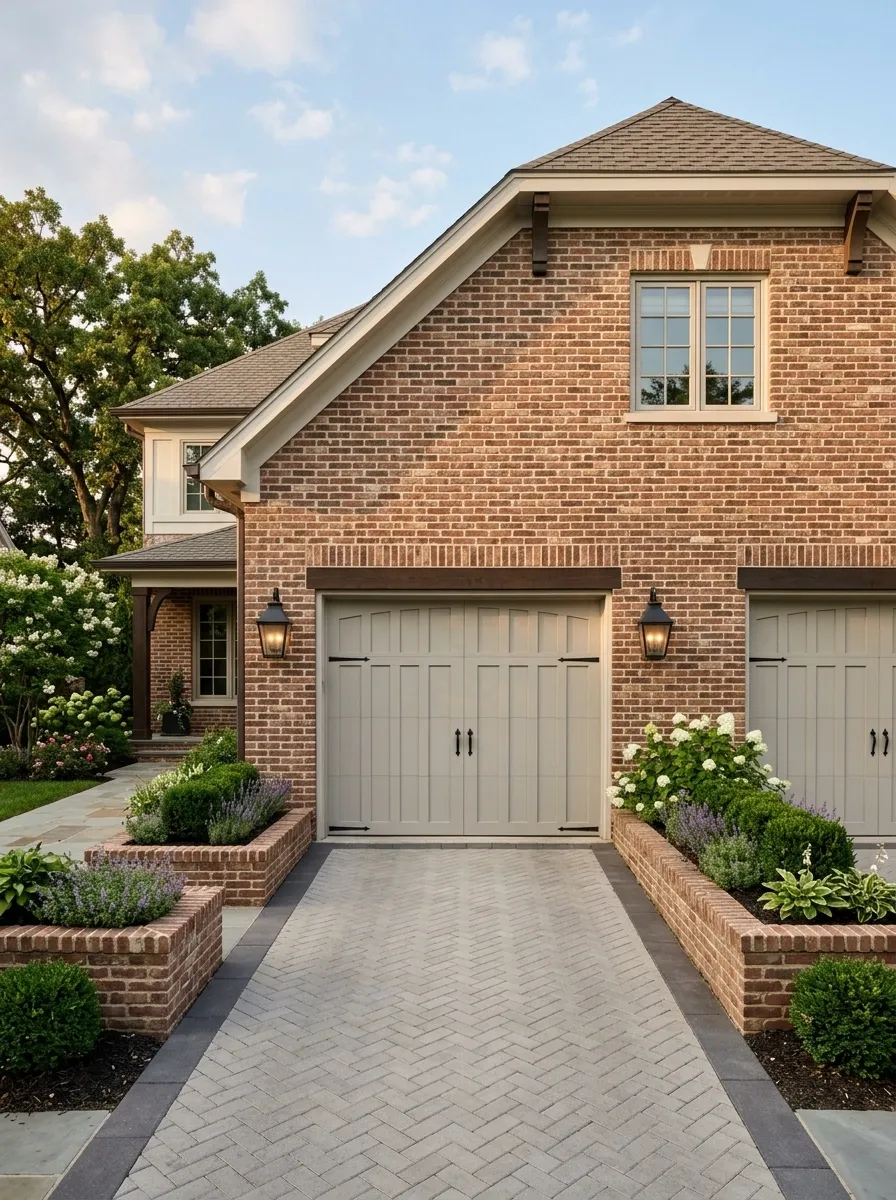
This traditional garage frontage treats the planting beds as part of the architecture instead of placing freestanding containers in front as an afterthought. Warm brick walls continue into low planter beds, where compact evergreens and seasonal flowers sit beneath a paneled garage door.
The result feels established because the same material language runs across the entire frontage. Nothing looks randomly added.
Keep the planting lower near the driveway so the garage remains visible and vehicle sightlines stay comfortable. The brick does most of the visual connecting, while the greenery adds softness.
It is the difference between “plants near garage” and “landscaped garage frontage.” Very different energy.
Farmhouse Garage With Galvanized Tub Planters and Soft Greenery
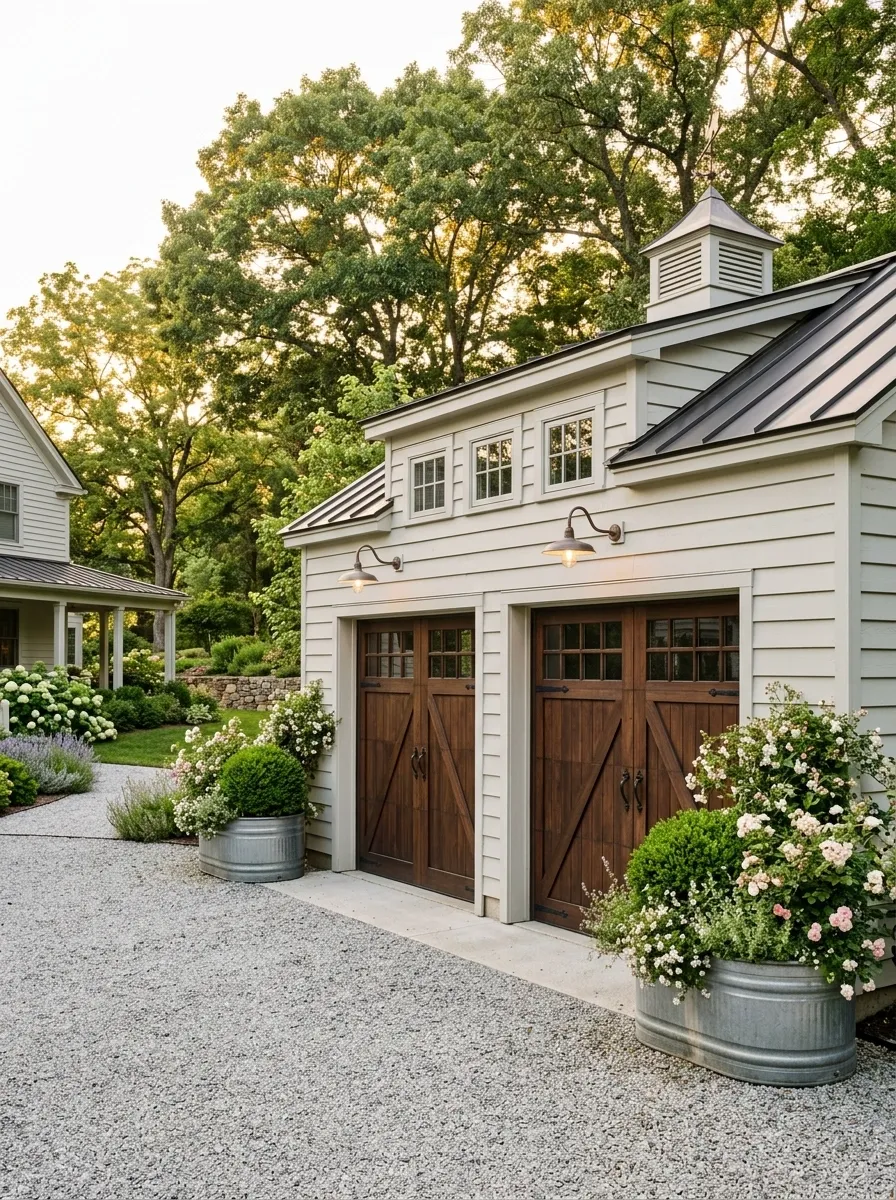
A farmhouse garage looks especially good when the planting feels relaxed without becoming messy. This composition pairs white or muted siding with carriage-style garage doors, galvanized metal tubs, rounded greenery, flowering shrubs, and a simple gravel or concrete approach.
The weathered metal adds a little grit against the softer siding, while the plants keep the whole scene from feeling too industrial. Matching containers aren’t necessary, but their finishes should stay in the same family so the arrangement reads as one idea.
The secret is restraint. A few generous containers look intentional. A dozen tiny metal pots start giving “garage sale aftermath.”
Symmetrical Boxwood Planters Around a Classic Garage Door
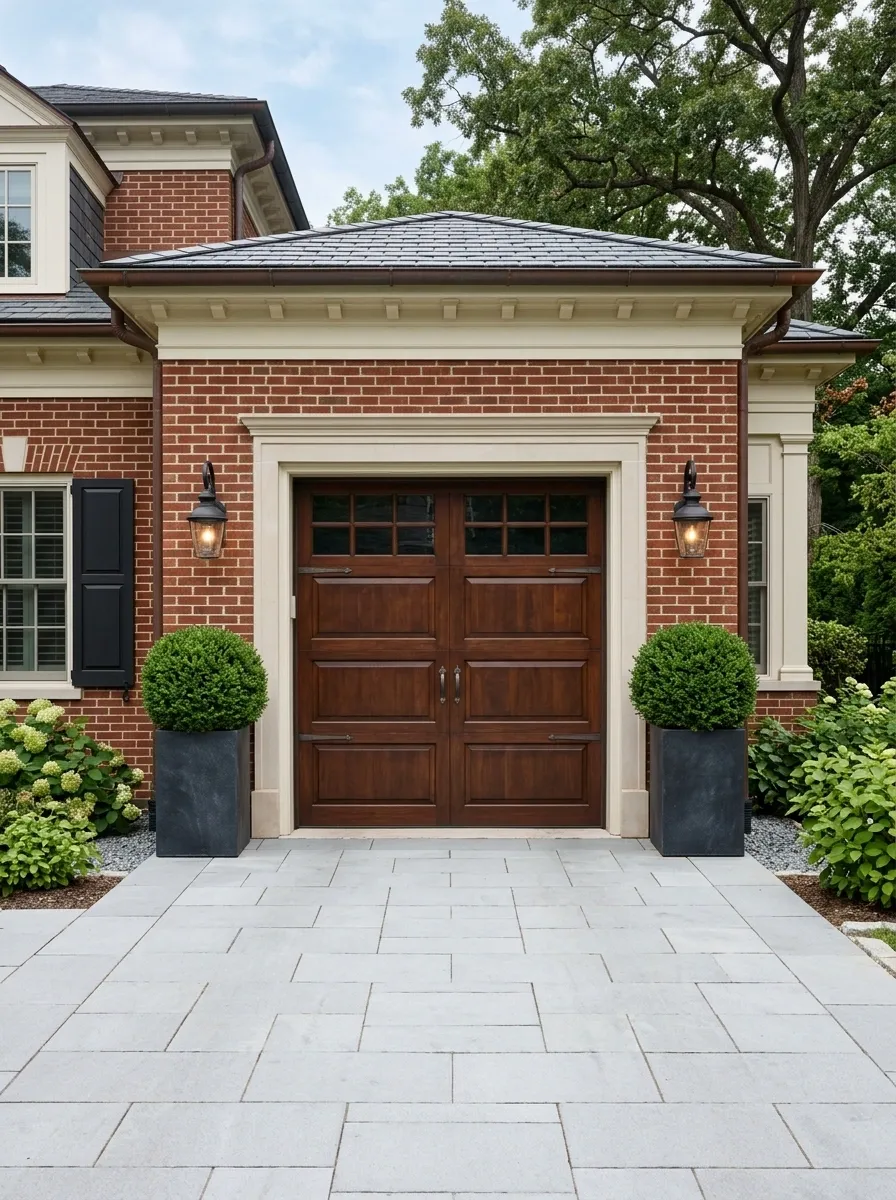
For a traditional exterior, symmetry does a lot of heavy lifting. Matching rectangular planters sit on both sides of a paneled garage door, each filled with dense rounded greenery. Stone or brick details, simple paving, and restrained exterior lighting complete the scene.
Nothing is fighting for attention. The repeated planter shapes frame the garage while the clipped foliage gives the facade a polished, orderly rhythm.
This look depends on consistency. The containers should relate in size and height, and the greenery needs enough fullness to hold its shape visually.
Because apparently the garage has finally decided to behave itself.
Layered Entry With Tall Planters, Shrubs, and a Stone Walkway
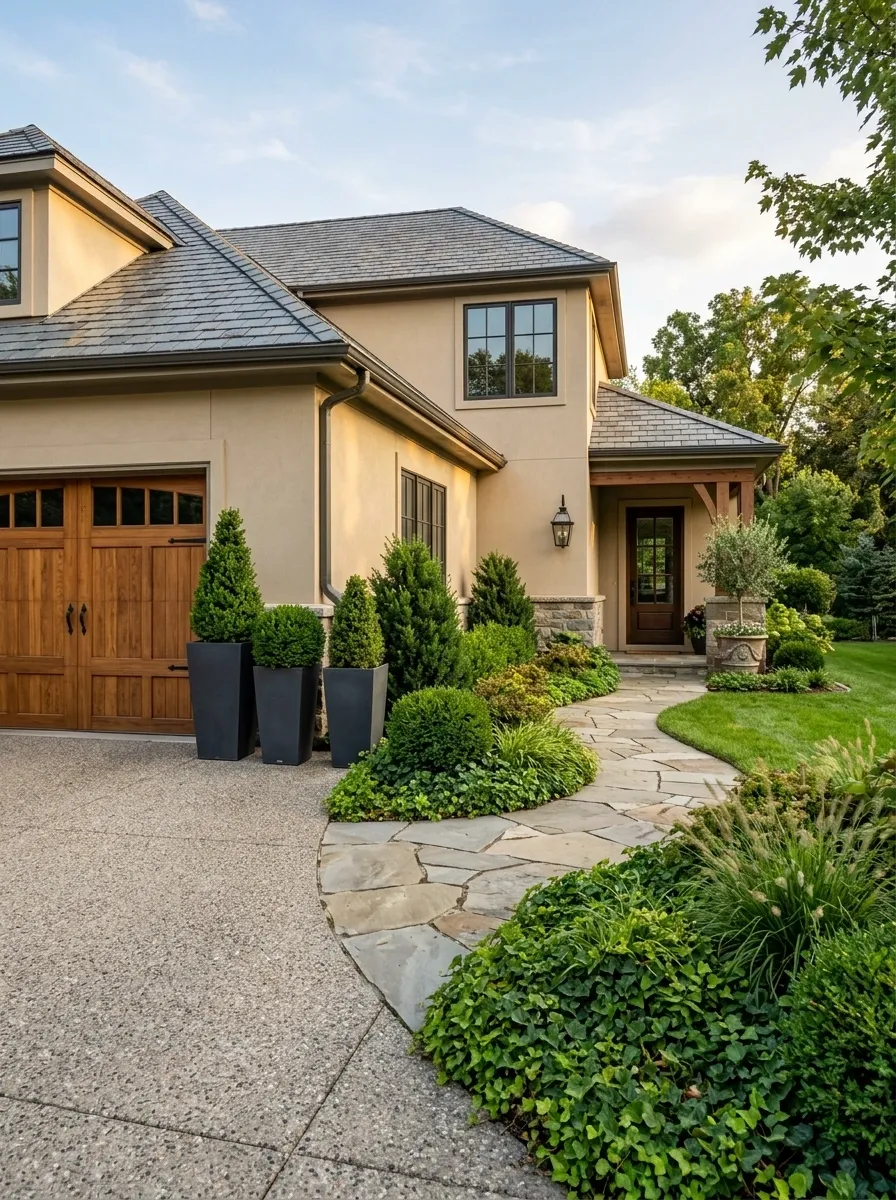
A garage doesn’t have to be treated as a separate landscaping zone. This arrangement connects it to the main entrance with a layered planting composition. Taller containers sit closest to the garage, medium shrubs occupy the transition area, and lower greenery follows a stone walkway toward the front door.
The changing plant heights create depth while the walkway gives the eye a clear route through the exterior. That connection matters, especially when the garage sits prominently beside the home entrance.
The result feels much more considered than simply placing two pots beside the door.
The landscape equivalent of a good outfit: different layers, everything somehow getting along.
Narrow Garage Front With Tall Slim Planters
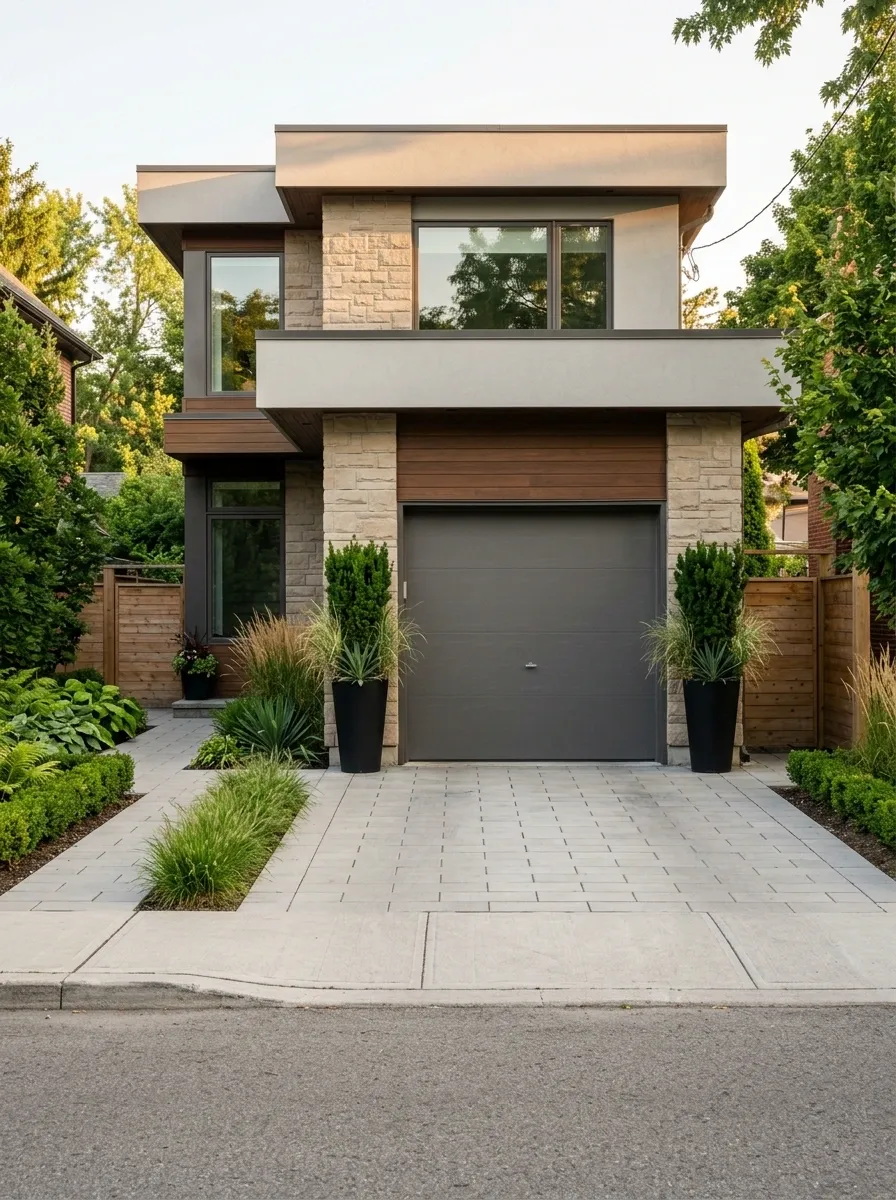
When the driveway is tight, adding large round containers everywhere is a wonderfully efficient way to make parking even more annoying. A better composition uses tall, narrow planters that add height without stealing much ground space.
This compact design pairs vertical containers with upright greenery, a simple garage door, restrained paving, and a clear pedestrian route. The planting stays concentrated near the edges rather than spreading into the vehicle zone.
The shape of the containers matters just as much as the plants. Narrow forms keep the frontage visually tall and clean while preserving useful floor area.
Small space, small footprint, still plenty of personality.
Black Garage Door With Cedar Planter Boxes and Warm Planting
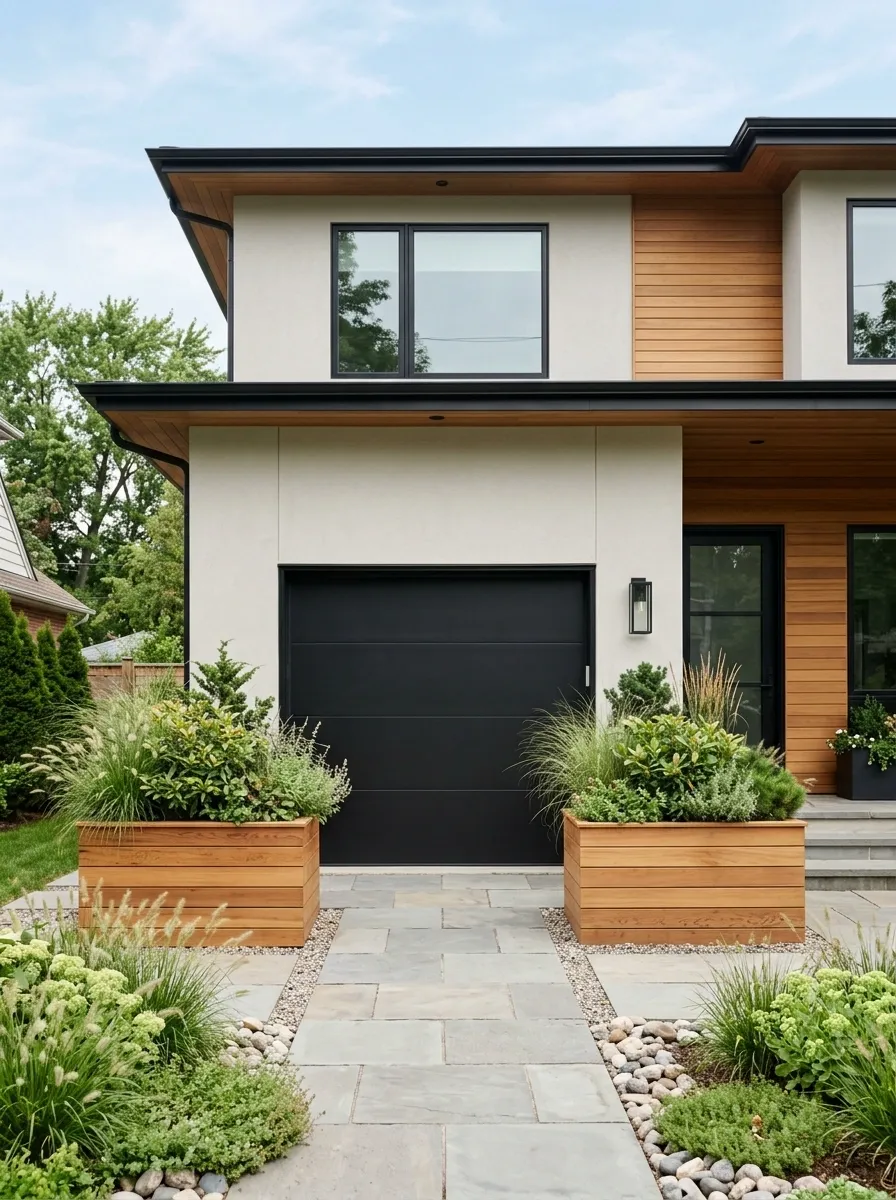
A black garage door can feel stark against a pale exterior, but warm cedar planter boxes change the temperature of the whole composition. Add soft grasses, leafy shrubs, muted paving, and a few warm wood details elsewhere on the facade, and the contrast starts feeling deliberate.
The best part is the material pairing. The black garage gives the scene depth, while the cedar adds natural warmth without introducing a completely new color story.
Keep the plant shapes loose rather than overly clipped. The contrast between structured wood and relaxed greenery gives the frontage some life.
Black and wood really did not need a complicated plot.
Built-In Stone Planters Along a Craftsman-Style Garage
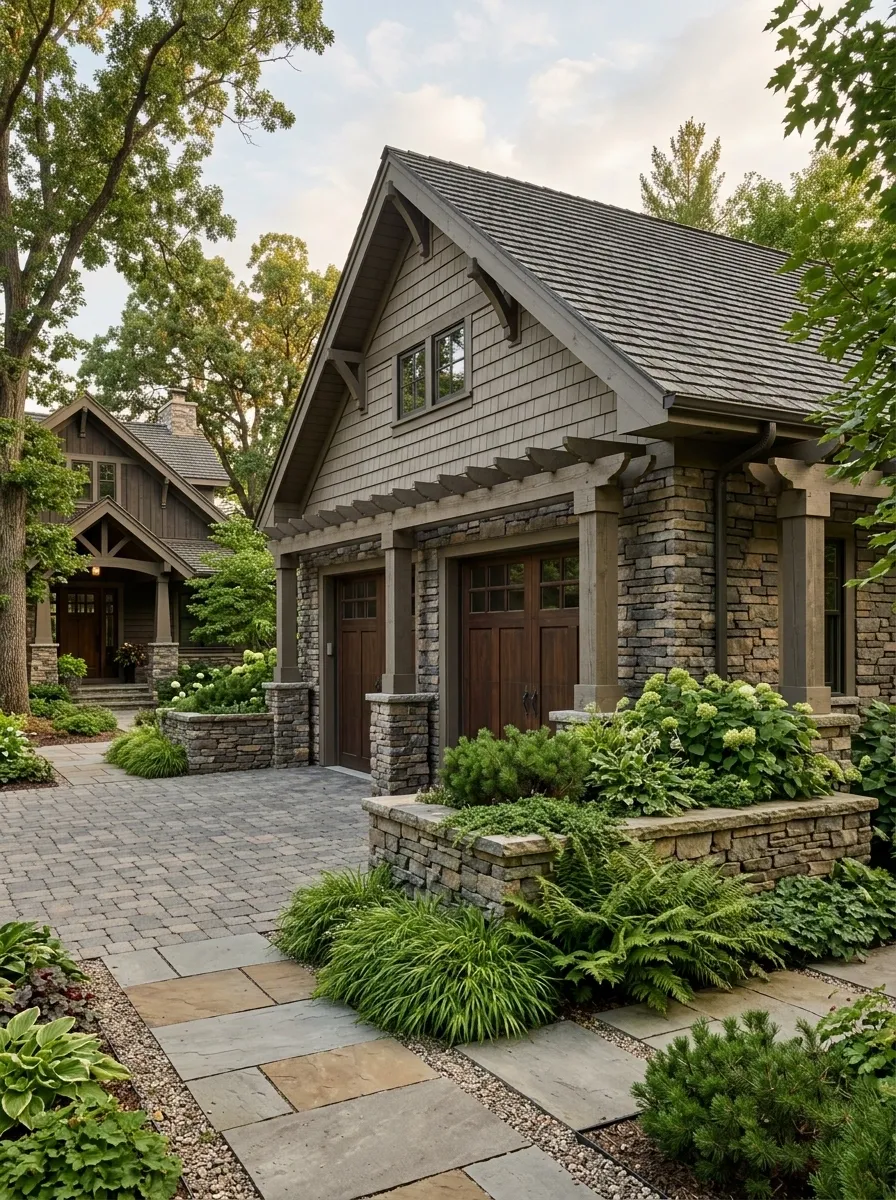
A Craftsman-style garage benefits from planting that feels connected to the architecture. Here, substantial stone planters sit directly alongside the garage, echoing the facade while ferns, shrubs, and layered greenery soften the masonry.
The stone shouldn’t look pasted on. Matching or closely related stone tones on the garage and planter walls make the whole frontage feel like one architectural decision.
The planting can be generous, but the structure stays visible. That balance keeps the scene detailed without losing the strong lines that make Craftsman exteriors distinctive.
The garage finally gets landscaping that speaks the same architectural language.
Coastal Garage With White Pots and Soft Blue-Green Planting
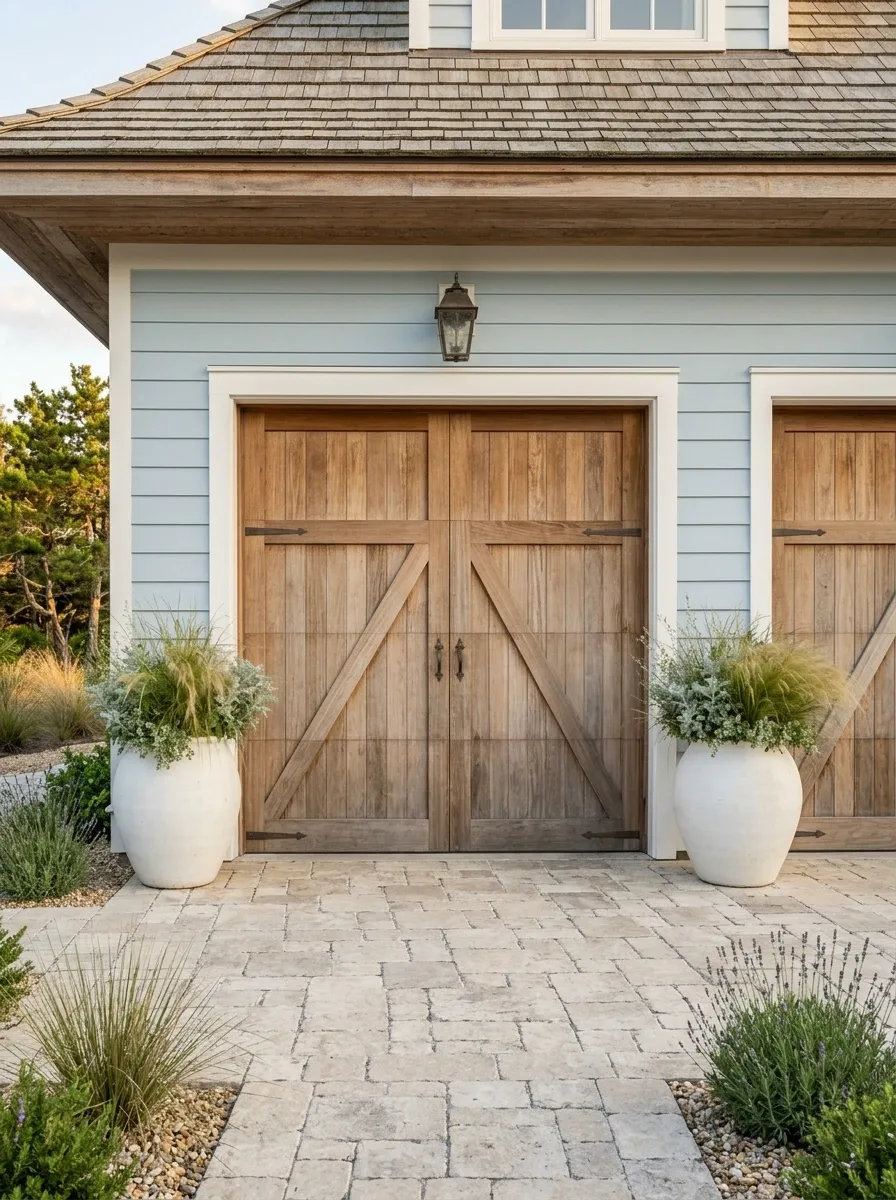
White planters can make a coastal-style garage frontage feel bright without relying on loud color. This composition pairs oversized white containers with airy grasses, silvery foliage, pale siding, natural wood accents, and light paving.
The palette stays deliberately narrow. Instead of throwing blue decorations everywhere, the cooler blue-green tones come mostly from the planting. That keeps the exterior relaxed and lets the texture of the foliage do the work.
A little weathered wood helps the white surfaces feel warmer and more lived-in.
Basically, coastal without turning the garage into a souvenir shop.
architecture
neutral
contrast
accent
Layered Cottage Containers Around a Single Garage Door
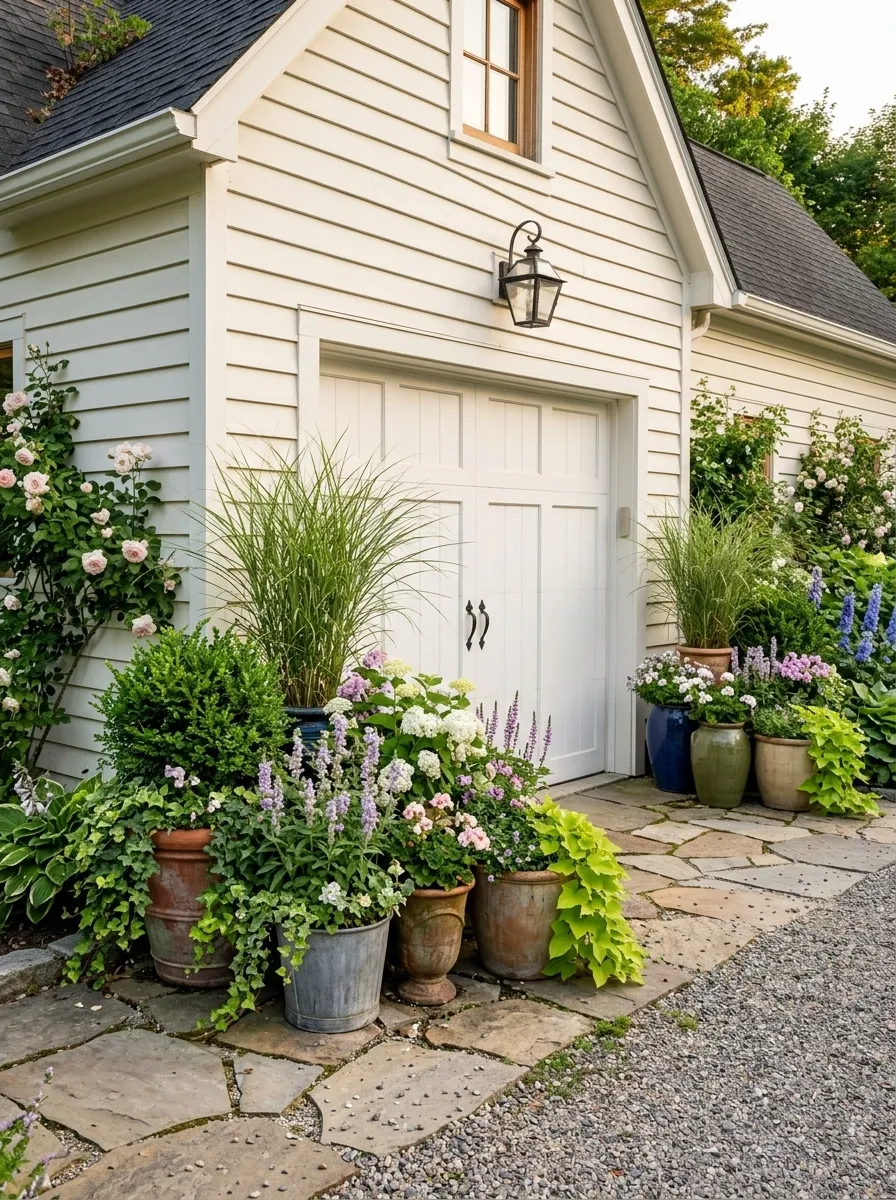
A single garage door leaves plenty of room for a softer, more layered planting composition. This cottage-inspired frontage groups containers at different heights around the edges, mixing flowering plants, trailing greenery, leafy shrubs, and a few taller forms.
The important part is that the containers still read as one arrangement. Similar colors and planting textures create a visual relationship even when the pot shapes aren’t identical. A narrow path and simple garage facade keep the lower half of the scene from becoming too busy.
It feels collected rather than matched, which is exactly what cottage style needs.
The pots can disagree slightly. They just shouldn’t start a family feud.
Minimalist Concrete Garage With One Strong Planter Pair
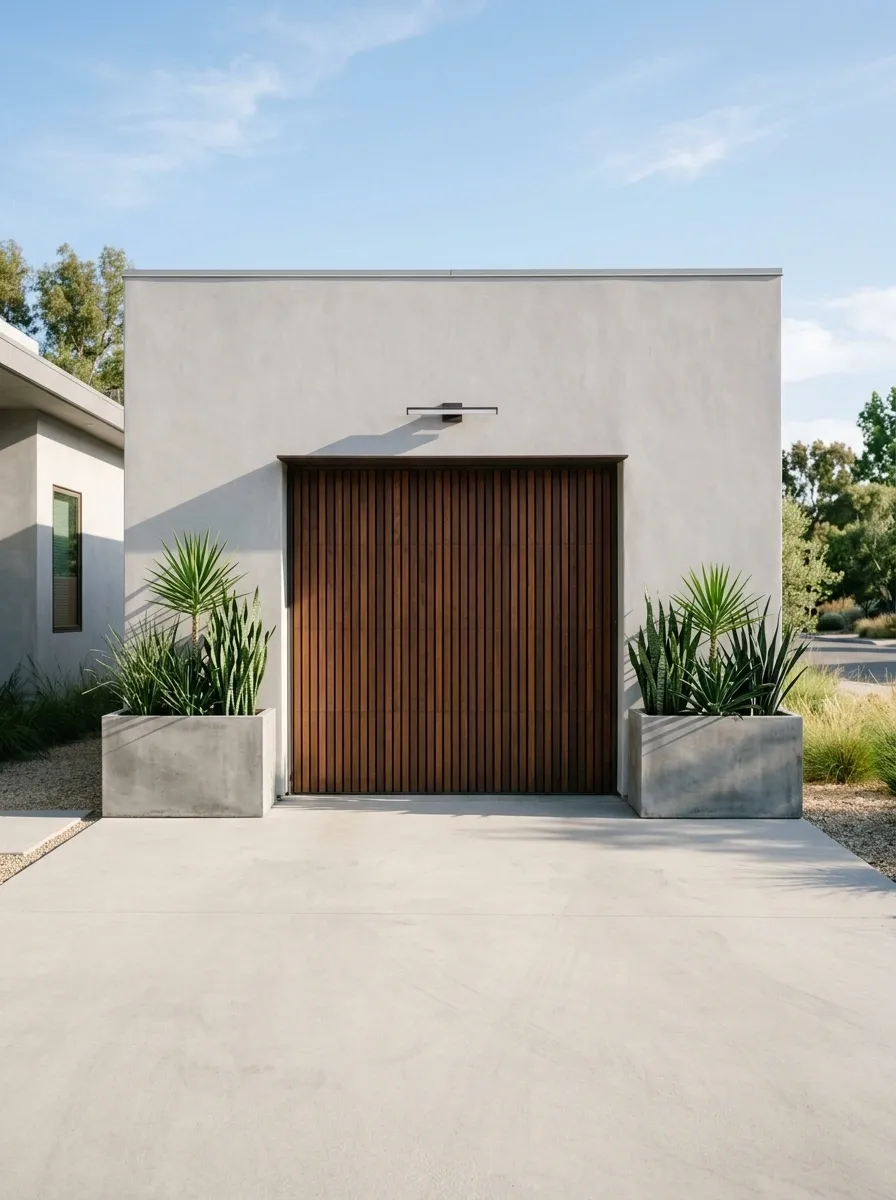
Some garage facades genuinely do not need more decoration. This minimalist composition uses two large concrete planters with sculptural greenery, leaving most of the driveway and facade intentionally open.
The architecture carries the visual weight through broad planes, simple geometry, and restrained materials. The containers simply reinforce those shapes rather than competing with them.
This is a strong direction when the garage door itself already has a bold finish, unusual proportions, or a strong architectural frame. Adding more objects would dilute the effect.
Sometimes the smartest landscaping decision is knowing when to stop.
A concept surprisingly difficult for the internet.
PLANTERS SECOND.
EVERYTHING ELSE QUIET.
Vintage-Inspired Garage With Blue Ceramic Planters and Flowering Shrubs
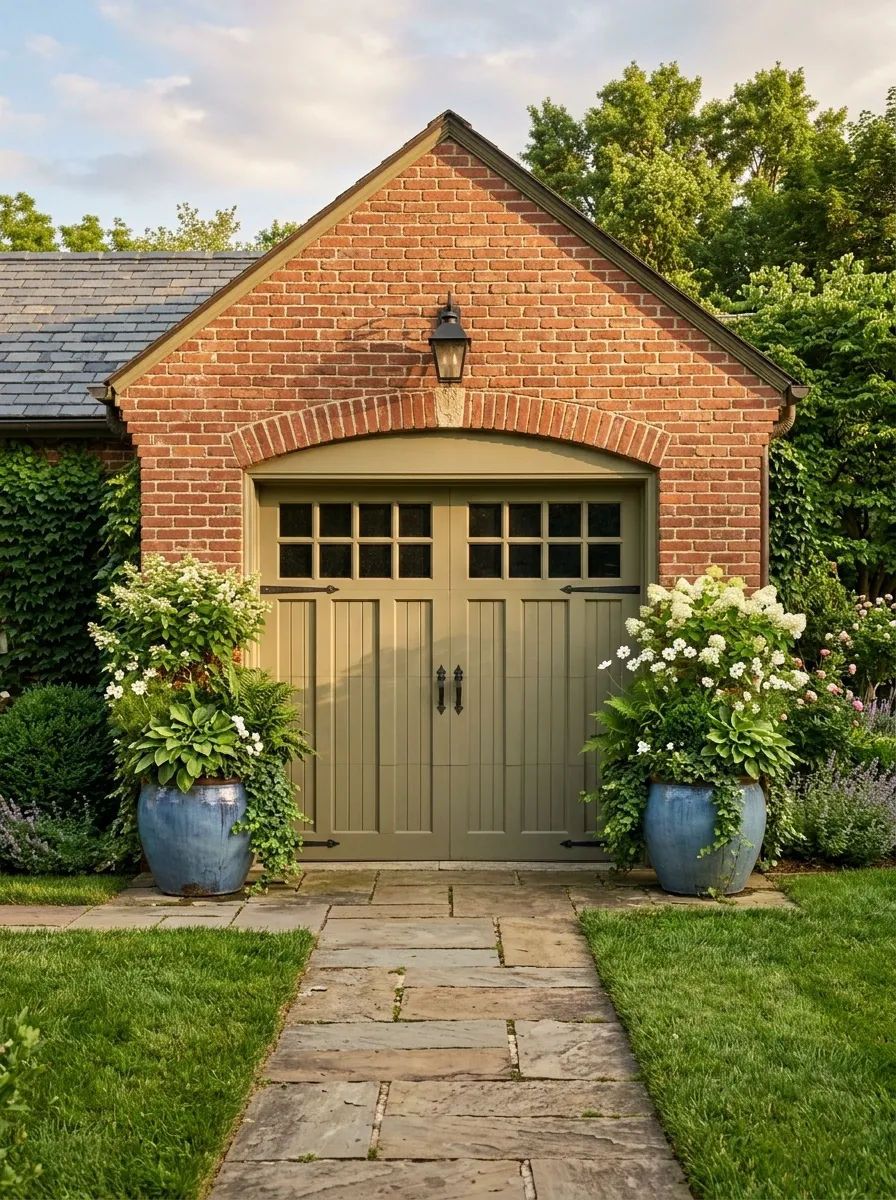
A vintage-inspired garage can handle more decorative character than a modern facade. This arrangement pairs muted blue ceramic planters with flowering shrubs, a painted or paneled garage door, warm brick or stone, and an informal path toward the house.
The blue containers act as a repeating accent rather than a collection of unrelated color. Their glossy or aged finish contrasts nicely with rougher masonry and softer foliage.
Keep the rest of the exterior relatively calm. The goal is charm, not a theme park version of “old-fashioned garden.”
One accent color is enough. The garage does not need twelve backup singers.
Formal Topiary Planters With a Deeply Framed Garage Entrance
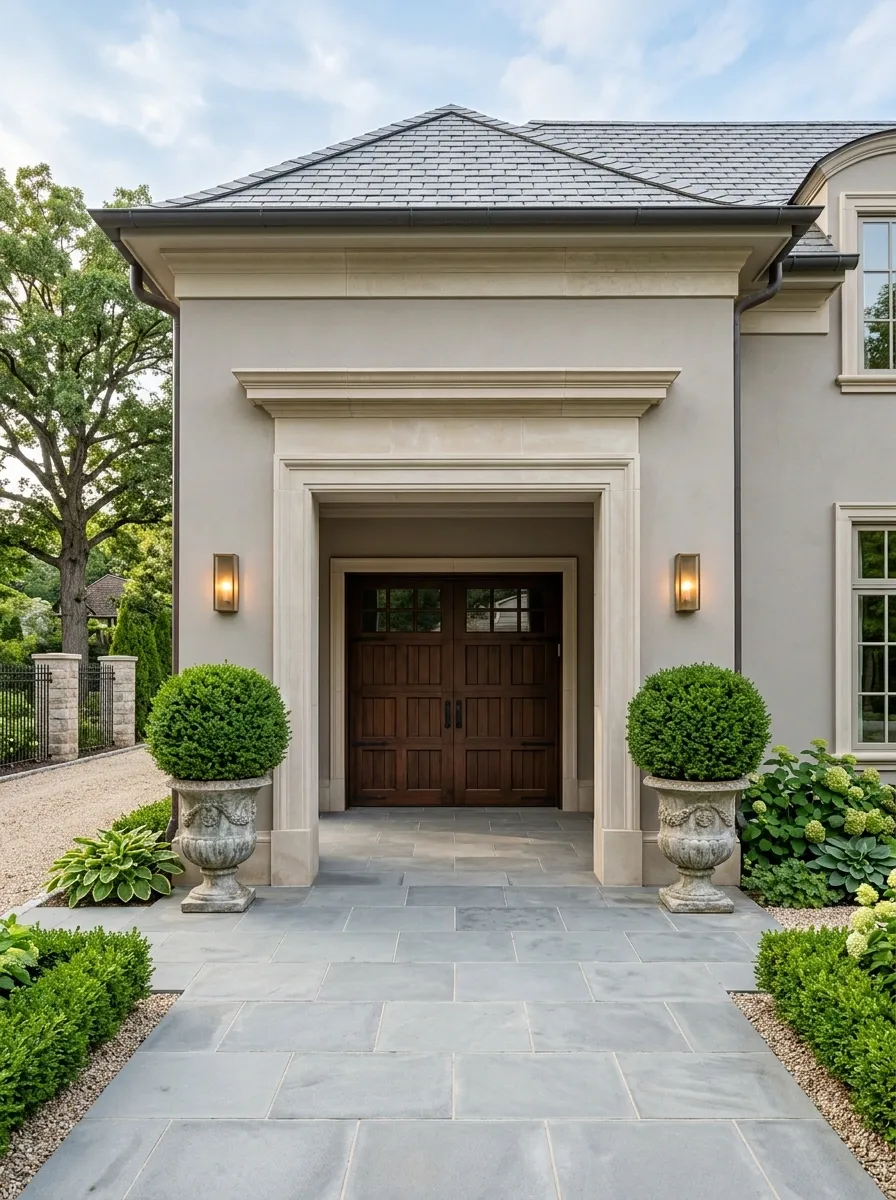
For a more formal exterior, substantial topiary planters can turn the garage into a clearly framed architectural feature. Matching containers sit on either side of the garage, while clipped greenery, stone paving, simple wall lighting, and a strong door surround reinforce the symmetrical layout.
The proportions matter more than the number of plants. The topiary should have enough height to frame the garage without visually blocking it, while the containers need enough mass to balance the surrounding architecture.
This is especially effective when the house already uses formal lines, stonework, or repeated architectural details.
Everything gets a place. Everything behaves.
Even the shrubs seem to know the assignment.
Organic Modern Garage With Stone, Wood, and Native-Looking Planting
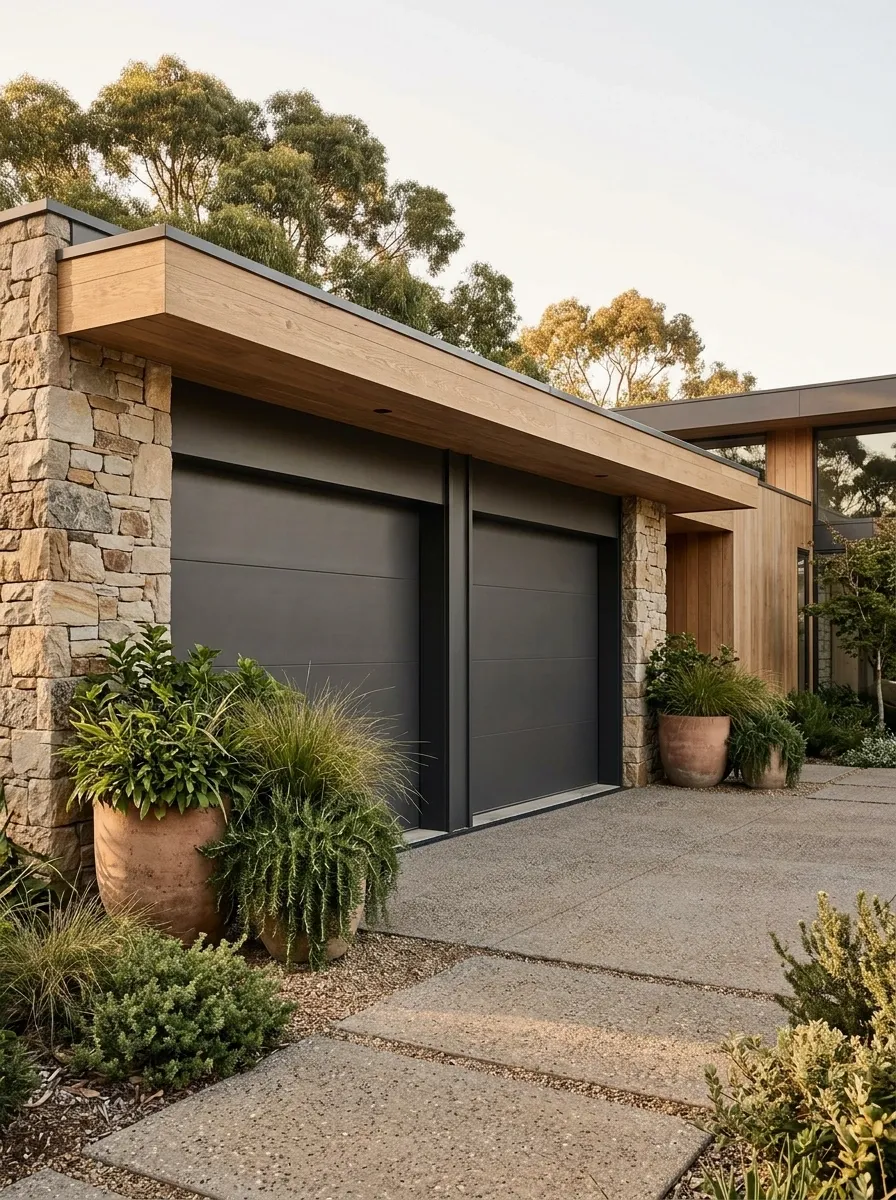
A plain modern garage becomes much more interesting when hard architectural lines meet rough stone, warm wood, and relaxed planting. This composition uses large earthy planters filled with grasses and leafy plants, with irregular stone and warm timber tying the landscape back to the house.
The planting isn’t clipped into perfect shapes. That slight irregularity keeps the exterior from feeling overly polished and gives the hard materials something softer to push against.
The trick is controlled texture. Rough stone, smooth garage panels, natural wood, and layered greenery each look different, but their earthy tones keep the scene from becoming visually noisy.
Modern architecture with a little dirt under its fingernails.
ARCHITECTURE
STONE
WOOD
GREENERY
Small Ranch Garage With Cheerful Mixed Planters and a Simple Path
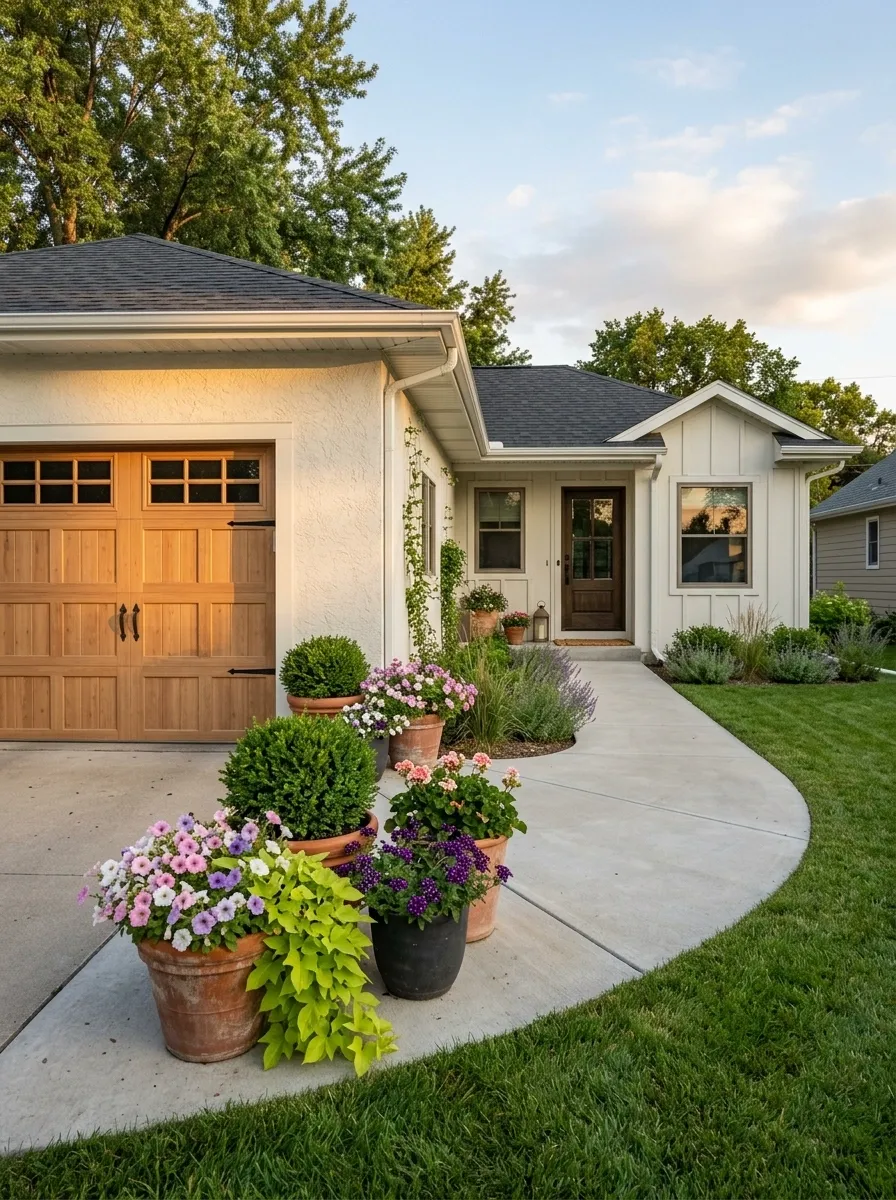
A modest ranch-style garage doesn’t need a huge landscaping budget or a wall of oversized containers to feel finished. This design concentrates planting where it has the most visual impact, using a few generous mixed planters, colorful flowers, compact greenery, and a simple path toward the house.
The garage remains easy to see, while the planting creates a softer transition between driveway and lawn. A neutral garage facade also gives the flowers room to provide personality without making the exterior feel chaotic.
The layout proves a small frontage can still have a strong focal point.
Tiny house, big curb-appeal aspirations. Respect.
+ WALKWAY
+ FRONT ENTRY
Monochrome Gray Planters With Silver Foliage and Stone
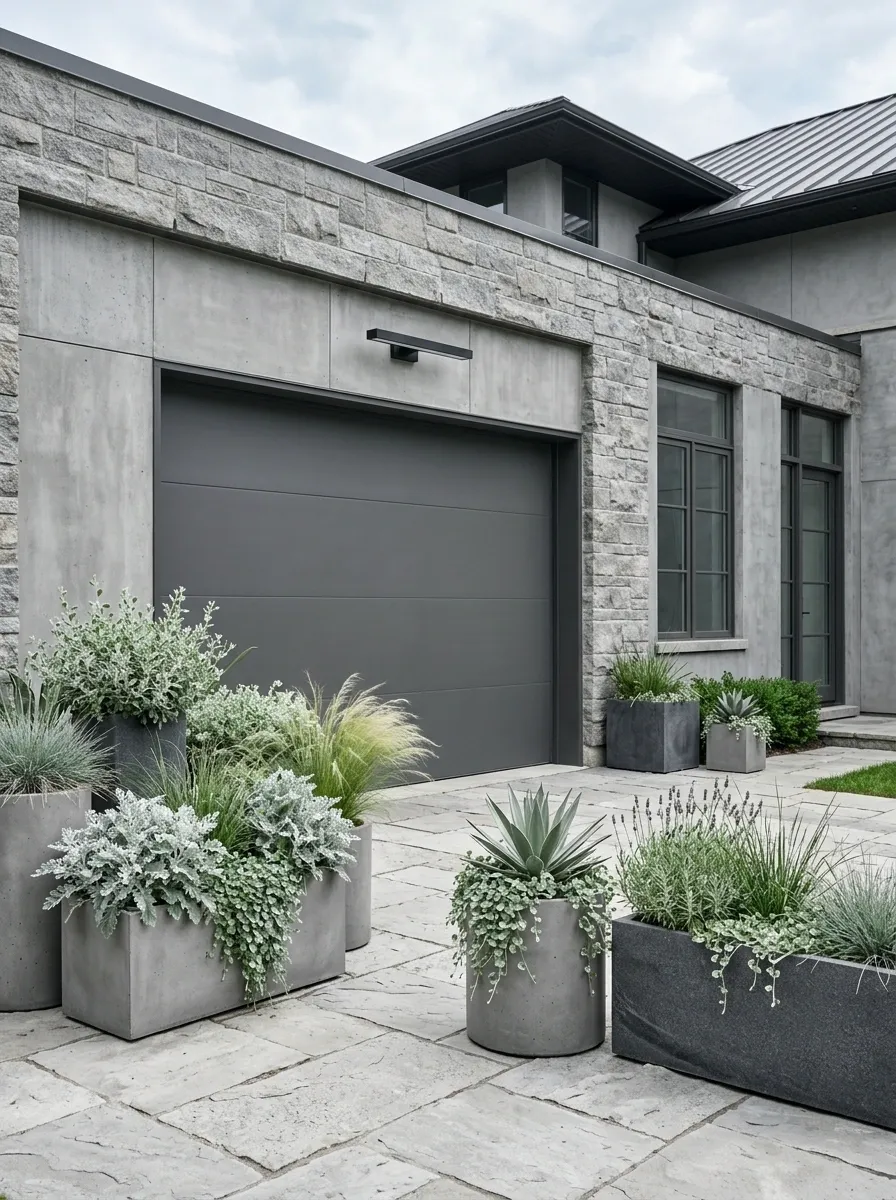
A garage can look expensive without relying on a long list of decorative details. This monochrome composition layers gray planters, pale stone, muted paving, a gray garage door, and silver-green foliage into one restrained palette.
The interest comes from differences in shape and texture rather than dramatic color. Matte concrete contrasts with leafy surfaces, rough stone breaks up smooth paving, and the foliage introduces movement without changing the overall color story.
This kind of arrangement suits a contemporary exterior that already has strong architecture and doesn’t need another visual conversation happening beside it.
Gray on gray on gray.
Somehow it works. The plants deserve partial credit.
Brick Garage With Oversized Greenery and Natural Clay Pots
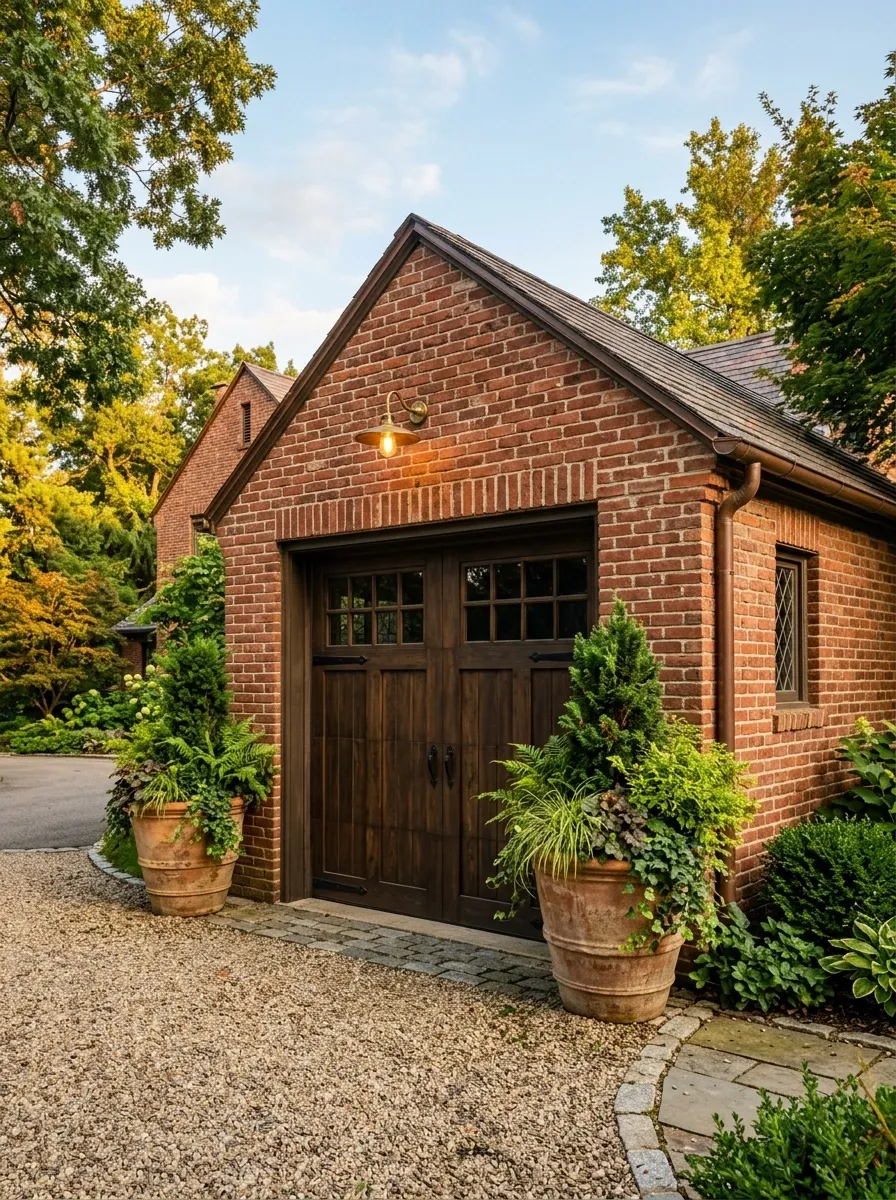
Warm brick and natural clay are a natural match, especially when the planting has enough scale to balance a substantial masonry facade. This design uses large clay pots filled with leafy shrubs and compact trees, with a relaxed driveway edge and restrained surrounding landscaping.
The greenery softens the brick without hiding it. That distinction matters. Brick already provides plenty of visual texture, so the plants work better when their forms are broad and readable rather than densely packed.
Choose larger containers over a crowd of small ones and let the masonry remain visible.
Brick is already doing the talking. It doesn’t need thirty tiny pots chiming in.
Garage Front With a Curved Planting Bed Breaking Straight Lines
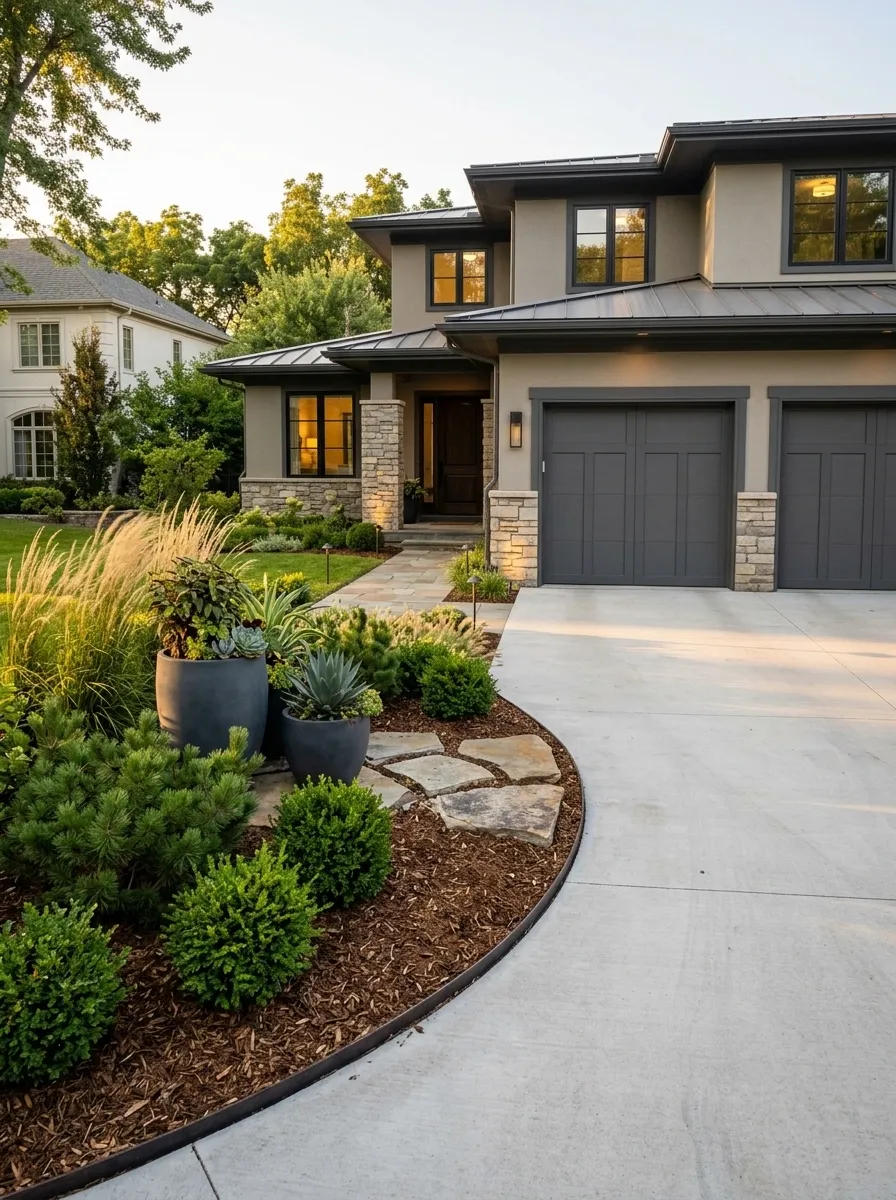
A garage and driveway are usually built from straight lines, so a curved planting bed can completely change how the frontage feels. This composition wraps a gentle planting curve along the edge of the driveway, using larger planters, layered shrubs, grasses, and a few stepping stones that connect the landscape to the house.
The curve creates a softer transition without hiding the garage. It also gives the eye somewhere to move instead of stopping at one long horizontal driveway edge.
Keep the curve broad and confident. A tiny wobbly planting island in the middle of a giant driveway just looks confused.
The architecture gets to stay serious. The landscaping handles the personality.
Rain-Friendly Garage Planting With Gravel and Raised Containers
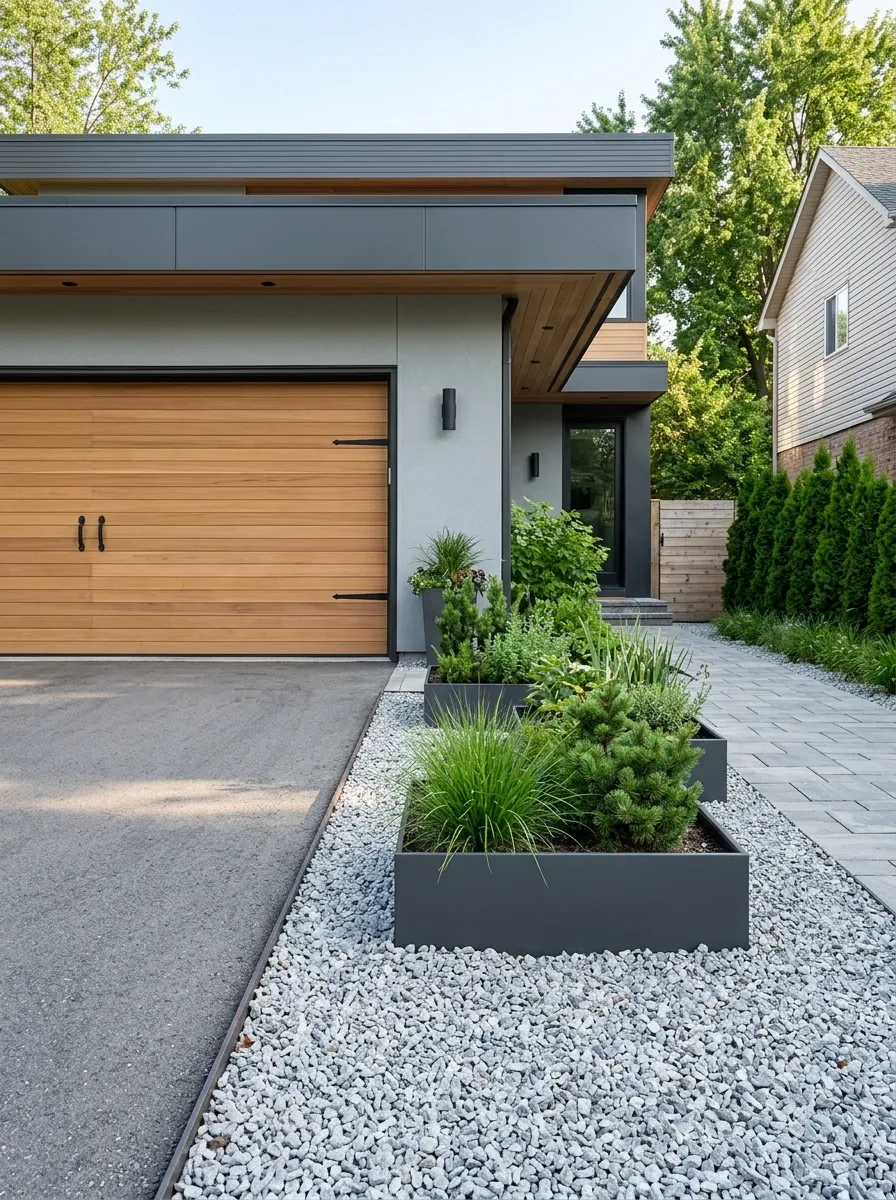
A garage frontage has to deal with water, vehicles, and foot traffic, so the prettiest arrangement on earth is not much help when the planting becomes a muddy obstacle. This practical design uses raised containers, gravel, hardy greenery, and clearly separated paved areas to create a cleaner transition around the garage.
The raised planting brings greenery upward while keeping the ground plane visually open. Gravel gives the scene a lighter, more natural texture than a wall of solid paving, while the main vehicle route stays obvious.
Function is doing some of the heavy lifting here, and honestly, good design usually does.
Pretty is nice. Pretty and usable is considerably less annoying.
Moody Charcoal Garage With Deep Green Planters
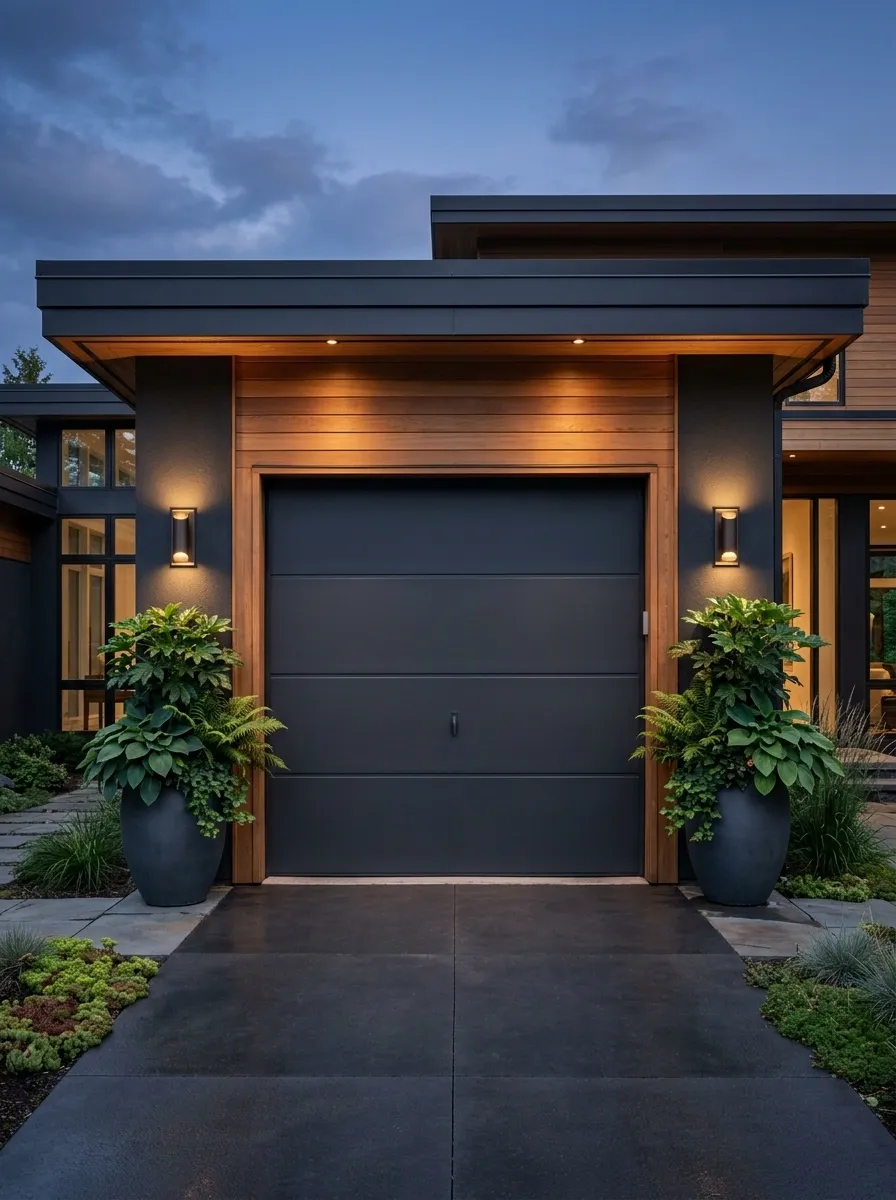
Dark architecture creates a completely different opportunity for planting. This moody composition combines a charcoal garage door, deep-green foliage, dark containers, warm wood details, and soft exterior lighting.
The plants don’t need to provide a burst of bright color. Their rich green tones create enough contrast against the dark surfaces while maintaining the dramatic character of the facade. Warm lighting then picks out the texture of the leaves and planters after sunset.
Keep the number of materials limited so the scene feels deliberate rather than gloomy.
Dark garage, dark pots, dark foliage. Apparently the plants have entered their mysterious era.
Colorful Seasonal Garage Front With Rotating Flower Containers
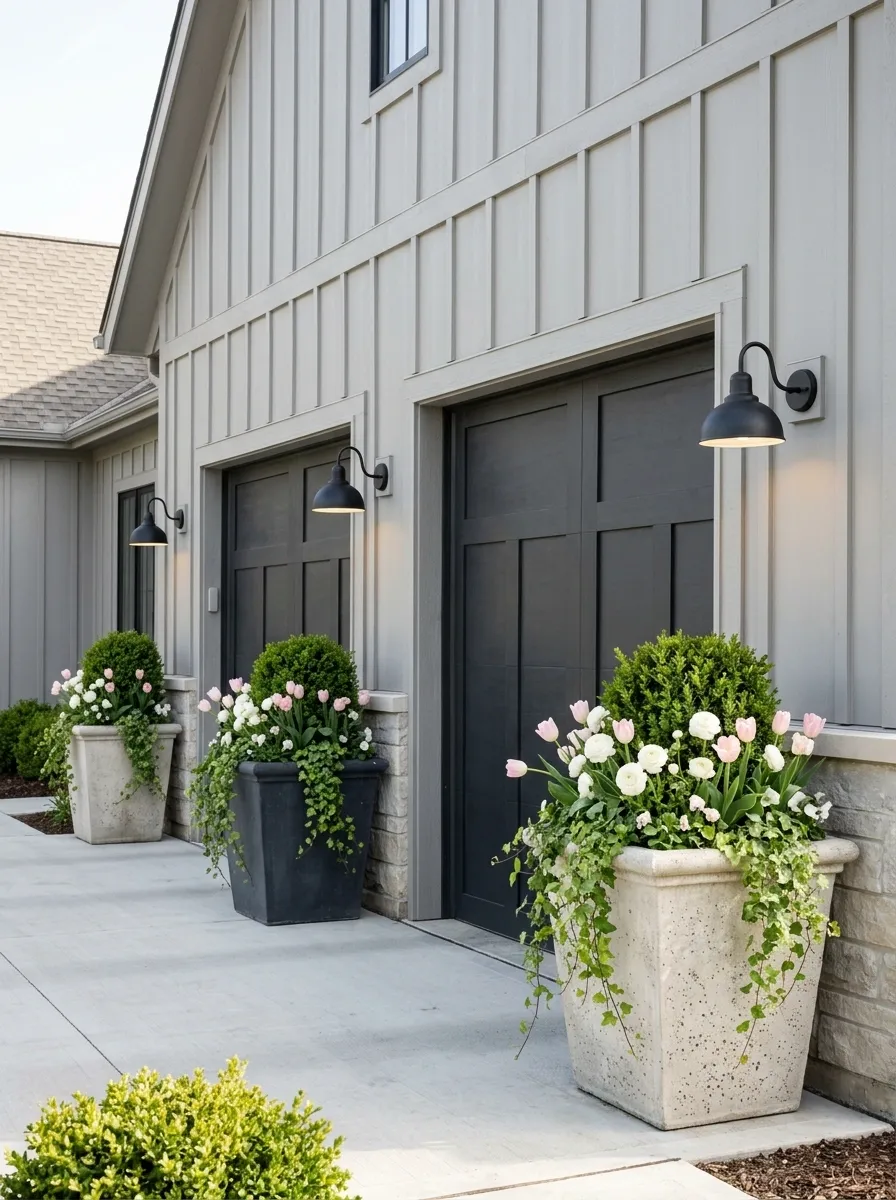
A neutral garage makes an excellent backdrop for changing seasonal color. This composition uses substantial containers with evergreen structure and flowers that can be refreshed throughout the year, keeping the main planter positions and overall layout consistent.
That creates a smarter kind of flexibility. The garage doesn’t need a new landscaping identity every few months. The permanent forms stay in place while the seasonal flowers change the mood.
Use the containers as repeated visual anchors, then let the flowers provide the temporary personality.
The garage stays the same. The flowers get to be dramatic.
Everyone has a role.
Full Curb-Appeal Composition With Garage, Walkway, Planters, and Entry Landscaping
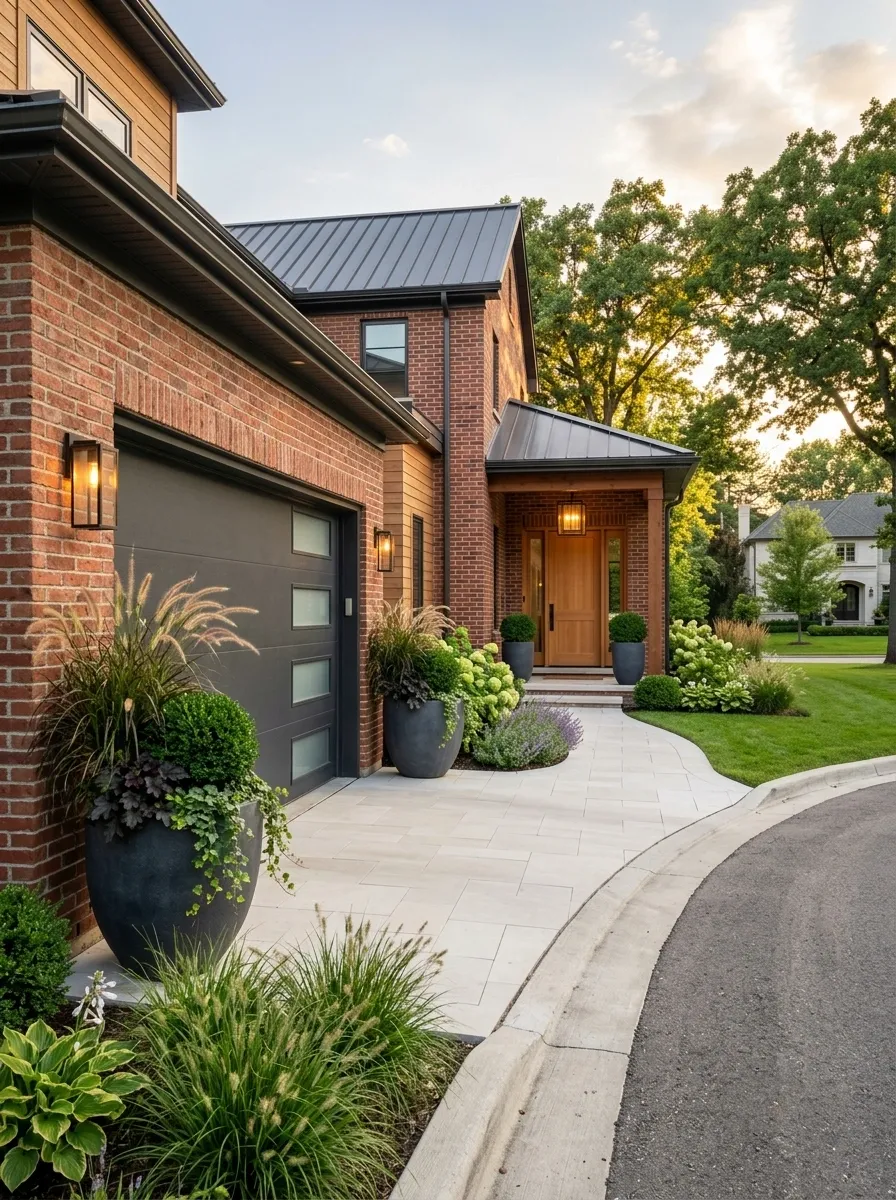
The strongest garage landscaping doesn’t stop at the garage. This complete composition connects substantial planters around the garage with the walkway, front door, shrubs, lighting, paving, and the materials already used across the house.
That connection is what makes the exterior feel finished. The planters aren’t isolated decorations sitting beside a garage. They become part of a larger visual path from driveway to front entrance.
Use repeated materials or plant shapes to bridge the spaces, but don’t copy every detail exactly. The goal is harmony, not cloning.
This is the final boss of garage curb appeal: every part of the frontage actually knows what the other parts are doing.