
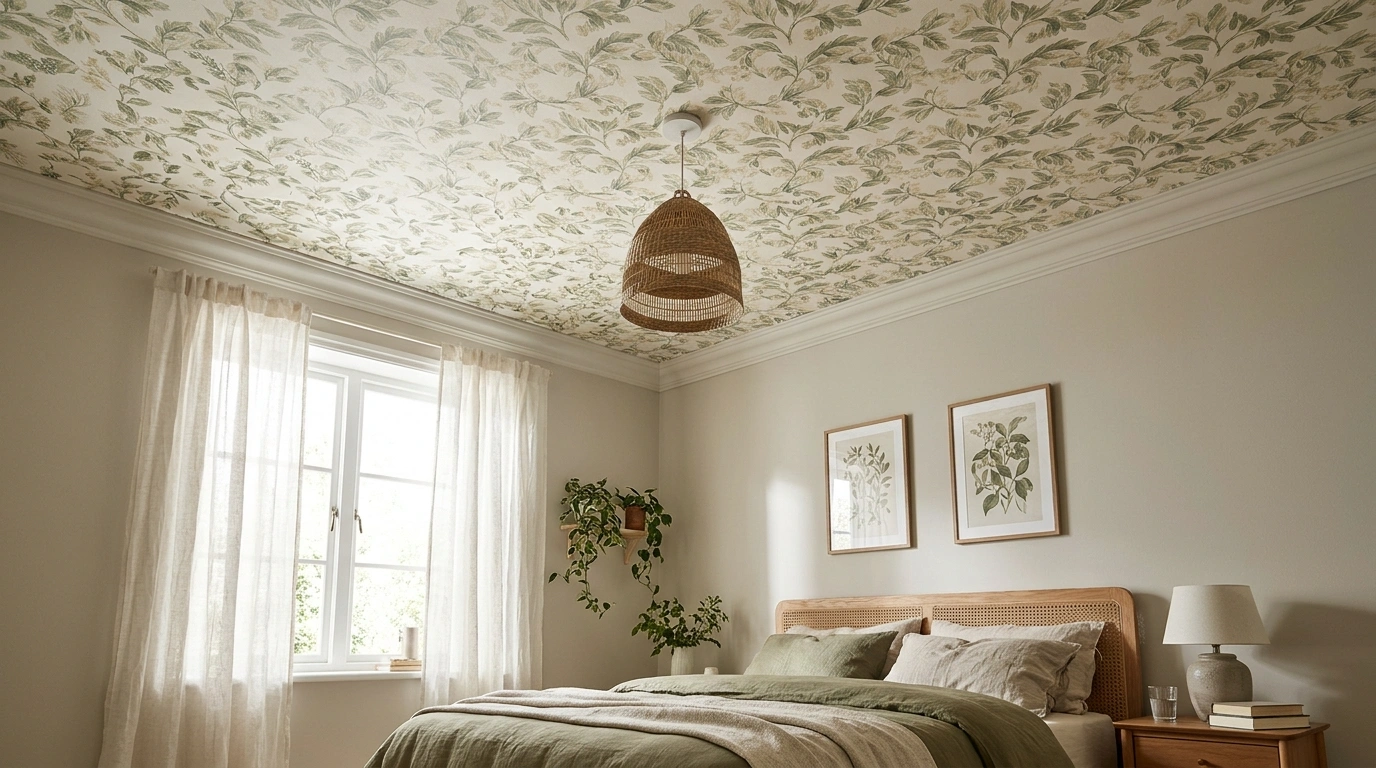
A finished room can have excellent furniture, lovely paint colors, and lighting that deserves a standing ovation, yet something still feels unfinished. Often, it’s the ceiling. That large, empty surface gets ignored until the entire room is done, at which point decorating it becomes an afterthought.
Ceiling wallpaper can change the mood of a room without adding another piece of furniture or covering every wall in a competing print. Think delicate botanicals above warm oak, dramatic florals over a dining table, or soft geometric patterns that give a plain bedroom some personality.
Because let’s be honest, a gorgeous wallpaper sample means absolutely nothing if the finished room looks like five different decorating decisions got into an argument. These designs show how to make the ceiling part of a complete composition, with colors that connect, materials that balance one another, and patterns that know when to make a statement.
Your Ceiling Has Entered the Chat
Ceiling Wallpaper Designs
Sage Powder Room with Floral Ceiling
A compact powder room gets an instant dose of character when a vibrant floral ceiling meets calming sage walls. Muted green wainscoting and warm brass fixtures create an enveloping atmosphere that makes a small space feel remarkably intentional.
The intricate floral pattern overhead draws the eye upward, adding unexpected depth while working in harmony with the patterned floor tile. A classic mirror and traditional lantern sconce anchor the design without overpowering the statement ceiling.
Keep surrounding accessories minimal to let the overhead print shine. Test your wallpaper sample alongside the wall paint to ensure the green undertones complement each other perfectly.
Soft Botanical Ceiling in a Warm Neutral Living Room
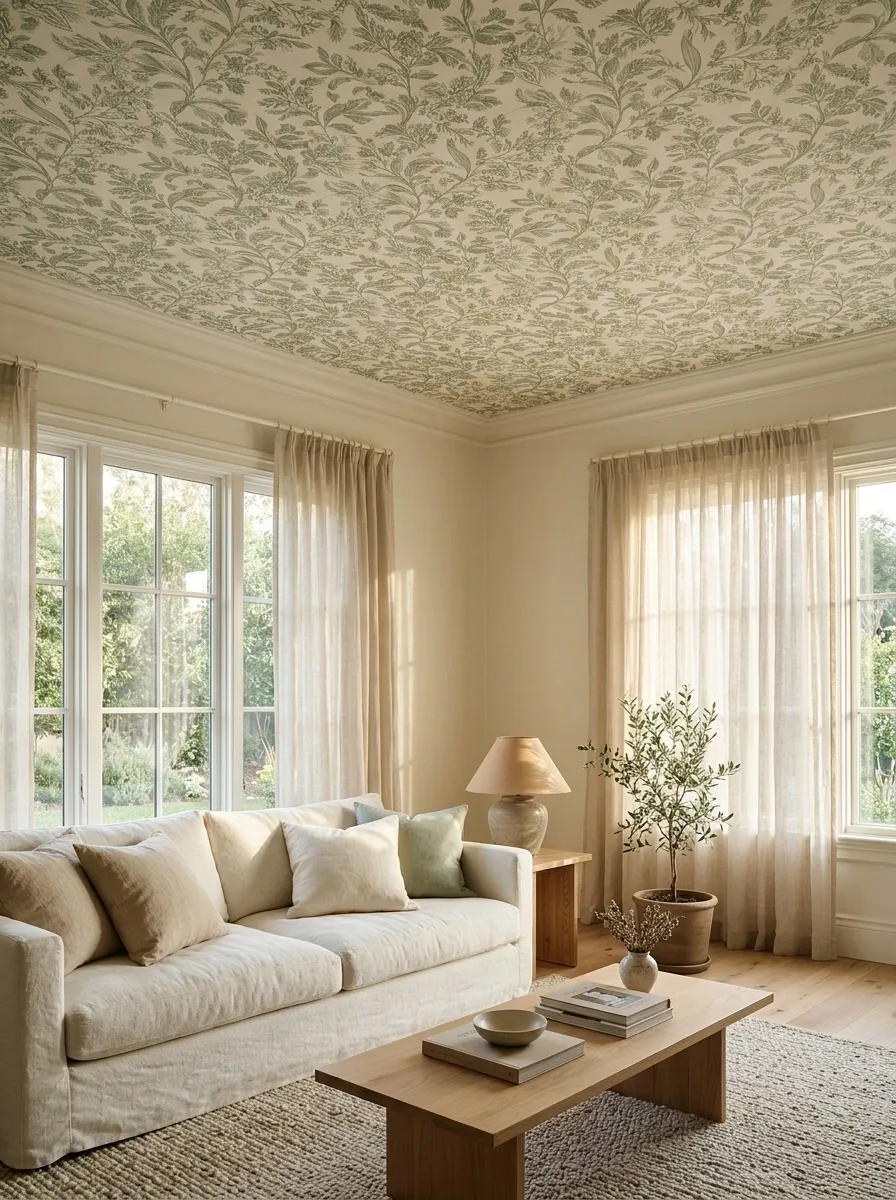
A delicate sage botanical print gives this living room a ceiling that feels connected to the garden, not dressed for a wallpaper showroom.
Warm ivory walls, a linen sofa, natural oak furniture, and soft curtains establish a calm foundation. Above them, a fine botanical pattern introduces muted green without demanding that every cushion and accessory suddenly become a leaf.
A textured neutral rug and simple ceramic lighting keep the composition grounded. The sage can reappear in a few carefully chosen textiles or plants, while the oak and ivory stop the room from becoming one enormous botanical illustration.
The ceiling gets its moment. The furniture doesn’t have to audition for a supporting role.
Choose a wallpaper with gentle contrast if the living room already has substantial furniture or a busy view through the windows. Check a sample from the main seating position before committing to the full ceiling.
Botanical living room
The color handoff
Sage
Ceiling motif
Ivory
Wall backdrop
Warm oak
Furniture
Linen
Soft furnishings
Repeat the colors, not the entire print. A few shared tones make the room feel connected without turning every surface into a matching set.
Moody Botanical Ceiling in a Dark Library
A dramatic library proves that dark, moody ceilings can transform a functional workspace into an absolute sanctuary. Deep navy walls, floor-to-ceiling bookshelves, and a rich leather desk establish a sophisticated, scholarly foundation.
Overhead, a lush botanical canopy brings unexpected texture and whimsy to the deep tones of the room. A plush velvet armchair in matching blue and a classic brass-framed mirror complete the cohesive, layered composition.
Balance heavy furniture with vibrant elements by keeping the surrounding decor edited and purposeful. Check the wallpaper pattern under both daylight and evening lamp lighting to ensure the rich tones hit just the right note.
Dramatic Dark Floral Ceiling in an Elegant Dining Room
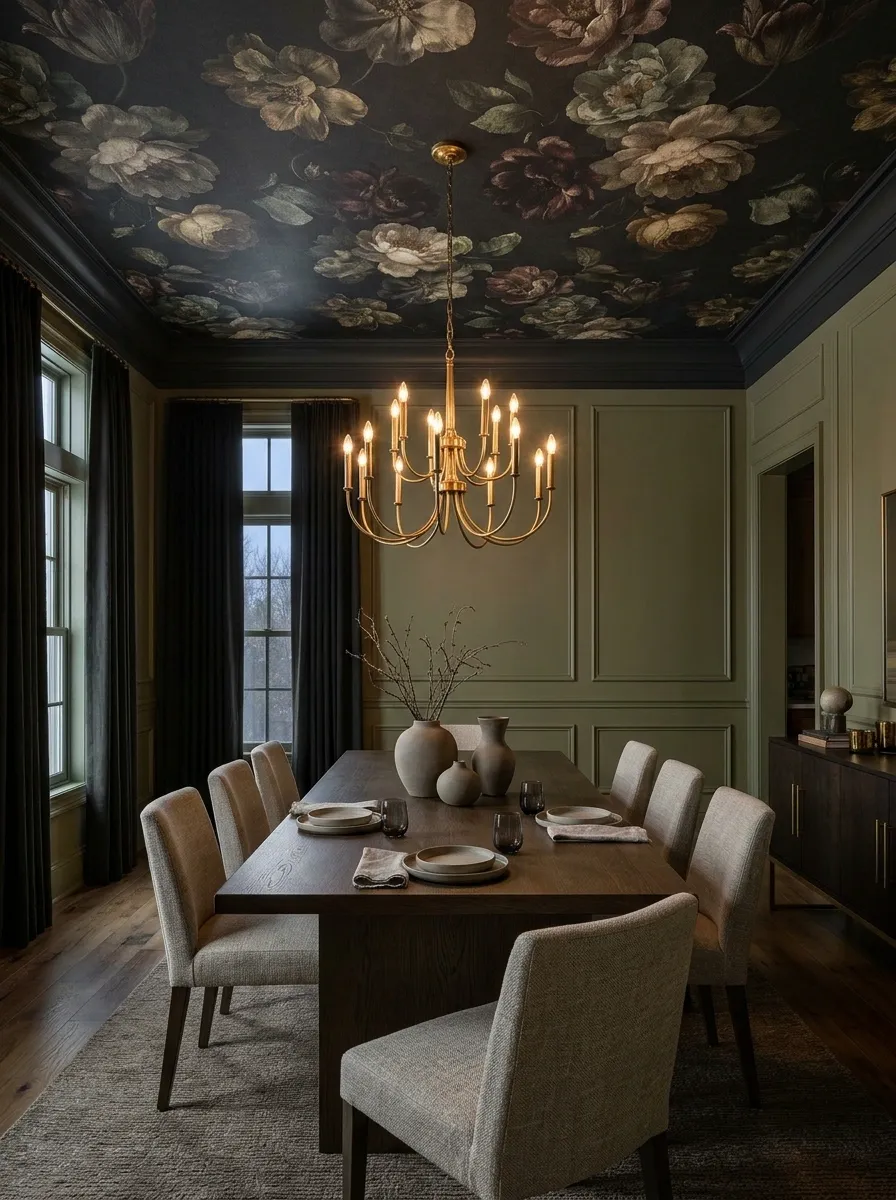
Some dining rooms have wallpaper. This one has a personality, a guest list, and very strong opinions about overhead lighting.
Oversized florals against a charcoal ceiling create a dramatic canopy above a substantial dark wood dining table. Muted olive walls soften the transition between ceiling and walls, while upholstered chairs bring texture instead of another competing pattern. A warm chandelier provides the visual center of the dining area.
The contrast makes the arrangement convincing. The ceiling supplies expressive detail, the walls establish a quiet backdrop, and the table adds weight below.
Keep table accessories relatively simple so the floral design stays visible. Adding a heavily patterned rug and elaborate curtains would push this from atmospheric to decorative committee meeting.
Dark ceiling wallpaper can work in a room with good lighting and a deliberate color scheme. Test a sample under daylight and evening lighting before committing.
Dining room after dark
Let the ceiling lead.
First glance
Charcoal and oversized florals
The expressive surface. Leave enough uninterrupted pattern to appreciate the design.
Second glance
Muted olive walls
The visual pause between the statement ceiling and the furniture.
Grounding element
Dark timber and warm light
Substantial furniture and considered lighting keep the drama from feeling visually top-heavy.
Cozy Floral Ceiling in a Neutral Lounge
A traditional living space becomes instantly memorable when a classic floral ceiling introduces a layer of timeless charm. Warm cream armchairs, a plush tufted ottoman, and soft linen curtains establish an inviting, neutral foundation.
Above the seating area, a detailed botanical print adds warmth and visual interest, proving that fifth walls deserve just as much attention as the rest of the room. A sleek brass table lamp and curated artwork ground the space in understated elegance.
Pair a busy ceiling pattern with solid upholstered pieces and neutral rugs to keep the room feeling balanced. Always review a wallpaper sample from your favorite seating position before committing to the full overhead installation.
Blue-and-White Ceiling Wallpaper in a Classic Bedroom
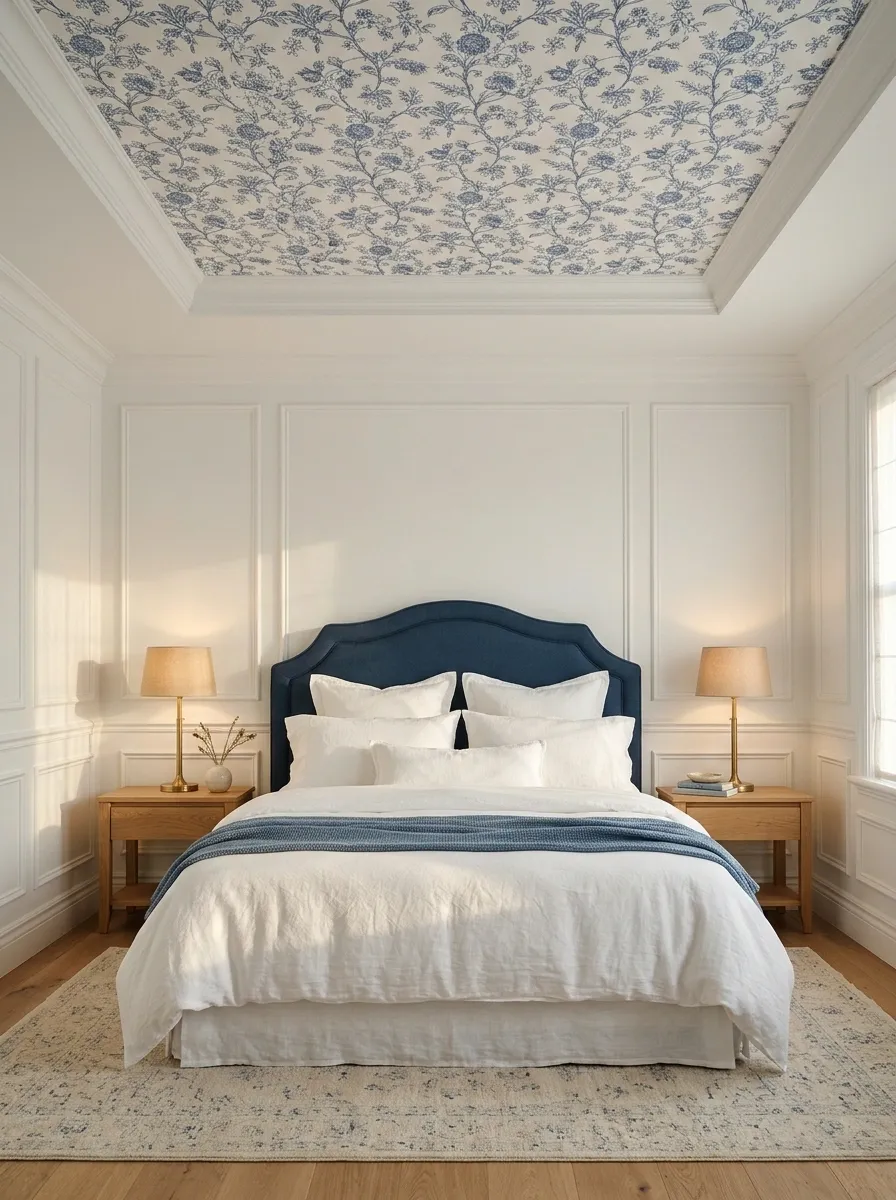
A classic bedroom doesn’t need twelve decorative cushions and a headboard with the emotional baggage of a palace. Sometimes, a crisp blue-and-white ceiling does enough.
A fine chinoiserie or traditional botanical print sits above white paneled walls, a blue upholstered headboard, and neatly layered white bedding. The bedside tables remain simple, with warm lamps bringing softness to the symmetrical layout.
The ceiling pattern makes the upper part of the room feel detailed, while the calm bedding gives the eye somewhere to rest. Centering the pattern’s main visual rhythm over the bed makes it feel related to the architecture instead of randomly applied overhead.
Repeating blue in the headboard or one small textile detail is enough. Matching every accessory to the wallpaper would turn a restrained room into a very committed blue-and-white fan club.
Check where the wallpaper repeat falls in relation to the bed, ceiling edges, and light fixture before installation.
A classic bedroom
Find the centerline.
Left ceiling field
✿
Pattern repeats
Right ceiling field
✿
Balanced repeat
Treat the bed’s center as a useful starting reference, then check the actual room dimensions, repeat width, and light fixture position. Wallpaper rarely cooperates with perfect symmetry without a little planning.
Traditional Toile Ceiling in a Classic Bath
A classic bathroom transcends ordinary design when a crisp blue-and-white toile ceiling meets bright white subway tile. The delicate historical pattern adds an artistic touch to the upper architecture without overwhelming the clean, bright space.
Traditional brass fixtures, a custom vanity, and an elegant framed mirror create a harmonious transition between the patterned ceiling and the neutral walls below. A subtle vintage-inspired floor tile ties the entire look together with understated grace.
Coordinate small accent details to echo the ceiling hue without matching every single element in the room. Check where the wallpaper repeat falls in relation to your light fixture and architectural edges prior to hanging.
Warm Geometric Ceiling in a Mid-Century Living Room
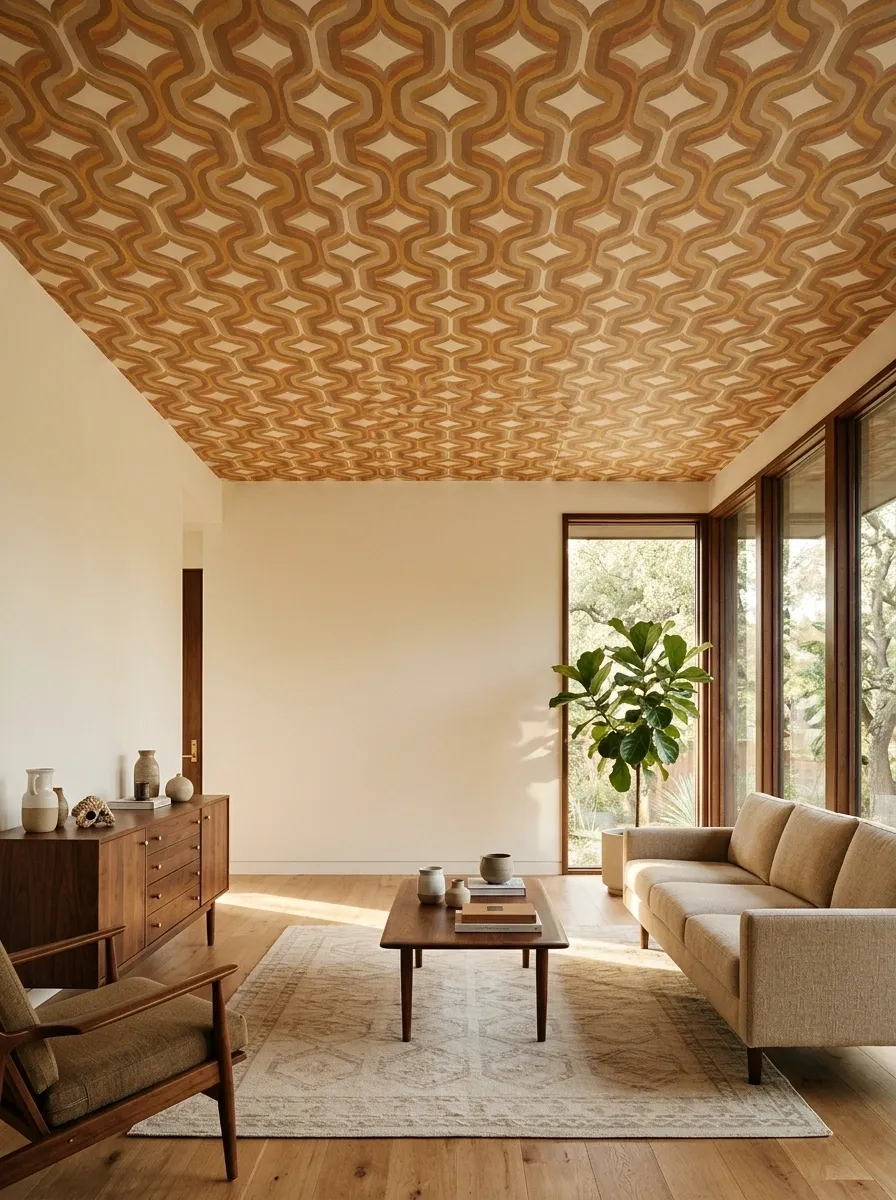
The right geometric ceiling gives a mid-century living room a stronger identity without requiring a vintage shop to empty its entire inventory onto the floor.
Repeating shapes in ochre, rust, cream, and muted brown sit above walnut furniture, a low sofa, and a vintage-inspired rug. A sculptural pendant adds an interesting silhouette, while the room’s clean furniture lines give the print enough breathing room.
The composition feels rooted in mid-century design without turning the space into a museum exhibit.
The trick is to share a visual rhythm rather than copy every shape. If the ceiling has strong repeating geometry, the rug can use a simpler pattern and the upholstery can remain mostly solid. Walnut and warm neutrals help the ceiling feel grounded rather than disconnected.
Look at the wallpaper and rug together before choosing either. Two bold geometric repeats can compete even when their colors match beautifully.
Mid-century composition
Repeat. Echo. Pause.
Ceiling: bold, repeating geometry establishes the rhythm.
Rug: a quieter repeat echoes the geometry without copying its intensity.
Furniture: simpler shapes provide the visual pause.
Verdant Canopy Ceiling in a Modern Kitchen
A contemporary kitchen gains a breathtaking organic element when a lush forest canopy wallpaper covers the ceiling. Dark marble countertops and sleek matte black cabinetry provide a striking, modern contrast to the natural overhead motif.
Minimalist wire barstools and modern pendant lighting keep the focus squarely on the dramatic ceiling design, allowing the woodland print to feel completely integrated into the modern architecture. The result is a moody, sophisticated space that feels connected to nature.
Balance bold ceiling graphics with clean-lined cabinetry and simple hardware to maintain a polished aesthetic. Test a large wallpaper sample in natural light to see how the rich greens interact with your kitchen’s lighting scheme.
Painted-Trim Floral Ceiling in a Romantic Cottage Bedroom
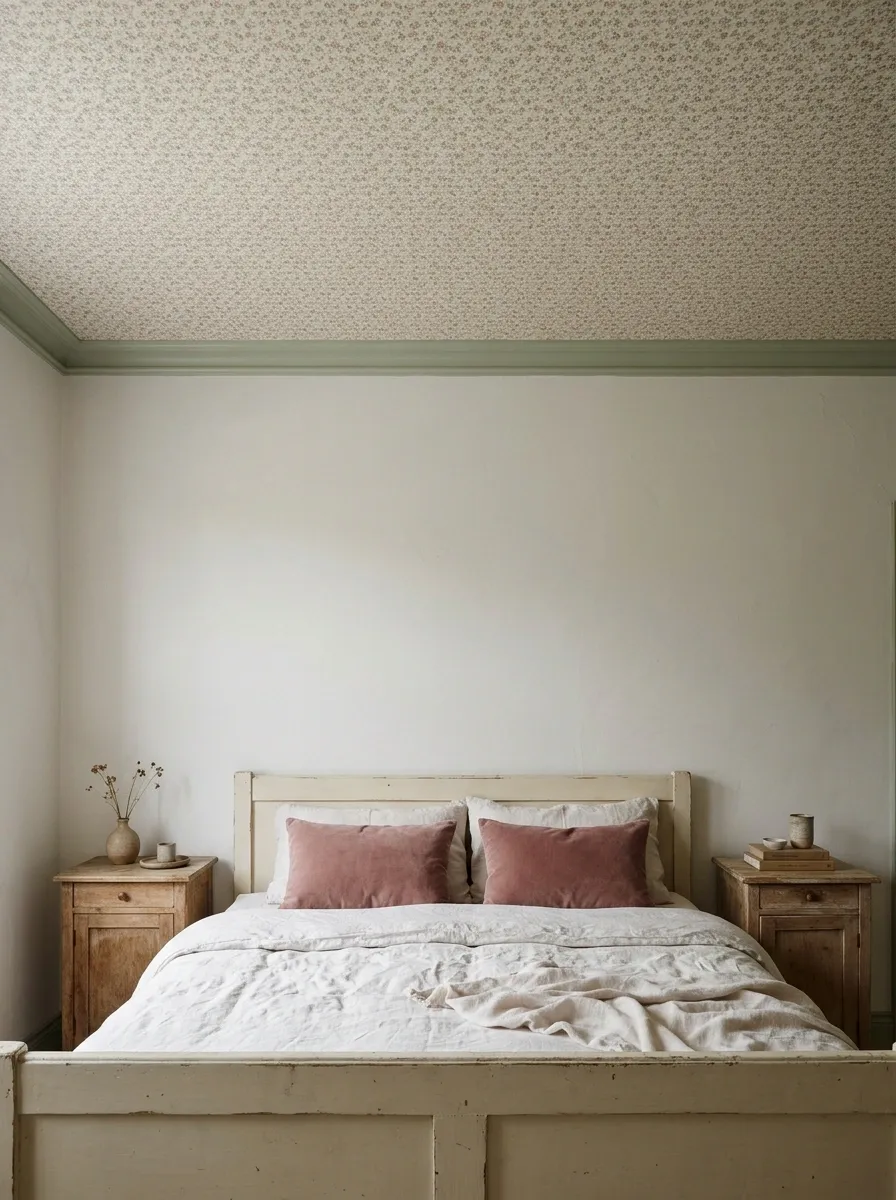
Cottage style can be charming without making every inch of the room look like it escaped from a fabric shop.
Small-scale floral wallpaper covers the ceiling above a simple iron or painted wood bed, soft white bedding, and gentle sage trim. Dusty rose accents add warmth, while antique-inspired bedside furniture gives the space its lived-in character.
The surrounding walls stay relatively quiet, allowing the delicate pattern to create interest overhead without competing with curtains and bedding. Painted trim provides a clear architectural boundary, so the ceiling looks finished instead of abruptly covered in paper.
A fine repeat suits the intimate mood, while a few restrained floral accents connect the palette to the furnishings. Keep the pattern from spreading everywhere. A bedroom can be romantic without requiring a committee meeting between the curtains and the duvet.
Check a wallpaper sample from bed height as well as from directly underneath it. A print that looks delicate in the hand can read much busier across an entire ceiling.
Cottage bedroom
Same flowers. Different story.
Pattern repeat changes the visual weight of the ceiling. The right choice depends on room proportions and the amount of detail elsewhere.
Fine repeat
Quiet, delicate, and visually detailed.
Medium repeat
A more visible motif with a balanced rhythm.
Large repeat
A stronger statement that needs room to read clearly.
Choose the repeat for the room, not just for the tiny sample. A sample is a flirtation. An entire ceiling is a commitment.
Oversized Abstract Ceiling in a Minimalist Modern Living Room
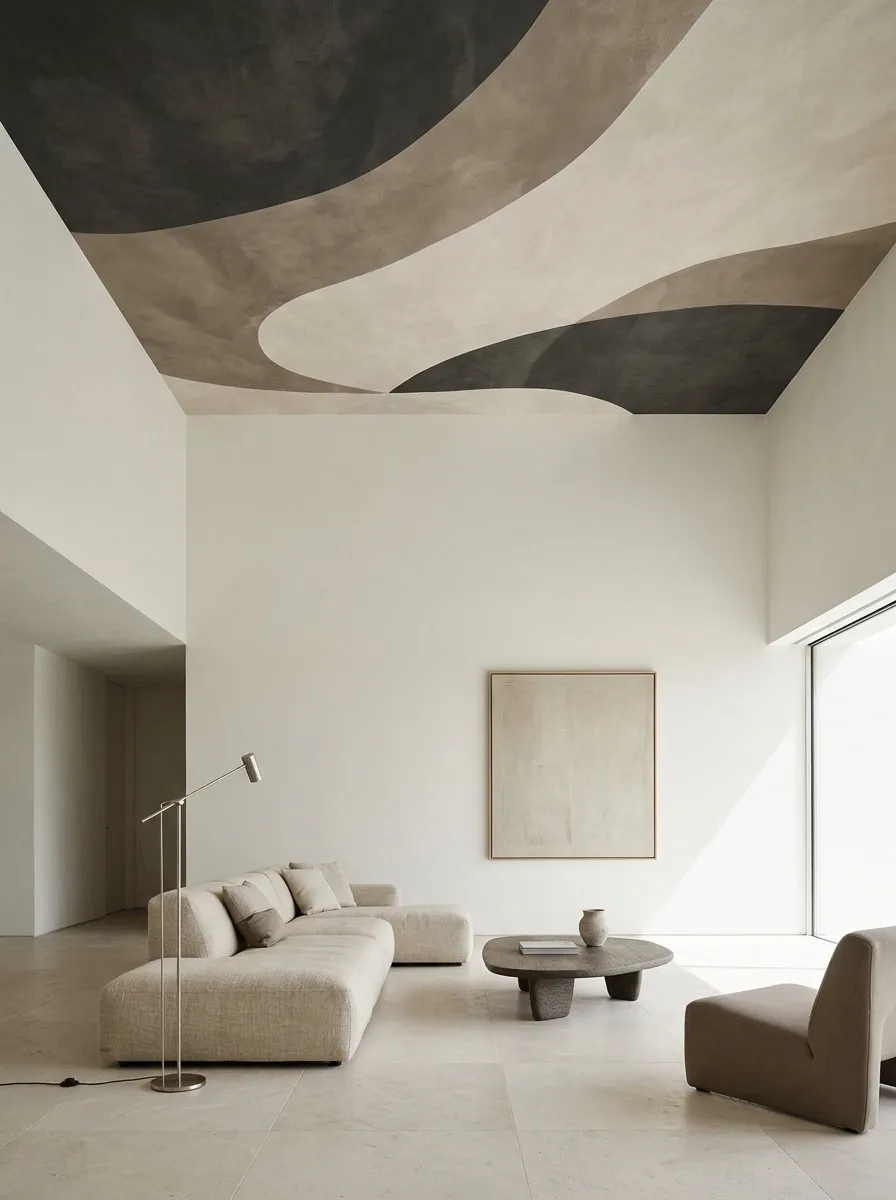
Minimalist rooms have one dangerous weakness: remove too much, and the whole space starts looking like an expensive waiting room.
An oversized abstract ceiling print fixes that problem without sacrificing the clean lines that make modern interiors work. Large organic shapes in cream, taupe, and charcoal sit above sculptural seating, pale stone flooring, and understated furniture.
The walls remain quiet, allowing the ceiling to supply the movement. A simple floor lamp and one restrained artwork are enough to finish the composition.
Large motifs make a stronger statement than tiny repeating shapes, so the furniture and surrounding surfaces need room to breathe. Keep the silhouettes simple and let negative space do its job. Minimalism doesn’t mean the room has to be boring. It just means every element needs a reason to be there.
Check the pattern from several viewpoints, especially from the main sofa. An abstract motif should read as an intentional composition rather than a random collection of shapes.
Modern room composition
Let the shapes breathe.
Oversized ceiling graphics work best when the surrounding room isn’t competing for attention.
Keep the statement
Use a few large motifs and leave visible gaps between them.
Quiet the furniture
Simple upholstery and clean silhouettes preserve visual balance.
Antique-Inspired Ceiling Print in a Heritage Sitting Room
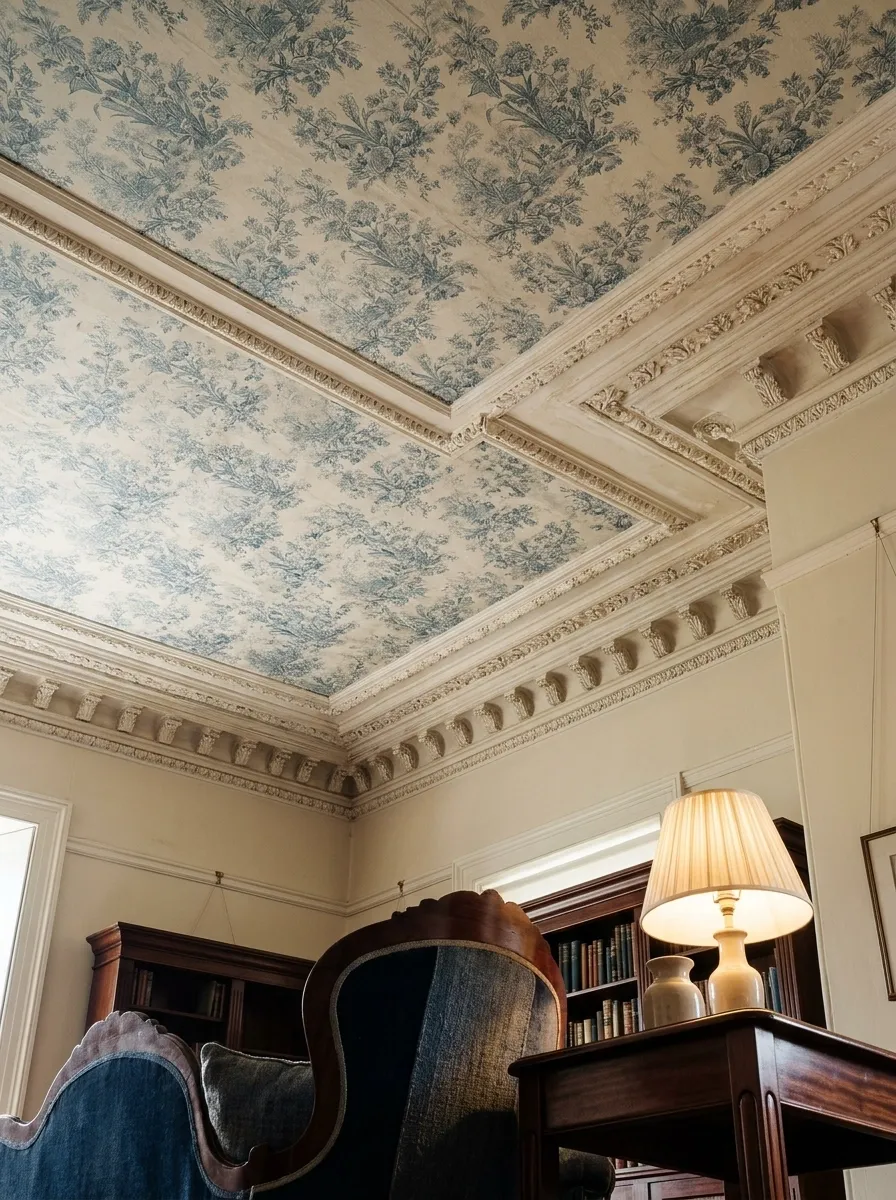
A historic-looking room can go wrong when every piece of furniture, every finish, and every decorative object tries to prove its age. The result isn’t heritage style. It’s a very expensive history exam.
An antique-inspired ceiling print works best when it feels connected to the room’s architecture. Faded blue and cream toile or archival-style botanical motifs sit above traditional plaster molding, dark mahogany seating, and a richly layered rug.
Warm table lamps soften the deeper wood tones, while the walls remain restrained enough to let the ceiling pattern register clearly.
The wallpaper supplies detail, the molding frames it, and the dark furniture gives the room visual weight. Avoid introducing too many competing historical prints. One considered ceiling pattern can provide more character than a room where every surface has its own century.
In rooms with ornate molding or uneven ceiling edges, plan the wallpaper layout around the architecture before ordering. Pattern placement at the perimeter can make or break the finished result.
Heritage sitting room
The border matters.
Ceiling wallpaper field
Keep the repeat aligned within the finished border.
Architectural frame
Cornices and molding define where the paper begins and ends.
Pattern alignment
Repeat size and starting position affect the balance at each edge.
Measure the ceiling and mark the main architectural boundaries before choosing the starting point. Historic molding is not obligated to make installation easy.
Black-and-White Ceiling Stripes in a Contemporary Entryway
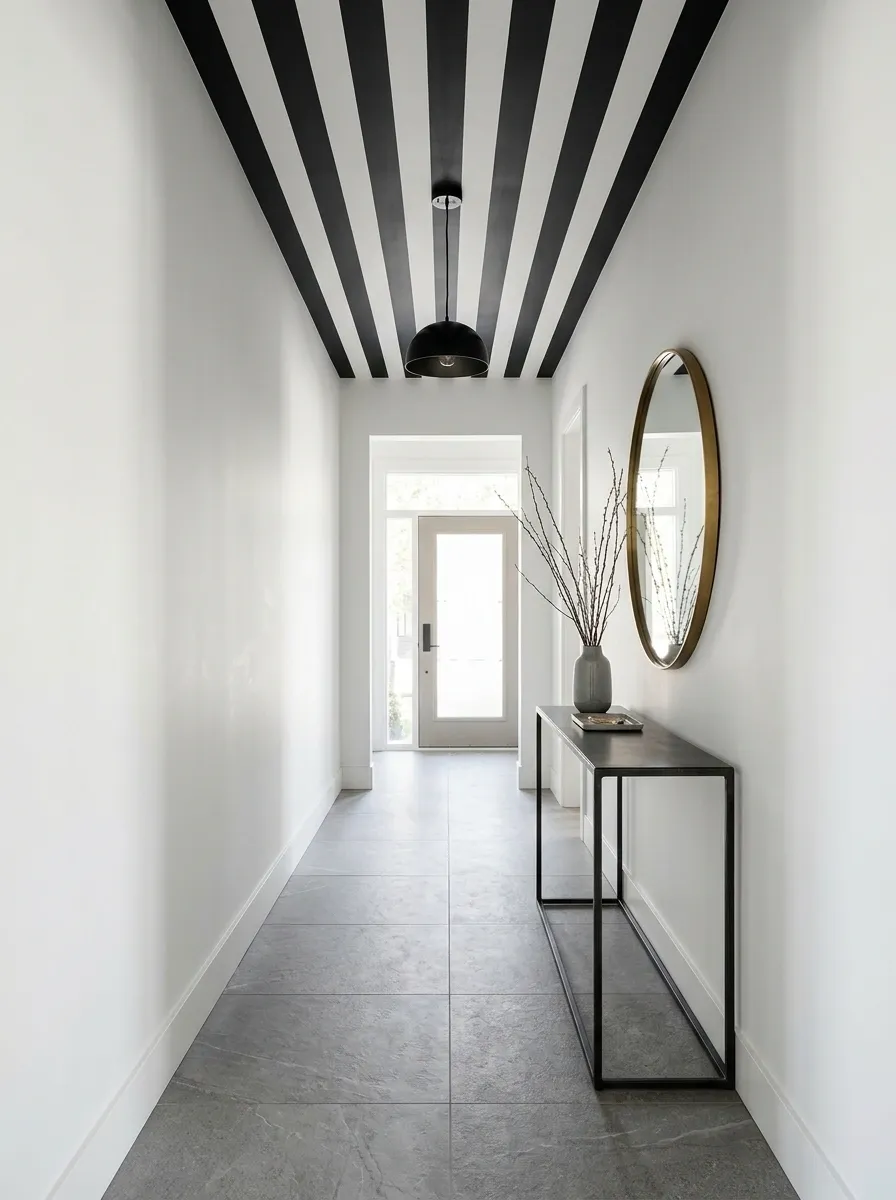
A narrow hallway can make even excellent decorating choices look oddly cramped. Adding more furniture isn’t usually the answer. There is barely room for the furniture already there, let alone a console table with ambitions.
Black-and-white ceiling stripes give a contemporary entryway a clear visual direction. Crisp white walls, a slim dark console, a simple mirror, and restrained stone flooring keep the corridor uncluttered.
The stripe direction carries the eye through the space, while a compact pendant provides a focal point without interrupting the ceiling pattern. Stripes running lengthwise can reinforce the hallway’s long axis, while crosswise stripes create a different visual effect.
Neither is an automatic solution for every corridor. The actual proportions, door openings, ceiling height, and fixture positions should guide the choice.
Lay out a sample in the intended direction before installation. A strong stripe pattern can highlight uneven ceiling edges, so the starting line needs careful planning.
Entryway planning
The stripes set the direction.
A simple pattern can change the way a narrow corridor reads. Compare the orientation with the room’s actual shape.
Lengthwise stripes
Echo the long axis of a corridor when the ceiling and overall layout support that direction.
Crosswise stripes
Create a different visual rhythm that may emphasize the corridor’s width.
Before committing, check the doorways, light fittings, and actual ceiling dimensions. The goal is an intentional direction, not a very striped surprise.
Blue Sky Ceiling Wallpaper in a Light-Filled Sunroom
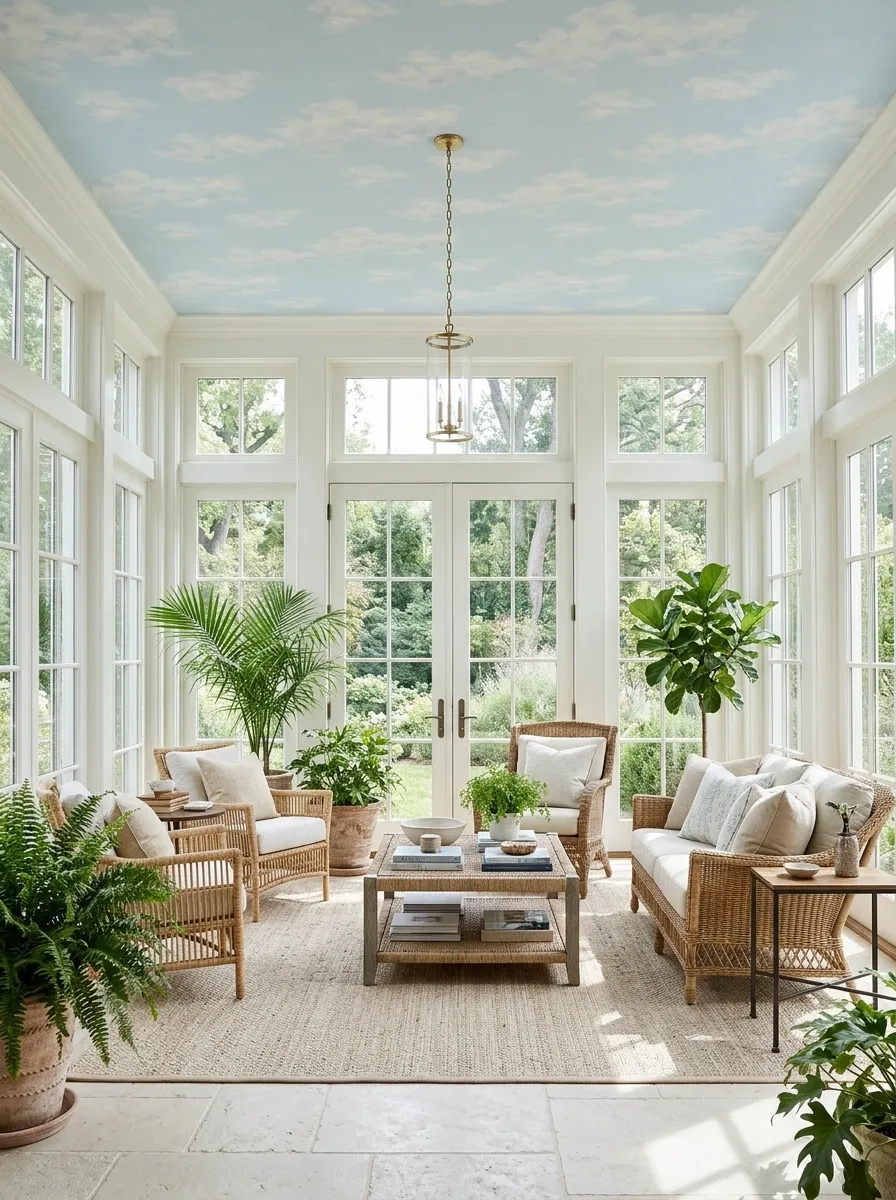
A sunroom already has windows doing most of the heavy lifting. A soft sky-patterned ceiling simply gives the view a little competition.
Pale blue wallpaper with delicate cloud motifs sits overhead, while tall white-framed windows, woven armchairs, leafy plants, and a pale stone floor keep the room grounded. Cushions in quiet cream tones soften the seating, and a simple pendant leaves the ceiling pattern visible.
The result feels airy without relying on an entirely white room that looks like it has never encountered a human being.
The trick is keeping the print gentle enough to work with the real sky outside. A highly detailed cloud pattern can compete with the garden view, especially when the windows already frame plenty of greenery.
Check how the wallpaper looks at different times of day. Strong daylight can wash out pale motifs, while evening lighting may make them more prominent.
Sunroom planning
Let the real sky join the design.
A cloud-patterned ceiling looks most convincing when the wallpaper, daylight, and garden view feel related.
Garden view
The balancing act
Keep the ceiling print soft, the window frames simple, and the furniture natural. The wallpaper should complement the view, not start a rivalry with the weather.
Art Deco Ceiling Geometry in a Jewel-Toned Lounge
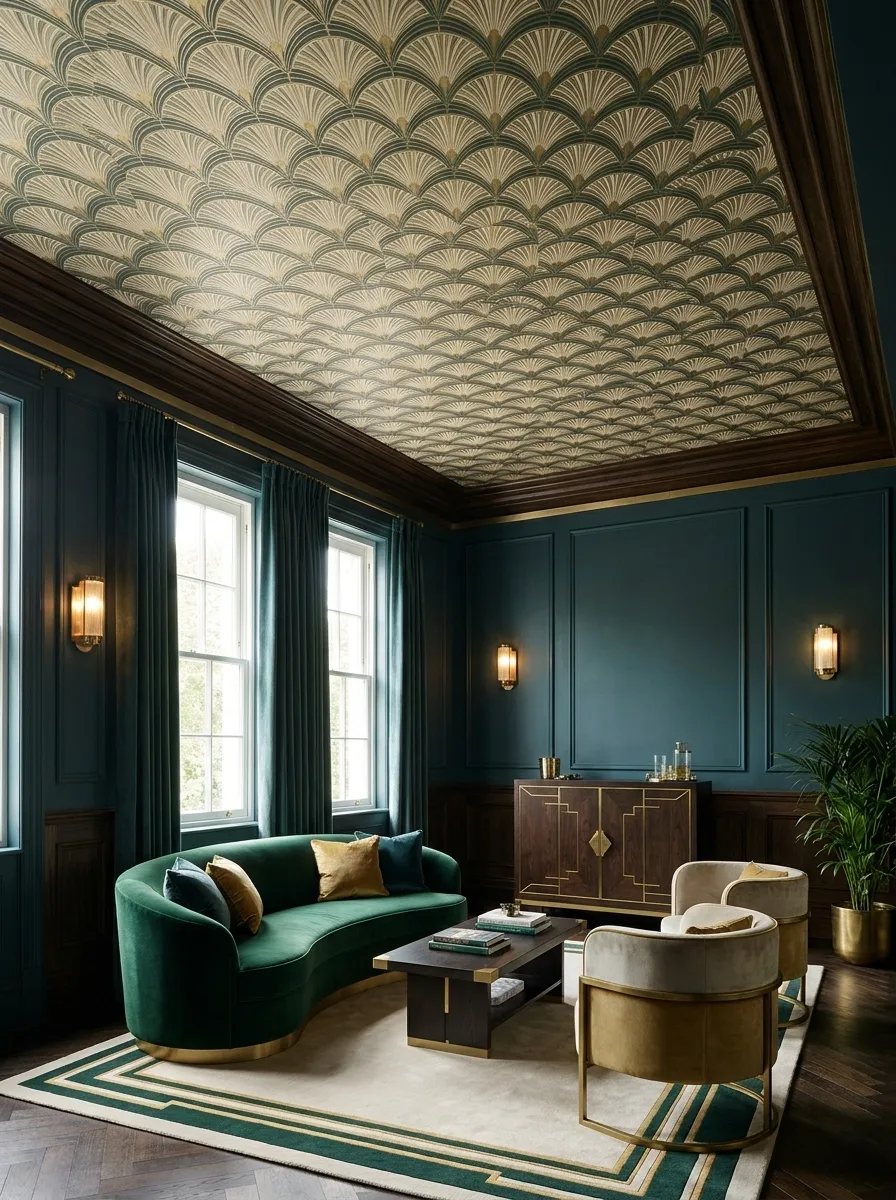
Subtlety can take the evening off. This lounge has Art Deco geometry, velvet seating, and a ceiling that clearly didn’t come to socialize quietly.
A fan-patterned ceiling in muted gold, cream, and deep green sets the tone above emerald or petrol-colored walls. A curved velvet sofa softens the geometry, while dark timber furniture and brushed brass details reinforce the period-inspired mood. Layered lighting gives the room depth, allowing the ceiling pattern to remain visible without turning every reflective surface into a spotlight.
The composition combines angular repetition with rounded silhouettes. The wallpaper brings order, the sofa introduces movement, and the deeper walls provide a rich backdrop.
Avoid adding several unrelated geometric prints to the cushions and rug. Art Deco has plenty of personality already. It doesn’t need every accessory making a speech.
Test metallic or high-contrast samples with the actual lamps and fittings before settling on the final combination.
Art Deco lounge
Sharp pattern. Soft silhouettes.
Fan geometry
Repeating arcs supply the architectural rhythm overhead.
Curved seating
Rounded forms offset the sharper lines above.
The design rule: Pair strong ceiling geometry with rounded furniture and a controlled palette. Drama is good. Decorative overcrowding is a different career path.
Hand-Drawn Ceiling Mural in a Creative Home Office
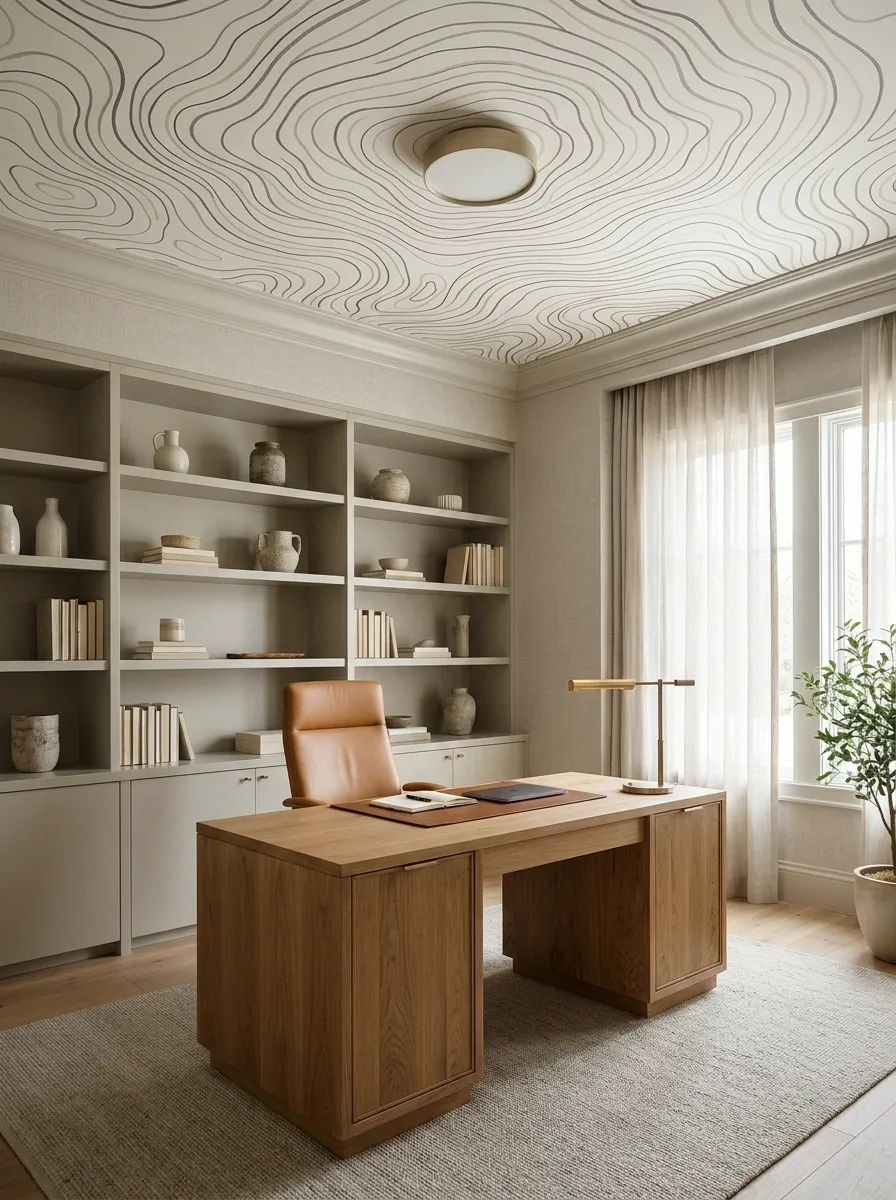
A home office doesn’t need motivational quotes covering every wall. The unfinished deadline on the laptop is already inspirational enough.
A hand-drawn map, contour-line, or abstract ink-pattern ceiling gives a creative workspace personality without filling the desk with decorative clutter. Warm oak furniture, neutral walls, functional shelving, and a comfortable ergonomic chair keep the room practical. A proper desk lamp provides focused lighting, while the patterned ceiling introduces the more expressive detail.
The ceiling pattern should be visually interesting but not so busy that the workspace feels distracting. Keep the main working wall fairly quiet, especially if the desk faces it.
Before choosing a print, identify the desk position, monitor location, overhead lights, and any ceiling-mounted fixtures. A creative ceiling still needs a functional office underneath it.
Creative home office
Creativity overhead. Focus at the desk.
Illustrative room plan, not to scale
Ceiling pattern zone
Map or contour motif
Lighting zone
Coordinate with overhead fixtures
Desk and monitor
Preserve usable workspace
Storage and access
Keep shelves and walkways clear
Plan the working layout first and fit the pattern around it. Wallpaper should support the room’s purpose, not turn a perfectly usable desk into a furniture rearrangement project.
Fine Botanical Ceiling in a Traditional Kitchen
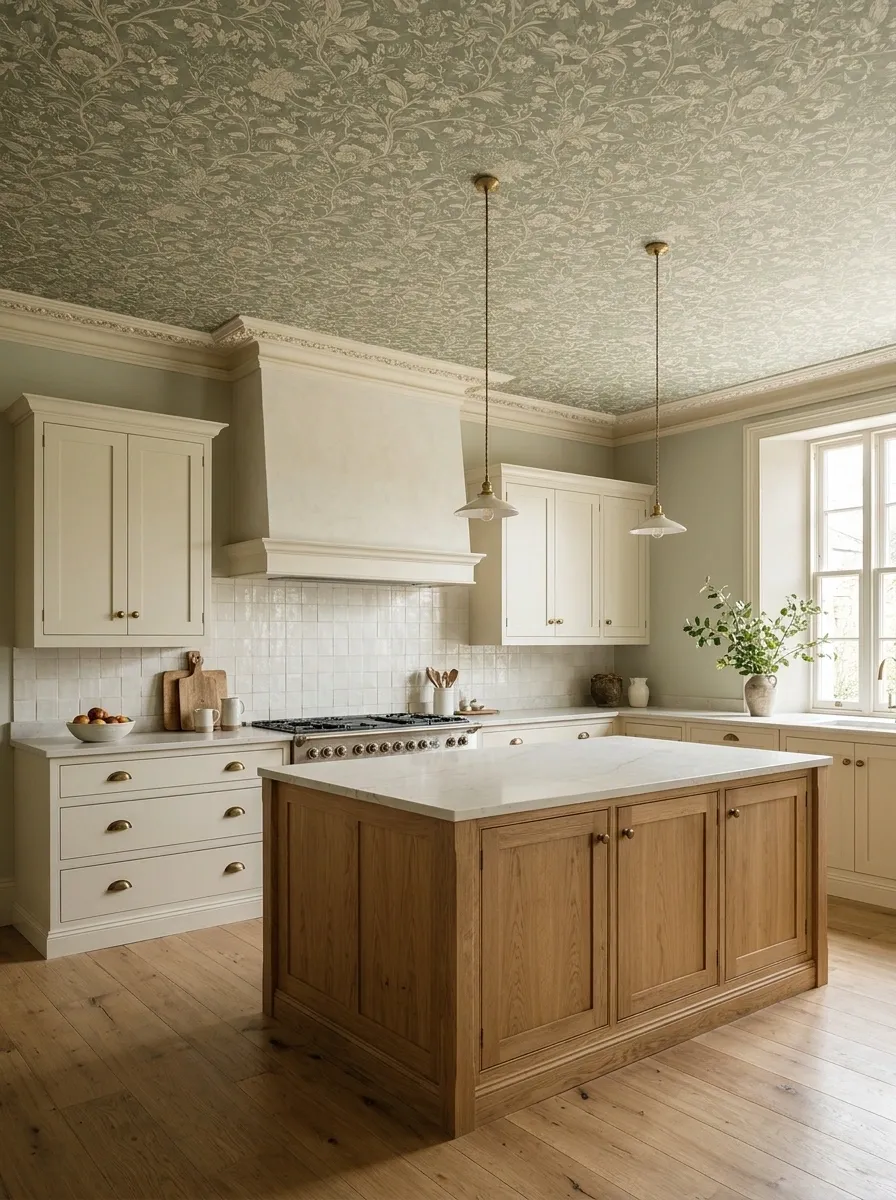
Traditional kitchens already have enough decisions happening between cabinetry, handles, splashbacks, and countertops. The ceiling doesn’t need to join the committee with a twelve-page presentation.
Fine botanical wallpaper in muted sage and cream brings softness to classic cabinetry and natural timber. White or warm ivory cupboard fronts keep the kitchen light, while an oak island and pale stone worktops give it warmth. Simple ceramic pendants finish the composition without competing with the ceiling.
The result feels more personal than a plain fitted kitchen but still practical enough for everyday cooking.
Treat the patterned ceiling as a decorative zone rather than extending the print onto every surface. Keep splashbacks and worktops suited to their cleaning demands, and make sure the ceiling wallpaper is appropriate for the kitchen’s heat and humidity conditions.
Confirm the manufacturer’s installation and maintenance guidance, and plan around ventilation and cooking areas. Not every wallpaper is suitable for every kitchen.
Traditional kitchen planning
Not every surface has the same job.
A successful kitchen balances decorative finishes with the surfaces that handle daily cooking, splashes, heat, and cleaning.
Decorative zone
Ceiling wallpaper chosen for pattern, color, and compatibility with the room.
Check product suitability and installation conditions.
Working zone
Splashbacks, countertops, and surfaces that need practical cleaning and maintenance.
Specify finishes for their actual exposure.
The wallpaper handles the decoration. The work surfaces handle the cooking. Asking one material to do every job is how kitchen plans become unnecessarily complicated.
Deep Blue Constellation Ceiling in a Moody Reading Room
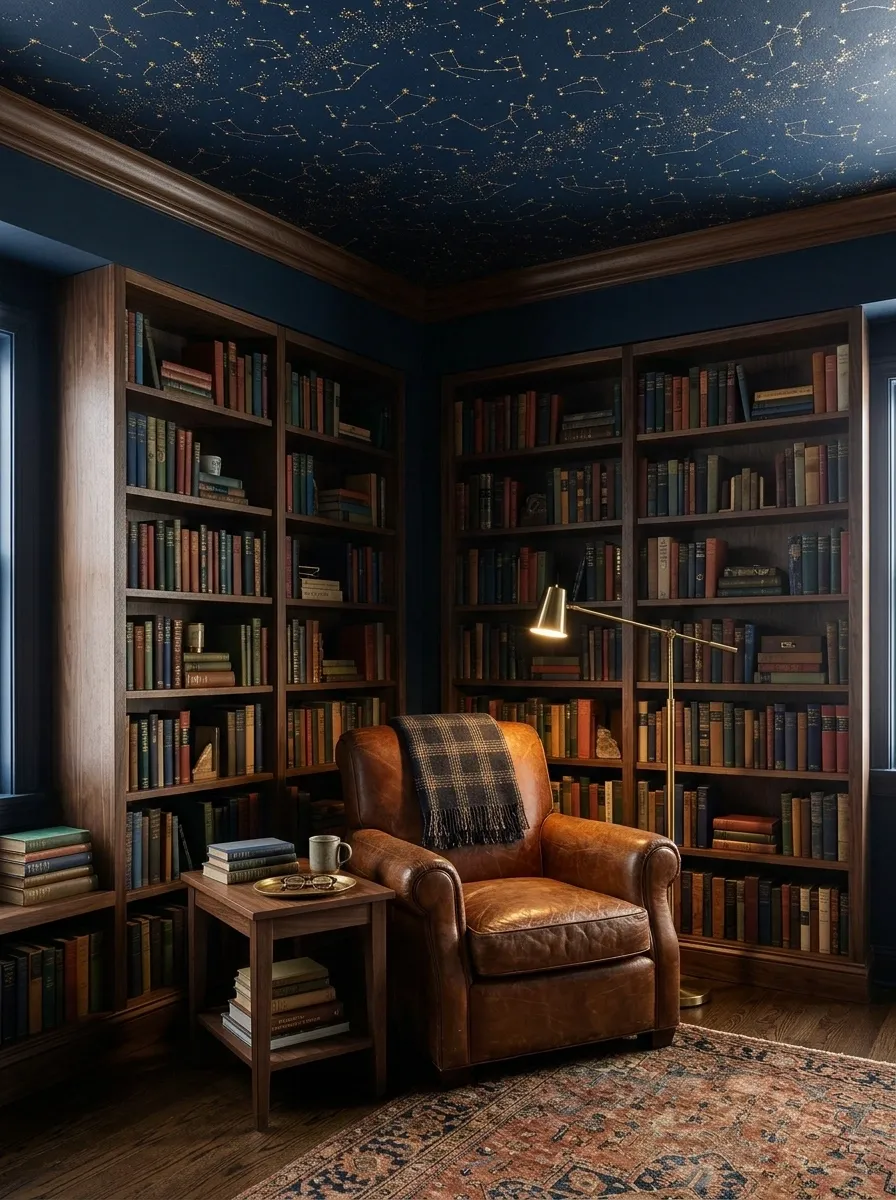
A reading room should feel like a retreat, not a brightly lit office that happens to contain books.
Deep navy constellation wallpaper creates an atmospheric ceiling above dark blue walls, walnut bookcases, and a substantial leather or textured reading chair. A warm floor lamp provides focused light beside the chair, while softer ambient lighting keeps the bookshelves and surrounding corners from disappearing into darkness.
The contrast between deep colors and warm lighting gives the room its character. The ceiling adds a sense of depth, while walnut and leather bring warmth to the darker palette.
Practical reading light matters more than decorative glow alone. A constellation print may look romantic, but tiny lettering on a book still needs to be readable.
Include both ambient lighting and a suitable reading light. Check that darker wallpaper won’t make an already poorly lit room feel less usable during the day.
Moody reading room
Dark ceiling. Readable pages.
A dark palette needs a lighting plan that supports actual reading, not just attractive photographs.
Ambient light
General illumination keeps the room usable beyond the chair.
Reading light
A well-positioned lamp illuminates the page without relying on ceiling light alone.
Decorative glow
Soft light around bookshelves and corners adds atmosphere without replacing task lighting.
Choose the ceiling pattern, then plan the light sources around the room’s real uses. Mysterious is a design mood. Squinting at chapter three is not.
Tropical Leaf Ceiling in a Relaxed Indoor-Outdoor Living Room
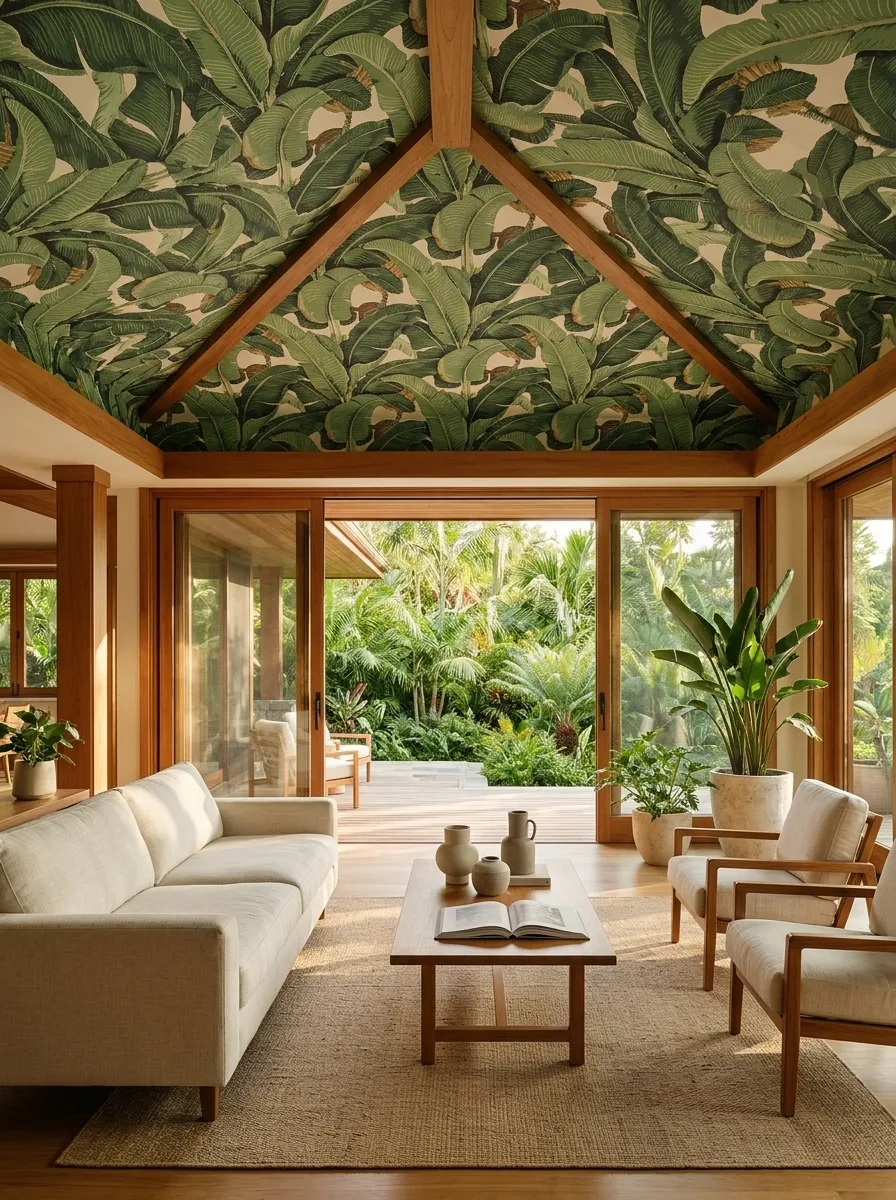
Apparently, having six houseplants isn’t enough. Sometimes the ceiling wants to join the jungle too.
Large tropical leaf wallpaper brings bold greenery overhead, while warm teak furniture, natural linen upholstery, woven textures, and broad garden-facing doors keep the room grounded. A light neutral sofa balances the leafy print, and a simple rug connects the seating area to the natural materials throughout the space.
Live plants add depth near the windows, but they don’t need to occupy every available corner.
The secret is balancing printed foliage with real greenery. If the ceiling features enormous banana leaves, keep the cushions relatively simple and avoid covering every shelf with another leafy accessory. The room should feel connected to the garden, not like the garden has filed a property claim.
Consider how much foliage is already visible through the windows. A strong botanical ceiling works best when the room has a clear visual hierarchy.
Indoor-outdoor living
The jungle needs a little editing.
A tropical ceiling already brings plenty of movement. Let the other elements support it rather than compete for the same attention.
THE BOTANICAL STATEMENT
Printed foliage on the ceiling establishes the pattern.
Warm timber and neutral linen
Natural materials give the green palette a calmer foundation.
Add selectively
A few live plants near the windows.
Keep restrained
Cushions, rugs, and smaller accessories.
Soft Terrazzo-Inspired Ceiling in a Modern Bathroom
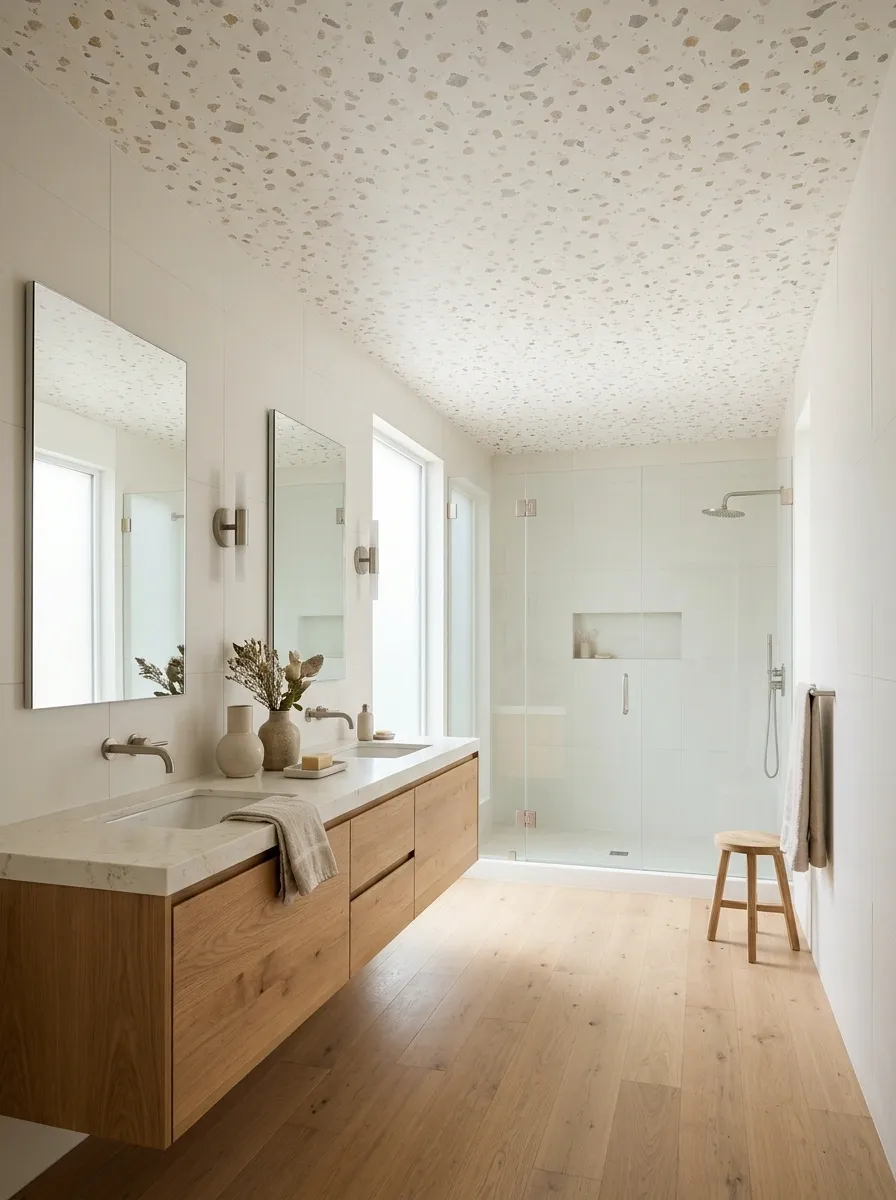
Bathrooms already have enough reflective surfaces. The last thing the design needs is a ceiling that competes with the mirror for screen time.
A subtle terrazzo-inspired wallpaper introduces flecks of muted stone colors above a floating oak vanity, warm white tiles, and understated brushed-nickel fittings. A clear-glass shower keeps the architecture visible, while the oak adds warmth against the cooler mineral palette.
The ceiling pattern picks up colors from the floor or countertop, tying the room together without repeating the exact same finish everywhere.
The important decision is where wallpaper belongs. Decorative ceiling paper must be suitable for the bathroom’s actual moisture conditions, ventilation, and substrate. The shower’s wet zone demands particular care, and ordinary wallpaper should never be assumed appropriate simply because the finished photograph looks expensive.
Check the manufacturer’s suitability and installation instructions before using wallpaper in a bathroom. Plan the pattern alongside the mirror, ventilation, and overhead lighting.
Modern bathroom planning
Pretty is not a waterproofing system.
Separate the decorative treatment from the surfaces exposed to water. Product suitability matters more than the mood board.
Ceiling zone
Choose a product approved for the room’s humidity and installation conditions.
Wet zone
Use materials and assemblies suitable for direct water exposure where required.
Before installation: Check moisture exposure, ventilation, substrate preparation, and product instructions. A bathroom renovation is a terrible time for surprise wallpaper archaeology.
Large-Scale Damask Ceiling in a Formal Guest Bedroom
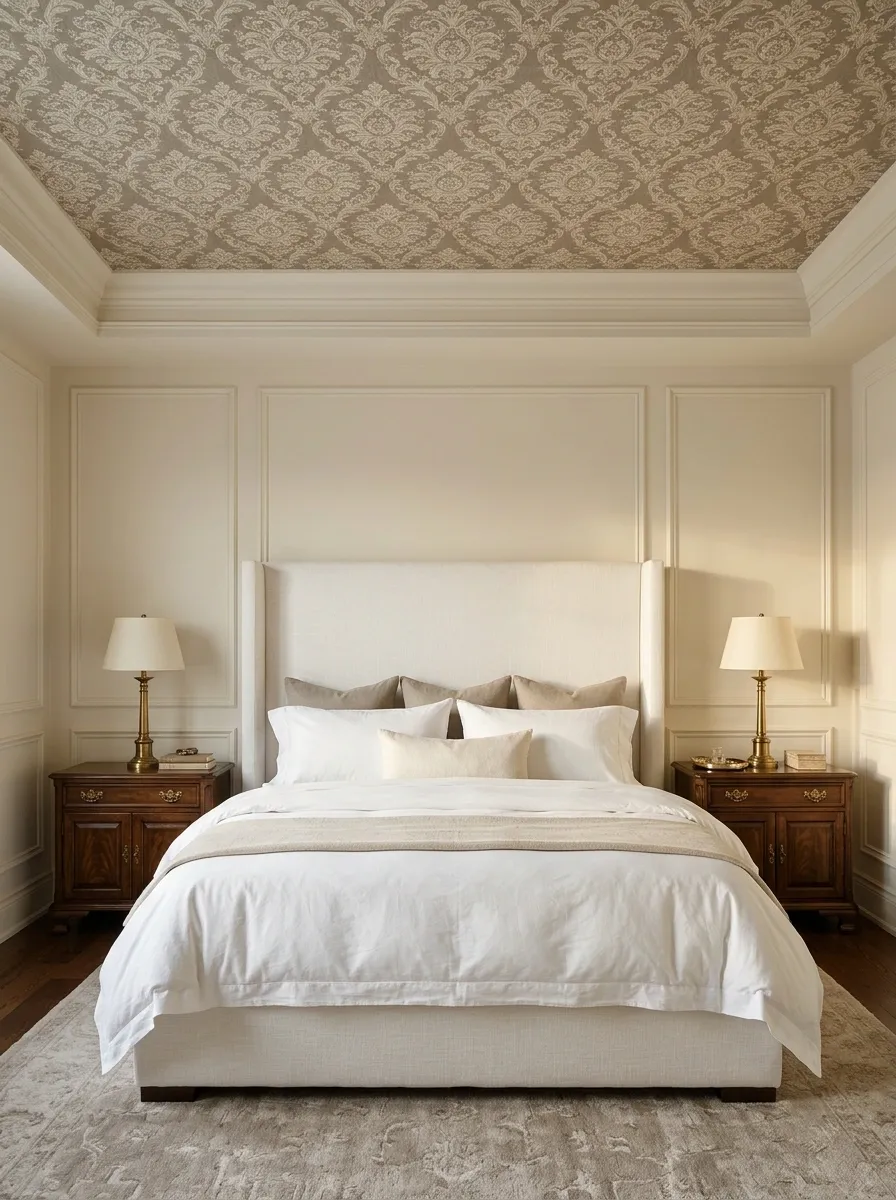
A formal guest bedroom should feel thoughtful, not like a hotel room that has been asked to dress for a royal appointment.
Large-scale damask wallpaper in muted taupe and cream gives the ceiling an architectural presence above an upholstered headboard, crisp bedding, and traditional bedside tables. Subtle wall paneling frames the bed, while warm lamps soften the contrast between the pale textiles and deeper furniture finishes.
The low contrast is doing important work. A bold damask motif already has plenty of visual structure, so softer colors make it easier to appreciate without making the room feel heavy. Keep the bedding mostly solid and let the wallpaper provide the decorative detail overhead.
Consider the width of the bed, the ceiling’s dimensions, and the wallpaper repeat together. A large motif needs enough space to read as a complete pattern.
Formal guest bedroom
The motif needs room to breathe.
Damask is naturally decorative. Use contrast and repeat size to decide how much visual weight it should carry.
Tighter repeat
Creates denser visual detail across the ceiling.
Larger repeat
Gives individual motifs more room to register.
Check the actual repeat dimensions against the ceiling and bed layout. The goal is a readable pattern, not an accidental close-up of one enormous decorative flourish.
Warm Wood-Effect Ceiling Wallpaper in an Industrial Loft
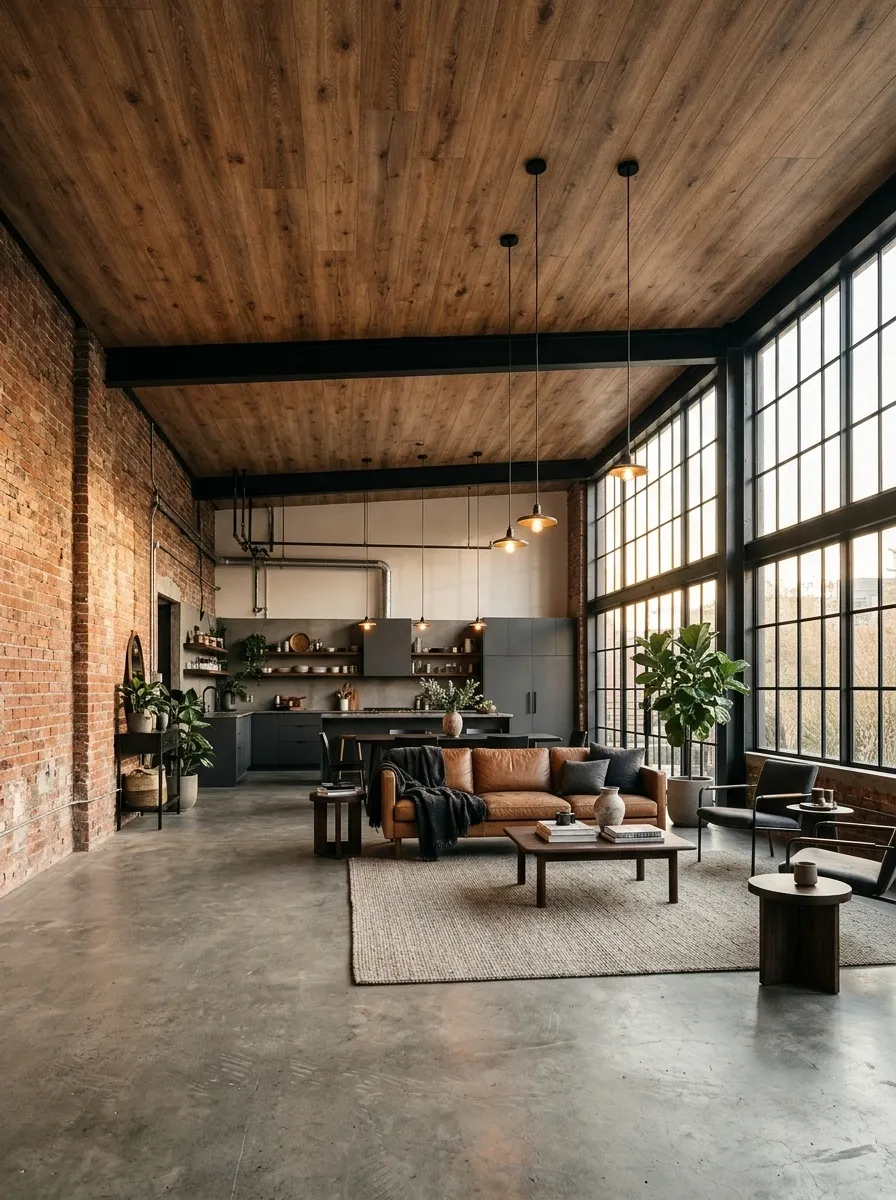
Exposed brick, steel-framed windows, concrete floors, and charcoal cabinetry can make an industrial loft look impressive. They can also make it feel as if warmth was removed from the specification to save money.
A realistic wood-effect ceiling brings warmth to the full composition. The timber tones connect with a caramel leather sofa and dark wood furniture, while the exposed brick and black steel windows preserve the loft’s industrial character.
A restrained concrete floor and simple pendant lights prevent the room from becoming a pile of competing finishes.
Choose a wood-effect pattern that looks believable at the scale of the ceiling. Repeated planks with artificial-looking grain can undermine the whole design, especially beside real timber furniture. The wood tone should complement existing finishes rather than pretend every wooden surface came from the same tree.
Review samples against the actual brick, cabinetry, and furniture. Wallpaper should be specified for ceiling use, and the substrate must be appropriate for the product’s weight and installation method.
Industrial loft
Hard finishes need a warmer counterpoint.
The industrial side
Concrete, steel, and exposed brick create texture and visual weight.
The warm side
Wood tones and leather soften the sharper industrial materials.
The bridge between them
Repeat the ceiling’s wood tone selectively in furniture, then leave enough contrast for the brick and steel to retain their character.
Delicate Scallop Ceiling in a Playful Nursery
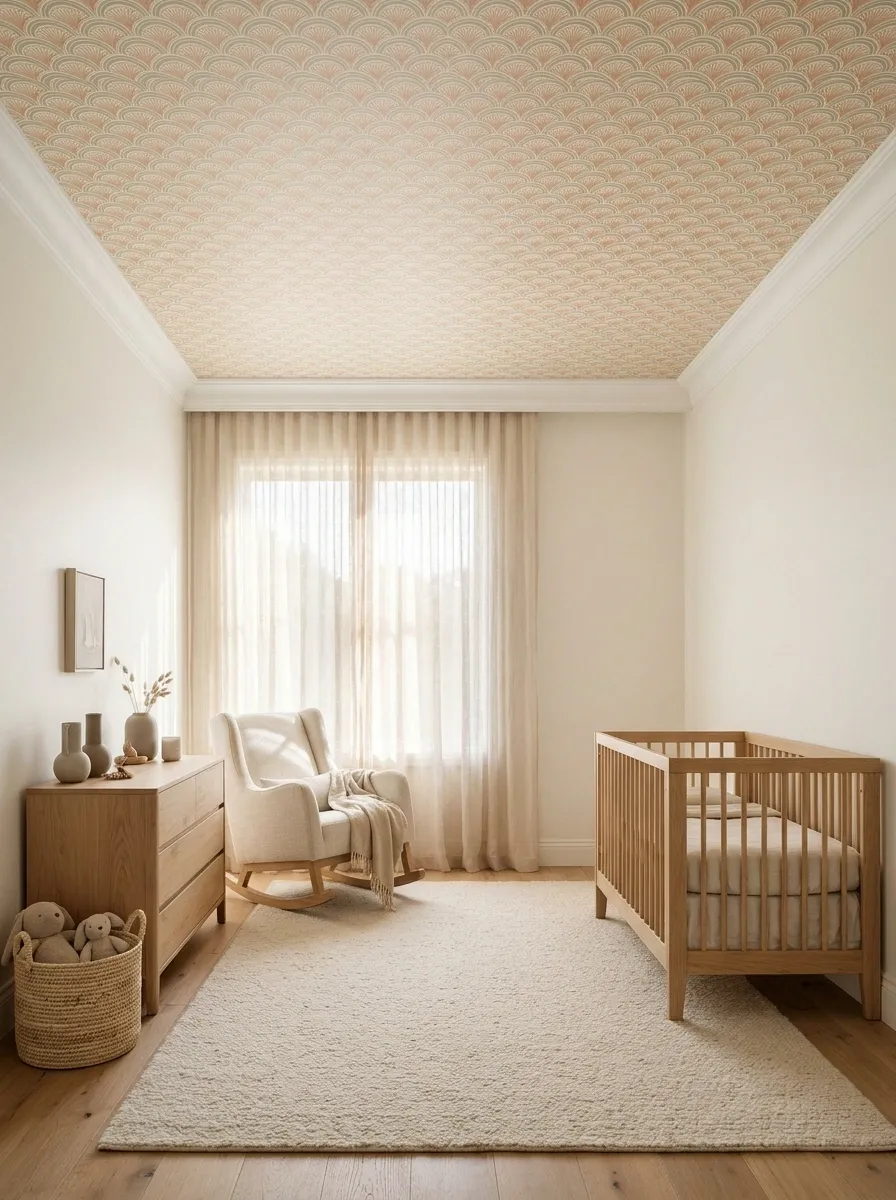
Nursery design can get out of hand surprisingly quickly. Suddenly, the ceiling has stars, the walls have rainbows, the rug has clouds, and every toy is apparently required to coordinate with a theme.
A delicate scallop-patterned ceiling in muted peach, sage, and cream gives the room a playful focal point without overwhelming the furnishings. A natural wood cot, soft rug, comfortable rocking chair, and simple curtains establish a calm foundation.
Painted walls remain relatively quiet, allowing the ceiling to provide the decorative movement. The scalloped repeat feels gentle beside the straight lines of the cot and furniture.
Keep the pattern scale appropriate to the ceiling and repeat just one or two of its colors in the textiles. The room will feel considered without requiring every accessory to participate in the theme.
Choose materials and installation methods appropriate for a nursery, and follow product guidance for ventilation, surface preparation, and secure installation. Keep hanging decorations, cords, and other potential hazards safely away from the sleeping area.
Nursery ceiling
Playful does not mean visually chaotic.
Scallop patterns can feel delicate or bold depending on the repeat size and contrast.
Small scallops
A fine, gentle repeat for a quieter ceiling treatment.
Medium scallops
A visible motif that provides personality without dominating the room.
Large scallops
A stronger graphic statement that needs space around it.
Choose the repeat in relation to the room’s dimensions and furniture. A nursery can be playful without making the ceiling look like it has discovered a sticker collection.
Hand-Blocked Ceiling Pattern in a Mediterranean Dining Room
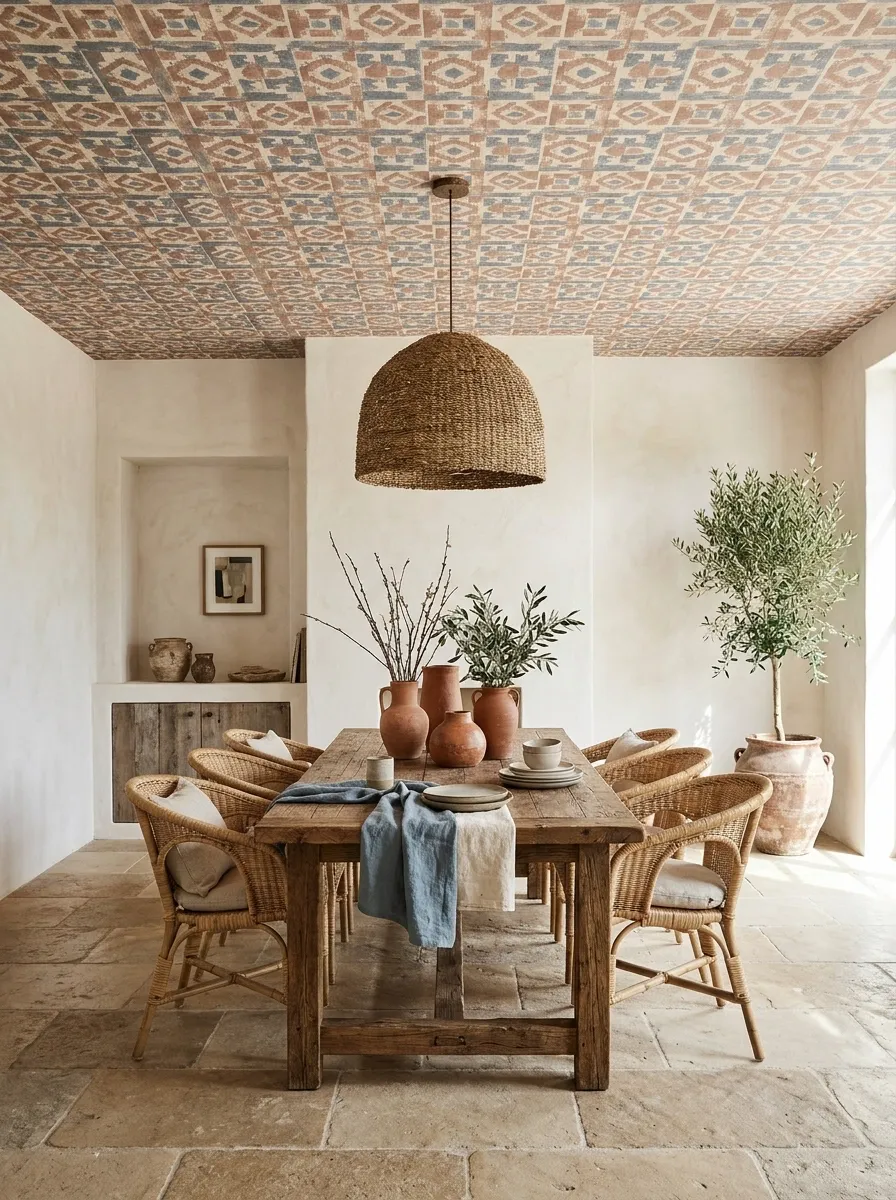
Terracotta, faded blue, natural timber, and a patterned ceiling. Finally, a dining room with more personality than a beige sofa and a motivational sign about wine.
A hand-blocked geometric print in muted terracotta, dusty blue, and cream brings artisanal character overhead. Warm plaster-like walls, a reclaimed wood dining table, woven chairs, and a simple pendant create a relaxed Mediterranean setting.
Natural stone flooring grounds the palette, while handmade ceramic pieces connect the ceiling’s pattern to the furnishings.
The design works because its colors recur in different ways rather than appearing in identical patterns everywhere. Terracotta can show up in pottery, blue in a small textile accent, and cream across the walls.
Choose a print with a limited color palette if the room already includes strong wood grain, stone textures, or patterned floor tiles. A little repetition creates cohesion. Too much repetition looks like the room got a bulk discount.
Mediterranean dining room
One palette, different materials.
Spread the ceiling’s colors across the room without repeating its exact pattern on every surface.
Ceiling
Use the strongest combination in the main print.
Ceramics
Echo a color through pottery or table accessories.
Furniture
Let warm timber supply the quieter visual anchor.
The palette should repeat throughout the room. The pattern doesn’t need to.
Watercolor Wash Ceiling in a Contemporary Primary Bedroom
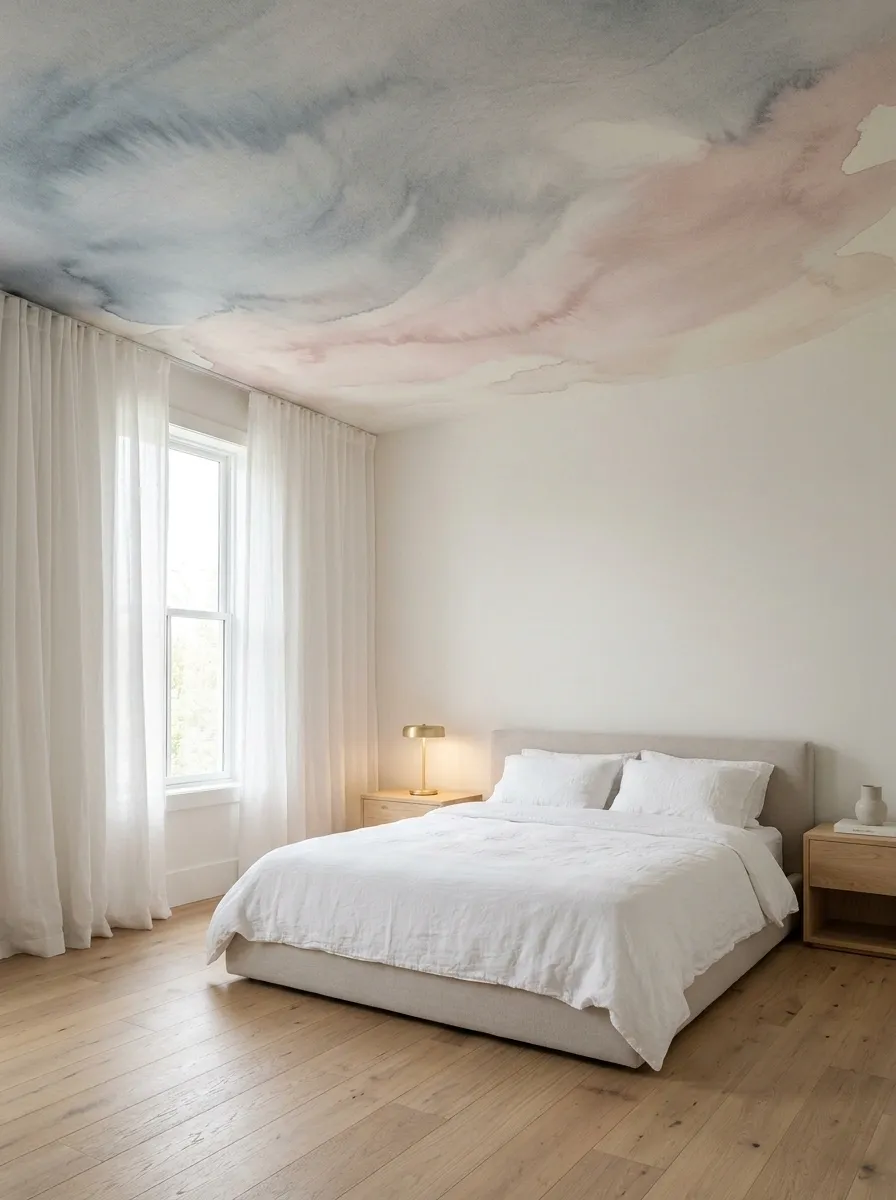
Some bedrooms have enough sharp edges to qualify as a geometry lesson. A watercolor ceiling introduces a welcome change of pace.
Soft blue-gray washes blend into restrained blush and creamy white overhead, creating a hazy pattern above a low upholstered bed. Pale oak furniture, simple bedding, and flowing curtains keep the room’s architecture clean, while a subtle bedside light adds warmth.
The ceiling looks expressive without relying on oversized flowers or rigid geometric repeats.
The appeal comes from the contrast between the ceiling’s fluid forms and the furniture’s clear lines. The watercolor effect softens the room, while oak and tailored upholstery keep it grounded.
Let the ceiling provide most of the decorative movement. A heavily patterned duvet and elaborate curtains would turn the gentle color wash into visual competition nobody asked for.
Examine the wallpaper’s color transitions and finish in both daylight and evening light. Soft gradients can look very different under warm bulbs than they do on a phone screen.
Watercolor bedroom
Soft color. Strong composition.
The ceiling supplies the fluid shapes. Furniture and textiles keep the overall room grounded.
Fluid overhead
Gentle color shifts provide movement without rigid repetition.
Defined furnishings
Clean lines and natural timber prevent the palette from feeling too vague.
Let the ceiling blur the edges. Keep the bed, furniture, and practical details clear enough to anchor the room.
Gilded Botanical Ceiling in a Restored Period Dining Room
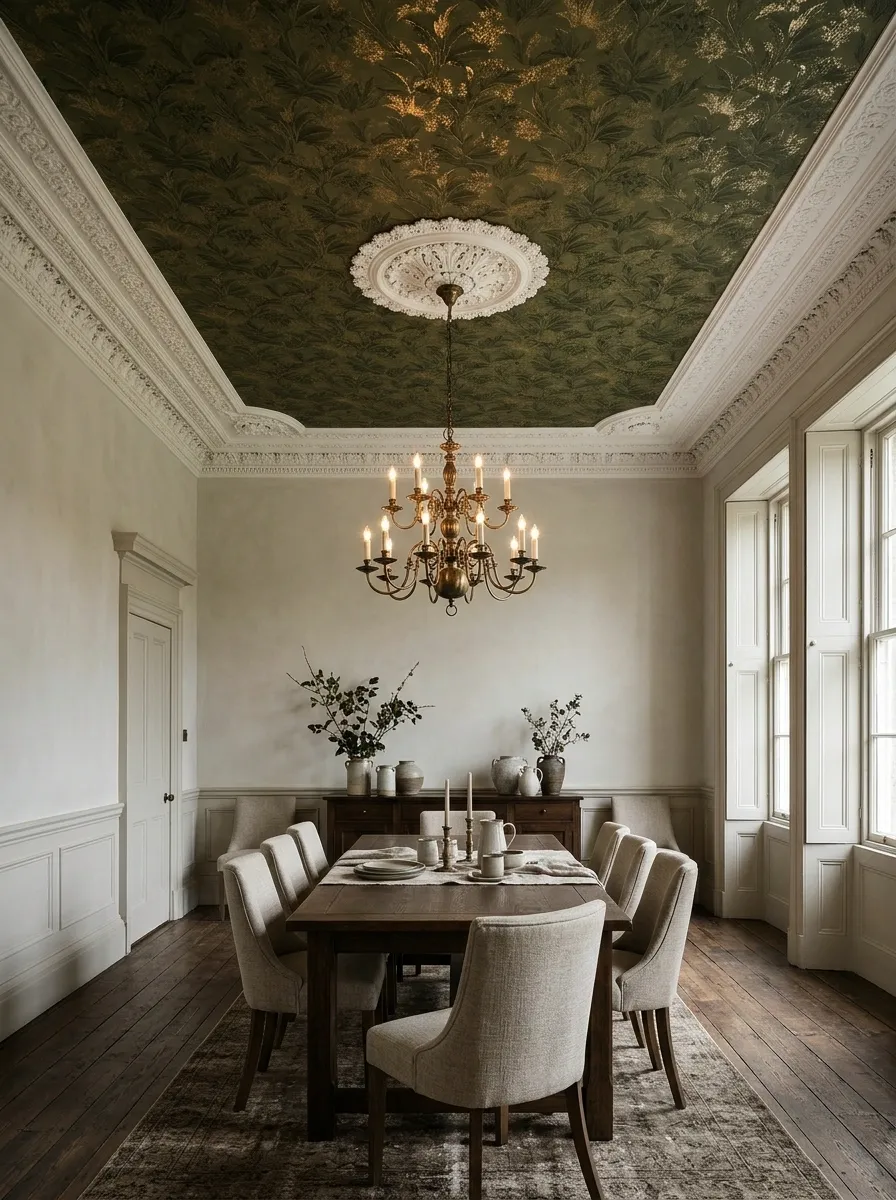
A restored period dining room doesn’t need another antique vase desperately auditioning for the spotlight. Sometimes the ceiling is the most convincing place to put the drama.
Gilded botanical wallpaper with muted green or deep olive tones sits within detailed cornicing, above a substantial dark oak table and upholstered dining chairs. Warm chandelier light catches the metallic details, while quiet wall finishes preserve the architecture’s presence.
Traditional proportions and carefully chosen furnishings make the ceiling feel like part of the building rather than a decorative stunt.
The cornice is the critical boundary. A busy botanical pattern looks more considered when it meets the molding cleanly, with the repeat planned around the room’s edges and central light fixture.
Measure the ceiling and inspect its molding before deciding on the pattern’s starting point. Check metallic samples under the room’s actual lighting, and avoid assuming that a modern print will align neatly with historic architectural details.
Period dining room
Frame the print. Respect the architecture.
The cornice defines the ceiling’s boundary, so the wallpaper layout needs to account for the trim and light fitting.
Illustrative ceiling field and architectural border
Before installation
Check cornice dimensions, repeat placement, ceiling-light position, and the condition of the existing surface. Historic architecture has its own plans, and it rarely shares them in advance.
Monochrome Wave Ceiling in a Compact Modern Apartment
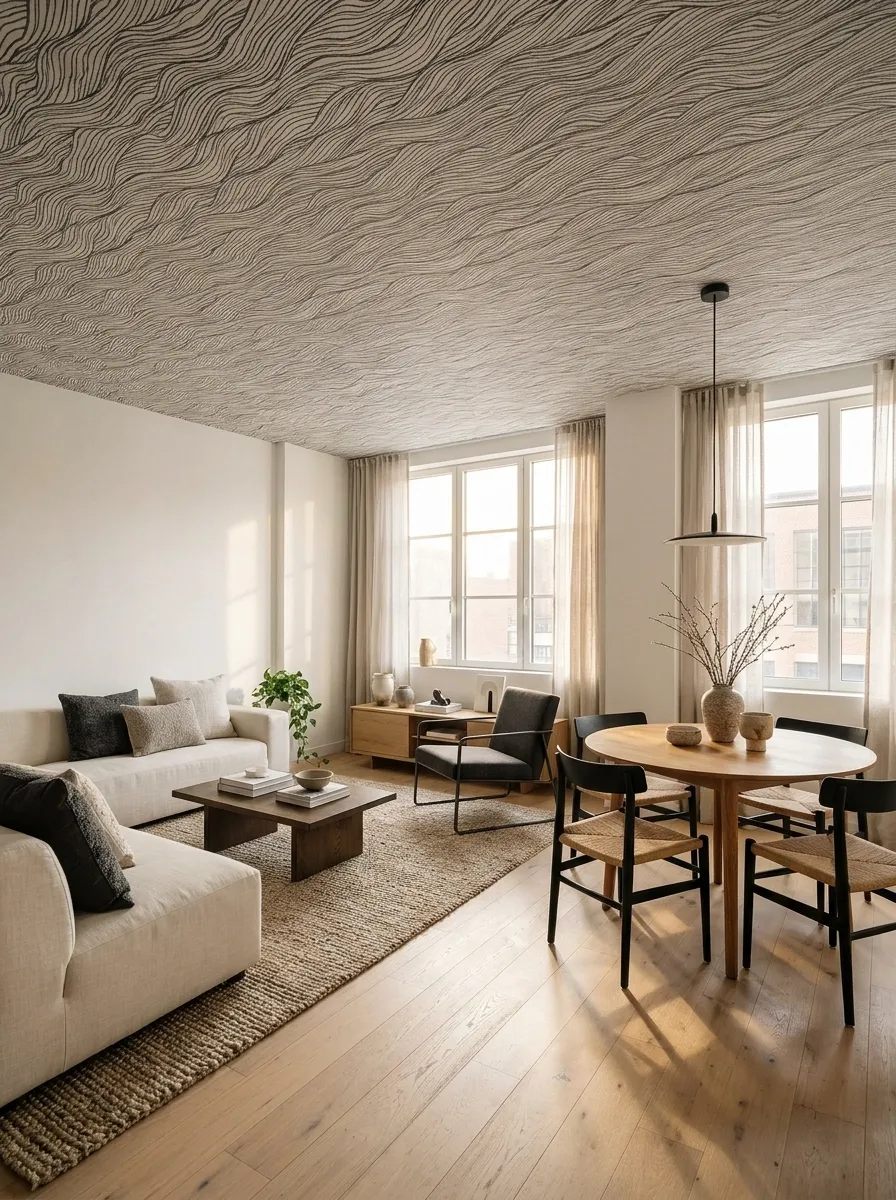
Small apartments don’t need more stuff. They need better decisions about the stuff already there.
A monochrome wave-patterned ceiling creates a graphic focal point above a compact living and dining area. Pale timber flooring, a low sofa, a round dining table, and clean-lined furniture keep the plan open.
White walls provide a light backdrop, while the ceiling introduces enough visual character to make the two functional zones feel connected without filling the floor with extra furniture.
This concept is especially useful when the apartment has a shared living and dining area. The continuous ceiling treatment can visually link both functions, while a rug or carefully positioned light helps define where one zone ends and the other begins.
Plan the wallpaper boundaries in relation to the room’s shape and lighting. In an open-plan space, a continuous print often reads more clearly than an arbitrary change directly above the sofa.
Compact apartment
One ceiling. Two functions.
A shared visual treatment connects the living and dining areas while the furniture defines their separate jobs.
CONTINUOUS CEILING PATTERN
Living zone
Dining zone
Keep the wallpaper treatment continuous where the room allows. Use furniture, rugs, and lighting to organize the space instead of adding unnecessary visual boundaries overhead.
Dramatic Jewel-Pattern Ceiling in a Boutique-Style Dressing Room
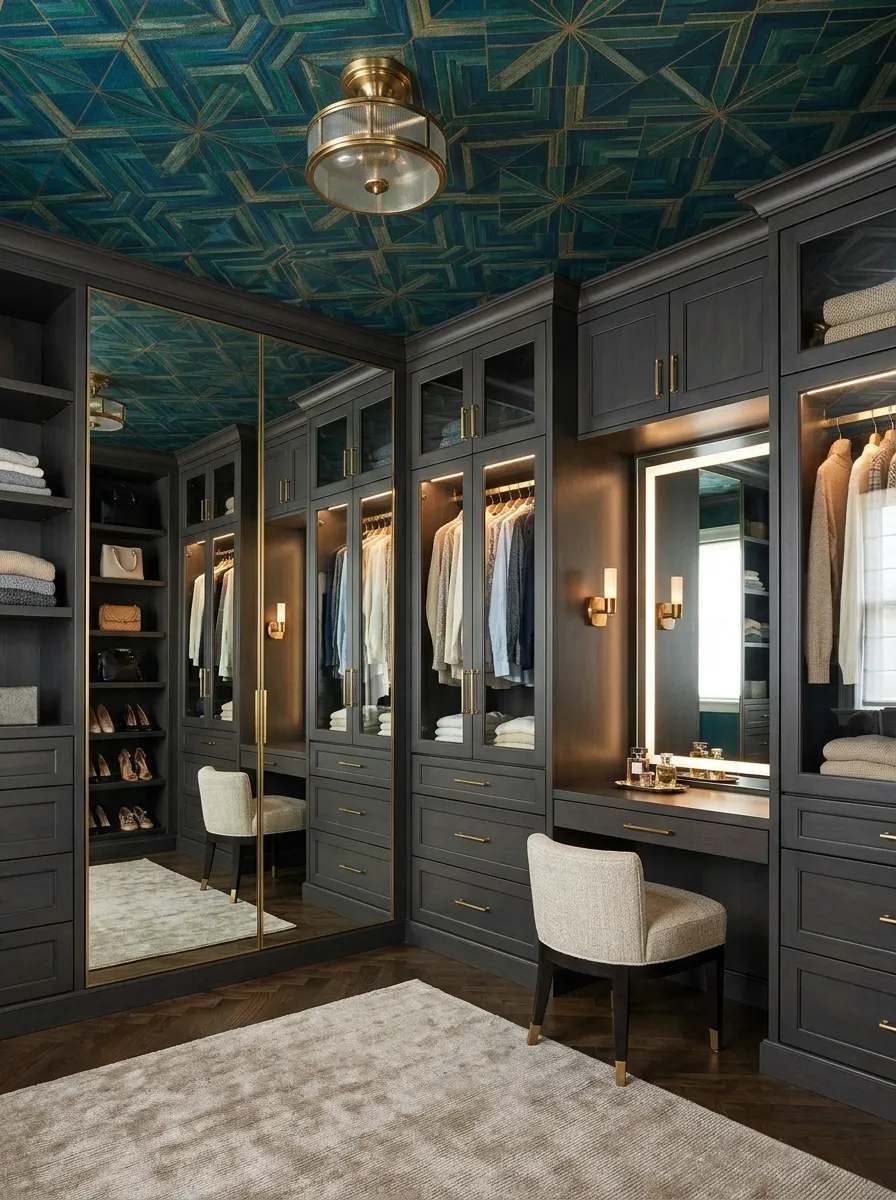
A dressing room deserves more personality than a row of identical hangers and one overhead bulb that makes everything look vaguely disappointing.
A jewel-toned geometric ceiling in peacock blue, emerald, and antique gold establishes an intimate boutique atmosphere above dark cabinetry, full-height mirrors, and a tailored upholstered stool. Warm, flattering lighting gives the finishes depth, while restrained wall treatments keep the space from feeling crowded.
The mirrors expand the visual field, and the patterned ceiling provides the decorative detail that makes the room feel deliberately designed.
Lighting and reflection matter as much as wallpaper. Position mirrors so they provide useful views without creating awkward reflections of bright fixtures, and make sure the dressing area has practical illumination.
Check mirror sightlines, lighting placement, ceiling height, and access to storage before finalizing the wallpaper layout. A dressing room may look glamorous, but it still needs to function on an ordinary Tuesday morning.
Boutique dressing room
A little drama. Zero wardrobe chaos.
The richest ceiling designs work best when mirror placement, storage, and task lighting are already accounted for.
Storage
Clear access to cabinetry.
CEILING STATEMENT
Geometric print with restrained metallic accents.
Mirror and light
Clear sightlines and useful illumination.
For the atmosphere
Deep color, patterned wallpaper, and warm accent lighting.
For real life
Accessible storage, flattering task light, and usable mirror positions.
Let the Ceiling Finish the Room
The best ceiling wallpaper doesn’t look like a last-minute decorating decision. It feels connected to the furniture, architecture, lighting, and finishes already in the room.
A quiet botanical print can soften a neutral interior, while bold geometry or dark florals can establish a stronger mood. The right choice depends on the whole composition, not simply which sample looks appealing under store lighting.
Before ordering, check the wallpaper repeat, test the colors in the actual room, and plan around light fittings, ceiling edges, and existing finishes. Small details matter when the entire surface is visible at once.
Save the designs that fit the rooms on your renovation list. Future decorating decisions are much easier when the reference shows a complete look, not just a pretty patch of wallpaper.