
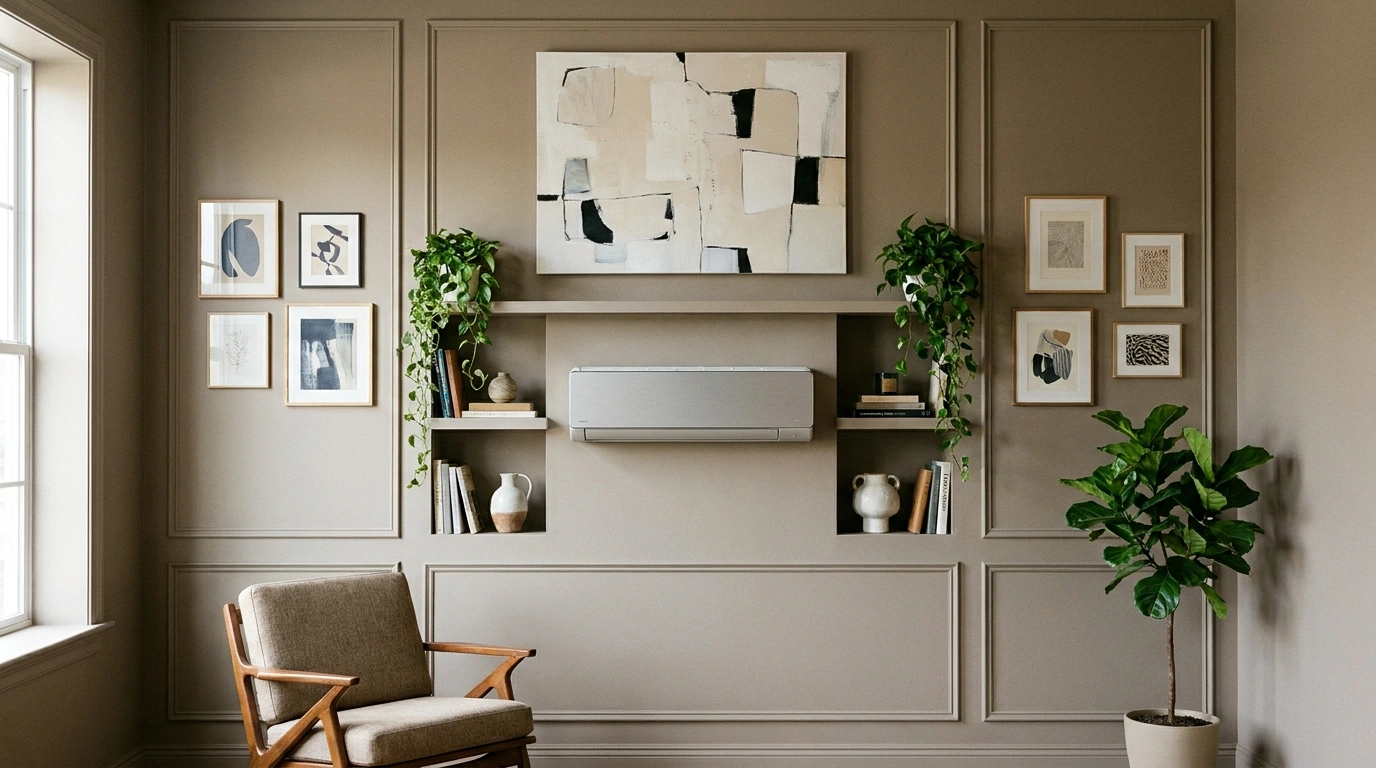
An air conditioner does not care about your carefully balanced wall arrangement. It has arrived to move air and will continue looking like equipment while doing so.
You can make the surrounding wall feel coherent without disguising the machine. Start with its operating space: air intake, discharge, panel movement, filter removal, service access, remote reception, and any unit-specific clearances. Check your exact manual before placing anything nearby.
Daikin’s operation guidance warns against blocking air inlets and outlets. Its additional precautions also caution against moisture-sensitive objects directly beneath indoor units. The decorative diagrams here are conceptual and do not provide installation clearances.
Wall Decorating Ideas That Leave the Air Conditioner Free to Work
Use a Related Wall White
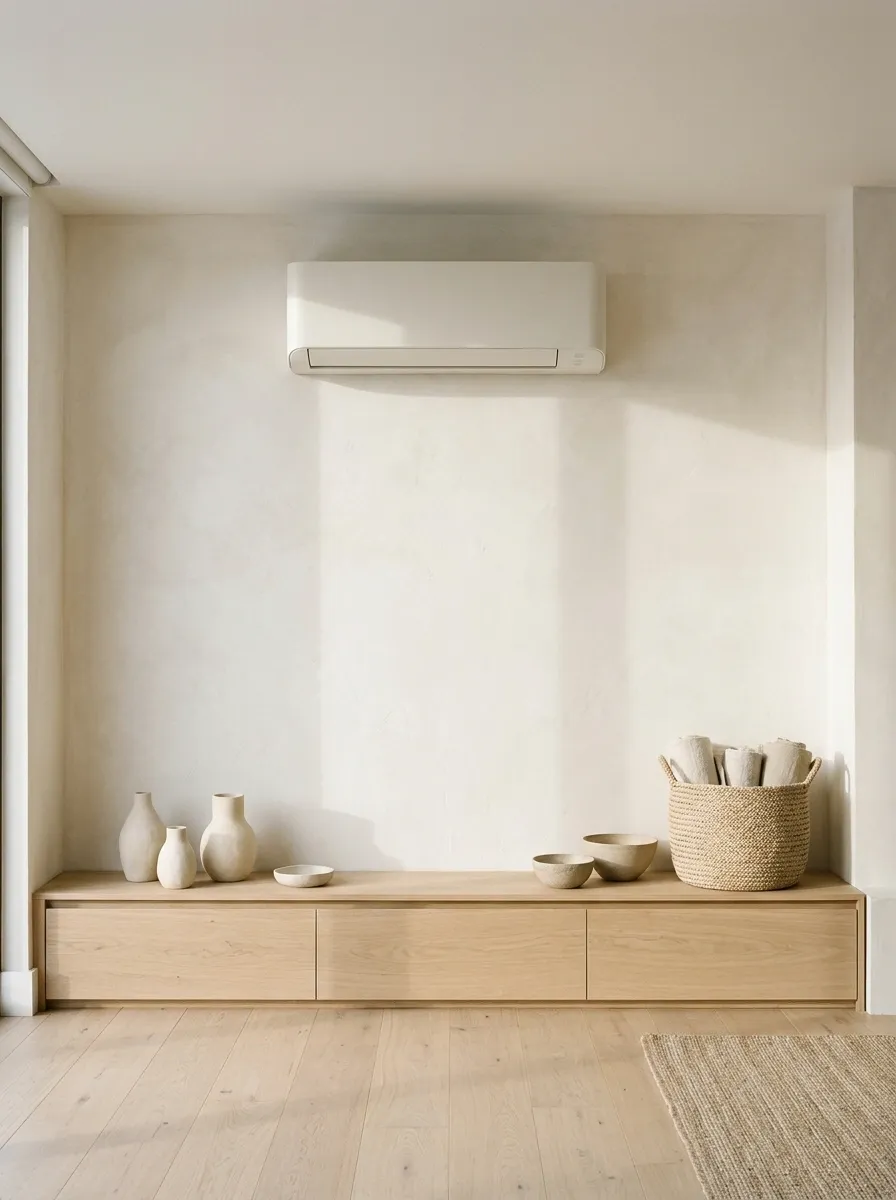
A white air conditioner tends to draw less contrast against a related white wall. Compare samples with the actual casing rather than assuming every white belongs to the same family.
Leave the appliance unpainted unless its manufacturer explicitly provides an approved treatment. Painting a casing can interfere with labels, sensors, finishes, or moving parts.
Keep the wall finish consistent across a clear architectural area. A little white rectangle directly behind the unit can look more like a patch than a design choice. The whole wall usually makes a more convincing gesture.
Reduce the contrast around a white unit
Operating and service area: follow the exact manual
Related white wall
Decor stays outside the operating and service area Concept diagram, not a clearance drawing. Keep airflow, panel movement, filter removal, and service access unobstructed.
Put the Strong Color Lower on the Wall
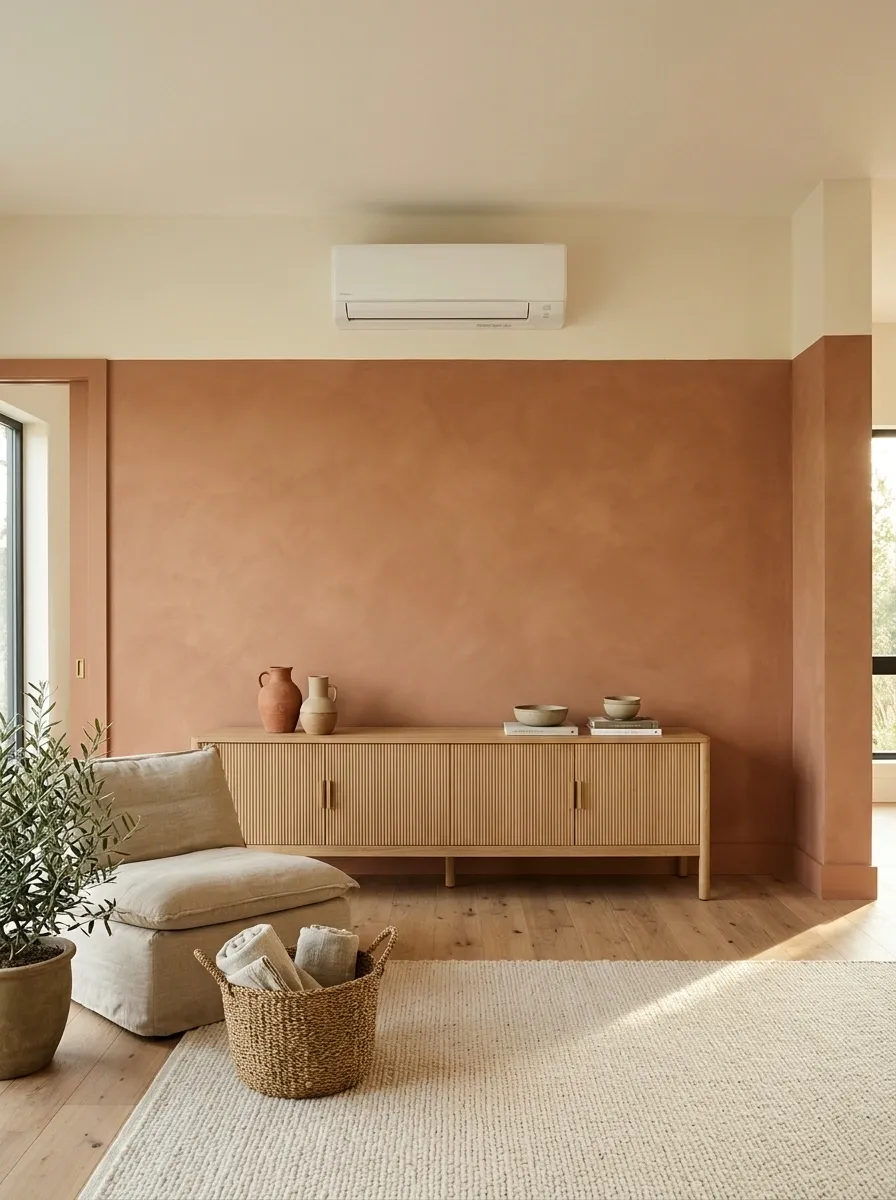
A broad lower color band can give the room personality while leaving the upper wall quiet around a high-mounted unit. Choose the band height in relation to furniture and architecture, not simply the underside of the machine.
Carry it to natural stops such as corners or door frames. This makes the treatment belong to the wall.
Keep the band clear of any required operating area and leave the unit untouched. A warm clay or muted green below a pale upper wall can create a complete room composition without building anything around the appliance.
Useful relationship: The lower color relates to the furniture; the quiet upper wall accommodates the equipment.
Make the Whole Wall a Calm Accent Color
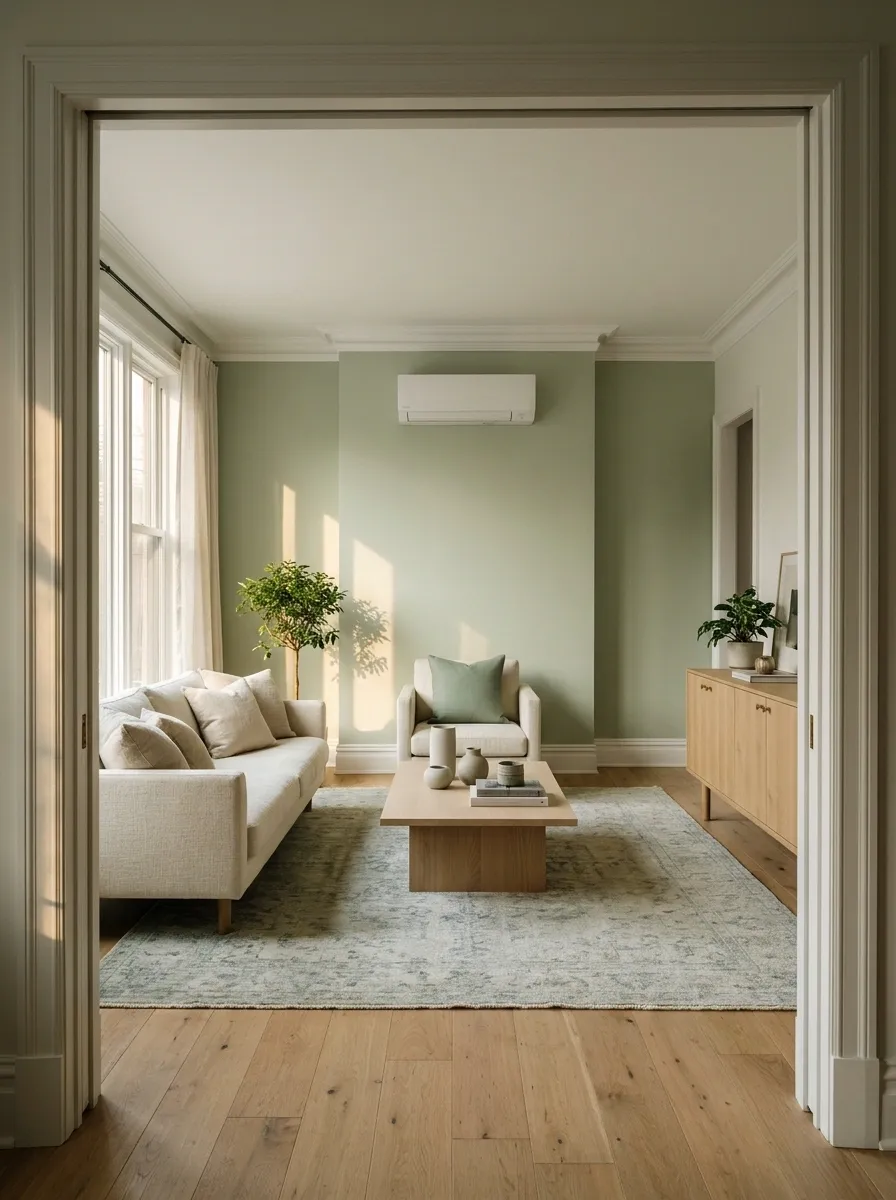
A pale green, soft blue-gray, or muted stone wall can absorb the unit into a broader scheme even when the casing remains white. Choose a color you want in the room, not merely one intended to camouflage equipment.
Look from the doorway.
Sometimes a gentle difference looks cleaner than an unsuccessful attempt at matching. You are judging a whole wall, not two sample chips touching on a desk.
Repeat the wall color once through a textile elsewhere so the choice feels connected. The room then reads as a planned palette, with an appliance present, rather than a decorating operation entirely dedicated to one white box.
Use Lower Wall Paneling as the Main Detail
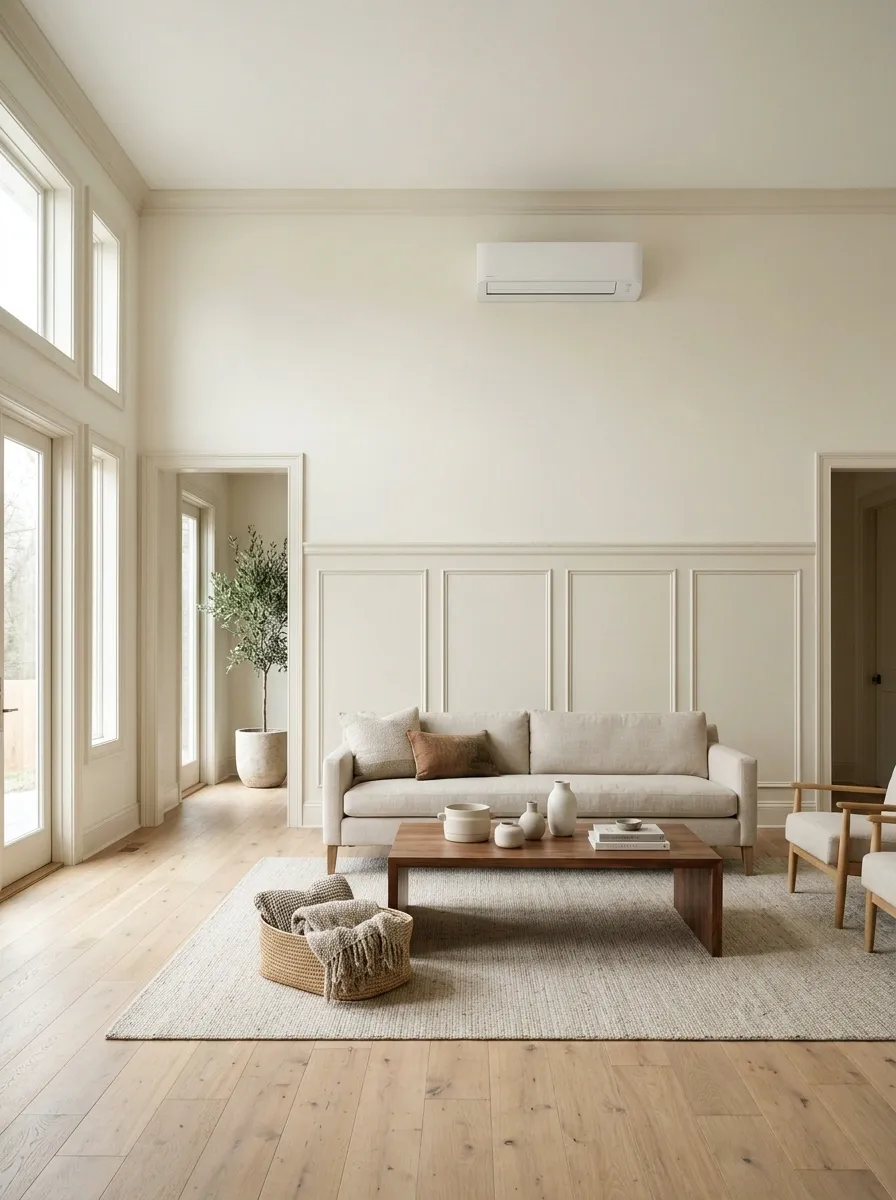
Appropriately planned lower paneling can draw attention toward the furniture zone while keeping the upper wall simple. Let the panel rhythm relate to doors and room proportions.
Check concealed services before any fixing and keep the treatment outside the unit’s operating and maintenance areas. Do not run decorative joinery tightly around the casing.
A restrained panel profile can add enough interest without introducing several patterns. It also gives the wall a permanent architectural role, rather than making the air conditioner the starting point for every measurement.
| Plan around | Keep independent |
|---|---|
| Door and wall proportions | Unit casing |
| Furniture height | Air intake and discharge |
| Existing service routes | Filter and service access |
Group Art on the Clear Side of the Wall
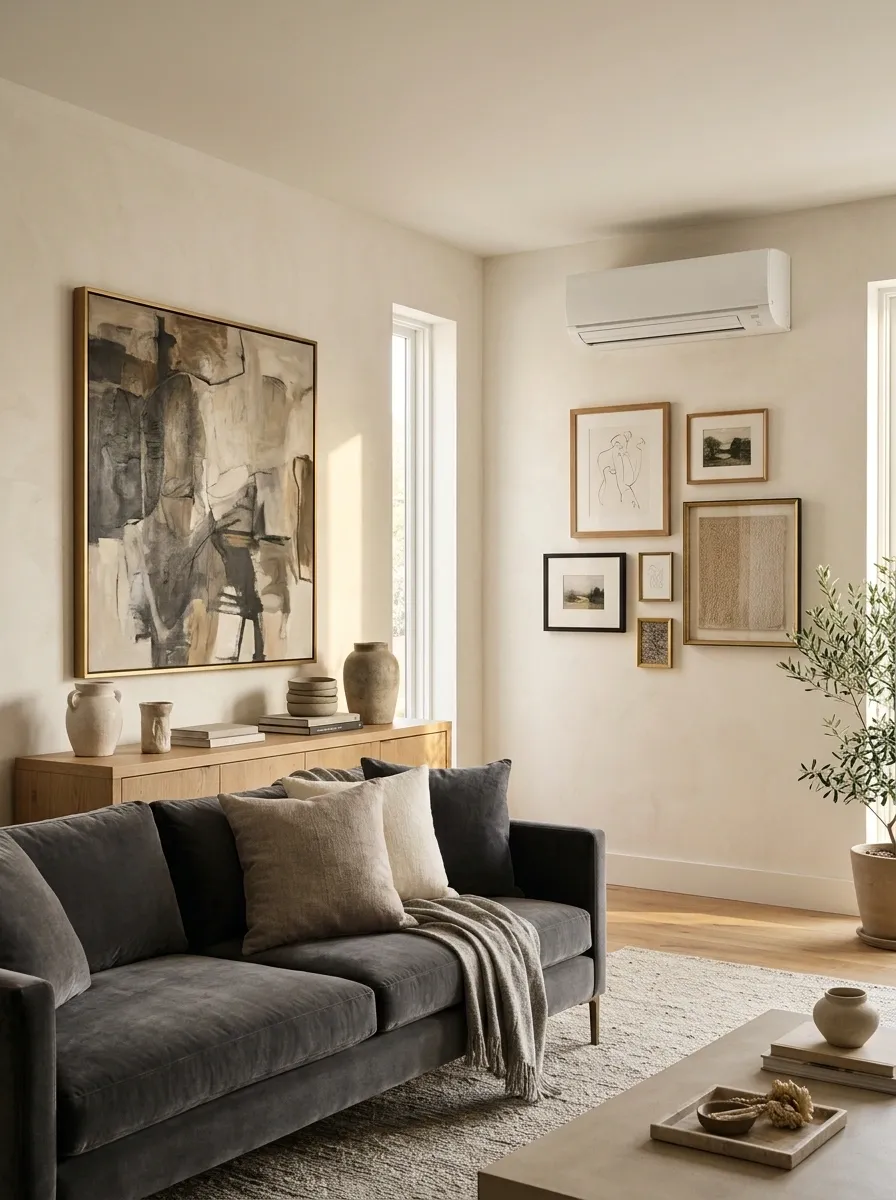
An asymmetrical arrangement can look intentional when the air conditioner sits toward one side. Put the main artwork on the clear portion and relate it to the furniture below.
Keep the artwork outside airflow, moisture risk, and required service space. Valuable or moisture-sensitive pieces belong elsewhere if the location is unsuitable.
Use a paper template to find the balance from the doorway. The art does not need to be centered on the full wall if the wall’s actual usable area is unequal. Symmetry is a tool, not a zoning authority.
Let the clear side hold the art
Operating and service area: follow the exact manual
Unit keeps its working space
Art aligns with furniture on the clear side Concept diagram, not a clearance drawing. Keep airflow, panel movement, filter removal, and service access unobstructed.
Use a Tall Mirror on a Separate Clear Section
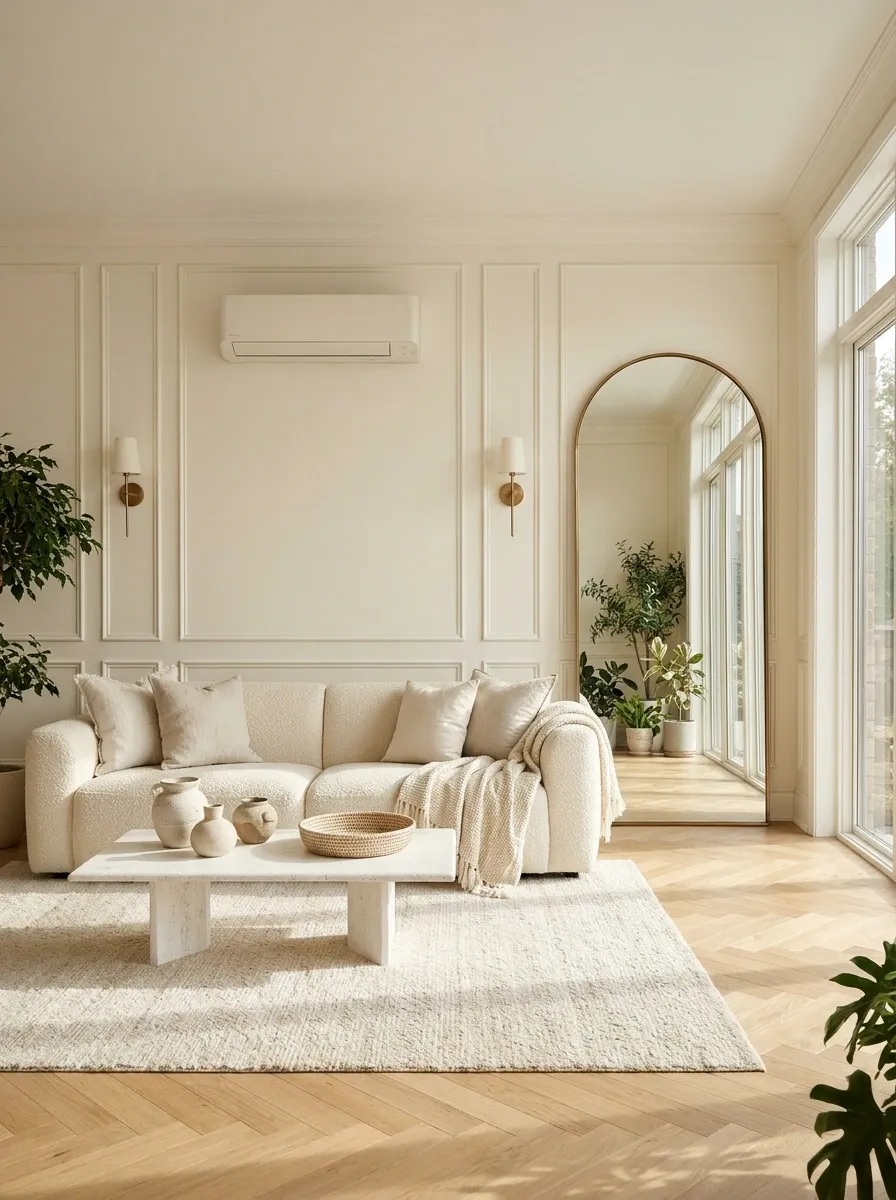
A tall mirror can give the wall another strong vertical element beside a high horizontal unit. Place it where the reflection is useful and the operating space stays clear.
Secure it appropriately and check concealed services before fixing. Avoid placing vulnerable backing materials in a position exposed to dripping or direct airflow.
Look at the reflected view from normal room positions. A mirror that mainly repeats the appliance has contributed additional air conditioner, which was probably not the brief. Reflect light, a pleasant corner, or a broader view instead.
Check the reflection first: The mirror’s position affects the room more than its decorative frame alone.
Let a Statement Sofa Carry the Color
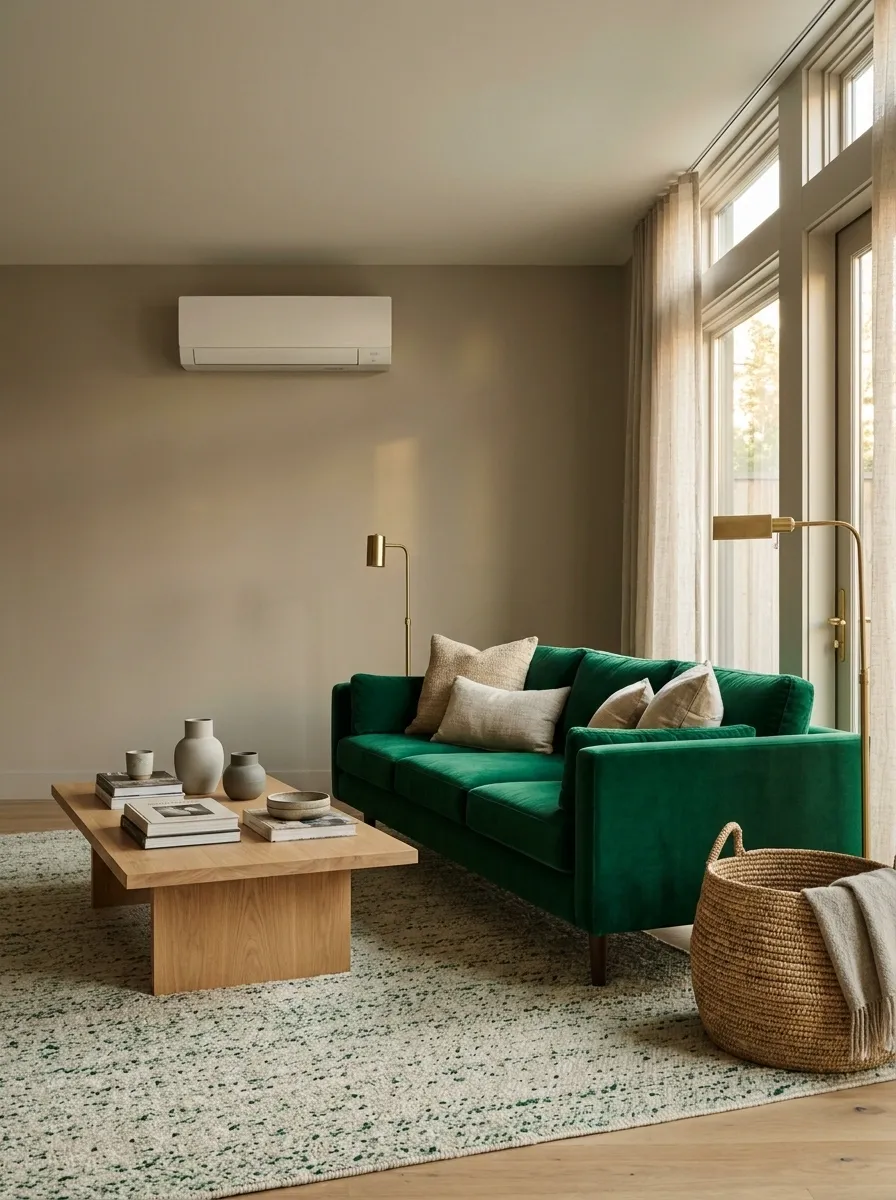
If the unit wall is awkward to decorate, give the room a more interesting center of attention through a colored sofa or chair on a suitable wall.
Choose a hue tied to the rug or artwork so the furniture feels integrated. Keep the equipment wall quieter and more restrained.
Check seating comfort relative to the discharge direction. A sofa may look excellent in plan while placing somebody in an uncomfortable stream of air. Arrange for actual use first, then enjoy the visual benefit of a clear furniture focal point.
| Main focus | Supporting wall |
|---|---|
| Colored seating | Quiet paint |
| Coherent rug | Clear operating space |
| Comfortable position | Accessible filters and controls |
Use Wallpaper Across a Properly Defined Wall Area
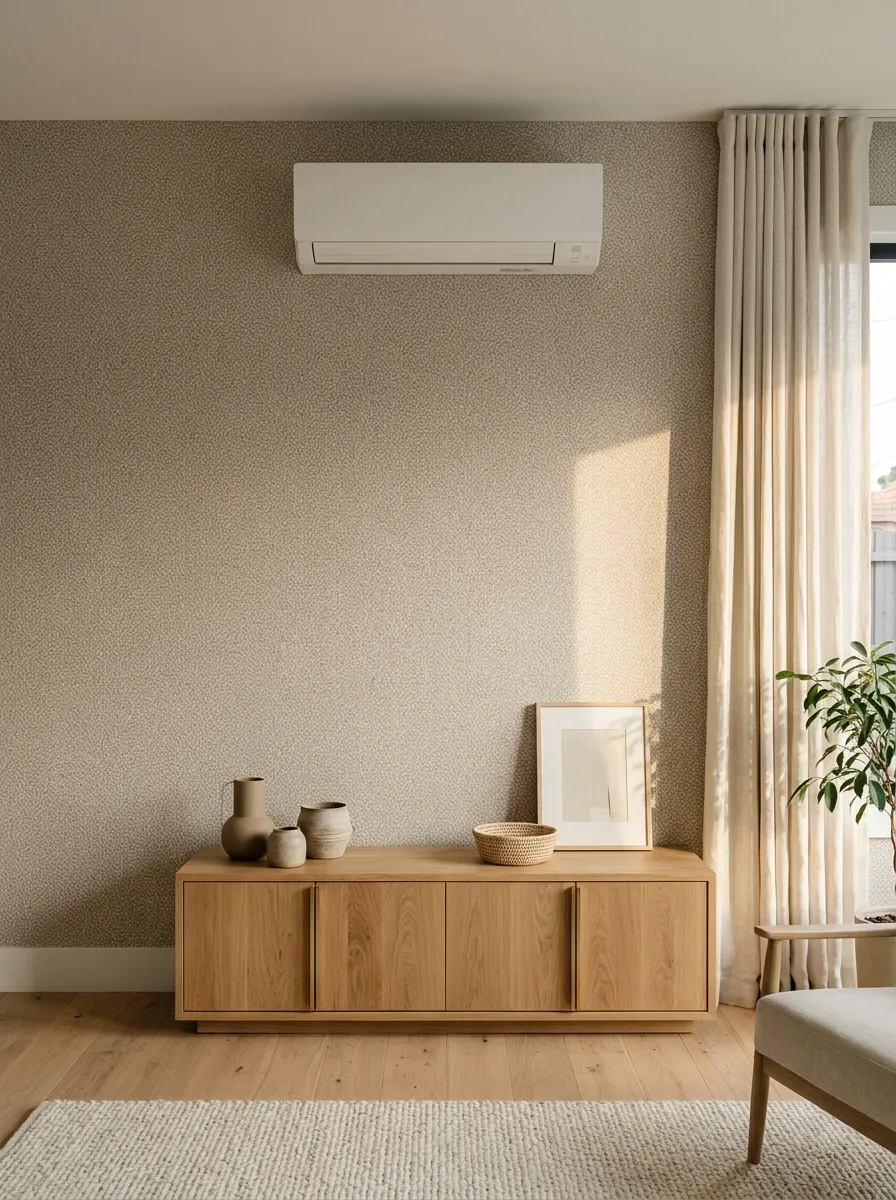
A restrained wallpaper can make the wall feel considered without pretending the appliance is invisible. Choose a pattern scale that looks good interrupted by doors, windows, and the unit.
Keep wallpaper and any decorative edging off the appliance and away from moving parts. Have work around the installed unit planned appropriately; do not loosen or relocate it yourself.
A small all-over texture can be easier to resolve than a large motif cut awkwardly by the casing. Inspect a full repeat before buying, because a tiny sample rarely reveals the interruption problem.
Let pattern belong to the wall
Operating and service area: follow the exact manual
Quiet repeated wall texture
Unit remains uncovered and fully serviceable Concept diagram, not a clearance drawing. Keep airflow, panel movement, filter removal, and service access unobstructed.
Place a Floor Lamp on the Clear Side
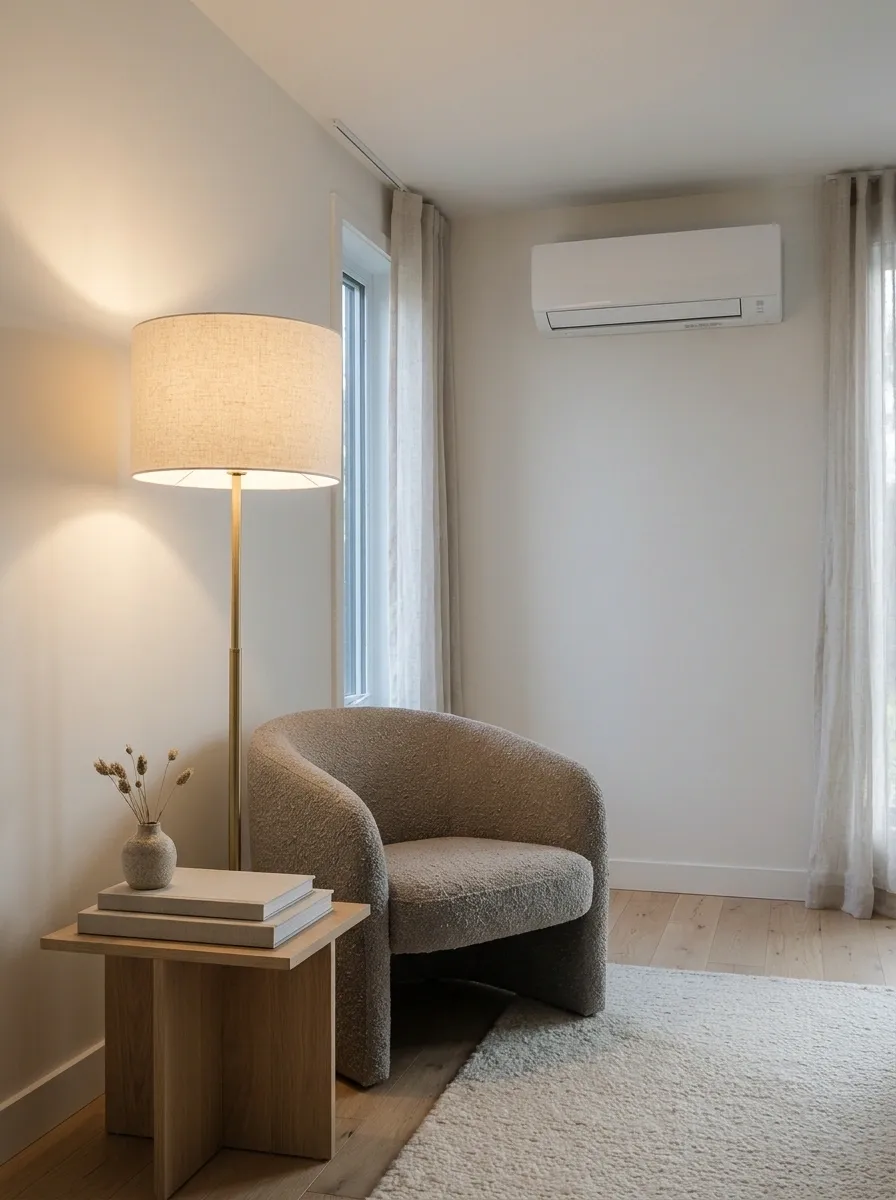
A floor lamp can add height and evening light to the opposite side of an unbalanced wall. Keep it and its cable outside the unit’s working area and the walking route.
Choose a shape with enough presence to register without trying to imitate the appliance’s size. A slender stem and substantial shade may be enough.
Use the lamp where the light is useful, such as beside a reading chair. A decorative counterweight that illuminates nothing is technically successful styling, but a fairly disappointing lamp.
Two checks: The light should serve a seat or activity, and the cable should have a safe, tidy route.
Add Texture on the Adjacent Wall
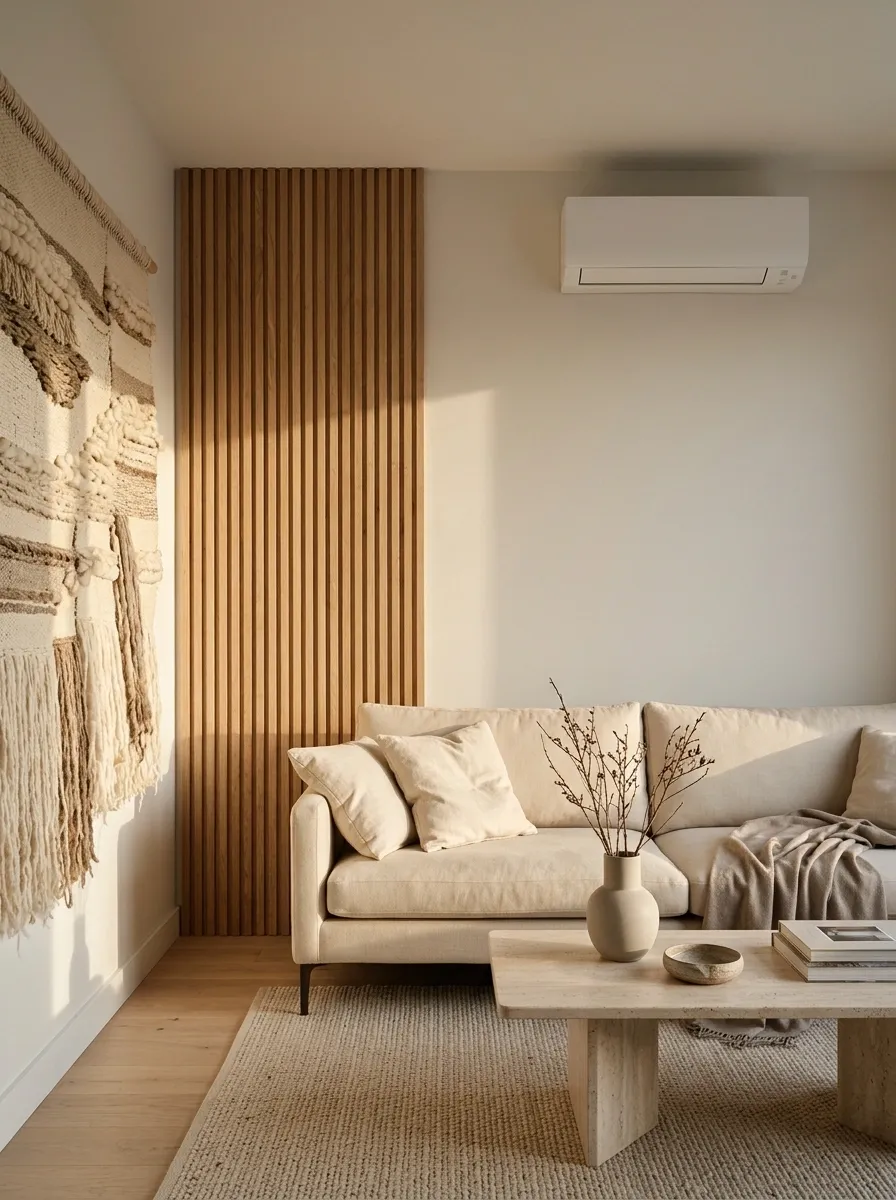
A timber detail, textile artwork, or textured wall finish on a different wall can give the room character while leaving the unit’s wall relatively plain.
Choose the material for its location and keep textiles away from direct discharge or damp risk. Plan any fixings around concealed services.
This is particularly helpful in a small room where decorating around the casing would feel crowded. The room can have a rich material palette without putting every attractive thing in the air conditioner’s immediate neighborhood. Adjacent walls are allowed to participate.
Keep Curtains Clear of a Window Unit
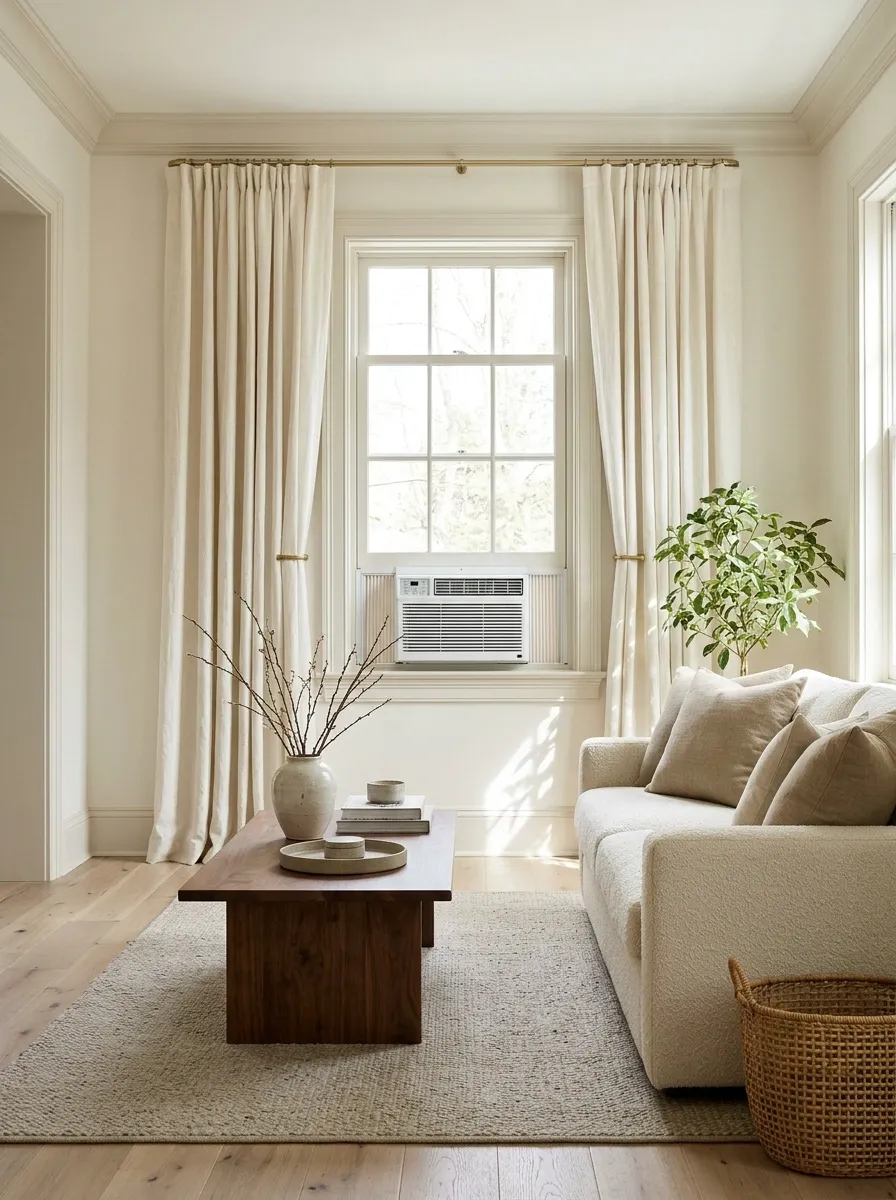
For a window air conditioner, use a window treatment that stays completely clear of the intake, discharge, controls, and required access. Check the exact unit instructions and the way the fabric moves when air is flowing.
Side panels may work only where they can remain safely outside the operating area. Tiebacks do not automatically make an unsuitable position acceptable.
Check the proposed treatment in use:
- Open and close it fully.
- Watch the fabric while the unit runs.
- Confirm that controls and service access remain usable.
If it cannot stay clear, choose an appropriate alternative. Fabric will not hover obediently beside a fan all day.
| Observe with the unit operating | What must stay clear |
|---|---|
| Fabric movement | Intake and discharge |
| Blind or curtain position | Controls and access |
| Full opening range | Unit and window operation |
Finish the Surrounding Window Trim Neatly
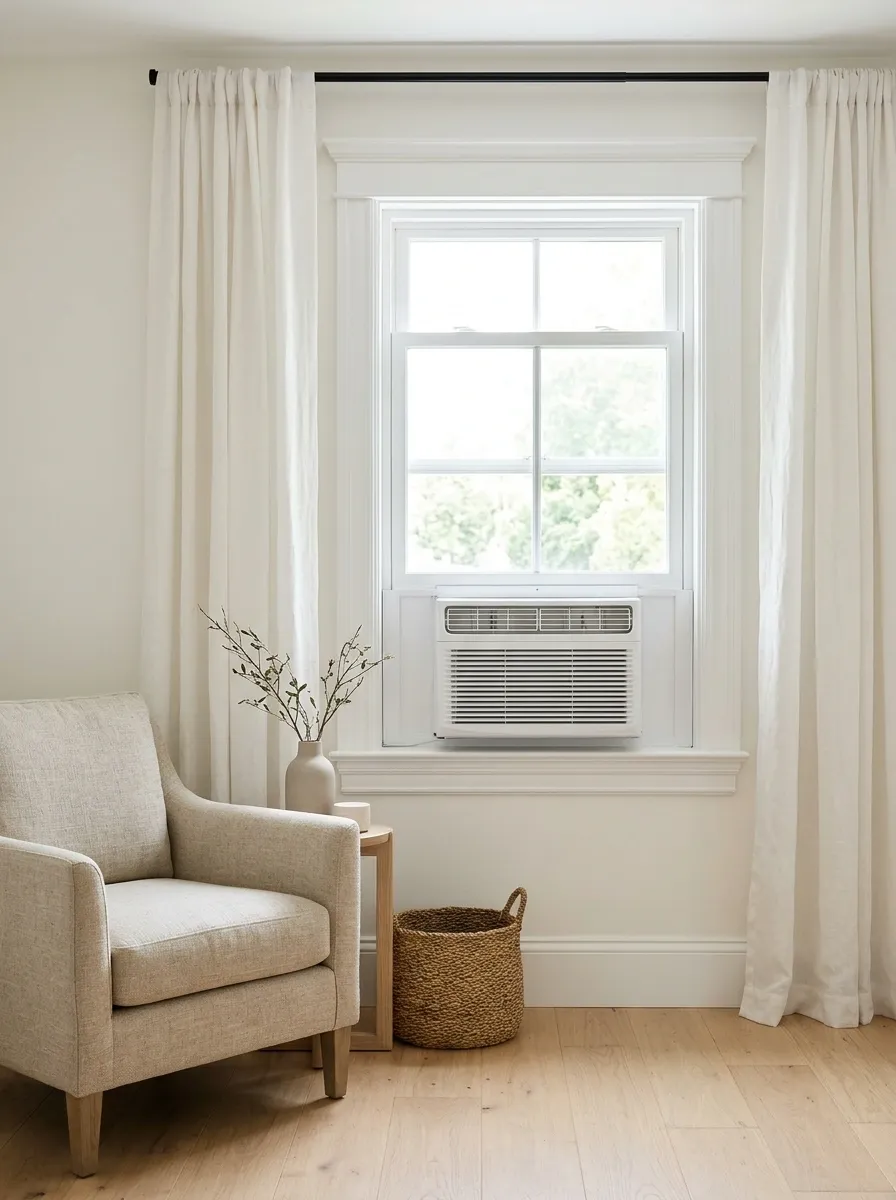
A window unit looks less temporary when the surrounding trim and approved installation panels are properly finished. Have gaps, support, weather sealing, and drainage assessed as installation matters rather than decorative improvisations.
Paint suitable surrounding trim if needed, leaving the unit, vents, labels, and intended openings untouched.
Keep the window treatment simple so the whole assembly reads clearly. The visual improvement comes from neat, correct edges, not from hiding the installation behind objects that make inspection harder or trap moisture where you can no longer see it.
Let a Through-Wall Unit Sit Within a Simple Wall Finish
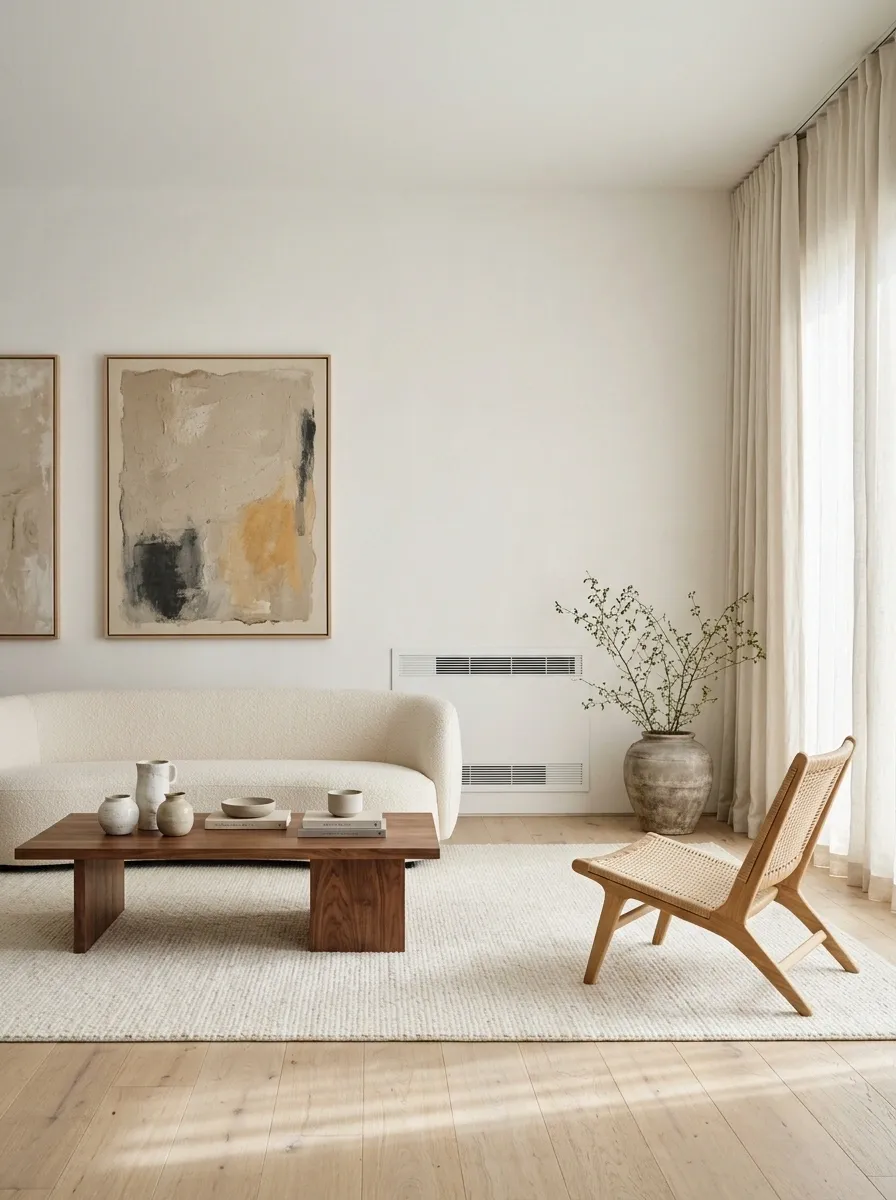
A through-wall air conditioner can look deliberate when the surrounding wall is plain and the manufacturer-approved sleeve or trim is installed correctly.
Do not add a decorative frame that reduces airflow or obstructs maintenance. Have unfinished edges resolved through the appropriate installation system.
Use other furniture and art to give the room its character. The unit’s section of wall can be quietly functional. Creating a heavy ornamental surround often makes the machine more prominent while introducing several new corners to collect dust, which is a generous gift nobody requested.
Ask the installer: Is the existing sleeve, trim, drainage, and service access complete for this model?
Put a Bookcase on a Different Clear Wall
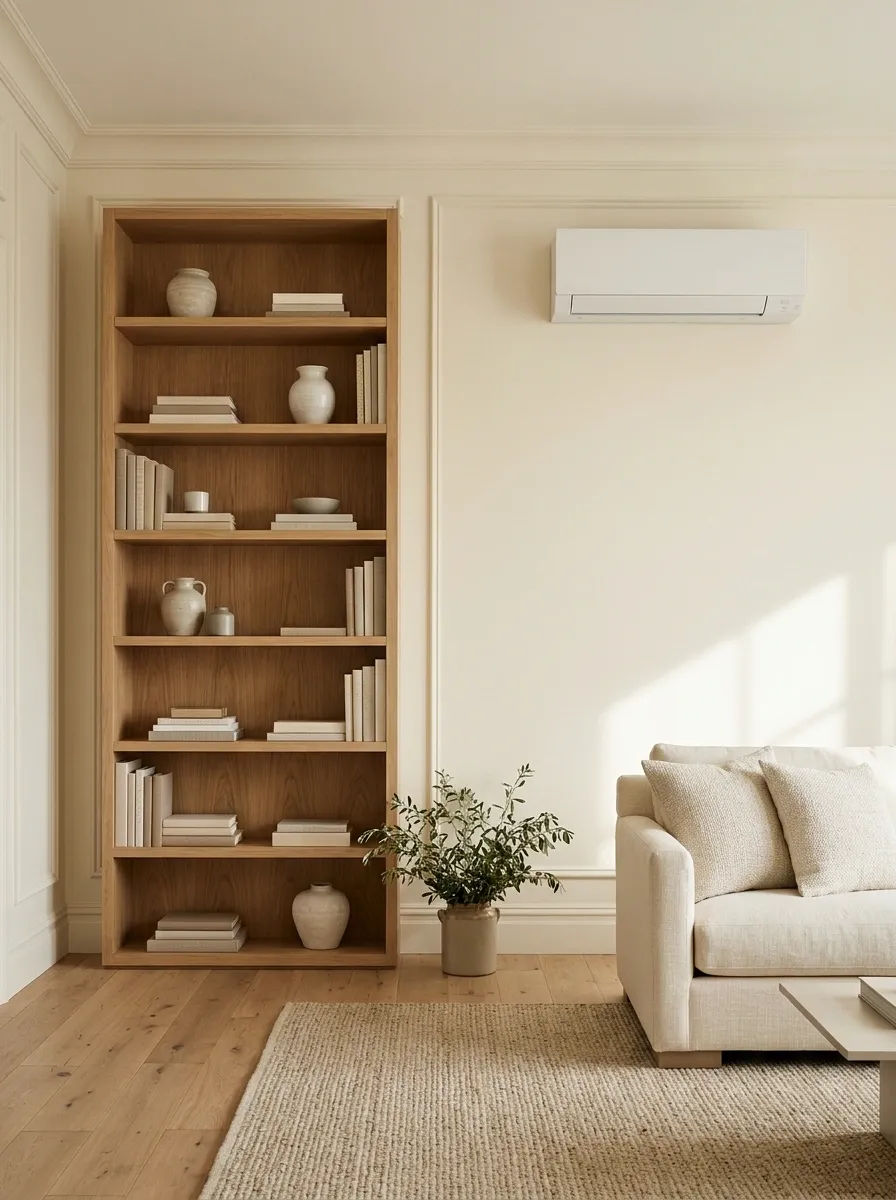
A bookcase can add height, storage, and personal detail without crowding the appliance. Position it on a suitable wall beyond the operating and service area.
Secure tall furniture appropriately, checking concealed routes first. Keep the shelves visually organized. Books, a few useful containers, and some empty space will usually give the wall enough interest without overcrowding it.
Avoid filling the gap beside a unit simply because a narrow bookcase happens to fit. Appliance clearance is not leftover storage territory. A better location can improve both the room’s proportions and the machine’s ability to do its actual job.
| Choose the position for | Do not choose it only for |
|---|---|
| Usable storage | A conveniently narrow gap |
| Safe anchoring | Perfect visual symmetry |
| Clear circulation | Concealing the unit’s edge |
Choose One Large Artwork on an Adjacent Wall
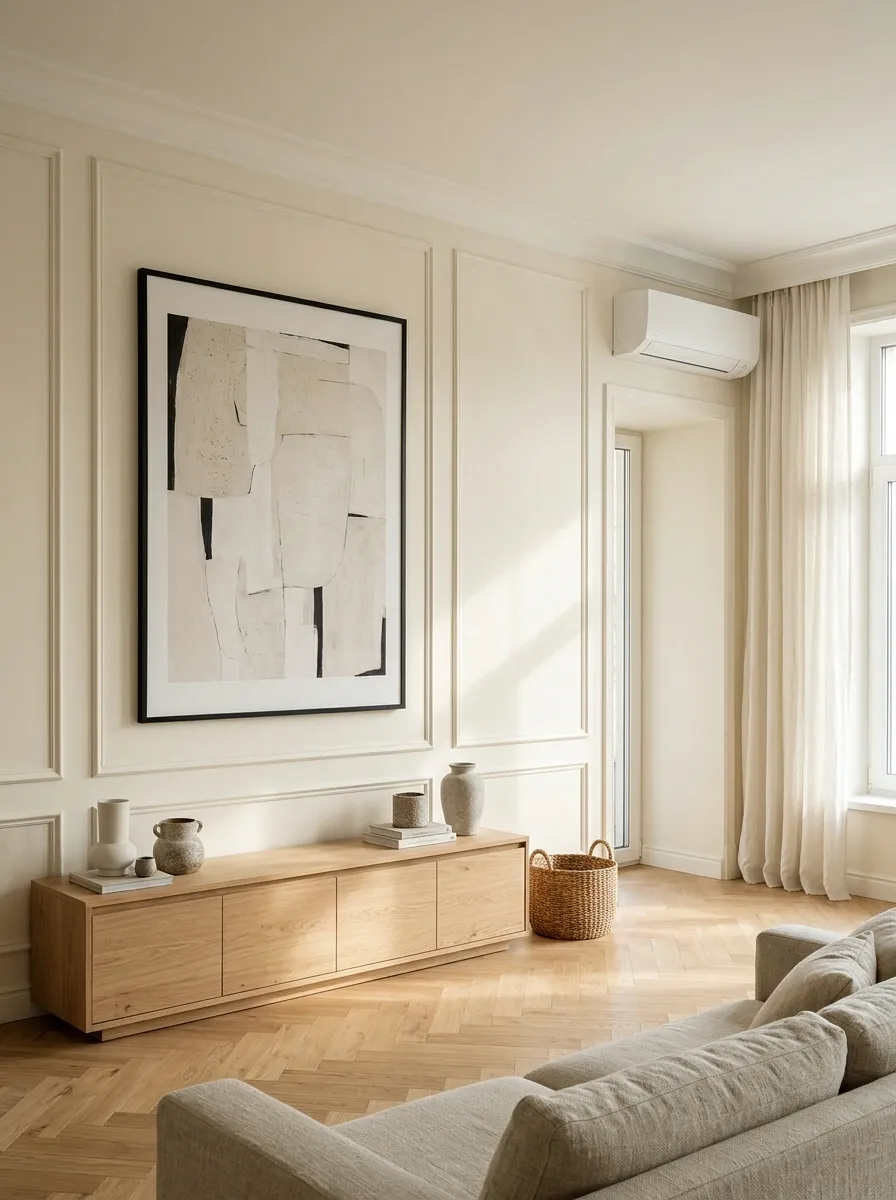
A substantial picture elsewhere can make the room feel more settled than a scatter of small pieces squeezed around the machine. Size it in relation to the furniture below and the available wall.
Use a position appropriate for the artwork’s material, away from direct discharge, moisture risk, and service routes.
The benefit is a clear hierarchy: one deliberate visual destination, with the appliance simply present. You do not need to decorate every fragment of wall left beside the casing. Some fragments have already secured permanent employment as blank space.
Keep a Plant Outside the Discharge Path
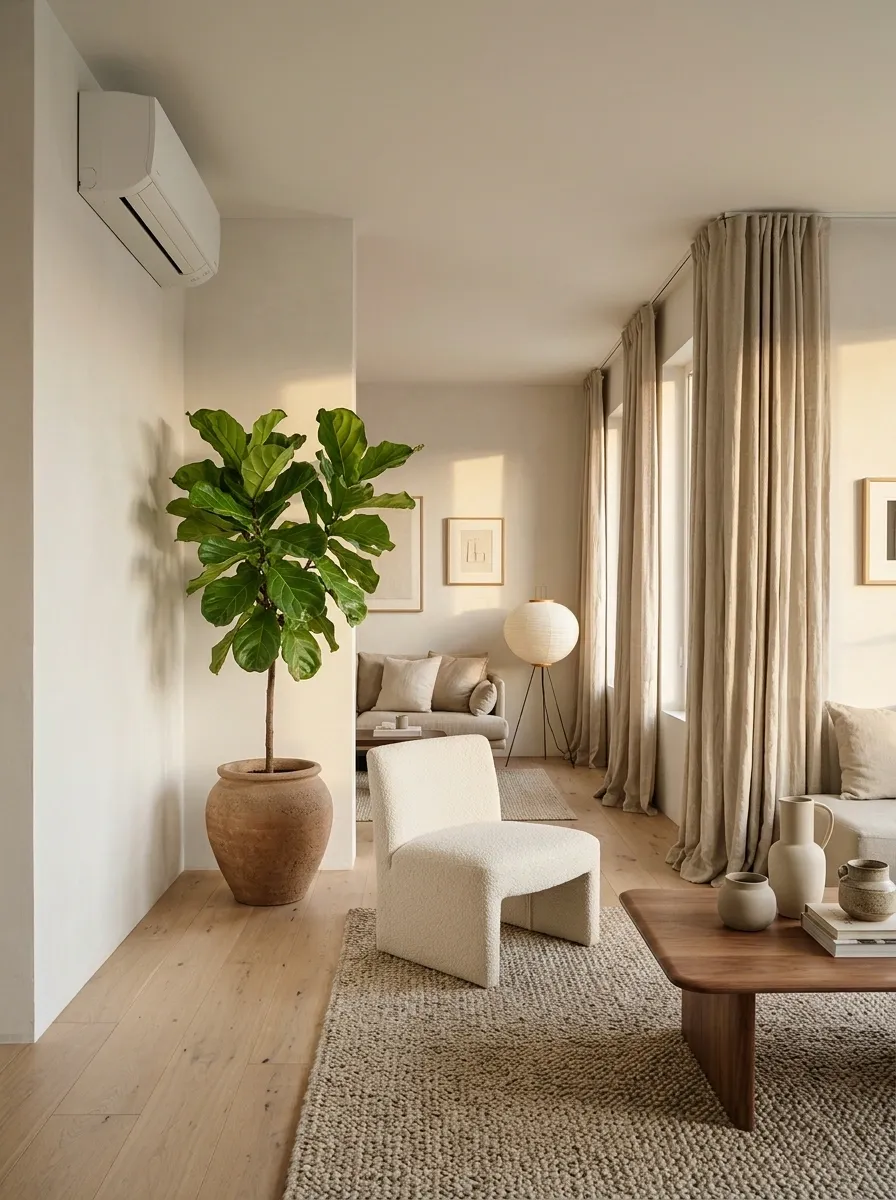
A plant can balance a room’s hard shapes when it has suitable light and sits outside direct air discharge and maintenance space. Choose its location for the plant’s needs rather than its ability to hide equipment.
Keep pots off the unit and away from electrical components. Water in a stable container with sensible spill protection.
A separate corner may provide a better position than the wall itself. The greenery still helps the room feel softer without becoming a living curtain expected to tolerate repeated blasts of conditioned air.
| Plant needs | Room needs |
|---|---|
| Suitable light | Clear service access |
| Appropriate temperature | No blocked airflow |
| Stable watering setup | Electrical components kept dry |
Resolve Visible Cable or Pipe Ducting Through the Installer
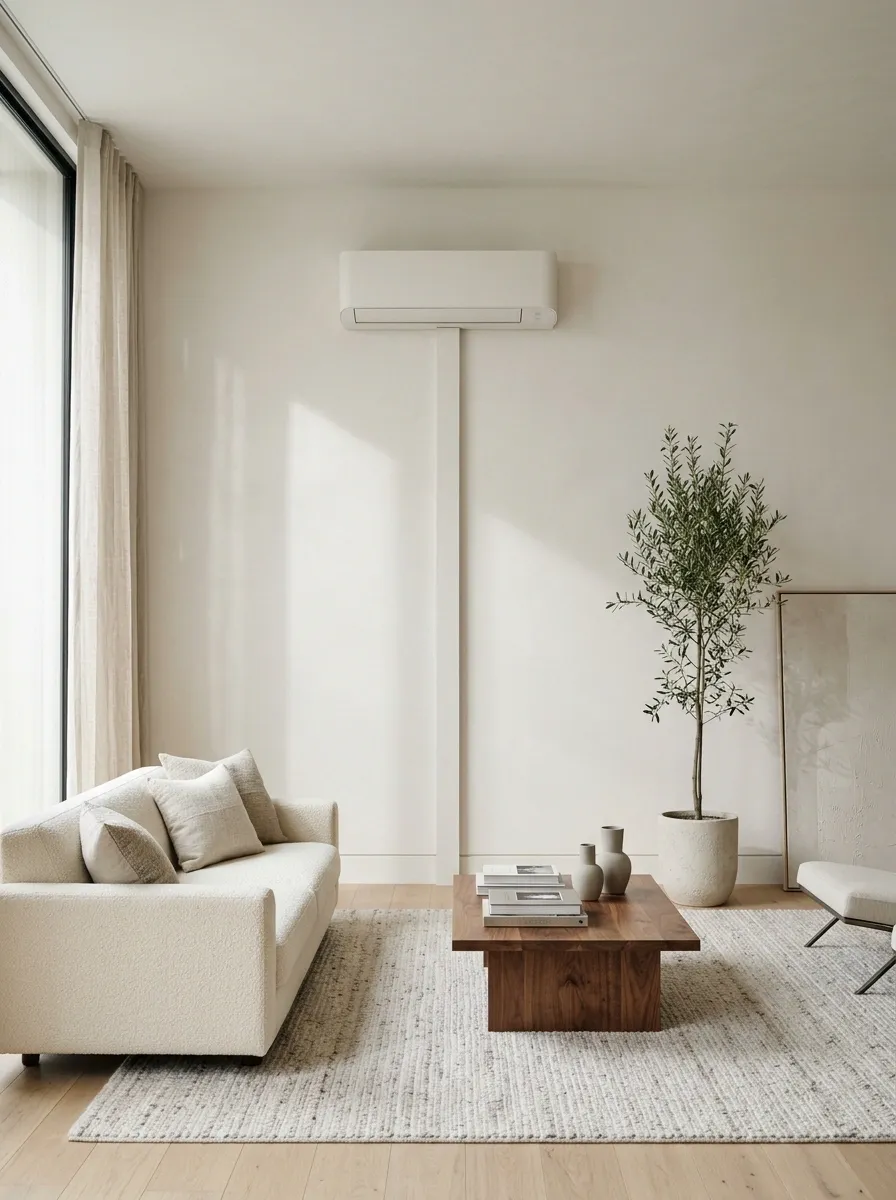
Untidy service covers can make the whole wall look unfinished. Ask the installer whether approved trunking, routing, or a suitable finish can neaten the visible run.
Do not open refrigerant lines, alter electrical routes, or cover drainage as a decorative DIY task. The correct solution depends on the installed system.
Once the service detailing is complete, keep its surroundings simple. A neat wall-colored cover can be less distracting than attempting to conceal a messy route behind artwork that prevents anyone from reaching it again.
Choose a Simple Window Treatment on the Other Wall
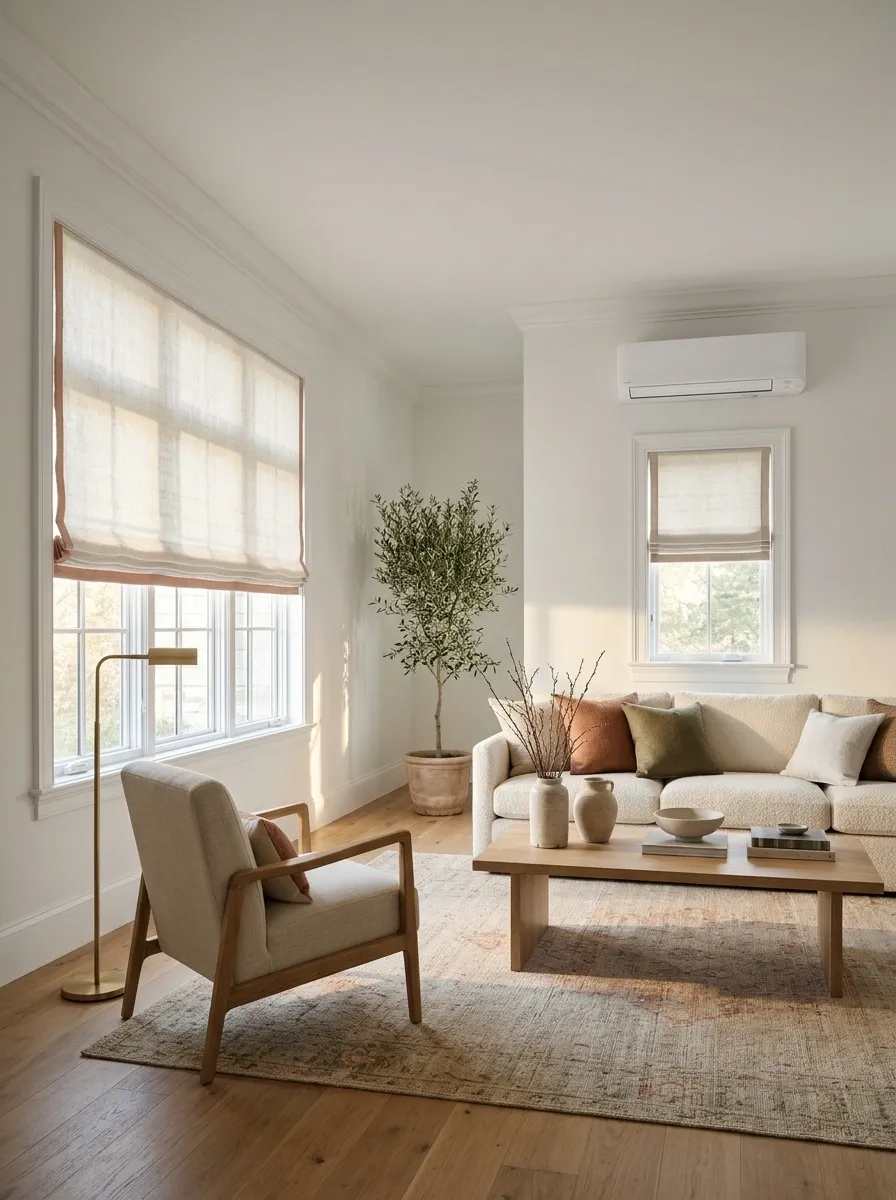
A well-fitted blind or curtain at a separate window can make the room feel finished without adding anything beside the unit. Choose the treatment for privacy, daylight, and the room’s style.
Keep it outside the air conditioner’s operating area and check how fabric behaves in the actual airflow. A separate window is not automatically outside the discharge path.
Repeat a color already in the rug or seating. The resulting connection can be enough to make the room feel coherent, especially when the appliance wall is intentionally plain.
Check while running: Airflow can move lightweight fabric farther than its still photograph suggests.
Use a Large Headboard on a Suitable Bedroom Wall
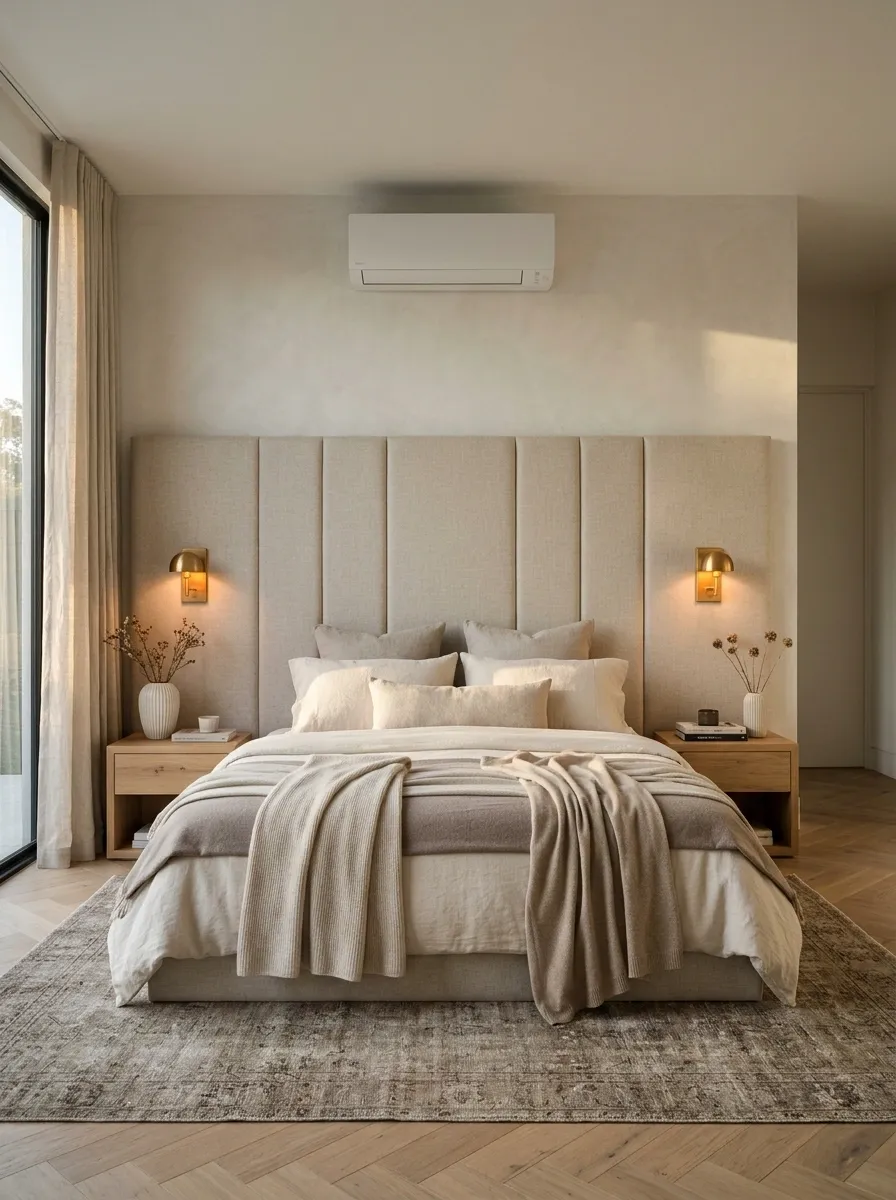
A substantial headboard can establish the bed as the bedroom’s main visual feature. Choose the bed position for comfortable sleep and appropriate airflow, then size the headboard to that arrangement.
Do not install a high upholstered surround that crowds a unit above it. If the only available wall creates operating or comfort problems, reconsider the layout with the installer or a qualified designer.
A different wall may give both the bed and appliance better conditions. Decorative balance improves when the major pieces have workable positions before anyone selects a fabric sample.
Let the Appliance Wall Stay Mostly Plain
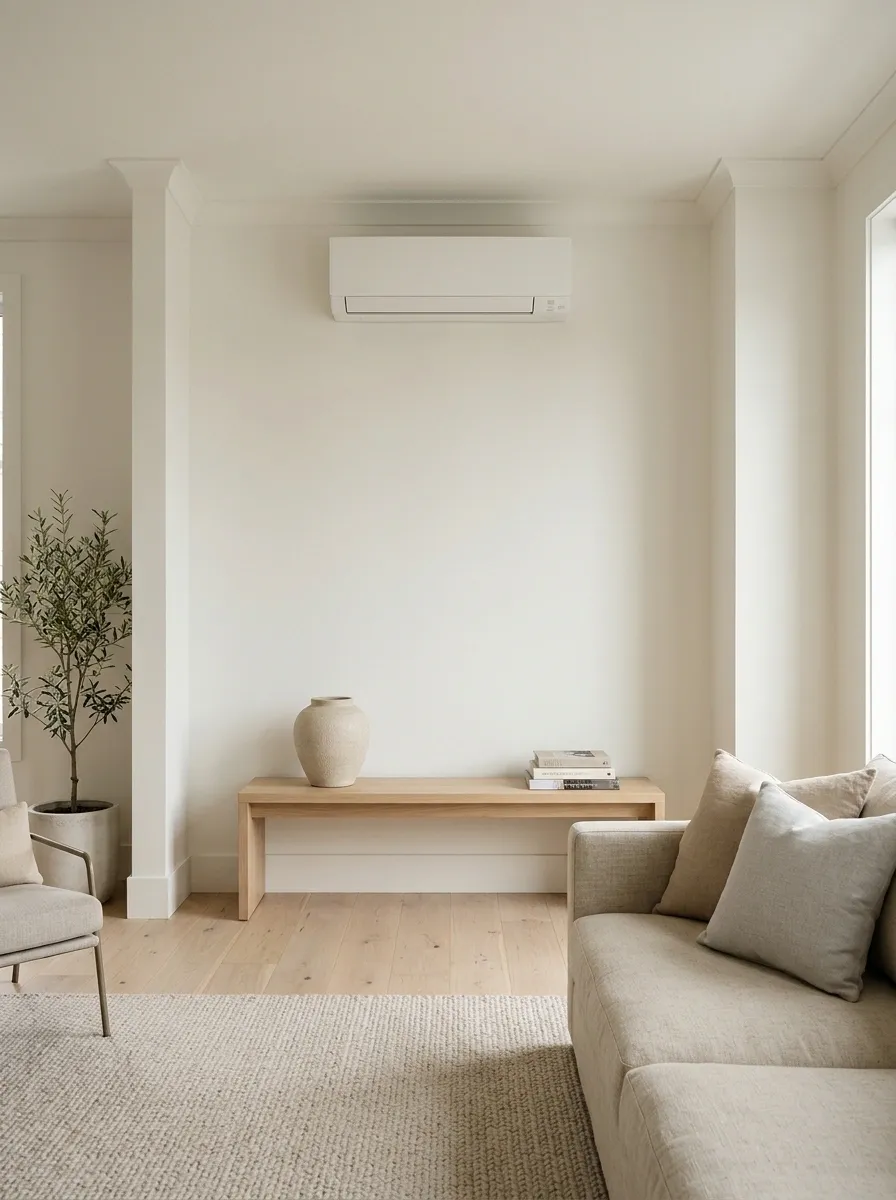
A properly finished, accessible wall can be the final answer. Put the room’s strongest decorative choices elsewhere and give the equipment its working space.
Keep surrounding surfaces clean and complete. The distinction between intentional simplicity and an unfinished wall often comes down to tidy edges, coherent paint, and a furniture arrangement that feels settled.
There is no need to disguise a useful appliance until it resembles a cabinet pretending not to contain an appliance. A comfortable room with a visible air conditioner is an entirely respectable outcome.
A finished wall can stay simple
Operating and service area: follow the exact manual
Plain coherent wall finish
Clear airflow, panel movement, and maintenance access Concept diagram, not a clearance drawing. Keep airflow, panel movement, filter removal, and service access unobstructed.
Turn the unit on before calling the arrangement finished. Walk around, operate the controls, check fabric movement, and confirm that routine cleaning remains straightforward. The room needs to work in motion, not just sit still for a photograph.