
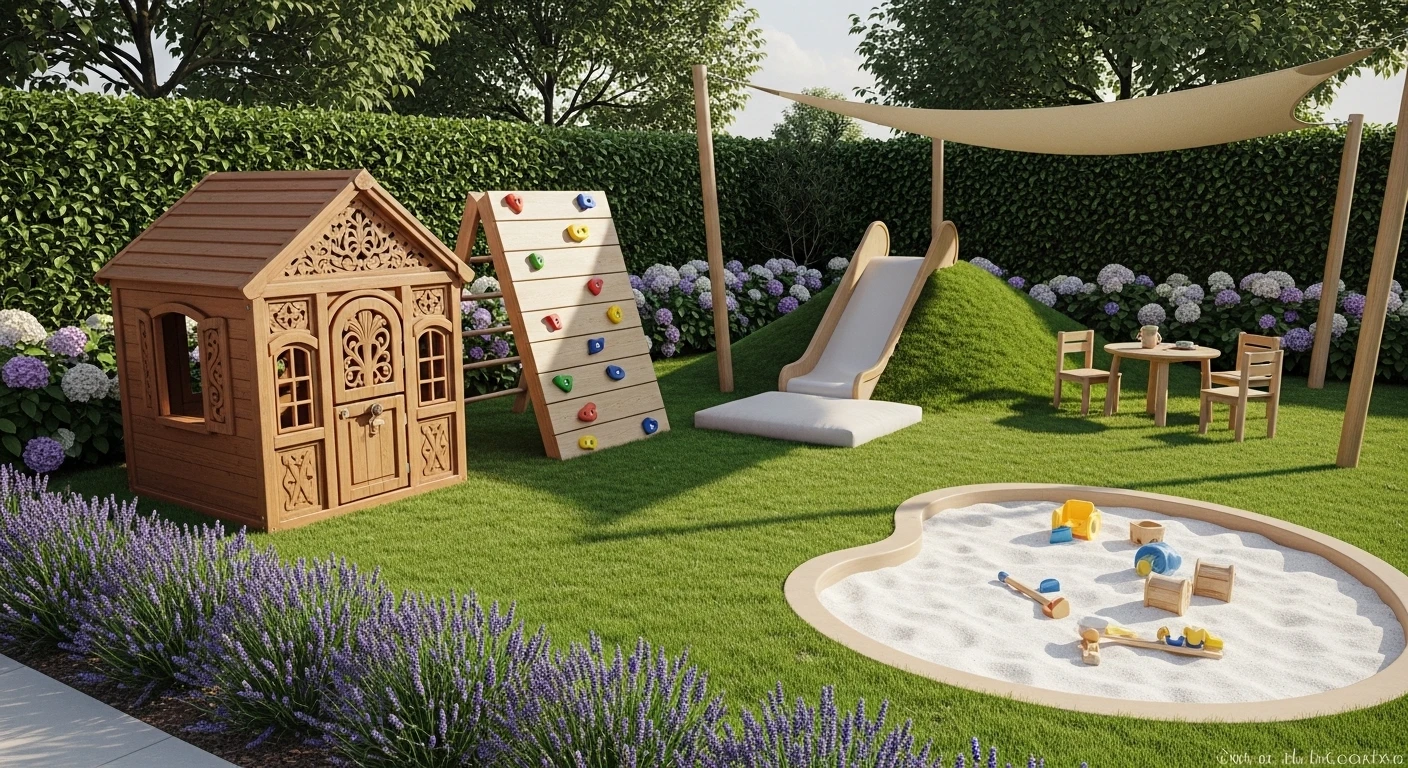
Somewhere between “the kids need fresh air” and “I am not spending another Saturday at a public playground that smells like sunscreen and regret,” lies the backyard play area — one of the most ambitious home projects a parent can attempt and, statistically, one of the most likely to end in a pile of plastic that looked better in the product photos. The gap between a backyard that genuinely works for small children and one that’s just a collection of primary-colored objects slowly sinking into the lawn is not about budget. It’s about intention, and most backyards for toddlers have none.
Kids don’t need more stuff. They need environments that invite exploration, absorb the inevitable chaos, and — this part matters more than any parent wants to admit — look like a considered design decision rather than a garage sale that got rained on. A well-designed toddler play area does all of that while also keeping small humans occupied long enough for you to finish a hot cup of coffee, which is honestly the real metric.
Whether your yard is the size of a postage stamp or a generous suburban rectangle, these six setups prove that backyard play spaces can be thoughtfully designed, genuinely beautiful, and still completely survive contact with a two-year-old who has opinions about everything.
Why Most Backyard Play Areas Fail Inside the First Year
The problems aren’t random. Every backyard that ends up looking like a neglected daycare commits the same handful of predictable sins.
No defined boundary means no defined space — A play area without clear edges bleeds into the rest of the yard and makes everything look messier than it actually is. A simple timber border, rubber edging, or even a change in ground surface tells the eye — and the child — where the play zone begins and ends, which is both a design win and a surprisingly effective behavioral one.
Ground surface is an afterthought — Bare grass under a swing set looks destroyed within three months. Concrete is a health and safety nightmare. The ground surface is doing the hardest physical work in the entire setup and deserves actual thought — whether that’s mulch, rubber, sand, or turf depends on your climate and your tolerance for tracking things inside, but “whatever was already there” is never the right answer.
Everything is the same height — Toddler play spaces that sit entirely at ground level miss the single most important thing about how small children play: they want to climb, peek from above, hide underneath, and experience the world at different elevations. Vertical interest isn’t just fun — it’s developmentally appropriate, and a flat setup communicates that nobody thought about it.
What Actually Makes a Toddler Play Space Worth Building
The best outdoor setups for young children share qualities that have nothing to do with how much equipment is in there.
Open-ended beats prescribed every time — A slide sends a child in one direction and that’s its entire creative offering. A sand pit, a mud kitchen, a pile of building blocks, or a construction zone with toy diggers invites a child to invent the activity, which means they stay interested significantly longer. Mix prescribed equipment with open-ended materials and your odds of reclaiming your afternoon go up considerably.
Natural materials age better than plastic — Timber structures, rubber mulch, and sand look better at year three than they did at install. Plastic equipment looks worse at year one than it did in the box. This is not a coincidence and it is not reversible with cleaning.
The adult experience matters too — A play area you can see from the kitchen window, that doesn’t require you to stand in it to supervise, that has somewhere comfortable to sit nearby — these are not luxuries, they are the difference between a space that gets used daily and one you eventually stop bothering with.
Toddler Outdoor Play Area Ideas That Refuse to Be Boring
The Mulch-Bordered Everything Zone
Completed play area for the kids- it was exhausting, but worth it!
by u/lagrange_james_d23dt in daddit
This is the setup that doesn’t pretend to be something it isn’t — a timber-framed rectangle of cedar mulch containing a swing set with slide, a small trampoline, a water table, and a plastic playhouse, arranged with enough breathing room between each element that the whole thing functions without children constantly colliding. The cedar mulch border is doing critical work here: it clearly defines the play zone against the surrounding lawn, provides adequate fall cushioning under every piece of equipment, and looks significantly better than the bare dirt situation that forms under most suburban play sets within a season. The mix of equipment types — climbing, bouncing, water play, imaginative play — means this single zone covers the full range of how toddlers want to spend outdoor time, which is how you build a space that remains relevant as children grow rather than one they’ve outgrown by age four. Styling note: the timber border edging is the detail that separates this from “toys on grass” — it’s a ten-dollar-per-linear-foot decision that makes the entire setup read as intentional rather than accumulated.
The A-Frame Forest Den
An A-frame timber den draped in living ivy and stocked with log cushions, a toy campfire, and a small wooden ladder is either the most enchanting thing a child can disappear into or proof that some parents have correctly identified that the best play environment is one that doesn’t look like a play environment at all. The climbing ivy integrated into the structure is the move that makes this feel genuinely magical rather than constructed — it blurs the line between built thing and grown thing in a way that fires imagination considerably harder than any branded playhouse. Inside, the faux log seats, scatter cushions in forest green, and wooden props create a scene rather than just a shelter, which is the distinction between a cubby that gets used for years and one that gets used for a weekend. The integration with the existing tree and shrub boundary makes this feel like it belongs to the garden rather than being placed in it. One honest caveat: ivy grows aggressively and needs managing, or this enchanting den becomes a structural problem faster than you’d expect.
The Black Rubber Mulch Play Set
The swing set and fort structure here are perfectly competent — a two-level timber tower with a green slide, a swing arm extension, and a small enclosed upper platform — but what makes this setup genuinely distinctive is the black rubber mulch ground covering, which is a choice that the majority of parents never consider and immediately wish they had once they see it in action. Black mulch makes every color in the play structure read at higher contrast and saturation, which is why this setup photographs dramatically better than the identical structure would on standard brown mulch or grass. More practically, rubber mulch doesn’t decompose, doesn’t attract insects, provides excellent impact absorption, and doesn’t track into the house on small shoes the way wood mulch does — which, if you’ve ever swept a mudroom after a post-rain play session, is the kind of detail that makes parents genuinely emotional with gratitude. The white picket fence boundary behind creates a clean backdrop that keeps the whole composition reading as a designed space rather than a yard with equipment in it.
The Recycled Tyre Construction Zone
Old car tyres filled with wooden building blocks, arranged around a gravel pit stocked with toy diggers and construction vehicles, is the kind of play setup that costs almost nothing and produces the kind of sustained, imaginative, physically engaged play that expensive branded equipment struggles to match — which is an uncomfortable fact for the toy industry and a useful one for parents working with any budget. The tyres serve multiple simultaneous functions: containment for the wooden blocks, seating for children at play, low climbing structures, and tactile sensory objects, all without requiring a single purchase beyond the gravel and whatever secondhand diggers you can source. The wooden blocks inside each tyre are the creative engine of the whole setup — loose parts play, where children build, knock down, load, unload, and invent rules, is among the most developmentally rich activities a toddler can engage in outdoors. The synthetic turf base keeps the area clean enough that parents are willing to let children play here unsupervised, which is the practical test that all outdoor play setups eventually face.
The Timber Fort with Sand Base
A well-built timber fort with an elevated lookout platform, a wraparound staircase, a rainbow-colored slide, and a swing arm — all set into a generously proportioned sand base framed by solid timber borders with integrated ground-level lights — is the kind of backyard installation that makes the neighbor’s kids ask if they can come over, which is the unofficial gold standard for outdoor play design. The sand base is the critical upgrade over mulch or rubber for this particular setup: it extends the play value of the structure by creating an open-ended sensory zone that changes character depending on what children bring to it, and it scales with age in a way that rubber mulch never does. The recessed lighting in the timber border is the detail that signals this was designed rather than assembled — those warm ground-level LEDs make the space feel intentional at dusk and extend the usable hours of the setup into early evenings without requiring floodlights that obliterate the atmosphere entirely. The surrounding lawn, kept clearly separate from the sand zone by the timber border, gives parents a clean place to sit at ground level without committing to sitting in sand.
The Pergola Classroom Garden
A timber pergola with climbing vines overhead, an exposed brick wall hosting a full-height chalkboard, synthetic turf underfoot, and a scatter of child-sized colorful tables, chairs, and open-ended building materials is the kind of outdoor play environment that treats children as people with intellectual interests rather than energy that needs redirecting — and children respond to that distinction with remarkable enthusiasm. The chalkboard wall is the anchor element that transforms this from a play area into a genuine creative environment: it’s large enough to draw entire cities, write in chalk, erase, and start again, which is a creative loop that toddlers and older children engage with equally. The pergola structure softens direct sunlight while keeping the space genuinely outdoor, and the climbing vine coverage over time will make this feel increasingly like a secret garden rather than a structured space — which is exactly the atmosphere that makes children choose to spend time here voluntarily rather than because they were sent outside. The mix of structured tables for craft activities and open floor space for building keeps this zone genuinely flexible across moods, weather, and ages.
Pastel Domes & Balance Beams—Modern Meets Playground
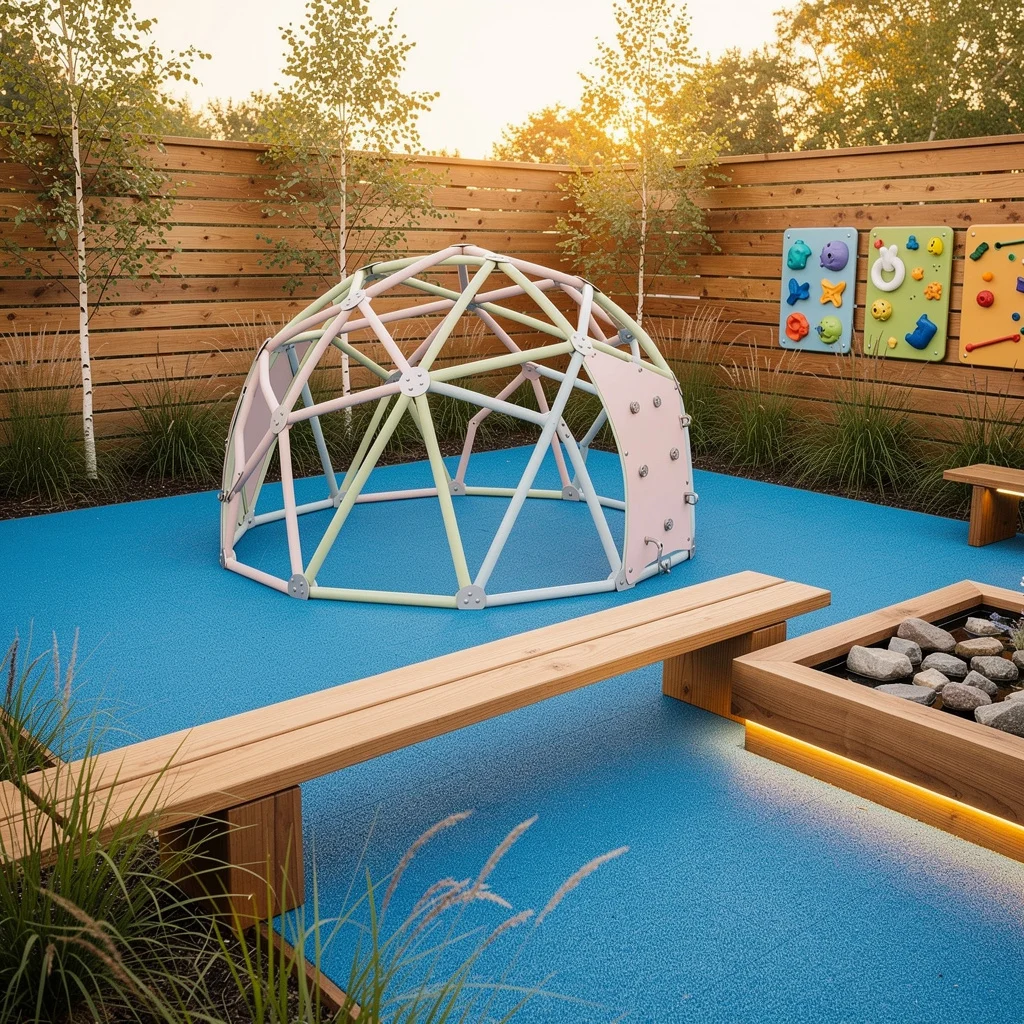
Stop the cheap plastic chaos and go for powder-coated steel climbing domes in the trendiest pastel colors you can snag. Lay bright blue poured rubber flooring—because scraped knees are so last decade. Toss sustainably harvested wood balance beams in there, but skip splinters with chamfered edges. Interactive tactile panels on cedar fencing are your secret weapon for actually engaging tiny hands. Throw in a river rock water play table for sensory bliss. Line the perimeter with tall grasses and dwarf birch to avoid the sad shrub look. Under-seat LED strips aren’t just flex, they’re a toddler-proof lighting hack. Here’s your move: keep everything low-profile so nobody’s doing Olympic dives off the dome.
Trampoline Jungle—Jump, Splash, and Chill
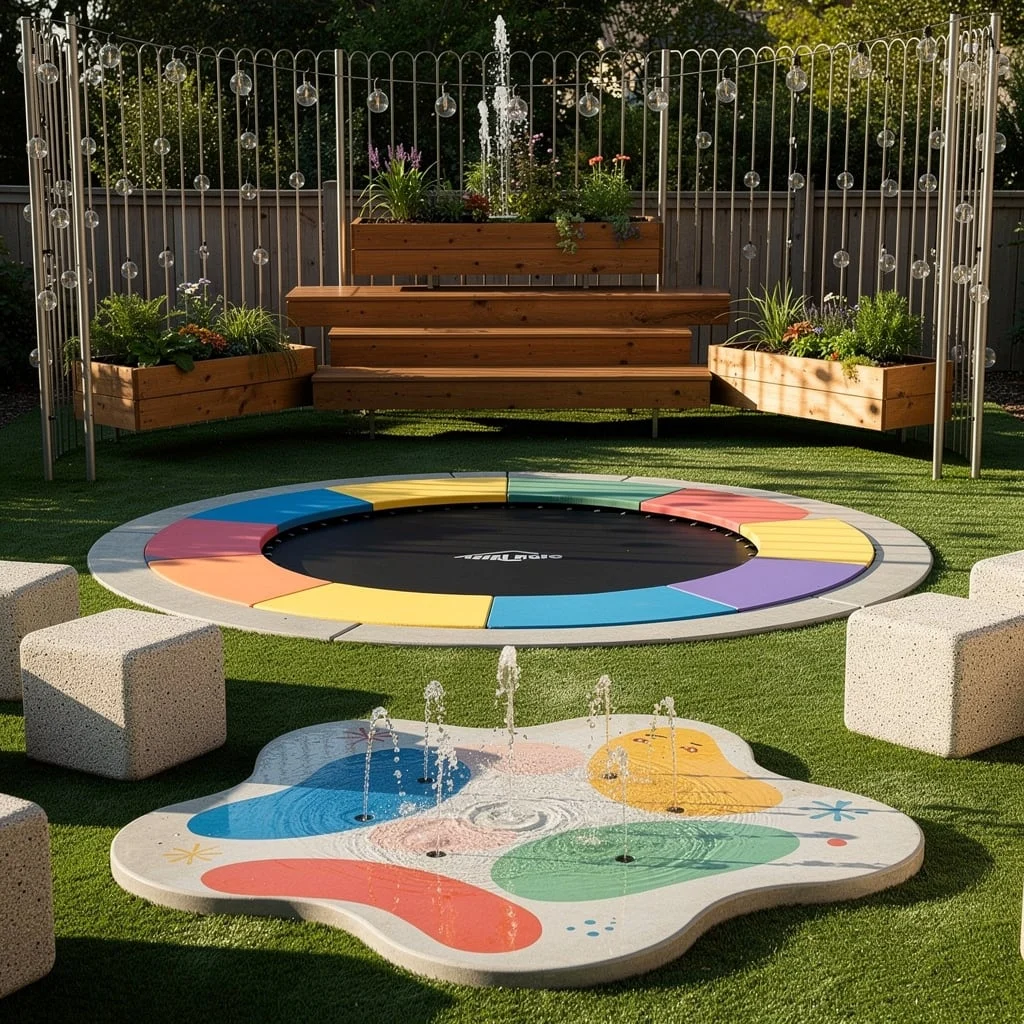
You want next-level play? Install an in-ground trampoline wrapped in vibrant pads—because flying children are better when close to earth. Replace sad grass with synthetic turf so you’re not mowing every weekend, and drop in a hand-painted splash pad with blastable water jets for maximum ‘wet hair, don’t care’. Tiered wooden platforms that float above ground are the move for flex seating and planters. String vertical steel wires with globe fairy lights for that instant party feel. And, yes, go wild with oversized foam blocks; they’re basically creative play on steroids. Do yourself a favor and keep afternoon shadows sharp; they’ll hide grass stains and make every color pop.
Tunnels & Mud: Let Tiny Humans Explore Like Wizards

Make your backyard a magical wild zone with curved willow tunnels tangled up in fragrant flowering vines on mulch—not dirt, mulch. Stepping logs from sanded teak say ‘nature, but make it safe’ and a sensory wall packed with spinning panels and abacus beads will keep wannabe mathematicians busy. Craft your mud kitchen in weathered pine for durability, not those sad plastic set-ups that crack in one summer. Frame everything with corten steel planters filled with sedum and ferns. Arching path lights make it a fairyland, but remember: keep lighting soft so it actually feels dreamy and not ‘haunted forest’ at sunrise.
Pergola Paradise—Hopscotch Wins & Wildflower Shade

Level up with a big pergola made from natural Accoya wood; it won’t rot, it just makes you look rich. Paint your hopscotch grid on eco-friendly rubber (yes, even toddlers can jump right). Embed child-sized spun aluminum drums at step height for that musical vibe—no need for plastic junk. Add a simple rope-and-plank bridge with rails for mini-adventurers. Plant hostas and wildflowers in the shaded garden below for legit kid-friendly botanics. Slatted fencing keeps things private, and globe solar lanterns are the ultimate finishing move. Always let late afternoon light show off the textures for big ‘I design for a living’ energy.
Zones Matter—Interactive, Modular, and Actually Fun

Partition your backyard into legit interactive play zones; pretend you’re designing for a VIP preschool. Install a curved wooden deck with a secure foam climbing structure—because modular is the cheat code for rearrangeability. Mold a faux-grass hill with a mini slide so kids get their speed on. Place a teak crafts table with rounded corners under a canvas canopy for shade and straight-up style. Illuminate each zone with recessed LEDs—not floodlights, thanks. Surround with vertical cedar screens, and border beds with purple alyssum and hydrangea for outdoor flex. Always layer your lighting—uplights, canopy covering, and soft daylight—so the whole space pops, no matter weather.
Mini-Mountains and Magic Lawns—Kid-Friendly Terrain FTW

Create a crescent-shaped playground lawn using soft play materials—your knees will thank you when you fall chasing tiny terrors. Construct a tumbling hill from firm foam blocks (marine vinyl is key, nothing soggy or sticky). Build out a mini-mountain play structure, with sculpted climbing holds and tunnels for the ultimate hide-and-seek. Use curved corten steel for section dividers; straight lines are out. Inset solar step lights at transitions for a low-glow luxury vibe. Never forget: groups of native perennials show you’re eco-conscious and stylish. Always schedule golden hour play dates—designer light makes everything look more expensive.
Final Thoughts
The outdoor play areas worth actually building share a quality that has nothing to do with the equipment catalog they came from: they feel like someone thought about what children actually do, rather than what adults imagine children should be doing. Open-ended materials, defined boundaries, varied surfaces, and at least one element that invites imagination rather than just directing it — those four things outperform any combination of branded plastic equipment, regardless of what it cost.
Your backyard doesn’t need to look like a commercial playground. It needs to look like a place where interesting things happen, where the ground doesn’t turn to mud in the first rain, and where a child can disappear into play long enough that you remember what silence sounds like. That’s an achievable brief. Pick one concept, execute it with decent materials and clear boundaries, and resist the urge to add just one more thing every time a new season brings new catalog arrivals. The restraint, as always, is the skill.