
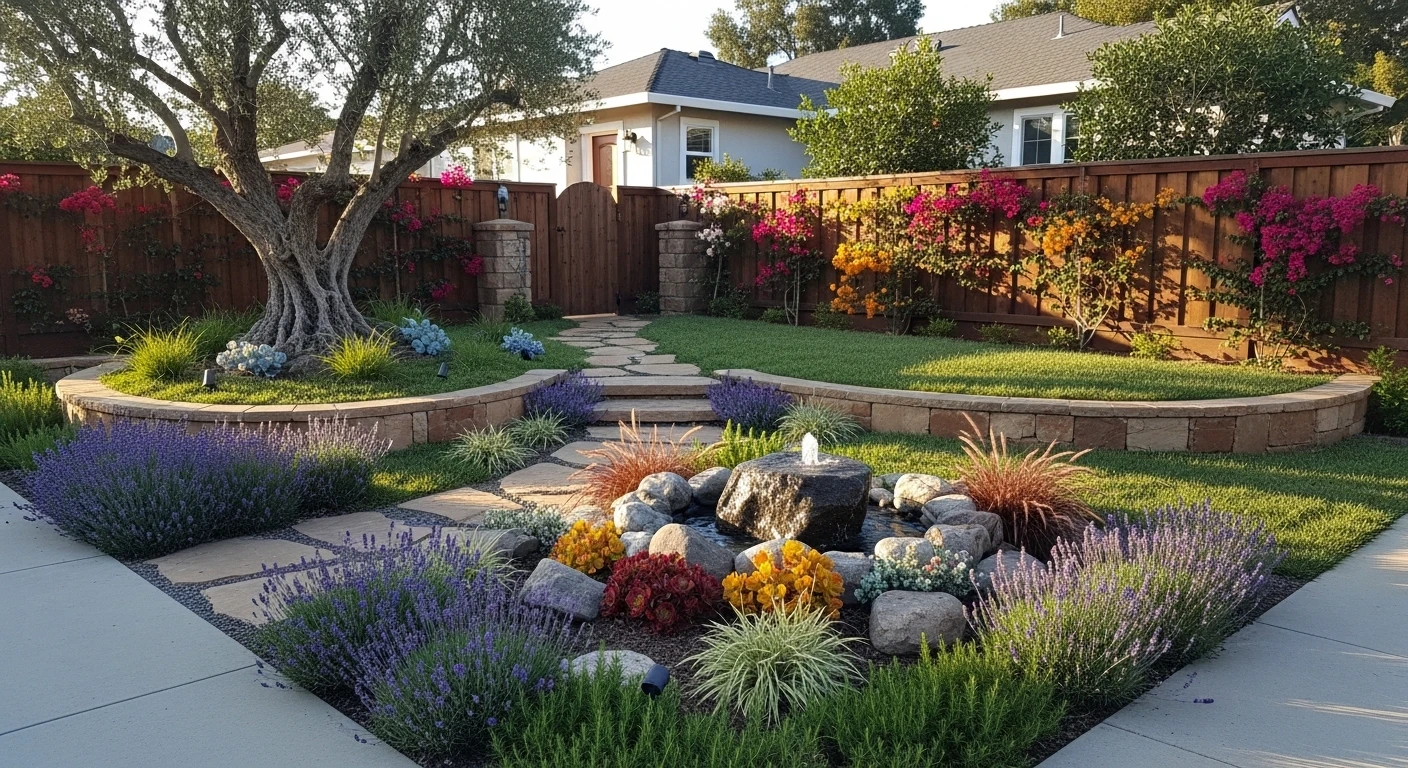
Corners are the most neglected square footage on any property. They’re too visible to ignore, too angular to treat like a regular bed, and too often used as a place to put the recycling or let the weeds settle in. Most people work around their corner rather than with it.
The ones who work with it end up with something that reads from two directions simultaneously — from the street and from the garden — and that level of exposure, once you lean into it, is actually the corner’s greatest advantage. A well-planted corner is the first thing people notice and the last thing they forget.
Every idea here takes a different approach to the same problem. Some are maximally simple. Some require real structural investment. All of them understand that a corner isn’t a limitation. It’s a stage.
The Two Things a Corner Planting Must Do
Every corner landscape that works does two things simultaneously: it anchors the property visually from the street, and it creates a resolved composition when viewed from inside the garden or approach. These are different requirements and the planting has to satisfy both.
Anchoring From the Street
From the road, a corner property has more public exposure than any other plot type. That’s a responsibility, not just an opportunity. The corner planting is part of the street scene. It will be seen by everyone who passes, constantly, in all seasons.
That means it needs to be interesting in winter as well as summer. Purely seasonal plantings that rely on annual bedding for their impact are fine for three months and embarrassing for the other nine. The best corner plantings have a permanent structural layer — evergreen trees, shaped hedging, architectural grasses, weathered stone — that holds through the year, with seasonal additions layered on top.
Creating a Resolved Composition from Inside
From inside the property — whether you’re looking out of a window, approaching along the driveway, or sitting in the garden — the corner is a visible terminus. The eye reaches it and stops there. If what it finds is interesting, the garden feels finished. If what it finds is disorder or emptiness, the garden feels incomplete.
The corner planting is the full stop at the end of the sentence. Every other element of the landscape points toward it, or at least acknowledges it. Give it the visual weight to carry that role.
Corner Yard Landscaping Ideas Worth Building
The Uplighted Conifer and Palm Courtyard Corner
In a compact walled or fenced courtyard corner, create a two-zone planting. The outer zone is a curved bed of brown leca pebbles or washed clay aggregate — warm, earthy, drought-tolerant — in a flowing kidney shape following the corner. Within this bed, plant Thuja occidentalis ‘Smaragd’ (Emerald Green Arborvitae) in a row of three at 80 to 90cm spacing, each tree sitting in a small white river rock ring approximately 30cm in diameter.
Install a low-voltage uplight beneath each conifer — warm white 2700K, spike-mounted in the rock ring — angled up through the foliage. The effect after dark is the whole point: the trees become three glowing columns that read powerfully from across the space.
Behind and above, allow a Washingtonia palm or Trachycarpus fortunei (hardy fan palm) to provide the upper canopy. Back the entire bed with white-rendered or white-painted walls to amplify reflected light. Lay large-format pale limestone or porcelain pavers as the surrounding hardscape. The combination of illuminated conifers, palm silhouette against white wall, and warm stone ground is genuinely exotic with almost zero maintenance once established.
The Gravel Seating Corner with Birch Standards and Container Grouping
Carve a generous curved area from the lawn at an inner garden corner — at least 2 metres across — and fill it with pale pea gravel or gold flint to a depth of 8 to 10cm on compacted sand over membrane. This becomes a gravel sitting area rather than a planting bed.
Position a solid wood bench — teak or hardwood, warm honey-stained — against the fence at one end of the curve. Group terracotta and seagrass pots of varying sizes in a loose cluster: a large Hosta in a generous terracotta pot as the foliage anchor, a Acer palmatum in a tall seagrass pot for height and autumn colour, and a trailing Lysmachia nummularia in a smaller terracotta pot to soften the grouping at the base.
Along the fence behind the bench, plant two or three young birch standards (Betula utilis var. jacquemontii) at 1.5 metre spacing and underplant the fence base with a low white-flowering border — Alyssum or Gypsophila as a continuous white ribbon. The white bark, white flowers, and pale gravel create a cohesive cool-toned composition that photographs beautifully year-round.
The Crape Myrtle and Hydrangea Courtyard Corner with Box Hedging
For a formal enclosed corner — particularly effective where white-rendered or pale stone walls meet — plant one multi-stem Lagerstroemia indica as the corner centrepiece. Choose a white-flowering variety such as ‘Natchez’ or ‘Biloxi’. The multi-stem form creates a loose vase-shaped canopy with extraordinary ornamental bark — smooth, peeling, cinnamon-coloured — visible through winter.
Beneath the Lagerstroemia, mass-plant Hydrangea macrophylla in the pink-and-white palette: ‘Mathilda Gutges’, ‘Pink Diamond’, or ‘Blushing Bride’. They form the full, lush mid-layer that fills the space between the ground and the canopy.
Contain the entire composition within a Buxus sempervirens low hedge edging — clipped to 40 to 50cm height, with crisp 90-degree corners. The box hedge creates a formal frame that makes the looser planting inside it look deliberate. Install a white-painted timber gate with decorative ironwork as the entry point if the corner adjoins a property boundary.
The Phoenix Palm on Layered Stone Island Corner
Create a raised island bed in the corner using a slightly elevated single-course stone or concrete block edging, approximately 15 to 20cm high. In the inner zone, lay a layer of dark grey or black river rocks 20 to 25cm deep — these create the dramatic dark base. At the absolute centre of the island, plant one Phoenix roebelenii (Pygmy Date Palm) or Trachycarpus wagnerianus for cooler climates.
Surrounding the dark rock inner zone, create an outer ring of white pea gravel. Flanking the palm on each side at approximately 60cm distance, plant one compact globe-shaped evergreen — Podocarpus macrophyllus, Osmanthus burkwoodii ball, or slow-growing Taxus baccata ball — clipped tightly to maintain the sphere form.
Extend the pale gravel ground out from the island bed as the surrounding hardscape. The geometric clarity of the composition — dark inner ring, pale outer ring, central palm, flanking spheres — creates a formal symmetry that reads powerfully from both street directions simultaneously.
The Prairie Corner Curb Bed with Layered Perennials
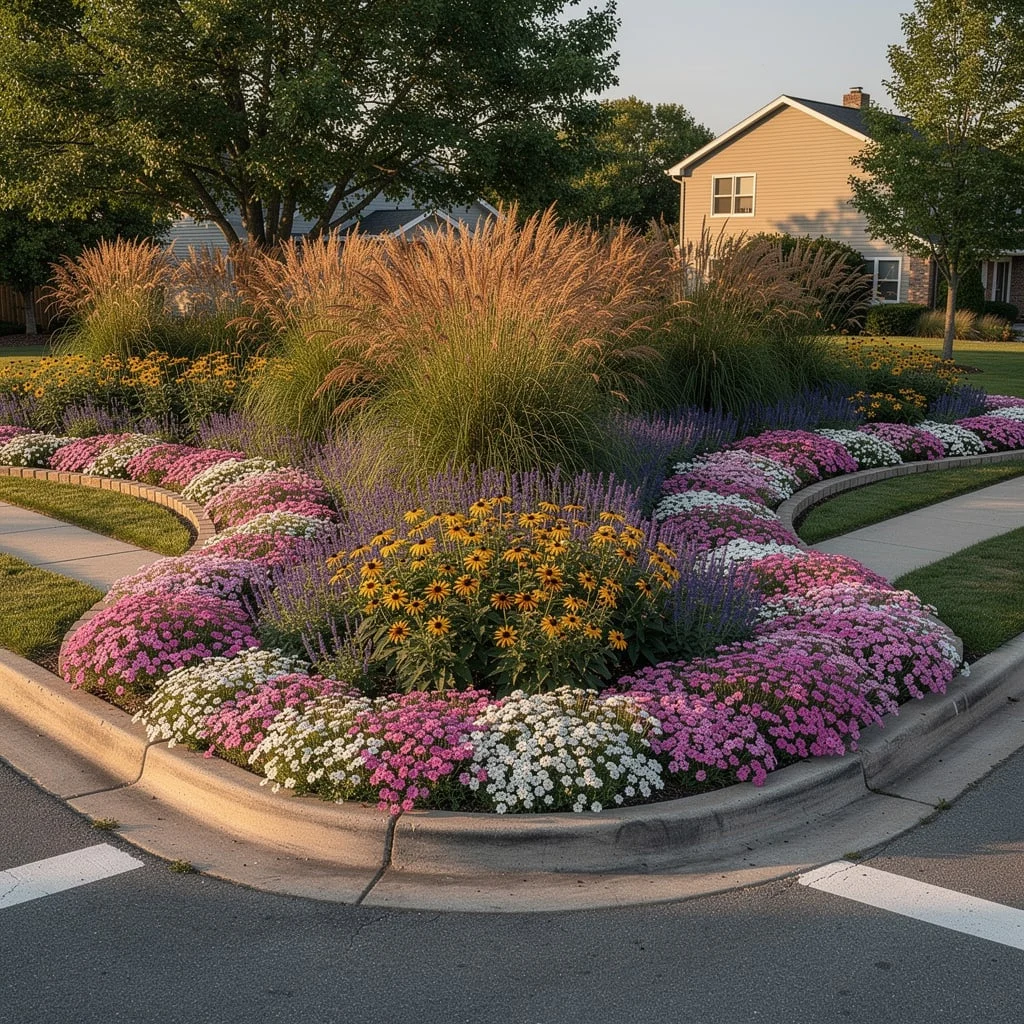
Edge the corner with a smooth concrete curb form — the sweeping poured-concrete edge creates a clean separation between the street and the planting without the visual weight of a raised wall. The interior of the corner bed should be large enough to accommodate at least three layers of planting.
Back layer: three or five Miscanthus sinensis ‘Gracillimus’ or ‘Flamingo’ at 1.2 metre spacing for a tall, feathery, autumn-golden backdrop. Mid layer: Rudbeckia fulgida ‘Goldsturm’ in a generous sweep — twenty to thirty plants — for consistent yellow-black daisy flowers from July to October, alongside Salvia nemorosa ‘Caradonna’ for the dark-stemmed purple spike.
Outer edge: pink and white Phlox subulata as a low-growing carpet that flowers in spring and provides dense evergreen groundcover through winter, mixed with Verbena bonariensis for airy pink dots that weave through the lower layer all summer.
The perennial border style works in corner curb beds because the naturalistic mixed planting looks as good from the road as it does from the garden. No bare soil visible. No obvious care required beyond one cut per year.
The Boulder and Dwarf Pine Corner with Heather Groundcover
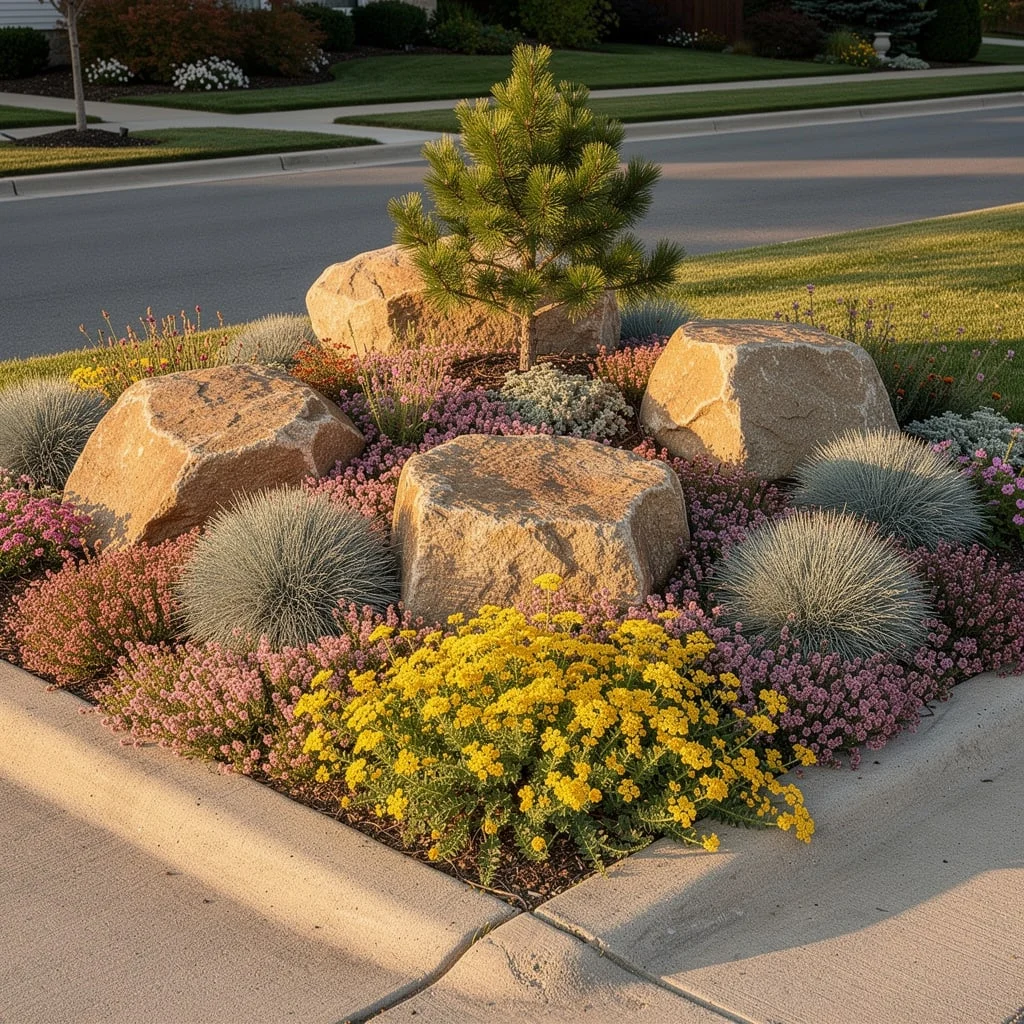
Source four to five large field-stone boulders in a warm sandstone or granite — genuinely weathered, partially buried at different depths so they emerge from the ground naturally. No two should be at the same height. Group three of the larger ones toward the inner corner apex and position one or two smaller ones at the outer edges of the bed.
Plant one Pinus mugo var. pumilio — dwarf mountain pine — at the centre of the boulder grouping. It will grow slowly to approximately 1.5 to 2 metres spread over a decade, always looking like a plant that belongs in a rocky landscape.
Fill the entire bed with a low-growing tapestry of Erica carnea and Calluna vulgaris (heathers) in mixed pink, rose, and white varieties, interspersed with Festuca glauca sphere clumps and drifts of yellow Achillea ‘Moonshine’ and silver Artemisia schmidtiana. The overall palette is silvery-pink-yellow — warm and naturalistic — and the boulders provide year-round structure when the heathers are between flushes. No mulch needed: the groundcover suppresses weeds entirely once established.
The Weeping Japanese Maple as a Solo Corner Statement
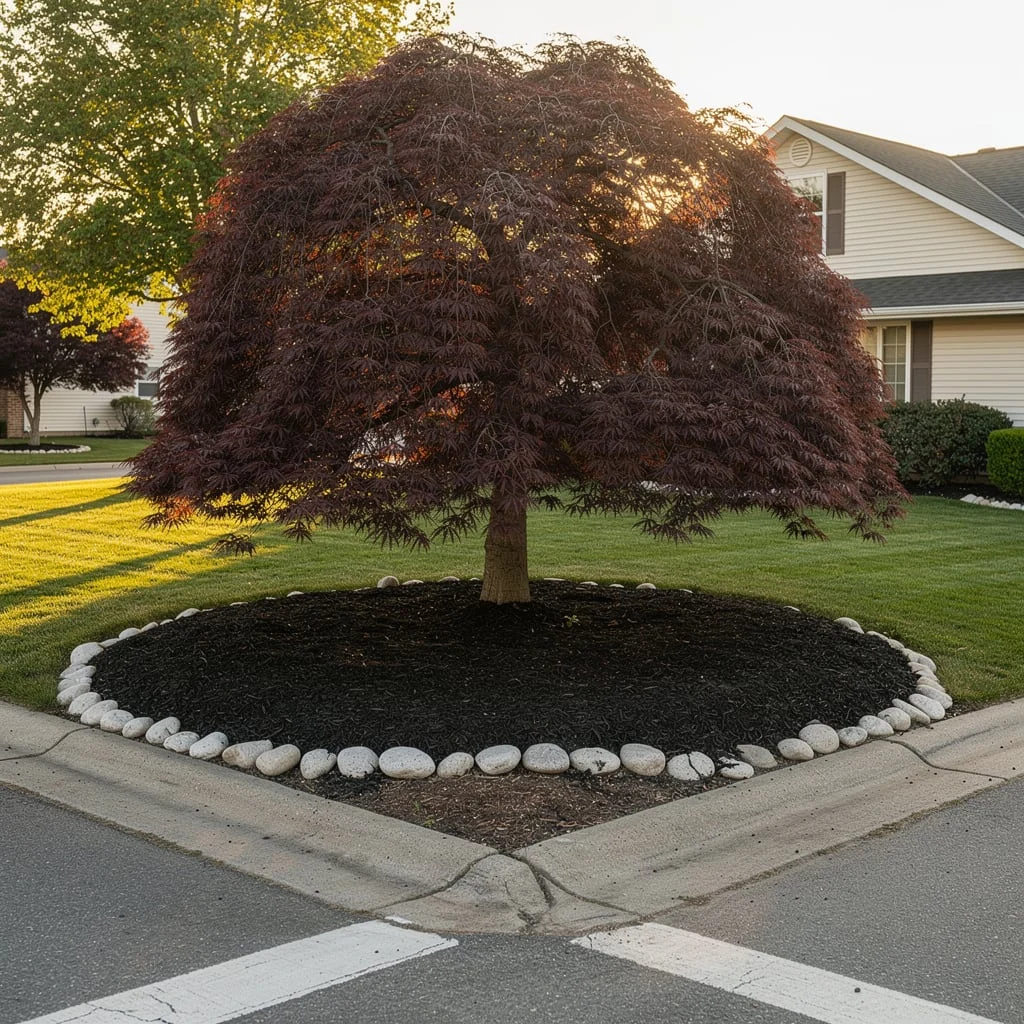
The simplest and most effective corner planting in temperate gardens is a single specimen Acer palmatum dissectum in a cultivar with strong colour: ‘Crimson Queen’ or ‘Garnet’ for deep burgundy, ‘Seiryu’ for bright green, ‘Katsura’ for orange-tipped spring growth.
Clear all other planting from a generous circular area — at least 1.5 metres radius from the trunk. Fill with black-dyed hardwood mulch applied at 8cm depth and raked smooth. Edge the circle with a continuous line of smooth white river rocks, each approximately 8 to 10cm across, set directly on the mulch surface in a consistent ring. No plastic edging, no steel strip — just the stone ring.
Do not underplant. Do not add companion plants. Do not surround with annuals. The entire point of this approach is that the tree is sufficient on its own. A Japanese maple in full form is an extraordinary plant and it needs nothing competing with it for attention. The black mulch and white stone ring exist purely to frame it.
The Basalt Column Fountain Corner with Architectural Planting
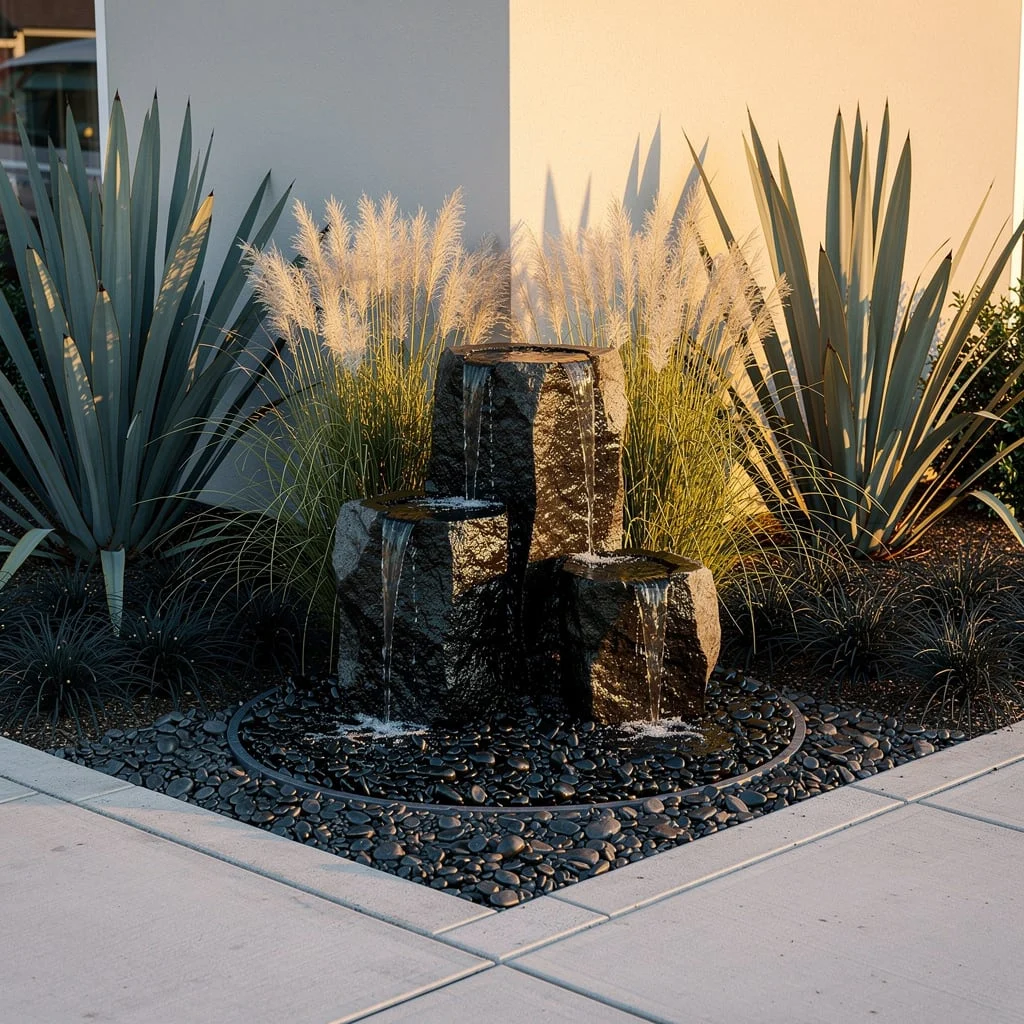
Install three basalt rock column water features — drilled through the centre to carry the recirculating pipe — in graduated heights: approximately 60cm, 90cm, and 120cm. Group them at angles so each column is visible from both street-facing directions. Set them in a circular metal ring edging approximately 1.2 metres in diameter, filled entirely with black polished pebbles to a 10cm depth. The pebbles conceal the reservoir tank below.
Plant directly into the surrounding corner bed with two Agave americana as bookend structures — powerful blue-grey rosettes that need zero maintenance and provide year-round architectural presence. Behind the agave, plant a mass of Cortaderia selloana ‘Pumila’ (compact pampas grass) for the large white-silver plumes that appear September through December.
The combination of moving water, stone column textures, sharp agave geometry, and feathered pampas plumes creates maximum sensory variety from minimum plant count. The sound of water is an active design element. Position the feature where it can be heard from a patio or entrance.
The Corten Steel Curved Raised Bed with Ornamental Grasses
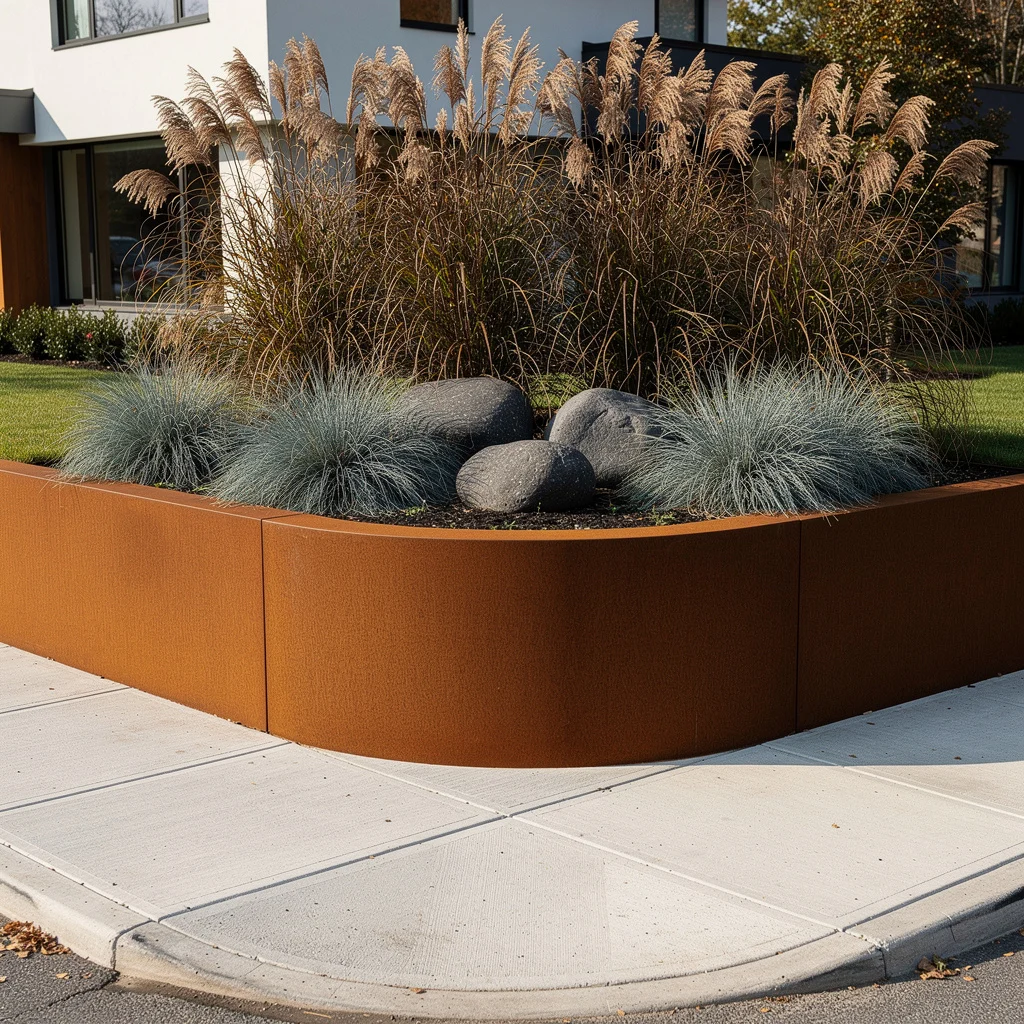
Fabricate or purchase a curved Corten steel panel to form a sweeping raised bed wall following the arc of the corner curb — approximately 30 to 40cm high, curving from one pavement edge to the other. The Corten weathers to rich rust-orange within the first season and develops a protective patina that requires zero maintenance.
Fill the raised bed with quality free-draining topsoil and plant a three-species grass composition: Miscanthus sinensis ‘Flamingo’ or ‘Silberfeder’ at the rear for height and late-season plume drama, Festuca glauca ‘Elijah Blue’ in groups of three as silvery sphere clumps in the mid-ground, and a pair of smooth dark granite boulders 40 to 50cm across placed directly on the dark mulch surface between the grass clumps as permanent compositional anchors.
The warm orange of the Corten, the silver-blue of the fescue, and the warm gold of the Miscanthus plumes in autumn create a landscape that is extraordinary for approximately four months and quietly beautiful for the rest of the year.
The Three-Tier Curved Sandstone Retaining Wall Corner
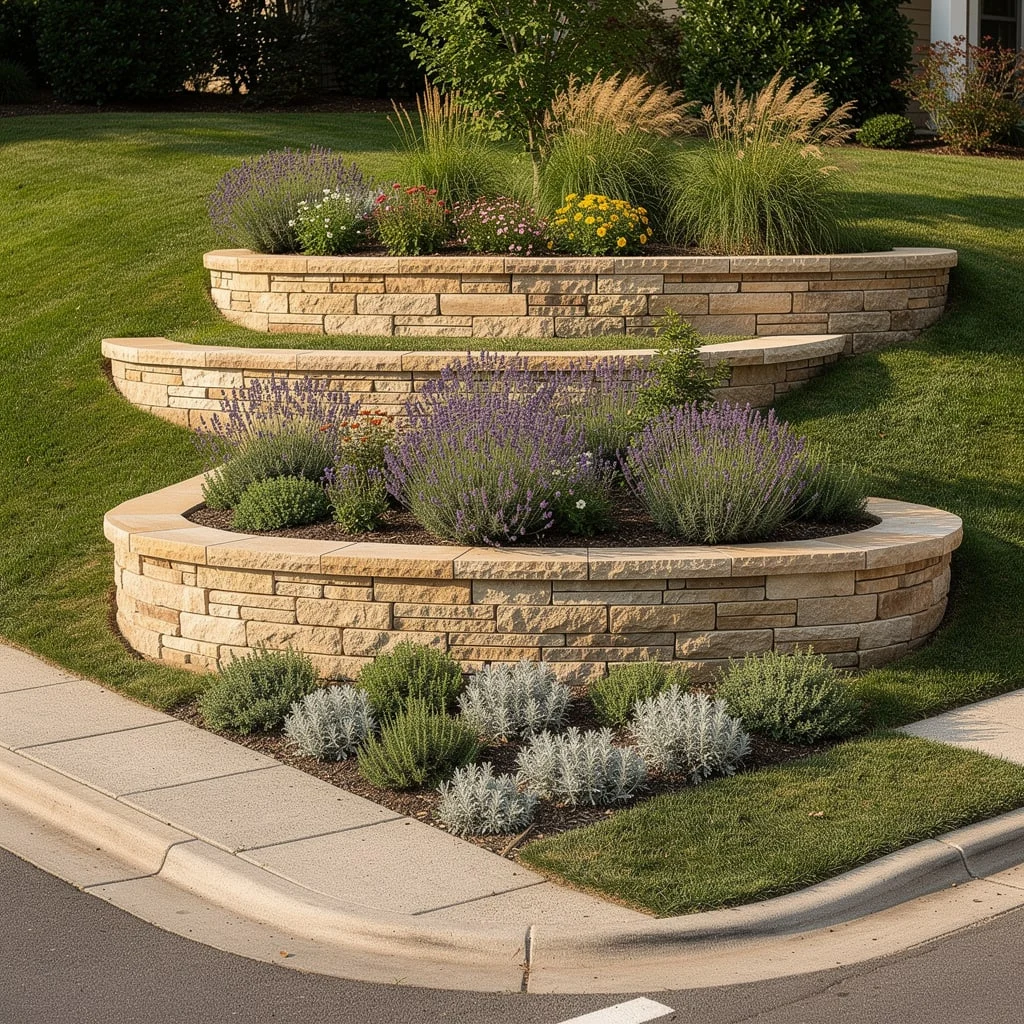
For a sloped corner or one where level change would add interest, build three concentric crescent walls in dry-stacked or mortared pale buff sandstone block — natural split-face, not smooth. Each wall should be 40 to 50cm high, creating three planting terraces of decreasing width as they ascend toward the inner corner.
Plant distinctly on each tier. Bottom tier at grade: silver Artemisia schmidtiana or Stachys byzantina as a low spreading carpet. Middle tier: Lavandula angustifolia in generous drifts, mixed with small Achillea and Chrysanthemum. Top tier: ornamental grasses — Miscanthus sinensis varieties — for the tall backdrop that rises above the wall system and gives the whole structure vertical scale.
Cap the walls with flat sandstone coping stones at a consistent height. The coping stones become natural perches and seating surfaces. The stone material and the planting palette should share warmth — buff stone, silver foliage, purple-blue lavender, warm gold grass plumes.
The L-Shaped Sandstone Bench Planter Corner
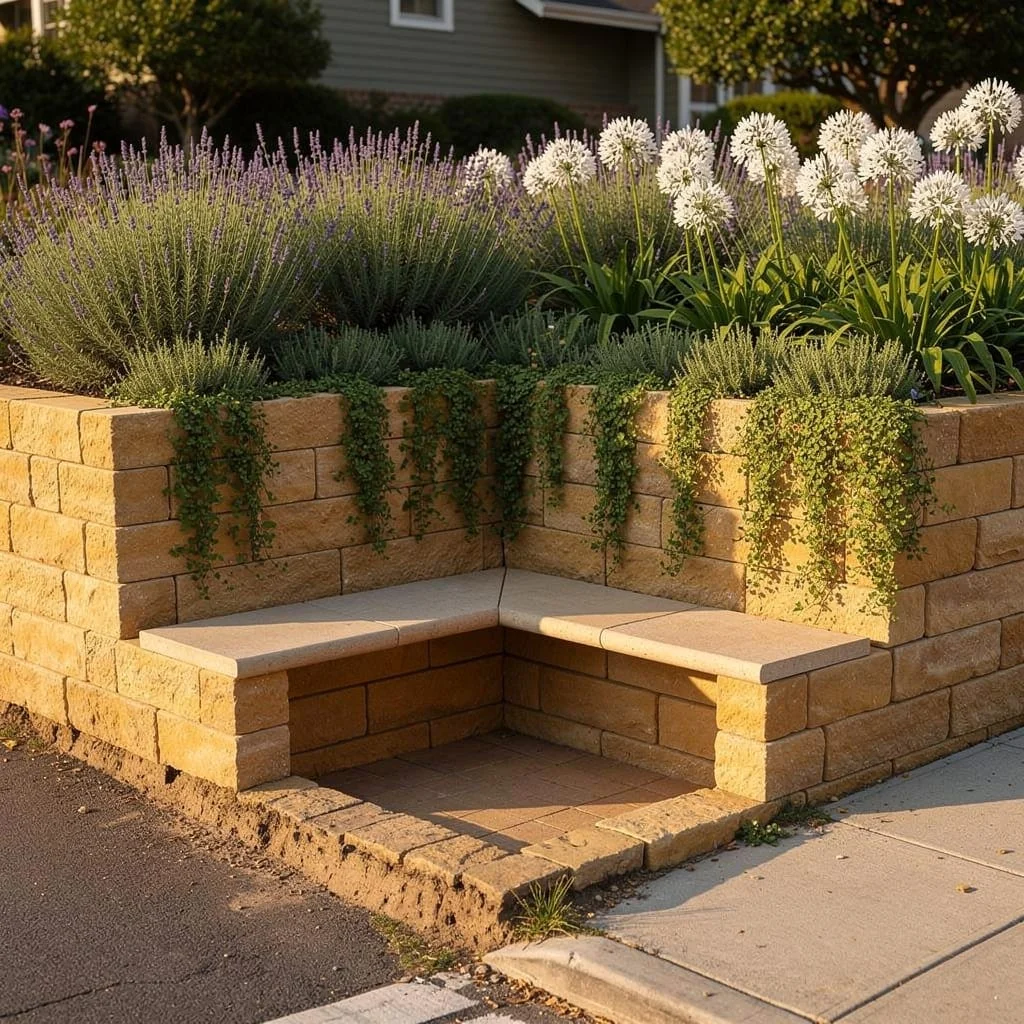
Build an L-shaped raised planter in warm golden sandstone block — two arms meeting at a right angle, each arm approximately 1.5 to 2 metres long and 45 to 50cm high. Cap the full length of both arms with smooth limestone or sandstone coping stones that overhang the face by 3 to 4cm. The coping becomes the bench surface along the entire length of the L.
At the inner corner where the two arms meet, position the tallest planting: Agapanthus africanus ‘Albus’ (white African lily) for its bold upright strap foliage and large white globe flowers in July and August. Run Lavandula angustifolia as the majority planting along both arms of the bed. Allow creeping Lysimachia nummularia ‘Aurea’ or Cymbalaria muralis to trail down the face of the warm stone wall.
This design solves two problems simultaneously: it creates a generous planting space at the corner, and it creates seating that reads as part of the structure rather than furniture placed in front of it.
The All-Grass Corner in Graduated Heights and Textures
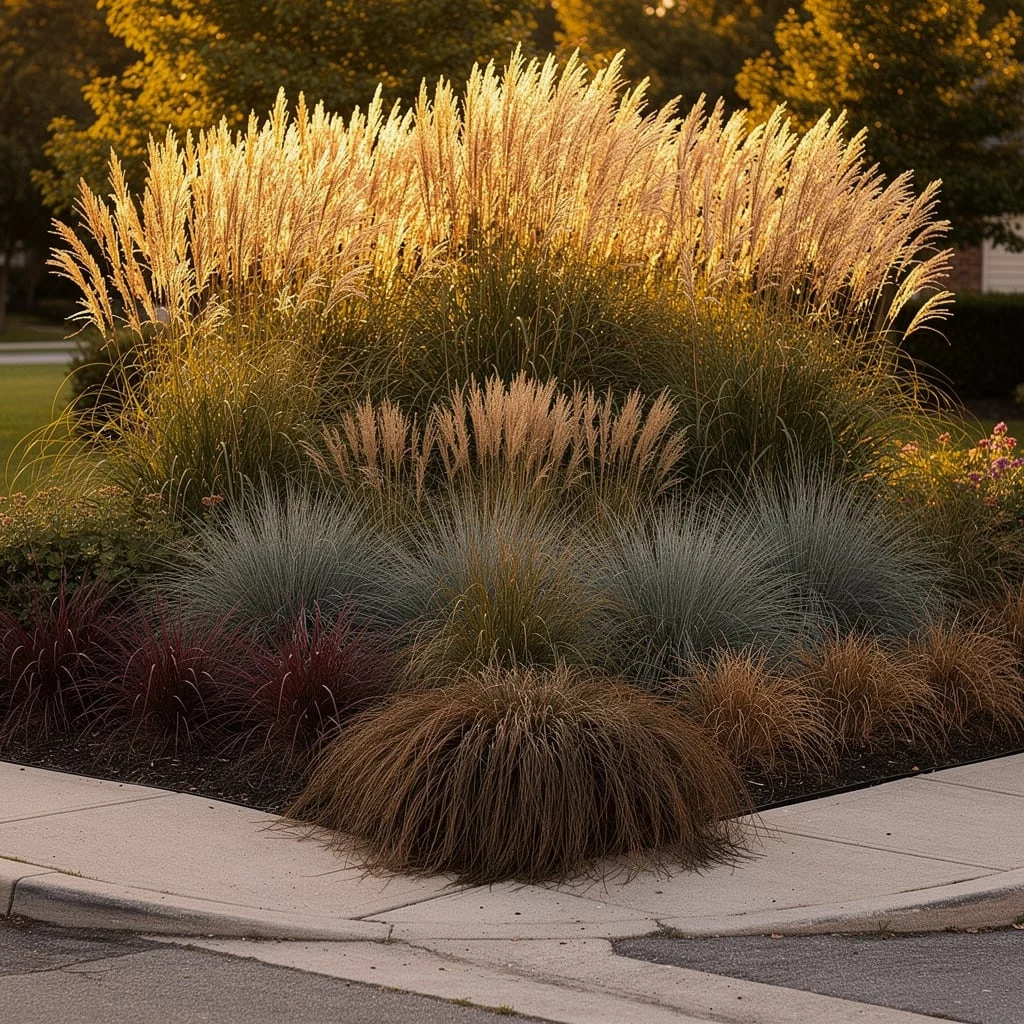
Plant the entire corner bed with ornamental grasses — nothing else. No flowering perennials, no shrubs, no trees. Just grasses in four or five species at different heights and with distinctly different textures.
The layering from tallest to shortest: Cortaderia selloana ‘Pumila’ at approximately 1.5 metres in flower at the rear, Miscanthus sinensis ‘Morning Light’ at approximately 1.2 metres as the mid-level layer, Pennisetum alopecuroides ‘Hameln’ or Calamagrostis x acutiflora at mid-height, Festuca glauca as the front-of-border sphere clumps, and Carex comans ‘Bronze Form’ at the very toe of the border for the warm brown low curl.
Use black hardwood mulch as the ground layer. No edging stones — just a clean spade-cut grass edge between the mulch and the lawn or pavement.
In September and October, when all the grasses are simultaneously in plume, this combination catches low light and glows in a way that no flowering border can match. In winter, the structure holds. Cut everything back hard in February and the performance begins again.
The Diamond Lavender Mass Corner Planting
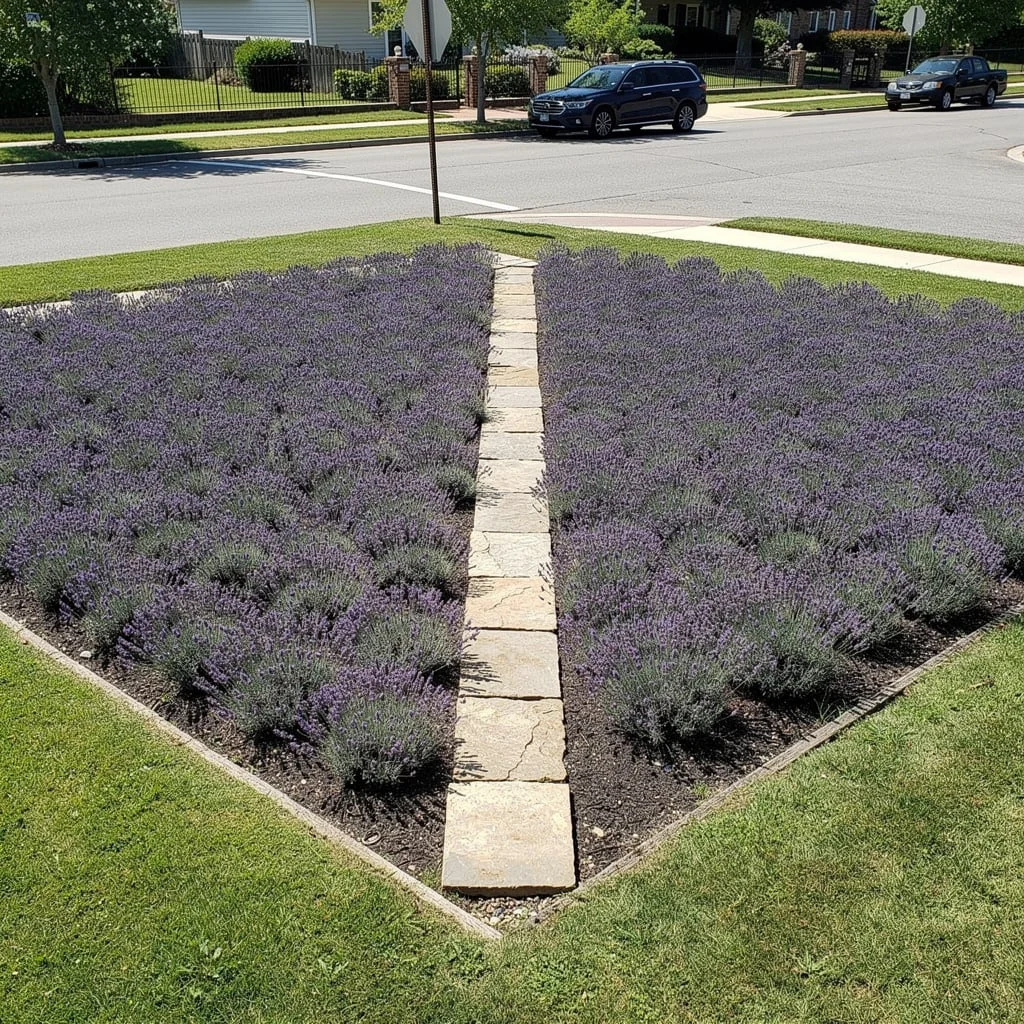
Remove all grass from the corner bed and reshape to a clean diamond or elongated triangle with straight edges. Install steel or aluminium edging strip around the entire perimeter, pushed flush with the pavement level.
Lay a central stone slab path — single stone width, irregular flagstones or cut sandstone laid end to end — from the point of the corner straight back through the bed toward the property. This path bisects the diamond symmetrically.
Plant the entire bed either side of the path with Lavandula angustifolia — same cultivar throughout, same spacing of 35 to 40cm on a staggered grid. ‘Hidcote’ for compact dark purple, ‘Munstead’ for slightly softer colour, or ‘Vera’ for larger, looser growth. Apply black mulch at planting and top up annually.
The result is a monoculture that looks extraordinary in June and July when everything is in full purple flower, and quietly silver-green for the rest of the year. The geometry of the diamond, the single central path, and the mass planting make this look completely intentional from any angle.
The Clipped Hedge Corner with Corten Sculpture Focal Point
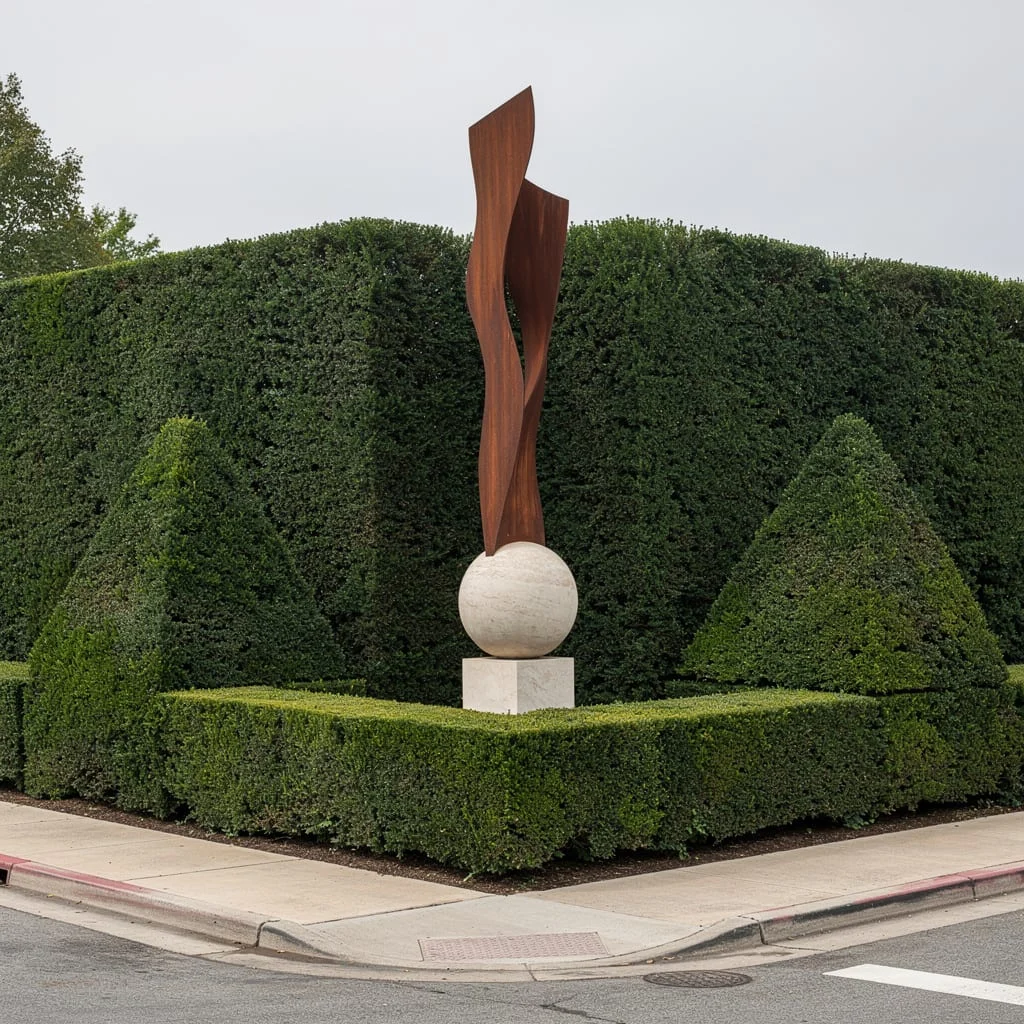
Establish a tall flat-topped hedge along the back face of the corner — yew, hornbeam, or Leyland cypress clipped to a consistent height of 1.8 to 2 metres. The hedge becomes the backdrop wall. It should be absolutely flat-faced and level-topped.
In front of the hedge, clip two cone or pyramid topiary forms — Taxus baccata or Buxus sempervirens — one on each side of the central axis, each approximately 1 to 1.2 metres high. In front of those, a low clipped Buxus square hedge approximately 50cm high closes the foreground.
At the precise centre point of the composition — where the eye naturally goes — install a Corten steel abstract sculpture on a white marble or limestone sphere plinth. The sculpture does not need to be representational. An abstract twist or vertical form in Corten works because the warm orange contrasts perfectly against the cool dark green of the yew backdrop. This is garden design that treats planting as architecture and sculpture as punctuation.
The Tropical Foliage Corner for Warm Climates
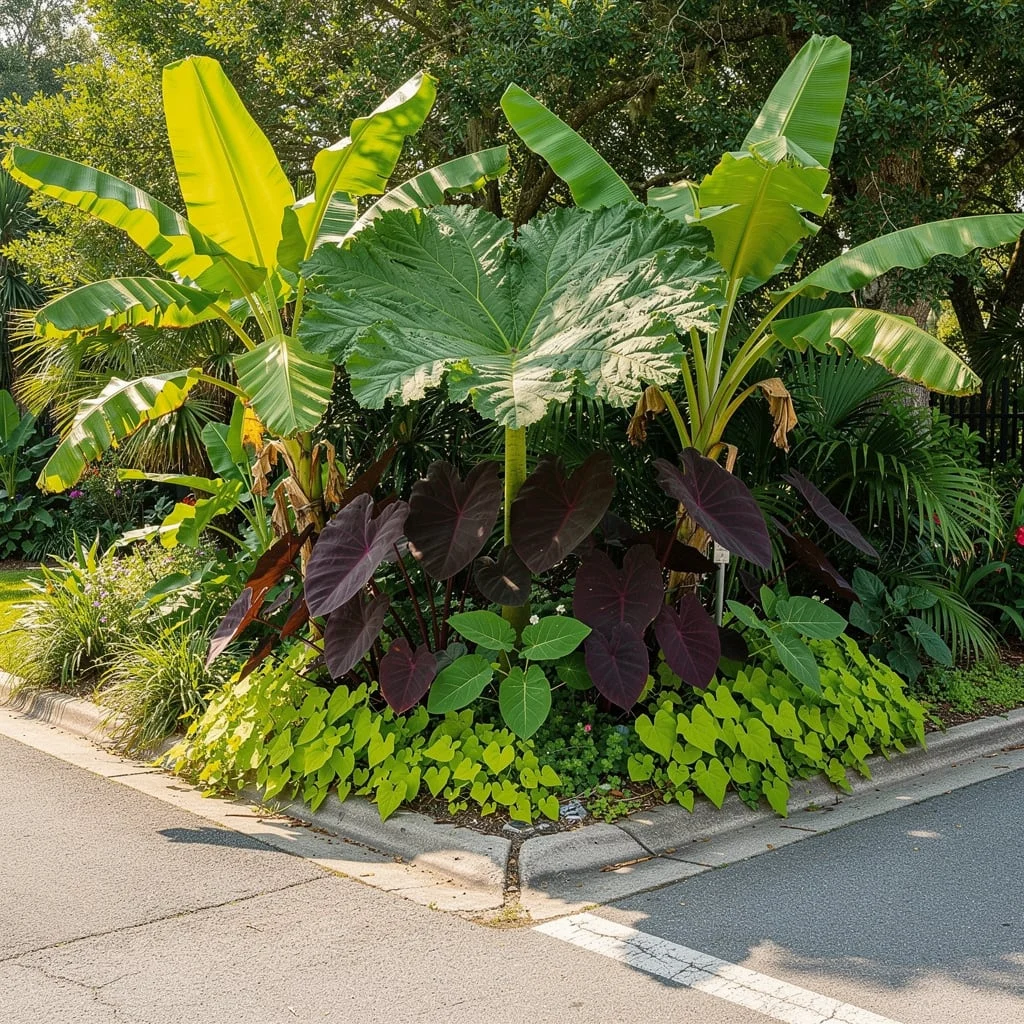
In USDA zones 9 and above, plant the corner entirely with large-leaved tropical foliage plants, layered by height, in a jungle of texture and contrast.
Back layer: two or three Musa basjoo (banana plant) as the dominant canopy — broad paddle-shaped leaves at 2 to 3 metres height, backlit by morning sun. Mid layer: Colocasia esculenta ‘Black Magic’ for the extraordinary dark purple-black elephant ear leaves that contrast utterly with the bright banana green. Front groundcover layer: Ipomoea batatas ‘Marguerite’ in chartreuse yellow — the bright, fast-spreading vine creates an almost fluorescent carpet under the dark Colocasia.
Side-fill with Washingtonia palm for vertical structure and Canna lilies in red or orange for additional tropical colour. The ground is entirely covered with living plants — no mulch visible. The entire composition reads as lush, warm, and maximally botanical.
The Uplighted Birch Corner Feature at Night
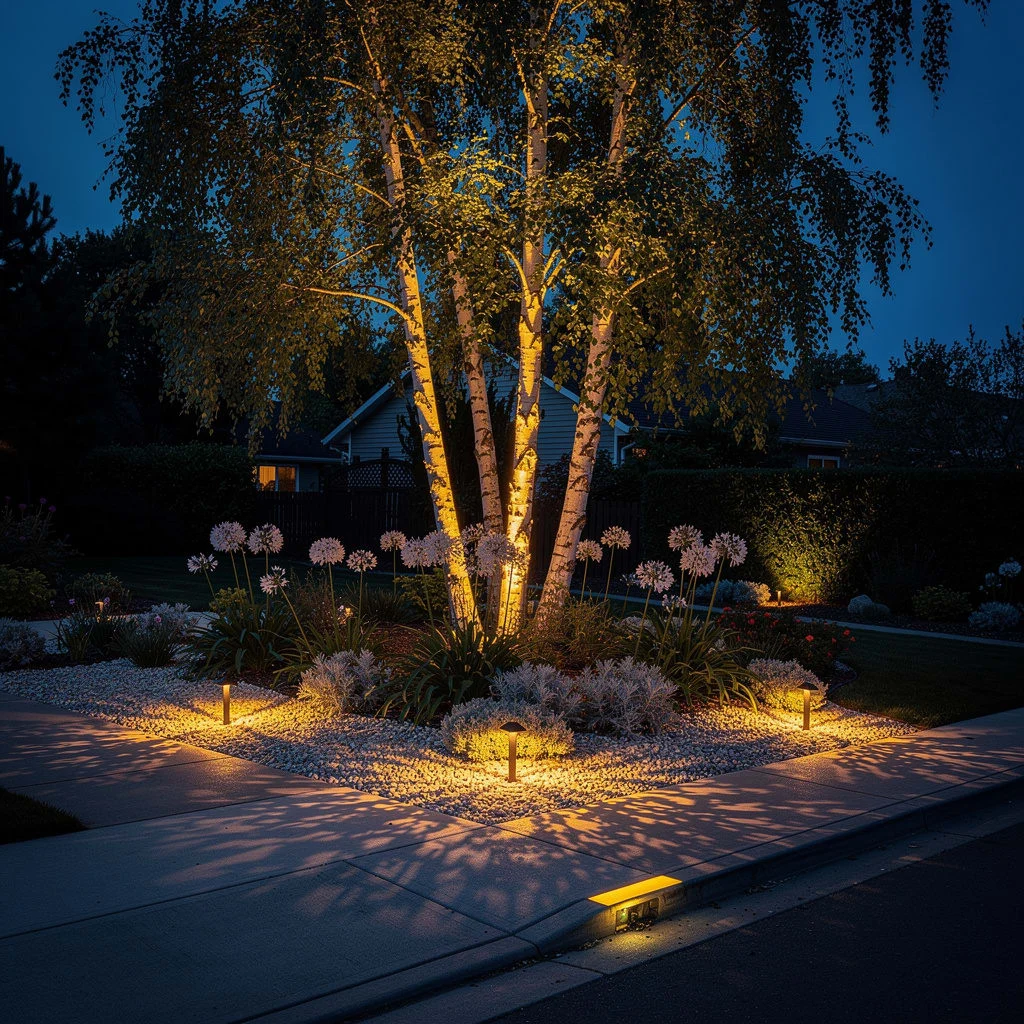
Plant a multi-stem Betula utilis var. jacquemontii as the central feature. Three or five stems are ideal. Position this off-centre within the corner bed — not at the exact apex, but slightly toward one face so it reads well from both directions but is weighted to one side.
Surround the birch with a white pea gravel ground layer — the pale ground reflects light upward through the stems at night. Plant Agapanthus africanus in white around the base for summer flower interest, and Artemisia ‘Powis Castle’ for silver foliage that also captures light.
Install three to four warm-white LED uplights spike-mounted in the gravel, directed up through the multi-stem structure at different angles. Add two low path bollard lights at the outer corners of the bed for ground-level definition. The night photograph is the design goal: white bark illuminated against blue-hour sky, pea gravel glowing warm at the base, agapanthus silhouetted against the lit trunk.
The Bamboo and Raked Gravel Zen Corner
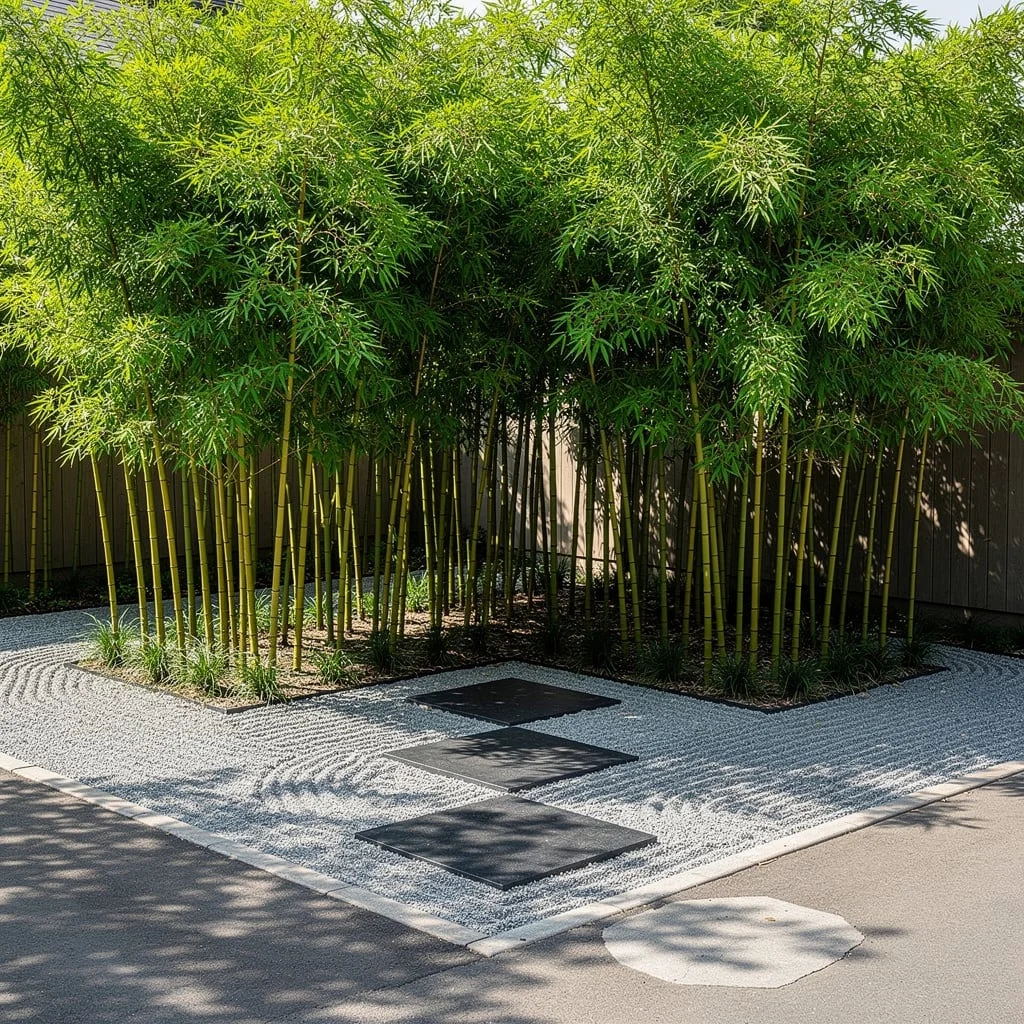
Plant a contained mass of clumping bamboo — Fargesia robusta, Fargesia nitida, or Phyllostachys contained with an HDPE root barrier to 60cm depth — across the full corner. Allow it to fill the corner space naturally from fence to fence, creating a dense green wall of upright yellow-green culms.
In front of the bamboo, lay white or pale grey sieved granite chip to an 8cm depth over weed membrane. Use a bamboo or steel rake with 5 to 6cm tine spacing to create flowing curved lines in the gravel surface — running parallel to the curb at the front edge, then curving to echo the bamboo boundary behind.
Place three large flat-faced dark slate square stepping pads in a diagonal sequence from the street to the base of the bamboo, oriented at 45 degrees. No other planting. The composition is bamboo, white gravel, dark stone pads, raked pattern. Four elements. Nothing extra.
What Makes a Corner Planting Stay Good
Every corner planting here was built around one clear idea. The lavender diamond is only lavender. The all-grass corner is only grasses. The Japanese maple is only the maple. The sculpture corner is only green architecture and one Corten form.
That specificity is the whole method. A corner that tries to include something for everyone ends up meaning nothing to anyone. A corner that commits to one material, one palette, or one plant family and executes it without apology reads as design rather than accumulation.
The decision is simple. Pick the idea. Then have the confidence to leave everything else out.