
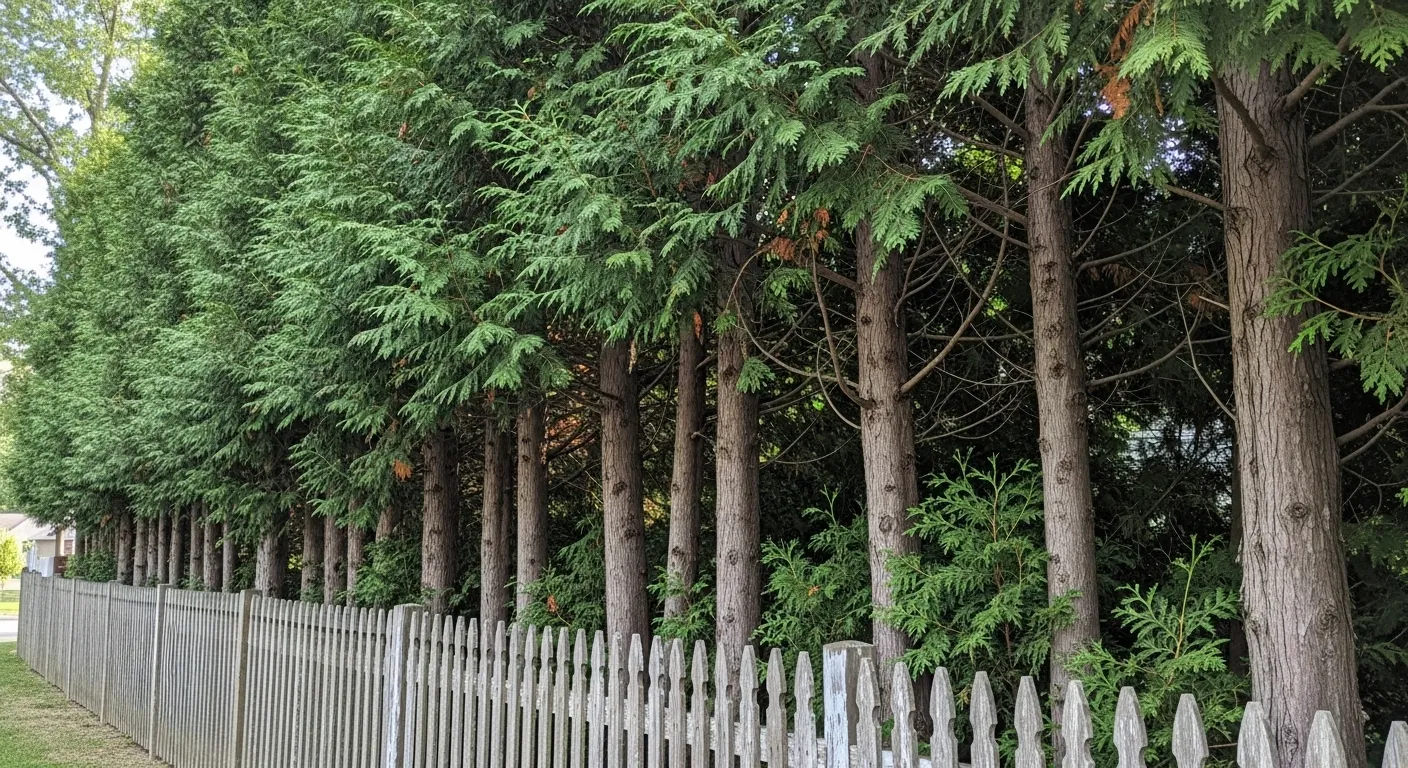
Your neighbours can see everything. The upstairs window, the patio table, the barbecue you bought six months ago and still haven’t assembled. A fence gets you halfway there. It handles the ground level. But the moment anyone stands at a first-floor window, steps onto a deck, or sits in an elevated garden, your fence becomes decorative.
Privacy trees fix that. Not with effort — with height. Done well, they don’t just block the view. They transform a boundary line into something you actually want to look at. Done badly, they become a maintenance headache, a root problem, or the most beige row of Leyland Cypress anyone has ever planted and instantly regretted.
There’s a difference between planting trees for privacy and designing a privacy planting. The first one is reactive. The second one is intentional. This post is about the second one.
Every example here solves a real privacy problem. Some do it with architecture, some with texture, some with sheer botanical drama. All of them are worth stealing.
Your Fence Is a Backdrop, Not the Boundary
Most people treat the fence as the endpoint. They plant something in front of it and stop thinking. But the fence and the planting are a system. What colour is the fence? What does the timber do for the planting in front of it? These are questions worth asking before you buy a single tree.
The Contrast Principle Nobody Talks About
Dark fences amplify green. It’s not complicated. When you paint or stain your fence in a deep charcoal, ebony, or near-black tone, every plant placed in front of it pops in a way it simply would not against unpainted wood or a pale grey panel.
This isn’t a subtle difference. It’s the difference between a planting that reads from across the garden and one that disappears into its own background.
How Height Allocation Changes Everything
A six-foot fence gives you six feet of hard privacy. That’s fine at ground level and useless the moment anyone has any elevation on you. The trees you plant above that line are doing the real work. Think of the fence as the lower half of your privacy screen and the canopy as the upper half.
That means the trees don’t need to reach the ground. They need to reach the sky. Keep the trunk clear, let the canopy do the job, and suddenly you have height, light, and screening all at once.
Spacing Changes the Character Entirely
Tight spacing creates mass. Generous spacing creates rhythm. Neither is wrong — they just do different things to a garden.
Mass planting reads as a wall. It’s maximally private and maximally bold. Rhythmic planting reads as a colonnade. It’s more architectural, lighter in feel, and still provides substantial screening above fence height.
Decide which one you’re after before you decide what to plant. The same species planted at different spacings creates a completely different garden.
The Ground Matters as Much as What’s in It
Most privacy planting fails not because of the tree choice but because of what’s happening at the base. Bare soil looks neglected immediately. Grass growing right to the trunk looks like an afterthought. The ground layer is where a planting goes from good to finished.
Mulch as a Design Choice, Not a Practical One
Black mulch is not neutral. It’s a deliberate colour choice that reads as modern, graphic, and clean. Brown bark mulch is warmer, more naturalistic. Fine gravel — white, grey, or pale buff — adds texture and permanence.
Choose your mulch the way you choose your fence colour: as part of the composition, not as a maintenance product.
The Underplanting That Earns Its Place
Underplanting beneath privacy trees serves two purposes. It fills the visual gap between ground level and trunk height — the awkward zone where a tree gives you nothing. And it adds a seasonal layer that the trees often can’t provide.
Lavender under climbing roses. Ferns under birch. Low boxwood hedging under large arborvitae. In every case the underplanting is doing structural work, not just decorative work. That’s the distinction worth making.
Edging and the Line That Defines Everything
A planting bed with a clean edge looks considered. A planting bed without one looks unfinished, regardless of what’s in it.
Steel, brick, or rubber edging — all work. The material matters less than the precision of the line. A sharp, consistent border between lawn and bed makes the entire planting read as intentional.
Decide the Character Before You Go to the Nursery
The single biggest mistake in privacy planting is choosing a tree first. Choose the character of the garden first. The tree follows from that. Columnar and architectural? Soft and romantic? Wild and natural? Mediterranean and spare? Each character demands a different plant palette.
Speed Versus Permanence
Fast-growing trees give you screening in two to three years and a maintenance problem in ten. Slower-growing trees take longer to deliver but cost you far less in annual trimming, root management, and replacement.
If you need privacy immediately, use a combination: a fast-growing species for the short term and a slower, more permanent species planted between them. Remove the fast growers in year five or six once the permanent planting has established.
Evergreen Versus Deciduous
Evergreen trees screen year-round. Deciduous trees screen the growing season and open up in winter. In most gardens, winter is exactly when you’d prefer less exposure — shorter days, more time spent near windows, neighbours who are also inside and looking out.
That said, deciduous trees offer something evergreens rarely do: genuine seasonal character. The autumn colour of a birch, the spring drama of a flowering cherry, the architectural bare trunk in winter — these are design assets, not deficiencies. Use them deliberately.
Root Behaviour and What It Does to Everything Nearby
Some trees have roots that are well-mannered and deep. Others spread aggressively near the surface, interfering with paving, drains, and structures. Know the root behaviour of your chosen species before planting within three metres of anything hard.
Bamboo is not a tree, but it behaves like a land grab. If you plant running bamboo, contain it with a root barrier at least 60cm deep. Skip that step and you’ll spend the next decade arguing with your garden.
Privacy Trees Along Fence Ideas
The Pleached Privet Screen with Dark Fence and Wildflower Underplanting
Install pleached Ligustrum japonicum — Japanese Privet — trained into a standard form at roughly 1.5 to 2 metres of clear stem, with a dense, cloud-like canopy above. Space them at 1.2 to 1.5 metres apart along a fence stained in a dark graphite or ebony tone. The bare stems sit in front of the fence panels, and the canopy rises above them in a continuous flowering mass.
Plant the bed below with a loose cottage mix: Echinacea purpurea in pink and white, Salvia nemorosa in dark violet, and silvery artemisia as filler. Use bark mulch in a warm brown or reddish tone to echo the earthy palette. Add a pair of decorative metal bird sculptures near one end to mark a visual anchor point without adding weight.
This look is relaxed rather than formal. The flowering canopy above the dark fence creates extraordinary depth. Prune the canopy once annually to maintain the cloud form — late winter before new growth. The underplanting is low maintenance once established.
The Uplighted Columnar Evergreen Wall with Hardscape Integration
Choose Italian Buckthorn (Rhamnus alaternus ‘Argenteovariegata’) or a compact Pittosporum tobira for a Mediterranean climate, or Osmanthus burkwoodii for cooler zones. Plant in a raised rendered planter bed, approximately 50cm high, positioned directly behind a low retaining wall with a built-in hardwood bench.
Space the trees at 80cm centres for a dense, near-solid screen. Install uplight fixtures at the base of each tree — warm white, 2700K — directed up through the canopy. The effect at dusk is theatrical: the uplighting turns what is already a clean green wall into a glowing architectural backdrop.
Pair with a square concrete fire pit on the patio side and a built-in outdoor kitchen at one end. The planting becomes the living wall of an outdoor room, not just a boundary. The mulch in the planter bed should be fine dark bark or decomposed granite to keep the look clean.
The Skyrocket Juniper Column Planting Against a Dark Wood Fence
Source Juniperus scopulorum ‘Skyrocket’ or its close relative J. virginiana ‘Taylor’ — both are narrow, fast-growing columnar junipers that reach 5 to 7 metres in height but stay under 60cm wide. Plant at 60 to 90cm spacing directly against a dark cedar or redwood fence.
These junipers provide real height fast — 1 to 1.5 metres per year in good conditions. They require virtually no pruning. They are drought tolerant once established and have minimal root aggression.
Underplant with a low-growing colourful mix: golden Marigolds at the front, burgundy barberry or nandina in the mid-ground. Add dark bark mulch throughout. The contrast between the deep green verticals, the dark fence, and the bright underplanting creates an energetic, almost tropical feel despite using completely cold-hardy plants.
The Emerald Green Arborvitae Curve with Black Mulch Edging
Thuja occidentalis ‘Emerald Green’ is the most reliable privacy tree in temperate North America. What makes it fail in most gardens is not the plant — it’s the execution. Planted in a dead-straight row with no ground treatment, it looks like a nursery display.
Plant instead in a gently curving line following the natural contour of your lawn edge. Use black rubber or steel edging to define a generous planting bed — at least 90cm wide. Fill it with dark black cedar mulch, raked flat and kept consistently topped up. Install low-voltage path lights at irregular intervals along the base.
Space the trees at 90cm to 1.2 metres for a tight screen within three years. The curve softens what could be a rigid planting, the dark mulch grounds the green, and the path lights add warmth at night. This is the most accessible version of privacy planting done properly.
The Black Bamboo and White Stone Contrast Planting
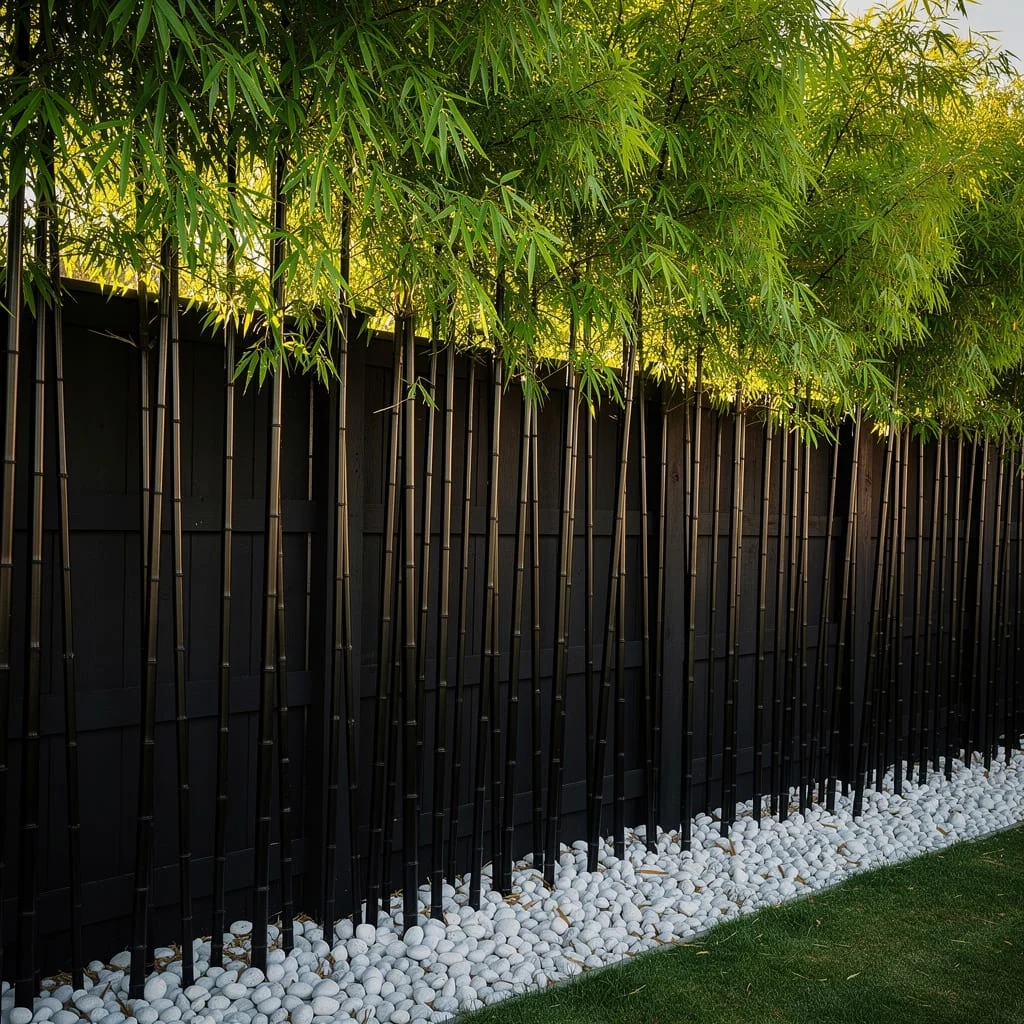
Select Phyllostachys nigra — Black Bamboo — for its extraordinary dark culm colour, which moves from green to near-black in its second year. Before planting a single cane, install a solid HDPE root barrier to 60cm depth around the entire planting zone. Do not skip this.
Plant in a bed directly in front of a matte black painted fence. Space the planting clusters generously, as the canes will multiply and fill. Top the bed entirely with large, rounded white cobbles or pea gravel — the monochrome contrast of black canes, black fence, and white stone is graphic and dramatic.
This combination delivers privacy from mid-spring onwards once established. The bamboo canopy is light and moving, rustling in the wind in a way that no conifer can. The ground treatment means almost zero weeding. Clean the planting bed annually of fallen leaf litter. The effect year-round is strong enough to anchor a garden scheme.
The Columnar Yew Against White Horizontal-Slat Fencing
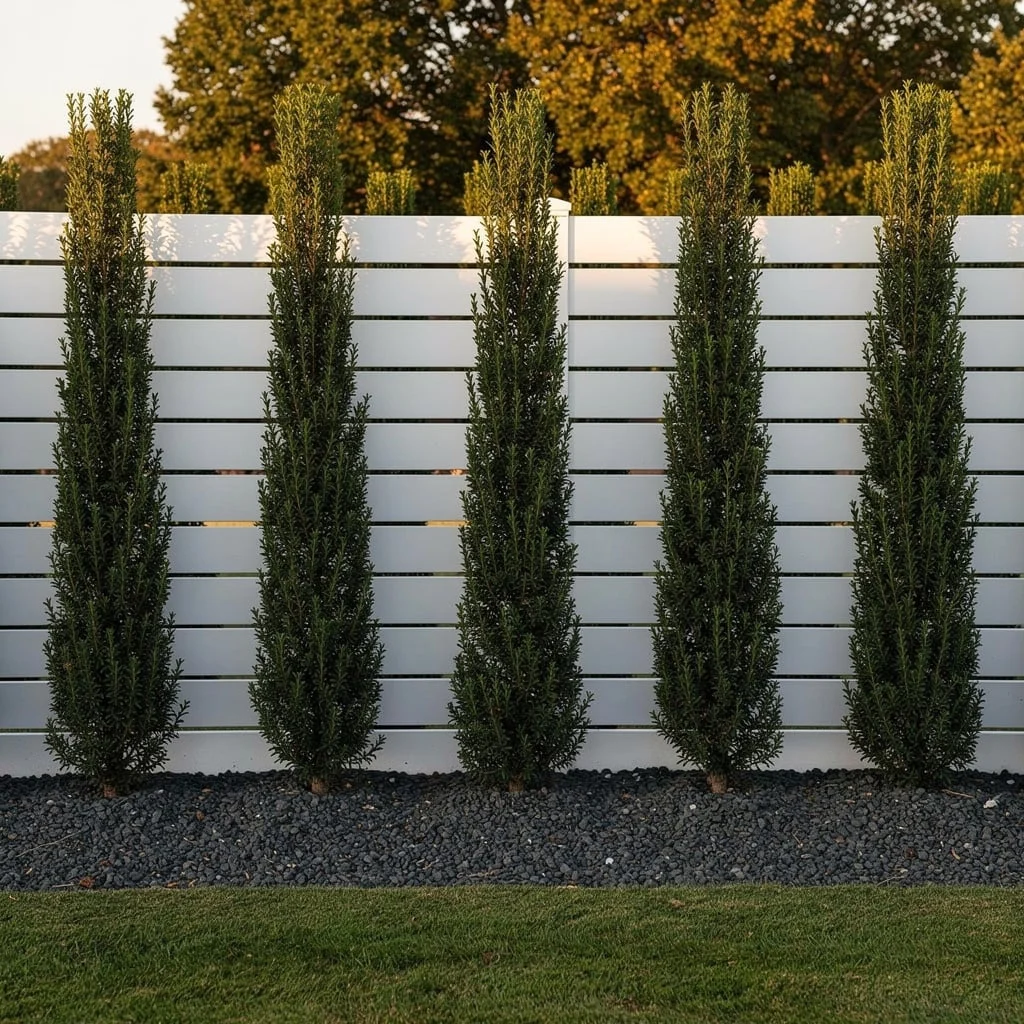
Taxus baccata ‘Fastigiata’ — Irish Yew — is the most sculptural of the columnar evergreens. Dark, dense, formal. Plant in groups of three or five against a white or pale grey horizontal-slat fence — the clean horizontal lines of the fence create a counterpoint to the strong verticals of the yew.
Set the planting bed in dark charcoal gravel or crushed slate rather than organic mulch. The mineral ground treatment reinforces the architectural mood. Space at 60 to 80cm between trees — close enough to read as a composed group from a distance, distinct enough to show individual form up close.
Note that Yew berries are toxic to humans and animals. If you have children or pets with regular access to the space, substitute Taxus x media ‘Hicksii’ which is slightly less fruiting, or use a different species entirely.
The Flowering Cherry Screen Against a Charcoal Fence
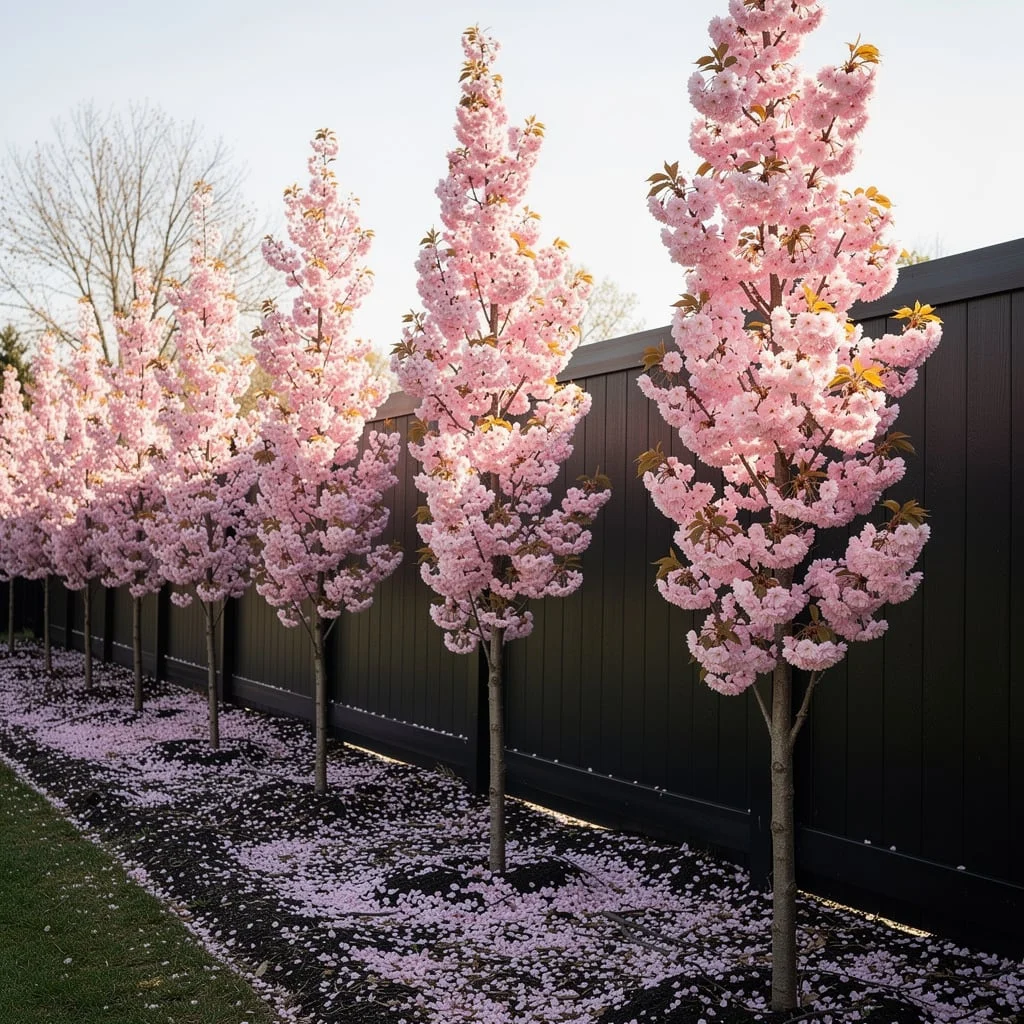
Prunus ‘Amanogawa’ is the columnar flowering cherry — narrow enough for fence-line planting, dramatic enough to stop a garden in its tracks in April. Plant at 1.5 to 2 metre spacing against a charcoal or near-black painted fence. Use black mulch in the bed below.
The moment of bloom is complete spectacle. Soft pink blossom at height, petals falling onto the dark mulch below. It lasts approximately two weeks. That is not a downside — it’s the entire point. Gardens that are extraordinary for two weeks and quietly interesting for the other fifty are worth having.
For the remaining months, the upright form, glossy foliage, and yellow-orange autumn colour carry the space. Plant a low evergreen groundcover at the base — Pachysandra or Vinca minor — to maintain interest through winter when the trees are bare.
The Solid Clipped Yew or Leyland Cypress Wall
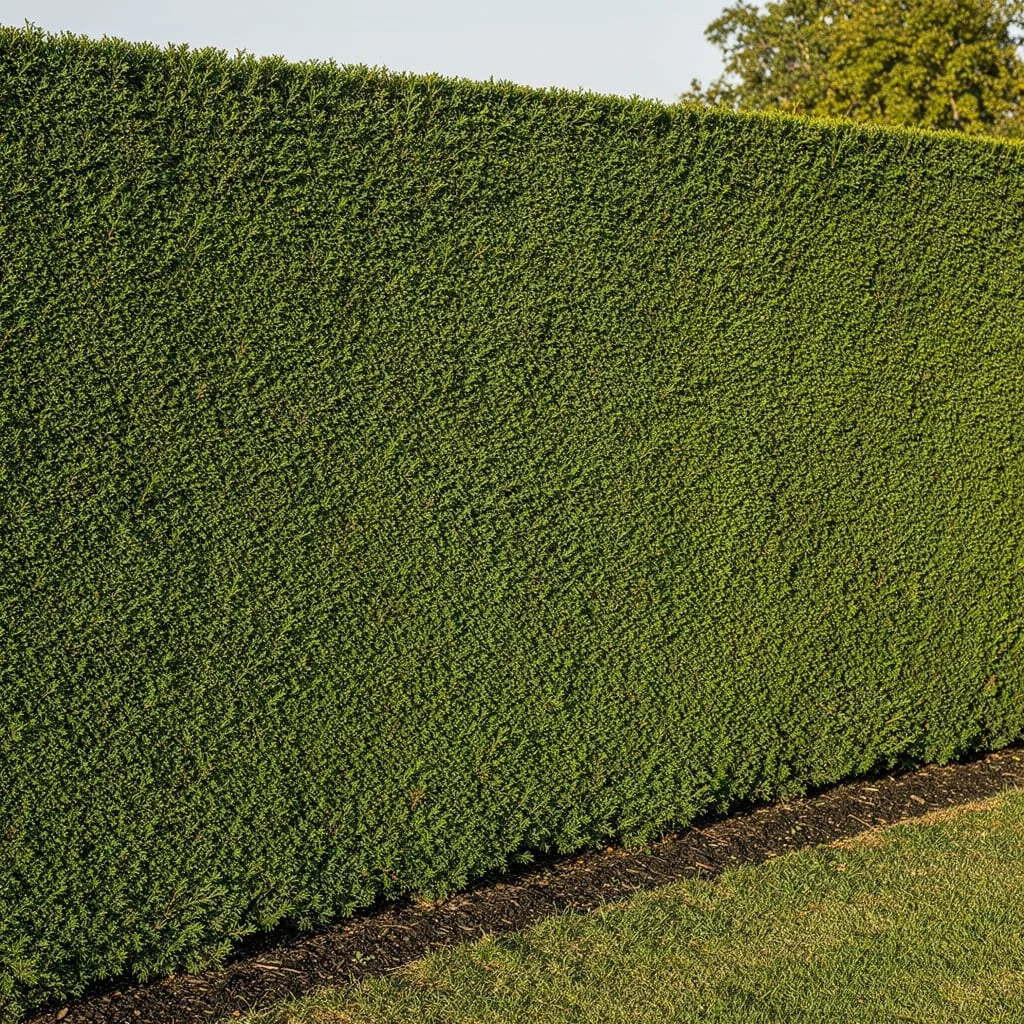
Sometimes the answer is not a row of individual trees but a single continuous wall of clipping. Taxus baccata as a formal hedge gives you one of the finest garden surfaces available — dense, flat-topped, a deep bottle green that holds its colour year-round.
To achieve this, plant at 50 to 60cm spacing in a single row and begin training from year one. Clip the sides vertical and the top flat from the beginning. Every time you clip, the hedge thickens. By year five you have something that looks decades old.
Maintain a clean mown grass strip at the base — no mulch, no underplanting. The formal hedge needs nothing competing with its line. Edge the grass strip sharply at the base and keep the face of the hedge absolutely vertical. The perfection is the point.
The Areca Palm Tropical Screen Against a White Fence
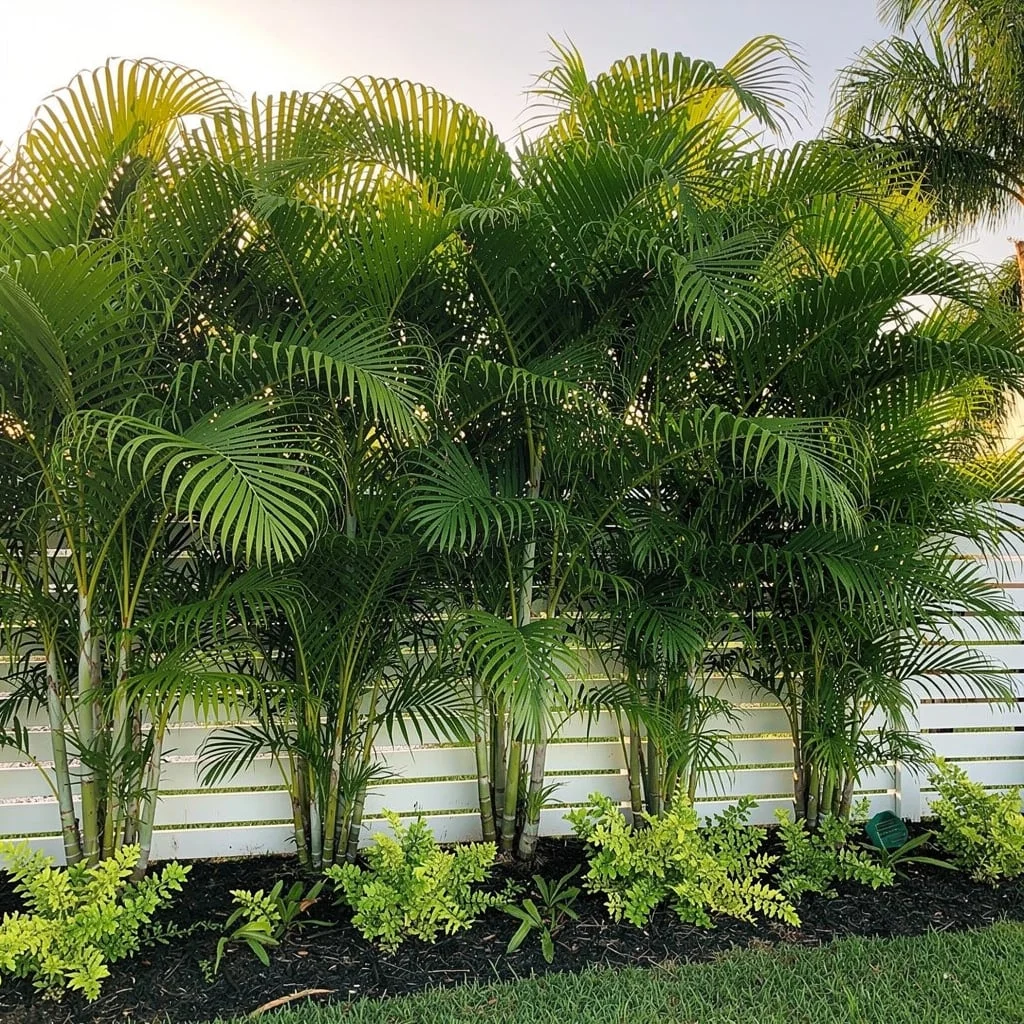
In USDA Zones 10 and above — South Florida, Southern California, coastal Texas — Dypsis lutescens, the Areca Palm, is an extraordinary privacy plant. Multi-stemmed, fast-growing, and capable of reaching 6 to 8 metres in ideal conditions.
Plant in groups of three to five stems planted close, at 1.2 to 1.5 metre spacing, against a white horizontal fence. Fill the bed with black hardwood mulch. At the base of each palm group, plant a low chartreuse groundcover — Duranta repens ‘Gold Mound’ or Philodendron ‘Lemon Lime’ — for a tropical layering effect.
The feathery fronds at height are light, moving, and exotic. The multi-stem habit means no single point of failure. If one stem is damaged, the others continue. Add a drip irrigation system at planting — Areca palms want consistent moisture especially in the first two years.
The Ornamental Grass and Arborvitae Layered Planting
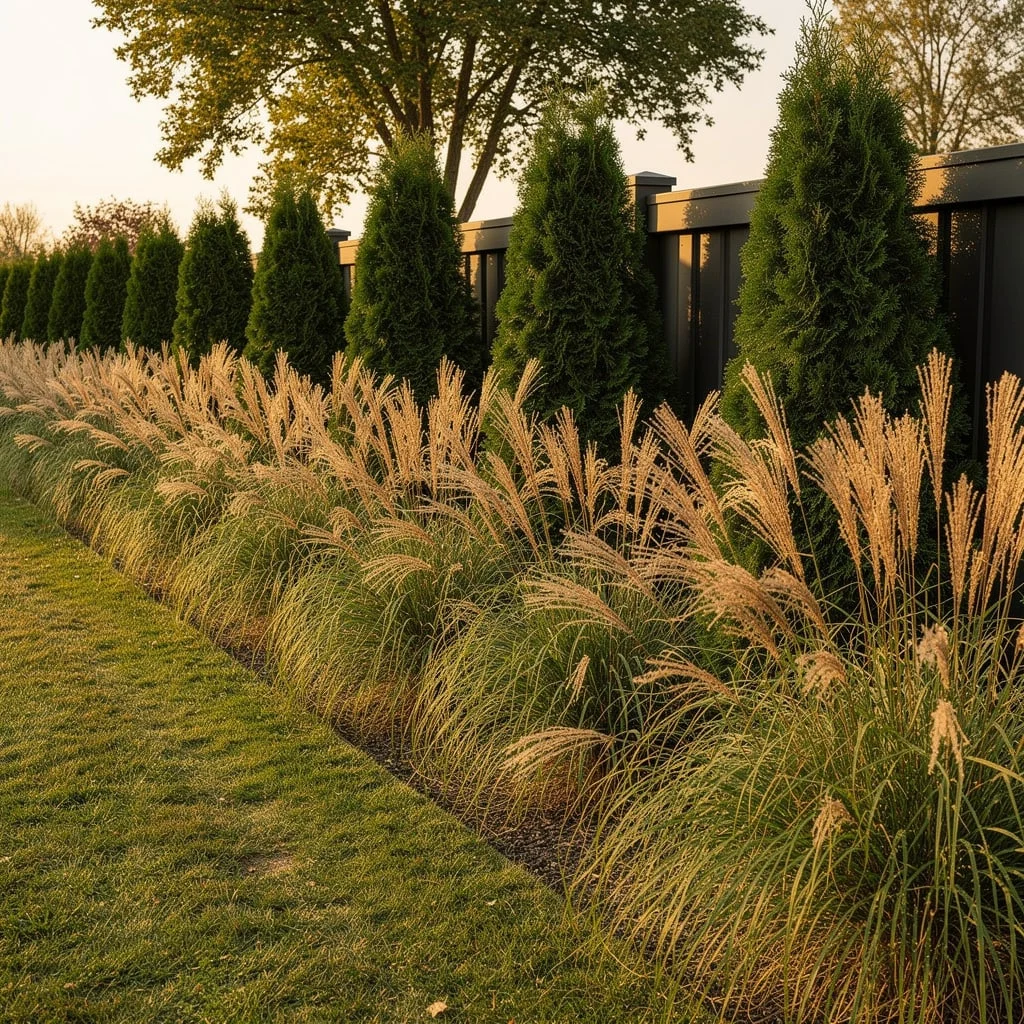
Behind a black powder-coated metal fence, plant a back row of Thuja occidentalis ‘Emerald Green’ at 1.2 metre spacing for the permanent evergreen screen. In front of that, plant a continuous sweep of Miscanthus sinensis ‘Gracillimus’ or ‘Morning Light’ — tall ornamental grass that reaches 1.5 to 1.8 metres in flower by late summer.
The result is two distinct layers: the steady green wall of the arborvitae behind, and the fluid, golden, wind-responsive mass of the grass in front. In autumn, when the Miscanthus plumes catch low light, the combination is genuinely beautiful.
Cut the Miscanthus back hard in late February or early March, before new growth emerges. Leave the cut stems in place for a few weeks — they break down quickly and feed the soil. The arborvitae behind requires no routine pruning if spaced correctly from the start.
The Climbing Rose and Cypress Romantic Planting
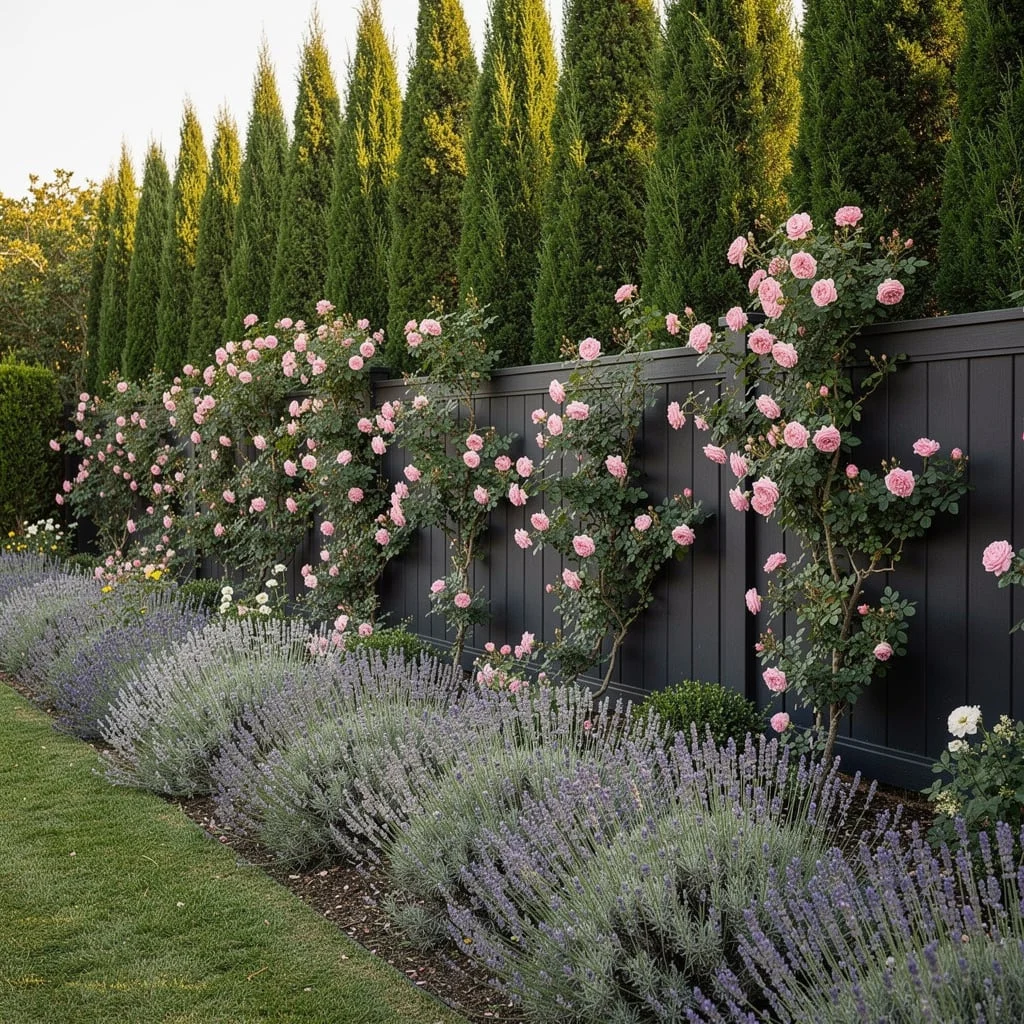
Fix horizontal wire supports to a dark painted fence at 30cm intervals from 30cm above the ground to the top of the fence. Train a climbing or rambling rose — Rosa ‘Generous Gardener’ in soft pink, or ‘Mortimer Sackler’ for a slightly paler tone — along the wires, tying in new stems as they grow.
Behind the fence, plant columnar Italian or Leyland Cypress at 1.2 metre spacing to carry the screening above fence height. In front of the fence, plant Lavandula x intermedia ‘Grosso’ in generous drifts — three to five plants per group — running the full length of the border.
The result layers three distinct characters: the soft romantic abundance of the roses, the structural dark verticals of the cypress above, and the silvery-purple drift of lavender at the front. Deadhead the roses through summer. Clip the lavender back by a third immediately after flowering to prevent woodiness.
The Pleached Hornbeam or Cherry Laurel Square-Canopy Screen
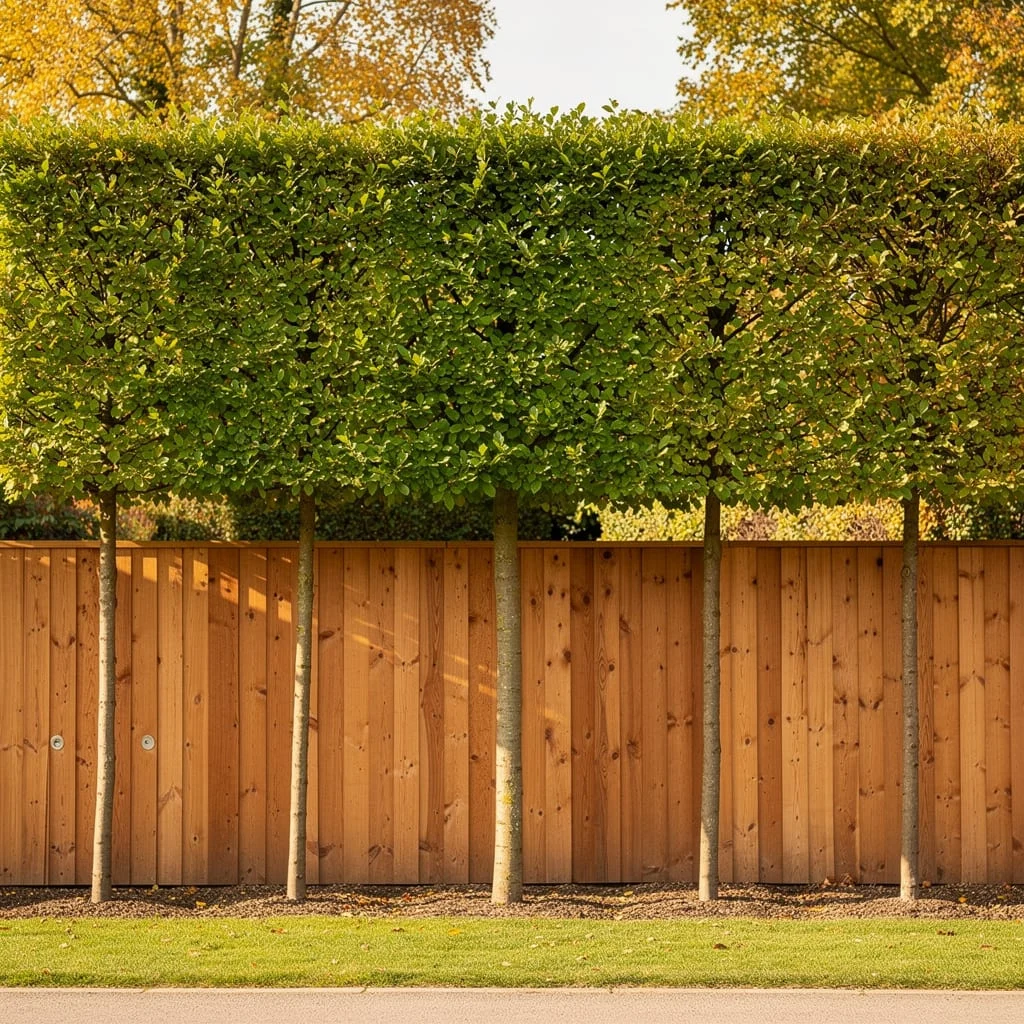
Pleaching is the practice of training trees on a flat, planar frame so that the canopy grows as a horizontal shelf. The trunks are kept clear, giving a floating screen effect — privacy above a certain height with full openness below.
Source Carpinus betulus ‘Fastigiata’ (Hornbeam) or Prunus laurocerasus (Cherry Laurel) as ready-pleached standards, typically available at 2 to 2.5 metre clear stem with a pre-formed canopy. Plant at 1.5 metre spacing in front of a natural-tone warm wood fence.
Set the bed in fine pea gravel. No underplanting. The architectural restraint of the pleached form needs nothing competing with it at ground level. The warm wood fence behind echoes the cream-grey bark of the trunks. This is a precision look that requires annual canopy trimming — late winter — to maintain the flat horizontal plane.
The Silver Birch and Fern Woodland Boundary
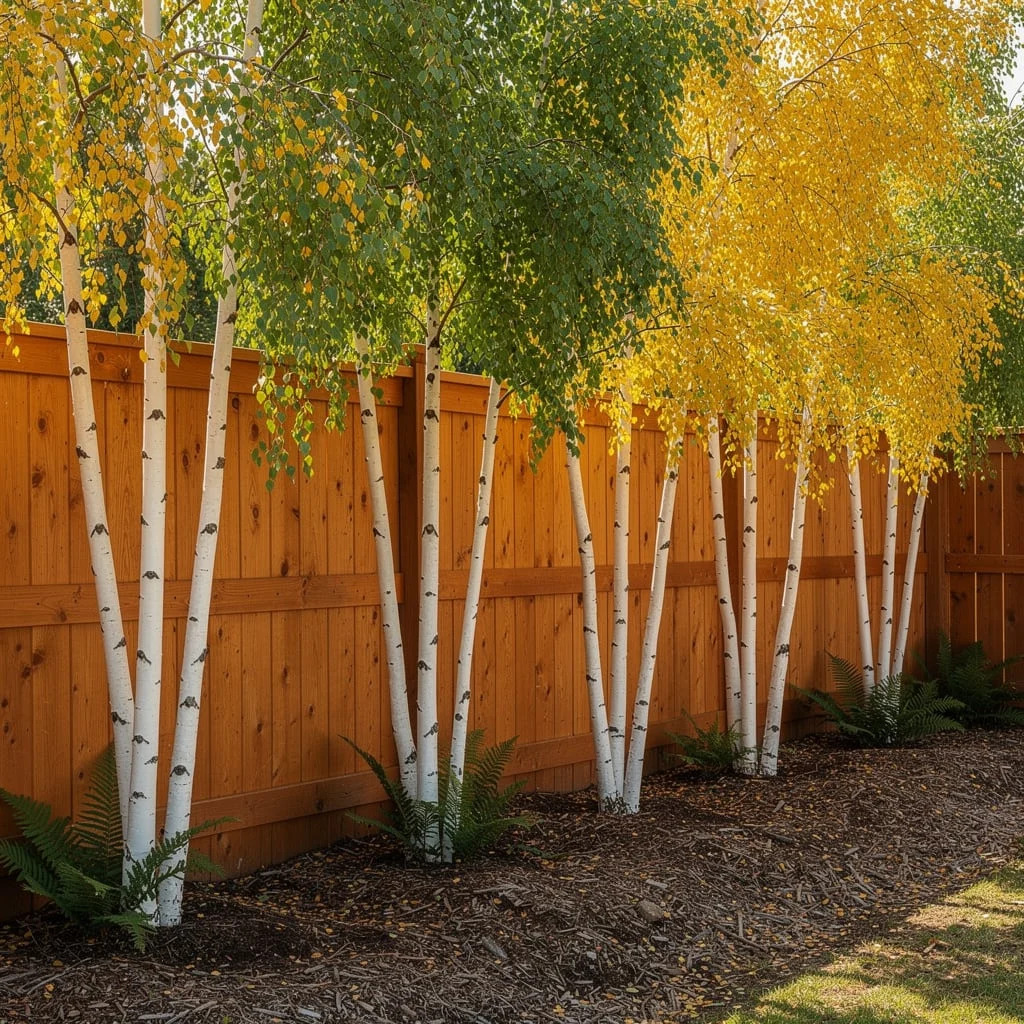
Plant Betula utilis var. jacquemontii — the whitest-stemmed of all birches — in multi-stem forms at 2 to 2.5 metre spacing along a cedar or warm-toned wood fence. Multi-stem forms give you three to five stems per planting unit, with the characteristic white papery bark immediately present from day one.
At the base of each birch group, plant Dryopteris filix-mas or Polystichum setiferum — hardy ferns that spread slowly and need minimal attention. Use dark bark chip mulch throughout the bed to make the white stems read even more starkly.
In autumn the foliage turns a clear lemon yellow before dropping. In winter the white stems against the warm fence are quietly extraordinary. Birch is relatively fast-growing and provides dappled rather than solid screening — ideal for spaces where you want privacy without losing all borrowed light.
The Layered Green Wall: Arborvitae Behind Boxwood Hedge
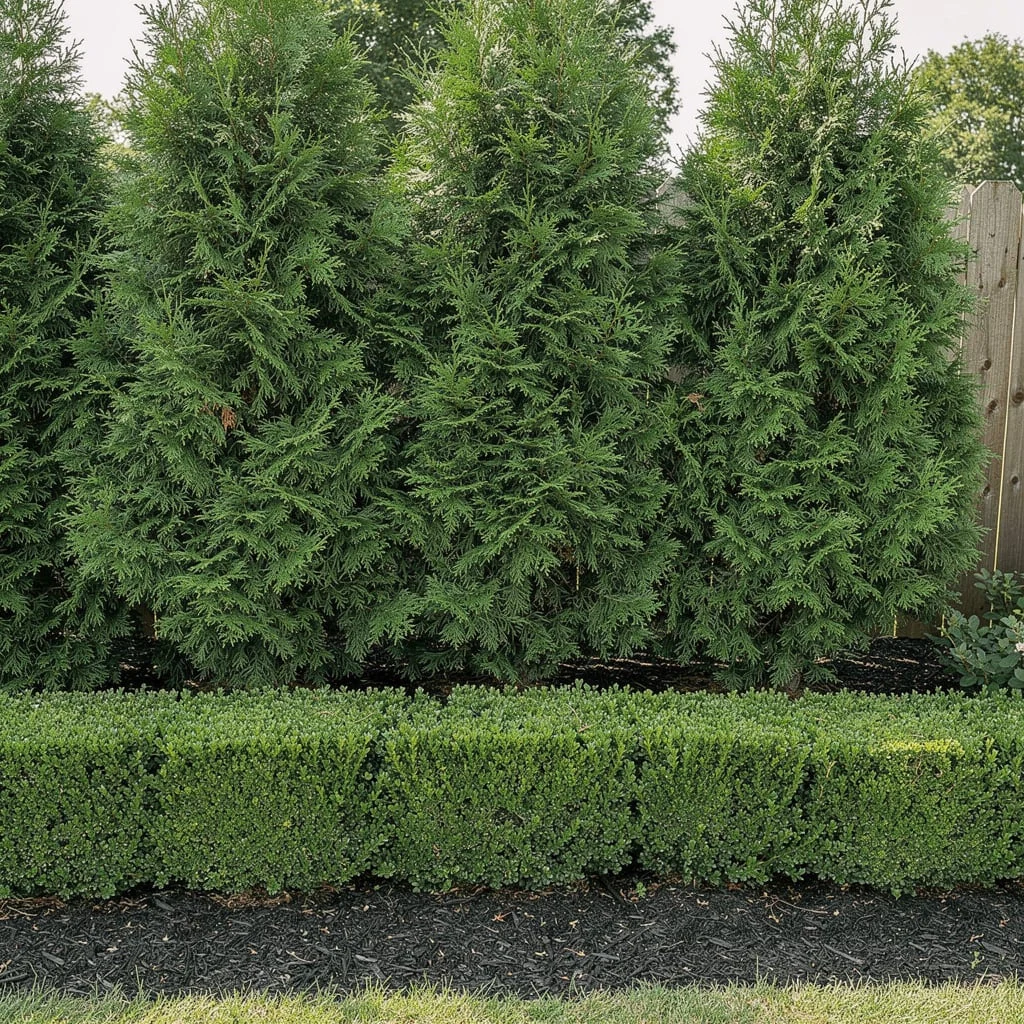
For a space where clean, controlled formality is the goal, plant a back row of Thuja ‘Green Giant’ or Leyland Cypress at 1.5 metre spacing for the tall screen. In front, plant a continuous formal boxwood hedge — Buxus sempervirens — clipped flat at 50 to 60cm height.
The combination delivers two green planes at completely different scales. The tall arborvitae create the privacy screen. The low boxwood creates a clean horizontal line that frames the entire bed and makes the taller trees read as a deliberate backdrop rather than a random planting.
Use black hardwood mulch between the boxwood and the arborvitae. Keep the boxwood face vertical and the top flat. Clip once in June and again lightly in September.
The Fastigiate Deciduous Tree Colonnade Against a Stone Wall
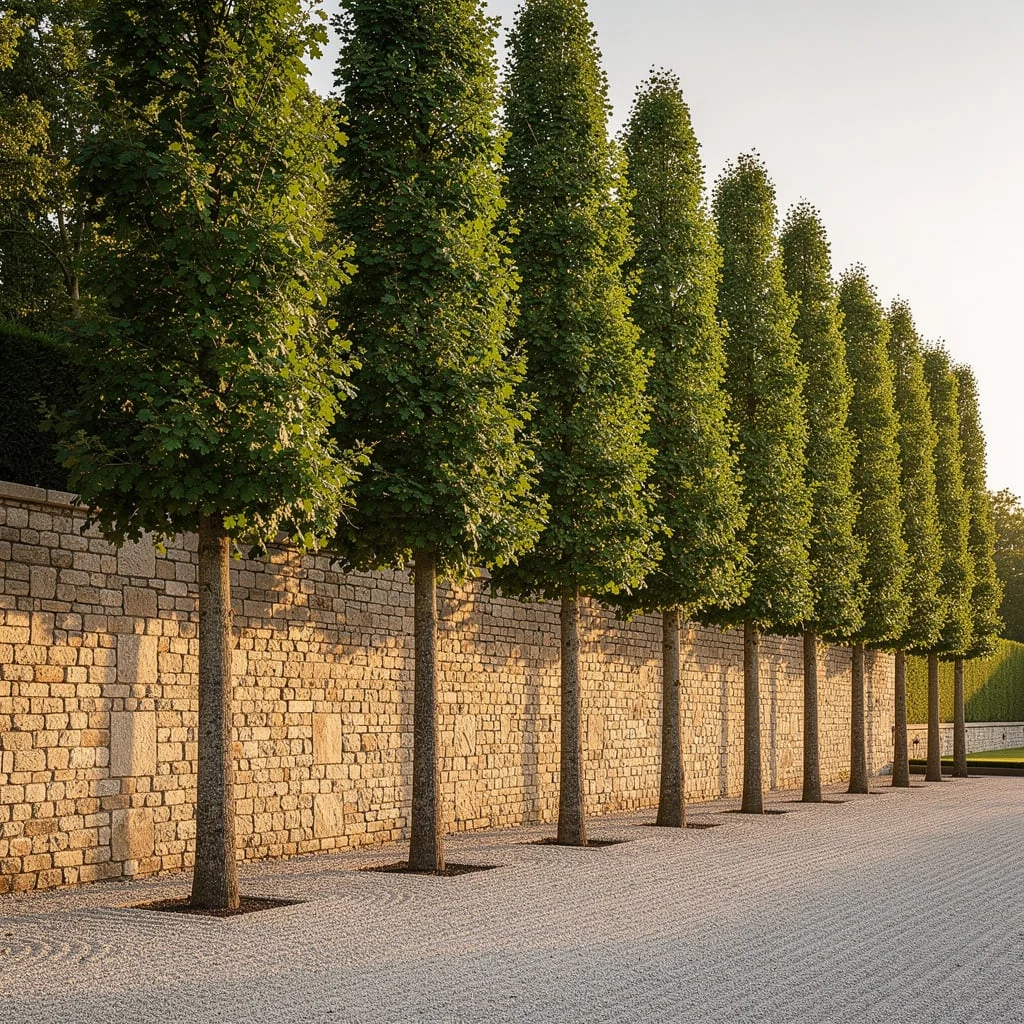
Where budget exists and permanence is the priority, plant columnar deciduous trees — Carpinus betulus ‘Fastigiata’ (Upright Hornbeam), Quercus robur ‘Fastigiata’ (Columnar English Oak), or Tilia cordata ‘Greenspire’ — at 2 to 2.5 metre spacing against a dressed stone or limestone block wall.
Set the base in fine gravel — white limestone chips or pale buff aggregate. No edging between the trees and the wall: let the gravel run cleanly to the wall base and out to the lawn edge, with a single steel strip defining the outer boundary.
These trees are slow. They will take ten years to deliver serious screening. But they will be there in a hundred years when everything else has been replanted three times. They require no routine pruning if spaced correctly. They deliver extraordinary seasonal colour — fresh green in spring, dense canopy through summer, gold in autumn, architectural bare structure in winter. The investment is long. The result is permanent.
What Every Great Privacy Planting Has in Common
Every example here works for the same reason. Not because of the species. Not because of the spacing or the mulch colour or the fence choice — though all of those matter.
They work because someone made a decision. Not a compromise. Not a cautious middle ground. A choice about what kind of garden this would be and what it would ask of the plants and the structure and the ground.
The fence-and-tree problem is actually a design problem. The question isn’t which tree screens best. It’s what you want your boundary to be when you’re standing inside the garden and looking at it. That question deserves a genuine answer.
Privacy is the minimum requirement. The best of these plantings deliver something beyond that. They deliver a garden wall you’d choose to look at even if you lived on a desert island with no neighbours at all.
That’s the standard worth aiming for.