
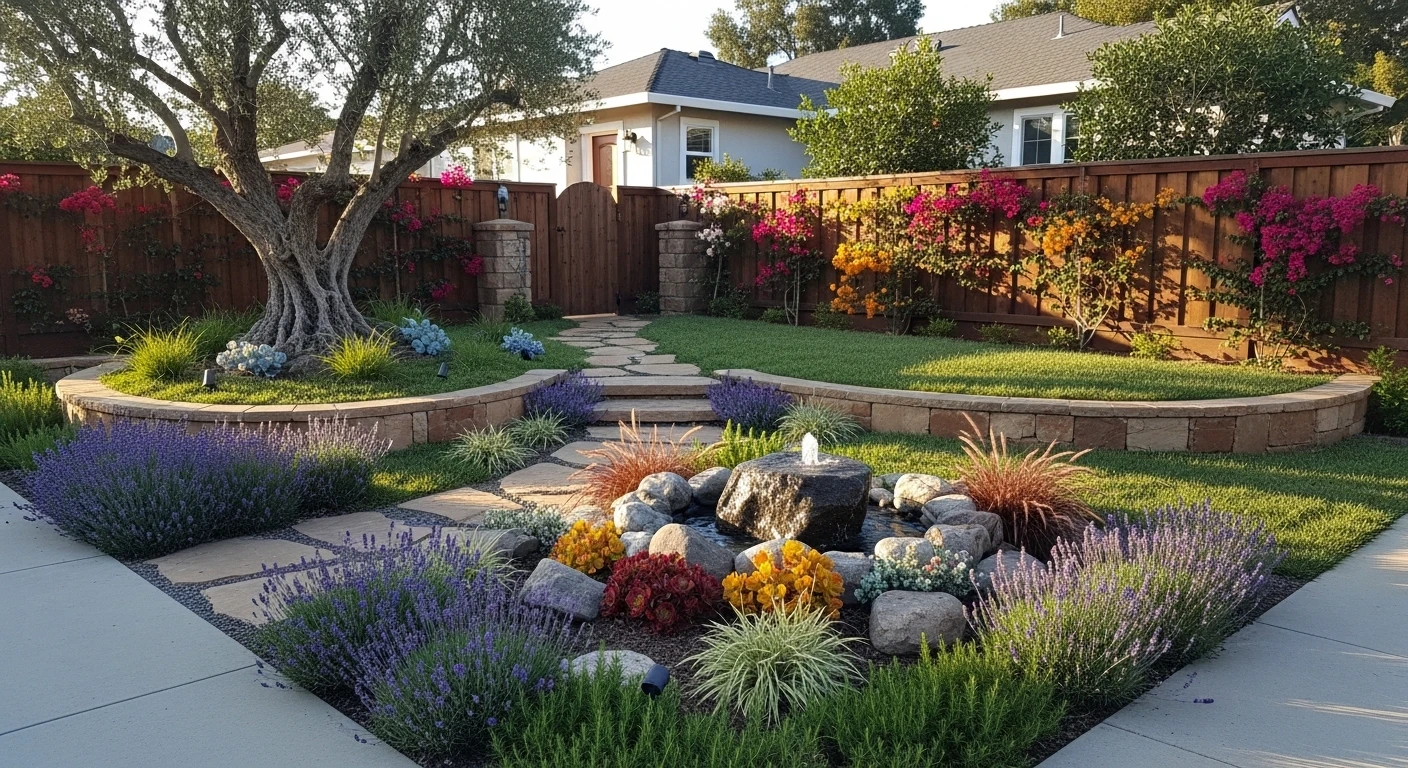
Most front gardens are afterthoughts. The builder put down some turf and a straight path, and nobody has questioned it since. The result is a house that exists rather than one that arrives. You see it, you note it, and you forget it before you’ve closed the gate.
The front garden has one job that no other part of the property shares. It sets the expectation for everything inside. A front garden that is confident, considered, and coherent makes the house feel larger, more valuable, and more cared for before anyone has crossed the threshold. A neglected or generic front garden undermines the house regardless of how much money has been spent on the interior.
Every idea here takes a different approach to the same challenge: making the arrival matter.
The Front Garden Is a Different Kind of Space
It doesn’t behave like a back garden. You don’t live in it. You move through it, usually quickly, once or twice a day. Neighbours and strangers see it constantly. It has to work at a range of distances — from across the street, from the pavement, and from the doorstep. That’s three completely different viewing scales, and most front gardens fail at all three simultaneously.
What Distance Sees and What Proximity Reveals
From across the street, only the large moves register. The colour of the house, the silhouette of major plants, the line of the path, the presence or absence of a focal point. No one can see individual flower varieties or the quality of your edging from fifteen metres away. That scale is about structure and mass.
From the pavement, texture starts to read. The material of the path, the form of clipped shrubs, the contrast between a hedge and what’s planted in front of it. This is the mid-distance view that most people spend the most time in as they approach.
From the doorstep, everything is visible. The detail of a container planting, the patina on pots, whether the mulch is fresh, how precisely the hedge has been clipped. This is where the quality of attention either shows or doesn’t.
Design your front garden to work at all three scales. The same garden can be bold from the road, interesting at mid-distance, and beautiful close up. It just requires thinking about each viewing distance separately.
Why the Path Is More Important Than the Planting
The path is the first experience of the garden. Its material, its width, its route, its alignment with the door — these are the primary design decisions. Everything planted either side of it is secondary.
A path that is too narrow makes the approach feel mean. A path that runs dead straight and centre might work for a formal symmetrical house and feel aggressive in front of anything else. A path that curves gently without any reason to curve looks indecisive. The route the path takes should be legible. It should feel natural to walk.
Most front gardens improve dramatically when the path is widened, the material upgraded, or the route adjusted. Fix the path first. Then think about the planting.
Symmetry Is Not the Same as Balance
Many front gardens attempt symmetry because it feels safe. A matching shrub either side of the door, a pair of pots on the steps. True symmetry requires perfect execution — the same plant at the same stage of growth, the same distance from centre, the same clipping standard. When that precision fails, the attempt at symmetry reads worse than no attempt at all.
Balance is easier to achieve and more forgiving. Different elements on either side of a central axis that carry equivalent visual weight. A large pot of one variety on one side; a group of three smaller elements on the other. A tall clipped column to the left; a lower spreading mound to the right. The eye reads these as balanced even though they’re not identical
Front Garden Ideas
The Modern Stone-and-Slate Approach with Architectural Container Planting
For a contemporary home with stone cladding or rendered exterior, lay large-format bluestone or dark slate pavers as the primary path — minimum 90cm wide, ideally 1.2 metres — with wide joints filled in black basalt chip or dark sand. Avoid light-coloured jointing material: it draws the eye to the gaps rather than the stone.
Edge both sides of the path with planting beds filled with black hardwood mulch. In the bed immediately adjacent to the porch or entrance step, position a cluster of large-scale tropical-looking containers: a Colocasia esculenta in a tall matte black pot for drama, a Boston fern in a lower container for softness, and a Caladium for colour. Use the same matte black container material throughout.
Flank the path with low, spreading evergreen groundcover — Cotoneaster dammeri or Juniperus horizontalis — punctuated at intervals with a Japanese maple (Acer palmatum ‘Bloodgood’) for seasonal drama. Behind that, a row of columnar junipers to give height without mass. The entire palette is dark-toned: dark stone, dark mulch, dark containers, dark foliage. The house provides the relief.
The Victorian Terraced House with Climbing Roses and Clematis
Fix two grey-painted timber trellis panels to the brick either side of the front door — one per side, floor to eaves height. Use a recessed trellis mounted 8 to 10cm off the wall surface to allow air circulation behind the plants and reduce disease pressure.
Plant one climbing rose on each side. For a pink, old-rose tone choose Rosa ‘Mortimer Sackler’, ‘Generous Gardener’, or ‘The Generous Gardener’ for their delicacy and scent. Train the first stems horizontally along the base of the trellis before allowing vertical growth — this stimulates more lateral flowering shoots and prevents the common problem of bare lower stems.
Through each rose, thread one Clematis ‘Perle d’Azur’ or ‘Arabella’ for the soft periwinkle-blue flower that amplifies the pink of the rose without competing. The two plants flower at different times and require different pruning regimes — keep this in mind. Prune the rose lightly after first flush. Prune the Clematis to 30cm from the base in late February.
At the base, plant Gomphrena globosa in deep crimson, Persicaria bistorta ‘Superba’ for its candyfloss-pink poker flowers, and a pot of deep pink Pelargonium on the step. The exuberance is the point.
The Formal American Front Garden with Island Beds and a Central Focal Point
Mark a series of circular island beds in an otherwise open, well-maintained lawn. Use a garden hose to draw the circles first, aiming for beds of 1.2 to 1.5 metre diameter. Edge with low stacked-stone or brick surrounds approximately 15 to 20cm high — enough to define the edge visually without creating a raised bed.
In each island, plant one or two standard ball-clipped Buxus sempervirens topiaries as the structural anchor, surrounded at the base with seasonal colour: Begonia semperflorens in red or orange for summer, Viola for autumn. Place a stone bird bath, cat figure, or classical urn as a focal point at specific beds rather than in every one.
Position a two-tier stone fountain at the garden’s central axis — the point equidistant from the house and the street. Keep the surrounding lawn impeccably mown: this style of garden fails entirely if the grass is not well maintained. Behind the island beds, allow Hydrangea paniculata ‘Limelight’ to grow to its natural width as a background mass of white-green flowers from July onwards.
The Corten Steel Beds on White Gravel for a Contemporary Front
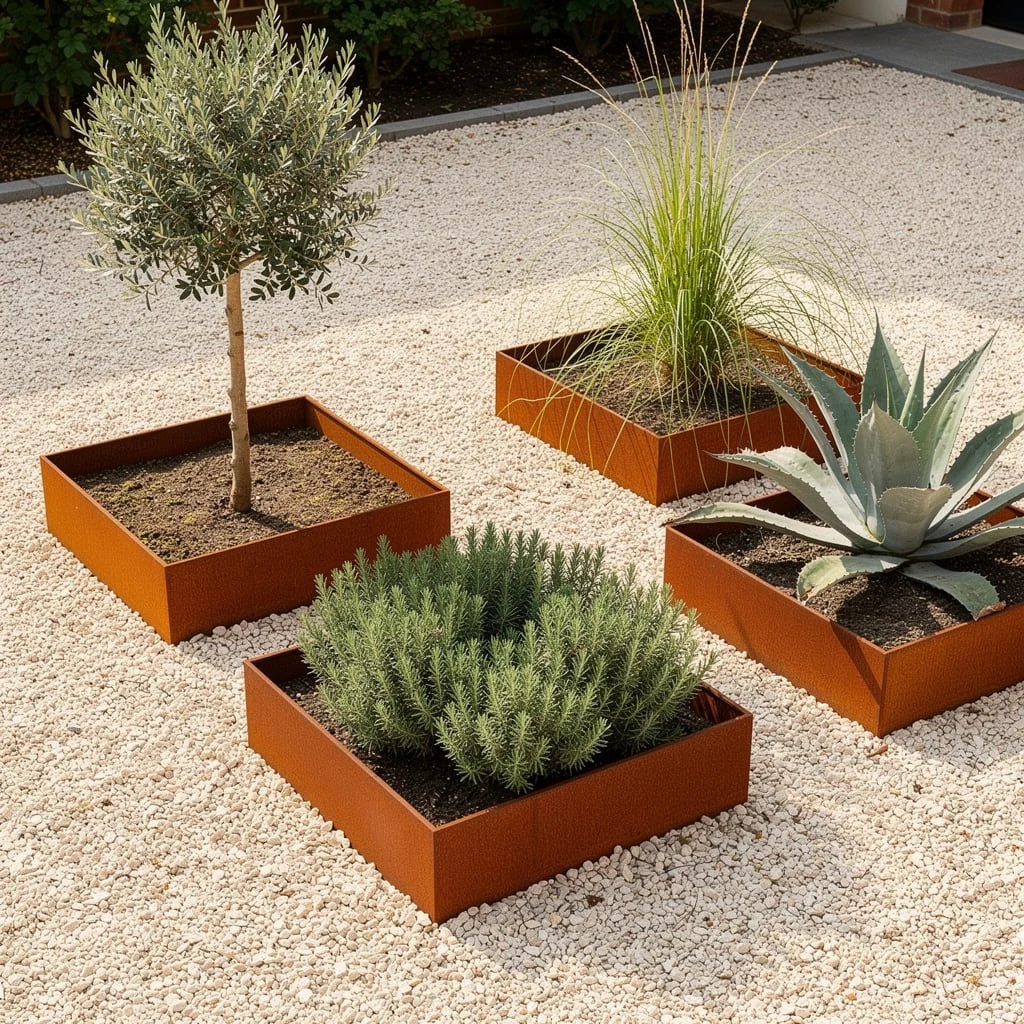
Lay a deep bed of white pea gravel — a minimum of 10cm depth over landscape fabric on a compacted sub-base — across the entire front garden. No lawn, no planted ground. The gravel is the floor.
Commission or purchase four to six low-profile Corten steel raised beds, each approximately 1 metre square and 20 to 25cm deep. The Corten weathers to a warm rust-orange within the first season and requires no maintenance thereafter. Position the beds at irregular but considered intervals across the gravel — not in a grid, not randomly. Think of them as sculpture placed in a gallery.
Plant each bed with a single dominant specimen: an olive tree standard in one, a clump of Festuca glauca in another, an Agave americana in a third, a rosemary standard in a fourth. The restraint is everything. One plant per bed. No underplanting within the beds. The gravel provides the neutral context and the Corten provides the warmth.
The Formal Parterre with Box Balls and Architectural Hedging
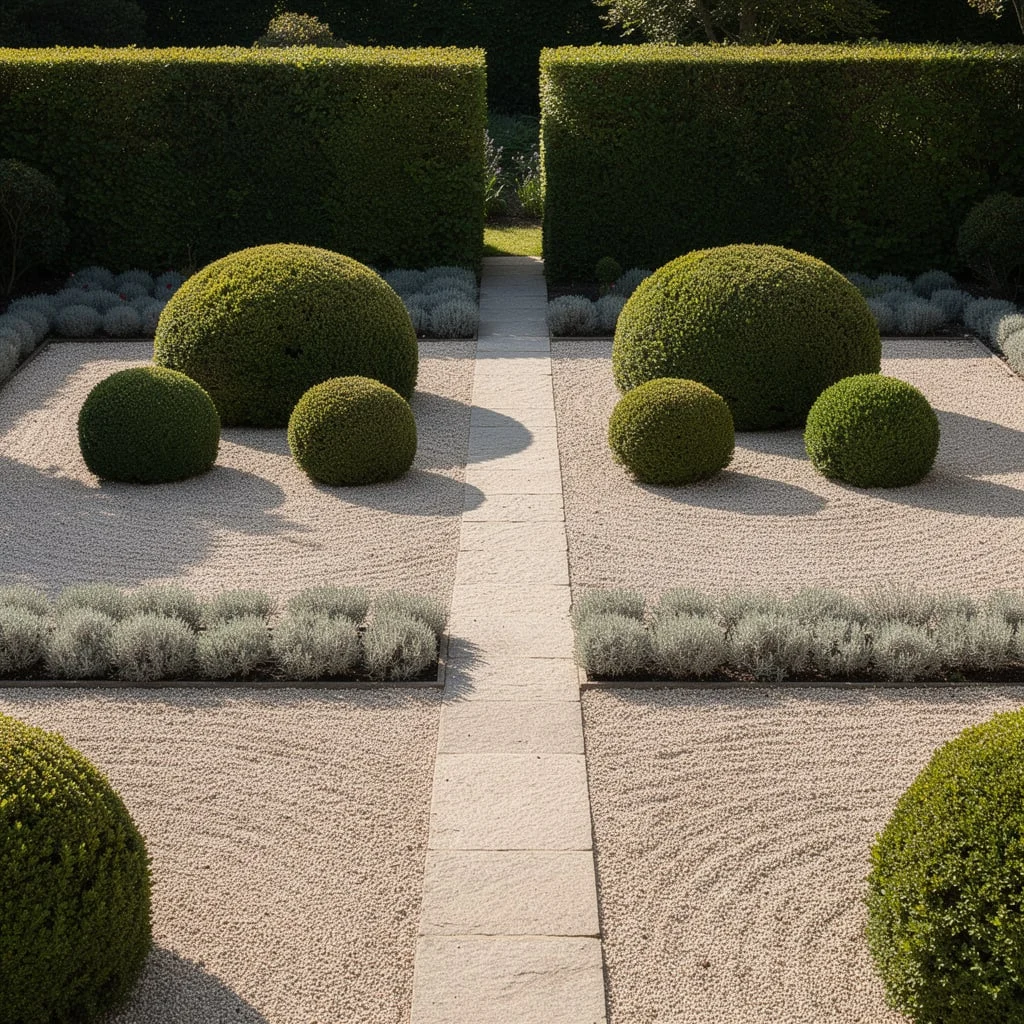
Install two tall hedges — yew, hornbeam, or Leyland cypress — as the outer structure of the garden, running parallel to the path from gate to door. These should be clipped flat-faced and square-topped to create wall-like architecture. Allow at least two seasons of establishment before hard clipping.
Between the hedges and the path, create gravel panels in a pale buff limestone or cream aggregate. Within each panel, plant Buxus sempervirens in ball form — clip to strict sphere shape twice per year, once in May and once in September. Use graduated sizes: a 60cm ball flanked by a 40cm ball on each side creates rhythm without monotony.
Edge the front face of the gravel beds with a ribbon of silver Santolina chamaecyparissus or Stachys byzantina, clipped flat. These silver strips read beautifully from distance and tie the panels together. The central path should be a single run of smooth limestone slab, joints tight and consistent.
The Layered Shade Planting Under an Existing Tree
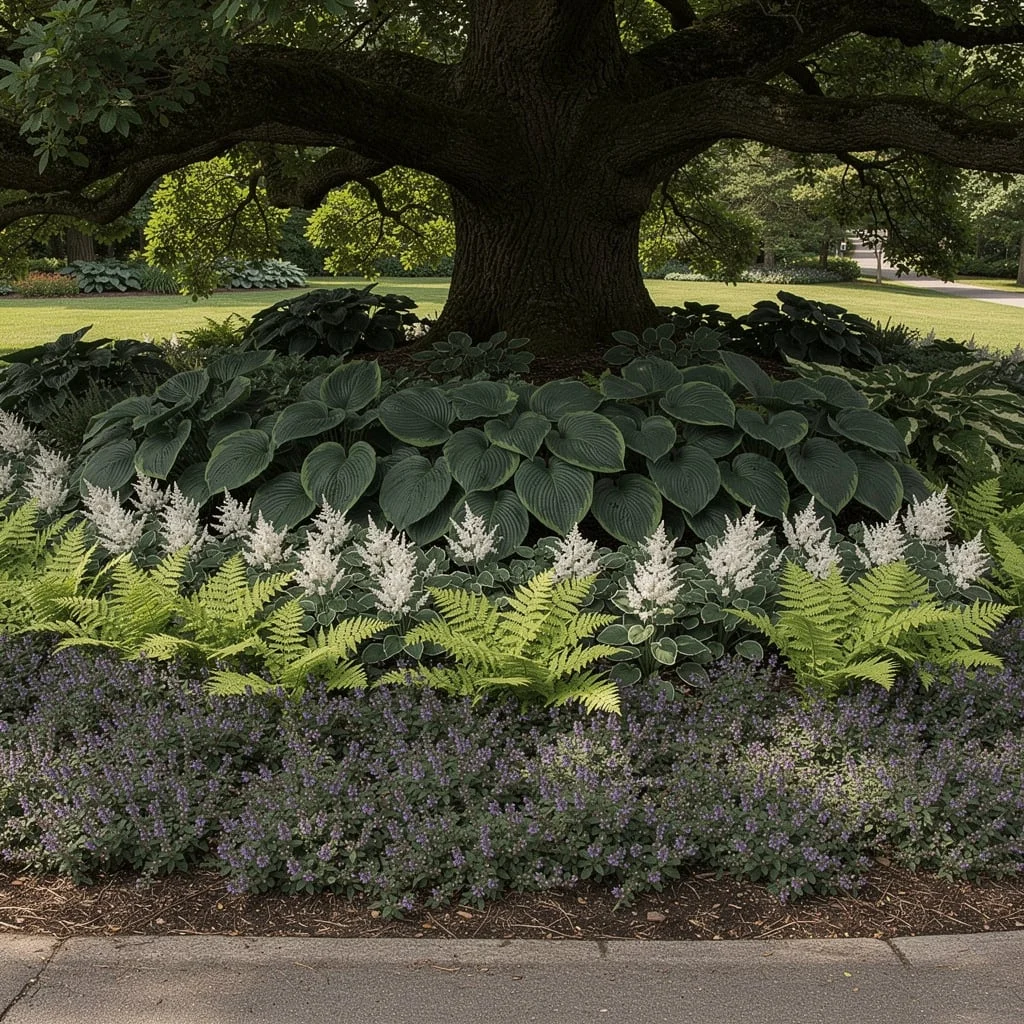
If the front garden contains a large established tree — oak, lime, sycamore — this is one of the most valuable features possible. Do not fight it. Work with the conditions it creates.
Clear the grass from the root zone (never dig in this area — you’ll damage the roots). Work inward from the outer drip line of the canopy. Spread a 7 to 8cm layer of well-composted bark mulch gently around the base, keeping it clear of the trunk itself.
Plant in distinct layers around the trunk: the outer edge with Nepeta racemosa ‘Walker’s Low’ as a low flowing purple-blue mass. Inside that, a band of bright green Dryopteris filix-mas ferns for fresh texture. Inside that, white Astilbe arendsii varieties for the white flower spires that illuminate shade beautifully in June. Closest to the trunk, mass-plant large dark Hosta cultivars — ‘Halcyon’, ‘Elegans’, or ‘Sum and Substance’ — for the bold leaf presence that anchors the whole composition.
The Desert Xeriscape with Boulder Composition
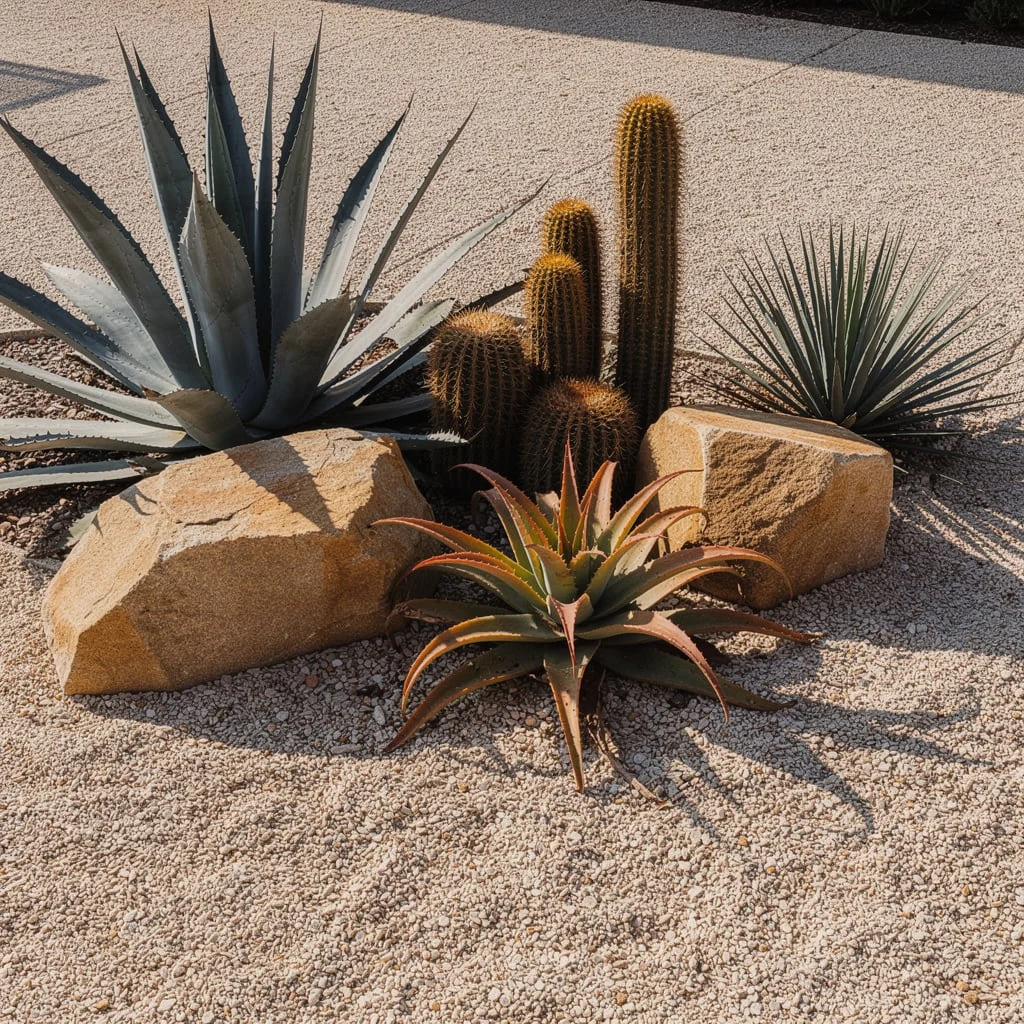
This requires a long-term climate check — genuine xeriscape works in USDA zones 8 and above or in areas with reliably warm, dry summers. If your climate suits it, it is one of the lowest-maintenance front gardens possible.
Lay decomposed granite or buff rounded pea gravel across the entire bed area. No lawn. Position two or three large sandstone or granite boulders — genuine field stone, not manufactured — as the sculptural anchors. These should be partially buried, not sat on top of the surface. A boulder that sits fully on top of the ground looks placed. One that appears to emerge from it looks found.
Plant in simple groups around the boulders: Agave americana as the dominant bold form, Echinocactus grusonii barrel cactus in a cluster for vertical interest, Aloe ferox for warm orange winter flower and red-tipped foliage, Yucca rostrata for the fine blue leaf ball on a stem. No irrigation once established. Annual maintenance consists of removing dead leaves from the agave’s lower skirt and raking the gravel flat.
The Monochrome Minimal Front Garden with Slate and Silver Grass
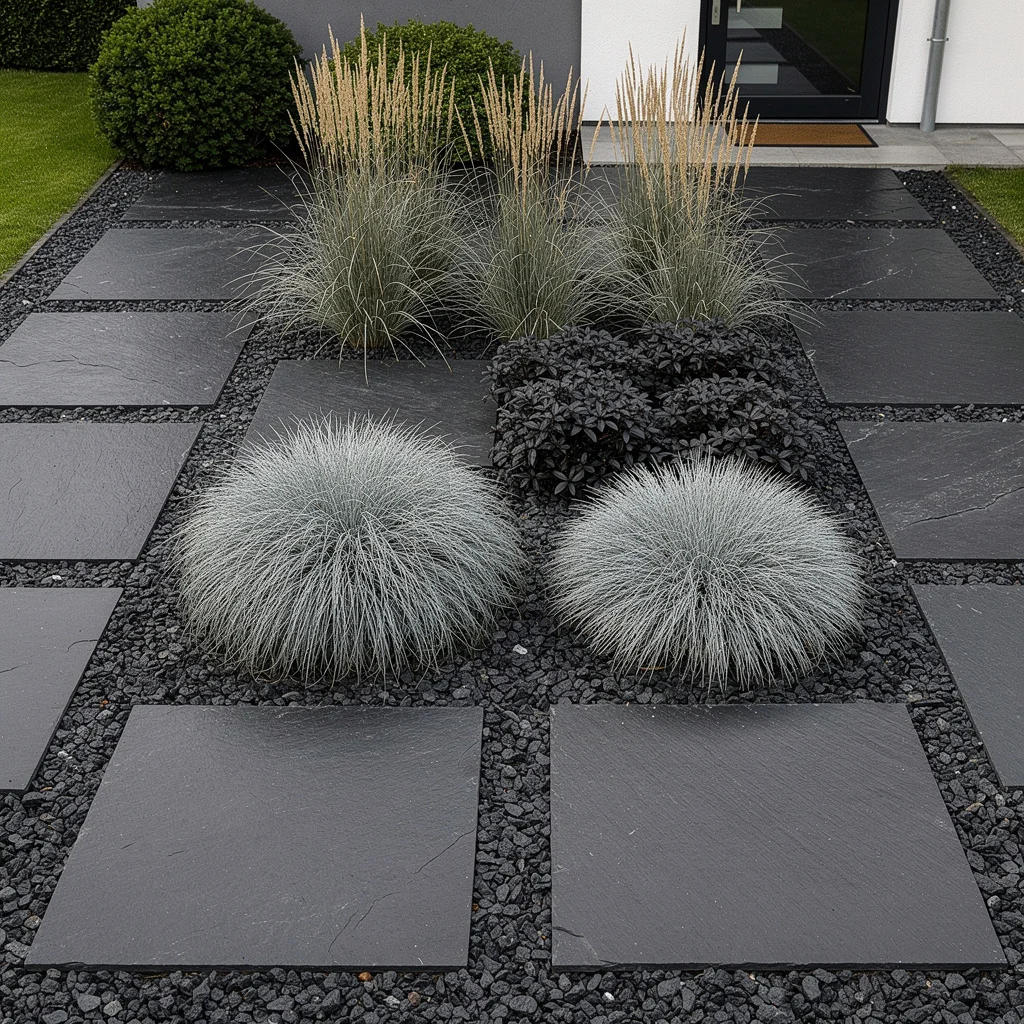
Lay large-format charcoal or blue-black slate pavers across the front garden in a straight running bond or staggered grid pattern. Fill joints with fine black basalt aggregate raked flush. No lawn, no planted beds at the edges — the pavers extend to the boundary wall or fence.
Cut planting pockets directly into the layout at the design stage: two rectangular openings in the paved surface, each approximately 60 x 90cm, positioned either side of the central path axis. Fill these pockets with black basalt chip as a ground layer. Plant two paired clumps of Festuca glauca ‘Elijah Blue’ — silver-blue, perfectly spherical grass mounds — in the forward pockets. In the pockets closest to the house, plant Calamagrostis x acutiflora ‘Karl Foerster’ for the upright amber plume and a low mass of Ophiopogon planiscapus ‘Nigrescens’, the black mondo grass, as contrast.
The entire palette is silver, black, and charcoal with warm amber in late summer. No colour. No seasonal bedding. No annual intervention beyond cutting the ornamental grasses back in February.
The Japanese-Inspired Garden with Raked Gravel and a Red Maple

This is not an attempt to replicate a Japanese garden. It is a front garden that borrows the logic of the karesansui — the dry stone garden — and applies it with appropriate restraint.
Lay white or pale grey granite sett or sieved granite chip across the bed area to a depth of 8cm on compacted sharp sand over weed membrane. Use a hand rake with 5cm tine spacing to create concentric ripple patterns around the stone placements. This takes five minutes per week to maintain and should be done.
Position two large lichen-mottled boulders — granite or limestone, genuinely weathered, not split stone — as the primary elements. Offset them from each other; they should not sit at equal distances from any axis.
Plant one Acer palmatum dissectum in the deepest, most sheltered corner — the weeping crimson laceleaf maple. Give it a circular dark mulch surround. Along one wall, plant a clipped Fargesia or Phyllostachys hedge to 1.2 to 1.5 metres, kept tight and formal. Lay a path of irregular dark slate stepping stones from gate to door, each stone individually placed by eye rather than evenly spaced.
The Wisteria Pergola Front Entrance
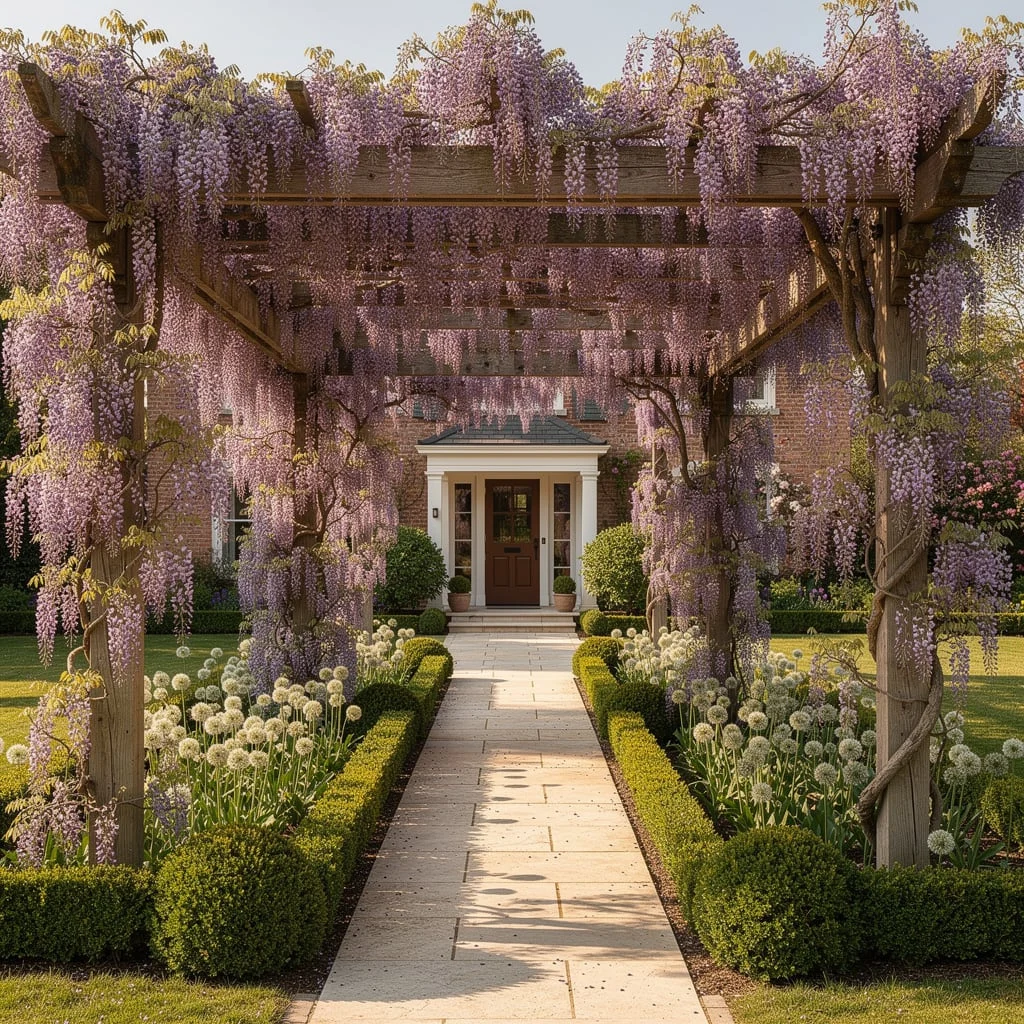
This takes three to four years to achieve and a lifetime to enjoy. Build a solid oak or pressure-treated timber pergola spanning from the front boundary gate to the front door — two uprights at the gate, two at the door, with substantial cross beams and secondary purlins. Use 150mm x 150mm uprights minimum and ensure they are set in concrete footings 600mm deep.
Plant one Wisteria sinensis ‘Prolific’ at the base of each upright. In the first season, train all growth horizontally along the lowest beam of each side. In subsequent years, allow vertical growth but direct all lateral shoots back along the overhead pergola frame. Remove suckers growing straight down from the overhead structure — these become the whips that prevent light getting through.
Either side of the pergola path, plant low clipped boxwood hedge beds and underplant with Allium ‘Mount Everest’ in white for May interest that coincides with the wisteria bloom. The combination of hanging mauve blossom overhead and white allium spheres at ground level, all seen in the same frame, is one of the most spectacular front garden views in temperate gardening.
The Raised Stone-Wall Entrance Feature with Mosaic Floor Panel
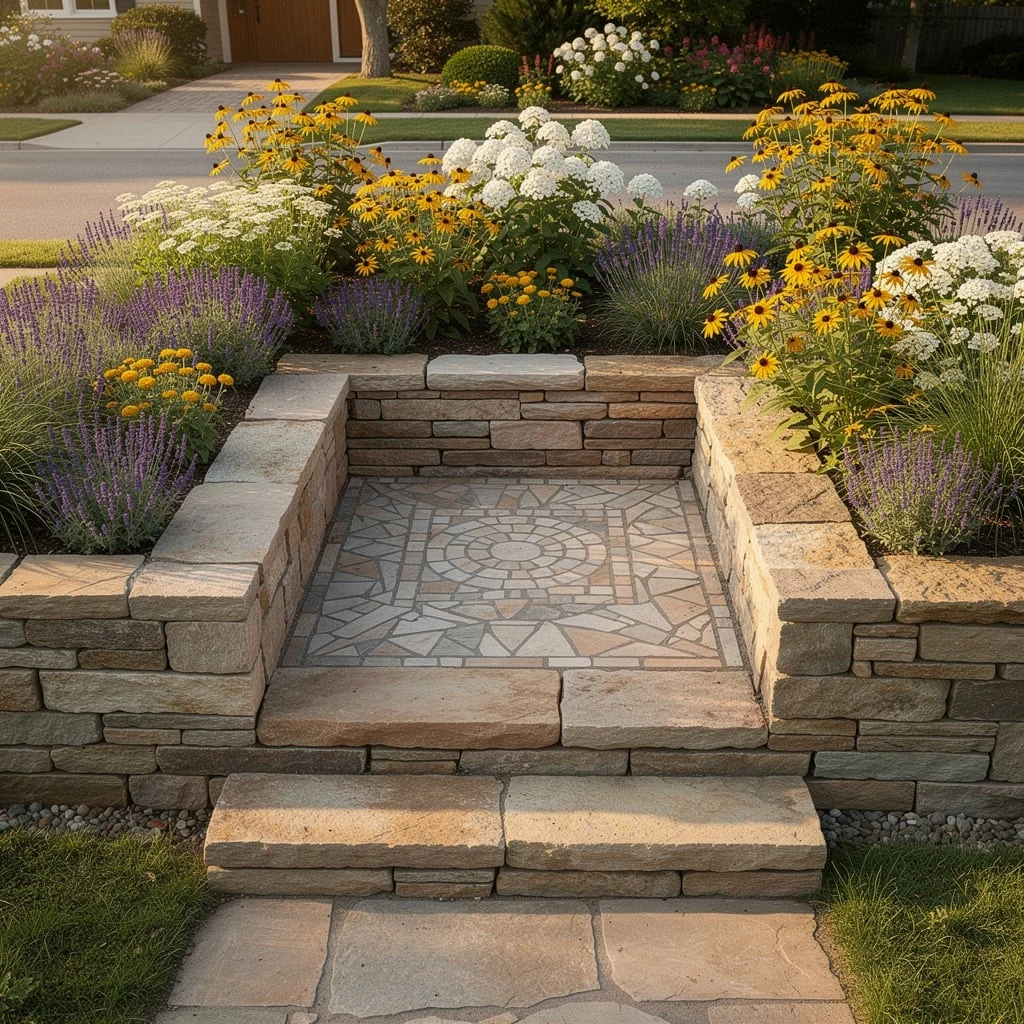
Build a U-shaped dry-stacked or mortared sandstone wall approximately 45 to 50cm high, opening toward the pavement or street. The interior of the U forms a shallow forecourt — approximately 1.5 metres square — with the open side facing the approach.
Within this forecourt, install a mosaic floor panel using broken natural stone, slate, terracotta, and marble chip in a geometric compass rose or sunburst pattern set in grey exterior mortar. This is a permanent installation that should be sealed with outdoor stone sealer annually.
On top of the retaining walls, position large flat capstone pieces — these become natural seating surfaces. Plant behind and around the wall in generous drifts: Rudbeckia fulgida for yellow daisy flowers from July to October, Lavandula x intermedia ‘Grosso’ for silvery-purple mass in June, Salvia nemorosa ‘Caradonna’ for the dark-stemmed vertical purple spikes, and white Hydrangea paniculata at the back for late-season presence.
The Wildflower Meadow with Mown Grass Path
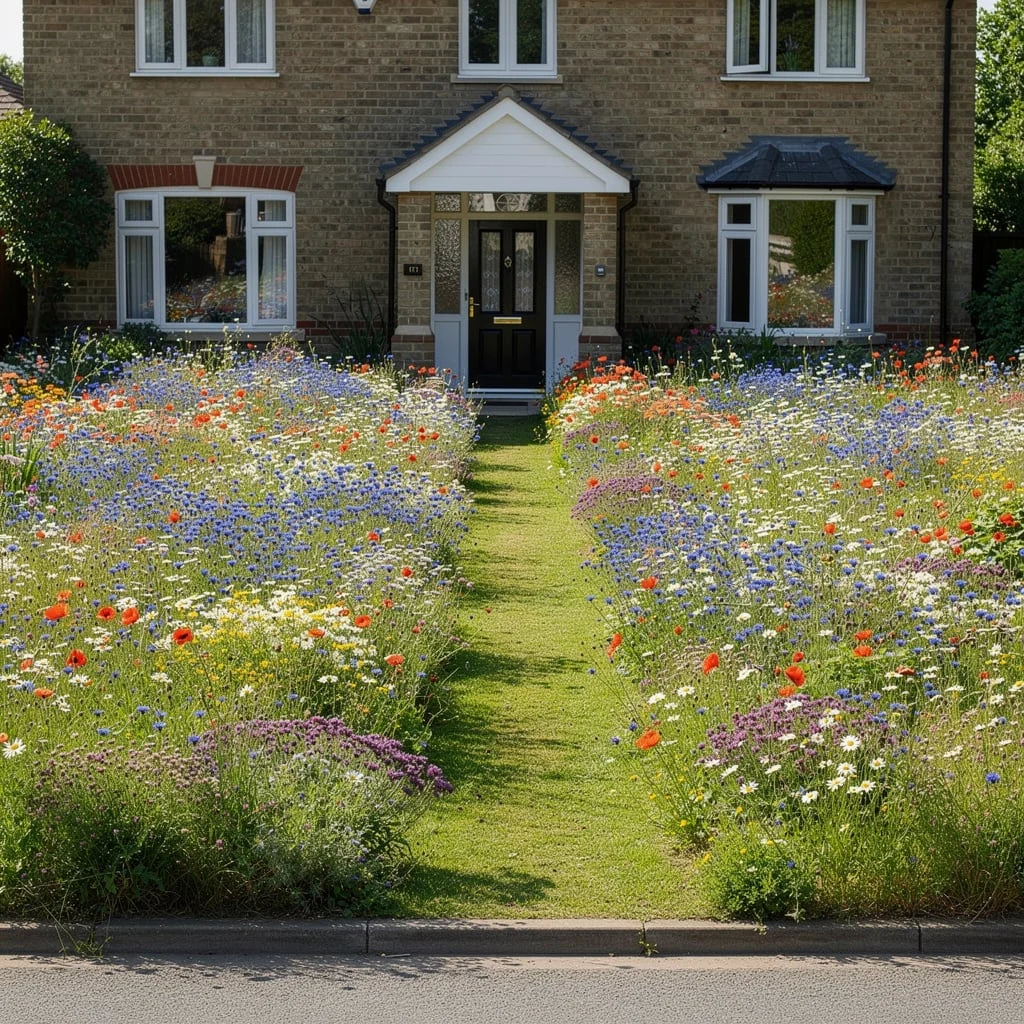
Strip the existing front lawn entirely. Rotavate and level the soil. Apply a thin layer of poor, low-fertility subsoil or sand to the surface — wildflowers thrive on impoverished ground and your topsoil is almost certainly too rich.
Sow a British or regional native annual and perennial wildflower mix by hand in September or April — scatter by hand then rake lightly to just cover the seed. Do not cover deeply. The mix should include Papaver rhoeas (field poppy), Centaurea cyanus (cornflower), Leucanthemum vulgare (ox-eye daisy), Phacelia tanacetifolia, Ammi majus, and Agrostemma githago (corncockle) for the first season.
Leave a single mown grass path from the pavement to the front door — 60 to 80cm wide, edges kept crisp with a half-moon edger or rotary cutter. The precision of the mown path makes the wildness of the meadow either side read as deliberate rather than neglected. Cut the entire meadow in late August, remove all cut material, and allow the rosettes of perennial species to overwinter. Reseed any bare patches in autumn.
The Mediterranean Courtyard Corner with Terracotta and a Fountain
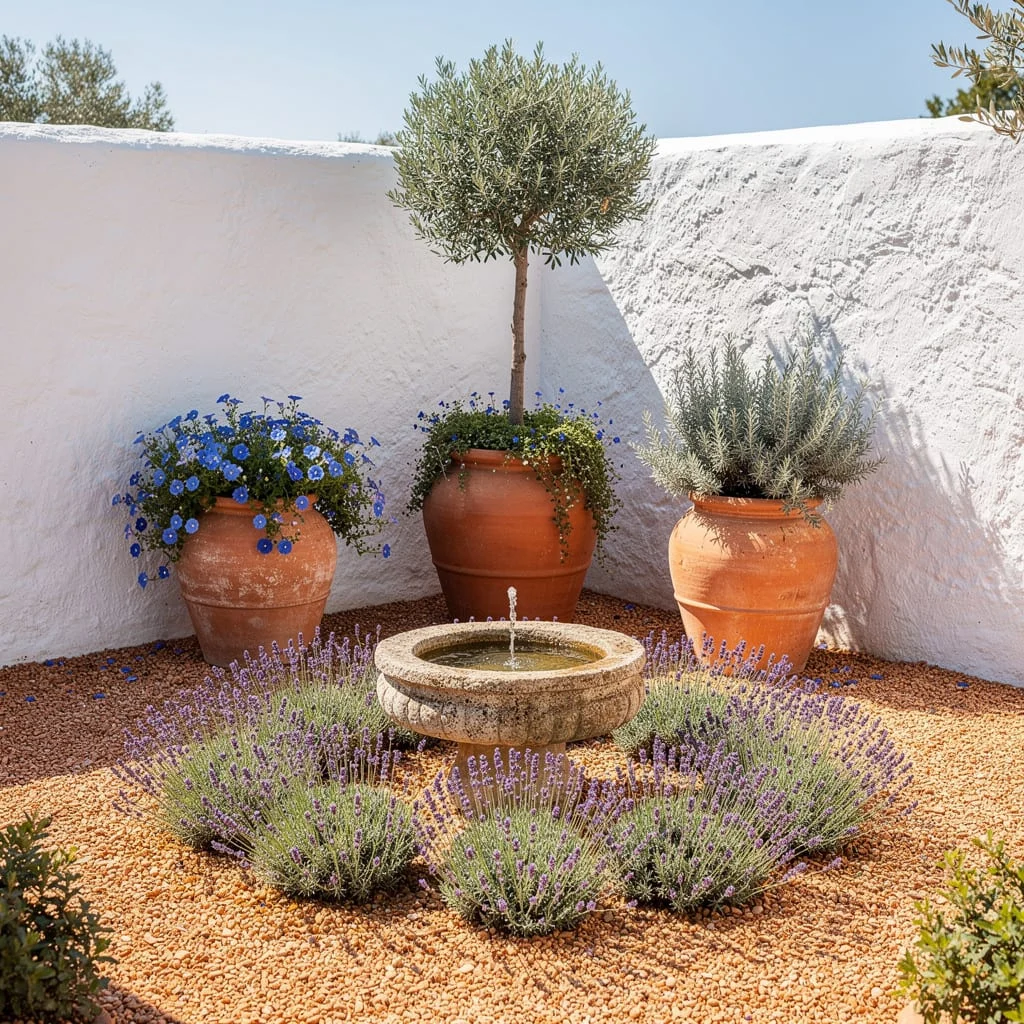
Position three substantial terracotta amphorae or traditional Mediterranean-style pots in a corner where two walls meet — ideally white rendered or pale stone walls that provide reflective brightness. Vary the pot sizes: one large 60 to 70cm pot in the centre rear, one medium pot to the left, one smaller pot to the right.
Plant the central pot with an olive tree standard — buy a large specimen, at least 1.2 metres of clear stem. The investment in an established tree is worth it. Plant the left pot with blue Convolvulus sabatius, which cascades over the pot rim in waves of small pure-blue flowers from June to September. Plant the right pot with silver Helichrysum italicum — curry plant — for the intense silver foliage and warm aromatic scent.
At the base, set a low stone basin fountain — the kind that circulates water through a simple submersible pump with just enough movement to create sound without spray. Surround it with five or six Lavandula angustifolia plants in the warm-toned gravel ground. The scent alone makes this one worth building.
The Formal Rose Parterre with Brick Edging
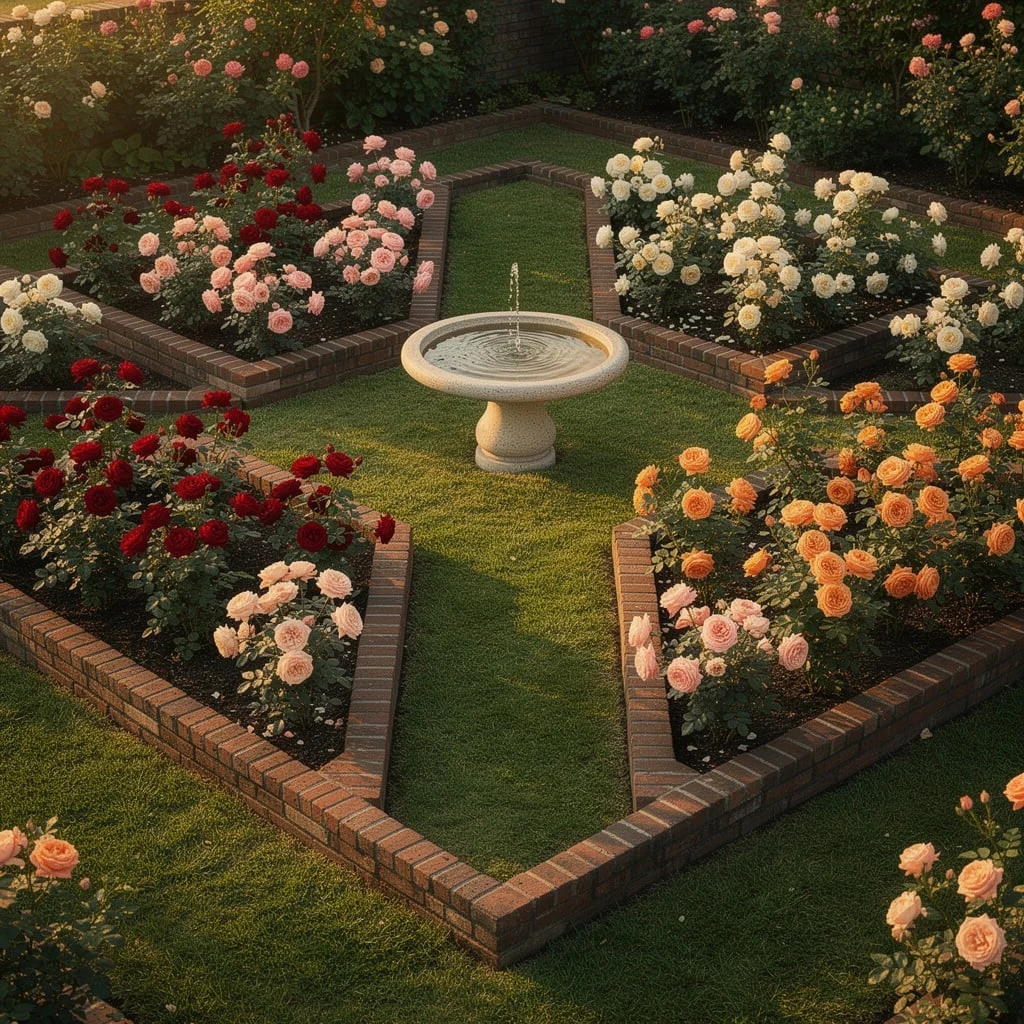
Lay the brick edging first. Use a standard reclaimed brick on edge, set in mortar to 10cm above the lawn level, in a diamond or chevron geometry that divides the front lawn into four to six distinct triangular or diamond-shaped beds. The geometry should be laid out with a builder’s line and pegs, then adjusted until the proportions look right in the actual space.
Install a simple stone birdbath or low bowl fountain at the centre point where the internal paths meet. Turf the paths between beds with a hard-wearing lawn mix and keep them clipped close.
Plant each bed entirely with roses — one colour per bed, mixed varieties. Use red in one quadrant (Rosa ‘Darcey Bussell’ or ‘The Prince’), soft blush pink in the next (‘Olivia Rose’, ‘A Shropshire Lad’), pure white in the third (‘Winchester Cathedral’, ‘Iceberg’), and warm apricot-orange in the fourth (‘Lady of Shalott’, ‘Jude the Obscure’). Use David Austin shrub roses throughout for their disease resistance, repeat flowering, and fragrance. Deadhead weekly through the season. Feed with rose fertiliser in April and June.
The Espalier Fruit Tree Wall
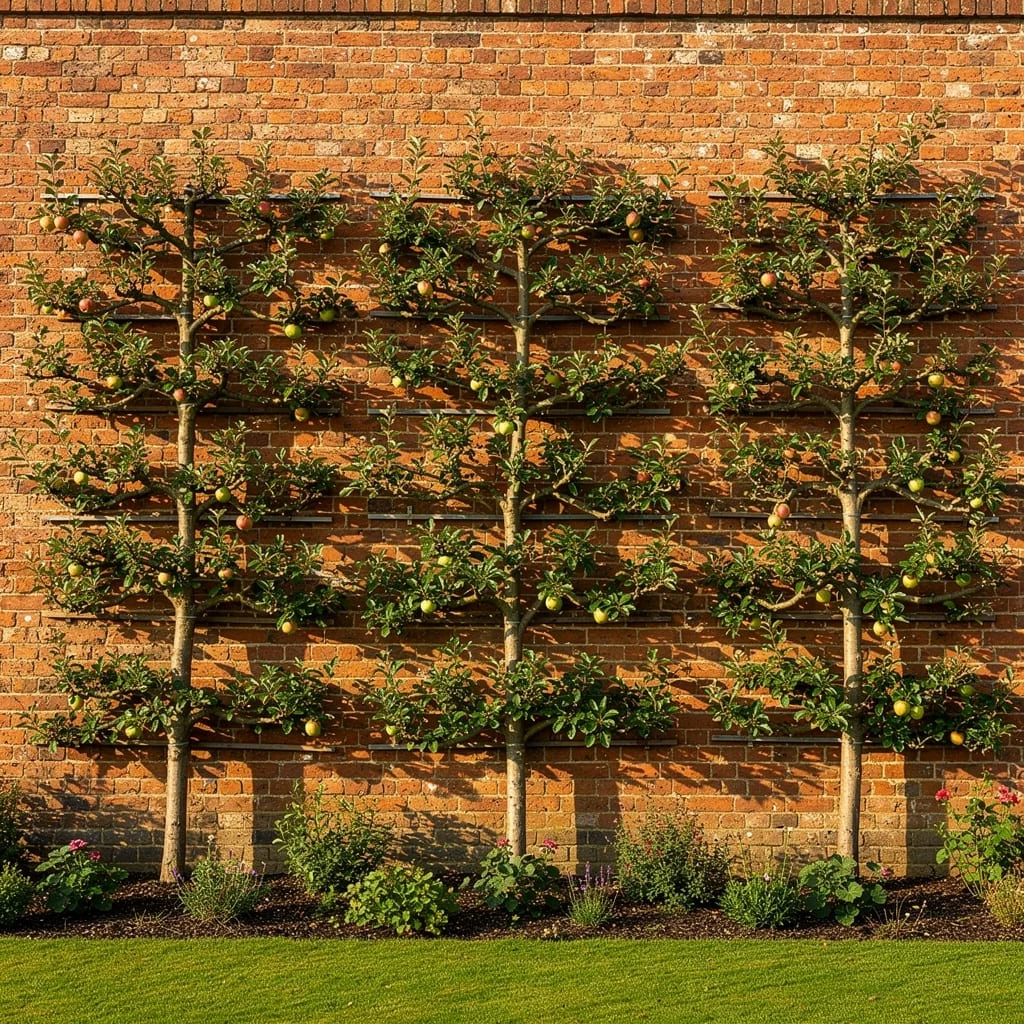
Fix galvanised wire supports horizontally across the full length of a brick or rendered wall, spacing the wires 40 to 45cm apart from a starting height of 60cm. Use vine eyes and tensioners to keep the wires taut. Each wire run must be level — check with a spirit level.
Plant apple trees on dwarfing M26 or semi-dwarfing MM106 rootstock at 2 to 2.5 metre intervals along the base of the wall. Immediately after planting, select two lateral branches growing in the plane of the wall and tie them down to the first wire at 45 degrees. Remove all other branches cleanly. In the following summer, lower these two branches to horizontal and tie to the wire. Select two new laterals from the leader for the second tier.
It takes four to five years to fill a wall to four tiers. Prune spur shoots to three leaves above the basal cluster in late July each year — this is the key to keeping the form tight and stimulating fruiting spurs. Underplant along the base with a low cottage mix: Geranium x magnificum, Lavandula angustifolia, and Fragaria vesca (wild strawberry) for soft informal contrast against the precision of the trained trees above.
The Front Garden Is a Commitment, Not a Project
Every garden here was built with a decision behind it. Not a compromise. A decision about what the space would be and what it would ask of whoever cared for it.
Some of these ideas are high maintenance: the espalier wall, the formal parterre, the rose garden. They repay attention with extraordinary results. Some are extremely low maintenance: the desert xeriscape, the Japanese gravel garden, the Corten steel and gravel layout. They repay restraint with permanence.
None of them are neutral. That’s the point. Your front garden faces the world every single day. It can be something worth looking at, or it can be something people look past on the way to the door.
That choice belongs entirely to you.