
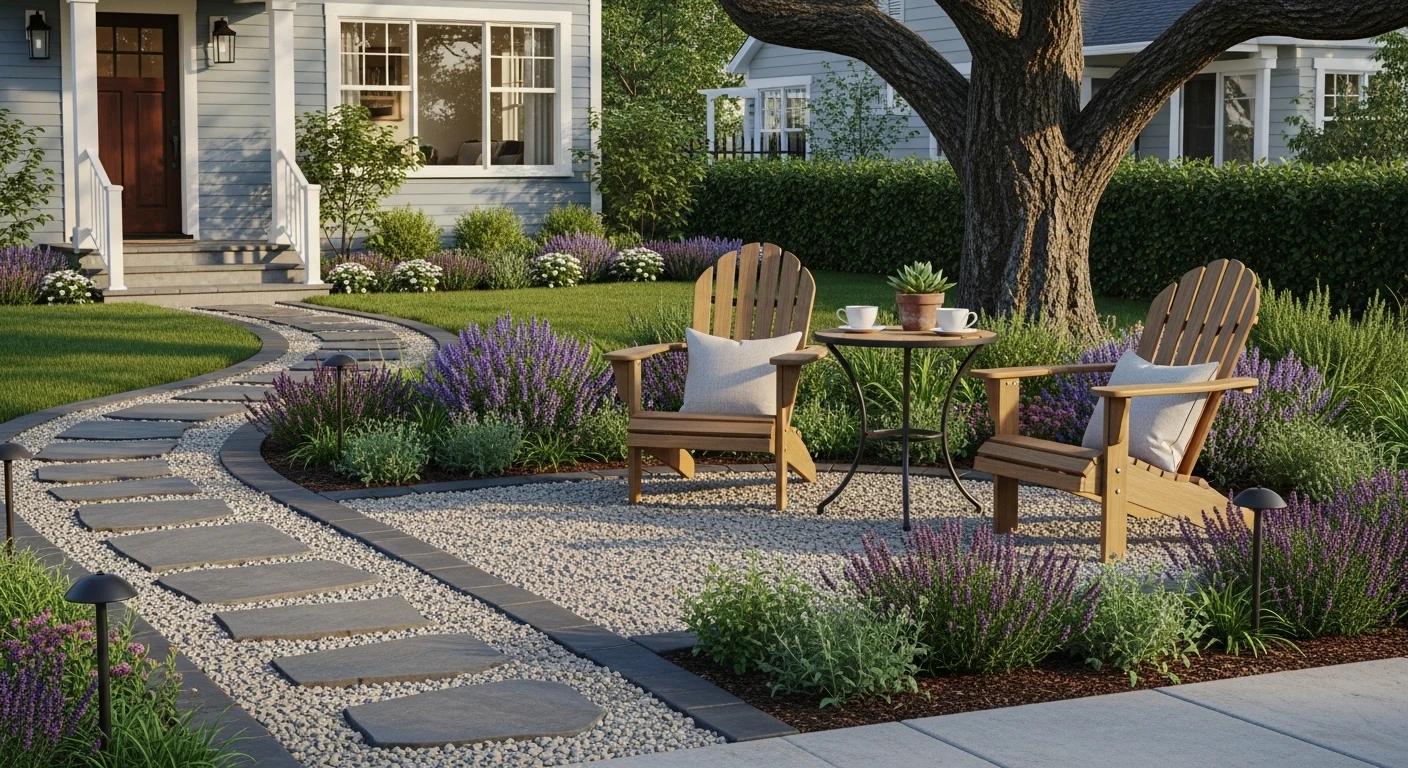
Most front yards are designed to be looked at, not sat in. The lawn gets mowed, the borders get planted, the path gets swept — and then everyone goes around the back. The front of the house becomes a stage set that nobody uses.
That’s a waste of what is often the best outdoor light, the most interesting street-facing view, and the only part of the property that genuinely connects to the neighbourhood. A front yard with seating changes the relationship between the house and the street. It says something about how the people inside want to live — not just how they want the house to appear.
Every idea here puts seating in the front. Some are fully committed outdoor rooms. Some are a bench against a wall and nothing else. All of them understand that sitting outside facing the world is not a luxury. It’s just a choice, and it’s one more people should be making.
Why Front Yard Seating Keeps Not Happening
The back garden gets all the investment and the front gets a lawn. There are real reasons for this — most people don’t want to feel exposed to the street while they’re trying to relax — but those reasons are worth examining rather than just accepting.
The Privacy Problem Is Usually Solvable
The number one reason people don’t sit in their front yards is the feeling of being watched. It’s a valid concern, but it’s a solvable one. A low planting at the boundary creates psychological separation even when it offers no physical privacy. A pergola or covered structure creates a sense of enclosure even when it has no walls. Two chairs facing each other at an angle rather than facing the street change the entire mood of the space.
The most successful front yard seating areas are not hidden. They’re framed. There’s a difference between being concealed and being composed. Composed spaces feel deliberate and settled. Concealed spaces feel defensive. Compose the seating. Don’t hide it.
The Distance Between the House and the Street
The further the seating is from the building, the more exposed it feels. The closer it is to the house — on a porch, a doorstep terrace, a canopied platform — the more it reads as an extension of the interior. This is why porch seating works in cultures where front-yard sitting is normal. The porch is still part of the house. It’s sheltered, it’s contained, and it backs up to something solid.
If a true front porch isn’t possible, the same principle applies at smaller scale. A seating area close to the house with the building at your back feels very different to the same chairs placed in the middle of the lawn. Use the house as the backdrop. Face outward from it rather than across it.
Seating Needs to Look Like It Belongs There
Garden furniture placed on a lawn looks temporary. Garden furniture placed on a defined surface — paving, gravel, decking, a flagstone ring — looks permanent. The difference in commitment is the difference between furniture that invites you to sit and furniture that looks like it got left there.
Even a modest defined surface — five large stepping stones arranged in a circle, a two-by-two metre slab of sandstone, a square of pea gravel — signals that the seating is where it’s supposed to be. The surface is what turns a chair in the grass into a seating area.
How to Think About Front Yard Seating Before Buying a Single Chair
The furniture and the setting are inseparable. You can’t choose one without the other. A white Adirondack chair on white gravel next to an olive tree is a composition. The same chair on a plain concrete driveway is a random object. The question isn’t what chair to buy. It’s what kind of space you’re creating.
Match the Seating to the Architecture, Not to the Trend
A Victorian terrace with London brick and a navy door looks right with dark green metal bistro furniture. It looks wrong with mid-century teak lounge chairs. The architecture is already making a statement. The seating should finish that statement rather than start a new one.
Similarly, a Japanese-influenced house with dark timber cladding and clean lines asks for seating that shares that restraint. A traditional colonial farmhouse with a full porch asks for something with warmth and depth. The architecture sets the grammar. The furniture choices are the vocabulary. They should be from the same language.
The Covered Versus Uncovered Decision
Covered front yard seating — a porch, a pergola, a canopy — works harder and gets used more than uncovered seating. Rain isn’t an option you can ignore in most climates. Neither is strong summer sun. A covered structure extends the season significantly and makes spontaneous use much more likely. When you don’t have to plan around the weather, you sit outside more.
Uncovered seating is perfectly valid for porches close to the house, low-use seating like a single bench, and climates where rain is seasonal rather than constant. But if the goal is genuine daily use, a structure overhead makes that happen.
One Seat or Many
A single bench, a single chair, or a swing for one is a statement about pause. It invites one person to stop, to sit briefly, to take in the front of the house and the street. It doesn’t promise a long stay.
Two chairs facing each other, a sofa with cushions, a curved bench that seats four — these are invitations to stay. They say the front yard is somewhere to spend time, not just somewhere to pass through.
Both are valid. What matters is that the choice is intentional. A single bench placed thoughtfully is more effective than four mismatched chairs arranged without conviction.
Front Yard Seating Ideas
The White Gravel Courtyard with Fire Bowl and Adirondack Chairs
On a property with a white or light-coloured house, create a gravel seating area directly adjacent to the porch or front entry. Use white or pale pearl gravel at 8 to 10cm depth over weed membrane, bordered by low ornamental grasses and Ophiopogon planiscapus ‘Nigrescens’ at the edges for dark contrast against the pale stone.
Position a white concrete or fibreglass fire bowl in the centre of the space — the round, low bowl form reads as modern without being cold. Flank it with two white slatted Adirondack chairs. Add a white cylindrical concrete side table between them for drinks and lanterns. Place two or three gold or brass lanterns nearby for evening warmth.
The entire palette is white, pale, and silver — the house, the gravel, the chairs, the fire bowl — with the dark Ophiopogon and silver-grey olive tree foliage as the only contrast. The coherence is what makes it work. Raise the patio level slightly at the back and transition to brick or pavers to create a defined threshold between the sitting area and the entry.
The Planter-Bench Combination with Olive Standards
Commission or purchase two large anthracite grey powder-coated steel rectangular planters — approximately 80cm x 80cm square, 60cm high — and connect them with a teak slatted bench top spanning between them. The planters act as the legs and ballast of the bench; the timber spans between at seat height.
Plant each planter with one olive tree standard — Olea europaea on a clear single stem, with a loose globe canopy. Underplant with white Bacopa (Sutera cordata) or white Lobularia maritima as a cascading white groundcover over the planter rim.
Set the entire assembly on a bed of blue-grey granite chip or slate chip, edged with a steel strip, in front of the house facade. No other furniture. The two planters-with-trees and the connecting bench between them create a minimal, self-contained composition that provides both greenery and a place to sit in a very small space.The Virginia Creeper Pergola with Curved Bench
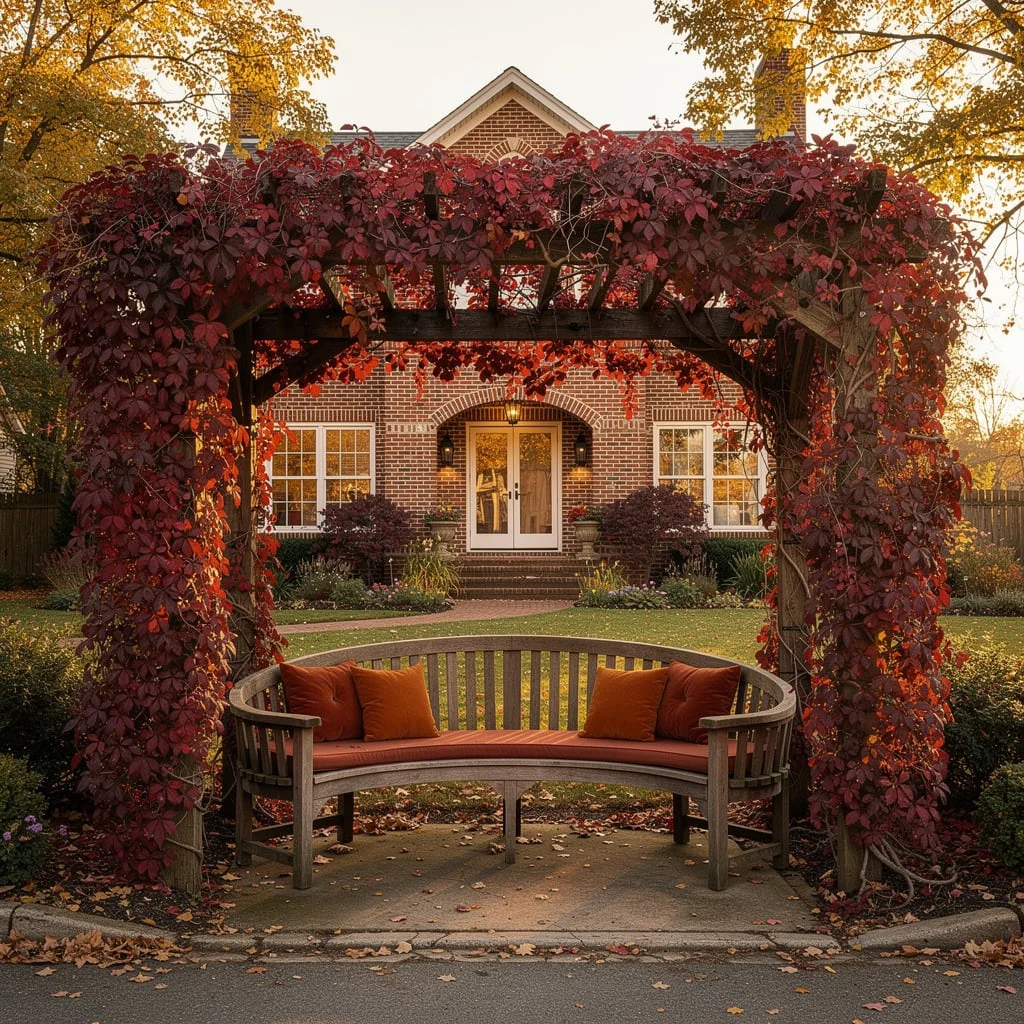
Build a timber pergola approximately 3 x 2.5 metres with four solid posts — 150mm x 150mm minimum — set in concrete footings. Use heavy-gauge cross beams and close secondary purlins for a dense overhead frame. Stain the timber in a dark walnut or near-black tone.
Plant one Virginia Creeper (Parthenocissus quinquefolia) at the base of each post. Wire training guides are not needed — the plant clings with adhesive discs. Within three to four years it will completely clothe the structure. In autumn it turns a spectacular crimson-scarlet that reads as extraordinary from the street.
Inside the pergola, position a curved crescent or horseshoe-shaped garden bench. A substantial hardwood curved bench — the kind designed to wrap around a fire pit — works perfectly. Dress with deep terracotta or rust-coloured outdoor cushions that echo the autumn vine colour. The combination of the crimson overhead canopy and the warm seating below creates one of the most atmospheric front yard spaces in a temperate climate.
The Spanish Revival Porch with Rattan Egg Chairs and Macramé
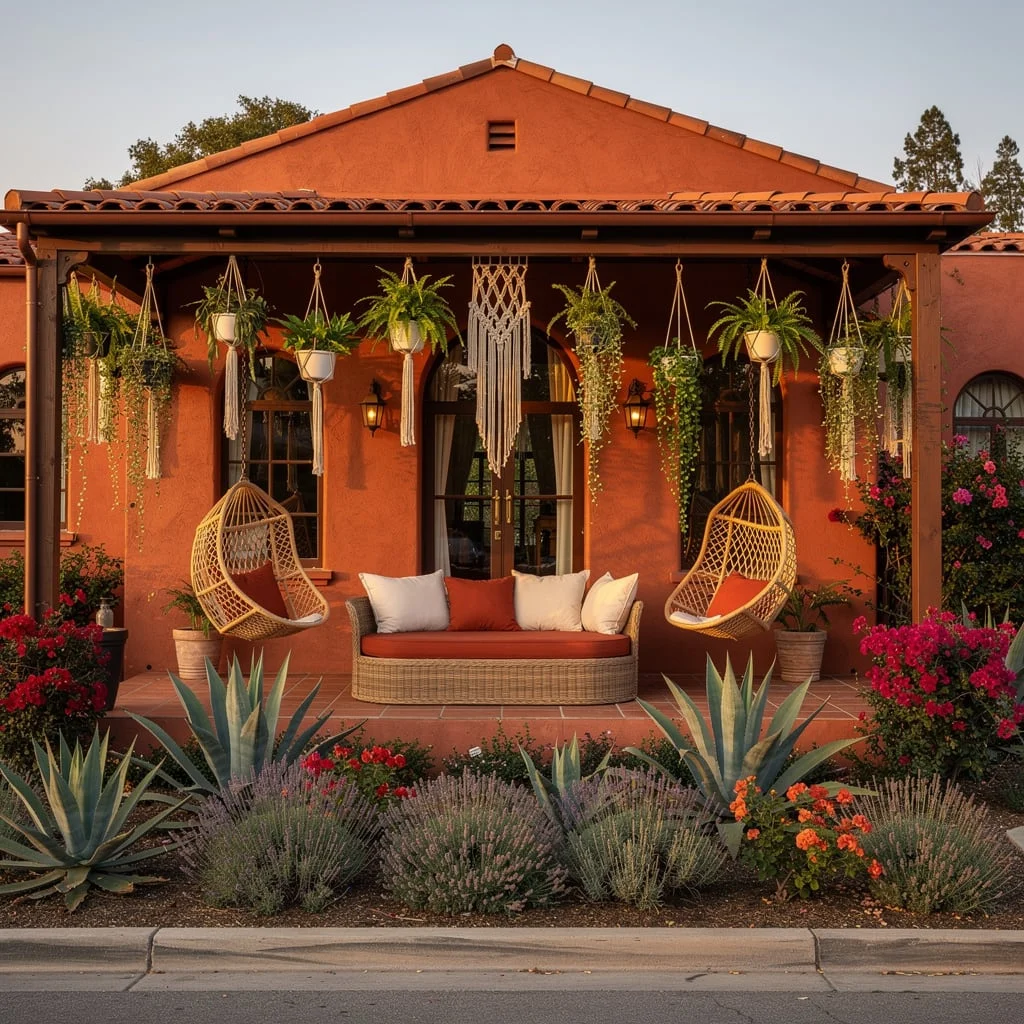
On a porch with a terracotta or warm stucco house, mount a timber pergola beam across the full porch width. Suspend two natural rattan egg chairs from the beam on heavy-duty ceiling hooks — one at each third of the porch width — with cream or natural linen cushions. The asymmetric positioning prevents the arrangement from looking like a stage set.
Between the egg chairs, position a low rattan daybed or sofa with rust-terracotta cushions as the centrepiece. Hang a series of macramé plant hangers from the beam between the chairs — vary the lengths between 60 and 120cm — containing Boston fern, Pothos, and trailing String of Pearls.
The planting at the porch base should be exuberant: large Agave americana for structure, lavender in generous drifts, Bougainvillea climbing the porch column, and Geranium in terracotta pots at the corners. The overall mood is layered, warm, and deeply comfortable.
The Japanese Raked Gravel Courtyard with Low Platform Deck
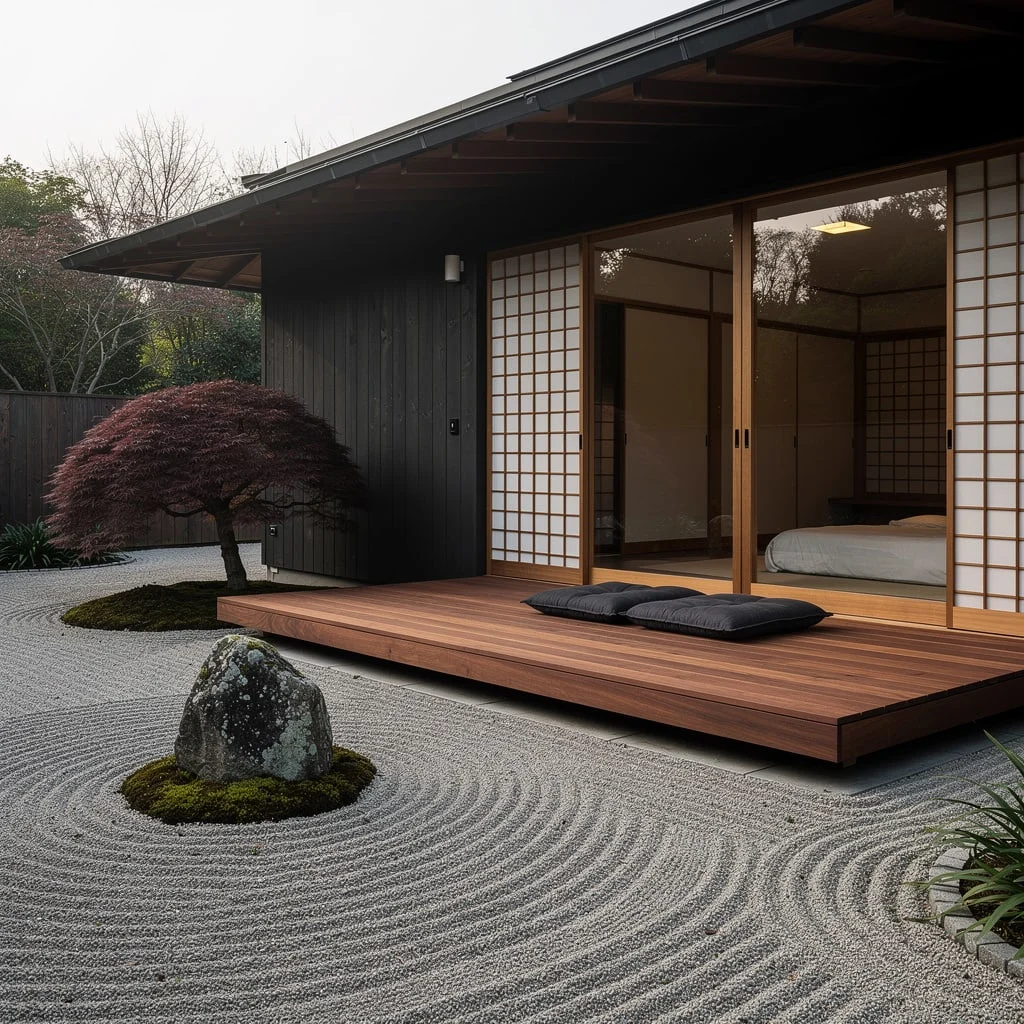
Lay raked granite sabi sand or pale grey granite grit across the entire front garden area to a depth of 8cm. Keep a strict perimeter edging — steel strip flush with the surrounding path or grass — to contain the gravel cleanly.
Build a low Ipe or Accoya timber platform deck in one corner of the space, approximately 2 x 2 metres, raised just 5cm off the gravel surface. The platform flush with the ground plane rather than elevated above it is critical — the low profile is what makes this feel like part of the garden rather than furniture placed in it. Dress with two or three large dark charcoal floor cushions.
Place one lichen-mottled boulder in the raked gravel away from the platform — partially buried, not sitting on top. Plant one Acer palmatum dissectum ‘Crimson Queen’ in the gravel, in a dark mulch surround. Keep the shoji-style screen or dark timber facade as the backdrop. Rake the gravel in concentric ellipses around the boulder weekly.
The Classic Southern Farmhouse Porch with Hanging Chairs
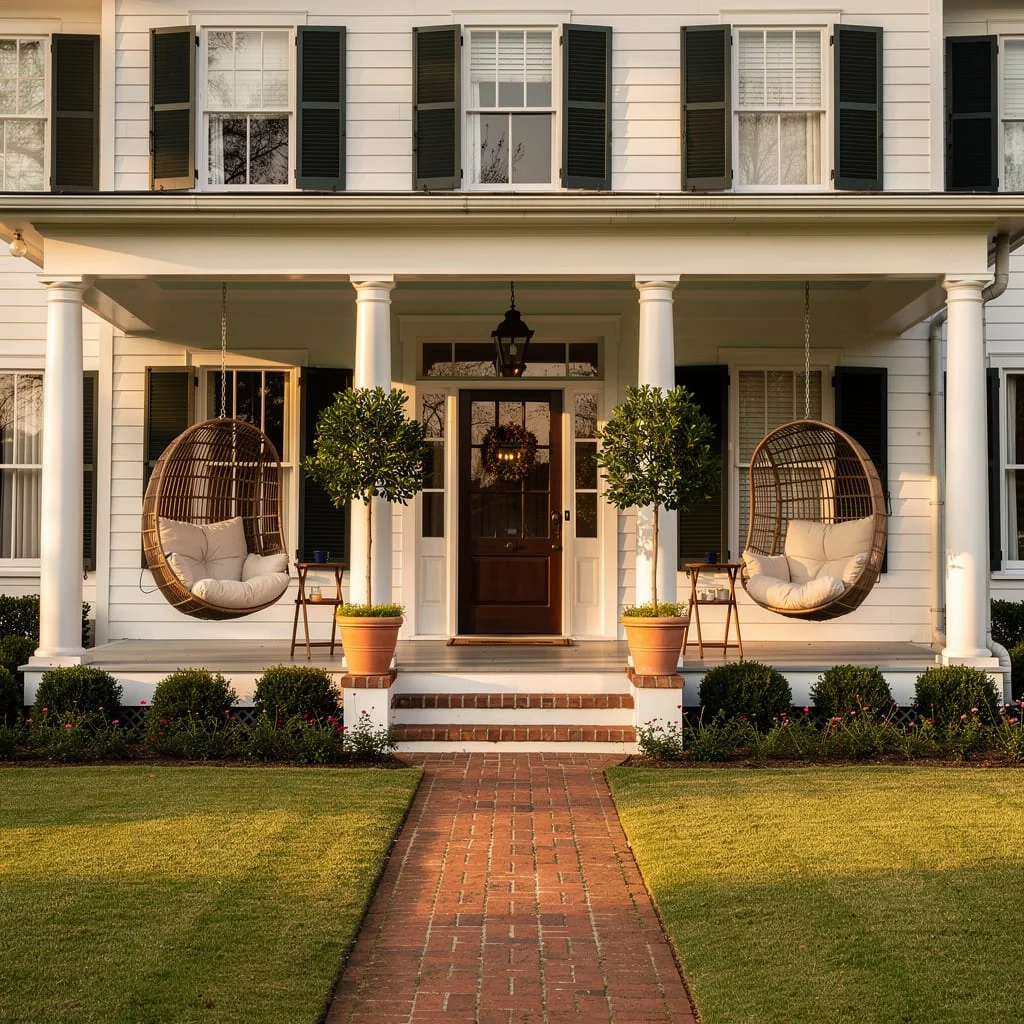
For a full-width covered front porch with classical columns, suspend two wicker or rattan hanging egg chairs from the ceiling joists — one between each pair of columns, equidistant from the centre door. The hanging chairs should be at a comfortable height: seat approximately 45cm from the floor with the suspension chain taking the load from a structural ceiling bracket, not just the fascia trim.
Between the chairs and the door, position a pair of bay tree (Laurus nobilis) standards in generous terracotta pots — 40 to 50cm diameter pots, trees at 1.2 metre stem height with clipped globe tops. These provide the formal vertical structure that the hanging chairs’ organic shapes need.
At the base of the porch along the front face, plant clipped Buxus mounds in dark mulch — three each side of the steps, set at slightly different sizes for naturalism. Keep a single brick path running straight from the steps to the street, perfectly centred on the door.
The Wisteria-Covered Porch with Navy Sofas and Parterre
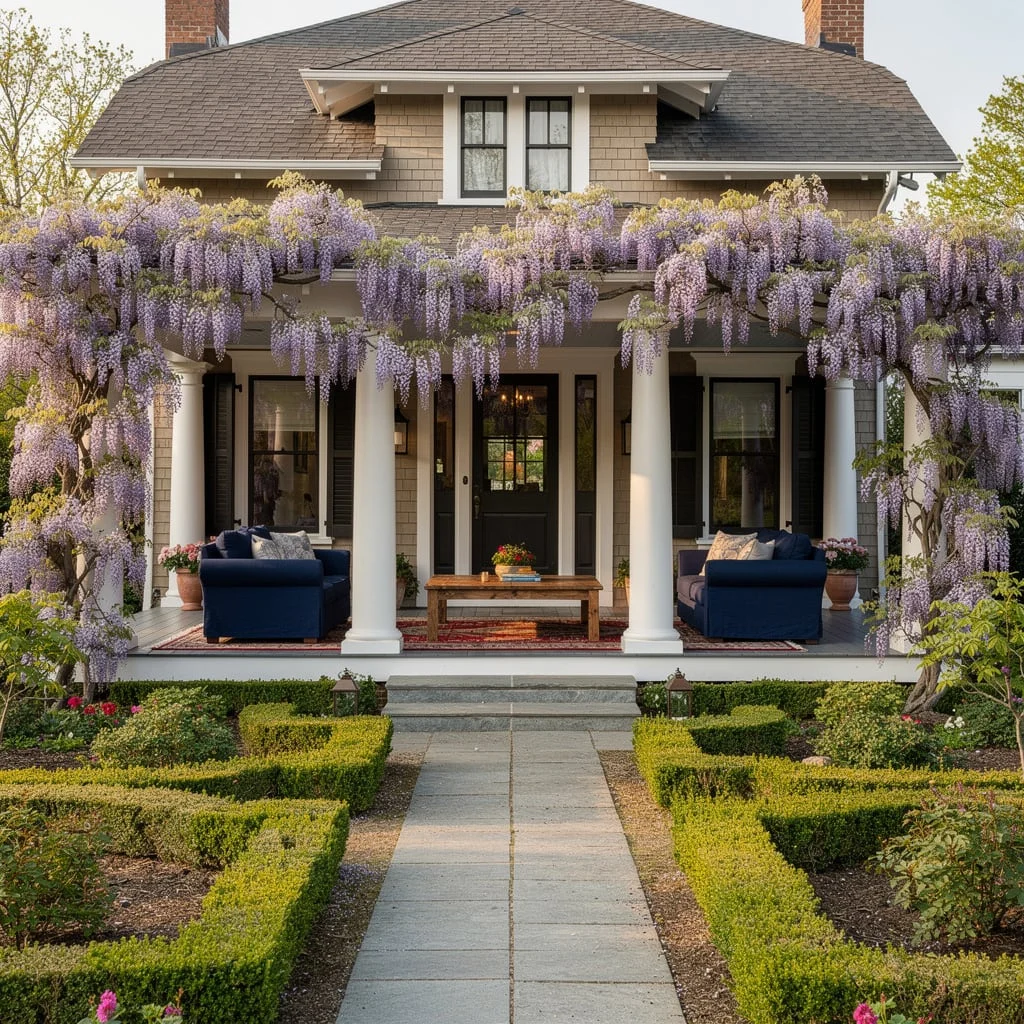
Train one Wisteria sinensis at the base of each porch column. In the first year, tie all growth to the column vertically. In subsequent years, direct growth along the porch beam and out over the roof trim. Prune twice annually: once in late July (shorten all new shoots to five leaves) and once in February (shorten those same shoots to two buds). It takes five years for mature coverage. The wait is worth it.
Under the wisteria canopy, place two generously sized navy linen-covered outdoor sofas facing each other over a reclaimed wood coffee table. Add a warm Persian-style outdoor rug in red and gold. The deep navy seating against the pale mauve blossom overhead is one of the most celebrated colour pairings in front porch design.
The front garden should be formal: clipped Buxus parterre beds either side of the central path — four beds in a grid, each filled with a single low plant species. Keep the lawn immaculate around the parterre edges.
The All-Black Contemporary Courtyard with a Single Olive Tree
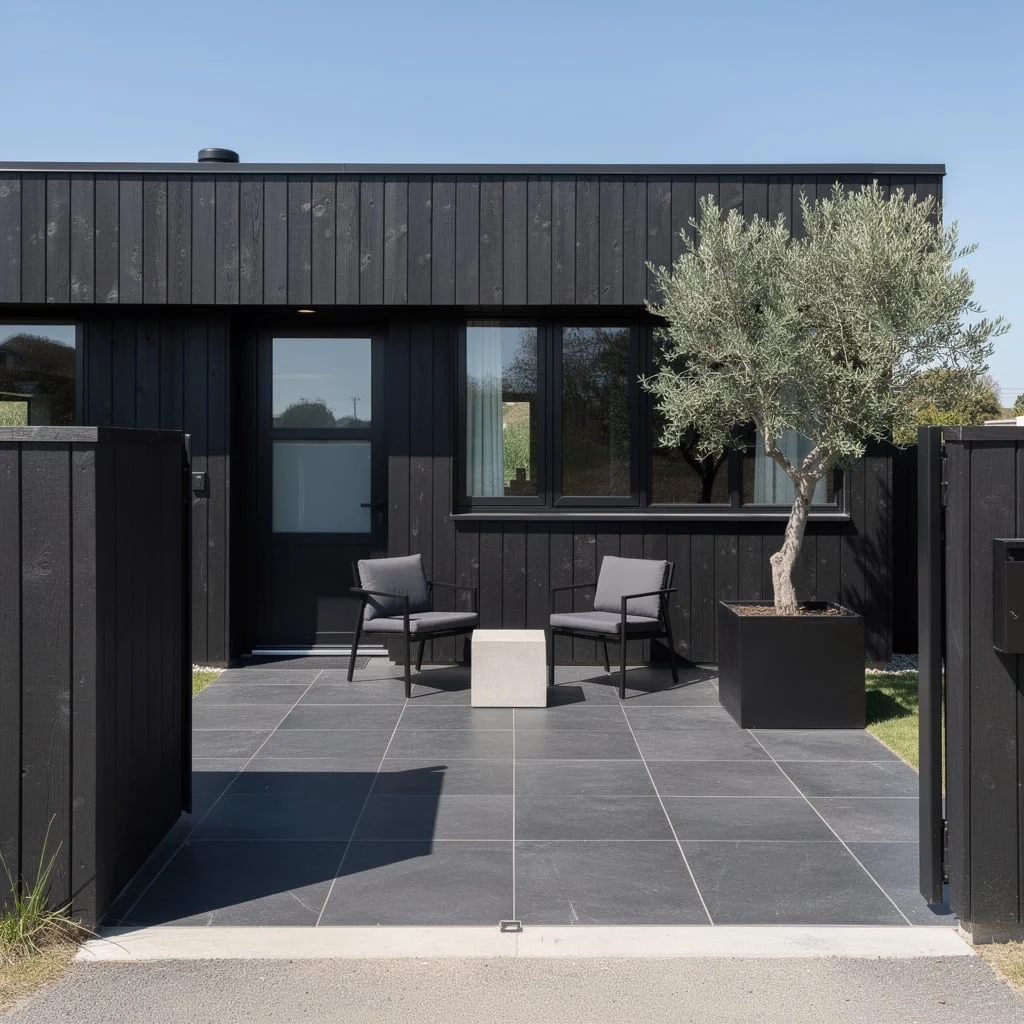
For a house with dark or black cladding, lay dark slate or anthracite porcelain tiles across the full forecourt area. The tile joints should be minimal — 3mm maximum — and the tiles should be cut to avoid grout lines across the primary view axis.
Position two black powder-coated lounge chairs on the tile surface facing obliquely outward toward the gate. A white or pale concrete cube side table between them provides the only tonal relief in the composition.
A single mature olive tree in a tall black powder-coated rectangular planter occupies the right side of the space. One tree. One planter. Nothing else. The white-silver foliage against the black cladding and black tile is the visual contrast that makes the whole space work. Open the black steel gate slightly for the street-facing view — the gate open at 45 degrees creates a compositional frame rather than a barrier.
The Classic Brick Bungalow with a Porch Swing
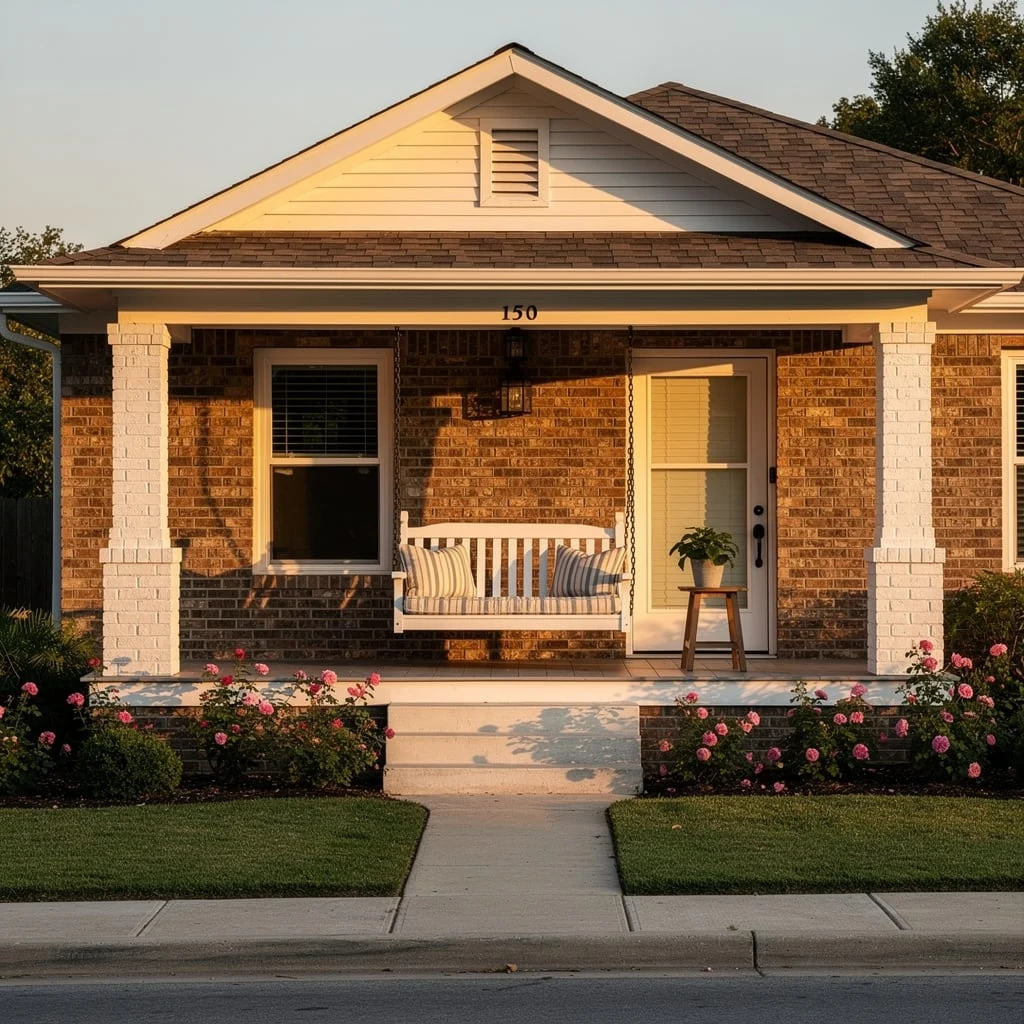
The front porch swing is one of the most instantly readable seating propositions in residential design. The swing says: slow down. It says: nothing urgent is happening here. That’s the entire idea.
Install a solid white-painted timber porch swing — wide enough for two people at comfortable depth — suspended from the porch ceiling joists on heavy-gauge black or stainless steel chains. Dress with striped ticking-fabric outdoor cushions in classic navy or grey. Position a small wood side table or plant stand with a terracotta pot beside it.
Plant Rosa ‘The Fairy’, Rosa ‘Bonica’, or another repeat-flowering shrub rose either side of the porch base — six plants each side — for continuous soft pink bloom from June through October. No other planting. The roses, the porch, and the swing are enough.
The Front Lawn Stepping-Stone Seating Circle
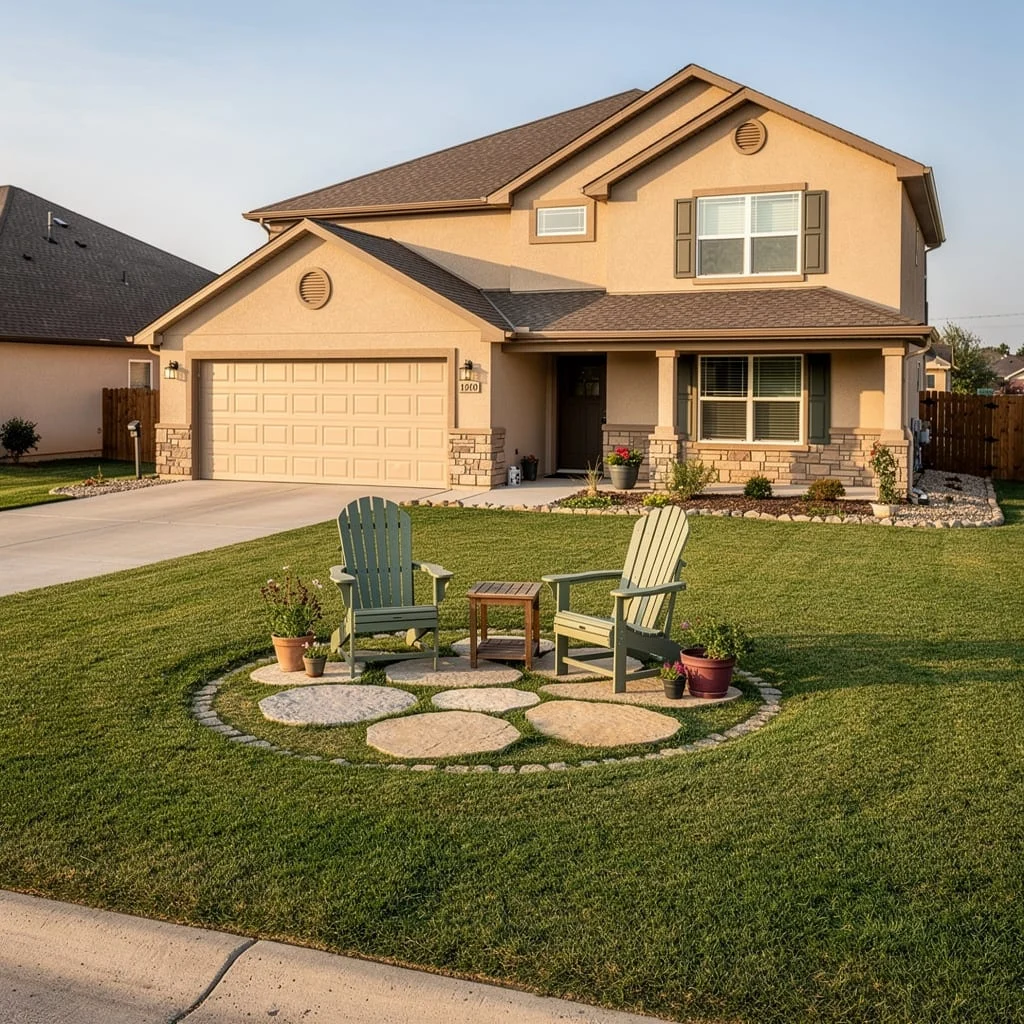
For a front lawn that doesn’t yet have any hardscape or porch, create a defined seating area using five or six large concrete stepping stones — 60cm diameter rounds or polygons — arranged in a loose circle approximately 1.8 metres across, set into the grass surface. Press each stone in slightly below the lawn level so the mower can pass over the edges.
Position two Adirondack chairs inside the circle facing slightly toward each other — not facing the street straight on. Paint them in a tone that relates to the house: sage green for an earthy palette, white for a clean look, slate grey for something quieter.
Add a small slatted wood side table between them. Place two or three terracotta pots of seasonal planting around the circle edge. This is the most minimal version of front yard seating — it costs almost nothing and requires no construction — and it works because the circle of stones creates the surface that turns the chairs from random furniture into a destination.
The Victorian Terrace Walled Front with Bistro Set and Bay Tree
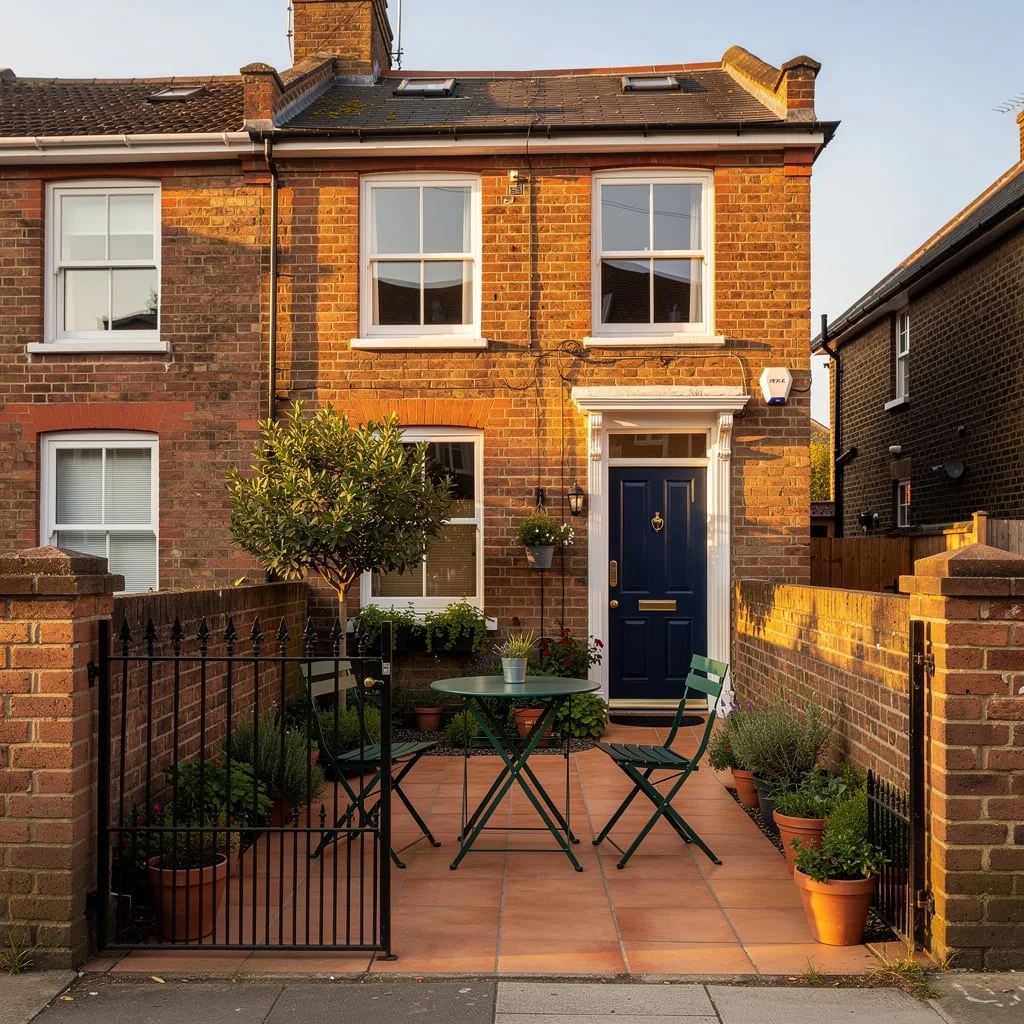
In a small walled or gated front terrace — the kind common to Victorian and Edwardian houses in British cities — tile or pave the entire surface in terracotta-coloured tiles or warm flagstones. Remove any remaining lawn.
Position a dark green metal bistro table and two matching chairs in the centre of the space, offset slightly toward the gated side to leave a clear path to the door. Add one olive tree standard in a classic terracotta pot — positioned to one side so it doesn’t block the door. Line the walls with a collection of terracotta herb pots: lavender, rosemary, thyme, and a small bay tree in a larger pot.
The dark blue or navy door, the dark green furniture, the warm terracotta tile, and the terracotta pots form a palette that reads as cohesive and considered from the street. The iron gate slightly open is the final detail that makes the whole thing feel like an invitation.
The Rendered UK Cottage Portico with Wicker Chairs and Climbing Roses
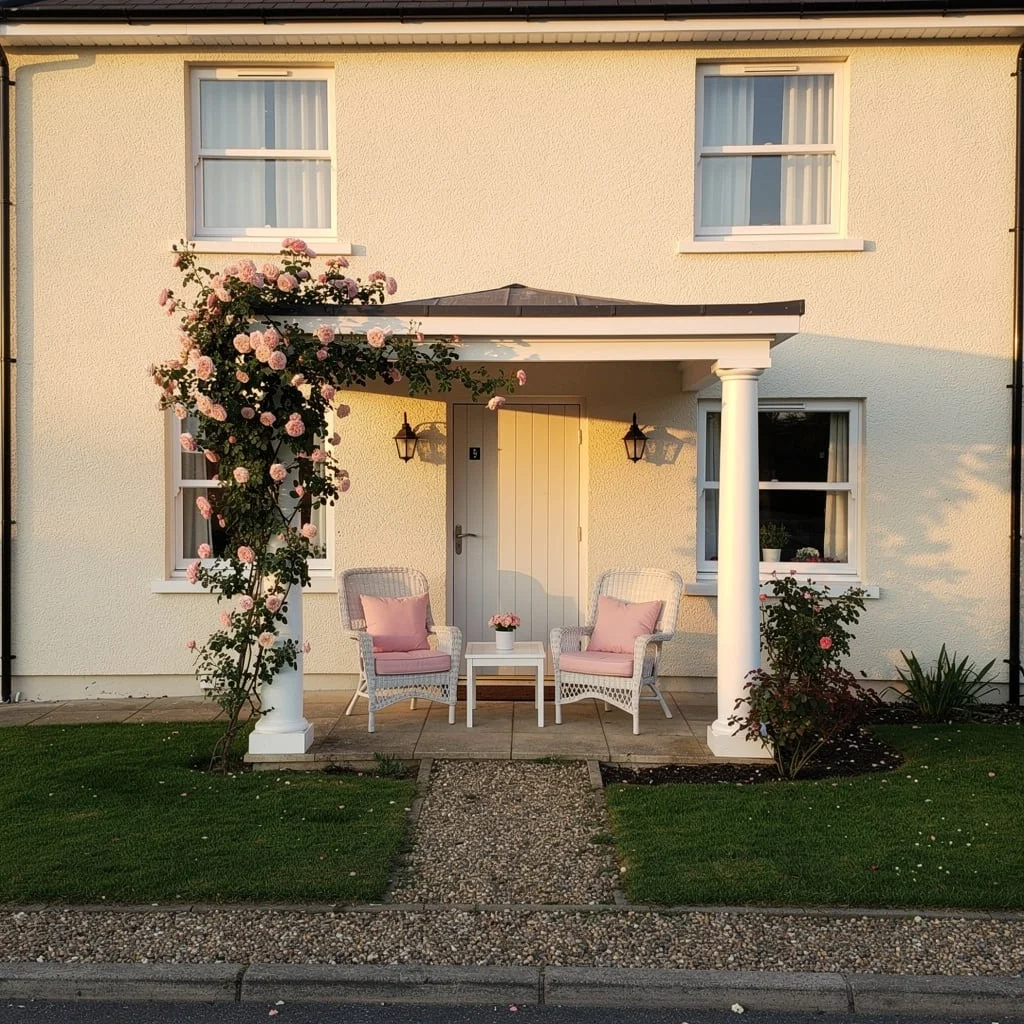
For a cream or pale rendered house with a classical portico entrance, position two white wicker chairs with pale pink cushions either side of the front door, within the shelter of the portico. A small white painted side table between them. Keep the styling extremely simple: one small bud vase of garden flowers, nothing more.
Plant one climbing rose up the left-hand column — Rosa ‘Blush Noisette’, ‘Compassion’, or ‘Mortimer Sackler’ for soft pink, good scent, and repeat flowering. Tie the first stems horizontally at low level to create a branched structure rather than a vertical spike. Allow growth to move over the portico roof edge in subsequent years.
Keep the planting in front — gravel path, simple lawn — completely uncluttered. The portico, the roses, and the two chairs in the shelter below them are a complete picture. Adding more would dilute it.
The Granite Cottage with Painted Bench and Lavender Border
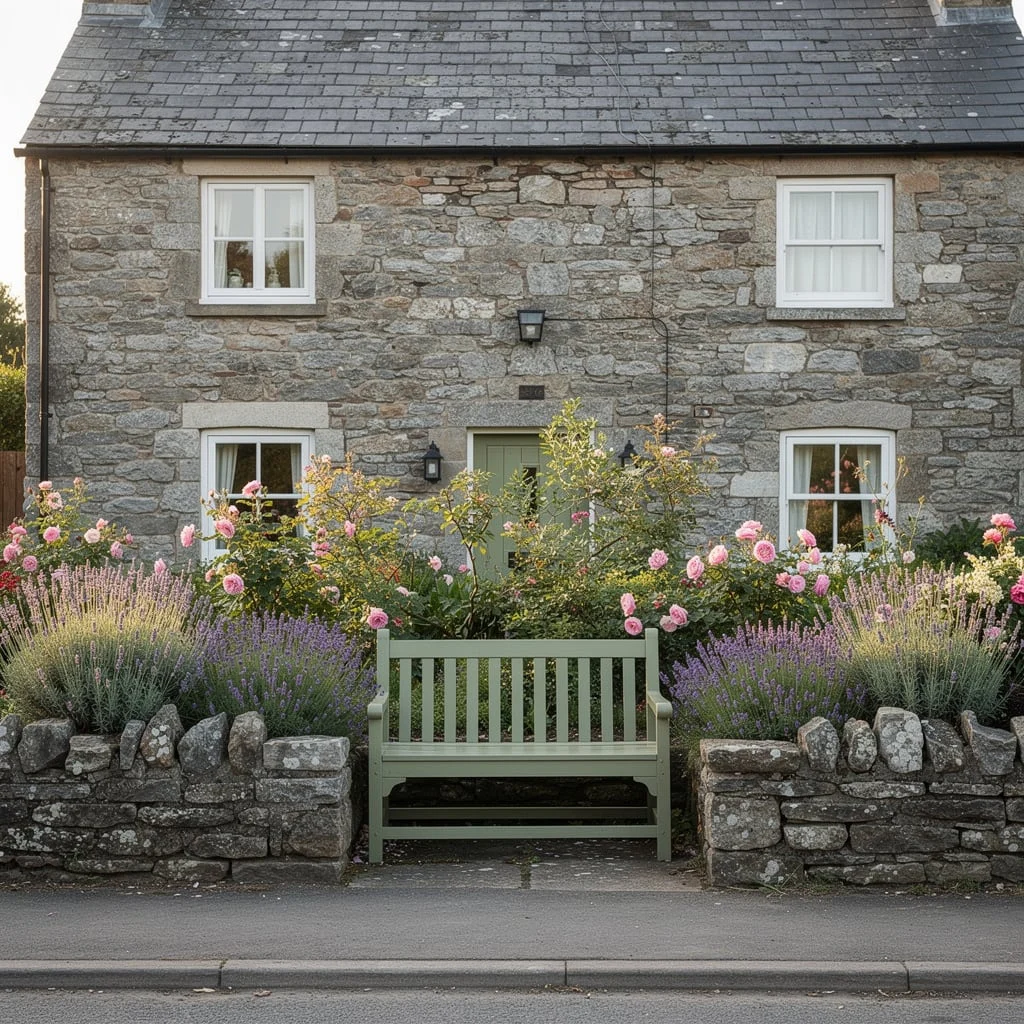
For a stone-built cottage or farmhouse — particularly in the west of Britain or Ireland where the vernacular is granite or limestone — the relationship between the bench, the stone wall, and the planting behind it is everything.
Position a sage-green painted timber garden bench in a recess of the front boundary wall — either a purpose-built gap or a point where the wall steps back. The bench back should be close to or touching the wall behind. The wall is the shelter. The bench belongs to it.
Behind and above the wall, plant a generous cottage border: shrub roses in pink — Rosa ‘Gertrude Jekyll’, ‘Mary Rose’, or ‘Olivia Rose’ — reaching above wall height for late May to October bloom. Below the roses, generous drifts of lavender and Nepeta as the fragrant, soft front of the border.
The granite wall, the sage bench, the lavender, and the roses are four elements that have been working together in British cottage gardens for centuries. There’s no need to improve on the combination.
The Front Lawn Sandstone Patio with Rattan Chairs
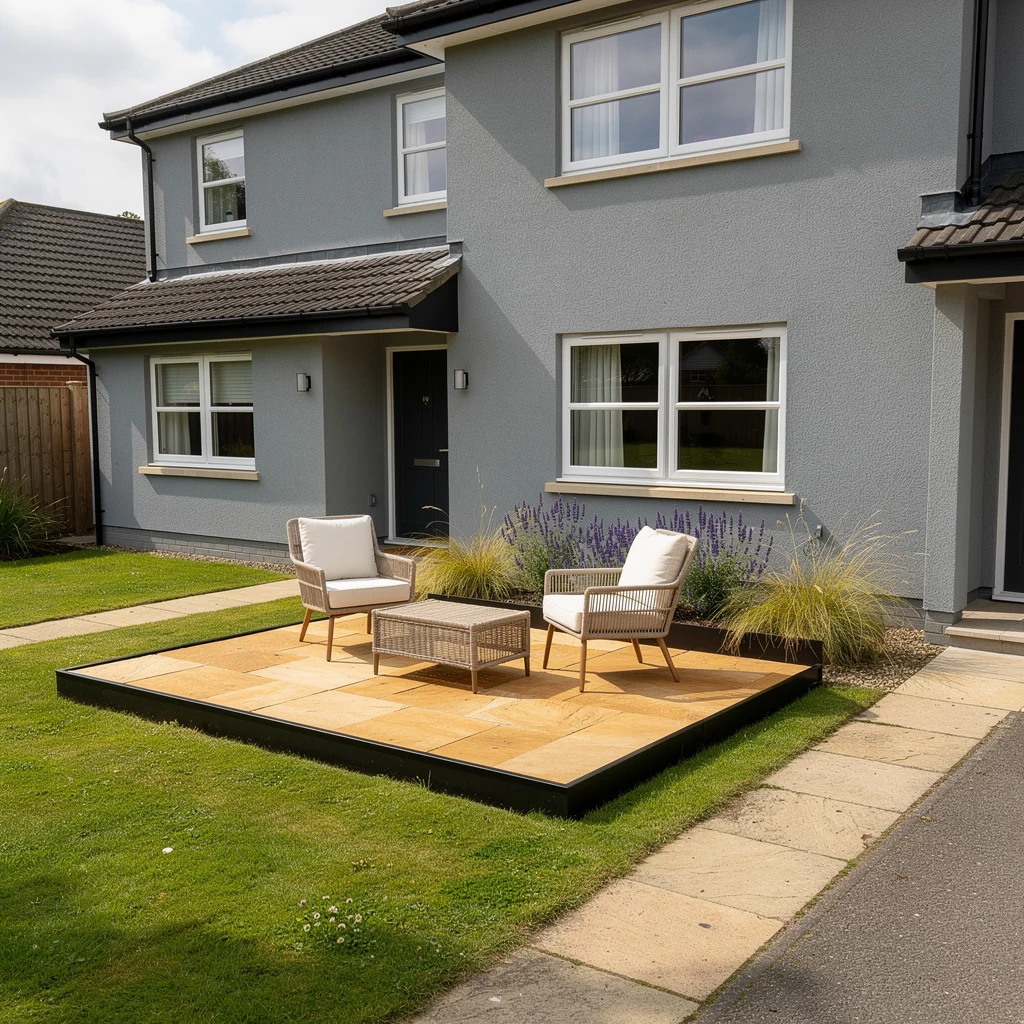
Cut a precise rectangular area from the front lawn — 3 x 3 metres is the minimum to avoid looking too small — and excavate to 120mm depth. Lay a compacted MOT type 1 sub-base, sand blind, and set buff Indian sandstone flags in a running bond with 3mm mortar joints. Edge the entire perimeter with a black steel landscape edging strip, pushed flush with the grass surface on all four sides.
Position two natural rattan or wicker chairs with cream upholstered cushions facing obliquely outward. A wicker or concrete coffee table between them. No other furniture.
The plant border behind — between the patio and the house wall — should contain Stipa tenuissima for fine transparent movement, Salvia nemorosa in violet-blue for upright flower colour, and perhaps one compact ornamental grass for anchor. The warm honey sandstone, cream cushions, and silver-blue salvia create a palette that works with a grey rendered house without the stiffness that all-grey materials create.
The Simplest Version of This That Always Works
Every idea here operates on the same logic. Decide where the seating belongs. Create a surface that says it belongs there. Put the right number of seats — not more than the space needs — and leave everything else out.
The front yard seating areas that don’t work are almost always the ones where someone put down two chairs and hoped the space would resolve itself around them. It doesn’t. The space has to be made first. The chairs go into it.
Make the space. Then sit down.