
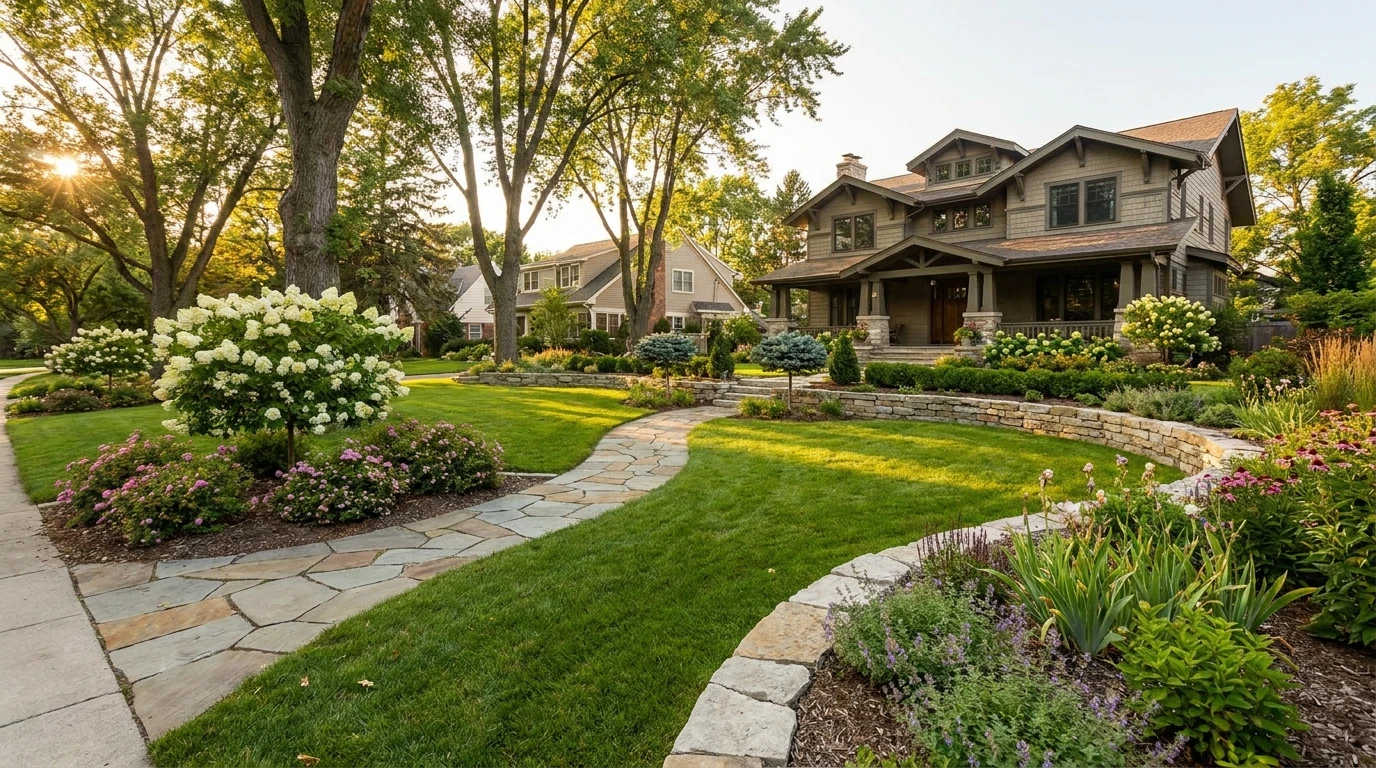
Most front yards make the same mistake in the opposite direction from small yards. Small yards try to fit everything in. Large yards just spread it out — a bit of mulch here, a shrub border there, a concrete path that wanders vaguely toward the door. The result is more square footage of mediocrity rather than less.
A large front yard isn’t an invitation to fill every corner. It’s an invitation to be deliberate about what you put in each one.
The house is still the point. The landscaping answers to it.
Scale Lies to You and You Need to Stop Believing It
A large front yard feels resolved when the landscaping elements are scaled to match it. It feels chaotic when everything is scaled to a smaller yard and simply repeated across a larger area.
The Proportional Failure of Small Plants on Large Lawns
Three boxwood balls at the base of a two-storey facade. A single rose standard in the middle of a thirty-metre front yard. An ornamental grass cluster that would look confident in a courtyard but reads like punctuation in an open lawn.
Scale is the most common failure in large front yard landscaping. The plants that work in a small garden don’t automatically scale up because you buy more of them. They scale up because you plant more specimens of a larger variety, in a wider mass, against a backdrop that can hold the weight.
A large house needs large gestures. Not large budgets, necessarily — a row of established native trees planted in a consistent grid costs roughly the same as a collection of mixed shrubs, and reads ten times more deliberately.
Why Paths Need Width
A path that works for a small front yard is 800mm wide. A path that reads appropriately on a large property is 1.2 to 1.5 metres, sometimes wider if the house has a grand entry.
The path is doing more than moving you from gate to door. It’s making a statement about the importance of the destination. A narrow path through a large yard looks like an afterthought — a line someone drew without considering the proportions of the journey.
Trees as the Primary Element
On any large front yard, trees should be the first decision, not an afterthought. Everything else — the shrubs, the ground cover, the paths, the lawn proportion — is composed around them.
A single well-placed specimen tree positioned off the central axis of the front yard, given enough space to develop its canopy, transforms the character of the property within five years. An avenue of matching trees along the entry path does it within three.
Choose trees appropriate to the scale. Not ornamental miniatures. Trees that will eventually own the space.
Lawn: How Much, Where, and Why It Still Matters
The default front yard is entirely lawn. The overcorrection is to remove all of it. Neither works for a large site.
Lawn as Ground Plane, Not Filler
Lawn is the ground plane against which everything else reads. It makes clipped hedges look crisper. It makes curved planting beds look more deliberate. It makes a stone path look like it means something.
The mistake is treating lawn as what you have when you haven’t decided what else to put there. Lawn should be a chosen material, with a defined shape and a clear relationship to whatever borders it.
A circular lawn set within a perimeter garden bed reads as a feature. The same square of lawn bordered by mulch reads as nothing.
The Curved Lawn Boundary
Straight lawn edges suit formal compositions. Curved edges suit naturalistic ones. But a curve needs to be deliberate — a generous, sweeping arc that reads as intentional geometry, not a line that wanders because the installer wasn’t paying attention.
A curved steel garden edge, properly installed to a radius that echoes the proportions of the house facade, is one of the most effective single interventions available in front yard design. It turns a flat plane into a composition.
When to Remove the Lawn Entirely
In climates that are genuinely dry — arid, semi-arid, Mediterranean — maintaining lawn in a large front yard is a decision that works against the site and the season. The plants that thrive in these conditions are more interesting than grass anyway.
Decomposed granite, desert boulders, agave, cactus, and low flowering perennials in a considered layout are not a compromise for a dry climate. They’re the correct response to it.
Large Front Yard Landscaping Ideas
The Craftsman Porch With the Dark Mulch Bed and Contemporary Stone Path
Cut two clean curves in the existing turf on either side of the entry path — one convex, one corresponding — creating a generous planting bed between the path and the porch edge. Mulch both beds in dark black wood chip.
Plant low compact shrubs in massed groupings of three or five: buxus, leucothoe, hellebore, white alyssum as ground cover. One single specimen in a black architectural planter at the porch column base — a standard olive or topiary conifer.
Replace the existing concrete path with large-format grey stepping pavers set into the lawn at consistent intervals — no mortar, just well-settled.
The dark mulch against the green lawn against the white porch trim does most of the work. Keep it extremely restrained and it reads as sophisticated rather than sparse.
The Parterre Formal Garden With Fountain Centrepiece
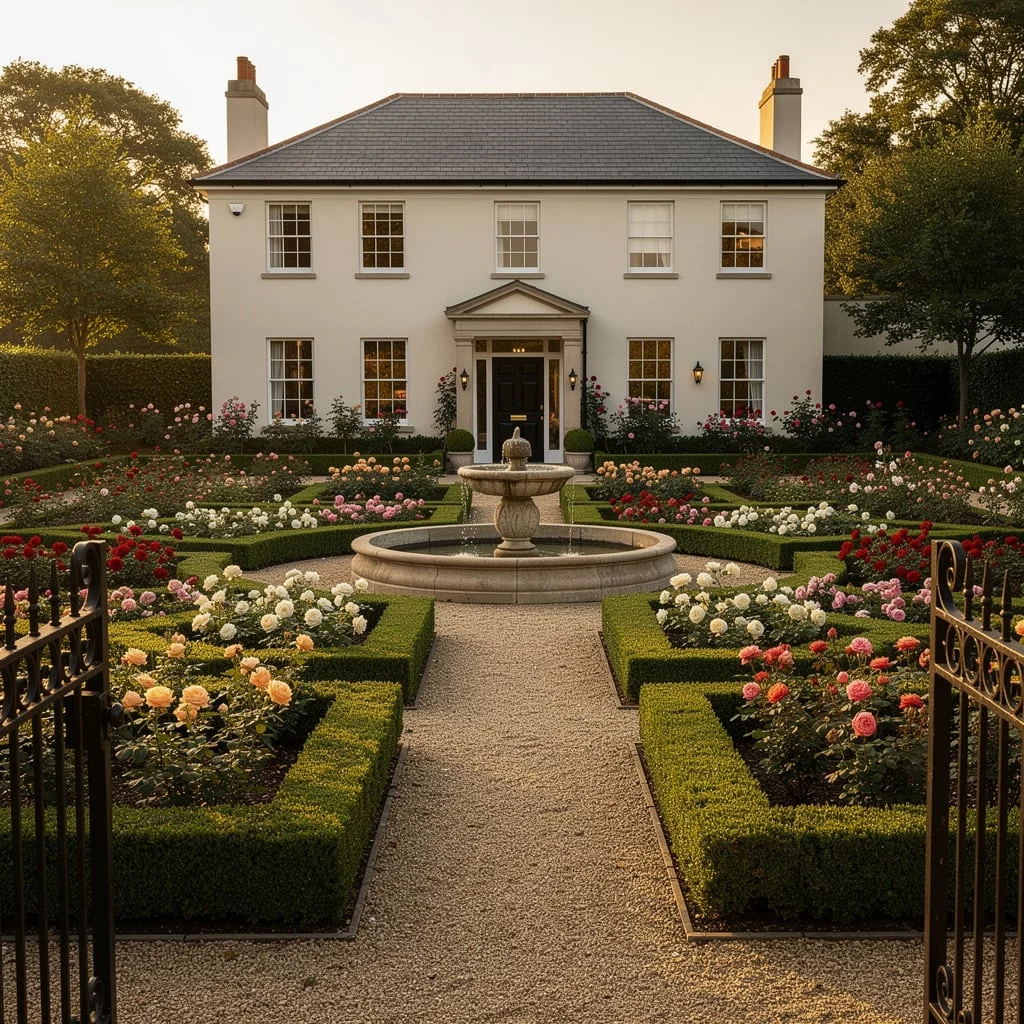
This is a high-commitment formal design for a house with a grand, symmetrical facade — Georgian, French country, Italianate, or any house with a central entry axis.
Divide the front yard into four equal planting quadrants using low buxus hedges clipped to 300mm height, set in a geometric pattern — a cross axis centred on the front door. Gravel paths, in fine-washed cream or limestone chip, define the edges of each quadrant.
At the cross-axis centre, install a stone or reconstituted stone tiered fountain. The fountain should be at a scale that reads from the street — minimum 1.2 metres in diameter — and be a genuine classical form: tiered basin, not a contemporary spill feature.
Plant each parterre quadrant with a single rose variety — mixed varieties in different quadrants create vibrancy. Tuck compact buxus topiary standards at the inner corners where the paths intersect.
Entry is through iron gates mounted between rendered or stone piers. The gates frame the view to the fountain and the house beyond.
This is the front yard that requires commitment to a style — and pays it back fully.
The Sloped Stone Terrace Front With Ornamental Grasses and Roses
Build dry-stacked or mortared stone retaining walls in two to three tiers across the sloped front yard, each approximately 500 to 600mm high. The stone should be field stone, quarried sandstone, or a matching manufactured stone unit in a warm grey or honey tone.
Plant the base terrace with a consistent mass of flowering ground rose — a compact floribunda in blush, pink, or red, repeated across the full length. Plant the second terrace with ornamental feather reed grasses at intervals among Russian sage or catmint. The top terrace, nearest the house, carries structured evergreen planting — clipped buxus, compact lavender, or dwarf conifers.
The stepped stone entry path bisects all three tiers on centre with the front door. The steps are generous-tread, single-rise, using the same stone as the walls.
This design exists to solve the problem of a sloped front yard by turning the slope into architecture. Every terrace is both retaining wall and planting opportunity.
The Brick Formal Front With Standard Rose Path
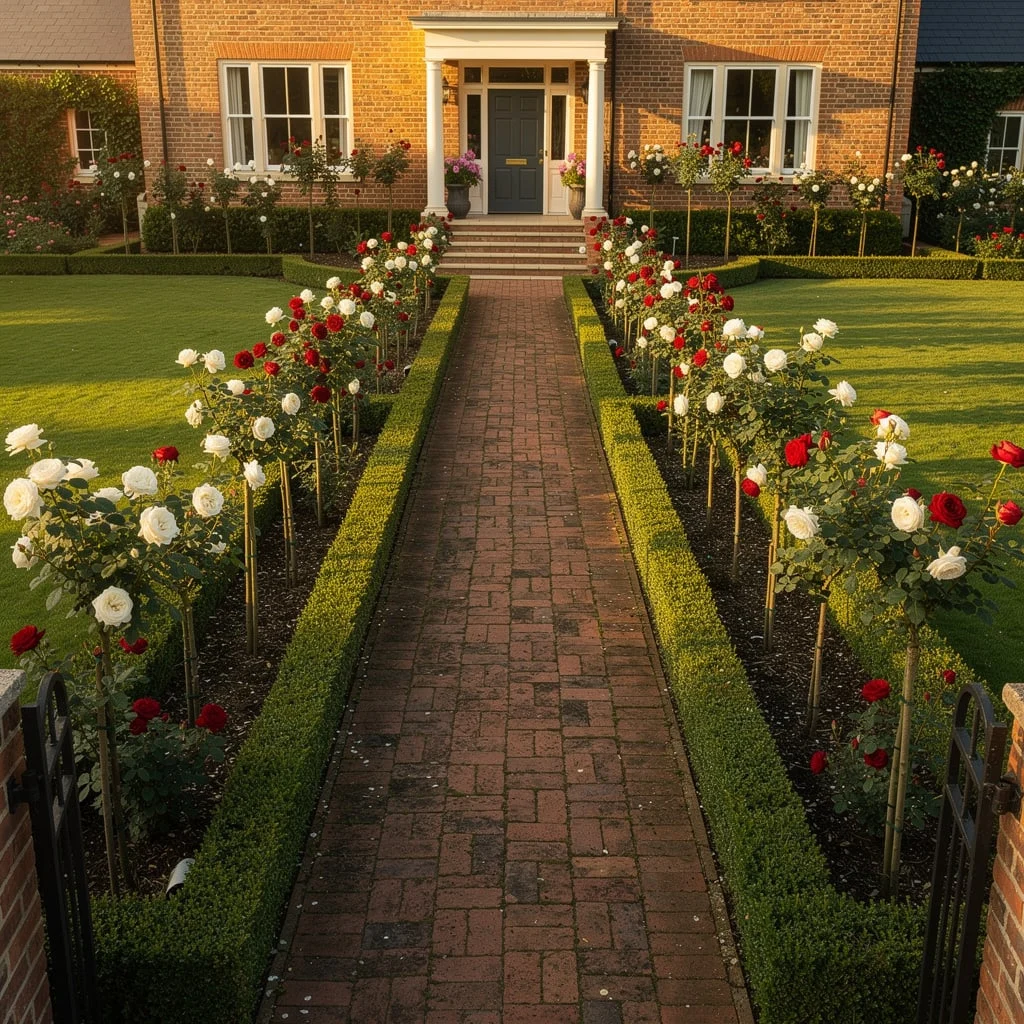
Lay a clay brick path — running bond, in a warm terracotta or charcoal-red — from the iron entry gate to the front door steps. The path should be at least 1.2 metres wide.
On either side of the path, install two parallel low buxus hedges clipped to 300mm height, with regularly spaced standard rose plants growing through and above them. The roses should be a single variety — not mixed — in red and white alternated, or a single creamy white throughout.
The lawn extends in equal panels on either side of the hedged path border, extending to the property boundary.
At the entry gate: two square red brick pillars with iron-framed gate panels. The gate does not need to be fancy. It needs to be the same register as the path material — warm brick, iron hardware, nothing shiny.
The brick path, the clipped hedges, the standard roses, and the wrought iron gate are doing one thing: building a formal procession to a house that deserves one.
The Layered Perennial Border With All-Season Interest
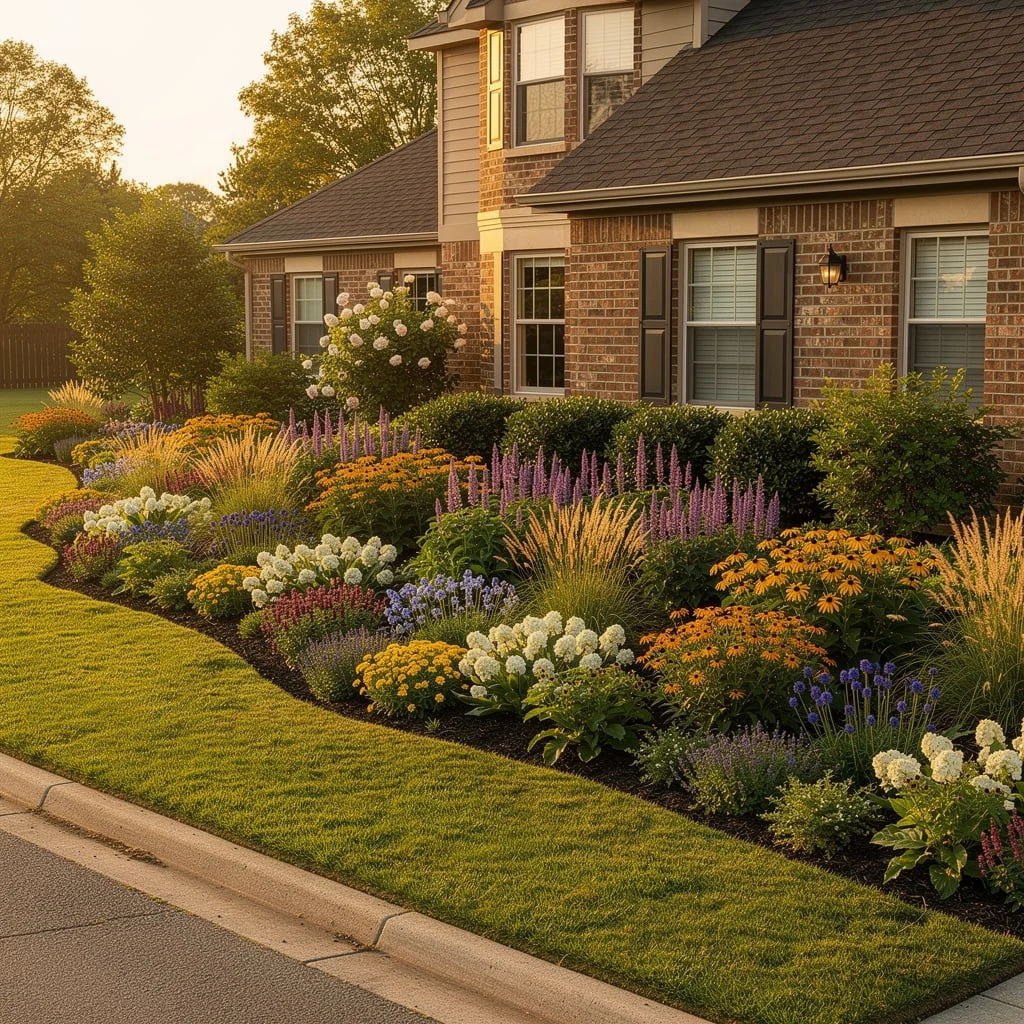
This is a front garden that replaces the conventional foundation planting with a deep, generous perennial border — minimum 1.2 metres deep, running the full width of the front facade, set in front of the house wall.
Plant in five species or fewer, in masses of seven to eleven plants per species, in a repeating sequence: clump-forming grasses at the back (feather reed grass, Karl Foerster), medium shrubby perennials in the mid section (rudbeckia, echinacea, salvia), low flowering perennials at the front edge (lavender, amsonia, alchemilla). Repeat this sequence horizontally across the full width.
The lawn in front of the border is generous and flat. A single path bisects it on the house axis.
This border looks its best in late summer when the rudbeckia and echinacea are in peak bloom and the grasses catch the afternoon light. It asks for two maintenance visits per year — a hard cut back in late winter and a light tidy in midsummer. Everything else it manages itself.
The Stone Terrace Front Yard With Three Levels and Stacked Wall Architecture
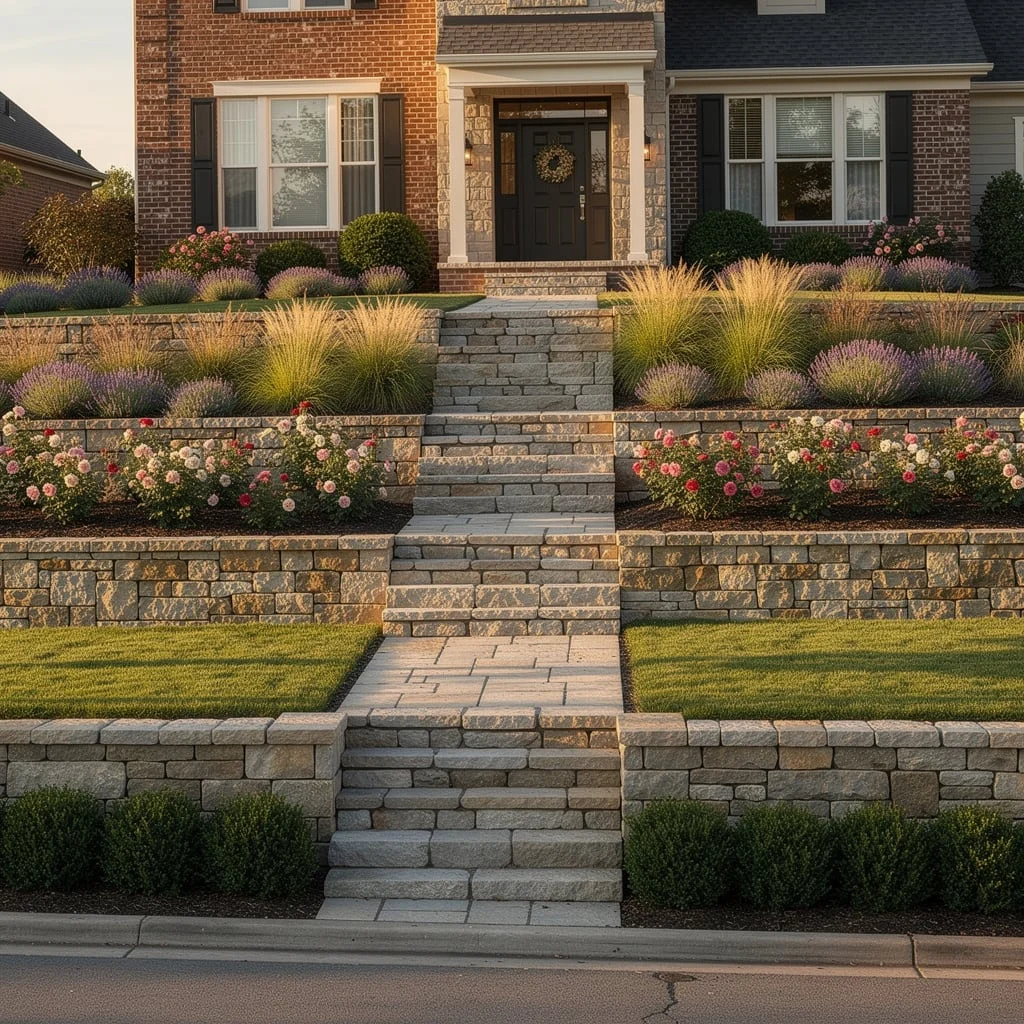
This design is for a front yard with significant grade change — a house that sits substantially above the street level, requiring three or more metres of height transition.
Build three horizontal stone terraces using coursed cut sandstone or limestone block walls. Each wall runs the full width of the property and stands approximately 600 to 800mm. The top of each wall is flat and planted.
Centre the entry stair on the house axis, running straight up through all three tiers. Treads are wide — minimum 400mm — and made from the same stone as the walls.
Plant each terrace in a single species, consistently: the bottom terrace in compact ground roses, the second in ornamental grasses and Russian sage, the third nearest the house in lavender and structured evergreens.
The walls are the architecture. The plants are the softening. The stair is the axis. Get these three things right and the grade change that was a problem becomes the defining feature of the property.
The Desert Xeriscape With Boulders and Low-Water Planting
Excavate the turf entirely. Lay a permeable landscape membrane and cover with fine white or buff decomposed granite or crushed gravel as the ground plane. Smooth and level it.
Position three to five large sandstone boulders of varied size — minimum 400mm diameter, largest approaching 700mm — in an asymmetric but considered arrangement. The boulders are not random. They define zones: a large boulder here sets a planting pocket, a medium boulder there marks a change in ground level.
Plant in groupings of odd numbers: agave americana as the large architectural statement, barrel cactus as the mid-level feature, feather grass and purple trailing lantana as ground-level coverage. Compact desert sage in the gaps.
The path to the front door is poured concrete in a warm buff or sandstone tone. Simple, direct, wide enough.
This landscape doesn’t have to look like a car park with plants. When the proportions are right — boulders large enough to read as structure, planting generous enough to read as mass — it looks like a landscape that belongs to its climate.
The Reflecting Pool Parterre With Clipped Topiary
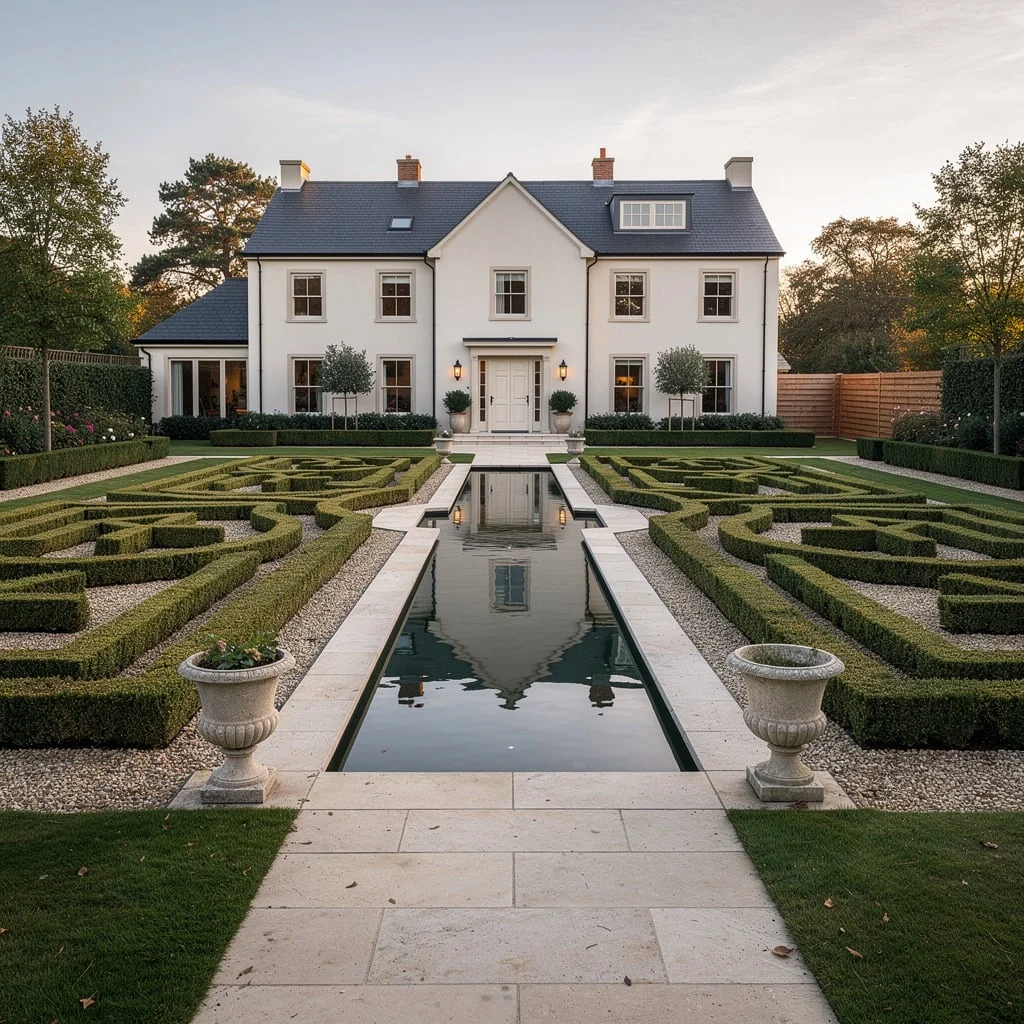
A white rendered symmetrical house with a flat or gabled roofline creates the backdrop for one of the most resolved front garden types available: the formal reflecting pool parterre.
Lay a limestone or sandstone path from the entry gate to the front door. On either side, create parterre panels of clipped buxus in a geometric pattern — interlocking curves, diamond forms, or simple scrolls — filled with white gravel between the hedged borders.
At the centre of the composition, between the path and the house, install a long narrow reflecting pool in dark-lined stone — approximately 3 by 1 metre, filled to the brim. Place two matching stone urns at the near ends, planted with seasonal flowers or clipped topiary standards.
The reflection of the house in the pool on a still morning is worth most of the effort.
The Sloped Grass Island With Boulders and Specimen Planting
For a large front yard with a circular driveway or a wide entry apron, install a gently mounded central planting island in a rounded organic form. The mound should rise 300 to 400mm at its peak — not a flat disc but a gentle hill.
Cover the mound in fine-cut grass, kept clipped. At the apex, plant a single ornamental cherry, crabapple, or weeping pear — a tree with seasonal interest that earns its position as the centrepiece of the composition.
Ring the base of the mound with a band of low flowering ground cover — heather, ajuga, creeping thyme — edged by a steel border that separates the mound from the surrounding gravel or driveway surface.
The mound is the gesture. The single tree is the reason for it. Don’t complicate it.
The Wildflower Meadow Front With Mown Path
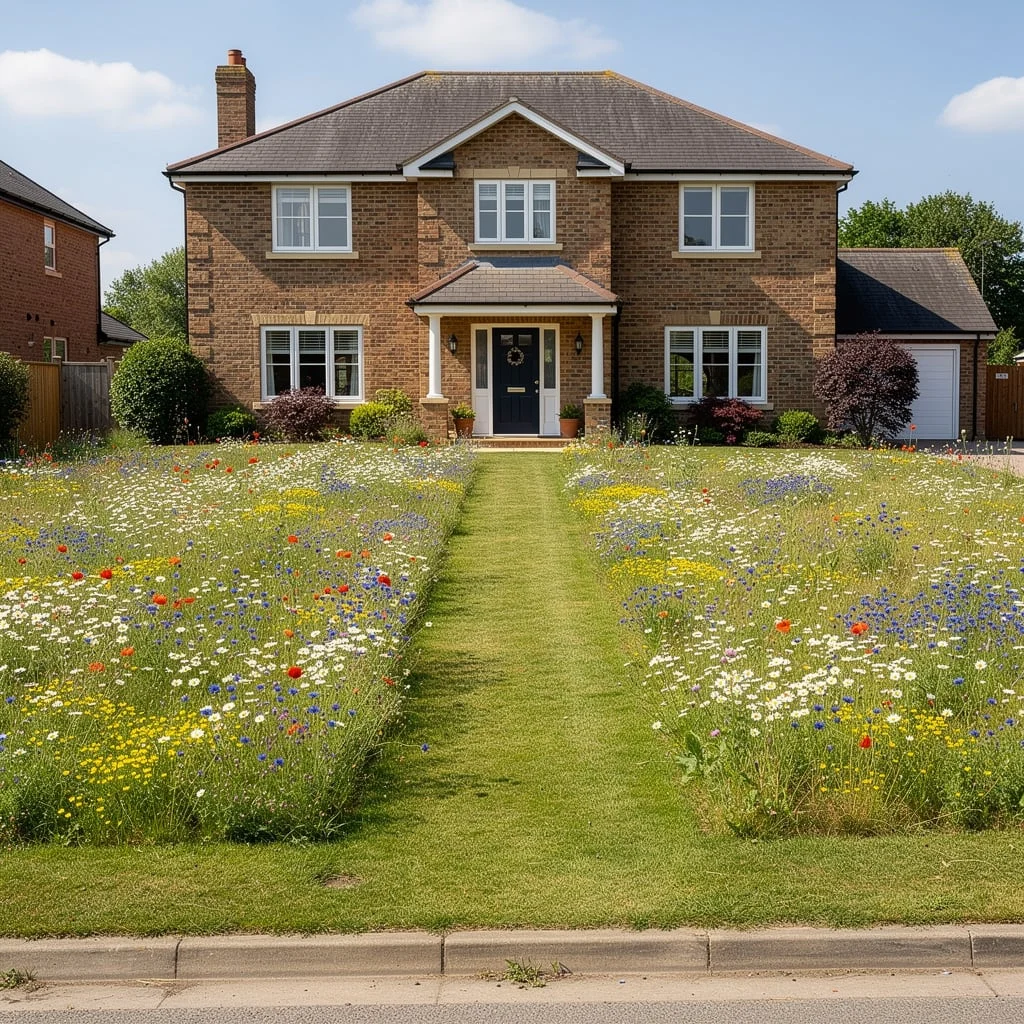
Divide the large front lawn into three zones: a central mown grass path from gate to door, and two flanking meadow zones that are not mown but are left to establish as wildflower meadow.
Sow a native or regional wildflower seed mix across both meadow zones — in Britain, a standard ox-eye daisy, cornflower, and poppy mix is reliable and beautiful. In North America, a native prairie mix with black-eyed Susan, coneflower, and prairie grasses works similarly.
The mown central path is the only tended element. The meadow zones are cut once per year in late autumn after the seed has set.
The contrast between the clipped central path and the abundant, loose meadow on either side is the entire composition. It looks purposeful precisely because the path is so intentional. Without it, the unmown zones look neglected.
The Cherry Tree Circle Driveway With Lavender Island
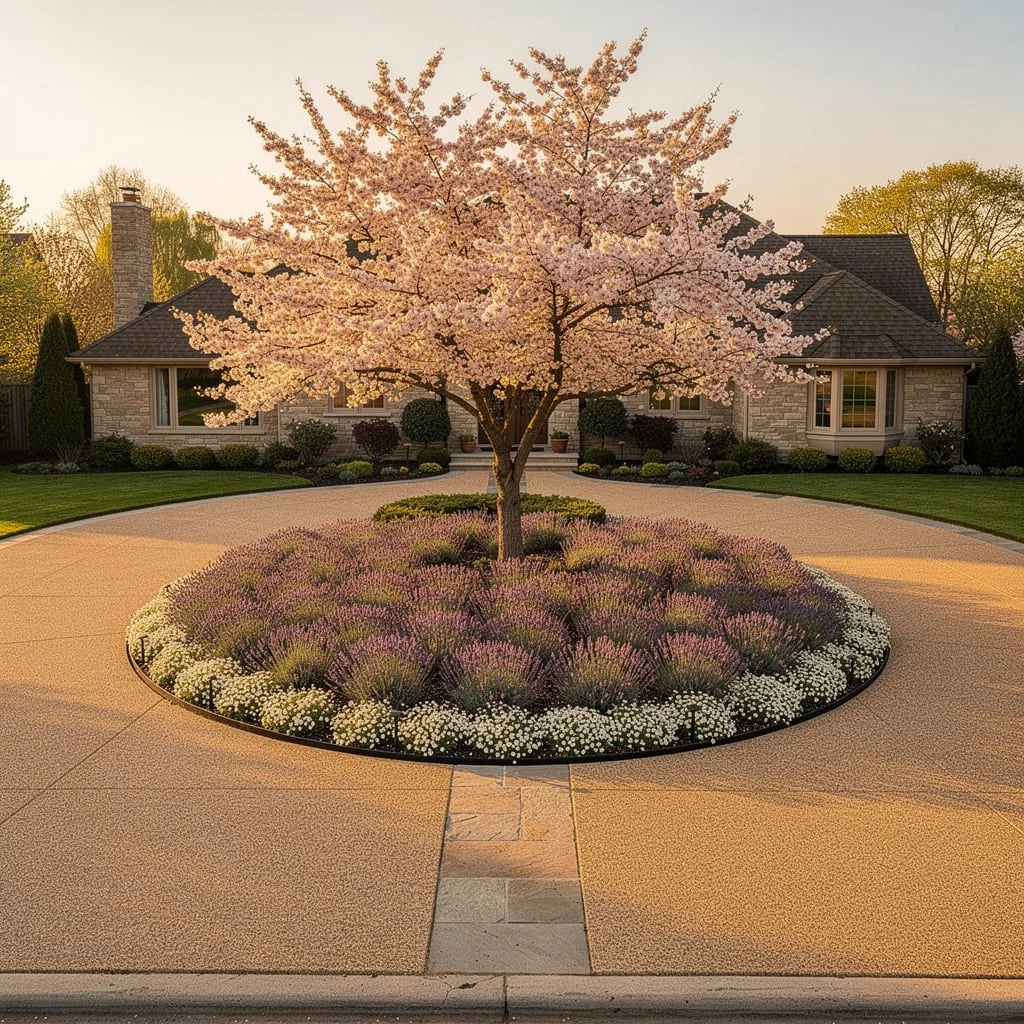
A circular concrete or aggregate driveway loop wraps around a generous central planting island — minimum five metres in diameter. At the island’s centre, plant a single ornamental cherry tree — Prunus ‘Kanzan’, Accolade, or a weeping form depending on climate — in a ground cover of lavender varieties and white alyssum edging.
The lavender varieties should create a subtle gradient: deep purple at the inner ring closest to the trunk, paler Hidcote or Munstead at mid-radius, white flowering alyssum at the outer edge nearest the driveway.
The driveway surface should be warm — exposed aggregate in a buff tone, resin-bonded gravel, or pale concrete. Not dark asphalt. The driveway is part of the composition, not just infrastructure.
In April, when the cherry is in full blossom above a carpet of just-emerging lavender, this design is genuinely worth the effort of everything that goes before.
The Organic Cottage Path With Perennial Gardens Swallowing the Approach
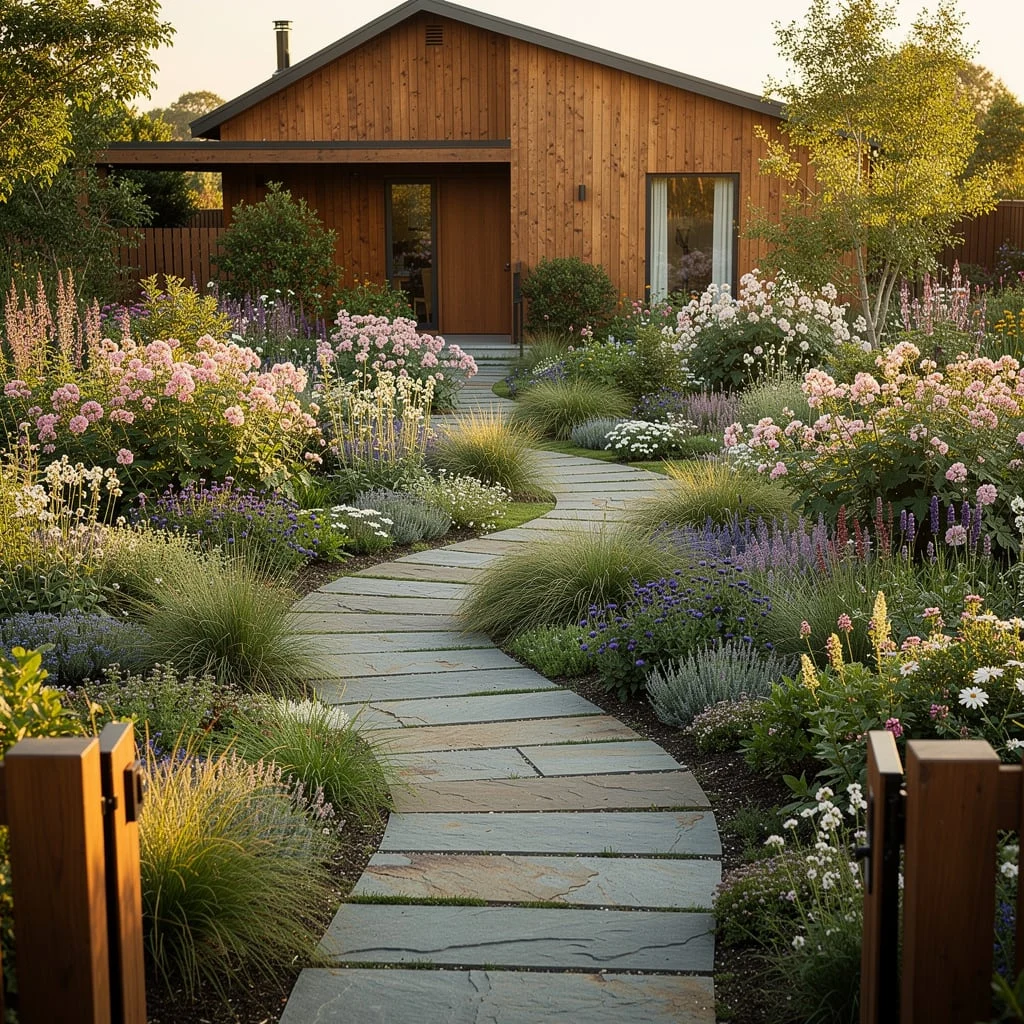
Lay a bluestone or sandstone flagging path — generous width, slightly irregular joints — from the timber entry gate to the front door. The path should curve gently rather than travel straight. Not meandering — purposeful, with a single curve that feels inevitable.
On both sides of the path, establish very deep garden beds — two to three metres wide minimum — planted with a fully naturalistic perennial and shrub mix. The plants should grow over and between the paving stones at the edges. They should reach and lean into the path. They should overhang each other.
Use plants that bloom in succession: in spring, nepeta and allium; in summer, salvia, scabiosa, and rosa; in autumn, rudbeckia and aster. Plant in repeating groups of three to five across the depth of the beds.
This garden requires real horticulture. You need to know what you’re planting and why, and you need to edit it seasonally. What it gives back is a front garden that looks alive at every scale — extraordinary from the street, and extraordinary at foot level as you walk through it.
The Formal Suburban Front With Circular Lawn and Steel-Edged Perimeter Beds
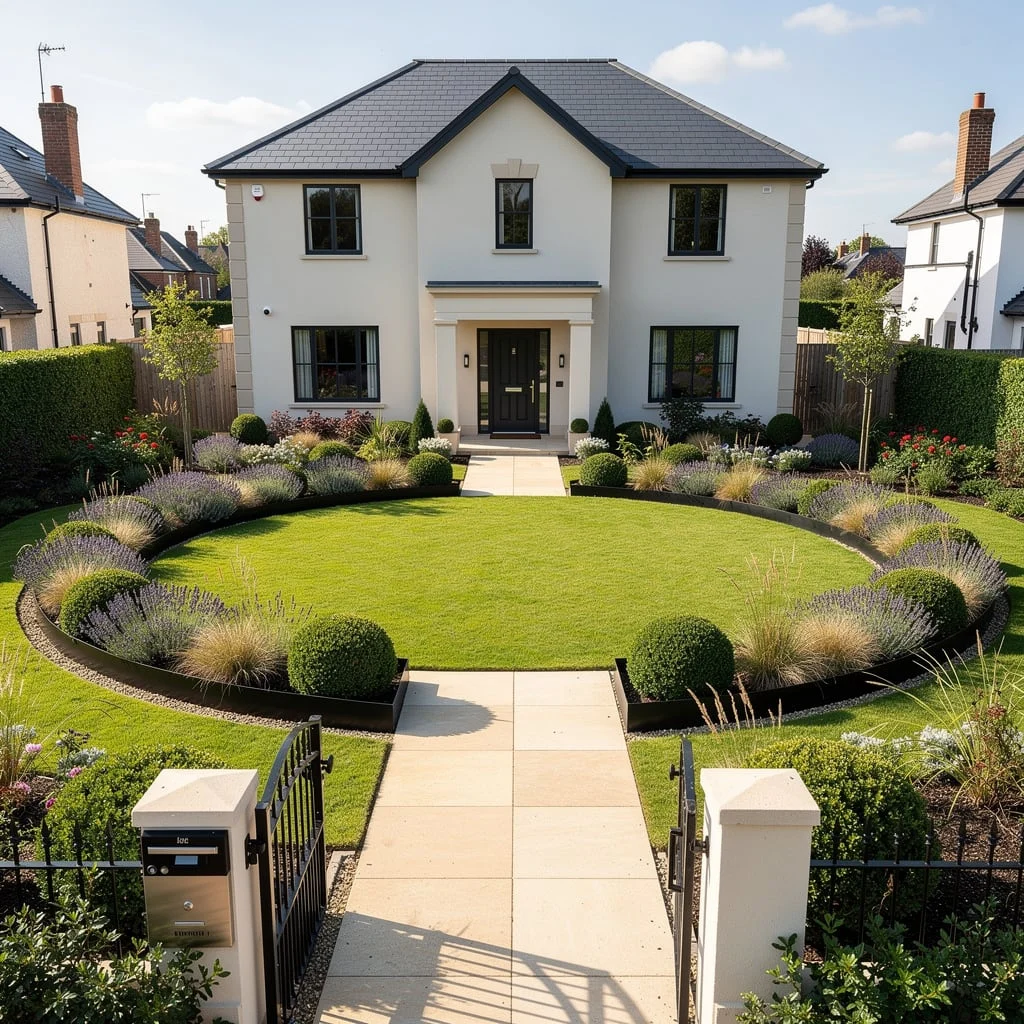
Create a central oval or circle of lawn as the dominant ground plane feature, edged in flat steel garden edging in matte black. The circle should be generous — at least four metres in diameter — and centred on the house entry axis or slightly forward of it.
Surround the circle with a continuous planting bed — lavender and buxus balls interspersed with ornamental grasses — filling the space between the circular lawn and the straight boundaries of the property.
Run a limestone or pale sandstone path from the street entry to the front door, bisecting the circular lawn slightly off-centre or running alongside its edge, depending on the house symmetry.
Two structural planted elements anchor the street boundary: square rendered piers with iron gate panels, flanked by tall conical conifers or matching standard trees.
The circle of lawn reads as a deliberate form against the surrounding planting, and the planting reads as a frame for the circle. Each element makes the other work better.
The Desert Rock Garden With Agave and Dry Creek Bed
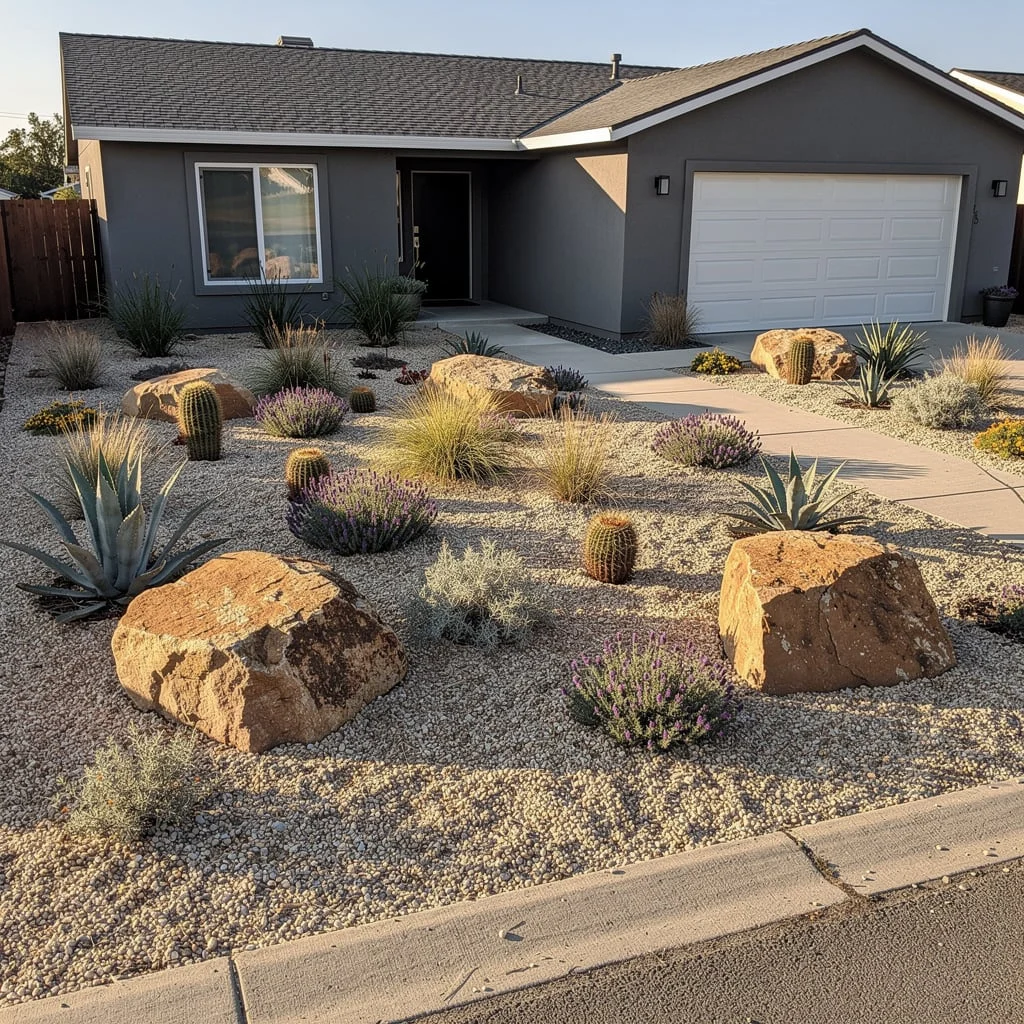
For a hot climate front yard where lawn makes no sense, grade the site slightly — not flat, but gently contoured — and install a dry creek bed running diagonally from one front corner toward the driveway edge. Line the creek bed with larger smooth river stones graded from 150mm near the house to 50mm at the street end.
Cover the remaining ground plane in fine white or buff crushed granite. Plant in generous masses: blue agave at the large scale, golden barrel cactus at medium, trailing desert lantana, purple verbena, and low woolly thyme at ground level.
Use boulders sparingly but significantly — one or two pieces of real scale, placed where the creek bed changes direction, that read as geology rather than decoration.
The front path is poured or broomed concrete, simple, from driveway to door.
The key to making this work is the planting density in year three and beyond. A newly planted xeriscape looks sparse for the first two seasons. Plant at the density you want it to look in five years, and it looks intentional within three.
The Allée Approach With Clipped Trees and Limestone Path
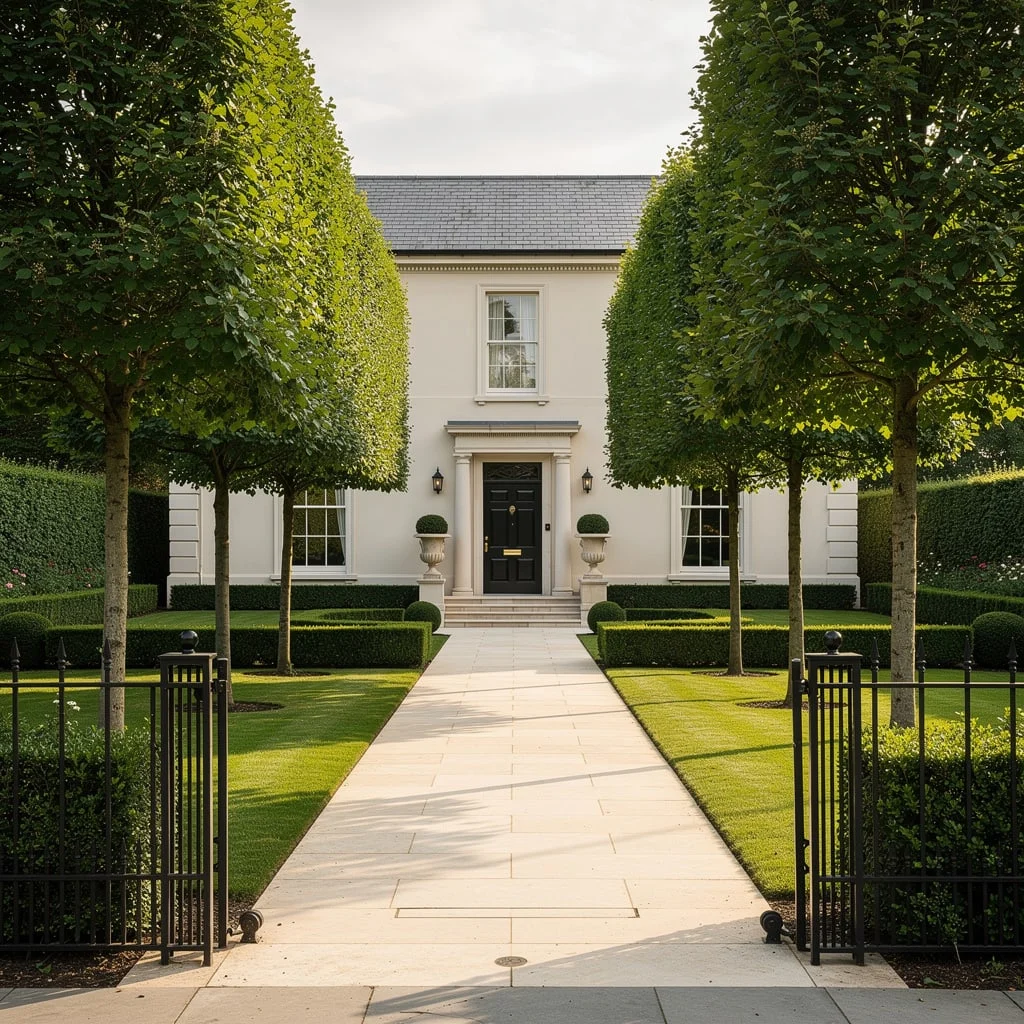
Install a single row of matching standard trees — lime, hornbeam, field maple, or liquidambar — on both sides of the entry path, spaced at consistent intervals of 2.5 to 3 metres. The trees should be purchased at a minimum clear stem height of 1.8 metres and a matching canopy height.
The path between the tree rows should be wide — 1.5 metres minimum — in pale limestone or sandstone, large-format, laid in a consistent bond. A gate at the street end frames the entry vista.
Between the tree trunks, the ground is either closely clipped grass or a simple layer of fine gravel. Nothing else. The grass or gravel runs from the path edge to the property boundary, punctuated only by the tree trunks at their regular intervals.
The house is visible from the street through the allée. The trees frame it without obscuring it. In autumn, the matching canopies turn simultaneously and the whole approach transforms.
The Front Yard Productive Garden With White Render Terraces
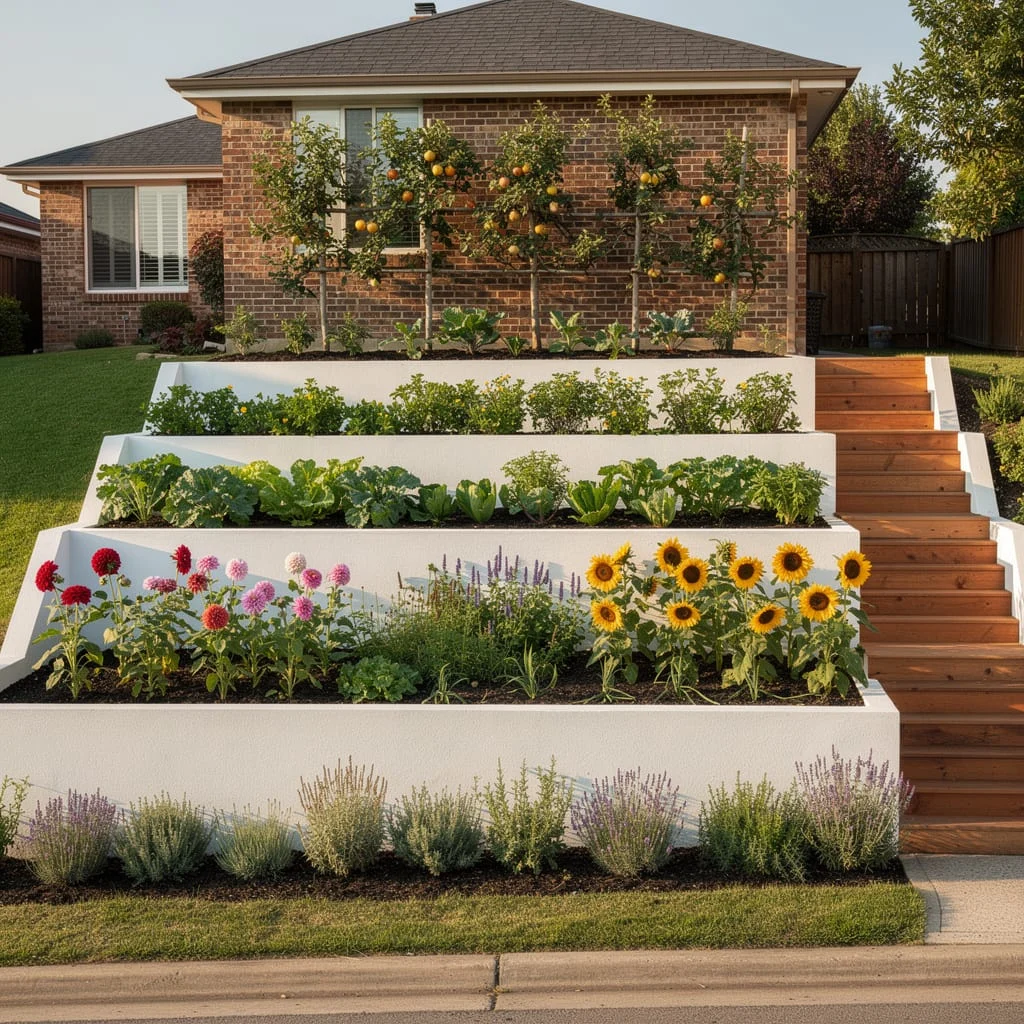
On a sloped site, build three rendering concrete terraces — render them white or near-white, smooth finish, no capping — each holding a different category of productive planting.
Bottom terrace (street-facing): low flowering herbs and lavender, ground level, accessible from the footpath. Middle terrace: flowering vegetables and cutting flowers — dahlias, sunflowers, salvia, brassicas in ornamental varieties. Top terrace: espalier fruit trees trained flat against a timber or wire frame, with leafy vegetables below.
Timber steps — hardwood, natural-oiled — ascend one side of the terracing from street to front door.
This is a front yard that produces something. Not a kitchen garden pretending to be ornamental, but a genuinely productive landscape that also looks composed. The white render walls, the timber steps, and the consistent planting character hold the composition together regardless of what’s growing.
Final Thoughts
Large front yards ask one question that small yards don’t: what is this space actually for?
A small yard answers that question by default. There’s only so much you can do. A large yard forces you to decide whether this space is a formal presentation of the house, a naturalistic garden, a productive landscape, or a social space. It can be more than one of these things, but not without choosing which one leads.
Every landscaping scheme in this collection made that decision first. The formal parterre chose symmetry and ceremony. The wildflower meadow chose ecological generosity. The desert xeriscape chose climate honesty. The allée approach chose procession.
A large front yard that tries to be all of these things simultaneously will exhaust every visitor before they reach the door.
Pick the thing your house and your climate and your genuine preferences actually call for. Then do that thing, and do it at scale.