
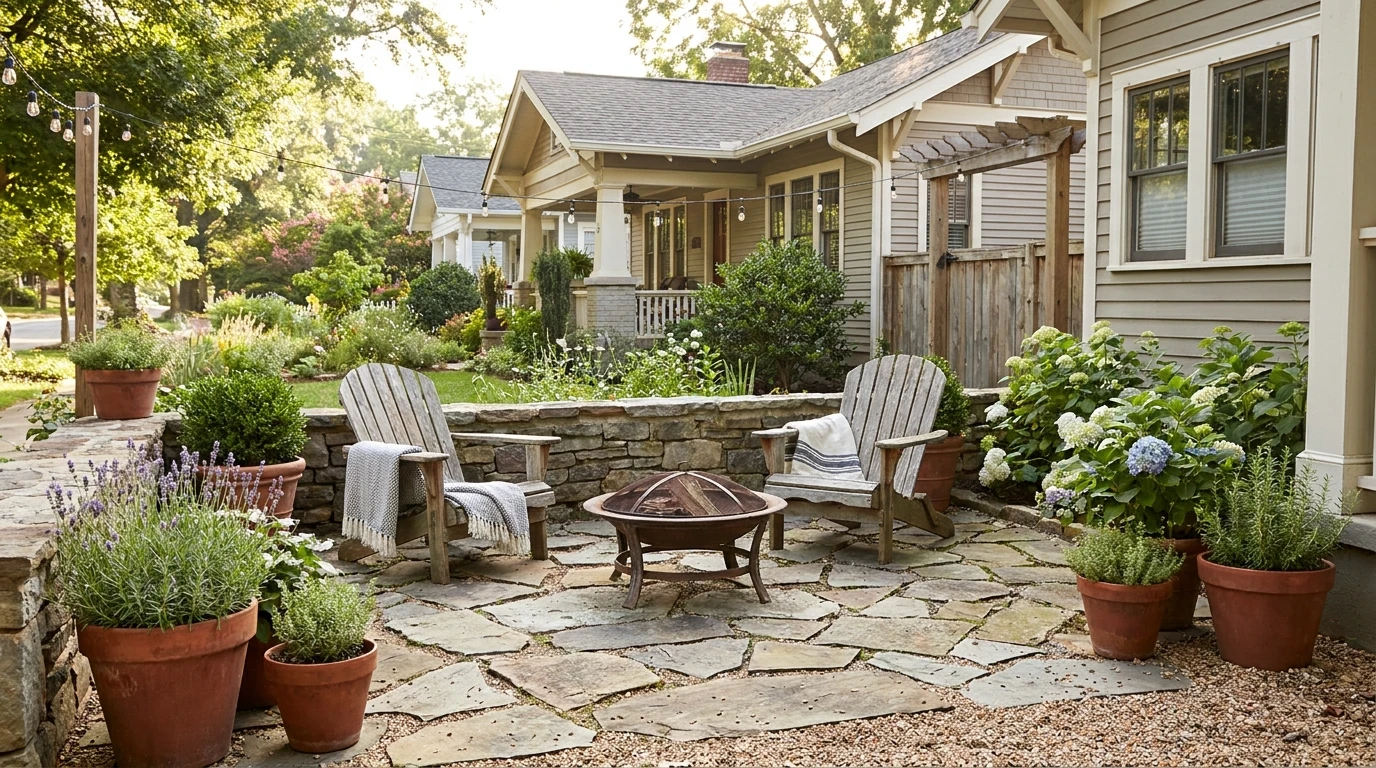
The backyard gets the pergola, the fire pit, the outdoor dining set, the string lights. The front yard gets a mailbox and some mulch. And then everyone wonders why the house doesn’t feel welcoming.
The front yard patio is the most underused idea in residential outdoor design. It’s the part of the property that faces the street, catches the afternoon sun, and greets everyone who walks up. Giving it a chair to sit in is, apparently, radical.
It isn’t. It’s just common sense that most people haven’t got around to.
These ideas are for houses that have finally decided the front deserves as much attention as the back.
Your House Has a Face. You’ve Been Ignoring Half of It.
The front facade is architecture. The space in front of it is the frame. Most people treat the frame as a formality — something to walk across, not linger in.
The Approach Experience Is a Design Decision
Every front yard has an entry sequence. It’s either designed or accidental. An accidental entry sequence is a strip of concrete between the driveway and the door, flanked by whatever survived the previous owners’ landscaping budget.
A designed entry sequence creates movement. It has rhythm — a path that leads at a pace that lets you look at the house. It has something to look at on the way: a planted bed, a change in surface material, a structure overhead. And it has a destination that looks like it was considered.
A patio at the front of the house anchors the entry sequence. It says: this is a place where people stop. The front door is no longer just the beginning of the inside. It’s the end of an outdoor experience.
Facing the Street Is Not as Uncomfortable as You Think
The objection to front yard seating is always privacy. People imagine sitting exposed on the footpath, making awkward eye contact with neighbours.
That’s not what a front yard patio is. A front yard patio is set back from the street, framed by planting or a low boundary wall, and oriented toward the house rather than outward. You face your own facade. You see the door, the garden, the approach. The street is peripheral.
Done right, a front patio feels more private than a backyard with a fence. Because the enclosure comes from the house itself — the most substantial wall available.
What the House Already Gives You
Every house facade offers something a designer would pay for: a ready-made backdrop. The material of the house — brick, render, weatherboard, timber — sets the visual tone for everything in front of it.
The mistake is ignoring this and choosing patio materials in isolation. A warm red brick house is already telling you something about the palette. A rendered white house is already telling you something else. Listen to the building before you choose the paving.
The front patio that works is the one that reads as an extension of the house’s exterior rather than a feature placed in front of it.
Overhead Cover Changes Everything About How the Front Yard Is Used
A patio without overhead cover is a patio used occasionally. Cover turns it into a room.
What Each Cover Type Actually Does
A pergola with open cross-battens filters light but doesn’t block rain. It creates the sense of enclosure without committing to shade. This works in climates that don’t need protection from heat and in front yards where you want the feeling of a frame without the weight of a solid roof.
A shade sail does the opposite. It blocks direct sun efficiently and cheaply, particularly useful in front yards that face west or north. It’s also honest — it looks like a sail, it functions like a sail, and when it’s installed on quality matte black steel poles with clean proportions, it looks deliberate rather than temporary.
A planted canopy is the slowest option and the best one. Pleached trees — hornbeam, lime, Photinia — trained flat at a consistent height above the ground plane create a living ceiling. The trunks are the posts. The canopy is the roof. It takes five years to establish and forty to pay back fully.
The roof that’s built into the house — an extended eave, a verandah soffit, a projecting concrete slab — is the most seamless option. It reads as architecture, not addition.
The Transition Between Cover and Open Sky
Most pergola and shade sail installs suffer from awkward transitions. The cover ends abruptly and the garden beyond it continues undifferentiated.
The solution is to treat the edge of the cover as a threshold. The paving material changes at the drip line. The planting density shifts. Something signals: inside this frame is different from outside it.
This transition is what makes a patio feel like a room rather than an area. The boundary doesn’t need to be physical. It just needs to be readable.
Paving, Levels, and the Ground Plane in Front of Your House
The ground material and how it’s organised determines whether a front yard patio reads as accidental or considered.
Raising the Patio Changes Its Relationship to the House
A patio that sits flush with grade is part of the garden. A patio raised even 200 to 300mm on a masonry base becomes a platform — an elevated stage that the house reads off. The retaining wall that holds the patio at grade becomes an architectural feature in its own right: dry-stacked stone, concrete block, coursed sandstone.
Raised patios suit front yards where the house itself is elevated above street level, because they reinforce the natural hierarchy of the approach. The house commands the site. The patio mediates between the house and the garden below.
Gravel Patios Work Better Than People Expect
Compressed gravel or fine crushed rock is one of the best-performing surfaces for a front patio. It drains perfectly. It needs almost no sub-base preparation. It looks deliberately casual in a way that concrete never manages.
The rule is containment. Gravel without a solid edge migrates. The frame — steel garden edging in a dark powder coat, a raised masonry border, a line of flat-set stone — is non-negotiable. Get the frame right and the gravel reads as a surface rather than a mistake.
A circular jute rug over gravel defines the seating area without introducing a hard material boundary. The softness of the rug against the texture of the gravel is a composition that costs very little and works consistently.
The Circular Patio in a Rectangular Lawn
A circle of paving set into a rectangular lawn creates visual tension that reads as intentional. The lawn is geometry. The circle is geometry. They are different kinds of geometry, and the contrast between them creates energy.
The circular patio works in front yards where the house facade is symmetric — where the circle can be centred on the entry axis and the lawn reads as two equal flanking planes. Off-centred circles in front of asymmetric facades create the wrong kind of tension.
Front Yard Patio Ideas Worth the Kerb Appeal
The Concrete and Lawn Contemporary With the Terrace Wall
Build a low concrete retaining wall — approximately 300mm high, clean formed edge, no capping stone — that defines a rectangular patio platform at the front of the house. The concrete face is left board-formed or smooth, depending on the house register.
Lay large-format dark charcoal porcelain tile across the platform surface. Place a low-profile outdoor sofa — dark fabric, minimal frame — against the house wall, flanked by two matching compact buxus topiary in matte black planters.
Two or three concrete stepping stones lead from the street-level lawn up to the platform entry, set into the lawn with a single step up.
Leave the rest of the front garden as lawn. Nothing else. The restraint of a dark tile platform floating above a green lawn, with the white house rising behind it, is a composition that doesn’t need any more parts.
The Stark Minimalist Covered Patio Against White Render
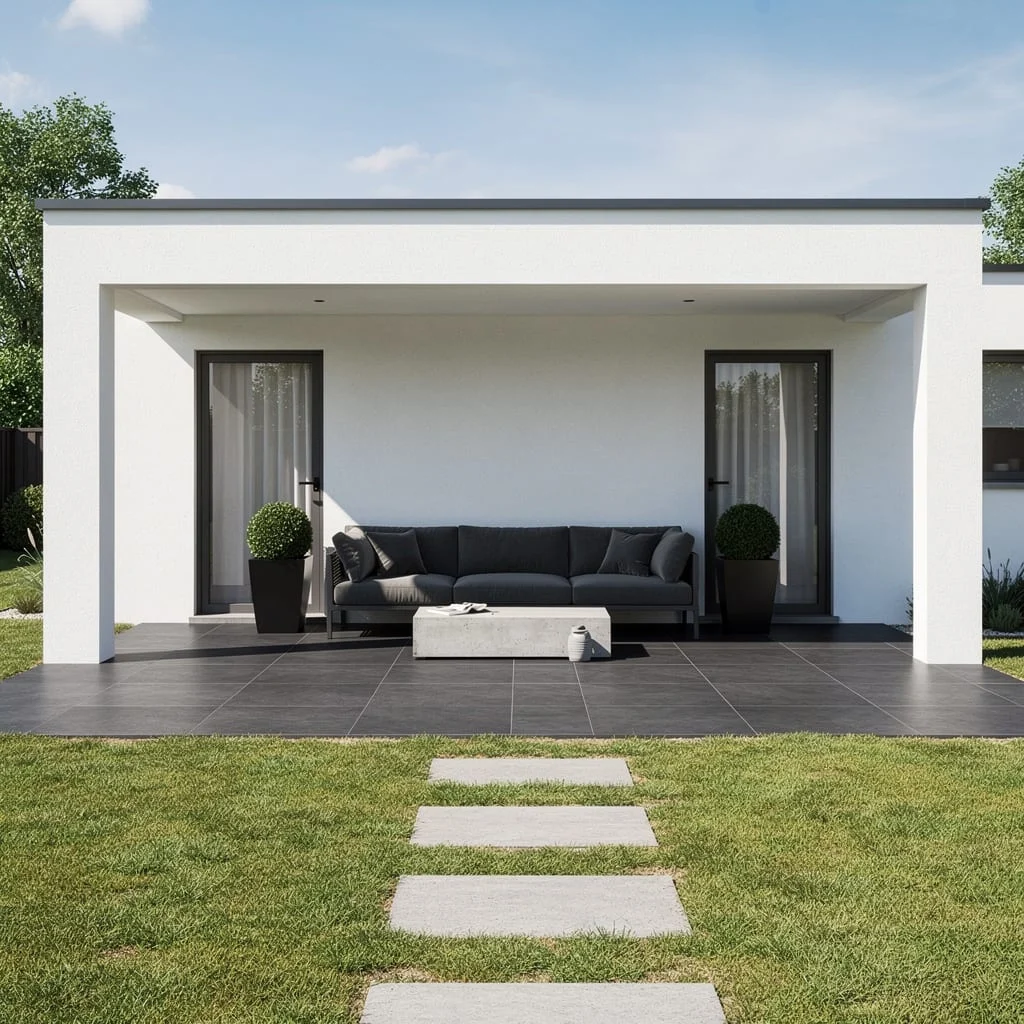
A white rendered house with a projecting concrete or zinc flat roof overhang already has its patio defined for it. The overhang is the roof. The space beneath it is the room.
Lay large-format dark anthracite porcelain tile across the full width of the overhang, flush to the house. Place a single long low sofa — charcoal upholstery, matte black frame — against the wall, centred. A rectangular concrete coffee table. Nothing else.
Two compact buxus topiary in matte charcoal rectangular planters at either end of the sofa, flanking the composition.
A single recessed downlight in the soffit above.
This patio has six components: tile, sofa, table, two planters, one light. Any addition weakens it. The power comes from the deliberate emptiness on either side of the furniture and the way the white wall reads as negative space behind.
The French Country Entry Courtyard With Stone Steps
The surface here is large-format natural sandstone or limestone, laid in an irregular bond across a generous entry terrace — wider than the entry path, set two or three steps above the garden level. The steps are broad-tread, single-rise, made from the same stone as the surface.
Place white-painted or cream-finish iron bistro furniture — a round table, two chairs — to one side of the entry rather than centred. Centred furniture blocks the door approach. Off-centre furniture creates a living corner.
Frame the terrace with terracotta pots of varied heights, planted with clipped standards and trailing seasonal flowers. Use creamy white or blush flowering annuals — repeat to maintain the tonal palette.
Don’t do this if the house is a flat-roofed contemporary. The stone, the iron furniture, and the potted standards are a specific register. They belong to a house with plaster walls and lantern-style wall lights. Match the architecture or change the approach.
The Sunken Dark-Tile Patio With Agapanthus Border
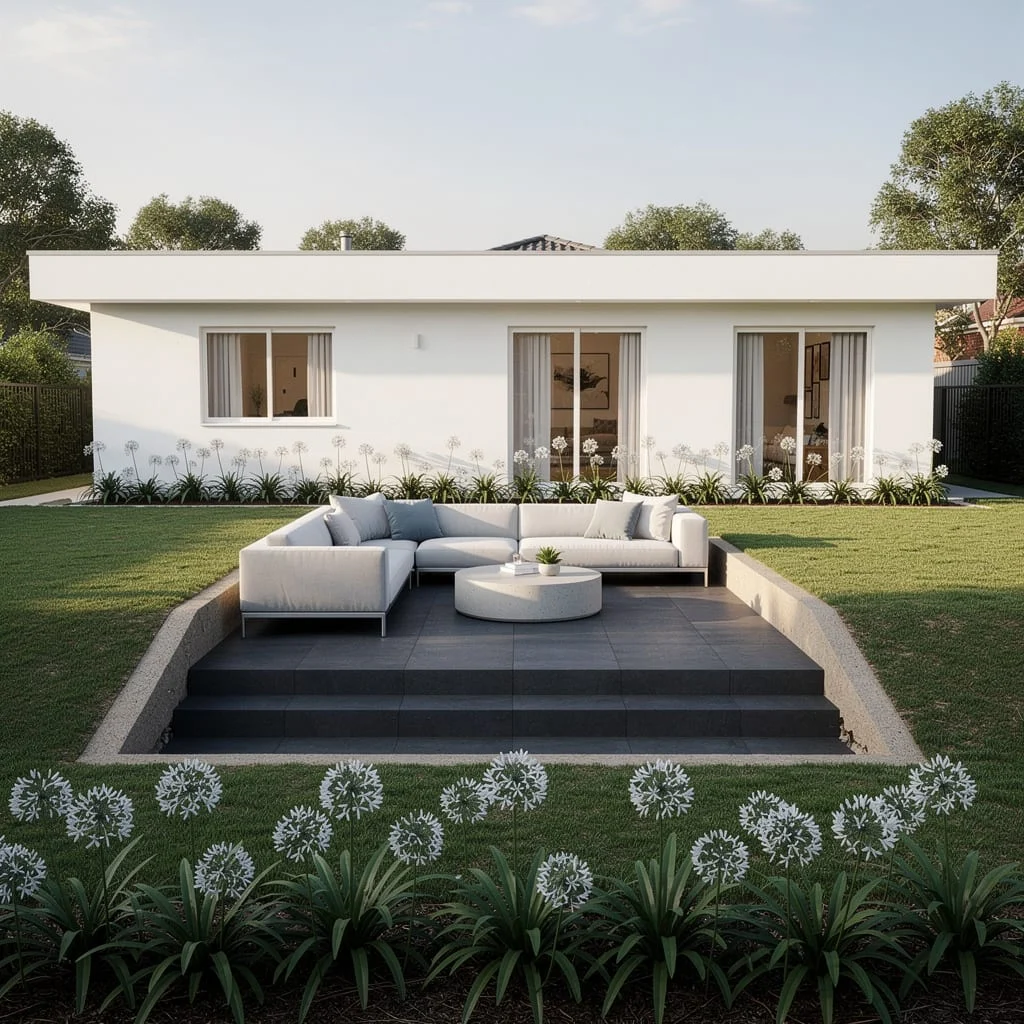
Excavate a rectangular area in the front lawn approximately 300mm below grade level. Lay dark anthracite stone or porcelain tile across the sunken base in a large-format grid. The perimeter is defined by the lawn edge, which reads as a low retaining plane.
Place an L-shaped outdoor sectional sofa — white or very pale grey upholstery, stainless or powder-coated aluminium frame — in the sunken area. A round concrete side table. Nothing vertical except the house behind.
Plant a continuous band of agapanthus along the perimeter of the sunken area, facing the street. When in flower, the white or pale blue globes on tall stems frame the dark patio below. Out of flower, the strappy dark green foliage maintains the edge definition.
The sunken patio is a bold idea for a flat site. It creates privacy and drama simultaneously — the depth of the recess means you sit below grade, sheltered from the street sightline without any wall or fence.
The Organic Gravel Fire Pit Patio With Walnut Wood Furniture
Lay a generous bed of washed pea gravel or fine decomposed granite across the front patio footprint, contained by a clean steel edging border. The footprint should be larger than feels necessary — minimum five metres across in any direction.
Place a long rectangular concrete gas fire pit at the centre. Arrange walnut-toned hardwood sofas and chairs around it in a loose U formation. Add a cylindrical concrete side table at one end. Dot the perimeter with upright feather reed grasses in matte black planters.
The house behind is white board-and-batten with black-framed french doors. The contrast is everything: warm gravel and warm wood against the crisp white facade, the fire providing the only warm light.
This configuration works at any scale. A smaller version with two chairs instead of a full sofa arrangement is just as resolved.
The Floating Hardwood Deck Against the Dark Facade
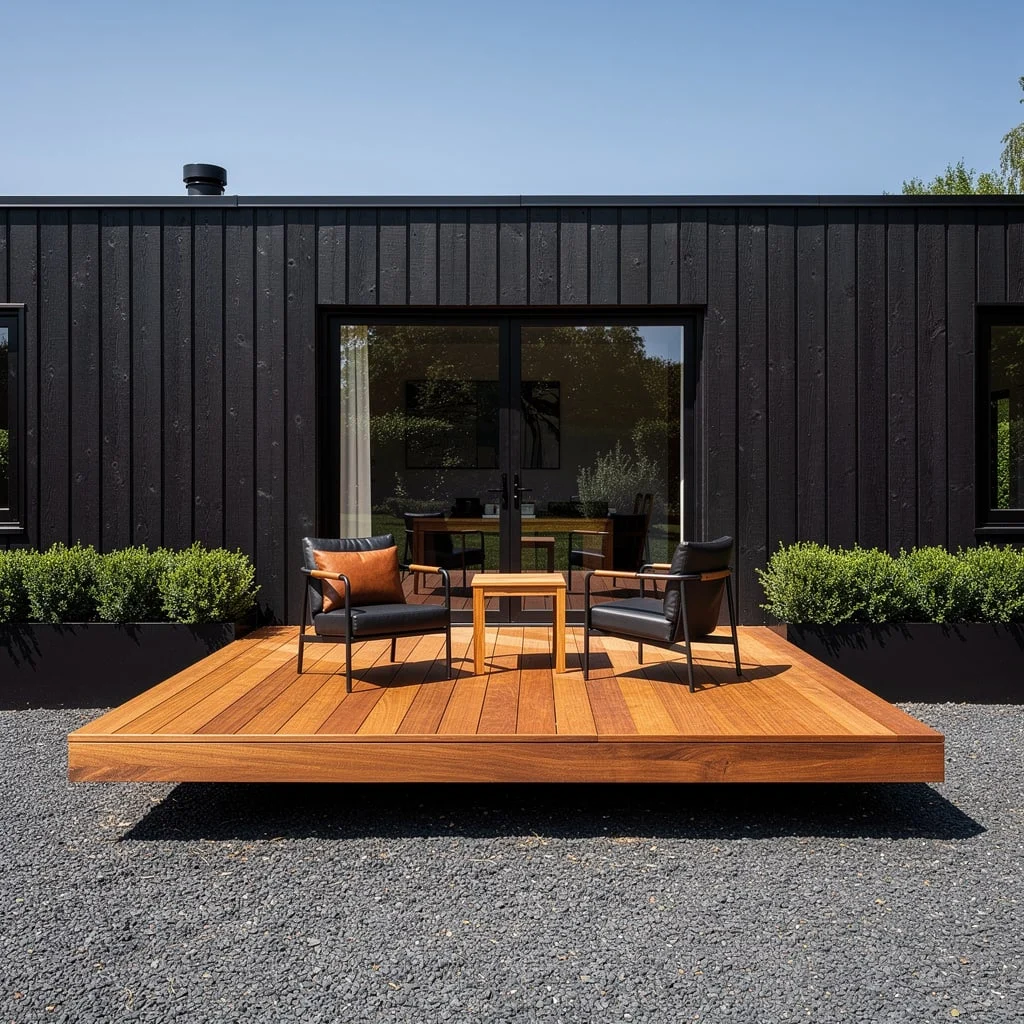
Build a flush hardwood deck — merbau or spotted gum, oiled natural — as a free-standing platform sitting on a bed of black basalt gravel. The deck should sit approximately 150 to 200mm above grade and cantilever slightly beyond its support posts so the edge appears to float.
Against the house — painted or clad in matte charcoal or near-black — the warm timber reads as deliberate contrast. Place two low-seated chairs in black leather and steel on the deck surface, with a compact timber side table between them.
Plant one continuous row of compact buxus along the gravel perimeter on either side of the deck — not mixed planting, a single species clipped to a consistent height. The dark gravel, the dark house, the green hedge, and the warm timber create a four-material palette that doesn’t need a fifth.
The Mid-Century Corner Patio Under the Eave
Find the sheltered corner where the roofline extends lowest over the facade — typically at a garage junction, a recessed entry wing, or a change in roof plane. This is where the front patio goes.
Lay irregular flagstone directly into the mulch bed — not mortared, not edged, just set flush. A few courses only, enough for two chairs and a small table. Keep the surface loose and casual.
Place two solid timber-framed armchairs with natural linen cushions. Add one oversize lantern at ground level beside the chairs. Mount a single simple timber panel — a decorative screen or slatted panel in the same stain as the garage door — on the wall behind.
Plant compact low evergreen shrubs in the mulch bed surrounding the paving, tightly spaced so the chairs sit inside a soft frame of green. Let creeping ground cover fill any gaps between the flagstones in the first season.
This patio costs almost nothing. What it requires is reading the architecture and placing the seating exactly where the house offers natural shelter.
The Round Sandstone Circle Set Into Suburban Lawn
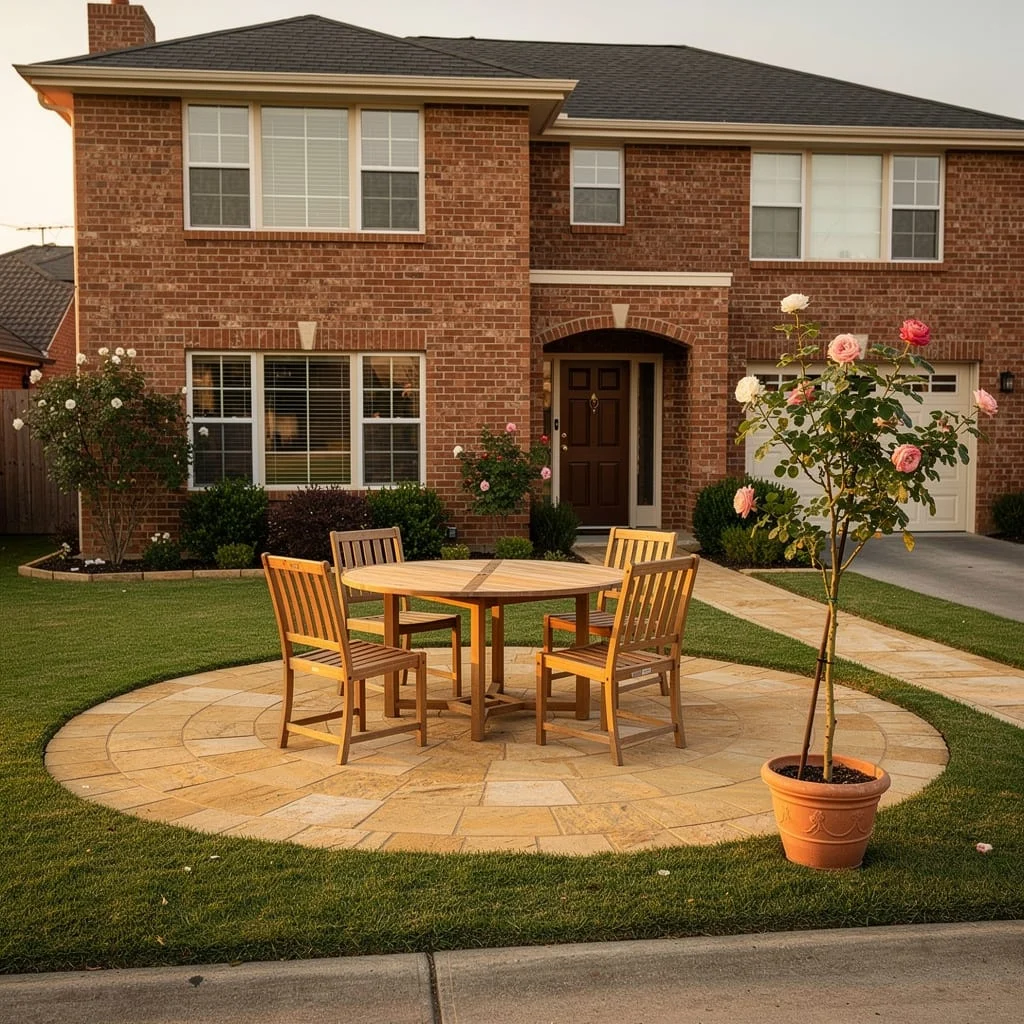
Cut a circle approximately three metres in diameter into the existing lawn of a brick suburban front yard. Excavate 100mm, compact the base, and lay large-format buff or honey sandstone in a radiating pattern — fan cut, joining at the centre.
Set a round timber table at the centre of the circle with four matching timber dining chairs. Place one potted standard rose — a single stem variety — at the edge of the circle as the only vertical element.
The circle is the intervention. The house behind doesn’t need to change. The circle announces: this is a place, not just a lawn. The geometry does everything. The furniture is secondary.
The Pale Gravel Patio With the Wicker Seating Set
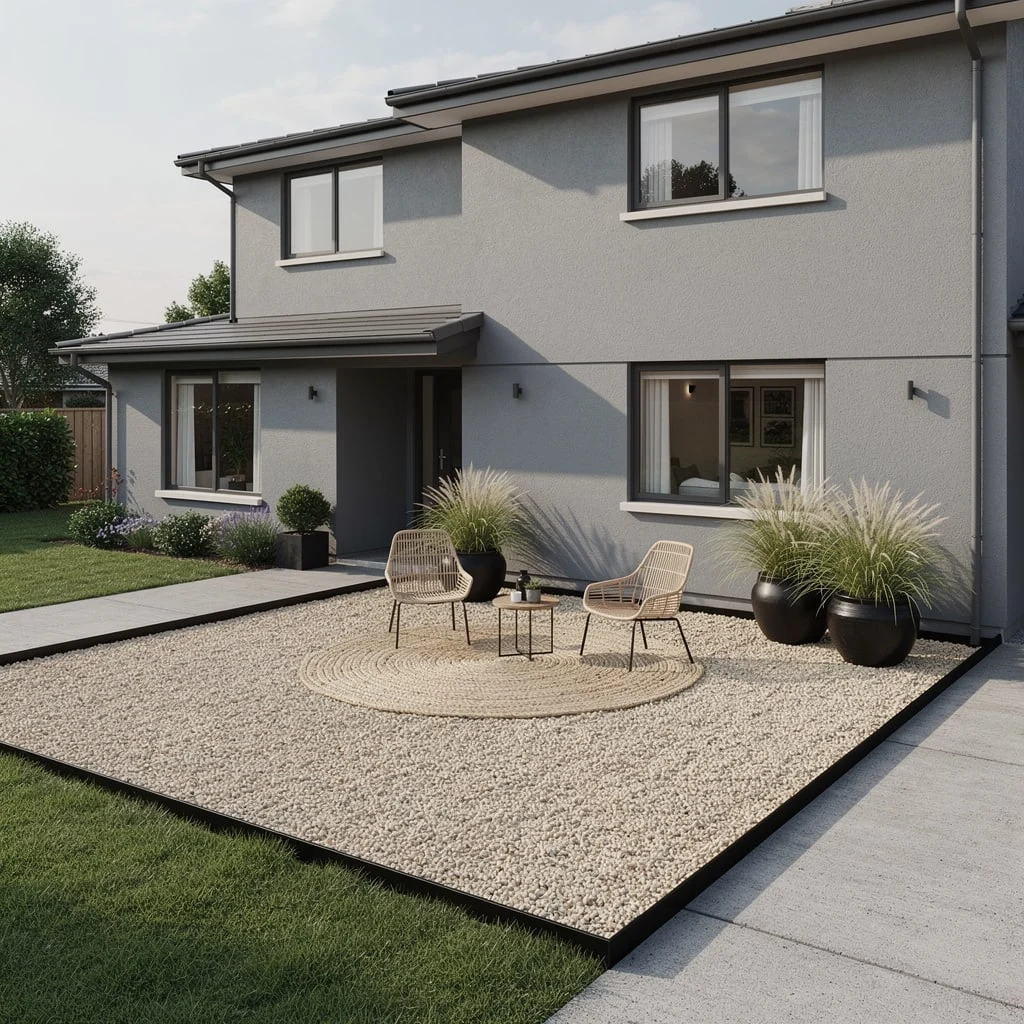
Lay a square of pale cream gravel — 10mm limestone chip or washed white quartz — contained by flat-set steel edging in a warm black powder coat. The square should be approximately four by four metres, set back from the kerb by at least two metres.
Place a circular woven jute rug in the centre of the gravel. Two natural rattan or wicker chairs with cushions face each other over a small round table. Add two oversized black ceramic or powder-coated steel planters with tall ornamental grasses at either rear corner of the gravel square.
The grey rendered house behind anchors the palette. The pale gravel and natural rattan are warm against the cool grey. The grasses provide movement and height without formality.
This is the front patio for people who say they’re not garden people. It requires no horticultural knowledge, no irrigation, and almost no maintenance. It looks like a considered decision about how to use the front yard rather than a default.
The Cedar Shingle Farmhouse With the Raised Stone Platform
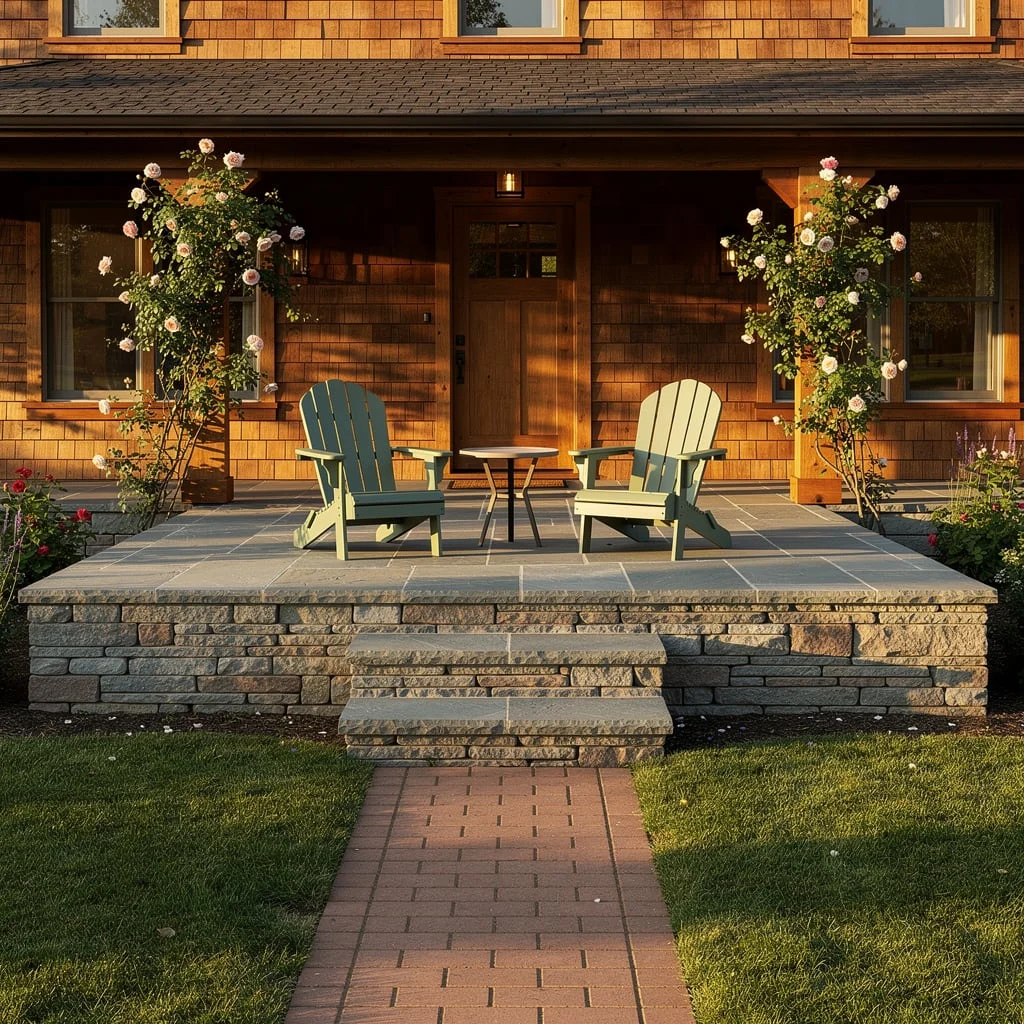
Build a dry-stacked or mortared fieldstone retaining wall — three or four courses high — that creates a raised platform directly in front of the farmhouse facade. The platform surface is large-format grey limestone or bluestone tile, roughly brushed, laid in a grid.
Centre two Adirondack chairs — painted in a sage green or dusty olive that picks up a colour already in the planting — on the platform, facing slightly outward. A simple iron side table between them.
At the base of the retaining wall on either side, plant a climbing rose on a simple obelisk or against the wall face. Allow the roses to bloom at wall height and above.
Lay a clay brick path from the gate to the base of the stone steps — a warm counterpoint to the cooler grey of the platform.
This works because every material is natural and the palette is controlled: warm brick, warm stone, warm timber chair, cool limestone surface. No plastic, no powder coat, nothing that draws the eye away from what the architecture is already providing.
The Mediterranean Terracotta Entry With Blue Pots and Bougainvillea
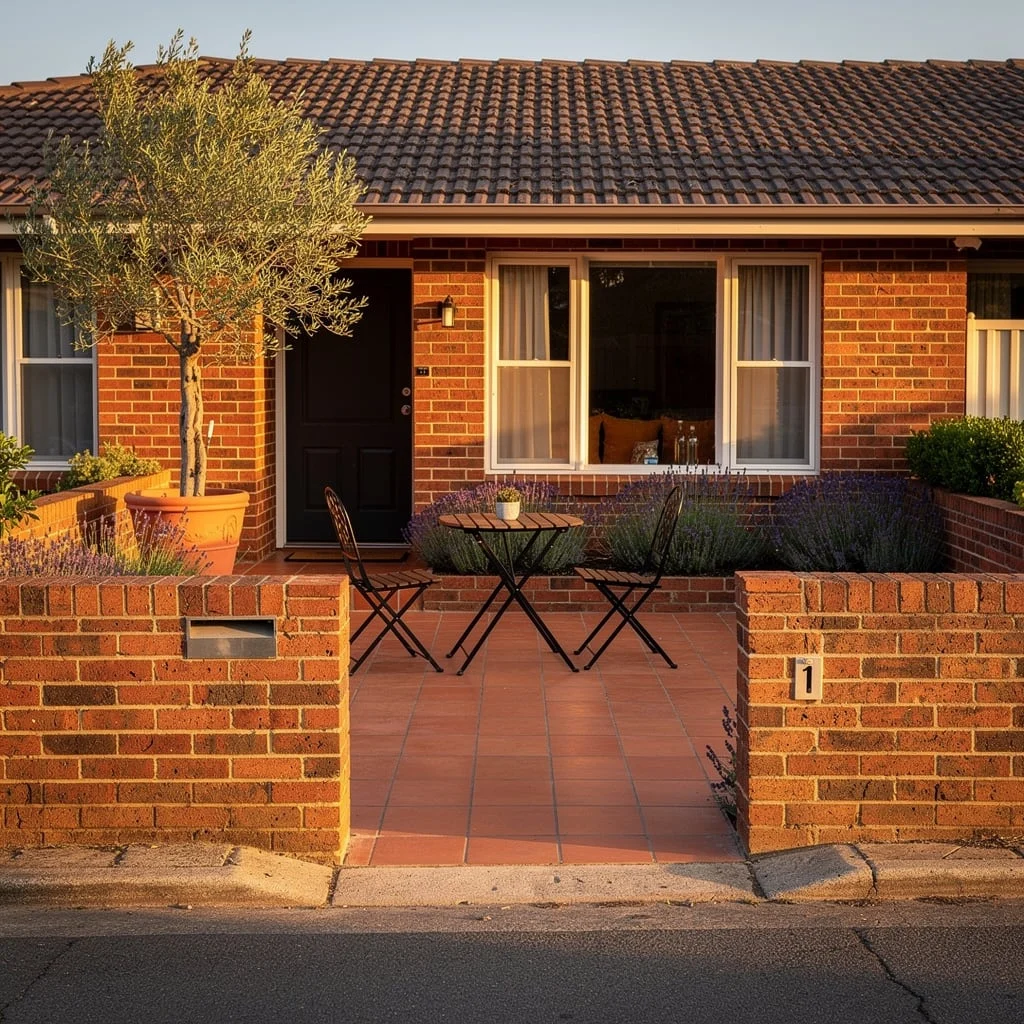
Lay terracotta square tiles — 300mm or 400mm format, unglazed or lightly sealed — across a raised entry terrace set two steps above the garden level. The tiles run from the house face to the kerb edge, not just the area near the door.
Plant one large bougainvillea at the entry corner and train it over a simple white-painted arch bolted to the house wall. Give it three seasons. It will occupy the corner and cascade beyond it.
Place two identical deep cobalt blue glazed pots — minimum 500mm diameter — symmetrically flanking the entry steps. Plant olive trees in standard form, one per pot.
A simple iron café table and two folding iron chairs sit to one side of the entry, on the terracotta surface. Don’t add cushions. The material palette is already warm enough.
This patio is entirely about the bougainvillea. The tile, the pots, the olive trees — they are supporting characters. Plant the bougainvillea first. Everything else organises itself around it.
The English Cottage Brick Patio Swallowed by Flowers
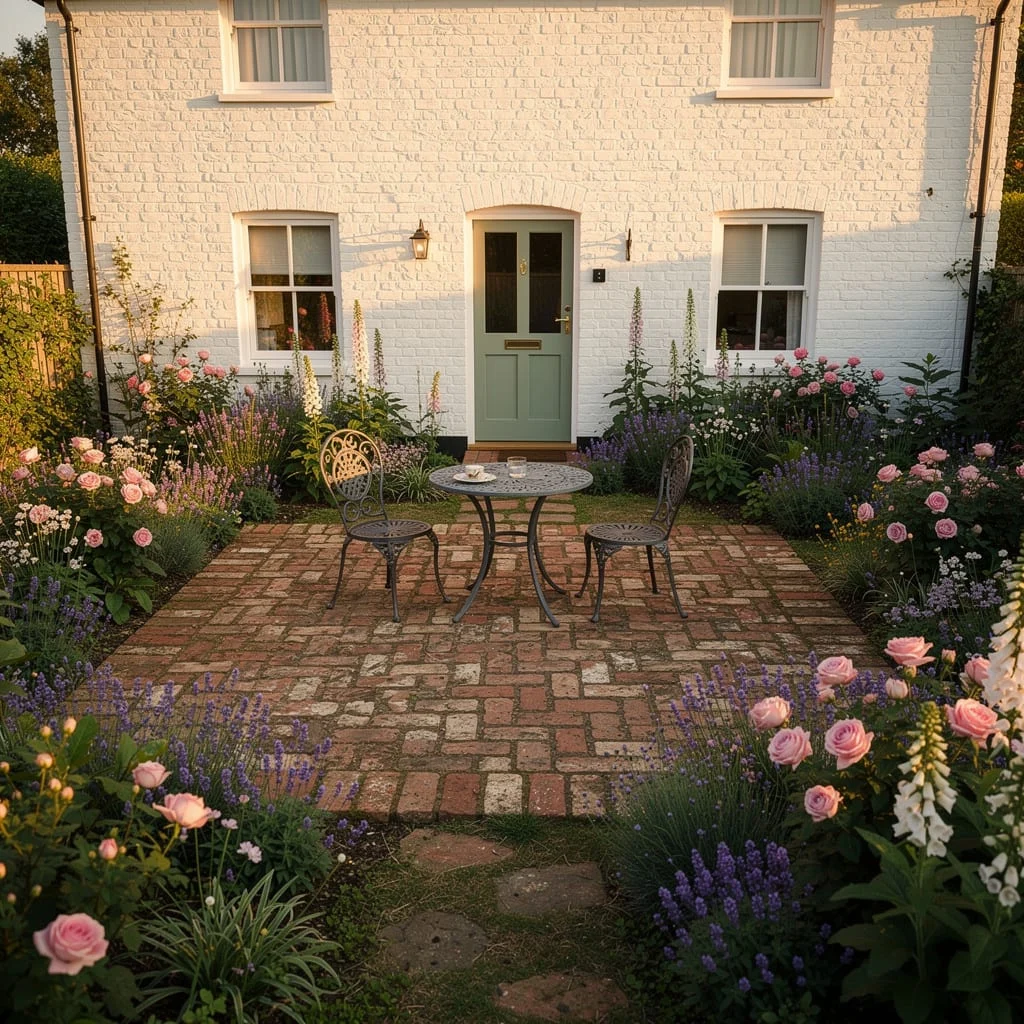
Lay reclaimed clay brick in a running bond — not herringbone — across a modestly sized front patio. The brick should be old. Not fake-aged, not tumbled, but genuinely reclaimed clay brick that has already developed its patina.
Allow the joints to be slightly irregular. Don’t point them tightly. Plant creeping thyme or mind-your-own-business moss into the gaps and let it establish.
Frame the patio on three sides with deep planting beds — old-fashioned roses, lavender, foxglove, campanula, chives left to flower. The beds should be wide enough that the plants lean over the brick edge. The brick disappears into the planting at its edges.
Place a cast iron bistro table and two chairs in the centre. Leave a cup and saucer on the table. This is a patio that belongs to a specific kind of afternoon and makes no apologies for it.
The Spanish Mission Entry With Terracotta Tile and Single Bougainvillea
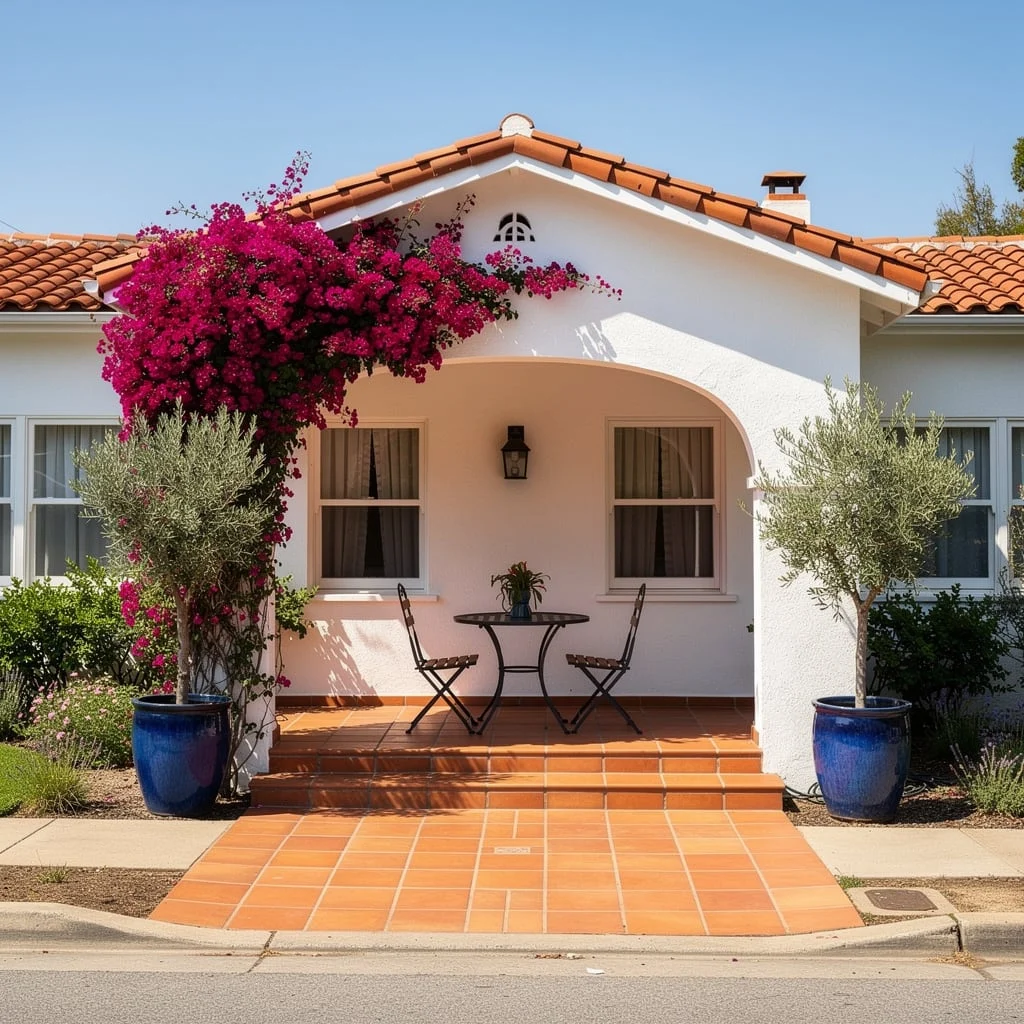
Lay terracotta floor tile from street level to the entry threshold — a continuous plane with no steps, just a gentle ramp if needed. Use 400mm square unglazed tiles in an orange-red tone that reads warm in flat light and luminous in sun.
Build an arched entry portal into the facade face — a plaster arch that frames the front door and creates a porch recess. Inside the recess: two iron folding chairs, one small iron table, the door beyond.
Symmetry is non-negotiable here. Two matching blue glazed ceramic pots flank the arch at ground level, each with a standard olive. The arch is the centrepiece. Everything frames it.
This look requires the right house. White stucco, terracotta roof tile, small-paned windows. The architecture has to say Spanish Mission or this patio says wrong house wrong style.
The Exposed Aggregate Front Patio With the Garden Bench
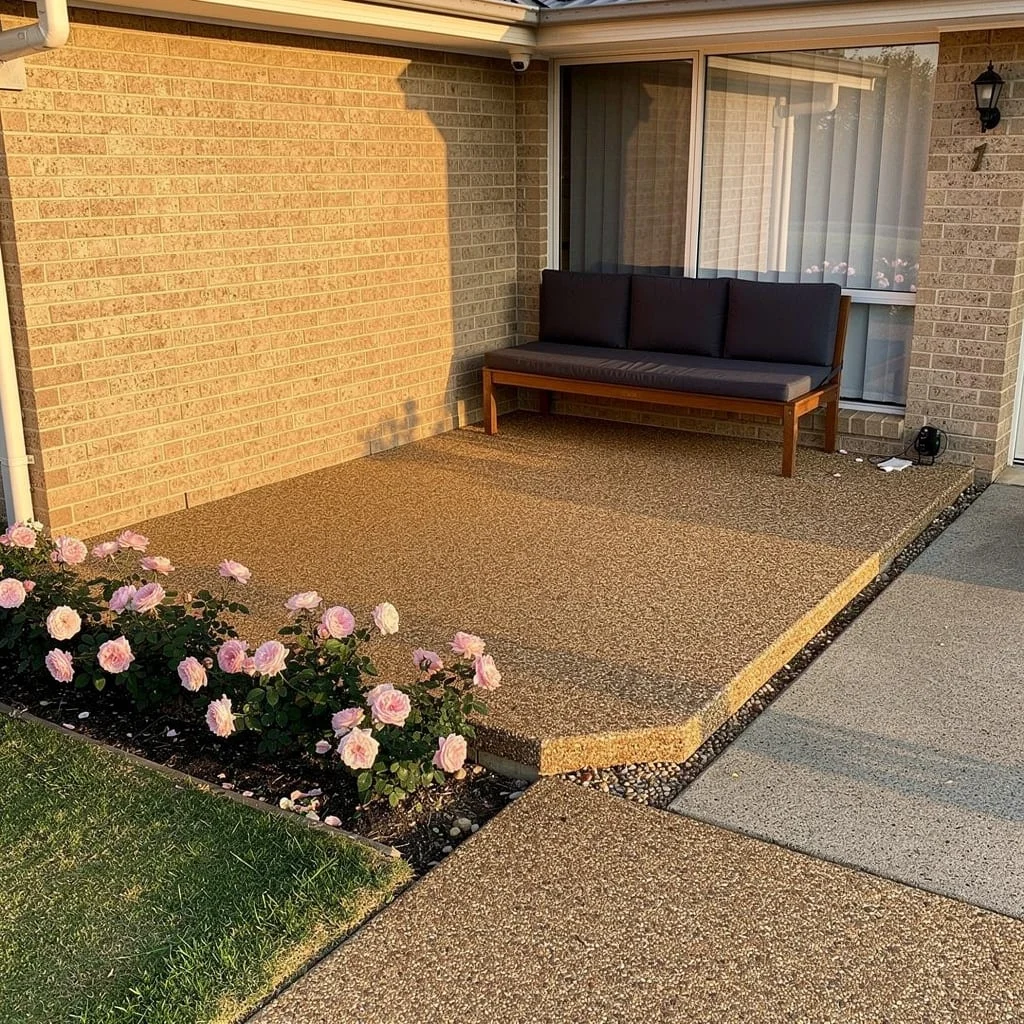
An exposed aggregate concrete slab is one of the most honest and underappreciated surfaces for a front patio. It reads warm, it has texture, it doesn’t look like a car park, and it drains well.
Mix a warm honey or buff aggregate with a slightly pink or terracotta cement base. The aggregate should be medium grade — not too fine that it disappears and not so coarse that it is rough underfoot.
Place a single three-seat timber outdoor bench against the house wall — one long seat, no arm rests, simple angled legs. Dark cushion. That’s the furniture. One piece.
The garden bed between the patio and the lawn contains compact roses, planted in a loose row rather than a formal pattern. They bloom over the bench from one direction and over the path from another.
This patio is for houses that haven’t committed to a style. The aggregate is neutral, warm, and undemanding. It works under a brick facade, under render, under weatherboard.
The Contemporary Sail Shade Dining Patio
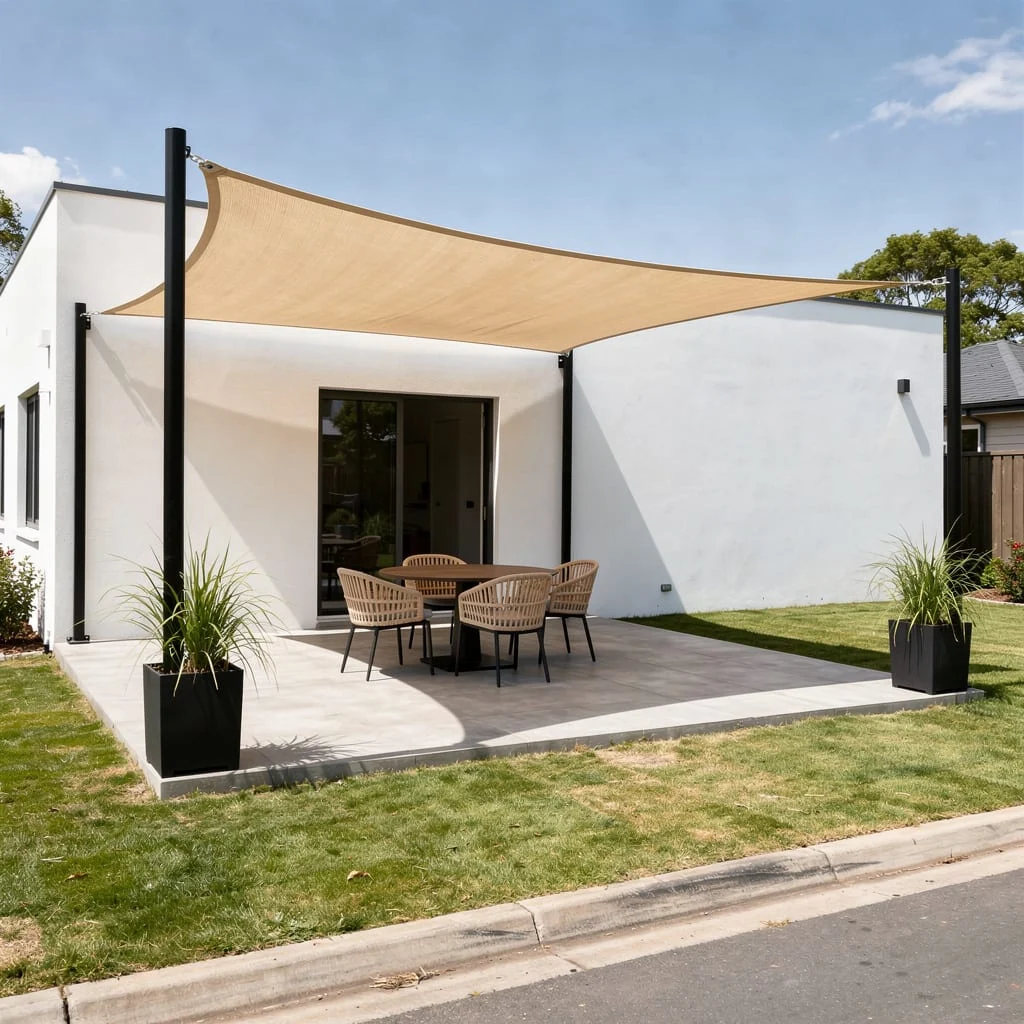
Mount two matte black steel posts at the outer edge of the front patio — round section, minimum 100mm diameter, set in concrete footings. Tension a square or rectangular shade sail between the two posts and two fixing points on the house wall, at a raking angle to shed water.
Below the sail: a concrete or light stone paving surface, large-format, pale in colour to maximise reflected light under the sail. A rectangular dining table — dark wood, matte black base — with woven rattan or rope dining chairs.
Two tall ornamental grass planters at the post bases. Nothing else in the patio zone.
The poles are the architectural event here. They need to be the right diameter — heavy enough to look intentional. The sail needs to be the right colour — sand, cream, stone, charcoal. Not bright white, which looks like a marquee. Not aqua, which looks like a resort.
This is the fastest front patio transformation available. Two posts, one sail, the right furniture. The house doesn’t need to change at all.
The Pleached Tree Dining Terrace With the Rendered Wall
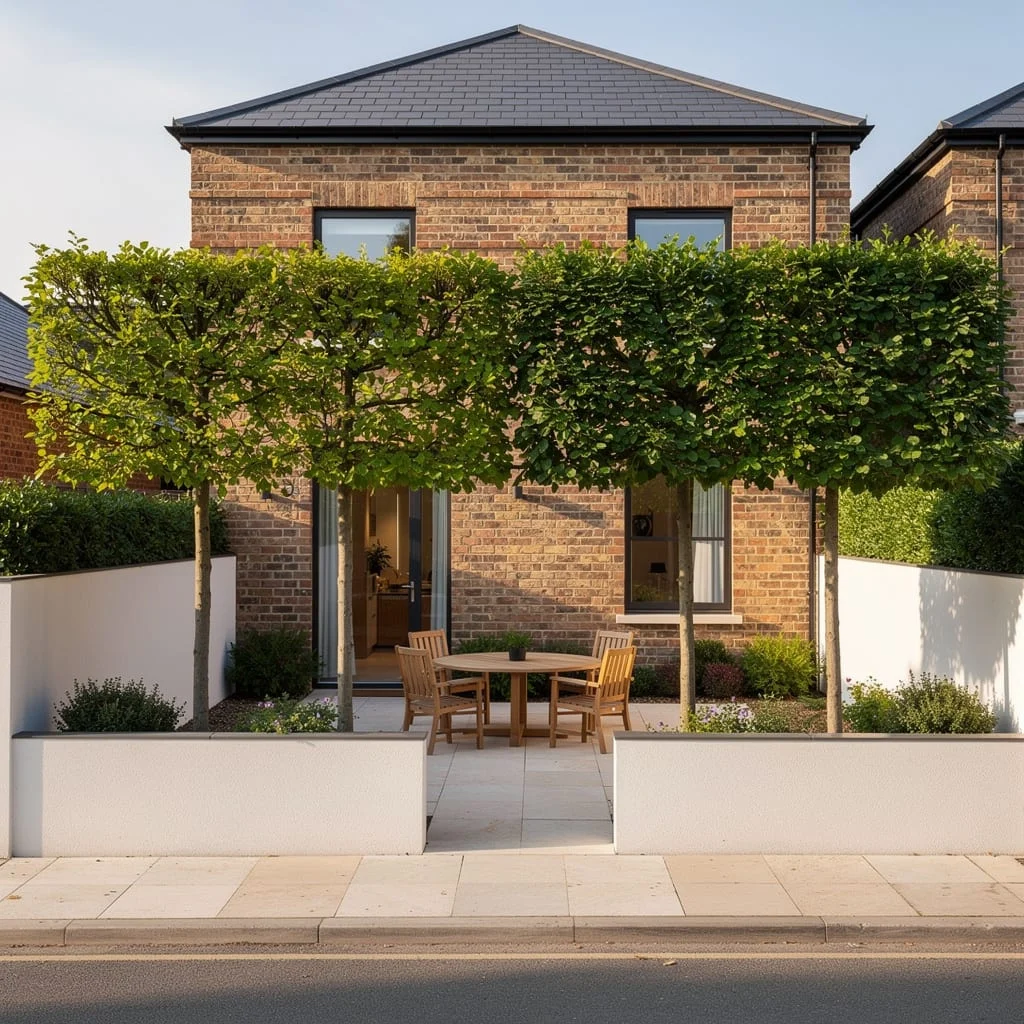
Install two pleached trees — hornbeam, lime, or Photinia — in a continuous row of white rendered raised planters along the street boundary. The trees should be pre-trained, bought at a minimum head height of 1.8 metres with a clear stem below the canopy.
Set a teak round dining table and chairs in the paved front garden behind the row of pleached trees. The canopy of the trees provides filtered shade. The white planters that hold them act as a low boundary wall.
The paved surface is large-format pale limestone or sandstone, laid flat in a consistent grid.
This is the front patio that gets described in property listings. The pleached trees do something structural fencing can’t: they give privacy while remaining permeable, allow light through while reducing street visibility, and look extraordinary at any scale.
The rendered planters are the critical detail. They have to be wide enough and solid enough to read as a wall, not just containers. Get the planter proportions right and this front garden resolves completely.
The Brick Farmhouse Dining Terrace With Lavender Edges
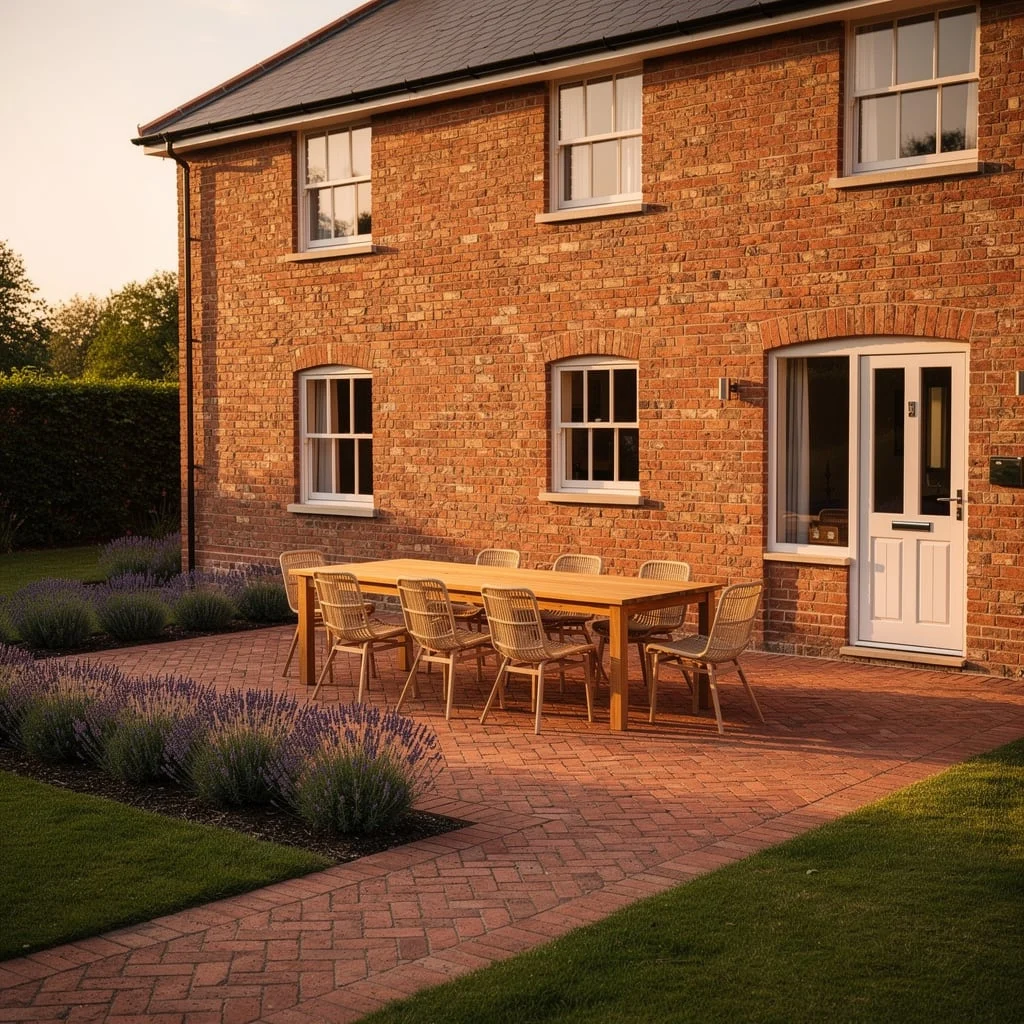
Lay clay brick paving in a herringbone or running bond in front of a warm red brick farmhouse facade. The brick tones should be complementary — the same warm red family — so the paving reads as an extension of the architecture rather than a separate element placed in front of it.
Place a large rectangular dining table — light oak or teak, natural finish — with rattan or woven dining chairs for six. No umbrella. The house wall is the backdrop and anything vertical competes with it.
Plant lavender in generous bands along both long sides of the patio, in dark mulched beds. Low, dense, fragrant. The purple of the lavender against the warm red brick and the golden wood of the table is a palette that photographs as well as it lives.
This patio is for evenings in late summer when the lavender is still blooming and the brick radiates heat stored through the afternoon. There are worse things to design around.
The Gravel Front Patio Enclosed by Clipped Hedging
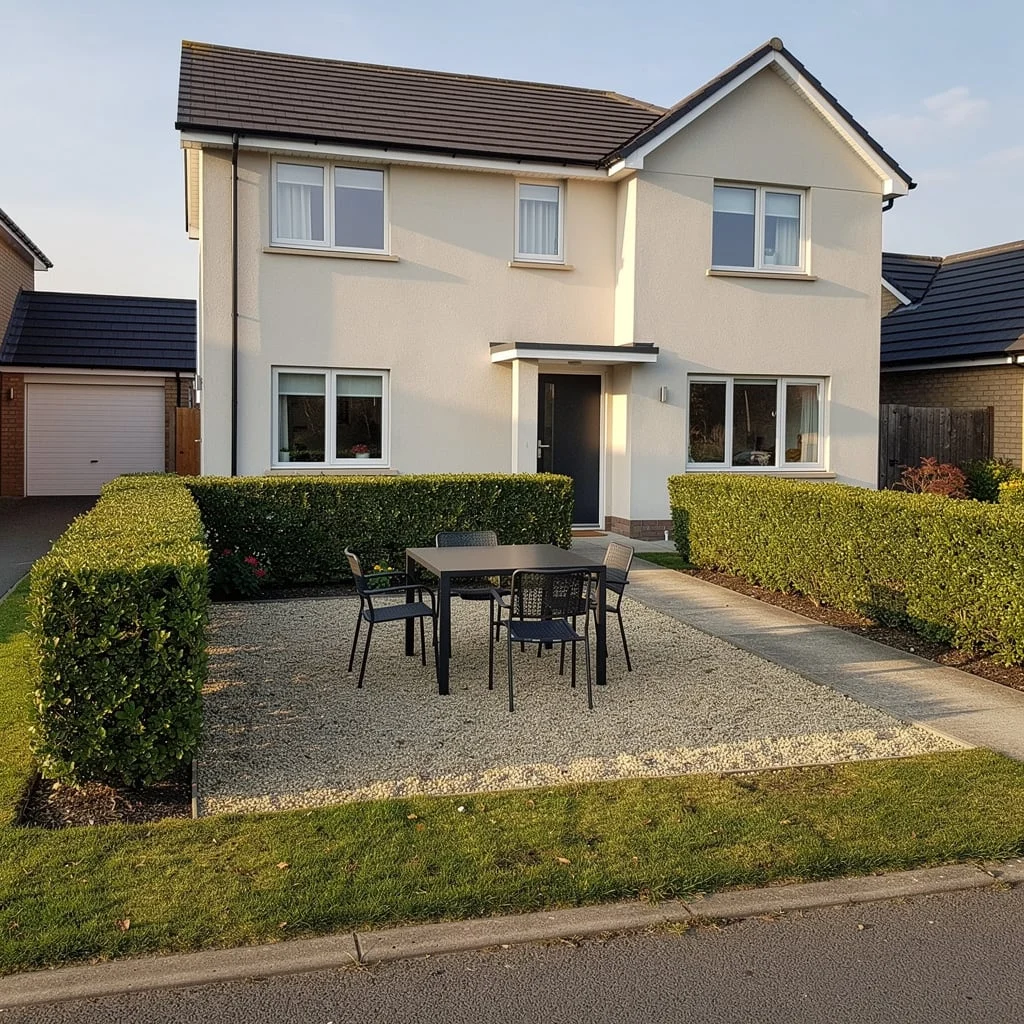
Install a low clipped hedge — beech, hornbeam, or Griselinia — in an open U or squared-horseshoe formation defining three sides of a front patio area. The hedge should be clipped to a height of 600 to 800mm — high enough to define the space, low enough to see over from a seated position.
Fill the enclosed area with fine grey or cream gravel, edged by a flat steel border at the hedge base. Place a compact dining set — metal table and four metal chairs — in the centre of the gravel.
Leave a gap in the hedge front centre as the entry. No gate, just an opening.
The hedge does every job the fence or wall would do, and does them better: it filters wind, provides privacy at seated height, absorbs sound, and looks organic rather than constructed. It takes three years to establish at density and then almost no maintenance beyond two clips per year.
Final Thoughts
The front yard patio represents a straightforward idea that most people find surprisingly difficult to act on: the best view of your house is from the front. Go sit in it.
Every patio in this collection is built around one commitment. The stone platform commits to elevation. The pleached trees commit to living architecture. The dark tile minimalist patio commits to emptiness. The cottage brick patio commits to the plants taking over.
What doesn’t work is the front patio that hedges. A little bit of gravel, a few plants from the garden centre, a chair that belongs to the indoor set. That’s not a decision. That’s a leftover.
Decide what kind of front you have. Listen to what the house is already telling you. Then put something in front of it that would make a visitor slow down and look, before they even reach the door.