
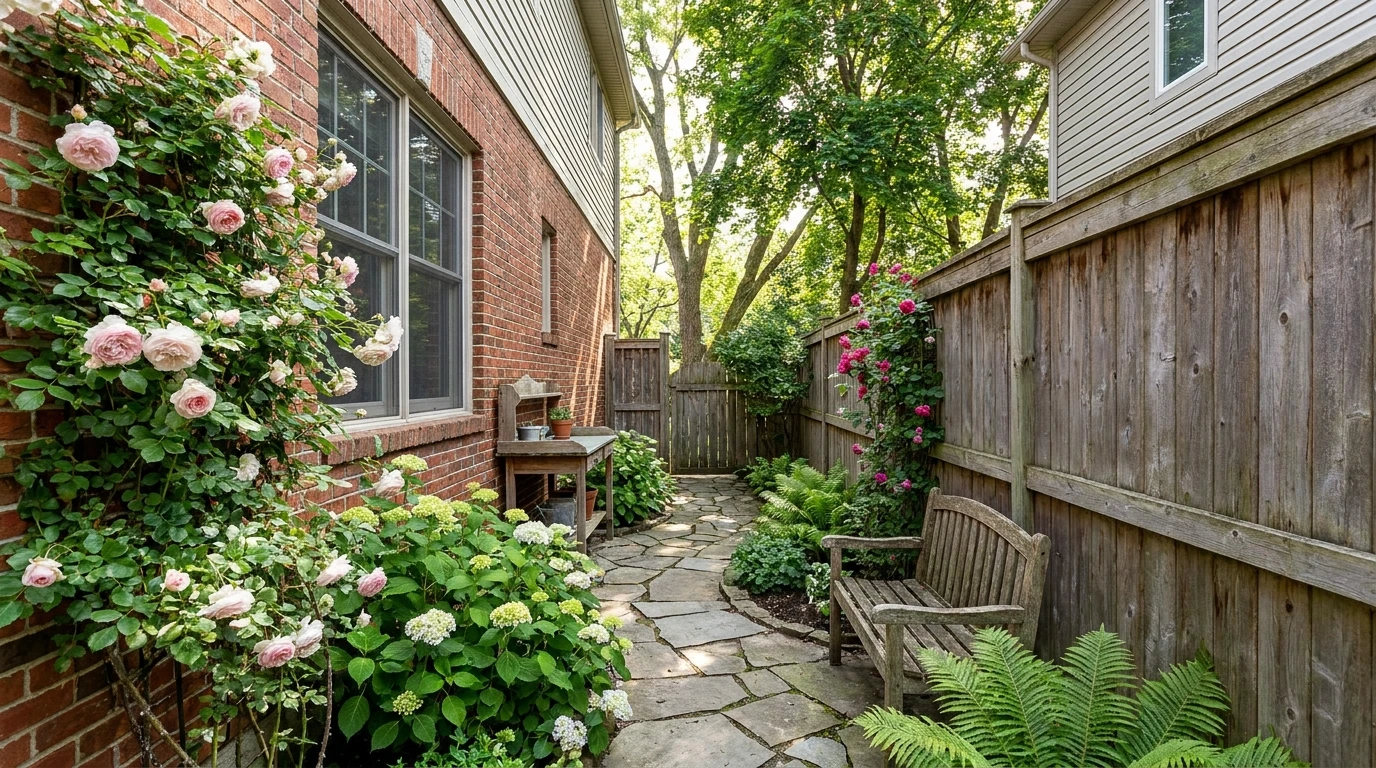
There’s a gap between your house and your fence. You’ve been walking through it for years without once stopping to look at it. You’ve stored a bin there, maybe a hose reel, possibly a retired barbecue. You’ve been treating this space like a corridor to somewhere better.
It isn’t a corridor. It’s a room without a ceiling. A surprisingly long, narrow, private room that faces your house wall on one side and a boundary fence on the other — two perfectly good vertical surfaces that most people leave completely blank.
The problem is a failure of imagination, not a failure of space.
These ideas are for people who’ve finally decided the side yard deserves the same attention as everything else.
The Side Yard Is a Vertical Problem, Not a Horizontal One
Most landscaping advice assumes you have width to play with. In a side yard, you don’t. You have height.
Stop Looking Down
The instinct when you enter a narrow space is to look at the ground and figure out what to put there. That instinct produces gravel and stepping stones and nothing else.
The walls are your real canvas. A side yard flanked by two blank surfaces is a side yard waiting to be ruined by indecision. A side yard where one or both walls are activated — planted, lit, structured, or clad — becomes a space you actually want to pass through.
The ground matters. But it resolves itself once you’ve decided what’s happening at eye level and above.
The Compression Is the Feature
Narrow spaces feel oppressive when nothing draws the eye forward. They feel intentional when there’s a focal point at the far end — a gate, a planting, a structure, something that justifies the journey.
A long corridor with nothing at the end is a dead end. The same corridor with a bamboo grove, a painted wall, a timber gate, or even a large potted specimen at the terminus suddenly has reason to exist.
Every side yard needs a destination. It doesn’t have to be grand. It just has to be there.
How Lighting Changes Everything After Dark
During the day, a side yard reads as a path. At night it can read as a gallery — if you light it that way.
Uplighting from below a wall creates drama. Wall-mounted directional fixtures that throw light both up and down double the perceived height of the space and turn a rendered surface into an architectural feature. Festoon lights strung across the width make the narrowness irrelevant because suddenly you’re looking up at light rather than inward at two fences.
Invest in the lighting before the planting. Light costs less than plants and pays more.
The Functional Side Yard Has Standards Too
Some side yards are working spaces. They store things, house equipment, route drainage. This doesn’t excuse them from looking good.
Storage That Admits What It Is
A shed in a side yard, handled well, looks like architecture. Handled badly, it looks like it ended up there because there was nowhere else.
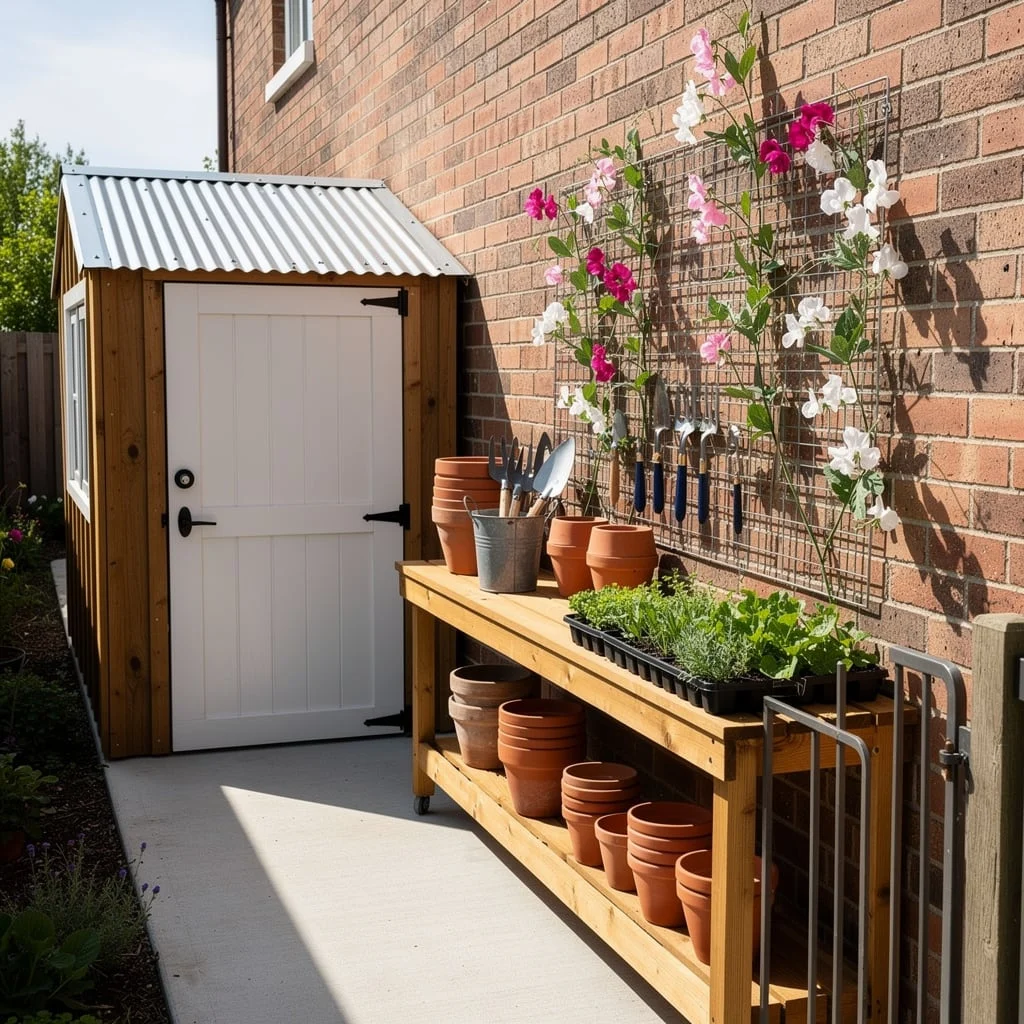
A small timber shed with a quality door — painted white, fitted with black hardware, given a corrugated iron roof — is a design object. Park a potting bench outside it. Hang a wire grid on the adjacent wall for tools. Stack terracotta pots in a loose composition on the shelf below. This is not a utility space. This is a working garden corner.
A flat-pack storage cabinet built to the full width of the space, in a charcoal or navy finish with timber trim, functions as a wall at the end of the side yard. It terminates the space with intention. Everything in front of it — the path, the planting strip — reads as the forecourt to a destination.
The Service Corridor Upgrade
When a side yard is genuinely a service corridor — it houses pool equipment, a gas meter, drainage infrastructure — the impulse is to apologise for that with some pebbles and a potted plant. Don’t.
Lay a proper surface. Large-format travertine or limestone pavers set in black river rock creates a handsome access path regardless of what’s alongside it. The equipment doesn’t disappear, but the ground tells you this was designed, not left.
River rock around service equipment grounds it visually. A consistent pebble treatment that runs wall to wall turns infrastructure from an embarrassment into something that simply lives in its context.
Side Yard Ideas
The Steel-Frame Pergola Corridor With the Green Wall
Build a series of steel rectangular frames — powder-coated matte black, flat section, minimal profile — spanning the full width of the side yard at regular intervals. The frames sit roughly 2.2 metres high. They don’t carry anything across the top. They’re gates without gates. They repeat down the length of the passage, creating a rhythm.
Lay large-format grey aggregate pavers between the frames, set in fine gravel. Plant rosemary or low thyme in a band either side of each paver, against the house wall. On the fence side, allow a climbing plant — grape vine, Virginia creeper — to grow freely.
At the far end, position an outdoor seating area through the final frame. That’s the destination. The frames make the journey worth taking.
The Living Wall Side Yard That Stops Traffic
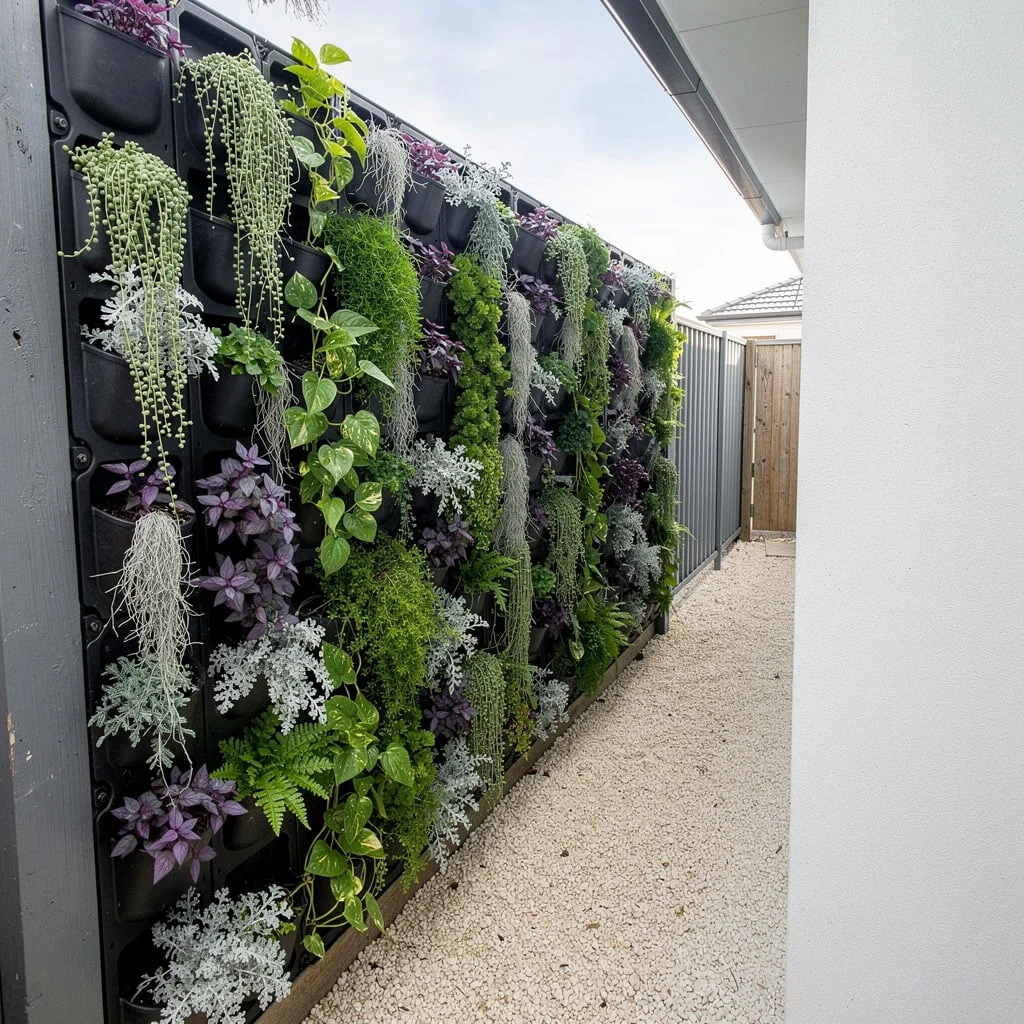
Mount a modular living wall panel system to a section of fence — as long and as tall as is practical. Use a proprietary pocket system in black, with individual felt or plastic pockets each holding one plant.
Plant in diagonal drifts of species rather than random mixing: a run of silver dusty miller, a run of dark purple tradescantia, a band of string-of-pearls or senecio, a column of bright green pothos, another of maidenhair fern. The composition should read as abstract colour-blocking rather than a collection of individual plants.
Below the living wall, lay pale cream gravel to create maximum contrast against the dark panels and varied foliage. Leave the opposite wall — the house wall — completely bare and white.
The living wall is the entire point of this side yard. Everything else serves it.
The Bocce Court Side Yard That Does One Thing Perfectly
Measure the available length — anything over seven metres is enough. Install a level turf surface, either real or high-quality synthetic, bordered by flat sandstone or concrete edging flush to the surface. The edging keeps the balls in play and defines the court.
Plant a tall, clipped hedge — Lilly pilly, Portuguese laurel, pencil pine — hard against the fence line on the opposite side to the house. The hedge does two things: it absorbs sound and it creates an enclosure that makes the space feel private rather than exposed.
Install two wall-mounted uplights at the house wall end and the hedge end. Play bocce at night.
This only works if you commit to it. A half-finished bocce court with rough grass and improvised edges looks like a problem. A proper bocce court with considered landscaping looks like a decision someone made on purpose — and almost certainly someone worth knowing.
The Travertine and River Rock Service Path That Beats Low Expectations
Lay large-format travertine pavers — honed, warm ivory tone — down the length of the side yard, wide enough to work comfortably alongside whatever equipment needs to be accessed. Between and beyond the pavers, fill with dark river pebble, raked flat.
Don’t apologise for the pool equipment, gas meter, or irrigation controls. Simply surround them consistently in the pebble ground cover. The visual continuity of the ground plane makes the equipment feel placed, not dumped.
If the fence is old and tired, paint it. A coat of dark grey or charcoal transforms a weathered timber fence into a backdrop. Do it before anything else.
The Espaliered Fruit Tree Fence That Does the Work of Ten Garden Beds
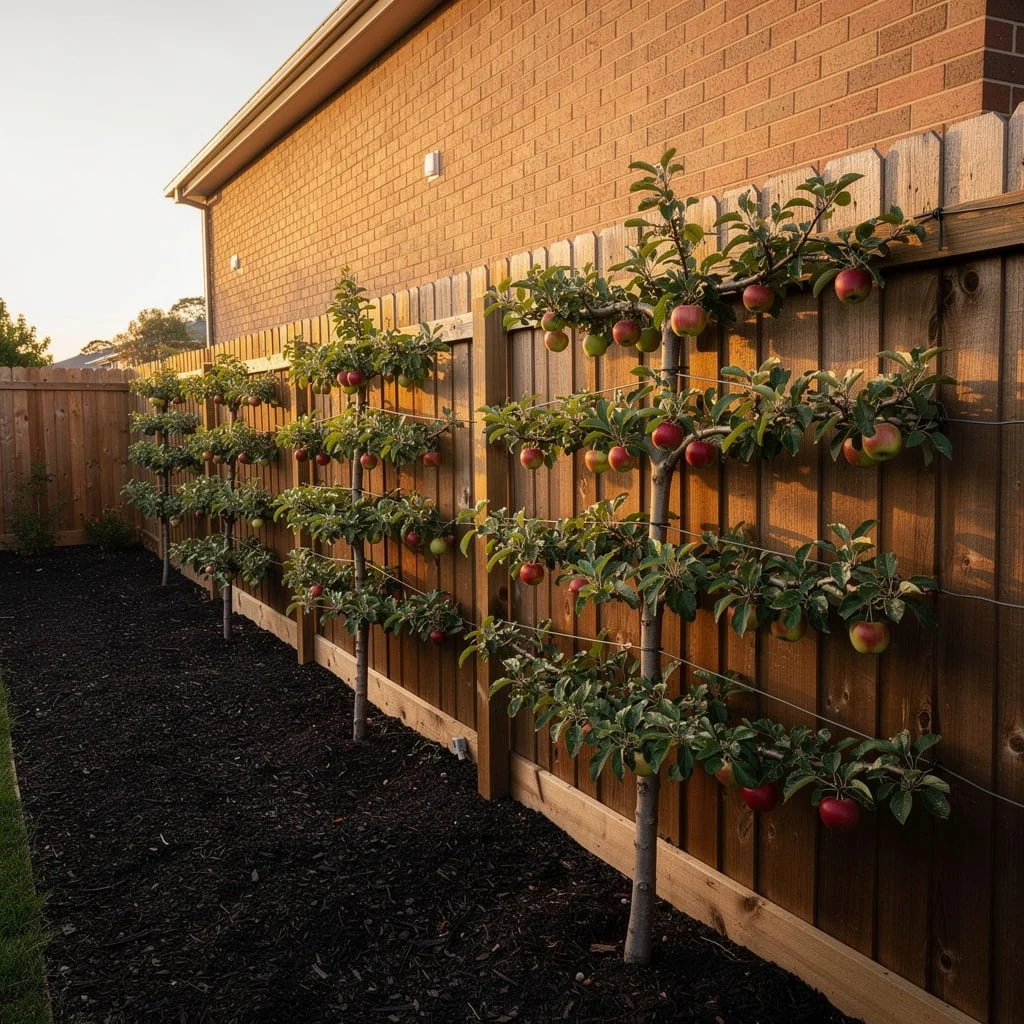
Install a continuous raised timber planter box running the full length of the fence — 200mm high, 300mm wide, made from treated pine or hardwood. Fill with a quality compost-rich growing mix.
Plant dwarf or semi-dwarf apple, pear, or quince trees at regular intervals — roughly 1.2 to 1.5 metres apart. Drive timber stakes or run horizontal galvanised wires at three heights between each tree along the fence. As the trees establish, train the lateral branches outward along the wires, tying in new growth each season.
This is espalier. It requires annual pruning and tying, some attention to variety selection for cross-pollination, and patience. Within three years the fence disappears behind a flat plane of trained branches. In autumn, the fruit hangs against the wood like a still life.
The mulch surface below the planter — dark wood chip or coco coir — keeps the base reading clean.
The Outdoor Shower Side Yard That Earns Its Access Strip
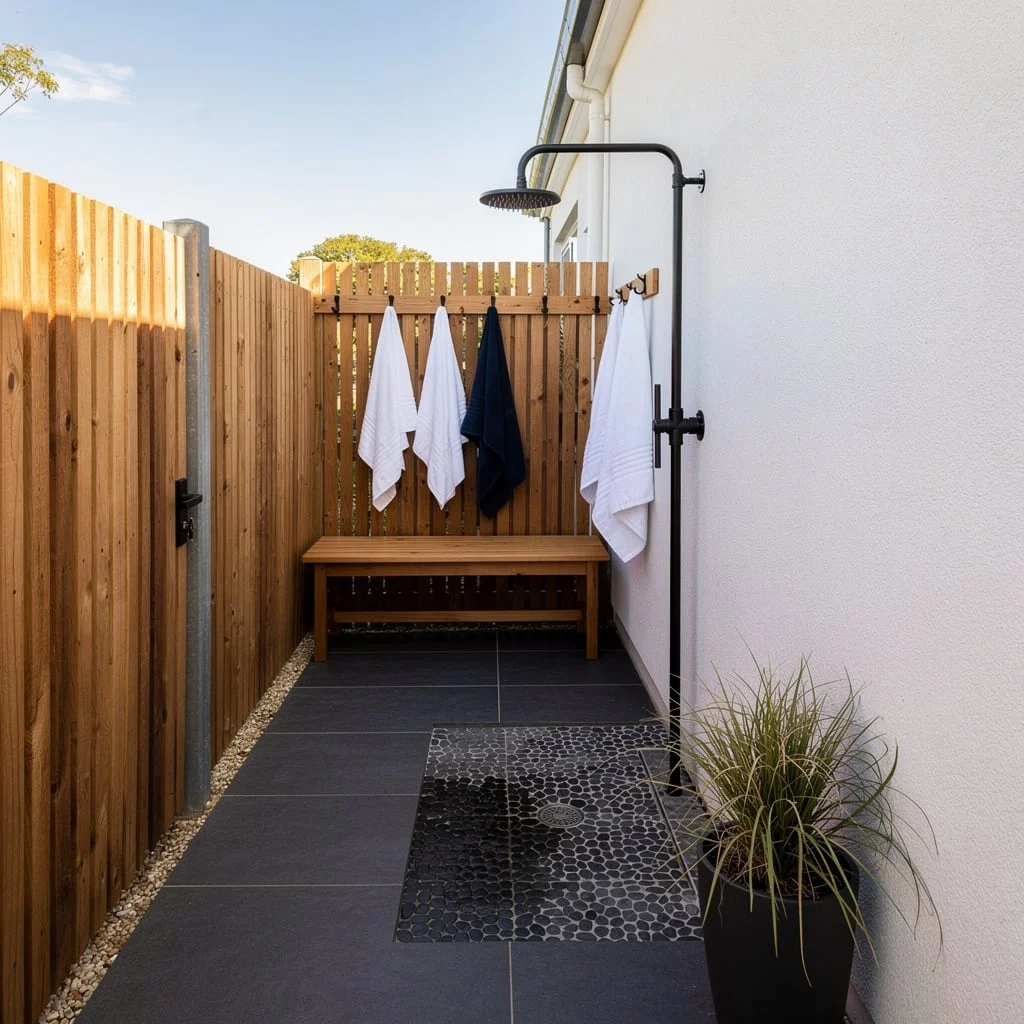
Take a concrete or masonry side yard between 1.5 and 2 metres wide and convert it into a functional outdoor shower space.
Lay large-format dark bluestone paving across the full width. At the shower position, set a rectangle of black river pebble mosaic into the paving — this is the shower floor, and it drains through to a central floor drain beneath. Keep the mosaic flush with the surrounding stone.
Mount a floor-to-ceiling black steel pipe shower column against the house wall with a large round head and a separate hand-held attachment. No tap hardware on the fence — everything mounts to the house wall for clean lines.
Fix a horizontal cedar or hardwood batten panel to the fence at shoulder height, approximately one metre wide. Attach five or six matte black robe hooks across it. Hang towels here.
Place a single low timber bench against the far fence section. One pot of ornamental grass in a black planter at the corner.
This space serves the pool, the garden, the children, and the dog. It does it without apology.
The Festoon-Lit Narrow Dining Terrace That Defeats All Logic
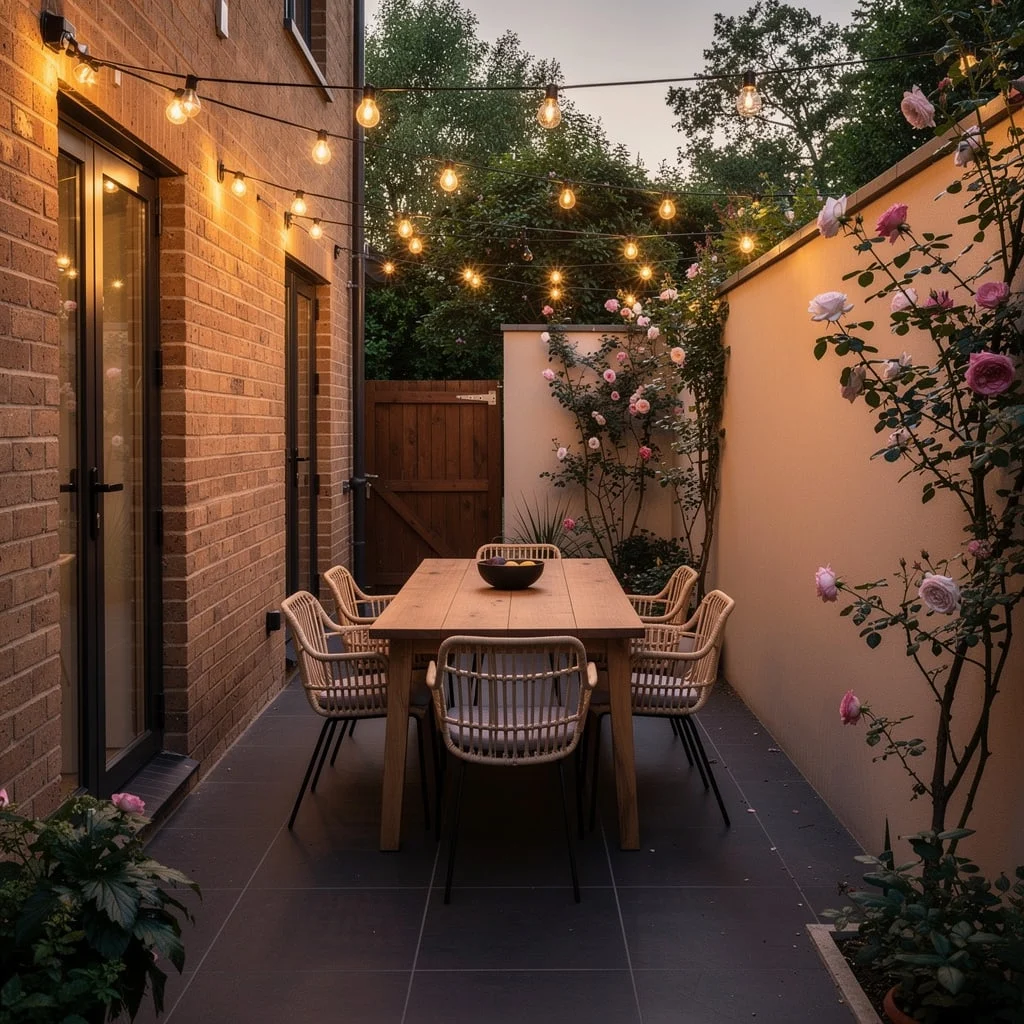
A side yard no more than two metres wide can seat six for dinner. This is not aspirational. This is geometry.
Lay large-format dark porcelain tile across the full surface. Place a long, narrow dining table — 2.2 metres long, no more than 800mm wide — parallel to the house wall. Use woven natural rattan or rope-seat chairs that are lightweight and stackable.
String festoon lights across the width at approximately 2.5 metres height, running the full length of the space from the house wall to a hook on the fence post. Two or three runs, spaced 400mm apart, hung with loose slack.
Train a climbing rose — a vigorous pink, a full-headed white, something that blooms prolifically — up the rendered courtyard wall behind. Let it make itself at home.
This dining terrace works because it refuses the premise that narrow means unsuitable. At night, with the lights and the rose and the food on the table, the narrowness becomes enclosure, which is exactly what a dinner party needs.
The Cottage Side Yard With Cobblestone and Pebble River
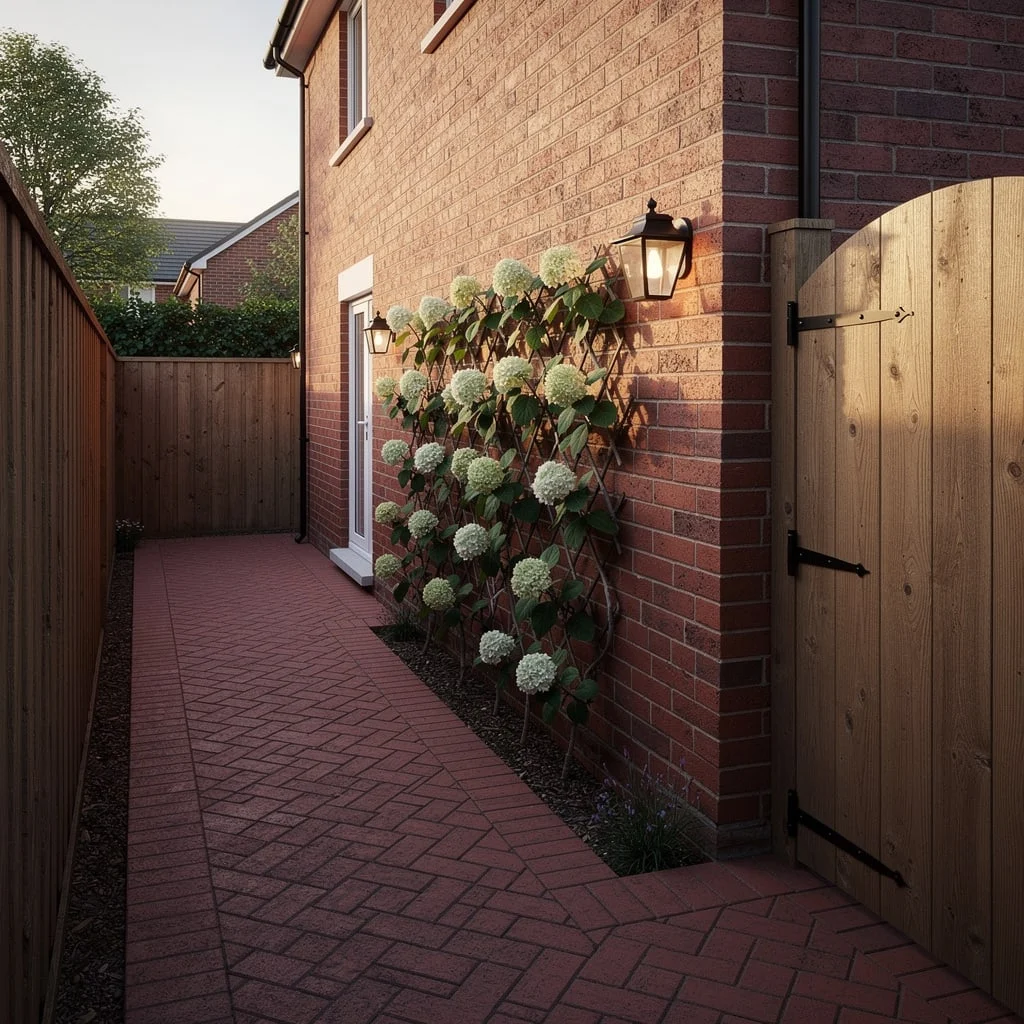
Lay charcoal clay brick pavers in a herringbone pattern down the centre of the side yard, wide enough for two people to pass. Either side of the path, lay a 200mm band of smooth river pebbles in a pale cream or buff tone. Beyond the pebble band on the fence side, a simple low garden bed with compact shrubs and seasonal ground cover.
Against the house wall, fix a simple timber diamond-pattern trellis and train a climbing hydrangea along it. Mount two matching lantern-style wall lights either side of a door or gate entry.
This is a very English approach. It’s warm, textural, and refuses to pretend the side yard is anything other than a proper part of the garden.
The Zen Gravel Corridor With Bamboo Terminus
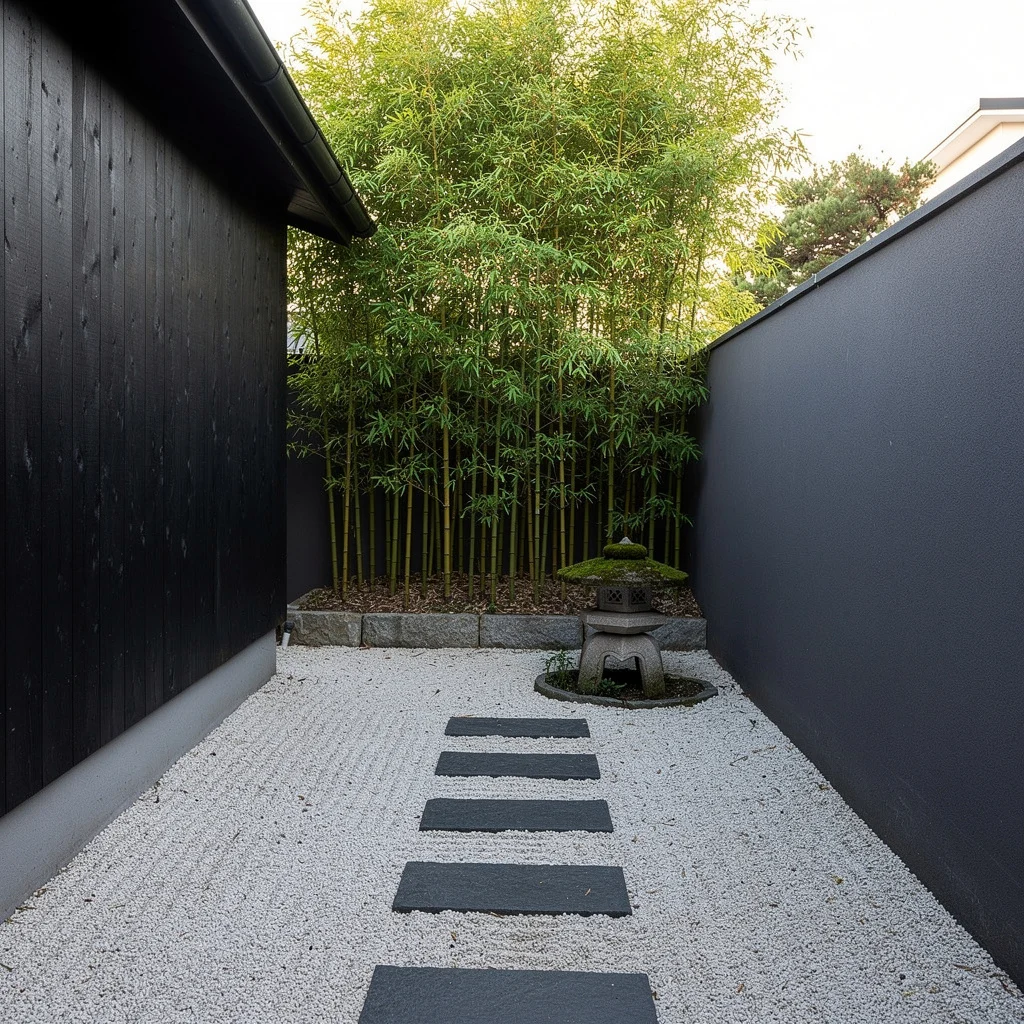
Lay white raked gravel across the entire floor plane of the side yard, wall to wall, edge to edge. No path. The gravel is the surface. Rake it in parallel lines running the length of the space.
Set five or six rectangular dark slate stepping stones directly into the gravel in a straight line, flush, with generous spacing. The stones don’t form a path in the conventional sense — they’re more like punctuation.
Paint both walls the same colour. Matte charcoal on the fence side, matte charcoal on the house wall. Everything is now the same dark register except the gravel and the stepping stones.
At the far end, plant a dense clump of clumping bamboo — not running bamboo, which will take over everything you love — and allow it to reach full height. Place a single stone lantern in front of it, slightly off-centre.
This space doesn’t function as much as it exists. Walking through it is the point.
The Wildflower Corridor With Corten Steel Planters
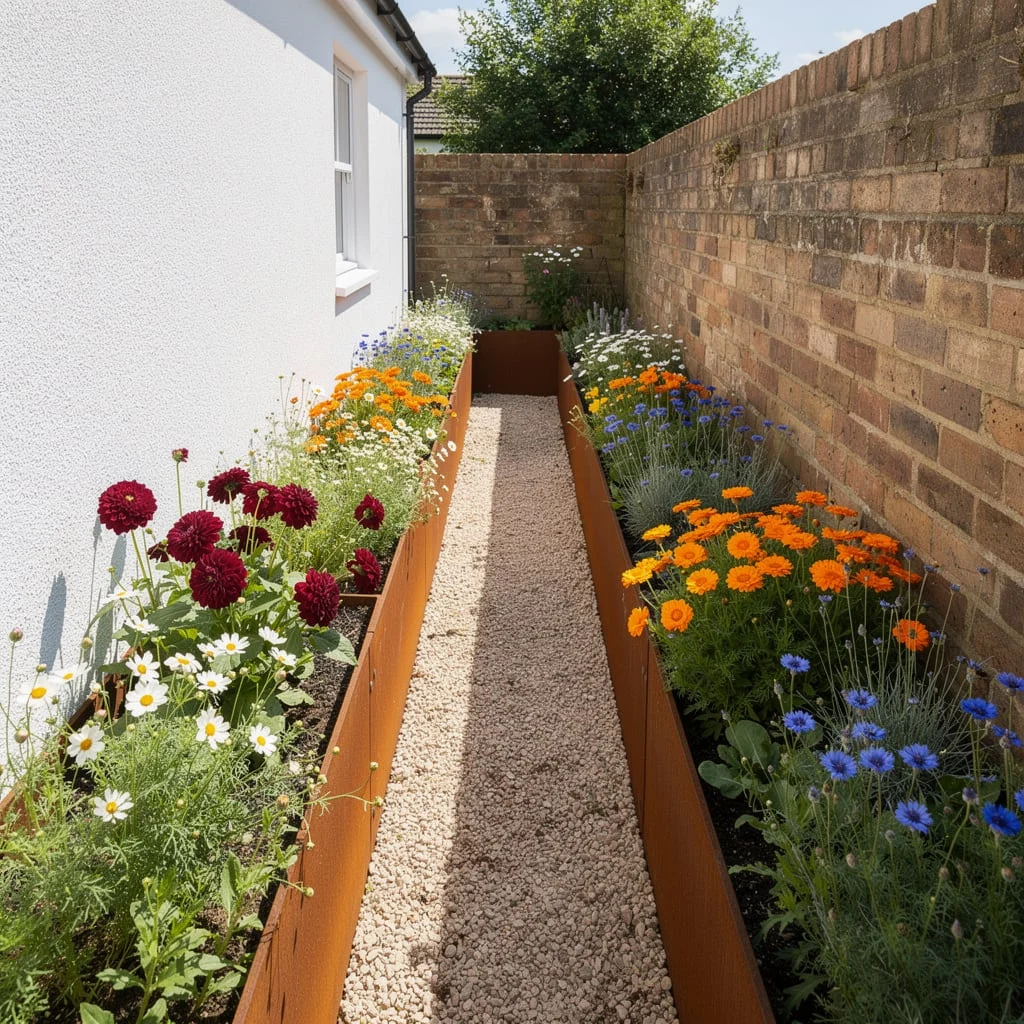
Fabricate or source two continuous Corten steel raised planters running the full length of the side yard — one hard against the fence, one hard against the house wall. Each planter should be approximately 300mm high and 400mm wide. The central path between them is gravel, in a pale shell or limestone chip.
Fill both planters with a wildflower and cottage plant mix: calendula, cornflower, dahlia, cosmos, chamomile, lavender. Don’t plan the arrangement too precisely. Direct sow from seed and let the plants compete. Stake the taller dahlias loosely.
The Corten steel weathers to a warm rust over twelve to eighteen months. Against a pale path and an abundance of flowering plants in orange, blue, purple, and white, it reads like a designed cutting garden.
This is the side yard that will make your neighbours ask who did your landscaping. Tell them you did.
The Japanese-Inspired Side Yard Built on Restraint
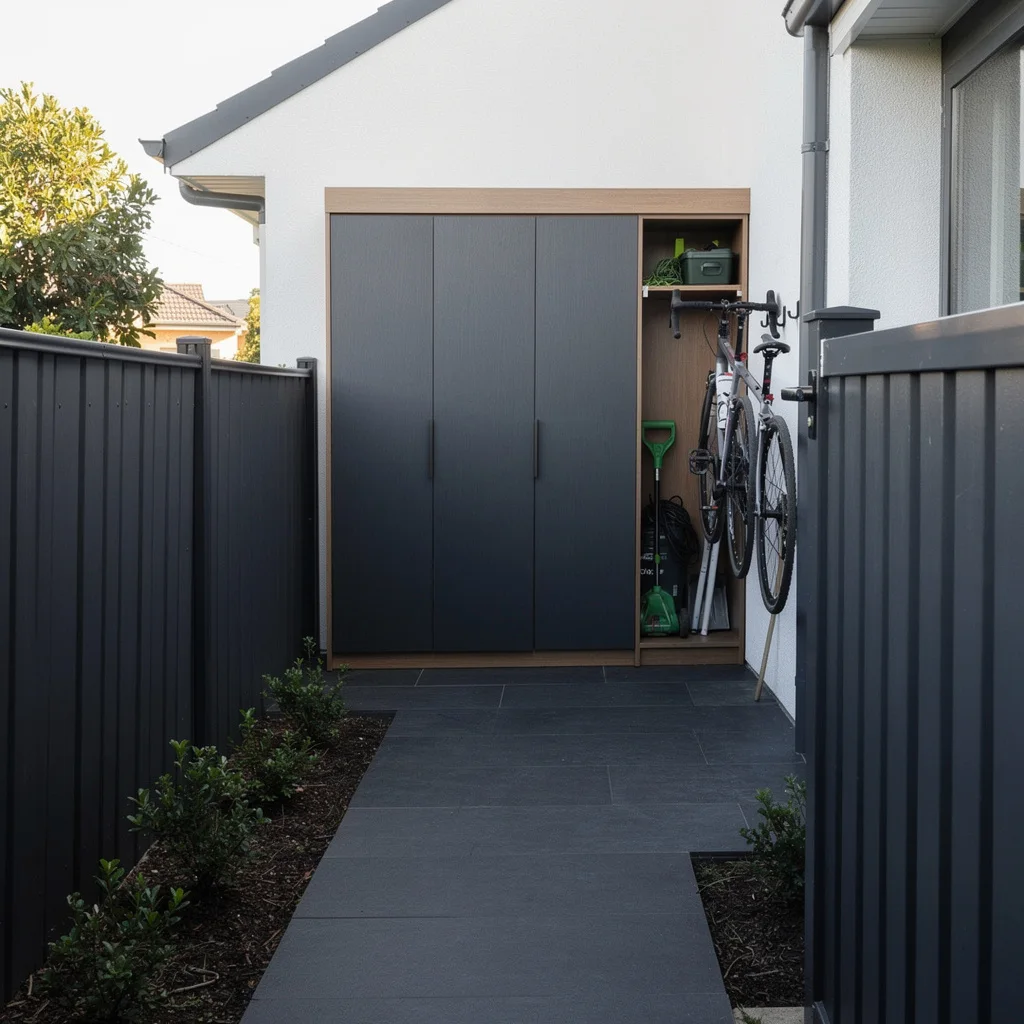
Two rules: only use black, white, and green. Use no more than three materials.
Paint the fence and house wall the same warm charcoal or near-black. Lay cream raked gravel across the floor. Set four rectangular black slate pavers as stepping stones in a straight line.
Plant a single clump of bamboo at the far end. Centre a modest stone lantern. Nothing else.
The success of this idea depends entirely on the quality of each element. Cheap plastic pots ruin it. Poor-quality pavers ruin it. Any third colour anywhere ruins it. If you can hold the discipline — three materials, three plants, one focal point — the result is a side yard that will outlast every trend around it.
The Fern-and-Stepping-Stone Side Yard That Needs No Further Justification
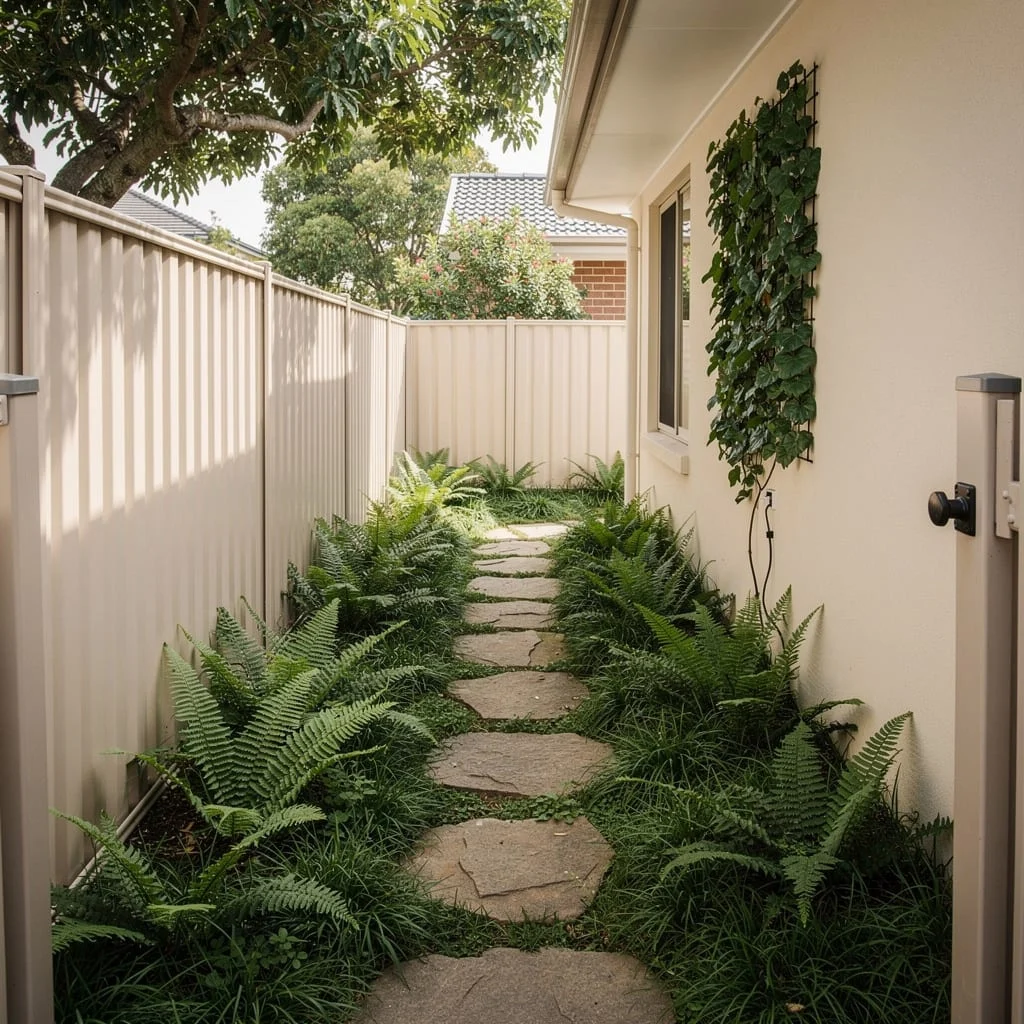
This one is for the side yard that gets no direct sun and collects shade for most of the day.
Lay irregular sandstone stepping stones directly into the existing ground, settled flat with a good firm base. Between and around the stones, plant Boston ferns or sword ferns densely — not in separate clumps but as a continuous carpet. Let them grow into each other and over the edges of the stepping stones.
On the house wall, fix a simple wire grid or star picket trellis and plant a shade-tolerant climber — hydrangea petiolaris, climbing fig, or star jasmine. Train it upward.
The fern carpet forgives irregular edges, hides the awkwardness of a narrow space, and looks increasingly established as the years pass. By the third season this side yard looks like it belongs to a much older, more considered garden.
The Kids’ Garden Arch With Raised Bed Kitchen Garden
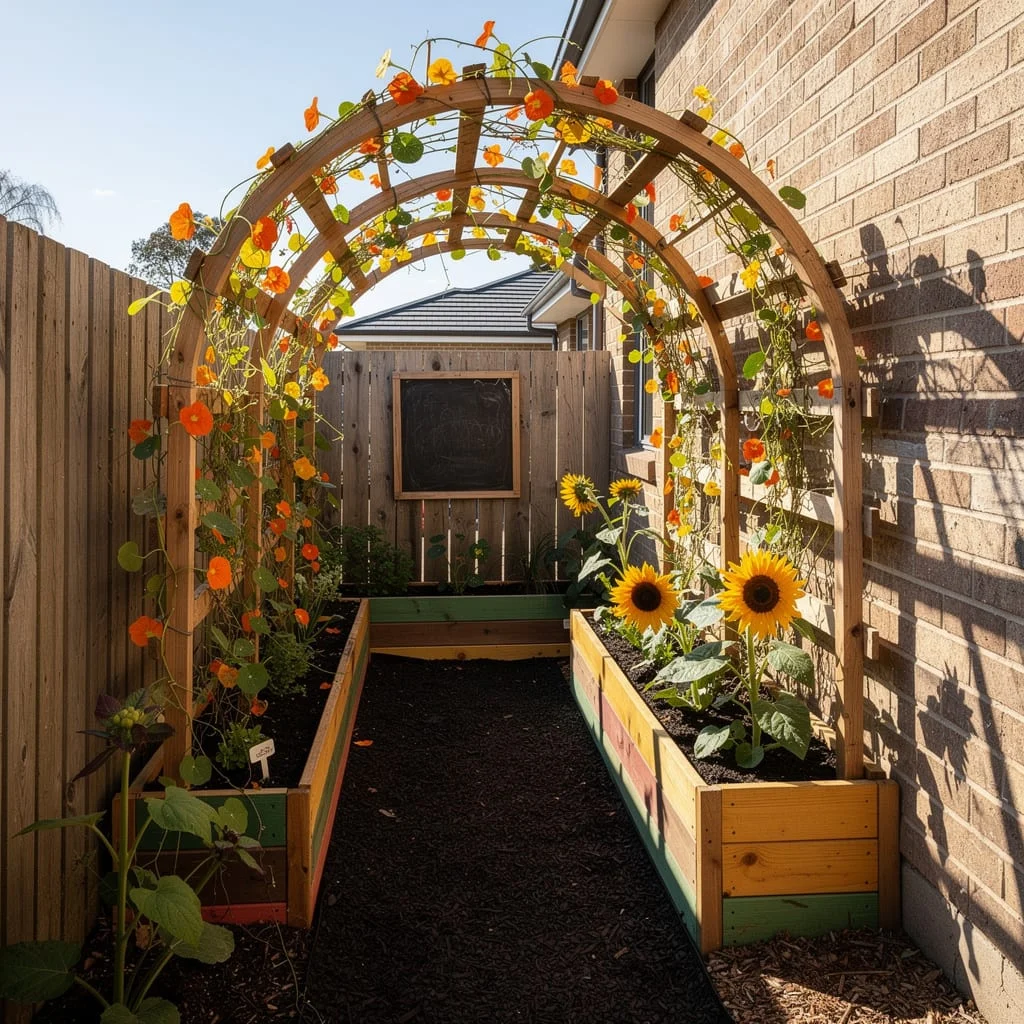
Build two parallel raised garden beds from untreated pine, painted or stained in a warm natural tone, running the length of the side yard with a central path of dark wood chip mulch between them.
At the midpoint of the path, build a timber arch — a simple half-circle form, freestanding, bolted to both beds. Plant nasturtium at the base of each arch upright and train it upward. Plant sunflowers at the front corner of each raised bed.
Mount a small blackboard panel on the timber fence at the end — a place to chalk the names of what’s growing.
Plant the beds generously with whatever the children want to grow: cherry tomatoes, sunflowers, strawberries, herbs. Let them make it messy. The arch and the consistent timber material hold the composition together regardless of what’s growing inside.
The Wisteria Pergola Walkway That Requires Patience and Then Pays Back Everything
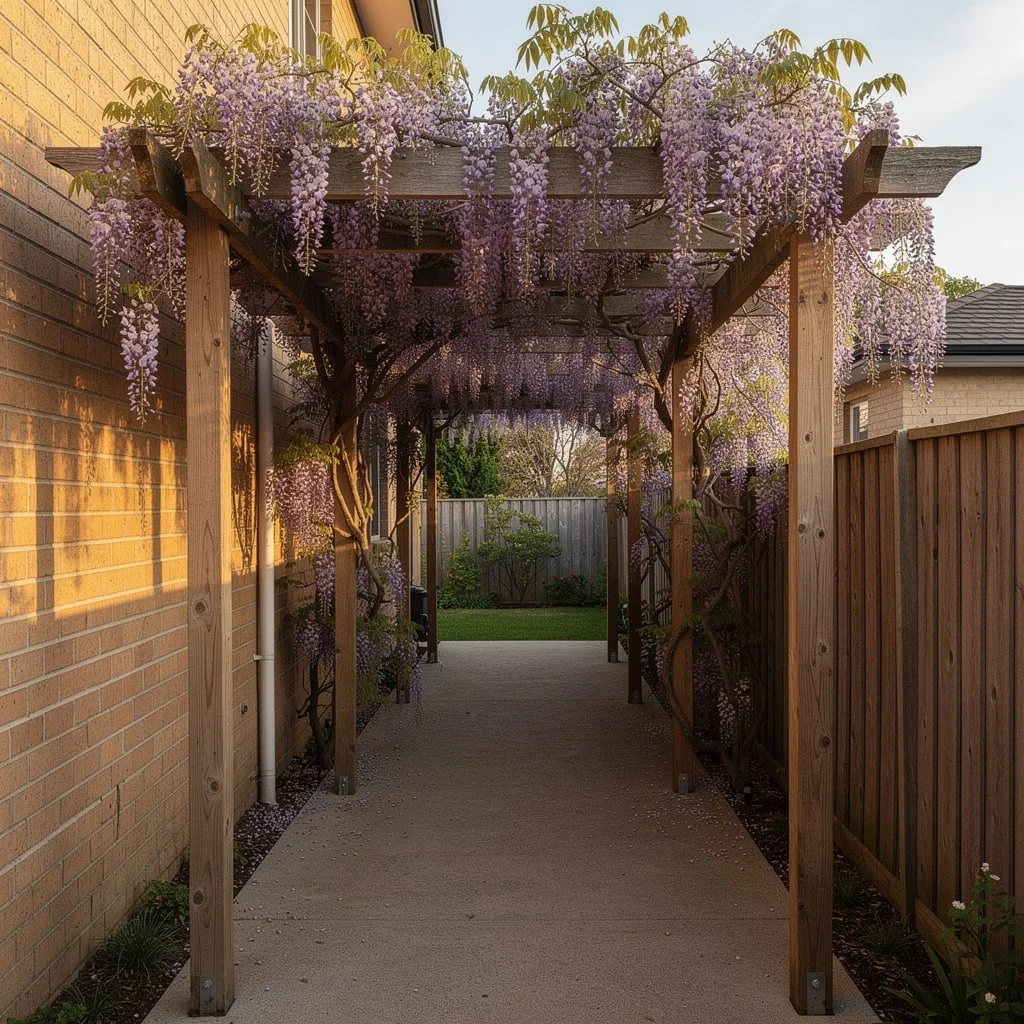
Build a simple overhead pergola structure — treated pine or cedar posts with a cross-hatch roof of lighter battens — spanning the full length of the side yard, high enough to walk under comfortably.
At the base of every second post on the fence side, plant one wisteria. Sinensis is vigorous and blooms in a single spectacular flush in spring. Floribunda blooms later and over a longer period. Choose one and be consistent.
In the first two years, train every stem along the posts and across the roof battens. Prune hard each winter to develop the woody framework. Feed with a low-nitrogen fertiliser in autumn.
In year three or four, the pergola disappears. What remains is a living tunnel of twisted trunk, hanging clusters, and filtered light. In spring the entire corridor becomes something most people only see in photographs.
Underneath, a simple gravel path. Nothing competes with the wisteria for attention, and nothing should.
The Monochrome Modern Side Yard Built on Commitment to Black
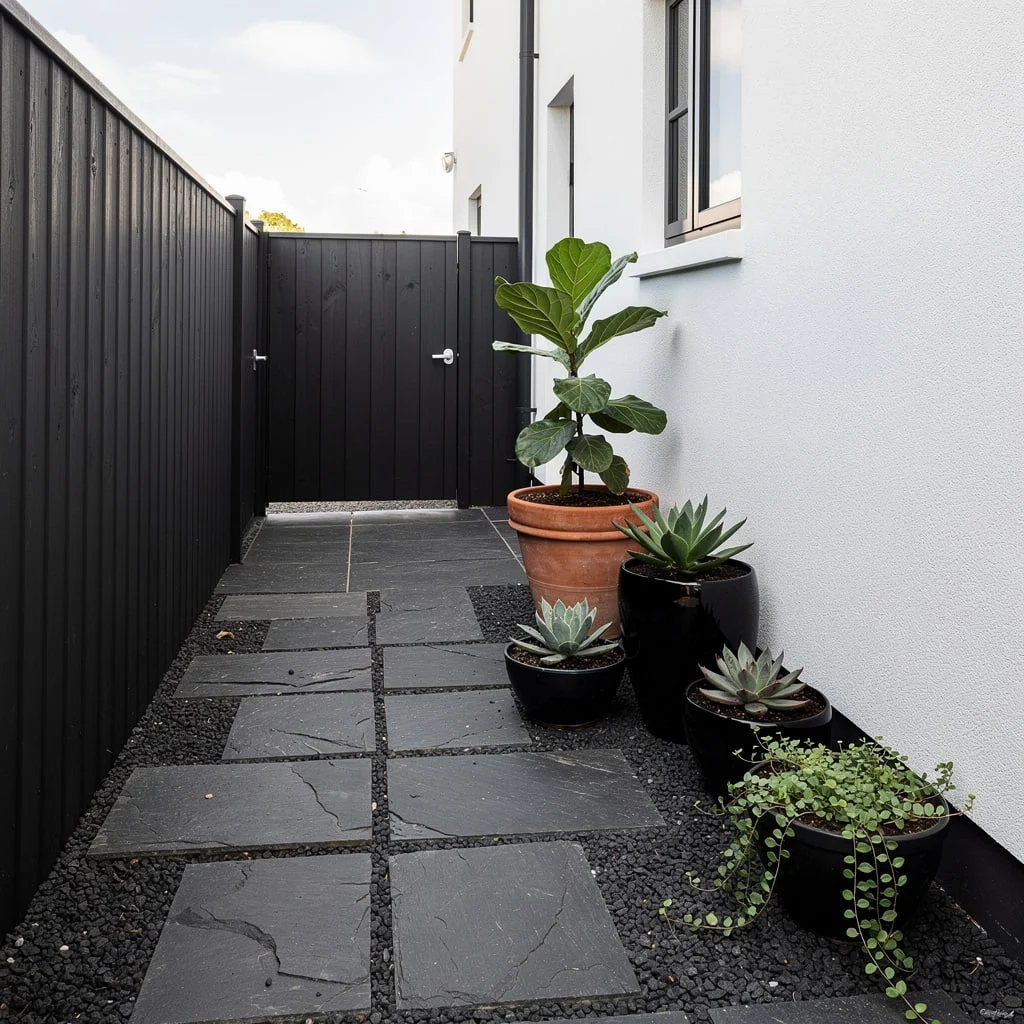
Paint the fence matte black. Lay black slate pavers in a grid set in black volcanic rock gravel. Build a simple black timber gate at the entry.
Place four black square tapered planters at even intervals along the fence side — squat, architectural, substantial. In each, plant a single buxus ball or clipped lilly pilly in a perfect sphere. Above each planter, mount a cube-format exterior wall light in matte black that throws light both up and down the wall.
On the house wall: nothing. The white rendered surface opposite the black fence is the contrast on which the whole thing depends.
This is the side yard that looks expensive. It isn’t, particularly. It costs the price of paint, a consistent material palette, and the discipline to not add one more thing.
The Lap Pool Squeezed Between House and Fence That Changes the Brief Entirely
A side yard roughly 1.5 metres or wider can accommodate a narrow lap or plunge pool that runs along the full or partial length. This is less unusual than it sounds.
Dig a pool no wider than one metre — this is genuinely functional for lap swimming with a current generator — and finish it in a near-black or charcoal pebblecrete interior. Lay limestone or travertine coping on the house-wall side only, wide enough to step out onto. The fence side has no coping — the water comes to within 50mm of the fence base.
The result is a side yard that is almost entirely water. The white house wall, the dark water, and the timber fence create a composition that would cost four times as much to replicate in a main backyard.
Add a single underwater light. At night, the water glows against both walls.
The Illuminated Buxus Corridor That Works as Sculpture After Dark
Lay large-format limestone or pale sandstone paving down the full length. Along the house wall, place a series of matching tapered planter boxes — black powder-coated steel — at even intervals, each containing a single buxus or murraya ball clipped to a tight sphere.
Above each planter, mount a square cube exterior light — matte black, double directional, warm white — on the wall surface. Space them to correspond with the planters below.
During the day this side yard reads as clean, ordered, contemporary. After dark it becomes something else entirely: the uplighting throws scallop shadows up the rendered wall while the downlighting pools warmth onto the stone and the dark planters below. The spherical plants cast round shadows. The repetition of the light and the planter rhythm draws the eye forward.
There is no softness here. No flowers. No colour except green and warm white. Some side yards earn their austerity.
Final Thoughts
A side yard is the most honest test of a garden designer’s convictions. There’s no room for distraction, no lawn to absorb mediocre ideas, no panoramic view to do the work for you.
What you’re left with is two walls, a floor, and a purpose. Get those three things right and the space becomes something most people have never thought to build. Get any one of them wrong and the space becomes exactly what it was before: a gap between a house and a fence with a bin in it.
Every side yard in this post was designed around one decision, made clearly and held consistently. The wisteria tunnel commits to the plant. The bocce court commits to the use. The monochrome black side yard commits to the palette. The living wall commits to the wall.
Commit to something. The space is too small to hedge.