
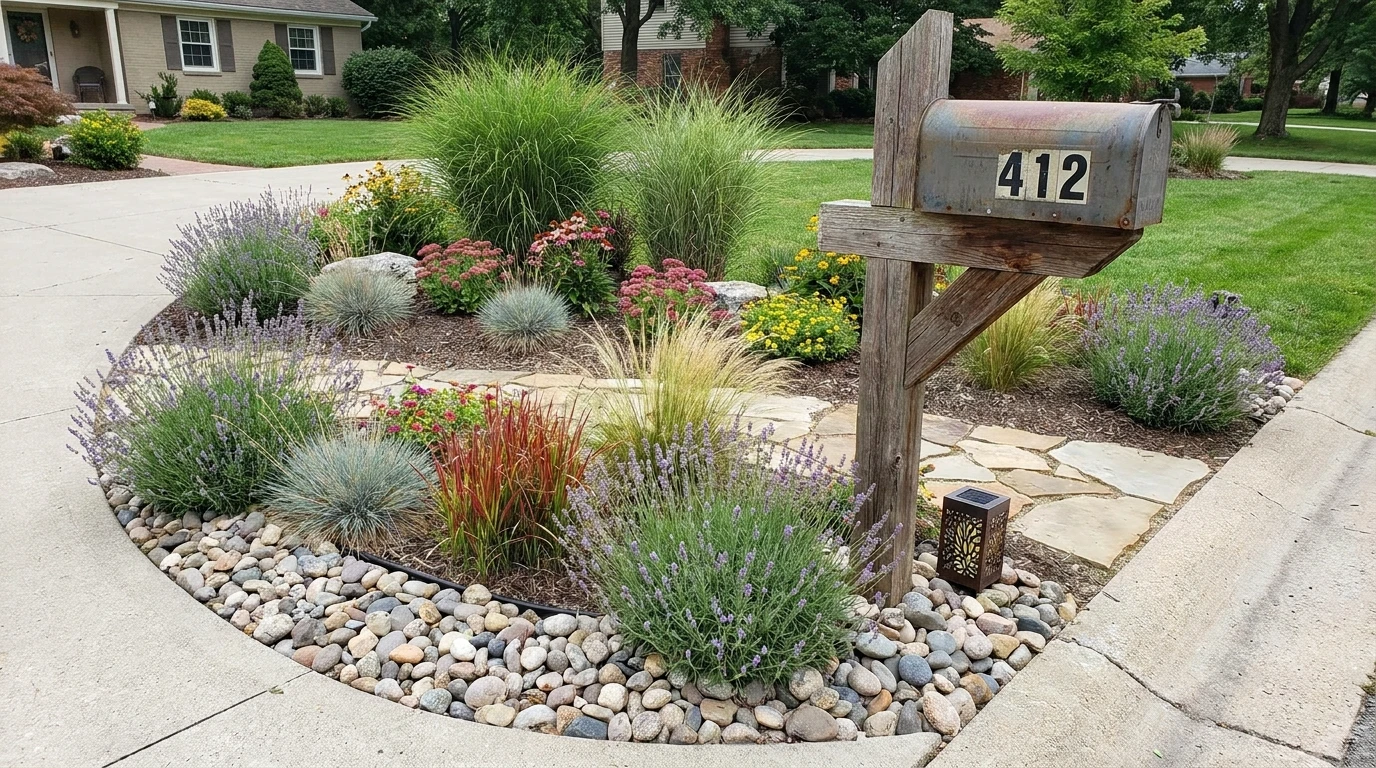
Nobody thinks about the mailbox until it embarrasses them. A rusting post stuck in a patch of bare dirt, or a plastic standard-issue box on a steel stake with absolutely nothing around it — sitting at the edge of the property like an apology for not finishing the landscaping.
The mailbox is the first thing the street sees. It’s a small vertical element with about a one-metre radius to work with. That’s actually enough to do something genuinely good.
Here’s what works.
The Mailbox Post Is Not Just Infrastructure
Most people treat the mailbox post as a functional object that happens to be visible. That’s why most mailbox situations look unresolved.
What the Post Material Is Already Telling You
A white painted timber post says one thing. A raw cedar post says another. A stone column says something else entirely. A matte black steel post on a white rendered column says a fourth thing.
The post material needs to agree with the house. Not match it exactly — that’s a different problem — but agree with it. A white weatherboard farmhouse and a rough-sawn cedar post are having the same conversation. A rendered contemporary with a standard galvanised steel stake are two strangers who ended up in a photo together.
Before choosing any planting, decide whether the hardware itself is right. A good mailbox post that matches the house is already halfway to a resolved mailbox landscape.
The Planting Bed as Frame, Not Filler
The planting around a mailbox should frame the post, not fill in the space around it because it seemed bare.
A good frame is asymmetric or symmetrically balanced, reads clearly from the street, and has a defined edge — either a physical border of stone, metal, or masonry, or a clean cut edge against a lawn. Without a defined boundary, even good planting looks like it accumulated rather than was designed.
The planting bed needs to be generous enough to matter. A token strip of ground cover with one overgrown shrub in it reads as afterthought. A proper planting bed of half a metre to a full metre radius, planted with intention, reads as decision.
Climbers, Clamberers, and the Question of Covering the Post
Growing a plant up the mailbox post is one of the most effective ways to make the whole setup look like a garden decision rather than a piece of infrastructure. Done right. Done wrong, it’s a mess.
Plants That Work and Plants That Don’t
Clematis is the right answer for most climates. It climbs readily, blooms prolifically, and when trained up a post, creates exactly the kind of flowering vertical the mailbox situation needs. White varieties look good against any post colour. Purple and mauve varieties suit warm brick and timber. Don’t let it run free — tie it in at four or five points along the post as it grows.
Climbing roses take longer to establish but pay back more generously. A single vigorous rose trained up a white post, blooming at the box level, is one of those combinations that looks completely inevitable. Prune to one main stem up the post and several short laterals — don’t let it become a thicket.
Star jasmine is a southern hemisphere favourite that works equally well: vigorous, fragrant, white-flowered, evergreen. It will cover a post in two seasons if trained.
What doesn’t work: anything with running roots that will spread into the driveway or footpath, anything thorny enough to snag a postman or delivery driver, and any vine that requires a wire or trellis structure that the post doesn’t provide naturally.
How Far to Let It Go
The plant should reach the base of the box. It should not cover the box, block the flag, or make mail collection an interaction with foliage.
The box stays accessible. The plant frames it.
Mailbox Landscaping Ideas Worth Planting
The White Post With White Clematis and Ground Planting
Take a quality white-painted timber post — square section, properly primed and painted, with a copper or matte black cap — and plant a white clematis at its base. Jackmanii Alba, Henryi, or Marie Boisselot are the right varieties. Tie the main stem to the post at 200mm intervals as it climbs.
At the base, plant a loose cottage mix: lamb’s ears, low thyme, white alyssum, and a compact sage. No mulch — let the ground planting cover the soil. Edge the bed with a clean cut against the lawn, no physical border.
In full bloom, the white flowers climb to box level and the silver-grey of the lamb’s ears sits at the base. Three materials. Nothing that requires more than annual pruning and occasional tidying.
The Timber Cross-Post With Two Boxes and a Lavender Bed
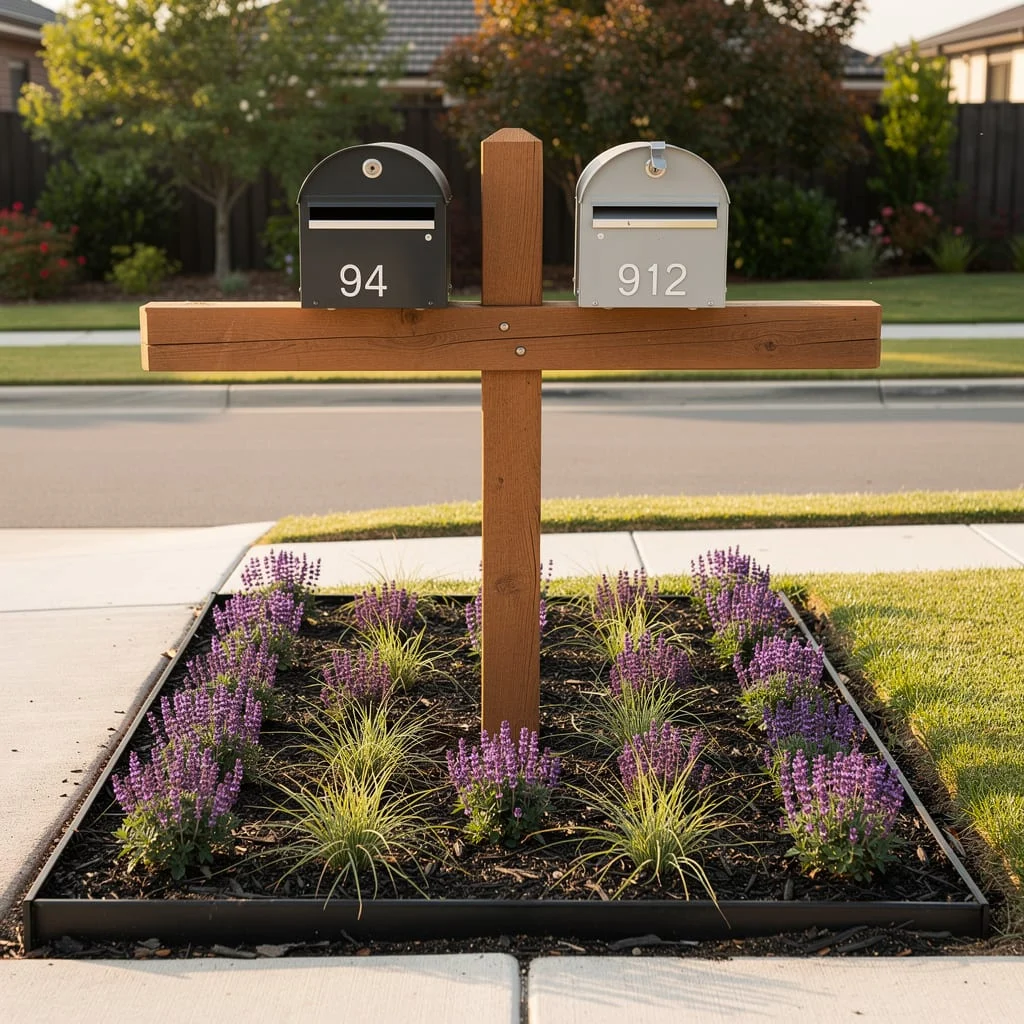
For a property where two boxes are needed — a shared driveway, a duplex, a neighbouring property — a horizontal timber arm on a single central post, carrying one box per side, is a clean solution.
Mount the arm at the same height as a single box installation. Both boxes face the street, numbered clearly in contemporary sans-serif adhesive vinyl numbers.
Below, a simple rectangular steel-edged garden bed. Plant with lavender in three clumps and three clumps of ornamental grass — alternating across the bed length. Mulch in dark wood chip. Nothing that grows tall enough to interfere with box access.
The simple structure of the cross-arm and the restrained bed planting reads as considered rather than improvised. It solves the two-box problem without looking like two compromises.
The Black Mailbox With Tumbling Annual Planting in a Barrel
A black arched mailbox on a straightforward timber post, set into a half wine barrel or large timber planter box positioned at the base.
Fill the planter with a generous cottage mix of tumbling annuals: wave petunia, verbena, calibrachoa, bacopa. Choose three to four colours and let them sprawl over the barrel edge. Plant a single upright element — salvia farinacea or small spike — at the centre for height.
Replace the annual planting twice a year: spring/summer mix in warm tones, autumn/winter mix in cool tones or evergreen foliage.
This is the mailbox for people who want seasonal colour and are willing to refresh it. The barrel does the landscaping work — it’s the container, the base, and the statement simultaneously.
The Contemporary Rendered Column With Twin Topiary Pots
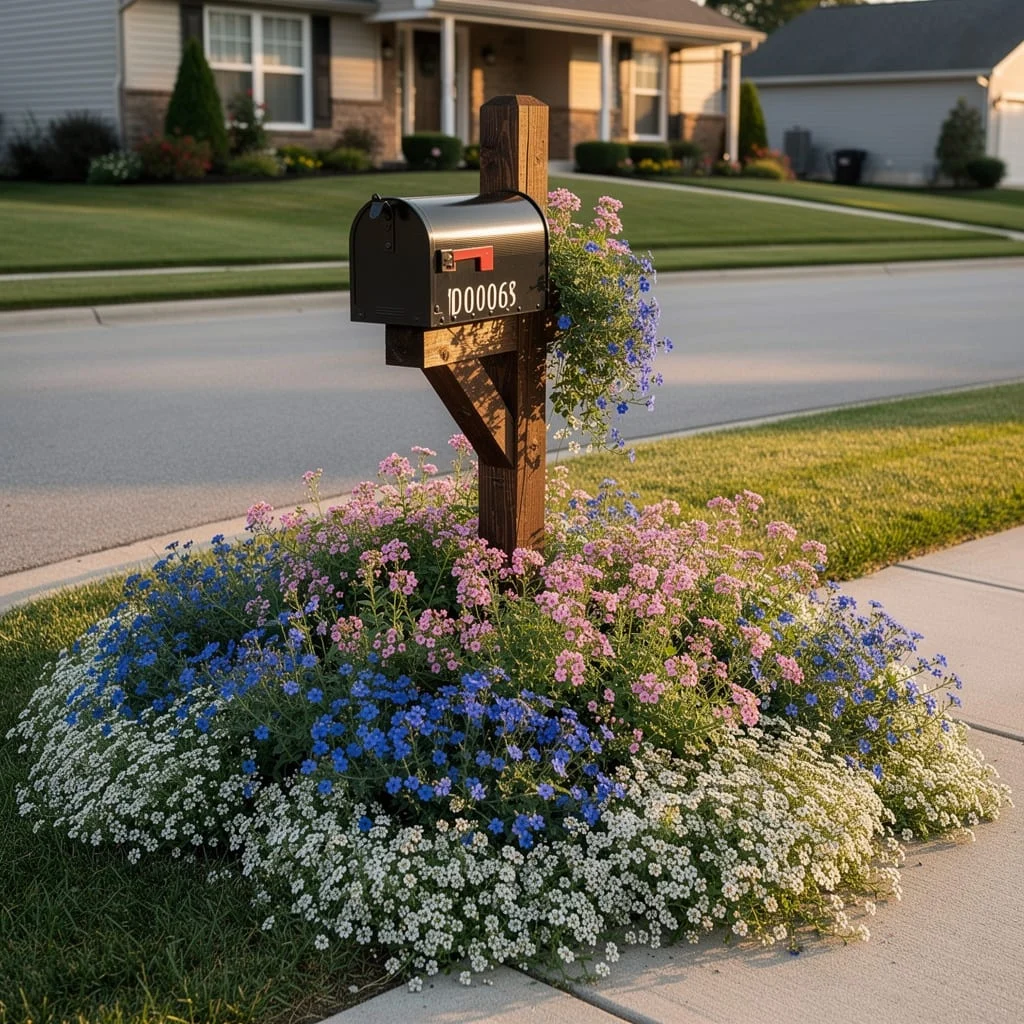
A rendered and painted column — white or off-white, with a clean mail slot and minimally expressed house numbers in matte black — flanked by two terracotta pots of matching size, each containing a single buxus hemisphere clipped to a tight ball.
Beneath the column, pale gravel or white chip as the ground surface, contained by a simple flat paver border.
The symmetry of the two topiary flanking the column is the whole composition. It reads as civic, ordered, confident. It asks for no further additions. No flowers, no trailing plants, nothing extra.
The Cream Brick Column With Zinnia Planting Bed
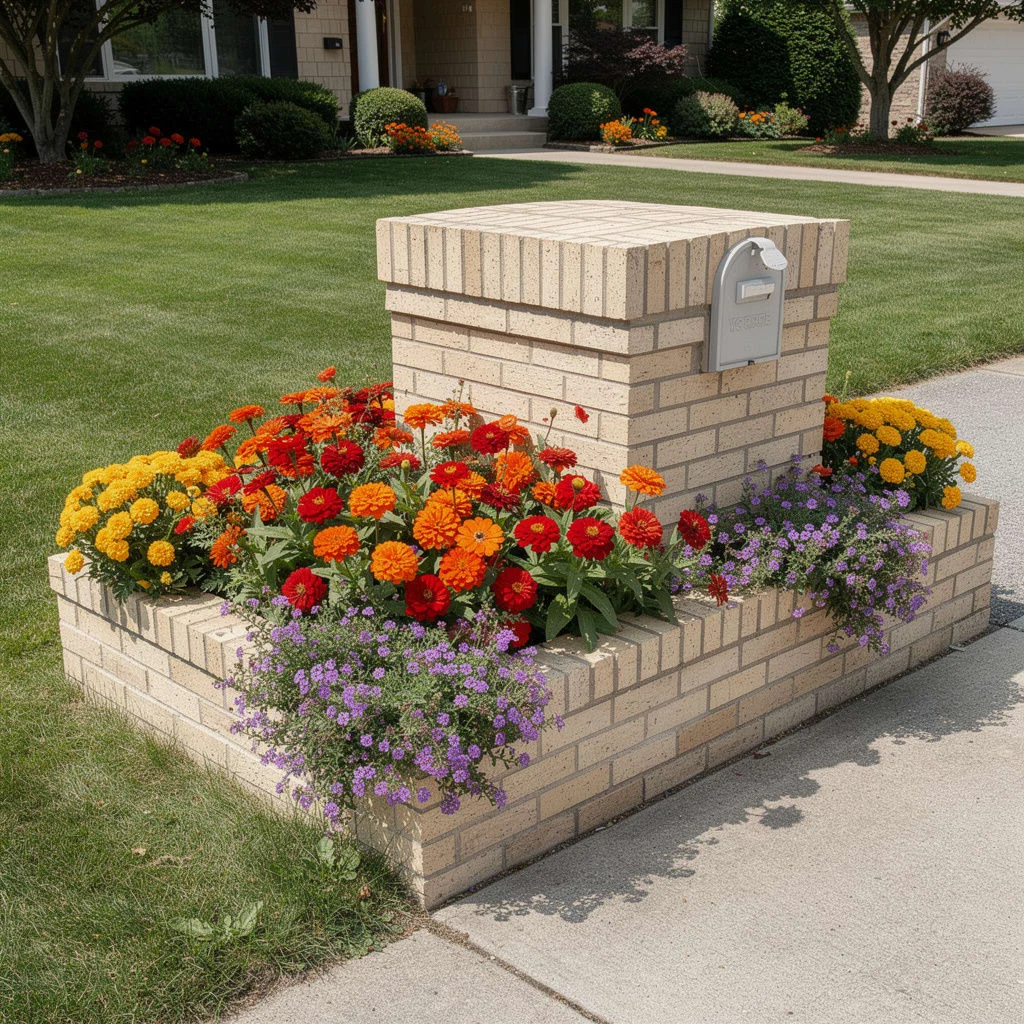
Build a mailbox column in cream or buff brick — a bullnose brick cap, mail slot set flush, house numbers in a contrasting tile or metal. Create a low stepped planting bed in matching brick around the base, approximately two courses high, roughly L-shaped to follow the kerb line.
Fill the bed with annual zinnias in orange, red, and yellow — grown from seed in situ from late spring. Add purple ageratum or lobelia at the front edge for the complementary contrast.
This is one of the most cheerful mailbox setups possible. The warm cream brick, the hot-toned zinnias, and the purple at the edge is a combination that reads from a moving car, which is the correct unit of measure for street-level curb appeal.
The White Post With Climbing Rose and River Stone Edge
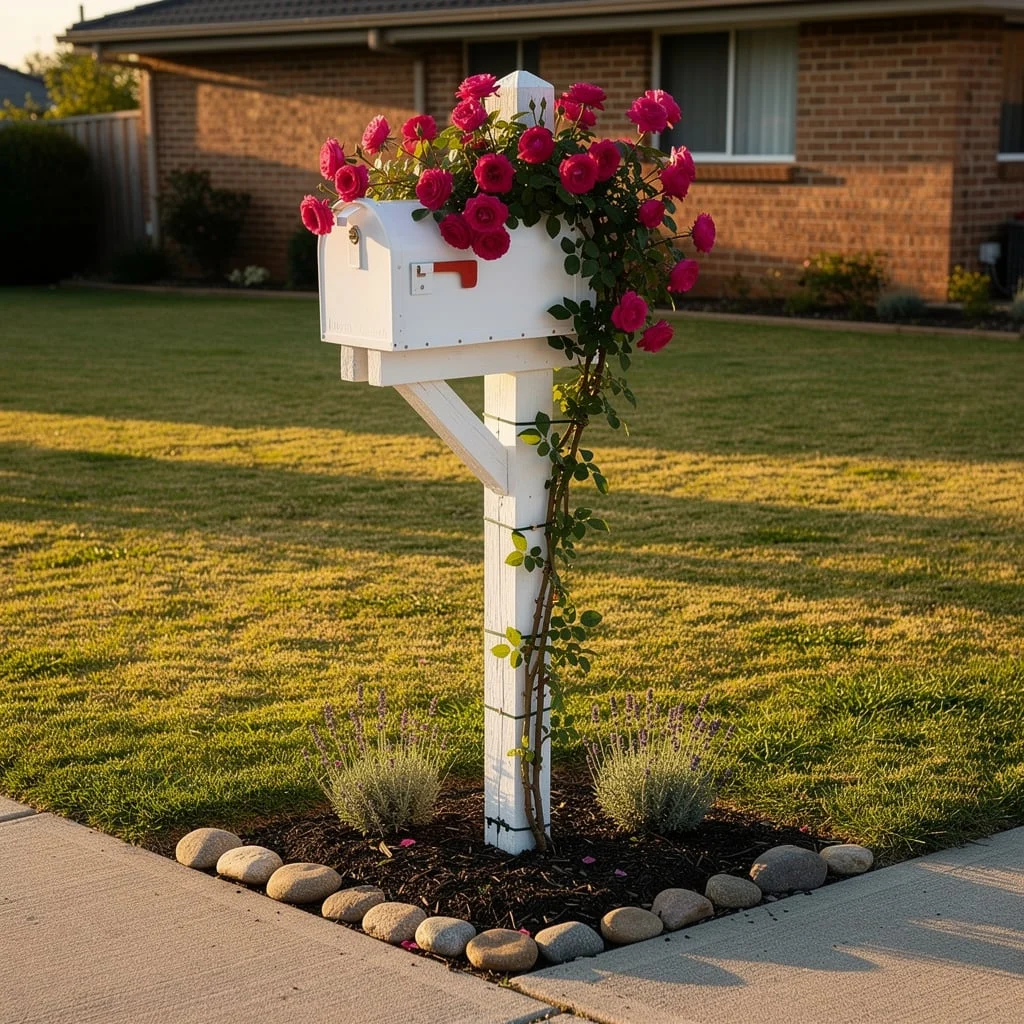
Plant a single vigorous climbing rose — a compact red or pink variety, planted against the post base — and train it up the post with soft ties at every 150 to 200mm. In the first season, train horizontally as much as vertically to encourage lateral flower production.
Define a small oval bed around the post base with smooth river stones as edge, filled with dark mulch. Plant two or three compact lavender at the front of the oval, outside the stone edge and against the lawn.
At the base of the post, add a few small stones inside the bed to cover the bare soil during the rose’s first year.
The white post and the deep pink or red rose are a classic combination for a reason. Train it properly and it stays presentable even out of bloom season.
The Timber Post With the Lavender and Rock Surround
On a natural weathered or stained cedar post, plant lavender generously around the base — three to five plants, not one. Use Hidcote or Munstead for compact form. Add one or two flowering perennials: snapdragon, sedum, or low helenium in warm orange or yellow tones.
Edge the bed with a ring of smooth river stones — 80 to 100mm diameter, laid side by side as a continuous border. The stones should be pale cream or buff, not the cheap grey gravel pebbles from the hardware store.
Mulch in between with dark wood chip.
This works for any house with natural timber elements — cedar cladding, a timber deck, a timber front fence. The materials are in the same family.
The Hardwood Box With Built-In Planter
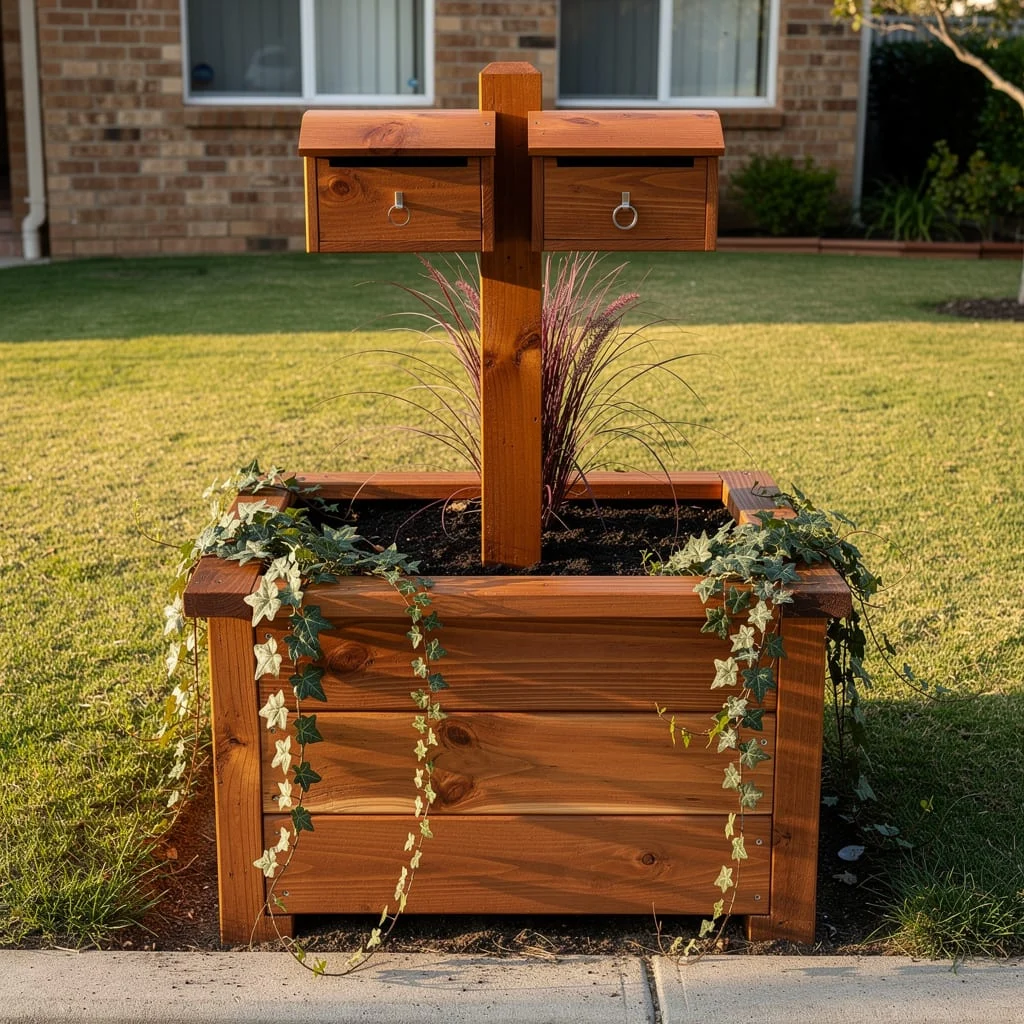
Commission or build a timber mailbox unit with an integrated raised planter box at the base — the box and the planter as one unified piece of furniture. Cedar, treated pine, or hardwood, in a warm honey or dark walnut stain.
Plant the integrated planter with a mix of trailing ivy, a compact fountain grass or mondo grass in dark tones, and one low-flowering perennial. The ivy trails over the front face of the box. The grass provides movement. The planting looks architectural.
This works on newer Australian or North American suburban properties where the house has a contemporary timber feature and the street landscape is otherwise low-key. The mailbox unit becomes the most interesting thing at the front boundary.
The Dry-Stacked Stone Column With Flowering Bed
Build a column of irregular field stone or split granite — roughly 400mm square, 1.2 metres high — and mortared tightly with a flat stone cap. Set the commercial mailbox box flush into one face at the correct postal height, bronze or copper finish to match the stone register.
Around the base, create a semicircular bed with a simple stone edge (matching the column material). Plant with impatiens, vinca, or low annuals in two or three colours. Mulch dark.
Embed the house number into the stone face using a natural stone slab with the number carved or routed — not a plastic adhesive number.
This is a mailbox that reads as architecture rather than hardware. It requires masonry skill to build once, and then almost no maintenance thereafter.
The Brick Column With Succulent and Cactus Planting
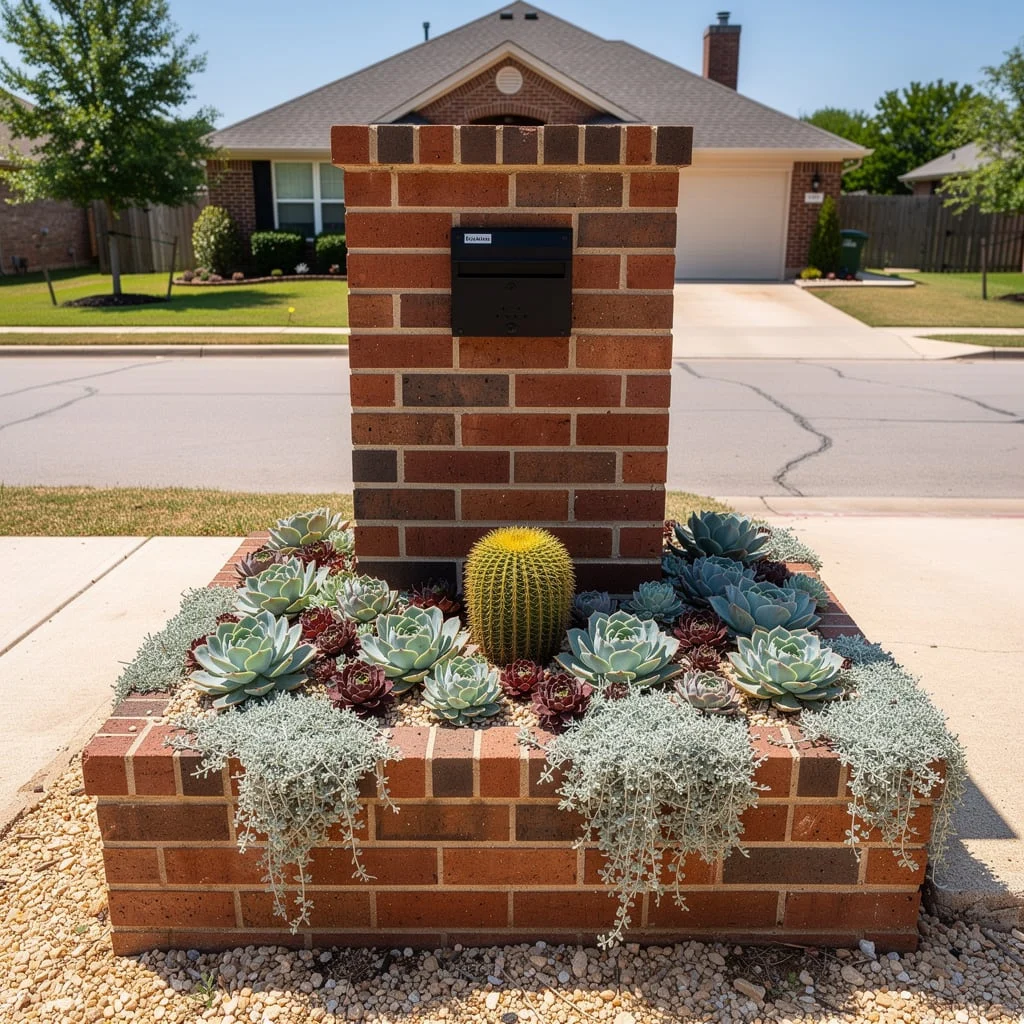
A red or terracotta brick column — box set flush, house numbers in black ceramic tile — with a built-in raised planting bed around the base in matching brick, two courses high.
Fill the bed with white crushed gravel ground cover and plant in: blue-grey echeveria in groupings of five to seven, two or three darkly coloured sempervivum, one central golden barrel cactus as the focal point, and trailing silver dichondra at the bed edge.
The warm red brick and the cool blue-grey succulent foliage is an underused combination. In a hot or dry climate, this bed needs almost zero water and almost zero maintenance. The cactus and the succulents look increasingly good as the years pass.
The Post Box on a Granite Plinth With Herb Planting
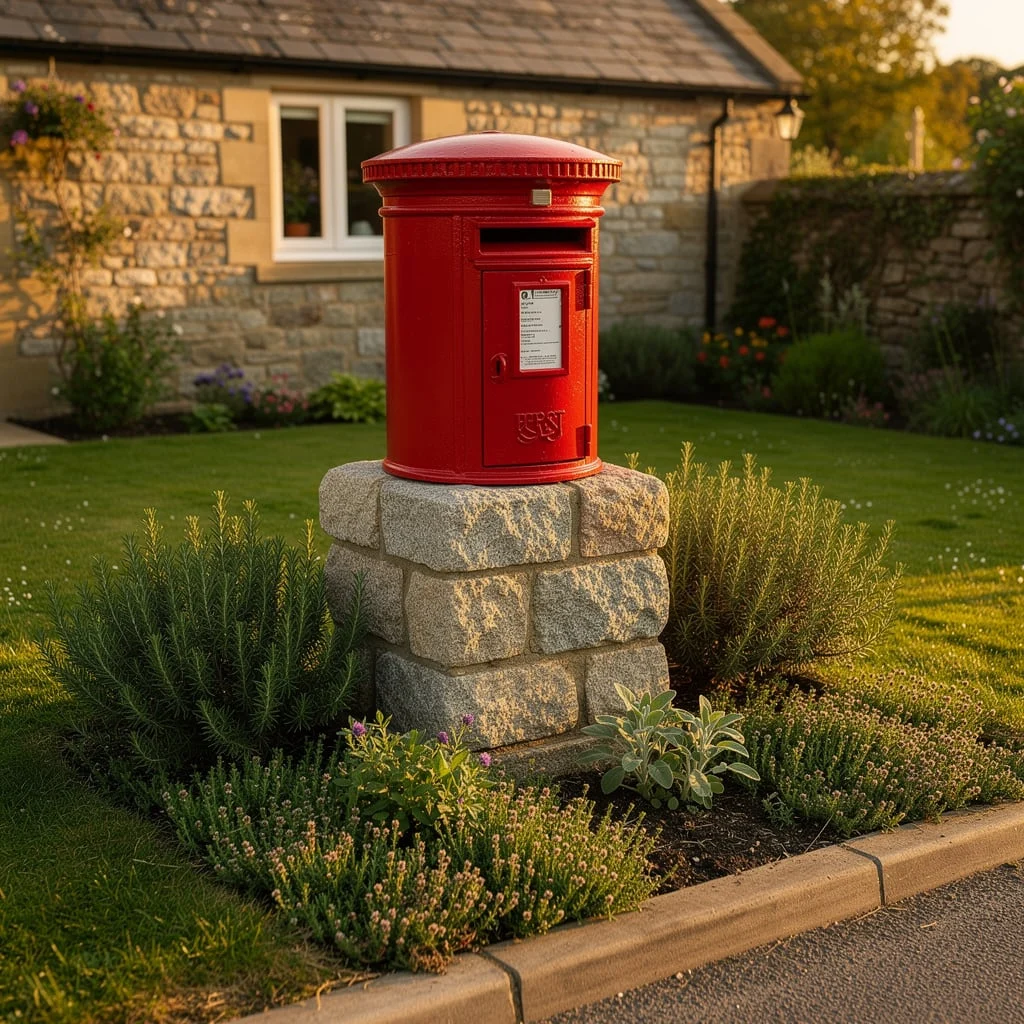
Take a bold cast-iron or lacquered red pillar box — the English style — and set it on a base of three or four courses of rough-cut granite block. The granite plinth gives the box permanence and grounds it.
Around the plinth, plant a loose collection of ground-covering herbs: creeping rosemary, thyme, heather, lamb’s ears. Let the planting reach over the granite base slightly. No mulch — let the herbs cover the ground.
This only works in front of the right house. A stone cottage, a rendered country house, a property with established mature trees. The cast-iron box on a granite plinth is a statement about permanence. If the house doesn’t support that statement, the mailbox looks like a prop.
The Star Jasmine Covered Post With Steel-Edged Mulch Bed
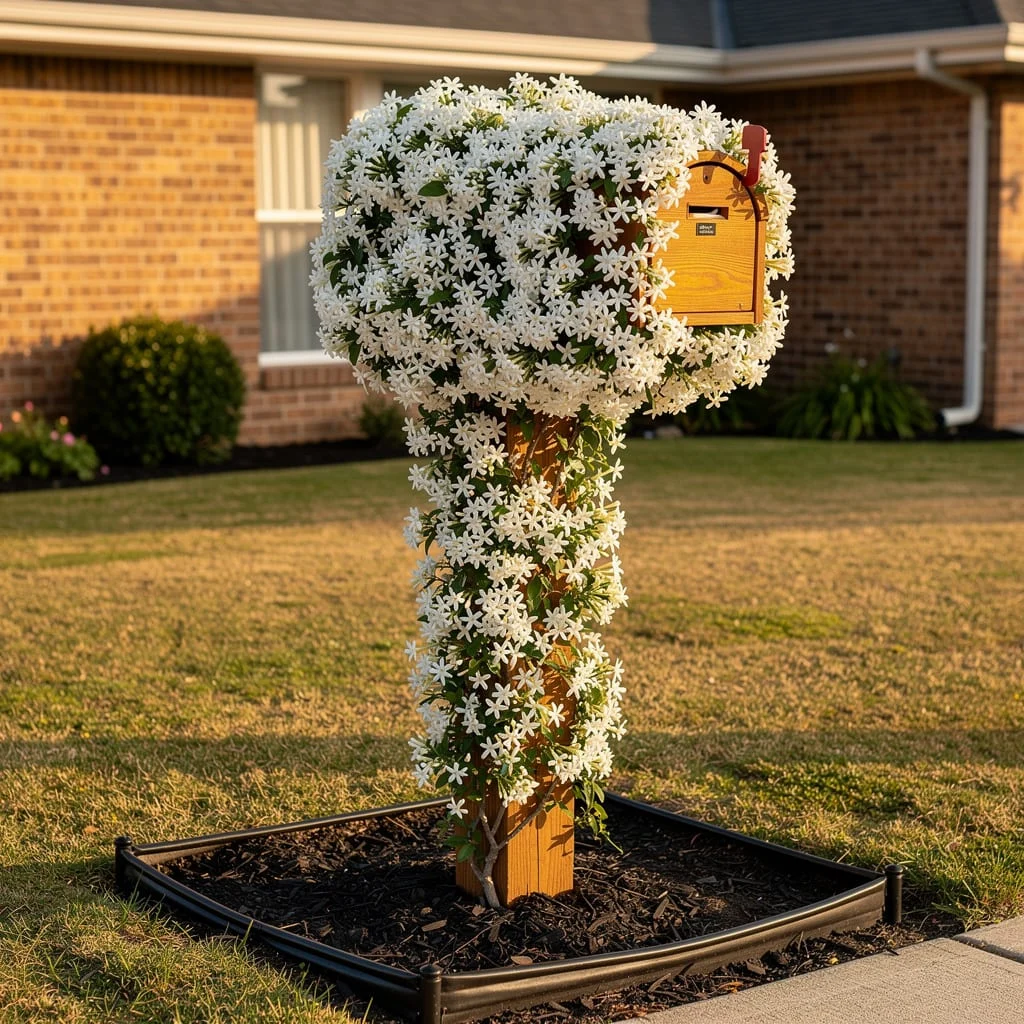
Train star jasmine up a timber post from a single plant at the base. In the second and third season it will cover the post entirely and begin to billow over the box in bloom. Allow it to do this for one month, then clip it back to the box line after flowering.
Define a clean rectangular bed around the post using flat-set steel edging in a dark powder coat. Fill with black wood chip mulch. No other plants — just the jasmine and the clean mulch bed.
The restraint of a single plant species on a single structural post, in a simple edged bed, is more sophisticated than a mixed planting of five different things. It says the person who lives here chose one plant and committed to it.
The Monochrome Minimal Post With Blue Fescue and White Boulders
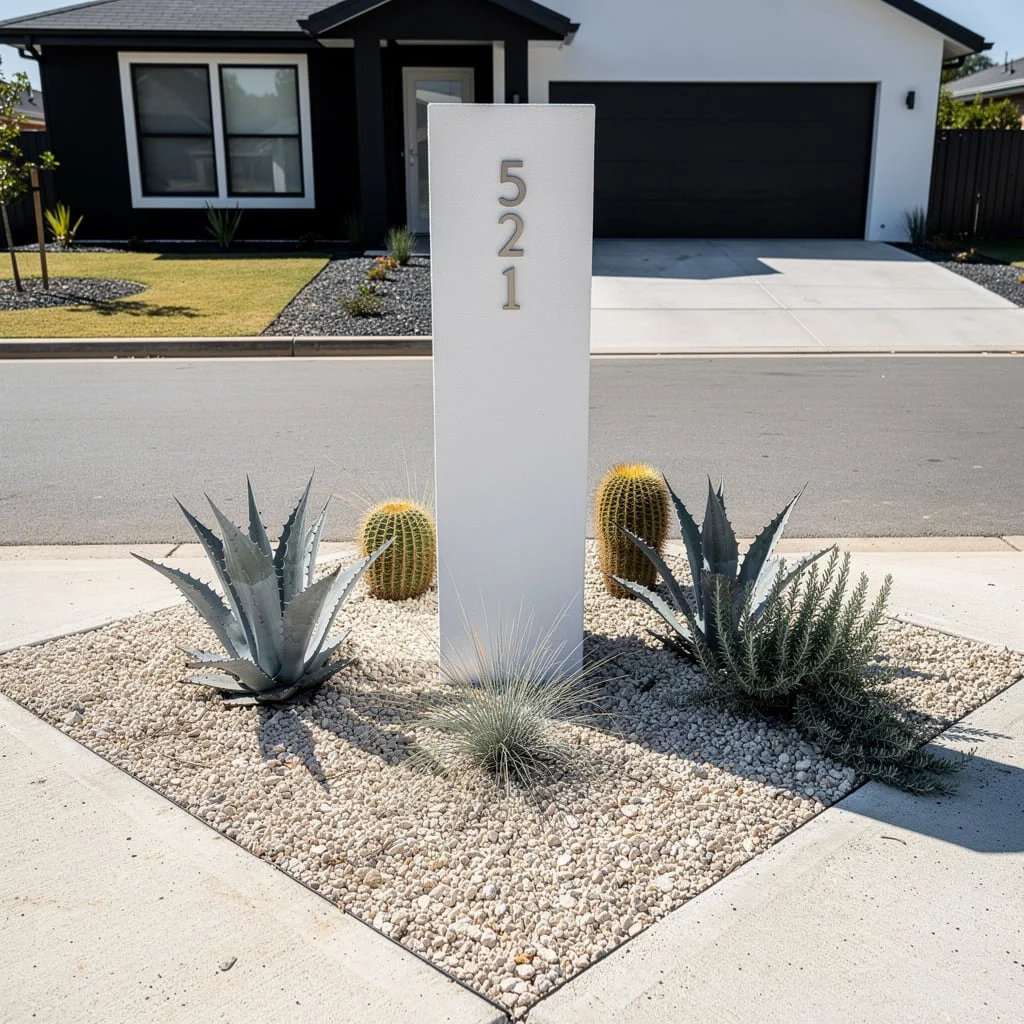
A matte black powder-coated steel post — round section, thin, with a matte black mailbox — in a simple square gravel bed edged in matching dark steel.
Plant three blue fescue grasses at the base of the post, loosely placed — not in a row. Add two medium sandstone or granite boulders, one slightly larger than the other, positioned to read as geology rather than decoration.
White rendered house, black fencing or window frames, black post. The blue-grey of the fescue against the white gravel and the black post creates a graphic that reads cleanly from the street.
This is the mailbox installation that architects would approve.
The Dark Brick Column With White Hydrangea Planting
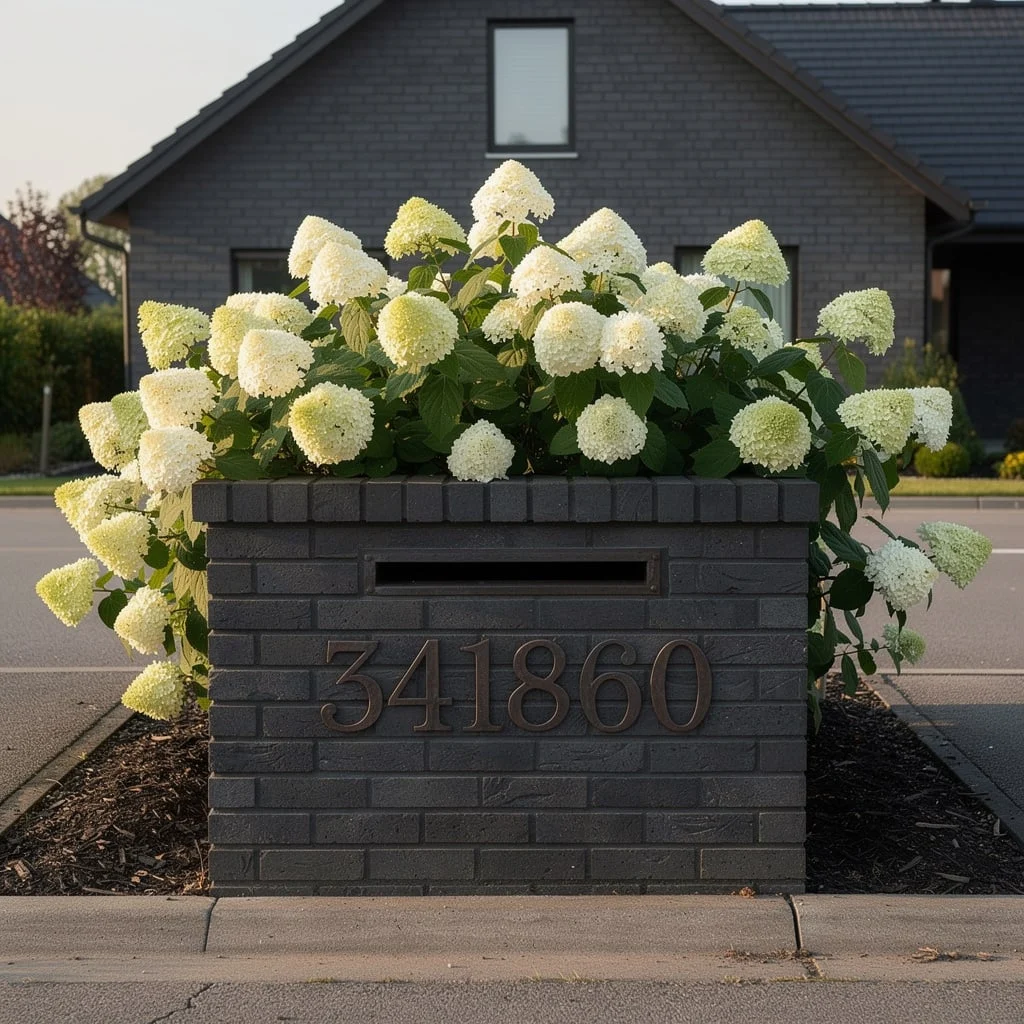
A dark charcoal or near-black brick column — letter slot, bronze house numbers, clean mortar joints — with a generous planting bed in dark mulch extending in a wide arc behind and to each side.
Plant the bed with Annabelle hydrangea — Hydrangea arborescens — in three or four plants behind the column, allowing them to grow to their natural mounding form. The white flower heads emerging above the dark brick column in summer is a combination that’s genuinely arresting.
Cut the hydrangeas back hard each spring. They will return.
The Black Post With Two Boulders and Blue Fescue
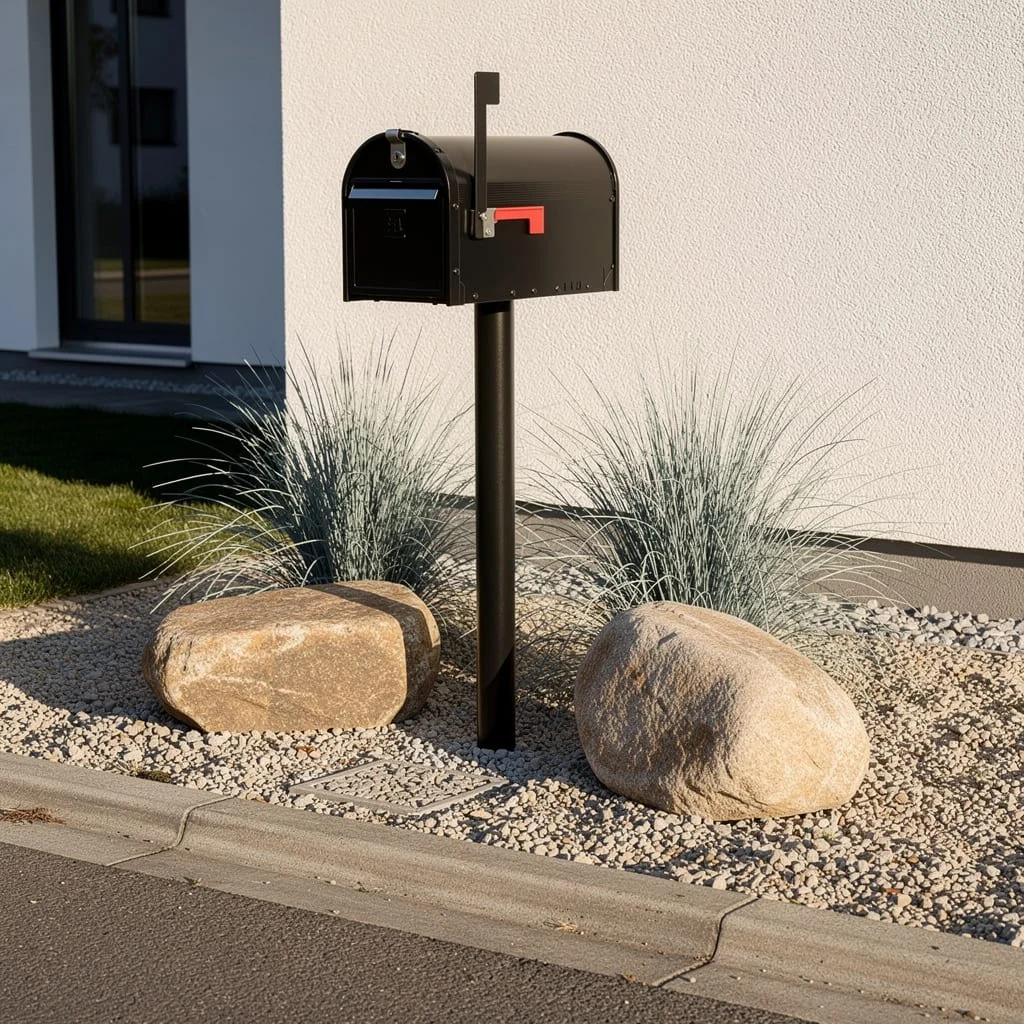
A matte black standard post — round tube section, contemporary — in a gravel bed with two substantial sandstone or granite boulders placed informally on either side of the post base. Three blue fescue grasses planted between and behind the boulders, emerging between them.
The boulders should be large enough to look intentional — minimum 300mm diameter. Small decorative stones are not boulders. The difference is everything.
This is the minimal installation for people who want something better than bare dirt but won’t commit to a planting bed. Three plants, two stones, one post. Completely resolved.
The Matte Black Cube Box With Dark Ophiopogon
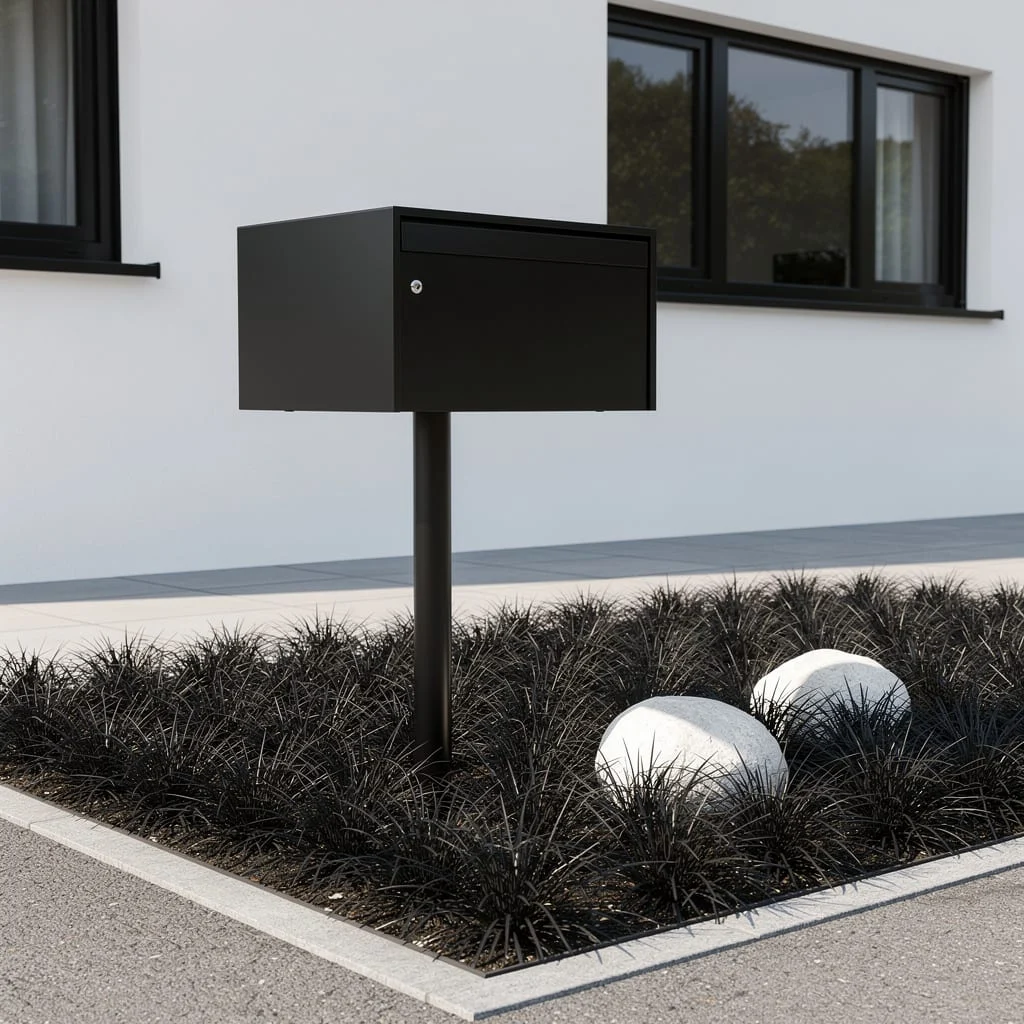
A square matte black powder-coated letterbox on a round black post — contemporary European in register — in a clean square bed edged in white granite cobble or flat-set pale stone.
Plant the entire bed with black mondo grass — Ophiopogon planiscapus ‘Nigrescens’ — in a tight mass covering the full bed area. Into this dark mass, place two rounded white stones of 200 to 250mm diameter, slightly off-centre.
This is a composition built entirely on contrast: the matte black box, the near-black grass, the white stones, the white house behind. It asks nothing of you horticulturally and looks better with each season as the mondo mass fills in.
The Galvanised Post With Native Prairie Planting
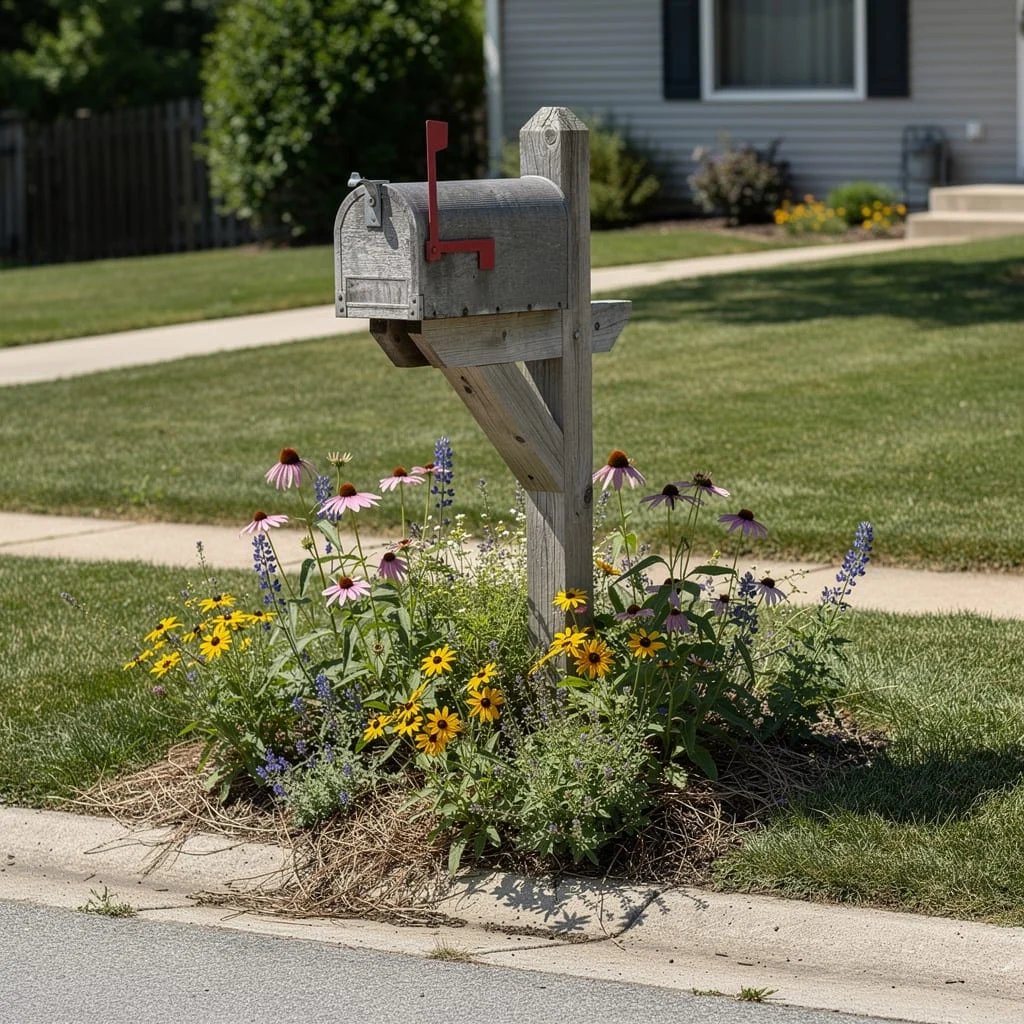
A weathered galvanised post — the standard residential box in grey — given new life by a planting bed of native prairie or cottage perennials that swamps the base and makes the box seem like an afterthought in a proper garden.
Plant echinacea, rudbeckia, blue sage, and white alyssum in a generous mound around the base, allowing plants to grow up to box level on the sides. Leave the front clear for flag and access.
The galvanised box stops looking like a grey object someone didn’t care about and starts looking like a working post standing in a garden. The key is density and the right perennial choices — things that will return each year and spread slightly.
The White Fence Post With Sunflower Wall Behind
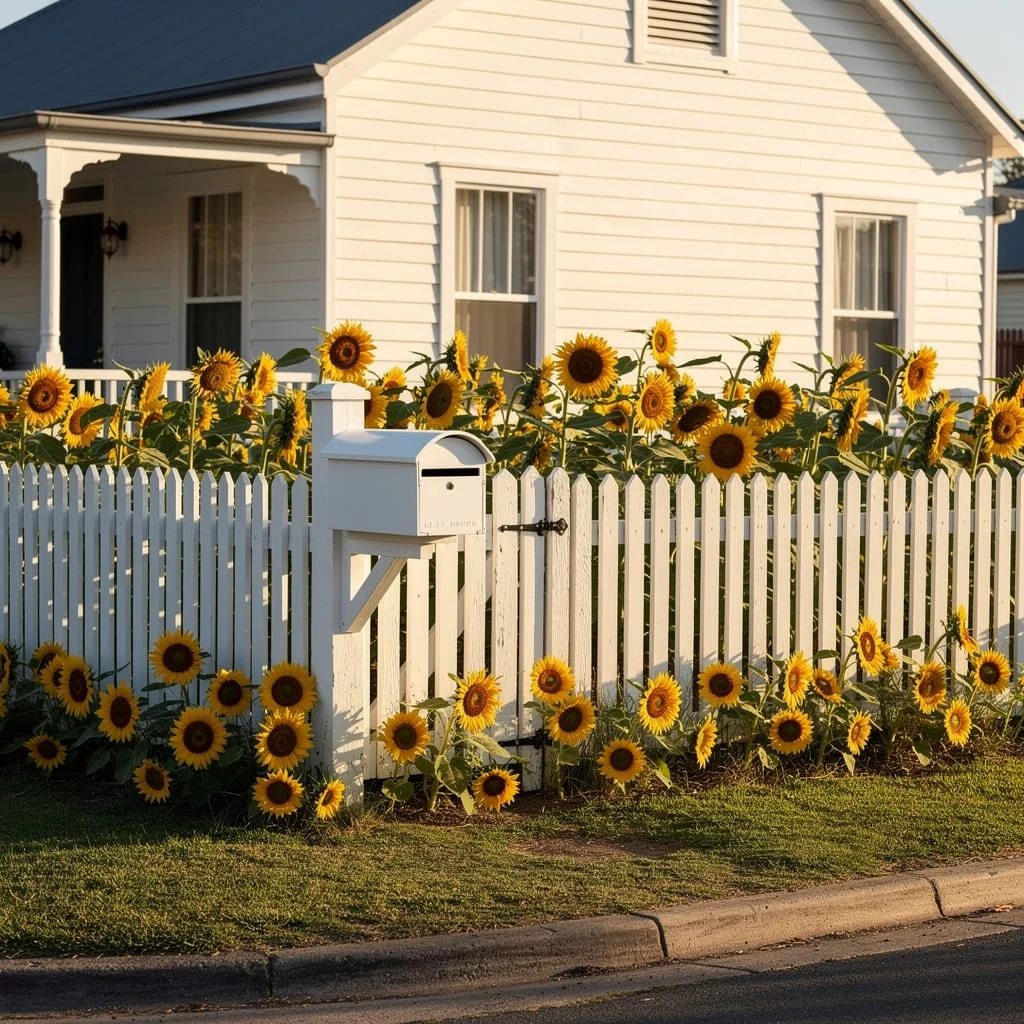
A white-painted mailbox post built into or alongside a white picket fence, with a dense planting of tall sunflowers established along the full fence length behind it.
Plant sunflowers from seed in early spring in a narrow bed against the fence line, at close spacing — 250 to 300mm apart. They will reach two metres and bloom prolifically in August.
The yellow of the sunflowers against the white fence and the white box, in late summer afternoon light, is the definition of cheerful. It’s also a zero-cost annual planting that regenerates itself partly by seed the following season.
This only works with the right house: a cottage, a farmhouse, a California bungalow. The sunflowers and the picket fence are making a specific statement.
The White Rendered Post With Clipped Buxus Flanking
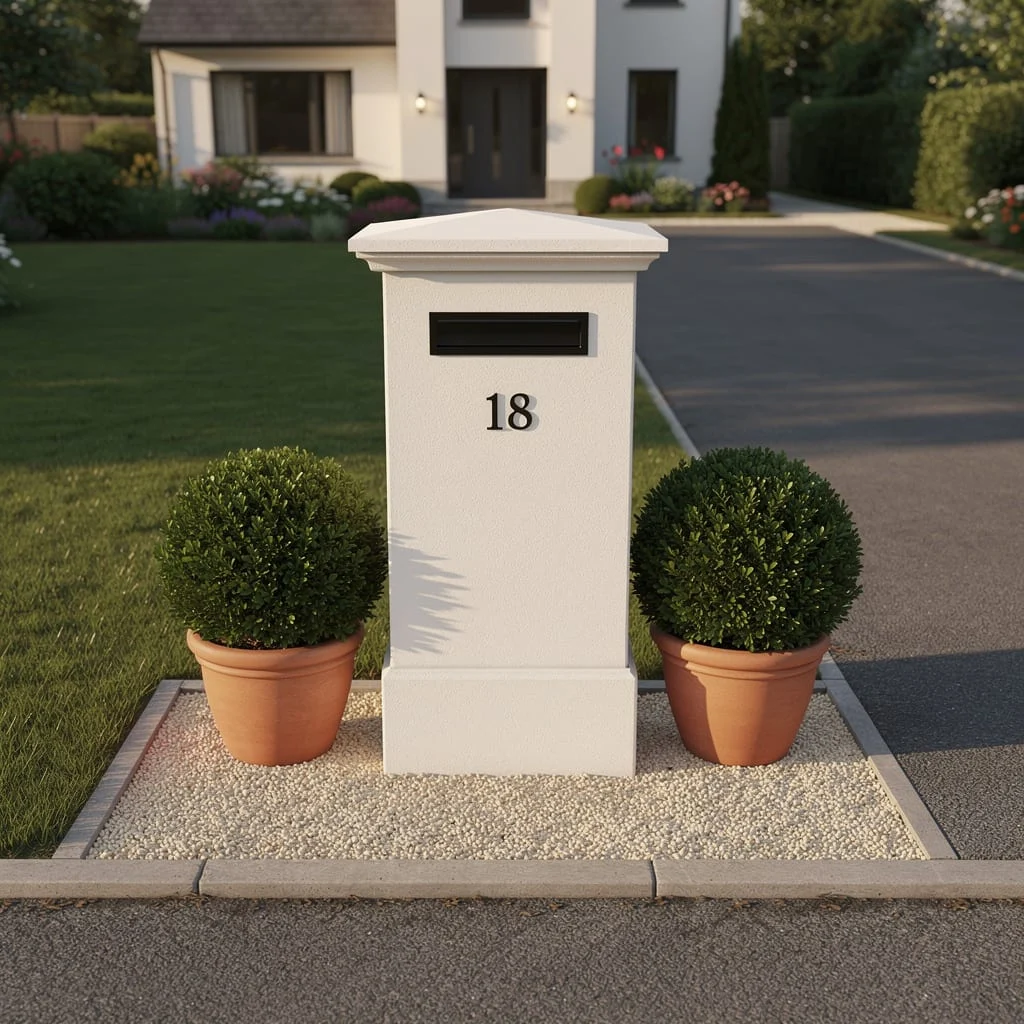
A white rendered masonry post — four-sided, with a proper pyramidal cap, letter slot, and black house number applied cleanly — on a gravel base with two matching buxus balls in terracotta pots on either side.
The pots should be identical. The buxus should be clipped to identical diameters. The gravel base should be pale and contained.
This installation is for the house that is tidy in all its other details and needs the mailbox to match that character. It’s resolved by restraint, not by abundance. The two identical plants, the two identical pots, the white column: complete.
Final Thoughts
The mailbox doesn’t deserve a separate design philosophy from the rest of the front garden. It’s a vertical element at the property boundary — and those elements are exactly what create the first impression before anyone reaches your front door.
What makes every installation in this collection work is the same thing: one clear decision, made well. The stone column commits to permanence. The climbing rose commits to romance. The monochrome minimal bed commits to graphic restraint. The sunflower fence commits to summer abundance without apology.
What doesn’t work is the mailbox bed that accumulated: a bit of gravel, a leftover ornamental grass, a solar light stuck in at an angle, one seasonal flower that died and wasn’t replaced. That’s not a decision. That’s what happens when nobody decided.
Your mailbox gets seen every day. It costs almost nothing to do properly. Start there.