
Your deck is finished. You spent the money, you have the receipts, and it looks fine. But fine is not the point. The point is that the ground around it still looks like it’s waiting for something to happen.
That gap between the deck edge and the rest of your garden is not a neutral zone. It’s the hinge. It’s the thing that decides whether your outdoor space reads as one considered place, or a platform dropped into a yard that hasn’t caught up.
Most people get the deck right and then completely misread the brief for everything surrounding it. They plant a few things. They add some mulch. They call it landscaping.
It isn’t. This is what it actually looks like when the space earns it.
The Ground Around Your Deck Is Not a Frame — It’s the Other Half of the Room
A deck without considered landscaping is like a sofa floating in an empty room. Technically functional. Spatially incomplete.
The common mistake is treating the perimeter as decoration — something to soften the edges, add colour, and look pleasant. That is the wrong job description entirely. The plants and materials that surround a deck do not decorate it. They anchor it. They tell the deck where it belongs.
When the Perimeter Reads as Filler, the Whole Thing Unravels
Filler planting has a look. It’s a row of the same shrub. A ring of annuals that will need replacing every spring. A narrow strip of something green that doesn’t connect to anything else in the garden.
It looks temporary because it is temporary. It says: I wasn’t quite sure what to do here, so I planted things.
The perimeter of your deck should have the same weight of intention as the deck itself. Every material, every plant, every edge makes a decision about what kind of space this is.
Transition Is the Actual Design Problem
The real challenge isn’t selecting plants. It’s managing the moment where built structure meets living garden.
Hard edge against soft ground is a jarring transition unless it’s handled deliberately. A raised deck with a sheer drop into lawn looks unfinished. A ground-level deck with no boundary loses its definition entirely.
The best landscaping around decks solves this transition with purpose. Stone walls that become part of the architecture. Planted beds that create a breathing buffer zone. Gravel that softens the line without dissolving it.
The Vertical Dimension Gets Ignored Almost Every Time
Everyone thinks in flat. They plan the bed width, they choose the plants, they add mulch.
Nobody thinks about how the planting behaves at height, in relation to the deck railing, to a pergola, to the sightline from a seated position. Tall grasses that screen neighbours at eye level. Climbing wisteria that changes the ceiling of the space. Espaliered trees that turn a fence into a living wall.
Height is the dimension that creates enclosure. Enclosure is the thing that makes outdoor spaces feel like rooms rather than open yards.
What the Relationship Between Plants and Structure Actually Does
The deck is hard. The garden is soft. The design question isn’t how to separate them — it’s how to let them negotiate.
Materials Speak to Each Other Across the Space
A warm cedar deck and a sandstone retaining wall share a warmth of tone that makes them feel inevitable together. A dark composite deck and white pebble gravel create a graphic contrast that is modern and clean.
These conversations don’t happen by accident. They happen because someone looked at the deck material and chose the surrounding materials to either harmonise or deliberately contrast with it. Neither approach is wrong. Choosing neither is.
Living Architecture Changes Everything Year-Round
A pergola without climbers is a timber structure. A pergola with wisteria is a room. A deck surrounded by ornamental grasses is completely different in February than it is in August — the grasses move in wind, they catch golden light in autumn, they add sound.
Static, evergreen perimeter planting is safe. It looks the same in every season. It doesn’t surprise you. Living architecture — climbers, grasses, deciduous shrubs — makes the space change with the year, which means you notice it. Which means you use it.
The Deck Edge Is an Opportunity Most People Miss
The moment where the decking board ends and something else begins is one of the most charged design opportunities in the whole space.
A raised deck lets you use that vertical fascia. Light it. Clad it in a contrasting timber. Build a planter box that sits flush with the deck surface and doubles as additional seating. A ground-level deck can be kissed by a low retaining wall, or edged in a bed of lavender so the line between structure and garden dissolves on purpose.
Landscaping Around a Deck Ideas
The Garden Room Deck Built on a Floating Platform
Start with a floating deck platform that sits a single step above grade — just enough to define it as a distinct surface without requiring railings or steps. Use cedar or treated pine laid horizontally, with tight joints and a warm honey-brown stain that deepens with weather.
Frame the deck on all sides with a dense clipped hedge — box or yew — at a height that allows someone seated to see over it into the garden beyond. This hedge is the wall of the room. It needs to be at least 600mm deep to read as structure rather than edging.
Place rounded topiary spheres of the same species at the corners and at intervals along the perimeter. Vary their size — some at 400mm diameter, some at 600mm — and position them with the slight irregularity of something placed by eye rather than a measuring tape.
Bring in rattan orbit chairs and a pendant egg chair rather than traditional outdoor furniture. These pieces have organic shapes that work against the geometric hedge-room rather than copying it. Lay a large jute rug to establish the seating area. Add a single dark metal coffee table at the centre — small enough to walk around comfortably.
Keep a mown grass path running diagonally from the deck to the garden, with stone stepping slabs set into the turf. This diagonal interrupts the formality of everything else in exactly the right way.
The Ground-Level Deck Wrapped in Roses, Lavender, and Salvia
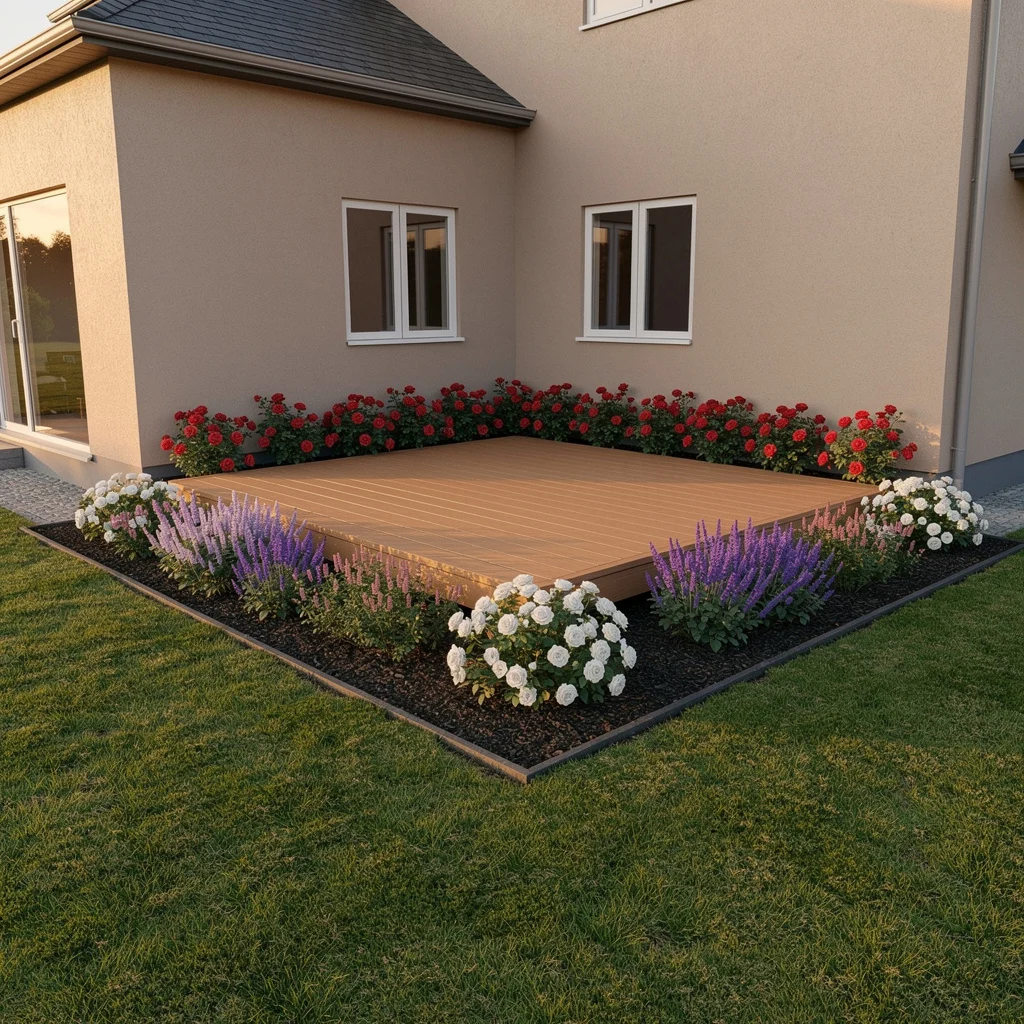
Choose a deck surface that works with soft romantic planting: warm pale wood, not grey composite. The grey composite deck reads as contemporary. This look is not contemporary.
Plant red climbing roses against the house wall behind the deck — ‘Climbing Iceberg’, ‘New Dawn’, or ‘Compassion’ for fragrance. Fix horizontal wires to the wall at 400mm intervals for training. In the first year, tie all growth horizontally to encourage more flowering laterals.
Create a U-shaped planting bed that wraps three sides of the deck. Plant in loose drifts, not rows: red roses at the back and corners, white shrub roses in the middle ground, lavender in long purple-blue sweeps at the front edge, and white salvia and mounding mums at the corners for successive flowering.
The palette is intentionally limited — red, white, and purple-blue — so that the abundance of plants reads as a colour composition rather than a colour collision.
Lose the furniture for a moment and imagine the deck itself as a floor in a garden room, the roses and lavender as its walls. That is the target.
The Stepped Cedar Platform Deck Floating Through a Full-Colour Perennial Garden
This is a three-level deck and the key structural decision is that no single level is very large. Each platform is a landing in a sequence — a pause in a journey from garden to house — rather than a destination in itself. Build each platform at a single step height above the last, roughly 175 to 200mm rise per level, using the same cedar board throughout so the levels read as one continuous material in three planes.
Leave the deck edges clean and sharp, with no fascia moulding and no railing unless a building code requires it. A low deck that needs no railing is a completely different, far more relaxed object than a railinged platform.
The planting is the architecture here, not the deck. Excavate the entire surrounding area to a depth of 300mm, improve with compost and slow-release fertiliser, and plant in a dense mixed perennial scheme. The colour palette is the decision that matters most: magenta and purple verbena and salvia at the front edge at low height, white peonies and cream dahlias at mid height, Japanese maple and tall flowering shrubs at the back. Dark bark mulch between plants makes every flower colour read with maximum saturation.
Lay large-format concrete or natural stone stepping pads through the planting beds to create a secondary navigation path alongside the deck steps. These stepping pads allow access to the beds for maintenance and create visual connections through the planting.
Use black steel landscape edging to hold the bed boundaries against the lawn and against the deck edge. The black edge strip reads as a shadow line between surfaces — it separates the warm timber, the dark mulch, and the green lawn without imposing itself as a material element.
The Japanese maple or red-leaved shrub placed at one corner of the highest platform level is the single most important plant decision in the space. It gives the whole garden a point of focus. Everything else can be dense and varied. That one dark red specimen is where the eye lands first and returns to.
The Ipe Deck with Bamboo Screen, White Pebble Ground Cover, and Maximum Privacy
Bamboo as a privacy screen is one of the most powerful tools available, and one of the most misused.
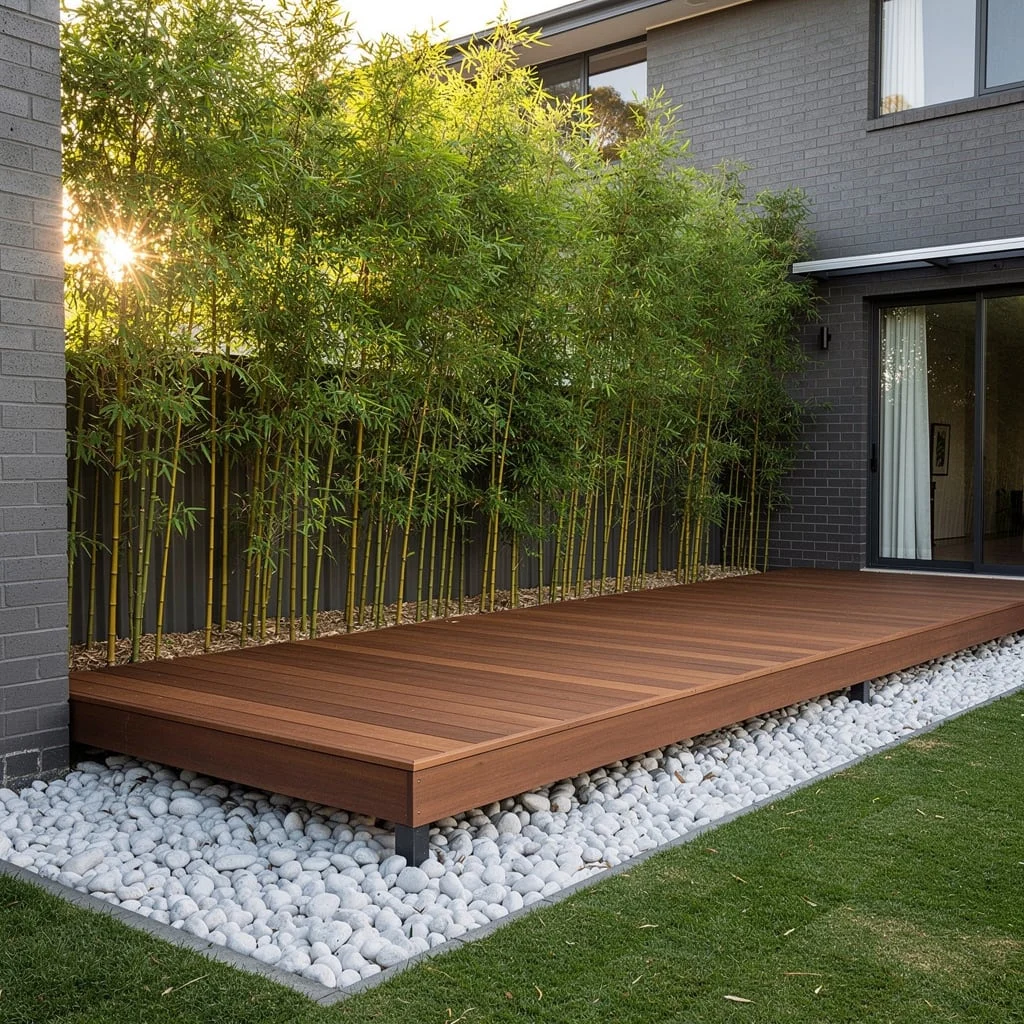
Use a clumping bamboo — Fargesia murielae or Fargesia robusta are both reliably clumping and will not invade adjacent beds. Running bamboo is a disaster. Do not use it. Plant the clumping variety in a deep root barrier trench regardless, as insurance.
Plant in a single row, 500mm apart, along the boundary you want to screen. Clumping bamboo grows densely but slowly in the first two years, then accelerates. By year three to four you will have a dense green wall that moves and whispers in wind.
Lay white or cream pebbles — washed river pebble at 20 to 40mm diameter — between the deck edge and the bamboo planting row. Keep this pebble border at 400 to 600mm wide. The white pebbles against a deep brown deck and a deep green bamboo creates a clean three-toned composition.
Install the deck in a rich reddish-brown hardwood — ipe, teak, or a quality composite in a similar tone. The warmth of the deck against the cool grey-green of bamboo foliage is the central material relationship. Everything in this space depends on getting that tonal contrast right.
The Evening Garden with In-Ground Uplighting, String Lights, and White Flowering Plants
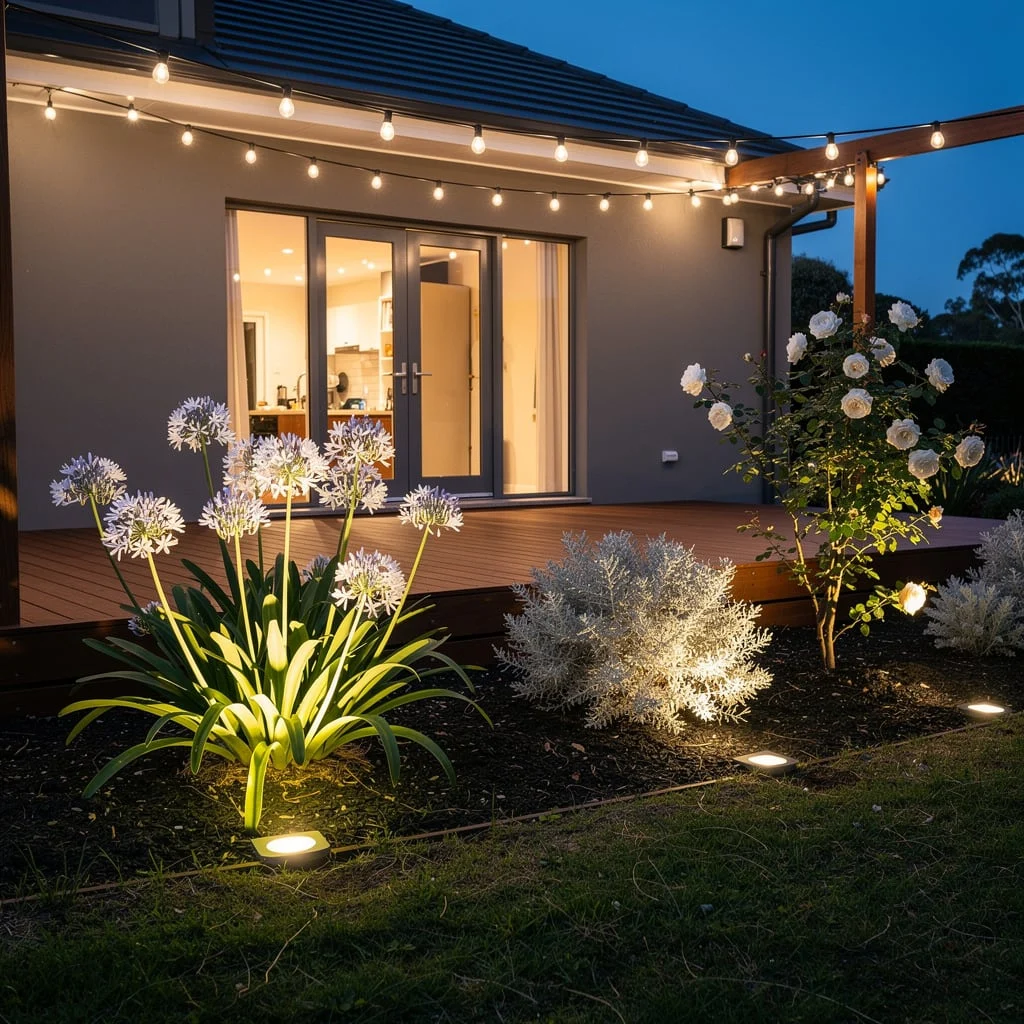
Build the deck low to the house, flush with or just above grade, in a warm reddish-brown hardwood or composite. Run the deck boards horizontally, parallel to the house wall, so the grain leads the eye toward the garden rather than back to the house.
Plant for night visibility. White flowers are the key. White roses, white agapanthus, white flowering shrubs — these glow in low light conditions in a way that coloured flowers simply do not. Pair them with silver-leaved plants: dusty miller, artemisia, or lavender in its silvery-green pre-flower state.
Install in-ground uplight fixtures at the base of each key plant — a recessed round fixture flush with the soil surface, angled to throw light upward through the foliage. Use 2700K warm white for a natural feel. Space them 800mm to 1200mm apart through the planting bed.
String globe lights from the house fascia to a timber pergola post at the garden edge. Keep the string horizontal and at a consistent height of around 2.5 metres. Do not drape or swag — a straight, level line of warm globes is more sophisticated than anything decorative.
The Raised Deck with White Aluminum Railings, Lattice Skirting, and a Curved Hydrangea Border
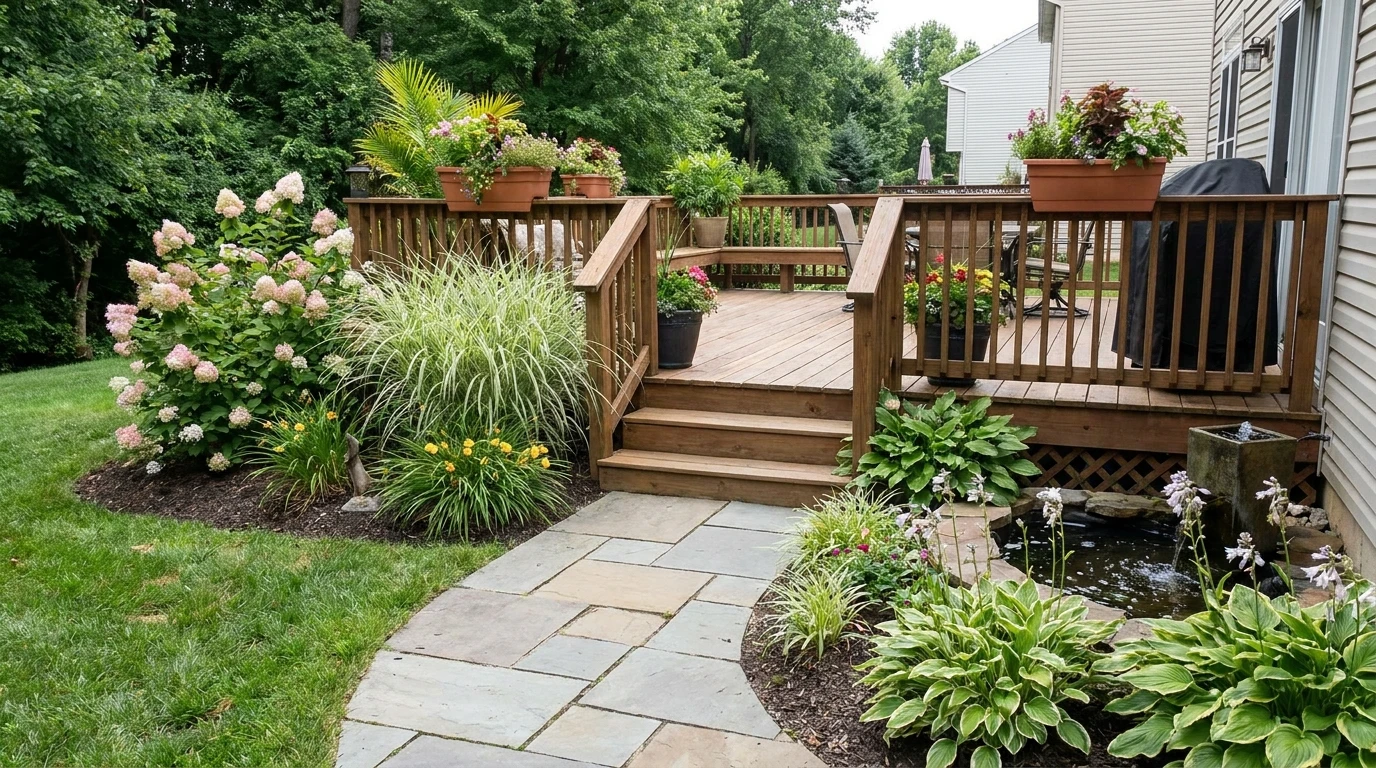
Start with the deck skirting, because it is doing more work than most people give it credit for. Timber lattice panels fixed below the deck frame close off the under-deck space cleanly while allowing airflow — buy pre-made cedar or pressure-treated lattice panels, cut them to fit the opening between the deck posts, and staple or nail them to a simple timber frame fixed inside the post faces. Stain them the same tone as the deck fascia so the whole base reads as one unified base.
Choose white aluminum for the railing system rather than timber. White aluminum balusters and posts are maintenance-free in a way timber never is — no repainting, no rot, no annual sanding. The contrast between a warm cedar or pine deck surface and crisp white railing is one of the cleanest combinations available for a traditional suburban deck.
For the perimeter bed, use a curved concrete or stone edging strip that follows a generous arc — not a tight radius, but a long sweeping curve that bows outward from the deck face. This edging is what separates the planting bed from the lawn, and its quality matters. Cheap plastic edging sags. Concrete edging or natural stone holds its line for twenty years.
Fill the bed with hydrangeas as the primary shrub — Annabelle hydrangeas for their enormous white flower heads, which work beautifully against warm timber. Plant them toward the back of the bed near the deck face. In front of the hydrangeas, layer in hostas in gold and green variegated varieties for foliage contrast. Add a single clipped box sphere at the stair base as a full stop to the composition.
Top-dress the whole bed with a dark bark mulch. Keep it at 75mm depth, pulled back slightly from each plant stem.
The Raised Deck with Under-Deck Planting in Hostas, Ferns, and Shade Perennials
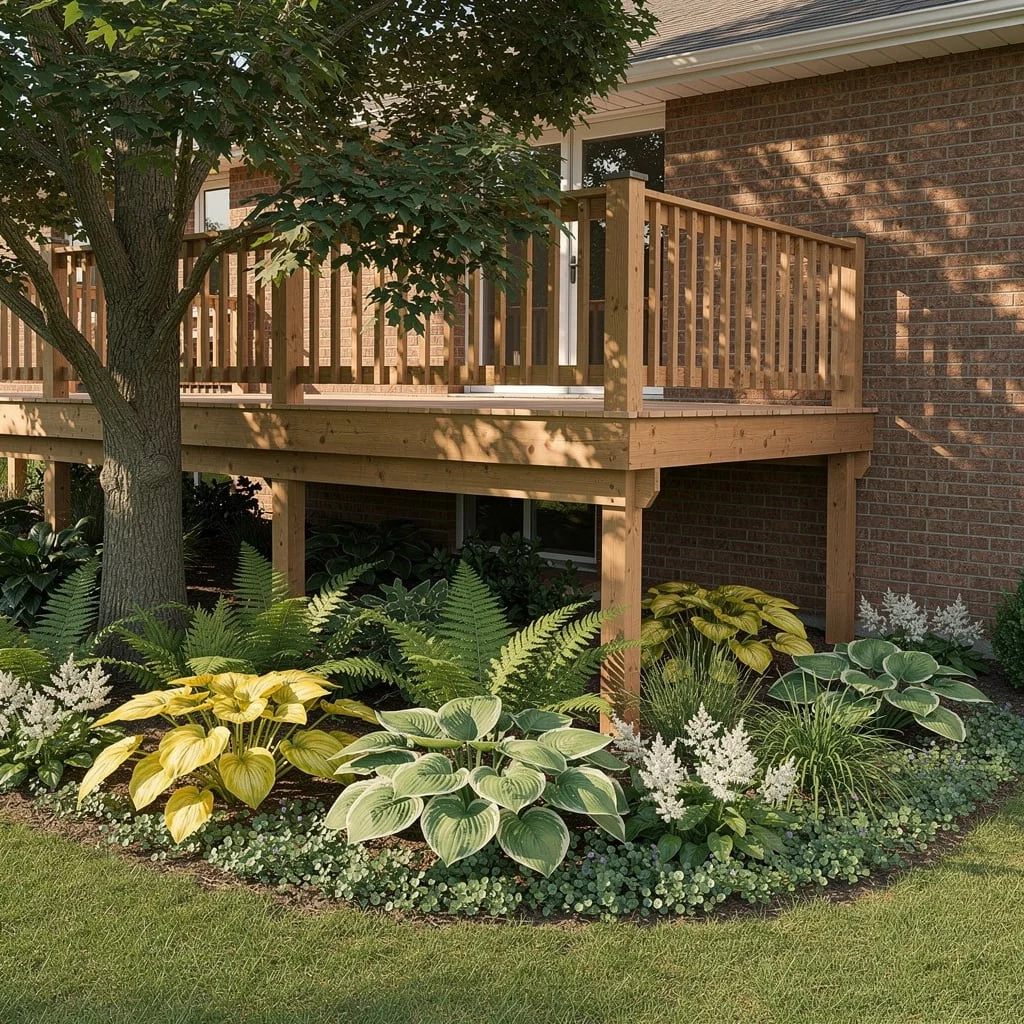
Accept that under a raised deck is a shaded, dry, structurally difficult space, and design for it on purpose rather than leaving it as dead ground.
Build a planting bed that wraps the entire deck perimeter below the deck edge. Excavate 300mm, improve the soil with compost, and establish drainage. Then plant for genuine shade: a mix of large-leaved hostas in gold, blue, and variegated varieties, autumn ferns for texture contrast, astilbe for seasonal flower, and white-flowered bleeding heart for vertical interest in spring.
This under-deck garden does two things simultaneously. It addresses the dead space that raised decks create. And it makes the deck feel as if it has risen out of the garden rather than been placed into it — a completely different reading of the relationship between structure and land.
Keep the lawn at the bed edge tightly edged with a steel landscape strip. The contrast between the loose, lush planting under the deck and the precise lawn line is what makes the whole thing look designed rather than accidental.
The Wisteria Pergola Over a Deck Platform That Connects Directly to the House Door
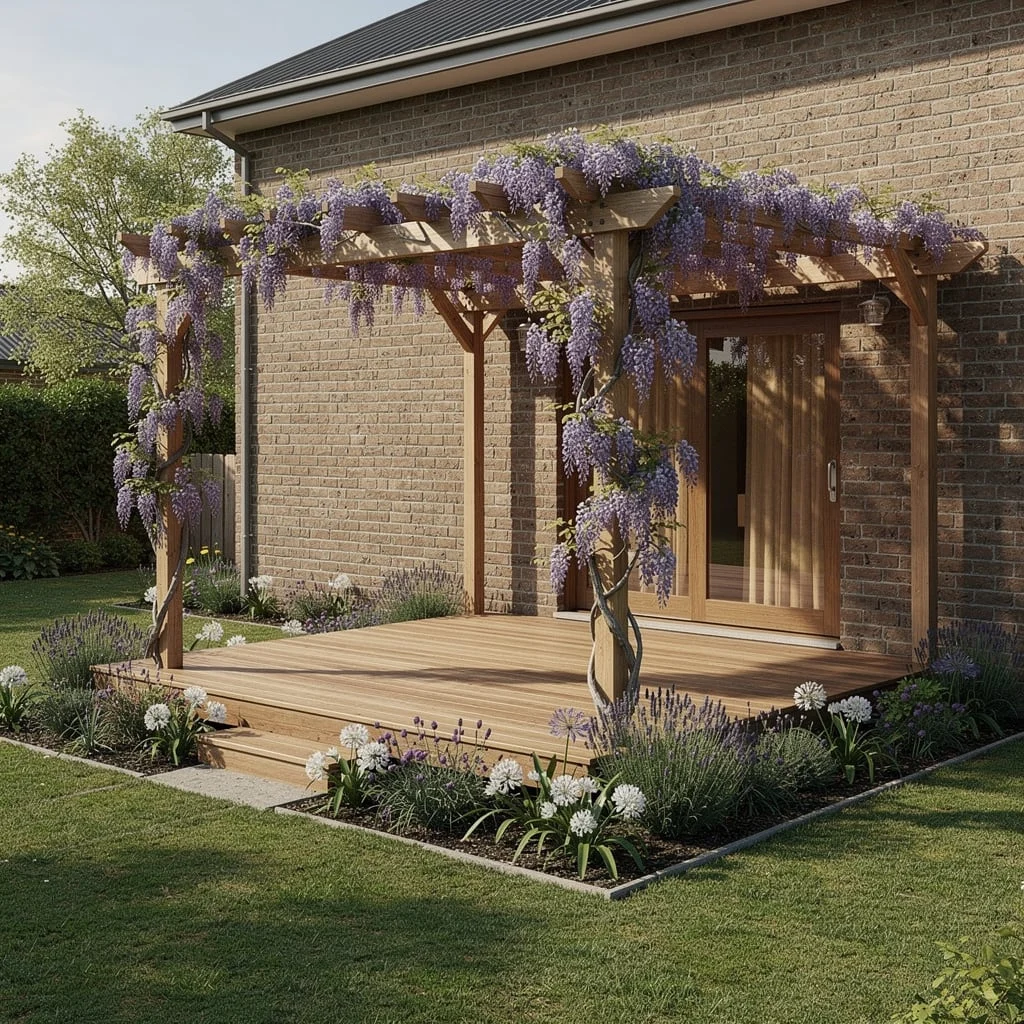
Build a simple four-post timber pergola directly adjacent to the door, with the pergola posts sitting in the deck surface. Use pressure-treated oak or cedar at a minimum 150x150mm post section — the heavier the post, the better it reads against a masonry wall. Run three or four cross beams across the top.
Source Wisteria sinensis or Wisteria floribunda — both work, though floribunda gives longer flower racemes. Plant one vine at the base of each post. In the first year, tie the main leader vertically up the post and allow side shoots to extend horizontally along the pergola beams. Tie these side shoots in loosely.
Over three to five years the wisteria will require annual pruning twice — once in summer to cut back long whippy growth to three to five leaves, and once in winter to cut back the same shoots to two or three buds. This is non-negotiable. Un-pruned wisteria becomes a structural problem.
Plant lavender and agapanthus at the deck base on both sides. The purple of wisteria and the purple of lavender in different values and scales at different heights creates a colour story that reads as considered without trying.
The Sandstone Retaining Wall with Lavender and Ornamental Grass Against a Deck
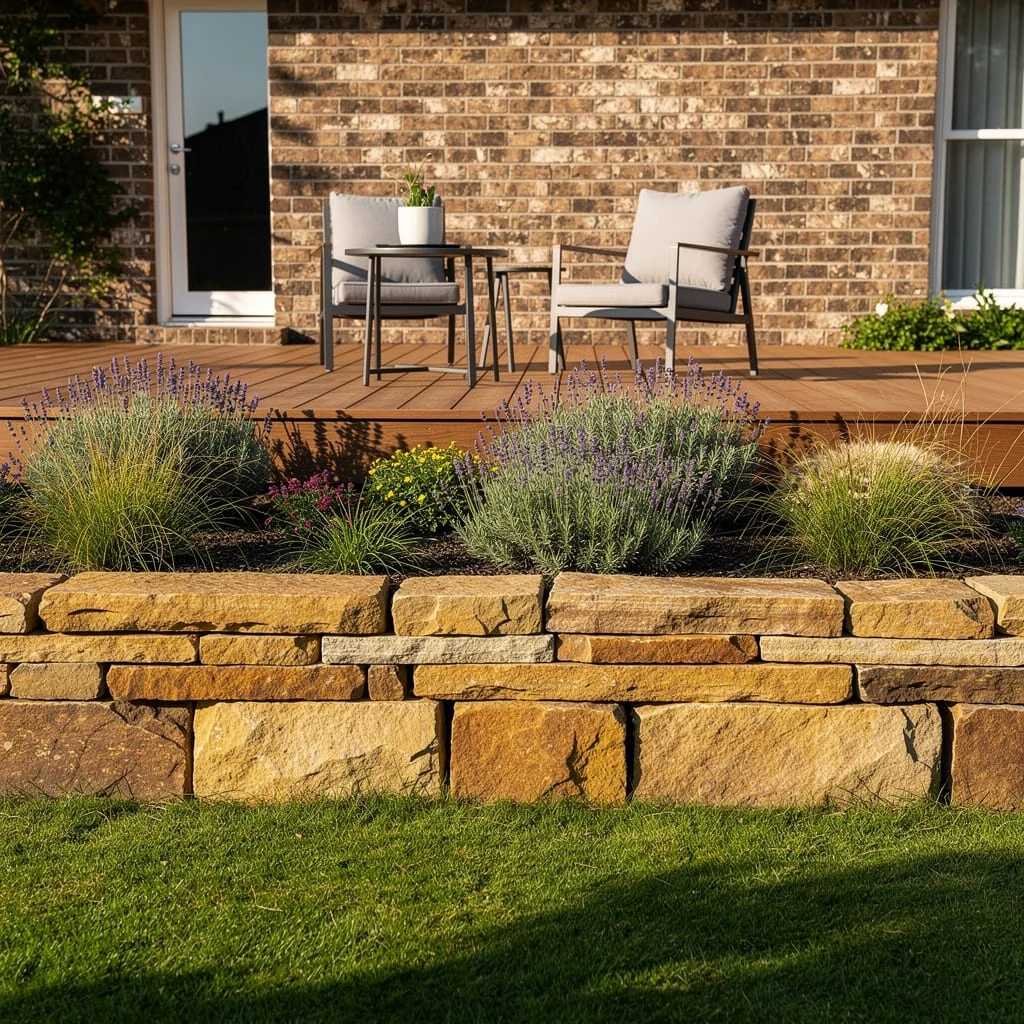
Source dressed or semi-dressed sandstone blocks in a warm golden-ochre tone. Build the retaining wall dry-stacked where possible — no mortar — to a height of 400 to 500mm. The wall creates a raised planter bed between the lawn level and the deck surface.
Fill the raised bed behind the wall with a free-draining mix: fifty percent topsoil, fifty percent horticultural grit. This is not optional. Lavender in heavy soil is a slow death.
Plant the bed with Russian sage, English lavender in mixed varieties (some tall, some compact), and feather grass — Stipa tenuissima — for movement. Plant densely. These species prefer competition at the roots. Leave 300mm between plants maximum.
Allow the plants to overflow slightly over the wall face. This softening of the hard edge is where the design becomes generous. A retaining wall with planting that billows over the top is a completely different object to one with a neat clipped line.
Sit two low-armed outdoor chairs on the deck above, turned to face the wall and the garden beyond. The simplicity of this composition — two chairs, a warm stone wall, a planted bed, a lawn — is enough.
The Minimalist White-Walled Deck with Terracotta Pots and Topiary Spheres
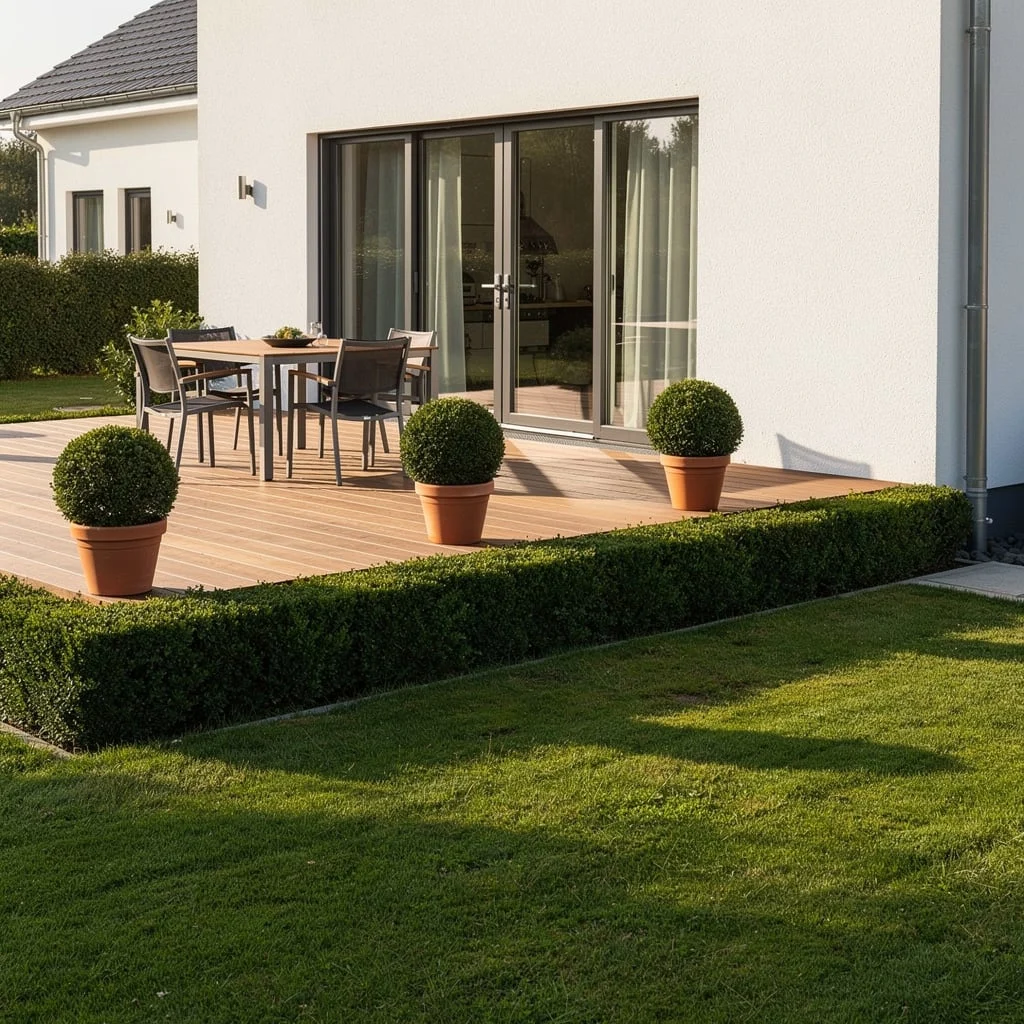
Begin with the white rendered or painted wall as the backdrop. It is the decision everything else responds to. Against white, everything reads with clarity — the warmth of timber, the green of plants, the burnt orange of terracotta.
Use a warm medium-brown composite or hardwood deck board. Not too dark. You want the timber to read as natural warmth against the white, not as a contrast element.
Source terracotta pots in graduated sizes — one very large (600mm diameter) for the specimen tree, several medium (400mm), and two or three small (250mm) for ground-level colour. Group them asymmetrically on both sides of the door rather than symmetrically. One large group on the left, a smaller gesture on the right.
Plant the large pots with a clipped olive tree and a clipped lemon tree — the two most reliable container trees for a white-walled Mediterranean aesthetic. Plant the medium pots with rosemary trained into a mound, box topiary spheres in the largest diameter you can find, and white-flowered marguerites for seasonal colour.
Pair terracotta pots with box spheres grown directly in the soil at deck level, slightly off the deck edge. This overlap of container and in-ground planting makes the arrangement feel organic.
Frame the whole thing with a low timber fence in the same tone as the deck to define the boundary without enclosing it.
The Deck with Black Planter Boxes, Topiary, and Ornamental Grass Along the Railing
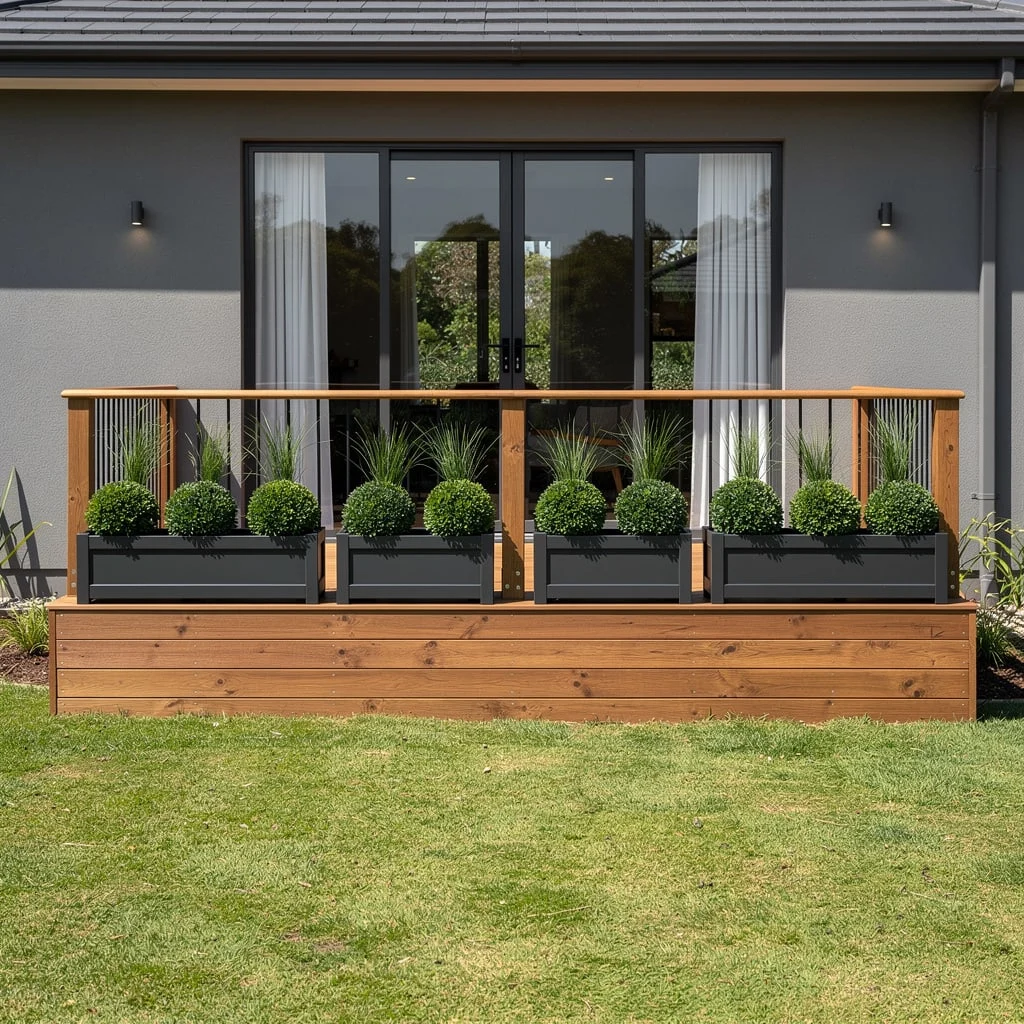
Source or build rectangular planter boxes in a powder-coated charcoal or matte black finish. Aluminium is the most practical — lightweight, non-rusting, holds its colour. Make them at least 400mm deep for root run and 600mm long so each box reads as substantial rather than fussy.
Line them along the deck edge below the railing, sitting on the deck surface rather than hanging from the railing. This position is the key decision — it creates a layered effect where the boxes are at mid-height between the deck surface and the railing top.
Plant each box with two elements: a rounded topiary sphere in box (buxus) as the primary form, and a single upright ornamental grass — Karl Foerster or a taller blue fescue — for height contrast and movement. Every box gets the same pair. Repetition is the point.
The uniform planting rhythm along the deck edge turns a standard railing into a structured garden feature. It also solves the problem of deck-to-garden transition by bringing the garden up onto the deck itself.
The Curved Deck Border with Ornamental Grass, Lavender, and a Steel Edging Strip
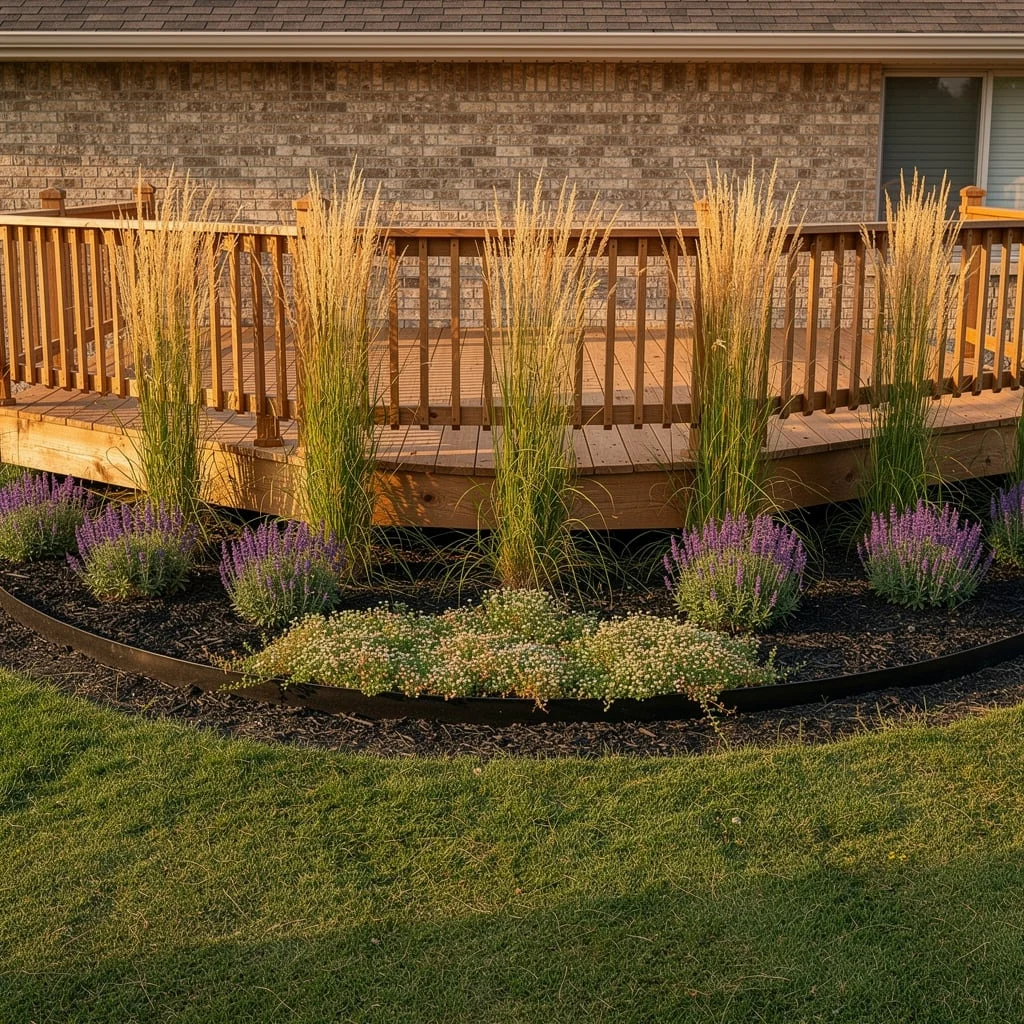
The bed that curves around a rounded deck edge must mirror the curve exactly. Any approximation looks like a mistake. Use a flexible steel landscape edging strip — available in 3mm and 5mm thickness — bent to match the deck curve perfectly and staked every 300mm.
Fill the bed inside the edging with black bark mulch before planting. The dark mulch makes every plant read with maximum contrast.
Plant in three layers by height. At the back, closest to the deck, plant three to five Karl Foerster feather reed grasses — these reach 1.5 to 1.8 metres and provide the vertical structure. In the middle band, plant Russian sage or Salvia nemorosa ‘Caradonna’ — both purple, both structural. At the front edge, plant a low-growing ground cover: creeping thyme or a dense mat-forming sedum.
Water at establishment and almost never after. These plants are chosen for their drought tolerance once established.
The curve of the steel edging strip and the arc of the deck form a single fluid line when the planting is in place. Everything inside it becomes a composition.
The Mediterranean Deck with Terracotta, an Olive Tree, and a Lemon Tree as Anchors
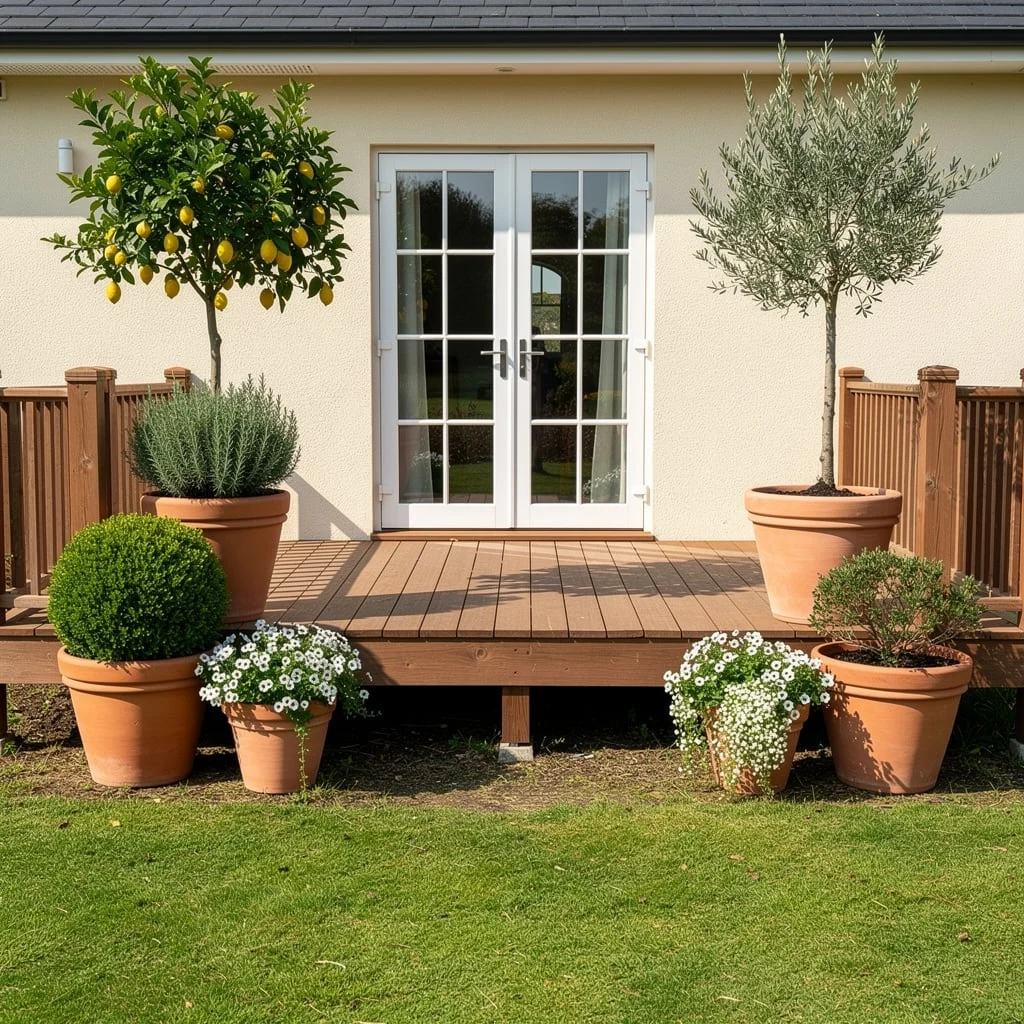
The lemon tree in a large terracotta pot is one of the most successful small garden moves available to anyone in a temperate climate. It provides year-round structure, seasonal fragrance, edible fruit, and a quality of light — the yellow against the grey-green foliage — that nothing else replicates.
Source the largest terracotta pot available within your budget, a minimum 600mm diameter and 500mm depth. Terracotta breathes, which citrus roots prefer to plastic. Fill with a mixture of quality loam-based compost and perlite in a 70/30 ratio for drainage.
Buy the largest lemon tree your budget allows — a standard form (clear stem with a ball head) is the most elegant and the most spatial. It reads as a tree, not a plant in a pot.
Pair it across the deck entrance with an olive tree in the same pot style and size. The olive brings silver to the pairing — a completely different texture and colour value to the lemon’s glossy dark green.
At deck level, add a lavender mound in a medium terracotta pot for fragrance and bee life. Add a rosemary bush trained into a cone or ball. Both are drought-tolerant and low-maintenance once established.
The deck surface should be warm and simple — nothing competing with the terracotta palette.
The Native Garden Deck with Aloe, Ornamental Grasses, and Boulder Accents
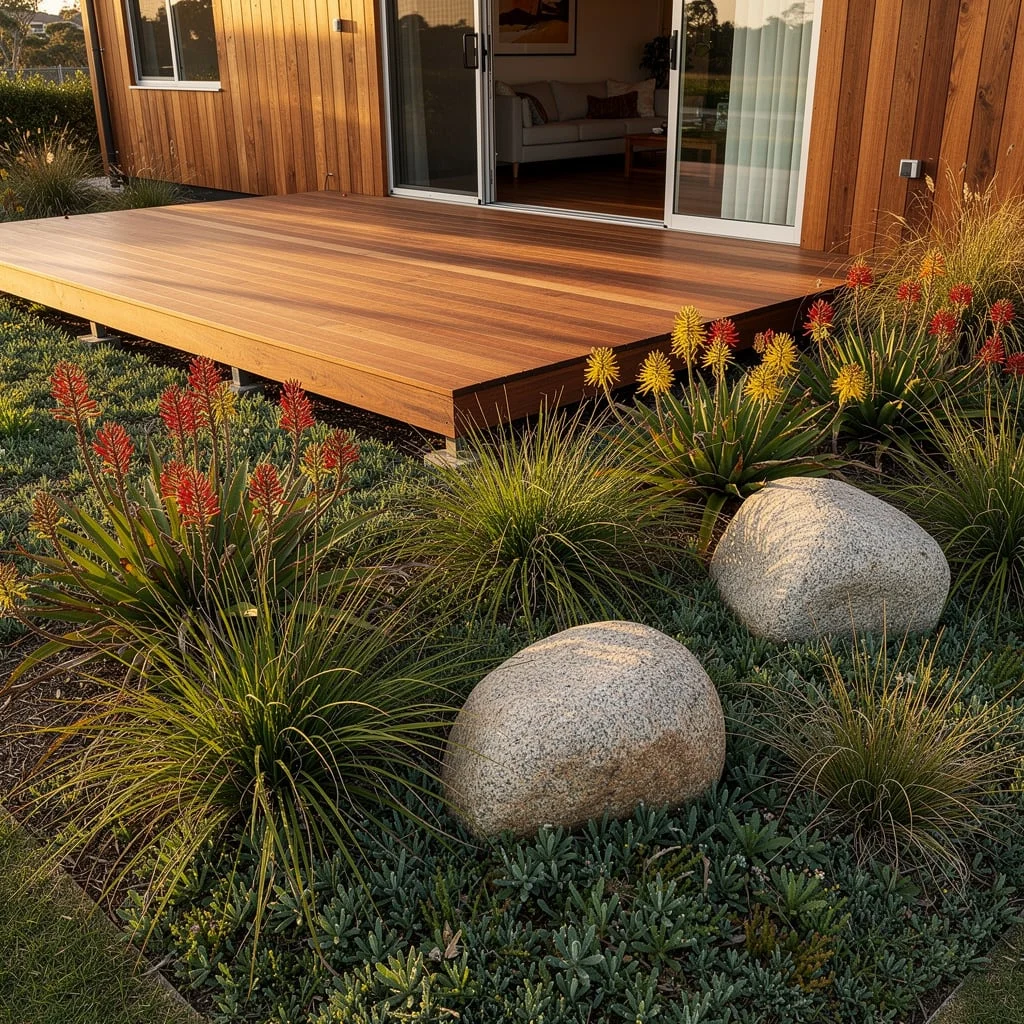
Source two or three large rounded granite or basalt boulders — not small decorative rocks, but genuinely large specimens at 400 to 600mm diameter — and position them first, before any planting. The boulders establish the scale and the aesthetic. Everything else is built around them.
Plant aloes for colour — the red and yellow-flowered varieties give late-winter and spring interest when almost nothing else does in a native or dry garden. Plant them in irregular clusters of three to five, not in rows.
Add ornamental grasses between the aloe clusters for textural contrast: tussock grass, kangaroo grass, or blue fescue depending on your climate. These grasses move in wind. Against the stillness of the boulders and the structural aloes, the movement reads as an intentional contrast.
Use a richly toned hardwood or composite deck — a deep reddish-brown — to work with the warm ochre tones of the aloe flowers and the grey of the granite boulders. The whole composition leans warm.
Keep ground cover minimal and low-maintenance: ground-hugging succulents, ice plants, or a fine-textured native groundcover. Dark soil or crushed granite as mulch rather than bark, which can look too domestic against a native planting scheme.
The Espalier Apple Tree Fence Along the Deck That Earns Its Place and Feeds You
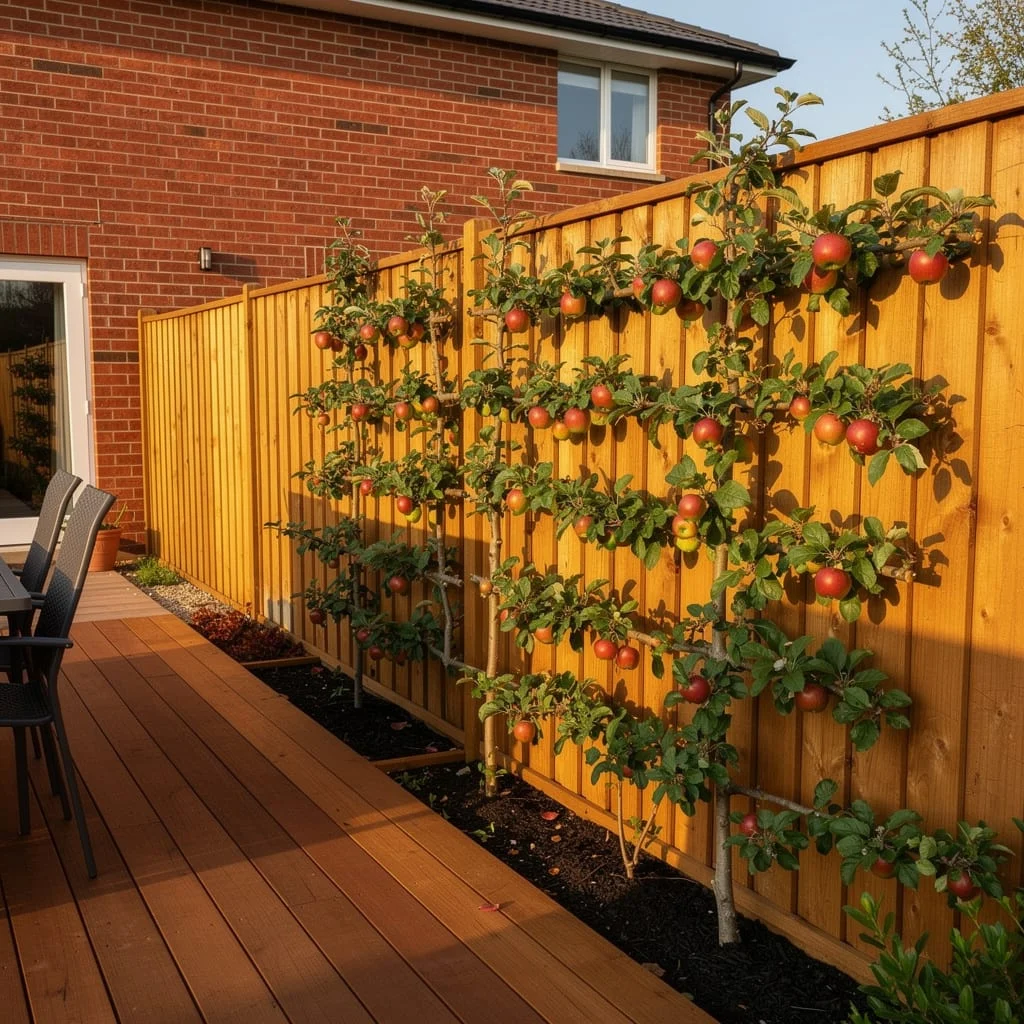
Source two-year-old espalier-trained apple trees from a specialist fruit tree nursery. They will already have their first tier or two of horizontal branches established. This is not a shortcut — starting with un-trained whips takes four to five additional years to achieve the same result.
Select varieties that are compatible pollinators — an early-season apple paired with a mid-season variety, or a self-fertile variety like ‘James Grieve’ or ‘Cox’s Orange Pippin’ if space is limited.
Fix horizontal wires at 400mm intervals up your fence face, using vine eyes screwed into the timber. The wires should run the full width of the fence. Tie the existing trained branches to the wires using soft tree ties or strips of fleece — never wire, which will damage the branch.
In each growing season, tie new growth horizontally as soon as it is long and flexible enough. In summer, cut back lateral shoots growing outward or upward to three leaves. In winter, cut those same laterals back to two to three buds. This is the complete pruning programme. It sounds involved; it takes twenty minutes per tree once you know what you’re doing.
The bed beneath the espaliers needs only good soil and a bark mulch layer. Plant nothing that will compete with the roots — the trees are the feature.
The Corten Steel Raised Bed on a Deck Platform Growing Food
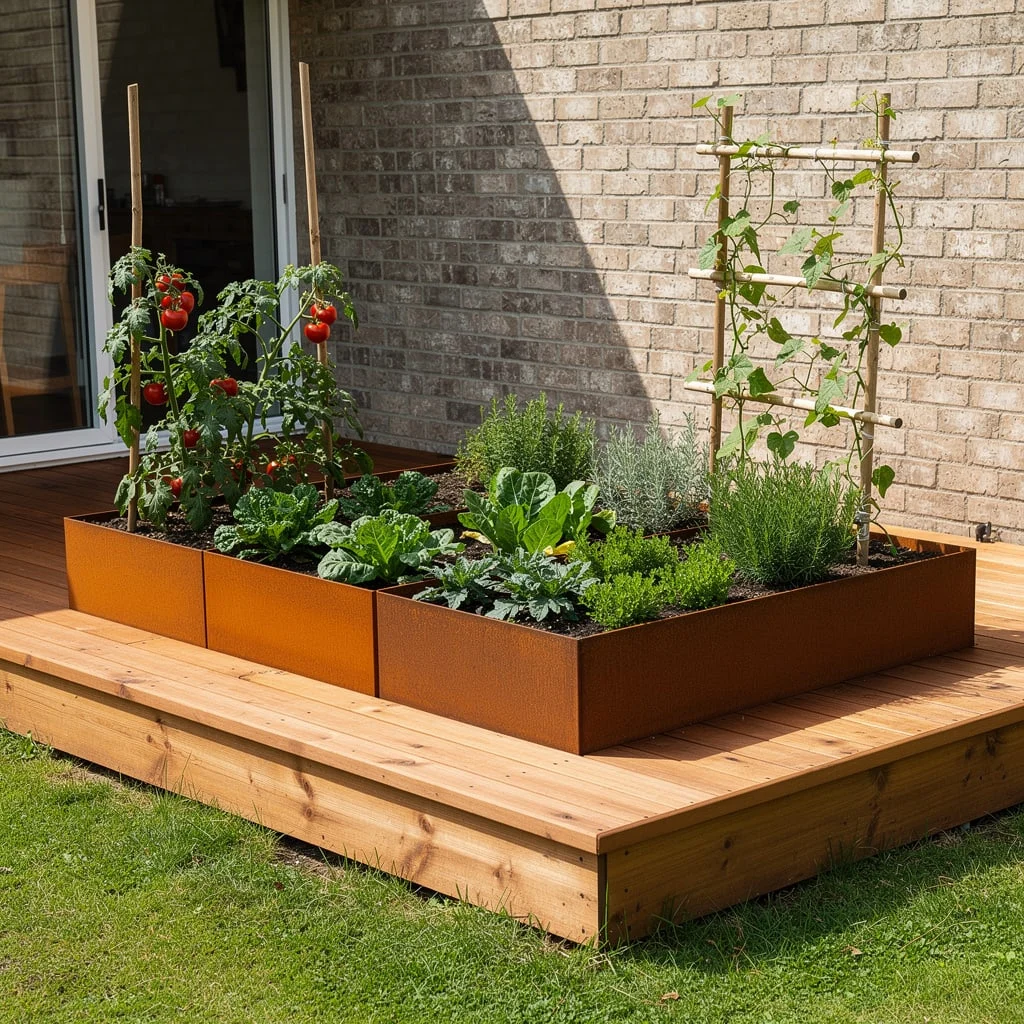
Order Corten steel raised bed panels in a size that will occupy no more than forty percent of your deck surface — you still need to walk around it comfortably. The standard panel height is 300mm or 450mm. Choose 450mm: it makes weeding and harvesting much more comfortable, and it gives the bed more visual weight.
Allow the Corten to weather naturally. When new, the panels are a flat orange-brown. Over six to twelve months they develop a layered rust patina — deeper in the recesses, more orange on the flat faces — that looks extraordinary against pale timber decking.
Fill the bed with a mixture of quality topsoil, home compost, and a slow-release vegetable fertiliser. A deep fill is the single biggest factor in vegetable garden success.
Plant in zones by light requirement: tomatoes and climbing cucumbers in the sunniest corner with bamboo cane and trellis support. Leafy brassicas — kale, cavolo nero, spinach — in the next zone. Herbs — thyme, rosemary, sage — along the front edge where they get maximum sun and their fragrance is at nose height from the deck.
The bamboo and trellis structure above the bed adds vertical interest and seasonal change that a conventional planting arrangement on flat ground cannot provide.
What Every One of These Spaces Has in Common
They made a decision about the relationship between the deck and the ground around it. Not about which flowers to plant. About what the space is.
Some of them chose enclosure. Some chose openness framed by a single strong element. Some used structure — walls, pergolas, fences — as the primary design move and let the plants support it. Some did the reverse.
None of them deferred the decision. None of them waited to see how it looked first and then tried to fix it with plants.
The deck already made a commitment. It said: this is where we live outside. The landscaping around it either honours that commitment or undermines it.
Your garden is a real place. The space around your deck is its most important room. Treat it accordingly.