
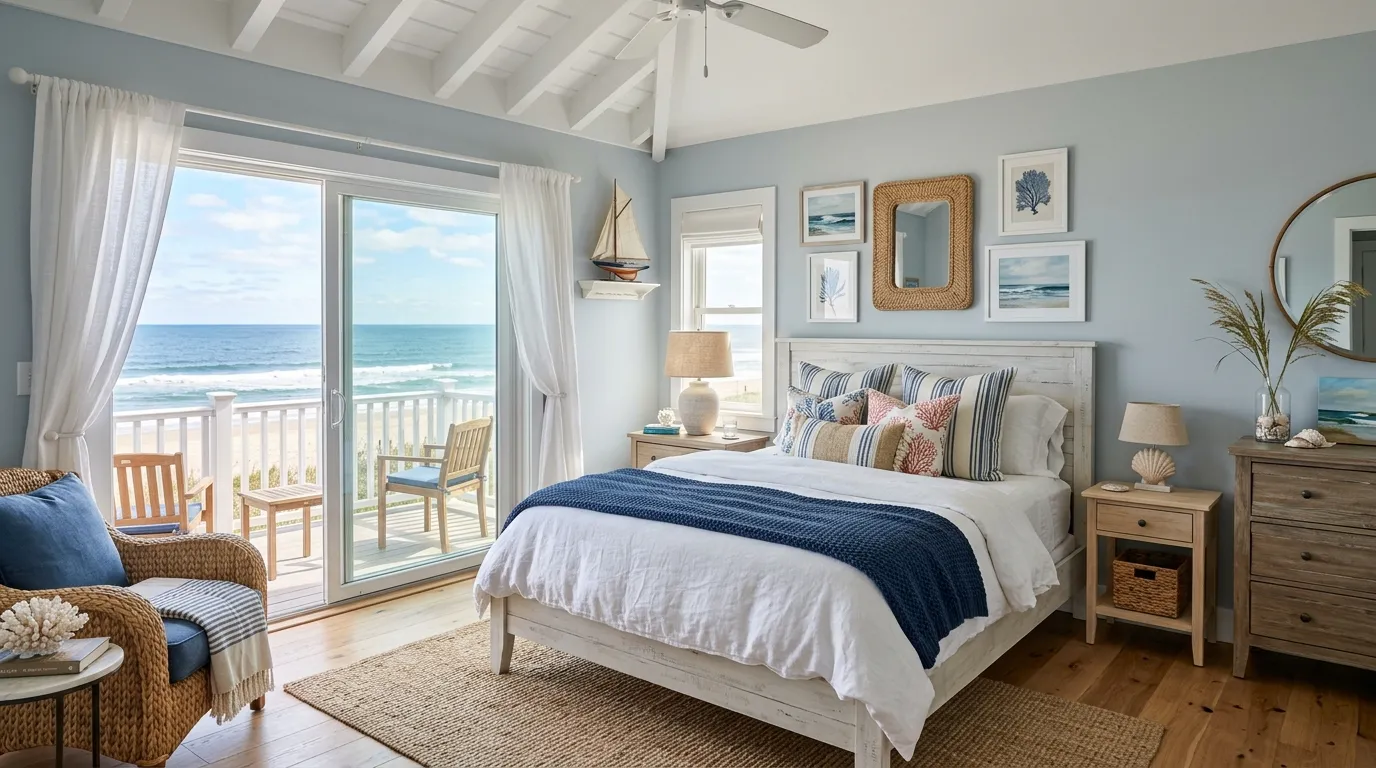
There’s a version of coastal decorating that involves a rope-wrapped anchor, three throw pillows embroidered with the word “beachy,” and a starfish glued to a picture frame. That version is not what’s happening in any of the twenty rooms in this post.
Real coastal bedrooms don’t need a single literal seashell to feel like they belong near water. What they need is light, natural material, and restraint — the same three things, over and over, executed with more discipline than the average person gives them credit for.
The rooms that get this right could be anywhere within a mile of an ocean and still look correct fifty miles from the nearest coastline. The ones that get it wrong look correct nowhere at all, including the beach house they were decorated for.
Here’s what actually belongs in a coastal bedroom, and what to skip entirely.
Getting the Vocabulary Right
Before touching a single throw pillow, it helps to understand what “coastal” is actually built from, because it’s not what the souvenir shop version suggests.
Why Most Coastal Bedrooms Look Like a Gift Shop
The instinct is to decorate coastal with coastal objects — shells, anchors, sailboats, the word “salty” in a beach-glass font. Every one of those objects, used more than once in a room, tips the whole space into theme park territory.
The rooms that actually work almost never use a literal ocean reference. When they do, it’s exactly one: a piece of coral, a small shell arrangement, a single piece of driftwood. One reference reads as a nod. Three reads as a costume.
What replaces the literal imagery is texture and material that simply happens to share a palette with sand, water, and weathered wood. That’s the whole trick, and it’s less about buying beach-themed things and more about buying natural-toned, texturally honest things.
The Materials Doing the Actual Work
Jute, rattan, linen, and raw or bleached wood show up in nearly every coastal room that photographs well. That’s not a coincidence — those four materials are doing more to establish the mood than any color choice.
Jute rugs in particular carry a huge amount of the visual load. Their texture reads as organic and worn-in even brand new, and their neutral tone lets everything else in the room stay quiet without the floor going flat and lifeless.
Linen matters just as much, specifically because of how it wrinkles. A crisp, ironed duvet reads as hotel-formal. A linen duvet left rumpled, half-made, reads as lived-in and relaxed — which is the entire emotional register coastal design is going for.
Color Is Optional, Texture Is Not
A coastal bedroom can be done in pure white with zero blue anywhere in the room and still read as coastal, as long as the texture layering is right. A room painted ocean blue with flat, shiny furniture and synthetic fabrics will not read as coastal no matter how accurate the paint color is.
This is the part people get backwards most often. Color is the easy, obvious signal. Texture is the harder, more important one.
Coastal Bedroom Must-Haves
Floating Shelf Shell Display
Mount two reclaimed wood floating shelves above the headboard rather than hanging art there. The shelves carry more texture and dimension than a flat frame ever could, and they give you a spot to actually display objects instead of just hanging them.
Style each shelf with two or three pieces maximum: a cluster of real or ceramic shells, one small potted or dried plant, a woven basket. Leave visible negative space between objects — a crowded shelf reads as clutter, a sparse one reads as curated.
Finish with a jute pouf at the foot of the bed as extra seating and texture at floor level, and let one soft blue throw do the only real color work in an otherwise neutral room.
Navy Piped Bedding Lanterns
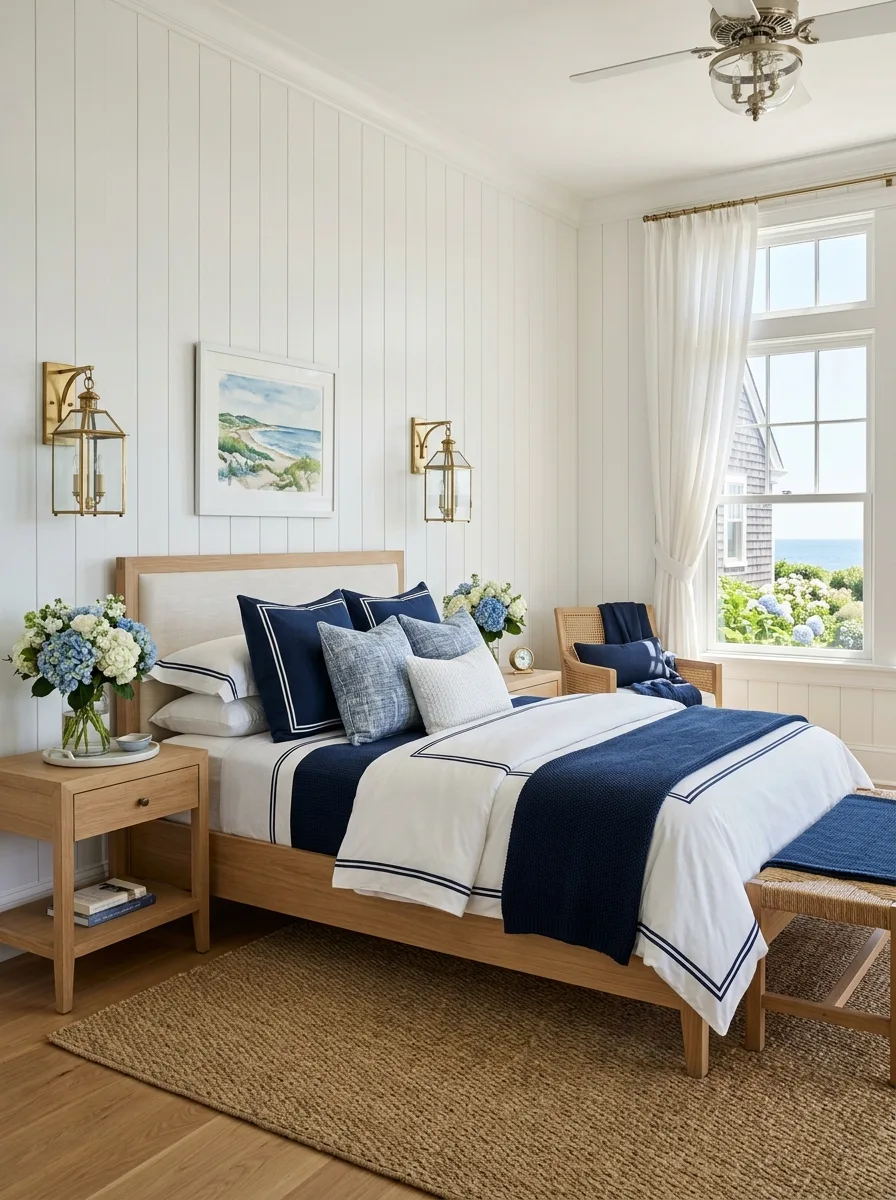
Dress the bed in crisp white bedding with navy piping along every edge — the piping detail alone does most of the nautical signaling this room needs, without a single anchor or rope in sight.
Mount brass lantern sconces on either side of a single piece of watercolor art above the bed, rather than table lamps. Wall-mounted lighting frees up the nightstands and adds an architectural, slightly formal note.
Use vertical shiplap paneling on the walls instead of horizontal, which reads as more tailored and less rustic-cabin. Finish with fresh hydrangeas on the nightstand and a jute rug underfoot to keep the crisp nautical bedding from feeling stiff.
Ocean View Shell Mobile
If the room has a real ocean view, let the window go essentially untreated — a sheer panel pushed fully to the side is enough — so nothing competes with what’s outside the glass.
Hang a simple driftwood or shell mobile beside the window rather than on the main wall. Small and slightly imperfect works better here than a polished, symmetrical piece.
Pile the bed with all-white, heavily textured linen bedding, rumpled rather than made, and add one jute pouf at the foot for a grounding note of warmth against all that white.
Hanging Rattan Reading Swing
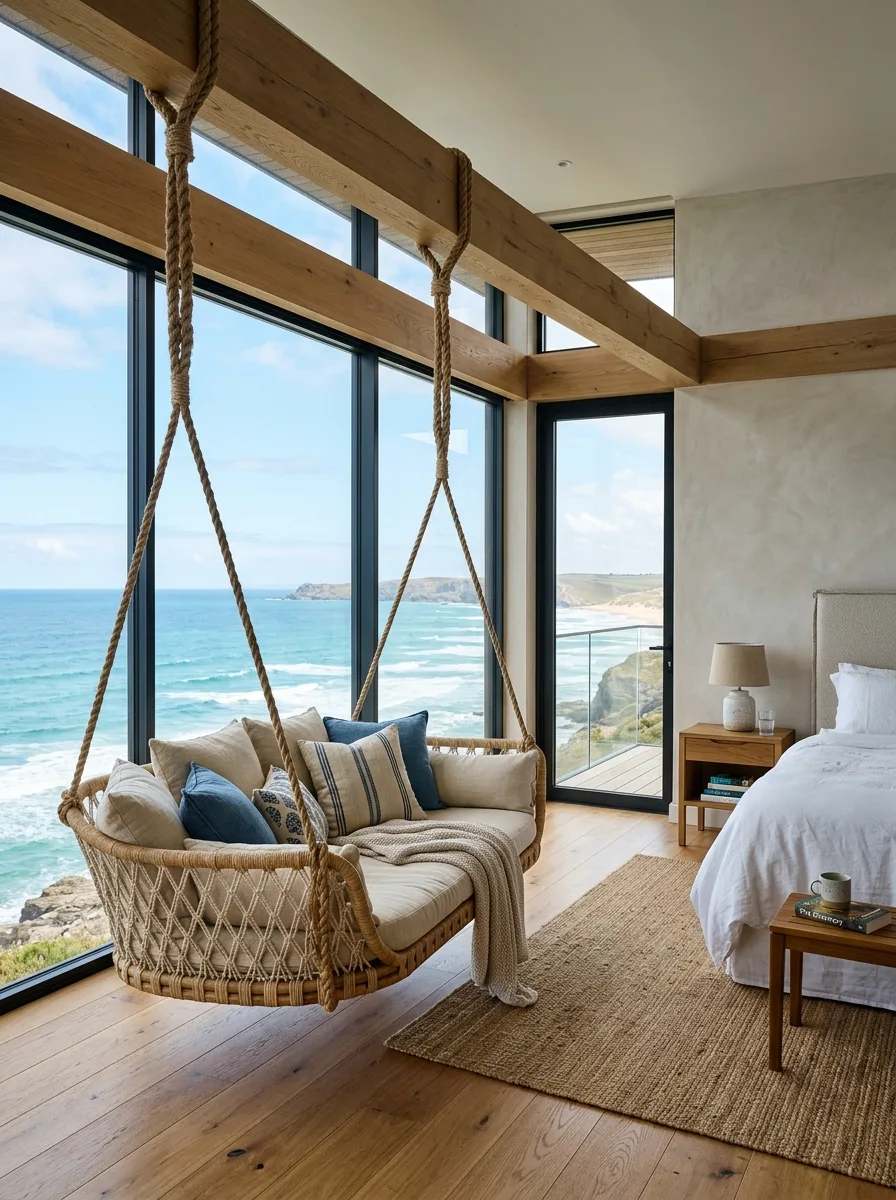
Suspend a woven rattan basket swing from exposed ceiling beams near a wall of glass, sized generously enough to seat two comfortably. This is the single most dramatic move on this entire list, and it earns its space by turning unused floor area near a window into the best seat in the house.
Pile the swing with mismatched blue and cream pillows and a chunky knit throw, treating it exactly like a sofa rather than an occasional accent.
Keep the rest of the room minimal, a simple wood bed and nightstand, so the swing and the view it faces stay the undisputed focal point. Skip curtains entirely if the view is strong enough to carry the room on its own.
Floral Wallpaper Cane Bed
Choose a soft, small-scale floral wallpaper in a single muted blue tone and apply it to one accent wall only, leaving the surrounding walls a solid matching blue. This combination — pattern plus solid in the same color family — reads as intentional rather than busy.
Pair the wallpaper with a cane or rattan headboard rather than upholstery. The open woven texture keeps the wall from feeling heavy even with a floral print behind it.
Add a brass chandelier with fabric shades as the room’s one metallic note, and keep bedding entirely solid and white so the wallpaper stays the star. A single ceramic lamp in a soft, sculptural shape finishes the nightstand without adding competing pattern.
Rattan Canopy Sheer Drapes
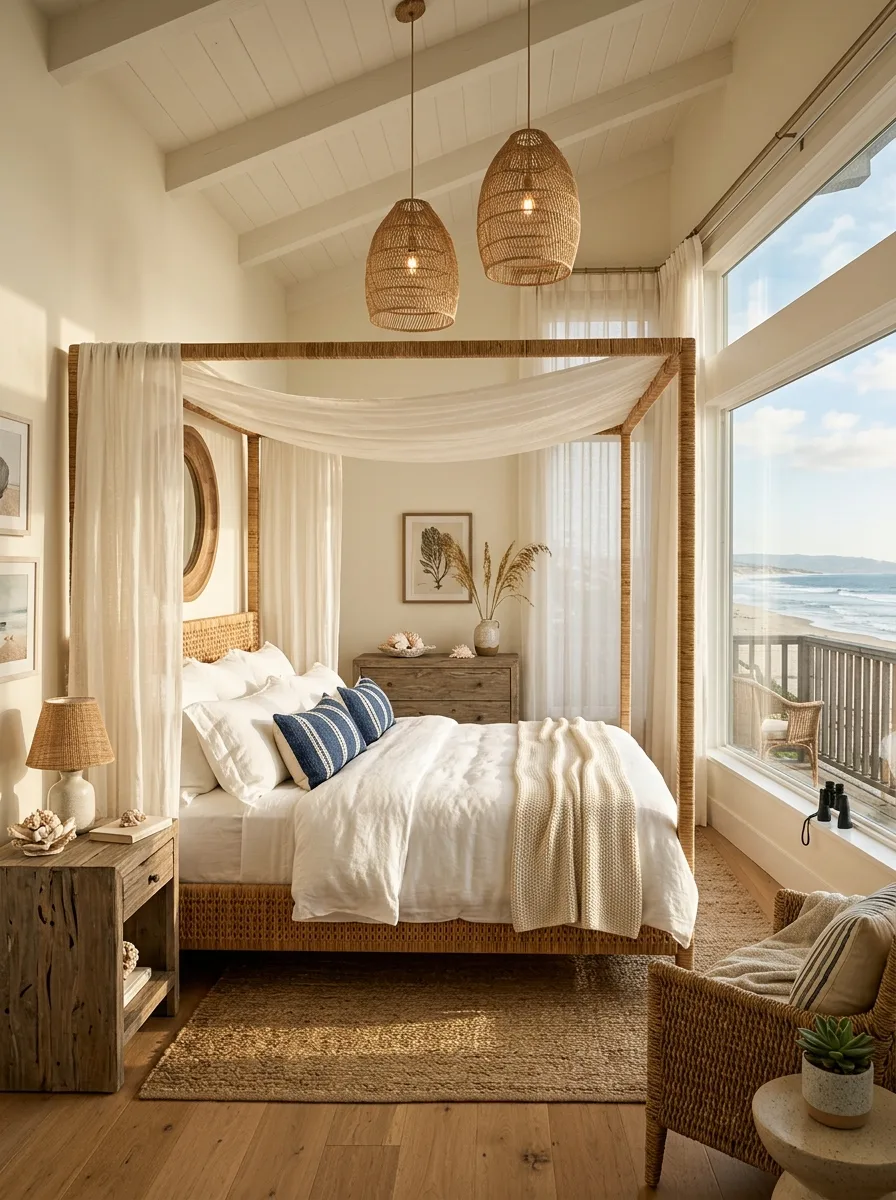
Choose a rattan four-poster frame and drape sheer white linen panels loosely across the top rather than hanging them formally down the sides. The canopy should feel optional and breezy, not like a formal four-poster with matching curtains.
Hang two woven pendant lights above the bed rather than a single central fixture, positioned asymmetrically so they read as a considered pair rather than a matched set.
Layer white and cream bedding with one small striped pillow for contrast, and add dried pampas grass in a simple vase on the nightstand. Keep everything else in the room — nightstands, dresser — in raw or lightly weathered wood so nothing competes with the rattan frame.
Shell Print Gallery Grid
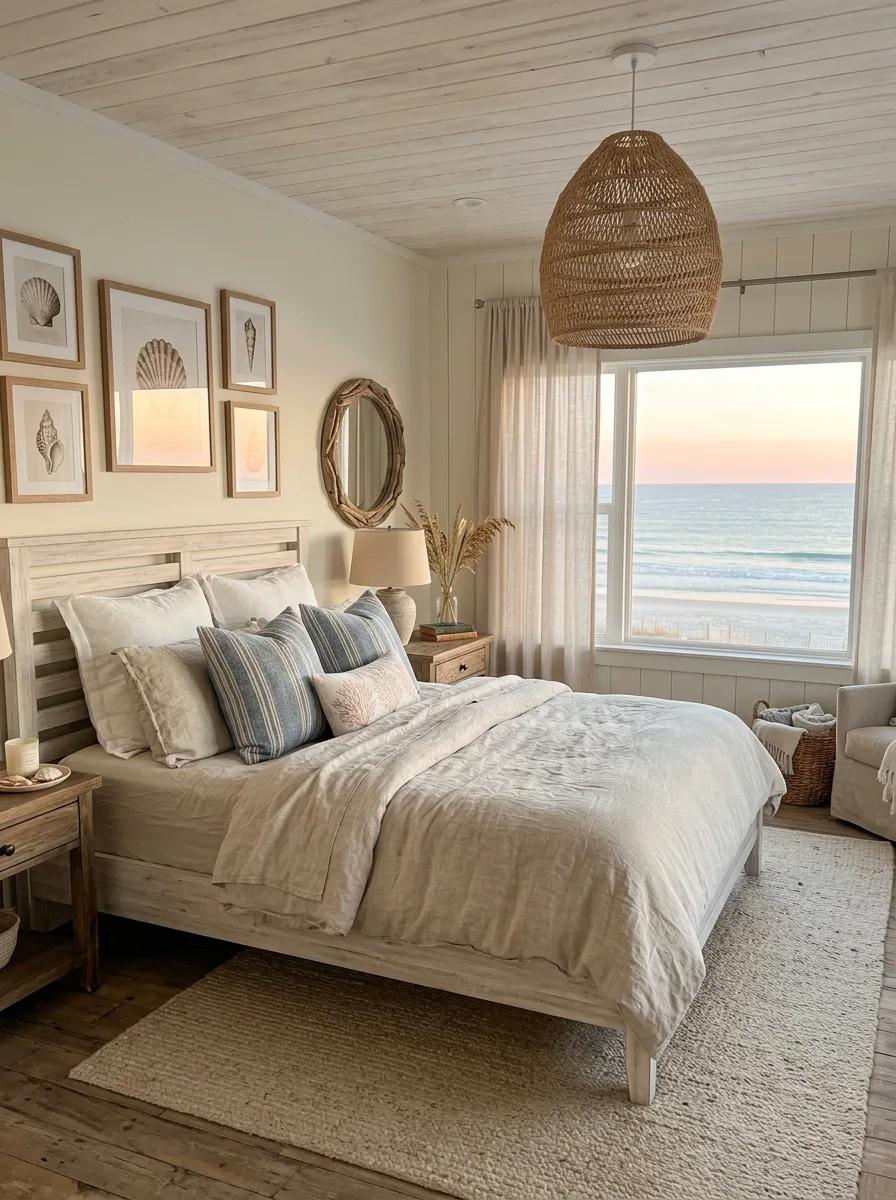
Arrange five or six small botanical or shell illustration prints in a tight grid above the headboard, all in matching light wood frames. The grid’s uniformity is what keeps a coastal gallery wall from tipping into gift-shop territory — mismatched frames read as busy here in a way they wouldn’t in other styles.
Hang a round driftwood-framed mirror just beside the grid, angled to catch light from the window across the room.
Choose a whitewashed wood headboard and layer in blue and white striped pillows against a mostly neutral base. One oversized woven pendant over the nightstand adds height without adding visual noise.
Macrame Headboard Rattan Bed
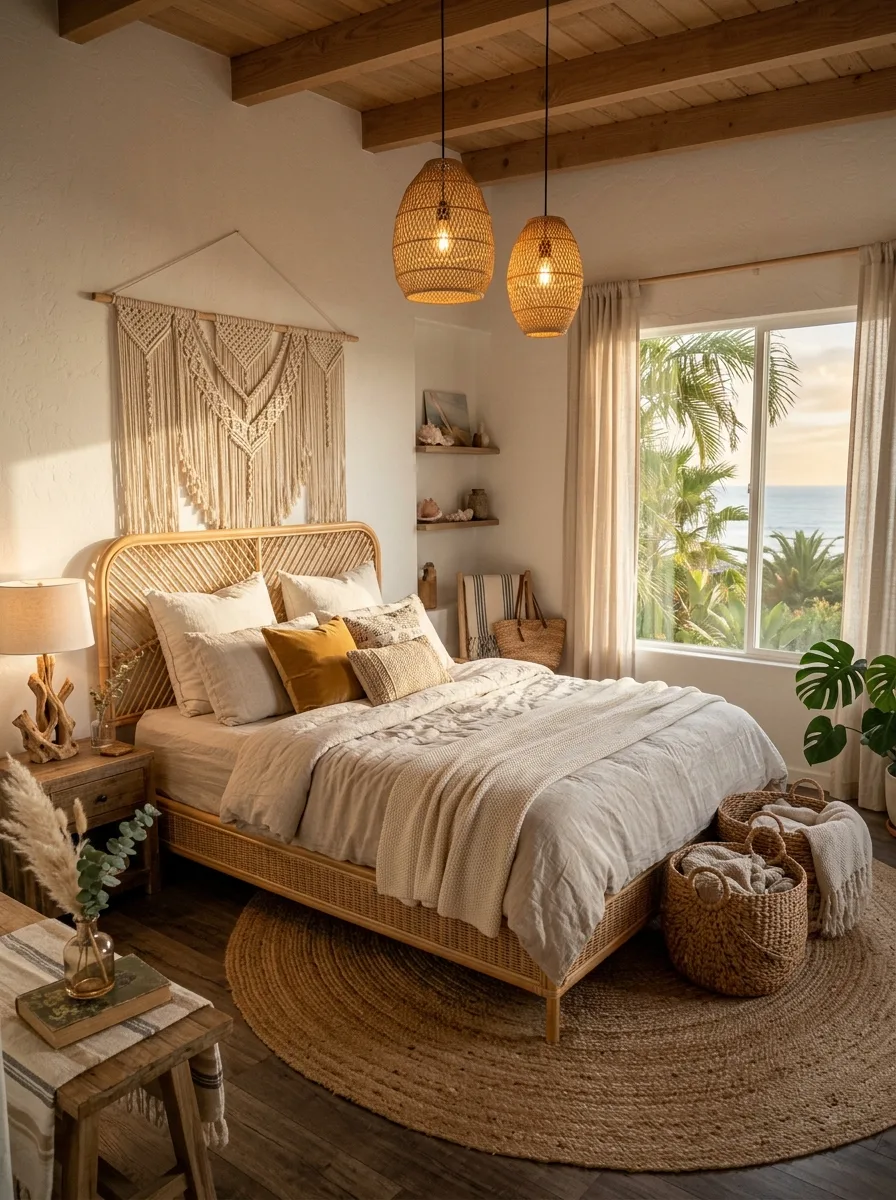
Hang a large macrame wall piece directly above a rattan headboard rather than art. The two woven textures, rattan and macrame rope, reinforce each other instead of competing.
Choose two woven pendant lights of slightly different shapes and hang them at staggered heights beside the bed. Perfect symmetry here would undercut the handmade feeling the macrame is establishing.
Lay a round jute rug rather than a rectangular one, and tuck woven baskets at the foot of the bed for blanket storage. A driftwood-framed lamp base on the nightstand ties the organic materials together without adding a single ocean cliché.
Vertical Wood Slat Wall
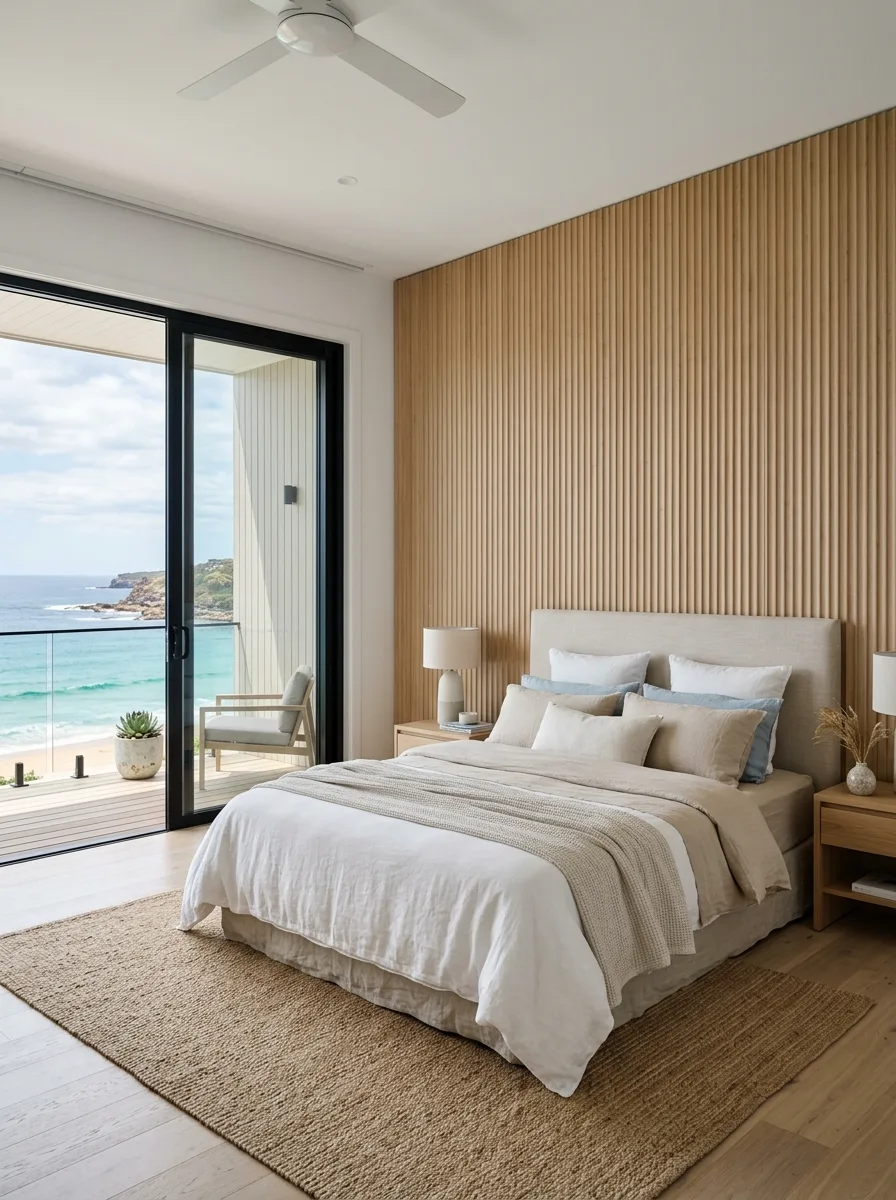
Install a vertical wood slat accent wall behind the bed, running the full width and height of the headboard zone. The vertical lines add architectural interest without adding any pattern or color.
Choose a simple upholstered headboard in a neutral linen to sit against the slats, letting the wall texture do the visual work instead of a busy fabric.
Keep the rest of the room’s palette tight, white bedding, a jute rug, one or two dusty blue pillows, and let sliding glass doors to an ocean-facing balcony stay uncovered whenever privacy allows.
Oversized Woven Pendant Anchor
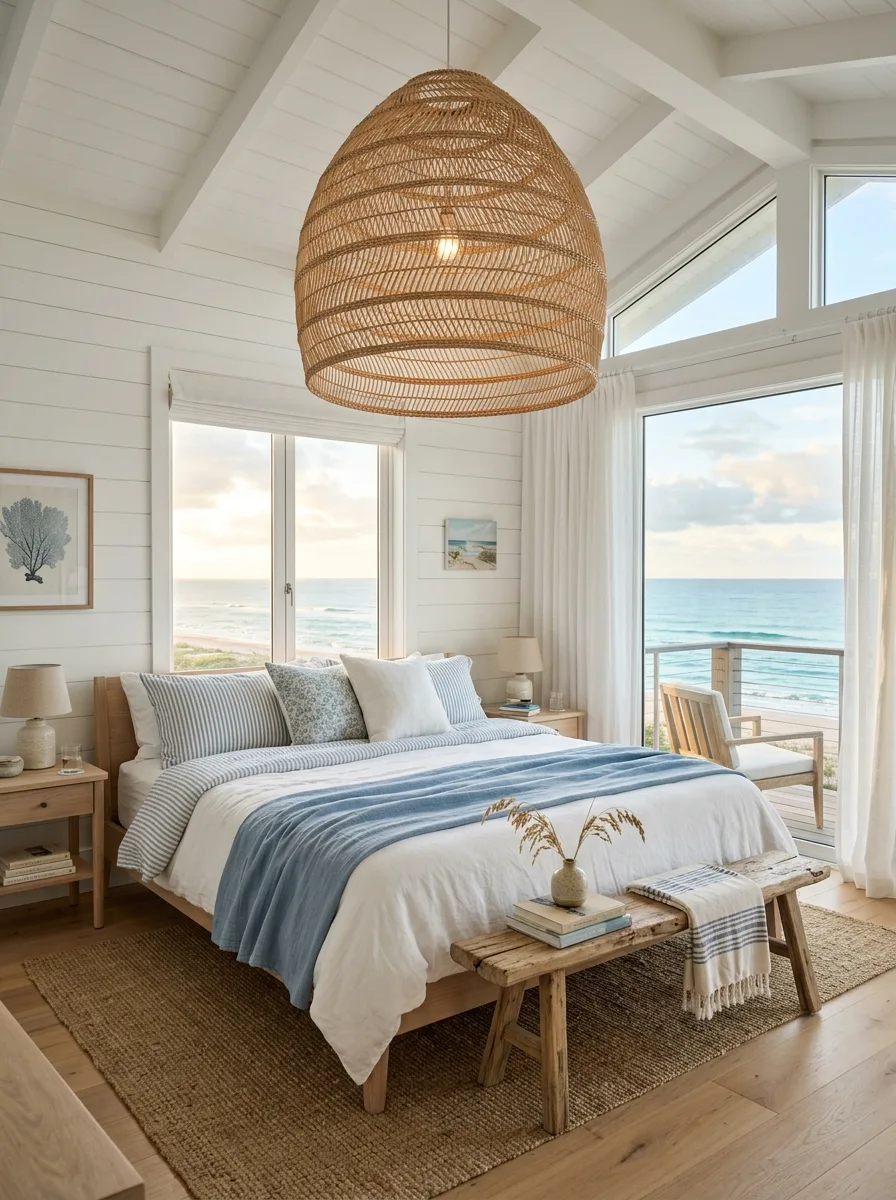
Hang one dramatically oversized woven pendant light as the room’s single largest object after the bed itself. Scale is the entire point here — a pendant this size, hung low, instantly reads as a design decision rather than a fixture that came with the house.
Keep the ceiling and walls in matching white shiplap so the pendant’s warm woven texture has maximum contrast to stand out against.
Add a simple wood bench at the foot of the bed for layering extra throws, and use blue and white striped pillows sparingly, two or three at most, so they read as accent rather than theme.
Built In Ocean Window Seat
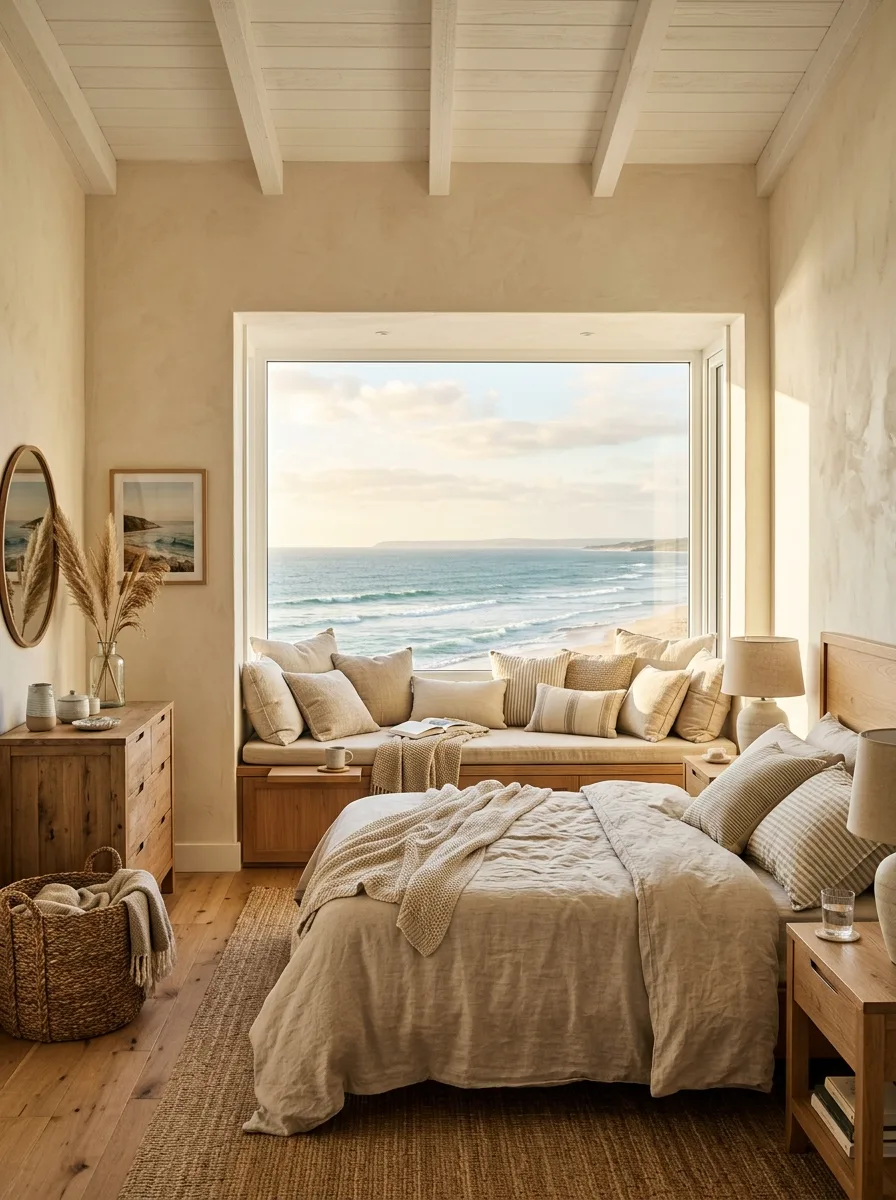
Build or install a window seat bench directly beneath the largest window in the room, sized to run the full width of the glass. This single addition turns a passive view into a room you’ll actually use during the day, not just at bedtime.
Pile the bench with mismatched neutral and striped pillows in slightly different scales, treating it like a small sofa rather than a shelf.
Keep the surrounding walls in warm plaster rather than flat paint for added texture, and choose a jute rug in a matching warm tone to unify the window seat with the bed area a few feet away.
Layered Sheer Curtain Olive Tree
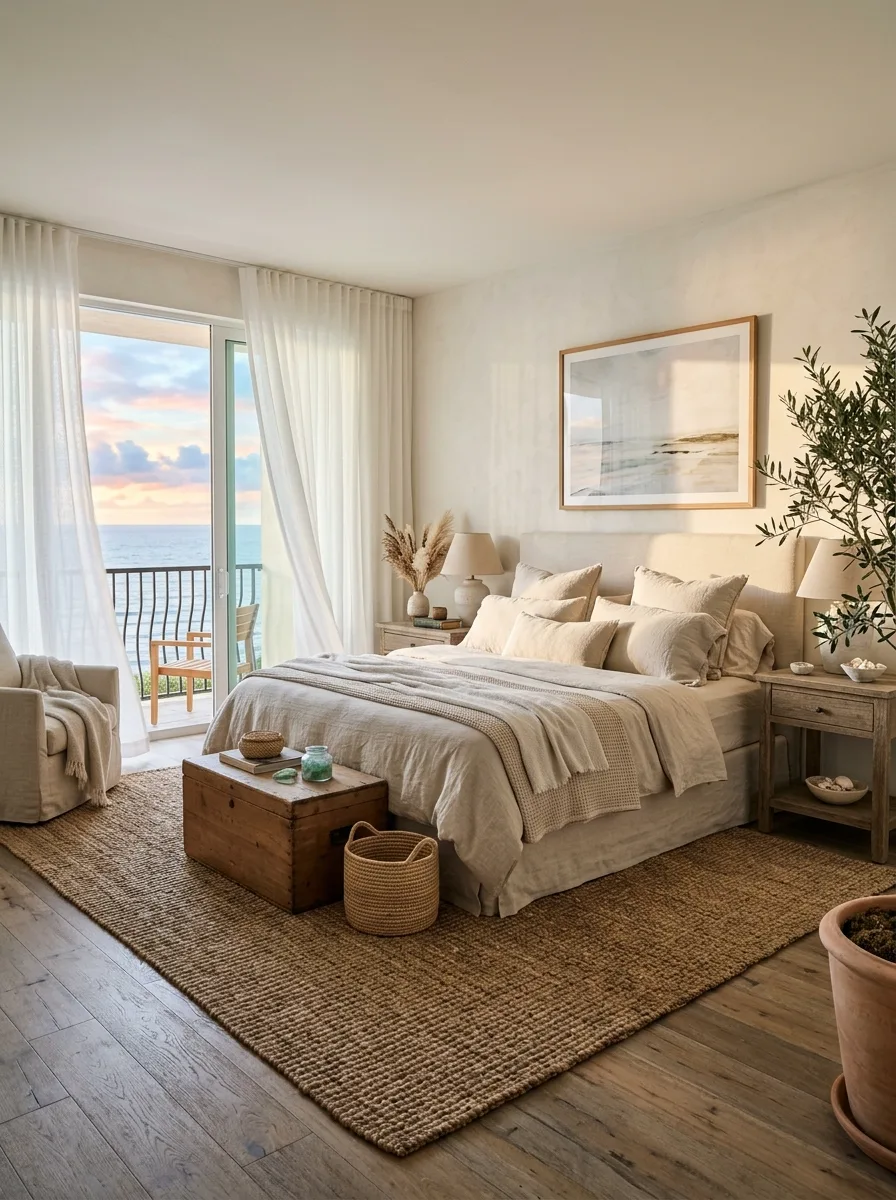
Hang sheer linen curtains in double layers, one sheer panel plus one slightly heavier linen panel on the same rod, so the window can flex between fully open and softly diffused depending on the time of day.
Place a real olive tree in a terracotta pot in the corner nearest the window. A live tree does more to soften a neutral room than almost any textile choice, and the silvery leaf tone works with nearly every coastal palette.
Keep bedding entirely tonal, cream on cream, and let a single framed coastal landscape above the bed provide the only real image in the room.
Stacked Wicker Storage Baskets
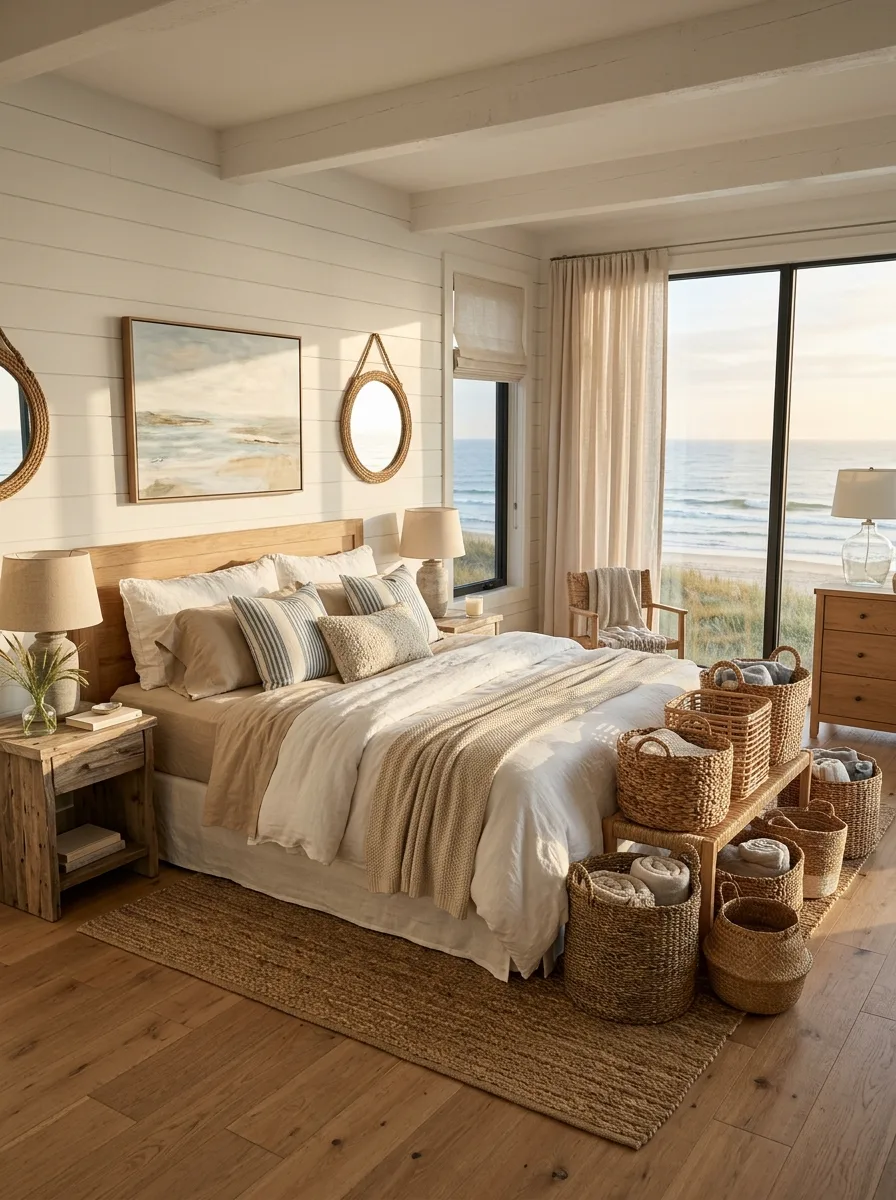
Line up a graduated row of wicker storage baskets at the foot of the bed, mixing at least three different sizes and weave patterns rather than a matched set. The variation in texture is what makes a purely functional storage solution look intentional.
Fill the baskets with rolled towels or blankets left slightly visible rather than fully hidden, since the texture of what’s inside matters as much as the baskets themselves.
Pair with a driftwood-framed mirror and a tight grid of shell illustrations above the bed, and choose warm reclaimed wood ceiling beams to tie the whole room’s material palette together from floor to ceiling.
Driftwood Mirror Reclaimed Dresser
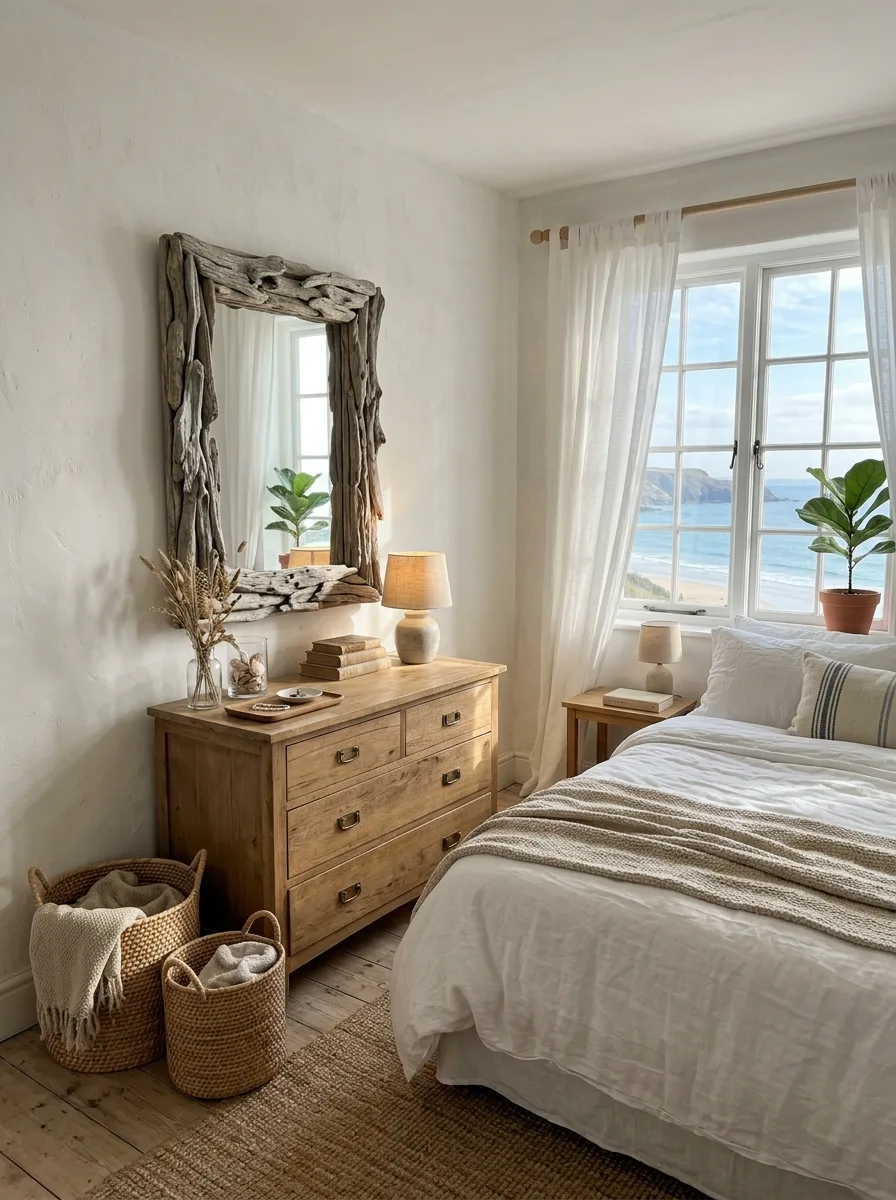
Hang a driftwood-framed mirror above a reclaimed wood dresser as the room’s main secondary vignette, positioned to catch light from the nearest window. The irregular, weathered frame is doing more character work here than a symmetrical antique mirror ever could.
Style the dresser top sparingly: a single ceramic lamp, a small glass vase with dried grasses, a stack of two or three books. Crowding this surface undercuts the calm the driftwood frame is establishing.
Add woven baskets on the floor beside the dresser for extra storage, and keep the surrounding walls in a warm, slightly textured white to let the wood tones stand out.
French Doors Ocean Balcony
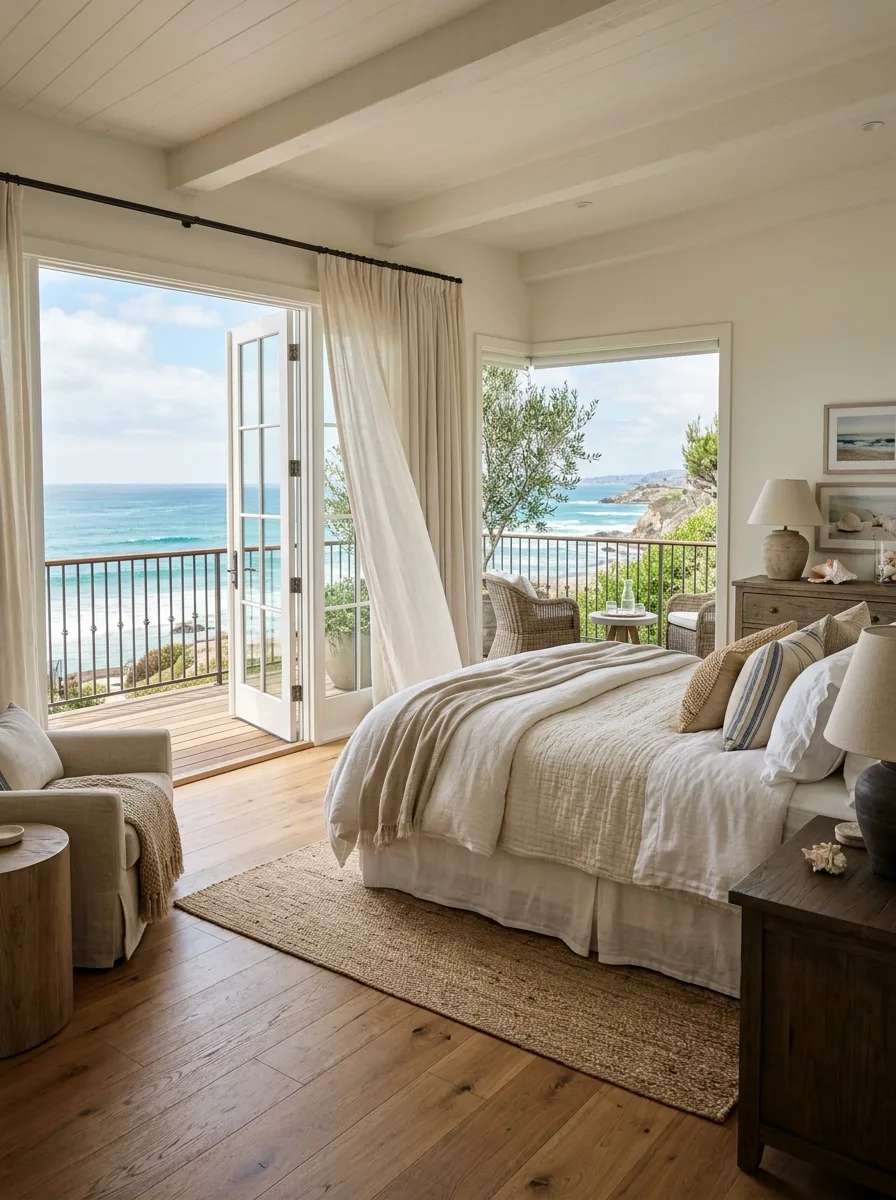
Install true French doors leading to an ocean-facing balcony rather than a single sliding panel, and hang one sheer curtain on a simple rod so it billows freely when the doors are open. Functioning doors that actually open change the entire relationship between the bedroom and the outdoors.
Choose a stone or ceramic lamp base with real weight and texture on the nightstand nearest the doors, since a delicate glass lamp would get visually lost against that much architecture.
Keep bedding in warm neutral linen, left unmade and layered, and add a single slipcovered armchair near the doors as an unofficial reading spot that takes advantage of the light.
Chunky Knit Texture Layer
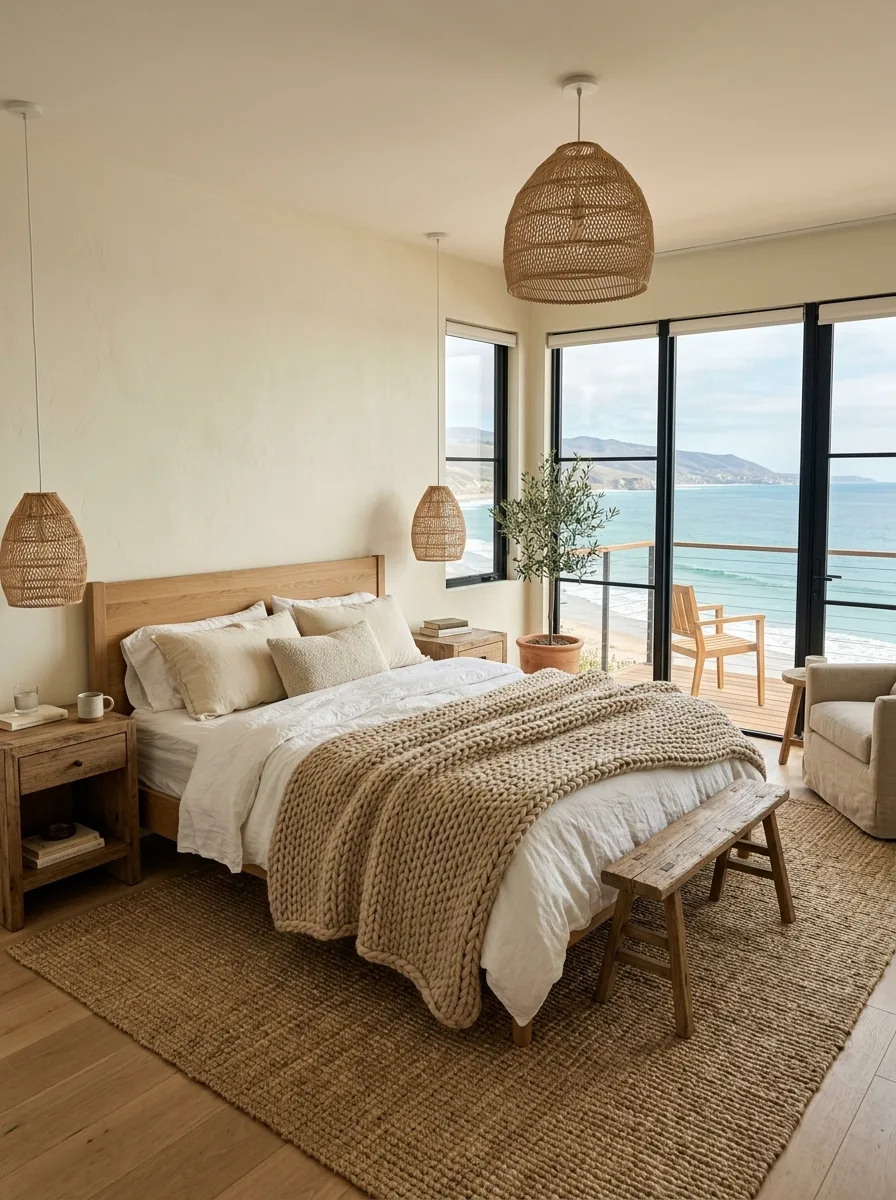
Add one oversized chunky knit throw across the foot of the bed as the room’s primary texture statement, chosen in a natural undyed wool tone rather than a bright color. The scale of the knit should be dramatic, thick enough to look sculptural rather than simply cozy.
Pair it with two woven rattan pendants of matching shape hung at slightly different heights, and a low wood bench at the foot of the bed for staging extra layers.
Keep everything else in the room quiet and tonal, white linens, a single potted olive tree on the balcony just outside, so the knit throw has room to be the loudest texture in the space.
Stone Fireplace Anchor Wall
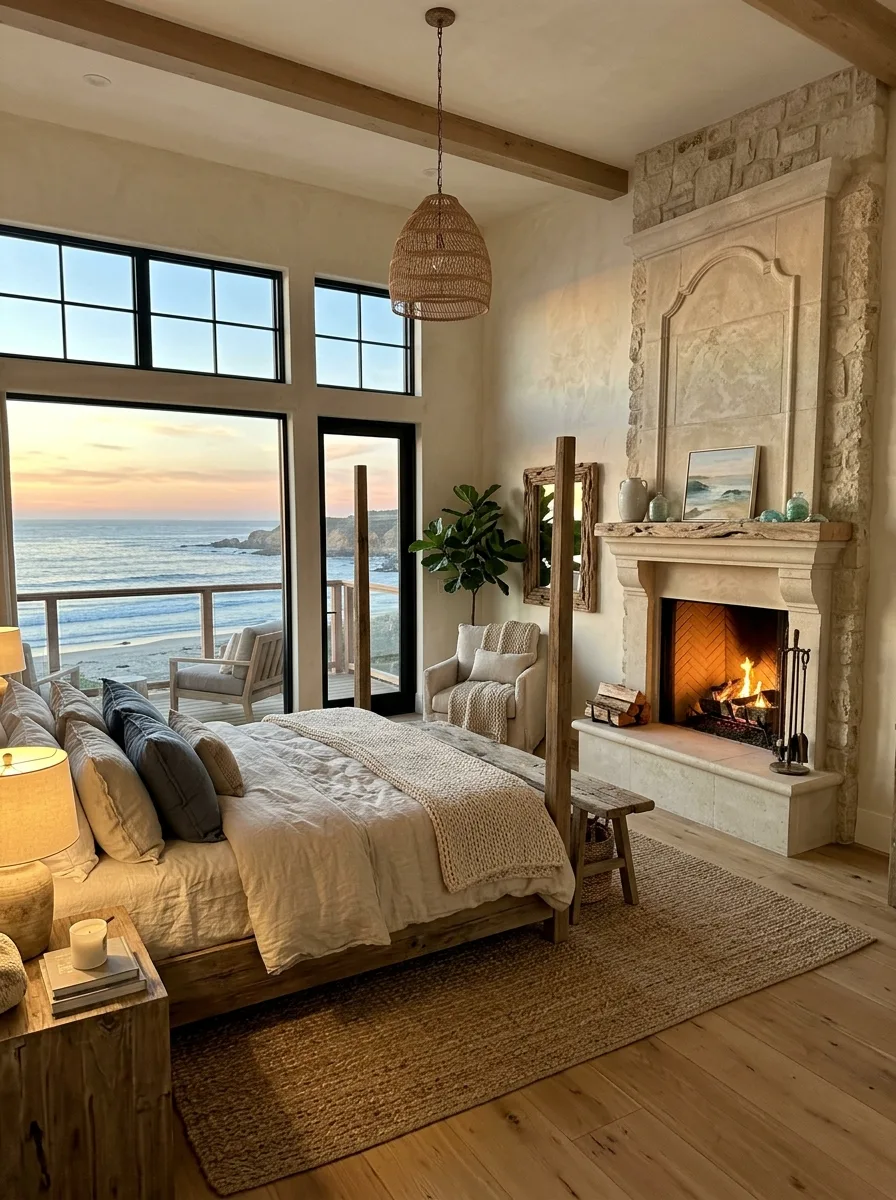
Build the room around a real stone fireplace as the anchor wall opposite the bed, choosing a rough, textural stone rather than a smooth veneer. A working fireplace does more to make a coastal bedroom feel like a retreat than almost any other single feature on this list.
Hang a driftwood-framed mirror on the mantle alongside a small stack of firewood left visibly in place, since the fireplace should look used, not staged.
Keep the seating nearby simple, a single slipcovered armchair angled toward the fire, and let floor-to-ceiling windows on the opposite wall balance the fireplace’s warmth with as much natural light as the room can hold.
Rattan Armchair Reading Corner
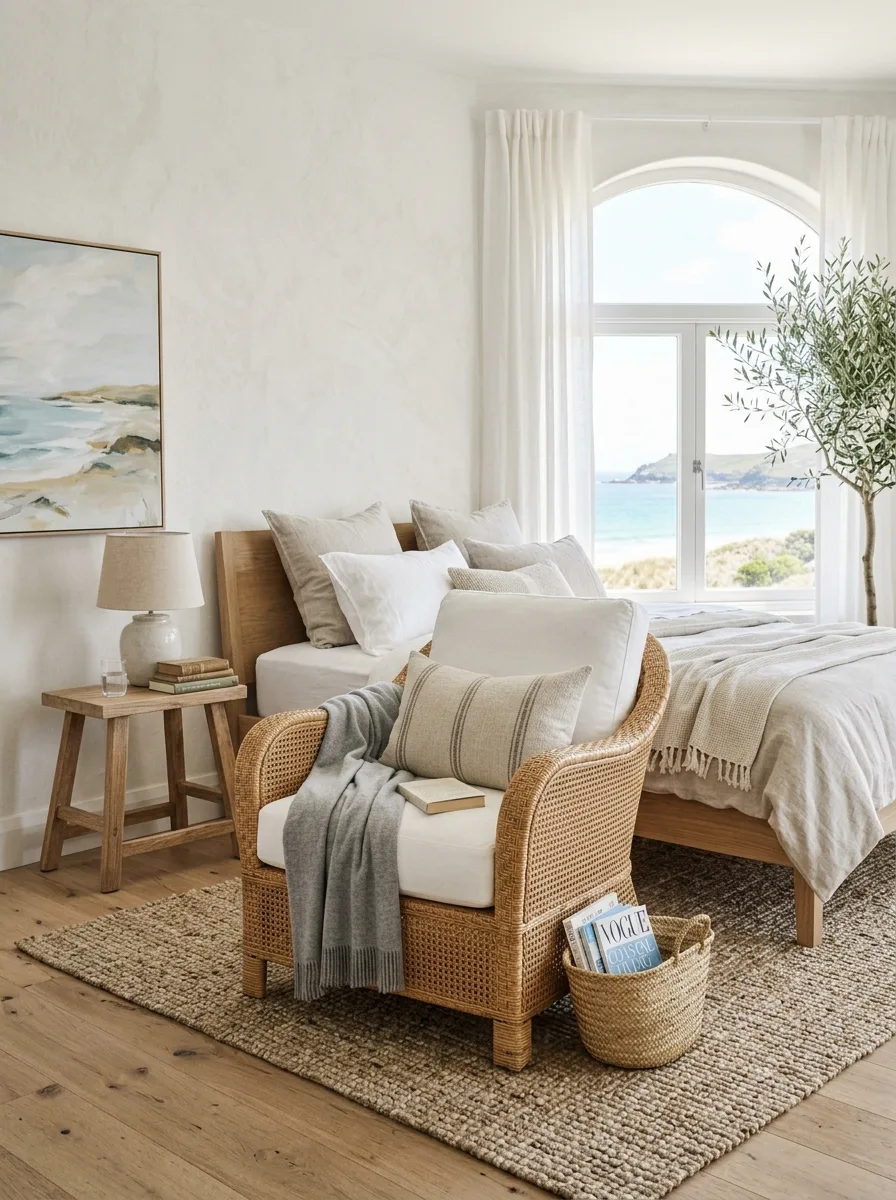
Place a rattan armchair with a simple white cushion at the foot of the bed rather than pushed into a corner, so it reads as an active part of the room instead of leftover furniture. Drape one grey knit throw over the arm to soften the woven texture.
Add a small woven basket beside the chair filled with a stack of magazines or books, left slightly askew rather than perfectly stacked, to reinforce the sense that the chair actually gets used.
Keep the wall behind the bed simple and unadorned aside from one large-format coastal painting, and let a single potted olive tree near the arched window provide the room’s only living element.
Built In Wood Shelving Surround

Build symmetrical wood shelving directly into the wall on either side of the bed, running from nightstand height up to the ceiling. This custom surround does the work of art, storage, and architectural interest all at once, without needing a single additional piece of decor.
Style the shelves loosely with books, small ceramic vessels, and a few pieces of driftwood, keeping items grouped in odd numbers and leaving visible gaps rather than filling every inch.
Choose soft dusty blue bedding as the one clear color note against all that warm wood, and hang a single woven pendant light centered above the bed to unify the whole built-in.
Floor Ceiling Drapery Headboard
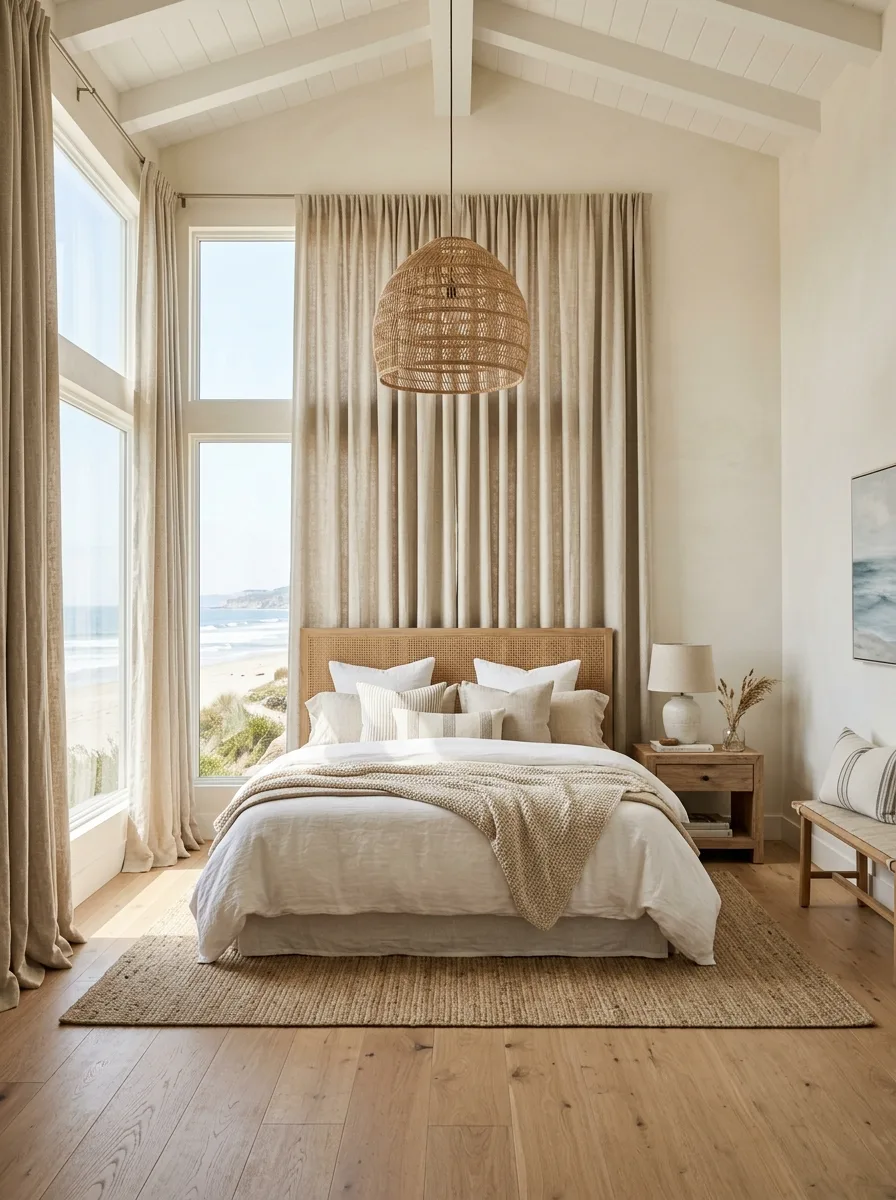
Hang floor-to-ceiling linen drapery directly behind the bed, functioning as a soft textile headboard rather than actual window treatment. The height alone, especially under a vaulted ceiling, makes even a fairly plain bed frame feel dramatic.
Choose a simple rattan headboard to sit in front of the drapery, low enough that the fabric remains the dominant visual element in the room.
Add one oversized woven pendant hung low and slightly off to one side, and keep bedding entirely neutral and textural, letting the drapery’s floor-to-ceiling scale stay the room’s single boldest gesture.
Final Thoughts
The rooms in this list never once needed a rope-wrapped anchor to feel like they belonged near the ocean. What they needed was material honesty — real jute, real linen, real weathered wood — used with more consistency than most people manage in a single room, let alone twenty.
Every one of these bedrooms trusted texture and light to do the job that color and literal imagery usually get assigned. That trust is what separates a coastal bedroom from a coastal-themed bedroom, and it’s a harder discipline than it looks.
None of this requires an actual ocean view, though it obviously doesn’t hurt. It requires treating natural materials as the main event instead of the supporting cast, and resisting the urge to explain the room’s mood with a seashell when the linen was already saying it.
Skip the souvenir shop. Buy the jute rug instead.