
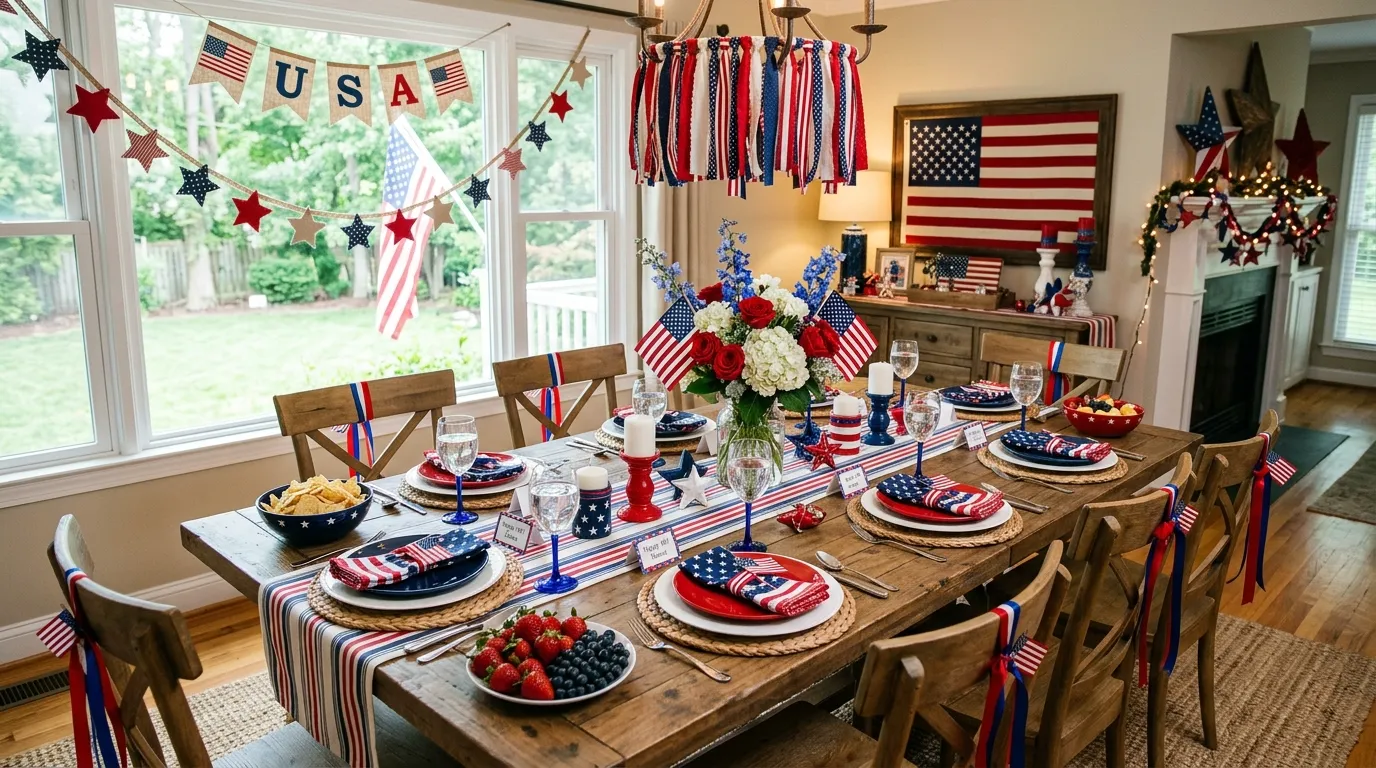
Most people decorate for Independence Day like they’re being graded on enthusiasm alone.
They buy the plastic tablecloth with the waving flag print. The paper plates that say “Let Freedom Ring” in Comic Sans. The centerpiece that is, inexplicably, a stuffed eagle holding a sparkler. And they arrange it all on the same table they use for Tuesday night takeout.
The result isn’t patriotic. It’s performative.
The dining room is where your guests will actually sit, eat, and talk for hours on the 4th. It deserves better than seasonal debris scattered across a surface. What follows isn’t a list of red, white, and blue things you can buy. It’s a guide to making patriotic decor feel intentional, layered, and—this is the part most people miss—like something that belongs in your actual home.
Why Most 4th of July Decor Looks Like a Mistake
The Color Panic Problem
Red, white, and blue is a strong palette. Too strong, if you’re not careful.
Most people see those three colors and decide every item in the room needs to scream one of them. Red napkins. Blue plates. White candles with little flags stuck in them. The eye has nowhere to rest. The room feels like a parade float that got lost indoors.
The fix isn’t using less color. It’s using more restraint in how you deploy it. Three bold colors need breathing room. They need neutral surfaces and textures to ground them. Without that, you’re not decorating. You’re color-bombing.
The Disposable Everything Trap
Paper banners. Plastic centerpieces. Tableware that goes straight in the trash.
There’s nothing wrong with a few disposable items for a big crowd. But when everything is temporary, the room feels temporary. Your guests notice, even if they can’t name why. The space feels thin. Uninvested.
The best patriotic dining rooms mix a few seasonal pieces with things that live in the house year-round. A good wooden table. Real glassware. Linen that has weight to it. The patriotic elements should feel like they’re visiting a well-appointed room, not camping in an empty one.
The Ceiling Is Not a Storage Unit
This one is specific but important.
People hang bunting, balloons, and streamers from every available surface and then wonder why the room feels cluttered from above. Your chandelier is already an object. Wrapping it in a balloon garland doesn’t add festivity. It adds visual noise at exactly the height where people are trying to have a conversation.
Vertical space matters. Use it deliberately, or don’t use it at all.
The Principles That Actually Make Patriotic Decor Work
Contrast Beats Volume Every Time
A single framed vintage flag on a navy wall hits harder than twenty small flags pinned to a bulletin board.
The principle is simple: one large, well-placed statement outperforms many small scattered ones. This is true for art, for floral arrangements, for lighting, for everything. The eye is drawn to contrast and scale. Give it one thing to notice, and it will notice it. Give it twenty things, and it will notice nothing.
In patriotic decor, this means choosing your hero piece. The thing that defines the room. Then letting everything else support it quietly.
Texture Is Your Neutralizer
Red, white, and blue are flat colors. Literally. They’re the colors of flags and logos and political broadcasts.
To make them feel domestic—livable—you need to introduce texture. Burlap runners. Linen napkins with a loose weave. Woven placemats. Galvanized metal vases. Wood grain. These textures interrupt the flatness of the palette and remind people they’re in a home, not a campaign office.
The most successful patriotic rooms in these images aren’t successful because of their color distribution. They’re successful because the colors are delivered through materials that have depth.
Light Determines Whether It Feels Festive or Forced
A dining room at 3 PM with harsh overhead lighting and plastic flags everywhere feels like a craft project.
The same room at 7 PM with candles lit, a chandelier dimmed, and string lights softening the corners feels like an event.
Lighting is the transformation layer. It doesn’t matter how good your tablescape is if the light is wrong. Patriotic decor, in particular, benefits from warmth. The red reads richer. The blue reads deeper. The white stops looking clinical and starts looking clean.
Getting the Foundation Right Before You Hang a Single Flag
Decide on Your Register: Casual, Formal, or In-Between
This is the decision that determines every other choice.
A casual 4th of July dinner means mason jars, gingham, picnic-style serving, and probably paper napkins because you’re grilling and nobody wants to launder sauce stains. A formal dinner means crystal, candlesticks, a floral runner, and cloth napkins folded with intention. In-between means you pick one formal element—maybe the candlesticks—and let everything else relax.
You cannot mix registers randomly. A crystal chandelier over a paper tablecloth doesn’t read eclectic. It reads confused. Choose your level of ceremony and commit.
The Wall Is More Important Than the Table
Everyone starts with the table. This is backward.
The walls are the largest visible surface in the room. What you do there sets the tone for everything below. A framed flag, a gallery wall with vintage maps and eagle prints, a painted shiplap feature wall in navy—these decisions establish whether your tablescape will feel supported or feel like it’s trying to compensate for a blank room.
If your walls are empty, your table has to do too much work. Give it some backup.
Choose Your Red, Your White, and Your Blue
Not all reds are the same. Not all blues.
A bright cherry red reads festive and casual. A deep burgundy reads sophisticated and almost autumnal. A primary blue is cheerful. A navy is grounded and formal. An off-white or cream softens the whole palette. A bright white sharpens it to the point of austerity.
Before you buy a single item, decide which versions of these colors you’re using. Mixing a cherry red napkin with a burgundy runner and a tomato-red placemat is how you end up with a table that looks like a color theory accident.
4th of July Dining Room Ideas
The Farmhouse Shelf Wall That Treats Patriotism Like a Layer, Not a Costume
This is for the person who wants patriotic spirit without changing their entire room.
Start with existing open shelving—dark wood brackets, white shiplap behind. Add one large sign with typography that has some wit to it. “Everyone has a seat at our table” works because it’s a statement about the room, not about the holiday. Drape a vintage-style flag banner across the shelves so it hangs in soft loops, not pulled tight like a clothesline.
Then add the layers that make it feel collected, not purchased: a galvanized watering can with greenery, a small “Fresh Flower Market” sign, terracotta pots with white blooms, a wooden toolbox with garden tools. The patriotic elements should feel like they live among things that were already there.
The table below should continue the farmhouse story. Checkered napkins. Amber glass jars with mixed bouquets of red, white, and blue flowers. Wooden star decorations that look like they were made by hand, even if they weren’t.
The Grand Flag Room That Built the House Around It
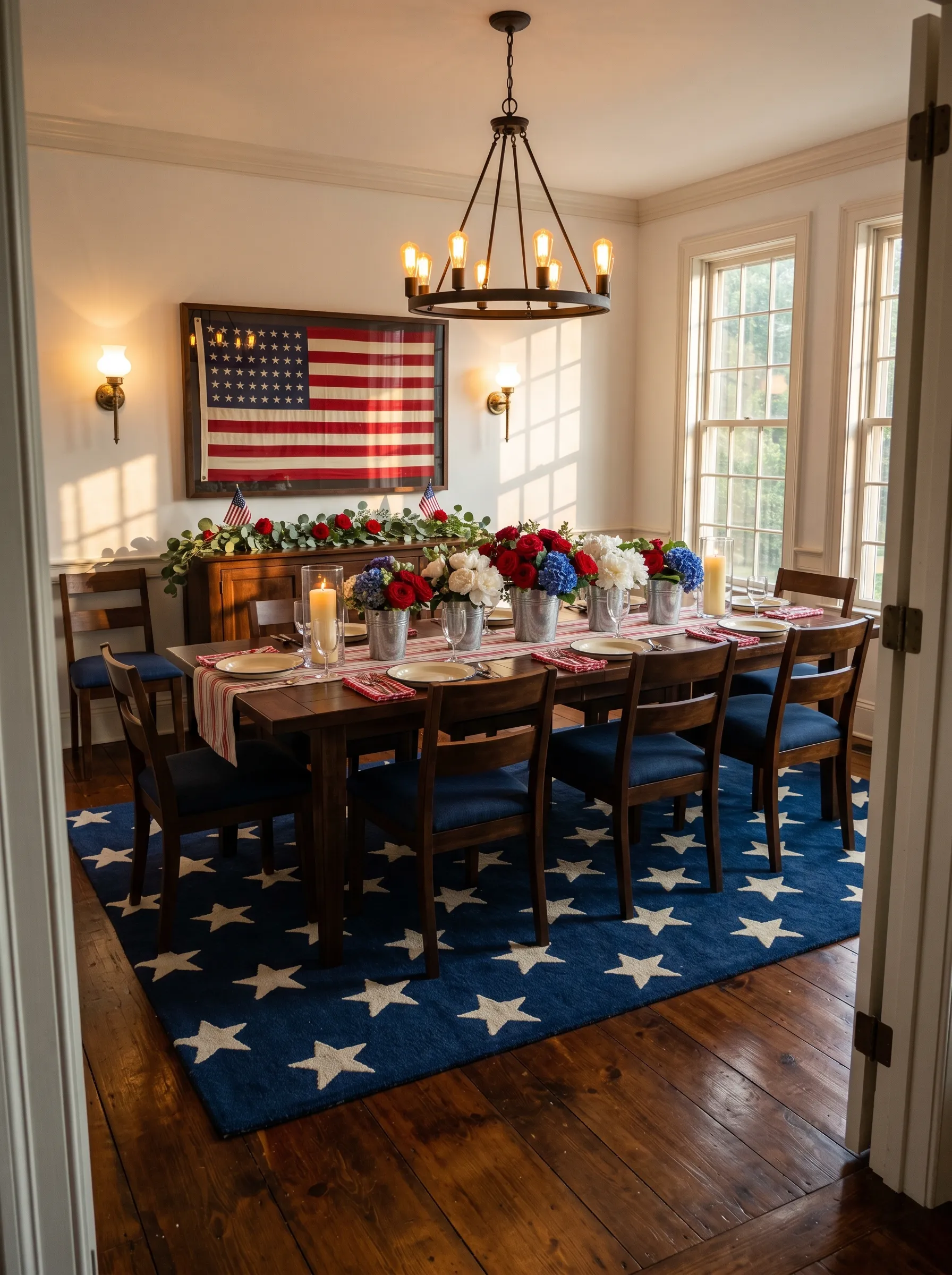
This is for the committed.
Hang a large framed vintage American flag on the main wall, flanked by brass sconces with warm light.
Below it, a long wooden sideboard dressed with a eucalyptus garland, red roses, and small flags.
The table in front should be set with a red-and-white striped runner, galvanized buckets of red, white, and blue flowers, tall pillar candles, and cream plates with red gingham napkins. The rug below should be deep navy with oversized white stars. The chairs should be dark wood with navy upholstered seats. The chandelier should be a wrought iron ring with exposed Edison bulbs, its warmth echoing the candlelight below.
This room works because the flag is treated as architecture, not accessory.
The room was built to hold it.
The Quietly Patriotic Breakfast Nook That Knows Restraint Is Power
Sometimes the most patriotic thing you can do is refuse to shout.
Take a simple round table with a blue-and-white floral tablecloth that reads as everyday, not seasonal. Add woven jute placemats—four of them, perfectly spaced. In the center, a single white ceramic pitcher with pale pink pom-pom flowers and two small American flags placed at a slight angle, like they were stuck in casually by someone who was thinking about something else.
The flags should be the only explicitly patriotic element. Everything else—the brass chandelier with patterned shades, the white curtains, the cabinet with leaded glass—should feel like it was there yesterday and will be there tomorrow.
This is the look for people who want to acknowledge the holiday without letting it take over their house. It works because it trusts the room’s existing architecture to do most of the work.
The Floral Runner Tablescape That Made the Centerpiece a River
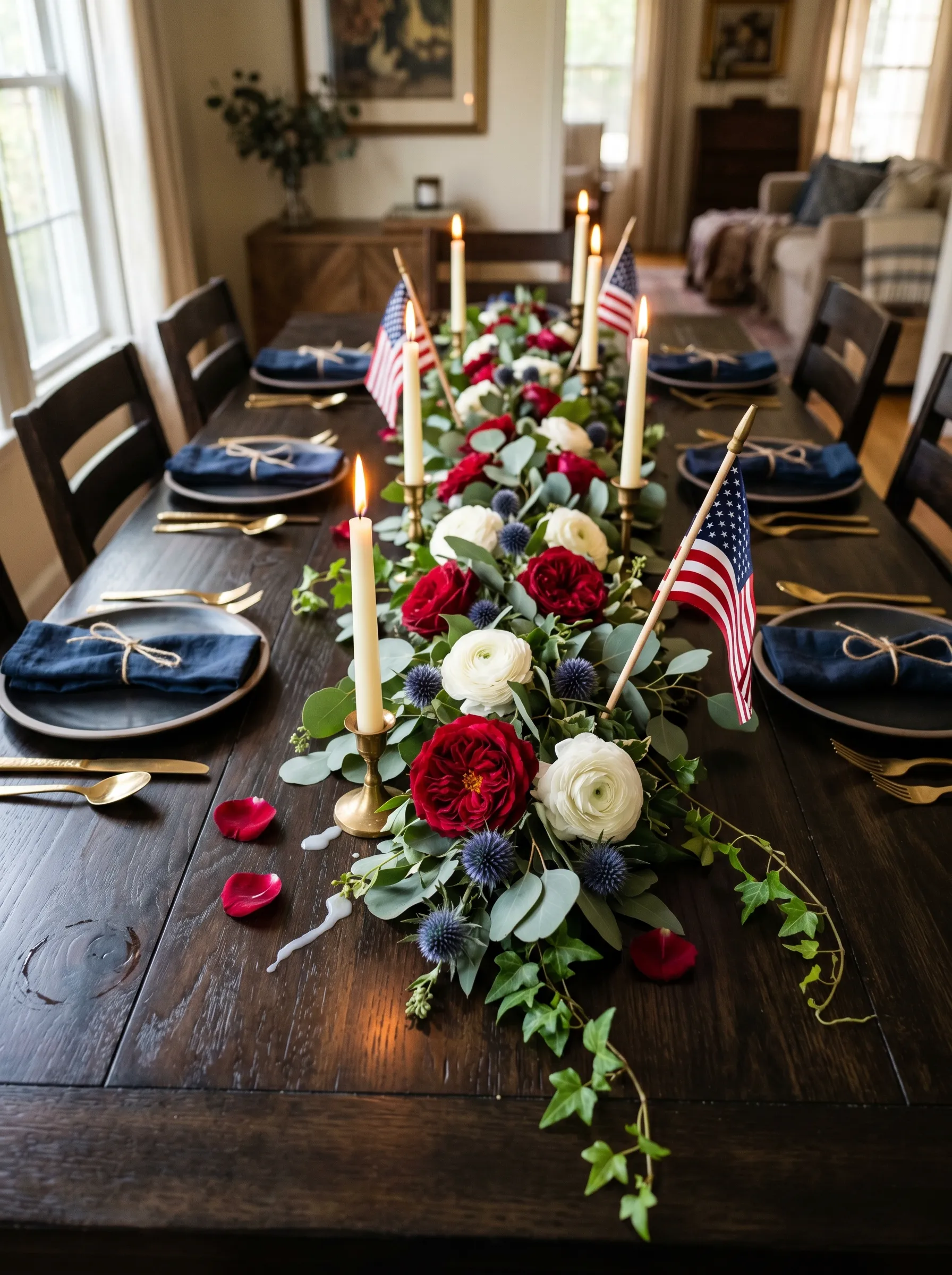
Most centerpieces sit in the middle and stop.
This one runs the full length of the table like a floral river.
Start with a long garland of eucalyptus as the base. Add clusters of red garden roses, white ranunculus, and blue thistle at intervals, so the color pops against the green rather than drowning in it. Place brass candlesticks with lit white tapers between the floral clusters—tall, medium, short, alternating so the eye travels. Set the table with dark plates, navy linen napkins tied with twine, and gold flatware. Add small American flags at two points along the runner, their poles angled slightly, not ramrod straight. Scatter a few red rose petals and a drip of white candle wax on the table surface—controlled imperfection that makes the setup feel lived-in.
This works because the centerpiece has scale.
It respects the length of the table. It gives every guest something beautiful directly in front of them, not just the people at the ends.
The Flag-Filled Tablescape That Uses Repetition Like a Weapon
This is not a subtle look. It is, however, a controlled one.
Line the center of a long wooden table with small American flags in brass-toned holders—one between each place setting, all facing the same direction. Behind them, a large glass vase with white hydrangeas. The flags create rhythm. The hydrangeas provide softness. Together they make a centerpiece that is both patriotic and actually attractive.
The chairs should be simple wood with X-backs, their seats in a neutral linen. The rug below should be a chunky natural weave. The chandelier above should be wood-beaded, its texture adding warmth that the flags alone would lack.
The discipline here is in the repetition. Eight identical flags. One type of flower. One style of chair. When the patriotic element is repeated rather than varied, it starts to feel like a design choice instead of a decoration.
The Dessert Table That Stole the Whole Party
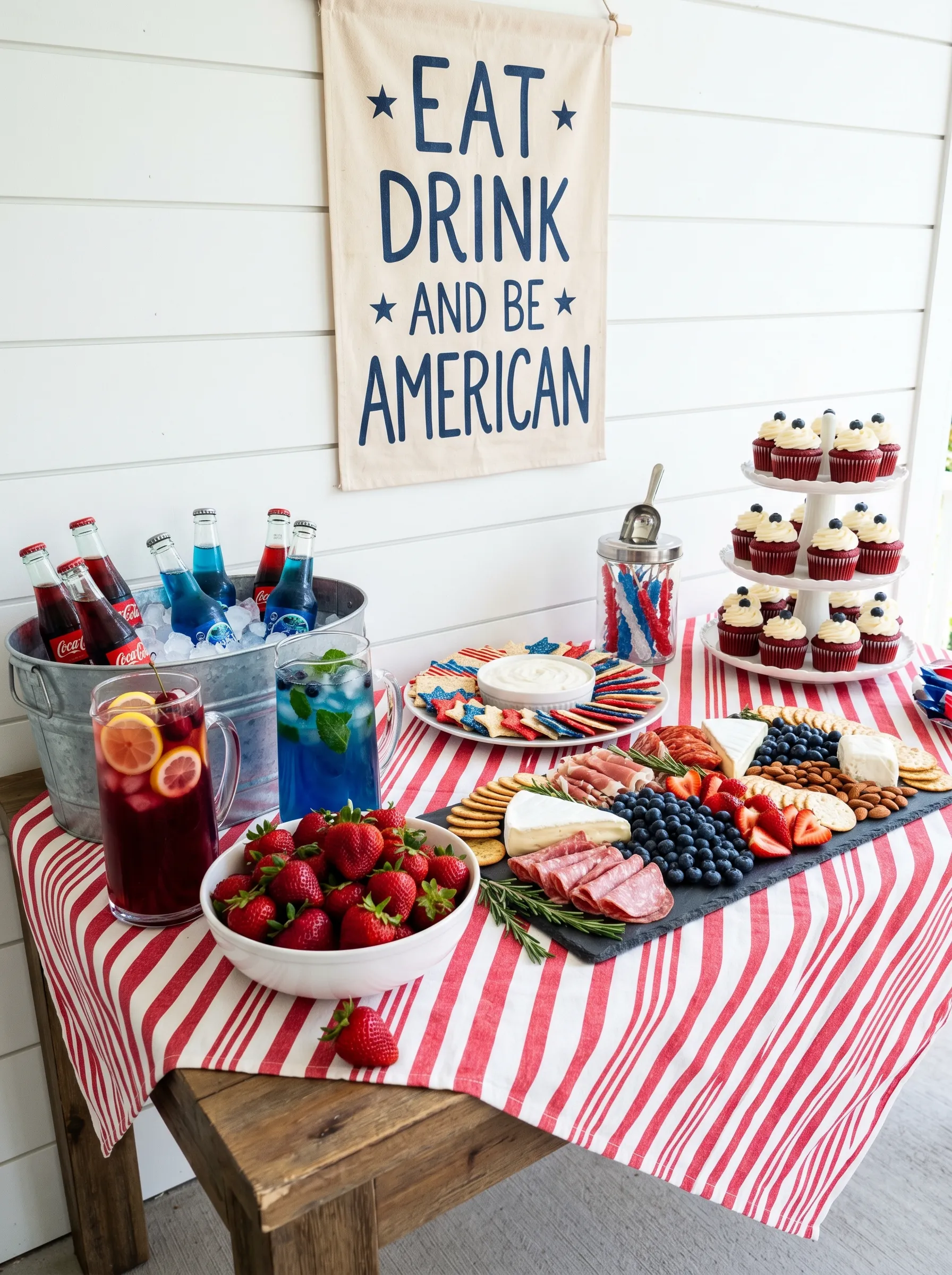
Sometimes the dining room isn’t for dinner.
It’s for the dessert table that everyone remembers.
Hang a canvas banner with clean typography: “EAT DRINK AND BE AMERICAN.” No exclamation point. The period makes it confident.
Below it, a long table covered in a red-and-white striped cloth that runs the full length.
The display should be arranged in heights. A galvanized bucket with red and blue bottled drinks on ice at one end. A three-tiered stand with red velvet cupcakes topped with white frosting and a single blueberry. A large glass trifle bowl with layers of strawberry, whipped cream, and blueberry. A slate board with a charcuterie spread arranged in color blocks: red salami, white cheese, blueberries, strawberries.
The discipline is in the color blocking.
Each item should read as clearly red, white, or blue.
When the eye can identify the palette instantly, the overall effect is stronger than if the colors are mixed and muddied.
The Ceiling Bunting Room That Used Vertical Space on Purpose
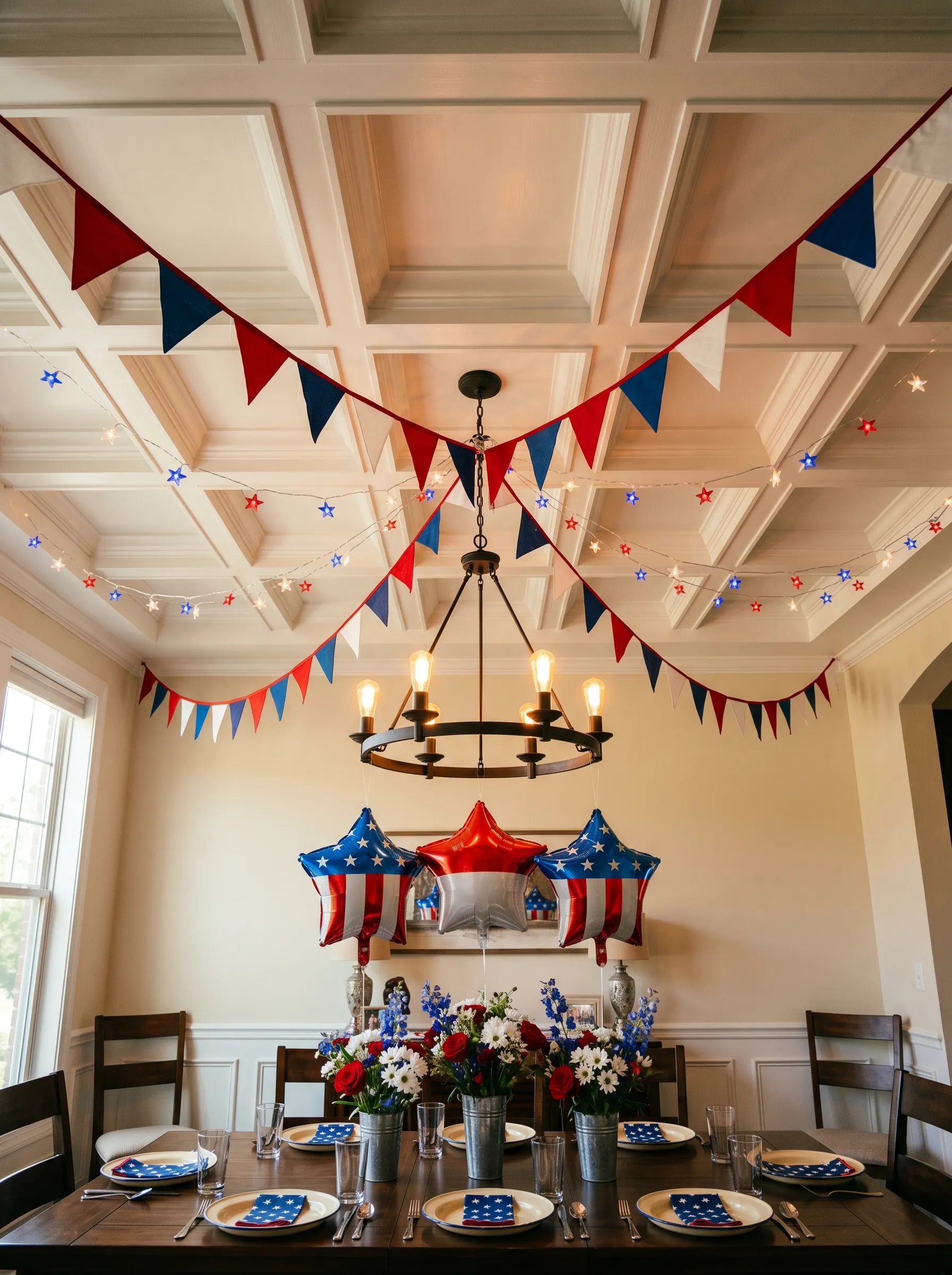
Most ceiling decorations are an afterthought. These are not.
String red, white, and navy triangular bunting across a coffered ceiling in two crossing lines, like the rigging of a ship. Below the bunting, run a string of small star-shaped lights in red and blue. The lights should be dim enough to glow, not bright enough to compete with the chandelier.
Below, the table should be set with galvanized buckets of red, white, and blue flowers—daisies, roses, delphinium. The plates should have star-patterned napkins. The chairs should be simple dark wood.
The effect is festive from the moment you walk in, but the festivity is overhead, leaving the table clear for conversation and food.
This is how you use vertical space without making the room feel cluttered: put the celebration above eye level and keep the human zone calm.
The Moody Candlelit Room That Made Patriotism Romantic
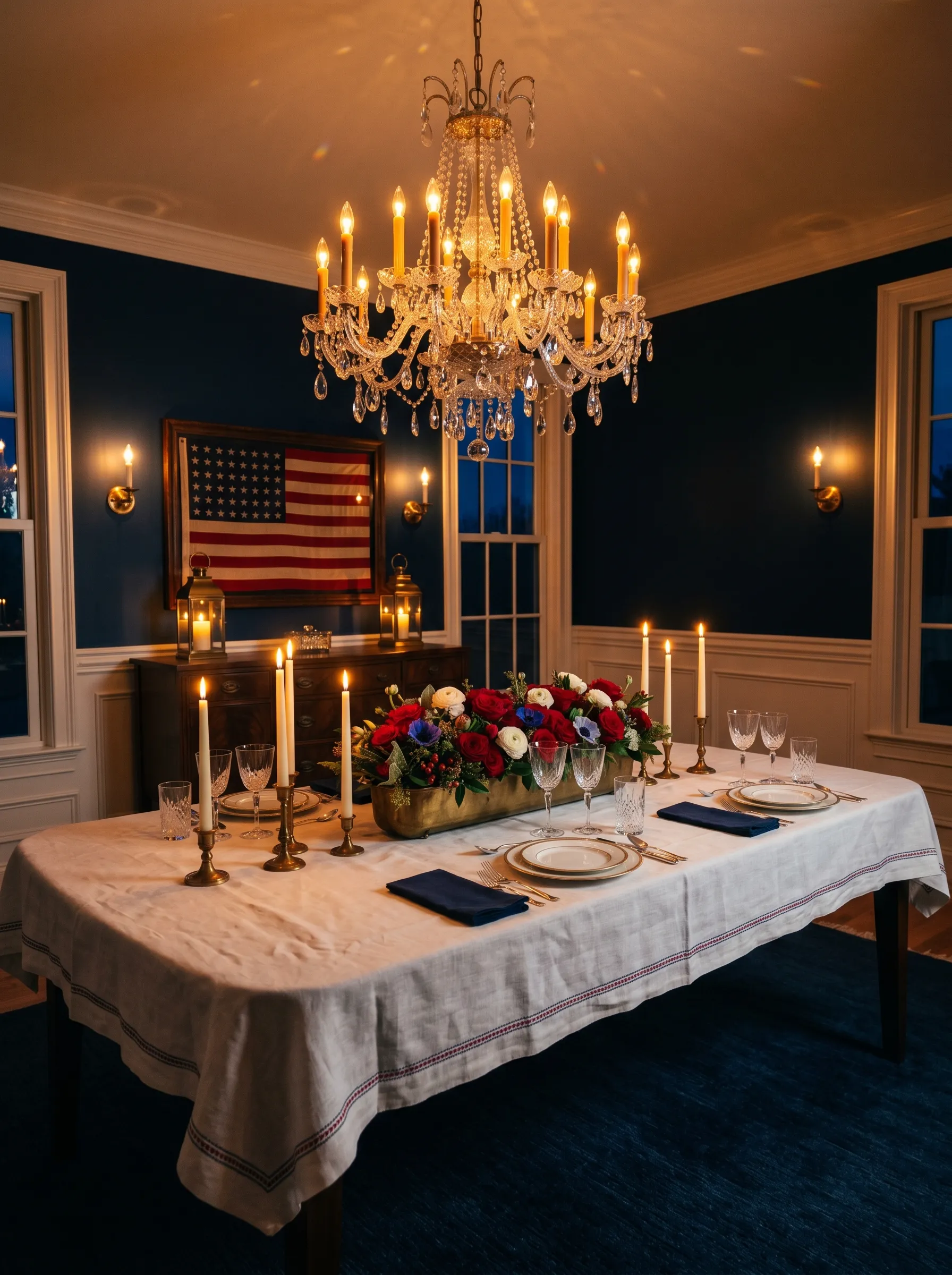
This is the night look. The one that happens after the sun goes down and the fireworks start.
Paint the walls deep navy. Hang a framed flag above a dark wood sideboard. Add brass sconces with candles, brass lanterns with red and blue pillar candles inside, and a crystal chandelier dimmed to a warm glow. String small red, white, and blue lights along the picture rail where the wall meets the ceiling.
The table should be covered in white linen with a thin red-and-blue stitched border. Brass candlesticks with white tapers should run the length of the table, interspersed with small red and blue votives. Crystal glassware should catch the light. Navy napkins should be folded simply, no rings, no flags, no gimmicks.
This room doesn’t need explicit patriotic symbols beyond the flag and the lights.
The color story does the work. The candlelight does the rest.
It feels like a celebration because it feels intimate, not because it feels decorated.
The Clean White Room That Let the Windows Do the Work
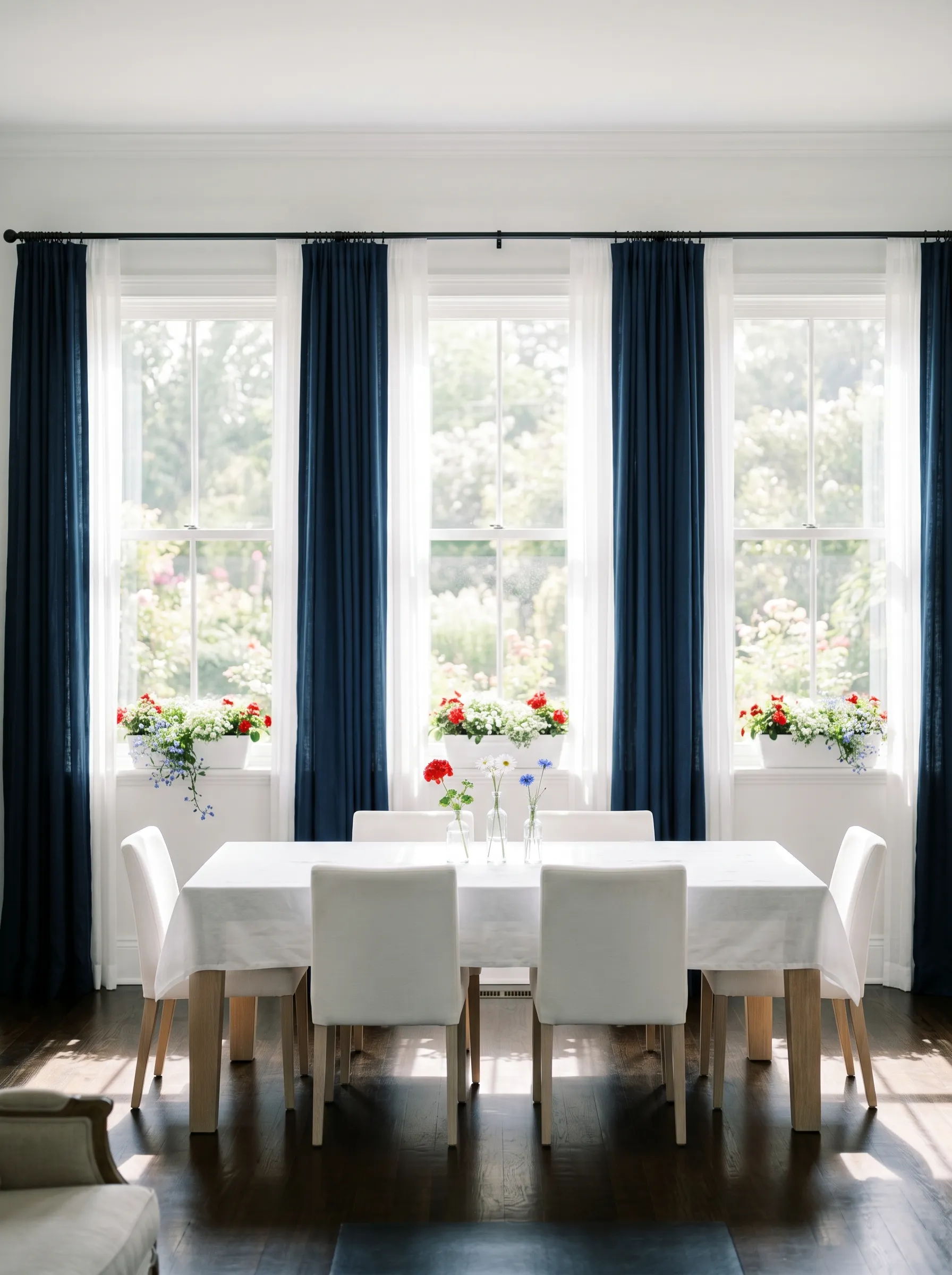
This is the room for people who think flags are fine but don’t want to live in a gift shop.
Paint everything white. Walls, ceiling, trim. Hang heavy navy curtains on a black rod across three tall windows, the curtains pulled back to frame the view, not cover it. Place white window boxes on the sills outside, planted with red geraniums, white alyssum, and blue lobelia—the patriotism is outside, visible through the glass, part of the landscape.
Inside, keep the table white. White linen, white upholstered chairs with light wood legs, a simple white ceramic vase in the center with three stems: one red, one white, one blue. Just three. No flags. No bunting. No explicit symbols.
The room is patriotic by inference. The navy curtains echo the flag. The window boxes deliver the colors. The restraint of the interior says that patriotism, in this house, is a quiet constant rather than a seasonal performance.
This is the hardest look to pull off because there is nowhere to hide. Every proportion has to be right. Every material has to be good.
But when it works, it works better than any banner or balloon because it feels like the room was always meant to be this way.
The Warm Confident Room That Made Navy the Main Character
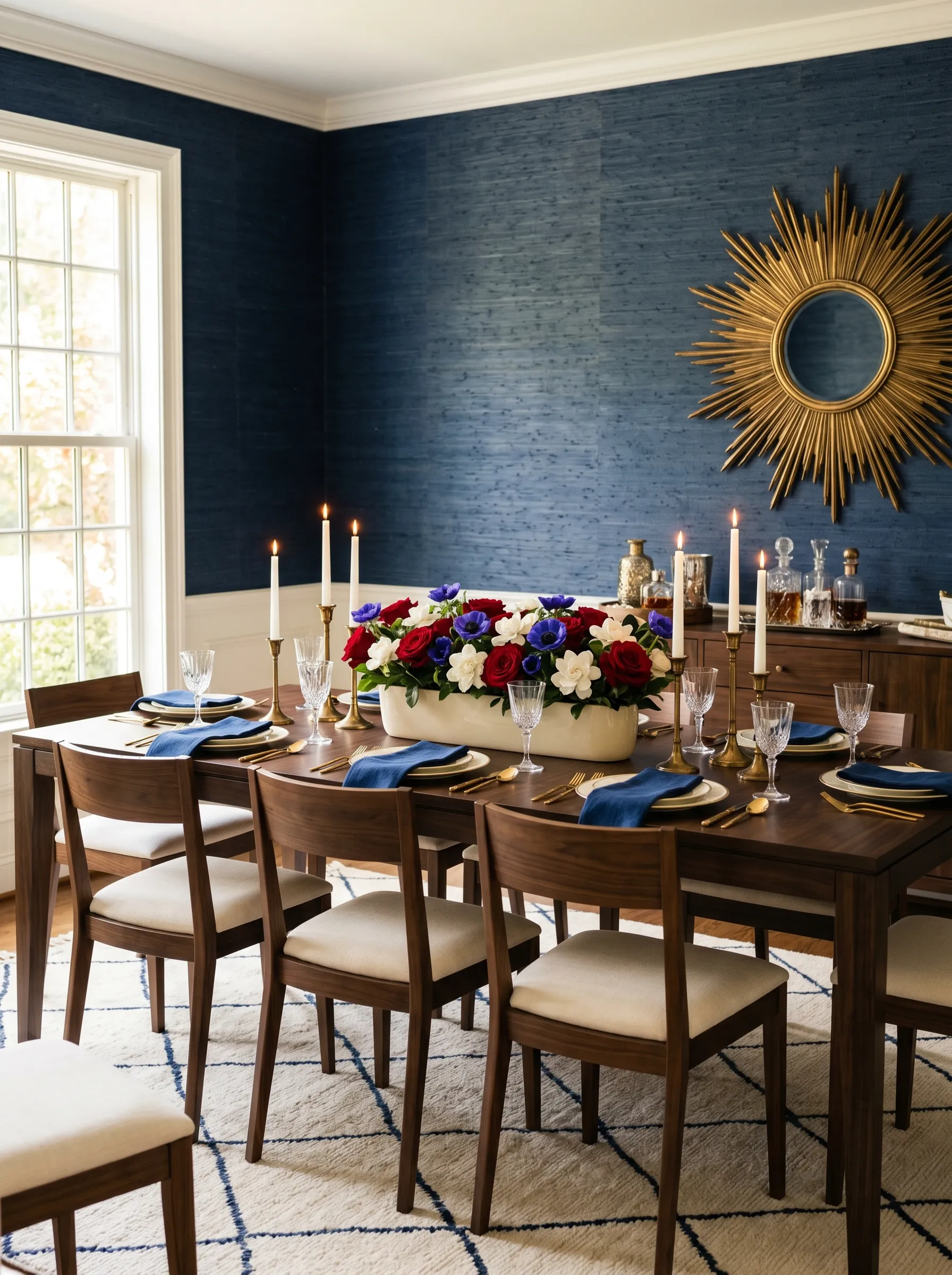
Most patriotic rooms use navy as an accent. This one made it the foundation.
Paint the walls in deep navy grasscloth—the texture matters, it keeps the dark color from feeling flat. Add a large gold sunburst mirror on the main wall. Set a dark wood table with walnut chairs upholstered in cream. Lay navy linen napkins at each place, folded simply. Use gold-rimmed plates and crystal glassware that catches the light.
The centerpiece should be a long white ceramic planter with a dense arrangement: red roses, white gardenias, blue anemones, and trailing greenery. Brass candlesticks with white tapers should flank it, four on each side, their height matching the centerpiece so the table reads as a single horizontal composition.
The rug below should be cream with a loose navy geometric pattern. The sideboard behind should hold brass decanters and a small tray—no flags, no bunting, no seasonal items at all.
This room is patriotic because of its color story, not its accessories.
The red, white, and blue are all present, but they’re delivered through flowers, napkins, and wall color rather than through symbols.
It is a patriotic room that would work on any day of the year. That permanence is the point.
The Balloon Arch Room That Built a Portal to the Party
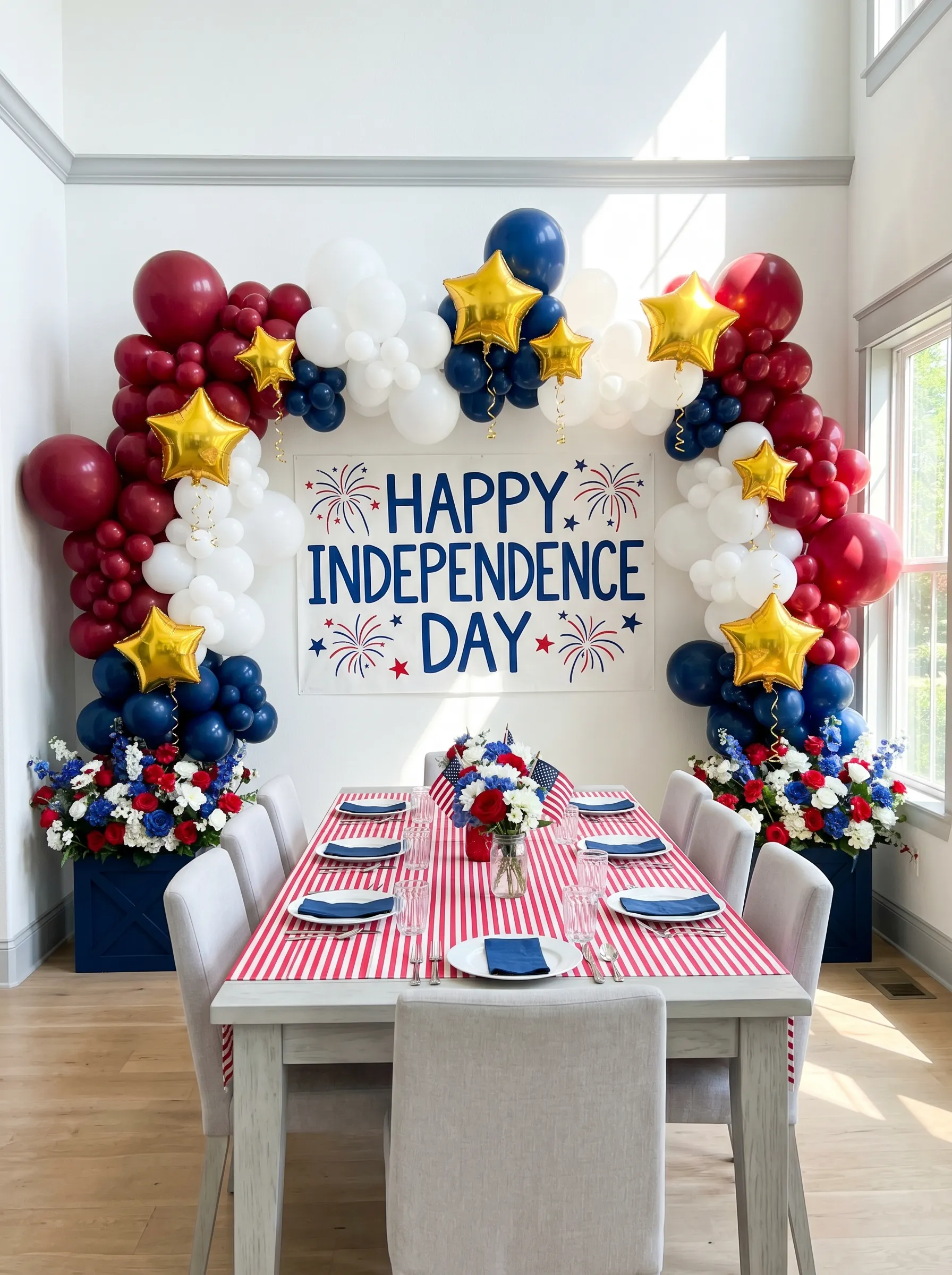
Most people put balloons on the table. This room put them on the wall.
Build an organic balloon arch in a doorway or along a flat wall using clusters of navy, deep red, and white balloons in varying sizes—12-inch, 9-inch, and 5-inch mixed together so the texture isn’t uniform. Add metallic gold star balloons at irregular intervals, their points facing different directions so they feel caught in a moment, not arranged by algorithm.
Behind the arch, hang a clean white banner with “HAPPY INDEPENDENCE DAY” in navy serif type, flanked by simple firework illustrations. The banner should be large enough to read from across the room but not so large it competes with the balloons.
Set a long table in front with a red-and-white striped cloth, white plates, navy napkins, and simple glassware. Add two large planters on either side of the arch base with dense arrangements of red, white, and blue flowers—roses, hydrangeas, daisies—so the floral color echoes the balloon colors and grounds the whole installation.
The trick is treating the wall as the event entrance.
Guests don’t walk into a decorated room. They walk through a decorated threshold.
That shift in sequence makes the whole evening feel like an occasion before anyone sits down.
The Chair-Decorated Table That Remembered the Seats
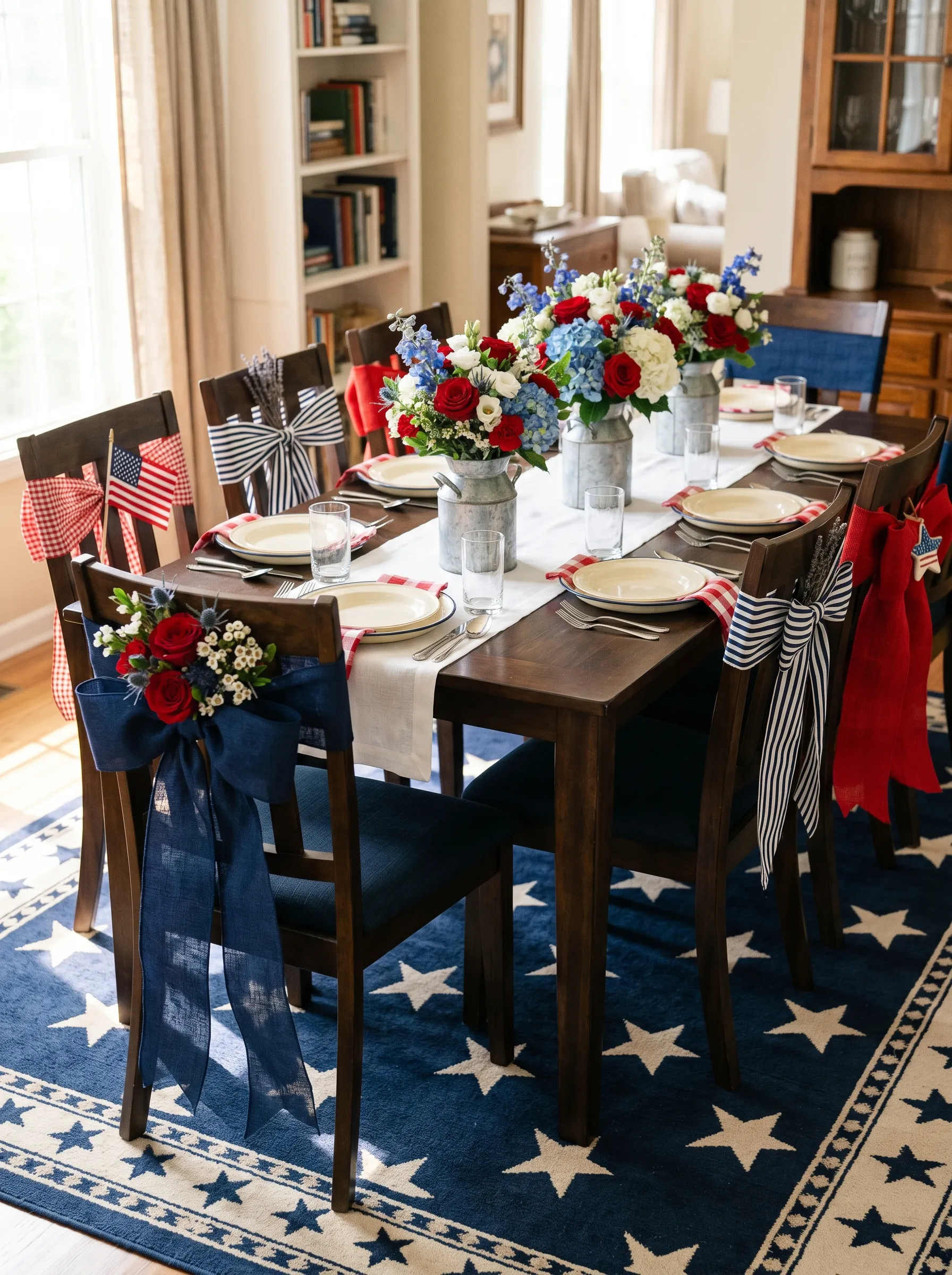
Everyone decorates the table. Almost no one decorates the chairs.
Tie wide navy gingham bows on the chair backs, alternating with red gingham on every other chair. Add small floral arrangements to the backs of two chairs—red roses, white baby’s breath, blue thistle—tied with the same ribbon. Tuck small flags into the bows on some chairs, let others stay plain.
The table itself should be simple: a white runner, galvanized milk jugs with mixed red, white, and blue flowers, cream plates with blue-rim detail. The rug below should be navy with a white star pattern that echoes the chair decorations without matching them exactly.
This works because it treats the whole room as the composition, not just the horizontal plane of the table.
The chairs become part of the visual story.
When guests walk in, they see festivity at every height.
The Symmetrical Tablescape That Treated the Flag Like a Flower
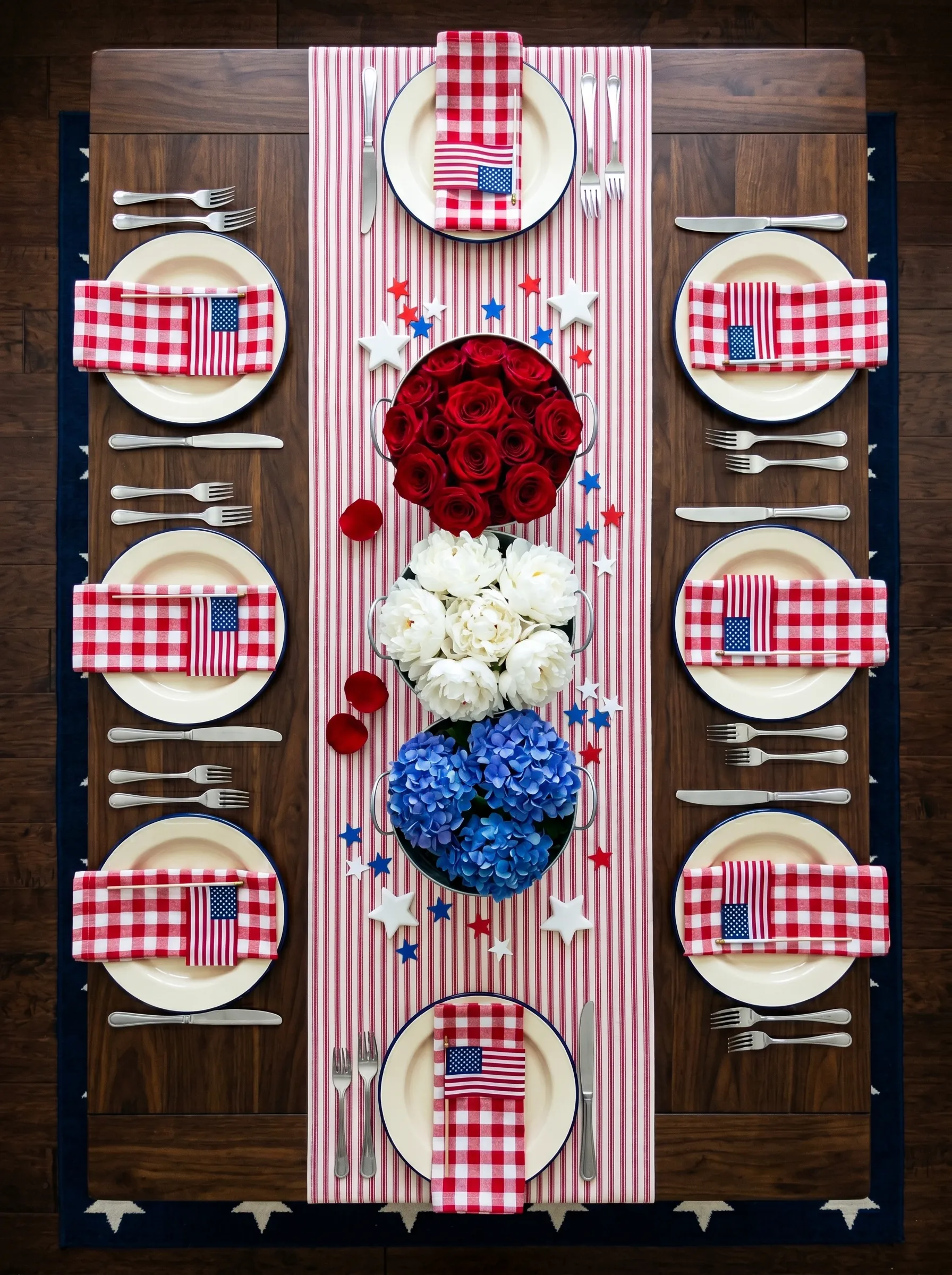
This is the overhead shot that breaks Instagram.
Run a red-and-white striped runner down the center of a long dark wood table. Place three round metal planters in a line: one with deep red roses, one with white peonies, one with blue hydrangeas. The flowers should be packed tight, almost spherical. Scatter small wooden stars and a few loose petals between the planters.
Set eight places—four on each side—with cream plates, red gingham napkins, and small American flags laid across the napkin fold like a utensil. Silver flatware, not gold. The coolness of the silver balances the warmth of the red.
The symmetry is the point.
The flag colors delivered as floral arrangements is the surprise.
Together they make a table that is unmistakably patriotic without being obvious about it.
The Navy Shiplap Room That Made the Wall the Statement
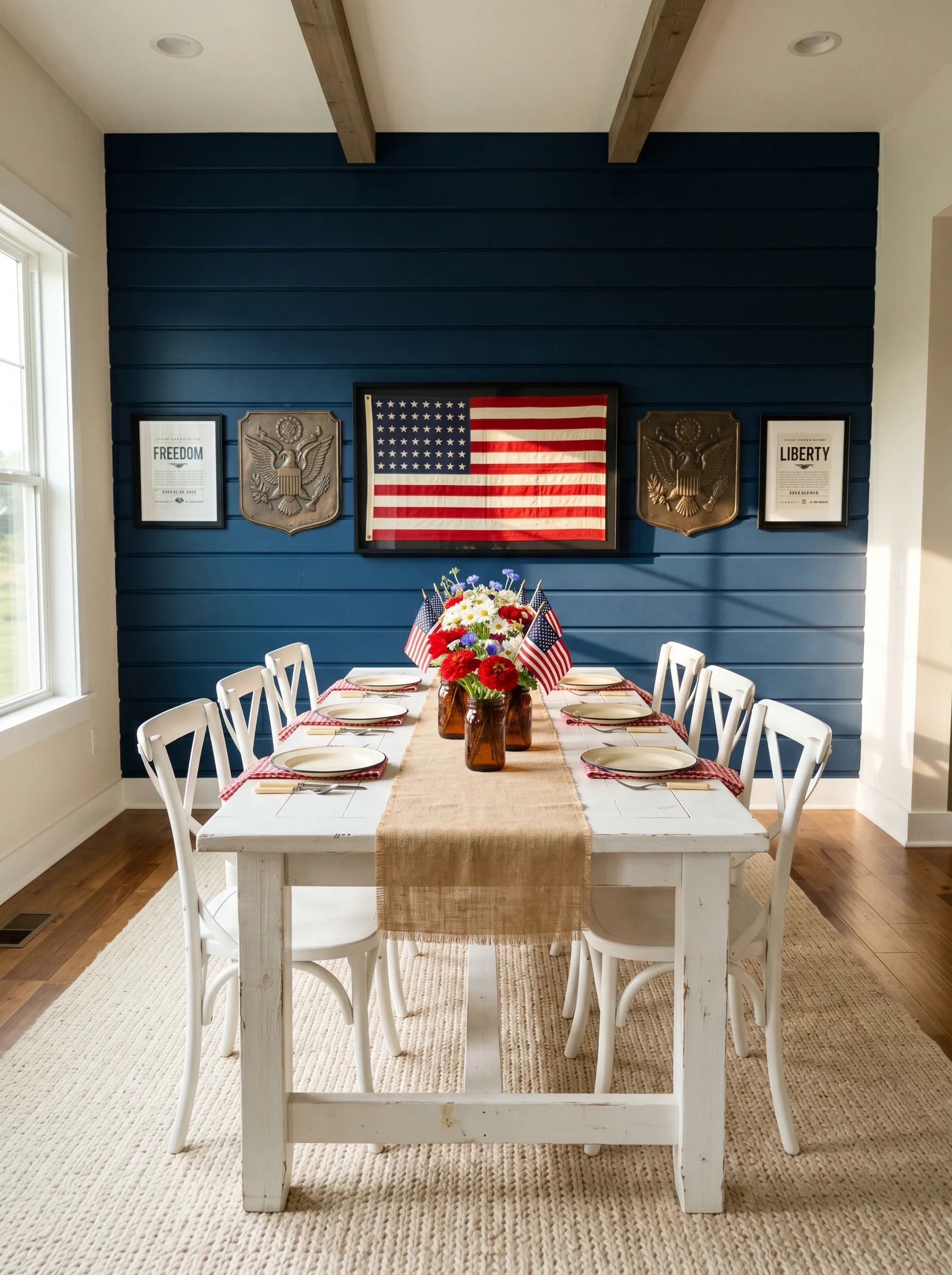
This is the room that understood architecture.
Paint one wall floor-to-ceiling in deep navy shiplap, extending up to exposed wood ceiling beams. Center a large framed vintage flag on the wall, flanked by brass eagle plaques and typography prints reading “FREEDOM” and “LIBERTY.” The frames should vary—some ornate, some simple—so the arrangement feels collected.
Set a white farm table in front with white X-back chairs. Lay a burlap runner down the center. Add mason jars with mixed red, white, and blue blooms—gerbera daisies, roses, cornflowers—and small flags tucked among the stems. Use red gingham placemats and simple cream plates.
The rug below should be a natural woven texture. The light should come from the window, not overhead, so the room feels sunlit and casual.
This room works because the architecture itself is patriotic.
The shiplap wall reads as American vernacular.
The flag is just confirming what the room already declared.
The Night Lit Room That Turned the Dining Room Into a Lantern
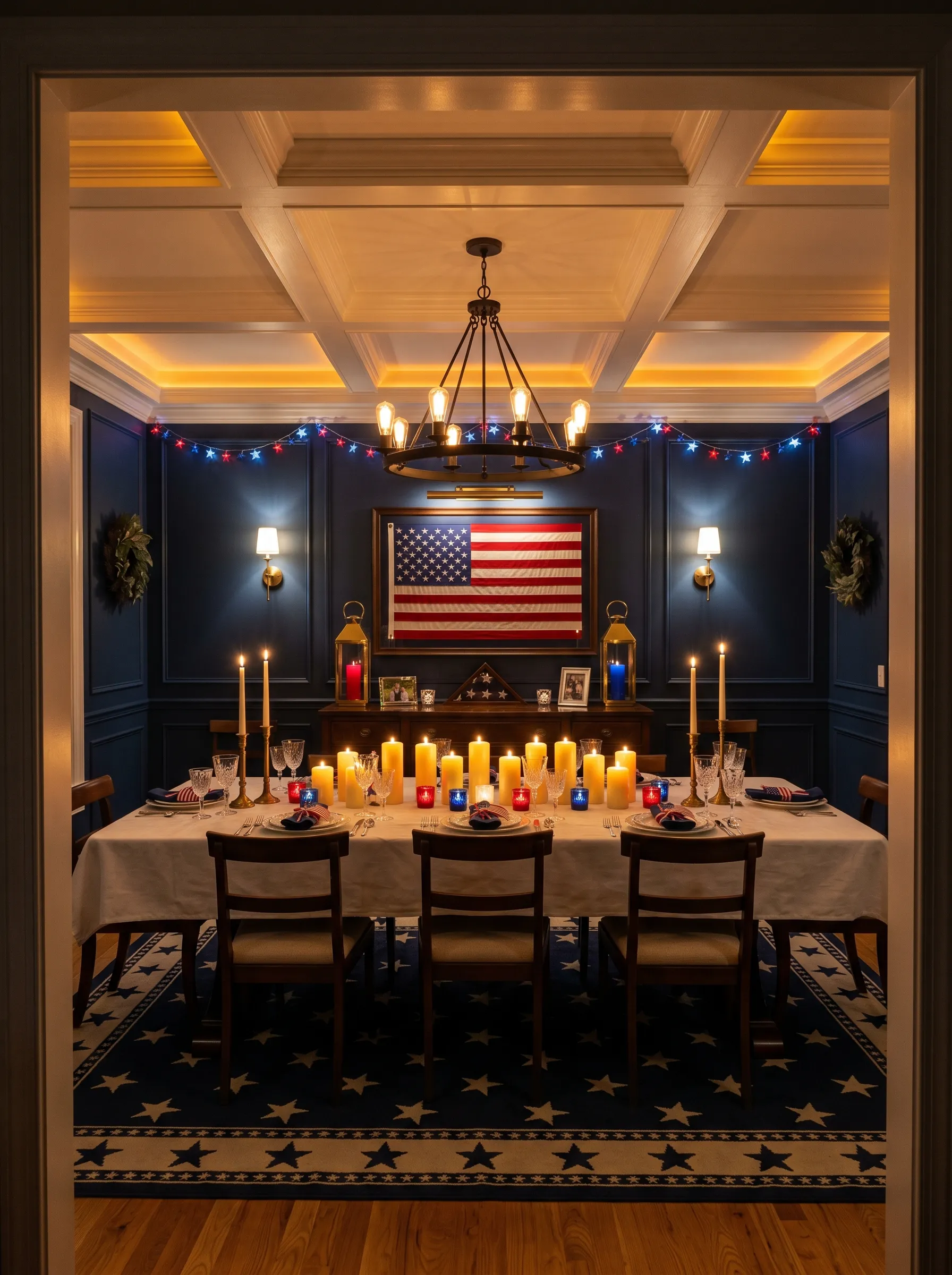
This is the most dramatic look, and it requires the most confidence.
Paint the walls and ceiling trim in deep navy. Install cove lighting behind the crown molding that washes the ceiling in warm amber. Hang a large framed flag on the main wall, lit from above by a picture light. Add brass sconces with white shades, brass lanterns with colored candles, and a wrought iron chandelier with exposed Edison bulbs.
The table should be set with white linen, dark wood chairs, and a centerpiece of multiple candles in varying heights—tall brass tapers, medium glass pillars, small red and blue votives. Crystal glassware. Simple white plates. Navy napkins folded flat.
The string lights along the picture rail should be the only explicitly festive element.
Everything else is just a very well-lit, very beautiful dining room.
The patriotism is in the flag, the colors, and the mood. The decor is in the architecture and the light.
The Dessert Display That Made Patriotism Edible
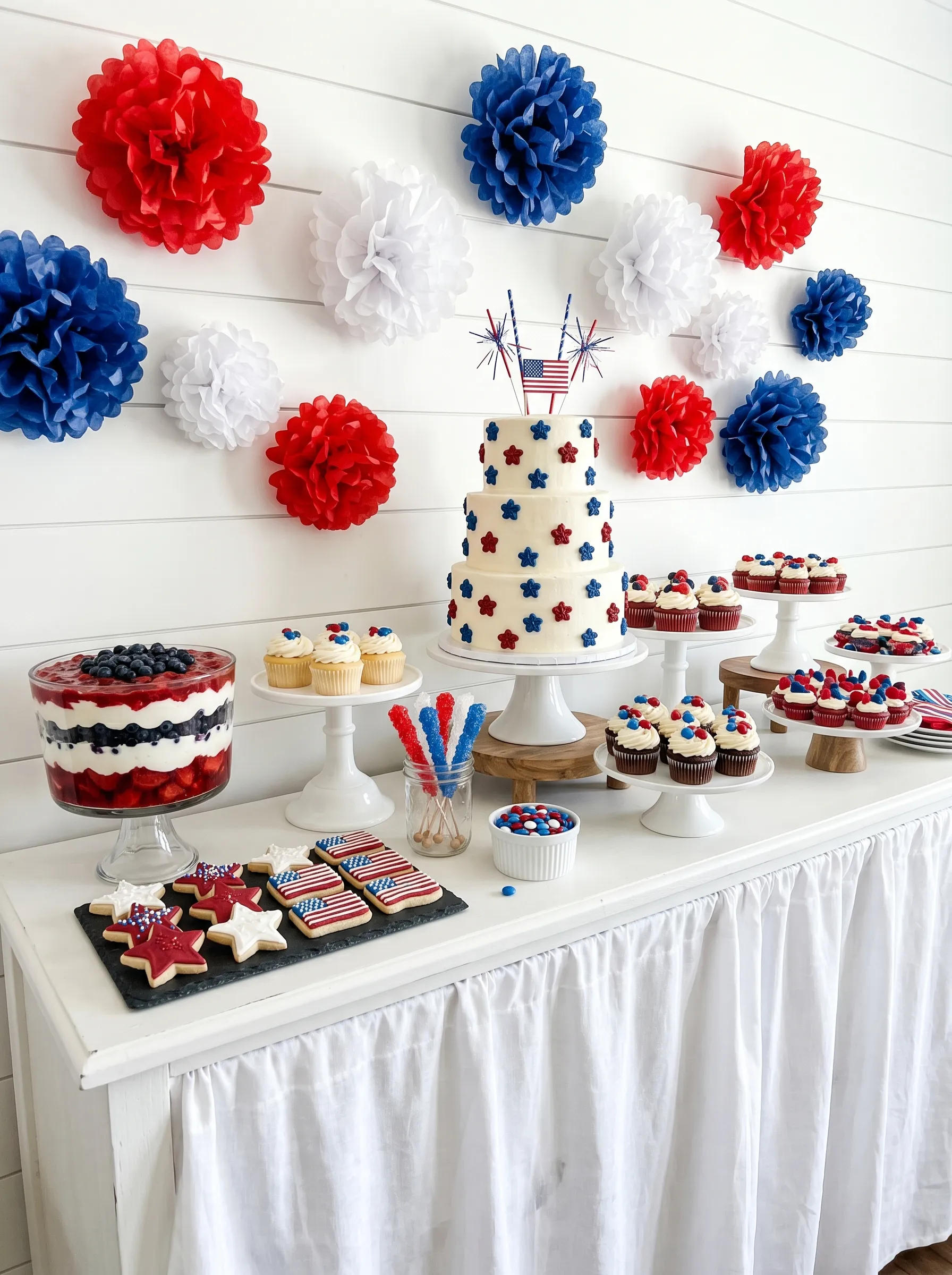
This is not a dining room table. It is a dedicated dessert station, and it operates by different rules.
Cover a long white table with a white skirt that reaches the floor—no legs visible, no storage underneath exposed. Against a white shiplap wall, hang tissue paper pom-poms in red, white, and navy in a scattered constellation, not a grid. They should feel like fireworks frozen mid-burst.
The display itself should rise and fall in tiers. A three-tiered white cake with red and blue fondant stars on a tall pedestal. Cupcakes on white cake stands at varying heights. A large glass trifle bowl with visible layers of strawberry, cream, and blueberry. Sugar cookies shaped like flags and stars on a slate board. Rock candy sticks in red, white, and blue in a mason jar.
The color discipline matters here.
Each item should be clearly assignable to one color.
The cake is white with colored accents. The cupcakes are red velvet with white frosting. The trifle is layered by color.
When the eye can parse the palette instantly, the display reads as designed rather than accumulated.
This works because it treats dessert as decor.
The food is the decoration. Which means it has to look good before anyone eats it—and taste good after.
The Gallery Wall Room That Curated Patriotism Like Art
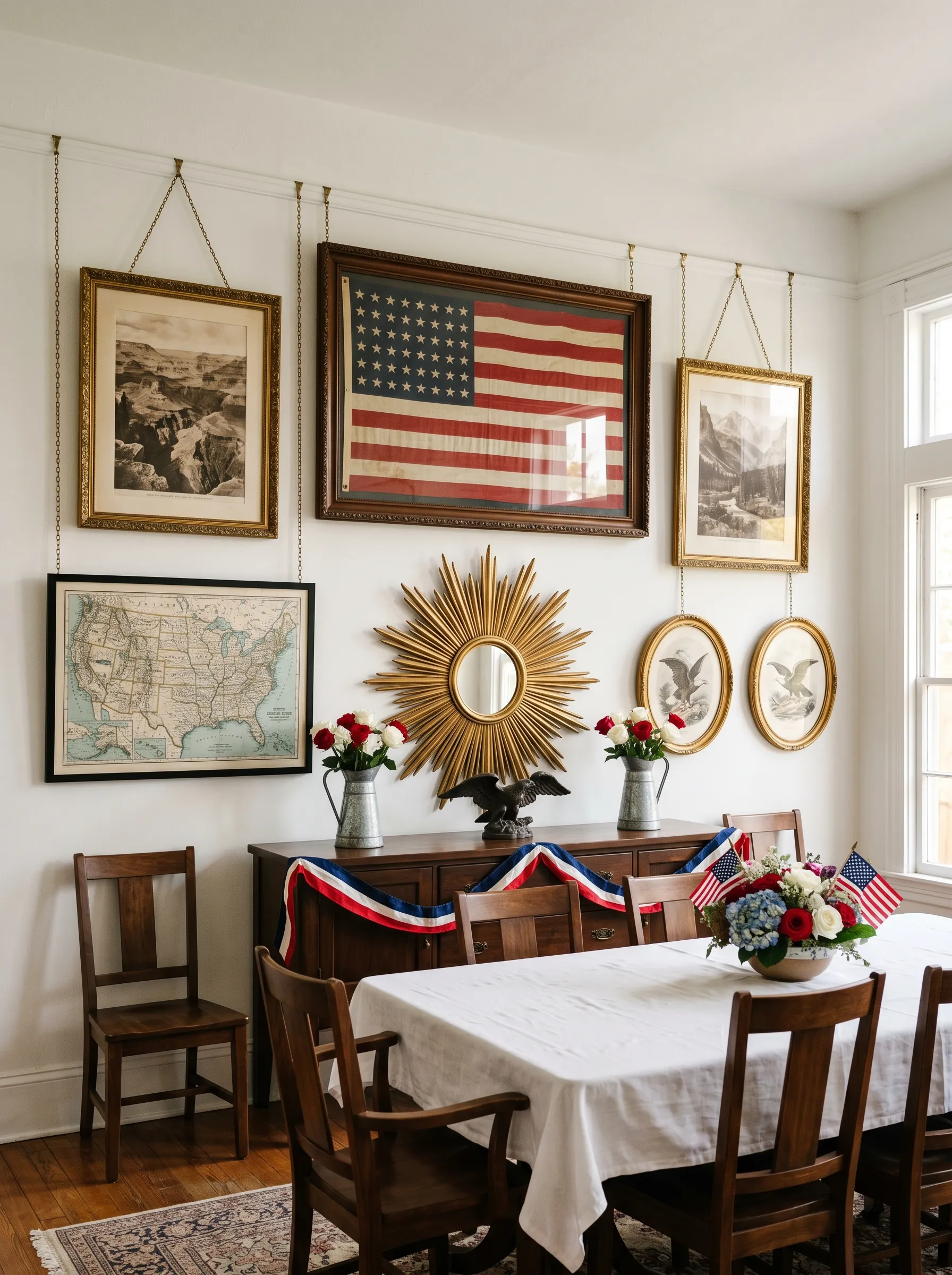
This is for the collector. The person who has things.
Hang a large framed vintage flag in the center of a white wall. Flank it with gold-framed landscape prints hung from picture rail molding with brass chains. Below, add a gold sunburst mirror, two oval eagle prints, and a vintage map of the United States in a black frame. The frames should not match. The arrangement should feel accumulated over time, not purchased in a set.
Below the gallery, a dark wood sideboard with a red, white, and blue bunting draped across the front. Two galvanized pitchers with red and white roses. A cast iron eagle figurine. The dining table in front should be covered in white linen, set simply with wood chairs and a central bowl of mixed patriotic flowers.
This room says that patriotism is part of a larger aesthetic life.
It is not the whole aesthetic.
That distinction matters.
Final Thoughts
The best 4th of July dining rooms don’t look like they were decorated for the 4th of July.
They look like someone with strong taste happens to live in America and is hosting dinner on a summer evening. The patriotic elements are there. They’re just not doing all the work alone. They’re supported by good furniture, thoughtful lighting, real materials, and a clear point of view about how formal or casual the night should feel.
What all these rooms have in common is intention. Someone decided where the eye should go first. Someone chose which surface would carry the patriotic message and which surfaces would stay neutral. Someone thought about what the room would look like at 2 PM versus 8 PM.
That thoughtfulness is what separates decoration from design. And on a holiday that is, at its core, about declaring independence, it seems fitting that your dining room should declare independence from the generic red-white-and-blue template that everyone else is using.
Your guests will notice. Even if they can’t name why.