
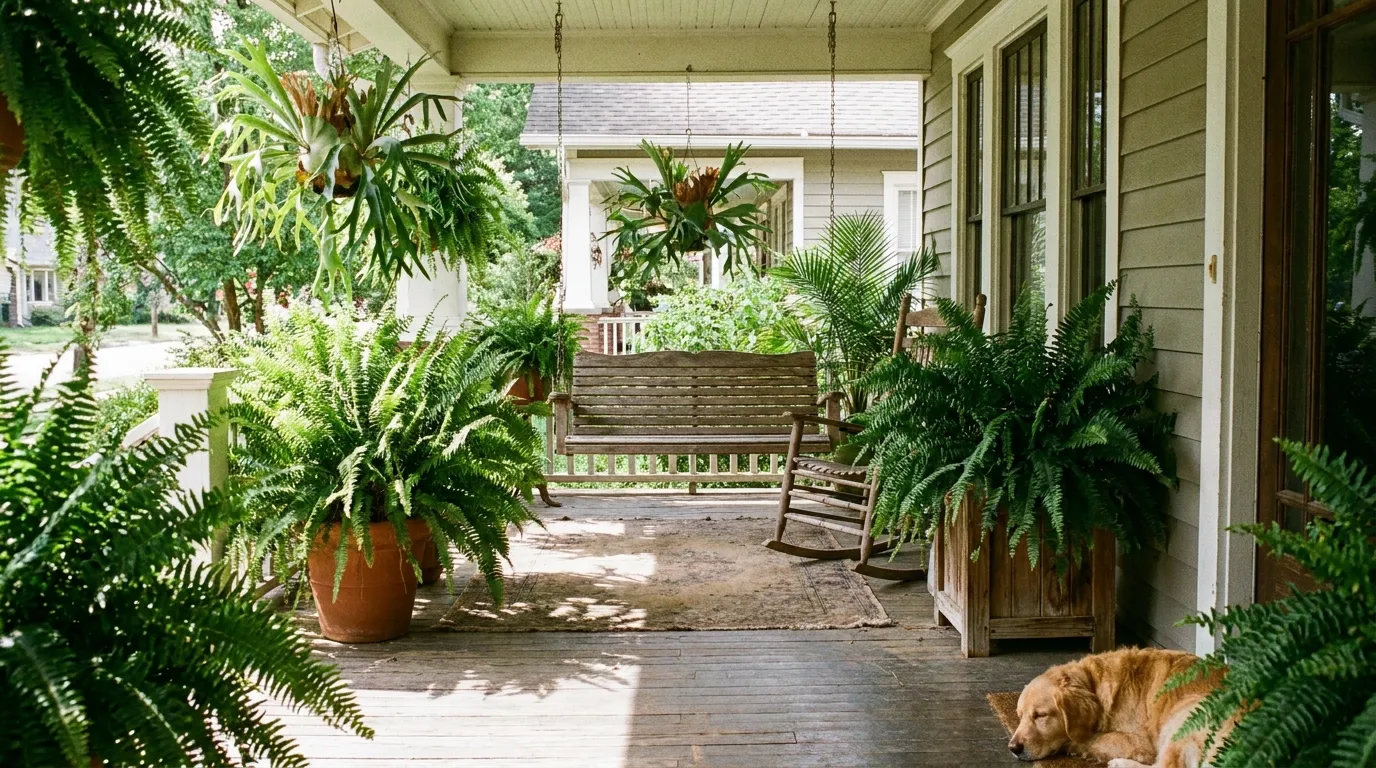
You already know your porch needs plants. You’ve known it for two years. The problem isn’t motivation — it’s that every time you search for ideas, you find the same three suggestions: hang a Boston fern, put a pot by the door, done. That’s not a design decision. That’s a default.
Ferns are one of the most versatile plants you can put on a porch. They work in formal settings and falling-apart ones. They thrive in shade when everything else sulks. They have texture, movement, and — when you stop treating them as an afterthought — genuine presence. The container you choose, the height you place them at, the way you group them: all of it matters more than most people realize.
This is the part nobody says out loud. The fern is almost never the problem. The problem is everything around it. The plastic pot. The single specimen placed with no relationship to anything else. The size that whispers when the space demands something that speaks.
Here’s how to actually do it.
Your Porch Architecture Is Talking. Are You Listening?
Every porch has a personality built into it before you bring a single plant home. Columns, railings, steps, wall materials — these are not neutral. They’re already making a statement. When your fern arrangement fights the architecture instead of extending it, the whole thing looks like an accident.
The Scale Problem Nobody Admits
Most people buy ferns that are too small for the space. A six-inch pot on a wide front porch is a houseplant that got lost outside. The fronds need room to arch, to spill, to fill negative space in a way that reads from the street.
A good rule: the fern should be visually obvious from the sidewalk. If you have to be standing on the porch to notice it, it’s too small. For large porches and wide entries, go for specimens that are at least eighteen to twenty-four inches across. For hanging installations, bigger always wins.
Symmetry Versus Intention
Symmetrical placement — one fern on each side of the door — is the classic approach. It works. But it only works when the symmetry is deliberate and the elements are matched precisely. Two different-sized pots, two ferns at slightly different fullness levels, and the whole thing looks like you couldn’t decide rather than like you made a choice.
If you’re going symmetrical, commit. Match the containers exactly. Use the same fern variety in both. Keep them at the same height. Anything else and you’d be better off going asymmetrical on purpose — one large statement piece offset with a smaller companion at a different height.
What Your Wall Material Wants
Brick wants contrast. White ceramic, galvanized metal, dark glazed pottery — anything that stands out against the warm red-orange of the brick will make both the pot and the plant look intentional.
White or painted siding is the most forgiving surface. Almost any container works. Stone exteriors lean naturally toward weathered, heavy containers — cast iron, rough concrete, aged terracotta — that echo the weight of the material behind them.
The Container Is Half the Decision
People spend thirty minutes choosing a fern and thirty seconds grabbing whatever pot is on the discount rack. Then they wonder why the whole arrangement looks off.
Material Creates Mood
Terracotta reads as warm, cottage, slightly rustic. Galvanized metal reads as farmhouse or industrial. Cast stone or concrete reads as formal or old-world. Black matte ceramic reads as modern. Wire reads as utilitarian-chic, especially in a farmhouse context. The container is not just a vessel. It’s the first thing people notice, before the plant does its work.
Height Changes Everything
A fern sitting directly on a porch floor barely registers. Lift it — on a stand, a barrel, a stacked set of risers, even a crate — and suddenly it occupies the space differently. Eye level is not a requirement, but somewhere between ankle and chest height is where ferns earn their place.
For hanging ferns, the drop matters. Too high and they look like they’re trying to escape. Too low and people walk into them. A frond-tip height of around six to seven feet off the ground is the sweet spot for most standard porch heights.
Mixing Fern Varieties
Boston ferns are the reliable workhorse, but they’re not the only option. Autumn ferns bring burnt-copper colour that plays beautifully against stone. Maidenhair ferns have a delicacy that works well in smaller containers and modern settings. Kimberly Queen ferns hold their shape upright rather than arching, which suits formal or linear arrangements. Knowing which fern to put where — rather than defaulting to whatever the garden centre has most of — is the difference between a coordinated look and a haphazard one.
Porch Fern Ideas
Boston Fern On A Twisted Iron Stand
Find an antique or reproduction iron plant stand — the kind with four twisted, spiralling legs and a flat circular top plate. The twisting of the iron is the detail that earns this arrangement; avoid stands with straight or plain legs. Plant a generously sized Boston fern in a simple cache pot — terracotta, copper, or natural wicker — and set it on the stand so the fronds spill down past the level of the top plate on all sides. The fern should almost obscure the stand when in full growth, letting just the legs show below. Place this at a slight angle to the door rather than directly in front of it for a less formal, more considered feel.
Galvanised Urns With Magnolia Wreath
Pair symmetrical galvanised metal urns on either side of the door, each planted with a full, compact fern — Kimberly Queen works best here for its upright habit. Add galvanised metal lanterns with white pillar candles directly on the ground beside each urn. On the door, hang a large fresh magnolia leaf wreath with a simple ribbon. The palette is monochromatic: grey galvanised metal, white door, dark painted door, green foliage. The lanterns at ground level keep the eye moving downward after it takes in the urns; without them the arrangement would feel top-heavy. Layer a simple striped cotton rug over a coir welcome mat for the final layer.
Wicker Basket On A Whiskey Barrel
Set a whiskey barrel — the full-size kind, not a planter made to look like one, but an actual retired cooperage barrel — on your porch near the wall. On top of the barrel, place a flat wooden board as a surface, and on that surface, a woven wicker basket planter overflowing with a wide, spreading fern. The barrel provides the height and the visual weight; the wicker basket adds a softer organic texture above it. Against stone or brick, this combination grounds the porch in a way that ceramic pots simply don’t. The barrel shouldn’t be planted in — its job is pedestal. The living element is entirely above it.
Urban Brick With Mixed Tropicals
Cover a narrow exterior urban wall with as many ferns and tropical foliage plants as the surface will support. Use every available ledge, window recess, bracket, and hook. The goal is density, not curation. Mix bird’s nest ferns, Boston ferns, and large-leafed tropicals like philodendron. Use a combination of white ceramic pots, terracotta, and hanging baskets; the variety of containers reads as intentional on a textured brick wall because the brick unifies everything behind them. The key is that nothing should look deliberate or arranged — each plant should look as though it found its own spot. The effect is an overgrown, slightly Gothic abundance that suits older urban architecture completely.
Fern Over The Porch Swing
Hang one single, enormous Boston fern from the porch ceiling directly above a swing or bench seat. One fern. Not three. Just one, planted to maximum fullness so it cascades down on all sides. This works because the fern becomes a canopy above the seating, rather than a decoration beside it. The fern and the furniture become one composition. String a single line of globe lights across the ceiling for evening. Don’t add more ferns, more plants, more anything — the restraint is the point.
Wine Crates With Boston Ferns
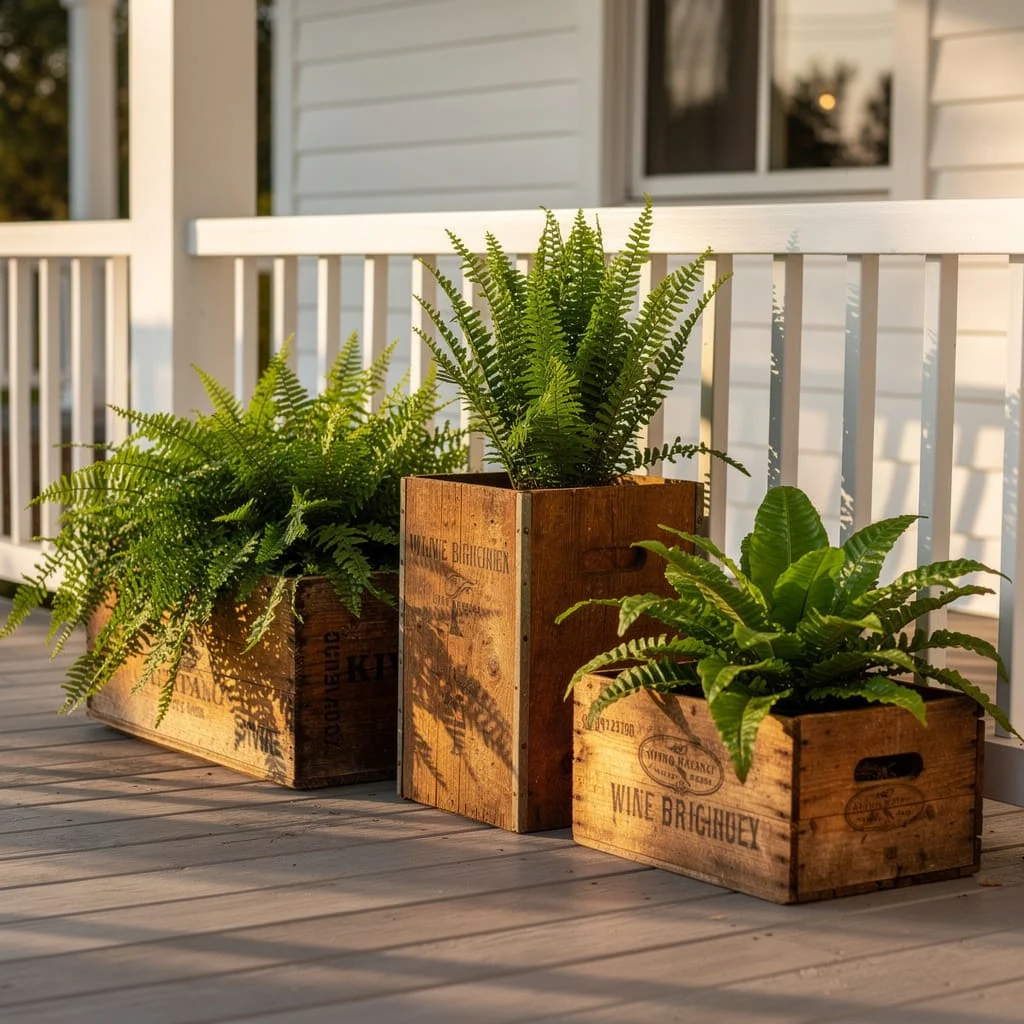
Source wooden wine crates — the kind with stencilled lettering on the sides — from estate sales, antique markets, or wine shops that receive bulk orders. The stencilling is the visual hook; you want it to remain visible, so treat the wood with a single coat of tung oil rather than painting or staining over it. Line the inside of each crate with landscape fabric or a heavy plastic liner before adding potting mix, to prevent moisture from rotting the wood too quickly. Plant a Boston fern with room to spill over the edges in all directions. Arrange the crates in a graduated grouping — a long shallow one, a taller square one, a smaller square one — at different heights on your porch deck. The variation in height is what makes it a composition rather than just three pots sitting together.
Cast Iron Urns On Pedestals
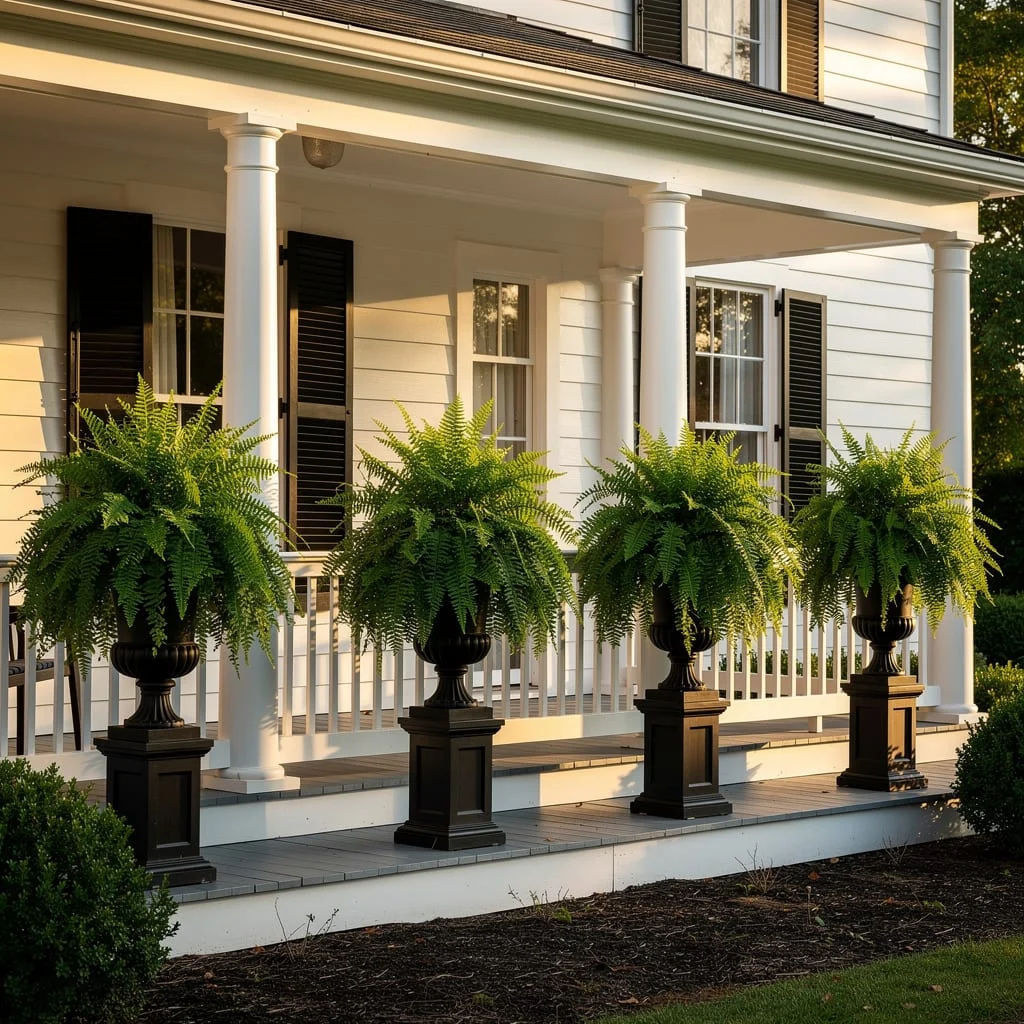
Choose urns with classic campana or goblet profiles — the kind with a flared rim and a narrowing base. The pedestal is non-negotiable; an urn sitting directly on the ground loses about half its impact. Source cast iron or heavy resin urns with the aged patina already built in, rather than trying to fake a finish on something new. Plant Boston or Kimberly Queen ferns to a volume that exceeds the rim of the urn generously — the fronds should arch outward and downward, creating a dome effect that echoes the rounded top of the urn. Line these up in a row across the front of a wide porch for maximum formality, spacing them evenly. The repetition is the point; one or two urns looks sparse, four or five reads as a deliberate design decision.
White Ceramic Globes On The Railing
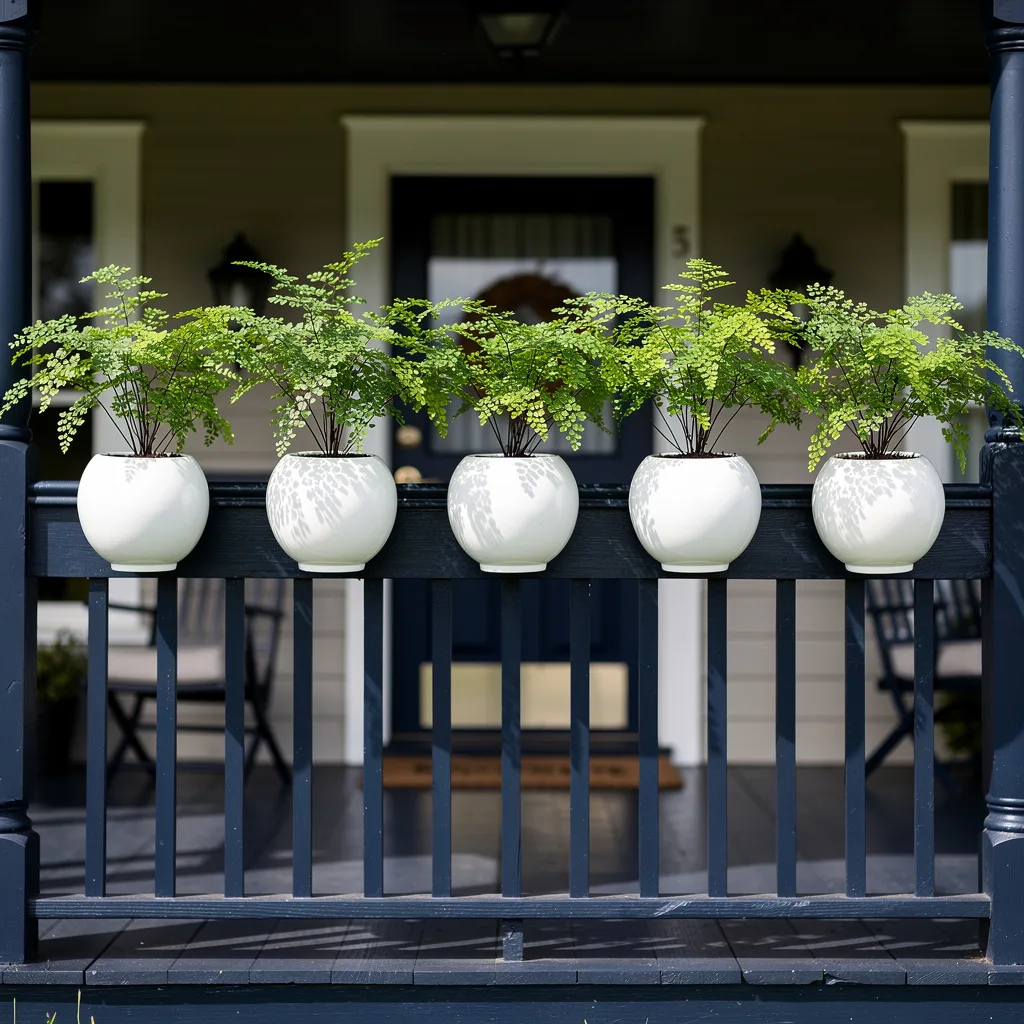
Find low, rounded ceramic pots — globe-shaped, white, with no decorative detail. The simplicity of the form is what makes them work against a dark painted railing. Use maidenhair ferns, which have a fine delicate texture that contrasts with the smooth ceramic. Set the pots directly on the flat top rail, evenly spaced, without anchoring brackets. The uniform spacing and identical containers create a rhythm along the railing that reads as intentional from the street. The dark railing becomes the frame, the white globes are the accent, and the fern fronds provide the movement. Don’t mix pot shapes or sizes in this arrangement — the repetition of identical containers is the whole concept.
Autumn Ferns In Stone Bowls
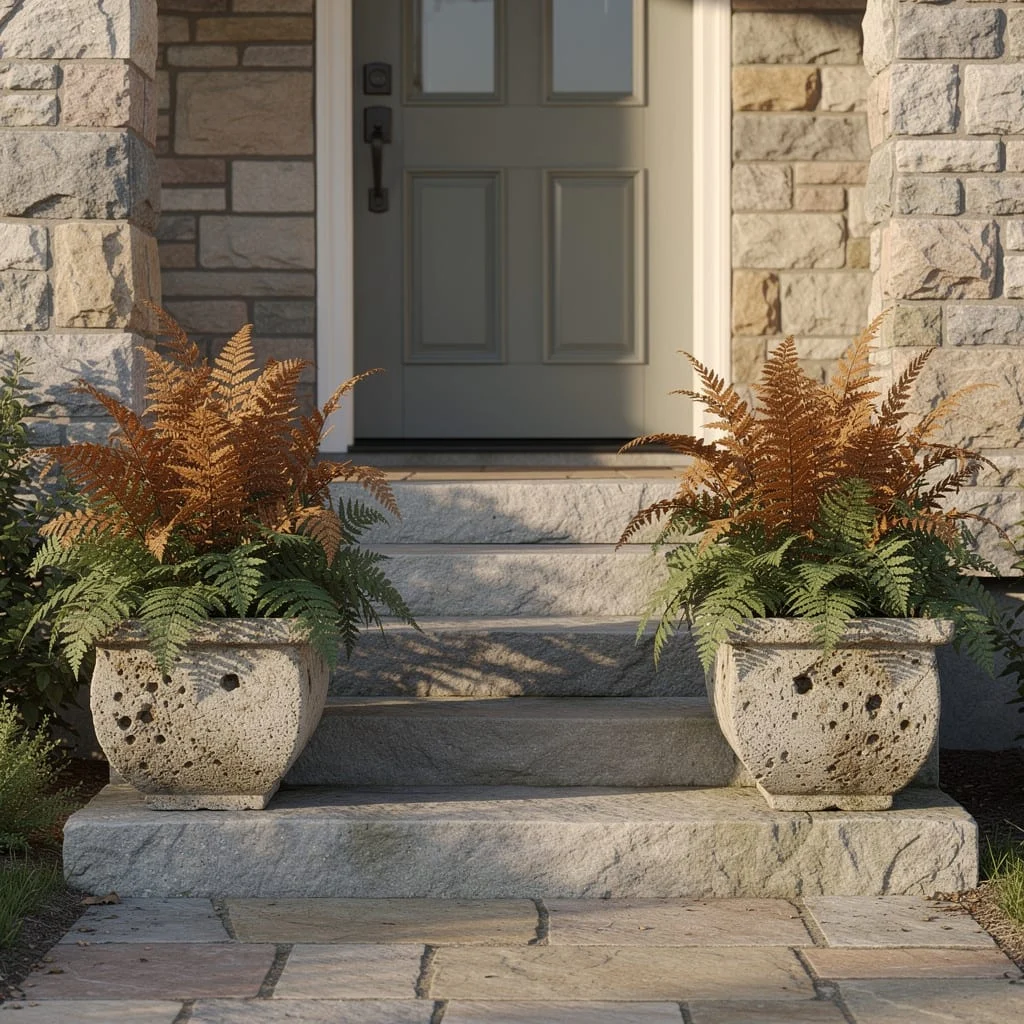
Use low, wide, rough-textured stone or concrete bowls rather than tall pots. Autumn ferns — with their distinctive copper-orange new growth that deepens to green as it matures — look extraordinary against natural stone. Plant them so they overflow the bowl edges slightly on all sides. Place a pair symmetrically on either side of a stone or masonry entry staircase, positioning the bowls on the first step rather than on the ground, so they sit slightly elevated. The mix of burnt fern colour against the grey-white of natural stone is where the real work happens. Don’t add any other plants to the bowl; the fern alone is the statement.
Enamel Colanders As Hanging Baskets
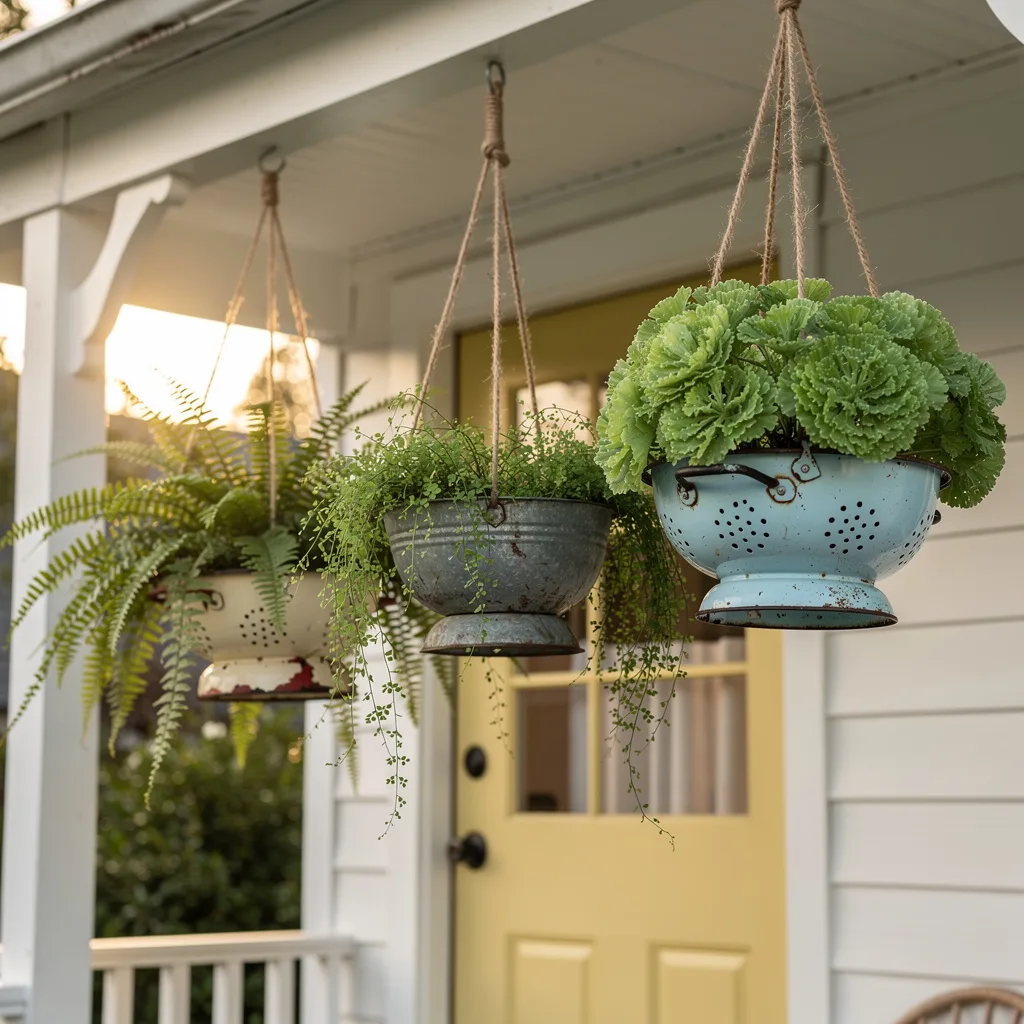
Go to antique markets or thrift stores and find old enamel colanders — the kind with a footed base and two handles, in faded white, grey, and pale blue. The holes in the colander already provide drainage. Thread three lengths of natural jute rope through the handles and the foot holes, tie them off securely, and hang from ceiling hooks. The imperfect, found quality of the vessels is the design point; don’t buy new colanders trying to replicate this. Plant each one with something different — a Boston fern in one, maidenhair in another, trailing string of pearls or wire vine alongside the third. Hang them at slightly different heights across a porch ceiling, staggering the drop by four to six inches between each one for visual interest.
Rustic Ladder Plant Stand
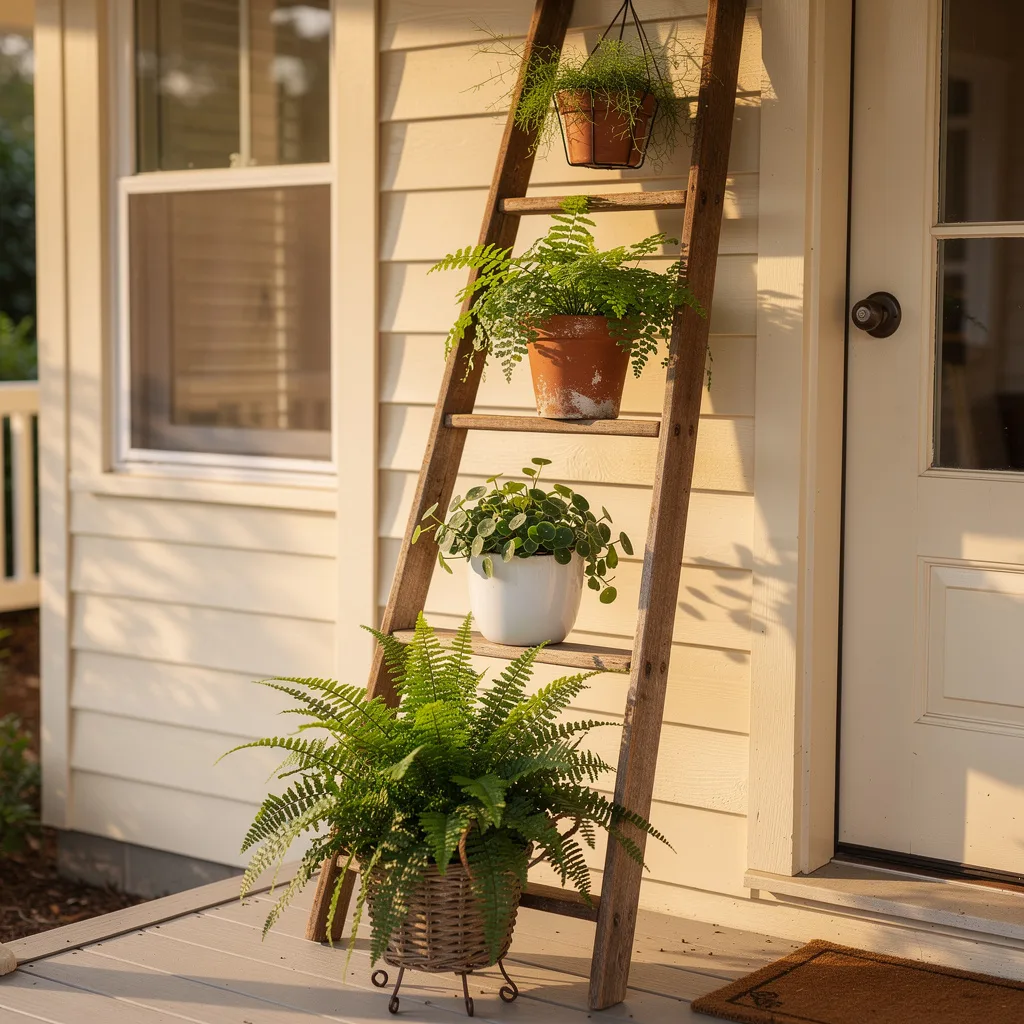
Source an old wooden ladder — a real one, not a decorative reproduction. The worn rungs and weathered wood are exactly what you want. Lean it at a gentle angle against the exterior wall beside the door, making sure it’s stable and not resting against painted siding where it could cause damage. Use a hook screwed into the ceiling or beam above for an additional hanging basket at the top. On the rungs, rest terracotta and white ceramic pots of varying sizes, placing a wicker-basked Boston fern at floor level at the base. The ladder creates vertical movement, and varying the container materials — terracotta, white ceramic, wicker — across the height of it adds texture without looking busy. The key is keeping everything in a natural, earthy palette so the mix of containers doesn’t fragment the look.
Black Grid Wall Planter
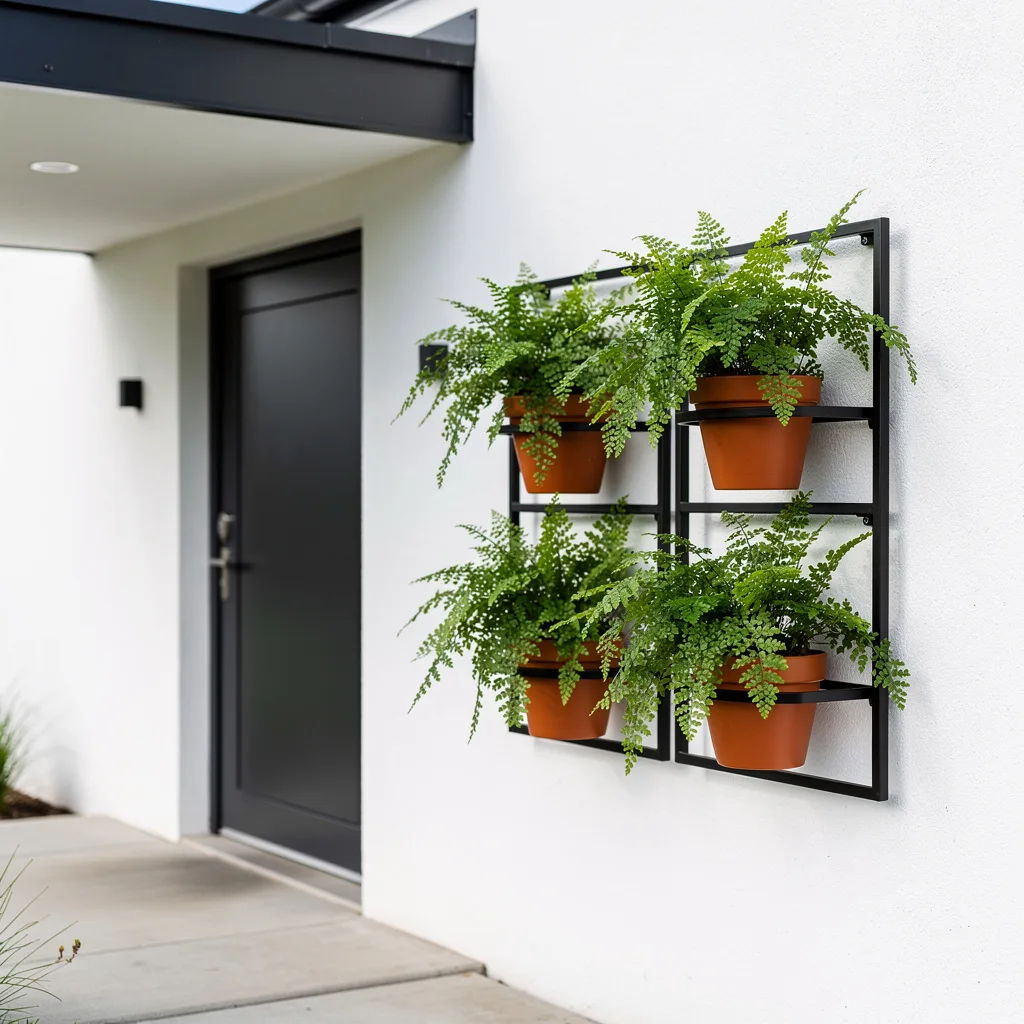
Mount a black powder-coated steel grid frame — the kind with two or three horizontal shelf-bars in a rectangular outer frame — directly onto an exterior white stucco or render wall beside the front door. Use standard terracotta pots that sit on the shelf bars. The terracotta against the black steel against the white wall is the contrast that makes this work. Plant each pot with a different fern variety, allowing the fronds to spill outward asymmetrically. The frame creates structure and formality; the organic overflow of the fern fronds creates the counterpoint. This works especially well on modern or minimalist exteriors where the clean geometry of the frame extends the architectural language of the building.
Dark Green Porch With Gold Hanging Pots
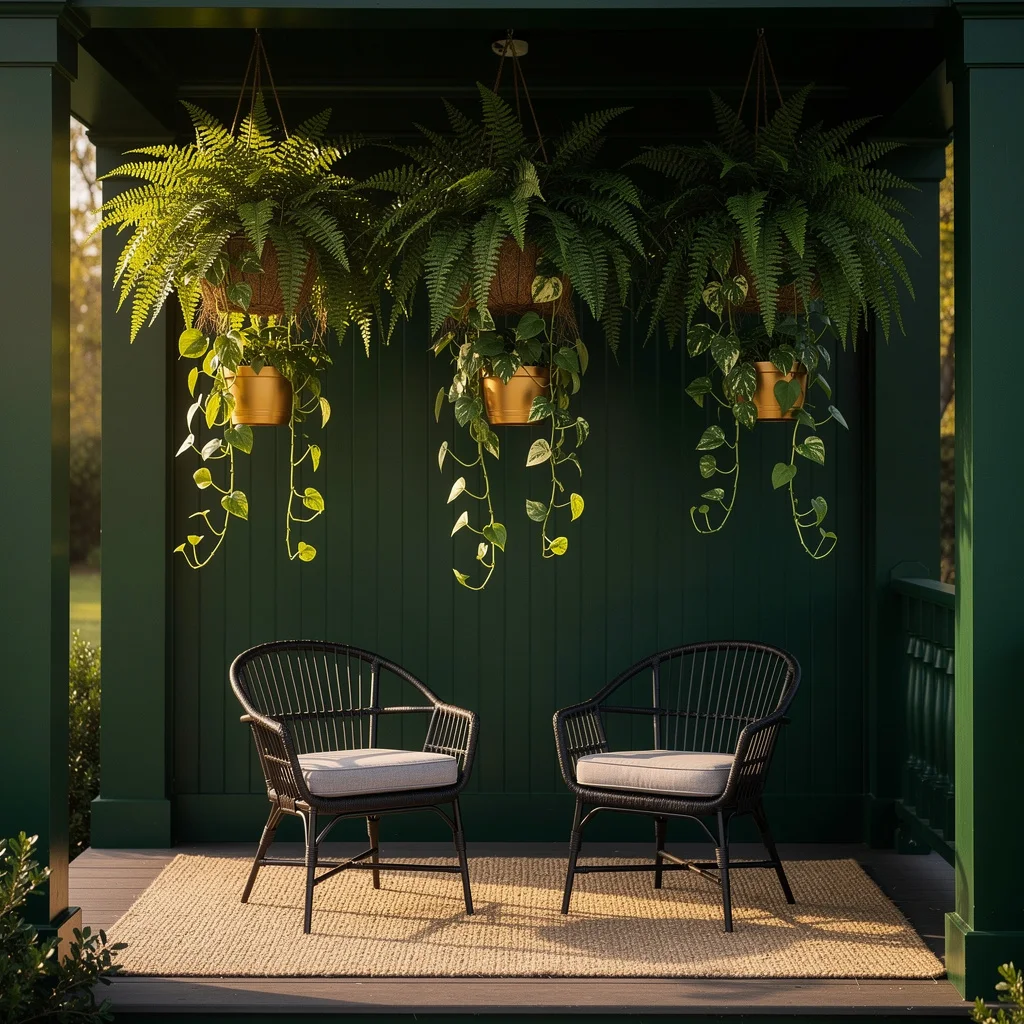
Paint your porch ceiling, back wall, and columns in a deep forest green — something in the range of Farrow and Ball’s Studio Green or Sherwin Williams Hunt Club. The paint does the heavy lifting before a single plant arrives. Hang large Boston ferns in gold or brass-finish cache pots from the ceiling at varying heights using black chain. Below them, in matching gold pots, trail golden pothos vines downward. The green-on-green of the fern foliage against the painted wall creates depth rather than flatness; the gold metallics provide the contrast that stops it from disappearing into itself. Add two dark wicker or rattan chairs and a jute rug at floor level. The entire scheme works because every element is committing to the same palette.
Three-Layer Porch Corner
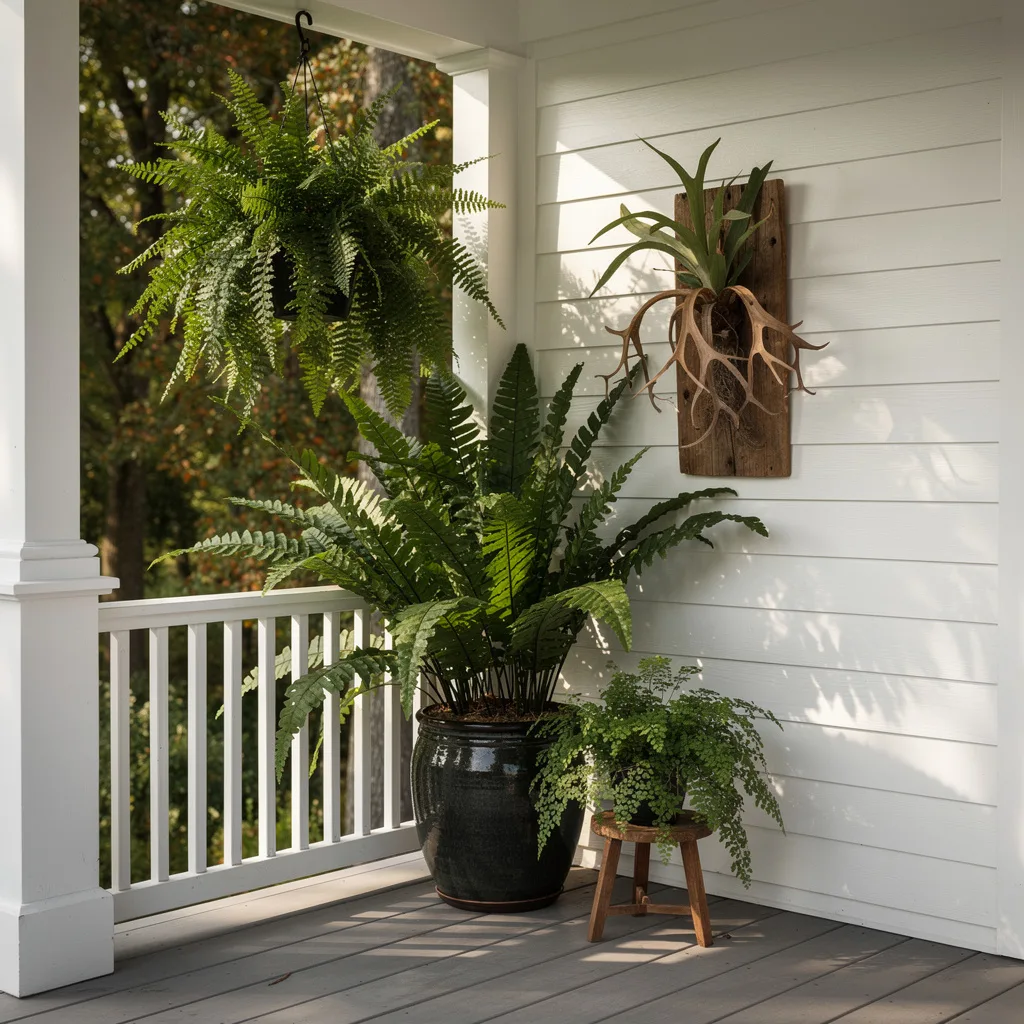
Build a corner arrangement using three different display heights: a large black glazed ceramic floor pot with an oversized sword fern or bird’s nest fern, a small wooden stool beside it carrying a maidenhair fern in a white ceramic pot, and a hanging basket above on a wall hook with a trailing Boston fern. Mount a staghorn fern on a small piece of rough-cut reclaimed wood and fix it to the wall as the fourth element. The staghorn adds a sculptural, almost antler-like silhouette that nothing else provides. The layering of heights — floor, stool, hanging, wall-mounted — is what turns a corner into a considered vignette rather than a random accumulation of plants.
Wire Basket Ceiling Hangers
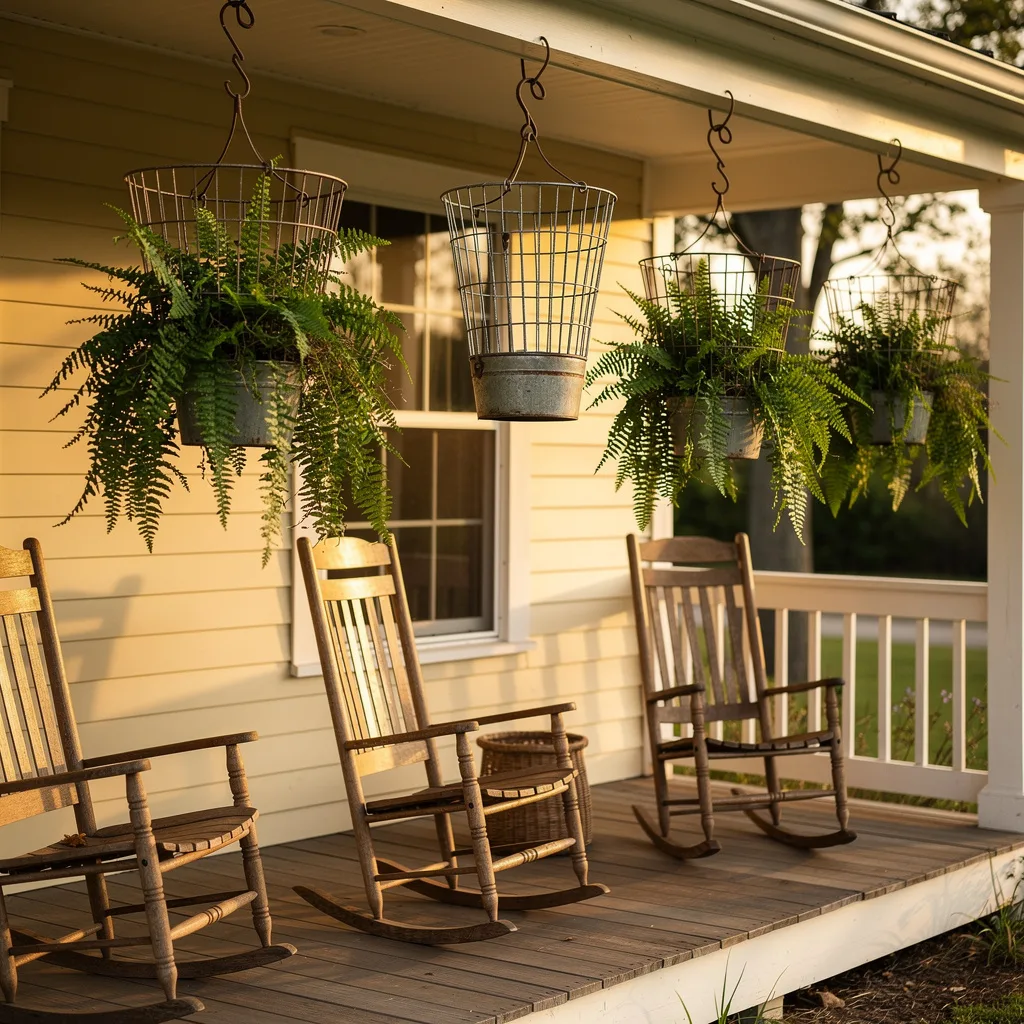
Find vintage galvanised wire baskets — the cone or bucket shape used for egg collecting or general farm storage. Thread a galvanised S-hook through the top of each one and hang from the porch ceiling. Fit a galvanised bucket or tin inside each wire basket as a liner, and plant with trailing Boston ferns. The wire exterior means you can see through to the metal liner inside, creating a layered texture. Hang three or four of these across the porch ceiling above rocking chairs, spaced evenly. The rustic-utility quality of the wire pairs naturally with wood rocking chairs and a warm-painted board-and-batten exterior. Don’t try to make this arrangement look polished; the beauty is in its working-farm simplicity.
Ferns With Edison Bulb Pendants
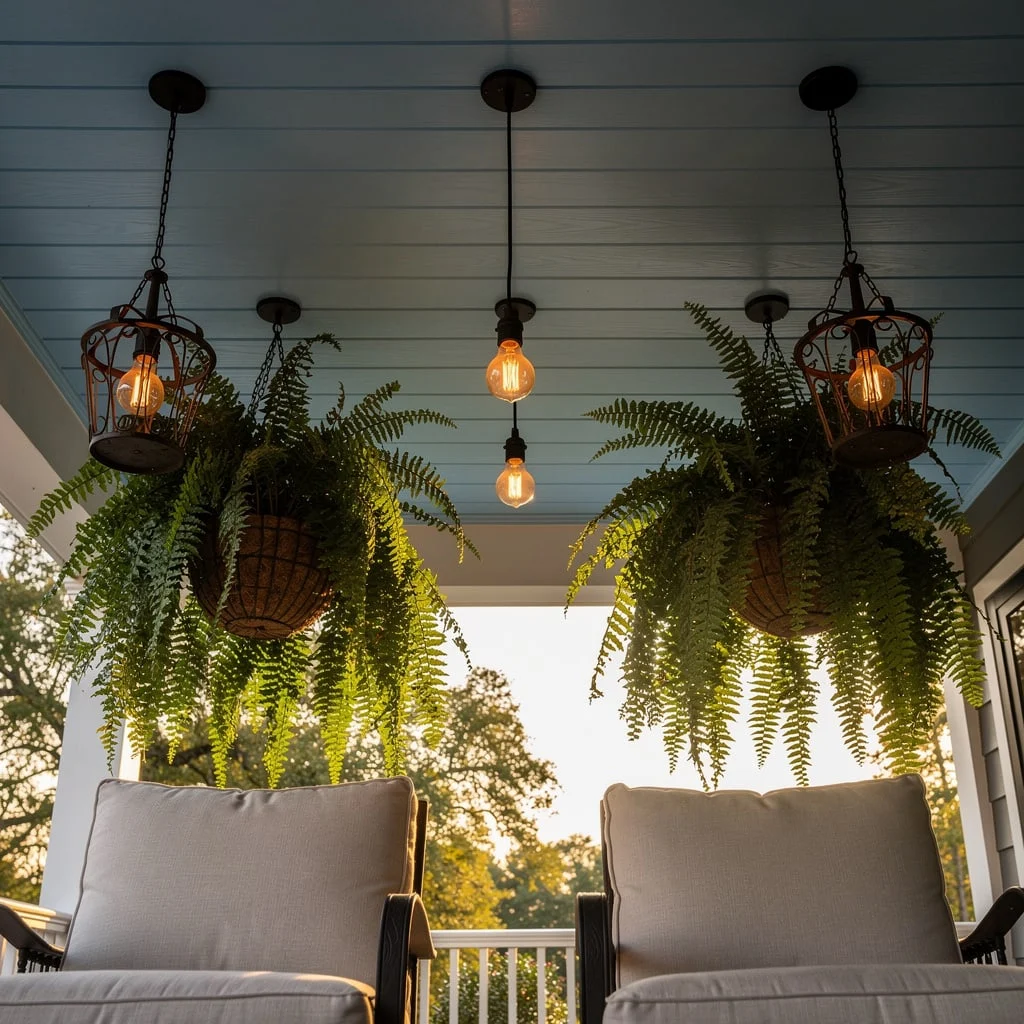
Use coconut fibre or coir hanging baskets — the kind with a natural dark-brown exterior — and plant large, full Boston ferns. Hang them from the porch ceiling alternating with single-bulb pendant lights on black cord, each with a vintage-style Edison filament bulb. The ratio of ferns to lights matters: two fern baskets to every one light pendant creates canopy without darkness. The blue painted porch ceiling above — haint blue or a similar pale grey-blue — acts as a reflective surface that lifts the warmth of the Edison bulbs. At dusk, when the lights come on and the fern fronds catch the amber glow, the porch ceiling becomes something worth sitting under.
Macramé Hangers On A Log Cabin Porch
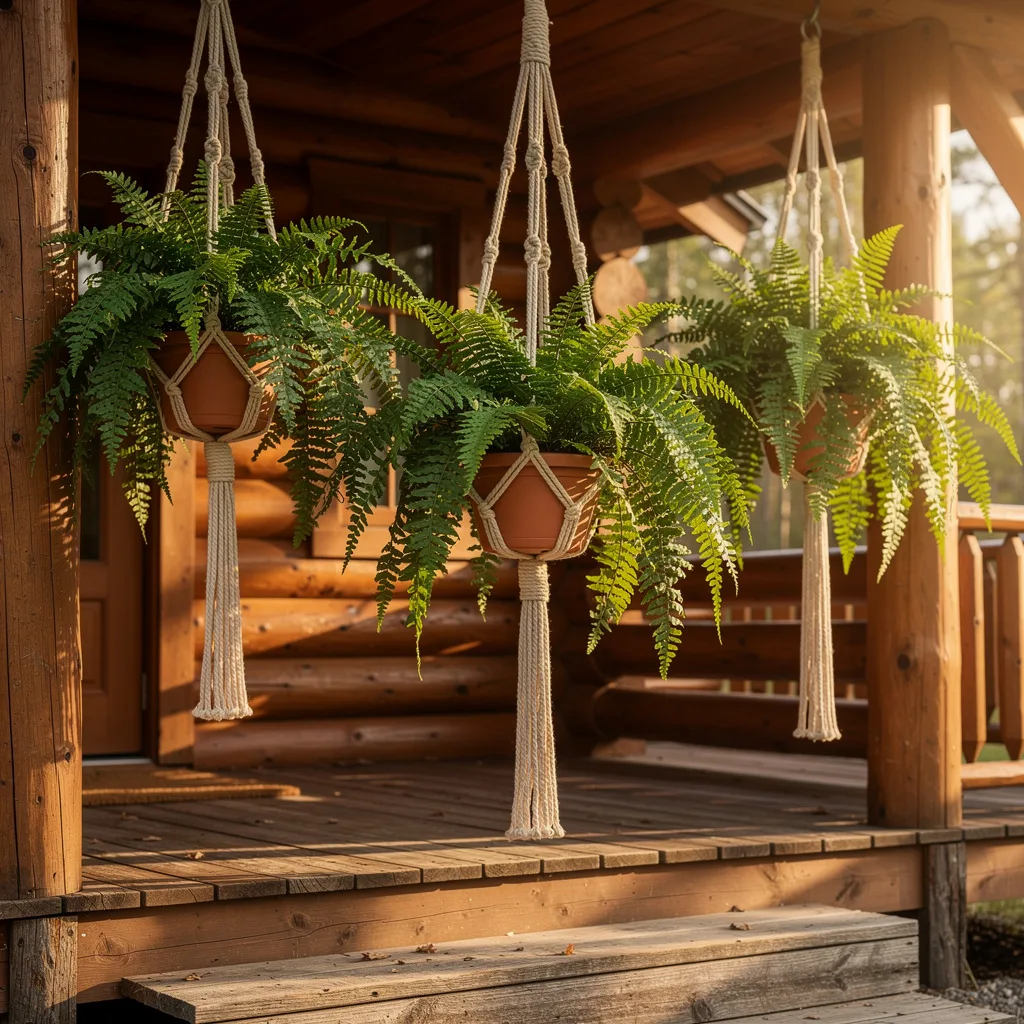
Make or purchase thick cotton rope macramé plant hangers — the kind with a wide knotted body and long trailing fringe below the pot. Use terracotta pots with a standard profile; the macramé needs something simple to frame. Plant Macho ferns or large Boston ferns and hang three across the porch ceiling of a log or timber structure. The natural materials — cotton rope, terracotta, wood — all sit within the same warm-toned family. The knot work of the macramé has enough visual complexity that it becomes its own decorative element above the pots. Space them evenly, hang them at the same height, and let the fronds grow wide enough that neighbouring plants almost touch at their tips.
Layered Brick Entryway Ferns
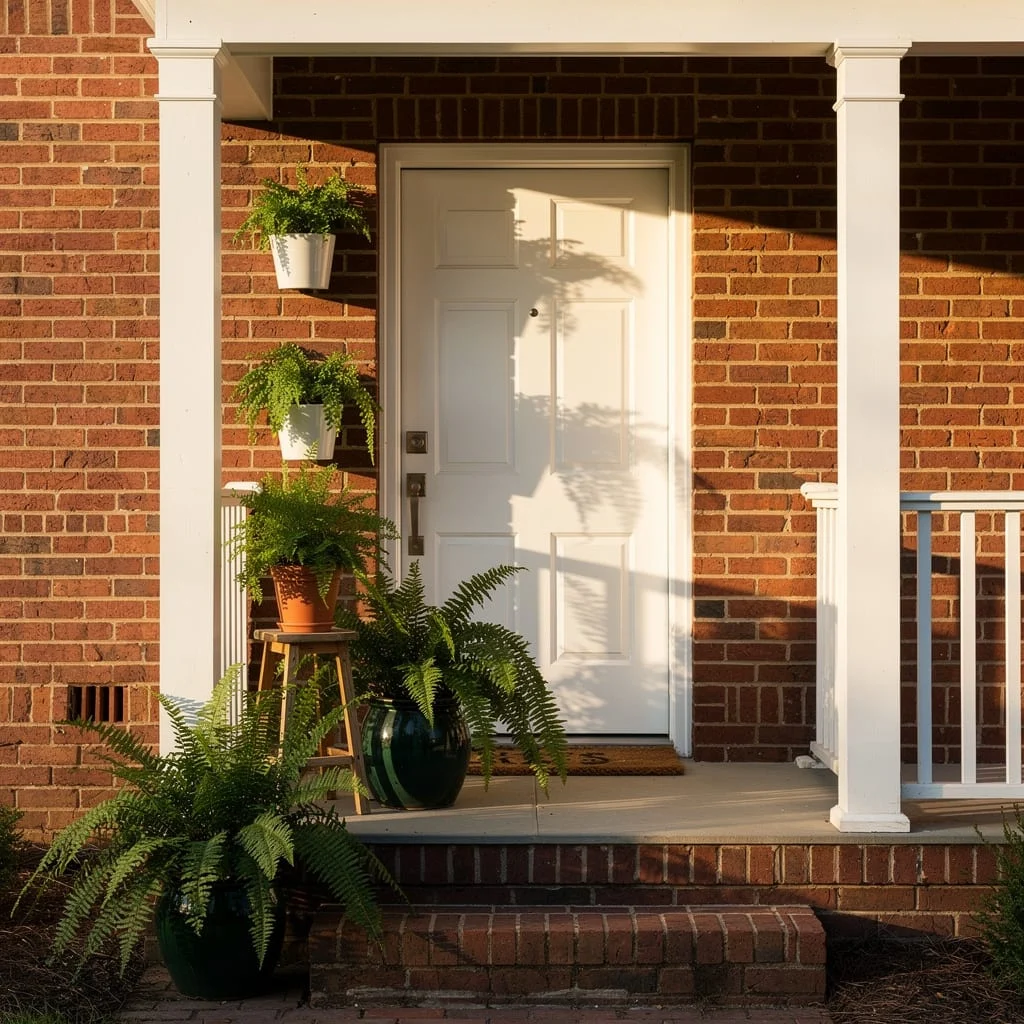
Work vertically against a brick wall beside a front door by using wall-mounted brackets at two different heights and floor-level pots below. White ceramic containers against red brick are high contrast without being aggressive. At the lowest point, use a large dark glazed pot — emerald green or deep navy — for a generous floor fern. On a low wooden stool beside it, place a terracotta pot with a compact maidenhair. At the two bracket heights above, use identical white ceramic pots with smaller ferns. The vertical stack of plants creates a green column alongside the door that frames the entry without blocking it. The mix of container materials — glazed, white ceramic, terracotta — works because the brick wall behind it provides visual unity through colour.f
Final Thoughts
Every porch in this list committed to something. A container choice, a colour decision, a structural approach. That’s what separates them from porches with a fern in a plastic pot shoved against the railing.
The fern itself is the easy part. It grows without asking much. It forgives inconsistent watering better than most plants. It tolerates shade when everything else refuses. What it cannot do is compensate for a container that doesn’t suit the space, a placement that ignores the architecture, or an arrangement that was never actually planned.
A porch does its best work before anyone walks through the door. It’s the first impression your home makes on everyone who approaches it. Ferns can carry a large share of that impression — provided you give them the right context to do it in.
The container is already out there. The fern is already at the garden centre. The porch is already waiting.