
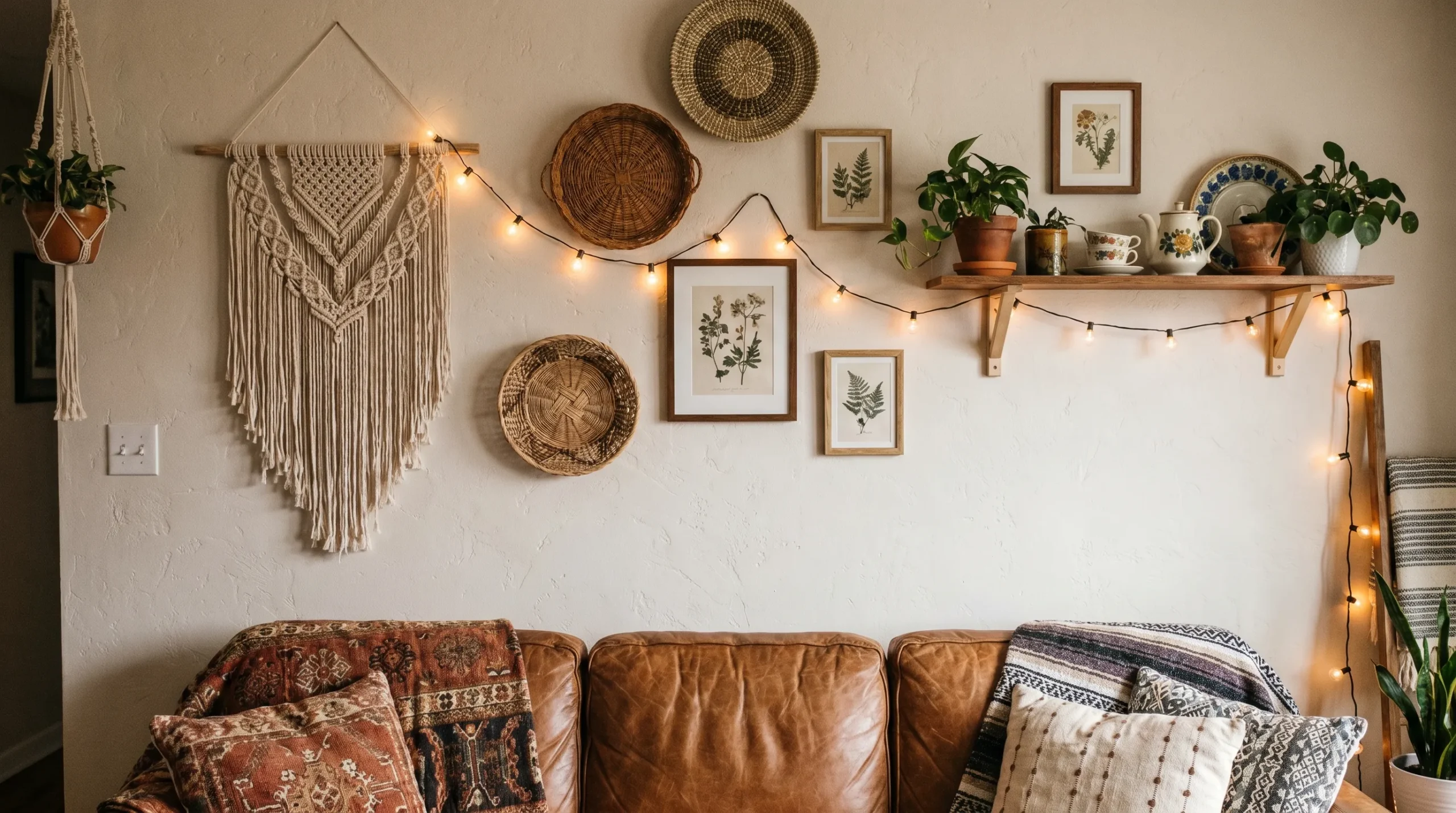
Most walls in most homes are doing nothing. They’re holding up the ceiling and staying out of the way, which is the minimum qualification for being a wall but is not, by any measure, interior design.
In a bohemian room, the wall is an active participant. It holds collections, textures, personal history, and objects that would be strange anywhere else but make complete sense together on a textured plaster surface in warm afternoon light. A boho wall doesn’t shout. It accumulates. And the accumulation, when done well, reads as a room that belongs to someone specific — someone who has been places, made things, gathered objects, and decided they belong together on this particular wall.
The challenge is that accumulated doesn’t mean random. The rooms in this list look effortless because real decisions were made. What goes on the wall. How high. How close together. What surrounds it. The effortlessness is the result of thought, not the absence of it.
How Walls Work in a Boho Room
Before anything goes on a wall, it’s worth understanding what the wall is doing in the room’s composition.
The Wall as a Fifth Surface
Most interior design thinking focuses on four surfaces: floor, ceiling, and two major walls. Bohemian design treats every visible wall as a fifth surface — including the one behind a sofa, the narrow wall beside a door, the corner between two larger walls. No surface is considered background in a boho room. Each one is an opportunity.
This doesn’t mean covering every square centimetre. It means making deliberate decisions about what gets attention and what gets left alone. A heavily decorated wall is more powerful next to one that’s completely bare. The contrast creates rhythm. Trying to give every wall equal treatment results in visual noise with no place for the eye to rest.
Materials That Make Sense Together
Bohemian wall decor operates in a narrow palette of materials: natural fibre, raw wood, woven textile, clay, metal in warm tones, and organic found objects. These materials share a quality — they all look like they came from somewhere, were made by hand, or exist in the natural world. Plastic, chrome, and synthetic fibres don’t belong, not because of snobbery, but because they read as manufactured in a way that breaks the atmosphere boho rooms are trying to create.
Within the natural-material palette, the combinations are almost infinitely flexible. Rattan beside macramé. Seagrass baskets beside dried botanicals. Woven kilim beside brass-framed mirrors. Each pairing is different in colour, texture, and scale, but all of them speak the same visual language.
Height and Hang Points
The conventional rule is to hang art at eye level, with the midpoint of the piece at approximately 145–150cm from the floor. Bohemian walls frequently break this rule — and do so better for it.
A large basket or tapestry hung high, close to the ceiling, draws the eye upward and makes the room feel taller. A cluster of small pieces arranged low, just above a shelf or bench, keeps the eye grounded and the room feeling intimate. The variation in hang height within a composition is part of what makes a boho wall feel like an accumulation rather than a display.
Choosing What Goes On the Wall
The quality of a boho wall is determined by curation, not quantity. More pieces don’t automatically mean better — they mean denser, which is only right if the density is managed.
Anchor Pieces
Every wall composition needs an anchor — the piece that the eye finds first and returns to. The anchor is usually the largest piece, the most visually complex piece, or the piece with the most colour. In a basket wall, it’s the largest basket. In a mixed gallery, it’s the boldest print. In a macramé arrangement, it’s the most intricate hanging.
Once the anchor is placed, everything else positions itself in relation to it. Smaller pieces cluster around it. Simpler pieces balance it. Nothing competes directly with it on the same axis.
Negative Space Is Not Wasted Space
The bare wall around your pieces is not empty — it’s part of the composition. A single large macramé hanging on a wide expanse of white wall is as considered as a full gallery wall. The negative space amplifies the piece rather than abandoning it.
The mistake is treating negative space as a problem to be filled. A wall that has been over-filled reads as anxious. A wall with breathing room around its pieces reads as confident.
Bohemian Wall Decor Ideas
Woven Basket Gallery, Warm Living Room
A collection of African or Moroccan flat-woven baskets hung in an organic cluster above a sofa is the definitive boho wall move. The baskets should vary in size — from 20cm to 60cm in diameter — and vary in pattern. Some with bold black geometric designs on natural ground. Some natural on natural, relying on weave texture for interest. Some with sun-burst patterns, some with concentric spiral motifs.
The arrangement should fill the wall above the sofa without rigid symmetry. Place the largest basket slightly off-centre, then build outward in all directions, letting smaller pieces fill gaps. Some should overlap slightly at their edges. Others should sit with clear space between them. The arrangement looks like it grew rather than was installed.
Below, the room earns its warmth from restraint: a cream linen sofa, terracotta cushions, a round rattan coffee table, a jute rug. A woven pendant lamp completes the tonal consistency. Everything shares the same warm, natural-material language as the baskets on the wall.
Pampas Arch Over the Bed
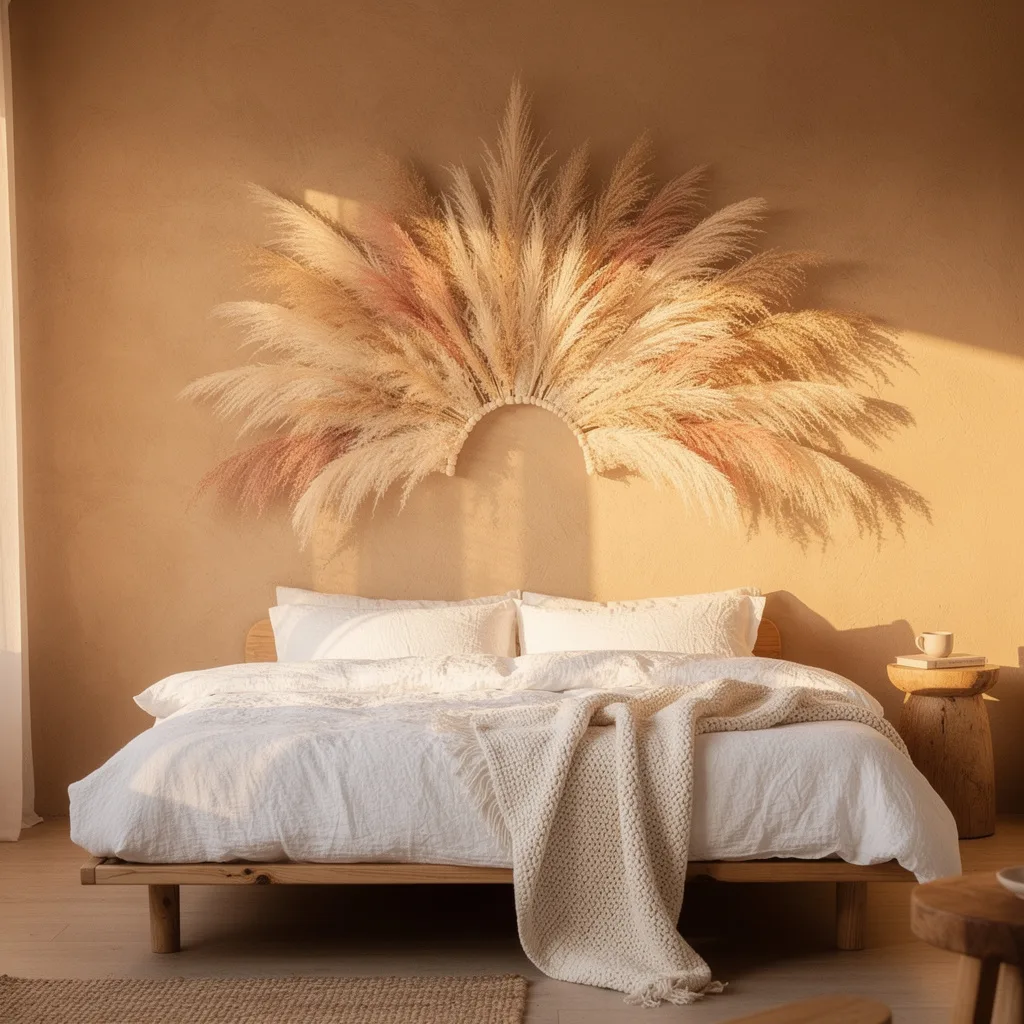
Dried pampas grass arranged in a fan or arch shape behind a bed headboard — using a wall-mounted arch of plaster or paint as the base, with the pampas stems radiating outward from within it — creates a bedroom focal point that has the drama of a canopy without the structure.
The arch is painted in terracotta or warm clay — a brushstroke shape, deliberately imperfect at its edges — on a pale sandy wall. Pampas stems in cream, warm gold, and dusty pink are gathered in a vase or mounted directly behind the headboard so they fan upward and outward, filling the arch.
The bed below is stripped back to white linen with a single knit throw and a ceramic mug on a raw wood stool-nightstand. The more elaborate the wall arrangement, the simpler the bedding must be.
Straw Hats and Woven Discs, Wall Display
Hanging straw hats alongside flat woven baskets and disc ornaments on a white wall is one of the most honest expressions of boho decorating — it puts the objects you actually own on the wall, rather than buying something specifically decorative. The hats vary in brim shape and weave style. The woven discs range in diameter, some with intricate patterns, others plain seagrass.
A large floor mirror in a raw wood frame leans against the same wall, propped in front of the display rather than hanging from it. The mirror’s reflective surface multiplies the wall objects visually, creating depth. Pampas grass in a tall white ceramic vase beside the mirror repeats the warm straw colour of the hats. Woven baskets on the floor complete a room entirely committed to natural texture.
This wall works because it has the courage to be one thing: texture in warm straw tones, without apology or colour.
Trailing Plant Wall Display
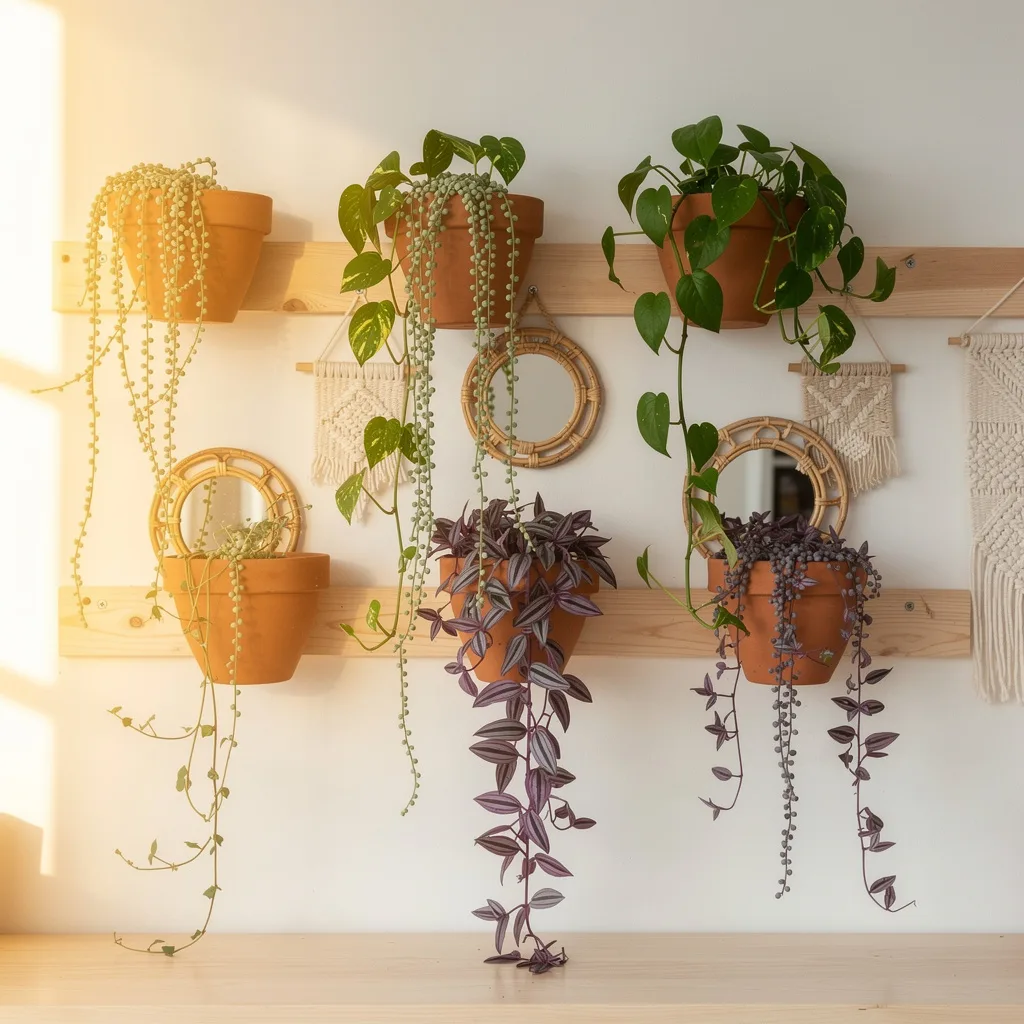
Two horizontal timber rails fixed to a white wall, with terracotta pots holding trailing plants — string of pearls, pothos in green and silver-dollar varieties, tradescantia in deep purple — create a living wall that costs nothing to install and is consistently extraordinary when the plants are healthy.
Between the potted plants on the rails, small rattan circular mirrors and tiny macramé hangings give the eye something to settle on between the flowing stems. The plants and the wall decor are equals here — neither is accessory to the other.
The trails should be long enough to reach the shelf or counter below the rails, or to brush the floor if the rails are high enough. Short, newly planted trailers look like they haven’t grown in yet. Wait until the trails are genuinely extravagant before considering this wall done.
Eclectic Home Office Gallery
A home office wall can be the most personally revealing wall in a house. A floating timber shelf running the full width of the wall, mounted high, holds a mixed display of framed prints, woven baskets, and small objects. Below it, the wall carries a loose gallery: botanical prints in simple frames, a small textile piece, a framed portrait, a kilim wall hanging, an abstract oil.
The arrangement doesn’t follow a grid. Pieces are at different heights and distances from each other. Some overlap the shelf’s shadow line. A wicker pendant light overhead is the anchor that pulls the eye upward and gives the room’s ceiling a presence it wouldn’t otherwise have.
What makes this work is that the pieces clearly belong to someone. They’re not a curated set. They look collected — some bought, some made, some found, some gifted. The wall is autobiography, which is the highest aspiration of bohemian decorating.
God’s Eye Wall of Colour
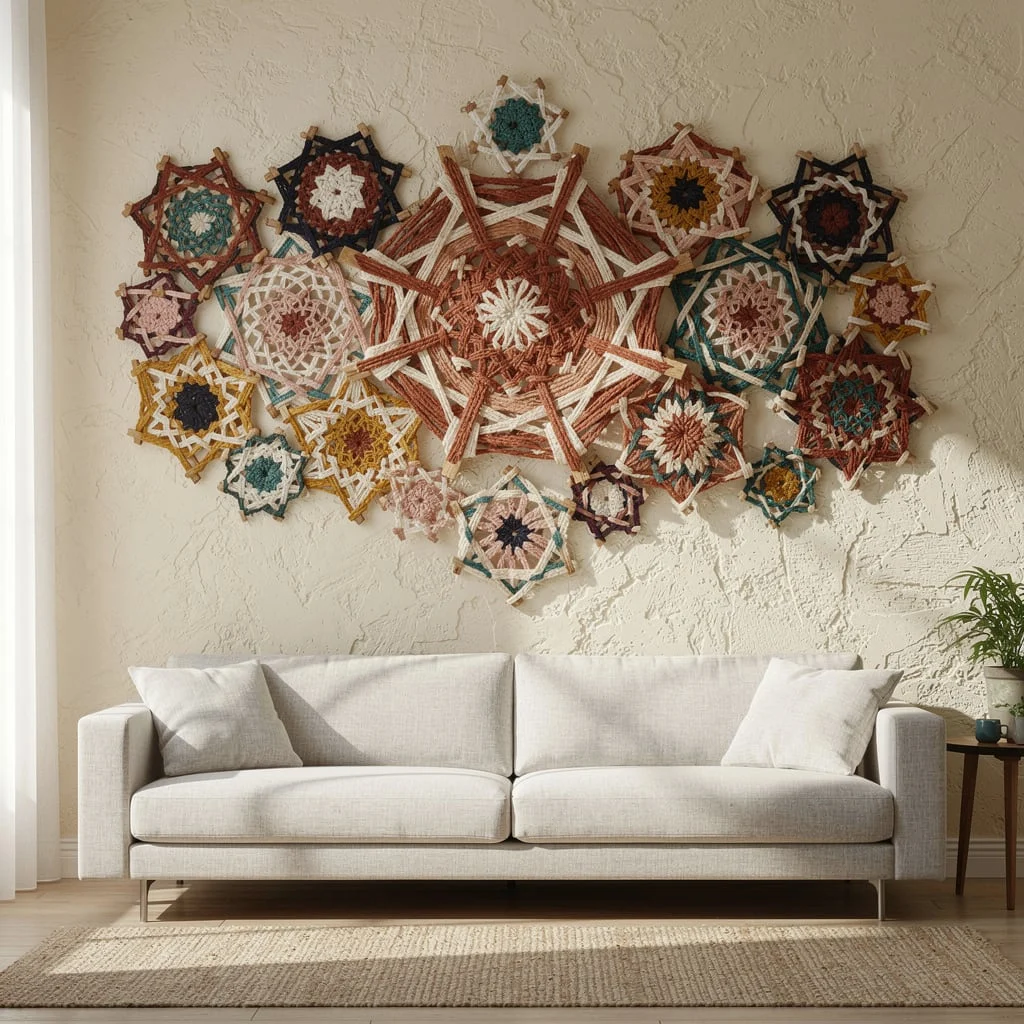
A Ojo de Dios — the Mexican craft of wrapping yarn around a cross of sticks — is, at its core, a coloured geometric mandala. When twenty or thirty of them are arranged across a wall in varying sizes, the effect is kaleidoscopic. Terracotta, teal, mustard, burgundy, dusty pink, deep navy — each one a different combination, some sharing colours, none identical.
The arrangement should look like a constellation. No grid. The largest pieces clustered slightly right of centre, with smaller ones scattered outward. The wall texture should be rough — limewash or Venetian plaster — so the shadows of the wrapped sticks create depth at different times of day.
Below this, a clean white or cream sofa keeps everything else quiet. The wall is the room’s entire decorative statement. Everything else is context.
Macramé and Bench Entryway
An entryway wall is the first impression a home makes. A large statement macramé hanging — worked in a V-shape or diamond pattern on a thick natural wood rod, with long fringe tassels at the base — gives an entryway a presence that a piece of art rarely achieves at the same scale. The knotted texture casts interesting shadows on shiplap or smooth-painted walls as light changes through the day.
Below the hanging, a simple timber bench with hairpin legs grounds the composition. The bench holds a collection of pattern-mixed cushions — kilim, geometric, stripe — without any attempt to coordinate them. A seagrass storage basket sits at one end. A hanging plant trails down from a hook beside the window. A colourful kilim runner on the floor ties the colour from the cushions down to the ground.
The entryway announces the room’s personality before anyone has stepped further inside.
Large-Scale Abstract Canvas
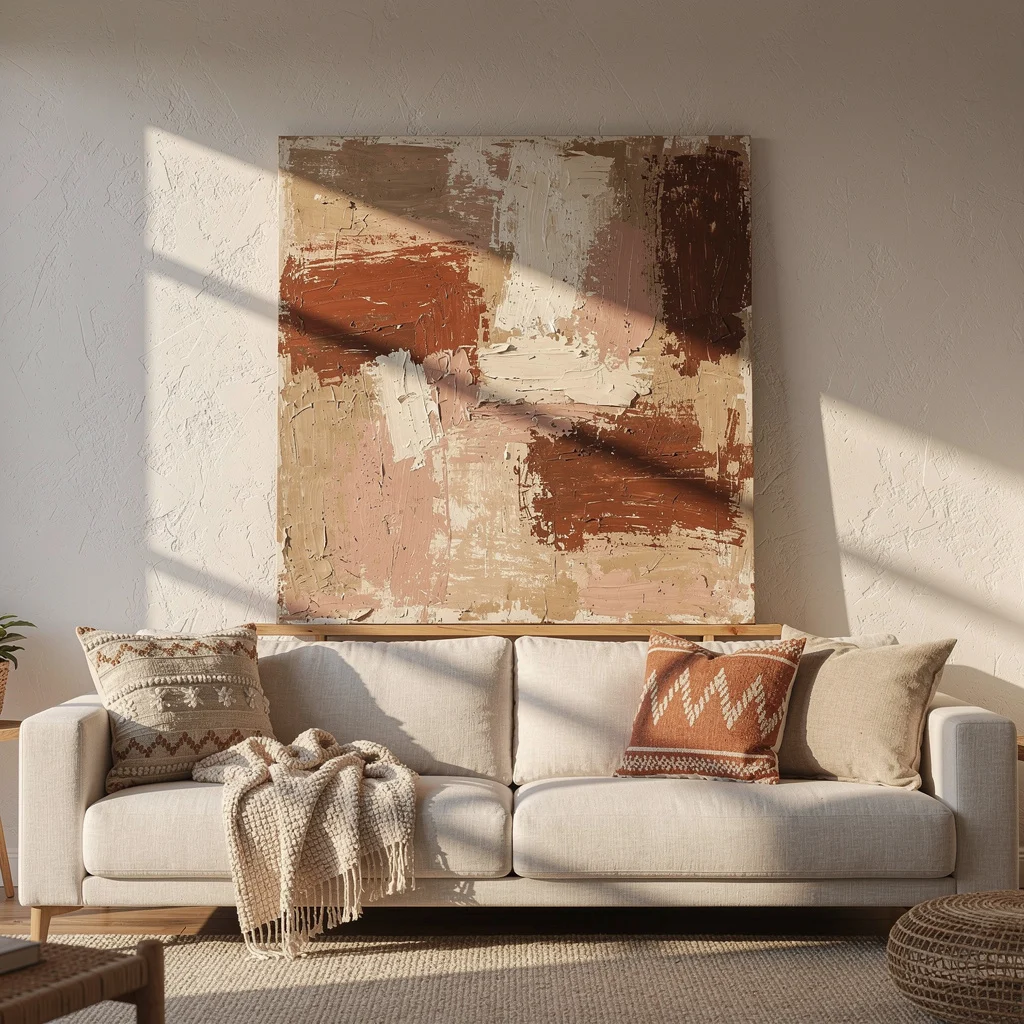
A single large-format abstract painting in a palette of terracotta, cream, dusty rose, and deep brown hung above a sofa is the most direct version of boho-meets-contemporary. The texture of the canvas is the point — thick impasto brushwork, palette knife marks, the surface of the paint as physical as fabric.
The painting shouldn’t be framed. Canvas edges visible, no border, no glass. The rawness of the unframed canvas is part of the aesthetic. Its colours directly inform the cushion choices on the sofa below: terracotta kilim cushions, cream linen, a warm knit throw.
This wall works because it makes one big decision and commits to it. No accessories, no layering, no additional pieces. Just the painting, the wall, the sofa, and the trust that one strong piece is enough.
Macramé Leaf Hanging
Macramé feather or leaf wall hangings — where individual knotted pieces in olive, sage, moss, and cream cotton are hung at different lengths from a single driftwood or branch rod — bring botanical energy to a wall without the watering schedule. The layering of the leaf shapes, overlapping and at varying depths, creates a sense of movement.
In a room with live monstera plants at floor level, the wall hanging extends the plant energy upward. The wall becomes a continuation of the room’s greenery rather than a separate decorative choice. Against a warm blush plaster wall, the greens read as both natural and warm — not the cool blue-green of a painted accent wall, but the alive quality of foliage.
Keep the surrounding wall clear. The hanging is delicate and layered; it needs clean space to read.
Celestial Bedroom Mural
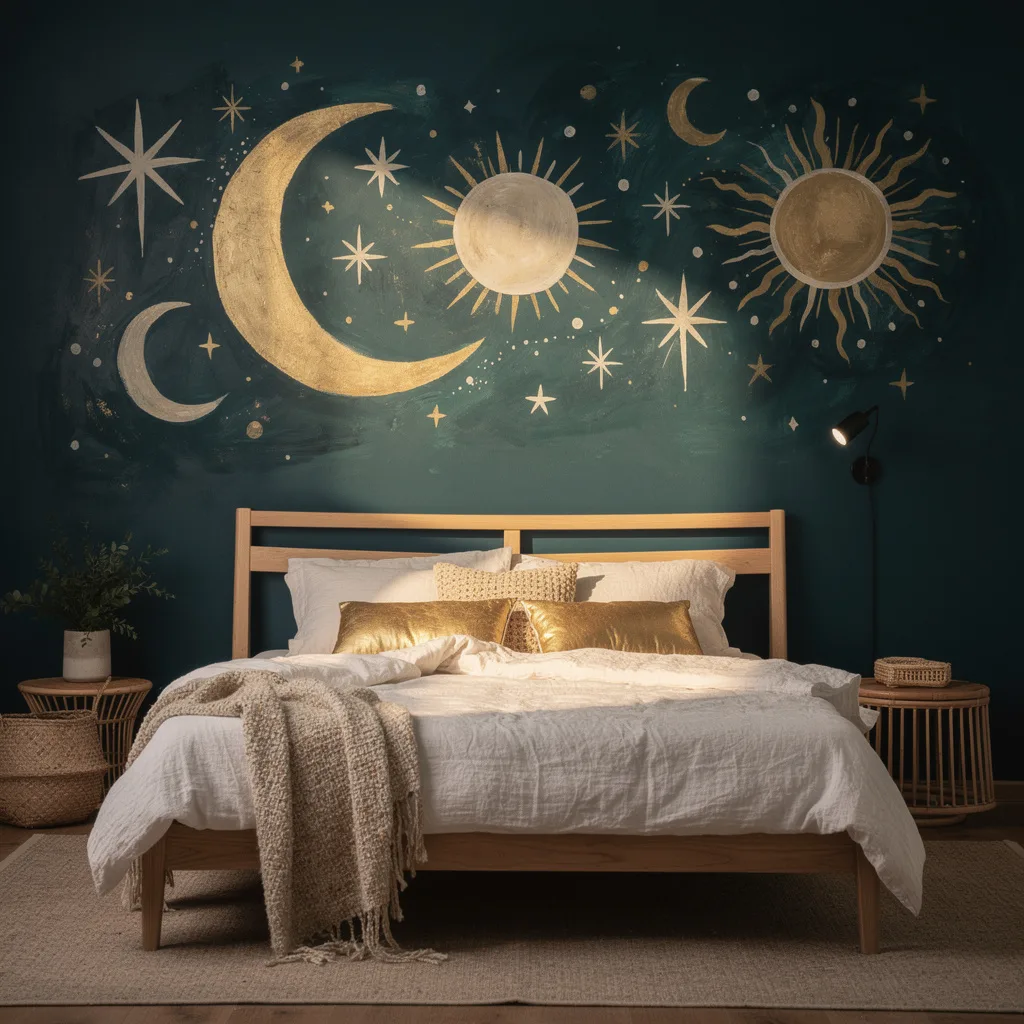
A hand-painted mural in deep teal with gold and silver celestial motifs — crescent moons, radiating suns, eight-pointed stars — painted directly on the plaster wall above the bed is the most committed wall decor choice in this list. It’s permanent. It changes the room’s entire register. Done well, it makes a bedroom feel like a place that exists slightly outside ordinary time.
The execution doesn’t need to be professional. Deliberate imperfection — slightly uneven line weight, hand-painted rather than stencilled edges — is actually preferable. It signals that a human made this, not a machine.
Against the deep teal, gold metallic cushions on white linen bedding catch the colour from the wall. Rattan drum side tables in natural honey tones warm what would otherwise be a room that skews cold. The mural is the room’s entire personality and the rest of the décor simply acknowledges it.
Layered Wall Above the Bed
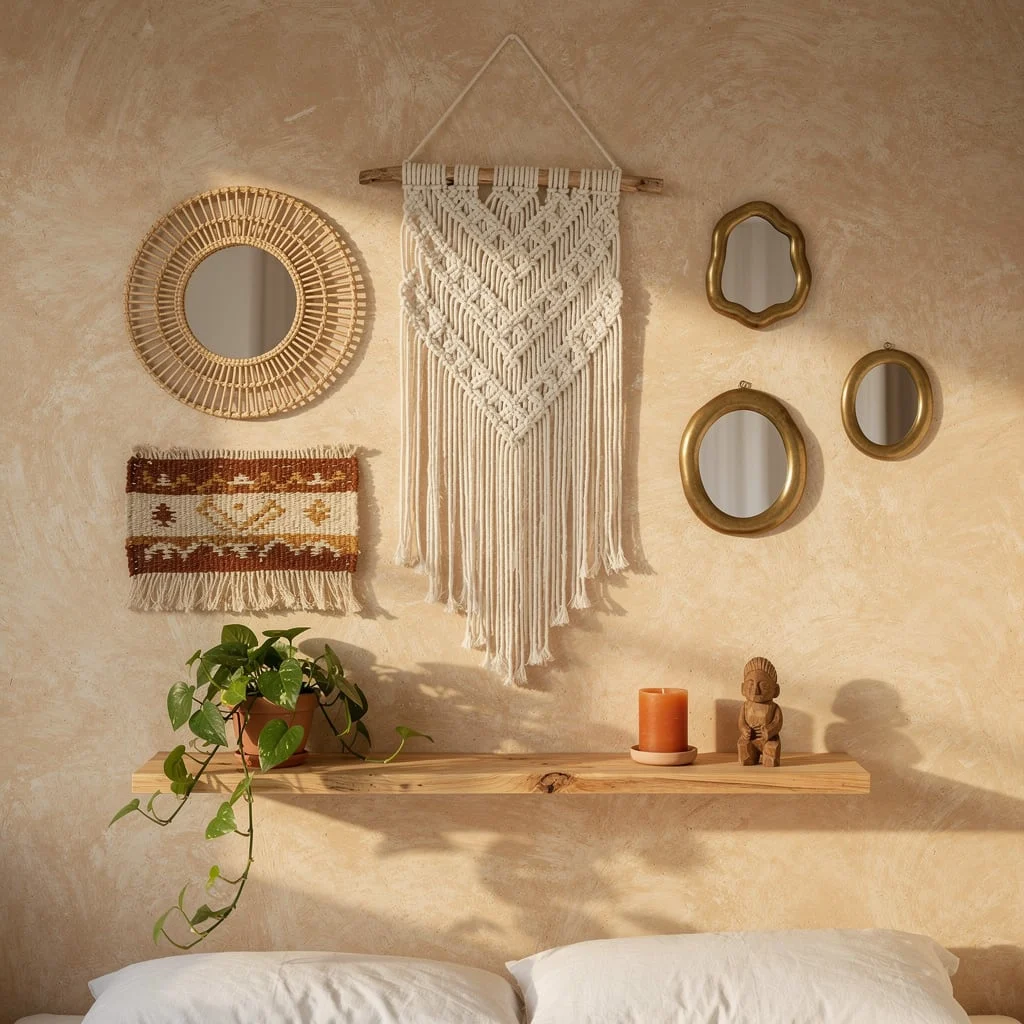
A composed wall behind a bed — a macramé hanging on a driftwood rod at the centre, a rattan circular mirror to the left and slightly lower, a small kilim textile square below the mirror, three small brass-framed mirrors of different shapes clustered to the right — is a wall that has been built over time rather than decorated in a day.
Below the arrangement, a floating timber shelf holds a trailing pothos in a terracotta pot, a pillar candle on a clay saucer, and a small carved wooden figure. The shelf itself is part of the wall composition, not a separate element.
The key is that each piece on this wall is doing something different: the macramé provides texture and movement, the rattan mirror adds reflection, the kilim provides pattern and colour, the brass mirrors add a different material warmth. No two pieces compete because no two pieces are trying to do the same thing.
Painted Arch Focal Wall
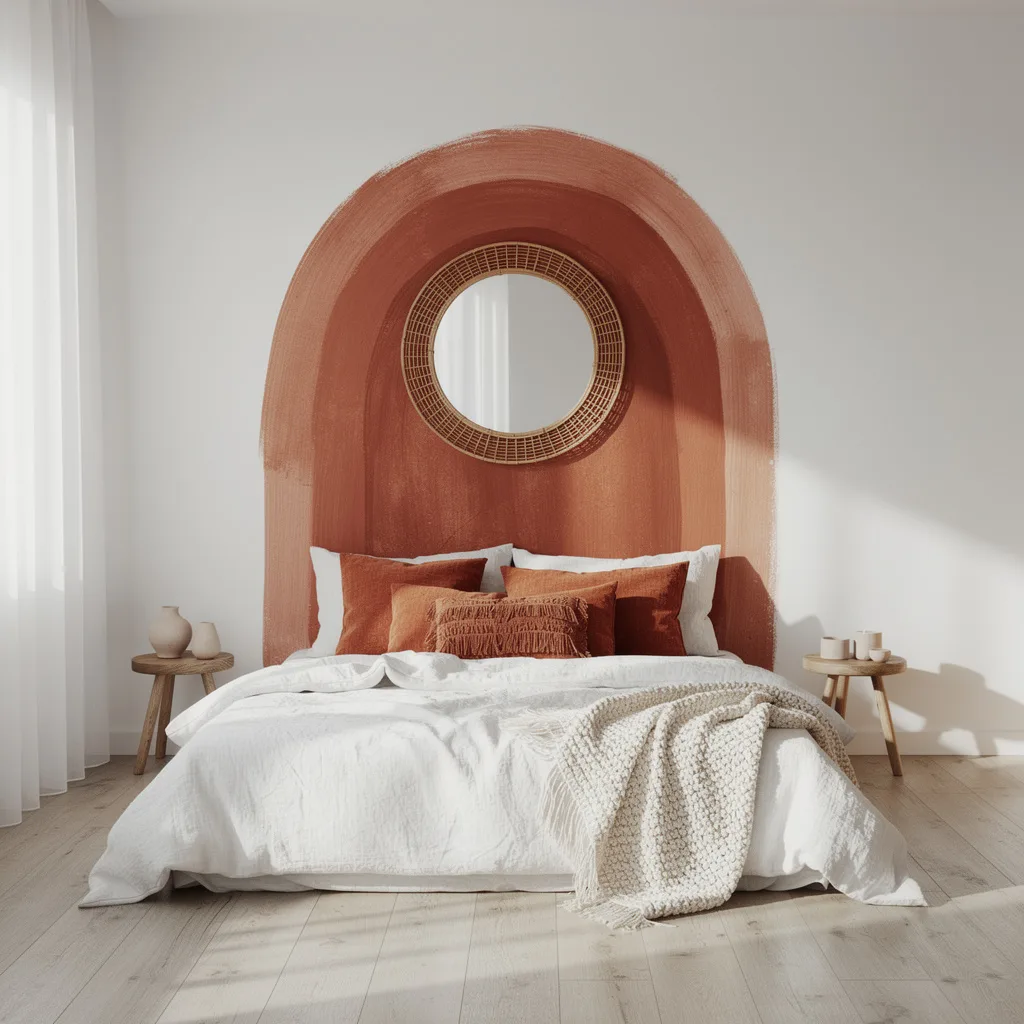
A terracotta arch painted directly on a white bedroom wall — brushstroke edges, not masked, so the shape reads as handmade — is one of the most impactful and reversible wall treatments available. It requires paint, a brush, and a confident hand. No permission from a landlord is needed if you’re prepared to paint over it later.
Inside the arch, hang a rattan-framed circular mirror at the arch’s midpoint. The circular mirror inside the arch shape creates a geometry that satisfies something deeply compositional — circle within arch, arch against rectangle.
The bed below should be dressed in rust and terracotta linen cushions so the colour relationship between wall and bedding is immediate and clear. Simple wood stool nightstands on each side. The arch wall needs simplicity around it to function — every additional element must earn its place.
Kilim Tapestry, Rattan Sofa
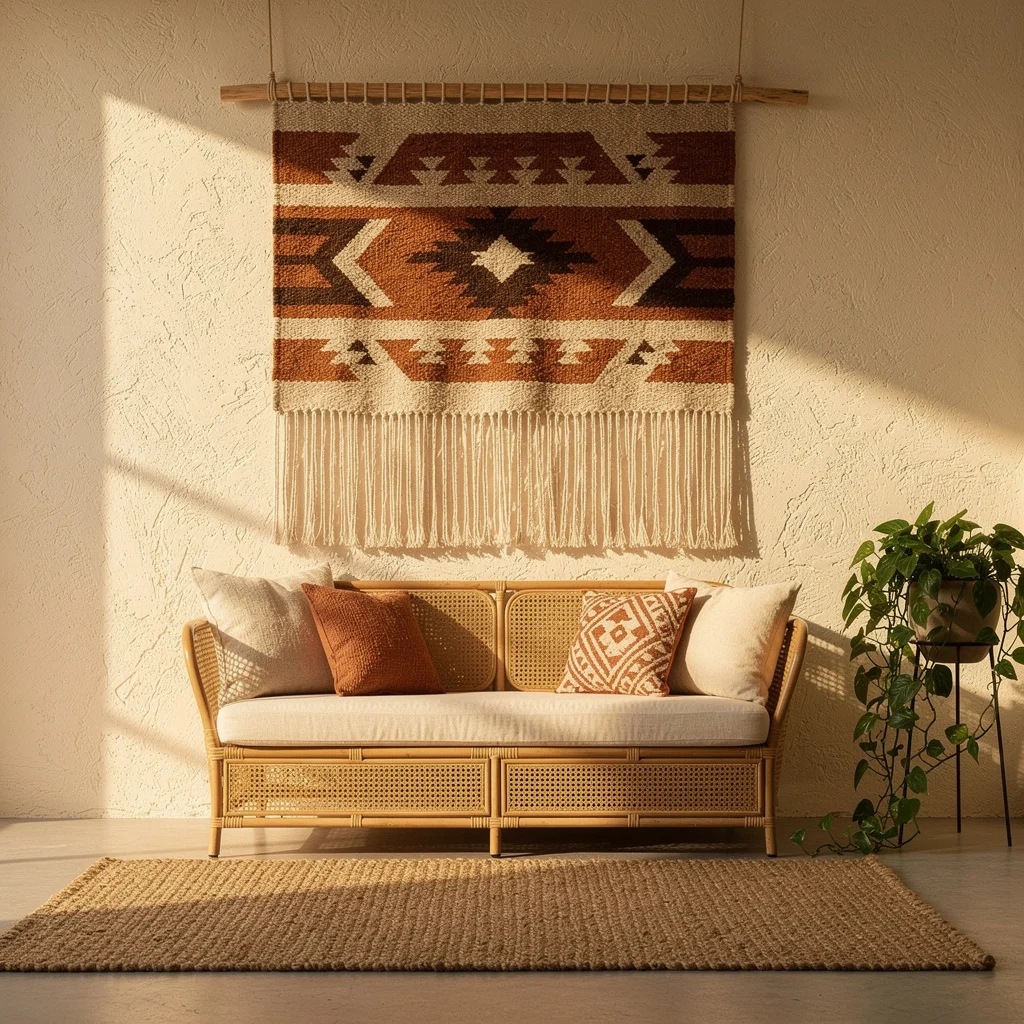
A large kilim or Navajo-influenced woven textile hanging as a tapestry is the oldest form of wall decor and still one of the most effective. Suspended from a natural branch or thick driftwood rod using leather tab hangers, a textile tapestry in warm terracotta, rust, cream, and dark brown above a rattan sofa creates a wall that feels ancestral rather than decorated.
The fringe at the tapestry’s lower edge should hang freely and move slightly. This movement — the response to air in the room — is what separates a textile wall piece from a painting. It reminds you that the material is real.
Keep the wall beside the tapestry bare. A trailing pothos plant at floor level to one side and a simple jute rug below are the only companions this wall needs.
Vintage Rug as Wall Art
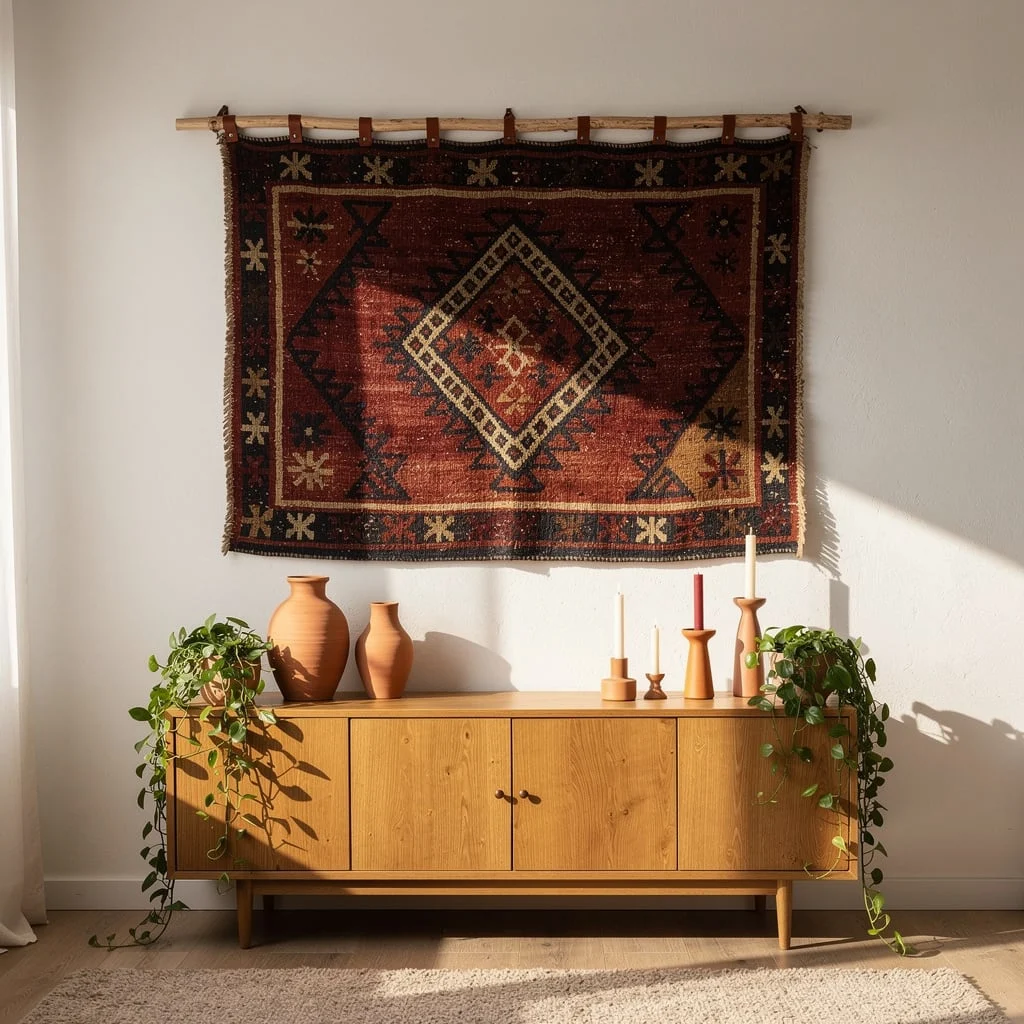
Hang a vintage or antique rug — the kind with a medallion centre, deep red ground, and navy border with repeated geometric motifs — from a driftwood branch hung at ceiling height, using leather straps looped through the warp threads at the top edge.
The scale should be generous: a rug that would be large enough for a small room reads correctly as wall art. Too small and it looks like an afterthought. The medallion pattern works because it has a clear visual centre — the eye knows where to go.
Below, a mid-century sideboard in warm timber holds terracotta vessels, tapered candles in wooden holders, and trailing pothos plants at each end. The warm honey tones of the sideboard and the deep reds of the rug exist in the same colour family without matching.
Vintage Maps and Botanicals
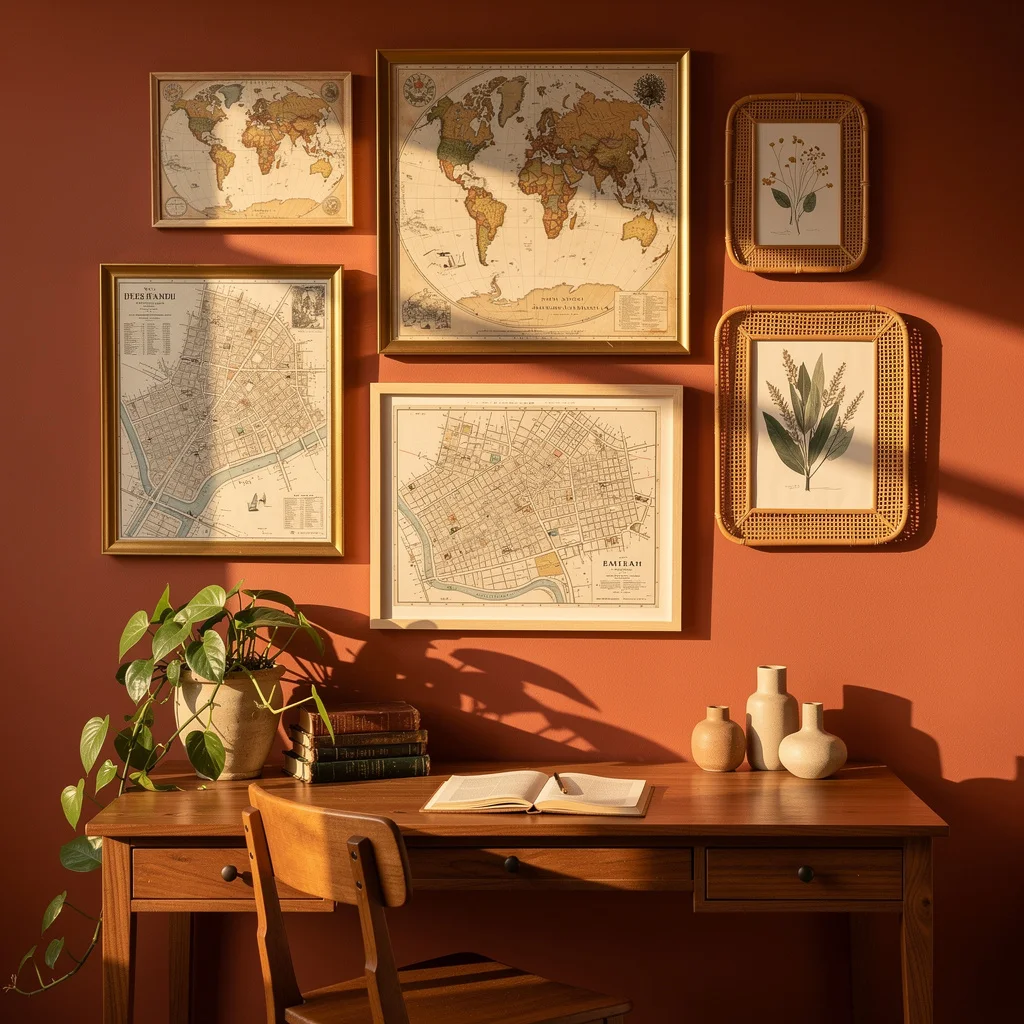
A travel-themed gallery wall on a deep terracotta or rust-painted wall: framed vintage maps of cities or countries, botanical prints in gold frames, the same prints in rattan-edged oval frames. The combination of cartography and natural-world illustration is a classic boho pairing — both suggest curiosity, travel, and a relationship with the wider world.
The frame variety matters. Some prints in simple gold timber frames. Others in rattan oval frames that echo the basketwork language of boho decoration elsewhere in the room. The combination of different frame shapes and materials is what makes the arrangement feel personal rather than purchased as a set.
Below, a timber writing desk with a worn patina and stacked books completes the study-like quality of the composition.
Seagrass Basket Wall, White Room
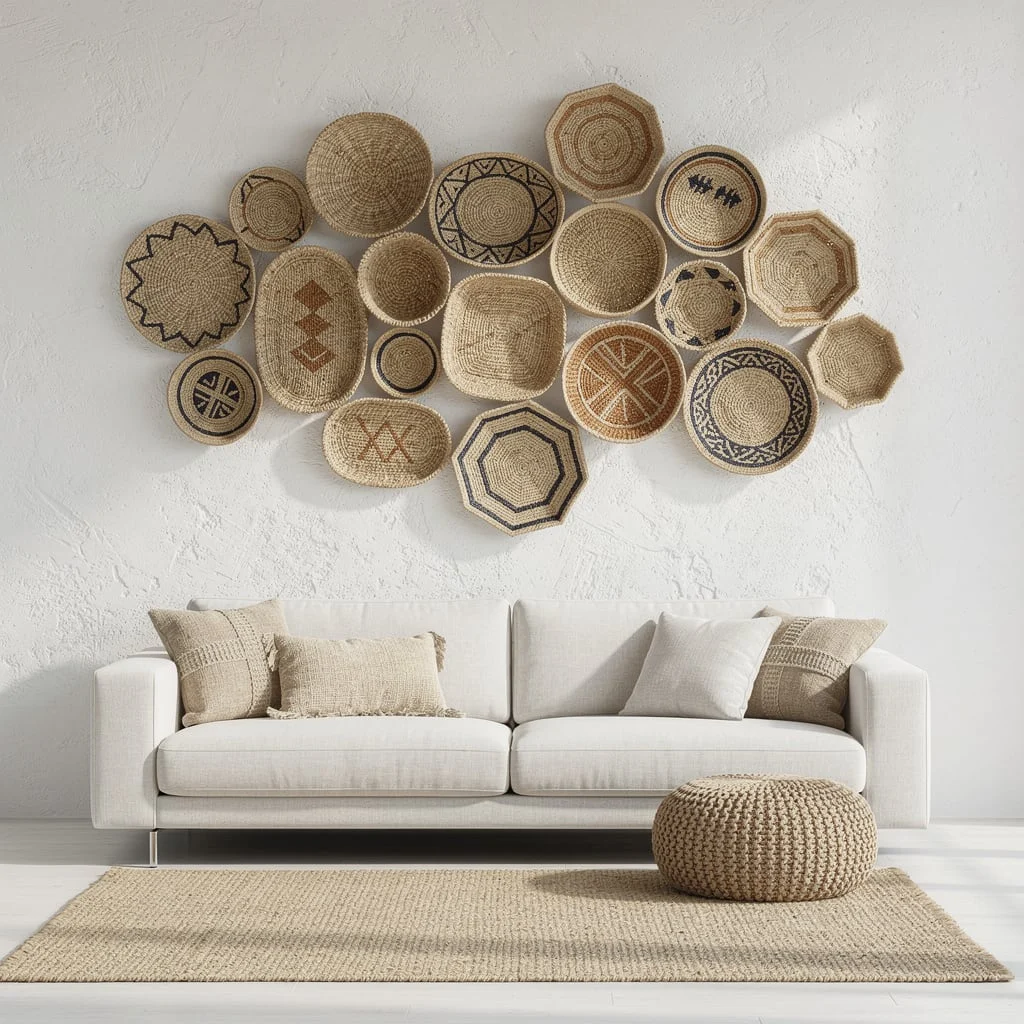
A white room with a white sofa — minimal, clean, almost Scandinavian — takes on a completely different character when fifteen to twenty seagrass and palm leaf flat baskets in natural tones are arranged across the wall above it.
The baskets should span from small (15cm) to very large (70cm+). Mix shapes: round, oval, octagonal, irregular. Mix patterns: plain seagrass, concentric spiral, diamond, star, chevron. Keep the entire palette within the natural-straw spectrum — no dyed baskets, no dark colours. The restraint of the palette is what gives the arrangement elegance.
The texture of the baskets against the rough plaster or smooth white wall creates depth through shadow rather than colour. In afternoon light, the shadows cast by each basket’s woven rim are part of the composition.
Driftwood and Natural Objects
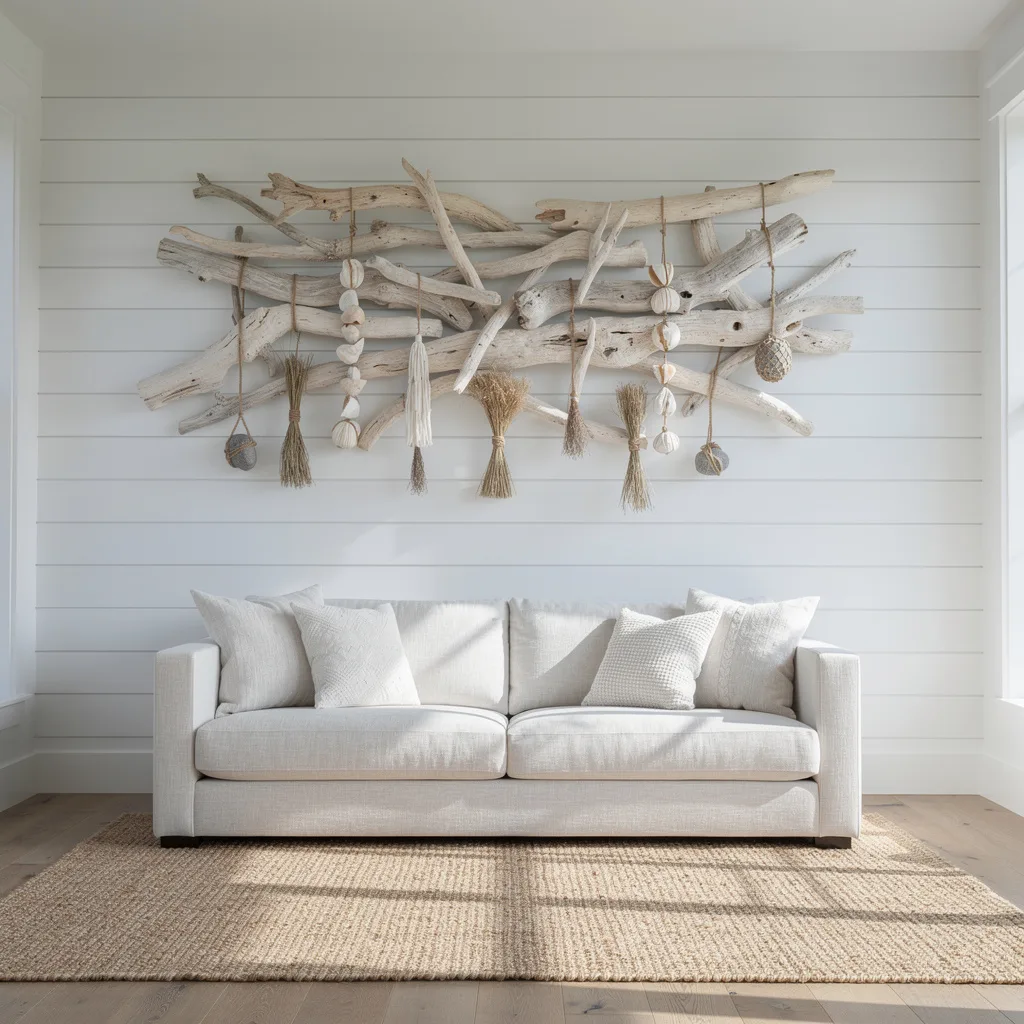
A large horizontal arrangement of overlapping driftwood pieces mounted on a shiplap or white wall — the pale bleached wood pieces crossed and stacked against each other, each one different in thickness and length — creates a piece of wall art that cost nothing except time at a beach or riverbank.
From the lower edge of the driftwood arrangement, hang objects collected alongside the wood: bundles of dried grass tied with twine, small shells threaded on cord, macramé tassels, smooth pebbles wrapped in jute. Each hanging should be slightly different in length so they don’t form a regular line.
Below, a white linen sofa keeps the room from feeling overwhelmed by the installation’s scale. A jute rug grounds the arrangement at floor level. The entire colour palette is white, cream, and pale driftwood — a room that looks as though it was assembled by the sea.
Botanical Gallery on Sage Green
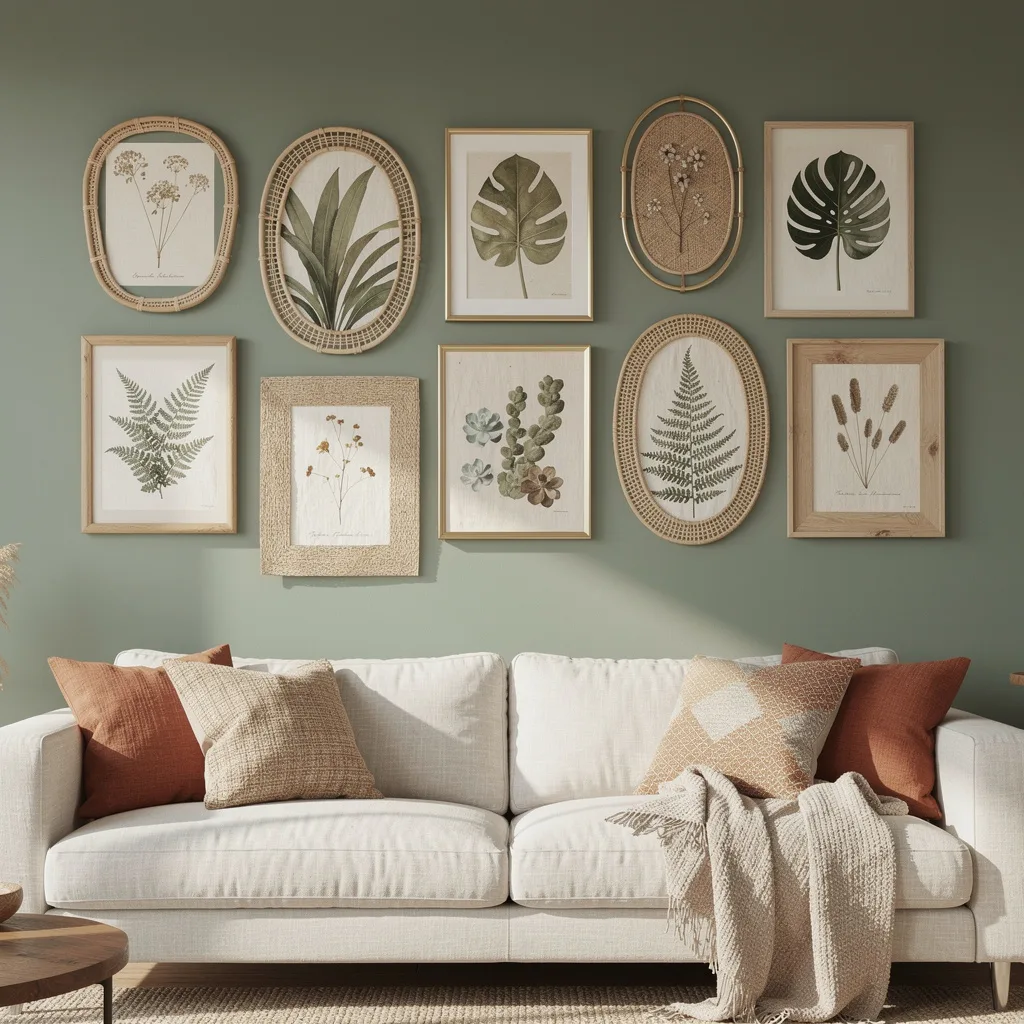
A sage green painted wall is one of the most successful backdrops for a botanical gallery. The green wall reads as an extension of the natural world, so framed botanical prints — ferns, monstera leaves, eucalyptus sprigs, succulent studies — feel continuous with the wall rather than hung on it.
Mix frame types across the arrangement: simple pine, thin gold, rattan oval, and woven seagrass. The mix of frame materials repeats the boho principle of collected-over-time rather than purchased-as-a-set. Some prints should be large enough to anchor their section of the wall. Others can be small enough to feel like finds.
Below, a white sofa with rust and terracotta cushions gives the room its warmth. The contrast between the cool sage wall and the warm cushion tones keeps the room from feeling clinical.
Dream Catcher Cluster
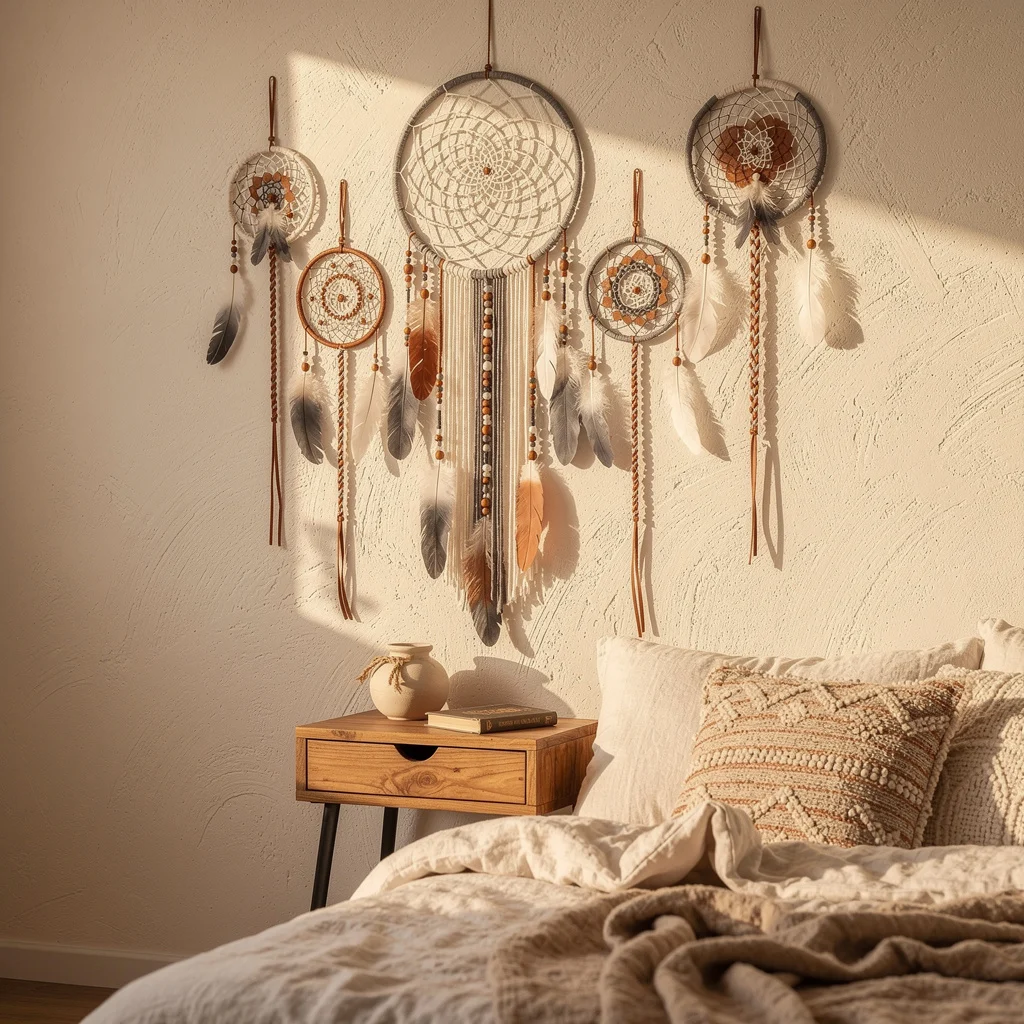
A cluster of dream catchers at different scales — one large central piece with an intricate web, several medium-sized ones flanking it, smaller ones at the outer edges — creates a wall of movement, feathers, and natural fibre that is unlike any other wall treatment in its delicacy.
The feathers respond to the slightest air current. The beads on the hanging strands catch light. The web patterns, seen up close, have their own geometric complexity. From across the room, the whole cluster reads as a soft, floating composition.
In a bedroom, position the cluster on the wall above and beside the bed rather than directly over it — this allows the pieces to be seen at an angle as well as straight-on. A simple timber nightstand with a small ceramic vase and a single book below completes a room that uses restraint everywhere except the wall it has decided to celebrate.
The Wall That Tells You Something
The best bohemian walls have one thing in common: they’re specific. Not general. Not “boho-inspired” in the way a shopping catalogue is boho-inspired. They contain things that would only make sense to the person who put them there — a basket from a specific market, a macramé made on a rainy afternoon, a print bought from a street stall in a city that meant something.
The ideal to aim for isn’t a perfectly styled wall. It’s a wall that, if someone spent ten minutes looking at it, they’d come away knowing something true about who lives in the room.
That’s what walls are for.