
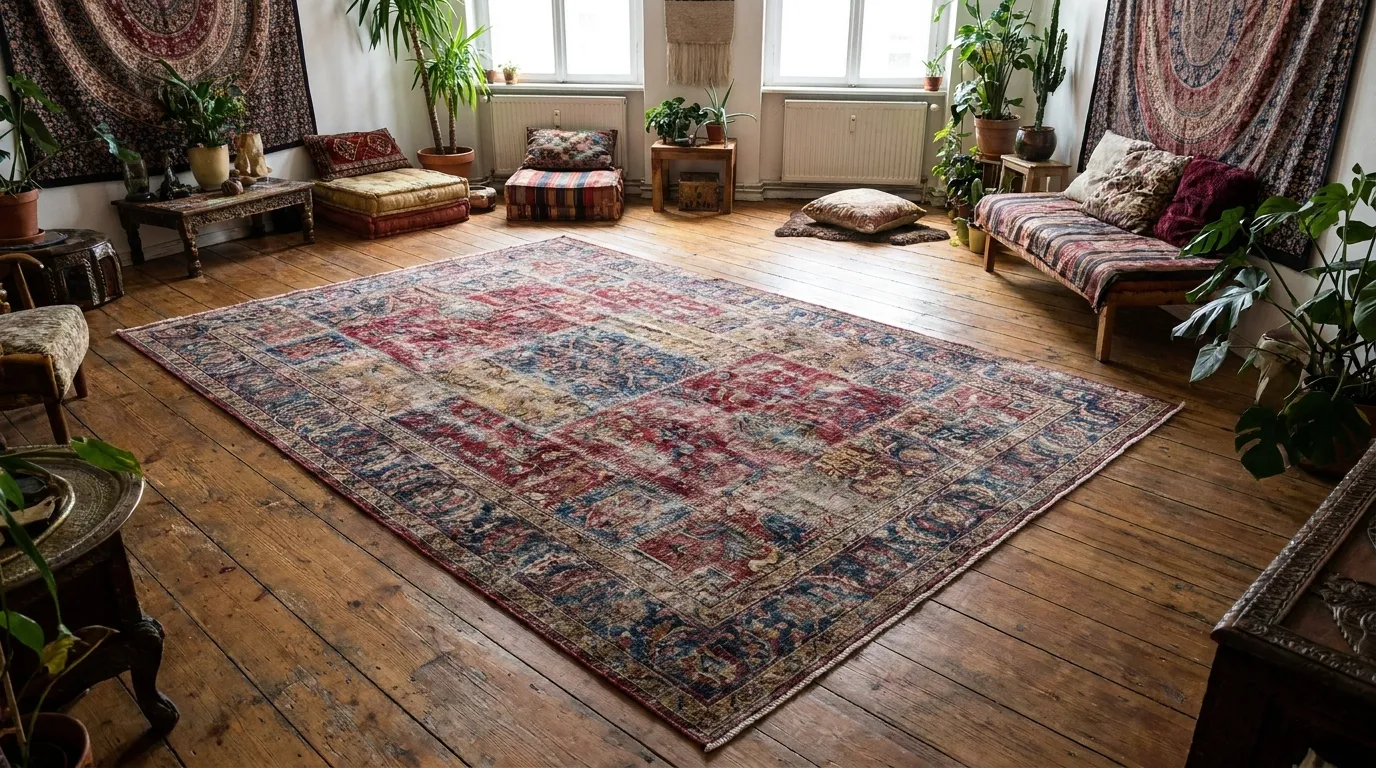
A rug is the only piece of furniture that every other piece of furniture has an opinion about. The sofa sits on it. The coffee table floats above it. The chairs graze its edges. Every time someone walks into the room, they walk across it first. And yet most people treat a rug like an afterthought — the thing they buy last, after everything else is already in place, hoping it will somehow pull it all together.
Spoiler: it usually doesn’t. Because by that point the decision has been made by process of elimination. What’s left in the budget. What fits the size. What doesn’t clash too badly. That’s not how you choose a rug. That’s how you end up with a beige rectangle that nobody notices.
In a bohemian room, the rug is frequently the whole decision. It sets the palette. It establishes the mood. It tells every other piece of furniture where to stand and what to do. Getting it right means understanding what makes a rug work — not just aesthetically, but structurally — before you ever start shopping.
The Rug as the Room’s Foundation
Every interior designer says the same thing about rugs: size up. The single most common rug mistake is buying one too small for the space. A rug that doesn’t fit under at least the front legs of every piece of furniture in the conversation area is decoratively useless. It becomes a floating rectangle in the middle of the room, disconnected from everything around it.
Sizing Rules That Actually Work
For a living room, the rug should extend at least 20–30cm beyond the sofa on both sides. All four legs of the sofa touching the rug is ideal. In a dining room, the rug needs to extend at least 60cm beyond the table on every side so that chairs remain on the rug even when pulled out. In a bedroom, the rug should extend at least 50–60cm beyond the bed on the sides you walk on — the feeling underfoot when you get out of bed in the morning is the whole point.
Round rugs follow different logic. A round rug under a round table is a natural pairing. Under a hanging chair or in a reading corner, a round rug defines the zone without imposing edges. In a rectangular room, a large round rug can be a deliberate design move — the circular softness against straight walls creates tension that feels intentional rather than accidental.
Layering Rugs Correctly
Two rugs stacked is not double the rug — it’s a completely different move. The base layer should be a large, relatively neutral rug in natural fibre: sisal, jute, seagrass, or a flat-weave cotton. The top layer should be smaller, patterned, and sit slightly off-centre or at an angle.
The top rug should cover no more than 60–70% of the base rug. If it covers more, you lose the layered effect and it just looks like a badly placed single rug. The base rug’s edge should be visible on at least three sides of the top rug, and the two rugs should share at least one colour so the combination reads as chosen rather than random.
Pattern, Texture, and What They Do to a Room
Pattern and texture are not decorative — they’re structural. They change how a room feels at a fundamental level before anyone has processed what they’re looking at consciously.
High Pile vs Flat Weave
High pile rugs — shag, tufted, deep wool — add warmth and absorb sound. A room with a deep shag rug is quieter, softer, and physically warmer than the same room with a hard floor. This makes high pile rugs ideal for bedrooms, reading corners, and any space where comfort is the primary function.
Flat weave rugs — kilim, dhurrie, cotton dhurrie — are easier to clean, more durable under heavy traffic, and visually crisper. They suit dining rooms, hallways, and home offices where practicality matters as much as aesthetics. Flat weaves also show pattern more sharply because there’s no pile to diffuse it.
What Pattern Does
A busy pattern reduces the apparent size of a room slightly — more visual information, more contained feeling. A simple or minimal pattern makes a room feel more open.
For a boho room with lots of objects, plants, textiles, and layering, the rug pattern needs to find its register in the overall visual noise. If every surface is already busy, a simpler rug — a plain jute, a solid shag, a minimal diamond — lets the room breathe. If the room is restrained and minimal, a heavily patterned kilim or Persian-style rug gives it the visual richness that boho spaces need.
Colour Commitment
The biggest single mistake with boho rugs is playing it safe. A neutral rug in a neutral room is just carpet. Bohemian design earns its warmth from colour — earthy terracotta, deep teal, forest green, warm ochre, dusty rose, burgundy, mustard. These aren’t accent colours. In a boho interior, they’re the foundation.
If the idea of committing to a coloured rug feels risky, start from the rug and build the room’s palette outward from it. Choose the rug first, then choose cushions that pick up two of the rug’s colours, then choose walls and textiles that echo the rug’s tone. This is how the rooms in this list work — the rug isn’t accommodating the room, the room is built around the rug.
Bohemian Rug Ideas to Try
Textured Stripe, Warm Neutral Living Room
A low-pile rug with a subtle stripe pattern in cream and warm sandy tones — the kind where the stripe is formed by changes in texture rather than colour — reads as restrained and sophisticated in a warm-walled boho living room. The tonal variation creates visual interest without visual noise. Against a terracotta-painted wall, a cream linen sofa, a ribbed dark walnut coffee table, and a jute pendant light, the rug reads as the foundation of a room that knows what it is.
The striped texture catches light differently across the day — in morning sun it appears almost plain; in late afternoon side-light the stripe becomes pronounced. That responsiveness to light is a quality worth selecting for deliberately.
Kilim in a Home Office
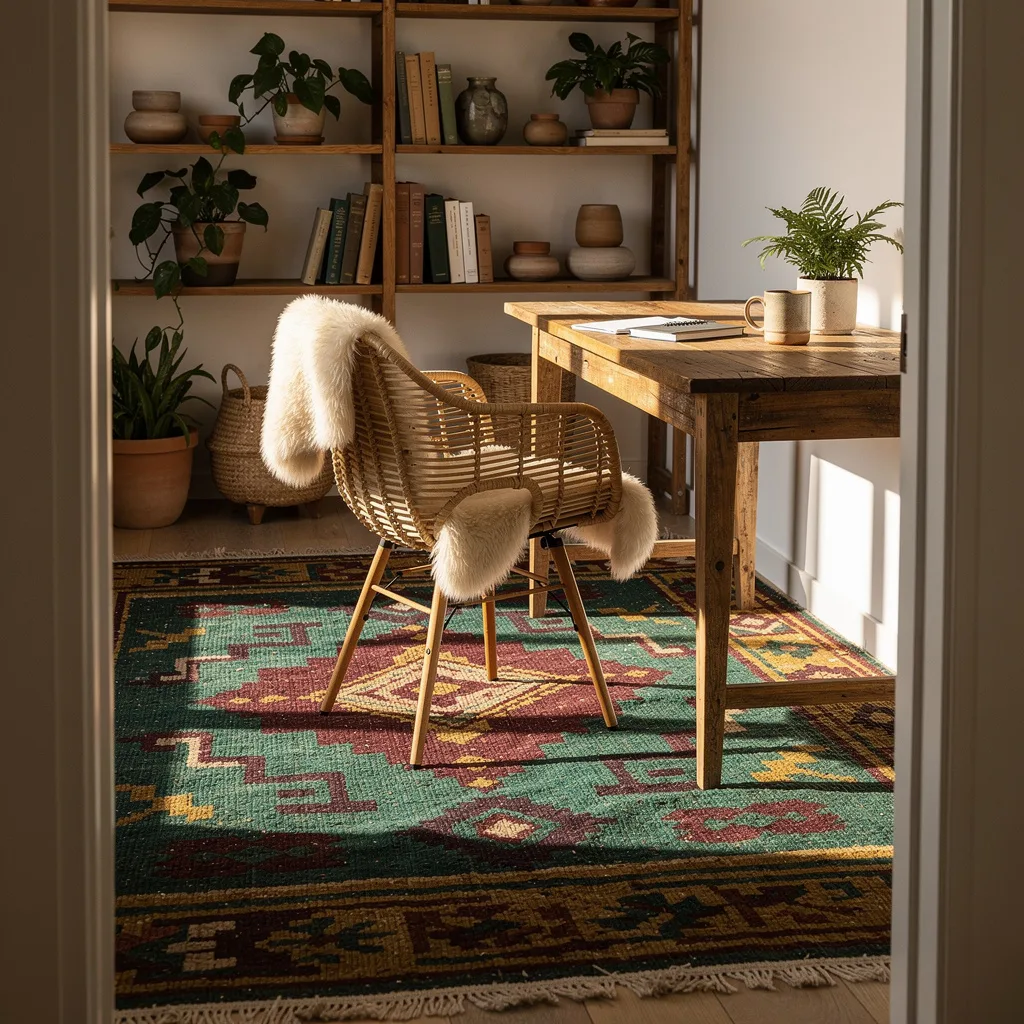
A kilim rug — flat-woven with a geometric or tribal pattern in forest green, burgundy, mustard, and dark charcoal — grounds a home office in a way that a plain rug never does. The density of the pattern absorbs the austerity of a workspace. Books on shelves, plants in terracotta pots, a rattan desk chair with a sheepskin throw: all of these echo the rug’s natural-material sensibility.
A kilim’s flat weave is practical in a workspace — chairs roll more easily over it than over a pile rug, and it tolerates traffic without compressing. Buy at least 10cm larger than you think you need. The desk and chair should both sit comfortably within the rug’s bounds, with the front legs of any additional seating touching the edge.
Grand Round Tribal Rug
A very large round rug with a cream ground and terracotta-and-brown tribal geometric pattern — concentric bands of triangles, arrows, diamonds, and borders radiating from a central point — is the natural foundation for a circular furniture arrangement. Two curved sectional sofas arranged in a loose arc around a central marble coffee table, ochre occasional chairs placed at intervals around the perimeter, all within the rug’s circle.
The circular rug dictates the circular arrangement. The furniture doesn’t choose its position so much as respond to the rug’s geometry. In a high-ceilinged space with floor-to-ceiling windows and a sculptural chandelier, the round rug at floor level anchors the vertical drama of the room. The whole arrangement says that the designer understood something essential: in a room this large, the rug is the room.
Rust Shag Reading Corner
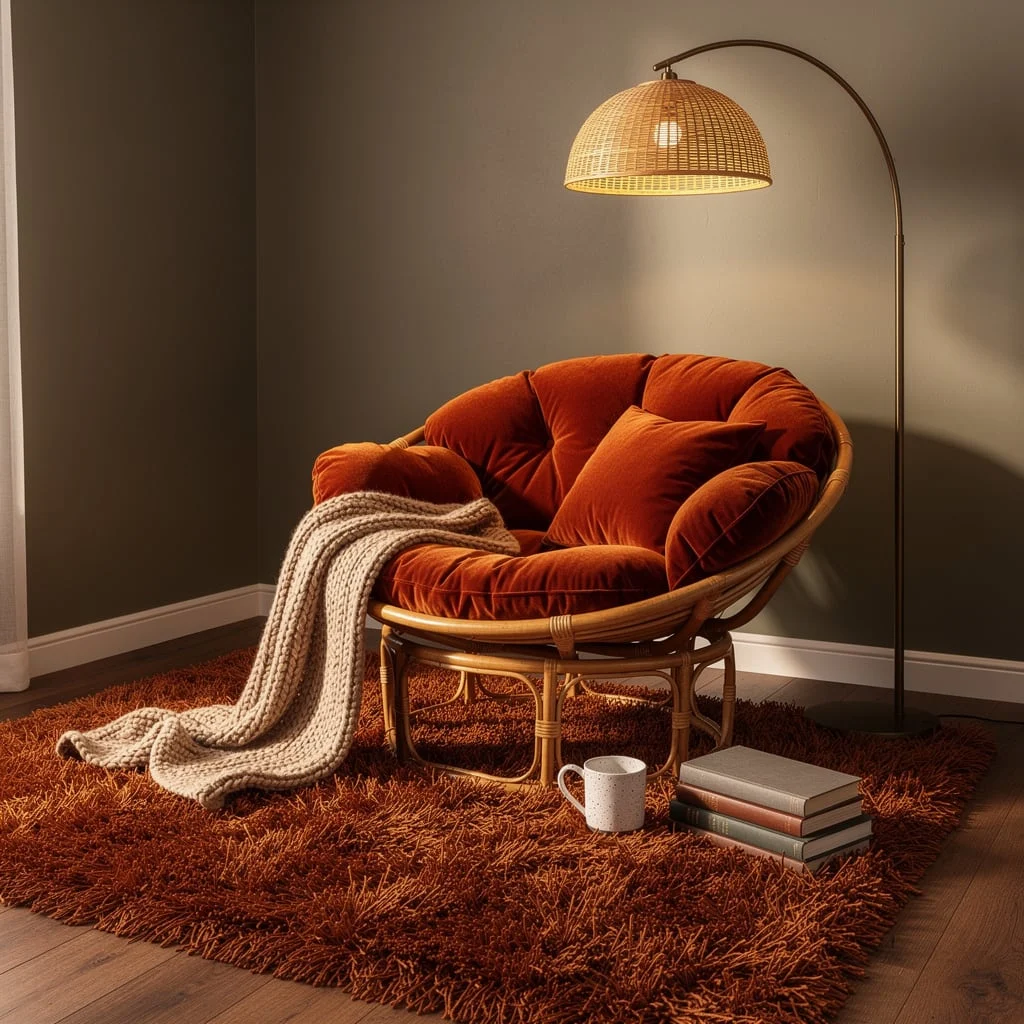
A deep rust or burnt sienna shag rug is the most committed way to establish a reading corner. The colour and texture do so much work that the furniture almost doesn’t matter — though a rattan papasan chair with a velvet cushion in the same rust family, a wicker-shade arc lamp curving overhead, and a stack of books with a ceramic mug beside them complete the picture.
The shag pile needs to be high — at least 4–5cm — so the warmth underfoot is tactile, not just visual. Place the rug on hardwood rather than over carpet where possible; the border where shag meets bare floor is part of the visual appeal. Leave at least 20–30cm of floor visible around the rug’s perimeter. A shag rug that runs wall to wall is a carpet. A shag rug floating in a corner is a destination.
Forest Green Stripe with Raised Dot
A green-and-cream rug with a stripe-and-raised-dot pattern — the kind of texture created by cut-loop pile technique — works in a room anchored by deep green tones. Against a parquet herringbone floor, with a linen-cushioned wood-frame lounge chair, a fluted arc sideboard, and dark artwork on the wall, the green rug pulls the room’s plant life down to floor level and makes the whole space feel more immersive.
The textural difference between the flat stripe and the raised dot pattern adds dimension that a flat-woven rug can’t replicate. In a room with otherwise clean lines and careful restraint, this texture is the element that keeps the space from going cold.
Sage Stripe Cotton Rug
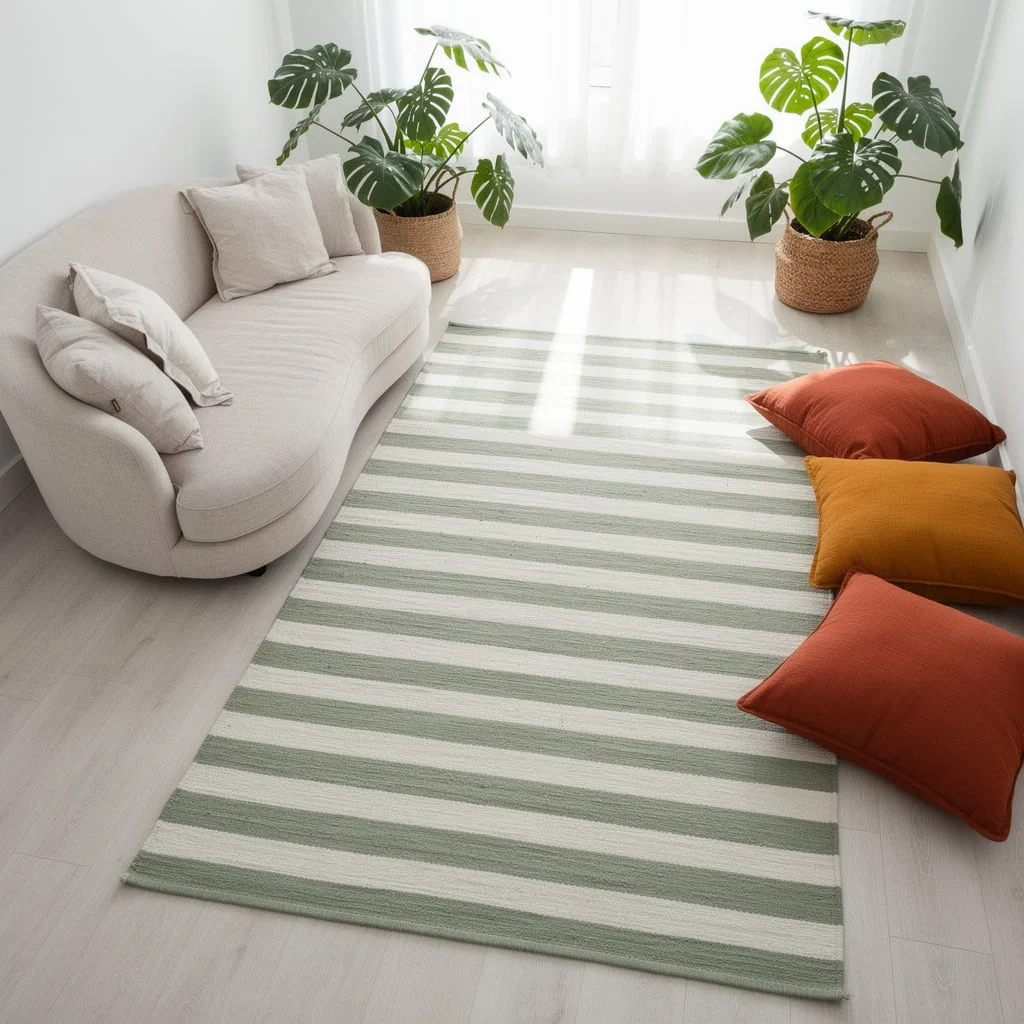
A flat-woven cotton rug with wide sage green and cream stripes is the quietest option in this list. It’s the rug for a room that’s already doing a lot — abundant plants, a curved bouclé sofa, oversized floor cushions in rust and ochre sitting directly on the rug’s surface.
The stripe’s simplicity is strategic. In a room with this much going on, a patterned rug would create competition. The stripe provides order without imposing it. It also brings the green of the monstera plants down to floor level, connecting the plant life to the base of the room in a way that a neutral rug wouldn’t.
Size is critical here. The rug should extend under the full length of the sofa and leave floor cushions entirely within its bounds. A stripe rug that’s too small creates awkward partial coverage — the stripes draw the eye to the edge, which then draws the eye to the exposed floor.
Traditional Persian, Maximalist Warmth
A large traditional Persian-style rug in deep red, navy, gold, and charcoal under a fully loaded boho living room — low floor sofa with a mountain of cushions in rust, ochre, and green; a wall tapestry hanging above; small carved-frame mirrors scattered to one side; trailing plants in terracotta — works because the rug and the room are operating at the same register. Maximalism meeting maximalism, but with the rug as the piece that holds all the colour together.
The key is the wall behind. Keeping it plain — off-white or warm cream — gives the eye somewhere to rest. If the wall were also patterned, the room would tip from rich to chaotic. The blank wall is the exhale that the rest of the room needs.
Beni Ourain Under a Low Bed
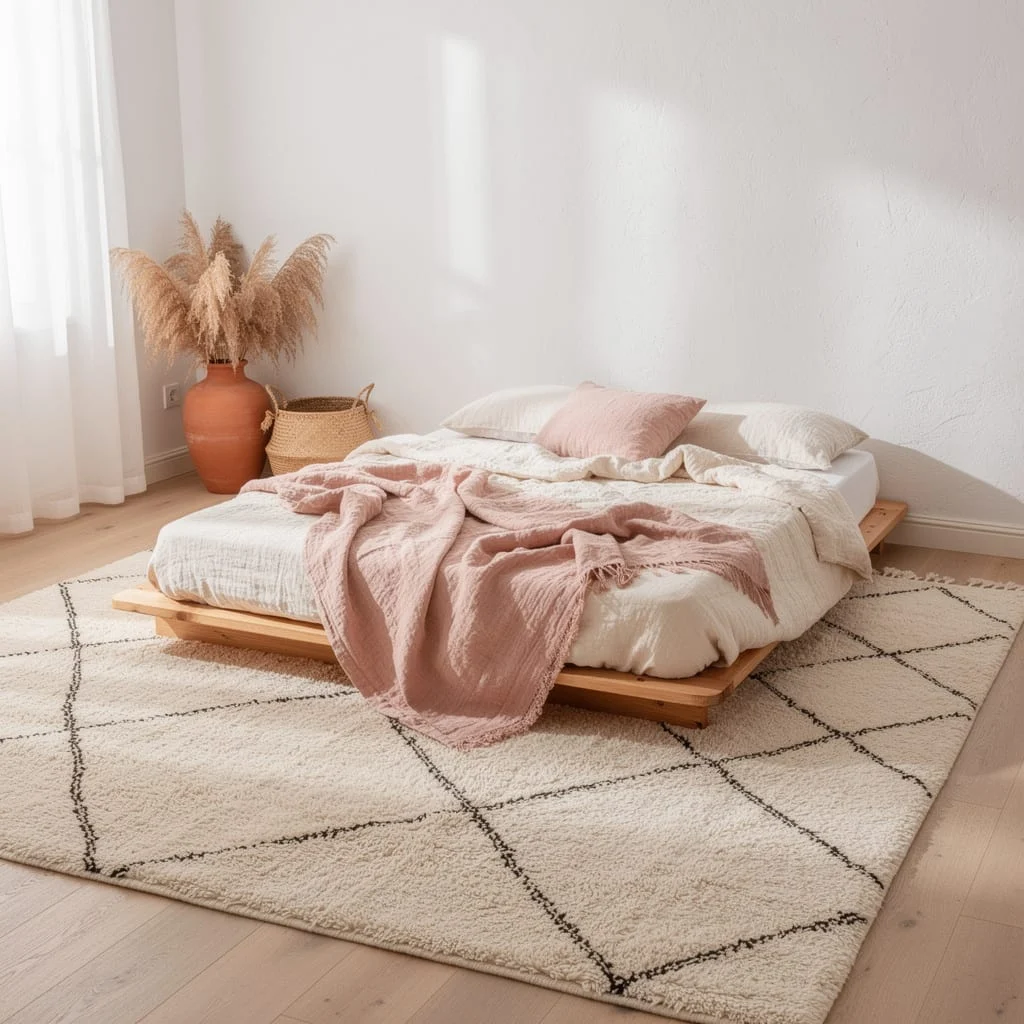
A Beni Ourain rug — the Moroccan style with cream wool and irregular black diamond lines hand-drawn across it — is the canonical boho bedroom rug. The reason it works so well under a low platform or floor bed is contrast. The off-white woolly pile against the bare pale wood floor creates a soft zone that makes the bed look more deliberate and more grounded.
The pile should be deep — Beni Ourain rugs are traditionally thick — and the colour should be genuinely cream rather than white. Pure white looks cold in a bedroom. The natural ivory-cream of undyed wool has warmth. Surround the bed with objects that match the rug’s palette: a terracotta vase, a seagrass basket, pink linen cushions. The dusty rose blanket folded loosely across the bed repeats the warmth without competing.
Patchwork Kilim Under a Round Dining Table
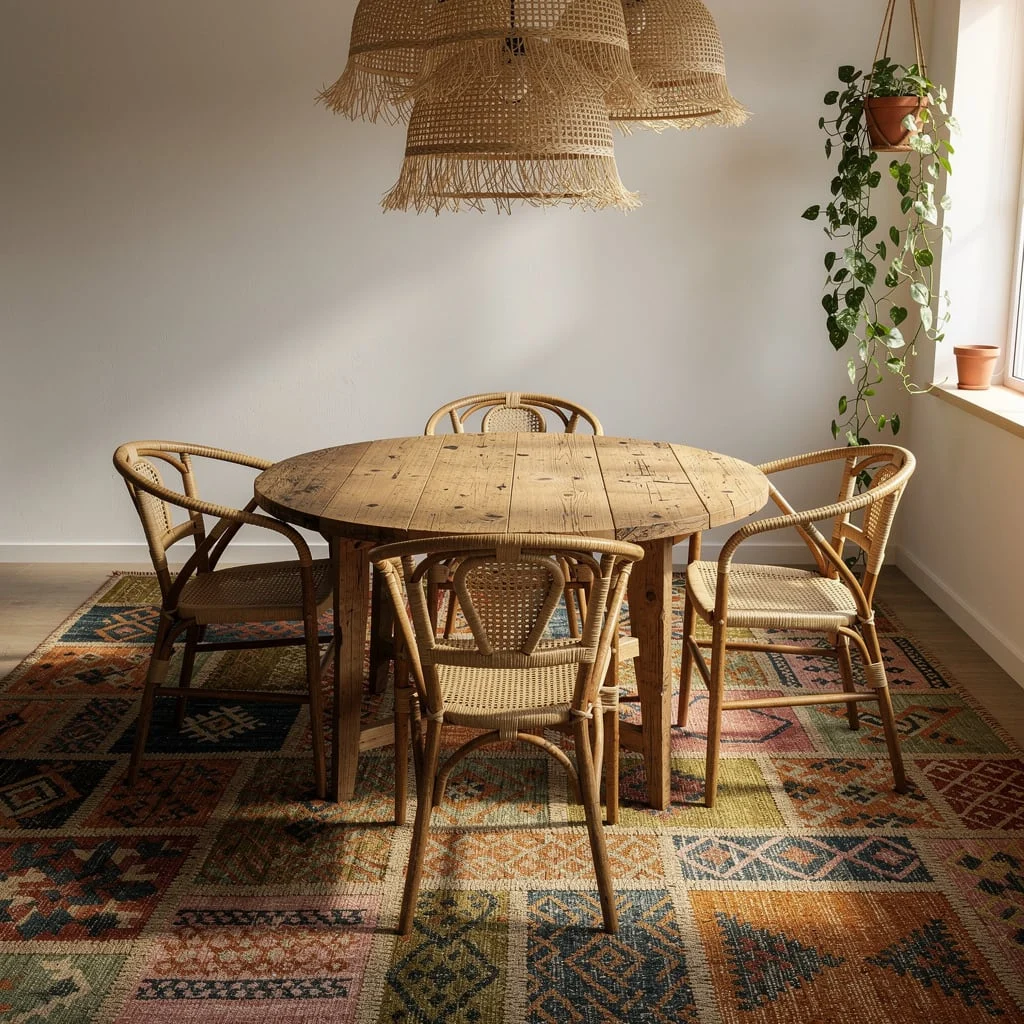
A patchwork kilim — assembled from sections of different vintage kilim pieces, each with its own geometric pattern, stitched together into one large rug — is the most visually complex option in a dining room. The mismatched sections, each with a slightly different colour palette, create a quilt-like surface that looks like it has accumulated history rather than been bought new.
Under a round reclaimed wood table with rattan chairs, this rug is perfect. The round table sits over the centre of the patchwork, the chairs pull up to the rug’s edge when seated, and the different kilim sections visible around the perimeter of the table read like a frame of collected textile around the dining zone.
Fringe raffia pendant lights above and trailing plants in terracotta pots at the windows complete a dining room that feels more like it grew organically than was designed.
Berber Shag Under a Dining Set
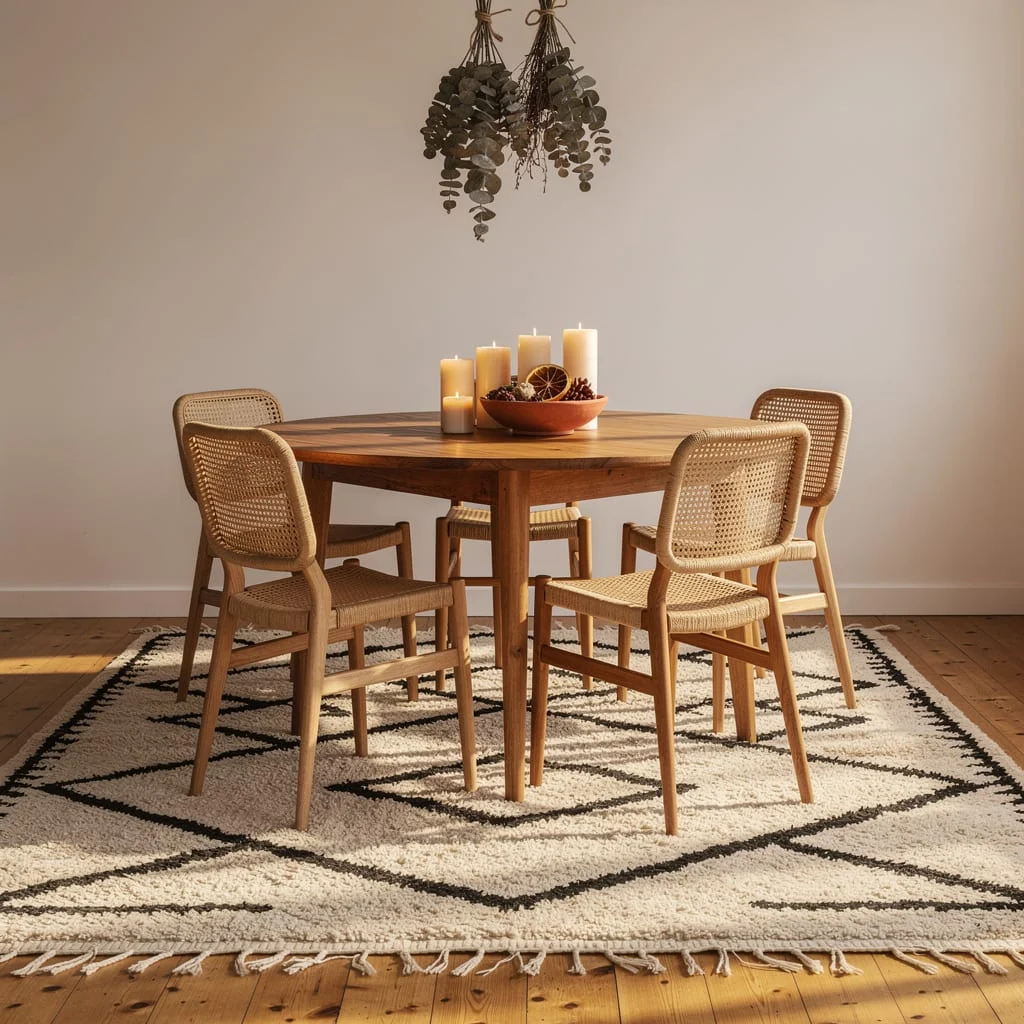
A cream Berber-style shag rug with dark charcoal diamond lines under a wooden dining table with cane-back chairs is a higher-maintenance but higher-impact choice. Shag rugs in dining rooms are not for everyone — crumbs get into the pile, spills are harder to remove, and chairs push through the deep fibres when pulled out. But the warmth they add is unmatched, and in a room where meals are long and conversations go late, that warmth counts.
The rug should extend well beyond the table — 60cm minimum on all sides — so chairs remain on rug when pulled out. Fringe on the rug’s short edges is traditional to the Berber style and adds a textural detail that the otherwise simple cream-and-charcoal surface needs. A hanging bundle of dried eucalyptus above the table and candles grouped at the centre tie the room to the organic sensibility the rug signals.
Persian-Style Runner in a Hallway
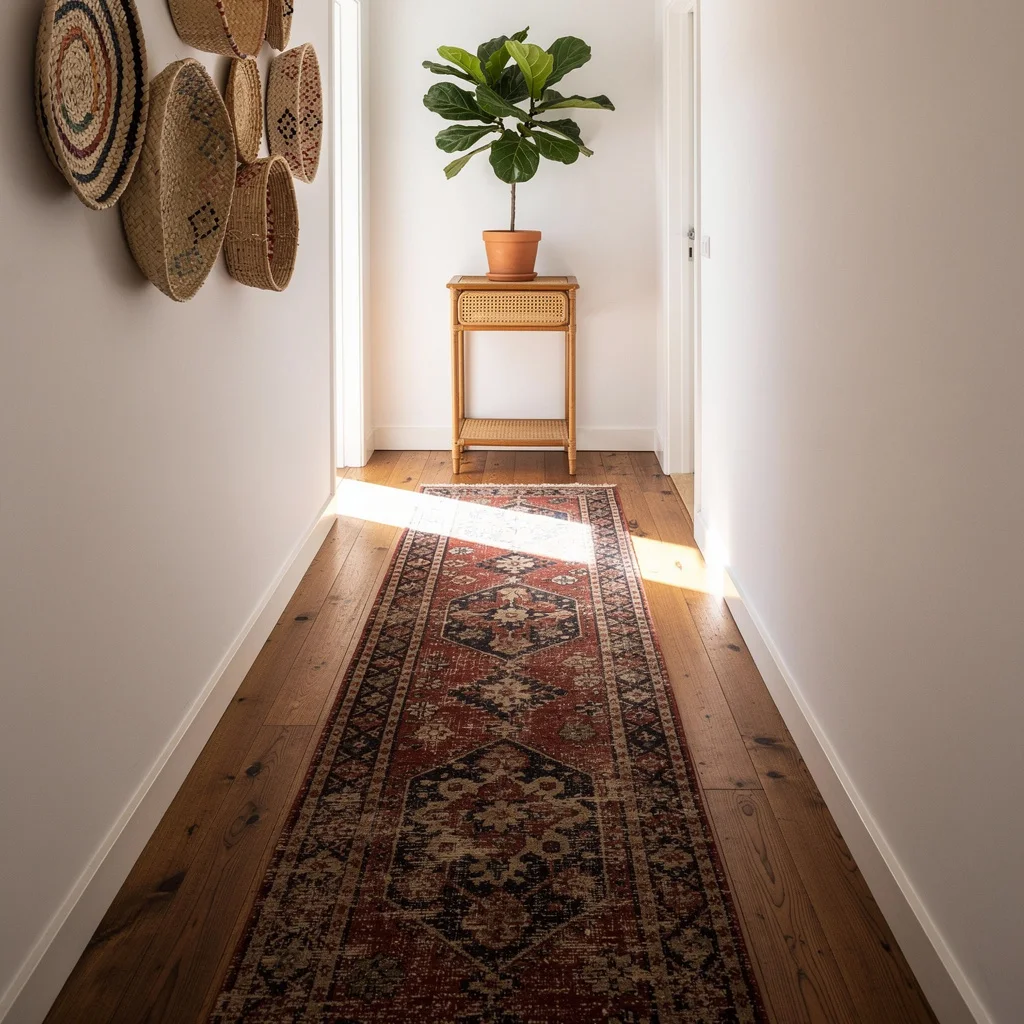
A hallway runner in a deep Persian or Caucasian style — burgundy ground, dark navy border, intricate floral-geometric pattern throughout — is the single most effective way to give a plain hallway character. The long narrow format suits the space, the pattern provides visual interest to what is otherwise a transitional space, and the colour makes the hallway feel warm rather than merely functional.
Leave 5–10cm of bare floor on either side of the runner. The runner floating on the floorboards rather than running wall-to-wall is the distinction between a rug and carpet. On the wall beside it, a cluster of woven basket wall art adds dimension. At the far end, a small rattan console table with a terracotta plant anchors the visual endpoint of the corridor.
Washed Medallion in an Open-Plan Loft
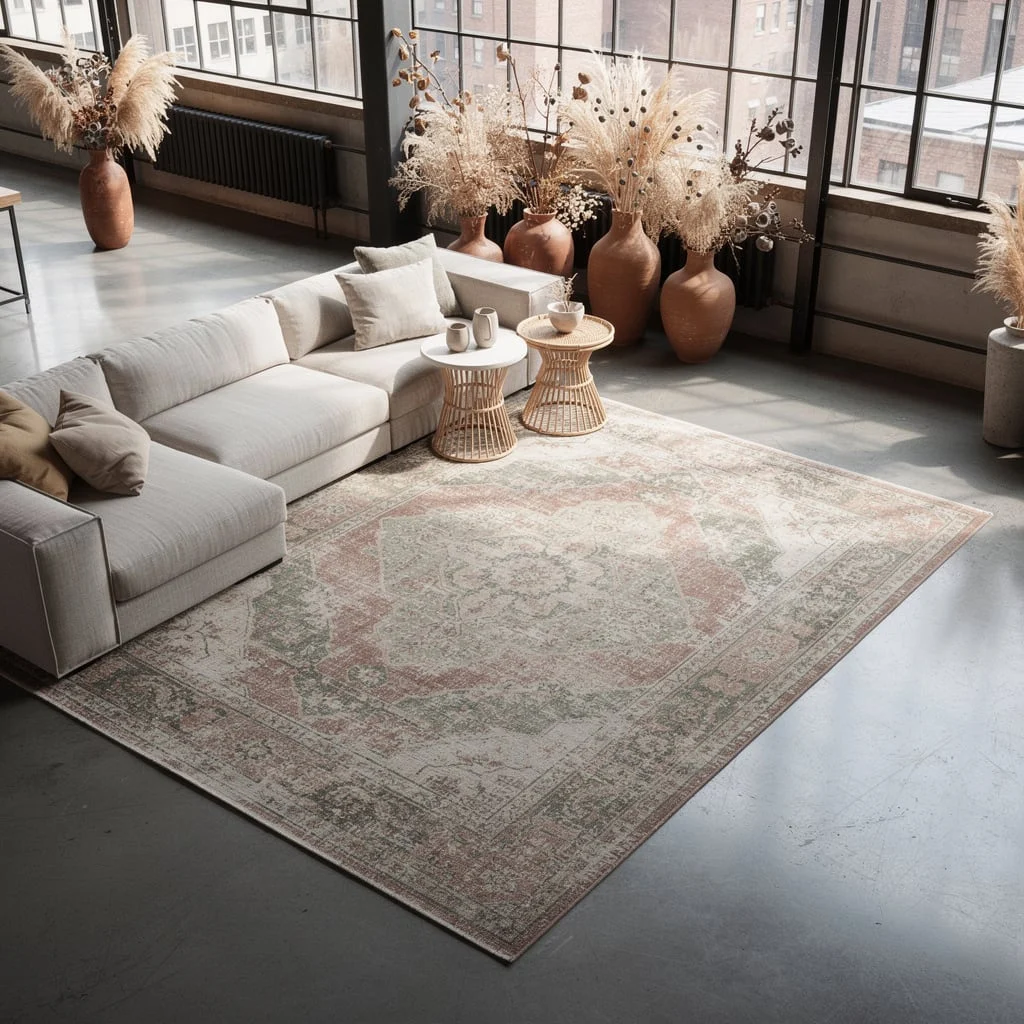
A large-scale washed or distressed medallion rug — the kind where the traditional Persian-style pattern has been intentionally faded to a dusty blush, sage, and cream palette — reads differently from a standard oriental rug. The washed finish removes the formality. In an industrial loft setting with concrete floors, steel windows, and oversized terracotta floor vases, the softened medallion sits between the rawness of the space and the softness of the furnishings.
The rug should be large enough for the entire L-shaped sectional to sit within it, with the two rattan side tables both touching the rug surface. In a loft space with high ceilings and large windows, the rug is doing the grounding work — it’s the one element that tells the furniture it belongs together.
Round Jute Under a Hanging Chair
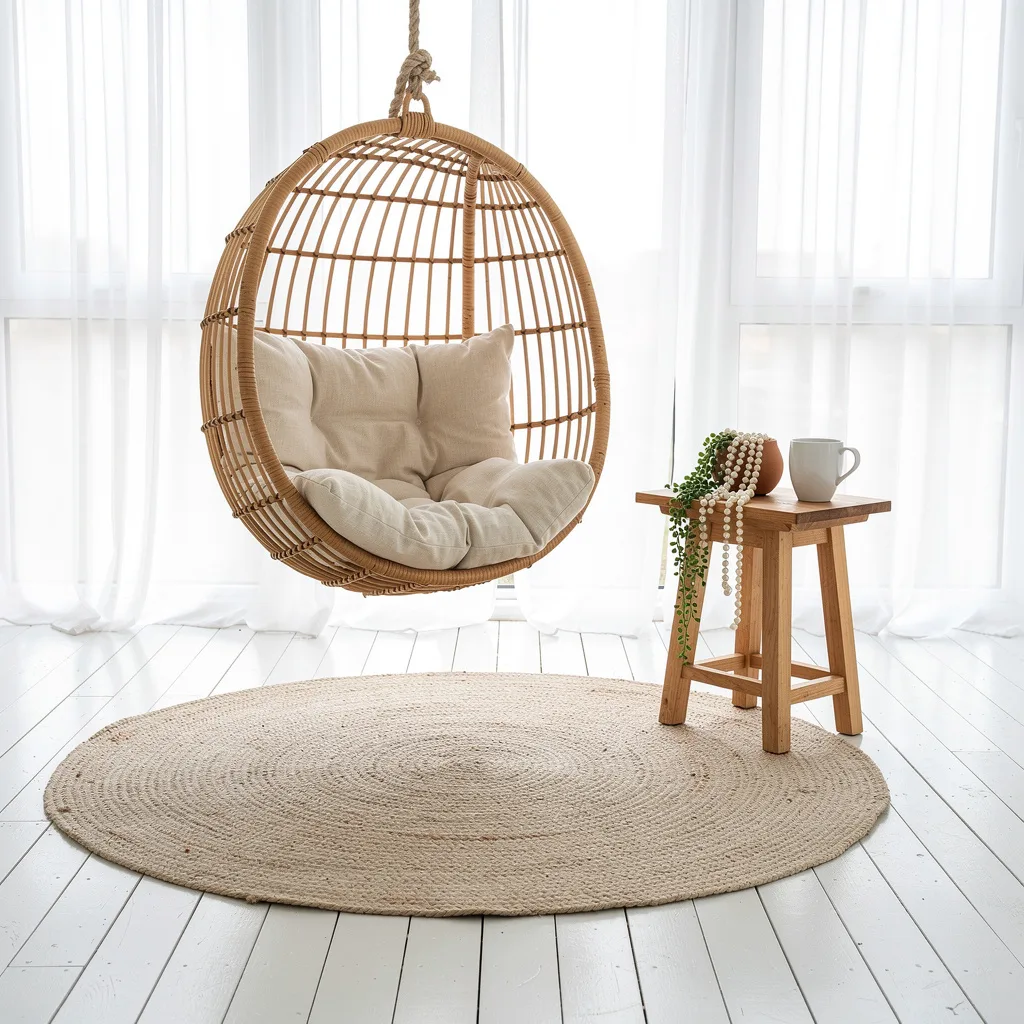
A round braided jute rug under a rattan egg chair is as close to a circle within a circle as interior design gets. The round rug defines the zone. The hanging chair, suspended from the ceiling above the rug’s centre, completes the geometry. Everything within the rug’s edge belongs to this reading or relaxing nook. Everything outside it is the rest of the room.
Jute’s natural straw colour reads as warm against a white painted floor — the contrast between the cream jute and the white boards is subtle but present. The raw texture of the braid adds tactile interest that a smoother rug wouldn’t. Keep the accessory on the small side table beside the chair simple: one ceramic mug, one trailing plant in a terracotta pot. The circle of the rug and the sphere of the chair are doing enough.
Tasselled Berber Diamond Rug
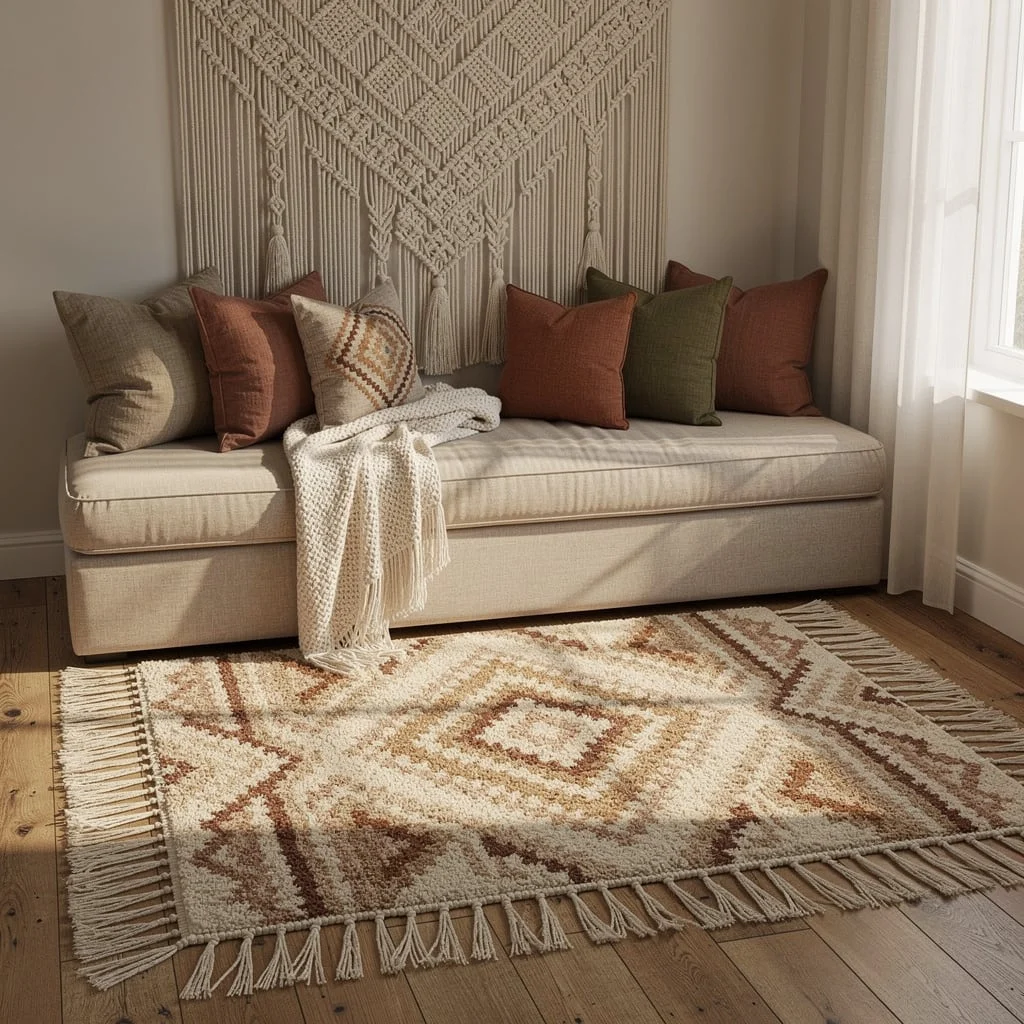
A cream shaggy rug with terracotta and amber diamond motifs and full tasselled edges on all four sides suits a boho living room that’s working within an earthy, handcraft-focused aesthetic. The tassel detail is the decorative commitment that a plain-edged rug can’t make — it says handmade, it says intentional, and it moves slightly in a breeze in a way that draws the eye.
Position it under a cream linen daybed or low sofa with cushions in rust, burnt orange, and forest green. A large macramé wall hanging behind the sofa should use the same cream tone as the rug base — the repetition of the cream across wall textile and floor textile creates a visual throughline that makes both pieces look more considered.
Layered Kilim Over Jute
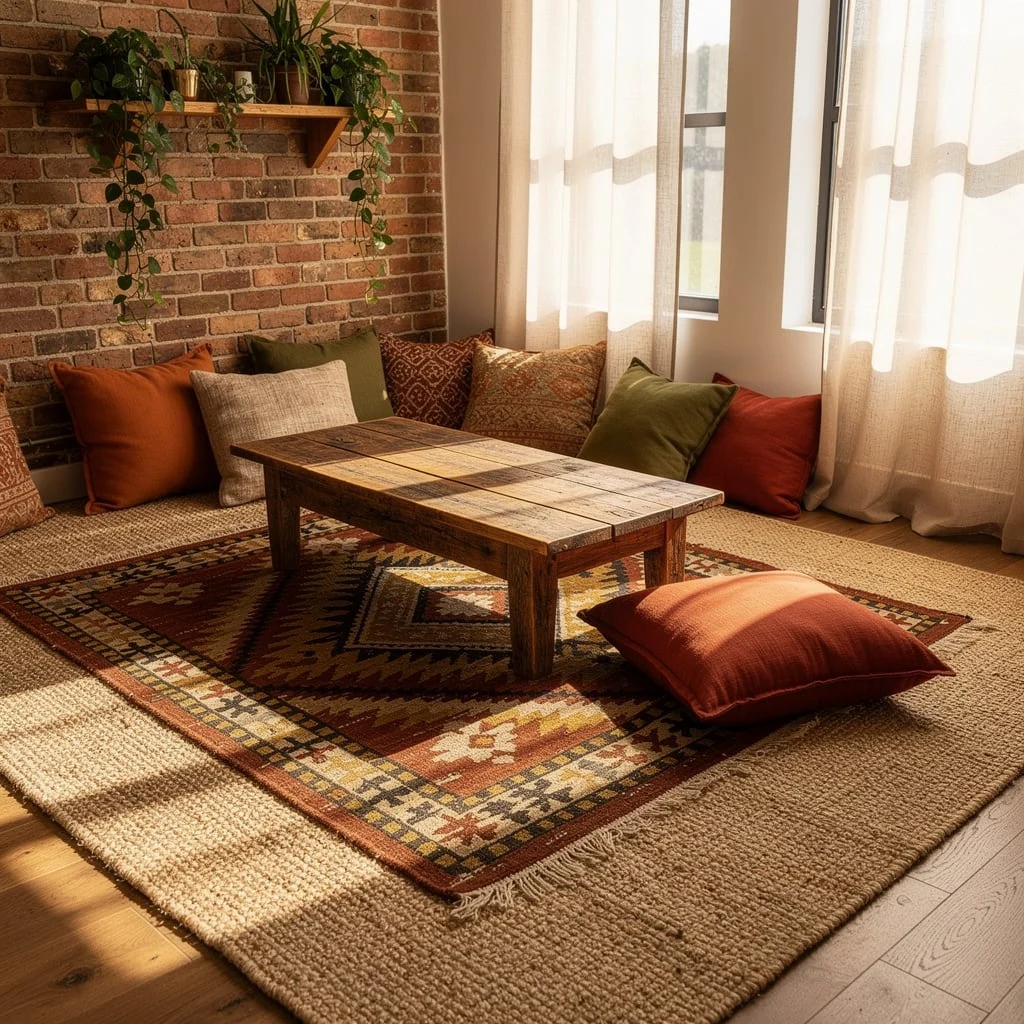
Place a large, neutral jute rug as the base layer — textured, flat, natural. Over it, at a slight angle or off-centre, lay a smaller kilim in deep rust, mustard, and charcoal with a traditional geometric pattern. The kilim’s edge should clear the jute’s edge by at least 20–25cm on all visible sides.
This layered arrangement works in a low-seating boho room — floor cushions, a low wooden table, cushioned benches along a wall — where the floor itself is part of the living space. The brick wall behind and the trailing plants on a timber shelf pull the room’s material vocabulary toward the same raw, earthy quality the rug combination is establishing. The jute layer adds square footage visually; the kilim layer adds pattern and history. Together they do what neither could alone.
Abstract Swirl Living Room Rug
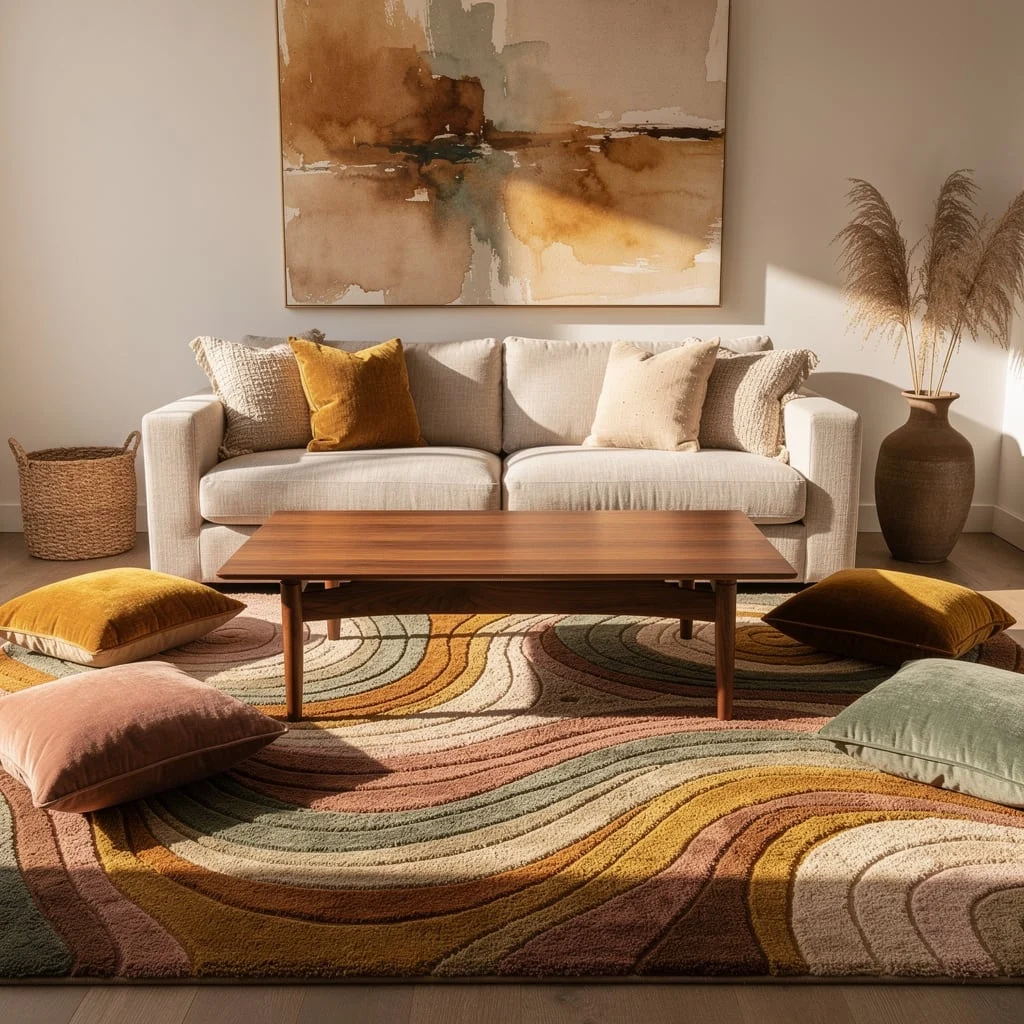
An abstract hand-tufted rug with large flowing swirl forms in earthy tones — ochre, sage, dusty rose, terracotta, cream — is the most painterly option here. The swirling pattern reads as organic and fluid, more like landscape topography or wood grain than traditional rug geometry. In a room with a large abstract watercolour above the sofa, the rug echoes the painting’s gesture without copying it.
Floor cushions in velvet — mustard, mauve, olive — placed directly on the rug’s surface should pick up the rug’s colours specifically, not a general boho palette. The walnut coffee table with its warm brown surface should sit over the richest area of the rug pattern. A tall ceramic vase of dried pampas grass at one side of the sofa brings the organic quality of the swirl motif into three dimensions.
Soft Pastel Nursery Rug
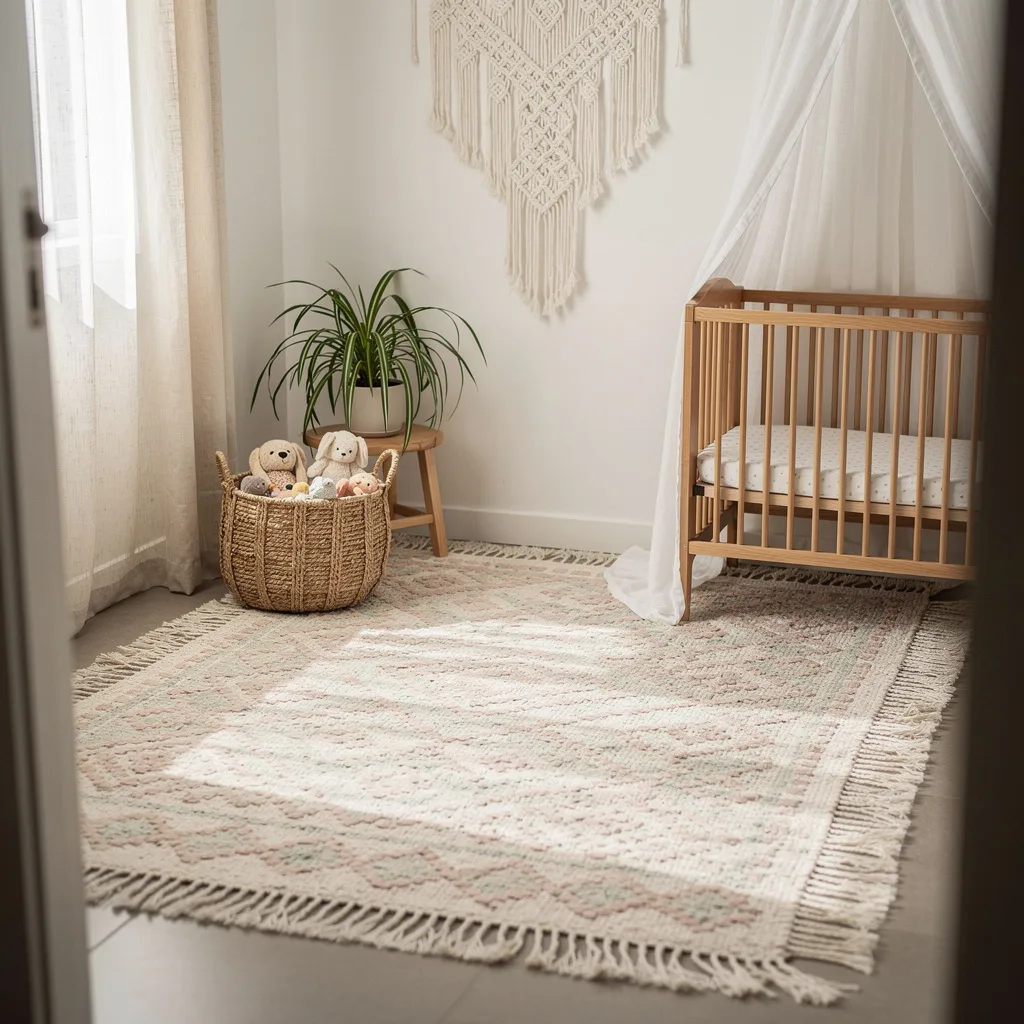
A soft cotton or wool rug in cream with faint pastel geometric patterns — muted blush, pale mint, soft lilac — gives a nursery floor warmth without introducing strong colour that might feel overwhelming at baby’s-eye level. The fringe edge on all four sides adds a tactile detail that toddlers will investigate and adults will love.
The rug should cover most of the nursery floor, leaving only a narrow border around the perimeter. In a small room where a baby or small child spends significant time on the floor, the rug’s softness and coverage are functional as well as decorative. A seagrass basket for toys, a canopy cot in natural pine, and a single potted plant add the organic texture without overwhelming a space that should ultimately feel calm and simple.
Vintage Medallion Boho Living Room
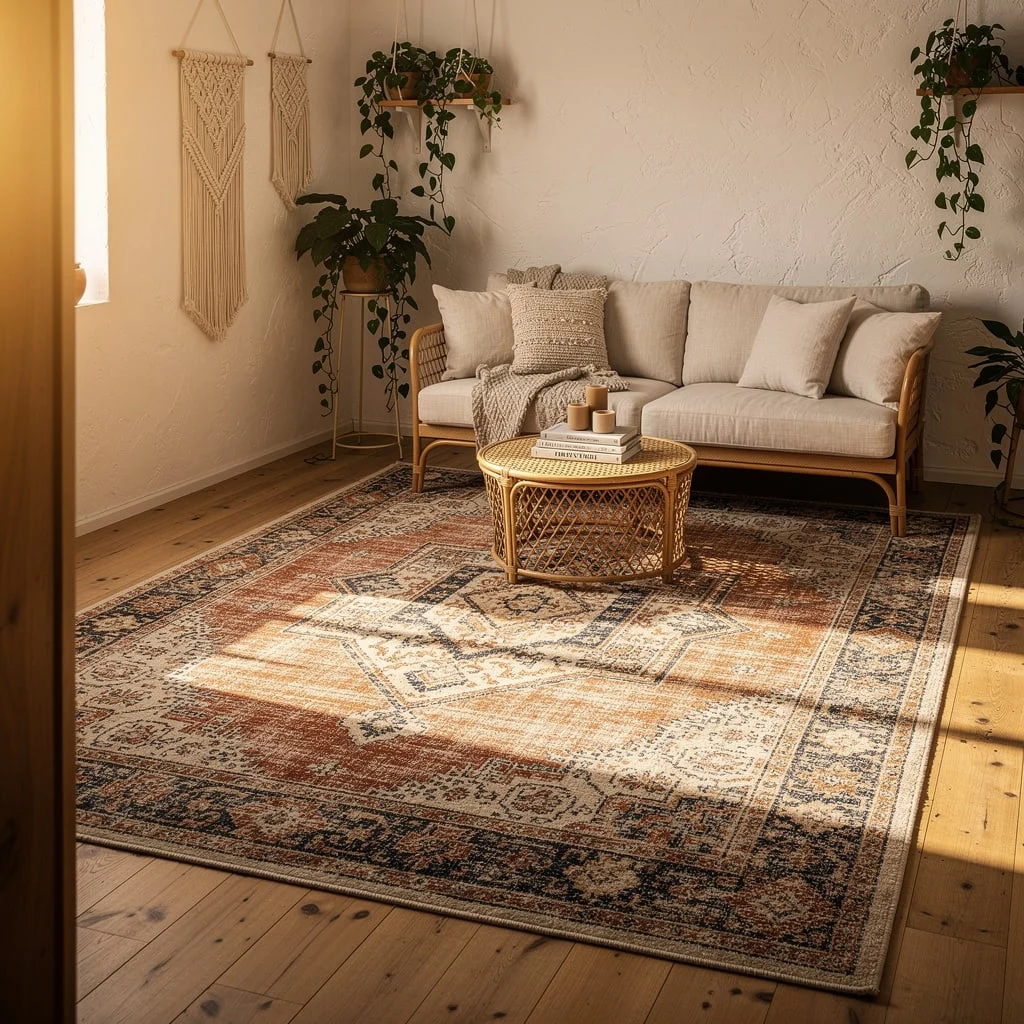
A distressed Persian-style medallion rug in warm rust, cream, and navy blue under a warm-lit boho living room is the piece that makes the whole room feel like it was already there when you moved in. The worn and faded quality of a vintage or vintage-look medallion rug suggests history — and in a boho interior, the suggestion of accumulated, travelled, gathered life is exactly the right atmosphere.
The rattan coffee table with its woven surface top and the rattan-framed sofa both sit within the rug’s bounds. The plants — trailing pothos from wall-mounted shelves, a larger floor plant in a basket — repeat the rug’s organic sensibility at different heights. Candles on the coffee table warm the scene further. This room doesn’t look designed. It looks inhabited.
Navy Medallion, Boho-Minimal
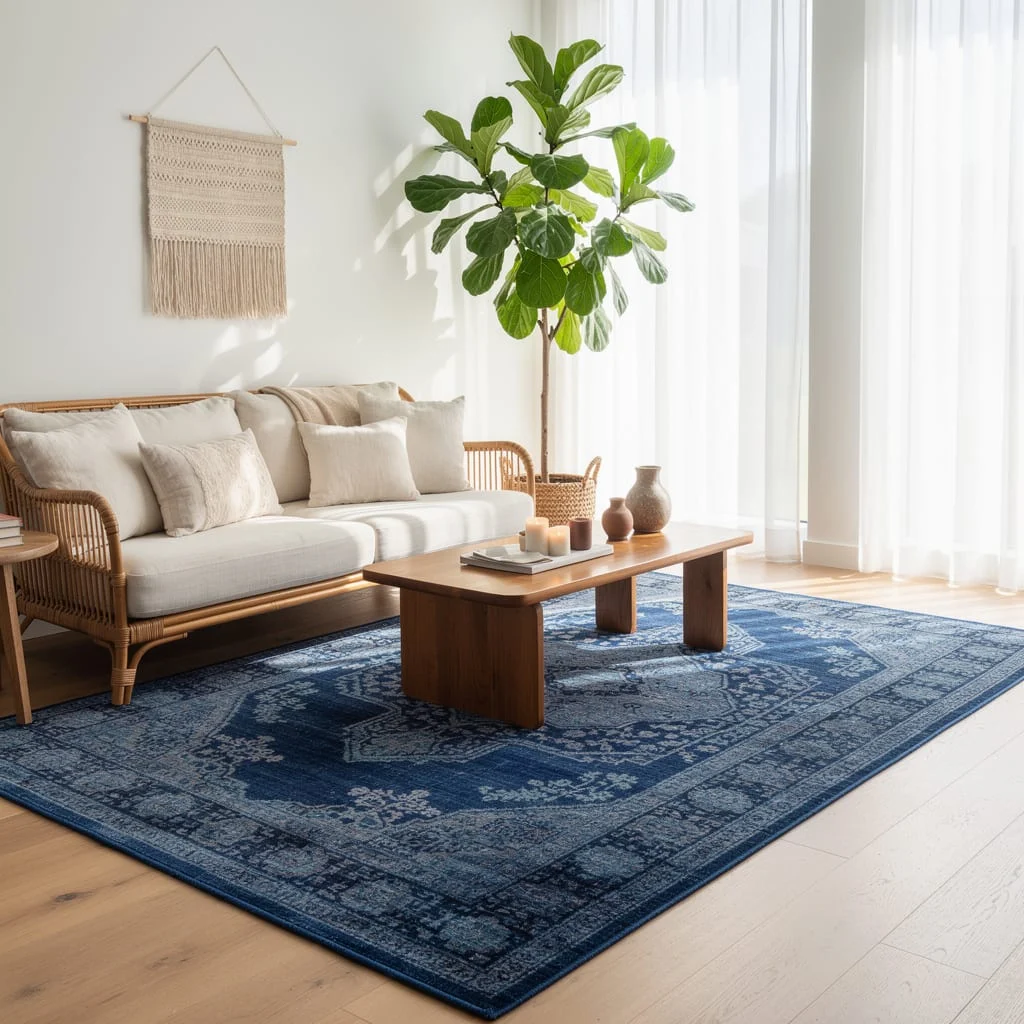
A deep navy blue Persian-style medallion rug in an otherwise light, minimal boho room is a confidence move. The navy is saturated and dark against pale floorboards and white walls — it does not blend in. It anchors. Everything in the room orbits around it.
The rattan-framed sofa in natural linen, the solid wood coffee table, the fig tree in a basket by the window — all of these are chosen to let the rug lead. The macramé hanging on the wall adds the boho signature. The small ceramic vases on the coffee table pick up the rug’s secondary tones without copying them exactly. This is how you use a bold rug in a room that might otherwise read as too cautious.
The Rule Underneath All of This
There is a version of every room in this list that gets the rug wrong: too small, too safe, too late in the decision sequence. And in every one of those cases, the rest of the room — however good — never quite comes together.
The rug is not the accessory. It’s the argument. Everything else in the room is the evidence. Start with the rug, and the rest becomes a great deal easier.