
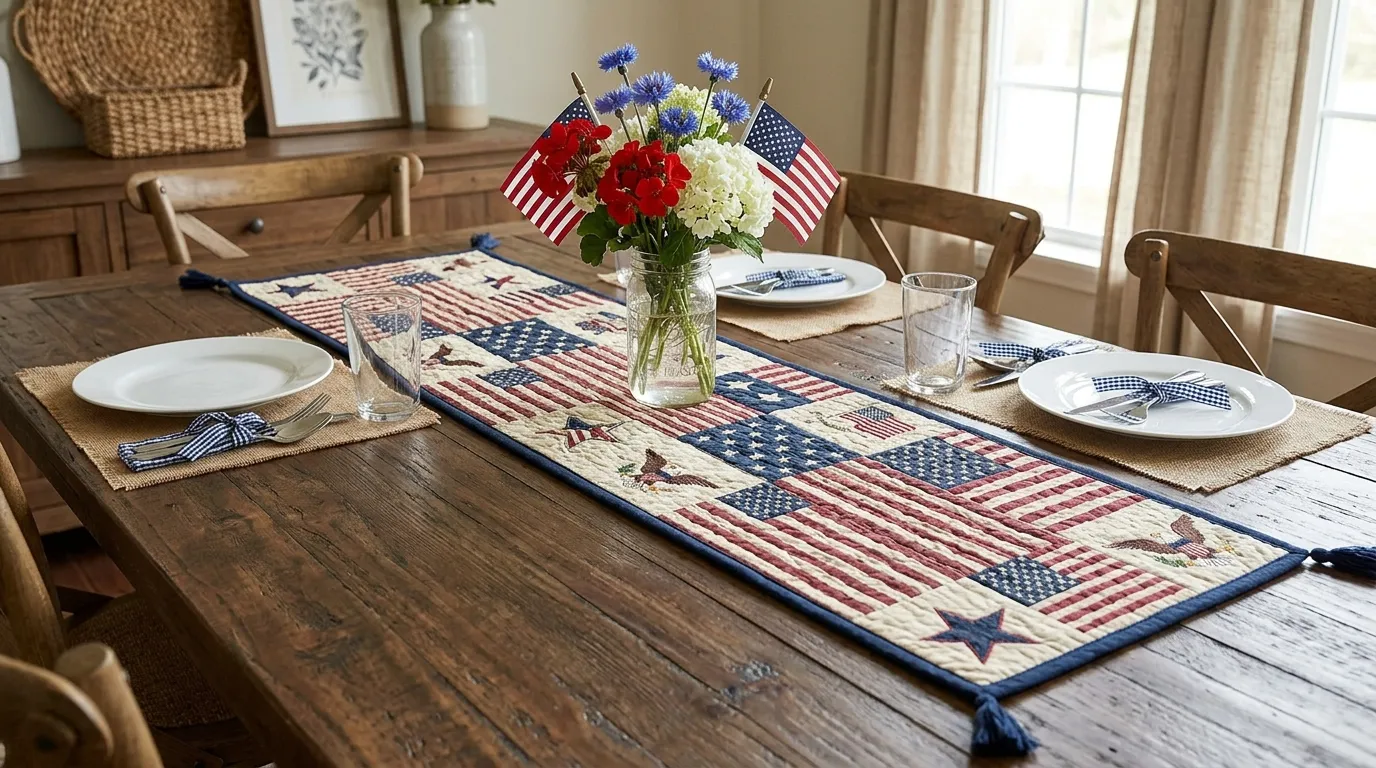
The runner goes down. The plates go on. The food arrives. Nobody has thought about whether those three things belong together, and somehow that oversight is obvious to every single person who sits down to eat.
A table runner is structural. It’s the horizontal spine of your entire table. When it’s right, everything placed on it — the plates, the flowers, the candles, the fruit bowl, the stacked red cups — reads as a deliberate decision rather than a collection of things that ended up in the same place. When it’s wrong, nothing can save you. You could have the most carefully composed centerpiece in the county and it will still look like you’re trying too hard if the runner underneath it is fighting everything else on the table.
Patriotic table runners have an extra challenge. The palette is fixed. Red, white, and blue doesn’t give you room to hide. Every choice is visible and every mistake is obvious. This is actually an advantage if you understand what you’re working with — a palette this specific forces commitment, and committed tables always look better than tentative ones.
What follows is every approach worth considering, from the quilted heirloom that takes forty hours to the burlap and jute runner you assemble in an afternoon. Each one works. None of them do it accidentally.
The Table Runner Principles That Actually Govern Good Outcomes
Fabric Weight Determines Everything Downstream
A lightweight cotton runner wrinkles, shifts, and shows every glass ring and crumb. On an outdoor farmhouse table in July it starts looking abandoned by mid-afternoon. A heavier woven textile, a quilted runner with batting, or a macramé piece stays put, drapes well at the ends, and photographs properly.
For outdoor summer entertaining, look for woven cotton with enough structure that it won’t blow off in a light breeze. For indoor formal tables, quilted runners have the weight and texture to look like something, not just a piece of fabric. The material is the decision. Pattern and color come after.
The Table Itself Is Part of the Runner’s Design
A white-painted table and a dark walnut table require completely different runners. On white, the runner needs to supply warmth — a quilted piece with organic texture, a macramé natural rope runner, a woven stripe that has body and color. White on white produces nothing.
On a dark walnut or cherry table, you can afford a simpler, more restrained runner because the table itself is doing visual work. A narrow navy linen runner beside white linen, a stripped-back color-block runner, a clean stripe. The table’s warmth fills in what the runner doesn’t supply.
A raw grey-washed farmhouse table is the most forgiving of all. Almost any runner looks intentional on it because the table’s texture does so much by itself.
Centerpiece Strategy Decides the Runner Before You Buy It
A runner is not chosen in isolation. It’s chosen with the centerpiece in mind. If you plan to run a line of individual bud vases down the center of the table — which is one of the most effective patriotic table strategies there is — you need a runner with enough surface area and visual calm to let those vases be the feature. A stripe runner or a simple linen runner. Not a busy patchwork.
If your centerpiece is a single large central piece — a candelabra, a cylinder grouping, a tray with objects on it — then the runner can afford to carry more pattern because the centerpiece will anchor and control it visually.
Decide the centerpiece first. Then choose the runner that best supports it.
Patriotic Table Runner Ideas
The Screened Porch Dinner Table With Flag Runner and Lupines
Use a full flag-print runner — the kind made from actual flag fabric — placed lengthwise down a long antique dining table. Allow generous overhang at both ends. The runner doesn’t need to be centered with ruler precision. A slight shift to one side or a mild diagonal reads as relaxed rather than careless.
Down the center, arrange a loose gathering of tall-stemmed purple lupines or larkspur in a single glass vase. Use a deep, slightly narrow vase so the stems stay grouped and upright rather than splaying outward. The purple against the red, white, and navy is the color combination that stops the table from feeling predictable. It introduces something the palette alone wouldn’t have.
Set the places in simple white ironstone. No placemats. Let the runner do the table decoration work. Above, string globe lights from the ceiling — a single strand looped back and forth, not multiple strands, so the light level is warm rather than festival-bright.
The Macramé Jute Runner With Scattered Botanicals and a Single Flag
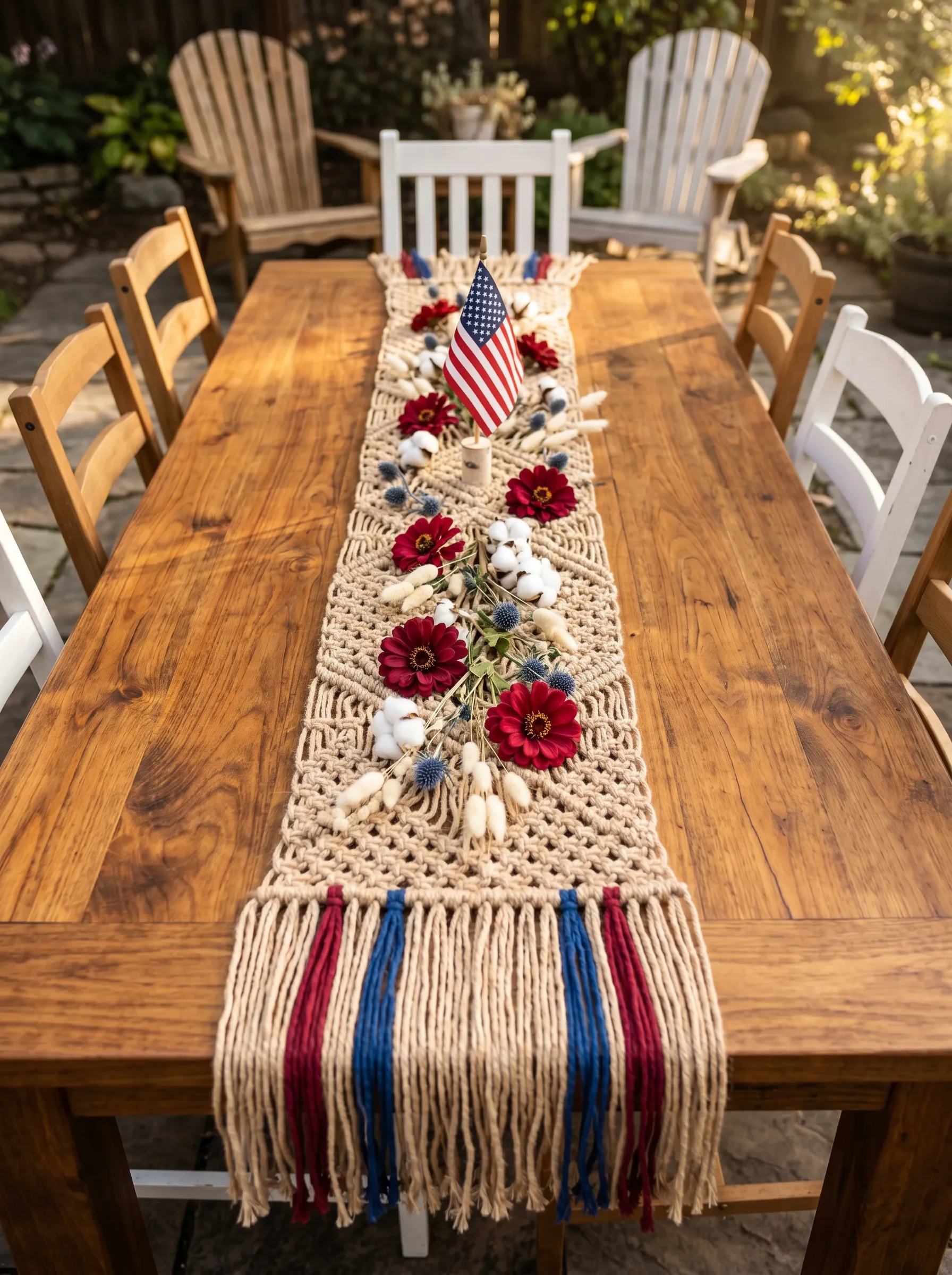
Work a macramé runner in natural undyed jute cord. The pattern should use a combination of square knots and half-hitch knots to create a diamond grid in the central body of the runner, with long fringe at both ends — at least eight inches of fringe is needed for this to look intentional rather than trimmed short. Before tying off the fringe, dye the fringe strands at each end. At one end, dye a section of fringe in deep crimson. At the other end, dye a matching section in deep navy. The coloring should extend only into the fringe, not the knotted body — the body stays natural jute throughout. This places the patriotic color at the extremities, referencing the palette without overcommitting to it. On the runner, lay a loose scatter of botanical elements along the center: crimson zinnia blooms, cotton boll stems, dried bunny tail grass, blue eryngium thistle. Allow the flowers to rest directly on the knot surface without any vessel. Tuck one miniature flag upright at the center, held steady by the surrounding botanicals.
The Gingham Star Quilt Table Runner With Windowsill Display
Cut your fabrics from three gingham patterns in the patriotic palette: a small-scale red gingham, a medium-scale navy gingham, and a wider cream-on-white gingham or daisy print for the white sections. Piece eight-pointed Sawtooth Star blocks — the classic American quilt star — using these fabrics, alternating which gingham color lands in the star points and which fills the background squares.
The charm of this runner is that no two star blocks are identical. In some, the red gingham is the star. In others, the navy. In others, the two gringhams sit side by side and the star only emerges when you step back and look at the full composition. The quilting should be simple — leaf or feather motifs in the white background squares — and the border should be bound in the small-scale daisy print that reads as white at a distance.
Set it on a white painted sill with a small galvanized planter and one decorative sign piece. Let the runner hang off the edge on both sides. The overhang shows the border binding and the quilting, which is the detail that sells the craftsmanship.
The Navy and White Linen Double-Layer Runner With Red Roses
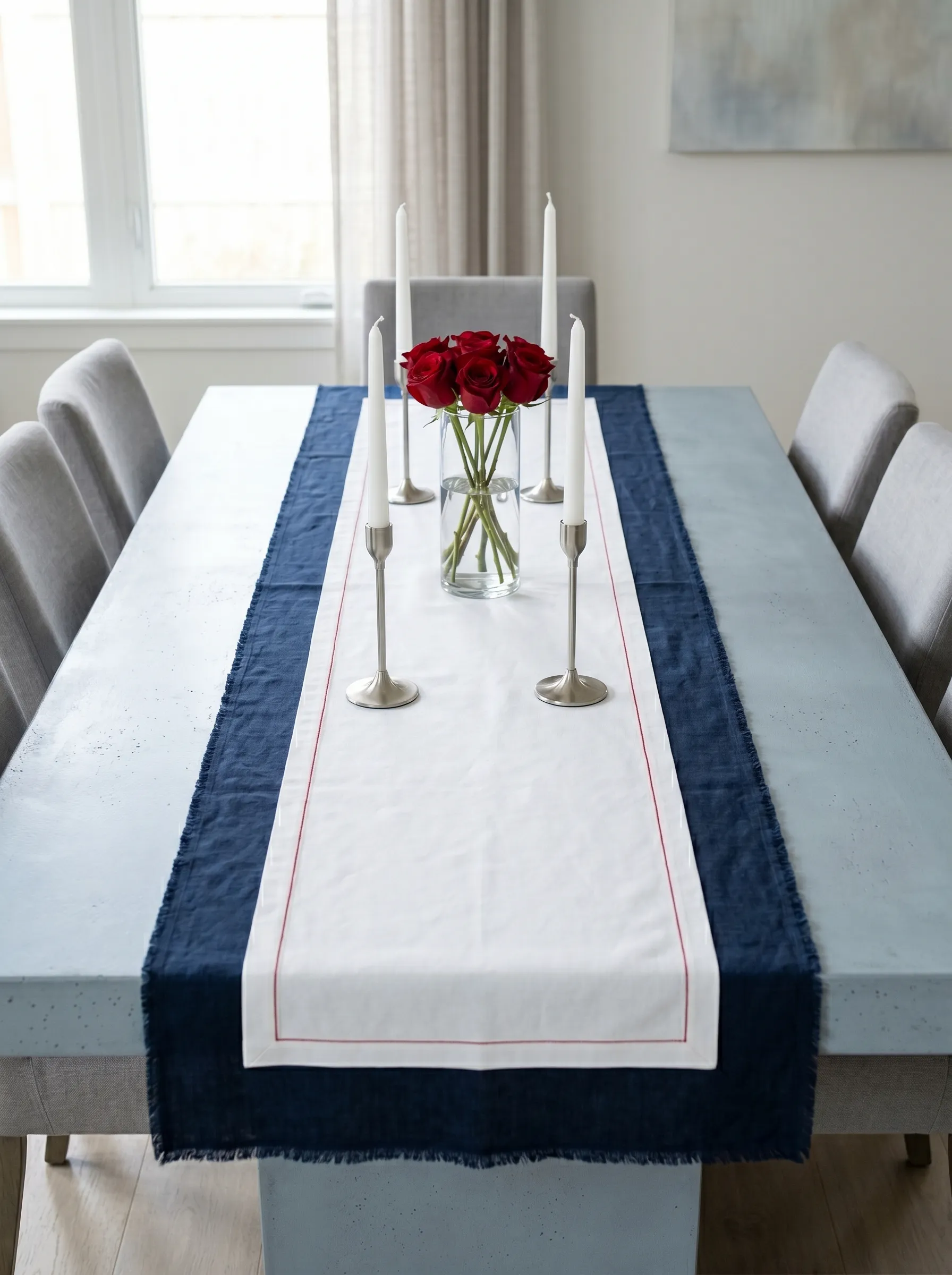
Find or sew a wide navy linen runner with raw-edge fringe along its length — substantial enough to show clearly on either side. Lay this as the base layer, centered on a stone-grey or concrete dining table. Over it, center a narrower white linen runner with a single hemstitched border in red — a hand-stitched or machine-sewn red running stitch, one inch from the edge, all the way around. The white runner sits on the navy, fringe visible on both sides. This layering creates a composed frame and introduces the red element via the hemstitch detail without any printed pattern. In the center, arrange a bunch of red roses in a clear glass cylinder vase at the runner’s midpoint. Add four slim silver candlesticks with white tapers, two on each side of the vase. Three elements. That’s all. The restraint of this table is what makes it work.
The Large Star Table Mat With Embroidered USA Center Block and Amber Glasses
This is a quilted table mat rather than a runner — a wide square or slightly rectangular piece designed to sit at the center of a table as a defined zone rather than running edge to edge. The block construction uses large quarter-square triangle units in solid navy, deep red, and white, arranged so they form an eight-pointed star at the center. The star’s center square is white, and into that white square, embroider USA in a traditional stitch — chain stitch or stem stitch in red thread for the letters, with small scattered star motifs in blue around the letters.
The quilting across the navy and red sections should be a continuous flowing swirl or loop pattern stitched in matching thread — it reads as texture without competing with the block pattern.
On this mat, set a white wooden tray holding a bowl of cherries, a grey linen napkin, gold-toned cutlery, and amber glass tumblers. The amber glass against the navy and red is the tonal decision that makes the whole table feel warm rather than cool. It introduces a warmth that pure patriotic palette styling never quite achieves alone.
The Midnight Checkerboard Quilted Runner With Pillar Candle Grouping
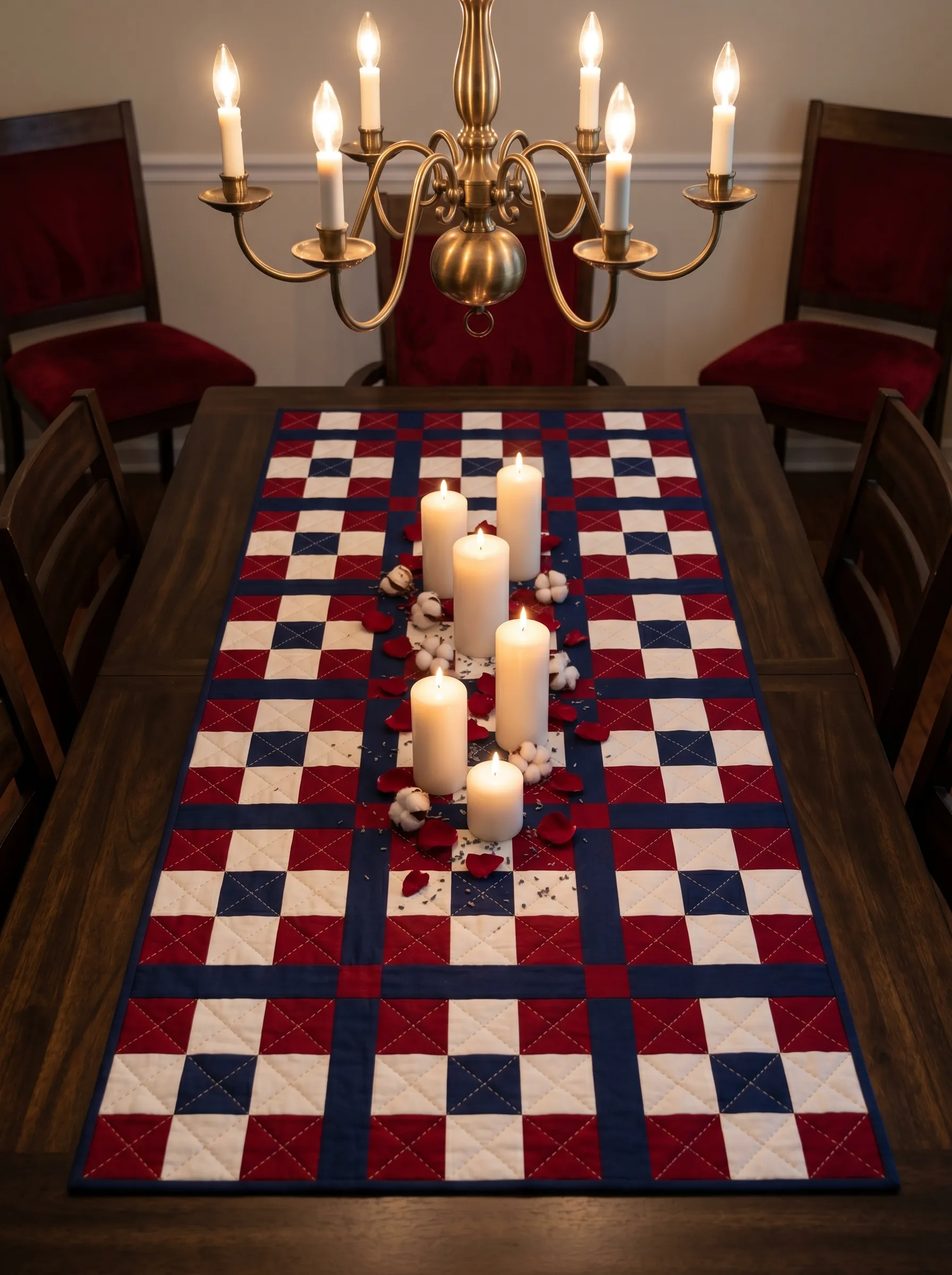
Piece a checkerboard runner from squares of three fabrics: deep navy solid, deep burgundy-red solid, and white or cream solid. Alternate the squares in a three-color checkerboard that creates a diagonal pattern when viewed from the side. Border the entire runner in a solid navy binding. The quilting over this runner should be simple diagonal grid lines — crossing the squares corner to corner — worked in metallic or light thread so it reads as texture in candlelight without flattening the checkerboard pattern. On this runner, group four pillar candles in varying heights directly on the runner surface — not in holders, just the candles themselves at staggered heights of four, six, eight, and ten inches. Scatter dried cotton stems and rose petals around the base of the candles on the runner. Dried cotton introduces an organic whiteness that reads differently from the sewn white squares beneath it. Light the candles. This runner is made for low light. Under a brass or aged-gold chandelier it becomes something genuinely beautiful.
The Multi-Fabric Pinwheel Placemat Set
Rather than one runner, make a set of large square placemats each built from a different mix of patriotic print fabrics — small florals, stripes, pin dots, tiny flags — all in the red, white, and navy palette, cut into equal triangles and pieced into pinwheel or star blocks. The key is using twelve to fifteen different print fabrics across the set so that no two placemats share the exact same combination.
Each mat is the visual piece. The table runner, if you use one, should be a single unprinted navy or cream linen strip to unify the varied prints. In the center of the table, set a simple glass jar or short vase with a handful of miniature flags. One vase. The flags read as sufficient centerpiece because the placemats carry the design weight.
The Graphic Block-Color AMERICA Runner on a White Table
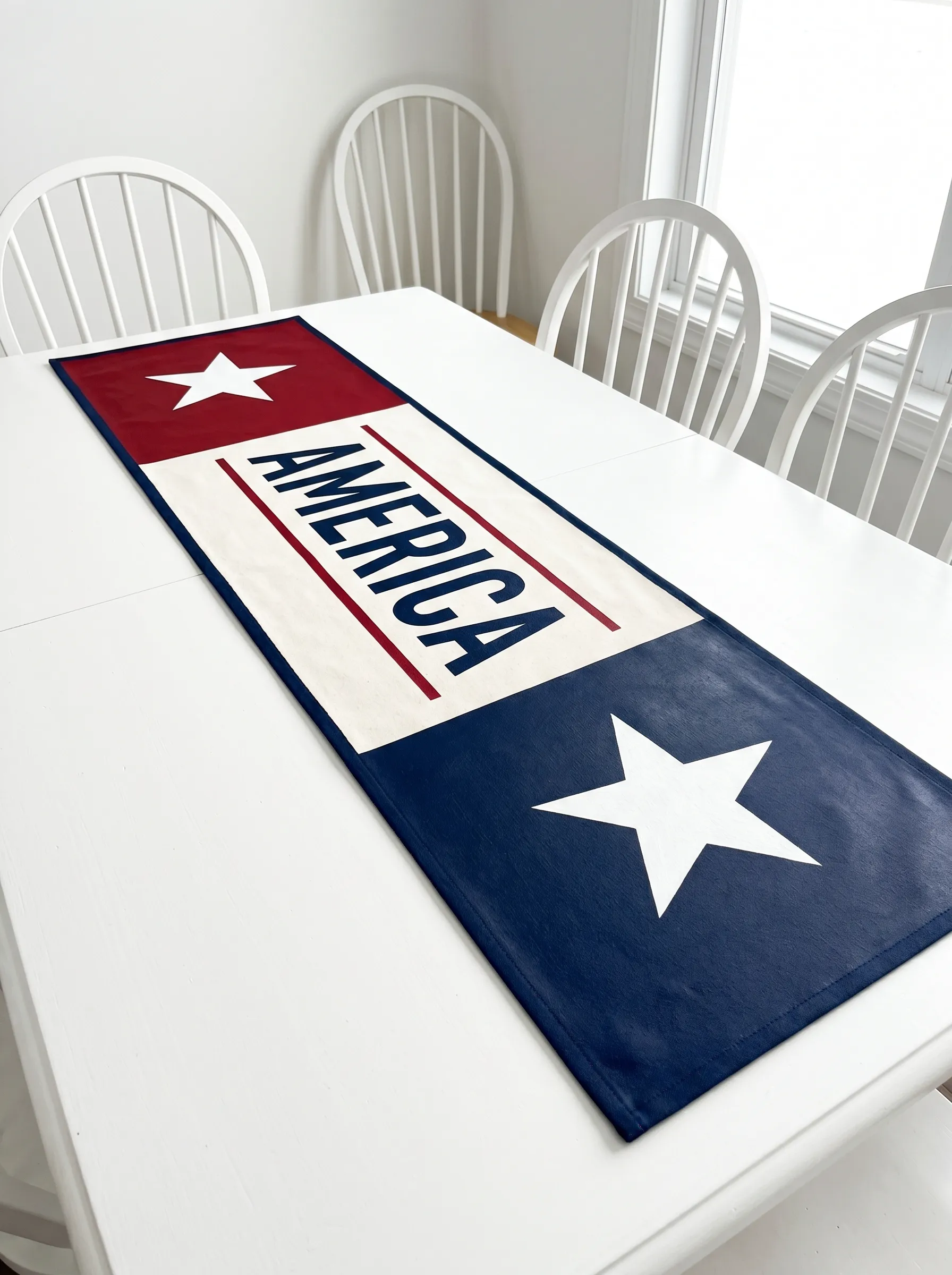
Source or sew a runner built from three large rectangular sections of solid fabric: a deep burgundy-red block at one end, a wide cream center section, and a deep navy block at the other end. Into the red section, appliqué or print a single large white star, centered and generous in size. Into the navy section, the same. The cream center section carries the word AMERICA in a wide, condensed sans-serif font, printed or appliquéd in navy. The cream section should also have two thin red lines flanking the text — a very narrow stripe on either side of the word, running parallel to the runner’s long edge. This runner is designed for a white table with white chairs. The minimalism of the table is the point. Set no centerpiece. The runner is the entire table decoration. The simplicity reads as graphic confidence rather than under-decoration.
The Quilted Flag Strip Runner for the Outdoor Picnic Table
This runner is built from quilted fabric blocks in a flag interpretation: alternating red and white strip sections running the length of the center field, with navy end blocks carrying white star appliqué or star quilting. The whole piece is bordered in a deep navy binding.
Lay it on a weathered grey picnic table and leave the runner to do the work alone. No formal centerpiece. Set a slice of watermelon and a glass of lemonade at one end — the way someone would actually use the table — rather than arranging a composed setting.
The quilted texture is what makes this runner work. It has dimension. It catches light differently in each section. Even without anyone sitting at it, it looks like something.
The Vertical Flag Strip Runner on an All-White Modern Table
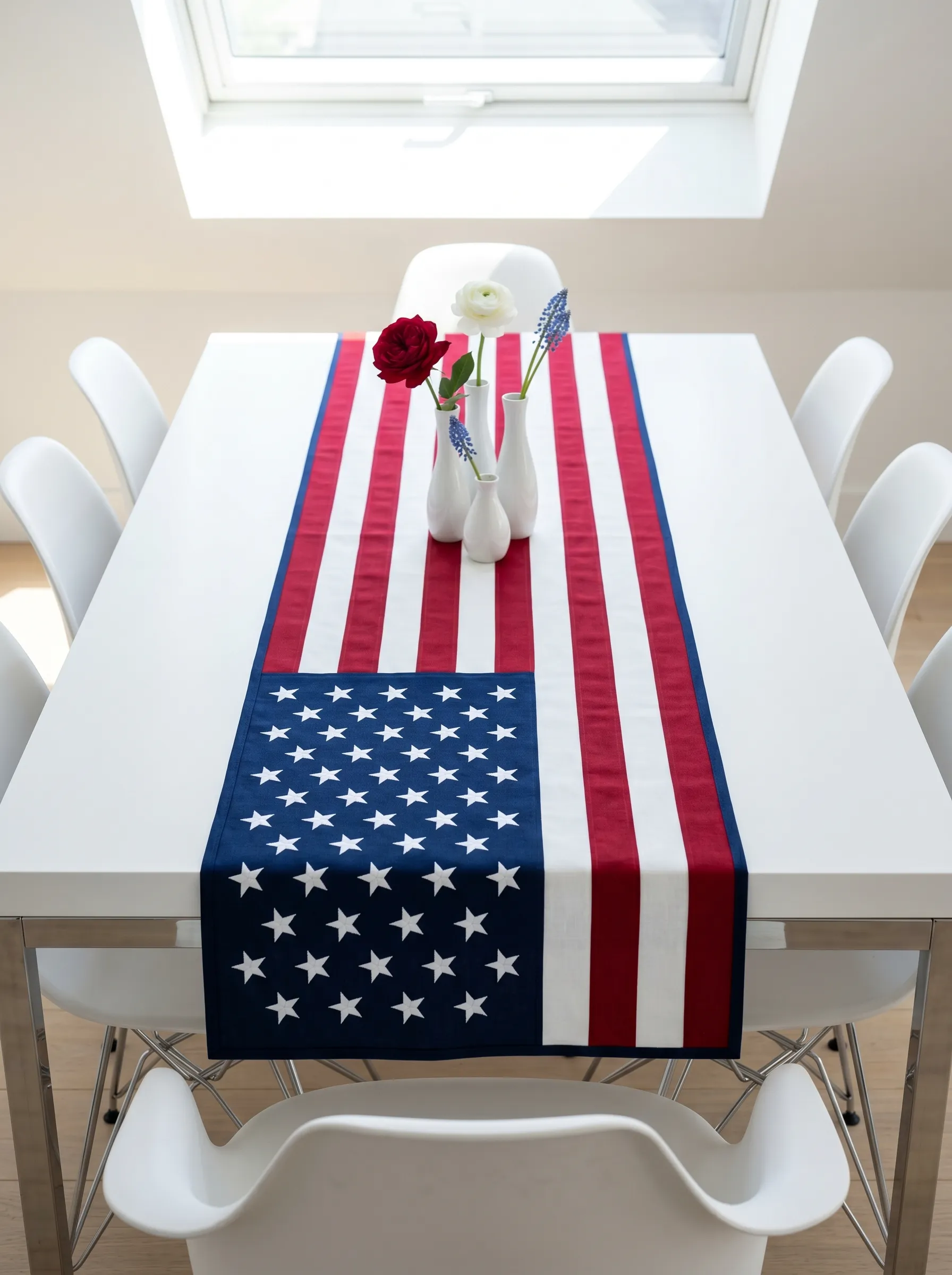
This runner is oriented to display the flag in a rotated orientation — the star canton at one end, the stripes running up the length of the runner rather than across. The star field sits at the end of the table closest to the entry, and the stripes run away from it toward the other end. On an all-white table with all-white Eames-style chairs, this runner is the entire table’s visual argument. Set three white bud vases down the center — the kind you’d find at an estate sale, each slightly different in silhouette — with single stems: one red rose, one white ranunculus, one stem of muscari. The three-vase grouping provides vertical interest without competing with the runner’s graphic. The whiteness of the table around the runner is critical. Don’t add placemats, don’t add a tablecloth. The flag runner on the bare white surface is a completely deliberate graphic choice.
The Kids’ Party Star-Stamped Cotton Runner on a Long Folding Table
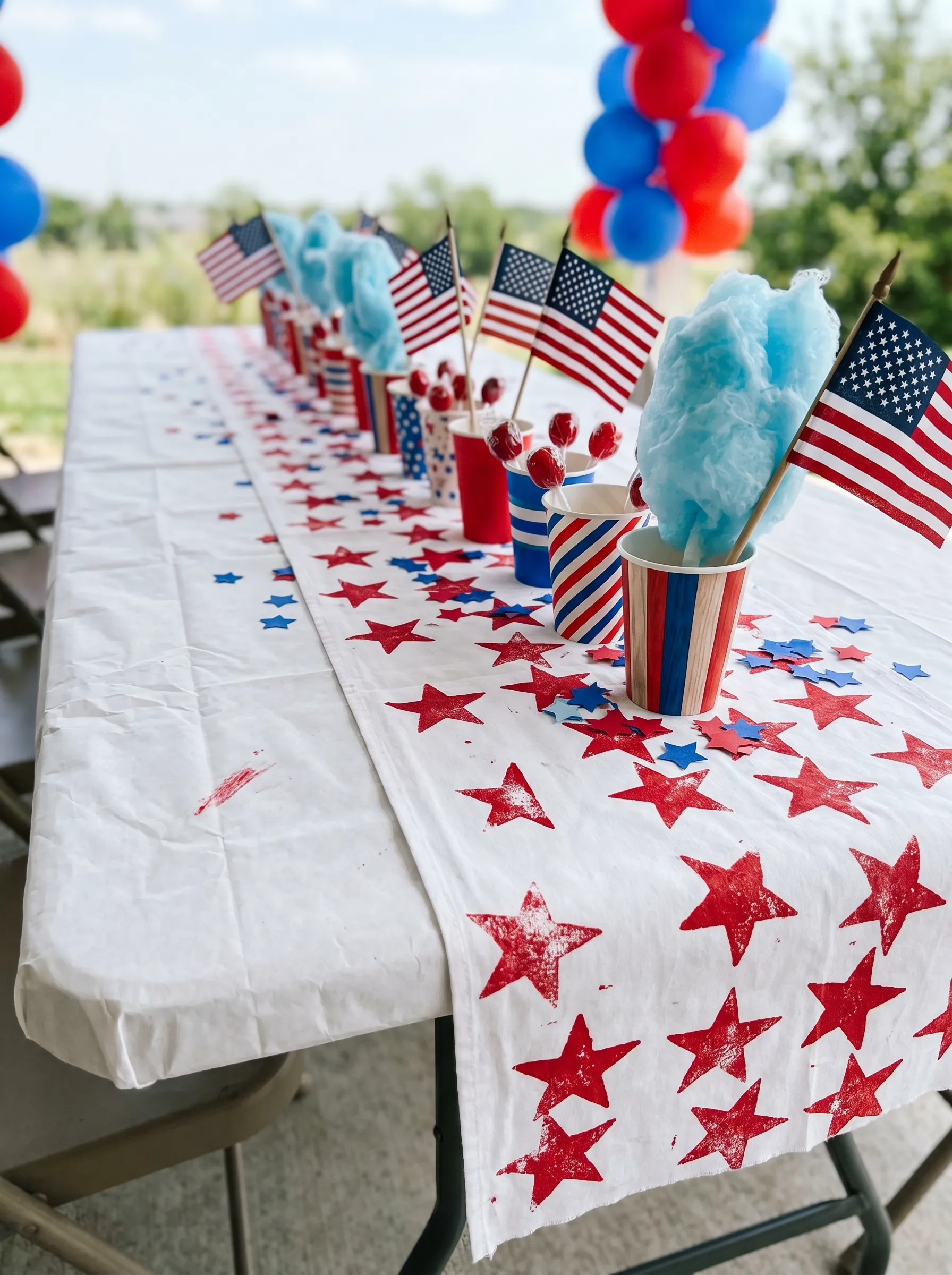
Lay a length of plain white cotton duck fabric down the center of a folding party table — cut it to size, hem the ends with iron-on hem tape, and press flat before the party. Before hemming, stamp large five-pointed star shapes in red acrylic craft paint down the length of the fabric using a star-shaped foam stamp. Vary the placement so the stars are scattered rather than in a line, and vary the pressure so some stars are slightly faded and textured. Allow to dry completely. Set striped paper cups with lollipops in them along the center at regular intervals, alternating red and blue cup colors. Add miniature flags between each cup. Scatter paper star confetti in red and blue across the entire surface. This runner doesn’t pretend to be anything other than what it is: a kids’ party table on a Tuesday afternoon in July. The informality is entirely appropriate. The homemade quality of the stamped fabric is part of the point.
The Lone Star Quilted Runner With Beeswax Taper Candle Tray
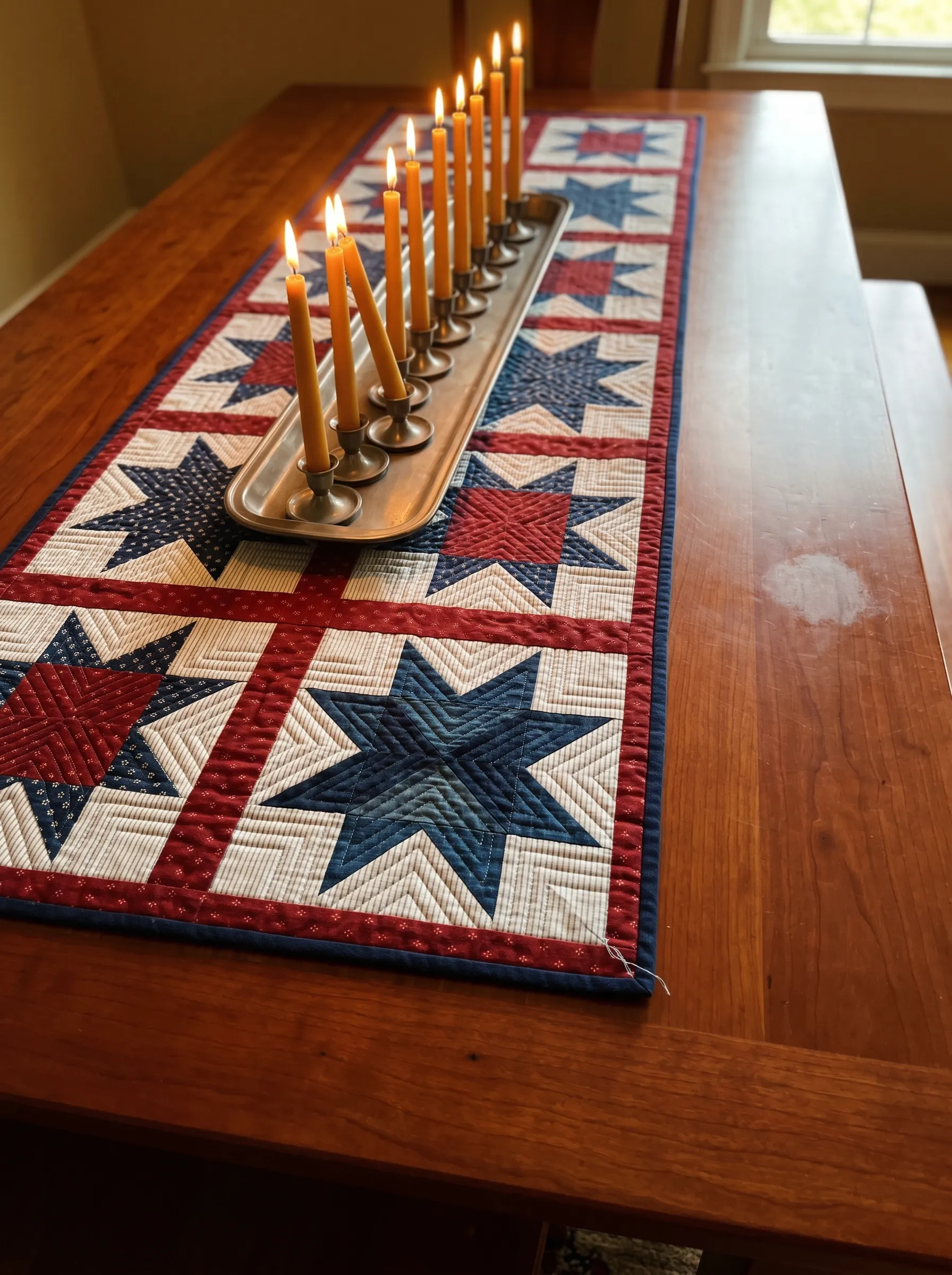
Build this runner using large eight-pointed Lone Star blocks — the more complex version of the star block where eight diamond-shaped wedges come together to form a single large star. Use three values of each color: dark navy, medium navy, and light blue-grey for the navy range; deep crimson, medium red, and dusty rose for the red range. Each diamond wedge gets a different value, creating a three-dimensional effect where the star appears to have depth rather than lying flat. The background fabric between the star points and at the corners should be a small-scale cream-on-cream print — a tone-on-tone texture that reads as cream at distance. The border binding is a deep navy. On this runner, center a long antique brass or pewter tray — the kind with handles — and fill it with eight to ten slim taper candleholders of varying heights, each holding a natural beeswax or ivory taper. Beeswax tapers are specifically correct here: they’re warm amber-gold against the cooler navy and red of the quilt, and that warmth stops the table from going cold and formal.
The White Linen Star Accessory Runner With Ceramic Stars and Baby’s Breath
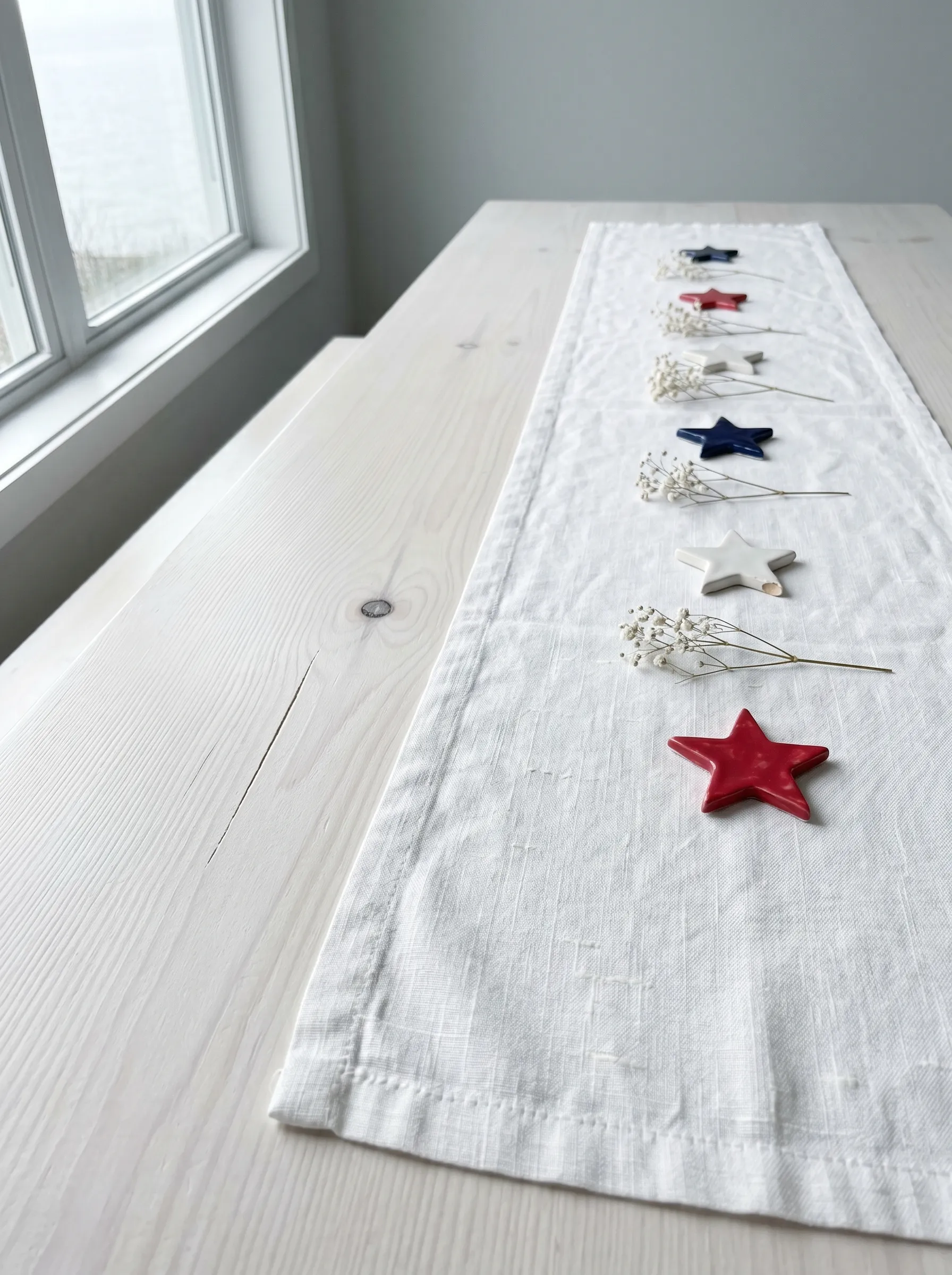
Source or sew a simple white linen runner — no pattern, no print, hemstitched edges in white thread only. The quality of the linen is the entire point of this runner: look for a medium-weight linen with visible slub texture that catches light, not a flat cotton-linen blend. Down the center of this runner, place a sequence of small ceramic or glazed clay star shapes — in navy, red, and white — alternating colors along the runner’s length, each one spaced about eight inches from the next. Between each ceramic star, lay two to three stems of dried baby’s breath flat on the runner surface — pressed and dried, not fresh, so they lie flat rather than lifting. That’s the complete arrangement. The white linen, the alternating ceramic stars, the dried baby’s breath stems. No vase. No candles. Nothing else. The arrangement’s strength comes entirely from its restraint.
The Patchwork Pattern Runner With Farmhouse Dough Box Centerpiece
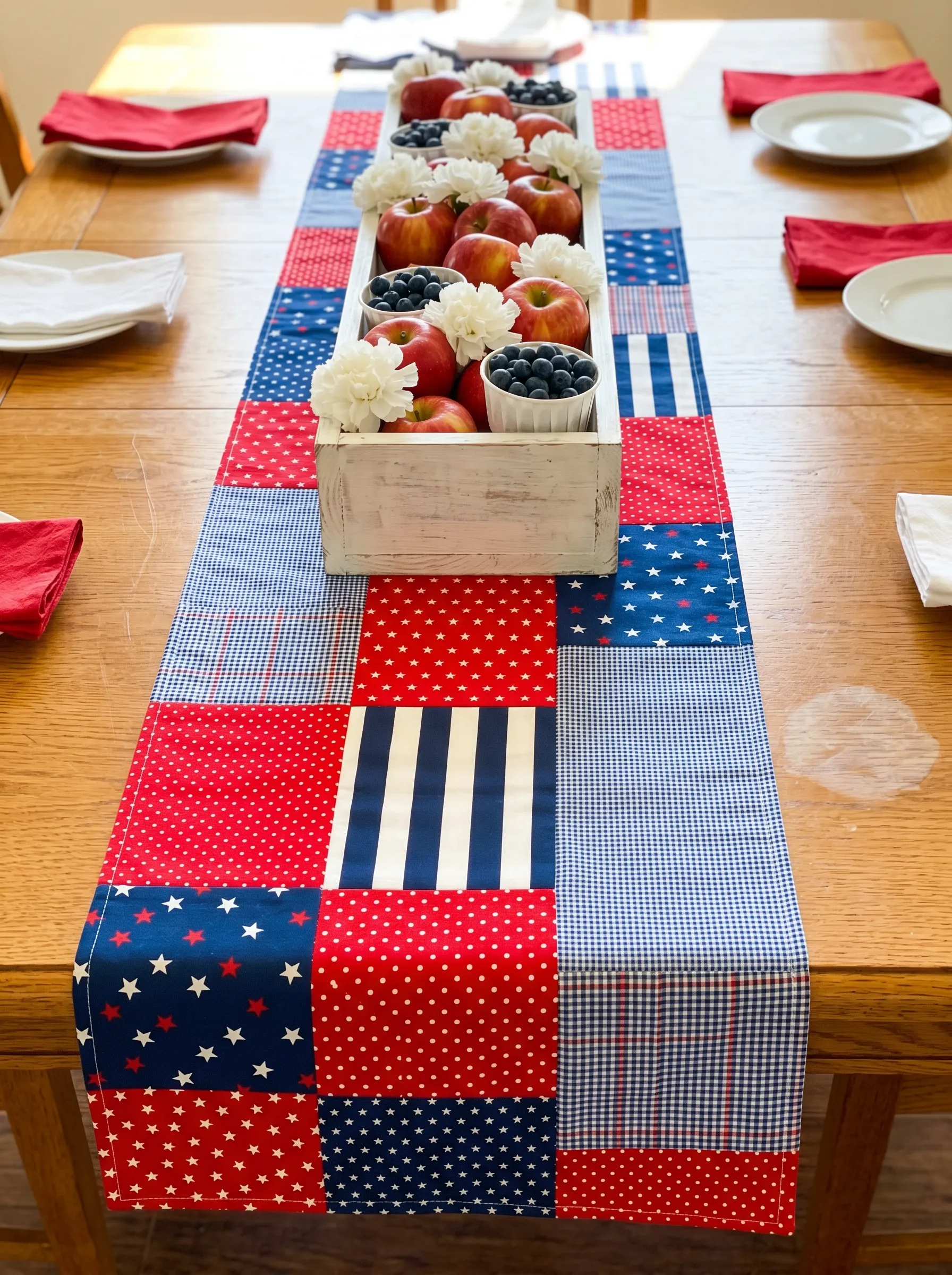
Sew this runner from a collection of large fabric squares — each approximately six by six inches, cut from six to eight different prints in the patriotic palette. Include: a red polka dot on white, a navy star print on white, a fine navy and white gingham, a bold navy and cream stripe, a red and white star print, and a red gingham. Sew them together in a random patchwork arrangement — no set pattern, just alternating the fabrics so no two identical prints sit adjacent. The patchwork runner is intentionally informal. It announces itself as handmade and functional. It belongs on a farmhouse table that already has character — worn edges, marks in the wood, visible grain. Down the center of the runner, set a long whitewashed wooden dough box or serving trough. Fill it with red apples, pints of blueberries in white paper cups, and white chrysanthemum or carnation blooms scattered between the fruit. The food is the centerpiece. The runner is the frame. Both are doing visible work.
The Flag Runner on the Backyard Grill Table With Sand-Filled Flag Centrepiece
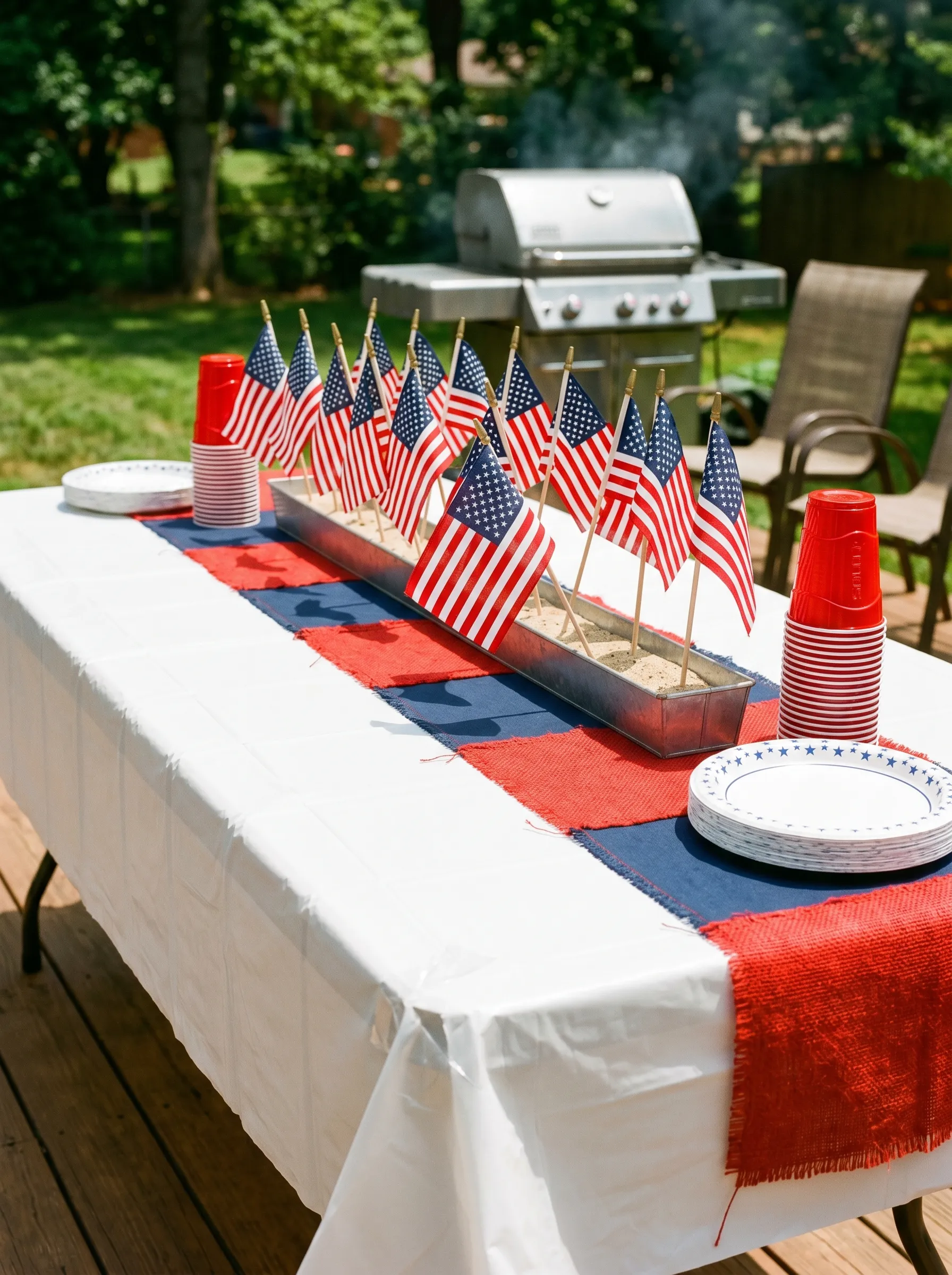
This is a practical outdoor setup. Lay a white plastic tablecloth as the base — the kind that folds over the table edges and stays put. Down the center, place two strips of burlap ribbon: a wide navy strip flanked on either side by a narrower red strip. This three-strip runner costs almost nothing and takes four minutes to assemble. In the center of the runner, set a long galvanized metal tray — a seed tray or baking pan works — and fill it with two to three inches of sand. Into the sand, push fifteen to twenty miniature flags at slightly varying angles. The sand holds them upright and the density creates an impressive visual: a garden of flags rather than a scattered handful. At each end of the table, stack red plastic cups. Alongside, stack patriotic paper plates. The cups and plates are part of the visual composition, not separate from it. Keep them stacked and centered rather than spread out carelessly.
The Coastal Seagrass Runner With Multiple Flower Vase Arrangement
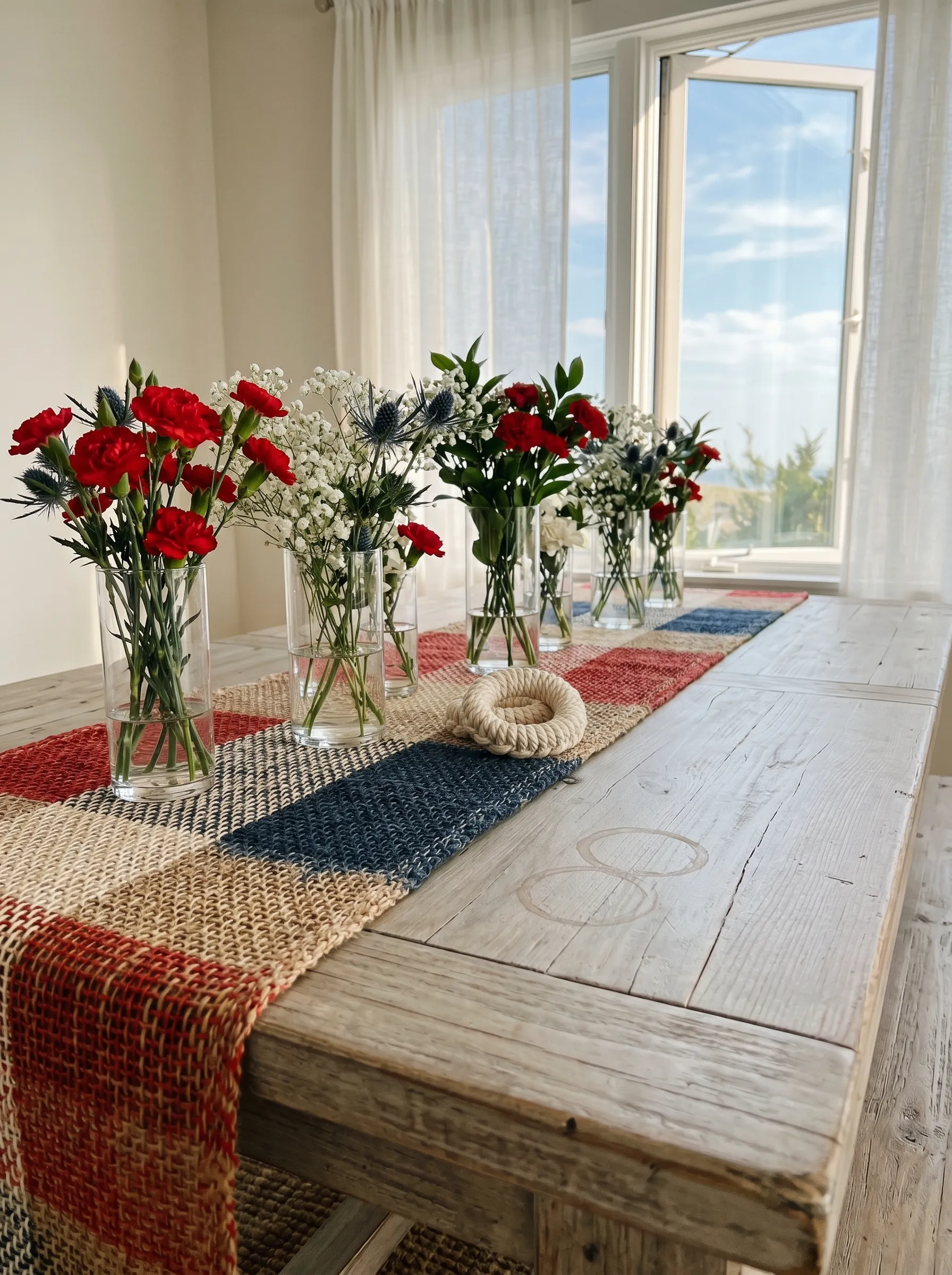
Source a seagrass or woven jute table runner made in three distinct color sections: natural tan in the center, with woven-in sections of brick red and navy at intervals — the color introduced into the weave itself rather than added afterward. The runner’s texture is the design element. It reads as coastal, organic, and seasonal without being overtly patriotic. On this runner, line up six to eight identical clear glass cylinder vases of the same height, each containing a different single-flower arrangement: red carnations in one, white baby’s breath in the next, blue eryngium thistle in the third, and then repeating the sequence. Add one rope ring or sailor’s knot in natural cotton beside the vases — this single nautical element reads as intentional styling rather than accidental object. The vases should touch each other lightly — not spaced apart, not pressed together, but just barely making contact. That slight touching creates a connected line of color rather than individual isolated arrangements.
The Small Flag-Print Table Runner With Enamelware Setting
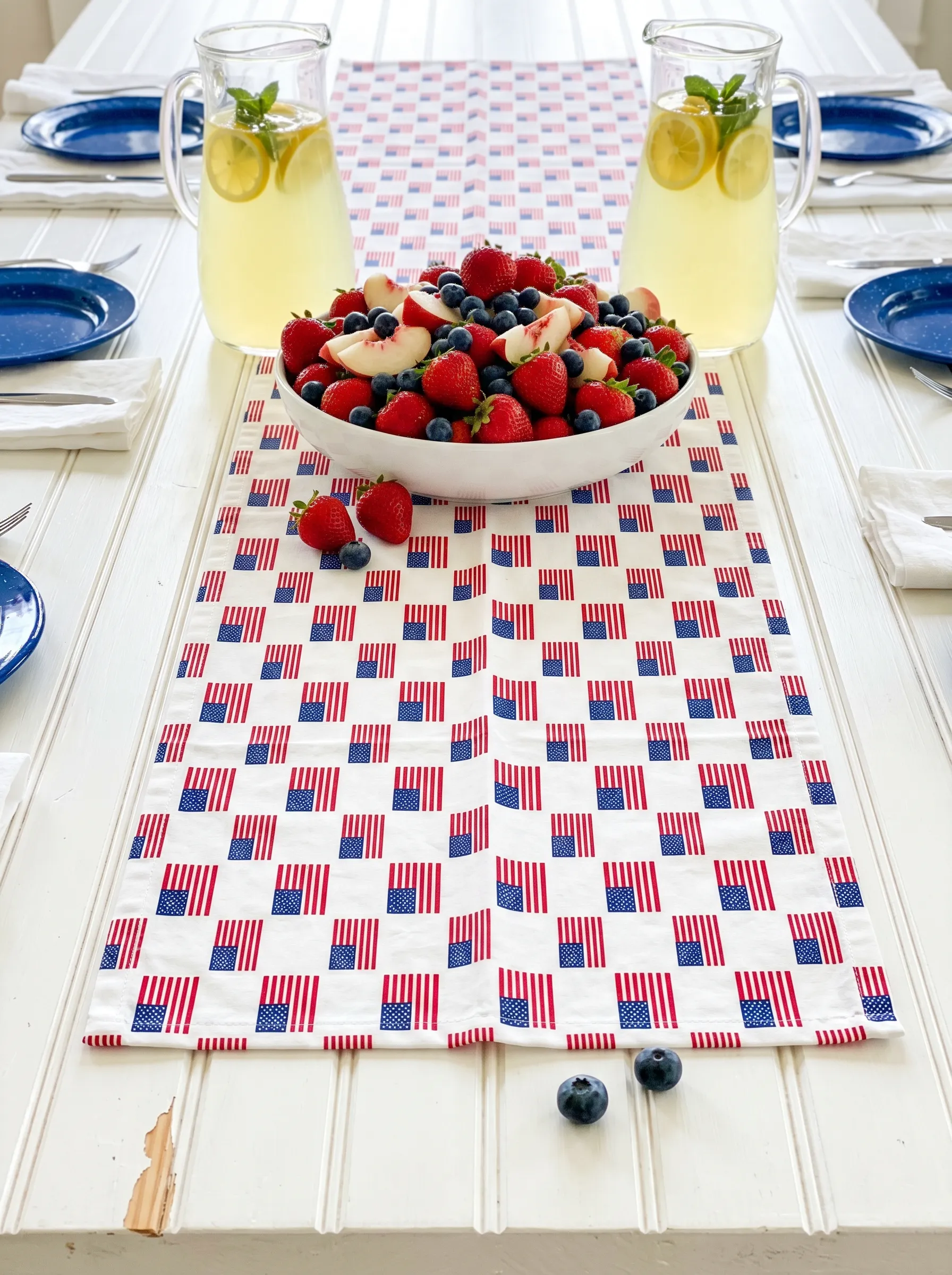
Source a cotton table runner printed with a small-repeat flag pattern — individual miniature flags tossed across a cream ground, each flag small enough that the pattern reads as a texture rather than a literal flag statement from a distance. This is a lighter visual commitment than a full flag runner and suits informal summer table settings. Lay it on a white beadboard table or painted white farmhouse table. Set dark navy enamelware camp plates at each place — these plates are the color contrast that makes the cream runner visible. Add clear glass pitchers of lemonade at each end. Center a wide white bowl piled with mixed fresh berries. The whole table reads as a summer morning before it reads as patriotic, which is precisely correct for a family breakfast on a holiday weekend.
The Stripe and Fringe Runner With Garden Bud Vase Row
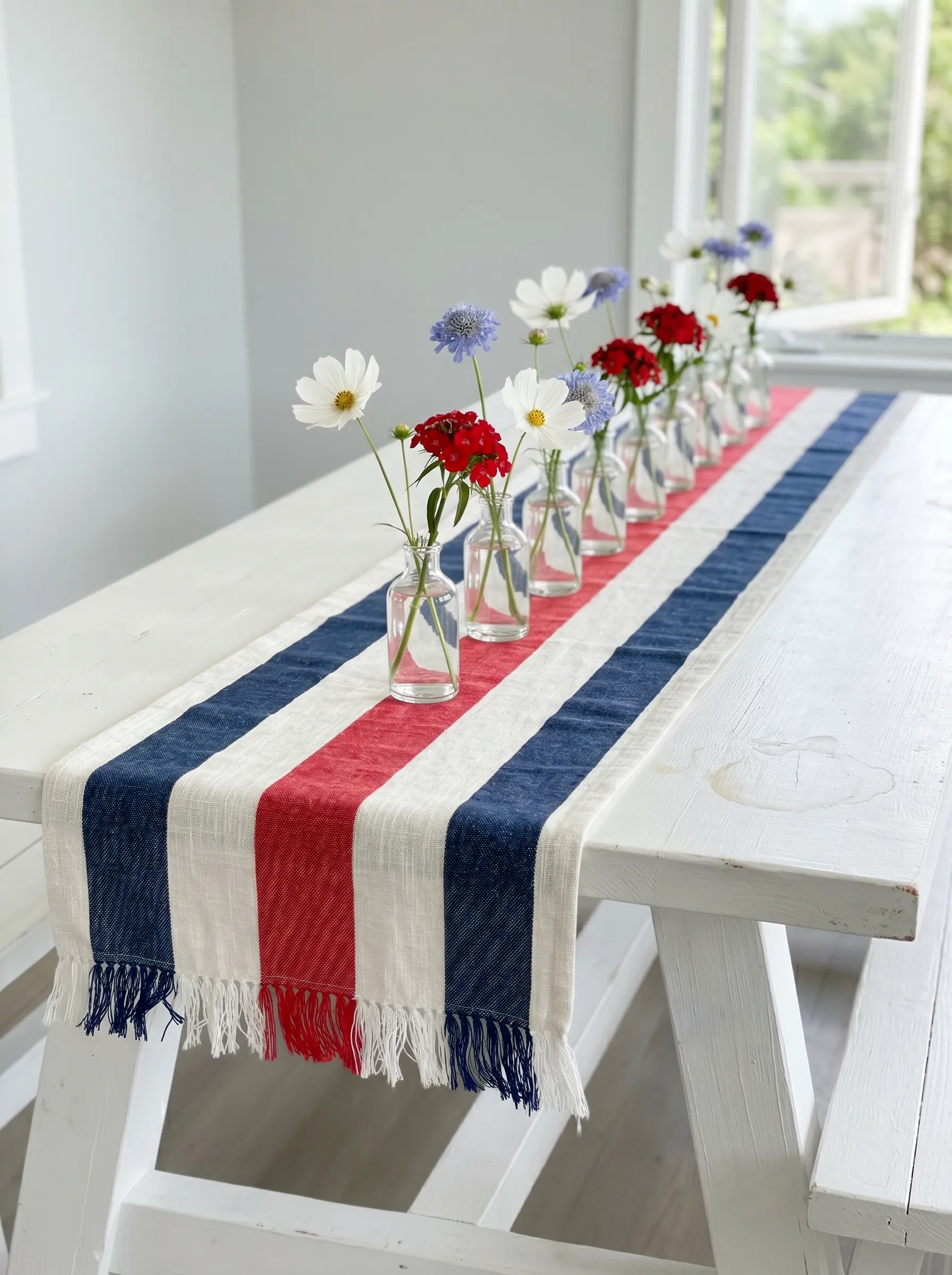
Make or source a woven textile runner with a bold vertical stripe pattern — three wide stripes of cream, red, and navy running lengthwise — finished with a knotted fringe at each end where the three colors of fringe hang together. The stripe weight matters: each stripe should be wide enough to read clearly from a distance, not so narrow it reads as a pinstripe. Down the center of this runner, line up eight to ten small glass milk bottles or bud vases — the kind with narrow necks that accommodate one to three stems — equally spaced. Fill each with a different single-flower type in the patriotic palette: cosmos, red geranium, white daisy, blue scabiosa. Alternate the flower types so the colors change every two vases. The lined-up bud vase centerpiece is one of the most effective summer table strategies that exists. Each vase is too small to make a statement alone. Together they create a garden on the table. The stripe runner beneath them provides the visual ground that ties them into a single arrangement.
The Pottery Barn-Style Quilted Checkerboard Runner for the Alfresco Dinner Party
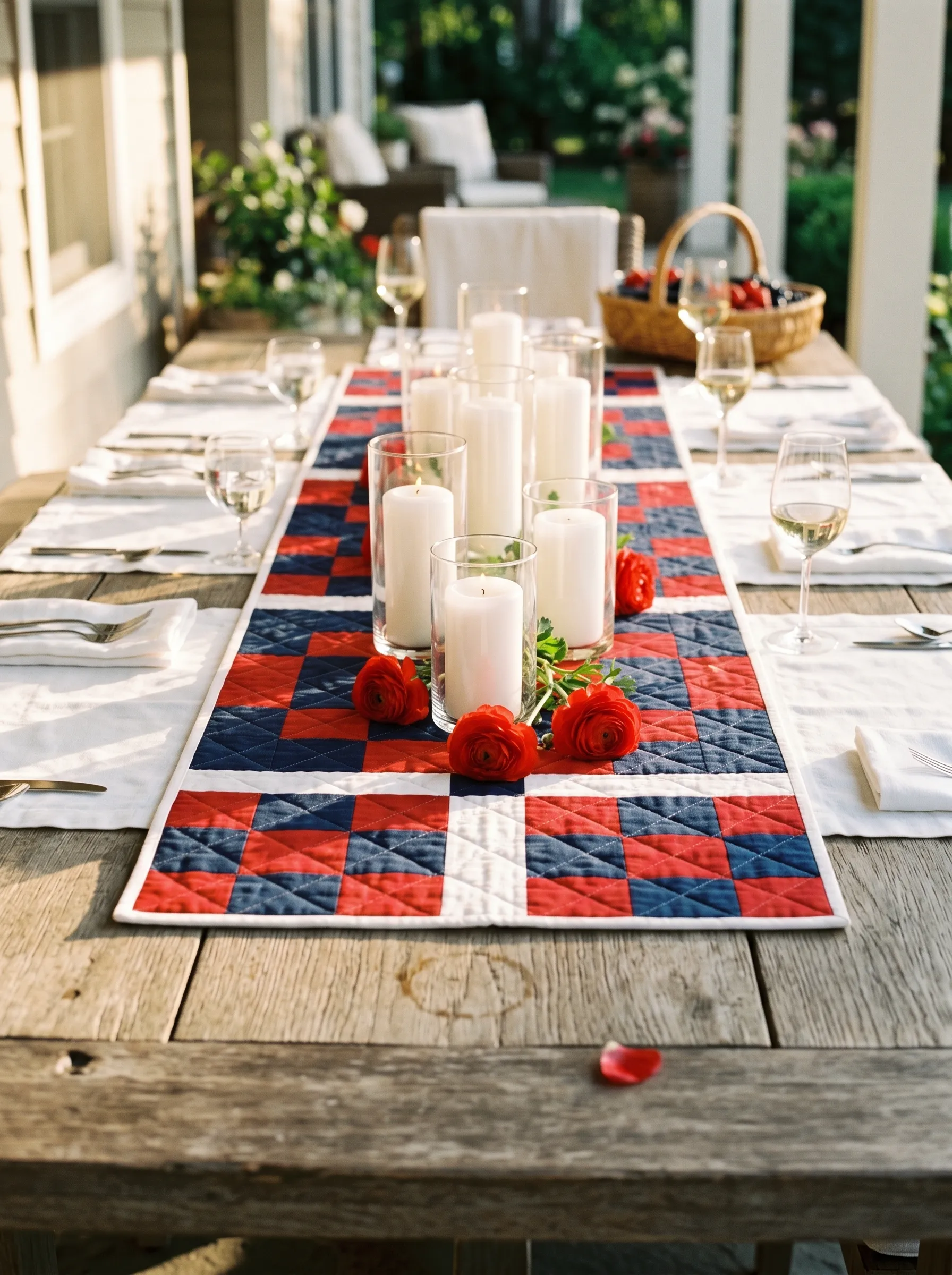
This is the most formal runner in the collection. Build it from solid fabrics only — no prints — using equal-sized squares in deep navy, deep red, and white. The grid should be regular: four squares across the width, as many as needed for the length. The border is a white band, about two inches wide, that frames the entire checkerboard section, then a final binding in deep navy. The quilting over the checkerboard squares should be a diagonal cross-hatch in contrasting thread — white thread over the red and navy squares, navy thread over the white squares. This makes the quilting visible without fighting the color blocking. Set this runner on a raw plank farmhouse table for a dinner party. Layer it with white linen napkins at each place and set stemmed wine glasses at every setting. In the center of the runner, group five to seven glass hurricane cylinders of different heights, each holding a single white pillar candle. Scatter red ranunculus blooms and a few unlit tapers around the base of the cylinders. Light the candles. Leave the overhead lights off.
Final Thoughts
The table runner is the one piece of dining decor that does its best work when nobody’s looking at it directly. It succeeds when everything placed on top of it looks better, more deliberate, more together than it would on a bare table. When your guests sit down and the table feels right, the runner is probably why.
Patriotic table runners ask a particular thing of you. The palette has no flexibility. There’s nowhere to hide an awkward choice behind an unexpected color introduction. What you choose tells the table what kind of day this is — whether it’s a formal evening around candles, an afternoon with the family at a farmhouse table, a loud kids’ party on a folding table in July, or a quiet screened porch dinner with people you’ve known for thirty years.
Every runner in this collection gets one of those days exactly right. None of them try to be all of them at once. That’s the discipline that makes the table work.
The palette is the easy part. Everything else is a decision.